


IEC 62423:2009
(Main)Type F and type B residual current operated circuit-breakers with and without integral overcurrent protection for household and similar uses
General Information
- Abstract
The scope of IEC 61008-1 and IEC 61009-1 applies with the following additions. IEC 62423:2009 specifies requirements and tests for Type F and Type B RCDs (Residual Current Devices). Requirements and tests given in this standard are in addition to the requirements of Type A residual current devices. This standard can only be used together with IEC 61008-1 and IEC 61009-1. Type F RCCBs (Residual Current Circuit Breaker) and Type F RCBOs (Residual current Circuit Breaker with Overcurrent protection) with rated frequency 50 Hz or 60 Hz are intended for installations when frequency inverters are supplied between phase and neutral or phase and earthed middle conductor and are able to provide protection in case of alternating residual sinusoidal at the rated frequency, pulsating direct residual currents and composite residual currents that may occur. Type B RCCBs and Type B RCBOs are able to provide protection in case of alternating residual sinusoidal currents up to 1 000 Hz, pulsating direct residual currents and smooth direct residual currents. This second edition cancels and replaces the first edition published in 2007 and constitutes a technical revision. The main changes from the first edition are as follows:
- requirements and tests for Type F RCD have been introduced;
- requirements and test for two-pole Type B RCD have been introduced;
- new additional requirements and tests for Type B RCDs have been introduced to cover requirements for Type F too. The contents of the corrigendum 1 of December 2011 have been included in this copy and the corrigendum 2 of July 2021 applies to the French language only.
- Status
- Published
- Publication Date
- 19-Nov-2009
- Technical Committee
- SC 23E - Circuit-breakers and similar equipment for household use
- Drafting Committee
- WG 2 - TC 23/SC 23E/WG 2
- Current Stage
- PPUB - Publication issued
- Start Date
- 20-Nov-2009
- Completion Date
- 15-Dec-2009


Overview
IEC 62423:2009 is an international standard published by the International Electrotechnical Commission (IEC) that specifies the requirements and testing procedures for Type F and Type B residual current operated circuit-breakers (RCCBs) with or without integral overcurrent protection for household and similar applications. This standard supplements IEC 61008-1 and IEC 61009-1 by addressing the unique characteristics and operational requirements of Type F and Type B Residual Current Devices (RCDs).
The key focus of IEC 62423:2009 is to ensure enhanced protection and reliability in installations involving frequency inverters and complex residual current scenarios, including composite, pulsating direct, and smooth direct residual currents. This second edition, released in 2009, updates the first 2007 edition by introducing requirements for Type F RCDs and two-pole Type B RCDs, along with additional testing protocols to strengthen operational integrity and safety.
Key Topics
Type F RCDs
These devices protect installations supplied with frequency inverters where pulses and multi-frequency residual currents are present between phase and neutral or earth. They are designed for rated frequencies of 50 Hz or 60 Hz and provide effective detection of alternating residual sinusoidal, pulsating direct, and composite residual currents.Type B RCDs
Type B RCDs offer protection against more complex current types, including residual alternating sinusoidal currents up to 1000 Hz, pulsating direct residual currents, and smooth direct residual currents, making them suitable for advanced supply scenarios including those with DC components.Testing and Verification
IEC 62423 outlines comprehensive laboratory tests such as:- Steady increase and sudden appearance of composite residual currents
- Surge current behavior tests (up to 3000 A)
- Inrush residual current response
- Operation in presence of residual pulsating and smooth direct currents
These ensure that Type F and Type B devices function reliably under challenging electrical conditions.
Marking and Product Information
The standard mandates specific marking conventions for Type F and Type B RCDs for clear identification. This supports better compliance, safety management, and user awareness.
Applications
IEC 62423:2009 is critical for residential, commercial, and industrial electrical installations where frequency inverters and complex electronic loads are present. Its provisions apply to:
- Household electrical safety systems equipped with advanced residual current protection.
- Installations using variable frequency drives (VFDs) or motor control equipment that can generate non-standard residual currents.
- Electrical environments requiring high sensitivity to DC and high-frequency residual currents to mitigate risks of electric shock and equipment damage.
- Settings demanding integrated overcurrent protection along with residual current detection for comprehensive circuit protection.
The standard ensures safe and reliable interruption of fault currents in environments with mixed AC and DC components, supporting modern electrical infrastructure and smart home systems.
Related Standards
- IEC 61008-1: Residual current operated circuit-breakers without integral overcurrent protection for household and similar uses. IEC 62423 extends this with specific criteria for Type F and B RCDs.
- IEC 61009-1: Residual current operated circuit-breakers with integral overcurrent protection for household and similar uses, complementing IEC 62423 for devices combining RCD and overcurrent functions.
- IEC 60755 series and related electrical safety standards that target protective devices and their testing methodologies.
By aligning with these foundational standards, IEC 62423 contributes to harmonized safety protocols worldwide and supports the integration of advanced protective devices in electrical systems.
Keywords: IEC 62423, residual current devices, Type F RCD, Type B RCD, RCCB, RCBO, household circuit breakers, overcurrent protection, frequency inverter, residual pulsating direct current, electrical safety standard, IEC standards, electrical protection devices.
Relations
- Effective Date
- 05-Sep-2023
- Effective Date
- 05-Sep-2023
- Effective Date
- 05-Sep-2023
Get Certified
Connect with accredited certification bodies for this standard

DNV
DNV is an independent assurance and risk management provider.

Lloyd's Register
Lloyd's Register is a global professional services organisation specialising in engineering and technology.
DNV Energy Systems
Energy and renewable energy certification.
Sponsored listings
Frequently Asked Questions
IEC 62423:2009 is a standard published by the International Electrotechnical Commission (IEC). Its full title is "Type F and type B residual current operated circuit-breakers with and without integral overcurrent protection for household and similar uses". This standard covers: The scope of IEC 61008-1 and IEC 61009-1 applies with the following additions. IEC 62423:2009 specifies requirements and tests for Type F and Type B RCDs (Residual Current Devices). Requirements and tests given in this standard are in addition to the requirements of Type A residual current devices. This standard can only be used together with IEC 61008-1 and IEC 61009-1. Type F RCCBs (Residual Current Circuit Breaker) and Type F RCBOs (Residual current Circuit Breaker with Overcurrent protection) with rated frequency 50 Hz or 60 Hz are intended for installations when frequency inverters are supplied between phase and neutral or phase and earthed middle conductor and are able to provide protection in case of alternating residual sinusoidal at the rated frequency, pulsating direct residual currents and composite residual currents that may occur. Type B RCCBs and Type B RCBOs are able to provide protection in case of alternating residual sinusoidal currents up to 1 000 Hz, pulsating direct residual currents and smooth direct residual currents. This second edition cancels and replaces the first edition published in 2007 and constitutes a technical revision. The main changes from the first edition are as follows: - requirements and tests for Type F RCD have been introduced; - requirements and test for two-pole Type B RCD have been introduced; - new additional requirements and tests for Type B RCDs have been introduced to cover requirements for Type F too. The contents of the corrigendum 1 of December 2011 have been included in this copy and the corrigendum 2 of July 2021 applies to the French language only.
The scope of IEC 61008-1 and IEC 61009-1 applies with the following additions. IEC 62423:2009 specifies requirements and tests for Type F and Type B RCDs (Residual Current Devices). Requirements and tests given in this standard are in addition to the requirements of Type A residual current devices. This standard can only be used together with IEC 61008-1 and IEC 61009-1. Type F RCCBs (Residual Current Circuit Breaker) and Type F RCBOs (Residual current Circuit Breaker with Overcurrent protection) with rated frequency 50 Hz or 60 Hz are intended for installations when frequency inverters are supplied between phase and neutral or phase and earthed middle conductor and are able to provide protection in case of alternating residual sinusoidal at the rated frequency, pulsating direct residual currents and composite residual currents that may occur. Type B RCCBs and Type B RCBOs are able to provide protection in case of alternating residual sinusoidal currents up to 1 000 Hz, pulsating direct residual currents and smooth direct residual currents. This second edition cancels and replaces the first edition published in 2007 and constitutes a technical revision. The main changes from the first edition are as follows: - requirements and tests for Type F RCD have been introduced; - requirements and test for two-pole Type B RCD have been introduced; - new additional requirements and tests for Type B RCDs have been introduced to cover requirements for Type F too. The contents of the corrigendum 1 of December 2011 have been included in this copy and the corrigendum 2 of July 2021 applies to the French language only.
IEC 62423:2009 is classified under the following ICS (International Classification for Standards) categories: 01 - GENERALITIES. TERMINOLOGY. STANDARDIZATION. DOCUMENTATION; 13.280 - Radiation protection; 27.120.10 - Reactor engineering; 29.120.01 - Electrical accessories in general; 29.120.50 - Fuses and other overcurrent protection devices. The ICS classification helps identify the subject area and facilitates finding related standards.
IEC 62423:2009 has the following relationships with other standards: It is inter standard links to IEC 62423:2009/COR2:2021, IEC 62423:2009/COR1:2011, IEC 62423:2007. Understanding these relationships helps ensure you are using the most current and applicable version of the standard.
IEC 62423:2009 is available in PDF format for immediate download after purchase. The document can be added to your cart and obtained through the secure checkout process. Digital delivery ensures instant access to the complete standard document.
Standards Content (Sample)
IEC 62423 ®
Edition 2.0 2009-11
INTERNATIONAL
STANDARD
NORME
INTERNATIONALE
Type F and type B residual current operated circuit-breakers with and without
integral overcurrent protection for household and similar uses
Interrupteurs automatiques à courant différentiel résiduel de type B et de type F
avec et sans protection contre les surintensités incorporée pour usages
domestiques et analogues
All rights reserved. Unless otherwise specified, no part of this publication may be reproduced or utilized in any form or by
any means, electronic or mechanical, including photocopying and microfilm, without permission in writing from either IEC or
IEC's member National Committee in the country of the requester.
If you have any questions about IEC copyright or have an enquiry about obtaining additional rights to this publication,
please contact the address below or your local IEC member National Committee for further information.
Droits de reproduction réservés. Sauf indication contraire, aucune partie de cette publication ne peut être reproduite
ni utilisée sous quelque forme que ce soit et par aucun procédé, électronique ou mécanique, y compris la photocopie
et les microfilms, sans l'accord écrit de la CEI ou du Comité national de la CEI du pays du demandeur.
Si vous avez des questions sur le copyright de la CEI ou si vous désirez obtenir des droits supplémentaires sur cette
publication, utilisez les coordonnées ci-après ou contactez le Comité national de la CEI de votre pays de résidence.
IEC Central Office
3, rue de Varembé
CH-1211 Geneva 20
Switzerland
Email: inmail@iec.ch
Web: www.iec.ch
About the IEC
The International Electrotechnical Commission (IEC) is the leading global organization that prepares and publishes
International Standards for all electrical, electronic and related technologies.
About IEC publications
The technical content of IEC publications is kept under constant review by the IEC. Please make sure that you have the
latest edition, a corrigenda or an amendment might have been published.
ƒ Catalogue of IEC publications: www.iec.ch/searchpub
The IEC on-line Catalogue enables you to search by a variety of criteria (reference number, text, technical committee,…).
It also gives information on projects, withdrawn and replaced publications.
ƒ IEC Just Published: www.iec.ch/online_news/justpub
Stay up to date on all new IEC publications. Just Published details twice a month all new publications released. Available
on-line and also by email.
ƒ Electropedia: www.electropedia.org
The world's leading online dictionary of electronic and electrical terms containing more than 20 000 terms and definitions
in English and French, with equivalent terms in additional languages. Also known as the International Electrotechnical
Vocabulary online.
ƒ Customer Service Centre: www.iec.ch/webstore/custserv
If you wish to give us your feedback on this publication or need further assistance, please visit the Customer Service
Centre FAQ or contact us:
Email: csc@iec.ch
Tel.: +41 22 919 02 11
Fax: +41 22 919 03 00
A propos de la CEI
La Commission Electrotechnique Internationale (CEI) est la première organisation mondiale qui élabore et publie des
normes internationales pour tout ce qui a trait à l'électricité, à l'électronique et aux technologies apparentées.
A propos des publications CEI
Le contenu technique des publications de la CEI est constamment revu. Veuillez vous assurer que vous possédez
l’édition la plus récente, un corrigendum ou amendement peut avoir été publié.
ƒ Catalogue des publications de la CEI: www.iec.ch/searchpub/cur_fut-f.htm
Le Catalogue en-ligne de la CEI vous permet d’effectuer des recherches en utilisant différents critères (numéro de référence,
texte, comité d’études,…). Il donne aussi des informations sur les projets et les publications retirées ou remplacées.
ƒ Just Published CEI: www.iec.ch/online_news/justpub
Restez informé sur les nouvelles publications de la CEI. Just Published détaille deux fois par mois les nouvelles
publications parues. Disponible en-ligne et aussi par email.
ƒ Electropedia: www.electropedia.org
Le premier dictionnaire en ligne au monde de termes électroniques et électriques. Il contient plus de 20 000 termes et
définitions en anglais et en français, ainsi que les termes équivalents dans les langues additionnelles. Egalement appelé
Vocabulaire Electrotechnique International en ligne.
ƒ Service Clients: www.iec.ch/webstore/custserv/custserv_entry-f.htm
Si vous désirez nous donner des commentaires sur cette publication ou si vous avez des questions, visitez le FAQ du
Service clients ou contactez-nous:
Email: csc@iec.ch
Tél.: +41 22 919 02 11
Fax: +41 22 919 03 00
IEC 62423 ®
Edition 2.0 2009-11
INTERNATIONAL
STANDARD
NORME
INTERNATIONALE
Type F and type B residual current operated circuit-breakers with and without
integral overcurrent protection for household and similar uses
Interrupteurs automatiques à courant différentiel résiduel de type B et de type F
avec et sans protection contre les surintensités incorporée pour usages
domestiques et analogues
INTERNATIONAL
ELECTROTECHNICAL
COMMISSION
COMMISSION
ELECTROTECHNIQUE
PRICE CODE
INTERNATIONALE
W
CODE PRIX
ICS 29.120; 29.120.50 ISBN 978-2-88910-700-1
– 2 – 62423 © IEC:2009
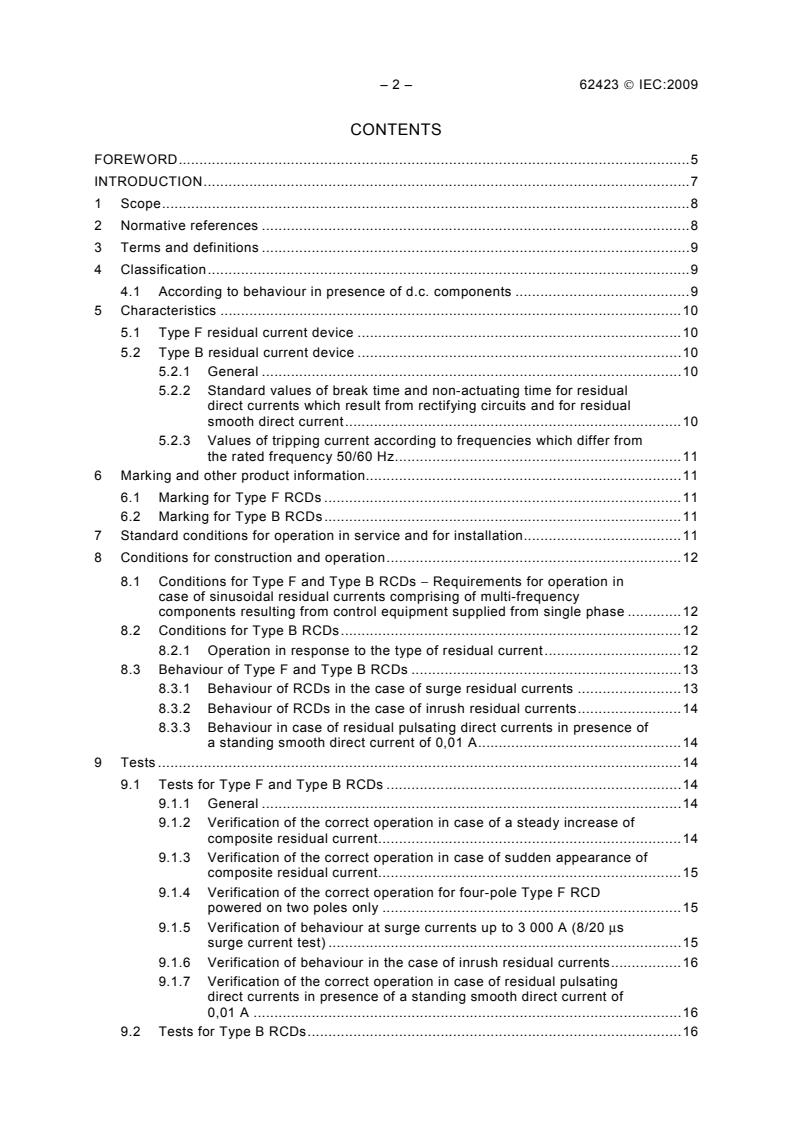
CONTENTS
FOREWORD.5
INTRODUCTION.7
1 Scope.8
2 Normative references .8
3 Terms and definitions .9
4 Classification.9
4.1 According to behaviour in presence of d.c. components .9
5 Characteristics .10
5.1 Type F residual current device .10
5.2 Type B residual current device .10
5.2.1 General .10
5.2.2 Standard values of break time and non-actuating time for residual
direct currents which result from rectifying circuits and for residual
smooth direct current.10
5.2.3 Values of tripping current according to frequencies which differ from
the rated frequency 50/60 Hz.11
6 Marking and other product information.11
6.1 Marking for Type F RCDs .11
6.2 Marking for Type B RCDs.11
7 Standard conditions for operation in service and for installation.11
8 Conditions for construction and operation.12
8.1 Conditions for Type F and Type B RCDs − Requirements for operation in
case of sinusoidal residual currents comprising of multi-frequency
components resulting from control equipment supplied from single phase .12
8.2 Conditions for Type B RCDs.12
8.2.1 Operation in response to the type of residual current.12
8.3 Behaviour of Type F and Type B RCDs .13
8.3.1 Behaviour of RCDs in the case of surge residual currents .13
8.3.2 Behaviour of RCDs in the case of inrush residual currents.14
8.3.3 Behaviour in case of residual pulsating direct currents in presence of
a standing smooth direct current of 0,01 A.14
9 Tests .14
9.1 Tests for Type F and Type B RCDs .14
9.1.1 General .14
9.1.2 Verification of the correct operation in case of a steady increase of
composite residual current.14
9.1.3 Verification of the correct operation in case of sudden appearance of
composite residual current.15
9.1.4 Verification of the correct operation for four-pole Type F RCD
powered on two poles only .15
9.1.5 Verification of behaviour at surge currents up to 3 000 A (8/20 μs
surge current test) .15
9.1.6 Verification of behaviour in the case of inrush residual currents.16
9.1.7 Verification of the correct operation in case of residual pulsating
direct currents in presence of a standing smooth direct current of
0,01 A .16
9.2 Tests for Type B RCDs.16
62423 © IEC:2009 – 3 –
9.2.1 Verification of the operating characteristic at the reference
temperature (20 ± 5) °C.16
9.2.2 Tests at the temperature limits .19
9.2.3 Verification of the correct operation for three- and four-pole Type B
RCDs powered on two poles only .19
9.2.4 Verification of the RCD after test sequences.19
Annex A (normative) Number of samples to be submitted and test sequences to be
applied for verification of conformity for type F RCCBs .28
Annex B (normative) Number of samples to be submitted and test sequences to be
applied for verification of conformity for Type F RCBOs .30
Annex C (normative) Number of samples to be submitted and test sequences to be
applied for verification of conformity for Type B RCCBs .32
Annex D (normative) Number of samples to be submitted and test sequences to be
applied for verification of conformity for Type B RCBOs .34
Annex E (normative) Routine tests for Type F and Type B RCDs .36
Bibliography.37
Figure 1 – Example of a test circuit for the verification of correct operation in case of
residual sinusoidal alternating currents composed of multi-frequency components
resulting from single-phase supplied speed motor control equipment .20
Figure 2 – Test circuit for the verification of the behaviour of the RCD in case of inrush
residual currents .21
Figure 3 – Test circuit for the verification of correct operation in case of residual
sinusoidal alternating current up to 1 000 Hz .22
Figure 4 – Test circuit for 2-, 3- and 4-pole Type B RCD to verify the correct operation
in case of a residual alternating current superimposed on a smooth direct current .23
Figure 5 – Test circuit for 2-, 3- and 4-pole Type B RCD to verify the correct operation
in case of a residual pulsating direct current superimposed on a smooth direct current.24
Figure 6a – Test circuit for 2-, 3- and 4-pole Type B to verify the correct operation in
case of residual pulsating direct currents which may result from rectifying circuits
supplied from two phases .25
Figure 6b – Test circuit for 3- and 4-pole Type B RCD to verify the correct operation in
case of residual pulsating direct currents which may result from rectifying circuits
supplied from three phases.26
Figure 6 – Test circuit for Type B RCD to verify the correct operation in case of
residual pulsating direct currents which may result from rectifying circuits .26
Figure 7 – Test circuit for 2-, 3- and 4-pole Type B RCD to verify the correct operation
in case of a residual smooth direct current.27
Table 1 – Type B RCDs – Standard values of break time and non-actuating time for
residual direct currents which result from rectifying circuits and for residual smooth
direct current .10
Table 2 – Type B RCDs – Residual non-operating and operating current according to
frequencies which differ from the rated frequency 50/60 Hz .11
Table 3 – Different frequency component values of test currents and starting current
values (I ) for verifying the operating in case of steady increased residual current.14
Δ
Table 4 – Operating current ranges for composite residual current .15
Table A.1 – Test sequences for Type F RCCBs .29
Table B.1 – Test sequences for Type F RCBOs .31
Table C.1 – Test sequences for Type B RCCBs .32
– 4 – 62423 © IEC:2009
Table D.1 – Test sequences for Type B RCBOs.34
62423 © IEC:2009 – 5 –
INTERNATIONAL ELECTROTECHNICAL COMMISSION
____________
TYPE F AND TYPE B RESIDUAL CURRENT OPERATED
CIRCUIT-BREAKERS WITH AND WITHOUT INTEGRAL OVERCURRENT
PROTECTION FOR HOUSEHOLD AND SIMILAR USES
FOREWORD
1) The International Electrotechnical Commission (IEC) is a worldwide organization for standardization comprising
all national electrotechnical committees (IEC National Committees). The object of IEC is to promote
international co-operation on all questions concerning standardization in the electrical and electronic fields. To
this end and in addition to other activities, IEC publishes International Standards, Technical Specifications,
Technical Reports, Publicly Available Specifications (PAS) and Guides (hereafter referred to as “IEC
Publication(s)”). Their preparation is entrusted to technical committees; any IEC National Committee interested
in the subject dealt with may participate in this preparatory work. International, governmental and non-
governmental organizations liaising with the IEC also participate in this preparation. IEC collaborates closely
with the International Organization for Standardization (ISO) in accordance with conditions determined by
agreement between the two organizations.
2) The formal decisions or agreements of IEC on technical matters express, as nearly as possible, an international
consensus of opinion on the relevant subjects since each technical committee has representation from all
interested IEC National Committees.
3) IEC Publications have the form of recommendations for international use and are accepted by IEC National
Committees in that sense. While all reasonable efforts are made to ensure that the technical content of IEC
Publications is accurate, IEC cannot be held responsible for the way in which they are used or for any
misinterpretation by any end user.
4) In order to promote international uniformity, IEC National Committees undertake to apply IEC Publications
transparently to the maximum extent possible in their national and regional publications. Any divergence
between any IEC Publication and the corresponding national or regional publication shall be clearly indicated in
the latter.
5) IEC itself does not provide any attestation of conformity. Independent certification bodies provide conformity
assessment services and, in some areas, access to IEC marks of conformity. IEC is not responsible for any
services carried out by independent certification bodies.
6) All users should ensure that they have the latest edition of this publication.
7) No liability shall attach to IEC or its directors, employees, servants or agents including individual experts and
members of its technical committees and IEC National Committees for any personal injury, property damage or
other damage of any nature whatsoever, whether direct or indirect, or for costs (including legal fees) and
expenses arising out of the publication, use of, or reliance upon, this IEC Publication or any other IEC
Publications.
8) Attention is drawn to the Normative references cited in this publication. Use of the referenced publications is
indispensable for the correct application of this publication.
9) Attention is drawn to the possibility that some of the elements of this IEC Publication may be the subject of
patent rights. IEC shall not be held responsible for identifying any or all such patent rights.
International Standard IEC 62423 has been prepared by subcommittee 23E: Circuit-breakers
and similar equipment for household use, of IEC technical committee 23: Electrical
accessories.
This second edition cancels and replaces the first edition published in 2007 and constitutes a
technical revision. The main changes from the first edition are as follows:
– requirements and tests for Type F RCD have been introduced;
– requirements and tests for two-pole Type B RCD have been introduced;
– new additional requirements and tests for Type B RCDs have been introduced to cover
requirements and tests for Type F too.
– 6 – 62423 IEC:2009
The text of this standard is based on the following documents:
FDIS Report on voting
23E/679/FDIS 23E/684/RVD
Full information on the voting for the approval of this standard can be found in the report on
voting indicated in the above table.
This publication has been drafted in accordance with the ISO/IEC Directives, Part 2.
This International Standard is to be read in conjunction with the following standards:
IEC 61008-1:1996, Residual current operated circuit-breakers without integral overcurrent
protection for household and similar uses (RCCBs) – Part 1: General rules
IEC 61009-1:1996, Residual current operated circuit-breakers with integral overcurrent
protection for household and similar uses (RCBOs) – Part 1: General rules
The committee has decided that the contents of this publication will remain unchanged until
the maintenance result date indicated on the IEC web site under "http://webstore.iec.ch" in
the data related to the specific publication. At this date, the publication will be
• reconfirmed,
• withdrawn,
• replaced by a revised edition, or
• amended.
The contents of the corrigendum of December 2011 have been included in this copy.
62423 © IEC:2009 – 7 –
INTRODUCTION
RCCBs and RCBOs designed according to IEC 61008-1 and IEC 61009-1 are suitable in most
of the applications. IEC 61008-1 and 61009-1 provide appropriate requirements and tests for
general use in household and similar uses. However, the use of new electronic technology in
equipment may result in particular residual currents not covered in IEC 61008-1 or
IEC 61009-1. This standard covers specific applications where additional requirements and
testing are needed.
This standard includes definitions, additional requirements and tests for Type F and Type B
RCCBs and/or RCBOs to cover particular situations.
The tests shall first be applied according to IEC 61008-1 for Type F or Type B RCCBs and
according to IEC 61009-1 for Type F or Type B RCBOs.
After completion of the tests given either in IEC 61008-1 or IEC 61009-1 the additional tests
given in this standard shall be applied in order to show conformity to this standard (see
Annex A, Annex B for Type F or Annex C, Annex D for Type B respectively).
The number of samples to be submitted and test sequences to be applied for verification of
conformity for Type F RCCBs and Type F RCBOs are given in Annex A and Annex B
respectively.
The number of samples to be submitted and test sequences to be applied for verification of
conformity for Type B RCCBs and Type B RCBOs are given in Annex C and Annex D
respectively.
This standard introduces Type F RCDs (F for Frequency) with rated frequency 50 Hz or 60 Hz
intended for protection of circuits with frequency inverters supplied between phase and
neutral or phase and earthed middle conductor taking into account the necessary features for
these particular situations in addition to the cases covered by type A RCDs. Type F RCDs
cannot be used where electronic equipment with double bridge rectifiers supplied from two phases is
found or if a smooth d.c. residual current can occur.
In case of a frequency inverter, e.g. used for motor speed control, supplied between phase
and neutral, a composite residual current including the power frequency, the motor frequency
and the chopper clock frequency of the frequency inverter may occur in addition to alternating
or pulsating d.c. residual currents.
This standard introduces Type B RCDs to be used in case of residual pulsating rectified direct
current which results from one or more phases, and smooth d.c. residual current in addition to
the cases covered by Type F RCDs. For these applications, two, three or four pole Type B
RCDs can be used.
– 8 – 62423 IEC:2009
TYPE F AND TYPE B RESIDUAL CURRENT OPERATED
CIRCUIT-BREAKERS WITH AND WITHOUT INTEGRAL OVERCURRENT
PROTECTION FOR HOUSEHOLD AND SIMILAR USES
1 Scope
The scope of IEC 61008-1 and IEC 61009-1 applies with the following additions.
This standard specifies requirements and tests for Type F and Type B RCDs (Residual
Current Devices). Requirements and tests given in this standard are in addition to the
requirements of Type A residual current devices. This standard can only be used together
with IEC 61008-1 and IEC 61009-1.
Type F RCCBs (Residual Current Circuit Breaker) and Type F RCBOs (Residual current
Circuit Breaker with Overcurrent protection) with rated frequency 50 Hz or 60 Hz are intended
for installations when frequency inverters are supplied between phase and neutral or phase
and earthed middle conductor and are able to provide protection in case of alternating
residual sinusoidal at the rated frequency, pulsating direct residual currents and composite
residual currents that may occur.
Type B RCCBs and Type B RCBOs are able to provide protection in case of alternating
residual sinusoidal currents up to 1 000 Hz, pulsating direct residual currents and smooth
direct residual currents.
RCDs according to this standard are not intended to be used in d.c. supply systems.
Further requirements and tests for products to be used in situations where the residual
current was not intended to be covered in IEC 61008-1 or IEC 61009-1 are under
consideration.
For the purpose of manufacturer’s declaration or verification of conformity, type tests should
be carried out in test sequences in compliance with Annex A, Annex B, Annex C or Annex D
of this standard.
The complete test sequence for type test of Type F RCCBs and Type F RCBOs is given in
Tables A.1 and B.1 respectively. The complete test sequence for type test of Type B RCCBs
and Type B RCBOs is given in Tables C.1 or D.1 respectively.
NOTE 1 Throughout the document, the term RCD refers to RCCBs and RCBOs.
NOTE 2 Requirements for 1 pole with solid neutral are under consideration.
NOTE 3 Type F and type B RCDs have high resistance against unwanted tripping, even if the surge voltage
causes a flashover and a follow-on current occurs, and in case of inrush residual currents with a maximum duration
of 10 ms which can occur in case of switching ON electronic equipment or EMC-filters.
2 Normative references
The following referenced documents are indispensable for the application of this document.
For dated references, only the edition cited applies. For undated references, the latest edition
of the referenced document (including any amendments) applies.
62423 IEC:2009 – 9 –
IEC 61008-1:1996, Residual current operated circuit-breakers without integral overcurrent
protection for household and similar uses (RCCBs) – Part 1: General rules
Amendment 1 (2002)
Amendment 2 (2006)
IEC 61009-1:1996, Residual current operated circuit-breakers with integral overcurrent
protection for household and similar uses (RCBOs) – Part 1: General rules
Amendment 1 (2002)
Amendment 2 (2006)
IEC/TS 60479-1, Effects of current on human beings and livestock – Part 1: General aspects
IEC/TS 60479-2, Effects of current on human beings and livestock – Part 2: Special aspects
3 Terms and definitions
For the purposes of this document, the following terms and definitions apply.
3.1
smooth direct current
a direct current which is ripple free
3.2
Type B residual current device
residual current device for which tripping is ensured as for Type F according to this standard
and in addition:
– for residual sinusoidal alternating currents up to 1 000 Hz,
– for residual alternating currents superimposed on a smooth direct current
– for residual pulsating direct currents superimposed on a smooth direct current
– for residual pulsating rectified direct current which results from two or more phases
– for residual smooth direct currents whether suddenly applied or slowly increased
independent of polarity
3.3
Type F residual current device
residual current device for which tripping is ensured as for Type A according to IEC 61008-1
or IEC 61009-1, as applicable, and in addition:
– for composite residual currents, whether suddenly applied or slowly rising intended for
circuit supplied between phase and neutral or phase and earthed middle conductor
– for residual pulsating direct currents superimposed on smooth direct current
4 Classification
According to IEC 61008-1 or IEC 61009-1, as applicable with the following addition:
4.1 According to behaviour in presence of d.c. components
– Type F RCDs
– Type B RCDs
—————————
A consolidated edition (2.2) exists including IEC 61008-1 (1996), its Amendment 1 (2002) and Amendment 2
(2006).
A consolidated edition (2.2) exists including IEC 61009-1 (1996), its Amendment 1 (2002) and Amendment 2
(2006).
– 10 – 62423 © IEC:2009
5 Characteristics
5.1 Type F residual current device
Residual current device for which tripping is ensured as for Type A according to IEC 61008-1
or IEC 61009-1, as applicable, and in addition,
– for composite residual currents, whether suddenly applied or slowly rising intended for
circuit supplied between phase and neutral or phase and earthed middle conductor (see
8.1);
– and for residual pulsating direct currents superimposed on smooth direct current of 0,01 A
(see 8.3.3).
The above specified residual currents may be suddenly applied or slowly rising.
5.2 Type B residual current device
5.2.1 General
Residual current device for which tripping is ensured as for Type F and in addition
− for residual sinusoidal alternating currents up to 1 000 Hz (see 8.2.1.1),
− for residual alternating currents superimposed on a smooth direct current of 0,4 times the
rated residual current (I ) (see 8.2.1.2),
Δn
− for residual pulsating direct currents superimposed on a smooth direct current of 0,4 times
the rated residual current (I ) or 10 mA, whichever is the highest value (see 8.2.1.3),
Δn
− for residual direct currents which may result from rectifying circuits, i.e.,
– two-pulse bridge connection line to line for 2-, 3- and 4-pole devices (see 8.2.1.4),
– three-pulse star connection or six-pulse bridge connection for 3- and 4-pole devices
(see 8.2.1.5),
− for residual smooth direct currents (see 8.2.1.6).
NOTE In NL, this characteristic is modified.
The above specified residual currents may be suddenly applied or slowly increased
independent of polarity.
5.2.2 Standard values of break time and non-actuating time for residual direct
currents which result from rectifying circuits and for residual smooth direct
current
Table 1 – Type B RCDs – Standard values of break time and non-actuating time for
residual direct currents which result from rectifying circuits and for residual smooth
direct current
Standard values of break time and non-actuating time at a
residual operating current (I ) equal to
Δ
s
I I
n Δn
2 I 4 I 10I 5 A,10 A,
Type
Δn Δn Δn
A A
20 A, 50 A,
100 A, 200 A
a
Maximum break times
General Any value Any value 0,3 0,15 0,04 0,04
0,5 0,2 0,15 0,15 Maximum break times
S ≥ 25 > 0,030
Minimum non-actuating times
0,13 0,06 0,05 0,04
62423 © IEC:2009 – 11 –
For Type B RCBOs any value exceeding the lower limit of the overcurrent instantaneous tripping range are
not tested.
a
The tests are only made during the verification of the correct operation as mentioned in 9.2.1.5 b )
according to Figure 6a, and 9.2.1.6 b) according to Figure 6b.
5.2.3 Values of tripping current according to frequencies which differ from the rated
frequency 50/60 Hz
Table 2 – Type B RCDs – Residual non-operating and operating current according to
frequencies which differ from the rated frequency 50/60 Hz
Frequency Residual non-operating current Residual operating current
Hz
I I
Δn Δn
a
150 0,5 I 2,4 I
Δn Δn
a
0,5 I 6 I
Δn Δn
a b
1 000
I 14 I
Δn Δn
NOTE 1 The definitions of “residual non-operating current and of “operating currents” are those of
IEC 61008-1 and IEC 61009-1.
NOTE 2 The waveform for the given frequencies is sinusoidal.
NOTE 3 The maximum permissible earthing impedance at a frequency f depends on the upper limit of the
x
operating currents of the RCD at that frequency.
NOTE 4 The relationship between the frequency of the acceptable touch voltages and the dissipated
power in the human body are under consideration. Until final values are fixed the maximum allowed touch
voltage of 50 V for 50/60 Hz is recommended.
a
The values correspond to the threshold of ventricular fibrillation according to IEC/TS 60479-1 in
combination with the frequency factor for ventricular fibrillation according to IEC/TS 60479-2.
b
IEC 60479 series gives no factors for frequencies above 1 kHz.
6 Marking and other product information
6.1 Marking for Type F RCDs
Add the following symbol adjacent to the symbol for Type A, e.g.
Alternatively the following symbol may be used
6.2 Marking for Type B RCDs
Add the following symbol adjacent to the symbol for Type F, e.g.:
Alternatively the following symbol may be used:
NOTE Where a 4-pole RCBO is used for single phase supply the device should be connected and installed
according to the manufacturer’s instructions.
7 Standard conditions for operation in service and for installation
According to IEC 61008-1 or IEC 61009-1, as applicable.
– 12 – 62423 © IEC:2009
8 Conditions for construction and operation
8.1 Conditions for Type F and Type B RCDs − Requirements for operation in case of
sinusoidal residual currents comprising of multi-frequency components resulting
from control equipment supplied from single phase
a) Type F and Type B RCDs shall operate in response to a steady increase of residual
current within the limits given in Table 4.
Compliance is checked by the tests of 9.1.2.
b) Type F and Type B RCDs shall operate in response to a sudden appearance of the
residual operating current.
For residual currents greater than 5 times the upper limit of Table 4 the maximum break time
of RCDs of the general type shall be 0,04 s, and, for RCDs Type S, the minimum non-
actuating time shall be equal to or greater than 0,05 s and the maximum break time shall not
exceed 0,15 s.
Compliance is checked by the tests of 9.1.3.
8.2 Conditions for Type B RCDs
8.2.1 Operation in response to the type of residual current
8.2.1.1 Residual sinusoidal alternating currents up to 1 000 Hz
Type B RCDs shall comply with the values given in Table 2 of this standard.
Compliance is checked by the tests of 9.2.1.2a).
Type B RCDs shall operate in response to a sudden appearance of the residual operating
current given in Table 2. The maximum break time of RCDs of the general type shall be 0,3 s,
and for RCDs type S the minimum non-actuating time shall be equal to or not lower than
0,13 s and the maximum break time shall not exceed 0,5 s.
Compliance is checked by the tests of 9.2.1.2b).
8.2.1.2 Residual alternating current superimposed on a residual smooth direct
current
Type B RCDs shall operate in case of residual alternating currents of the rated frequency
superimposed on a residual smooth direct current of 0,4 times the rated residual current (I )
Δn
or 10 mA whichever is the highest value.
The alternating tripping current shall be equal or lower than I .
Δn
Compliance is checked by the tests of 9.2.1.3.
8.2.1.3 Residual pulsating direct current superimposed on a smooth direct current
Type B RCDs shall operate in case of residual pulsating direct currents superimposed on a
residual smooth direct current of 0,4 times the rated residual current (I ) or 10 mA,
Δn
whichever is the highest value.
The tripping current shall not be higher than 1,4 I for RCDs with I > 0,01 A, or 2 I for
Δn Δn Δn
RCD with I ≤ 0,01 A.
Δn
NOTE The tripping current 1,4 I or 2 I , as applicable, is the r.m.s. value due to the half-wave pulsating direct
Δn
Δn
current.
62423 © IEC:2009 – 13 –
Compliance is checked by the tests of 9.2.1.4.
8.2.1.4 Residual pulsating direct currents which may result from rectifying circuits
supplied from two phases
Type B RCDs shall operate in response to a steady increase of residual pulsating direct
current resulting from rectifying circuits within the limits of 0,5 I to 2 I .
Δn Δn
Compliance is checked by the tests of 9.2.1.5a).
Type B RCDs shall operate in response to a sudden appearance of residual pulsating direct
current resulting from rectifying circuits according to the limits specified in Table 1.
Compliance is checked by the tests of 9.2.1.5b).
8.2.1.5 Residual pulsating direct currents which may result from rectifying circuits
supplied from three phases
Type B RCDs shall operate in response to a steady increase of residual pulsating direct
current resulting from rectifying circuits within the limits of 0,5 I to 2 I .
Δn Δn
Compliance is checked by the tests of 9.2.1.6a).
Type B RCDs shall operate in response to a sudden appearance of residual pulsating direct
current resulting from rectifying circuits according to the limits specified in Table 1.
Compliance is checked by the tests of 9.2.1.6b).
8.2.1.6 Residual smooth direct current
Type B RCDs shall operate in response to a steady increase of smooth direct residual current
within the limits of 0,5 I to 2 I .
Δn Δn
NOTE In NL this subclause is not applicable.
Compliance is checked by the tests of 9.2.1.7.1a) and 9.2.1.7.2.
Type B RCDs shall operate in response to a sudden appearance of smooth direct residual
current according to the limits specified in Table 1 of this standard.
Compliance is checked by the tests of 9.2.1.7.1b).
8.2.1.7 Behaviour of the correct operation for three- and four- pole Type B RCDs powered
on two poles only
Three- and four-pole RCDs shall be able to operate if they are powered on only two poles.
Compliance is checked by the tests of 9.2.3 for Type B RCDs.
8.3 Behaviour of Type F and Type B RCDs
8.3.1 Behaviour of RCDs in the case of surge residual currents
RCDs shall show adequate resistance against unwanted tripping in case of current surges to
earth due to the loading of the capacitances of the installation and the current surges to earth
due to flashover in the installation.
Compliance is checked by the tests of 9.1.5.
– 14 – 62423 © IEC:2009
8.3.2 Behaviour of RCDs in the case of inrush residual currents
RCDs shall adequately withstand inrush residual currents with a maximum duration of 10 ms
which can occur in case of switching on electronic equipment or EMC-filters.
Compliance is checked by the tests of 9.1.6.
8.3.3 Behaviour in case of residual pulsating direct currents in presence of a
standing smooth direct current of 0,01 A
RCDs shall operate in case of residual pulsating direct currents superimposed on a residual
smooth direct current of 0,01 A.
Compliance is checked by the tests of 9.1.7 for Type F.
Compliance is checked by the tests of 9.2.1.3 for Type B.
9 Tests
9.1 Tests for Type F and Type B RCDs
9.1.1 General
All tests shall be carried out with the RCD supplied at U , with the rated frequency and
n
without load.
Unless otherwise specified tests are made according to Figure 1.
9.1.2 Verification of the correct operation in case of a steady increase of composite
residual current
Table 3 provides frequency component values for calibration purposes as well as the starting
current values to verify the RCD operation in case of a steady increased residual current.
Table 4 provides the limit operating values of the composite residual current.
The test frequency has a tolerance of ± 2 %.
Table 3 – Different frequency component values of test currents and starting current
values (I ) for verifying the operating in case of steady increased residual current
Δ
Composite starting
Different frequency component values of test currents for calibration (RMS)
current value (RMS)
I I I I
at rated frequency 1 kHz F motor (10 Hz) Δ
0,138 I 0,138 I 0,035 I 0,2 I
Δn Δn Δn Δn
NOTE 1 I corresponds to the rated residual operating current of the device at the rated frequency.
Δn
NOTE 2 For the test purposes the values of 10 Hz and 1 kHz have been used for the output and clock
frequency respectively representing the most severe condition.
To verify the operation of the RCD in the presence of composite currents, the starting
composite residual current value given in Table 3 shall be increased at a linear rate. The RCD
shall trip within the limits of Table 4.
In any case the ratios of the different frequencies shall be maintained from the initial value up
to the operating value.
62423 © IEC:2009 – 15 –
Table 4 – Operating current ranges for composite residual current
Operating current (RMS)
Lower limit Upper limit
0,5 I 1,4 I
Δn Δn
NOTE 1 I corresponds to the rated residual operating current of the device at the rated frequency.
Δn
NOTE 2 Operating currents are composed of the ratio of frequency components given in Table 3.
The test switches S and S and the RCD being in the closed position, the residual current is
1 2
steadily increased, starting from a value not higher than the starting composite value given in
Table 3 trying to attain the upper limit of residual operating current given in Table 4 within
30 s.
The test is repeated three times through one pole chosen at random. Operating values shall
be within the limits of Table 4.
9.1.3 Verification of the correct operation in case of sudden appearance of
composite residual current
Tests are carried out to verify the break time of the RCD, the test current being calibrated at 5
times the upper limit value given in Table 4.
The test switch S1 and the RCD being in the closed position, the residual current is suddenly
established by closing the test switch S2.
Three measurements of the break time are made.
For general type RCDs, the break times shall be less than 0,04 s.
For RCDs Type S the break time shall be less than 0,15 s.
RCDs Type S shall be tested additionally with the test current which is suddenly established
for the minimum non-actuating time of 0,05 s, with a tolerance of
by closing the test switch S
%.
−5
Each of the three applications of residual current shall be separated from the previous one by
an interval of at least 1 min.
The RCD shall not trip during any of the tests.
9.1.4 Verification of the correct operation for four-pole Type F RCD powered on two
poles only
Tests shall be performed with a four-pole RCD according to 9.1.2, but the RCD is only
supplied between the neutral terminal and one-phase terminal chosen at random with rated
frequency and without load.
9.1.5 Verification of behaviour at surge currents up to 3 000 A (8/20 μs surge current
test)
9.1.5.1 Test conditions
The test conditions are given in IEC 61008-1 Subclause 9.19.2.1 or IEC 61009-1 Subclause
9.19.2.1, as applicable.
– 16 – 62423 IEC:2009
9.1.5.2 Test results
During the tests the RCD shall not trip.
After the surge current tests the correct operation of RCCBs is verified by a test according to
IEC 61008-1 Subclause 9.9.2.3 or for RCBOs according to IEC 61009-1 Subclause 9.9.1.2.c),
at I only, with the measurement of the break time.
∆n
9.1.6 Verification of behaviour in the case of inrush residual currents
The test is carried out with a circuit according to Figure 2, all switches and the RCD being in
closed position.
0
The generator (G) is able to produce a single sinusoidal half-wave pulse 50 Hz or 60Hz ( ms).
1
A pulse with a peak current of 10 times I is established on one pole chosen at random. Six
∆n
measurements are made 3 times in positive and 3 times in negative polarity. The polarity is
changed after each test. The time between two pulses shall be 30 s.
During the tests the RCD shall not trip.
9.1.7 Verification of the correct operation in case of residual pulsating direct
currents in presence of a standing smooth direct current of 0,01 A
The RCD is tested according to 9.21.1.4 of IEC 61008-1 or 9.21.1.4 of IEC 61009-1 but the
smooth direct current of 0,006 A is replaced by 0,01 A.
NOTE For Type B this test is replaced by the test of 9.2.1.4.
9.2 Tests for Type B RCDs
9.2.1 Verification of the operating characteristic at the reference temperature
(20 5) °C
9.2.1.1 General
The RCD is installed as for normal use.
All tests shall be carried out with the RCD supplied first at 0,85 U and then at
...