


IEC 62265:2005
(Main)Advanced Library Format (ALF) describing Integrated Circuit (IC) technology, cells and blocks
General Information
- Abstract
Provides rules that describe ALF and how tool developers, integrators, library creators, and library users should use it.
- Status
- Withdrawn
- Publication Date
- 19-Jul-2005
- Withdrawal Date
- 03-Aug-2010
- Technical Committee
- TC 91 - Electronics assembly technology
- Drafting Committee
- WG 2 - TC 91/WG 2
- Current Stage
- WPUB - Publication withdrawn
- Start Date
- 04-Aug-2010
- Completion Date
- 28-Aug-2026
Get Certified
Connect with accredited certification bodies for this standard

BSI Group
BSI (British Standards Institution) is the business standards company that helps organizations make excellence a habit.

DVS-ZERT GmbH
German welding certification society.
CARES (UK Certification Authority for Reinforcing Steels)
UK certification for reinforcing steels and construction.
Sponsored listings
Frequently Asked Questions
IEC 62265:2005 is a standard published by the International Electrotechnical Commission (IEC). Its full title is "Advanced Library Format (ALF) describing Integrated Circuit (IC) technology, cells and blocks". This standard covers: Provides rules that describe ALF and how tool developers, integrators, library creators, and library users should use it.
Provides rules that describe ALF and how tool developers, integrators, library creators, and library users should use it.
IEC 62265:2005 is classified under the following ICS (International Classification for Standards) categories: 25.040.99 - Other industrial automation systems; 35.160 - Microprocessor systems; 35.240.01 - Application of information technology in general. The ICS classification helps identify the subject area and facilitates finding related standards.
IEC 62265:2005 is available in PDF format for immediate download after purchase. The document can be added to your cart and obtained through the secure checkout process. Digital delivery ensures instant access to the complete standard document.
Standards Content (Sample)
INTERNATIONAL IEC
STANDARD 62265
First edition
2005-07
IEEE 1603
Advanced Library Format (ALF)
describing Integrated Circuit (IC) technology,
cells and blocks
Reference number
IEC 62265(E):2005
IEEE Std. 1603(E):2003
Publication numbering
As from 1 January 1997 all IEC publications are issued with a designation in the
60000 series. For example, IEC 34-1 is now referred to as IEC 60034-1.
Consolidated editions
The IEC is now publishing consolidated versions of its publications. For example,
edition numbers 1.0, 1.1 and 1.2 refer, respectively, to the base publication, the
base publication incorporating amendment 1 and the base publication incorporating
amendments 1 and 2.
Further information on IEC publications
The technical content of IEC publications is kept under constant review by the IEC,
thus ensuring that the content reflects current technology. Information relating to
this publication, including its validity, is available in the IEC Catalogue of
publications (see below) in addition to new editions, amendments and corrigenda.
Information on the subjects under consideration and work in progress undertaken
by the technical committee which has prepared this publication, as well as the list
of publications issued, is also available from the following:
• IEC Web Site (www.iec.ch)
• Catalogue of IEC publications
The on-line catalogue on the IEC web site (www.iec.ch/searchpub) enables you to
search by a variety of criteria including text searches, technical committees
and date of publication. On-line information is also available on recently issued
publications, withdrawn and replaced publications, as well as corrigenda.
• IEC Just Published
This summary of recently issued publications (www.iec.ch/online_news/ justpub)
is also available by email. Please contact the Customer Service Centre (see
below) for further information.
• Customer Service Centre
If you have any questions regarding this publication or need further assistance,
please contact the Customer Service Centre:
Email: custserv@iec.ch
Tel: +41 22 919 02 11
Fax: +41 22 919 03 00
INTERNATIONAL IEC
STANDARD 62265
First edition
2005-07
IEEE 1603
Advanced Library Format (ALF)
describing Integrated Circuit (IC) technology,
cells and blocks
© IEEE 2005 Copyright - all rights reserved
IEEE is a registered trademark in the U.S. Patent & Trademark Office, owned by the Institute of Electrical and Electronics Engineers, Inc.
No part of this publication may be reproduced or utilized in any form or by any means, electronic or
mechanical, including photocopying and microfilm, without permission in writing from the publisher.
International Electrotechnical Commission, 3, rue de Varembé, PO Box 131, CH-1211 Geneva 20, Switzerland
Telephone: +41 22 919 02 11 Telefax: +41 22 919 03 00 E-mail: inmail@iec.ch Web: www.iec.ch
The Institute of Electrical and Electronics Engineers, Inc, 3 Park Avenue, New York, NY 10016-5997, USA
Telephone: +1 732 562 3800 Telefax: +1 732 562 1571 E-mail: stds-info@ieee.org Web: www.standards.ieee.org
Commission Electrotechnique Internationale
International Electrotechnical Commission
Международная Электротехническая Комиссия
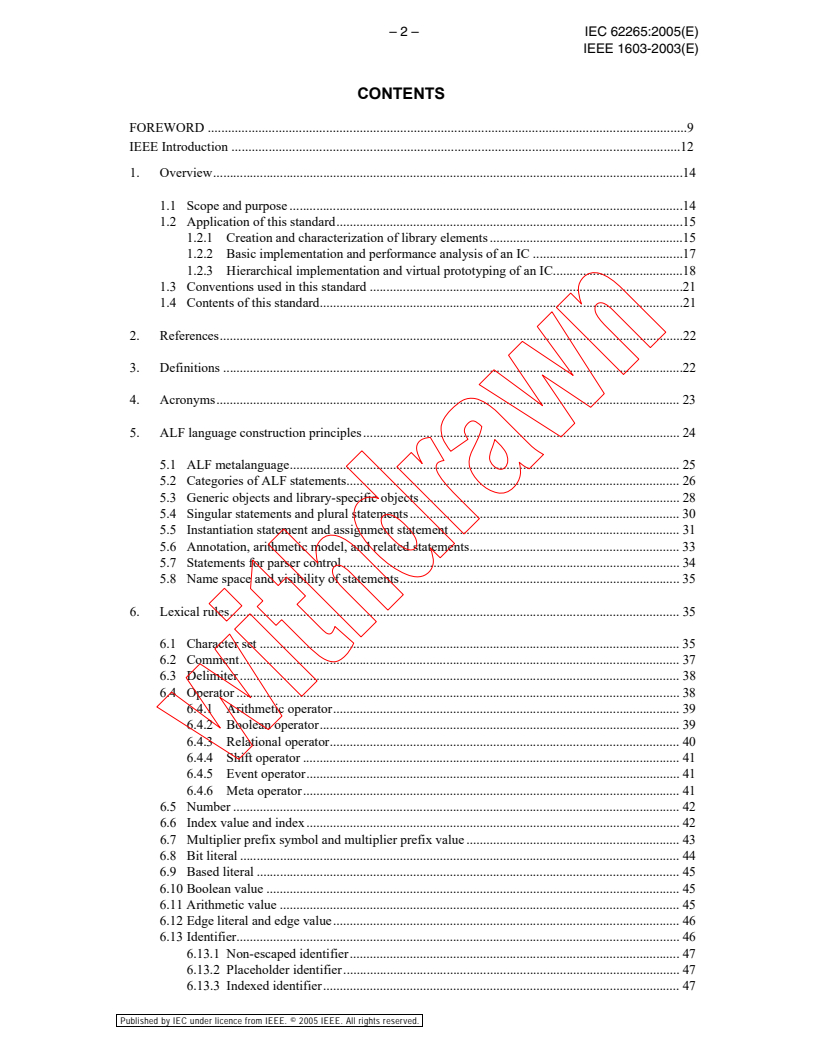
– 2 – IEC 62265:2005(E)
IEEE 1603-2003(E)
CONTENTS
FOREWORD .9
IEEE Introduction .12
1. Overview.14
1.1 Scope and purpose .14
1.2 Application of this standard.15
1.2.1 Creation and characterization of library elements .15
1.2.2 Basic implementation and performance analysis of an IC .17
1.2.3 Hierarchical implementation and virtual prototyping of an IC.18
1.3 Conventions used in this standard .21
1.4 Contents of this standard.21
2. References.22
3. Definitions .22
4. Acronyms. 23
5. ALF language construction principles. 24
5.1 ALF metalanguage. 25
5.2 Categories of ALF statements. 26
5.3 Generic objects and library-specific objects. 28
5.4 Singular statements and plural statements. 30
5.5 Instantiation statement and assignment statement. 31
5.6 Annotation, arithmetic model, and related statements. 33
5.7 Statements for parser control . 34
5.8 Name space and visibility of statements. 35
6. Lexical rules. 35
6.1 Character set . 35
6.2 Comment. 37
6.3 Delimiter . 38
6.4 Operator . 38
6.4.1 Arithmetic operator. 39
6.4.2 Boolean operator. 39
6.4.3 Relational operator. 40
6.4.4 Shift operator . 41
6.4.5 Event operator. 41
6.4.6 Meta operator. 41
6.5 Number . 42
6.6 Index value and index. 42
6.7 Multiplier prefix symbol and multiplier prefix value . 43
6.8 Bit literal . 44
6.9 Based literal . 45
6.10 Boolean value . 45
6.11 Arithmetic value . 45
6.12 Edge literal and edge value. 46
6.13 Identifier. 46
6.13.1 Non-escaped identifier. 47
6.13.2 Placeholder identifier. 47
6.13.3 Indexed identifier. 47
Published by IEC under licence from IEEE. © 2005 IEEE. All rights reserved.
IEEE 1603-2003(E)
6.13.4 Full hierarchical identifier . 47
6.13.5 Partial hierarchical identifier . 48
6.13.6 Escaped identifier . 48
6.13.7 Keyword identifier. 49
6.14 Quoted string. 49
6.15 String value. 50
6.16 Generic value . 50
6.17 Vector expression macro . 51
6.18 Rules for whitespace usage. 51
6.19 Rules against parser ambiguity . 51
7. Generic objects and related statements. 52
7.1 Generic object . 52
7.2 All purpose item. 52
7.3 Annotation . 53
7.4 Annotation container. 53
7.5 ATTRIBUTE statement. 53
7.6 PROPERTY statement. 54
7.7 ALIAS declaration. 54
7.8 CONSTANT declaration . 55
7.9 KEYWORD declaration . 55
7.10 SEMANTICS declaration . 56
7.11 Annotations and rules related to a KEYWORD or a SEMANTICS declaration. 57
7.11.1 VALUETYPE annotation. 57
7.11.2 VALUES annotation. 59
7.11.3 DEFAULT annotation . 59
7.11.4 CONTEXT annotation. 60
7.11.5 REFERENCETYPE annotation. 61
7.11.6 SI_MODEL annotation. 62
7.11.7 Rules for legal usage of KEYWORD and SEMANTICS declaration. 63
7.12 CLASS declaration . 64
7.13 Annotations related to a CLASS declaration. 64
7.13.1 General CLASS reference annotation. 64
7.13.2 USAGE annotation . 65
7.14 GROUP declaration . 66
7.15 TEMPLATE declaration. 67
7.16 TEMPLATE instantiation. 68
7.17 INCLUDE statement. 71
7.18 ASSOCIATE statement and FORMAT annotation. 71
7.19 REVISION statement . 72
8. Library-specific objects and related statements. 73
8.1 Library-specific object. 73
8.2 LIBRARY and SUBLIBRARY declaration. 74
8.3 Annotations related to a LIBRARY or a SUBLIBRARY declaration . 74
8.3.1 LIBRARY reference annotation . 74
8.3.2 INFORMATION annotation container. 75
8.4 CELL declaration. 76
8.5 Annotations related to a CELL declaration . 77
8.5.1 CELL reference annotation. 77
8.5.2 CELLTYPE annotation. 77
8.5.3 RESTRICT_CLASS annotation . 78
Published by IEC under licence from IEEE. © 2005 IEEE. All rights reserved.
– 4 – IEC 62265:2005(E)
IEEE 1603-2003(E)
8.5.4 SWAP_CLASS annotation. 80
8.5.5 SCAN_TYPE annotation. 80
8.5.6 SCAN_USAGE annotation. 81
8.5.7 BUFFERTYPE annotation . 82
8.5.8 DRIVERTYPE annotation. 82
8.5.9 PARALLEL_DRIVE annotation. 83
8.5.10 PLACEMENT_TYPE annotation. 83
8.5.11 SITE reference annotation for a CELL. 84
8.5.12 ATTRIBUTE values for a CELL. 84
8.6 PIN declaration . 86
8.7 PINGROUP declaration. 87
8.8 Annotations related to a PIN or a PINGROUP declaration. 88
8.8.1 PIN reference annotation . 88
8.8.2 MEMBERS annotation. 88
8.8.3 VIEW annotation . 88
8.8.4 PINTYPE annotation . 89
8.8.5 DIRECTION annotation . 90
8.8.6 SIGNALTYPE annotation. 91
8.8.7 ACTION annotation . 93
8.8.8 POLARITY annotation. 94
8.8.9 CONTROL_POLARITY annotation container. 95
8.8.10 DATATYPE annotation . 96
8.8.11 INITIAL_VALUE annotation . 97
8.8.12 SCAN_POSITION annotation. 97
8.8.13 STUCK annotation . 97
8.8.14 SUPPLYTYPE annotation. 98
8.8.15 SIGNAL_CLASS annotation . 99
8.8.16 SUPPLY_CLASS annotation . 99
8.8.17 DRIVETYPE annotation . 101
8.8.18 SCOPE annotation .102
8.8.19 CONNECT_CLASS annotation .102
8.8.20 SIDE annotation.103
8.8.21 ROW and COLUMN annotation .103
8.8.22 ROUTING_TYPE annotation.104
8.8.23 PULL annotation.105
8.8.24 ATTRIBUTE values for a PIN or a PINGROUP.106
8.9 PRIMITIVE declaration .108
8.10 WIRE declaration .108
8.11 Annotations related to a WIRE declaration .108
8.11.1 WIRE reference annotation .108
8.11.2 WIRETYPE annotation .109
8.11.3 SELECT_CLASS annotation .109
8.12 NODE declaration.110
8.13 Annotations related to a NODE declaration .111
8.13.1 NODE reference annotation.111
8.13.2 NODETYPE annotation .111
8.13.3 NODE_CLASS annotation .112
8.14 VECTOR declaration. 113
8.15 Annotations related to a VECTOR declaration . 113
8.15.1 VECTOR reference annotation. 113
8.15.2 PURPOSE annotation. 114
8.15.3 OPERATION annotation. 115
8.15.4 LABEL annotation. 115
8.15.5 EXISTENCE_CONDITION annotation. 116
Published by IEC under licence from IEEE. © 2005 IEEE. All rights reserved.
IEEE 1603-2003(E)
8.15.6 EXISTENCE_CLASS annotation . 116
8.15.7 CHARACTERIZATION_CONDITION annotation. 117
8.15.8 CHARACTERIZATION_VECTOR annotation . 117
8.15.9 CHARACTERIZATION_CLASS annotation. 117
8.15.10MONITOR annotation. 118
8.16 LAYER declaration . 118
8.17 Annotations related to a LAYER declaration. 119
8.17.1 LAYER reference annotation . 119
8.17.2 LAYERTYPE annotation . 119
8.17.3 PITCH annotation. 120
8.17.4 PREFERENCE annotation . 120
8.18 VIA declaration. 120
8.19 Annotations related to a VIA declaration . 121
8.19.1 VIA reference annotation. 121
8.19.2 VIATYPE annotation . 121
8.20 RULE declaration . 122
8.21 ANTENNA declaration . 122
8.22 BLOCKAGE declaration. 123
8.23 PORT declaration . 123
8.24 Annotations related to a PORT declaration . 124
8.24.1 Reference to a PORT using PIN reference annotation . 124
8.24.2 PORTTYPE annotation . 124
8.25 SITE declaration . 125
8.26 Annotations related to a SITE declaration. 125
8.26.1 SITE reference annotation . 125
8.26.2 ORIENTATION_CLASS annotation. 125
8.26.3 SYMMETRY_CLASS annotation . 126
8.27 ARRAY declaration. 126
8.28 Annotations related to an ARRAY declaration . 127
8.28.1 ARRAYTYPE annotation. 127
8.28.2 LAYER reference annotation for ARRAY. 127
8.28.3 SITE reference annotation for ARRAY. 128
8.29 PATTERN declaration. 128
8.30 Annotations related to a PATTERN declaration . 128
8.30.1 PATTERN reference annotation. 128
8.30.2 SHAPE annotation. 128
8.30.3 VERTEX annotation. 130
8.30.4 ROUTE annotation . 131
8.30.5 LAYER reference annotation for PATTERN. 132
8.31 REGION declaration. 132
8.32 Annotations related to a REGION declaration . 132
8.32.1 REGION reference annotation. 132
8.32.2 BOOLEAN annotation . 133
9. Description of functional and physical implementation . 133
9.1 FUNCTION statement. 133
9.2 TEST statement. 133
9.3 Definition and usage of a pin variable. 134
9.3.1 Pin variable and pin value. 134
9.3.2 Pin assignment . 134
9.3.3 Usage of a pin variable in the context of a FUNCTION or a TEST statement . 135
9.4 BEHAVIOR statement . 136
9.5 STRUCTURE statement and CELL instantiation . 137
Published by IEC under licence from IEEE. © 2005 IEEE. All rights reserved.
– 6 – IEC 62265:2005(E)
IEEE 1603-2003E)
9.6 STATETABLE statement. 138
9.7 NON_SCAN_CELL statement. 139
9.8 RANGE statement . 140
9.9 Boolean expression. 141
9.10 Boolean value system . 142
9.10.1 Scalar boolean value . 142
9.10.2 Vectorized boolean value. 142
9.10.3 Non-assignable boolean value . 144
9.11 Boolean operations and operators. 144
9.11.1 Logical operation . 144
9.11.2 Bitwise operation . 146
9.11.3 Conditional operation . 148
9.11.4 Integer arithmetic operation. 148
9.11.5 Shift operation. 149
9.11.6 Comparison operation. 149
9.12 Vector expression and control expression . 151
9.13 Specification of a pattern of events. 152
9.13.1 Specification of a single event. 152
9.13.2 Specification of a compound event. 153
9.13.3 Specification of a compound event with alternatives . 154
9.13.4 Evaluation of a specified pattern of events against a realized pattern of events .156
9.13.5 Specification of a conditional pattern of events. 158
9.14 Predefined PRIMITIVE. 158
9.14.1 Predefined PRIMITIVE ALF_BUF . 159
9.14.2 Predefined PRIMITIVE ALF_NOT. 159
9.14.3 Predefined PRIMITIVE ALF_AND . 159
9.14.4 Predefined PRIMITIVE ALF_NAND. 159
9.14.5 Predefined PRIMITIVE ALF_OR. 160
9.14.6 Predefined PRIMITIVE ALF_NOR. 160
9.14.7 Predefined PRIMITIVE ALF_XOR. 160
9.14.8 Predefined PRIMITIVE ALF_XNOR. 160
9.14.9 Predefined PRIMITIVE ALF_BUFIF1. 160
9.14.10 Predefined PRIMITIVE ALF_BUFIF0. 161
9.14.11 Predefined PRIMITIVE ALF_NOTIF1 . 161
9.14.12 Predefined PRIMITIVE ALF_NOTFIF0 . 161
9.14.13 Predefined PRIMITIVE ALF_MUX. 161
9.14.14 Predefined PRIMITIVE ALF_LATCH. 162
9.14.15 Predefined PRIMITIVE ALF_FLIPFLOP . 162
9.15 WIRE instantiation. 162
9.16 Geometric model. 164
9.17 Predefined geometric models using TEMPLATE. 166
9.17.1 Predefined TEMPLATE RECTANGLE . 166
9.17.2 Predefined TEMPLATE LINE .167
9.18 Geometric transformation . 167
9.19 ARTWORK statement. 169
9.20 VIA instantiation. 169
10. Description of electrical and physical measurements. 170
10.1 Arithmetic expression . 170
10.2 Arithmetic operations and operators. 171
10.2.1 Sign inversion . 171
10.2.2 Floating point arithmetic operation. 171
10.2.3 Macro arithmetic operator . 172
Published by IEC under licence from IEEE. © 2005 IEEE. All rights reserved.
IEEE 1603-2003(E)
10.3 Arithmetic model . 172
10.4 HEADER, TABLE, and EQUATION statements . 174
10.5 MIN, MAX, and TYP statements . 176
10.6 Auxiliary arithmetic model. 178
10.7 Arithmetic submodel. 178
10.8 Arithmetic model container . 179
10.8.1 General arithmetic model container. 179
10.8.2 Arithmetic model container LIMIT . 179
10.8.3 Arithmetic model container EARLY and LATE. 180
10.9 Generally applicable annotations for arithmetic models . 180
10.9.1 UNIT annotation . 180
10.9.2 CALCULATION annotation . 181
10.9.3 INTERPOLATION annotation. 182
10.9.4 DEFAULT annotation . 183
10.9.5 MODEL reference annotation . 184
10.10 VIOLATION statement, MESSAGE TYPE, and MESSAGE annotation. 185
10.11 Arithmetic models for timing, power, and signal integrity . 187
10.11.1 TIME. 187
10.11.2 FREQUENCY . 188
10.11.3 DELAY. 189
10.11.4 RETAIN. 190
10.11.5 SLEWRATE. 191
10.11.6 SETUP and HOLD . 192
10.11.7 RECOVERY and REMOVAL . 193
10.11.8 NOCHANGE and ILLEGAL . 194
10.11.9 PULSEWIDTH. 195
10.11.10 PERIOD. 196
10.11.11 JITTER . 197
10.11.12 SKEW. 198
10.11.13 THRESHOLD . 199
10.11.14 NOISE and NOISE_MARGIN. 200
10.11.15 POWER and ENERGY . 203
10.12 FROM and TO statements. 204
10.13 Annotations related to timing, power, and signal integrity . 205
10.13.1 EDGE_NUMBER annotation. 205
10.13.2 PIN reference and EDGE_NUMBER annotation for FROM and TO. 205
10.13.3 PIN reference and EDGE_NUMBER annotation for SLEWRATE. 206
10.13.4 PIN reference and EDGE_NUMBER annotation for PULSEWIDTH. 206
10.13.5 PIN reference and EDGE_NUMBER annotation for SKEW. 207
10.13.6 PIN reference annotation for NOISE and NOISE_MARGIN . 207
10.13.7 MEASUREMENT annotation . 207
10.14 Arithmetic models for environmental conditions . 209
10.14.1 PROCESS. 209
10.14.2 DERATE_CASE . 209
10.14.3 TEMPERATURE . 210
10.15 Arithmetic models for electrical circuits. 211
10.15.1 VOLTAGE. 211
10.15.2 CURRENT. 212
10.15.3 CAPACITANCE . 213
10.15.4 RESISTANCE . 215
10.15.5 INDUCTANCE . 216
10.16 Annotations for electrical circuits . 217
10.16.1 NODE reference annotation for electrical circuits . 217
10.16.2 COMPONENT reference annotation. 218
Published by IEC under licence from IEEE. © 2005 IEEE. All rights reserved.
– 8 – IEC 62265:2005(E)
IEEE 1603-2003(E)
10.16.3 PIN reference annotation for electrical circuits . 219
10.16.4 FLOW annotation . 220
10.17 Miscellaneous arithmetic models. 221
10.17.1 DRIVE STRENGTH. 221
10.17.2 SWITCHING_BITS with PIN reference annotation. 222
10.18 Arithmetic models related to structural implementation .
...