

IEC 63284:2022
(Main)Semiconductor devices - Reliability test method by inductive load switching for gallium nitride transistors
General Information
- Abstract
IEC 63284:2022 covers the protocol of performing a stress procedure and a corresponding test method to evaluate the reliability of gallium nitride (GaN) power transistors by inductive load switching, specifically hard-switching stress
- Status
- Published
- Publication Date
- 20-Apr-2022
- Technical Committee
- TC 47 - Semiconductor devices
- Drafting Committee
- WG 5 - TC 47/WG 5
- Current Stage
- PPUB - Publication issued
- Start Date
- 21-Apr-2022
- Completion Date
- 20-May-2022
Overview
IEC 63284:2022 is an international standard established by the International Electrotechnical Commission (IEC) that specifies a reliability test method for gallium nitride (GaN) power transistors under inductive load switching conditions. This standard focuses on hard-switching stress to evaluate how GaN transistors withstand continuous switching under high voltage and temperature conditions. As GaN transistors are increasingly employed in power electronics for their high efficiency and compact size, ensuring their reliability through standardized testing is critical for their widespread adoption in the market.
GaN semiconductors possess superior electrical properties compared to silicon-based devices, such as higher breakdown electric fields and faster switching speeds. However, GaN devices introduce unique reliability challenges and failure modes due to their materials and structural differences. IEC 63284:2022 addresses these challenges by defining a rigorous test procedure simulating inductive load switching, a common application stress in power conversion systems.
Key Topics
Scope and Application: The standard applies to all GaN power transistors including lateral and vertical structures using various substrates like silicon (Si), silicon carbide (SiC), sapphire, or GaN itself. It covers different gate structures such as Schottky, p-type GaN (p-GaN), and metal-insulator-semiconductor (MIS) designs.
Test Methodology: The reliability evaluation uses a Dynamic High Temperature Operating Life (DHTOL) test that involves continuous hard-switching with inductive loads. The test simulates operational stresses to accelerate wearout mechanisms unique to GaN devices.
Test Circuit and Conditions: The standard defines a detailed test circuit featuring inductive load switching, including component specifications for the gate driver, diode, inductance, and resistance parameters. Waveforms and electrical stress profiles are standardized to ensure repeatability.
Failure Criteria and Analysis: IEC 63284:2022 specifies criteria to determine transistor failure or degradation based on parameters such as dynamic on-state resistance changes. It also highlights common failure mechanisms linked to high-field stress, hot carriers, and thermal cycling.
Test Procedure: A step-by-step guide outlines initial measurements, continuous stress application, intermediate measurements, and final evaluations, supported by flow charts for clear procedural guidance.
Applications
IEC 63284:2022 is essential for manufacturers, designers, and testers of GaN power transistors and power electronics systems. Key practical applications include:
Reliability Qualification: Assisting manufacturers in certifying GaN transistor reliability for their customers by providing consistent stress testing protocols.
Product Development: Helping design engineers understand device robustness under inductive switching conditions common in power converters, inverters, and motor drives.
Quality Control: Ensuring production consistency by integrating standardized dynamic switching tests in quality assurance processes.
Market Acceptance: Supporting end-users and system integrators in selecting GaN devices with validated reliability data, thereby accelerating adoption of GaN technology in automotive, renewable energy, aerospace, and consumer electronics sectors.
Related Standards
While IEC 63284:2022 focuses on inductive load switching reliability for GaN transistors, users should consider complementary standards that address other aspects of semiconductor device testing and power electronics, such as:
IEC 60747 Series: Covers semiconductor device testing methodologies and definitions applicable broadly to discrete devices and integrated circuits.
JEDEC JESD22: A series of reliability test standards for semiconductor devices, including thermal cycling and high-temperature operating life tests relevant to power devices.
ISO/IEC 60050 (Electropedia): Provides standardized terminology essential for understanding test requirements and results.
Standards related to silicon-based transistor testing may not fully apply to GaN devices due to differing failure modes and device physics, underscoring the importance of IEC 63284:2022 as a dedicated protocol.
By adopting IEC 63284:2022, stakeholders can ensure rigorous reliability evaluation of GaN power transistors under inductive load switching stress, promoting confidence in device performance and longevity in demanding power electronic applications.
Frequently Asked Questions
IEC 63284:2022 is a standard published by the International Electrotechnical Commission (IEC). Its full title is "Semiconductor devices - Reliability test method by inductive load switching for gallium nitride transistors". This standard covers: IEC 63284:2022 covers the protocol of performing a stress procedure and a corresponding test method to evaluate the reliability of gallium nitride (GaN) power transistors by inductive load switching, specifically hard-switching stress
IEC 63284:2022 covers the protocol of performing a stress procedure and a corresponding test method to evaluate the reliability of gallium nitride (GaN) power transistors by inductive load switching, specifically hard-switching stress
IEC 63284:2022 is classified under the following ICS (International Classification for Standards) categories: 31.080.30 - Transistors. The ICS classification helps identify the subject area and facilitates finding related standards.
IEC 63284:2022 is available in PDF format for immediate download after purchase. The document can be added to your cart and obtained through the secure checkout process. Digital delivery ensures instant access to the complete standard document.
Standards Content (Sample)
IEC 63284 ®
Edition 1.0 2022-04
INTERNATIONAL
STANDARD
NORME
INTERNATIONALE
Semiconductor devices – Reliability test method by inductive load switching for
gallium nitride transistors
Dispositifs à semiconducteurs – Méthode d’essai de fiabilité par la commutation
sur charge inductive pour les transistors au nitrure de gallium
All rights reserved. Unless otherwise specified, no part of this publication may be reproduced or utilized in any form
or by any means, electronic or mechanical, including photocopying and microfilm, without permission in writing from
either IEC or IEC's member National Committee in the country of the requester. If you have any questions about IEC
copyright or have an enquiry about obtaining additional rights to this publication, please contact the address below or
your local IEC member National Committee for further information.
Droits de reproduction réservés. Sauf indication contraire, aucune partie de cette publication ne peut être reproduite
ni utilisée sous quelque forme que ce soit et par aucun procédé, électronique ou mécanique, y compris la photocopie
et les microfilms, sans l'accord écrit de l'IEC ou du Comité national de l'IEC du pays du demandeur. Si vous avez des
questions sur le copyright de l'IEC ou si vous désirez obtenir des droits supplémentaires sur cette publication, utilisez
les coordonnées ci-après ou contactez le Comité national de l'IEC de votre pays de résidence.
IEC Secretariat Tel.: +41 22 919 02 11
3, rue de Varembé info@iec.ch
CH-1211 Geneva 20 www.iec.ch
Switzerland
About the IEC
The International Electrotechnical Commission (IEC) is the leading global organization that prepares and publishes
International Standards for all electrical, electronic and related technologies.
About IEC publications
The technical content of IEC publications is kept under constant review by the IEC. Please make sure that you have the
latest edition, a corrigendum or an amendment might have been published.
IEC publications search - webstore.iec.ch/advsearchform IEC Products & Services Portal - products.iec.ch
The advanced search enables to find IEC publications by a Discover our powerful search engine and read freely all the
variety of criteria (reference number, text, technical publications previews. With a subscription you will always
committee, …). It also gives information on projects, replaced have access to up to date content tailored to your needs.
and withdrawn publications.
Electropedia - www.electropedia.org
IEC Just Published - webstore.iec.ch/justpublished
The world's leading online dictionary on electrotechnology,
Stay up to date on all new IEC publications. Just Published
containing more than 22 300 terminological entries in English
details all new publications released. Available online and
and French, with equivalent terms in 19 additional languages.
once a month by email.
Also known as the International Electrotechnical Vocabulary
(IEV) online.
IEC Customer Service Centre - webstore.iec.ch/csc
If you wish to give us your feedback on this publication or
need further assistance, please contact the Customer Service
Centre: sales@iec.ch.
A propos de l'IEC
La Commission Electrotechnique Internationale (IEC) est la première organisation mondiale qui élabore et publie des
Normes internationales pour tout ce qui a trait à l'électricité, à l'électronique et aux technologies apparentées.
A propos des publications IEC
Le contenu technique des publications IEC est constamment revu. Veuillez vous assurer que vous possédez l’édition la
plus récente, un corrigendum ou amendement peut avoir été publié.
Recherche de publications IEC - IEC Products & Services Portal - products.iec.ch
webstore.iec.ch/advsearchform Découvrez notre puissant moteur de recherche et consultez
La recherche avancée permet de trouver des publications IEC gratuitement tous les aperçus des publications. Avec un
en utilisant différents critères (numéro de référence, texte, abonnement, vous aurez toujours accès à un contenu à jour
comité d’études, …). Elle donne aussi des informations sur adapté à vos besoins.
les projets et les publications remplacées ou retirées.
Electropedia - www.electropedia.org
IEC Just Published - webstore.iec.ch/justpublished
Le premier dictionnaire d'électrotechnologie en ligne au
Restez informé sur les nouvelles publications IEC. Just
monde, avec plus de 22 300 articles terminologiques en
Published détaille les nouvelles publications parues.
anglais et en français, ainsi que les termes équivalents dans
Disponible en ligne et une fois par mois par email.
19 langues additionnelles. Egalement appelé Vocabulaire
Electrotechnique International (IEV) en ligne.
Service Clients - webstore.iec.ch/csc
Si vous désirez nous donner des commentaires sur cette
publication ou si vous avez des questions contactez-nous:
sales@iec.ch.
IEC 63284 ®
Edition 1.0 2022-04
INTERNATIONAL
STANDARD
NORME
INTERNATIONALE
Semiconductor devices – Reliability test method by inductive load switching for
gallium nitride transistors
Dispositifs à semiconducteurs – Méthode d’essai de fiabilité par la commutation
sur charge inductive pour les transistors au nitrure de gallium
INTERNATIONAL
ELECTROTECHNICAL
COMMISSION
COMMISSION
ELECTROTECHNIQUE
INTERNATIONALE
ICS 31.080.30 ISBN 978-2-8322-1101-6
– 2 – IEC 63284:2022 © IEC 2022
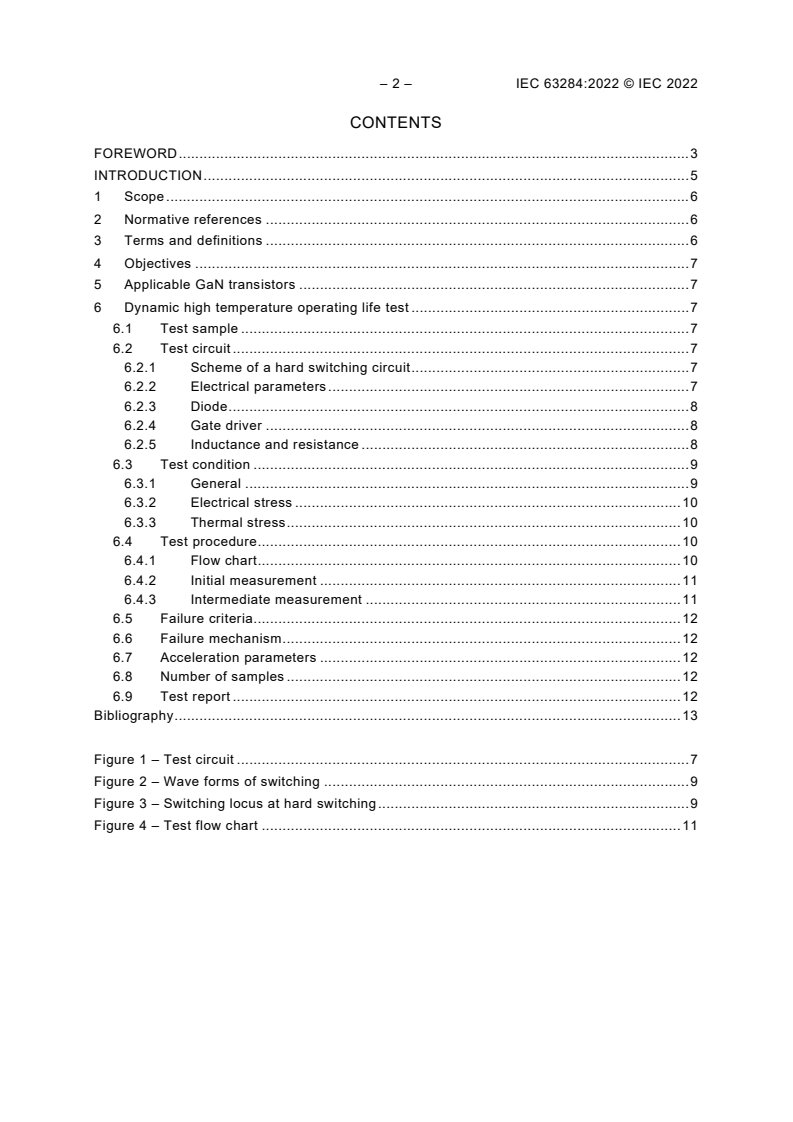
CONTENTS
FOREWORD . 3
INTRODUCTION . 5
1 Scope . 6
2 Normative references . 6
3 Terms and definitions . 6
4 Objectives . 7
5 Applicable GaN transistors . 7
6 Dynamic high temperature operating life test . 7
6.1 Test sample . 7
6.2 Test circuit . 7
6.2.1 Scheme of a hard switching circuit . 7
6.2.2 Electrical parameters . 7
6.2.3 Diode . 8
6.2.4 Gate driver . 8
6.2.5 Inductance and resistance . 8
6.3 Test condition . 9
6.3.1 General . 9
6.3.2 Electrical stress . 10
6.3.3 Thermal stress . 10
6.4 Test procedure . 10
6.4.1 Flow chart . 10
6.4.2 Initial measurement . 11
6.4.3 Intermediate measurement . 11
6.5 Failure criteria . 12
6.6 Failure mechanism . 12
6.7 Acceleration parameters . 12
6.8 Number of samples . 12
6.9 Test report . 12
Bibliography . 13
Figure 1 – Test circuit . 7
Figure 2 – Wave forms of switching . 9
Figure 3 – Switching locus at hard switching . 9
Figure 4 – Test flow chart . 11
INTERNATIONAL ELECTROTECHNICAL COMMISSION
____________
SEMICONDUCTOR DEVICES – RELIABILITY TEST METHOD BY INDUCTIVE
LOAD SWITCHING FOR GALLIUM NITRIDE TRANSISTORS
FOREWORD
1) The International Electrotechnical Commission (IEC) is a worldwide organization for standardization comprising
all national electrotechnical committees (IEC National Committees). The object of IEC is to promote international
co-operation on all questions concerning standardization in the electrical and electronic fields. To this end and
in addition to other activities, IEC publishes International Standards, Technical Specifications, Technical Reports,
Publicly Available Specifications (PAS) and Guides (hereafter referred to as “IEC Publication(s)”). Their
preparation is entrusted to technical committees; any IEC National Committee interested in the subject dealt with
may participate in this preparatory work. International, governmental and non-governmental organizations liaising
with the IEC also participate in this preparation. IEC collaborates closely with the International Organization for
Standardization (ISO) in accordance with conditions determined by agreement between the two organizations.
2) The formal decisions or agreements of IEC on technical matters express, as nearly as possible, an international
consensus of opinion on the relevant subjects since each technical committee has representation from all
interested IEC National Committees.
3) IEC Publications have the form of recommendations for international use and are accepted by IEC National
Committees in that sense. While all reasonable efforts are made to ensure that the technical content of IEC
Publications is accurate, IEC cannot be held responsible for the way in which they are used or for any
misinterpretation by any end user.
4) In order to promote international uniformity, IEC National Committees undertake to apply IEC Publications
transparently to the maximum extent possible in their national and regional publications. Any divergence between
any IEC Publication and the corresponding national or regional publication shall be clearly indicated in the latter.
5) IEC itself does not provide any attestation of conformity. Independent certification bodies provide conformity
assessment services and, in some areas, access to IEC marks of conformity. IEC is not responsible for any
services carried out by independent certification bodies.
6) All users should ensure that they have the latest edition of this publication.
7) No liability shall attach to IEC or its directors, employees, servants or agents including individual experts and
members of its technical committees and IEC National Committees for any personal injury, property damage or
other damage of any nature whatsoever, whether direct or indirect, or for costs (including legal fees) and
expenses arising out of the publication, use of, or reliance upon, this IEC Publication or any other IEC
Publications.
8) Attention is drawn to the Normative references cited in this publication. Use of the referenced publications is
indispensable for the correct application of this publication.
9) Attention is drawn to the possibility that some of the elements of this IEC Publication may be the subject of patent
rights. IEC shall not be held responsible for identifying any or all such patent rights.
IEC 63284 has been prepared by IEC technical committee 47: Semiconductor devices. It is an
International Standard.
The text of this International Standard is based on the following documents:
Draft Report on voting
47/2753/FDIS 47/2763/RVD
Full information on the voting for its approval can be found in the report on voting indicated in
the above table.
The language used for the development of this International Standard is English.
This document was drafted in accordance with ISO/IEC Directives, Part 2, and developed in
accordance with ISO/IEC Directives, Part 1 and ISO/IEC Directives, IEC Supplement, available
at www.iec.ch/members_experts/refdocs. The main document types developed by IEC are
described in greater detail at www.iec.ch/standardsdev/publications.
– 4 – IEC 63284:2022 © IEC 2022
The committee has decided that the contents of this document will remain unchanged until the
stability date indicated on the IEC website under webstore.iec.ch in the data related to the
specific document. At this date, the document will be
• reconfirmed,
• withdrawn,
• replaced by a revised edition, or
• amended.
INTRODUCTION
Gallium nitride (GaN), one of the wide bandgap semiconductors, has superior properties over
conventional silicon (Si) for power devices, such as high breakdown electric field and high
saturation velocity. Two dimensional electron gas with high mobility and high concentration is
induced by forming heterojunction of GaN with aluminum gallium nitride (AlGaN) due to
polarization effects, which is another merit of GaN related materials. Moreover, several kinds
of materials such as Si, sapphire, silicon-carbide (SiC) or GaN can be selected as epitaxial
growth substrates in terms of device performances and costs. Recently, GaN power transistors
have been widely developed and commercialized.
GaN power transistors have some unique failure modes due to device construction differences
and carrier trapping effects. In addition, GaN power transistors are more compact, so are
exposed to higher fields. Further, some hot-carrier and robustness tests for silicon Field Effect
Transistors (FETs) are not applicable to GaN FETs. For example, the hot carrier injection (HCI)
test for lateral MOSFETs is not applicable to lateral GaN FETs due to the blocking nature of the
buffer, and the unclamped inductive switching (UIS) test is not useful because it could cause
damage. Therefore, several unique reliability test methods, which are not generally requested
for Si power transistors, are performed as reliability examination, for example, test methods of
dynamic on-resistances. Especially, switching test methods and reliability procedures are
significant for practical use and need to be standardized in order to establish switching reliability
of GaN power transistors.
This document is a guideline focusing on inductive load switching in order to confirm the
conditions under which GaN power transistors are used reliably. Since the inductive load
switching is considered to be an important stress application for power devices, this guideline
will promote the acceptance of GaN power transistors in the power device market. However, it
is important to note that there are other application-relevant stress conditions, such as
soft-switching at high frequencies, which will not be covered by this document.
– 6 – IEC 63284:2022 © IEC 2022
SEMICONDUCTOR DEVICES – RELIABILITY TEST METHOD BY INDUCTIVE
LOAD SWITCHING FOR GALLIUM NITRIDE TRANSISTORS
1 Scope
This document covers the protocol of performing a stress procedure and a corresponding test
method to evaluate the reliability of gallium nitride (GaN) power transistors by inductive load
switching, specifically hard-switching stress.
2 Normative references
There are no normative references in this document.
3 Terms and definitions
For the purposes of this document, the following terms and definitions apply.
ISO and IEC maintain terminological databases for use in standardization at the following
addresses:
• IEC Electropedia: available at http://www.electropedia.org/
• ISO Online browsing platform: available at http://www.iso.org/obp
3.1
gallium nitride
GaN
compound semiconductor material composed of gallium and nitrogen
3.2
aluminum gallium nitride
AlGaN
compound semiconductor alloy of aluminum nitride and gallium nitride
3.3
on-state resistance
resistance of the device at nominal current conditions
3.4
dynamic on-state resistance
ratio of on-state drain-source voltage(v ) to drain current(i ) at switching
DS D
3.5
dynamic high temperature operating life test
DHTOL test
reliability test of continuous switching stress with high junction temperature
Note 1 to entry: The term DHTOL is used broadly, encompassing both switching accelerated life test (SALT), where
failures are expected for wearout modelling, and HTOL, where failures are not expected.
3.6
switching locus
trajectory showing relationship between v and i during switching
DS D
4 Objectives
The purpose of this document is to define a reliability test method for finding conditions under
which GaN power transistors can operate reliably, when they are used for continuous hard
switching with inductive loads. Therefore, this document does not cover other
application-relevant stress conditions, such as third quadrant operation and soft-switching or
other types of circuit topologies.
5 Applicable GaN transistors
This test method can be applied to all power transistors, which include GaN power transistors
with any substrate such as Si, SiC, sapphire or GaN, and to lateral or vertical types. Moreover,
this test method can be applied to any gate structure such as Schottky-types, p-type GaN
(p-GaN) types and MIS (metal-insulator-semiconductor) types. It can also be applicable to
normally-off types, normally-on types and to cascode configuration types.
6 Dynamic high temperature operating life test
6.1 Test sample
The test sample is recommended to be an actual packaged product. For family products,
reliability test results of transistors with large gate widths can be applied to transistors with
small gate widths when use conditions such as current density and supply voltage are
equivalent or less.
6.2 Test circuit
6.2.1 Scheme of a hard switching circuit
The dynamic high temperature operating life (DHTOL) test employs a hard switching circuit with
an inductive load as shown in Figure 1.
Figure 1 – Test circuit
6.2.2 Electrical parameters
Frequency f, power supply voltage V , and average current flowing through inductance I
DD L(AV)
are set by considering the actual operating condition.
– 8 – IEC 63284:2022 © IEC 2022
6.2.3 Diode
A diode is selected by considering the maximum current and the maximum voltage. In particular,
since the recovery current of the diode flows to the transistor at turn-on time, the diode is
selected to replicate the switching conditions of the final application, e.g. emulate the
capacitance of the high-side FET, or have a larger capacitance for accelerated stress.
6.2.4 Gate driver
A test circuit including a gate drive circuit suitable for the individual test transistor is constructed
with attention paid to heat dissipation of each component. The gate driver is required to drive
DUT in the same conditions as the actual usage unless switching parameters to acquire
acceleration factors are included. Note that the gate driver is also required to have current
driving capability so as not to cause false turn-on of the DUT.
6.2.5 Inductance and resistance
An inductance value L and a resistance value R are set with reference to the following
C L
Equation (1) to Equation (3) and the switching waveforms in Figure 2.
ΔI
L×= VI− ×R (1)
C DD L(AV) L
t
ΔI
L× I ×+RV
C L(AV) L F
t
(2)
f= (3)
tt+
where
V is the power supply voltage;
DD
I is the average current;
L (AV)
ΔI is the ripple current;
V is the threshold voltage of diode;
F
L is the coil inductance value;
C
R is the load resistance value;
L
is the on time;
t
t is the off time;
f is the switching frequency.
=
Figure 2 – Wave forms of switching
Figure 3 – Switching locus at hard switching
6.3 Test condition
6.3.1 General
After the test circuit is configured, electrical and thermal stress conditions are applied and
evaluated.
– 10 – IEC 63284:2022 © IEC 2022
6.3.2 Electrical stress
A switching locus of the test transistor is constructed by using switching wave forms as shown
in Figure 3. It is confirmed that the current and voltage stress conditions are equivalent to or
greater than the actual application. For more details on how to assess whether the current and
voltage stress is equivalent to the actual application, refer to JEDEC JEP180.01, Clause 5 [1] .
6.3.3 Thermal stress
External heating and/or cooling may be used in order that thermal stress is independently varied
without changing other stress conditions. When other stress conditions are varied with
minimizing effects of variation in junction temperature, the relative changes of the junction
temperature should be monitored by a thermocouple provided as close as possible to the DUT
or by a thermo-viewer. The junction temperature is recommended to be equal to or below the
absolute maximum rating temperature. The protocol is described in 6.6 if a more accelerated
temperature is used.
6.4 Test procedure
6.4.1 Flow chart
A flow chart of the DHTOL test is shown in Figure 4. In the flow chart, the procedure is aimed
at accelerated life testing (ALT).
____________
Numbers in square brackets refer to the Bibliography.
Figure 4 – Test flow chart
6.4.2 Initial measurement
Initial measurements of on-state resistance, threshold voltage and off-state leak current shall
be conducted as transistor parameters. Other parameters may be considered, for example,
those listed in the datasheet of the DUT and determined to suffer shift due to switching stress.
6.4.3 Intermediate measurement
The test is interrupted to check the parameters obtained at the initial measurements. If it is
difficult to detach the mounted evaluation transistor, the interruption of the test can be omitted,
and the test shall be completed when the transistor has catastrophically failed or it reaches the
predetermined time.
If the root causes of the failures are investigated, monitoring dynamic on-state resistance in-situ
during the test may provide additional insight. The dynamic on-state resistance is calculated
from the ratio of v and i just after turning on by using a clamp circuit in order to capture the
DS D
oscilloscope waveforms at the resolution needed. For additional information on the dynamic
on-state resistance, refer to JEDEC JEP173 [2].
– 12 – IEC 63284:2022 © IEC 2022
6.5 Failure criteria
Since the test conditions of supply voltage and current generally exceed general use condition,
catastrophic failures are caused in most cases. Otherwise, drift of the device electrical
parameters from its limits of minimum and maximum in the datasheet is defined as a failure
(sometimes referred to as parametric failure). In addition, the time from the start of the test to
the failure is defined as a time to failure.
6.6 Failure mechanism
If the test is accelerated by setting the average current, power supply voltage, or junction
temperature over the absolute maximum rating values, it is necessary to confirm that the failure
mechanism is the same as the one assumed in the test within the absolute maximum rating
values. As confirmation methods, in the case of a failure accompanied by catastrophic failures,
it is necessary to check the current and voltage waveforms at the time of catastrophic failures
and the failure points in the semiconductor die by opening the package. In the case of a failure
due to deterioration of the transistor characteristics, the failure mechanism may be confirmed
from the changes of the transistor parameters.
6.7 Acceleration parameters
In this test, a lifetime under actual use conditions is estimated by checking the presence of
acceleration for each parameter such as average current, power supply voltage, switching
frequency, ON/OFF duty ratio, junction temperature, etc. One of the possible failures is caused
by a dynamic on-state resistance increase which may be affected by current and voltage.
6.8 Number of samples
An appropriate number of samples depending on lifetime distributions is required in order to
utilize probability theory and statistics.
6.9 Test report
A
...