

IEC 63505:2025
(Main)Guidelines for measuring the threshold voltage (VT) of SiC MOSFETs
General Information
- Abstract
IEC 63505:2025 gives guidance on VT measurement methods and conditioning prior to VT testing in SiC power MOSFETs to reduce or eliminate the effect of the aforementioned hysteresis. The method is applicable for PBTI testing, NBTI and threshold voltage changes caused by switching events are excluded from the scope.
SiC MOSFETs have threshold voltage hysteresis caused by transient trap effects, which impacts the evaluation of the actual the VT shift caused by stress tests such as bias temperature instabilities (BTI).
- Status
- Published
- Publication Date
- 07-Apr-2025
- Technical Committee
- TC 47 - Semiconductor devices
- Drafting Committee
- WG 8 - TC 47/WG 8
- Current Stage
- PPUB - Publication issued
- Start Date
- 08-Apr-2025
- Completion Date
- 28-Mar-2025
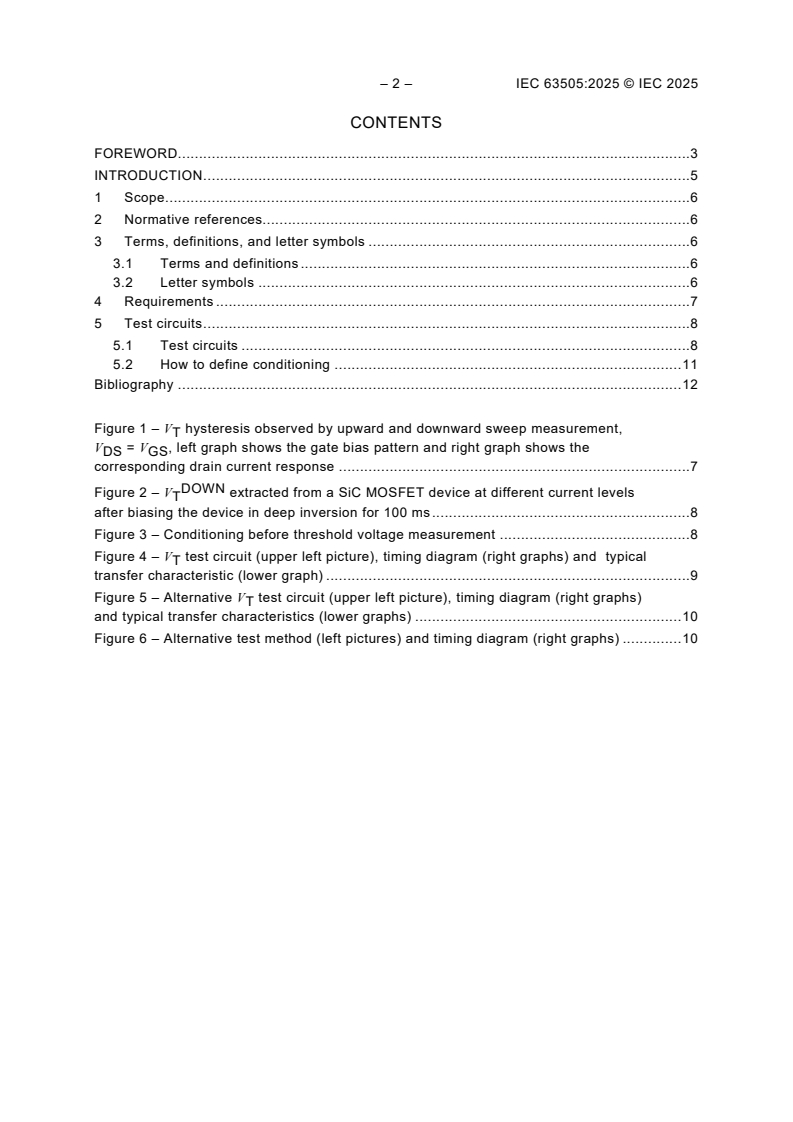
Overview
IEC 63505:2025 - Guidelines for measuring the threshold voltage (VT) of SiC MOSFETs provides practical, consensus guidance for measuring and conditioning the threshold voltage of N‑channel vertical-structure silicon carbide (SiC) power MOSFETs. The standard addresses measurement methods and pre‑test conditioning that reduce or eliminate VT hysteresis caused by transient traps at the SiC/SiO2 interface. The methods are applicable for positive bias temperature instability (PBTI) testing; negative BTI (NBTI) and VT changes caused by switching events are excluded from the scope.
Key topics and technical requirements
- VT hysteresis: SiC MOSFETs can show gate-sweep hysteresis from transient trap effects, complicating true VT-shift evaluation after stress (e.g., BTI).
- Conditioning pulse: A positive gate pulse (up to VGS_MAX) applied before measurement minimizes hysteresis; the pulse can make VT effectively “flat” over time.
- Test circuits and extraction methods:
- Conventional SMU-based transfer sweep (separate gate and drain): measure IDS while sweeping VGS upward and downward.
- Gate‑drain shorted (GDS) methods: extract VT from the X‑intercept of √IDS vs VGS or by forcing a target IDS for a spot measurement.
- Measurement details:
- Small VGS step for sweeps (recommended e.g., 0.1 V) to improve VT accuracy.
- Define a threshold current (Ith) for VT determination.
- Recommended timing intervals (from literature and expert consensus):
- For sweep test circuit: t_con = 1–100 ms; t_V < 10 ms × number of steps; t_float < 10 ms (keep as short as possible).
- For GDS/alternative methods: t_con = 1–100 ms; t_V < 100 ms (device dependent); t_float < 50 ms.
- Test conditions: Maintain consistent conditioning pulse width and device temperature to ensure repeatable VT values.
Applications - who uses this standard
- SiC power semiconductor manufacturers and process engineers (datasheet and process control)
- Reliability and test engineers performing PBTI stress and VT monitoring
- Device characterization labs and OEM power electronics teams validating on-resistance transitions and final tests
- Technology development teams optimizing gate oxide and interface treatments
Related standards and references
- JEDEC JEP183A - predecessor guidance referenced in IEC 63505
- IEC 60747‑8 - related device symbol conventions (document cites symbol usage)
- Use IEC Electropedia and ISO Online Browsing Platform for terminology
Keywords: IEC 63505:2025, SiC MOSFET, threshold voltage, VT measurement, VT hysteresis, conditioning pulse, PBTI, SMU, gate‑drain shorted (GDS), bias temperature instability (BTI).
Frequently Asked Questions
IEC 63505:2025 is a standard published by the International Electrotechnical Commission (IEC). Its full title is "Guidelines for measuring the threshold voltage (<em>V</em><sub>T</sub>) of SiC MOSFETs". This standard covers: IEC 63505:2025 gives guidance on VT measurement methods and conditioning prior to VT testing in SiC power MOSFETs to reduce or eliminate the effect of the aforementioned hysteresis. The method is applicable for PBTI testing, NBTI and threshold voltage changes caused by switching events are excluded from the scope. SiC MOSFETs have threshold voltage hysteresis caused by transient trap effects, which impacts the evaluation of the actual the VT shift caused by stress tests such as bias temperature instabilities (BTI).
IEC 63505:2025 gives guidance on VT measurement methods and conditioning prior to VT testing in SiC power MOSFETs to reduce or eliminate the effect of the aforementioned hysteresis. The method is applicable for PBTI testing, NBTI and threshold voltage changes caused by switching events are excluded from the scope. SiC MOSFETs have threshold voltage hysteresis caused by transient trap effects, which impacts the evaluation of the actual the VT shift caused by stress tests such as bias temperature instabilities (BTI).
IEC 63505:2025 is classified under the following ICS (International Classification for Standards) categories: 31.080.30 - Transistors. The ICS classification helps identify the subject area and facilitates finding related standards.
IEC 63505:2025 is available in PDF format for immediate download after purchase. The document can be added to your cart and obtained through the secure checkout process. Digital delivery ensures instant access to the complete standard document.
Standards Content (Sample)
IEC 63505 ®
Edition 1.0 2025-04
INTERNATIONAL
STANDARD
Guidelines for measuring the threshold voltage (V ) of SiC MOSFETs
T
All rights reserved. Unless otherwise specified, no part of this publication may be reproduced or utilized in any form
or by any means, electronic or mechanical, including photocopying and microfilm, without permission in writing from
either IEC or IEC's member National Committee in the country of the requester. If you have any questions about IEC
copyright or have an enquiry about obtaining additional rights to this publication, please contact the address below or
your local IEC member National Committee for further information.
IEC Secretariat Tel.: +41 22 919 02 11
3, rue de Varembé info@iec.ch
CH-1211 Geneva 20 www.iec.ch
Switzerland
About the IEC
The International Electrotechnical Commission (IEC) is the leading global organization that prepares and publishes
International Standards for all electrical, electronic and related technologies.
About IEC publications
The technical content of IEC publications is kept under constant review by the IEC. Please make sure that you have the
latest edition, a corrigendum or an amendment might have been published.
IEC publications search - webstore.iec.ch/advsearchform IEC Products & Services Portal - products.iec.ch
The advanced search enables to find IEC publications by a Discover our powerful search engine and read freely all the
variety of criteria (reference number, text, technical publications previews, graphical symbols and the glossary.
committee, …). It also gives information on projects, replaced With a subscription you will always have access to up to date
and withdrawn publications. content tailored to your needs.
IEC Just Published - webstore.iec.ch/justpublished
Electropedia - www.electropedia.org
Stay up to date on all new IEC publications. Just Published
The world's leading online dictionary on electrotechnology,
details all new publications released. Available online and once
containing more than 22 500 terminological entries in English
a month by email.
and French, with equivalent terms in 25 additional languages.
Also known as the International Electrotechnical Vocabulary
IEC Customer Service Centre - webstore.iec.ch/csc
(IEV) online.
If you wish to give us your feedback on this publication or need
further assistance, please contact the Customer Service
Centre: sales@iec.ch.
IEC 63505 ®
Edition 1.0 2025-04
INTERNATIONAL
STANDARD
Guidelines for measuring the threshold voltage (V ) of SiC MOSFETs
T
INTERNATIONAL
ELECTROTECHNICAL
COMMISSION
ICS 31.080.30 ISBN 978-2-8327-0325-0
– 2 – IEC 63505:2025 © IEC 2025
CONTENTS
FOREWORD . 3
INTRODUCTION . 5
1 Scope . 6
2 Normative references. 6
3 Terms, definitions, and letter symbols . 6
3.1 Terms and definitions . 6
3.2 Letter symbols . 6
4 Requirements . 7
5 Test circuits . 8
5.1 Test circuits . 8
5.2 How to define conditioning . 11
Bibliography . 12
Figure 1 – V hysteresis observed by upward and downward sweep measurement,
T
V = V , left graph shows the gate bias pattern and right graph shows the
DS GS
corresponding drain current response . 7
DOWN
Figure 2 – V extracted from a SiC MOSFET device at different current levels
T
after biasing the device in deep inversion for 100 ms . 8
Figure 3 – Conditioning before threshold voltage measurement . 8
Figure 4 – V test circuit (upper left picture), timing diagram (right graphs) and typical
T
transfer characteristic (lower graph) . 9
Figure 5 – Alternative V test circuit (upper left picture), timing diagram (right graphs)
T
and typical transfer characteristics (lower graphs) . 10
Figure 6 – Alternative test method (left pictures) and timing diagram (right graphs) . 10
INTERNATIONAL ELECTROTECHNICAL COMMISSION
____________
GUIDELINES FOR MEASURING THE THRESHOLD VOLTAGE (V )
T
OF SIC MOSFETS
FOREWORD
1) The International Electrotechnical Commission (IEC) is a worldwide organization for standardization comprising
all national electrotechnical committees (IEC National Committees). The object of IEC is to promote international
co-operation on all questions concerning standardization in the electrical and electronic fields. To this end and
in addition to other activities, IEC publishes International Standards, Technical Specifications, Technical Reports,
Publicly Available Specifications (PAS) and Guides (hereafter referred to as "IEC Publication(s)"). Their
preparation is entrusted to technical committees; any IEC National Committee interested in the subject dealt with
may participate in this preparatory work. International, governmental and non-governmental organizations liaising
with the IEC also participate in this preparation. IEC collaborates closely with the International Organization for
Standardization (ISO) in accordance with conditions determined by agreement between the two organizations.
2) The formal decisions or agreements of IEC on technical matters express, as nearly as possible, an international
consensus of opinion on the relevant subjects since each technical committee has representation from all
interested IEC National Committees.
3) IEC Publications have the form of recommendations for international use and are accepted by IEC National
Committees in that sense. While all reasonable efforts are made to ensure that the technical content of IEC
Publications is accurate, IEC cannot be held responsible for the way in which they are used or for any
misinterpretation by any end user.
4) In order to promote international uniformity, IEC National Committees undertake to apply IEC Publications
transparently to the maximum extent possible in their national and regional publications. Any divergence between
any IEC Publication and the corresponding national or regional publication shall be clearly indicated in the latter.
5) IEC itself does not provide any attestation of conformity. Independent certification bodies provide conformity
assessment services and, in some areas, access to IEC marks of conformity. IEC is not responsible for any
services carried out by independent certification bodies.
6) All users should ensure that they have the latest edition of this publication.
7) No liability shall attach to IEC or its directors, employees, servants or agents including individual experts and
members of its technical committees and IEC National Committees for any personal injury, property damage or
other damage of any nature whatsoever, whether direct or indirect, or for costs (including legal fees) and
expenses arising out of the publication, use of, or reliance upon, this IEC Publication or any other IEC
Publications.
8) Attention is drawn to the Normative references cited in this publication. Use of the referenced publications is
indispensable for the correct application of this publication.
9) IEC draws attention to the possibility that the implementation of this document may involve the use of (a)
patent(s). IEC takes no position concerning the evidence, validity, or applicability of any claimed patent rights in
respect thereof. As of the date of publication of this document, IEC had not received notice of (a) patent(s), which
may be required to implement this document. However, implementers are cautioned that this may not represent
the latest information, which may be obtained from the patent database available at https://patents.iec.ch. IEC
shall not be held responsible for identifying any or all such patent rights.
IEC 63505 has been prepared by IEC technical committee 47: Semiconductor devices. It is an
International Standard.
This standard is based upon JEP183 [1] with permission of the copyright holder, JEDEC Solid
State Technology Association, and was submitted as a Fast-Track document.
___________
Numbers in square brackets refer to the Bibliography.
– 4 – IEC 63505:2025 © IEC 2025
The text of this International Standard is based on the following documents:
Draft Report on voting
47/2885/FDIS 47/2908/RVD
Full information on the voting for its approval can be found in the report on voting indicated in
th
...