

IEC 62386-302:2017
(Main)Digital addressable lighting interface - Part 302: Particular requirements - Input devices - Absolute input devices
General Information
- Abstract
IEC 62386-302:2017 specifies a bus system for control by digital signals of electronic lighting equipment which is in line with the requirements of IEC 61347, with the addition of DC supplies.
This document is only applicable to IEC 62386-103:2014 and IEC 62386-103:2014/AMD1:— input devices that make the lighting control system sensitive to absolute input devices such as switches or sliders. An absolute input device always has a deterministic state, such as a position between start and end point.
- Status
- Published
- Publication Date
- 09-Apr-2024
- Technical Committee
- SC 34C - Auxiliaries for lamps
- Drafting Committee
- WG 11 - TC 34/WG 11
- Current Stage
- PPUB - Publication issued
- Start Date
- 19-May-2017
- Completion Date
- 26-May-2017
Buy Documents
IEC 62386-302:2017+AMD1:2024 CSV - Digital addressable lighting interface - Part 302: Particular requirements - Input devices - Absolute input devices Released:4/10/2024

IEC 62386-302:2017 - Digital addressable lighting interface - Part 302: Particular requirements - Input devices - Absolute input devices Released:5/19/2017
Overview
IEC 62386-302:2017 (consolidated with AMD1:2024) is part of the Digital Addressable Lighting Interface (DALI) family of standards. It specifies particular requirements for absolute input devices used in DALI lighting control systems - devices whose state is deterministic (for example, a slider position or a switch position between defined end points). The standard covers a digital bus system for controlling electronic lighting equipment (aligned with IEC 61347 requirements) and includes provisions for DC supplies.
This standard is intended to be used together with IEC 62386-103 (general requirements for input/control devices) and sits within the broader IEC 62386 series for DALI-compatible lighting control.
Key Topics and Requirements
- Scope and applicability: Defines absolute input devices that report a deterministic state to a DALI bus and interact with other IEC 62386 parts.
- Electrical and power requirements: Interface power supply and insulation rules consistent with system safety expectations.
- Transmission protocol and timing: Structure of bus messages and timing constraints to ensure reliable reporting and control.
- Method of operation / Instance model: Instance types, mapping of physical input signals to the standardized inputValue, and relation tables for signal interpretation.
- Event handling: Encoding, priority usage, event generation and bus usage for position and state events.
- Configuration parameters: Timers and filters such as SET REPORT TIMER and SET DEADTIME TIMER, event filters and manual configuration capabilities.
- Commands and messages: Standard device and instance commands including INPUT NOTIFICATION and POWER NOTIFICATION, device queries and configuration instructions.
- Error and exception handling: Manufacturer-specific errors, error value definition and instance error reporting.
- Application examples: Normative annex showing wiring/examples for single switches, rotary switches and sliders.
Practical Applications
- Design and manufacture of DALI-compatible absolute input devices (sliders, potentiometers, rotary switches, multi-position switches).
- Integration of absolute controls into building automation and smart lighting systems where deterministic input state is required.
- Firmware and system developers implementing DALI device instances, event encoding, timers and command handling.
- System integrators, lighting designers and specifiers creating reliable human interfaces for dimming, scene control or position-based inputs.
- Test labs and certification bodies verifying compliance with IEC 62386 series requirements.
Who Should Use This Standard
- Product manufacturers of input devices and lighting control gear
- Firmware and embedded systems engineers working on DALI implementations
- Lighting system integrators and installers
- Certification bodies and test laboratories
- Architects and lighting designers requiring compliance and interoperability
Related Standards
- IEC 62386-101 / -102 / -103 (general system and control device requirements)
- IEC 61347 (requirements for lamp controlgear)
- Other parts of the IEC 62386 DALI series
Keywords: IEC 62386-302:2017, DALI, digital addressable lighting interface, absolute input devices, lighting control, inputValue, report timer, deadtime timer, input notification, bus protocol.
Relations
- Effective Date
- 05-Sep-2023
Buy Documents
IEC 62386-302:2017+AMD1:2024 CSV - Digital addressable lighting interface - Part 302: Particular requirements - Input devices - Absolute input devices Released:4/10/2024
IEC 62386-302:2017 - Digital addressable lighting interface - Part 302: Particular requirements - Input devices - Absolute input devices Released:5/19/2017
Get Certified
Connect with accredited certification bodies for this standard

IMQ S.p.A. (Certification)
Italian electrical product certification.

SLG Prüf- und Zertifizierungs GmbH
German testing and certification body.

UL Solutions
Global safety science company with testing, inspection and certification.
Sponsored listings
Frequently Asked Questions
IEC 62386-302:2017 is a standard published by the International Electrotechnical Commission (IEC). Its full title is "Digital addressable lighting interface - Part 302: Particular requirements - Input devices - Absolute input devices". This standard covers: IEC 62386-302:2017 specifies a bus system for control by digital signals of electronic lighting equipment which is in line with the requirements of IEC 61347, with the addition of DC supplies. This document is only applicable to IEC 62386-103:2014 and IEC 62386-103:2014/AMD1:— input devices that make the lighting control system sensitive to absolute input devices such as switches or sliders. An absolute input device always has a deterministic state, such as a position between start and end point.
IEC 62386-302:2017 specifies a bus system for control by digital signals of electronic lighting equipment which is in line with the requirements of IEC 61347, with the addition of DC supplies. This document is only applicable to IEC 62386-103:2014 and IEC 62386-103:2014/AMD1:— input devices that make the lighting control system sensitive to absolute input devices such as switches or sliders. An absolute input device always has a deterministic state, such as a position between start and end point.
IEC 62386-302:2017 is classified under the following ICS (International Classification for Standards) categories: 29.060.10 - Wires; 29.140.50 - Lighting installation systems; 29.140.99 - Other standards related to lamps. The ICS classification helps identify the subject area and facilitates finding related standards.
IEC 62386-302:2017 has the following relationships with other standards: It is inter standard links to IEC 62386-302:2017/AMD1:2024. Understanding these relationships helps ensure you are using the most current and applicable version of the standard.
IEC 62386-302:2017 is available in PDF format for immediate download after purchase. The document can be added to your cart and obtained through the secure checkout process. Digital delivery ensures instant access to the complete standard document.
Standards Content (Sample)
IEC 62386-302 ®
Edition 1.1 2024-04
CONSOLIDATED VERSION
INTERNATIONAL
STANDARD
colour
inside
Digital addressable lighting interface –
Part 302: Particular requirements – Input devices – Absolute input devices
All rights reserved. Unless otherwise specified, no part of this publication may be reproduced or utilized in any form
or by any means, electronic or mechanical, including photocopying and microfilm, without permission in writing from
either IEC or IEC's member National Committee in the country of the requester. If you have any questions about IEC
copyright or have an enquiry about obtaining additional rights to this publication, please contact the address below or
your local IEC member National Committee for further information.
IEC Secretariat Tel.: +41 22 919 02 11
3, rue de Varembé info@iec.ch
CH-1211 Geneva 20 www.iec.ch
Switzerland
About the IEC
The International Electrotechnical Commission (IEC) is the leading global organization that prepares and publishes
International Standards for all electrical, electronic and related technologies.
About IEC publications
The technical content of IEC publications is kept under constant review by the IEC. Please make sure that you have the
latest edition, a corrigendum or an amendment might have been published.
IEC publications search - webstore.iec.ch/advsearchform IEC Products & Services Portal - products.iec.ch
The advanced search enables to find IEC publications by a Discover our powerful search engine and read freely all the
variety of criteria (reference number, text, technical publications previews, graphical symbols and the glossary.
committee, …). It also gives information on projects, replaced With a subscription you will always have access to up to date
and withdrawn publications. content tailored to your needs.
IEC Just Published - webstore.iec.ch/justpublished
Electropedia - www.electropedia.org
Stay up to date on all new IEC publications. Just Published
The world's leading online dictionary on electrotechnology,
details all new publications released. Available online and once
containing more than 22 500 terminological entries in English
a month by email.
and French, with equivalent terms in 25 additional languages.
Also known as the International Electrotechnical Vocabulary
IEC Customer Service Centre - webstore.iec.ch/csc
(IEV) online.
If you wish to give us your feedback on this publication or need
further assistance, please contact the Customer Service
Centre: sales@iec.ch.
IEC 62386-302 ®
Edition 1.1 2024-04
CONSOLIDATED VERSION
INTERNATIONAL
STANDARD
colour
inside
Digital addressable lighting interface –
Part 302: Particular requirements – Input devices – Absolute input devices
INTERNATIONAL
ELECTROTECHNICAL
COMMISSION
ICS 29.140.50; 29.140.99 ISBN 978-2-8322-8752-1
REDLINE VERSION – 2 – IEC 62386-302:2017+AMD1:2024 CSV
© IEC 2024
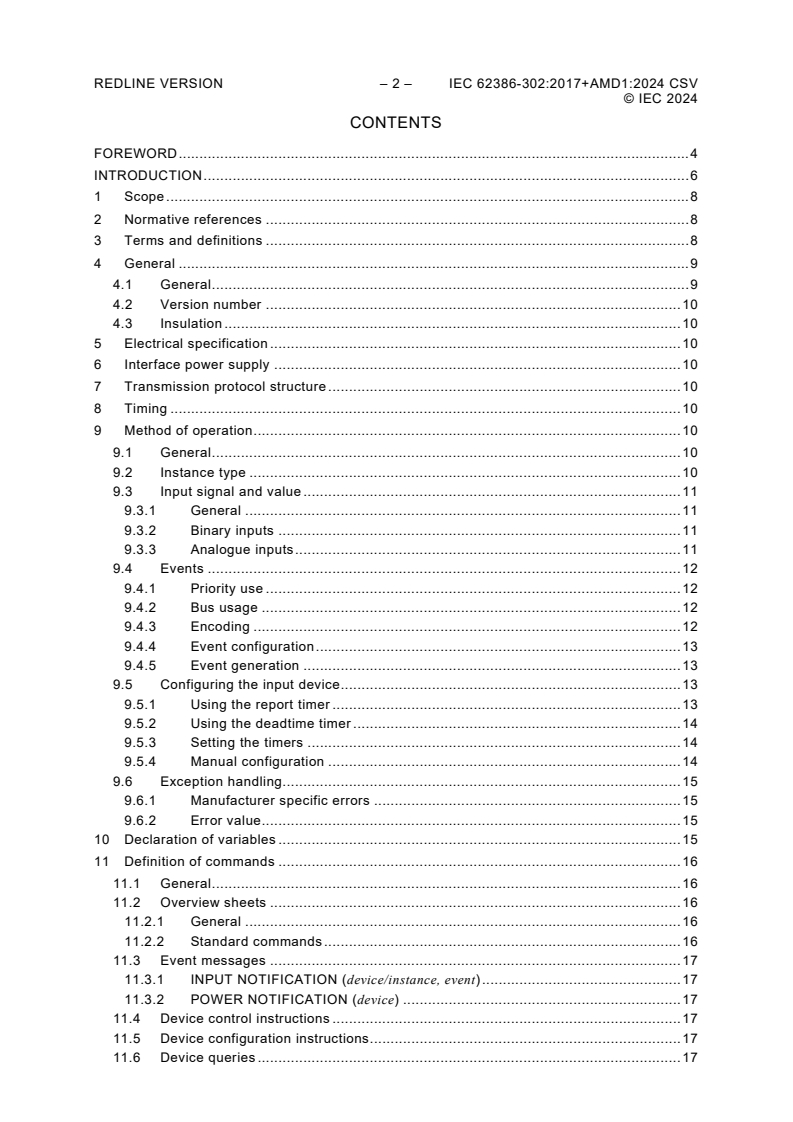
CONTENTS
FOREWORD . 4
INTRODUCTION . 6
1 Scope . 8
2 Normative references . 8
3 Terms and definitions . 8
4 General . 9
4.1 General . 9
4.2 Version number . 10
4.3 Insulation . 10
5 Electrical specification . 10
6 Interface power supply . 10
7 Transmission protocol structure . 10
8 Timing . 10
9 Method of operation . 10
9.1 General . 10
9.2 Instance type . 10
9.3 Input signal and value . 11
9.3.1 General . 11
9.3.2 Binary inputs . 11
9.3.3 Analogue inputs . 11
9.4 Events . 12
9.4.1 Priority use . 12
9.4.2 Bus usage . 12
9.4.3 Encoding . 12
9.4.4 Event configuration . 13
9.4.5 Event generation . 13
9.5 Configuring the input device . 13
9.5.1 Using the report timer . 13
9.5.2 Using the deadtime timer . 14
9.5.3 Setting the timers . 14
9.5.4 Manual configuration . 14
9.6 Exception handling. 15
9.6.1 Manufacturer specific errors . 15
9.6.2 Error value . 15
10 Declaration of variables . 15
11 Definition of commands . 16
11.1 General . 16
11.2 Overview sheets . 16
11.2.1 General . 16
11.2.2 Standard commands . 16
11.3 Event messages . 17
11.3.1 INPUT NOTIFICATION (device/instance, event) . 17
11.3.2 POWER NOTIFICATION (device) . 17
11.4 Device control instructions . 17
11.5 Device configuration instructions . 17
11.6 Device queries . 17
© IEC 2024
11.7 Instance control instructions . 17
11.8 Instance configuration instructions . 17
11.8.1 General . 17
11.8.2 SET REPORT TIMER (DTR0) . 18
11.8.3 SET DEADTIME TIMER (DTR0) . 18
11.8.4 SET EVENT FILTER (DTR0) . 18
11.9 Instance queries . 18
11.9.1 General . 18
11.9.2 QUERY INSTANCE ERROR . 18
11.9.3 QUERY DEADTIME TIMER . 18
11.9.4 QUERY REPORT TIMER . 18
11.9.5 QUERY SWITCH . 18
11.10 Special commands . 18
(normative) Examples of connecting external switches or sliders . 19
A.1 Single switch. 19
A.2 Single switch, two positions . 19
A.3 Single switch with neutral position. 19
A.4 Rotary switch . 19
A.5 Slider . 20
Bibliography . 21
Figure 1 – IEC 62386 graphical overview . 6
Figure A.1 – Single switch (single-pole, single-throw) . 19
Figure A.2 – Single switch double throw (single-pole, double-throw) . 19
Figure A.3 – Single switch (single-pole, double-throw) with neutral position . 19
Figure A.4 – Rotary switch . 20
Figure A.5 – Slider . 20
Table 1 – Relation of input signal and "inputValue" . 11
Table 2 – Position events . 12
Table 3 – Event filter . 13
Table 4 – Event timer setting . 14
Table 5 – “manualCapabilityInstance3xx” values . 15
Table 6 – “instanceErrorByte” values . 15
Table 7 – Declaration of device variables . 16
Table 8 – Restrictions to instance variables defined in IEC 62386-103:2014 and
IEC 62386-103:2014/AMD1:— IEC 62386-103:2022 . 16
Table 9 – Declaration of instance variables . 16
Table 10 – Standard commands . 17
REDLINE VERSION – 4 – IEC 62386-302:2017+AMD1:2024 CSV
© IEC 2024
INTERNATIONAL ELECTROTECHNICAL COMMISSION
____________
DIGITAL ADDRESSABLE LIGHTING INTERFACE –
Part 302: Particular requirements – Input devices –
Absolute input devices
FOREWORD
1) The International Electrotechnical Commission (IEC) is a worldwide organization for standardization comprising
all national electrotechnical committees (IEC National Committees). The object of IEC is to promote
international co-operation on all questions concerning standardization in the electrical and electronic fields. To
this end and in addition to other activities, IEC publishes International Standards, Technical Specifications,
Technical Reports, Publicly Available Specifications (PAS) and Guides (hereafter referred to as "IEC
Publication(s)"). Their preparation is entrusted to technical committees; any IEC National Committee interested
in the subject dealt with may participate in this preparatory work. International, governmental and non-
governmental organizations liaising with the IEC also participate in this preparation. IEC collaborates closely
with the International Organization for Standardization (ISO) in accordance with conditions determined by
agreement between the two organizations.
2) The formal decisions or agreements of IEC on technical matters express, as nearly as possible, an international
consensus of opinion on the relevant subjects since each technical committee has representation from all
interested IEC National Committees.
3) IEC Publications have the form of recommendations for international use and are accepted by IEC National
Committees in that sense. While all reasonable efforts are made to ensure that the technical content of IEC
Publications is accurate, IEC cannot be held responsible for the way in which they are used or for any
misinterpretation by any end user.
4) In order to promote international uniformity, IEC National Committees undertake to apply IEC Publications
transparently to the maximum extent possible in their national and regional publications. Any divergence
between any IEC Publication and the corresponding national or regional publication shall be clearly indicated in
the latter.
5) IEC itself does not provide any attestation of conformity. Independent certification bodies provide conformity
assessment services and, in some areas, access to IEC marks of conformity. IEC is not responsible for any
services carried out by independent certification bodies.
6) All users should ensure that they have the latest edition of this publication.
7) No liability shall attach to IEC or its directors, employees, servants or agents including individual experts and
members of its technical committees and IEC National Committees for any personal injury, property damage or
other damage of any nature whatsoever, whether direct or indirect, or for costs (including legal fees) and
expenses arising out of the publication, use of, or reliance upon, this IEC Publication or any other IEC
Publications.
8) Attention is drawn to the Normative references cited in this publication. Use of the referenced publications is
indispensable for the correct application of this publication.
9) IEC draws attention to the possibility that the implementation of this document may involve the use of (a)
patent(s). IEC takes no position concerning the evidence, validity or applicability of any claimed patent rights in
respect thereof. As of the date of publication of this document, IEC had not received notice of (a) patent(s),
which may be required to implement this document. However, implementers are cautioned that this may not
represent the latest information, which may be obtained from the patent database available at
https://patents.iec.ch. IEC shall not be held responsible for identifying any or all such patent rights.
This consolidated version of the official IEC Standard and its amendment has been
prepared for user convenience.
IEC 62386-302 edition 1.1 contains the first edition (2017-05) [documents 34C/1312/FDIS
and 34C/1332/RVD] and its amendment 1 (2024-04) [documents 34/1012/CDV and
34/1077A/RVC].
In this Redline version, a vertical line in the margin shows where the technical content
is modified by amendment 1. Additions are in green text, deletions are in strikethrough
red text. A separate Final version with all changes accepted is available in this
publication.
© IEC 2024
International Standard IEC 62386-302 has been prepared by subcommittee 34C: Auxiliaries
for lamps, of IEC technical committee 34: Lamps and related equipment.
This document has been drafted in accordance with the ISO/IEC Directives, Part 2.
This Part 302 of IEC 62386 is intended to be used in conjunction with:
• Part 101, which contains general requirements for system components;
• Part 103, which contains general requirements for control devices.
A list of all parts in the IEC 62386 series, published under the general title: Digital
addressable lighting interface, can be found on the IEC website.
The committee has decided that the contents of this document and its amendment will remain
unchanged until the stability date indicated on the IEC website under webstore.iec.ch in the
data related to the specific document. At this date, the document will be
• reconfirmed,
• withdrawn, or
• revised.
IMPORTANT – The 'colour inside' logo on the cover page of this publication indicates
that it contains colours which are considered to be useful for the correct
understanding of its contents. Users should therefore print this document using a
colour printer.
REDLINE VERSION – 6 – IEC 62386-302:2017+AMD1:2024 CSV
© IEC 2024
INTRODUCTION
IEC 62386 contains several parts, referred to as series. The 1xx series includes the basic
specifications. Part 101 contains general requirements for system components, Part 102
extends this information with general requirements for control gear and Part 103 extends it
further with general requirements for control devices.
The 2xx parts extend the general requirements for control gear with lamp specific extensions
(mainly for backward compatibility with Edition 1 of IEC 62386) and with control gear specific
features.
The 3xx parts extend the general requirements for control devices with input device specific
extensions describing the instance types as well as some common features that can be
combined with multiple instance types.
This first edition of IEC 62386-302 is intended to be used in conjunction with
IEC 62386-101:2014, IEC 62386-101:2014/AMD1:— IEC 62386-101:2022, IEC 62386-
103:2014 and IEC 62386-103:2014/AMD1:— IEC 62386-103:2022. The division of IEC 62386
into separately published parts provides for ease of future amendments and revisions.
Additional requirements will be added as and when a need for them is recognized.
The setup of the standards is graphically represented in Figure 1 below.
2xx 2xx 2xx 2xx 2xx 3xx 3xx 3xx 3xx 3xx
102 General requirements - 103 General requirements -
Control gear Control devices
101 General requirements -
System components
IEC
Figure 1 – IEC 62386 graphical overview
© IEC 2024
This document, and the other parts that make up the IEC 62386-300 series, in referring to any
of the clauses of IEC 62386-1XX, specifies the extent to which such a clause is; the parts also
include additional requirements, as necessary.
Where the requirements of any of the clauses of IEC 62386-1XX are referred to in this
document by the sentence “The requirements of IEC 62386-1XX, Clause “n” apply”, this
sentence is to be interpreted as meaning that all requirements of the clause in question of
Part 1XX apply, except any which are clearly inapplicable.
The standardization of the control interface for control devices is intended to achieve
compatible co-existence and multi-master operation between electronic control gear and
lighting control devices, below the level of building management systems. This document
describes a method of implementing control devices.
All numbers used in this document are decimal numbers unless otherwise noted. Hexadecimal
numbers are given in the format 0xVV, where VV is the value. Binary numbers are given in
the format XXXXXXXXb or in the format XXXX XXXX, where X is 0 or 1; “x” in binary numbers
means “don't care”.
The following typographic expressions are used:
Variables: “variableName” or “variableName[3:0]”, giving only bits 3 to 0 of “variableName”.
Range of values: [lowest, highest]
Command: “COMMAND NAME”
REDLINE VERSION – 8 – IEC 62386-302:2017+AMD1:2024 CSV
© IEC 2024
DIGITAL ADDRESSABLE LIGHTING INTERFACE –
Part 302: Particular requirements – Input devices –
Absolute input devices
1 Scope
This part of IEC 62386 specifies a bus system for control by digital signals of electronic
lighting equipment which is in line with the requirements of IEC 61347, with the addition of DC
supplies.
This document is only applicable to IEC 62386-103:2014 and IEC 62386-103:2014/AMD1:—
input devices that make the lighting control system sensitive to absolute input devices such as
switches or sliders. An absolute input device always has a deterministic state, such as a
position between start and end point.
NOTE Requirements for testing individual products during production are not included.
This part of IEC 62386 is applicable to input devices that provide the lighting control system
with absolute switch, slider or rotary switch information, such as a position between start and
end points.
This document is only applicable to input devices complying with IEC 62386-103:2022.
2 Normative references
The following documents are referred to in the text in such a way that some or all of their
content constitutes requirements of this document. For dated references, only the edition
cited applies. For undated references, the latest edition of the referenced document (including
any amendments) applies.
IEC 62386-101:20142022, Digital addressable lighting interface – Part 101: General
requirements – System components
IEC 62386-101:2014/AMD1:—
IEC 62386-103:20142022, Digital addressable lighting interface – Part 103: General
requirements – Control devices
IEC 62386-103:2014/AMD1—
IEC 62386-333:— 2018, Digital addressable lighting interface – Part 333: Particular
requirements for control devices – Manual configuration (feature type 33)
3 Terms and definitions
For the purposes of this document, the terms and definitions given in IEC 62386-101 and
IEC 62386-103 and the following apply.
______________
Under preparation. Stage at the time of publication: IEC ACDV 62386-101/AMD1:2017.
Under preparation. Stage at the time of publication: IEC ACDV 62386-103/AMD1:2017.
Under preparation. Stage at the time of publication: IEC CCDV 62386-333:2017.
© IEC 2024
ISO and IEC maintain terminological databases for use in standardization at the following
addresses:
• IEC Electropedia: available at http://www.electropedia.org/
• ISO Online browsing platform: available at http://www.iso.org/obp
3.1
instance
analogue or binary signal processing unit of an input device
[SOURCE: IEC 62386-101:20142022, 3.29, modified — addition of “analogue or binary”]
3.2
analogue input
means for the environment to interact with the lighting control system and known to be
represented by a specific value relative to the known upper and lower boundary
3.3
binary input
means for the environment to interact with the lighting control system and known to be in
open or closed state
3.4
bouncing
tendency of any two contacts in an electronic device to generate multiple signals as the
contacts close or open
3.5
debouncing
any kind of hardware device or software that ensures that only a single signal will be acted
upon for a single opening or closing of a contact
3.6
slider
means for the end user to interact with a control lighting system and known to be in a specific
position
3.7
strictly monotonic
either entirely increasing or decreasing without repeating values
Note 1 to entry: Function f defined on a subset of the real numbers with real values is called monotonically
increasing, if for all x and y such that x < y one has f(x) < f(y), so f preserves the order. Likewise, a function is
called monotonically decreasing if, whenever x < y, then f(x) > f(y) so it reverses the order. For this document
strictly monotonic is defined as either monotonically increasing or monotonically decreasing.
3.8
switch
means for the end user to interact with the lighting control system and known to be in open or
closed state
4 General
4.1 General
The requirements of IEC 62386-103:2014 and IEC 62386-103:2014/AMD1:— IEC 62386-
103:2022, Clause 4 apply, with the restrictions, changes and additions identified below.
REDLINE VERSION – 10 – IEC 62386-302:2017+AMD1:2024 CSV
© IEC 2024
4.2 Version number
In 4.2 of IEC 62386-103:2014 and IEC 62386-103:2014/AMD1:— IEC 62386-103:2022, “103”
shall be replaced by “302”, “version number” shall be replaced by “extended version number”
and “versionNumber” shall be replaced by "extendedVersionNumber".
4.3 Insulation
According to IEC 61347-1 applicable safety standards, it might can be required that the input
device has at least supplementary insulation to accessible parts. This depends on the
connected components. In case internal sliders or switches are used, the input device shall
have at least supplementary insulation. In case of external connected components, it depends
on the requirements imposed on these components. In this case special attention should be
paid with respect to the switches, sliders, rotaries or other sensor input components being
used.
NOTE IEC 62386-103:2014 and IEC 62386-103:2014/AMD1:— IEC 62386-103:2022 requires system components
to have at least basic insulation. Sliders and switches are intended to be safely operable by end users.
5 Electrical specification
The requirements of IEC 62386-103:2014 and IEC 62386-103:2014/AMD1:— IEC 62386-
103:2022, Clause 5 apply.
6 Interface power supply
The requirements of IEC 62386-103:2014 and IEC 62386-103:2014/AMD1:— IEC 62386-
103:2022, Clause 6 apply.
7 Transmission protocol structure
The requirements of IEC 62386-103:2014 and IEC 62386-103:2014/AMD1:— IEC 62386-
103:2022, Clause 7 apply.
NOTE Subclause 9.3.3.2 provides detailed event information applicable to instances.
8 Timing
The requirements of IEC 62386-103:2014 and IEC 62386-103:2014/AMD1:— IEC 62386-
103:2022, Clause 8 apply.
9 Method of operation
9.1 General
The requirements of IEC 62386-103:2014 and IEC 62386-103:2014/AMD1:— IEC 62386-
103:2022, Clause 9 apply, with the following restrictions and additions.
9.2 Instance type
The instance type (“instanceType”) shall be equal to 2.
© IEC 2024
9.3 Input signal and value
9.3.1 General
“inputValue” is an N-byte variable as defined in IEC 62386-103:2022, 9.8.2, and shall reflect
the input signal as shown in Table 1.
Table 1 – Relation of input signal and "inputValue"
d
”inputValue” Slider Analogue input Switch or
binary input
0x00 Minimum position Lower boundary value Open contact
”resolution” b
[0x01,2 - Position indication, linear Linear representation of the value Closed
a c
2] between min. and max. between the upper and lower contact
a
position boundary
”resolution”
[2 - 1] Maximum position Upper boundary value
a
Only applicable if “resolution” ≥ 2.
b
Unless specifically stated otherwise.
c
The maximum value depends on the available positions of the switch with respect to the reported resolution.
d
For sliders and analogue inputs, this column represents the "resolution" most significant bits of "inputValue",
with the remaining bits in accordance with IEC 62386-103:2022, 9.8.2.
An bouncing input signal shall be adequately debounced to ensure
• a single change of "inputValue" reflects the new state of the input signal a maximum of
80 ms from the first change of a bouncing or non-bouncing input signal;
• a single "INPUT NOTIFICATION" event message.
9.3.2 Binary inputs
9.3.2.1 General
For binary inputs the manual/documentation shall clearly state the relationship between
“inputValue” and the externally applied signal. At least the following parameters shall be
specified:
• input signal range that shall be considered to represent an open contact;
• input signal range that shall be considered to represent a closed contact.
9.3.2.2 Switch input
For switch inputs the manual/documentation shall clearly state any particular requirements for
the switches that can be connected.
A position change for a switch shall be considered as one action leading to one event at most.
9.3.3 Analogue inputs
9.3.3.1 General
For analogue inputs the manual/documentation shall clearly state the relationship between
“inputValue” the measured value defined in IEC 62386-103:2022, 9.8.2, and the externally
applied signal. At least the following parameters shall be specified:
• input signal that shall be considered to represent the “inputValue” (0) represented by a
measured value of 0;
REDLINE VERSION – 12 – IEC 62386-302:2017+AMD1:2024 CSV
© IEC 2024
• input signal that shall be considered to represent the “inputValue” represented by a
”resolution”
measured value of ([2 - 1]);
• the physical limits of the input signal that the analogue input can withstand.
Unless specifically stated otherwise the relationship between the input signal and “inputValue”
shall be linear.
9.3.3.2 Slider input
For slider inputs the manual/documentation shall clearly state any particular requirements for
the sliders that can be connected.
9.4 Events
9.4.1 Priority use
9.4.1.1 General
The default “eventPriority” shall be priority 3. Since the application controller needs a timeslot
to respond, “eventPriority” should not be set to 2.
9.4.1.2 Periodic events
The periodic "INPUT NOTIFICATION" message to report the position event shall always be
sent with priority 5.
NOTE This makes "eventPriority" inapplicable for this event only.
9.4.2 Bus usage
9.4.2.1 Instance level
Multiple events from an instance shall not be sent in a transaction. There is a configurable
delay T that shall be taken into account. See 9.5.2 for more information.
deadtime
9.4.2.2 Device level
At the device level, events from different instances may be sent in a transaction.
9.4.3 Encoding
Position events shall be encoded as shown in Table 2.
Table 2 – Position events
Event name Event Description
information
Position report positionEvent A position report, passing the actual position along.
For the event information of a binary/switch input see Annex A for possible encodings.
The event information of an analogue/slider input shall be encoded as follows:
• if “resolution” ≤ 10: “positionEvent” shall be encoded in such a way that the resulting event
information is a 10-bit value, according to IEC 62386-103:2014 and IEC 62386-
103:2014/AMD1:— IEC 62386-103:2022, 9.8.2;
• in all other cases: “positionEvent” shall provide the 10 MSB bits of the “inputValue”.
© IEC 2024
9.4.4 Event configuration
The application controller may not need all the events mentioned in 9.4.3. The instance shall
allow the application controller to set the “eventFilter” (see IEC 62386-103:2014 and
IEC 62386-103:2014/AMD1:—, 9.7.4) to inhibit those events that the application controller
does not need. For this document, “eventFilter” shall be reduced to one byte.
Events shall be enabled or disabled according to the value of "eventFilter". For this document,
"eventFilter" shall be reduced to one byte. No configuration of "eventFilter" shall prevent the
periodic "INPUT NOTIFICATION" message triggered by the report timer (9.5.1).
NOTE Inhibiting events increases the effective bus bandwidth availability.
The “eventFilter” shall have the definition as given in Table 3:
Table 3 – Event filter
Bit Description Value Default
0 Position event enabled? "1" = "Yes" 1
1 Reserved 0 0
2 Reserved 0 0
3 Reserved 0 0
4 Reserved 0 0
5 Reserved 0 0
6 Reserved 0 0
7 Reserved 0 0
The filter can be set via “SET EVENT FILTER (DTR0)” and be queried using
“QUERY EVENT FILTER 0-7”, see IEC 62386-103:2014 and IEC 62386-103:2014/AMD1:—
IEC 62386-103:2022 for details.
9.4.5 Event generation
An event shall be generated on every change of “inputValue” or when the report timer expires.
In case a new event occurs before the current event is being sent the new event shall replace
the current event. This could be caused for example by bus unavailability or the deadtime
timer.
9.5 Configuring the input device
9.5.1 Using the report timer
even if the “inputValue” has not
If the report timer is set, it shall trigger an event every T
report
changed. The report timer shall be restarted every time an event is sent.
The report timer shall be started
• at power-on: if enabled, immediately after the receiver has started up, with the time to the
first trigger recommended to be shortened to a random time between 0 s and T s;
report
• otherwise immediately after enablement.
This implies that the first "INPUT NOTIFICATION" message due to the report timer is sent at
a maximum time of T after starting. This may be delayed by other "INPUT
report
NOTIFICATION" messages, or by bus availability.
REDLINE VERSION – 14 – IEC 62386-302:2017+AMD1:2024 CSV
© IEC 2024
NOTE If multiple devices have the report timer enabled, they might send out conflicting data used by application
controllers to control the same control gear. Depending on the application care needs to be taken when enabling
the report timer. Application controllers can avoid this problem by enabling only the required report timer(s).
9.5.2 Using the deadtime timer
If the deadtime timer is set, the instance shall not send out an event until the deadtime timer
has expired. The deadtime timer shall be restarted every time an event is sent.
9.5.3 Setting the timers
The event deadtime and report timers shall be programmable as is indicated in Table 4.
For each timer, a fixed minimum duration and a fixed increment duration are given. The
application controller can set the desired actual timer duration by setting the number of
increments to some value in the range [0,255]. The resulting time shall be strictly monotonic
according to the following formula:
Time = T * multiplier
incr
Only on (re-)starting a timer the actual time shall be calculated based on the corresponding
variable. This implies that the times only change after any running timer has been cancelled
or expired. The tolerance on the time shall be ±5 %.
Table 4 – Event timer setting
Time Multiplier Default value T T T T
incr default min max
T “tDeadtime” 2 50 ms 100 ms 0 s 12,75 s
deadtime
T “tReport” 0 1 s ∞ s 1 s 4 min 15 s
report
The input device shall expose the following operations to set and observe the timer
multipliers:
• “SET REPORT TIMER (DTR0)”, “QUERY REPORT TIMER” to set or query "tReport";
• “SET DEADTIME TIMER (DTR0)", "QUERY DEADTIME TIMER” to set or query
"tDeadtime".
“SET REPORT TIMER (DTR0)” shall set “tReport” depending on the “DTR0” value. If “tReport”
is set to 0, the report timer shall be disabled immediately.
“SET DEADTIME TIMER (DTR0)” shall set “tDeadtime” depending on “DTR0”. If “tDeadtime” is
set to 0, the deadtime timer shall be disabled immediately, but shall not affect T until the
report
report timer is (re-)started.
If T < T , T shall be T (independent of the value of “tReport”).
report deadtime report deadtime
9.5.4 Manual configuration
If IEC 62386-333 is implemented, the instance level variables according to Table 5 may be
manually configured. QUERY MANUAL CONFIGURATION CAPABILITY 3xx (see
IEC 62386-333) shall return the byte as defined in Table 5:
© IEC 2024
Table 5 – “manualCapabilityInstance3xx” values
Bit Description Value
0 Manual configuration of “tReport” supported “1” = “Yes”
1 Manual configuration of “tDeadtime” supported “1” = “Yes”
2 Reserved “0”
3 Reserved “0”
4 Reserved “0”
5 Reserved “0”
6 Reserved “0”
7 Reserved “0”
9.6 Exception handling
9.6.1 Manufacturer specific errors
If a manufacturer specific error is detected, the instance shall set “instanceError” to TRUE,
from the moment the error occurs until the error is gone.
9.6.2 Error value
“instanceError” can be observed via “QUERY INSTANCE STATUS”.
While “instanceError” is set, “QUERY INSTANCE ERROR” shall return “instanceErrorByte”
according to Table 6:
Table 6 – “instanceErrorByte” values
Bit Description Value
0 Reserved “0”
1 Reserved “0”
2 Reserved “0”
3 Reserved “0”
4 Manufacturer specific error 1? "1" = "Yes"
5 Manufacturer specific error 2? "1" = "Yes"
6 Manufacturer specific error 3? "1" = "Yes"
7 Manufacturer specific error 4? “1” = “Yes”
If used, the meaning of bits [7:4] of “instanceErrorByte” shall be documented in the
manual/documentation. The impact on event generation shall also be documented.
10 Declaration of variables
The requirements of IEC 62386-103:2014 and IEC 62386-103:2014/AMD1:— IEC 62386-
103:2022, Clause 10 apply, with the following considerations.
Table 7 shows additions to the device variables.
REDLINE VERSION – 16 – IEC 62386-302:2017+AMD1:2024 CSV
© IEC 2024
Table 7 – Declaration of device variables
Variable Default value Reset value Power on Range of Memory
(factory) value validity type
“extendedVersionNumber” 2.0 no change no change 00001000b ROM
Table 8 shows restrictions to the instance variables.
Table 8 – Restrictions to instance variables defined in IEC 62386-103:2014 and
IEC 62386-103:2014/AMD1:— IEC 62386-103:2022
Variable Default value Reset value Power on Range of Memory
(factory) value validity type
“instanceType” 2 no change no change 2 ROM
“eventFilter” 0000 0001b 0000 0001b no change 0000 000xb NVM
“eventPriority” 3 3 no change [2,5] NVM
a
"instanceConfiguration[x]" reserved reserved reserved reserved reserved
a
Where x is in the range [0,190].
Table 9 shows additions to the instance variables.
Table 9 – Declaration of instance variables
Variable Default value Reset value Power on Range of Memory
(factory) value validity type
a
b
“instanceErrorByte” no change 0 xxxx 0000b RAM
“tDeadtime” 2 2 no change [0,255] NVM
“tReport” 0 0 no change [0,255] NVM
a
Not applicable.
b
The value should reflect the actual situation as soon as possible.
11 Definition of commands
11.1 General
Unused opcodes shall be reserved for future needs.
11.2 Overview sheets
11.2.1 General
The requirements of IEC 62386-103:2014 and IEC 62386-103:2014/AMD1:— IEC 62386-
103:2022, 11.2 apply, with the following additions.
11.2.2 Standard commands
Table 10 gives an overview of the additional commands.
© IEC 2024
Table 10 – Standard commands
Command name Address Instance Opcode See Command
byte byte byte subclause subclause
SET REPORT TIMER (DTR0) Device Instance 0x10 9.5.1 11.8.2
SET DEADTIME TIMER (DTR0) Device Instance 0x11 9.5.2 11.8.3
QUERY DEADTIME TIMER Device Instance 0x1D 9.5.2 11.9.3
QUERY REPORT TIMER Device Instance 0x1E 9.5.1 11.9.4
QUERY SWITCH Device Instance 0x1F 11.9.5
11.3 Event messages
11.3.1 INPUT NOTIFICATION (device/instance, event)
The requirements of IEC 62386-103:2014 and IEC 62386-103:2014/AMD1:— IEC 62386-
103:2022, 11.3.1 apply.
Refer to 9.4.3 for an overview of event values.
11.3.2 POWER NOTIFICATION (device)
The requirements of IEC 62386-103:2014 and IEC 62386-103:2014/AMD1:— IEC 62386-
103:2022, 11.3.2 apply.
11.4 Device control instructions
The requirements of 62386-103:2014 and IEC 62386-103:2014/AMD1:— IEC 62386-
103:2022, 11.4 apply.
11.5 Device configuration instructions
The requirements of IEC 62386-103:2014 and IEC 62386-103:2014/AMD1:— IEC 62386-
103:2022, 11.5 apply.
11.6 Device queries
The requirements of IEC 62386-103:2014 and IEC 62386-103:2014/AMD1:— IEC 62386-
103:2022, 11.6 apply.
11.7 Instance control instructions
The requirements of IEC 62386-103:2014 and IEC 62386-103:2014/AMD1:— IEC 62386-
103:2022, 11.7 apply.
11.8 Instance configuration instructions
11.8.1 General
The requirements of IEC 62386-103:2014 and IEC 62386-103:2014/AMD1:— IEC 62386-
103:2022, 11.8 apply, with the following additions and replacements:
DTR0
DTR1
DTR2
Answer
Send twice
REDLINE VERSION – 18 – IEC 62386-302:2017+AMD1:2024 CSV
© IEC 2024
11.8.2 SET REPORT TIMER (DTR0)
“tReport” shall be set to “DTR0”.
Refer to 9.5.1 for more information.
11.8.3 SET DEADTIME TIMER (DTR0)
“tDeadtime” shall be set to “DTR0”.
Refer to 9.5.2 for more information.
11.8.4 SET EVENT FILTER (DTR0)
“eventFilter” shall be set to DTR0 if the value is within the valid range. Otherwise, the
command shall be ignored discarded.
11.9 Instance queries
11.9.1 General
The requirements of IEC 62386-103:2014 and IEC 62386-103:2014/AMD1:— IEC 62386-
103:2022, 11.9 apply, with the following additions and replacements:
11.9.2 QUERY INSTANCE ERROR
The detailed error information shall be “instanceErrorByte”.
Refer to 9.6.1 for more information.
11.9.3 QUERY DEADTIME TIMER
The answer shall be “tDeadtime”.
Refer to 9.5.2 for more information.
11.9.4 QUERY REPORT TIMER
The answer shall be “tReport”.
Refer to 9.5.1 for more information.
11.9.5 QUERY SWITCH
The answer shall be YES in case the device represents a switch and NO otherwise.
NOTE This query helps the application controller to correctly interpret the values returned, as it is not possible to
distinguish a value returned by a switch from a value returned by a slider.
11.10 Special commands
The requirements of IEC 62386-103:2014 and IEC 62386-103:2014/AMD1:— IEC 62386-
103:2022, 11.10 apply.
...
IEC 62386-302 ®
Edition 1.0 2017-05
INTERNATIONAL
STANDARD
NORME
INTERNATIONALE
colour
inside
Digital addressable lighting interface –
Part 302: Particular requirements – Input devices – Absolute input devices
Interface d'éclairage adressable numérique –
Partie 302: Exigences particulières – Dispositifs d'entrée – Dispositifs d'entrée
absolus
All rights reserved. Unless otherwise specified, no part of this publication may be reproduced or utilized in any form
or by any means, electronic or mechanical, including photocopying and microfilm, without permission in writing from
either IEC or IEC's member National Committee in the country of the requester. If you have any questions about IEC
copyright or have an enquiry about obtaining additional rights to this publication, please contact the address below or
your local IEC member National Committee for further information.
Droits de reproduction réservés. Sauf indication contraire, aucune partie de cette publication ne peut être reproduite
ni utilisée sous quelque forme que ce soit et par aucun procédé, électronique ou mécanique, y compris la photocopie
et les microfilms, sans l'accord écrit de l'IEC ou du Comité national de l'IEC du pays du demandeur. Si vous avez des
questions sur le copyright de l'IEC ou si vous désirez obtenir des droits supplémentaires sur cette publication, utilisez
les coordonnées ci-après ou contactez le Comité national de l'IEC de votre pays de résidence.
IEC Central Office Tel.: +41 22 919 02 11
3, rue de Varembé Fax: +41 22 919 03 00
CH-1211 Geneva 20 info@iec.ch
Switzerland www.iec.ch
About the IEC
The International Electrotechnical Commission (IEC) is the leading global organization that prepares and publishes
International Standards for all electrical, electronic and related technologies.
About IEC publications
The technical content of IEC publications is kept under constant review by the IEC. Please make sure that you have the
latest edition, a corrigenda or an amendment might have been published.
IEC Catalogue - webstore.iec.ch/catalogue Electropedia - www.electropedia.org
The stand-alone application for consulting the entire The world's leading online dictionary of electronic and
bibliographical information on IEC International Standards, electrical terms containing 20 000 terms and definitions in
Technical Specifications, Technical Reports and other English and French, with equivalent terms in 16 additional
documents. Available for PC, Mac OS, Android Tablets and languages. Also known as the International Electrotechnical
iPad. Vocabulary (IEV) online.
IEC publications search - www.iec.ch/searchpub IEC Glossary - std.iec.ch/glossary
The advanced search enables to find IEC publications by a 65 000 electrotechnical terminology entries in English and
variety of criteria (reference number, text, technical French extracted from the Terms and Definitions clause of
committee,…). It also gives information on projects, replaced IEC publications issued since 2002. Some entries have been
and withdrawn publications. collected from earlier publications of IEC TC 37, 77, 86 and
CISPR.
IEC Just Published - webstore.iec.ch/justpublished
Stay up to date on all new IEC publications. Just Published IEC Customer Service Centre - webstore.iec.ch/csc
details all new publications released. Available online and If you wish to give us your feedback on this publication or
also once a month by email. need further assistance, please contact the Customer Service
Centre: csc@iec.ch.
A propos de l'IEC
La Commission Electrotechnique Internationale (IEC) est la première organisation mondiale qui élabore et publie des
Normes internationales pour tout ce qui a trait à l'électricité, à l'électronique et aux technologies apparentées.
A propos des publications IEC
Le contenu technique des publications IEC est constamment revu. Veuillez vous assurer que vous possédez l’édition la
plus récente, un corrigendum ou amendement peut avoir été publié.
Catalogue IEC - webstore.iec.ch/catalogue Electropedia - www.electropedia.org
Application autonome pour consulter tous les renseignements
Le premier dictionnaire en ligne de termes électroniques et
bibliographiques sur les Normes internationales,
électriques. Il contient 20 000 termes et définitions en anglais
Spécifications techniques, Rapports techniques et autres
et en français, ainsi que les termes équivalents dans 16
documents de l'IEC. Disponible pour PC, Mac OS, tablettes
langues additionnelles. Egalement appelé Vocabulaire
Android et iPad.
Electrotechnique International (IEV) en ligne.
Recherche de publications IEC - www.iec.ch/searchpub
Glossaire IEC - std.iec.ch/glossary
65 000 entrées terminologiques électrotechniques, en anglais
La recherche avancée permet de trouver des publications IEC
en utilisant différents critères (numéro de référence, texte, et en français, extraites des articles Termes et Définitions des
comité d’études,…). Elle donne aussi des informations sur les publications IEC parues depuis 2002. Plus certaines entrées
projets et les publications remplacées ou retirées. antérieures extraites des publications des CE 37, 77, 86 et
CISPR de l'IEC.
IEC Just Published - webstore.iec.ch/justpublished
Service Clients - webstore.iec.ch/csc
Restez informé sur les nouvelles publications IEC. Just
Published détaille les nouvelles publications parues. Si vous désirez nous donner des commentaires sur cette
Disponible en ligne et aussi une fois par mois par email. publication ou si vous avez des questions contactez-nous:
csc@iec.ch.
IEC 62386-302 ®
Edition 1.0 2017-05
INTERNATIONAL
STANDARD
NORME
INTERNATIONALE
colour
inside
Digital addressable lighting interface –
Part 302: Particular requirements – Input devices – Absolute input devices
Interface d'éclairage adressable numérique –
Partie 302: Exigences particulières – Dispositifs d'entrée – Dispositifs d'entrée
absolus
INTERNATIONAL
ELECTROTECHNICAL
COMMISSION
COMMISSION
ELECTROTECHNIQUE
INTERNATIONALE
ICS 29.140.50; 29.140.99 ISBN 978-2-8322-4342-8
– 2 – IEC 62386-302:2017 © IEC 2017
CONTENTS
FOREWORD . 4
INTRODUCTION . 6
1 Scope . 8
2 Normative references . 8
3 Terms and definitions . 8
4 General . 9
4.1 General . 9
4.2 Version number . 9
4.3 Insulation . 10
5 Electrical specification . 10
6 Interface power supply . 10
7 Transmission protocol structure . 10
8 Timing . 10
9 Method of operation . 10
9.1 General . 10
9.2 Instance type . 10
9.3 Input signal and value . 10
9.3.1 General . 10
9.3.2 Binary inputs . 11
9.3.3 Analogue inputs . 11
9.4 Events . 12
9.4.1 Priority use . 12
9.4.2 Bus usage . 12
9.4.3 Encoding . 12
9.4.4 Event configuration . 12
9.4.5 Event generation . 13
9.5 Configuring the input device . 13
9.5.1 Using the report timer . 13
9.5.2 Using the deadtime timer . 13
9.5.3 Setting the timers . 13
9.5.4 Manual configuration . 14
9.6 Exception handling. 14
9.6.1 Manufacturer specific errors . 14
9.6.2 Error value . 14
10 Declaration of variables . 15
11 Definition of commands . 16
11.1 General . 16
11.2 Overview sheets . 16
11.2.1 General . 16
11.2.2 Standard commands . 16
11.3 Event messages . 16
11.3.1 INPUT NOTIFICATION (device/instance, event) . 16
11.3.2 POWER NOTIFICATION (device) . 16
11.4 Device control instructions . 17
11.5 Device configuration instructions . 17
11.6 Device queries . 17
11.7 Instance control instructions . 17
11.8 Instance configuration instructions . 17
11.8.1 General . 17
11.8.2 SET REPORT TIMER (DTR0) . 17
11.8.3 SET DEADTIME TIMER (DTR0) . 17
11.8.4 SET EVENT FILTER (DTR0) . 17
11.9 Instance queries . 17
11.9.1 General . 17
11.9.2 QUERY INSTANCE ERROR . 17
11.9.3 QUERY DEADTIME TIMER . 17
11.9.4 QUERY REPORT TIMER . 18
11.9.5 QUERY SWITCH . 18
11.10 Special commands . 18
Annex A (normative) Examples of connecting external switches or sliders . 19
A.1 Single switch. 19
A.2 Single switch, two positions . 19
A.3 Single switch with neutral position. 19
A.4 Rotary switch . 19
A.5 Slider . 20
Bibliography . 21
Figure 1 – IEC 62386 graphical overview . 6
Figure A.1 – Single switch (single-pole, single-throw) . 19
Figure A.2 – Single switch double throw (single-pole, double-throw) . 19
Figure A.3 – Single switch (single-pole, double-throw) with neutral position . 19
Figure A.4 – Rotary switch . 20
Figure A.5 – Slider . 20
Table 1 – Relation of input signal and "inputValue" . 11
Table 2 – Position events . 12
Table 3 – Event filter . 13
Table 4 – Event timer setting . 14
Table 5 – “manualCapabilityInstance3xx” values . 14
Table 6 – “instanceErrorByte” values . 15
Table 7 – Declaration of device variables . 15
Table 8 – Restrictions to instance variables defined in IEC 62386-103:2014 and
IEC 62386-103:2014/AMD1:— . 15
Table 9 – Declaration of instance variables . 16
Table 10 – Standard commands . 16
– 4 – IEC 62386-302:2017 © IEC 2017
INTERNATIONAL ELECTROTECHNICAL COMMISSION
____________
DIGITAL ADDRESSABLE LIGHTING INTERFACE –
Part 302: Particular requirements – Input devices –
Absolute input devices
FOREWORD
1) The International Electrotechnical Commission (IEC) is a worldwide organization for standardization comprising
all national electrotechnical committees (IEC National Committees). The object of IEC is to promote
international co-operation on all questions concerning standardization in the electrical and electronic fields. To
this end and in addition to other activities, IEC publishes International Standards, Technical Specifications,
Technical Reports, Publicly Available Specifications (PAS) and Guides (hereafter referred to as “IEC
Publication(s)”). Their preparation is entrusted to technical committees; any IEC National Committee interested
in the subject dealt with may participate in this preparatory work. International, governmental and non-
governmental organizations liaising with the IEC also participate in this preparation. IEC collaborates closely
with the International Organization for Standardization (ISO) in accordance with conditions determined by
agreement between the two organizations.
2) The formal decisions or agreements of IEC on technical matters express, as nearly as possible, an international
consensus of opinion on the relevant subjects since each technical committee has representation from all
interested IEC National Committees.
3) IEC Publications have the form of recommendations for international use and are accepted by IEC National
Committees in that sense. While all reasonable efforts are made to ensure that the technical content of IEC
Publications is accurate, IEC cannot be held responsible for the way in which they are used or for any
misinterpretation by any end user.
4) In order to promote international uniformity, IEC National Committees undertake to apply IEC Publications
transparently to the maximum extent possible in their national and regional publications. Any divergence
between any IEC Publication and the corresponding national or regional publication shall be clearly indicated in
the latter.
5) IEC itself does not provide any attestation of conformity. Independent certification bodies provide conformity
assessment services and, in some areas, access to IEC marks of conformity. IEC is not responsible for any
services carried out by independent certification bodies.
6) All users should ensure that they have the latest edition of this publication.
7) No liability shall attach to IEC or its directors, employees, servants or agents including individual experts and
members of its technical committees and IEC National Committees for any personal injury, property damage or
other damage of any nature whatsoever, whether direct or indirect, or for costs (including legal fees) and
expenses arising out of the publication, use of, or reliance upon, this IEC Publication or any other IEC
Publications.
8) Attention is drawn to the Normative references cited in this publication. Use of the referenced publications is
indispensable for the correct application of this publication.
9) Attention is drawn to the possibility that some of the elements of this IEC Publication may be the subject of
patent rights. IEC shall not be held responsible for identifying any or all such patent rights.
International Standard IEC 62386-302 has been prepared by subcommittee 34C: Auxiliaries
for lamps, of IEC technical committee 34: Lamps and related equipment.
The text of this standard is based on the following documents:
FDIS Report on voting
34C/1312/FDIS 34C/1332/RVD
Full information on the voting for the approval of this International Standard can be found in
the report on voting indicated in the above table.
This document has been drafted in accordance with the ISO/IEC Directives, Part 2.
This Part 302 of IEC 62386 is intended to be used in conjunction with:
• Part 101, which contains general requirements for system components;
• Part 103, which contains general requirements for control devices.
A list of all parts in the IEC 62386 series, published under the general title: Digital
addressable lighting interface, can be found on the IEC website.
The committee has decided that the contents of this document will remain unchanged until the
stability date indicated on the IEC website under "http://webstore.iec.ch" in the data related to
the specific document. At this date, the document will be
• reconfirmed,
• withdrawn,
• replaced by a revised edition, or
• amended.
IMPORTANT – The 'colour inside' logo on the cover page of this publication indicates
that it contains colours which are considered to be useful for the correct
understanding of its contents. Users should therefore print this document using a
colour printer.
– 6 – IEC 62386-302:2017 © IEC 2017
INTRODUCTION
IEC 62386 contains several parts, referred to as series. The 1xx series includes the basic
specifications. Part 101 contains general requirements for system components, Part 102
extends this information with general requirements for control gear and Part 103 extends it
further with general requirements for control devices.
The 2xx parts extend the general requirements for control gear with lamp specific extensions
(mainly for backward compatibility with Edition 1 of IEC 62386) and with control gear specific
features.
The 3xx parts extend the general requirements for control devices with input device specific
extensions describing the instance types as well as some common features that can be
combined with multiple instance types.
This first edition of IEC 62386-302 is intended to be used in conjunction with
IEC 62386-101:2014, IEC 62386-101:2014/AMD1:—, IEC 62386-103:2014 and
IEC 62386-103:2014/AMD1:—. The division of IEC 62386 into separately published parts
provides for ease of future amendments and revisions. Additional requirements will be added
as and when a need for them is recognized.
The setup of the standards is graphically represented in Figure 1 below.
2xx 2xx 2xx 2xx 2xx 3xx 3xx 3xx 3xx 3xx
102 General requirements - 103 General requirements -
Control gear Control devices
101 General requirements -
System components
IEC
Figure 1 – IEC 62386 graphical overview
This document, and the other parts that make up the IEC 62386-300 series, in referring to any
of the clauses of IEC 62386-1XX, specifies the extent to which such a clause is; the parts also
include additional requirements, as necessary.
Where the requirements of any of the clauses of IEC 62386-1XX are referred to in this
document by the sentence “The requirements of IEC 62386-1XX, Clause “n” apply”, this
sentence is to be interpreted as meaning that all requirements of the clause in question of
Part 1XX apply, except any which are clearly inapplicable.
The standardization of the control interface for control devices is intended to achieve
compatible co-existence and multi-master operation between electronic control gear and
lighting control devices, below the level of building management systems. This document
describes a method of implementing control devices.
All numbers used in this document are decimal numbers unless otherwise noted. Hexadecimal
numbers are given in the format 0xVV, where VV is the value. Binary numbers are given in
the format XXXXXXXXb or in the format XXXX XXXX, where X is 0 or 1; “x” in binary numbers
means “don't care”.
The following typographic expressions are used:
Variables: “variableName” or “variableName[3:0]”, giving only bits 3 to 0 of “variableName”.
Range of values: [lowest, highest]
Command: “COMMAND NAME”
– 8 – IEC 62386-302:2017 © IEC 2017
DIGITAL ADDRESSABLE LIGHTING INTERFACE –
Part 302: Particular requirements – Input devices –
Absolute input devices
1 Scope
This part of IEC 62386 specifies a bus system for control by digital signals of electronic
lighting equipment which is in line with the requirements of IEC 61347, with the addition of DC
supplies.
This document is only applicable to IEC 62386-103:2014 and IEC 62386-103:2014/AMD1:—
input devices that make the lighting control system sensitive to absolute input devices such as
switches or sliders. An absolute input device always has a deterministic state, such as a
position between start and end point.
NOTE Requirements for testing individual products during production are not included.
2 Normative references
The following documents are referred to in the text in such a way that some or all of their
content constitutes requirements of this document. For dated references, only the edition
cited applies. For undated references, the latest edition of the referenced document (including
any amendments) applies.
IEC 62386-101:2014, Digital addressable lighting interface – Part 101: General requirements
– System components
IEC 62386-101:2014/AMD1:—
IEC 62386-103:2014, Digital addressable lighting interface – Part 103: General requirements
– Control devices
IEC 62386-103:2014/AMD1—
IEC 62386-333:— , Digital addressable lighting interface – Part 333: Particular requirements
for control devices – Manual configuration (feature type 33)
3 Terms and definitions
For the purposes of this document, the terms and definitions given in IEC 62386-101 and
IEC 62386-103 and the following apply.
ISO and IEC maintain terminological databases for use in standardization at the following
addresses:
• IEC Electropedia: available at http://www.electropedia.org/
• ISO Online browsing platform: available at http://www.iso.org/obp
______________
Under preparation. Stage at the time of publication: IEC ACDV 62386-101/AMD1:2017.
Under preparation. Stage at the time of publication: IEC ACDV 62386-103/AMD1:2017.
Under preparation. Stage at the time of publication: IEC CCDV 62386-333:2017.
3.1
instance
analogue or binary signal processing unit of an input device
[SOURCE: IEC 62386-101:2014, 3.29, modified — addition of “analogue or binary”]
3.2
analogue input
means for the environment to interact with the lighting control system and known to be
represented by a specific value relative to the known upper and lower boundary
3.3
binary input
means for the environment to interact with the lighting control system and known to be in
open or closed state
3.4
bouncing
tendency of any two contacts in an electronic device to generate multiple signals as the
contacts close or open
3.5
debouncing
any kind of hardware device or software that ensures that only a single signal will be acted
upon for a single opening or closing of a contact
3.6
slider
means for the end user to interact with a control lighting system and known to be in a specific
position
3.7
strictly monotonic
either entirely increasing or decreasing without repeating values
Note 1 to entry: Function f defined on a subset of the real numbers with real values is called monotonically
increasing, if for all x and y such that x < y one has f(x) < f(y), so f preserves the order. Likewise, a function is
called monotonically decreasing if, whenever x < y, then f(x) > f(y) so it reverses the order. For this document
strictly monotonic is defined as either monotonically increasing or monotonically decreasing.
3.8
switch
means for the end user to interact with the lighting control system and known to be in open or
closed state
4 General
4.1 General
The requirements of IEC 62386-103:2014 and IEC 62386-103:2014/AMD1:—, Clause 4 apply,
with the restrictions, changes and additions identified below.
4.2 Version number
In 4.2 of IEC 62386-103:2014 and IEC 62386-103:2014/AMD1:—, “103” shall be replaced by
“302”, “version number” shall be replaced by “extended version number” and “versionNumber”
shall be replaced by "extendedVersionNumber".
– 10 – IEC 62386-302:2017 © IEC 2017
4.3 Insulation
According to IEC 61347-1 it might be required that the input device has at least
supplementary insulation. This depends on the connected components. In case internal
sliders or switches are used, the input device shall have at least supplementary insulation. In
case of external connected components, it depends on the requirements imposed on these
components.
NOTE IEC 62386-103:2014 and IEC 62386-103:2014/AMD1:— requires system components to have at least basic
insulation. Sliders and switches are intended to be safely operable by end users.
5 Electrical specification
The requirements of IEC 62386-103:2014 and IEC 62386-103:2014/AMD1:—, Clause 5 apply.
6 Interface power supply
The requirements of IEC 62386-103:2014 and IEC 62386-103:2014/AMD1:—, Clause 6 apply.
7 Transmission protocol structure
The requirements of IEC 62386-103:2014 and IEC 62386-103:2014/AMD1:—, Clause 7 apply.
NOTE Subclause 9.3.3.2 provides detailed event information applicable to instances.
8 Timing
The requirements of IEC 62386-103:2014 and IEC 62386-103:2014/AMD1:—, Clause 8 apply.
9 Method of operation
9.1 General
The requirements of IEC 62386-103:2014 and IEC 62386-103:2014/AMD1:—, Clause 9 apply,
with the following restrictions and additions.
9.2 Instance type
The instance type (“instanceType”) shall be equal to 2.
9.3 Input signal and value
9.3.1 General
“inputValue” shall reflect the input signal as shown in Table 1.
Table 1 – Relation of input signal and "inputValue"
”inputValue” Slider Analogue input Switch or
binary input
0x00 Minimum position Lower boundary value Open contact
”resolution” b
[0x01,2 - Position indication, linear Linear representation of the value Closed
a c
2] between min. and max. between the upper and lower contact
a
position boundary
”resolution”
[2 - 1] Maximum position Upper boundary value
a
Only applicable if “resolution” ≥ 2.
b
Unless specifically stated otherwise.
c
The maximum value depends on the available positions of the switch with respect to the reported resolution.
A bouncing input signal shall be adequately debounced to ensure
• a single change of “inputValue”;
• a single “INPUT NOTIFICATION” event message.
9.3.2 Binary inputs
9.3.2.1 General
For binary inputs the manual/documentation shall clearly state the relationship between
“inputValue” and the externally applied signal. At least the following parameters shall be
specified:
• input signal range that shall be considered to represent an open contact;
• input signal range that shall be considered to represent a closed contact.
9.3.2.2 Switch input
For switch inputs the manual/documentation shall clearly state any particular requirements for
the switches that can be connected.
A position change for a switch shall be considered as one action leading to one event at most.
9.3.3 Analogue inputs
9.3.3.1 General
For analogue inputs the manual/documentation shall clearly state the relationship between
“inputValue” and the externally applied signal. At least the following parameters shall be
specified:
• input signal that shall be considered to represent the “inputValue” (0);
”resolution”
• input signal that shall be considered to represent the “inputValue” ([2 - 1]);
• the physical limits of the input signal that the analogue input can withstand.
Unless specifically stated otherwise the relationship between the input signal and “inputValue”
shall be linear.
9.3.3.2 Slider input
For slider inputs the manual/documentation shall clearly state any particular requirements for
the sliders that can be connected.
– 12 – IEC 62386-302:2017 © IEC 2017
9.4 Events
9.4.1 Priority use
The default “eventPriority” shall be priority 3. Since the application controller needs a timeslot
to respond, “eventPriority” should not be set to 2.
9.4.2 Bus usage
9.4.2.1 Instance level
Multiple events from an instance shall not be sent in a transaction. There is a configurable
delay T that shall be taken into account. See 9.5.2 for more information.
deadtime
9.4.2.2 Device level
At the device level, events from different instances may be sent in a transaction.
9.4.3 Encoding
Position events shall be encoded as shown in Table 2.
Table 2 – Position events
Event name Event Description
information
Position report positionEvent A position report, passing the actual position along.
For the event information of a binary/switch input see Annex A for possible encodings.
The event information of an analogue/slider input shall be encoded as follows:
• if “resolution” ≤ 10: “positionEvent” shall be encoded in such a way that the resulting event
information is a 10-bit value, according to IEC 62386-103:2014 and IEC 62386-
103:2014/AMD1:—, 9.8.2;
• in all other cases: “positionEvent” shall provide the 10 MSB bits of the “inputValue”.
9.4.4 Event configuration
The application controller may not need all the events mentioned in 9.4.3. The instance shall
allow the application controller to set the “eventFilter” (see IEC 62386-103:2014 and
IEC 62386-103:2014/AMD1:—, 9.7.4) to inhibit those events that the application controller
does not need. For this document, “eventFilter” shall be reduced to one byte.
NOTE Inhibiting events increases the effective bus bandwidth availability.
The “eventFilter” shall have the definition as given in Table 3:
Table 3 – Event filter
Bit Description Value Default
0 Position event enabled? "1" = "Yes" 1
1 Reserved 0 0
2 Reserved 0 0
3 Reserved 0 0
4 Reserved 0 0
5 Reserved 0 0
6 Reserved 0 0
7 Reserved 0 0
The filter can be set via “SET EVENT FILTER (DTR0)” and be queried using
“QUERY EVENT FILTER 0-7”, see IEC 62386-103:2014 and IEC 62386-103:2014/AMD1:—
for details.
9.4.5 Event generation
An event shall be generated on every change of “inputValue” or when the report timer expires.
In case a new event occurs before the current event is being sent the new event shall replace
the current event. This could be caused for example by bus unavailability or the deadtime
timer.
9.5 Configuring the input device
9.5.1 Using the report timer
If the report timer is set, it shall trigger an event every T even if the “inputValue” has not
report
changed. The report timer shall be restarted every time an event is sent.
If multiple devices have the report timer enabled, they might send out conflicting data used by
application controllers to control the same control gear. Depending on the application care
needs to be taken when enabling the report timer.
9.5.2 Using the deadtime timer
If the deadtime timer is set, the instance shall not send out an event until the deadtime timer
has expired. The deadtime timer shall be restarted every time an event is sent.
9.5.3 Setting the timers
The event report timer shall be programmable as is indicated in Table 4.
For each timer, a fixed minimum duration and a fixed increment duration are given. The
application controller can set the desired actual timer duration by setting the number of
increments to some value in the range [0,255]. The resulting time shall be strictly monotonic
according to the following formula:
Time = T * multiplier
incr
Only on (re-)starting a timer the actual time shall be calculated based on the corresponding
variable. This implies that the times only change after any running timer has been cancelled
or expired. The tolerance on the time shall be ±5 %.
– 14 – IEC 62386-302:2017 © IEC 2017
Table 4 – Event timer setting
Time Multiplier Default value T T T T
incr default min max
T “tDeadtime” 2 50 ms 100 ms 0 s 12,75 s
deadtime
T “tReport” 0 1 s ∞ s 1 s 4 min 15 s
report
The input device shall expose the following operations to set and observe the timer
multipliers:
• “SET REPORT TIMER (DTR0)”, “QUERY REPORT TIMER”;
• “SET DEADTIME TIMER (DTR0)", "QUERY DEADTIME TIMER”.
“SET REPORT TIMER (DTR0)” shall set “tReport” depending on the “DTR0” value. If “tReport”
is set to 0, the report timer shall be disabled.
“SET DEADTIME TIMER (DTR0)” shall set “tDeadtime” depending on “DTR0”. If “tDeadtime” is
set to 0, the deadtime timer shall be disabled.
If T < T , T shall be T (independent of the value of “tReport”).
report deadtime report deadtime
9.5.4 Manual configuration
If IEC 62386-333 is implemented, the instance level variables according to Table 5 may be
manually configured. QUERY MANUAL CONFIGURATION CAPABILITY 3xx (see
IEC 62386-333) shall return the byte as defined in Table 5:
Table 5 – “manualCapabilityInstance3xx” values
Bit Description Value
0 Manual configuration of “tReport” supported “1” = “Yes”
1 Manual configuration of “tDeadtime” supported “1” = “Yes”
2 Reserved “0”
3 Reserved “0”
4 Reserved “0”
5 Reserved “0”
6 Reserved “0”
7 Reserved “0”
9.6 Exception handling
9.6.1 Manufacturer specific errors
If a manufacturer specific error is detected, the instance shall set “instanceError” to TRUE,
from the moment the error occurs until the error is gone.
9.6.2 Error value
“instanceError” can be observed via “QUERY INSTANCE STATUS”.
While “instanceError” is set, “QUERY INSTANCE ERROR” shall return “instanceErrorByte”
according to Table 6:
Table 6 – “instanceErrorByte” values
Bit Description Value
0 Reserved “0”
1 Reserved “0”
2 Reserved “0”
3 Reserved “0”
4 Manufacturer specific error 1? "1" = "Yes"
5 Manufacturer specific error 2? "1" = "Yes"
6 Manufacturer specific error 3? "1" = "Yes"
7 Manufacturer specific error 4? “1” = “Yes”
If used, the meaning of bits [7:4] of “instanceErrorByte” shall be documented in the
manual/documentation. The impact on event generation shall also be documented.
10 Declaration of variables
The requirements of IEC 62386-103:2014 and IEC 62386-103:2014/AMD1:—, Clause 10
apply, with the following considerations.
Table 7 shows additions to the device variables.
Table 7 – Declaration of device variables
Variable Default value Reset value Power on Range of Memory
(factory) value validity type
“extendedVersionNumber”
2.0 no change no change 00001000b ROM
Table 8 shows restrictions to the instance variables.
Table 8 – Restrictions to instance variables defined in IEC 62386-103:2014 and
IEC 62386-103:2014/AMD1:—
Variable Default value Reset value Power on Range of Memory
(factory) value validity type
“instanceType” 2 no change no change 2 ROM
“eventFilter” 0000 0001b 0000 0001b no change 0000 000xb NVM
“eventPriority” 3 3 no change [2,5] NVM
Table 9 shows additions to the instance variables.
– 16 – IEC 62386-302:2017 © IEC 2017
Table 9 – Declaration of instance variables
Variable Default value Reset value Power on Range of Memory
(factory) value validity type
a
b
“instanceErrorByte” no change 0 xxxx 0000b RAM
“tDeadtime”
2 2 no change [0,255] NVM
“tReport” 0 0 no change [0,255] NVM
a
Not applicable.
b
The value should reflect the actual situation as soon as possible.
11 Definition of commands
11.1 General
Unused opcodes shall be reserved for future needs.
11.2 Overview sheets
11.2.1 General
The requirements of IEC 62386-103:2014 and IEC 62386-103:2014/AMD1:—, 11.2 apply, with
the following additions.
11.2.2 Standard commands
Table 10 gives an overview of the additional commands.
Table 10 – Standard commands
Command name Address Instance Opcode See Command
byte byte byte subclause subclause
SET REPORT TIMER (DTR0) Device Instance 0x10 9.5.1 11.8.2
SET DEADTIME TIMER (DTR0) Device Instance 0x11 9.5.2 11.8.3
QUERY DEADTIME TIMER Device Instance 0x1D 9.5.2 11.9.3
QUERY REPORT TIMER Device Instance 0x1E 9.5.1 11.9.4
QUERY SWITCH Device Instance 0x1F 11.9.5
11.3 Event messages
11.3.1 INPUT NOTIFICATION (device/instance, event)
The requirements of IEC 62386-103:2014 and IEC 62386-103:2014/AMD1:—, 11.3.1 apply.
Refer to 9.4.3 for an overview of event values.
11.3.2 POWER NOTIFICATION (device)
The requirements of IEC 62386-103:2014 and IEC 62386-103:2014/AMD1:—, 11.3.2 apply.
DTR0
DTR1
DTR2
Answer
Send twice
11.4 Device control instructions
The requirements of 62386-103:2014 and IEC 62386-103:2014/AMD1:—, 11.4 apply.
11.5 Device configuration instructions
The requirements of IEC 62386-103:2014 and IEC 62386-103:2014/AMD1:—, 11.5 apply.
11.6 Device queries
The requirements of IEC 62386-103:2014 and IEC 62386-103:2014/AMD1:—, 11.6 apply.
11.7 Instance control instructions
The requirements of IEC 62386-103:2014 and IEC 62386-103:2014/AMD1:—, 11.7 apply.
11.8 Instance configuration instructions
11.8.1 General
The requirements of IEC 62386-103:2014 and IEC 62386-103:2014/AMD1:—, 11.8 apply, with
the following additions and replacements:
11.8.2 SET REPORT TIMER (DTR0)
“tReport” shall be set to “DTR0”.
Refer to 9.5.1 for more information.
11.8.3 SET DEADTIME TIMER (DTR0)
“tDeadtime” shall be set to “DTR0”.
Refer to 9.5.2 for more information.
11.8.4 SET EVENT FILTER (DTR0)
“eventFilter” shall be set to DTR0 if the value is within the valid range. Otherwise, the
command shall be ignored.
11.9 Instance queries
11.9.1 General
The requirements of IEC 62386-103:2014 and IEC 62386-103:2014/AMD1:—, 11.9 apply, with
the following additions and replacements:
11.9.2 QUERY INSTANCE ERROR
The detailed error information shall be “instanceErrorByte”.
Refer to 9.6.1 for more information.
11.9.3 QUERY DEADTIME TIMER
The answer shall be “tDeadtime”.
Refer to 9.5.2 for more information.
– 18 – IEC 62386-302:2017 © IEC 2017
11.9.4 QUERY REPORT TIMER
The answer shall be “tReport”.
Refer to 9.5.1 for more information.
11.9.5 QUERY SWITCH
The answer shall be YES in case the device represents a switch and NO otherwise.
NOTE This query helps the application controller to correctly interpret the values returned, as it is not possible to
distinguish a value returned by a switch from a value returned by a slider.
11.10 Special commands
The requirements of IEC 62386-103:2014 and IEC 62386-103:2014/AMD1:—, 11.10 apply.
Annex A
(normative)
Examples of connecting external switches or sliders
A.1 Single switch
A single external switch shall be connected between the common contact and Contact 1. The
resolution for such an input is 1. If the switch is open, the input value shall be 0. If closed, the
input value shall be 1. See Figure A.1 below:
Common Contact 1
IEC
Figure A.1 – Single switch (single-pole, single-throw)
A.2 Single switch, two positions
A single external switch shall be connected between the common contact, Contact 1 and
Contact
...