


IEC PAS 61162-103:2021
(Main)Maritime navigation and radiocommunication equipment and systems - Digital interfaces - Part 103: Single talker and multiple listeners - New and amended sentences and Talker IDs
Maritime navigation and radiocommunication equipment and systems - Digital interfaces - Part 103: Single talker and multiple listeners - New and amended sentences and Talker IDs
IEC PAS 61162-103:2021 supports the transfer of data between various equipment. This document specifies more equipment Talker IDs, amends existing sentences and introduce new sentences to facilitate more functionality between equipment.
General Information
- Status
- Published
- Publication Date
- 06-Apr-2021
- Technical Committee
- TC 80 - Maritime navigation and radiocommunication equipment and systems
- Current Stage
- WPUB - Publication withdrawn
- Start Date
- 30-Sep-2024
- Completion Date
- 30-Sep-2024
Overview - IEC PAS 61162-103:2021 (Maritime digital interfaces)
IEC PAS 61162-103:2021 is a Publicly Available Specification (PAS) published by the IEC that extends IEC 61162-1 digital interface rules for maritime navigation and radiocommunication equipment. It defines additional Talker IDs, provides new and amended sentence structures, and introduces functionality to improve data transfer in single‑talker / multiple‑listener networks. This pre‑standard (processed by IEC TC 80 WG6 in cooperation with NMEA) is intended for later inclusion in a revision of IEC 61162-1.
Key topics and technical requirements
- Expanded Talker IDs (mnemonics) - adds identifiers for automation and ship systems, for example:
- JA–JF (automation: alarm/monitoring, reefer, power management, propulsion, engine console, boilers)
- JH (electronic governor), NV (night vision), RB (electronic record book), RI (rudder angle indicator), SC (steering control), SM (system management), TC (track control)
- New and amended sentences - the PAS includes approved sentences such as:
- DDC (Display Dimming Control) - controls display dimming presets, brightness percentage (00–99), and colour palettes (D/K/N/O). Supports command vs status report modes (C = command, R = report), operational vs preset contexts (O/P), and may elicit NAK responses when commands are unsupported.
- EPM, NLS, SEL, SLM, VBC - additional sentences for equipment property reporting, navigation light status, selection reporting, steering location/mode, and docking log speed (water/ground referenced).
- Communication modes - supports unidirectional and bidirectional implementations; sentences may be used for commands, status reports, queries and acknowledgements (including NAK reason codes).
- Sentence format guidance - includes field definitions and example NMEA‑style sentence structures to promote interoperability between manufacturers.
Applications and who uses this standard
- Shipboard equipment manufacturers - for integrating displays, automation systems, propulsion and steering controls, and bridge systems.
- System integrators and shipyards - to ensure consistent wiring and data exchange between devices from multiple vendors.
- Maritime software developers - implementing parsers, command interfaces and display controllers that conform to expanded Talker IDs and sentence sets.
- Regulatory bodies and classification societies - for evaluating interoperability and conformity of bridge equipment.
- Operators and OEMs seeking predictable behavior for features like centralized display dimming, system monitoring, and automated control reporting.
Related standards
- IEC 61162-1 (digital interfaces - single talker multiple listeners) - PAS 61162-103 extends and will be incorporated into future revisions.
- NMEA sentence conventions (industry practice; collaboration referenced in the PAS)
Keywords: IEC PAS 61162-103:2021, maritime navigation, digital interfaces, talker IDs, DDC, single talker multiple listeners, sentence definitions, IEC 61162-1, maritime equipment interoperability.

Get Certified
Connect with accredited certification bodies for this standard

TL 9000 QuEST Forum
Telecommunications quality management system.

ANCE
Mexican certification and testing association.

Intertek Slovenia
Intertek testing, inspection, and certification services in Slovenia.
Sponsored listings
Frequently Asked Questions
IEC PAS 61162-103:2021 is a technical specification published by the International Electrotechnical Commission (IEC). Its full title is "Maritime navigation and radiocommunication equipment and systems - Digital interfaces - Part 103: Single talker and multiple listeners - New and amended sentences and Talker IDs". This standard covers: IEC PAS 61162-103:2021 supports the transfer of data between various equipment. This document specifies more equipment Talker IDs, amends existing sentences and introduce new sentences to facilitate more functionality between equipment.
IEC PAS 61162-103:2021 supports the transfer of data between various equipment. This document specifies more equipment Talker IDs, amends existing sentences and introduce new sentences to facilitate more functionality between equipment.
IEC PAS 61162-103:2021 is classified under the following ICS (International Classification for Standards) categories: 33.060 - Radiocommunications. The ICS classification helps identify the subject area and facilitates finding related standards.
IEC PAS 61162-103:2021 is available in PDF format for immediate download after purchase. The document can be added to your cart and obtained through the secure checkout process. Digital delivery ensures instant access to the complete standard document.
Standards Content (Sample)
IEC PAS 61162-103 ®
Edition 1.0 2021-04
PUBLICLY AVAILABLE
SPECIFICATION
PRE-STANDARD
Maritime navigation and radiocommunication equipment and systems – Digital
interfaces –
Part 103: Single talker and multiple listeners – New and amended sentences and
Talker IDs
All rights reserved. Unless otherwise specified, no part of this publication may be reproduced or utilized in any form
or by any means, electronic or mechanical, including photocopying and microfilm, without permission in writing from
either IEC or IEC's member National Committee in the country of the requester. If you have any questions about IEC
copyright or have an enquiry about obtaining additional rights to this publication, please contact the address below or
your local IEC member National Committee for further information.
IEC Central Office Tel.: +41 22 919 02 11
3, rue de Varembé info@iec.ch
CH-1211 Geneva 20 www.iec.ch
Switzerland
About the IEC
The International Electrotechnical Commission (IEC) is the leading global organization that prepares and publishes
International Standards for all electrical, electronic and related technologies.
About IEC publications
The technical content of IEC publications is kept under constant review by the IEC. Please make sure that you have the
latest edition, a corrigendum or an amendment might have been published.
IEC publications search - webstore.iec.ch/advsearchform IEC online collection - oc.iec.ch
The advanced search enables to find IEC publications by a Discover our powerful search engine and read freely all the
variety of criteria (reference number, text, technical publications previews. With a subscription you will always
committee, …). It also gives information on projects, replaced have access to up to date content tailored to your needs.
and withdrawn publications.
Electropedia - www.electropedia.org
IEC Just Published - webstore.iec.ch/justpublished
The world's leading online dictionary on electrotechnology,
Stay up to date on all new IEC publications. Just Published
containing more than 22 000 terminological entries in English
details all new publications released. Available online and
and French, with equivalent terms in 18 additional languages.
once a month by email.
Also known as the International Electrotechnical Vocabulary
(IEV) online.
IEC Customer Service Centre - webstore.iec.ch/csc
If you wish to give us your feedback on this publication or
need further assistance, please contact the Customer Service
Centre: sales@iec.ch.
IEC PAS 61162-103 ®
Edition 1.0 2021-04
PUBLICLY AVAILABLE
SPECIFICATION
PRE-STANDARD
Maritime navigation and radiocommunication equipment and systems – Digital
interfaces –
Part 103: Single talker and multiple listeners – New and amended sentences and
Talker IDs
INTERNATIONAL
ELECTROTECHNICAL
COMMISSION
ICS 33.060 ISBN 978-2-8322-9598-4
– 2 – IEC PAS 61162-103:2021 IEC 2021
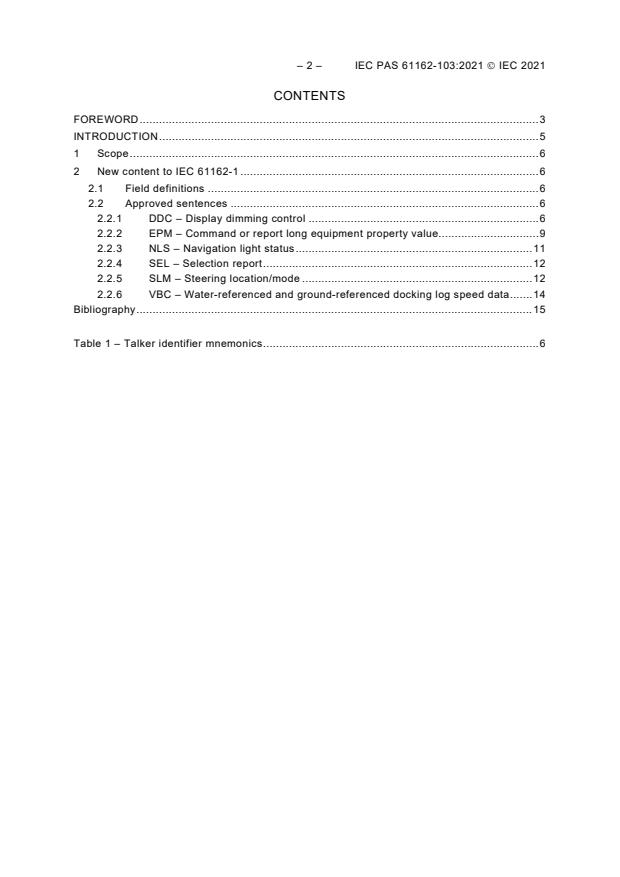
CONTENTS
FOREWORD . 3
INTRODUCTION . 5
1 Scope . 6
2 New content to IEC 61162-1 . 6
2.1 Field definitions . 6
2.2 Approved sentences . 6
2.2.1 DDC – Display dimming control . 6
2.2.2 EPM – Command or report long equipment property value. 9
2.2.3 NLS – Navigation light status . 11
2.2.4 SEL – Selection report . 12
2.2.5 SLM – Steering location/mode . 12
2.2.6 VBC – Water-referenced and ground-referenced docking log speed data . 14
Bibliography . 15
Table 1 – Talker identifier mnemonics . 6
INTERNATIONAL ELECTROTECHNICAL COMMISSION
____________
MARITIME NAVIGATION AND RADIOCOMMUNICATION
EQUIPMENT AND SYSTEMS – DIGITAL INTERFACES –
Part 103: Single talker and multiple listeners –
New and amended sentences and Talker IDs
FOREWORD
1) The International Electrotechnical Commission (IEC) is a worldwide organization for standardization comprising
all national electrotechnical committees (IEC National Committees). The object of IEC is to promote international
co-operation on all questions concerning standardization in the electrical and electronic fields. To this end and
in addition to other activities, IEC publishes International Standards, Technical Specifications, Technical Reports,
Publicly Available Specifications (PAS) and Guides (hereafter referred to as "IEC Publication(s)"). Their
preparation is entrusted to technical committees; any IEC National Committee interested in the subject dealt with
may participate in this preparatory work. International, governmental and non-governmental organizations liaising
with the IEC also participate in this preparation. IEC collaborates closely with the International Organization for
Standardization (ISO) in accordance with conditions determined by agreement between the two organizations.
2) The formal decisions or agreements of IEC on technical matters express, as nearly as possible, an international
consensus of opinion on the relevant subjects since each technical committee has representation from all
interested IEC National Committees.
3) IEC Publications have the form of recommendations for international use and are accepted by IEC National
Committees in that sense. While all reasonable efforts are made to ensure that the technical content of IEC
Publications is accurate, IEC cannot be held responsible for the way in which they are used or for any
misinterpretation by any end user.
4) In order to promote international uniformity, IEC National Committees undertake to apply IEC Publications
transparently to the maximum extent possible in their national and regional publications. Any divergence between
any IEC Publication and the corresponding national or regional publication shall be clearly indicated in the latter.
5) IEC itself does not provide any attestation of conformity. Independent certification bodies provide conformity
assessment services and, in some areas, access to IEC marks of conformity. IEC is not responsible for any
services carried out by independent certification bodies.
6) All users should ensure that they have the latest edition of this publication.
7) No liability shall attach to IEC or its directors, employees, servants or agents including individual experts and
members of its technical committees and IEC National Committees for any personal injury, property damage or
other damage of any nature whatsoever, whether direct or indirect, or for costs (including legal fees) and
expenses arising out of the publication, use of, or reliance upon, this IEC Publication or any other IEC
Publications.
8) Attention is drawn to the Normative references cited in this publication. Use of the referenced publications is
indispensable for the correct application of this publication.
9) Attention is drawn to the possibility that some of the elements of this IEC Publication may be the subject of patent
rights. IEC shall not be held responsible for identifying any or all such patent rights.
A PAS is a technical specification not fulfilling the requirements for a standard, but made
available to the public.
IEC PAS 61162-103 has been processed by IEC technical committee 80: Maritime navigation
and radiocommunication equipment and systems.
The text of this PAS is based on the This PAS was approved for
following document: publication by the P-members of the
committee concerned as indicated in
the following document
Draft PAS Report on voting
80/985/DPAS 80/992/RVDPAS
Following publication of this PAS, which is a pre-standard publication, the technical committee
or subcommittee concerned may transform it into an International Standard.
– 4 – IEC PAS 61162-103:2021 IEC 2021
This PAS shall remain valid for an initial maximum period of 2 years starting from the publication
date. The validity may be extended for a single period up to a maximum of 2 years, at the end
of which it shall be published as another type of normative document, or shall be withdrawn.
INTRODUCTION
This document is circulated as an IEC Publicly Available Specification (IEC/PAS). This agreed
process allows the new information needed to implement new sentences in a shorter time-scale
than revising the appropriate international standards. This document provides information on
th
sentences to support more functionality than available in the published 5 edition of
IEC 61162-1.
This PAS has been developed in conjunction with the IEC TC 80 WG6 and the NMEA.
This PAS will be replaced at a future date by, or be included within, a revision of IEC 61162-1.
– 6 – IEC PAS 61162-103:2021 IEC 2021
MARITIME NAVIGATION AND RADIOCOMMUNICATION
EQUIPMENT AND SYSTEMS – DIGITAL INTERFACES –
Part 103: Single talker and multiple listeners –
New and amended sentences and Talker IDs
1 Scope
IEC 61162-1:2016 supports the transfer of data between various equipment. This document
specifies more equipment Talker IDs, amends existing sentences and introduce new sentences
to facilitate more functionality between equipment.
2 New content to IEC 61162-1
2.1 Field definitions
Additional field definitions are indicated in Table 1.
Table 1 – Talker identifier mnemonics
Talker device Identifier
Automation – Alarm and monitoring system JA
Automation – Reefer monitoring system JB
Automation – Power management system JC
Automation – Propulsion control system JD
Automation – Engine control console JE
Automation – Propulsion boiler JF
Automation – Auxiliary boiler JG
Automation – Electronic governor system JH
Night vision NV
Electronic record book RB
Rudder angle indicator RI
Steering control system/device SC
System managament SM
Track control system TC
2.2 Approved sentences
2.2.1 DDC – Display dimming control
The DDC sentence provides controls for equipment display dimming presets. display brightness
percentage and selection of colour palette.
Transmitting and receiving equipment may support unidirectional or bidirectional
communications as determined by the manufacturer.
When this sentence is sent as a command and not supported or not accepted by the recipient,
the receiving equipment may generate a NAK sentence response providing an appropriate
"reason code". Additionally the receiving equipment may generate a DDC status report
sentence which provides the current dimming state of the receiving equipment.
NOTE The following luminance values are the preferred values to allow uniform dimming with one DDC transmitter,
without the need to pre-compute and store a brightness and colour palette value for every display in a multi-display
system. These values are in conformance with IEC 62288 Presentation of navigation-related information on
shipborne navigational displays (ECDIS colour brightness requirements). A device with a monochrome display may
adjust its display brightness to respect the colour palette selection, to match the luminance of a device with a colour
display for each selected colour palette. The value 49, center position on the brightness scale, represents the
calibrated position for calibrated displays.
D = Day time setting, with a luminance of the brightest colour of 80 cd/m at brightness percentage value 49
K = Dusk setting, with a luminance of the brightest colour of 36 cd/m at brightness percentage value 49
N = Night time setting, with a luminance of the brightest colour of 5 cd/m at brightness percentage value 49
O = Non-luminous setting, without luminance at any brightness percentage value
$--DDC,a,xx,a,a,a*hh
5)
Command mode
4)
Sentence status flag
3)
Colour palette
2)
Brightness percentage 00 to 99
1)
Display dimming preset
Comments:
1) The display dimming preset field contains an indicator that may be associated with a preset dimmed level
consisting of both brightness and colour palette in the receiving equipment.
D = Day time setting
K = Dusk setting
N = Night time setting
O = Non-luminous (i.e.backlighting off) setting
Actual display brightness levels for the display dimming preset indicators above are dependant upon the
capabilities provided by the manufacturer of the equipment. Upon receipt of the DDC sentence, the device shall
switch its display brightness and may switch to the preset value the operator or manufacturer had determined for
the corresponding indicator value. If the equipment had no brightness or dimming preset capability this field would
be ignored.
NOTE 1 If the receiving equipment has preset capability and this field contains a valid value the content of
separate brightness percentage and colour palette fields transmitted within the same sentence can be ignored
by the receiving equipment.
NOTE 2 If the receiving equipment has no preset capability a DDC transmitting device can populate brightness
and palette fields to use the brightness percentage and colour palette fields as an alternative to using stored
presets in the receiving equipment.
2) The brightness percentage field contains a value from zero to ninety nine. The value zero, provided as 00,
indicates that the display’s brightness shall be set to its most dimmed level, as determined by the capabilities of
the equipment. The value ninety nine, provided as 99, indicates that the display brightness shall be set to the
brightest level, as determined by the capabilities of the equipment. Values between 0 and 99 correspond to some
percentage of brightness, as determined by the equipment receiving this sentence, such as a gamma 2.2
corrected brightness curve. Where the colour palette filed is supported, the actual display luminance is always a
combination of this value and the colour palette field.
3) The colour palette field contains an indicator that may be associated with the selected colour palette in the
receiving equipment.
D = Day time setting
K = Dusk setting
N = Night time setting
O = Non-luminous (i.e.backlighting off) setting
If the receiving equipment does not support colour palettes it may ignore values in this field rather than discard
sentences where this field is not a null field. This way a display controller can by default send sentences where
the colour palette field is not a null field, thus avoiding unnecessary per-display configuration.
– 8 – IEC PAS 61162-103:2021 IEC 2021
4) This field is used to indicate a sentence that is a status report of current settings or a configuration command
changing settings. This field shall not be a null field.
R = Sentence is a status report of current settings (use for a reply to a query).
C = Sentence is a configuration command to change settings. A sentence without "C" is not a command.
The DDC sentence may be sent as a report of settings (i.e. R flag set); in response to a standard query sentence,
as an unsolicited notification e.g. on start-up or after the brightness or colour palette has been adjusted by other
means, in response to a valid command sentence or in response to an invalid command sentence.
When the Sentence status flag is set to "R" and the Command mode is set to "O" then the DDC sentence is a
report of the current operational dimming state.
When the Sentence status flag is set to "R" and the Command mode is set to "P" then the DDC sentence is a
report of the settings for the preset specified in the display dimming preset field. If there are multiple preset
settings to be conveyed, then there shall be multiple DDC sentences of this form, each with the appropriate data
fields populated to convey each setting.
The standard query sentence has no means to identify a specific DDC setting and therefore the response from
the display equipment may consist of multiple sentences where stored presets are provided and/or a single
sentence indicating the current state. If no presets are provided by the receiving equipment only a single sentence
indicating the current state is provided.
5) This field is used to indicate that this sentence is used to change the stored settings or used to change the current
state of the receiving equipment. This field shall not be a null field.
O = Sentence is relevant to current operational settings
P = Sentence is relevant to stored ‘Preset’ settings
Examples and guidance for device manufacturers:
>> indicates Controller sends to Display.
<< indicates Display sends to Controller.
In these examples the ‘Dimming controllers’ typically have talker IDs of "II" and "IN".
...
Questions, Comments and Discussion
Ask us and Technical Secretary will try to provide an answer. You can facilitate discussion about the standard in here.
Loading comments...