

IEC 60601-2-66:2012
(Main)Medical electrical equipment - Part 2-66: Particular requirements for the basic safety and essential performance of hearing instruments and hearing instrument systems
General Information
- Abstract
IEC 60601-2-66:2012 International Standard applies to the basic safety of hearing instruments and hearing instrument systems. Hazards inherent in the intended physiological function of hearing instruments or hearing instrument systems within the scope of this standard are not covered by specific requirements in this standard except in 201.7.9.2 and 201.9.6. Accessories to hearing instruments in the home healthcare environment (e.g. remote control units, audio streamers, battery chargers, power supplies) are covered by the most applicable standard, IEC 60065, IEC 60950-1 or other applicable IEC safety standards. Accessories connected to a hearing instrument may form a hearing instrument system. Only the hearing instrument and its detachable parts are subject to all applicable clauses of this particular standard. The remaining components of the hearing instrument system are subject to requirements of this particular standard that result from their connection to the hearing instrument system. This standard does not apply to:
- cochlear implants or other implanted hearing instruments;
- bone conduction hearing instruments;
- educational hearing instruments (i.e. group hearing instruments, auditory trainers etc.);
- the application of a hearing instrument for the measurement of hearing levels. IEC 60645-1 applies;
- audio-frequency induction-loop systems or their component parts, as described in IEC 60118-4 and IEC 62489-1;
- assisted hearing instrument systems using infra-red or radio;
- and the sound generating function of a tinnitus masker.
- Status
- Published
- Publication Date
- 01-Oct-2012
- Technical Committee
- TC 29 - Electroacoustics
- Drafting Committee
- WG 13 - TC 29/WG 13
- Current Stage
- DELPUB - Deleted Publication
- Start Date
- 26-Jun-2015
- Completion Date
- 28-Aug-2026
Buy Documents
IEC 60601-2-66:2012 - Medical electrical equipment - Part 2-66: Particular requirements for the basic safety and essential performance of hearing instruments and hearing instrument systems Released:10/2/2012
Overview
IEC 60601-2-66:2012 is an international standard published by the International Electrotechnical Commission (IEC) that specifies particular requirements for the basic safety and essential performance of hearing instruments and hearing instrument systems. This standard forms part of the widely recognized IEC 60601 series, which covers medical electrical equipment safety.
The scope of IEC 60601-2-66 focuses specifically on hearing instruments and systems, ensuring that these devices meet stringent safety and performance criteria essential for use in medical applications. The standard excludes certain categories such as cochlear implants, bone conduction hearing instruments, and educational hearing instruments, directing those to other relevant standards. Accessories related to hearing instruments, like remote control units and battery chargers, are regulated under other IEC standards.
Key Topics
Basic Safety and Essential Performance
IEC 60601-2-66 mandates safety requirements that address risks linked to electrical, mechanical, thermal, and radiation hazards associated with hearing instruments and systems. It ensures that safety measures protect users without compromising the intended auditory functions.Scope and Applicability
The standard applies to hearing instruments and hearing instrument systems, including their detachable parts. Accessories forming part of communication systems or power supplies may fall under different IEC standards but must still comply with relevant safety requirements.Risk Management and Hazard Protection
Special attention is devoted to identifying and controlling hazards such as electrical leakage currents, mechanical hazards, electromagnetic compatibility (EMC), overheating, and hazardous outputs. These protections are critical to preventing injury or device malfunction during use.Testing and Compliance Requirements
IEC 60601-2-66 outlines mandatory testing procedures for hearing instruments to verify compliance with electrical safety, mechanical integrity, temperature limits, and electromagnetic compatibility. It integrates seamlessly with the general IEC 60601-1 standard for medical electrical equipment.Exclusions and Related Standards
The standard excludes cochlear implants, bone conduction devices, and audio induction loop systems, which are covered by other standards such as IEC 60645-1 and IEC 60118-4. Accessories used in home healthcare environments are covered by standards IEC 60065, IEC 60950-1, or other applicable IEC safety standards.
Applications
IEC 60601-2-66 is essential for manufacturers, regulatory bodies, and healthcare providers involved in the design, production, certification, and use of hearing instruments and hearing instrument systems. Key applications include:
Medical Device Design and Manufacturing
Ensures hearing instruments are designed to meet global safety standards and essential performance metrics, facilitating market access and compliance with international regulations.Regulatory Compliance and Certification
Supports manufacturers in demonstrating conformity to essential safety requirements under directives such as the European Medical Devices Directive (93/42/EEC), helping achieve CE marking and other certifications.Clinical and Home Healthcare Use
Provides guidelines that protect end-users in both clinical environments and home healthcare settings, especially where hearing instrument systems are integrated with accessories like chargers, remote controls, or audio streamers.Quality Assurance and Risk Management
Enables effective risk assessment and management for hearing instruments, mitigating risks related to electrical shock, mechanical failure, electromagnetic interference, and other hazards.
Related Standards
To ensure comprehensive safety and performance evaluation of hearing devices and associated systems, IEC 60601-2-66 references or complements several other international standards:
IEC 60601-1
General requirements for safety and essential performance of medical electrical equipment, forming the base standard for IEC 60601-2-66.IEC 60065 and IEC 60950-1
Safety standards covering electrical accessories such as power supplies and chargers used with hearing instrument systems in non-medical or home-care environments.IEC 60645-1
Defines particular requirements for audiometric equipment related to hearing level measurement, relevant for educational or diagnostic hearing instruments.IEC 60118-4 and IEC 62489-1
Standards for audio-frequency induction-loop systems and their components used in assisted listening environments.ISO/IEC Directives
The standard has been prepared following ISO/IEC procedures, ensuring harmonized international adoption and consistency in technical requirements.
Keywords: IEC 60601-2-66, hearing instrument safety standard, medical electrical equipment, hearing instrument systems, IEC 60601 series, electrical safety, medical device regulations, hearing aid safety, essential performance, risk management, accessory safety, electromagnetic compatibility, medical device compliance.
Relations
- Effective Date
- 05-Sep-2023
Buy Documents
IEC 60601-2-66:2012 - Medical electrical equipment - Part 2-66: Particular requirements for the basic safety and essential performance of hearing instruments and hearing instrument systems Released:10/2/2012
Get Certified
Connect with accredited certification bodies for this standard

BSI Group
BSI (British Standards Institution) is the business standards company that helps organizations make excellence a habit.

TÜV Rheinland
TÜV Rheinland is a leading international provider of technical services.

TÜV SÜD
TÜV SÜD is a trusted partner of choice for safety, security and sustainability solutions.
Sponsored listings
Frequently Asked Questions
IEC 60601-2-66:2012 is a standard published by the International Electrotechnical Commission (IEC). Its full title is "Medical electrical equipment - Part 2-66: Particular requirements for the basic safety and essential performance of hearing instruments and hearing instrument systems". This standard covers: IEC 60601-2-66:2012 International Standard applies to the basic safety of hearing instruments and hearing instrument systems. Hazards inherent in the intended physiological function of hearing instruments or hearing instrument systems within the scope of this standard are not covered by specific requirements in this standard except in 201.7.9.2 and 201.9.6. Accessories to hearing instruments in the home healthcare environment (e.g. remote control units, audio streamers, battery chargers, power supplies) are covered by the most applicable standard, IEC 60065, IEC 60950-1 or other applicable IEC safety standards. Accessories connected to a hearing instrument may form a hearing instrument system. Only the hearing instrument and its detachable parts are subject to all applicable clauses of this particular standard. The remaining components of the hearing instrument system are subject to requirements of this particular standard that result from their connection to the hearing instrument system. This standard does not apply to: - cochlear implants or other implanted hearing instruments; - bone conduction hearing instruments; - educational hearing instruments (i.e. group hearing instruments, auditory trainers etc.); - the application of a hearing instrument for the measurement of hearing levels. IEC 60645-1 applies; - audio-frequency induction-loop systems or their component parts, as described in IEC 60118-4 and IEC 62489-1; - assisted hearing instrument systems using infra-red or radio; - and the sound generating function of a tinnitus masker.
IEC 60601-2-66:2012 International Standard applies to the basic safety of hearing instruments and hearing instrument systems. Hazards inherent in the intended physiological function of hearing instruments or hearing instrument systems within the scope of this standard are not covered by specific requirements in this standard except in 201.7.9.2 and 201.9.6. Accessories to hearing instruments in the home healthcare environment (e.g. remote control units, audio streamers, battery chargers, power supplies) are covered by the most applicable standard, IEC 60065, IEC 60950-1 or other applicable IEC safety standards. Accessories connected to a hearing instrument may form a hearing instrument system. Only the hearing instrument and its detachable parts are subject to all applicable clauses of this particular standard. The remaining components of the hearing instrument system are subject to requirements of this particular standard that result from their connection to the hearing instrument system. This standard does not apply to: - cochlear implants or other implanted hearing instruments; - bone conduction hearing instruments; - educational hearing instruments (i.e. group hearing instruments, auditory trainers etc.); - the application of a hearing instrument for the measurement of hearing levels. IEC 60645-1 applies; - audio-frequency induction-loop systems or their component parts, as described in IEC 60118-4 and IEC 62489-1; - assisted hearing instrument systems using infra-red or radio; - and the sound generating function of a tinnitus masker.
IEC 60601-2-66:2012 is classified under the following ICS (International Classification for Standards) categories: 11.180.15 - Aids for deaf and hearing impaired people; 17.140.50 - Electroacoustics; 17.240 - Radiation measurements. The ICS classification helps identify the subject area and facilitates finding related standards.
IEC 60601-2-66:2012 has the following relationships with other standards: It is inter standard links to IEC 60601-2-66:2015. Understanding these relationships helps ensure you are using the most current and applicable version of the standard.
IEC 60601-2-66:2012 is available in PDF format for immediate download after purchase. The document can be added to your cart and obtained through the secure checkout process. Digital delivery ensures instant access to the complete standard document.
Standards Content (Sample)
IEC 60601-2-66 ®
Edition 1.0 2012-10
INTERNATIONAL
STANDARD
NORME
INTERNATIONALE
Medical electrical equipment –
Part 2-66: Particular requirements for the basic safety and essential performance
of hearing instruments and hearing instrument systems
Appareils électromédicaux –
Partie 2-66: Exigences particulières pour la sécurité de base et les performances
essentielles des instruments d'audition et systèmes d'audition
All rights reserved. Unless otherwise specified, no part of this publication may be reproduced or utilized in any form
or by any means, electronic or mechanical, including photocopying and microfilm, without permission in writing from
either IEC or IEC's member National Committee in the country of the requester.
If you have any questions about IEC copyright or have an enquiry about obtaining additional rights to this publication,
please contact the address below or your local IEC member National Committee for further information.
Droits de reproduction réservés. Sauf indication contraire, aucune partie de cette publication ne peut être reproduite ni
utilisée sous quelque forme que ce soit et par aucun procédé, électronique ou mécanique, y compris la photocopie et les
microfilms, sans l'accord écrit de la CEI ou du Comité national de la CEI du pays du demandeur.
Si vous avez des questions sur le copyright de la CEI ou si vous désirez obtenir des droits supplémentaires sur cette
publication, utilisez les coordonnées ci-après ou contactez le Comité national de la CEI de votre pays de résidence.
IEC Central Office Tel.: +41 22 919 02 11
3, rue de Varembé Fax: +41 22 919 03 00
CH-1211 Geneva 20 info@iec.ch
Switzerland www.iec.ch
About the IEC
The International Electrotechnical Commission (IEC) is the leading global organization that prepares and publishes
International Standards for all electrical, electronic and related technologies.
About IEC publications
The technical content of IEC publications is kept under constant review by the IEC. Please make sure that you have the
latest edition, a corrigenda or an amendment might have been published.
Useful links:
IEC publications search - www.iec.ch/searchpub Electropedia - www.electropedia.org
The advanced search enables you to find IEC publications The world's leading online dictionary of electronic and
by a variety of criteria (reference number, text, technical electrical terms containing more than 30 000 terms and
committee,…). definitions in English and French, with equivalent terms in
It also gives information on projects, replaced and additional languages. Also known as the International
withdrawn publications. Electrotechnical Vocabulary (IEV) on-line.
IEC Just Published - webstore.iec.ch/justpublished Customer Service Centre - webstore.iec.ch/csc
Stay up to date on all new IEC publications. Just Published If you wish to give us your feedback on this publication
details all new publications released. Available on-line and or need further assistance, please contact the
also once a month by email. Customer Service Centre: csc@iec.ch.
A propos de la CEI
La Commission Electrotechnique Internationale (CEI) est la première organisation mondiale qui élabore et publie des
Normes internationales pour tout ce qui a trait à l'électricité, à l'électronique et aux technologies apparentées.
A propos des publications CEI
Le contenu technique des publications de la CEI est constamment revu. Veuillez vous assurer que vous possédez
l’édition la plus récente, un corrigendum ou amendement peut avoir été publié.
Liens utiles:
Recherche de publications CEI - www.iec.ch/searchpub Electropedia - www.electropedia.org
La recherche avancée vous permet de trouver des Le premier dictionnaire en ligne au monde de termes
publications CEI en utilisant différents critères (numéro de électroniques et électriques. Il contient plus de 30 000
référence, texte, comité d’études,…). termes et définitions en anglais et en français, ainsi que
Elle donne aussi des informations sur les projets et les les termes équivalents dans les langues additionnelles.
publications remplacées ou retirées. Egalement appelé Vocabulaire Electrotechnique
International (VEI) en ligne.
Just Published CEI - webstore.iec.ch/justpublished
Service Clients - webstore.iec.ch/csc
Restez informé sur les nouvelles publications de la CEI.
Just Published détaille les nouvelles publications parues. Si vous désirez nous donner des commentaires sur
Disponible en ligne et aussi une fois par mois par email. cette publication ou si vous avez des questions
contactez-nous: csc@iec.ch.
IEC 60601-2-66 ®
Edition 1.0 2012-10
INTERNATIONAL
STANDARD
NORME
INTERNATIONALE
Medical electrical equipment –
Part 2-66: Particular requirements for the basic safety and essential performance
of hearing instruments and hearing instrument systems
Appareils électromédicaux –
Partie 2-66: Exigences particulières pour la sécurité de base et les performances
essentielles des instruments d'audition et systèmes d'audition
INTERNATIONAL
ELECTROTECHNICAL
COMMISSION
COMMISSION
ELECTROTECHNIQUE
PRICE CODE
INTERNATIONALE
CODE PRIX X
ICS 11.180.15; 17.140.50 ISBN 978-2-83220-381-1
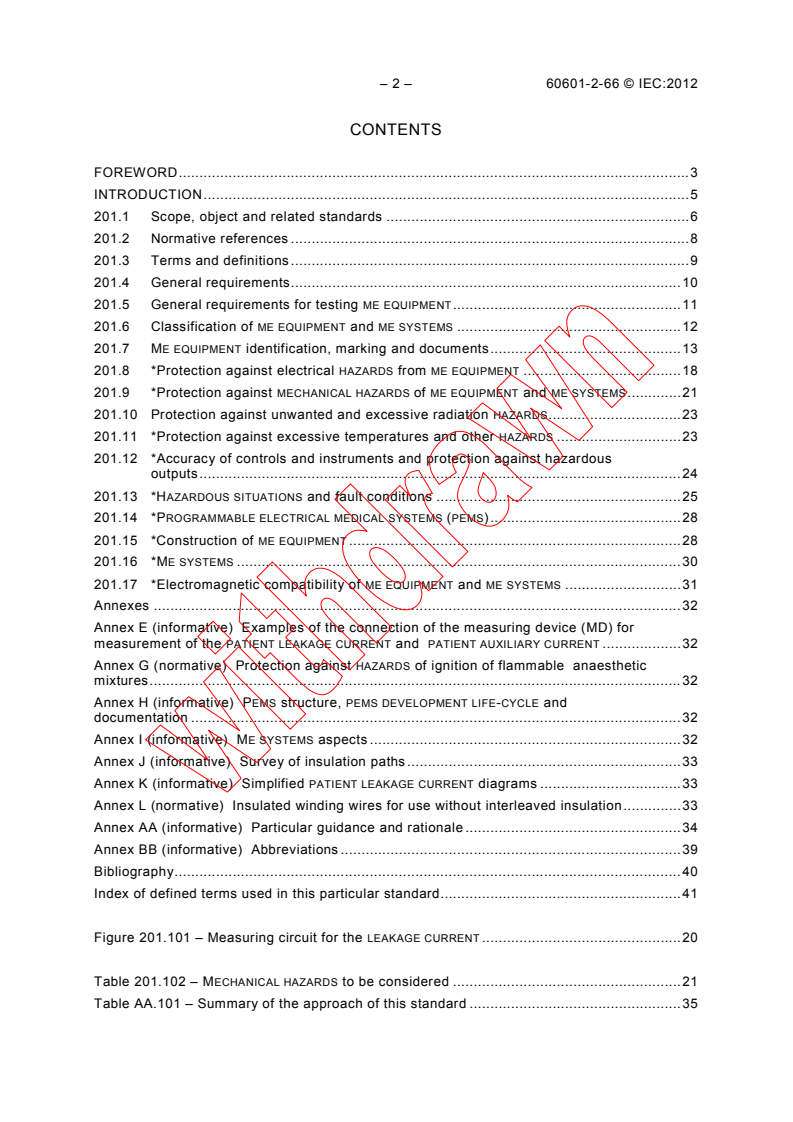
– 2 – 60601-2-66 © IEC:2012
CONTENTS
FOREWORD . 3
INTRODUCTION . 5
201.1 Scope, object and related standards . 6
201.2 Normative references . 8
201.3 Terms and definitions . 9
201.4 General requirements . 10
201.5 General requirements for testing ME EQUIPMENT . 11
201.6 Classification of ME EQUIPMENT and ME SYSTEMS . 12
201.7 ME EQUIPMENT identification, marking and documents . 13
201.8 *Protection against electrical HAZARDS from ME EQUIPMENT . 18
201.9 *Protection against MECHANICAL HAZARDS of ME EQUIPMENT and ME SYSTEMS . 21
201.10 Protection against unwanted and excessive radiation HAZARDS . 23
201.11 *Protection against excessive temperatures and other HAZARDS . 23
201.12 *Accuracy of controls and instruments and protection against hazardous
outputs . 24
201.13 *HAZARDOUS SITUATIONS and fault conditions . 25
201.14 *PROGRAMMABLE ELECTRICAL MEDICAL SYSTEMS (PEMS) . 28
201.15 *Construction of ME EQUIPMENT . 28
201.16 *ME SYSTEMS . 30
201.17 *Electromagnetic compatibility of ME EQUIPMENT and ME SYSTEMS . 31
Annexes . 32
Annex E (informative) Examples of the connection of the measuring device (MD) for
measurement of the PATIENT LEAKAGE CURRENT and PATIENT AUXILIARY CURRENT . 32
Annex G (normative) Protection against HAZARDS of ignition of flammable anaesthetic
mixtures . 32
Annex H (informative) PEMS structure, PEMS DEVELOPMENT LIFE-CYCLE and
documentation . 32
Annex I (informative) ME SYSTEMS aspects . 32
Annex J (informative) Survey of insulation paths . 33
Annex K (informative) Simplified PATIENT LEAKAGE CURRENT diagrams . 33
Annex L (normative) Insulated winding wires for use without interleaved insulation . 33
Annex AA (informative) Particular guidance and rationale . 34
Annex BB (informative) Abbreviations . 39
Bibliography . 40
Index of defined terms used in this particular standard . 41
Figure 201.101 – Measuring circuit for the LEAKAGE CURRENT . 20
Table 201.102 – MECHANICAL HAZARDS to be considered . 21
Table AA.101 – Summary of the approach of this standard . 35
60601-2-66 © IEC:2012 – 3 –
INTERNATIONAL ELECTROTECHNICAL COMMISSION
____________
MEDICAL ELECTRICAL EQUIPMENT –
Part 2-66: Particular requirements for the basic safety and essential
performance of hearing instruments and hearing instrument systems
FOREWORD
1) The International Electrotechnical Commission (IEC) is a worldwide organization for standardization comprising
all national electrotechnical committees (IEC National Committees). The object of IEC is to promote
international co-operation on all questions concerning standardization in the electrical and electronic fields. To
this end and in addition to other activities, IEC publishes International Standards, Technical Specifications,
Technical Reports, Publicly Available Specifications (PAS) and Guides (hereafter referred to as “IEC
Publication(s)”). Their preparation is entrusted to technical committees; any IEC National Committee interested
in the subject dealt with may participate in this preparatory work. International, governmental and non-
governmental organizations liaising with the IEC also participate in this preparation. IEC collaborates closely
with the International Organization for Standardization (ISO) in accordance with conditions determined by
agreement between the two organizations.
2) The formal decisions or agreements of IEC on technical matters express, as nearly as possible, an international
consensus of opinion on the relevant subjects since each technical committee has representation from all
interested IEC National Committees.
3) IEC Publications have the form of recommendations for international use and are accepted by IEC National
Committees in that sense. While all reasonable efforts are made to ensure that the technical content of IEC
Publications is accurate, IEC cannot be held responsible for the way in which they are used or for any
misinterpretation by any end user.
4) In order to promote international uniformity, IEC National Committees undertake to apply IEC Publications
transparently to the maximum extent possible in their national and regional publications. Any divergence
between any IEC Publication and the corresponding national or regional publication shall be clearly indicated in
the latter.
5) IEC itself does not provide any attestation of conformity. Independent certification bodies provide conformity
assessment services and, in some areas, access to IEC marks of conformity. IEC is not responsible for any
services carried out by independent certification bodies.
6) All users should ensure that they have the latest edition of this publication.
7) No liability shall attach to IEC or its directors, employees, servants or agents including individual experts and
members of its technical committees and IEC National Committees for any personal injury, property damage or
other damage of any nature whatsoever, whether direct or indirect, or for costs (including legal fees) and
expenses arising out of the publication, use of, or reliance upon, this IEC Publication or any other IEC
Publications.
8) Attention is drawn to the Normative references cited in this publication. Use of the referenced publications is
indispensable for the correct application of this publication.
9) Attention is drawn to the possibility that some of the elements of this IEC Publication may be the subject of
patent rights. IEC shall not be held responsible for identifying any or all such patent rights.
International Standard IEC 60601-2-66 has been prepared by IEC technical committee 29:
Electroacoustics.
The text of this particular standard is based on the following documents:
FDIS Report on voting
29/777/FDIS 29/792/RVD
Full information on the voting for the approval of this particular standard can be found in the
report on voting indicated in the above table.
This publication has been drafted in accordance with the ISO/IEC Directives, Part 2.
In this standard, the following print types are used:
– 4 – 60601-2-66 © IEC:2012
– Requirements and definitions: roman type.
– Test specifications: italic type.
– Informative material appearing outside of tables, such as notes, examples and references: in smaller type.
Normative text of tables is also in a smaller type.
– TERMS DEFINED IN CLAUSE 3 OF THE GENERAL STANDARD, IN THIS PARTICULAR STANDARD OR AS
NOTED: SMALL CAPITALS.
In referring to the structure of this standard, the term
– “clause” means one of the seventeen numbered divisions within the table of contents,
inclusive of all subdivisions (e.g. Clause 7 includes subclauses 7.1, 7.2, etc.);
– “subclause” means a numbered subdivision of a clause (e.g. 7.1, 7.2 and 7.2.1 are all
subclauses of Clause 7).
References to clauses within this standard are preceded by the term “Clause” followed by the
clause number. References to subclauses within this particular standard are by number only.
In this standard, the conjunctive “or” is used as an “inclusive or” so a statement is true if any
combination of the conditions is true.
The verbal forms used in this standard conform to usage described in Annex H of the ISO/IEC
Directives, Part 2. For the purposes of this standard, the auxiliary verb:
– “shall” means that compliance with a requirement or a test is mandatory for compliance
with this standard;
– “should” means that compliance with a requirement or a test is recommended but is not
mandatory for compliance with this standard;
– “may” is used to describe a permissible way to achieve compliance with a requirement or
test.
An asterisk (*) as the first character of a title or at the beginning of a paragraph or table title
indicates that there is guidance or rationale related to that item in Annex AA.
A list of all parts of the IEC 60601 series, published under the general title Medical electrical
equipment, can be found on the IEC website.
The committee has decided that the contents of this publication will remain unchanged until
the stability date indicated on the IEC web site under "http://webstore.iec.ch" in the data
related to the specific publication. At this date, the publication will be
• reconfirmed,
• withdrawn,
• replaced by a revised edition, or
• amended.
60601-2-66 © IEC:2012 – 5 –
INTRODUCTION
In 1998 the HEARING INSTRUMENT industry represented by the EHIMA attempted to establish a
standard with the main purpose of providing manufacturers with a guide to demonstrate
conformity with the European Medical Devices Directive 93/42/EEC.
The document prEN 50220 failed CENELEC vote and was published as “EHIMA standard” in
June 1998 with almost identical content. EHIMA concluded in 2009 that the requirements of
that standard were no longer up to date and an internationally accepted standard for HEARING
INSTRUMENT safety published by IEC or ISO to demonstrate compliance with regulatory
requirements should be produced.
This resulting IEC standard amends and supplements IEC 60601-1 (third edition, 2005):
Medical electrical equipment – Part 1: General requirements for safety and essential
performance, hereinafter referred to as ‘the general standard’.
Figures in square brackets refer to the Bibliography.
– 6 – 60601-2-66 © IEC:2012
MEDICAL ELECTRICAL EQUIPMENT –
Part 2-66: Particular requirements for the basic safety and essential
performance of hearing instruments and hearing instrument systems
201.1 Scope, object and related standards
Clause 1 of the general standard applies, except as follows:
201.1.1 * Scope
Replacement:
This International Standard applies to the BASIC SAFETY of HEARING INSTRUMENTS and HEARING
INSTRUMENT SYSTEMS, hereafter also referred to as ME EQUIPMENT or ME SYSTEM.
If a clause or subclause is specifically intended to be applicable to HEARING INSTRUMENTS only,
or to HEARING INSTRUMENT SYSTEMS only, the title and content of that clause or subclause will
say so. If that is not the case, the clause or subclause applies both to HEARING INSTRUMENTS
and to HEARING INSTRUMENT SYSTEMS, as relevant.
HAZARDS inherent in the intended physiological function of HEARING INSTRUMENTS or HEARING
INSTRUMENT SYSTEMS within the scope of this standard are not covered by specific
requirements in this standard except in 201.7.9.2 and 201.9.6.
NOTE See also 201.4.2. (RISK MANAGEMENT).
ACCESSORIES to HEARING INSTRUMENTS in the HOME HEALTHCARE ENVIRONMENT (e.g. remote
control units, audio streamers, battery chargers, power supplies) are covered by the most
applicable standard, IEC 60065, IEC 60950-1 or other applicable IEC safety standards.
Alternatively the general standard may be applied. HEARING INSTRUMENTS do not have a MAINS
PART intended for connection to a.c. SUPPLY MAINS. The connection to the SUPPLY MAINS of a
HEARING INSTRUMENT system is covered by power supply, charger or other types of
ACCESSORIES.
ACCESSORIES connected to a HEARING INSTRUMENT may form a HEARING INSTRUMENT SYSTEM.
Only the HEARING INSTRUMENT and its detachable parts are subject to all applicable clauses of
this particular standard. The remaining components of the HEARING INSTRUMENT SYSTEM are
subject to requirements of this particular standard that result from their connection to the
HEARING INSTRUMENT SYSTEM.
Programming interfaces or ACCESSORIES in a clinical application are covered by the general
standard.
NOTE Detachable parts of HEARING INSTRUMENTS even if supplied separately (e.g. ear hooks, domes, wax guards
etc.), are not regarded as ACCESSORIES.
This standard does not apply to:
– cochlear implants or other implanted HEARING INSTRUMENTS;
– bone conduction HEARING INSTRUMENTS;
—————————
The general standard is IEC 60601-1:2005, Medical electrical equipment – Part 1: General requirements for
basic safety and essential performance.
60601-2-66 © IEC:2012 – 7 –
– educational HEARING INSTRUMENTS (i.e. group HEARING INSTRUMENTS, auditory trainers etc.);
– the application of a HEARING INSTRUMENT for the measurement of hearing levels.
IEC 60645-1 applies;
– audio-frequency induction-loop systems or their component parts, as described in
IEC 60118-4 and IEC 62489-1;
– assisted HEARING INSTRUMENT SYSTEMS using infra-red or radio;
– the sound generating function of a tinnitus masker.
201.1.2 Object
Replacement:
The object of this particular standard is to establish particular BASIC SAFETY requirements for
HEARING INSTRUMENTS and HEARING INSTRUMENT SYSTEMS as defined in 201.3.202 and
201.3.203.
201.1.3 * Collateral standards
Addition:
This particular standard refers to those applicable collateral standards that are listed in
Clause 2 of the general standard.
IEC 60601-1-2, IEC 60601-1-3, IEC 60601-1-9, IEC 60601-1-10, and IEC 60601-1-11 do not
apply. All other published collateral standards in the IEC 60601-1 series apply as published.
201.1.4 Particular standards
Replacement:
In the IEC 60601 series, particular standards may modify, replace or delete requirements
contained in the general standard and collateral standards as appropriate for the particular
ME EQUIPMENT under consideration, and may add other BASIC SAFETY and ESSENTIAL
PERFORMANCE requirements.
A requirement of a particular standard takes priority over the general standard.
For brevity, IEC 60601-1 is referred to in this particular standard as the general standard.
Collateral standards are referred to by their document number.
The numbering of clauses and subclauses of this particular standard corresponds to that of
the general standard with the prefix “201” (e.g. 201.1 in this standard addresses the content
of Clause 1 of the general standard) or applicable collateral standard with the prefix “20x”
where x is the final digit(s) of the collateral standard document number (e.g. 202.4 in this
particular standard addresses the content of Clause 4 of the IEC 60601-1-2 collateral
standard, 203.4 in this particular standard addresses the content of Clause 4 of the
IEC 60601-1-3 collateral standard, etc.). The changes to the text of the general standard are
specified by the use of the following words:
"Replacement" means that the clause or subclause of the general standard or applicable
collateral standard is replaced completely by the text of this particular standard.
"Addition" means that the text of this particular standard is additional to the requirements of
the general standard or applicable collateral standard.
– 8 – 60601-2-66 © IEC:2012
"Amendment" means that the clause or subclause of the general standard or applicable
collateral standard is amended as indicated by the text of this particular standard.
Subclauses, figures or tables which are additional to those of the general standard are
numbered starting from 201.101. However, due to the fact that definitions in the general
standard are numbered 3.1 through 3.139, additional definitions in this standard are
numbered beginning from 201.3.201. Additional annexes are lettered AA, BB, etc., and
additional items aa), bb), etc.
Subclauses, figures or tables which are additional to those of a collateral standard are
numbered starting from 20x, where “x” is the number of the collateral standard, e.g. 202 for
IEC 60601-1-2, 203 for IEC 60601-1-3, etc.
The term "this standard" is used to make reference to the general standard, any applicable
collateral standards and this particular standard taken together.
Where there is no corresponding clause or subclause in this particular standard, the clause or
subclause of the general standard or applicable collateral standard, although possibly not
relevant, applies without modification; where it is intended that any part of the general
standard or applicable collateral standard, although possibly relevant, is not to be applied, a
statement to that effect is given in this particular standard.
201.2 Normative references
Clause 2 of the general standard applies except as follows:
Replacement of the introductory paragraph:
The following documents, in whole or in part, are normatively referenced in this document and
are indispensable for its application. For dated references, only the edition cited applies. For
undated references, the latest edition of the referenced document (including any
amendments) applies.
NOTE Informative references are listed in the bibliography.
Replacement:
IEC 60950-1:2005, Information technology equipment – Safety – Part 1: General requirements
Addition:
IEC 60065:2001, Audio, video and similar electronic apparatus –Safety requirements
IEC 60118-7:2005, Electroacoustics – Hearing aids – Part 7: Measurement of the
performance characteristics of hearing aids for production, supply and delivery quality
assurance purposes
IEC 60118-13, Electroacoustics – Hearing aids – Part 13: Electromagnetic compatibility
(EMC)
IEC 60601-1-11:2010, Medical electrical equipment – Part 1-11: General requirements for
basic safety and essential performance – Collateral Standard: Requirements for medical
electrical equipment and medical electrical systems used in the home healthcare environment
IEC 62304, Medical device software – Software life cycle processes
60601-2-66 © IEC:2012 – 9 –
IEC 62366:2007, Medical devices – Application of usability engineering to medical devices
201.3 Terms and definitions
For the purposes of this document, the terms and definitions given in IEC 60601-1:2005
apply, except as follows:
NOTE An index of defined terms is found beginning on page 41.
201.3.73
OPERATOR
Addition:
Note 1 to entry: Usually equal to patient for hearing instruments in a home healthcare environment
201.3.76
PATIENT
Addition:
Note 1 to entry: In this particular standard and in applying the requirements of the general standard, the term
PATIENT has the meaning explained in the second paragraph of 4.1 of the general standard. The PATIENT is also
usually the OPERATOR.
The term PATIENT is being used in this standard in line with the general terminology in the medical product field. It
is however understood, that the user of a HEARING INSTRUMENT is typically not an ill person but someone healthy
with a hearing impairment in a HOME HEALTHCARE ENVIRONMENT.
201.3.113
SERVICE PERSONNEL
Replacement:
individuals or entity that assemble, maintain or repair HEARING INSTRUMENTS or HEARING
INSTRUMENT SYSTEMS
201.3.132
TYPE B APPLIED PART
Replacement:
APPLIED PART complying with the specified requirements of this particular standard to provide
protection against electric shock, particularly regarding allowable PATIENT LEAKAGE CURRENT
and PATIENT AUXILIARY CURRENT
Addition:
201.3.201
HEARING HEALTH-CARE PROFESSIONAL
acoustician, audiologist and trained clinical staff
201.3.202
HEARING INSTRUMENT
HEARING AID
ME EQUIPMENT which picks up sound and delivers processed sound to the ear canal through
air-conduction. A HEARING INSTRUMENT includes all detachable parts that are essential for the
performance of its intended use.
– 10 – 60601-2-66 © IEC:2012
201.3.203
HEARING SYSTEM
HEARING INSTRUMENT SYSTEM
combination, as specified by its MANUFACTURER, of items of equipment, at least one of which
is a HEARING INSTRUMENT to be inter-connected by FUNCTIONAL CONNECTION
201.3.204
SOUND PRESSURE LEVEL
SPL
L
p
ten times the logarithm to the base 10 of the ratio of the square of the sound pressure, p, to
the square of a reference value, p , expressed in decibels
p
L = 10lg dB
p
p
where the reference value, p , is 20 µPa
[SOURCE: ISO/TR 25417:2007, 2.2]
Note 1 to entry: Because of practical limitations of the measuring instruments, p is always understood to denote
the square of a frequency-weighted, frequency-band-limited or time-weighted sound pressure.
If specific frequency and time weightings as specified in IEC 61672-1 and/or specific frequency bands are applied,
this should be indicated by appropriate subscripts; e.g. L denotes the A-weighted sound pressure level with
p,AF
time weighting F.
Note 2 to entry: This definition is technically in accordance with ISO 80000-8:2007, 8-22.
201.4 General requirements
Clause 4 of the general standard applies, except as follows:
201.4.1 Conditions for application to ME EQUIPMENT or ME SYSTEMS
Replacement:
Unless otherwise specified, the requirements of this standard shall apply in NORMAL USE and
reasonably foreseeable misuse.
When applying this standard to HEARING INSTRUMENTS or HEARING INSTRUMENT SYSTEMS, the
definitions and requirements that use the term PATIENT shall be considered as applying to the
HEARING INSTRUMENT or HEARING INSTRUMENT SYSTEMS is intended.
person for whom the
201.4.3 * ESSENTIAL PERFORMANCE
Replacement:
HEARING INSTRUMENTS do not have an ESSENTIAL PERFORMANCE.
201.4.6 ME EQUIPMENT or ME SYSTEM parts that contact the PATIENT
Subclause 4.6 of the general standard does not apply.
201.4.10 Power supply
Subclause 4.10 of the general standard does not apply.
60601-2-66 © IEC:2012 – 11 –
201.4.11 Power input
Subclause 4.11 of the general standard does not apply.
201.5 General requirements for testing ME EQUIPMENT
Clause 5 of the general standard applies, except as follows:
201.5.2 Number of samples
Replacement:
TYPE TESTS are performed on a representative sample of the item being tested. If multiple
products are under consideration, which have a similar mechanical and electrical architecture,
then an engineering analysis by the MANUFACTURER may justify a single representative sample
for a family of products.
201.5.3 Ambient temperature, humidity, atmospheric pressure
Replacement:
After the HEARING INSTRUMENT or HEARING INSTRUMENT SYSTEM to be tested has been set up for
NORMAL USE, tests are performed within the range of environmental conditions indicated in the
technical description, as specified by the MANUFACTURER.
201.5.4 Other conditions
Addition:
aa) Inventory stocking conditions are specified by the MANUFACTURER.
bb) HEARING INSTRUMENT transport conditions are specified by the MANUFACTURER.
201.5.5 Supply voltages, type of current, nature of supply, frequency
Replacement:
a) Where test results are influenced by deviations of the supply voltage from its rated value,
the effect of such deviations shall be taken into account.
b) HEARING INSTRUMENTS and HEARING INSTRUMENT SYSTEMS designed for more than one
rated voltage shall be tested in conditions related to the least favourable voltage and
nature of supply.
c) HEARING INSTRUMENTS for which alternative ACCESSORIES or detachable parts can be
connected as specified in the ACCOMPANYING DOCUMENTS shall be tested with those
ACCESSORIES or detachable parts that result in the least favourable conditions.
HEARING INSTRUMENT or a HEARING INSTRUMENT
d) If the instructions for use specify that a
SYSTEM is intended to receive its power from a separate power supply, it shall be
connected to such a power supply.
201.5.7 Humidity preconditioning treatment
Replacement:
Where climatic conditions could influence the safety of a HEARING INSTRUMENT or HEARING
INSTRUMENT SYSTEM or its parts, it shall be subjected to a humidity preconditioning treatment
prior to the tests of 201.8.7.4.
HEARING INSTRUMENTS and HEARING INSTRUMENT SYSTEMS or theirs parts shall be set up
completely (or where necessary partially). Covers used during transport and storage shall be
detached.
– 12 – 60601-2-66 © IEC:2012
Parts that can be detached without the use of tools shall be detached, but tested
simultaneously with the major part.
ACCESS COVERS that can be opened or detached without the use of tools shall be opened and
detached.
The humidity preconditioning treatment shall be performed in a humidity cabinet containing air
with a relative humidity of 93% ± 3%. The temperature of the air in the cabinet, at all places
where HEARING INSTRUMENTS and HEARING INSTRUMENT SYSTEMS can be located, shall be
maintained within 2 °C of any convenient value T in the range of + 20 °C to + 32 °C. Before
being placed in the humidity cabinet, HEARING INSTRUMENTS and HEARING INSTRUMENT SYSTEMS
shall be brought to a temperature between T and T + 4 °C, and kept at this temperature for at
least 4 h before the humidity treatment.
HEARING INSTRUMENTS and HEARING INSTRUMENT SYSTEMS and its parts shall be kept in the
humidity cabinet for at least 48 h.
201.5.9 Determination of APPLIED PARTS and ACCESSIBLE PARTS
PPLIED PARTS
201.5.9.1 *A
Addition:
The HEARING INSTRUMENT is a TYPE B APPLIED PART in the HEARING INSTRUMENT SYSTEM. If any
other parts have to be in contact with the PATIENT, those parts are also TYPE B APPLIED PARTS.
201.5.9.2 ACCESSIBLE PARTS
201.5.9.2.1 Test finger
Addition:
The tests as described in the general standard are additionally performed with the small finger
probe shown in Figure 1 of IEC 60601-1-11.
201.5.201 SOUND PRESSURE LEVEL
Any sound pressure level specified in this document is measured in decibels (dB) as
described in IEC 60118-7:2005.
201.6 Classification of ME EQUIPMENT and ME SYSTEMS
Clause 6 of the general standard applies, except as follows:
201.6.2 Protection against electric shock
Replacement:
HEARING INSTRUMENTS are INTERNALLY POWERED, but may have connections to mains supplied
equipment. The insulation between the SUPPLY MAINS and the HEARING INSTRUMENT shall be
provided within the power supply, charger or other type of ACCESSORY.
The HEARING INSTRUMENT is classified a TYPE B APPLIED PART.
201.6.3 Protection against harmful ingress of water or particulate matter
Replacement:
60601-2-66 © IEC:2012 – 13 –
See 201.11.6.5.
201.6.6 Mode of operation
Replacement:
HEARING INSTRUMENTS are classified for CONTINUOUS OPERATION.
201.7 ME EQUIPMENT identification, marking and documents
Clause 7 of the general standard applies, except as follows:
201.7.1.1 USABILITY of the identification, marking and documents
Replacement:
The MANUFACTURER shall address in the RISK MANAGEMENT PROCESS the RISK of poor USABILITY
HEARING INSTRUMENT’S identification, marking and
associated with the design of the
documents.
The USABILITY of the identification, marking and ACCOMPANYING DOCUMENTS intended for the
PATIENT shall be evaluated based on a PATIENT profile that includes basic school education.
Hearing instruments should be designed to be simple to use and not require reference to
complex ACCOMPANYING DOCUMENTS.
Compliance shall be checked by inspection of the results of the RISK MANAGEMENT PROCESS.
201.7.1.2 Legibility of markings
Replacement:
The markings required by 7.2 and 7.3 shall be clearly legible under the following conditions:
HEARING INSTRUMENT except serial number, shall be
– Safety signs and identification, on the
clearly legible when it is placed in the hand of the PATIENT.
– The serial number and any other markings shall be legible utilizing an optical aid if
necessary.
201.7.2 Marking on the outside of ME EQUIPMENT or ME EQUIPMENT parts
201.7.2.1 Minimum requirements for marking on HEARING INSTRUMENT
Replacement:
If the size of the HEARING INSTRUMENT does not allow affixation of all markings specified in 7.2,
the markings shall be recorded in full in the ACCOMPANYING DOCUMENTS.
201.7.2.2 Identification
Replacement:
HEARING INSTRUMENTS shall be marked on the outside with:
– the name or trademark of the MANUFACTURER;
– a MODEL OR TYPE REFERENCE.
– 14 – 60601-2-66 © IEC:2012
HEARING INSTRUMENTS shall be marked visibly on the outside or inside when the battery drawer
is open, with:
– identification of right and left HEARING INSTRUMENT unless absence of this marking does not
present an unacceptable RISK. Right is defined by the colour red. Left is defined by the
colour blue;
– serial number.
In case of HEARING INSTRUMENTS worn in the ear, the marking on the instrument may be
reduced to the serial number and the identification of right and left.
201.7.2.5 ME EQUIPMENT intended to receive power from other equipment
Subclause 7.2.5 of the general standard does not apply.
201.7.2.6 Connection to the SUPPLY MAINS
Subclause 7.2.6 of the general standard does not apply.
201.7.2.7 Electrical input power from the SUPPLY MAINS
Subclause 7.2.7 of the general standard does not apply.
201.7.2.8 Output connectors
Subclause 7.2.8 of the general standard does not apply.
201.7.2.10 APPLIED PARTS
Subclause 7.2.10 of the general standard does not apply.
201.7.2.17 Protective packaging
Replacement:
If special handling measures have to be taken during transport or storage, the packaging shall
be marked accordingly.
201.7.8.1 *Colours of indicator lights
Replacement:
The colours of indicator lights and their meanings shall be stated in the instructions for use.
Compliance with the requirements is checked by inspection.
201.7.9 ACCOMPANYING DOCUMENTS
201.7.9.1 General
Replacement:
HEARING INSTRUMENTS shall be accompanied by documents containing at least the instructions
for use and a technical description. The technical description may be included in the same
document as the instructions for use. The ACCOMPANYING DOCUMENTS shall be regarded as a
part of the HEARING INSTRUMENT.
The ACCOMPANYING DOCUMENTS shall identify the HEARING INSTRUMENT by including, as
applicable, the following:
60601-2-66 © IEC:2012 – 15 –
– name or trade-name of the MANUFACTURER and an address to which the PATIENT can refer;
– model or type reference.
ACCOMPANYING DOCUMENTS may be provided electronically, e.g. electronic file format on CD-
ROM.
If the ACCOMPANYING DOCUMENTS are provided electronically, the RISK MANAGEMENT PROCESS
shall include consideration of which information also needs to be provided as hard copy.
The ACCOMPANYING DOCUMENTS shall be written at a level consistent with the education,
training and any special needs of the person(s) for whom they are intended.
Compliance shall be checked by inspection.
201.7.9.2 Instructions for use
201.7.9.2.1 General
Replacement:
The instructions for use shall document:
– the purpose and INTENDED USE of the HEARING INSTRUMENT;
– the operating functions;
– identification of any known side effects associated with the use of hearing instrument that
may warrant consultation with a physician e.g. accumulation of cerumen.
The instructions for use shall be in a language that is acceptable to the intended PATIENT.
The instructions for use shall include
– easily understood diagrams, illustrations, or photographs of the fully assembled and
ready-to-operate HEARING INSTRUMENT including all controls, visual information signals, and
indicators;
– easily understood diagrams, illustrations, or photographs showing proper connection of
the PATIENT to the HEARING INSTRUMENT, ACCESSORIES and other equipment;
– any restrictions on locations or environments in which the HEARING INSTRUMENT can be
used;
– advice to the PATIENT to contact the MANUFACTURER or the MANUFACTURER'S representative:
• for assistance, if needed, in setting up, using or maintaining the HEARING INSTRUMENT
HEARING INSTRUMENTS SYSTEM; or
or
• to report unexpected operation or events.
The instructions for use shall include a description and illustration on how to replace and/or
recharge batteries.
201.7.9.2.2 Warning and safety notices
Replacement:
The instructions for use shall include all warning and safety notices.
NOTE General warnings and safety notices should be placed in a specifically identified section of the instructions
for use. A warning or safety notice that applies only to a specific instruction or action should precede the
instruction to which it applies.
Where relevant, the instructions for use shall state:
– 16 – 60601-2-66 © IEC:2012
– for HEARING INSTRUMENTS in pediatric applications: warning to keep small parts (HEARING
INSTRUMENTS, batteries and detachable parts) that can be swallowed out of children’s
reach;
– for HEARING INSTRUMENTS able to provide more than 132 dB SPL: warning to the
professional OPERATOR fitting the HEARING INSTRUMENT that there may be a RISK of
impairing the remaining hearing of the PATIENT;
– for HEARING INSTRUMENTS that do not comply with requirements for explosive or oxygen-
enriched atmospheres: warning not to use the HEARING INSTRUMENT in such areas;
– warning that the specific HEARING INSTRUMENT must only be used by the intended person
and not by others;
– for HEARING INSTRUMENTS with wireless transmission: warning to check first before using
the HEARING SYSTEM in areas where electronics or wireless devices are restricted;
– statement required about the special needs of particular PATIENT groups e.g. small children
or mentally disabled persons;
– warning about common conditions that could damage the HEARING INSTRUMENT such as
dropping, immersing in liquid, strong electromagnetic fields or excessive heat;
– other warnings that may result from the risk assessment, e.g. a warning if parts could
remain in the ear and what to do;
– the permissible environmental conditions of transport and storage of a HEARING
INSTRUMENT after it has been removed from its protective packaging and subsequently
between uses;
– for each warning and safety sign, the nature of the HAZARD, likely consequences that could
occur if the advice is not followed, and the precautions for reducing the RISK.
201.7.9.2.4 Electrical power source
Replacement:
If leakage from a battery would result in an unacceptable RISK, the instructions for use shall
include a warning to remove the battery to avoid this from happening.
201.7.9.2.5 ME EQUIPMENT description
Replacement:
The instructions for use shall include:
– a brief description of the HEARING INSTRUMENT;
– how the HEARING INSTRUMENT operates.
If the HEARING INSTRUMENT can be externally connected, the instruction for use shall state a
warning only to connect to equipment that conforms to relevant international safety standards.
201.7.9.2.9 Operating instructions
Replacement:
The instructions for use shall contain all information necessary to operate the HEARING
INSTRUMENT in accordance with its specification. This shall include explanation of the
functions of controls, battery compartment and signals as well as connection and
ACCESSORIES.
disconnection of detachable parts and
The meanings of left and right indicator symbols, warning statements, abbreviations and
indicator lights on the HEARING INSTRUMENT shall be explained in the instructions for use.
60601-2-66 © IEC:2012 – 17 –
201.7.9.2.12 Cleaning, disinfection and sterilization
Replacement:
The instruction for use shall contain information about cleaning and maintenance of the
HEARING INSTRUMENT where applicable:
– the procedure to follow for washing the ear mould;
– replacing tubing, filters and other replaceable parts;
– storing the HEARING INSTRUMENT;
– special adequate maintenance for rechargeable batteries;
– information on how and where to obtain repair services.
201.7.9.2.14 ACCESSORIES, supplementary equipment, used material
Replacement:
The instructions for use shall include a list of detachable and replaceable parts as well as
ACCESSORIES.
If the HEARING INSTRUMENT is rechargeable, the instructions for use shall sufficiently specify
the recharger equipment to ensure compliance with the requirements of this standard.
201.7.9.2.15 Environmental protection
Replacement:
The instructions for use shall provide information about
– how to dispose of batteries;
– how to dispose of the HEARING INSTRUMENT;
– how to dispose of any part that may provide a RISK associated with the disposal.
201.7.9.2.16 Reference to the technical description
Replacement:
The instructions for use shall contain the i
...