

IEC 63203-201-2:2022
(Main)Wearable electronic devices and technologies - Part 201-2: Electronic textile - Measurement methods for basic properties of conductive fabrics and insulation materials
General Information
- Abstract
IEC 63203-201-2:2022 specifies the provisions for conductive fabrics and insulation materials used for electronic textiles and measurement methods for their properties.
Conductive fabrics covered by this document are basic materials in electronic textiles and are mainly used as conductive traces, electrodes and the like in clothes-type wearable devices. This document does not cover high-resistance conductive fabrics used for antistatic purposes and heater applications.
Insulating materials handled in this document are materials used for electrical insulation of conductive parts in electronic textiles. They include materials for covering the conductive parts, and general fabrics constituting the basic structure of clothes‑type wearable devices.
This document does not define the required characteristics of the conductive fabric and insulation materials; rather, it specifies measurement methods for general and electrical properties of the conductive fabric and insulation materials.
The contents of the corrigendum of October 2023 have been included in this copy.
- Status
- Published
- Publication Date
- 25-Apr-2022
- Technical Committee
- TC 124 - Wearable electronic devices and technologies
- Drafting Committee
- WG 2 - TC 124/WG 2
- Current Stage
- PPUB - Publication issued
- Start Date
- 26-Apr-2022
- Completion Date
- 27-May-2022
Buy Documents
IEC 63203-201-2:2022 - Wearable electronic devices and technologies - Part 201-2: Electronic textile - Measurement methods for basic properties of conductive fabrics and insulation materials Released:4/26/2022
Overview
IEC 63203-201-2:2022 is an international standard developed by the International Electrotechnical Commission (IEC) that specifies measurement methods for the basic properties of conductive fabrics and insulation materials used in electronic textiles. This standard forms part of the IEC 63203 series focused on wearable electronic devices and technologies, addressing the crucial area of electronic textiles (e-textiles). It provides practical guidelines for assessing the general and electrical properties of materials employed in clothes-type wearable devices, including conductive traces, electrodes, and insulation components.
The document addresses measurement techniques rather than defining performance requirements. By standardizing evaluation procedures, IEC 63203-201-2:2022 supports innovation and quality assurance in the development of advanced wearable electronics integrating e-textile components.
Key Topics
Conductive Fabrics:
The standard covers conductive fabrics used as core materials in wearable electronics, functioning as conductive traces and electrodes within garments. It specifically excludes high-resistance conductive fabrics intended for antistatic or heater applications.Insulation Materials:
Materials serving as insulators to electrically separate conductive parts in e-textiles are addressed. These include cover layers for conductive traces and general fabrics forming the structural basis of wearable devices.Measurement Methods:
IEC 63203-201-2:2022 specifies detailed procedures for evaluating:- Electrical properties such as sheet resistance, fusing current, and electric insulation properties
- Chemical and biological resistances, including tests for perspiration resistance and detergent resistance
These methods ensure standardized assessment of conductive and insulating materials for e-textiles under controlled atmospheric and conditioning environments.
Material Classification:
The standard defines classifications for conductive fabrics and electric insulation materials to guide testing methods and material selection for specific wearable applications.Normative References:
It incorporates relevant international and industry standards including IEC 60243-1 (electric strength testing), IEC 60468 (resistivity measurement), and ISO textile testing standards to ensure comprehensive and consistent evaluation.
Applications
IEC 63203-201-2:2022 is essential for manufacturers, researchers, and developers involved in the design and production of wearable electronic devices that incorporate electronic textiles. Practical applications include:
- Healthcare Wearables: Ensuring reliable conductive pathways and insulation in smart clothing for monitoring vital signs.
- Sports and Fitness Apparel: Enhancing durability and functionality of e-textiles exposed to sweat and washing cycles.
- Consumer Electronics: Integrating flexible circuits and sensors directly into garments with guaranteed electrical performance.
- Industrial and Safety Wear: Developing electrically robust smart textiles for communication and protection in challenging environments.
By standardizing property measurements, the document facilitates quality control, material selection, and certification processes, leading to safer and more efficient wearable e-textile products.
Related Standards
IEC 63203-201-2:2022 is part of a comprehensive series on wearable electronics and electronic textiles, including:
- IEC 63203-201: E-textile materials – General framework.
- IEC 63203-201-1: Conductive yarn – Measurement methods and properties.
- IEC 63203-202: Passive electric parts for e-textiles.
- IEC 63203-202-1: Connectors for e-textile applications.
- IEC 63203-203: E-textile functional elements.
- IEC 63203-204: E-textile systems – Evaluation methods for garment-type wearable devices.
- IEC 63203-204-1: Test methods for washing durability of sportswear and leisurewear with e-textile systems.
In addition, it leverages established electrical and textile test methods such as IEC 60243-1 for electric strength and ISO 105-E04 for color fastness to perspiration, supporting integrated and harmonized approaches for the wearable technology sector.
By adhering to IEC 63203-201-2:2022, stakeholders in the wearable electronic device industry can achieve reliable, reproducible evaluation of conductive fabrics and insulation materials, driving forward the advancement of innovative e-textile applications with assured electrical safety and performance.
Relations
- Effective Date
- 05-Sep-2023
Buy Documents
IEC 63203-201-2:2022 - Wearable electronic devices and technologies - Part 201-2: Electronic textile - Measurement methods for basic properties of conductive fabrics and insulation materials Released:4/26/2022
Get Certified
Connect with accredited certification bodies for this standard

Control Union Certifications
Global certification for agriculture and sustainability.

Hohenstein Institut
Textile testing and certification.

Bureau Veritas Bangladesh
Bureau Veritas certification services in Bangladesh.
Sponsored listings
Frequently Asked Questions
IEC 63203-201-2:2022 is a standard published by the International Electrotechnical Commission (IEC). Its full title is "Wearable electronic devices and technologies - Part 201-2: Electronic textile - Measurement methods for basic properties of conductive fabrics and insulation materials". This standard covers: IEC 63203-201-2:2022 specifies the provisions for conductive fabrics and insulation materials used for electronic textiles and measurement methods for their properties. Conductive fabrics covered by this document are basic materials in electronic textiles and are mainly used as conductive traces, electrodes and the like in clothes-type wearable devices. This document does not cover high-resistance conductive fabrics used for antistatic purposes and heater applications. Insulating materials handled in this document are materials used for electrical insulation of conductive parts in electronic textiles. They include materials for covering the conductive parts, and general fabrics constituting the basic structure of clothes‑type wearable devices. This document does not define the required characteristics of the conductive fabric and insulation materials; rather, it specifies measurement methods for general and electrical properties of the conductive fabric and insulation materials. The contents of the corrigendum of October 2023 have been included in this copy.
IEC 63203-201-2:2022 specifies the provisions for conductive fabrics and insulation materials used for electronic textiles and measurement methods for their properties. Conductive fabrics covered by this document are basic materials in electronic textiles and are mainly used as conductive traces, electrodes and the like in clothes-type wearable devices. This document does not cover high-resistance conductive fabrics used for antistatic purposes and heater applications. Insulating materials handled in this document are materials used for electrical insulation of conductive parts in electronic textiles. They include materials for covering the conductive parts, and general fabrics constituting the basic structure of clothes‑type wearable devices. This document does not define the required characteristics of the conductive fabric and insulation materials; rather, it specifies measurement methods for general and electrical properties of the conductive fabric and insulation materials. The contents of the corrigendum of October 2023 have been included in this copy.
IEC 63203-201-2:2022 is classified under the following ICS (International Classification for Standards) categories: 59.080.30 - Textile fabrics; 59.080.80 - Smart textiles. The ICS classification helps identify the subject area and facilitates finding related standards.
IEC 63203-201-2:2022 has the following relationships with other standards: It is inter standard links to IEC 63203-201-2:2022/COR1:2023. Understanding these relationships helps ensure you are using the most current and applicable version of the standard.
IEC 63203-201-2:2022 is available in PDF format for immediate download after purchase. The document can be added to your cart and obtained through the secure checkout process. Digital delivery ensures instant access to the complete standard document.
Standards Content (Sample)
IEC 63203-201-2 ®
Edition 1.0 2022-04
INTERNATIONAL
STANDARD
NORME
INTERNATIONALE
Wearable electronic devices and technologies –
Part 201-2: Electronic textile – Measurement methods for basic properties of
conductive fabrics and insulation materials
Technologies et dispositifs électroniques prêts-à-porter –
Partie 201-2: Textile électronique – Méthodes de mesure des propriétés
fondamentales des étoffes conductrices et des matériaux isolants
All rights reserved. Unless otherwise specified, no part of this publication may be reproduced or utilized in any form
or by any means, electronic or mechanical, including photocopying and microfilm, without permission in writing from
either IEC or IEC's member National Committee in the country of the requester. If you have any questions about IEC
copyright or have an enquiry about obtaining additional rights to this publication, please contact the address below or
your local IEC member National Committee for further information.
Droits de reproduction réservés. Sauf indication contraire, aucune partie de cette publication ne peut être reproduite
ni utilisée sous quelque forme que ce soit et par aucun procédé, électronique ou mécanique, y compris la photocopie
et les microfilms, sans l'accord écrit de l'IEC ou du Comité national de l'IEC du pays du demandeur. Si vous avez des
questions sur le copyright de l'IEC ou si vous désirez obtenir des droits supplémentaires sur cette publication, utilisez
les coordonnées ci-après ou contactez le Comité national de l'IEC de votre pays de résidence.
IEC Secretariat Tel.: +41 22 919 02 11
3, rue de Varembé info@iec.ch
CH-1211 Geneva 20 www.iec.ch
Switzerland
About the IEC
The International Electrotechnical Commission (IEC) is the leading global organization that prepares and publishes
International Standards for all electrical, electronic and related technologies.
About IEC publications
The technical content of IEC publications is kept under constant review by the IEC. Please make sure that you have the
latest edition, a corrigendum or an amendment might have been published.
IEC publications search - webstore.iec.ch/advsearchform IEC Products & Services Portal - products.iec.ch
The advanced search enables to find IEC publications by a Discover our powerful search engine and read freely all the
variety of criteria (reference number, text, technical publications previews. With a subscription you will always
committee, …). It also gives information on projects, replaced have access to up to date content tailored to your needs.
and withdrawn publications.
Electropedia - www.electropedia.org
IEC Just Published - webstore.iec.ch/justpublished
The world's leading online dictionary on electrotechnology,
Stay up to date on all new IEC publications. Just Published
containing more than 22 300 terminological entries in English
details all new publications released. Available online and
and French, with equivalent terms in 19 additional languages.
once a month by email.
Also known as the International Electrotechnical Vocabulary
(IEV) online.
IEC Customer Service Centre - webstore.iec.ch/csc
If you wish to give us your feedback on this publication or
need further assistance, please contact the Customer Service
Centre: sales@iec.ch.
A propos de l'IEC
La Commission Electrotechnique Internationale (IEC) est la première organisation mondiale qui élabore et publie des
Normes internationales pour tout ce qui a trait à l'électricité, à l'électronique et aux technologies apparentées.
A propos des publications IEC
Le contenu technique des publications IEC est constamment revu. Veuillez vous assurer que vous possédez l’édition la
plus récente, un corrigendum ou amendement peut avoir été publié.
Recherche de publications IEC - IEC Products & Services Portal - products.iec.ch
webstore.iec.ch/advsearchform Découvrez notre puissant moteur de recherche et consultez
La recherche avancée permet de trouver des publications IEC gratuitement tous les aperçus des publications. Avec un
en utilisant différents critères (numéro de référence, texte, abonnement, vous aurez toujours accès à un contenu à jour
comité d’études, …). Elle donne aussi des informations sur adapté à vos besoins.
les projets et les publications remplacées ou retirées.
Electropedia - www.electropedia.org
IEC Just Published - webstore.iec.ch/justpublished
Le premier dictionnaire d'électrotechnologie en ligne au
Restez informé sur les nouvelles publications IEC. Just
monde, avec plus de 22 300 articles terminologiques en
Published détaille les nouvelles publications parues.
anglais et en français, ainsi que les termes équivalents dans
Disponible en ligne et une fois par mois par email.
19 langues additionnelles. Egalement appelé Vocabulaire
Electrotechnique International (IEV) en ligne.
Service Clients - webstore.iec.ch/csc
Si vous désirez nous donner des commentaires sur cette
publication ou si vous avez des questions contactez-nous:
sales@iec.ch.
IEC 63203-201-2 ®
Edition 1.0 2022-04
INTERNATIONAL
STANDARD
NORME
INTERNATIONALE
Wearable electronic devices and technologies –
Part 201-2: Electronic textile – Measurement methods for basic properties of
conductive fabrics and insulation materials
Technologies et dispositifs électroniques prêts-à-porter –
Partie 201-2: Textile électronique – Méthodes de mesure des propriétés
fondamentales des étoffes conductrices et des matériaux isolants
INTERNATIONAL
ELECTROTECHNICAL
COMMISSION
COMMISSION
ELECTROTECHNIQUE
INTERNATIONALE
ICS 59.080.30; 59.080.80 ISBN 978-2-8322-1104-0
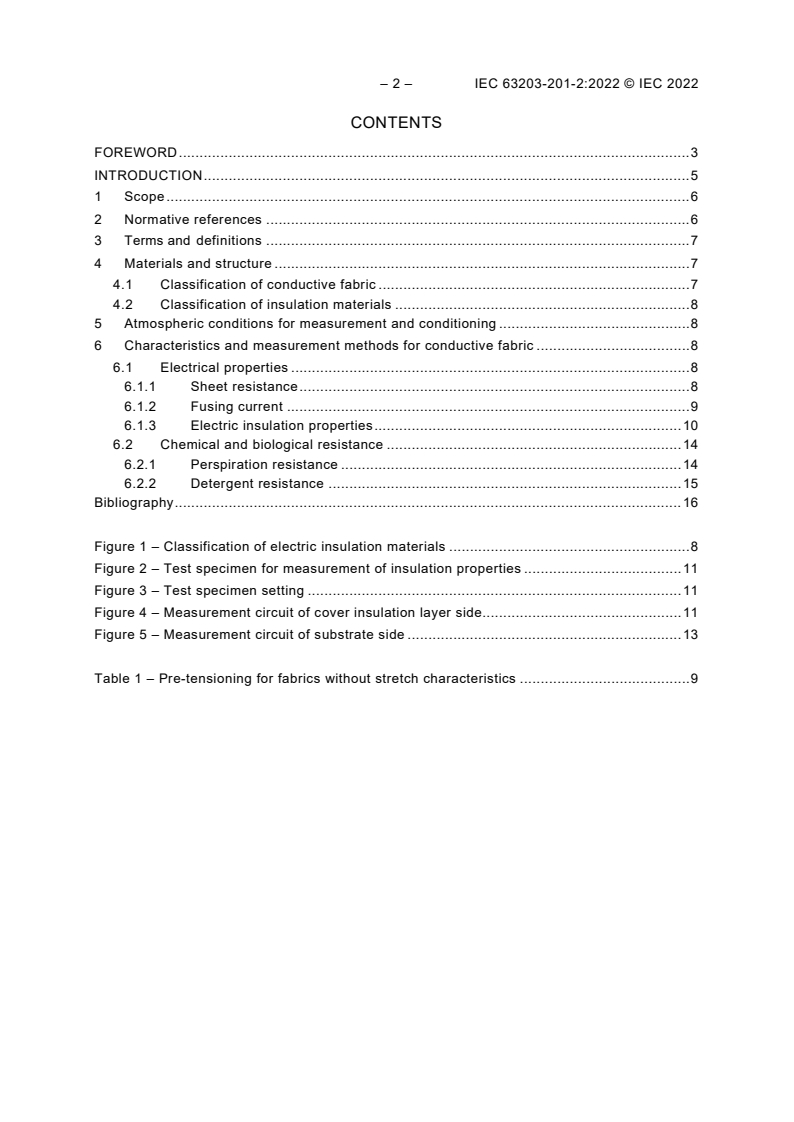
– 2 – IEC 63203-201-2:2022 © IEC 2022
CONTENTS
FOREWORD . 3
INTRODUCTION . 5
1 Scope . 6
2 Normative references . 6
3 Terms and definitions . 7
4 Materials and structure . 7
4.1 Classification of conductive fabric . 7
4.2 Classification of insulation materials . 8
5 Atmospheric conditions for measurement and conditioning . 8
6 Characteristics and measurement methods for conductive fabric . 8
6.1 Electrical properties . 8
6.1.1 Sheet resistance . 8
6.1.2 Fusing current . 9
6.1.3 Electric insulation properties . 10
6.2 Chemical and biological resistance . 14
6.2.1 Perspiration resistance . 14
6.2.2 Detergent resistance . 15
Bibliography . 16
Figure 1 – Classification of electric insulation materials . 8
Figure 2 – Test specimen for measurement of insulation properties . 11
Figure 3 – Test specimen setting . 11
Figure 4 – Measurement circuit of cover insulation layer side. 11
Figure 5 – Measurement circuit of substrate side . 13
Table 1 – Pre-tensioning for fabrics without stretch characteristics . 9
INTERNATIONAL ELECTROTECHNICAL COMMISSION
____________
WEARABLE ELECTRONIC DEVICES AND TECHNOLOGIES –
Part 201-2: Electronic textile –
Measurement methods for basic properties of
conductive fabrics and insulation materials
FOREWORD
1) The International Electrotechnical Commission (IEC) is a worldwide organization for standardization comprising
all national electrotechnical committees (IEC National Committees). The object of IEC is to promote international
co-operation on all questions concerning standardization in the electrical and electronic fields. To this end and
in addition to other activities, IEC publishes International Standards, Technical Specifications, Technical Reports,
Publicly Available Specifications (PAS) and Guides (hereafter referred to as “IEC Publication(s)”). Their
preparation is entrusted to technical committees; any IEC National Committee interested in the subject dealt with
may participate in this preparatory work. International, governmental and non-governmental organizations liaising
with the IEC also participate in this preparation. IEC collaborates closely with the International Organization for
Standardization (ISO) in accordance with conditions determined by agreement between the two organizations.
2) The formal decisions or agreements of IEC on technical matters express, as nearly as possible, an international
consensus of opinion on the relevant subjects since each technical committee has representation from all
interested IEC National Committees.
3) IEC Publications have the form of recommendations for international use and are accepted by IEC National
Committees in that sense. While all reasonable efforts are made to ensure that the technical content of IEC
Publications is accurate, IEC cannot be held responsible for the way in which they are used or for any
misinterpretation by any end user.
4) In order to promote international uniformity, IEC National Committees undertake to apply IEC Publications
transparently to the maximum extent possible in their national and regional publications. Any divergence between
any IEC Publication and the corresponding national or regional publication shall be clearly indicated in the latter.
5) IEC itself does not provide any attestation of conformity. Independent certification bodies provide conformity
assessment services and, in some areas, access to IEC marks of conformity. IEC is not responsible for any
services carried out by independent certification bodies.
6) All users should ensure that they have the latest edition of this publication.
7) No liability shall attach to IEC or its directors, employees, servants or agents including individual experts and
members of its technical committees and IEC National Committees for any personal injury, property damage or
other damage of any nature whatsoever, whether direct or indirect, or for costs (including legal fees) and
expenses arising out of the publication, use of, or reliance upon, this IEC Publication or any other IEC
Publications.
8) Attention is drawn to the Normative references cited in this publication. Use of the referenced publications is
indispensable for the correct application of this publication.
9) Attention is drawn to the possibility that some of the elements of this IEC Publication may be the subject of patent
rights. IEC shall not be held responsible for identifying any or all such patent rights.
IEC 63203-201-2 has been prepared by IEC technical committee 124: Wearable electronic
devices and technologies. It is an International Standard.
The text of this International Standard is based on the following documents:
Draft Report on voting
124/176/FDIS 124/181/RVD
Full information on the voting for its approval can be found in the report on voting indicated in
the above table.
The language used for the development of this International Standard is English.
– 4 – IEC 63203-201-2:2022 © IEC 2022
This document was drafted in accordance with ISO/IEC Directives, Part 2, and developed in
accordance with ISO/IEC Directives, Part 1 and ISO/IEC Directives, IEC Supplement, available
at www.iec.ch/members_experts/refdocs. The main document types developed by IEC are
described in greater detail at www.iec.ch/standardsdev/publications.
A list of all parts in the IEC 63203 series, published under the general title Wearable electronic
devices and technologies, can be found on the IEC website.
The committee has decided that the contents of this document will remain unchanged until the
stability date indicated on the IEC website under webstore.iec.ch in the data related to the
specific document. At this date, the document will be
• reconfirmed,
• withdrawn,
• replaced by a revised edition, or
• amended.
INTRODUCTION
This document contains the provisions for conductive fabrics and insulation materials used for
electronic textiles and measurement methods for their properties. When a conductive fabric
becomes a wearable electronics product, it plays the role of conductive traces, electrodes and
the like in clothes-type wearable devices. Therefore, measurement methods are defined for the
characteristics of such conductive fabrics.
The IEC 63203-2 series relates mainly to measurement methods for electronic textile (e- textile)
of wearable electronics.
The IEC 63203-2 series is divided into parts according to each category of electronic textile.
Each part is prepared as a generic specification containing fundamental information for the area
of printed electronics.
The IEC 63203-2 series consists of the following parts:
IEC 63203-201: E‑textile materials
IEC 63203-201-1: E‑textile materials – Conductive yarn
IEC 63203-201-2: E‑textile materials – Conductive fabrics and insulation materials
IEC 63203-202: Passive electric parts for e‑textiles
IEC 63203-202-1: Passive e‑textile parts – Connectors for e‑textile applications
IEC 63203-203: E‑textile functional elements
IEC 63203-204: E‑textile systems (evaluation method for garment-type wearable systems)
IEC 63203-204-1: E‑textile systems – Test method for assessing washing durability of
leisurewear and sportswear e‑textile systems
(Subsequent parts will be prepared according to other categories.)
Furthermore, sectional specifications, blank detail specifications, and detail specifications of
each category will follow these parts.
– 6 – IEC 63203-201-2:2022 © IEC 2022
WEARABLE ELECTRONIC DEVICES AND TECHNOLOGIES –
Part 201-2: Electronic textile –
Measurement methods for basic properties of
conductive fabrics and insulation materials
1 Scope
This part of IEC 63203-201 specifies the provisions for conductive fabrics and insulation
materials used for electronic textiles and measurement methods for their properties.
Conductive fabrics covered by this document are basic materials in electronic textiles and are
mainly used as conductive traces, electrodes and the like in clothes-type wearable devices.
This document does not cover high-resistance conductive fabrics used for antistatic purposes
and heater applications.
Insulating materials handled in this document are materials used for electrical insulation of
conductive parts in electronic textiles. They include materials for covering the conductive parts,
and general fabrics constituting the basic structure of clothes-type wearable devices.
This document does not define the required characteristics of the conductive fabric and
insulation materials; rather, it specifies measurement methods for general and electrical
properties of the conductive fabric and insulation materials.
2 Normative references
The following documents are referred to in the text in such a way that some or all of their content
constitutes requirements of this document. For dated references, only the edition cited applies.
For undated references, the latest edition of the referenced document (including any
amendments) applies.
IEC 60243-1:2013, Electric strength of insulating materials – Test methods – Part 1: Tests at
power frequencies
IEC 60468:1974, Method of measurement of resistivity of metallic materials
IEC 62631-3-1:2016, Dielectric and resistive properties of solid insulating materials – Part 3-1:
Determination of resistive properties (DC methods) – Volume resistance and volume resistivity
– General method
ISO 105-E04, Textiles − Tests for colour fastness − Part E04: Colour fastness to perspiration
ISO 139, Textiles − Standard atmospheres for conditioning and testing
ISO 6330, Textiles – Domestic washing and drying procedures for textile testing
EN 16812:2016, Textiles and textile products – Electrically conductive textiles – Determination
of the linear electrical resistance of conductive tracks
3 Terms and definitions
For the purposes of this document, the following terms and definitions apply.
ISO and IEC maintain terminological databases for use in standardization at the following
addresses:
• IEC Electropedia: available at http://www.electropedia.org/
• ISO Online browsing platform: available at http://www.iso.org/obp
3.1
conductive fabric
fabric, such as woven fabric, knitted fabric, or nonwoven fabric, having electrical conductivity
Note 1 to entry: Conductive fabric can be used at the level of signal line, power transmission line, and
electromagnetic shield.
[SOURCE: IEC 63203-101-1:2021, 3.18]
3.2
insulation material
insulant material used to prevent electric conduction between conductive elements
Note 1 to entry: In the field of electromagnetism the term "insulant" is also used as a synonym for "insulating
medium".
[SOURCE: IEC 60050-151:2001, 151-15-35, modified – The terms "insulating material" and
"insulant" have been replaced with "insulation material" and the word "insulant" added to the
definition.]
3.3
sheet resistance
electrical resistance of a sheet of nominally uniform thickness, measured across the opposite
ends of a square area
Note 1 to entry: The unit of sheet resistance is Ohm (Ω). However, in order not to confuse sheet resistance with
bulk resistance, the use of Ohm per square (Ω/□) is recommended.
Note 2 to entry: If fabric thickness is known, the average bulk resistivity of the fabric material can be calculated as
the product of sheet resistance and fabric thickness.
Note 3 to entry: In a conductive fabric whose resistance value can be regarded as isotropic, the fabric can be
regarded as a sheet and the sheet resistance can be used as an expression of conductivity.
[SOURCE: IEC 62899-101:2019, 3.122, modified − In the definition, "thin film" has been
replaced with "sheet"; in Note 2, "film" has been replaced with "fabric", and Note 3 has been
added.]
4 Materials and structure
4.1 Classification of conductive fabric
"Fabric" is a generic term for fibre structures having planar shapes. Fabrics are classified as
follows: woven fabric, knitted fabric, and nonwoven fabric. Electric conductive fabrics are fabrics
that contain conductive yarns or fibres in their composition or fabrics that are coated by
electro-conductive materials.
– 8 – IEC 63203-201-2:2022 © IEC 2022
4.2 Classification of insulation materials
The insulating materials in this document are used for e‑textile products with electric conductive
fabrics or conductive yarns. Layers of fabrics used for the purpose of insulation materials are
made of generic non-conductive yarns and are non-conductive fabrics, further, they may have
non-conductive coating on one side or both sides. Such fabrics are used as substrate for
arranging conductive thread materials consisting of conductive fabrics or yarns and the like.
The insulation materials include non-conductive polymer film and a non-conductive resin
coating in addition to the non-conductive fabrics. These materials form protective layers over
conductive threads and have the role of electric insulation. Electric insulation materials are
classified as shown in Figure 1.
Figure 1 – Classification of electric insulation materials
5 Atmospheric conditions for measurement and conditioning
Preparation, and conditioning and measurement of the test specimens shall be compliant with
ISO 139 according to the standard atmosphere of ISO 139 (i.e., 20 °C, 65 % RH).
6 Characteristics and measurement methods for conductive fabric
6.1 Electrical properties
6.1.1 Sheet resistance
6.1.1.1 Specimens
Cut out five test specimens from the conductive fabric. Each test specimen should have a width
W: 10 mm and an effective length L: 100 mm or other size with similar or larger length-width
ratio. If the entire fabric specimen is not conductive, conductive elements should extend the
complete length of the specimen. Report alternate length-width ratio if used. Conductive fabrics
are not homogeneous materials and may have directionality in electrical properties. A test
specimen for which the direction is different from the original fabric may be cut out as necessary.
6.1.1.2 Pre-tensioning
Pre-tensioning is required to obtain flatness for good contact between the specimen fabric and
the electrodes.
Pre-tensioning condition for the fabric without stretch characteristics is indicated at Table 1 with
reference to EN 16812:2016.
Pre-tensioning condition for the fabric with stretch characteristics is 0,1 N per 10 mm of width
with reference to EN 16812:2016.
Table 1 – Pre-tensioning for fabrics without stretch characteristics
Applied tension (N)
Fabric mass per unit area (g/m )
per 10 mm width
≤ 200 0,4
> 200 and 500 ≤ 1
> 500 2
6.1.1.3 Procedure
The conductivity of conductive fabric is measured by determining the sheet resistance R . The
s
sheet resistance R is determined by the following the procedure.
s
a) Pre-tension is applied to the specimen according to 6.1.1.2.
b) Measure the resistance R in the longitudinal direction of the test specimen according to the
four electrode four-wire method as defined in IEC 60468:1974 and EN 16812:2016.
c) Calculate the sheet resistance R by applying the following formula.
s
Sheet resistance R = R (W / L)
s
d) When the conductivity is anisotropic, the direction in which the specimen is cut out is
determined by the user and supplier.
Calculate the linear resistance R by applying the following formula.
L
Linear resistance R = R/L
L
NOTE 1 The "user" can be any of the following: manufacturer of the yarn, manufacturer of the fabric, manufacturer
of the semi-finished or end product, or end-user.
NOTE 2 The "supplier" can be any of the following: manufacturer of the raw material, manufacturer of the yarn,
manufacturer of the fabric, manufacturer of the semi-finished or end product.
6.1.1.4 Report of the results
The report shall include the following items:
a) identification of measured conductive fabric;
b) test conditions (room temperature and humidity);
c) numbers of measured specimens;
d) average of sheet resistance and linear resistance;
e) standard deviation of sheet resistance and linear resistance.
6.1.2 Fusing current
6.1.2.1 General
This Subclause 6.1.2 describes how to determine at which value of current passing through the
conductive fabric, the fabric melts or ignites by Joule heat. The fusing current is a fundamental
value, to determine the permissible current that may be passed through the conductive fabric.
A safety margin should be determined on a case-by-case basis for the permissible current,
since the surrounding conditions of the conductive fabric depend on the application and its use.
The measuring environment should be equipped with a non-flammable underground, safety
measures to extinguish fires and appropriate ventilation to remove (toxic) fumes.
– 10 – IEC 63203-201-2:2022 © IEC 2022
6.1.2.2 Procedure
a) Cut test specimen according to 6.1.1.1.
b) Clamp electrodes to both ends of the test specimen such that the effective length is 100 mm.
Make sure the test specimen does not slacken in the windless air. Make sure that the test
piece does not wiggle in windless air.
c) Apply a DC voltage such that the initial current becomes 1 mA.
d) Starting 10 s after applying the voltage, increase the voltage such that the current increase
rate becomes 1 mA/s.
e) Determine the fusing current, which is the moment the test specimen melts or ignites.
If the fusing current is below 10 mA, arrange multiple specimens of conductive fabric in
parallel at step b), and determine the fusing current. Divide the measured value by the
number of parallel specimens to get the fusing current. In this case, more than five test
specimens are necessary.
f) Repeat the test for five specimens and calculate the average value of fusing current.
6.1.2.3 Report of the results
The report shall include the following items:
a) identification of test specimen;
b) test conditions (room temperature and humidity);
c) number of test specimens;
d) average of all fusing current (A) measurements;
e) standard deviation of all fusing current measurements.
6.1.3 Electric insulation properties
6.1.3.1 General
The insulation performance is a basic property to understand the level of insulation between
the conductive fabric and the outside. The electric strength is a basic value for understanding
the resistance of the conductive fabric to external voltage.
This Subclause 6.1.3 describes how to measure the insulation performance of the insulation
material and how the electric strength can be determined.
6.1.3.2 Insulation resistance of cover and insulation cover side
6.1.3.2.1 Procedure
a) Test specimens should be prepared as shown in Figure 2. The test specimens consist of a
substrate, a rectangular stretchable conductor of 70 mm × 210 mm, and a cover insulation
layer of 70 mm × 70 mm.
The test specimen substrate shall have a margin of at least 5 mm on each side of the edges
of the conductor. Dimensional errors of ±1 mm are allowed for stretchable conductors and
cover insulation layer.
b) Use an electrode with a guard ring for volume resistivity measurement conforming to
IEC 62631-3-1:2016.
Insert the test specimen between the circular electrode E with the guard ring electrode E
C R
and the ground electrode E , as shown in Figure 3. Fold the specimen in half and sandwich
G
it between both electrodes.
Connect the measuring circuit as shown in Figure 4.
c) Apply a voltage of 500 V if not specified otherwise.
d) Measure the current 1 min after the voltage has been applied, the resistance is calculated
from the current measured.
Key
1 stretchable substrate 70 mm × 210 mm
2 stretchable conductor 70 mm × 210 mm
3 stretchable insulator 70 mm × 70 mm
Figure 2 – Test specimen for measurement of insulation properties
Key
1 stretchable substrate E circular electrode
C
2 stretchable conductor E guard ring electrode
R
3 stretchable insulator E ground electrode
G
Figure 3 – Test specimen setting
Key
1 stretchable substrate
2 stretchable conductor
3 stretchable insulator
Figure 4 – Measurement circuit of cover insulation layer side
– 12 – IEC 63203-201-2:2022 © IEC 2022
6.1.3.2.2 Report of the results
The report shall include the following items:
a) test specimen identification;
b) test conditions (room temperature and humidity);
c) applied voltage (V);
d) number of measured test specimens;
e) average of all measured current and calculated insulation resistance (Ω);
f) standard deviation of all fusing current measurements calculated insulation resistance (Ω).
6.1.3.3 Electric strength of insulation cover side
6.1.3.3.1 Procedure
The test specimen is prepared as specified in 6.1.3.2.1.
Hold the test specimen on a horizontal insulation table with the cover insulating layer facing
upward.
Place a 25 mm diameter electrode on the test specimen insulator layer at a pressure of 1 kg/cm
(the area of 25 mm diameter circle is 4,9 cm ; that is, the weight of the electrode is 4,9 kg). The
electrode is placed at least 10 mm away from the edge of the insulator layer. Measure the
breakdown voltage between electrode and stretchable conductor with an electric breakdown
tester conforming to IEC 60243-1:2013. Apply AC voltage, gradually increase the voltage and
read the voltage value at which the dielectric breakdown occurs. At least five points are
measured and the maximum, minimum and average values and breakdown mode of each test
are recorded.
6.1.3.3.2 Report of the results
The report shall include the following items:
a) test specimen identification;
b) test conditions (room temperature and room humidity);
c) number of test specimens;
d) maximum, minimum and average values of breakdown voltage and each breakdown mode
(thickness direction/surface direction);
e) standard deviation of breakdown voltage.
6.1.3.4 Insulation resistance of substrate side
6.1.3.4.1 Procedure
Test specimen is prepared the same way as in 6.1.3.2.1.
Insulation resistance of the substrate side is measured by the following procedure using an
electrode with a guard ring for volume resistivity measurement conforming to
IEC 62631-3-1:2016. As shown in Figure 5, the test specimen is inserted between the circular
electrode E with the guard ring electrode E and the ground electrode E . It is folded to form
C R G
three layers and sandwiched between both electrodes. The measuring circuit is connected as
shown in Figure 5.
The applied voltage shall be 500 V if not specified otherwise. Read the resistance value after
1 min from the voltage being applied, and the resistance value calculated from the current value
after 1 min is recorded.
Key
1 stretchable substrate
2 stretchable conductor
3 stretchable insulator
Figure 5 – Measurement circuit of substrate side
6.1.3.4.2 Report of the results
The report shall include the following items:
a) test specimen identification;
b) test conditions (room temperature and humidity);
c) applied voltage (V);
d) number of measured test specimens;
e) average of all measured current values and insulation resistance values calculated (Ω);
f) standard deviation of all measured current values and insulation resistance values
calculated (Ω).
6.1.3.5 Electric strength of substrate side
6.1.3.5.1 Procedure
The test specimen is prepared as per 6.1.3.2.1.
Hold the test specimen on a horizontal insulation table with the substrate side facing upward.
Place a 25 mm diameter electrode on the test specimen insulator layer at a pressure of 1 kg/cm
(the area of 25 mm diameter is 4,9 cm ; that is, the weight of the electrode is 4,9 kg). The
electrode is placed at least 15 mm away from the edge of the substrate. Measure the breakdown
voltage between electrode and stretchable conductor with an electric breakdown tester
conforming to IEC 60243-1:2013. Apply AC voltage, gradually increase the voltage and read
the voltage value at which the dielectric breakdown occurs. At least five points are measured
and the maximum, minimum and average values and breakdown mode of each test are recorded.
6.1.3.5.2 Report of the results
The report shall include the following items:
a) test specimen identification;
b) test conditions (room temperature and humidity);
c) numbers of test specimens;
– 14 – IEC 63203-201-2:2022 © IEC 2022
d) maximum, minimum and average values of breakdown voltage and each breakdown mode
(thickness direction/surface direction);
e) standard deviation of breakdown voltage.
6.2 Chemical and biological resistance
6.2.1 Perspiration resistance
6.2.1.1 General
Perspiration durability is indicated by the sheet resistance change ratio before and after
exposure to artificial perspiration liquid. The sheet resistance change ratio of perspiration
durability can be obtained by the following procedure.
Artificial perspiration liquid (alkaline solution and acid solution) shall be prepared according to
ISO 105-E104.
6.2.1.2 Specimens
Cut the test specimen according to 6.1.1.1.
6.2.1.3 Procedure
a) For each specimen measure the initial sheet resistance R in accordance with the method
p0
described in 6.1.1.3.
b) Immerse the specimens in artificial alkaline perspiration solution adjusted to (37 ± 2) °C for
24 h, by laying them in a flat-bottomed dish and covering them with the alkaline solution.
Thoroughly wet the specimen in this solution at an approximate liquor ratio of 50:1.
c) Remove the test specimen from the artificial perspiration liquid and rinse thoroughly with
running water.
d) Hang the test specimen vertically for 24 h under standard environment (i.e., at (20 ± 2) °C,
(65 ± 4) % RH) to dry.
e) Measure the resistance R of the test specimen as described in 6.2.1.
pt
f) Calculate the resistance change ratio by applying the following formula:
Resistance change ratio = 100 × (R − R ) / R [%]
pt p0 p0
Here, R is the resistance value before the test
p0
R is the resistance value after the perspiration treatment.
pt
g) Repeat the above procedure for five specimens and calculate the average value.
h) Apply the procedure from steps a) to g) using the artificial perspiration acid solution.
6.2.1.4 Report of the results
The report shall include the following items:
a) identification of measured fabric;
b) test conditions (room temperature and humidity and type of artificial perspiration);
c) number of specimens;
d) average of resistance change ratio;
e) standard deviation of resistance change ratio.
6.2.2 Detergent resistance
6.2.2.1 Specimens
Prepare five test specimens using the same method as described in 6.2.1.2.
6.2.2.2 Detergent
Detergent shall be selected by a mutual agreement between the user and supplier from standard
detergents specified in ISO 6330.
NOTE 1 The "user" can be any of the following: manufacturer of the yarn, manufacturer of the fabric, manufacturer
of the semi-finished or end product, or end-user.
NOTE 2 The "supplier" can be any of the following: manufacturer of the raw material, manufacturer of the yarn,
manufacturer of the fabric, manufacturer of the semi-finished or end product.
6.2.2.3 Procedure
a) Measure the initial sheet resistance R of the sample fabric using the method described in
d0
6.1.1.3.
b) Immerse the specimens in 2,0 g/l detergent aqueous solution adjusted to (25 ± 2) °C for
24 h.
c) Remove the test specimen from the detergent solution and rinse thoroughly with running
water.
d) Hang the test specimen vertically for 24 h under standard environment (i.e., at (20 ± 2) °C,
(65 ± 4) % RH) to dry.
e) Measure the resistance value R of the test specimen as described in 6.2.1.
dt
f) Calculate the resistance change ratio by applying the following formula:
Resistance change ratio = 100 × (R − R ) / R [%]
dt d0 d0
Here, R is the resistance value before the test
d0
is the resistance value after the detergent treatment.
R
dt
g) Repeat the above procedure for five specimens, and calculate the average value.
6.2.2.4 Report of the results
The report shall include the following items:
a) identification of measured fabric;
b) test conditions (room temperature and humidity and type of detergent);
c) number of specimens;
d) average of resistance change ratio;
e) standard deviation of resistance change ratio.
– 16 – IEC 63203-201-2:2022 © IEC 2022
Bibliography
IEC 61557-2:2019, Electrical safety in low voltage distribution systems up to 1 000 V a.c. and
1 500 V d.c. – Equipment for testing, measuring or monitoring of protective measures – Part 2:
Insulation resistance
IEC 62899-101:2019, Printed electronics – Part 101: Terminology – Vocabulary
IEC 62899-201-2:2021, Printed electronics – Part 201-2: Materials − Substrates –
Measurement method for properties of stretchable substrate
IEC 62899-202-4:2021, Printed electronics – Part 201-4: Materials − Conductive ink −
Measurement methods for properties of stretchable printed layers (conductive and insulating)
ISO 105-C06-C10, Textiles – Tests for colour fastness – Part C06: Colour fastness to domestic
and commercial laundering
ISO 3915:1981, Plastics – Measurement of resistivity of conductive plastics
EN 16711-2:2015, Textiles – Determination of metal content – Part 2: Determination of metals
extracted by acidic artificial perspiration solution
AATCC EP13-2018, Evaluation procedure for electrical resistance of electronically-integrated
textiles
ASTM D6611-16, Standard Test Method for Wet and Dry Yarn-on-Yarn Abrasion Resistance
___________
– 18 – IEC 63203-201-2:2022 © IEC 2022
SOMMAIRE
AVANT-PROPOS . 19
INTRODUCTION . 21
1 Domaine d’application . 22
2 Références normatives . 22
3 Termes et définitions . 23
4 Matériaux et structure . 23
4.1 Classification des étoffes conductrices . 23
4.2 Classification des matériaux isolants . 23
5 Conditions atmosphériques de mesure et de conditionnement . 24
6 Caractéristiques et méthodes de mesure d’une étoffe conductrice . 24
6.1 Propriétés électriques . 24
6.1.1 Résistance d’une feuille . 24
6.1.2 Courant de fusion . 26
6.1.3 Propriétés d’isolation électrique . 26
6.2 Résistance chimique et biologique . 31
6.2.1 Solidité à la sueur . 31
6.2.2 Solidité au détergent . 32
Bibliographie . 33
Figure 1 – Classification des matériaux isolants électriques . 24
Figure 2 – Éprouvette d’essai pour le mesurage des propriétés isolantes . 27
Figure 3 – Installation de l’éprouvette d’essai . 28
Figure 4 – Circuit de mesure du côté couche isolante de recouvrement . 28
Figure 5 – Circuit de mesure du côté substrat . 30
Tableau 1 – Prétension appliquée aux étoffes sans caractéristiques d'allongement . 25
COMMISSION ÉLECTROTECHNIQUE INTERNATIONALE
____________
TECHNOLOGIES ET DISPOSITIFS ÉLECTRONIQUES PRÊTS-À-PORTER –
Partie 201-2: Textile électronique – Méthodes de mesure des propriétés
fondamentales des étoffes conductrices et des matériaux isolants
AVANT-PROPOS
1) La Commission Electrotechnique Internationale (IEC) est une organisation mondiale de normalisation composée
de l'ensemble des comités électrotechniques nationaux (Comités nationaux de l’IEC). L’IEC a pour objet
de favoriser la coopération internationale pour toutes les questions de normalisation dans les domaines
de l'électricité et de l'électronique. À cet effet, l’IEC – entre autres activités – publie des Normes internationales,
des Spécifications techniques, des Rapports techniques, des Spécifications accessibles au public (PAS) et
des Guides (ci-après dénommés "Publication(s) de l’IEC"). Leur élaboration est confiée à des comités d'études,
aux travaux desquels tout Comité national intéressé par le sujet traité peut participer. Les organisations
internationales, gouvernementales et non gouvernementales, en liaison avec l’IEC, participent également
aux travaux. L’IEC collabore étroitement avec l'Organisation Internationale de Normalisation (ISO), selon
des conditions fixées par accord entre les deux organisations.
2) Les décisions ou accords officiels de l’IEC concernant les questions techniques représentent, dans la mesure
du possible, un accord international sur les sujets étudiés, étant donné que les Comités nationaux de l’IEC
intéressés sont représentés dans chaque comité d’études.
3) Les Publications de l'IEC se présentent sous la forme de recommandations internationales et sont agréées
comme telles par les Comités nationaux de l'IEC. Tous les efforts raisonnables sont entrepris afin que l’IEC
s'assure de l'exactitude du contenu technique de ses publications; l’IEC ne peut pas être tenue responsable
de l'éventuelle mauvaise utilisation ou interprétation qui en est faite par un quelconque utilisateur final.
4) Dans le but d'encourager l'uniformité internationale, les Comités nationaux de l’IEC s'engagent, dans toute
la mesure possible, à appliquer de façon transparente les Publications de l’IEC dans leurs publications nationales
et régionales. Toutes divergences entre toutes Publications de l'IEC et toutes publications nationales
ou régionales correspondantes doivent être indiquées en termes clairs dans ces dernières.
5) L’IEC elle-même ne fournit aucune attestation de conformité. Des organismes de certification indépendants
fournissent des services d'évaluation de conformité et, dans certains secteurs, accèdent aux marques
de conformité de l’IEC. L’IEC n'est responsable d'aucun des services effectués par les organismes de certification
indépendants.
6) Tous les utilisateurs doivent s'assurer qu'ils sont en possession de la dernière édition de cette pub
...