

IEC TS 62271-320:2025
(Main)High-voltage switchgear and controlgear - Part 320: Environmental aspects and life cycle assessment rules for high-voltage switchgear and controlgear
General Information
- Abstract
IEC TS 62271-320:2025 provides guidance to suppliers, manufacturers, users, and waste operators of high-voltage switchgear and controlgear as well as their assemblies having a rated voltage above 1 kV AC and 1,5 kV DC, together with their associated auxiliary equipment, on environmentally conscious design, and on assessing environmental impacts when used in systems. This document also gives guidance on effective communication of environmental information throughout the entire life cycle.
- Status
- Published
- Publication Date
- 24-Mar-2025
- Technical Committee
- TC 17 - High-voltage switchgear and controlgear
- Drafting Committee
- WG 10 - TC 17/WG 10
- Current Stage
- PPUB - Publication issued
- Start Date
- 25-Mar-2025
- Completion Date
- 01-Nov-2024
Buy Documents
IEC TS 62271-320:2025 - High-voltage switchgear and controlgear - Part 320: Environmental aspects and life cycle assessment rules for high-voltage switchgear and controlgear Released:3/25/2025
Overview - IEC TS 62271-320:2025 (Environmental aspects and LCA rules)
IEC TS 62271-320:2025 is a Technical Specification from IEC that provides guidance on environmentally conscious design and life cycle assessment (LCA) for high-voltage switchgear and controlgear (HV SG&CG) and their assemblies. It applies to equipment with rated voltages above 1 kV AC and 1.5 kV DC and covers associated auxiliary equipment. The document defines how suppliers, manufacturers, users and waste operators should assess and communicate environmental impacts throughout the product life cycle, from raw materials to end-of-life.
Key topics and technical requirements
- Life cycle thinking and reference service life - setting the temporal basis for environmental assessment and design decisions.
- Product Specific Rules (PSR) for LCA - rules tailored to HV SG&CG enabling consistent life cycle inventories and impact assessments.
- LCA functional unit (LCA-FU) and system boundaries - guidance on defining the functional unit (switching device or assembly) and which life cycle stages to include.
- Inputs and outputs (LCI) - material and energy inputs, emissions, and waste streams to be considered at manufacturing, distribution, installation, use, maintenance and end-of-life.
- Emission and scenario guidance - recommended scenarios for insulation/switching medium emissions, manufacturing, installation, use and end-of-life.
- Impact categories and interpretation - recommended environmental impact categories for reporting and decision-making.
- Material declaration and end-of-life information - required content and recommended additional reporting (mass breakdown, recyclability, hazardous constituents).
- Digitization and LCA reporting - structuring LCA reports and digital exchange of environmental data to support transparency across supply chains.
- Material circularities and net benefits beyond system boundaries - treating reused/recycled materials and closed-loop scenarios.
Practical applications
- Perform standardized LCAs and prepare environmental declarations for HV switchgear and controlgear.
- Integrate environmental criteria into product design, material selection and maintenance strategies.
- Support procurement and compliance with sustainability or regulatory programs by providing consistent environmental data.
- Enable downstream users and waste operators to plan end-of-life processing, recycling and reuse.
- Facilitate digital exchange of LCA data across supply chains to improve transparency and circularity.
Who should use this standard
- Manufacturers and suppliers of high-voltage switchgear and controlgear
- Product designers and R&D teams implementing environmentally conscious design
- Environmental and sustainability engineers conducting LCA studies
- Asset owners, utilities and specifiers assessing equipment environmental performance
- Waste operators and recyclers planning EoL treatment and material recovery
Related standards
- IEC 62271 series (high-voltage switchgear & controlgear standards)
- IEC/IEEE 62271-37-013 and IEC 62271-109 (product-specific references illustrated in the TS)
- IEC 63366 (LCA-related guidance referenced)
Keywords: IEC TS 62271-320:2025, high-voltage switchgear and controlgear, life cycle assessment (LCA), environmentally conscious design, product specific rules (PSR), material declaration, end-of-life.
Buy Documents
IEC TS 62271-320:2025 - High-voltage switchgear and controlgear - Part 320: Environmental aspects and life cycle assessment rules for high-voltage switchgear and controlgear Released:3/25/2025
Get Certified
Connect with accredited certification bodies for this standard

BSI Group
BSI (British Standards Institution) is the business standards company that helps organizations make excellence a habit.

Bureau Veritas
Bureau Veritas is a world leader in laboratory testing, inspection and certification services.

DNV
DNV is an independent assurance and risk management provider.
Sponsored listings
Frequently Asked Questions
IEC TS 62271-320:2025 is a technical specification published by the International Electrotechnical Commission (IEC). Its full title is "High-voltage switchgear and controlgear - Part 320: Environmental aspects and life cycle assessment rules for high-voltage switchgear and controlgear". This standard covers: IEC TS 62271-320:2025 provides guidance to suppliers, manufacturers, users, and waste operators of high-voltage switchgear and controlgear as well as their assemblies having a rated voltage above 1 kV AC and 1,5 kV DC, together with their associated auxiliary equipment, on environmentally conscious design, and on assessing environmental impacts when used in systems. This document also gives guidance on effective communication of environmental information throughout the entire life cycle.
IEC TS 62271-320:2025 provides guidance to suppliers, manufacturers, users, and waste operators of high-voltage switchgear and controlgear as well as their assemblies having a rated voltage above 1 kV AC and 1,5 kV DC, together with their associated auxiliary equipment, on environmentally conscious design, and on assessing environmental impacts when used in systems. This document also gives guidance on effective communication of environmental information throughout the entire life cycle.
IEC TS 62271-320:2025 is classified under the following ICS (International Classification for Standards) categories: 13.020.30 - Environmental impact assessment; 29.130.10 - High voltage switchgear and controlgear. The ICS classification helps identify the subject area and facilitates finding related standards.
IEC TS 62271-320:2025 is available in PDF format for immediate download after purchase. The document can be added to your cart and obtained through the secure checkout process. Digital delivery ensures instant access to the complete standard document.
Standards Content (Sample)
IEC TS 62271-320 ®
Edition 1.0 2025-03
TECHNICAL
SPECIFICATION
High-voltage switchgear and controlgear –
Part 320: Environmental aspects and life cycle assessment rules for high-
voltage switchgear and controlgear
All rights reserved. Unless otherwise specified, no part of this publication may be reproduced or utilized in any form
or by any means, electronic or mechanical, including photocopying and microfilm, without permission in writing from
either IEC or IEC's member National Committee in the country of the requester. If you have any questions about IEC
copyright or have an enquiry about obtaining additional rights to this publication, please contact the address below or
your local IEC member National Committee for further information.
IEC Secretariat Tel.: +41 22 919 02 11
3, rue de Varembé info@iec.ch
CH-1211 Geneva 20 www.iec.ch
Switzerland
About the IEC
The International Electrotechnical Commission (IEC) is the leading global organization that prepares and publishes
International Standards for all electrical, electronic and related technologies.
About IEC publications
The technical content of IEC publications is kept under constant review by the IEC. Please make sure that you have the
latest edition, a corrigendum or an amendment might have been published.
IEC publications search - webstore.iec.ch/advsearchform IEC Products & Services Portal - products.iec.ch
The advanced search enables to find IEC publications by a Discover our powerful search engine and read freely all the
variety of criteria (reference number, text, technical publications previews, graphical symbols and the glossary.
committee, …). It also gives information on projects, replaced With a subscription you will always have access to up to date
and withdrawn publications. content tailored to your needs.
IEC Just Published - webstore.iec.ch/justpublished
Electropedia - www.electropedia.org
Stay up to date on all new IEC publications. Just Published
The world's leading online dictionary on electrotechnology,
details all new publications released. Available online and once
containing more than 22 500 terminological entries in English
a month by email.
and French, with equivalent terms in 25 additional languages.
Also known as the International Electrotechnical Vocabulary
IEC Customer Service Centre - webstore.iec.ch/csc
(IEV) online.
If you wish to give us your feedback on this publication or need
further assistance, please contact the Customer Service
Centre: sales@iec.ch.
IEC TS 62271-320 ®
Edition 1.0 2025-03
TECHNICAL
SPECIFICATION
High-voltage switchgear and controlgear –
Part 320: Environmental aspects and life cycle assessment rules for high-
voltage switchgear and controlgear
INTERNATIONAL
ELECTROTECHNICAL
COMMISSION
ICS 13.020.30; 29.130.10 ISBN 978-2-8327-0293-2
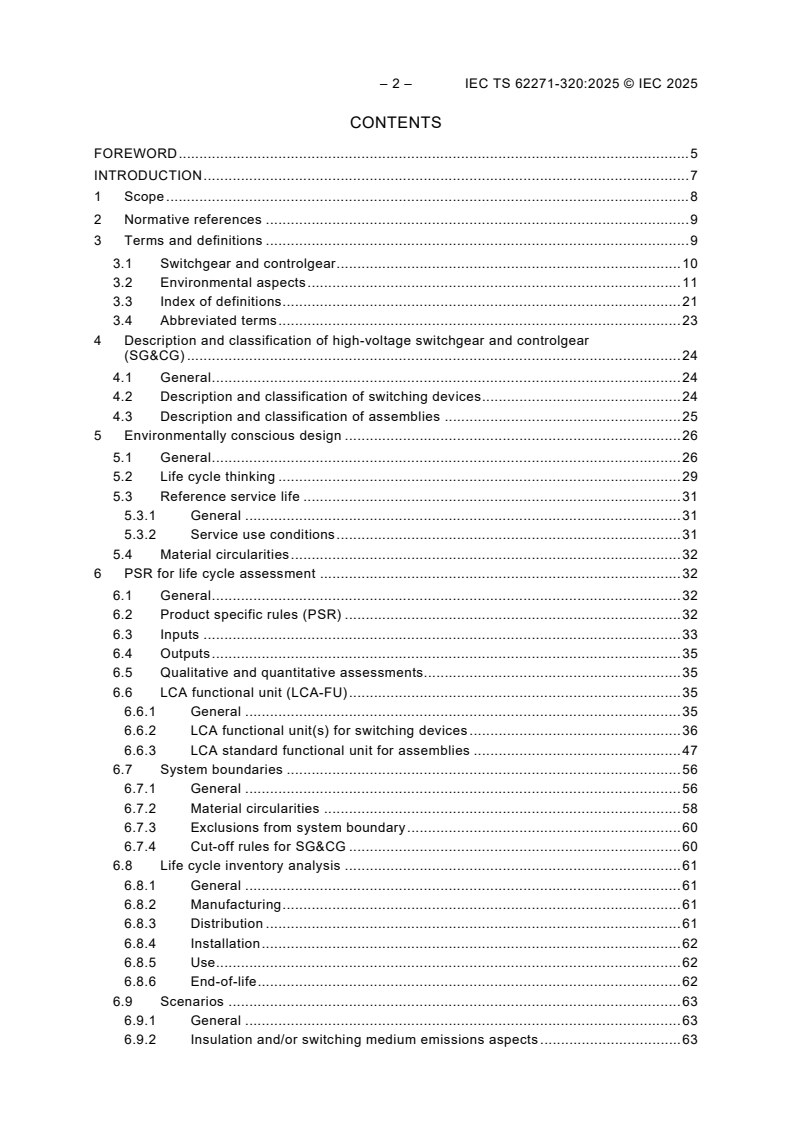
– 2 – IEC TS 62271-320:2025 © IEC 2025
CONTENTS
FOREWORD . 5
INTRODUCTION . 7
1 Scope . 8
2 Normative references . 9
3 Terms and definitions . 9
3.1 Switchgear and controlgear . 10
3.2 Environmental aspects . 11
3.3 Index of definitions . 21
3.4 Abbreviated terms . 23
4 Description and classification of high-voltage switchgear and controlgear
(SG&CG) . 24
4.1 General . 24
4.2 Description and classification of switching devices . 24
4.3 Description and classification of assemblies . 25
5 Environmentally conscious design . 26
5.1 General . 26
5.2 Life cycle thinking . 29
5.3 Reference service life . 31
5.3.1 General . 31
5.3.2 Service use conditions . 31
5.4 Material circularities . 32
6 PSR for life cycle assessment . 32
6.1 General . 32
6.2 Product specific rules (PSR) . 32
6.3 Inputs . 33
6.4 Outputs . 35
6.5 Qualitative and quantitative assessments. 35
6.6 LCA functional unit (LCA-FU) . 35
6.6.1 General . 35
6.6.2 LCA functional unit(s) for switching devices . 36
6.6.3 LCA standard functional unit for assemblies . 47
6.7 System boundaries . 56
6.7.1 General . 56
6.7.2 Material circularities . 58
6.7.3 Exclusions from system boundary . 60
6.7.4 Cut-off rules for SG&CG . 60
6.8 Life cycle inventory analysis . 61
6.8.1 General . 61
6.8.2 Manufacturing . 61
6.8.3 Distribution . 61
6.8.4 Installation . 62
6.8.5 Use . 62
6.8.6 End-of-life . 62
6.9 Scenarios . 63
6.9.1 General . 63
6.9.2 Insulation and/or switching medium emissions aspects . 63
6.9.3 Manufacturing and installation scenario . 66
6.9.4 Distribution scenario . 66
6.9.5 Use scenario . 67
6.9.6 End-of-life scenarios . 72
6.10 Impact categories . 76
6.11 Guidance for extrapolation of LCA results within a homogenous product
family . 78
6.12 LCA comparison aspects . 79
7 Information . 79
7.1 General . 79
7.2 Material declaration . 80
7.2.1 General . 80
7.2.2 Additional reporting recommendations . 80
7.3 End-of-life information . 81
7.3.1 General . 81
7.3.2 End-of-life information provision . 81
7.4 Digitization of high-voltage switchgear and controlgear and information
related to LCA . 81
7.5 LCA report . 82
7.5.1 General . 82
7.5.2 General information . 82
7.5.3 Goal and scope of the study . 83
7.5.4 Life cycle inventory analysis . 83
7.5.5 Environmental impact assessment . 83
7.5.6 Additional environmental information . 84
Annex A (informative) Environmental aspects in environmentally conscious design . 85
A.1 General . 85
A.2 Inputs and outputs to be considered . 85
A.2.1 General . 85
A.2.2 Inputs . 85
A.2.3 Outputs. 86
A.3 Tools for including environmental impacts in high-voltage switchgear and
controlgear design . 86
Annex B (informative) Brief introduction to life cycle assessment (LCA) . 88
B.1 General . 88
B.2 Definition of the goal and scope of the LCA . 88
B.3 Inventory analysis . 89
B.4 Impact assessment . 89
B.5 Interpretation . 90
Annex C (informative) Environmental impact criteria . 91
C.1 General . 91
C.2 Sustainable development goals (SDGs) and environmental impact category . 91
Annex D (informative) Equivalent energy mix – Example of calculation . 101
D.1 Hypothesis . 101
D.2 Example. 101
Bibliography . 105
Figure 1 – Overview of the defined product families SG&CG within the scope of this
document . 25
– 4 – IEC TS 62271-320:2025 © IEC 2025
Figure 2 – General relationship between environmental aspects and associated
impacts for SG&CG during their life cycle . 27
Figure 3 – Example of system diagram of the whole life cycle for life cycle assessment
of SG&CG . 30
Figure 4 – Functional description for IEC 62271-109 AC by-pass switches > 52 kV . 47
Figure 5 – Functional description for IEC/IEEE 62271-37-013 Generator circuit-
breakers ≤ 38 kV . 47
Figure 6 – Scheme of the analysed product system's boundaries, including the life
cycle stages and unit processes, which separate it from the ecosphere (natural
environment) (based on IEC 63366:—, Figure 2) . 58
Figure 7 – Upstream and downstream product information . 79
Figure C.1 – Life cycle impact assessment, from inventory to category endpoints . 91
Figure C.2 – Life cycle impact assessment, from inventory to category midpoints . 92
Figure C.3 – Relation between LCA impact categories (endpoints) and sustainable
development goals . 93
Table 1 – Abbreviated terms . 23
Table 2 – Overview of the referenced standards, structure, content and the
corresponding clauses/subclauses of this document . 28
Table 3 – Examples of typical average environmental intended use conditions of
SG&CG . 31
Table 4 – Typical LCA-functional unit properties of switching devices . 37
Table 5 – Typical LCA-functional unit properties of assemblies . 49
Table 6 – Formulas for calculating the net benefits and loads beyond the system
boundaries . 59
Table 7 – Calculation of emissions during the use life cycle stage including refilling
and maintenance, if applicable . 64
Table 8 – Typical emissions factors in per unit SGCG and by life cycle stage . 66
Table 9 – Recommended scenarios for IED for use phase . 67
Table 10 – Typical scenarios for switchgear and controlgear switching devices . 68
Table 11 – Typical use scenarios for calculating impacts of assemblies . 69
Table 12 – Typical load conditions for assemblies. 69
Table 13 – Further explanation of the generic EoL treatment scenario . 74
Table 14 – Recommended impact categories in LCA studies or reported in
environmental declarations for SG&CG . 77
Table 15 – Additional parameters to be considered in the environmental declaration
per functional/reference unit . 77
Table C.1 – Detailed environmental impact criteria . 94
Table D.1 – Energy mix by location . 101
Table D.2 – Parts manufacturing mass ratio and use unit ratio . 102
Table D.3 – Equivalent energy mixes for manufacturing . 103
Table D.4 – Equivalent energy mixes for installation, use and EoL . 104
Table D.5 – Equivalent energy mixes by life cycle stages . 104
INTERNATIONAL ELECTROTECHNICAL COMMISSION
____________
HIGH-VOLTAGE SWITCHGEAR AND CONTROLGEAR –
Part 320: Environmental aspects and life cycle assessment rules
for high-voltage switchgear and controlgear
FOREWORD
1) The International Electrotechnical Commission (IEC) is a worldwide organization for standardization comprising
all national electrotechnical committees (IEC National Committees). The object of IEC is to promote international
co-operation on all questions concerning standardization in the electrical and electronic fields. To this end and
in addition to other activities, IEC publishes International Standards, Technical Specifications, Technical Reports,
Publicly Available Specifications (PAS) and Guides (hereafter referred to as "IEC Publication(s)"). Their
preparation is entrusted to technical committees; any IEC National Committee interested in the subject dealt with
may participate in this preparatory work. International, governmental and non-governmental organizations liaising
with the IEC also participate in this preparation. IEC collaborates closely with the International Organization for
Standardization (ISO) in accordance with conditions determined by agreement between the two organizations.
2) The formal decisions or agreements of IEC on technical matters express, as nearly as possible, an international
consensus of opinion on the relevant subjects since each technical committee has representation from all
interested IEC National Committees.
3) IEC Publications have the form of recommendations for international use and are accepted by IEC National
Committees in that sense. While all reasonable efforts are made to ensure that the technical content of IEC
Publications is accurate, IEC cannot be held responsible for the way in which they are used or for any
misinterpretation by any end user.
4) In order to promote international uniformity, IEC National Committees undertake to apply IEC Publications
transparently to the maximum extent possible in their national and regional publications. Any divergence between
any IEC Publication and the corresponding national or regional publication shall be clearly indicated in the latter.
5) IEC itself does not provide any attestation of conformity. Independent certification bodies provide conformity
assessment services and, in some areas, access to IEC marks of conformity. IEC is not responsible for any
services carried out by independent certification bodies.
6) All users should ensure that they have the latest edition of this publication.
7) No liability shall attach to IEC or its directors, employees, servants or agents including individual experts and
members of its technical committees and IEC National Committees for any personal injury, property damage or
other damage of any nature whatsoever, whether direct or indirect, or for costs (including legal fees) and
expenses arising out of the publication, use of, or reliance upon, this IEC Publication or any other IEC
Publications.
8) Attention is drawn to the Normative references cited in this publication. Use of the referenced publications is
indispensable for the correct application of this publication.
9) IEC draws attention to the possibility that the implementation of this document may involve the use of (a)
patent(s). IEC takes no position concerning the evidence, validity or applicability of any claimed patent rights in
respect thereof. As of the date of publication of this document, IEC had not received notice of (a) patent(s), which
may be required to implement this document. However, implementers are cautioned that this may not represent
the latest information, which may be obtained from the patent database available at https://patents.iec.ch. IEC
shall not be held responsible for identifying any or all such patent rights.
IEC TS 62271-320 has been prepared by IEC technical committee 17: High-voltage switchgear
and controlgear. It is a Technical Specification.
The text of this Technical Specification is based on the following documents:
Draft Report on voting
17/1161/DTS 17/1169/RVDTS
Full information on the voting for its approval can be found in the report on voting indicated in
the above table.
The language used for the development of this Technical Specification is English.
– 6 – IEC TS 62271-320:2025 © IEC 2025
This document was drafted in accordance with ISO/IEC Directives, Part 2, and developed in
accordance with ISO/IEC Directives, Part 1 and ISO/IEC Directives, IEC Supplement, available
at www.iec.ch/members_experts/refdocs. The main document types developed by IEC are
described in greater detail at www.iec.ch/publications.
A list of all parts in the IEC 62271 series, published under the general title High-voltage
switchgear and controlgear, can be found on the IEC website.
The committee has decided that the contents of this document will remain unchanged until the
stability date indicated on the IEC website under webstore.iec.ch in the data related to the
specific document. At this date, the document will be
• reconfirmed,
• withdrawn, or
• revised.
INTRODUCTION
Increasingly there is a focus on preserving the natural environment for the good of future
generations. For this to be achieved, efficient use of energy and materials throughout the life
cycle of every product when used in a system and process to conserve the world's finite natural
resources is essential. In addition, it is essential that the release of substances and materials
that might be harmful for the environment or induce climatic changes be avoided or minimized.
From concept to end-of-life of a product, the environmental impact of all the relevant processes
should be considered, including the circularities of materials for their future life such as how
materials are disposed of or recovered.
In order to contribute to conserving natural resources, manufacturers of high-voltage switchgear
and controlgear and their assemblies should ensure an environmentally conscious design (ECD)
involving:
a) phasing-out or minimizing the use of hazardous substances or materials;
b) efficient use of energy and materials in the manufacture of products;
c) ensuring the lowest practical energy consumption by the products while they are in use;
d) ensuring a dependability performance consideration in relation to the reference service life
and associated conditions;
e) at the end-of-product life, as far as practical, the design should enable recovery of materials
for future use and sorting hazardous components requiring a specific treatment.
As this approach considers the use of high-voltage switchgear and controlgear in systems, this
document contributes to conserving natural resources by users.
Declarations and ECD are increasingly required. This document recommends type III
environmental declarations in accordance with ISO 14025 and material declarations (MD) in
accordance with IEC 62474. In some businesses, green public procurement (GPP) is applicable
and/or ECD is part of the ISO 14001 certification. Some countries and regions are also actively
pushing for environmental conservation, for example, the European Union through its
Ecodesign for Sustainable product regulations (ESPR, Regulation EU 2024/1781) and China
through Ecodesign and life cycle assessment initiatives. Systematic demands for ECD will be
required by most, if not all customers, in the medium term.
Assessing the environmental impact of high-voltage switchgear and controlgear and their
assemblies is part of an ECD process. ECD requires the identification, measurement and
reporting of particular impacts. IEC 62430 describes the basic principles of ECD, with the goal
of reducing the potential environmental impacts of products.
Stakeholders met along the life cycle of the switchgear and controlgear (suppliers,
manufacturers, carriers, contractors, users, recyclers) are continuing their efforts to reduce their
environmental footprint and to assess it as targeted by this document. A simplified means of
estimating the environmental impacts is essential together with readily available data to make
the stakeholder's, i.e., manufacturer's, contractor's, installer's, end user's and recycler's, task
of assessing environmental impacts at system level easier.
Product specific rules (PSR) for assessing the environmental impacts and providing appropriate
data for high-voltage switchgear and controlgear and their assemblies are among the purposes
of this document. These rules establish a common evaluation scheme of their environmental
impacts in terms of characterized impact indicators (e.g. carbon dioxide equivalents, ozone
depletion, etc.) over their whole life cycle.
The informative references are mentioned in bibliography. They are referred to in the text in
such a way that some or all of their content constitutes the most useful references for this
document. For dated references, only the edition cited applies. For undated references, the
latest edition of the referenced document (including any amendments) applies.
– 8 – IEC TS 62271-320:2025 © IEC 2025
HIGH-VOLTAGE SWITCHGEAR AND CONTROLGEAR –
Part 320: Environmental aspects and life cycle assessment rules
for high-voltage switchgear and controlgear
1 Scope
This part of IEC 62271 provides guidance to suppliers, manufacturers, users, and waste
operators of high-voltage switchgear and controlgear as well as their assemblies having a rated
voltage above 1 kV AC and 1,5 kV DC, together with their associated auxiliary equipment, on
environmentally conscious design, and on assessing environmental impacts when used in
systems. This document also gives guidance on effective communication of environmental
information throughout the entire life cycle.
This document provides guidance on the process and general aspects to select UN sustainable
development goals (UN sustainable development goals (SDG)), especially those dealing with
health and environmental impacts and their assessments, represented respectively by:
• SDG 3-Good Health and Well-being;
• SDG 6-Clean Water and Sanitation;
• SDG 7-Affordable and Clean Energy;
• SDG 12-Responsible Consumption and Production;
• SDG 13-Climate Action;
• SDG 14-Life Below Water;
• SDG 15-Life on Land.
This document gives guidance on the process and general aspects to implement
environmentally conscious product design (ECD) principles, as given in IEC 62430, essential
for high-voltage electrical power equipment and power control equipment.
This document gives guidance on executing the life cycle assessment (LCA) based on product
category rules (PCR) in accordance with IEC 63366, ISO 14040 and ISO 14044 and on applying
the Type III environmental declaration in accordance with ISO 14025, both for high-voltage
switchgear and controlgear. This guidance provides standardized product specific rules (PSR)
summarized as follows:
1) Common rules for the LCA process describing functional units, system boundaries, life cycle
inventory analysis, scenarios, environmental impact categories;
2) Common rules for communicating information about the presence of regulated substances
and the materials contained in the product, according to IEC 62474;
3) Common rules for communicating information about the end-of-life treatment of the product
including material efficiency.
This document does not address the environmental declaration programme, however it can be
used by program operators.
This document focuses on describing the LCA process referring to the functional unit, system
boundary, scenarios, etc.
Owing to variability of influencing factors, such as flows, allocations, not balanced and time-
stable energy mix under different programmes, equipment customization, durability related to
environmental conditions, it is not possible to compare two similar high-voltage switchgear and
controlgear analysed in different contexts.
This document does not address by-products from arcing which are generated in sufficiently
small quantities such that their environmental impact can be neglected. Any by-product
generated by arcing during the use of equipment is strongly dependent on operating conditions
and cannot a priori be qualified nor quantified. However, they are not expected to be released
in air and will be managed at end-of-life by a dedicated process.
EXAMPLE
During the use of high-voltage switchgear and controlgear the handlings of normally arced gas are covered by
IEC 62271-4. When the volume of gaseous by-product is below 1 % of normally arced gas, it is not considered
compared to the cut-off rules specified in this document. The scenarios related to the system boundary do not take
into account leakages from failures except if an agreement is reached on this between user and manufacturer (see
Table 7, item h).
Power transformers, low-voltage switchgear and controlgear, and the interconnections with
such equipment are not covered by this document. Therefore, assemblies according to
IEC 62271-202 or IEC 62271-212 comprising any of the above equipment are not within the
scope of this document.
This document supports material efficiency for circular economy. However, one of the major
issues related to remanufacturing is the consideration of used parts and product(s) while
regulatory requirements are applicable to new product. For high voltage switchgear and
controlgear and for this document remanufacturing is not considered avoiding any misalignment
for life cycle assessment.
2 Normative references
The following documents are referred to in the text in such a way that some or all of their content
constitutes requirements of this document. For dated references, only the edition cited applies.
For undated references, the latest edition of the referenced document (including any
amendments) applies.
IEC 62271-1, High-voltage switchgear and controlgear – Part 1: Common specifications for
alternating current switchgear and controlgear
IEC 62271-4:2022, High-voltage switchgear and controlgear – Part 4: Handling procedures for
gases for insulation and/or switching
3 Terms and definitions
For the purposes of this document, the terms and definitions given in IEC 62271-1 and the
following apply.
ISO and IEC maintain terminology databases for use in standardization at the following
addresses:
• IEC Electropedia: available at https://www.electropedia.org/
• ISO Online browsing platform: available at https://www.iso.org/obp
– 10 – IEC TS 62271-320:2025 © IEC 2025
3.1 Switchgear and controlgear
3.1.1
assembly
combination of switchgear and/or controlgear completely
assembled with all internal electrical and mechanical interconnections
[SOURCE: IEC 60050-441:1984, 441-12-01]
3.1.2
controlgear
general term covering switching devices and their combination with associated control,
measuring, protective and regulating equipment, also assemblies of such devices and
equipment with associated interconnections, accessories, enclosures and supporting
structures, intended in principle for the control of electric energy consuming equipment
[SOURCE: IEC 60050-441:1984, 441-11-03]
3.1.3
part
essential sub-assembly of the high-voltage or earthing circuits of an
assembly, which serves a specific function (e.g., circuit-breaker, disconnector, switch, fuse,
earthing switch, instrument transformer, bushing, busbar)
Note 1 to entry: The term "part" can be equivalent to switching device or any other part constituting an assembly or
a product in this document.
Note 2 to entry: In this document, the term "part" is neither an electronic component nor electronic part nor a piece
part, as defined by IEV 904-01-09. Electronic component can be a subset of a part as defined in this document.
3.1.4
product
high-voltage switchgear and controlgear
Note 1 to entry: Based on the definition given in ISO 9000:2015, 3.7.6, the term "product" for the purposes of this
document is also considered as the output of an organization that can be produced without any transaction taking
place between the organization and the customer.
3.1.5
switchgear
general term covering switching devices and their combination with associated control,
measuring, protective and regulating equipment, also assemblies of such devices and
equipment with associated interconnections, accessories, enclosures and supporting
structures, intended in principle for use in connection with generation, transmission, distribution
and conversion of electric energy
[SOURCE: IEC 60050-441:1984, 441-11-02]
3.1.6
switchgear and controlgear
general term covering switching devices and their combination with associated control,
measuring, protective and regulating equipment, also assemblies of such devices and
equipment with associated interconnections, accessories, enclosures and supporting structures
[SOURCE: IEC 60050-441:1984, 441-11-01]
3.2 Environmental aspects
3.2.1
declarable substance
DS
substance that meets specified criteria for reporting
Note 1 to entry: Criteria for declarable substances are within the IEC 62474 DSL.
[SOURCE: IEC 62474:2018, 3.5, modified – Note 1 modified to remove the reference to
Clause 5.]
3.2.2
declarable substance group
DSG
substance group that meets specified criteria for reporting
EXAMPLE Chromium (VI) compounds.
Note 1 to entry: Criteria for declarable substance groups are within the IEC 62474 DSL.
[SOURCE: IEC 62474:2018, 3.6, modified – Note 1 modified to remove the reference to
Clause 5.]
3.2.3
dependability
ability to perform as and when required
Note 1 to entry: Dependability includes availability (192-01-23), reliability (192-01-24), recoverability (192-01-25),
maintainability (192-01-27), and maintenance support performance (192-01-29), and, in some cases, other
characteristics such as durability, safety and security.
Note 2 to entry: Dependability is used as a collective term for the time-related quality characteristics of an item.
[SOURCE: IEC 60050-192:2015, 192-01-22]
3.2.4
discard
action to get rid of something that you no longer want or need
Note 1 to entry: The term "discard" does not consider the notion of change of ownership, such as when waste is
disposed.
3.2.5
durability
ability to function as required, under defined conditions of use,
maintenance and repair, until a final limiting state is reached
Note 1 to entry: The degree to which maintenance and repair are within scope of durability will vary by product or
product group.
Note 2 to entry: Durability can be expressed in units appropriate to the part or product concerned, e.g. calendar
time, operating cycles, distance run, etc. The applicable unit should always be clearly stated.
[SOURCE: ISO 14009:2020, 3.2.24, modified – The word "final" has been added to the
definition and in Note 2, the term "units" is replaced by "applicable unit".]
– 12 – IEC TS 62271-320:2025 © IEC 2025
3.2.6
end of life
life cycle stage of a product starting when it is removed from its intended use phase
[SOURCE: IEC 60050-904:2014, 904-01-17, modified – The term "use-stage" is replaced with
"use phase".]
3.2.7
end of life treatment
any operation on discarded product and part including, dismantling from the installation,
disassembly, dismantling into parts, reuse part, material separation, material recycling, energy
recovery and residue disposal
[SOURCE: IEC TR 62635:2012, 3.3, modified – "after a waste has been handed over to a facility
for" has been replaced by "discarded product and part" and operations have been listed
avoiding the different meanings of "dismantling".]
3.2.8
energy recovery
production of useful energy through direct and controlled combustion or other processing of
waste
Note 1 to entry: Waste incinerators producing hot water, steam and/or electricity are common means for energy
recovery.
[SOURCE: IEC 60050-904:2014, 904-04-03]
3.2.9
environment
surroundings in which a product or system exists, including air, water, land, natural resources,
flora, fauna, humans and their interrelation
[SOURCE: IEC GUIDE 109:2012, 3.3.]
3.2.10
environmental aspect
element of an organization's activities or products or services that interacts or can interact with
the environment
Note 1 to entry: An environmental aspect can cause (an) environmental impact(s). A significant environmental
aspect is one that has or can have one or more significant environmental impact(s).
Note 2 to entry: Significant environmental aspects are determined by the organization applying one or more criteria.
[SOURCE: ISO 14001:2015, 3.2.2]
3.2.11
environmental claim
statement, symbol or graphic that indicates an environmental aspect of a product, a component
or packaging
Note 1 to entry: An environmental claim may be made on product or packaging labels, through product literature,
technical bulletins, advertising, publicity, telemarketing, as well as through digital or electronic media such as the
Internet.
[SOURCE: ISO 14021:2016, 3.1.4]
3.2.12
environmentally conscious design
ECD
systematic approach which considers environmental aspects in the design and development
with the aim to reduce adverse environmental impacts throughout the life cycle of a product
Note 1 to entry: Other terminology used worldwide with the same meaning includes eco-design, design for
environment (DFE), circular design and environmentally sustainable design.
[SOURCE: IEC 62430:2019, 3.1.1, modified – In Note 1, the term "green design" has been
replaced with "circular design" and Note 2 has been omitted.]
3.2.13
environmental declaration
claim which indicates the environmental aspects of a product or a service
Example Type III environmental declaration like environmental declaration of product, environmental product
declaration (EPD), product environmental profile (PEP) and product environmental footprint (PEF).
Note 1 to entry: An environmental label or declaration may take the form of a statement, symbol or graphic on a
product or package label, in product literature, in technical bulletins, in advertising or in publicity, amongst other
things.
Note 2 to entry: Service includes services related to product such as maintenance activities.
[SOURCE: ISO 14020:2000, 2.1, Note 2 and Example have been added, the synonym,
"environmental label" has been omitted.]
3.2.14
environmental impact
any change to the environment, whether adverse or beneficial, wholly or partially resulting from
environmental aspects
[SOURCE: ISO 14001:2015, 3.2.4, modified – Addition of "any", and deletion of "an
organization's".]
3.2.15
environmental parameter
quantifiable attribute of an environmental aspect
Note 1 to entry: Environmental parameters include the type and quantity of any parameter influencing the
environmental impact such as materials used (weight, volume), power consumption, emissions, rate of any circularity
of materials, etc.
3.2.16
functional analysis
process that identifies, describes and classifies the functions of material(s), part(s), product(s)
and system
Note 1 to entry: Material, part and product are considered as a sub-system of the upper element.
3.2.17
hazardous substance
substance that has, according to defined classification criteria, the potential for adversely
impacting human health and/or the environment
Note 1 to entry: The criteria for determining whether a substance is classified as hazardous are defined by law or
regulation.
[SOURCE: IEC 60050-901:2013, 901-07-04]
– 14 – IEC TS 62271-320:2025 © IEC 2025
3.2.18
homogeneous product family
subgroup of a product family where the environmental aspects can reasonably be expected to
be similar and therefore scalable over the group through a function of certain parameters, e.g.,
electrical ratings or weight
3.2.19
intended use
use in accordance with information provided with a product or system, or, in the absence of
such information, by generally understood patterns of usage
Note 1 to entry: Intended use should not be confused with normal use. While both include the concept of use as
intended by the manufacturer, intended use focuses on the purpose while normal use incorporates not only the
purpose, but transport and storage as well.
[SOURCE: IEC 60050-871:2018, 871-04-17]
3.2.20
intelligent electronic device
IED
device incorporating one or more processors with the capability to receive or send data from or
to an external source to monitor or control
Note 1 to entry: IEDs can be electronic multifunction meters, digital relays
...