

IEC TR 62635:2012
(Main)Guidelines for end-of-life information provided by manufacturers and recyclers and for recyclability rate calculation of electrical and electronic equipment
General Information
- Abstract
IEC/TR 62635:2012(E) provides a methodology for information exchange involving EEE manufacturers and recyclers, and for calculating the recyclability and recoverability rates to provide information to recyclers to enable appropriate and optimized EoL treatment operations, provide sufficient information to characterize activities at EoL treatment facilities in order to enable manufacturers to implement effective ECD, evaluate the recyclability and recoverability rates based on product attributes and reflecting real end-of-life practices.
- Status
- Published
- Publication Date
- 18-Oct-2012
- Current Stage
- PPUB - Publication issued
- Start Date
- 19-Oct-2012
- Completion Date
- 30-Nov-2012
Buy Documents
IEC TR 62635:2012 - Guidelines for end-of-life information provided by manufacturers and recyclers and for recyclability rate calculation of electrical and electronic equipment Released:10/19/2012
Overview
IEC TR 62635:2012 provides comprehensive guidelines for the exchange of end-of-life (EoL) information between manufacturers and recyclers of electrical and electronic equipment (EEE), focusing on optimizing recyclability and recoverability rates. Published by the International Electrotechnical Commission (IEC), this technical report establishes a common methodology for EEE manufacturers and recyclers to enable efficient, environmentally conscious design (ECD) and treatment of products at their end-of-life phase. The methodology helps stakeholders comply with international, regional, and national regulations, and supports effective resource efficiency throughout the electronics product lifecycle.
Key Topics
EoL Treatment Process Principles:
- Defines generic steps in EoL treatment: pre-treatment, material separation, energy recovery, and disposal.
- Emphasizes compliance with regulations and the need to address safety and environmental concerns.
Provision of Product Information:
- Details the information manufacturers should provide, including product identification, potential hazards, and part identification for dismantling.
- Stresses the importance of clear labeling, documentation, and the use of standardized material classifications (e.g., IEC 62474).
End-of-Life Treatment Information:
- Outlines what recyclers need to inform manufacturers regarding specific processing capabilities and requirements.
- Covers feedback mechanisms so manufacturers can factor actual recycling practices into product design and recyclability rate calculations.
Calculation of Recyclability and Recoverability Rates:
- Presents methods to calculate the proportion of a product’s mass that can be recycled or recovered.
- Describes how to document and communicate these rates, aiding transparency and improvement in EEE design and recycling procedures.
Criteria for Dismantling and Selective Treatment:
- Provides guidance on identifying parts for reuse, selective dismantling (for hazard mitigation), and single-material parts to improve recycling efficiency.
- Addresses challenges related to parts that are difficult to process and require special handling.
Applications
IEC TR 62635:2012 is applicable across all sectors producing or handling electrical and electronic equipment, including:
Manufacturers:
- Incorporate EoL and recyclability considerations early in the product design phase.
- Document parts and materials to facilitate easier dismantling and more effective recycling.
- Supply recyclers and other stakeholders with detailed, standardized EoL information to support compliance and sustainability objectives.
Recyclers:
- Utilize provided product information to optimize treatment operations, ensure safety, and support environmental regulations.
- Share process feedback with manufacturers for continuous improvement in EEE design and end-of-life treatment scenarios.
Product Designers and Sustainability Officers:
- Use recyclability and recoverability methodology to evaluate and improve EEE products with regard to their full lifecycle environmental impacts.
Regulators and Policy Makers:
- Reference these guidelines to shape local or national regulations and promote harmonized EoL management best practices.
Related Standards
IEC 62474 - Material Declaration for products of and for the electrotechnical industry:
Ensures standardized reporting of materials in EEE and supports the identification needed for efficient end-of-life treatment.IEC 62430 - Environmentally conscious design for electrical and electronic products:
Details broader principles and practices for ECD, of which EoL management and recyclability rates are key components.ISO 22628 - Road vehicles - Recyclability and recoverability calculation method:
Offers complementary methodology specifically for automotive products, referenced as a precedent for recyclability calculations.Various regional WEEE (Waste Electrical and Electronic Equipment) directives:
Local legislation often implements the processes and definitions outlined in IEC TR 62635 for waste handling and recovery.
Keywords: IEC TR 62635:2012, electrical and electronic equipment, recyclability rate, end-of-life information, manufacturers, recyclers, recoverability, EoL treatment, environmental compliance, resource efficiency, sustainability, product lifecycle, waste electrical and electronic equipment (WEEE), environmentally conscious design (ECD).
Buy Documents
IEC TR 62635:2012 - Guidelines for end-of-life information provided by manufacturers and recyclers and for recyclability rate calculation of electrical and electronic equipment Released:10/19/2012
Get Certified
Connect with accredited certification bodies for this standard

BSI Group
BSI (British Standards Institution) is the business standards company that helps organizations make excellence a habit.

Bureau Veritas
Bureau Veritas is a world leader in laboratory testing, inspection and certification services.

DNV
DNV is an independent assurance and risk management provider.
Sponsored listings
Frequently Asked Questions
IEC TR 62635:2012 is a technical report published by the International Electrotechnical Commission (IEC). Its full title is "Guidelines for end-of-life information provided by manufacturers and recyclers and for recyclability rate calculation of electrical and electronic equipment". This standard covers: IEC/TR 62635:2012(E) provides a methodology for information exchange involving EEE manufacturers and recyclers, and for calculating the recyclability and recoverability rates to provide information to recyclers to enable appropriate and optimized EoL treatment operations, provide sufficient information to characterize activities at EoL treatment facilities in order to enable manufacturers to implement effective ECD, evaluate the recyclability and recoverability rates based on product attributes and reflecting real end-of-life practices.
IEC/TR 62635:2012(E) provides a methodology for information exchange involving EEE manufacturers and recyclers, and for calculating the recyclability and recoverability rates to provide information to recyclers to enable appropriate and optimized EoL treatment operations, provide sufficient information to characterize activities at EoL treatment facilities in order to enable manufacturers to implement effective ECD, evaluate the recyclability and recoverability rates based on product attributes and reflecting real end-of-life practices.
IEC TR 62635:2012 is classified under the following ICS (International Classification for Standards) categories: 13.020.30 - Environmental impact assessment; 31.020 - Electronic components in general. The ICS classification helps identify the subject area and facilitates finding related standards.
IEC TR 62635:2012 is available in PDF format for immediate download after purchase. The document can be added to your cart and obtained through the secure checkout process. Digital delivery ensures instant access to the complete standard document.
Standards Content (Sample)
IEC/TR 62635 ®
Edition 1.0 2012-10
TECHNICAL
REPORT
colour
inside
Guidelines for end-of-life information provided by manufacturers and recyclers
and for recyclability rate calculation of electrical and electronic equipment
IEC/TR 62635:2012(E)
All rights reserved. Unless otherwise specified, no part of this publication may be reproduced or utilized in any form
or by any means, electronic or mechanical, including photocopying and microfilm, without permission in writing from
either IEC or IEC's member National Committee in the country of the requester.
If you have any questions about IEC copyright or have an enquiry about obtaining additional rights to this publication,
please contact the address below or your local IEC member National Committee for further information.
IEC Central Office Tel.: +41 22 919 02 11
3, rue de Varembé Fax: +41 22 919 03 00
CH-1211 Geneva 20 info@iec.ch
Switzerland www.iec.ch
About the IEC
The International Electrotechnical Commission (IEC) is the leading global organization that prepares and publishes
International Standards for all electrical, electronic and related technologies.
About IEC publications
The technical content of IEC publications is kept under constant review by the IEC. Please make sure that you have the
latest edition, a corrigenda or an amendment might have been published.
Useful links:
IEC publications search - www.iec.ch/searchpub Electropedia - www.electropedia.org
The advanced search enables you to find IEC publications The world's leading online dictionary of electronic and
by a variety of criteria (reference number, text, technical electrical terms containing more than 30 000 terms and
committee,…). definitions in English and French, with equivalent terms in
It also gives information on projects, replaced and additional languages. Also known as the International
withdrawn publications. Electrotechnical Vocabulary (IEV) on-line.
IEC Just Published - webstore.iec.ch/justpublished Customer Service Centre - webstore.iec.ch/csc
Stay up to date on all new IEC publications. Just Published If you wish to give us your feedback on this publication
details all new publications released. Available on-line and or need further assistance, please contact the
also once a month by email. Customer Service Centre: csc@iec.ch.
IEC/TR 62635 ®
Edition 1.0 2012-10
TECHNICAL
REPORT
colour
inside
Guidelines for end-of-life information provided by manufacturers and recyclers
and for recyclability rate calculation of electrical and electronic equipment
INTERNATIONAL
ELECTROTECHNICAL
COMMISSION
PRICE CODE
V
ICS 13.020.30; 31.020 ISBN 978-2-83220-413-9
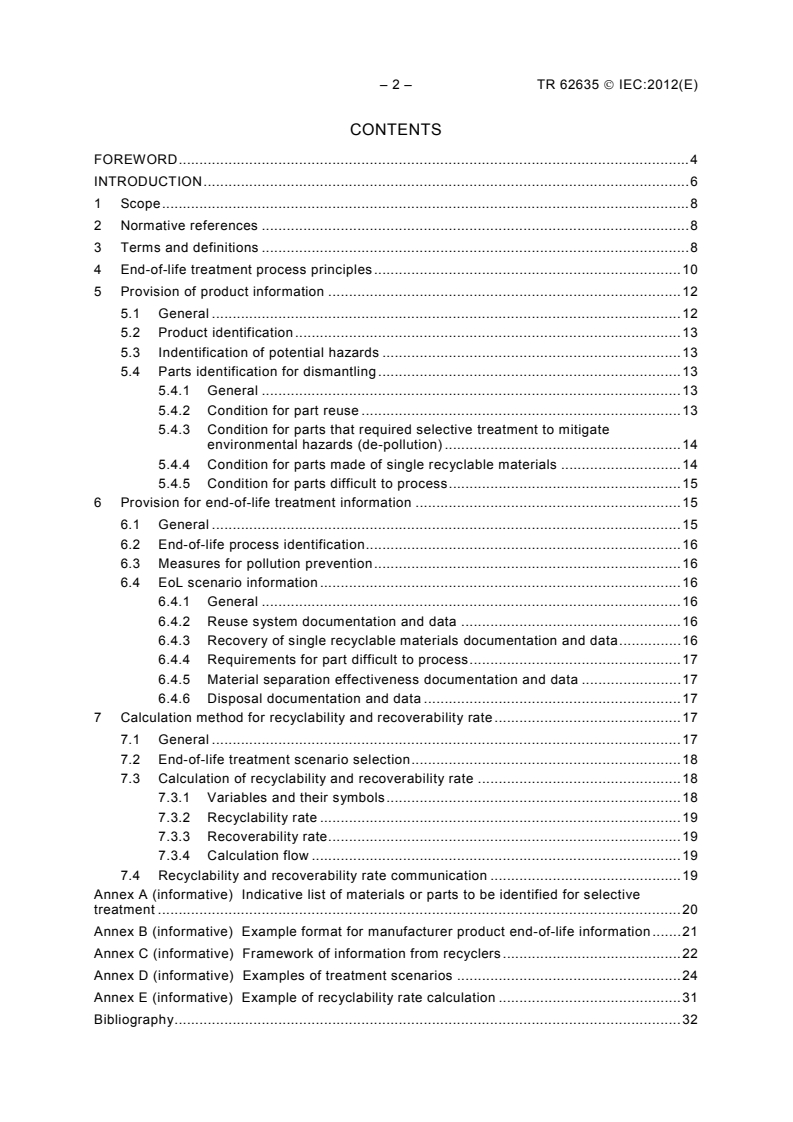
– 2 – TR 62635 IEC:2012(E)
CONTENTS
FOREWORD . 4
INTRODUCTION . 6
1 Scope . 8
2 Normative references . 8
3 Terms and definitions . 8
4 End-of-life treatment process principles . 10
5 Provision of product information . 12
5.1 General . 12
5.2 Product identification . 13
5.3 Indentification of potential hazards . 13
5.4 Parts identification for dismantling . 13
5.4.1 General . 13
5.4.2 Condition for part reuse . 13
5.4.3 Condition for parts that required selective treatment to mitigate
environmental hazards (de-pollution) . 14
5.4.4 Condition for parts made of single recyclable materials . 14
5.4.5 Condition for parts difficult to process . 15
6 Provision for end-of-life treatment information . 15
6.1 General . 15
6.2 End-of-life process identification . 16
6.3 Measures for pollution prevention . 16
6.4 EoL scenario information . 16
6.4.1 General . 16
6.4.2 Reuse system documentation and data . 16
6.4.3 Recovery of single recyclable materials documentation and data . 16
6.4.4 Requirements for part difficult to process . 17
6.4.5 Material separation effectiveness documentation and data . 17
6.4.6 Disposal documentation and data . 17
7 Calculation method for recyclability and recoverability rate . 17
7.1 General . 17
7.2 End-of-life treatment scenario selection . 18
7.3 Calculation of recyclability and recoverability rate . 18
7.3.1 Variables and their symbols . 18
7.3.2 Recyclability rate . 19
7.3.3 Recoverability rate . 19
7.3.4 Calculation flow . 19
7.4 Recyclability and recoverability rate communication . 19
Annex A (informative) Indicative list of materials or parts to be identified for selective
treatment . 20
Annex B (informative) Example format for manufacturer product end-of-life information . 21
Annex C (informative) Framework of information from recyclers . 22
Annex D (informative) Examples of treatment scenarios . 24
Annex E (informative) Example of recyclability rate calculation . 31
Bibliography . 32
TR 62635 IEC:2012(E) – 3 –
Figure 1 – Framework of the main definition covering end-of-life treatment . 11
Figure 2 – End-of-life treatment generic scheme . 12
Table 1 – Masses – Symbols and definitions . 18
Table D.1 – Recycling and recovery rate of product parts which require selective
treatment . 25
Table D.2 – Recycling and recovery rate of product parts with a single recyclable
material . 26
Table D.3 – Recycling and recovery rate of product parts difficult to process . 26
Table D.4 – Recycling and recovery rate of product parts which go to separation
process . 27
Table D.5 – Recycling and recovery rate of product parts which require selective
treatment . 29
Table D.6– Recycling and recovery rate of product parts with a single recyclable
material . 29
Table D.7 – Recycling and recovery rate of product parts difficult to process . 30
Table D.8 – Recycling and recovery rate of product parts which go to separation
process . 30
Table E.1 – Recyclability rate calculation table . 31
– 4 – TR 62635 IEC:2012(E)
INTERNATIONAL ELECTROTECHNICAL COMMISSION
____________
GUIDELINES FOR END-OF-LIFE INFORMATION
PROVIDED BY MANUFACTURERS AND RECYCLERS
AND FOR RECYCLABILITY RATE CALCULATION OF
ELECTRICAL AND ELECTRONIC EQUIPMENT
FOREWORD
1) The International Electrotechnical Commission (IEC) is a worldwide organization for standardization comprising
all national electrotechnical committees (IEC National Committees). The object of IEC is to promote
international co-operation on all questions concerning standardization in the electrical and electronic fields. To
this end and in addition to other activities, IEC publishes International Standards, Technical Specifications,
Technical Reports, Publicly Available Specifications (PAS) and Guides (hereafter referred to as “IEC
Publication(s)”). Their preparation is entrusted to technical committees; any IEC National Committee interested
in the subject dealt with may participate in this preparatory work. International, governmental and non-
governmental organizations liaising with the IEC also participate in this preparation. IEC collaborates closely
with the International Organization for Standardization (ISO) in accordance with conditions determined by
agreement between the two organizations.
2) The formal decisions or agreements of IEC on technical matters express, as nearly as possible, an international
consensus of opinion on the relevant subjects since each technical committee has representation from all
interested IEC National Committees.
3) IEC Publications have the form of recommendations for international use and are accepted by IEC National
Committees in that sense. While all reasonable efforts are made to ensure that the technical content of IEC
Publications is accurate, IEC cannot be held responsible for the way in which they are used or for any
misinterpretation by any end user.
4) In order to promote international uniformity, IEC National Committees undertake to apply IEC Publications
transparently to the maximum extent possible in their national and regional publications. Any divergence
between any IEC Publication and the corresponding national or regional publication shall be clearly indicated in
the latter.
5) IEC itself does not provide any attestation of conformity. Independent certification bodies provide conformity
assessment services and, in some areas, access to IEC marks of conformity. IEC is not responsible for any
services carried out by independent certification bodies.
6) All users should ensure that they have the latest edition of this publication.
7) No liability shall attach to IEC or its directors, employees, servants or agents including individual experts and
members of its technical committees and IEC National Committees for any personal injury, property damage or
other damage of any nature whatsoever, whether direct or indirect, or for costs (including legal fees) and
expenses arising out of the publication, use of, or reliance upon, this IEC Publication or any other IEC
Publications.
8) Attention is drawn to the Normative references cited in this publication. Use of the referenced publications is
indispensable for the correct application of this publication.
9) Attention is drawn to the possibility that some of the elements of this IEC Publication may be the subject of
patent rights. IEC shall not be held responsible for identifying any or all such patent rights.
The main task of IEC technical committees is to prepare International Standards. However, a
technical committee may propose the publication of a technical report when it has collected
data of a different kind from that which is normally published as an International Standard, for
example "state of the art".
IEC/TR 62635, which is a technical report, has been prepared by IEC technical committee 111:
Environmental standardization for electrical and electronic products and systems.
The text of this technical report is based on the following documents:
Enquiry draft Report on voting
111/252/DTR 111/267/RVC
Full information on the voting for the approval of this technical report can be found in the
report on voting indicated in the above table.
TR 62635 IEC:2012(E) – 5 –
This publication has been drafted in accordance with the ISO/IEC Directives, Part 2.
The committee has decided that the contents of this publication will remain unchanged until
the stability date indicated on the IEC web site under "http://webstore.iec.ch" in the data
related to the specific publication. At this date, the publication will be
• reconfirmed,
• withdrawn,
• replaced by a revised edition, or
• amended.
A bilingual version of this publication may be issued at a later date.
IMPORTANT – The 'colour inside' logo on the cover page of this publication
indicates that it contains colours which are considered to be useful for the correct
understanding of its contents. Users should therefore print this document using a
colour printer.
– 6 – TR 62635 IEC:2012(E)
INTRODUCTION
All electrical and electronic equipment (EEE) have an effect on the environment throughout
their life cycle. As increasingly higher volumes of EEE reach their end-of-life (EoL) and
become wastes of EEE (WEEE), it is essential for manufacturers to implement
environmentally conscious design (ECD) as described in IEC 62430 [1] , taking into account
the optimization of resource efficiency.
One aspect of ECD is an evaluation of potential for recycling of an EEE at the product design
phase, hereinafter called the recyclability rate. As described in ISO 22628 [2], this covers
road vehicles. The recyclability rate of EEE is dependent on the parts and materials used in
the products and also on the EoL treatment process implemented by recyclers where the
product is being recycled, as with to road vehicles. It is recognized that the calculation of the
recyclability rate based on the product mass approach is not the only criteria to ensure a
material efficient design (e.g. for rare materials), yet it is considered an important parameter
for ECD.
It has also become increasingly important for manufacturers and recyclers to exchange
certain specific information to implement both effective ECD and EoL treatment operations,
while complying with regional and national regulations and recognizing that actual practices
vary throughout the world.
The purpose of this technical report is to provide sufficient data:
to provide developers with data to consider improvements in recyclability, within the context of
the environmentally conscious design process, and accurately calculate and inform
downstream manufacturers and customers of recyclability rates;
to allow recyclers to safely recycle and to improve their processes.
This technical report covers three main aspects:
1) a description of EoL principles including the scope, terms and definitions and description
of a generic treatment process of WEEE. It is recognized that the generic treatment
process described in this report is but one of many potential scenarios and is intended to
be as generic as possible. Actual recycling processes may include or exclude portions of
the generic process presented here;
2) a description of key product information which is useful when considering the product
EoL and exchange of EoL treatment scenario information for manufacturers and recyclers.
In order to improve ECD and potentially improve the EoL handling of WEEE,
manufacturers need to know the processes taking place at the recyclers and recyclers
need to know some specific information such as parts which may need to be treated
selectively to carry out effective treatment;
3) a description of the method of recyclability and recoverability calculation.
This technical report provides examples of EoL treatment scenario and data in Annex D. It
should be noted that each region, nation or enterprise may have their own data. For example,
Annex D contains parts or materials and their respective recycling rates (actual rates) and
recovery rates (actual rates) which might differ from the examples given. In addition, some
enterprises conduct such calculation based on their internal data which are proprietary and
cannot be disclosed. Therefore, when implementing recyclability rate calculation according to
this technical report, it should be noted that this report provides methodology to document the
calculation of recyclability and recoverability and examples of data that can be used but does
not intend to cover all scenarios.
As practices within the recycling industry can change quickly, the sample data should be
reviewed to assure it adequately describes current practices.
___________
References in square brackets refer to the Bibliography.
TR 62635 IEC:2012(E) – 7 –
By using this technical report, manufacturers can use a common format and method to
document and report on the EoL aspect of resource efficiency for ECD. Eventually, this will
result in common methodologies for the recyclability rate calculation and effective information
exchange between manufacturers and recyclers. The potential also exists to provide relevant
stakeholders with more resource efficiency EEE.
– 8 – TR 62635 IEC:2012(E)
GUIDELINES FOR END-OF-LIFE INFORMATION
PROVIDED BY MANUFACTURERS AND RECYCLERS
AND FOR RECYCLABILITY RATE CALCULATION OF
ELECTRICAL AND ELECTRONIC EQUIPMENT
1 Scope
IEC/TR 62635, which is a technical report, provides a methodology for information exchange
involving EEE manufacturers and recyclers, and for calculating the recyclability and
recoverability rates to
• provide information to recyclers to enable appropriate and optimized EoL treatment
operations,
• provide sufficient information to characterize activities at EoL treatment facilities in order
to enable manufacturers to implement effective ECD,
• evaluate the recyclability and recoverability rates based on product attributes and
reflecting real end-of-life practices.
Furthermore this technical report includes:
• criteria to describe EoL treatment scenarios;
• criteria to determine product parts that might require removal before material separation
and related information to be provided by manufacturers (location and material
composition);
• a format for information describing EoL scenarios and the results of EoL treatment
activities;
• a method for calculating the recyclability and recoverability rate of EEE. The calculation is
limited to EoL treatment and does not cover collection. The recyclability rate is expressed
as a percentage of the mass of the product that can be recycled or reused, whereas the
recoverability rate in addition includes a portion derived from energy recovery. This
techncial report can be applied to all electrical and electronic equipment;
• some example data corresponding to identified scenarios provided in Annex D.
2 Normative references
The following documents, in whole or in part, are normatively referenced in this document and
are indispensable for its application. For dated references, only the edition cited applies. For
undated references, the latest edition of the referenced document (including any
amendments) applies.
IEC 62474, Material declaration for products of and for the electrotechnical industry
3 Terms and definitions
For the purposes of this document, the following terms and definitions apply.
NOTE The following definitions are harmonized with the glossary of terms currently under development by TC 111
as future IEC/TR 62542 [3].
TR 62635 IEC:2012(E) – 9 –
3.1
disposal
any operation which is not recovery even where this operation has a reclamation of
substances or energy secondary consequences
3.2
end-of-life
EoL
life cycle stage of a product starting when it is removed from its intended use-stage
[SOURCE: IEC 62075:2008 [4], definition 3.4, modified]
3.3
end-of-life treatment
any operation after a waste has been handed over to a facility for product and product part
reuse, material recycling, energy recovery and residue disposal
3.4
end-of-life treatment scenario
description of an end-of-life treatment process and corresponding recycling rates of product
parts and materials
3.5
energy recovery
production of useful energy through direct and controlled combustion or other processing of
waste
Note 1 to entry: Waste incinerators producing hot water, steam and/or electricity are a common form of energy
recovery.
3.6
manufacturer
organization responsible for the design, development and manufacture of a product in view of
its being placed on the market, regardless of whether these operations are carried out by that
organization itself or on its behalf
3.7
material recovery
material-processing operations including mechanical recycling, feedstock (chemical) recycling
and organic recycling, but excluding energy recovery
[SOURCE: ISO 15270:2008 [5]]
3.8
material separation
operation to separate materials, including mechanical, chemical or thermal process (e.g.
shredding, smelting, sorting , etc.) other than dismantling
Note 1 to entry: Reuse in the context of this technical report does not include second-hand sales.
3.9
recovery
any operation by which waste serving a useful purpose by replacing other materials which
would otherwise have been used to fulfill a particular function, or waste being prepared to
fulfill that function, in the plant or in the wider economy
3.10
recovery rate
ratio of recovered products, product parts or materials mass to waste product mass
reprocessed
– 10 – TR 62635 IEC:2012(E)
3.11
recoverability
ability of a waste product to be recovered, based on actual practices
3.12
recoverability rate
ratio of recoverable products, product parts, materials mass to total waste product mass
reprocessed
3.13
recyclability
ability of waste product to be recycled, based on actual practices
3.14
recyclability rate
ratio of recyclable product mass to total product mass
3.15
recycler
organization with the facility to carry out recycling and/or recovery operations
3.16
recycling
any operation by which waste products are reprocessed into products, product parts,
materials or substances whether for the original or other purposes
Note 1 to entry: It includes the reuse, the reprocessing of material but does not include the energy recovery and
reprocessing into materials that are to be used as fuels or for back-filling operations.
3.17
recycling rate
ratio of recycled products, product parts or materials mass to waste product mass
reprocessed
Note 1 to entry: A recycling rate is obtained by computing data obtained from recycling operations.
3.18
reuse
operation by which a product, or a part thereof, having reached the end of one use-stage is
used again for the same purpose for which it was conceived
3.19
total product mass
waste product mass reference which is inputted to the end-of-life treatment process
Note 1 to entry: Total product mass is used for recyclability/recoverability rate calculation.
3.20
waste
any material or object which the holder discards or intends or is required to discard
4 End-of-life treatment process principles
In general, EoL treatment needs to comply with applicable regulations, observe relevant
industry practices and allow efficient recycling and recovery, while at the same time
addressing safety and environmental concerns.
Figure 1 provides a synthesis of the main definition covering end-of-life treatment
TR 62635 IEC:2012(E) – 11 –
Treatment
Recovery
Recycling
Energy recovery Residue disposal
Reuse of waste products Material recovery
and waste product parts
IEC 1895/12
Figure 1 – Framework of the main definition covering end-of-life treatment
EoL treatment generally presents four phases:
a) pre-treatment: pre-treatment usually includes operations to mitigate hazards and
dismantling parts for selective treatment. Parts are dismantled when there is a possibility
for reuse, or they require selective treatment (e.g. regulations applicable to the recycling
facility or contractual agreement), where this would allow a better end-of-life treatment
efficiency;
b) material separation: several techniques may be used, such as mechanical separation
(e.g. shredding), chemical separation or thermal separation (smelting), with appropriate
sorting processes;
c) energy recovery: after these operations, the remaining and unsorted material may then
be considered for energy recovery;
d) disposal: residues are then disposed in appropriate landfills.
The generic steps of EoL treatment used in this technical report are described in Figure 2,
with each part or material flow having its own recycling rate. It is noted that the generic
treatment process described in Figure 2 is one of many potential scenarios, while it is
intended to be as generic as possible. Actual recycling processes may add additional
processes, include or exclude portions of the generic process presented here.
– 12 – TR 62635 IEC:2012(E)
ReReuusasabbllee
WWWEEEEEEEEE
PaParrtsts
PParartt r reqequiuirriingng
PrPre-e-ttrreaeattmmenentt
RRececyycclleded
sselelececttiivve te trreeatatmmeentnt
MMatatereriiaallss
HHazazaarrdd
PPaarrtt m madeade of of S Siinnglglee
WaWassttee f foror
mmiittiigagattiionon EEEnenenerrrgggyyy
AAdddidittiiononaall
RRececyyccllaablble Me Matatereriialalss EEnenerrggyy
RRRecececooovvveeerrryyy
TTrreateatmmenentt
RRececoovveerryy
PPaarrttiiaall or or FuFulll l
DiDissmmaannttlliingng
PPPaaarrrttt Di Di Difffffficicicuuultltlt
ttto Po Po Prrrocococesesessss
DiDiDissspopoposssaaalll
ReReResssiiidddueueue
ReRemmaaiinniingng P Paartrtss
RRRecececyyyccclllededed
MMMatataterereriiiaaalllsss
MMetetalal
PPoossibssible le
ee.g.g. . FFe,e,CCu,u,AAll……
MMaatteerriiaall S Seepapararattiioonn
WaWassttee f foror
AAdddidittiiononaall
EEEnenenerrrgggyyy
EEnenerrggyy
RRRecececooovvveeerrryyy
TTrreateatmmenentt
MMechechananiiccalal S Sepepararatatiioonn
RRececoovveerryy
NNonon--MMetetalal
ee.gg. PS, PS,ABABA,A,PPPP.
CChhememiicalcal S Sepepararatatiioonn
DiDiDissspopoposssaaalll
ReReResssiiidddueueue
TThherermmalal S Sepepararatatiioonn
(S(Smmeelltitinngg) )
DiDiDissspopoposssaaalll
ReReResssiiidddueueue
IEC 1896/12
Figure 2 – End-of-life treatment generic scheme
The provision of product information may be helpful to recyclers when implementing treatment
that respects environmental and safety requirements and optimizes parts and material
recovery. Criteria to describe these parts are based on their characteristics and existence of
dedicated EoL processing channels. These criteria are detailed in 5.4 along with related
information to document the characteristics of the parts.
The provision of EoL treatment information, including recycling rates of the different materials,
allows a recyclability and recoverability rate calculation which is based on the principle of
Figure 2 and EoL treatment scenario which describes the processes at a recycling facility.
Thus, it enables improvements in product design with regards to recyclability aspects.
Feedback information exchange is essential when setting up a dedicated EoL channel.
Criteria for treatment process identification are given in 6.2 and related information that
describes the treatment processes is given in 6.4
5 Provision of product information
5.1 General
Provision of product information provides a method for manufacturers or other product
suppliers to make EoL product information available to relevant stakeholders. Information can
be provided on paper or in electronic form. Where a direct information transfer cannot be
guaranteed, an electronic form can be made available on a website.
Details of information are given in 5.2 to 5.4.
TR 62635 IEC:2012(E) – 13 –
The format given in Annex B should be used preferably for information from the manufacturer.
Sketches, drawings or pictures are recommended to ease the interpretation.
5.2 Product identification
Product identification should contain:
a) manufacturer identification and contact details;
b) name, model or type of product;
c) total product mass – when relevant, the manufacturer should indicate which accessories
or consumables are included in the mass. Dimensions may also be indicated;
d) date of information release – it is recommended to include a revision history;
e) product characteristics that may lead to special transportation requirements.
5.3 Indentification of potential hazards
Manufacturers should provide information which identifies the sources of potential hazards to
recycling or recovery personnel. Examples include but are not limited to batteries, power
capacitors, springs, high pressure fluids or gasses.
5.4 Parts identification for dismantling
5.4.1 General
The manufacturer should provide the identification of parts that may not be readily identified
by recyclers and for which dismantling is recommended, so that recyclers can perform
optimized EoL operations in compliance with regulations local to the recycling facility or
required by contractual agreement.
This information is also used to calculate recyclability and recoverability rates of the product
as described in Clause 7.
Guidelines for defining these parts for dismantling and based on EoL current practices are
given in 5.4.2 to 5.4.4. It is assumed that further part dismantling would not improve EoL
treatment safety or efficiency and that remaining parts can be processed as a whole in any
mechanical, chemical, thermal or other means to separate recyclable materials.
For each part that requires removal, the following information should be declared based on
the need of recyclers:
• identification of the part;
• purpose for dismantling;
• location;
• part mass.
It is recommended to provide information concerning the dismantling procedure (dismantling
steps, tool(s), etc).
For the remaining parts, a material content description should be provided according to
IEC 62474, the material declaration standard, using the relevant material classes.
This product description is also used in the recyclability and recoverability rates calculation as
described in Clause 7.
5.4.2 Condition for part reuse
Reuse of parts often gives maximum environmental benefits. When a stable reuse system is
in place and a market exists, reuse becomes economically viable. If such a system exists,
– 14 – TR 62635 IEC:2012(E)
manufacturers should identify it in product documents or on websites so recyclers not directly
in the system can direct parts accordingly.
A manufacturer is entitled to identify parts as reusable in a scenario for recovery rate
calculations when the following two conditions are fulfilled:
a) it is possible to separate the part from the product while maintaining the part or
component’s functional integrity. In practice, this implies the product design allows
accessibility and that binding systems are reversible;
b) the manufacturer can provide evidence that a commercial reuse and refurbishment system
has been established for that part that takes into consideration regulation and market
expectations. This can take the form of contracts with commercial partners, availability of
refurbished parts in the marketplace or other evidence that there is an established
system.
5.4.3 Condition for parts that required selective treatment to mitigate environmental
hazards (de-pollution)
Manufacturers should provide information which identifies parts that present potential hazards
to the environment. For these parts, there are generally legal requirements that impose
dismantling and separate treatment. If needed, manufacturers should indicate which
operations should be carried out before further product dismantling and treatment. This will
assist recyclers to take the appropriate measures to prevent potential hazards or, at a
minimum, mitigate it before further dismantling or material separation operations.
A few examples are the removal of
– batteries by EU WEEE and implementing legislation for each country,
– polychlorinated biphenyls (PCB) often contained within old capacitors – see Council
Directive 96/59/EC [6]
– refrigerants as required by international agreements and implemented by individual
countries (see USA Clean Air Act as an example).
Annex A provides a list of product parts and materials that potentially should be dismantled.
This list is dependent on the jurisdiction in which the recycling facility resides.
It is important that the source of the requirement is communicated as well as the possible
treatment required if such information is known to the manufacturer.
5.4.4 Condition for parts made of single recyclable materials
A manufacturer may choose to identify these parts based on recycler feedback. When a part
of the product is made from a single recyclable material, dismantling of this part can be
beneficial. A single part made from one material is well suited for end-of-life treatment
without further processing. Recycling rates for this class of parts are typically high, see
Annex D.
A manufacturer is entitled to identify parts as single recyclable in a scenario for recovery rate
calculations when the following two conditions are fulfilled:
a) the size of the part and nature of material is such that there is an economical interest for
dismantling. Due to the variety of end-of-life treatment practices, it is left to the
manufacturer to identify components or parts that may lead to improved recovery;
b) there is a specific EoL channel for these materials with higher recycling rates compared to
the results obtained after material separation.
The manufacturer should identify to the recycler these parts and the single recyclable material
they are made of to facilitate effective recovery or recycling.
TR 62635 IEC:2012(E) – 15 –
5.4.5 Condition for parts difficult to process
Some parts may require specific treatment to optimize end-of-life treatment operations. This
may be due to the physical characteristics of the part that generally are too large for the
capacity of a shredder or are incompatible with the material sorting process at a particular
facility even after size reduction. Examples of parts that may require removal are castings,
wire or cable and refrigerator motors. Metal parts that are difficult to process through size
reduction and certain plastics are often included in this category.
The manufacturer should identify to the recycler such parts, provide dismantling instructions
and use scenario feedback from recyclers when calculating the recyclability and recoverability
rates.
6 Provision for end-of-life treatment information
6.1 General
Because of the wide variety of material separation methods, a recycler may wish to provide a
manufacturer with detailed information on its process capability.
Clause 6 concerns information on the methods used by the recycler and facility specific
requirements for processing of EEE for EoL treatment. It includes any process that sorts
materials by density, electrical characteristics, magnetic, eddy current, spectrometry or other
methods based on one or more material properties. This also includes separation by human
pickers or sorters.
In particular, the recycler should bring suggestions regarding product design to the attention
of the manufacturers for consideration during product design and in the calculation of the
product recoverability and recyclability rates. In particular, a recycler should identify what
parts need to be dismantled and recovered or recycled in specific channels. This is, for
instance, when material, or a part, cannot be sorted out on line (e.g. plastics containing
substances of concern) or presenting characteristics outside the treatment process
capabilities, or presenting environmental or safety risks.
In general, information should be provided so that the extent of separation and disposition of
parts and materials can be determined and used in the calculation of recyclability and
recoverability rates.
Recyclers should identify critical issues affecting material separation such as difficulty to
shred, material mixing incompatibility impairing recycling performances or dismantling costs.
This aids the manufacturer in obtaining feedback on the practicality, feasibility and any issues
with EoL treatment.
In addition, recyclers should indicate to manufacturers which product information is needed to
optimize recycling and recovery processes, and to ensure adequate treatment.
Recyclers should also indicate to the manufacturers the materials, parts or components that
are dismantled. For these instances, the recycling rate should be also indicated. The numbers
reported should reflect the actual performance of the system employed by the recycler and
not the theoretical capability of the equipment installed. They may vary according to the
system employed by the recyclers at a given place.
The information from recyclers may be detailed when a particular product is treated in a
dedicated stream. An average recycling rate may be given when the product is processed in a
mixed stream, or when a generic EoL treatment process is referred to, as appropriate.
Recyclers may be required to obtain information from downstream recyclers or treatment
providers.
– 16 – TR 62635 IEC:2012(E)
Then, upon request, waste treatment information should be made available to the
manufacturer of the products, as described in 6.2 to 6.4
A framework of information from recyclers is given in Annex C.
Information can be provided on paper or by electronic form.
6.2 End-of-life process identification
A lead page describing the contact data and a description of the EoL treatment process
(general diagram and techniques, or generic EoL treatment process category) should be
provided by the recycler.
It should contain:
• company name and address;
• contact name and email address;
• generic process diagram;
• covered product categories;
• date of release.
6.3 Measures for pollution prevention
Recyclers should provide the manufacturer with information on implementation of pollution
prevention measures in compliance with legal and any specific requirements from the
manufacturer.
In addition, recyclers should inform manufacturers of any difficulties they have experienced or
they may face in pollution prevention.
6.4 EoL scenario information
6.4.1 General
The provision of information by recyclers about their process, in particular concerning
dismantling operations and recycling or recovery rates achieved, assists manufacturers to
assess the recyclability rates of their products and improve their designs with regards to EoL
treatment. This ultimately has a greater environmental and societal benefit.
Elements of the EoL process to be documented are given in 6.4.2 to 6.4.6. It should be noted
that this technical report covers the methodology to calculate recyclability and recoverability
rate but does not stipulate that recyclers’ proprietary information should be disclosed.
6.4.2 Reuse system documentation and data
The recycler should provide documentation that a commercial reuse and refurbishment
system has been established for that part/component. Evidence of such a system can take the
form of contracts with commercial partners, availability of refurbished parts in the marketplace,
or other evidence that there is an established system. Documentation of the statistics on the
rate of reuse of parts from EoL treatment should also be included either in the form of sales
numbers as a percentage of incoming parts or third party industry wide surveys.
6.4.3 Recovery of single recyclable materials documentation and data
For product parts made of single recyclable materials, recycler specification should include:
• material description;
TR 62635 IEC:2012(E) – 17 –
• minimum purity (acceptable contaminants);
• size and/or mass;
• material recycling rate and/or energy recovery rate when appropriate.
Documentation should consist of a statement of results for the recovery/recycling process.
The material recycler may need to consult with the purchaser of the material after
removal/disassembly from the product to obtain the information on the actual recovered
material rate. In that case, a statement from the final processor of the material stating the
recycling and recovery rates should be included.
6.4.4 Requirements for part difficult to process
For product parts affecting material separation or requiring special EoL process, recycler
specifications should include:
• product part description or characteristics;
• reason for requirement;
• materials recovered during processing of these parts;
• recycling rate and/or energy recovery rate when appropriate.
Documentation should consist of a statement of results from the final end-of-life treatment of
the removed parts/components. The material recycler may need to consult with the purchaser
of the material after removal/disassembly from the product to obtain the information on the
actual recovered material rate. If that is the case, a statement from the final processor of the
material stating the recycling and recovery rates should be included.
6.4.5 Material separation effectiveness documentation and data
Documentation should consist of the input and output statistics for the reporting facility using
the rep
...