

IEC 62751-1:2014
(Main)Power losses in voltage sourced converter (VSC) valves for high-voltage direct current (HVDC) systems - Part 1: General requirements
General Information
- Abstract
IEC 62751-1:2014 sets out the general principles for calculating the power losses in the converter valves of a voltage sourced converter (VSC) for high-voltage direct current (HVDC) applications, independent of the converter topology. Several clauses in the standard can also be used for calculating the power losses in the dynamic braking valves (where used) and as guidance for calculating the power losses of the valves for a STATCOM installation.
- Status
- Published
- Publication Date
- 15-Mar-2022
- Drafting Committee
- MT 31 - TC 22/SC 22F/MT 31
- Current Stage
- PPUB - Publication issued
- Start Date
- 27-Aug-2014
- Completion Date
- 15-Oct-2014
Buy Documents
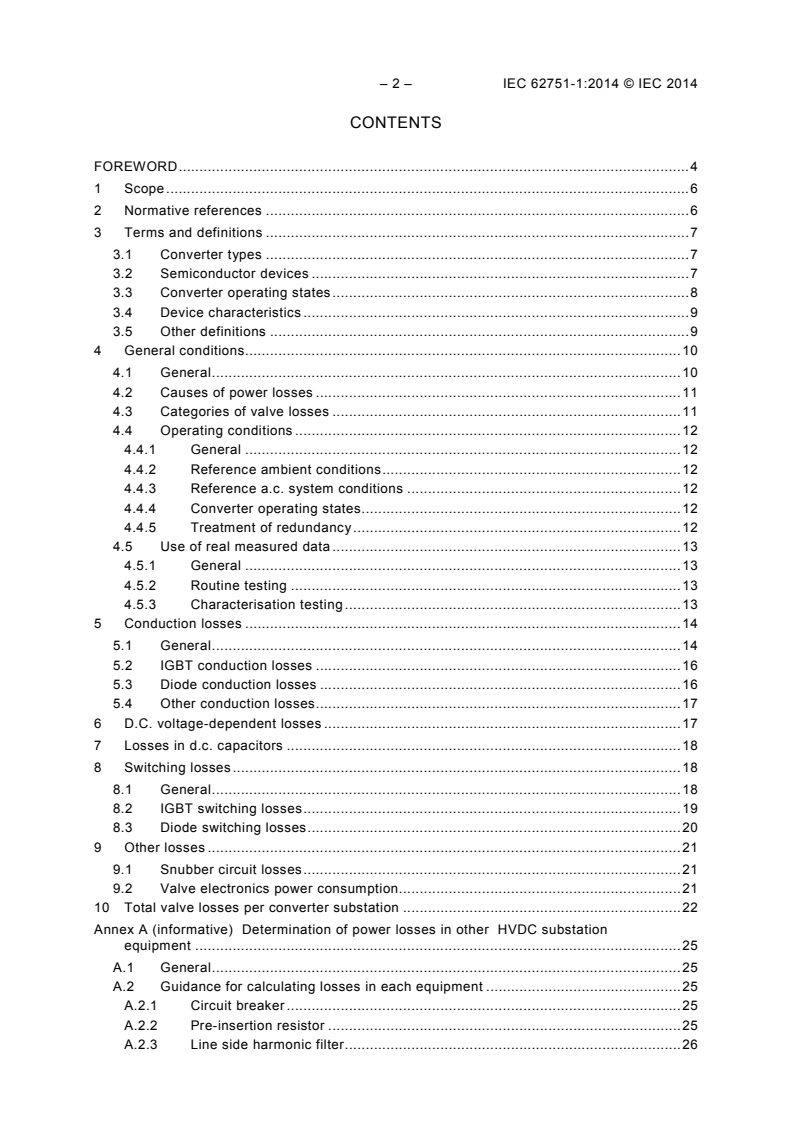
IEC 62751-1:2014 - Power losses in voltage sourced converter (VSC) valves for high-voltage direct current (HVDC) systems - Part 1: General requirements Released:8/27/2014

IEC 62751-1:2014+AMD1:2018+AMD2:2022 CSV - Power losses in voltage sourced converter (VSC) valves for high-voltage direct current (HVDC) systems - Part 1: General requirements Released:3/16/2022

IEC 62751-1:2014+AMD1:2018 CSV - Power losses in voltage sourced converter (VSC) valves for high-voltage direct current (HVDC) systems - Part 1: General requirements Released:4/20/2018
Overview
IEC 62751-1:2014 specifies the general requirements and principles for calculating power losses in voltage sourced converter (VSC) valves used in high-voltage direct current (HVDC) systems. Developed by the International Electrotechnical Commission (IEC), this standard ensures that power loss calculations for VSC valves are applied consistently, enabling fair comparison and reliability in HVDC projects regardless of converter topology. It also provides guidance for similar calculations in dynamic braking valves, STATCOM installations, and unified power flow controllers (UPFC).
Accurate determination of VSC valve power losses is essential for both system manufacturers and purchasers, impacting performance evaluations, bid comparisons, equipment sizing, and long-term system efficiency. IEC 62751-1:2014 streamlines these calculations, helping the HVDC industry improve operational performance and transparency.
Key Topics
Calculation Principles: Outlines a standardized approach for calculating VSC valve power losses, independent of the particular converter design. This allows application across various VSC topologies, including two-level, multi-level, modular multi-level, and cascaded two-level converters.
Loss Categories: Defines specific types of valve losses, including:
- IGBT conduction and switching losses
- Diode conduction and turn-off losses
- Other conduction losses (auxiliary components)
- DC voltage-dependent losses
- Losses in DC capacitors
- Snubber circuit and valve electronics power consumption
Operating Conditions: Guidance on reference ambient and AC system conditions, ensuring comparability between projects and bids. Specifies default temperatures, pressures, and AC network conditions if the purchaser does not define them.
Measurement and Uncertainty: Emphasizes the use of real, traceable measurement data for loss calculations where feasible, aligned with ISO/IEC Guide 98-3 on measurement uncertainty.
Applicability to Other Equipment: While focused on VSC valves, certain procedures can be adapted for dynamic braking valves and STATCOM installations. Annex A provides additional direction for loss calculations in other HVDC substation equipment.
Applications
IEC 62751-1:2014 is a fundamental standard for stakeholders involved in the design, procurement, and operation of HVDC transmission systems utilizing VSC technology. Its applications include:
- Design Optimization: Enables manufacturers to accurately estimate and minimize VSC valve losses, leading to improved converter efficiency and lower operational costs.
- Procurement and Bidding: Provides a common basis for loss calculation, allowing purchasers to compare technical offers from different suppliers on a fair and objective basis.
- Performance Verification: Facilitates the verification of supplier guarantees related to valve losses during project commissioning and acceptance testing.
- System Planning: Supports grid operators and planners in modeling system losses and assessing the economic and environmental impact of HVDC projects.
- Guidance for STATCOM and UPFC: The methodology supports similar apparatus, improving performance and loss evaluation in flexible AC transmission systems.
Related Standards
For comprehensive loss calculation and terminology consistency, IEC 62751-1:2014 should be used alongside the following standards:
- IEC 60633: Terminology for high-voltage direct current (HVDC) transmission
- IEC 60747-2: Semiconductor devices - Discrete devices and integrated circuits - Part 2: Rectifier diodes
- IEC 60747-9: Semiconductor devices - Discrete devices - Part 9: Insulated-gate bipolar transistors (IGBTs)
- IEC 62747: Terminology for voltage-sourced converters (VSC) for HVDC systems
- IEC 61803: Procedures for calculating power losses in LCC HVDC substations (for related equipment)
- ISO/IEC Guide 98-3: Guide to the expression of uncertainty in measurement
IEC 62751-1:2014 forms the foundation for accurate, standardized VSC valve loss calculations, ensuring the reliability, efficiency, and fair assessment of HVDC projects and components worldwide.
Relations
- Effective Date
- 05-Sep-2023
- Effective Date
- 05-Sep-2023
Buy Documents
IEC 62751-1:2014 - Power losses in voltage sourced converter (VSC) valves for high-voltage direct current (HVDC) systems - Part 1: General requirements Released:8/27/2014
IEC 62751-1:2014+AMD1:2018+AMD2:2022 CSV - Power losses in voltage sourced converter (VSC) valves for high-voltage direct current (HVDC) systems - Part 1: General requirements Released:3/16/2022
IEC 62751-1:2014+AMD1:2018 CSV - Power losses in voltage sourced converter (VSC) valves for high-voltage direct current (HVDC) systems - Part 1: General requirements Released:4/20/2018
Get Certified
Connect with accredited certification bodies for this standard

IMQ S.p.A. (Certification)
Italian electrical product certification.

SLG Prüf- und Zertifizierungs GmbH
German testing and certification body.

UL Solutions
Global safety science company with testing, inspection and certification.
Sponsored listings
Frequently Asked Questions
IEC 62751-1:2014 is a standard published by the International Electrotechnical Commission (IEC). Its full title is "Power losses in voltage sourced converter (VSC) valves for high-voltage direct current (HVDC) systems - Part 1: General requirements". This standard covers: IEC 62751-1:2014 sets out the general principles for calculating the power losses in the converter valves of a voltage sourced converter (VSC) for high-voltage direct current (HVDC) applications, independent of the converter topology. Several clauses in the standard can also be used for calculating the power losses in the dynamic braking valves (where used) and as guidance for calculating the power losses of the valves for a STATCOM installation.
IEC 62751-1:2014 sets out the general principles for calculating the power losses in the converter valves of a voltage sourced converter (VSC) for high-voltage direct current (HVDC) applications, independent of the converter topology. Several clauses in the standard can also be used for calculating the power losses in the dynamic braking valves (where used) and as guidance for calculating the power losses of the valves for a STATCOM installation.
IEC 62751-1:2014 is classified under the following ICS (International Classification for Standards) categories: 29.200 - Rectifiers. Convertors. Stabilized power supply; 29.240.99 - Other equipment related to power transmission and distribution networks; 33.060.20 - Receiving and transmitting equipment; 33.060.30 - Radio relay and fixed satellite communications systems. The ICS classification helps identify the subject area and facilitates finding related standards.
IEC 62751-1:2014 has the following relationships with other standards: It is inter standard links to IEC 62751-1:2014/AMD1:2018, IEC 62751-1:2014/AMD2:2022. Understanding these relationships helps ensure you are using the most current and applicable version of the standard.
IEC 62751-1:2014 is available in PDF format for immediate download after purchase. The document can be added to your cart and obtained through the secure checkout process. Digital delivery ensures instant access to the complete standard document.
Standards Content (Sample)
IEC 62751-1 ®
Edition 1.0 2014-08
INTERNATIONAL
STANDARD
NORME
INTERNATIONALE
colour
inside
Power losses in voltage sourced converter (VSC) valves for high-voltage direct
current (HVDC) systems –
Part 1: General requirements
Pertes de puissance dans les valves à convertisseur de source de tension (VSC)
des systèmes en courant continu à haute tension (CCHT) –
Partie 1: Exigences générales
All rights reserved. Unless otherwise specified, no part of this publication may be reproduced or utilized in any form
or by any means, electronic or mechanical, including photocopying and microfilm, without permission in writing from
either IEC or IEC's member National Committee in the country of the requester. If you have any questions about IEC
copyright or have an enquiry about obtaining additional rights to this publication, please contact the address below or
your local IEC member National Committee for further information.
Droits de reproduction réservés. Sauf indication contraire, aucune partie de cette publication ne peut être reproduite
ni utilisée sous quelque forme que ce soit et par aucun procédé, électronique ou mécanique, y compris la photocopie
et les microfilms, sans l'accord écrit de l'IEC ou du Comité national de l'IEC du pays du demandeur. Si vous avez des
questions sur le copyright de l'IEC ou si vous désirez obtenir des droits supplémentaires sur cette publication, utilisez
les coordonnées ci-après ou contactez le Comité national de l'IEC de votre pays de résidence.
IEC Central Office Tel.: +41 22 919 02 11
3, rue de Varembé Fax: +41 22 919 03 00
CH-1211 Geneva 20 info@iec.ch
Switzerland www.iec.ch
About the IEC
The International Electrotechnical Commission (IEC) is the leading global organization that prepares and publishes
International Standards for all electrical, electronic and related technologies.
About IEC publications
The technical content of IEC publications is kept under constant review by the IEC. Please make sure that you have the
latest edition, a corrigenda or an amendment might have been published.
IEC Catalogue - webstore.iec.ch/catalogue Electropedia - www.electropedia.org
The stand-alone application for consulting the entire The world's leading online dictionary of electronic and
bibliographical information on IEC International Standards, electrical terms containing more than 30 000 terms and
Technical Specifications, Technical Reports and other definitions in English and French, with equivalent terms in 14
documents. Available for PC, Mac OS, Android Tablets and additional languages. Also known as the International
iPad. Electrotechnical Vocabulary (IEV) online.
IEC publications search - www.iec.ch/searchpub IEC Glossary - std.iec.ch/glossary
The advanced search enables to find IEC publications by a More than 55 000 electrotechnical terminology entries in
variety of criteria (reference number, text, technical English and French extracted from the Terms and Definitions
committee,…). It also gives information on projects, replaced clause of IEC publications issued since 2002. Some entries
and withdrawn publications. have been collected from earlier publications of IEC TC 37,
77, 86 and CISPR.
IEC Just Published - webstore.iec.ch/justpublished
Stay up to date on all new IEC publications. Just Published IEC Customer Service Centre - webstore.iec.ch/csc
details all new publications released. Available online and If you wish to give us your feedback on this publication or
also once a month by email. need further assistance, please contact the Customer Service
Centre: csc@iec.ch.
A propos de l'IEC
La Commission Electrotechnique Internationale (IEC) est la première organisation mondiale qui élabore et publie des
Normes internationales pour tout ce qui a trait à l'électricité, à l'électronique et aux technologies apparentées.
A propos des publications IEC
Le contenu technique des publications IEC est constamment revu. Veuillez vous assurer que vous possédez l’édition la
plus récente, un corrigendum ou amendement peut avoir été publié.
Catalogue IEC - webstore.iec.ch/catalogue Electropedia - www.electropedia.org
Application autonome pour consulter tous les renseignements
Le premier dictionnaire en ligne de termes électroniques et
bibliographiques sur les Normes internationales,
électriques. Il contient plus de 30 000 termes et définitions en
Spécifications techniques, Rapports techniques et autres
anglais et en français, ainsi que les termes équivalents dans
documents de l'IEC. Disponible pour PC, Mac OS, tablettes
14 langues additionnelles. Egalement appelé Vocabulaire
Android et iPad.
Electrotechnique International (IEV) en ligne.
Recherche de publications IEC - www.iec.ch/searchpub
Glossaire IEC - std.iec.ch/glossary
Plus de 55 000 entrées terminologiques électrotechniques, en
La recherche avancée permet de trouver des publications IEC
en utilisant différents critères (numéro de référence, texte, anglais et en français, extraites des articles Termes et
comité d’études,…). Elle donne aussi des informations sur les Définitions des publications IEC parues depuis 2002. Plus
projets et les publications remplacées ou retirées. certaines entrées antérieures extraites des publications des
CE 37, 77, 86 et CISPR de l'IEC.
IEC Just Published - webstore.iec.ch/justpublished
Service Clients - webstore.iec.ch/csc
Restez informé sur les nouvelles publications IEC. Just
Published détaille les nouvelles publications parues. Si vous désirez nous donner des commentaires sur cette
Disponible en ligne et aussi une fois par mois par email. publication ou si vous avez des questions contactez-nous:
csc@iec.ch.
IEC 62751-1 ®
Edition 1.0 2014-08
INTERNATIONAL
STANDARD
NORME
INTERNATIONALE
colour
inside
Power losses in voltage sourced converter (VSC) valves for high-voltage direct
current (HVDC) systems –
Part 1: General requirements
Pertes de puissance dans les valves à convertisseur de source de tension (VSC)
des systèmes en courant continu à haute tension (CCHT) –
Partie 1: Exigences générales
INTERNATIONAL
ELECTROTECHNICAL
COMMISSION
COMMISSION
ELECTROTECHNIQUE
PRICE CODE
INTERNATIONALE
CODE PRIX V
ICS 29.200; 29.240 ISBN 978-2-8322-1835-8
– 2 – IEC 62751-1:2014 © IEC 2014
CONTENTS
FOREWORD . 4
1 Scope . 6
2 Normative references . 6
3 Terms and definitions . 7
3.1 Converter types . 7
3.2 Semiconductor devices . 7
3.3 Converter operating states . 8
3.4 Device characteristics . 9
3.5 Other definitions . 9
4 General conditions. 10
4.1 General . 10
4.2 Causes of power losses . 11
4.3 Categories of valve losses . 11
4.4 Operating conditions . 12
4.4.1 General . 12
4.4.2 Reference ambient conditions . 12
4.4.3 Reference a.c. system conditions . 12
4.4.4 Converter operating states. 12
4.4.5 Treatment of redundancy . 12
4.5 Use of real measured data . 13
4.5.1 General . 13
4.5.2 Routine testing . 13
4.5.3 Characterisation testing . 13
5 Conduction losses . 14
5.1 General . 14
5.2 IGBT conduction losses . 16
5.3 Diode conduction losses . 16
5.4 Other conduction losses . 17
6 D.C. voltage-dependent losses . 17
7 Losses in d.c. capacitors . 18
8 Switching losses . 18
8.1 General . 18
8.2 IGBT switching losses . 19
8.3 Diode switching losses . 20
9 Other losses . 21
9.1 Snubber circuit losses . 21
9.2 Valve electronics power consumption. 21
10 Total valve losses per converter substation . 22
Annex A (informative) Determination of power losses in other HVDC substation
equipment . 25
A.1 General . 25
A.2 Guidance for calculating losses in each equipment . 25
A.2.1 Circuit breaker . 25
A.2.2 Pre-insertion resistor . 25
A.2.3 Line side harmonic filter . 26
A.2.4 Line side high frequency filter . 26
A.2.5 Interface transformer . 26
A.2.6 Converter side harmonic filter . 27
A.2.7 Converter side high frequency filter . 27
A.2.8 Phase reactor . 27
A.2.9 VSC unit . 27
A.2.10 VSC d.c. capacitor . 27
A.2.11 D.C. harmonic filter . 27
A.2.12 Dynamic braking system . 27
A.2.13 Neutral point grounding branch . 28
A.2.14 D.C. reactor . 28
A.2.15 Common mode blocking reactor . 28
A.2.16 D.C. side high frequency filter . 28
A.2.17 D.C. cable or overhead transmission line . 28
A.3 Auxiliaries and station service losses . 29
Bibliography . 30
Figure 1 – On-state voltage of an IGBT or diode . 14
Figure 2 – Piecewise-linear representation of IGBT or diode on-state voltage . 15
Figure 3 – IGBT switching energy as a function of collector current . 19
Figure 4 – Diode recovery energy as a function of current . 20
Figure A.1 – Major components that may be found in a VSC substation . 26
Table 1 – Matrix indicating the relationship of data needed for calculation of losses
and the type of valve losses (1 of 2) . 23
– 4 – IEC 62751-1:2014 © IEC 2014
INTERNATIONAL ELECTROTECHNICAL COMMISSION
____________
POWER LOSSES IN VOLTAGE SOURCED CONVERTER (VSC)
VALVES FOR HIGH-VOLTAGE DIRECT CURRENT (HVDC) SYSTEMS –
Part 1: General requirements
FOREWORD
1) The International Electrotechnical Commission (IEC) is a worldwide organization for standardization comprising
all national electrotechnical committees (IEC National Committees). The object of IEC is to promote
international co-operation on all questions concerning standardization in the electrical and electronic fields. To
this end and in addition to other activities, IEC publishes International Standards, Technical Specifications,
Technical Reports, Publicly Available Specifications (PAS) and Guides (hereafter referred to as “IEC
Publication(s)”). Their preparation is entrusted to technical committees; any IEC National Committee interested
in the subject dealt with may participate in this preparatory work. International, governmental and non-
governmental organizations liaising with the IEC also participate in this preparation. IEC collaborates closely
with the International Organization for Standardization (ISO) in accordance with conditions determined by
agreement between the two organizations.
2) The formal decisions or agreements of IEC on technical matters express, as nearly as possible, an international
consensus of opinion on the relevant subjects since each technical committee has representation from all
interested IEC National Committees.
3) IEC Publications have the form of recommendations for international use and are accepted by IEC National
Committees in that sense. While all reasonable efforts are made to ensure that the technical content of IEC
Publications is accurate, IEC cannot be held responsible for the way in which they are used or for any
misinterpretation by any end user.
4) In order to promote international uniformity, IEC National Committees undertake to apply IEC Publications
transparently to the maximum extent possible in their national and regional publications. Any divergence
between any IEC Publication and the corresponding national or regional publication shall be clearly indicated in
the latter.
5) IEC itself does not provide any attestation of conformity. Independent certification bodies provide conformity
assessment services and, in some areas, access to IEC marks of conformity. IEC is not responsible for any
services carried out by independent certification bodies.
6) All users should ensure that they have the latest edition of this publication.
7) No liability shall attach to IEC or its directors, employees, servants or agents including individual experts and
members of its technical committees and IEC National Committees for any personal injury, property damage or
other damage of any nature whatsoever, whether direct or indirect, or for costs (including legal fees) and
expenses arising out of the publication, use of, or reliance upon, this IEC Publication or any other IEC
Publications.
8) Attention is drawn to the Normative references cited in this publication. Use of the referenced publications is
indispensable for the correct application of this publication.
9) Attention is drawn to the possibility that some of the elements of this IEC Publication may be the subject of
patent rights. IEC shall not be held responsible for identifying any or all such patent rights.
International Standard IEC 62751-1 has been prepared by subcommittee 22F: Power
electronics for electrical transmission and distribution systems, of IEC technical committee 22:
Power electronic systems and equipment.
The text of this standard is based on the following documents:
CDV Report on voting
22F/302/CDV 22F/321A/RVC
Full information on the voting for the approval of this standard can be found in the report on
voting indicated in the above table.
This publication has been drafted in accordance with the ISO/IEC Directives, Part 2.
A list of all parts in the IEC 62751series, published under the general title Power losses in
voltage sourced converter (VSC) valves for high-voltage direct current (HVDC) systems, can
be found on the IEC website.
The committee has decided that the contents of this publication will remain unchanged until
the stability date indicated on the IEC web site under "http://webstore.iec.ch" in the data
related to the specific publication. At this date, the publication will be
• reconfirmed,
• withdrawn,
• replaced by a revised edition, or
• amended.
IMPORTANT – The 'colour inside' logo on the cover page of this publication indicates
that it contains colours which are considered to be useful for the correct
understanding of its contents. Users should therefore print this document using a
colour printer.
– 6 – IEC 62751-1:2014 © IEC 2014
POWER LOSSES IN VOLTAGE SOURCED CONVERTER (VSC)
VALVES FOR HIGH-VOLTAGE DIRECT CURRENT (HVDC) SYSTEMS –
Part 1: General requirements
1 Scope
This part of IEC 62751 sets out the general principles for calculating the power losses in the
converter valves of a voltage sourced converter (VSC) for high-voltage direct current (HVDC)
applications, independent of the converter topology. Clauses 6 and 8 and subclauses 9.1, 9.2
and A.2.12 of the standard can also be used for calculating the power losses in the dynamic
braking valves (where used) and as guidance for calculating the power losses of the valves
for a STATCOM installation.
Power losses in other items of equipment in the HVDC substation, apart from the converter
valves, are excluded from the scope of this standard. Power losses in most equipment in a
VSC substation can be calculated using similar procedures to those prescribed for HVDC
systems with line-commutated converters (LCC) in IEC 61803. Annex A presents the main
differences between LCC and VSC HVDC substations in so far as they influence the method
for determining power losses of other equipment.
This standard does not apply to converter valves for line-commutated converter HVDC
systems.
2 Normative references
The following documents, in whole or in part, are normatively referenced in this document and
are indispensable for its application. For dated references, only the edition cited applies. For
undated references, the latest edition of the referenced document (including any
amendments) applies.
IEC 60633, Terminology for high-voltage direct current (HVDC) transmission
IEC 60747-2, Semiconductor devices – Discrete devices and integrated circuits – Part 2:
Rectifier diodes
IEC 60747-9:2007, Semiconductor devices – Discrete devices – Part 9: Insulated-gate bipolar
transistors (IGBTs)
IEC 62747:2014, Terminology for voltage-sourced converters (VSC) for high-voltage direct
current (HVDC) systems
3 Terms and definitions
For the purposes of this document, the terms and definitions given in IEC 60633, IEC 62747,
IEC 60747-2, IEC 60747-9 as well as the following apply.
NOTE 1 Related terms and definitions can also be found in IEC TR 62543, IEC 62751-2 and in the other relevant
parts of the IEC 60747 series.
NOTE 2 Throughout this standard, the term “insulated gate bipolar transistor (IGBT)” is used to indicate a turn-off
semiconductor device; however, the standard is equally applicable to other types of turn-off semiconductor devices
such as the GTO, IGCT, ETO, IEGT, etc.
3.1 Converter types
3.1.1
2-level converter
converter in which the voltage between the a.c. terminals of the VSC unit and VSC unit
midpoint is switched between two discrete d.c. voltage levels
Note 1 to entry: VSC unit midpoint is defined in 3.5.9.
3.1.2
multi-level converter
converter in which the voltage between the a.c. terminals of the VSC unit and VSC unit
midpoint is switched between more than three discrete d.c. voltage levels
Note 1 to entry: VSC unit midpoint is defined in 3.5.9.
3.1.3
modular multi-level converter
MMC
multi-level converter in which each VSC valve consists of a number of MMC building blocks
connected in series
Note 1 to entry: MMC building block is defined in 3.5.4.
Note 2 to entry: This note applies to the French language only.
3.1.4
cascaded two-level converter
CTL
modular multi-level converter in which each switch position consists of more than one IGBT-
diode pair connected in series
Note 1 to entry: IGBT-diode pair is defined in 3.2.4.
Note 2 to entry: This note applies to the French language only.
3.2 Semiconductor devices
3.2.1
turn-off semiconductor device
controllable semiconductor device which may be turned on and off by a control signal, for
example an IGBT
3.2.2
insulated gate bipolar transistor
IGBT
turn-off semiconductor device with three terminals: a gate terminal (G) and two load terminals
emitter (E) and collector (C)
– 8 – IEC 62751-1:2014 © IEC 2014
Note 1 to entry: By applying appropriate gate to emitter voltages, current in one direction can be controlled, i.e.
turned on and turned off.
Note 2 to entry: This note applies to the French language only.
3.2.3
free-wheeling diode
FWD
power semiconductor device with diode characteristic
Note 1 to entry: A FWD has two terminals: an anode (A) and a cathode (K). The current through FWDs is in
opposite direction to the IGBT current. FWDs are characterized by the capability to cope with high rates of
decrease of current caused by the switching behaviour of the IGBT.
Note 2 to entry: This note applies to the French language only.
3.2.4
IGBT-diode pair
arrangement of IGBT and FWD connected in inverse parallel
Note 1 to entry: An IGBT-diode pair is usually in one common package; however, it can include individual IGBTs
and/or diodes packages connected in parallel.
3.3 Converter operating states
3.3.1
no-load operating state
condition in which the VSC substation is energized but the IGBTs are blocked and all
substation service loads and auxiliary equipment are connected
3.3.2
idling operating state
condition in which the VSC substation is energized and the IGBTs are de-blocked but with no
active or reactive power output at the point of common connection to the a.c. network
Note 1 to entry: The “idling operating” and “no-load” conditions are similar but from the no-load state several
seconds may be needed before power can be transmitted, while from the idling operating state, power transmission
may be commenced almost immediately (less than 3 power frequency cycles).
Note 2 to entry: In the idling operating state, the converter is capable of actively controlling the d.c. voltage, in
contrast to the no-load state where the behaviour of the converter is essentially “passive”.
Note 3 to entry: Losses will generally be slightly lower in the no-load state than in the idling operating state,
therefore this operating mode is preferred where the arrangement of the VSC system permits it.
3.3.3
operating state
condition in which the VSC substation is energized and the converters are de-blocked
Note 1 to entry: Unlike line-commutated converter, VSC can operate with zero active/reactive power output.
3.3.4
no-load power losses
power losses in the VSC valve in the no-load state
Note 1 to entry: In some converter designs, it may be necessary to make occasional switching operations for the
purposes of balancing voltages between different parts of the converter. In such converters, the calculation of no-
load losses shall take into account the switching frequency of such an operating mode.
3.3.5
idling operating losses
losses in the VSC valve in the idling operating state
3.3.6
operating losses
losses in the VSC valve in the operating state
3.4 Device characteristics
3.4.1
IGBT collector-emitter saturation voltage
V
CE(sat)
collector-emitter voltage under conditions of gate-emitter voltage at which the collector current
is essentially independent of the gate-emitter voltage
3.4.2
IGBT turn-on energy
E
on
energy dissipated inside the IGBT during the turn-on of a single collector current pulse
3.4.3
IGBT turn-off energy
E
off
energy dissipated inside the IGBT during the turn-off procedure of a single collector current
pulse
3.4.4
diode forward voltage
V
F
voltage across the terminals of a diode which results from the flow of current in the forward
direction
3.4.5
diode reverse recovery energy
E
rec
energy dissipated inside the diode during the turn-off procedure
3.5 Other definitions
3.5.1
VSC valve level
smallest indivisible functional unit of VSC valve
Note 1 to entry: For any VSC valve in which IGBTs are connected in series and operated simultaneously, one
VSC valve level is one IGBT-diode pair including its auxiliaries. For MMC type valve, one valve level is one
submodule together with its auxiliaries.
3.5.2
redundant levels
maximum number of series connected VSC valve levels or diode valve levels in a valve that
may be short-circuited externally or internally during service without affecting the safe
operation of the valve as demonstrated by type tests, and which if and when exceeded, would
require shutdown of the valve to replace the failed levels or acceptance of increased risk of
failures
Note 1 to entry: In valve designs such as the cascaded two level converter, which contain two or more conduction
paths within each cell and have series-connected VSC valve levels in each path, redundant levels shall be counted
only in one conduction path in each cell
3.5.3
valve electronics
electronic circuits at valve potential(s) which perform control and protection functions for one
or more valve levels
– 10 – IEC 62751-1:2014 © IEC 2014
3.5.4
MMC building block
self-contained, two-terminal controllable voltage source together with d.c. capacitor(s) and
immediate auxiliaries, forming part of a MMC
3.5.5
switch position
semiconductor function which behaves as a single, indivisible switch
Note 1 to entry: A switch position may consist of a single IGBT-diode pair or, in the case of the cascaded two
level converter, a series connection of multiple IGBT-diode pairs.
3.5.6
submodule
MMC building block where each switch position consists of only one IGBT-diode pair cell
3.5.7
cell
MMC building block where each switch position consists of more than one IGBT-diode pair
connected in series
3.5.8
VSC unit
three VSC phase units, together with VSC unit control equipment, essential protective and
switching devices, d.c. storage capacitors, phase reactors and auxiliaries, if any, used for
conversion
3.5.9
VSC unit midpoint
point in a VSC unit whose electrical potential is equal to the average of the potentials of the
positive and negative d.c. terminals of the VSC unit
Note 1 to entry: In some applications the VSC unit midpoint may exist only as a virtual point, not corresponding to
a physical node in the circuit.
4 General conditions
4.1 General
Suppliers need to know in detail how and where losses are generated, since this affects
component and equipment ratings. Purchasers are interested in a verifiable loss figure which
allows equitable bid comparison and in a procedure after delivery which can objectively verify
the guaranteed performance requirements of the supplier.
As a general principle, it would be desirable to determine the efficiency of an HVDC converter
station by a direct measurement of its energy losses. However, attempts to determine the
station losses by subtracting the measured output power from the measured input power
should recognize that such measurements have an inherent inaccuracy, especially if
performed at high voltage. The losses of an HVDC converter station at full load are generally
of the order 1 % of the transmitted power. Therefore, the loss measured as a small difference
between two large quantities is not likely to be a sufficiently accurate indication of the actual
losses.
In some special circumstances it may be possible, for example, to arrange a temporary test
connection in which two converters are operated from the same a.c. source and also
connected together via their d.c. terminals. In this connection, the power drawn from the a.c.
source equals the losses in the circuit. However, the a.c. source also provides var support
and commutating voltage to the two converters. Once again, there are practical measurement
difficulties. In order to avoid the problems described above, this standard standardizes a
method of calculating the HVDC converter station losses by summing the losses calculated
for each item of equipment. The standardized calculation method will help the purchaser to
meaningfully compare the competing bids. It will also allow an easy generation of
performance curves for the wide range of operating conditions in which the performance has
to be known. In the absence of an inexpensive experimental method which could be employed
for an objective verification of losses during type tests, the calculation method is the next best
alternative as it uses, wherever possible, experimental data obtained from measurements on
individual equipment and components under conditions equivalent to those encountered in
real operation.
It is important to note that the power loss in each item of equipment will depend on the
ambient conditions under which it operates, as well as on the operating conditions or duty
cycles to which it is subjected. Therefore, the ambient and operating conditions shall be
defined for each item of equipment, based on the ambient and operating conditions of the
entire HVDC converter station.
4.2 Causes of power losses
Dependent on the converter topology, a VSC valve can either have the function to act like a
controllable switch or to act like a controllable voltage source.
For the controllable voltage source type converter, the VSC valve is a complete controllable
voltage source assembly, which is generally connected between one a.c. terminal and one
d.c. terminal.
For the switch type converter, the VSC valve is an arrangement of IGBT-diode pairs
connected in series and arranged to be switched simultaneously as a single functional unit.
Most of the power losses in VSC valves appear in IGBTs and diodes. In each case, two
mechanisms are involved:
• conduction losses;
• switching losses.
There may, in addition, be small losses in d.c. submodule or cell capacitors, voltage divider
and snubber circuits, valve electronics etc.
Since the technology of VSC transmission is developing rapidly with several quite different
VSC topologies being used, a detailed procedure for calculating the power losses is not yet
available for all possible converter topologies. As a result, the manufacturer of the VSC
equipment shall present a detailed report of the VSC valve loss calculation, explaining the
method used and justifying any assumptions made. This standard gives the general principles
to be followed in calculating valve losses and provides guidance for the preparation and
interpretation of such a report.
Due to the accuracy of d.c. metering systems (especially due to the poor accuracy of d.c.
voltage measurement) the approach of the standard rests on calculations based on routine
testing of devices (datasheet) together with some characterisation measurements.
4.3 Categories of valve losses
The various components of valve losses are subdivided into terms referred to as P to P :
V1 V9
• P : IGBT conduction losses
V1
• P : diode conduction losses
V2
• P : other valve conduction losses
V3
• P : d.c. voltage-dependent losses
V4
• P : losses in d.c. capacitors of the valve
V5
– 12 – IEC 62751-1:2014 © IEC 2014
• P : IGBT switching losses
V6
• P : diode turn-off losses
V7
• P : snubber losses
V8
• P : valve electronics power consumption
V9
4.4 Operating conditions
4.4.1 General
Purchasers of HVDC systems may specify their own standard reference conditions for
atmospheric pressure, ambient temperature, humidity, coolant temperature, power
transmission level etc, at which the power losses are to be determined. Where the purchaser
does not specify such reference conditions, losses shall be determined under the following
default conditions.
4.4.2 Reference ambient conditions
The following default reference ambient conditions are applied:
• dry-bulb ambient temperature = 20 °C
• wet-bulb ambient temperature = 14 °C
• atmospheric pressure = 101,3 kPa.
4.4.3 Reference a.c. system conditions
The following default reference a.c. system conditions are applied:
• nominal a.c. system frequency,
• nominal a.c. network voltage,
• balanced a.c. conditions (i.e. no negative phase sequence).
4.4.4 Converter operating states
As a minimum, VSC valve losses shall be determined for the following operating states:
• no-load operation;
• idling operation;
• operation with 100 % rated power in each relevant direction of power transmission, with
zero net reactive power exchange with the a.c. system, and with the d.c. voltage at the
value as applicable to the power being transmitted.
In some VSC systems, the interface transformer includes a tap changer, the purpose of which
is to adjust the valve-side a.c. voltage, in steady-state, to a value which allows the power
losses to be optimised. The tap position has a large effect on the power losses of both the
transformer and the converter and should therefore be correctly represented in all
calculations. The tap position of the transformer tap changer (where fitted) is important in the
determination of losses. The calculations of losses shall take into account the tap position
corresponding to the operating point at which losses are to be determined and the control and
protection strategies employed for the VSC system, including, for example, fault ride-through
requirements. The manufacturer is responsible for defining and justifying the tap position for
the loss calculation.
4.4.5 Treatment of redundancy
For the calculation of valve losses, all redundant VSC levels shall be assumed to be in
operation.
NOTE This approach yields the highest total losses in the valve, although it does not give the highest losses per
VSC valve level, which occur when redundant levels are shorted.
4.5 Use of real measured data
4.5.1 General
The characteristics of the IGBTs and diodes used in the valve shall be determined by a
combination of routine tests performed under standardised conditions on 100 % of production,
and more comprehensive characterisation tests performed on smaller samples under
conditions that are more representative of the conditions encountered in the real converter
valve.
The routine tests shall be used to derive a population average of all IGBTs and diodes
supplied for the project, but under standardised operating conditions which may not
necessarily be applicable to the project (for example, junction temperature). The
characterisation tests shall then be used to derive correction factors applicable for the exact
operating conditions of the project.
4.5.2 Routine testing
As a minimum, the following tests shall be performed in accordance with IEC Publications by
the device manufacturer on all IGBTs (IEC 60747-9), and diodes (IEC 60747-2) used for the
valve:
• IGBT on-state voltage V and diode forward voltage V at one typical value of current
CE(sat) F
and temperature;
• IGBT turn-on energy E and turn–off energy E at one typical commutating condition;
on off
• diode recovery energy E at one typical commutating condition.
rec
This data shall be used to calculate the average device properties for calculation of the losses
of the complete converter.
The conditions under which the routine tests are performed may not be fully representative of
the conditions encountered in the VSC valve, in respect of temperature, stray inductance,
gate drive behaviour, etc.
4.5.3 Characterisation testing
4.5.3.1 Characterisation testing of semiconductor devices
A minimum of 10 devices from at least 2 different production lots shall be subjected to a more
comprehensive programme of characterisation tests to permit the routine test data obtained in
4.4.1 above to be adjusted to the correct operating conditions of the VSC valve. The following
conditions shall be reproduced adequately.
Fixed values for a given design of VSC valve are as follows:
• stray inductance of commutating loop;
• other semiconductor devices affected by the commutation process;
• gate drive characteristics;
• snubber circuits (if any).
Operating variables are as follows:
• d.c capacitor or d.c. submodule capacitor voltage, scaled to one VSC level;
• device current (over the range from standby to operation at full power in either rectifier or
inverter mode);
– 14 – IEC 62751-1:2014 © IEC 2014
• junction temperature (over the range from standby to operation at full power in either
rectifier or inverter mode).
The characterization tests shall be performed in accordance with IEC 60747-2 and
IEC 60747-9.
4.5.3.2 Characterisation testing of other components
Characterization tests for components are as follows:
• R test;
ESR
• snubber turn-on and turn-off tests.
5 Conduction losses
5.1 General
When an IGBT or a diode is in the conducting state, it exhibits a small on-state voltage of a
few volts. This on-state voltage, multiplied by the current flowing through the device, gives
rise to “conduction losses”. The on-state voltage is referred to as V in diodes and V in
F CE(sat)
IGBTs.
The on-state voltage depends on current in a non-linear manner, and to a lesser extent also
on the “junction temperature” of the device, as shown on Figure 1.
I
25°C 125°C
V , V
F CE(sat)
IEC
Figure 1 – On-state voltage of an IGBT or diode
NOTE 1 The on-state voltage V of an IGBT also depends on the gate-emitter voltage V . For low values of
CE GE
V , increasing V reduces the value of V . However, above a certain value of V , little or no further reduction of
GE GE CE GE
V occurs and the IGBT is said to be “saturated”. It is assumed here that V is high enough to ensure that the
CE GE
IGBT remains fully saturated. Consequently V (the saturated value of V ) can be used for loss calculation.
CE(sat) CE
NOTE 2 On some types of semiconductor device, the “crossover” current can be very low, such that for most
practical values of current the on-state voltage always increases with temperature.
Calculation of power losses requires that the on-state voltage be represented mathematically,
so that the average conduction losses over a complete cycle may be evaluated as follows:
2π
P =⋅⋅I ()ωωtV (I )⋅d()t (1)
cond_T T CE(sat) T
∫
2π
for an IGBT, or
2π
P =⋅ I ()ωωt⋅⋅VI( ) d()t (2)
cond_D D F D
∫
2π
for a diode.
The conduction losses of semiconductors in a complete valve are then found by summing the
conduction losses calculated as above for each IGBT and each diode in the valve.
To simplify this process, the on-state voltage shown in Figure 1 is usually represented as a
piecewise-linear approximation with a threshold voltage V and a slope resistance R , as
0 0
shown on Figure 2.
I
R
V , V
F CE(sat)
V
IEC
Figure 2 – Piecewise-linear representation of IGBT or diode on-state voltage
Having made this approximation, the conduction losses in each semiconductor device are
then determined by using the average and rms currents through that device:
P =V⋅ I+⋅R I (3)
cond 0 av 0 rms
where
V , R are the threshold voltage and slope resistance of the device;
0 0
I is the mean current in the device, averaged over one power-frequency cycle.
av
2π
I=⋅⋅I()ωωtd()t (4)
av
∫
2π
I is the rms current in the device, averaged over one power-frequency cycle.
rms
– 16 – IEC 62751-1:2014 © IEC 2014
2π
I=⋅⋅I()ωωt dt() (5)
rms
∫
2π
In general, rectifier mode gives rise to the largest diode conduction losses, while inverter
operation gives rise to the largest IGBT conduction losses.
It is possible to obtain greater accuracy by using a more exact model of the device on-state
voltage (as per Figure 1) rather than the piecewise linear approximation, and then performing
a direct numerical integration. However, the piecewise-linear approximation is preferred
because it simplifies the calculation process, allows greater transparency and still permits
good accuracy to be obtained, provided the measurements used to derive the piecewise-
linear approximation are made at appropriate values of current. Therefore it is recommended
that V and R are determined by measuring on-state voltage at 100 % and 33 % of the device
0 0
rated cu
...
IEC 62751-1 ®
Edition 1.2 2022-03
CONSOLIDATED VERSION
INTERNATIONAL
STANDARD
NORME
INTERNATIONALE
colour
inside
Power losses in voltage sourced converter (VSC) valves for high-voltage direct
current (HVDC) systems –
Part 1: General requirements
Pertes de puissance dans les valves à convertisseur de source de tension (VSC)
des systèmes en courant continu à haute tension (CCHT) –
Partie 1: Exigences générales
All rights reserved. Unless otherwise specified, no part of this publication may be reproduced or utilized in any form
or by any means, electronic or mechanical, including photocopying and microfilm, without permission in writing from
either IEC or IEC's member National Committee in the country of the requester. If you have any questions about IEC
copyright or have an enquiry about obtaining additional rights to this publication, please contact the address below or
your local IEC member National Committee for further information.
Droits de reproduction réservés. Sauf indication contraire, aucune partie de cette publication ne peut être reproduite
ni utilisée sous quelque forme que ce soit et par aucun procédé, électronique ou mécanique, y compris la photocopie
et les microfilms, sans l'accord écrit de l'IEC ou du Comité national de l'IEC du pays du demandeur. Si vous avez des
questions sur le copyright de l'IEC ou si vous désirez obtenir des droits supplémentaires sur cette publication, utilisez
les coordonnées ci-après ou contactez le Comité national de l'IEC de votre pays de résidence.
IEC Secretariat Tel.: +41 22 919 02 11
3, rue de Varembé info@iec.ch
CH-1211 Geneva 20 www.iec.ch
Switzerland
About the IEC
The International Electrotechnical Commission (IEC) is the leading global organization that prepares and publishes
International Standards for all electrical, electronic and related technologies.
About IEC publications
The technical content of IEC publications is kept under constant review by the IEC. Please make sure that you have the
latest edition, a corrigendum or an amendment might have been published.
IEC publications search - webstore.iec.ch/advsearchform IEC Products & Services Portal - products.iec.ch
The advanced search enables to find IEC publications by a Discover our powerful search engine and read freely all the
variety of criteria (reference number, text, technical publications previews. With a subscription you will always
committee, …). It also gives information on projects, replaced have access to up to date content tailored to your needs.
and withdrawn publications.
Electropedia - www.electropedia.org
IEC Just Published - webstore.iec.ch/justpublished
The world's leading online dictionary on electrotechnology,
Stay up to date on all new IEC publications. Just Published
containing more than 22 300 terminological entries in English
details all new publications released. Available online and
and French, with equivalent terms in 19 additional languages.
once a month by email.
Also known as the International Electrotechnical Vocabulary
(IEV) online.
IEC Customer Service Centre - webstore.iec.ch/csc
If you wish to give us your feedback on this publication or
need further assistance, please contact the Customer Service
Centre: sales@iec.ch.
A propos de l'IEC
La Commission Electrotechnique Internationale (IEC) est la première organisation mondiale qui élabore et publie des
Normes internationales pour tout ce qui a trait à l'électricité, à l'électronique et aux technologies apparentées.
A propos des publications IEC
Le contenu technique des publications IEC est constamment revu. Veuillez vous assurer que vous possédez l’édition la
plus récente, un corrigendum ou amendement peut avoir été publié.
Recherche de publications IEC - IEC Products & Services Portal - products.iec.ch
webstore.iec.ch/advsearchform Découvrez notre puissant moteur de recherche et consultez
La recherche avancée permet de trouver des publications IEC gratuitement tous les aperçus des publications. Avec un
en utilisant différents critères (numéro de référence, texte, abonnement, vous aurez toujours accès à un contenu à jour
comité d’études, …). Elle donne aussi des informations sur adapté à vos besoins.
les projets et les publications remplacées ou retirées.
Electropedia - www.electropedia.org
IEC Just Published - webstore.iec.ch/justpublished
Le premier dictionnaire d'électrotechnologie en ligne au
Restez informé sur les nouvelles publications IEC. Just
monde, avec plus de 22 300 articles terminologiques en
Published détaille les nouvelles publications parues.
anglais et en français, ainsi que les termes équivalents dans
Disponible en ligne et une fois par mois par email.
19 langues additionnelles. Egalement appelé Vocabulaire
Electrotechnique International (IEV) en ligne.
Service Clients - webstore.iec.ch/csc
Si vous désirez nous donner des commentaires sur cette
publication ou si vous avez des questions contactez-nous:
sales@iec.ch.
IEC 62751-1 ®
Edition 1.2 2022-03
CONSOLIDATED VERSION
INTERNATIONAL
STANDARD
NORME
INTERNATIONALE
colour
inside
Power losses in voltage sourced converter (VSC) valves for high-voltage direct
current (HVDC) systems –
Part 1: General requirements
Pertes de puissance dans les valves à convertisseur de source de tension (VSC)
des systèmes en courant continu à haute tension (CCHT) –
Partie 1: Exigences générales
INTERNATIONAL
ELECTROTECHNICAL
COMMISSION
COMMISSION
ELECTROTECHNIQUE
INTERNATIONALE
ICS 29.200; 29.240.99 ISBN 978-2-8322-5381-6
IEC 62751-1 ®
Edition 1.2 2022-03
CONSOLIDATED VERSION
REDLINE VERSION
VERSION REDLINE
colour
inside
Power losses in voltage sourced converter (VSC) valves for high-voltage direct
current (HVDC) systems –
Part 1: General requirements
Pertes de puissance dans les valves à convertisseur de source de tension (VSC)
des systèmes en courant continu à haute tension (CCHT) –
Partie 1: Exigences générales
– 2 – IEC 62751-1:2014+AMD1:2018
+AMD2:2022 CSV © IEC 2022
CONTENTS
FOREWORD . 4
1 Scope . 6
2 Normative references . 6
3 Terms and definitions . 6
3.1 Converter types . 7
3.2 Semiconductor devices . 7
3.3 Converter operating states . 8
3.4 Device characteristics . 8
3.5 Other definitions . 9
4 General conditions. 10
4.1 General . 10
4.2 Causes of power losses . 11
4.3 Categories of valve losses . 12
4.4 Operating conditions . 12
4.4.1 General . 12
4.4.2 Reference ambient conditions . 12
4.4.3 Reference a.c. system conditions . 12
4.4.4 Converter operating states. 12
4.4.5 Treatment of redundancy . 13
4.5 Use of real measured data . 13
4.5.1 General . 13
4.5.2 Routine testing . 13
4.5.3 Characterisation testing . 14
5 Conduction losses . 14
5.1 General . 14
5.2 IGBT conduction losses . 17
5.3 Diode conduction losses . 17
5.4 Other conduction losses . 17
6 D.C. voltage-dependent losses . 18
7 Losses in d.c. capacitors . 18
8 Switching losses . 19
8.1 General . 19
8.2 IGBT switching losses . 19
8.3 Diode switching losses . 21
9 Other losses . 22
9.1 Snubber circuit losses . 22
9.2 Valve electronics power consumption. 22
10 Total valve losses per converter substation . 23
Annex A (informative) Determination of power losses in other HVDC substation
equipment . 26
A.1 General . 26
A.2 Guidance for calculating losses in each equipment . 26
A.2.1 Circuit breaker . 26
A.2.2 Pre-insertion resistor . 27
A.2.3 Line side harmonic filter . 27
+AMD2:2022 CSV © IEC 2022
A.2.4 Line side high frequency filter . 28
A.2.5 Interface transformer . 28
A.2.6 Converter side harmonic filter . 28
A.2.7 Converter side high frequency filter . 28
A.2.8 Phase reactor . 28
A.2.9 VSC unit . 28
A.2.10 VSC d.c. capacitor . 28
A.2.11 D.C. harmonic filter . 29
A.2.12 Dynamic braking system . 29
A.2.13 Neutral point grounding branch . 29
A.2.14 D.C. reactor . 29
A.2.15 Common mode blocking reactor .
A.2.16 D.C. side high frequency filter . 30
A.2.17 D.C. cable or overhead transmission line . 30
A.3 Auxiliaries and station service losses . 30
Bibliography . 31
Figure 1 – On-state voltage of an IGBT or diode . 15
Figure 2 – Piecewise-linear representation of IGBT or diode on-state voltage . 16
Figure 3 – IGBT switching energy as a function of collector current . 20
Figure 4 – Diode recovery energy as a function of current . 21
Figure A.1 – Major components that may be found in a VSC substation . 27
Table 1 – Matrix indicating the relationship of data needed for calculation of losses
and the type of valve losses (1 of 2) . 24
– 4 – IEC 62751-1:2014+AMD1:2018
+AMD2:2022 CSV © IEC 2022
INTERNATIONAL ELECTROTECHNICAL COMMISSION
____________
POWER LOSSES IN VOLTAGE SOURCED CONVERTER (VSC)
VALVES FOR HIGH-VOLTAGE DIRECT CURRENT (HVDC) SYSTEMS –
Part 1: General requirements
FOREWORD
1) The International Electrotechnical Commission (IEC) is a worldwide organization for standardization comprising
all national electrotechnical committees (IEC National Committees). The object of IEC is to promote
international co-operation on all questions concerning standardization in the electrical and electronic fields. To
this end and in addition to other activities, IEC publishes International Standards, Technical Specifications,
Technical Reports, Publicly Available Specifications (PAS) and Guides (hereafter referred to as “IEC
Publication(s)”). Their preparation is entrusted to technical committees; any IEC National Committee interested
in the subject dealt with may participate in this preparatory work. International, governmental and non-
governmental organizations liaising with the IEC also participate in this preparation. IEC collaborates closely
with the International Organization for Standardization (ISO) in accordance with conditions determined by
agreement between the two organizations.
2) The formal decisions or agreements of IEC on technical matters express, as nearly as possible, an international
consensus of opinion on the relevant subjects since each technical committee has representation from all
interested IEC National Committees.
3) IEC Publications have the form of recommendations for international use and are accepted by IEC National
Committees in that sense. While all reasonable efforts are made to ensure that the technical content of IEC
Publications is accurate, IEC cannot be held responsible for the way in which they are used or for any
misinterpretation by any end user.
4) In order to promote international uniformity, IEC National Committees undertake to apply IEC Publications
transparently to the maximum extent possible in their national and regional publications. Any divergence
between any IEC Publication and the corresponding national or regional publication shall be clearly indicated in
the latter.
5) IEC itself does not provide any attestation of conformity. Independent certification bodies provide conformity
assessment services and, in some areas, access to IEC marks of conformity. IEC is not responsible for any
services carried out by independent certification bodies.
6) All users should ensure that they have the latest edition of this publication.
7) No liability shall attach to IEC or its directors, employees, servants or agents including individual experts and
members of its technical committees and IEC National Committees for any personal injury, property damage or
other damage of any nature whatsoever, whether direct or indirect, or for costs (including legal fees) and
expenses arising out of the publication, use of, or reliance upon, this IEC Publication or any other IEC
Publications.
8) Attention is drawn to the Normative references cited in this publication. Use of the referenced publications is
indispensable for the correct application of this publication.
9) Attention is drawn to the possibility that some of the elements of this IEC Publication may be the subject of
patent rights. IEC shall not be held responsible for identifying any or all such patent rights.
This consolidated version of the official IEC Standard and its amendments has been
prepared for user convenience.
IEC 62751-1 edition 1.2 contains the first edition (2014-08) [documents 22F/302/CDV and
22F/321A/RVC], its amendment 1 (2018-04) [documents 22F/439A/CDV and
22F/458A/RVC] and its amendment 2 (2022-03) [documents 22F/648/CDV and
22F/679/RVC].
In this Redline version, a vertical line in the margin shows where the technical content
is modified by amendments 1 and 2. Additions are in green text, deletions are in
strikethrough red text. A separate Final version with all changes accepted is available
in this publication.
+AMD2:2022 CSV © IEC 2022
International Standard IEC 62751-1 has been prepared by subcommittee 22F: Power
electronics for electrical transmission and distribution systems, of IEC technical committee 22:
Power electronic systems and equipment.
This publication has been drafted in accordance with the ISO/IEC Directives, Part 2.
A list of all parts in the IEC 62751 series, published under the general title Power losses in
voltage sourced converter (VSC) valves for high-voltage direct current (HVDC) systems, can
be found on the IEC website.
The committee has decided that the contents of the base publication and its amendments will
remain unchanged until the stability date indicated on the IEC web site under
"http://webstore.iec.ch" in the data related to the specific publication. At this date, the
publication will be
• reconfirmed,
• withdrawn,
• replaced by a revised edition, or
• amended.
IMPORTANT – The 'colour inside' logo on the cover page of this publication indicates
that it contains colours which are considered to be useful for the correct
understanding of its contents. Users should therefore print this document using a
colour printer.
– 6 – IEC 62751-1:2014+AMD1:2018
+AMD2:2022 CSV © IEC 2022
POWER LOSSES IN VOLTAGE SOURCED CONVERTER (VSC)
VALVES FOR HIGH-VOLTAGE DIRECT CURRENT (HVDC) SYSTEMS –
Part 1: General requirements
1 Scope
This part of IEC 62751 sets out the general principles for calculating the power losses in the
converter valves of a voltage sourced converter (VSC) for high-voltage direct current (HVDC)
applications, independent of the converter topology. Clauses 6 and 8 and subclauses 9.1, 9.2
and A.2.12 of the standard can also be used for calculating the power losses in the dynamic
braking valves (where used) and as guidance for calculating the power losses of the valves
for a STATCOM installation or unified power flow controller (UPFC).
Power losses in other items of equipment in the HVDC substation, apart from the converter
valves, are excluded from the scope of this standard. Power losses in most equipment in a
VSC substation can be calculated using similar procedures to those prescribed for HVDC
systems with line-commutated converters (LCC) in IEC 61803. Annex A presents the main
differences between LCC and VSC HVDC substations in so far as they influence the method
for determining power losses of other equipment.
This standard does not apply to converter valves for line-commutated converter HVDC
systems.
2 Normative references
The following documents, in whole or in part, are normatively referenced in this document and
are indispensable for its application. For dated references, only the edition cited applies. For
undated references, the latest edition of the referenced document (including any
amendments) applies.
IEC 60633, Terminology for high-voltage direct current (HVDC) transmission
IEC 60747-2, Semiconductor devices – Discrete devices and integrated circuits – Part 2:
Rectifier diodes
IEC 60747-9:2007, Semiconductor devices – Discrete devices – Part 9: Insulated-gate bipolar
transistors (IGBTs)
IEC 62747:2014, Terminology for voltage-sourced converters (VSC) for high-voltage direct
current (HVDC) systems
ISO/IEC Guide 98-3, Uncertainty of measurement – Part 3: Guide to the expression of
uncertainty in measurement (GUM:1995)
3 Terms and definitions
For the purposes of this document, the terms and definitions given in IEC 60633, IEC 62747,
IEC 60747-2, IEC 60747-9 as well as the following apply.
NOTE 1 Related terms and definitions can also be found in IEC TR 62543, IEC 62751-2 and in the other relevant
parts of the IEC 60747 series.
+AMD2:2022 CSV © IEC 2022
NOTE 2 Throughout this standard, the term “insulated gate bipolar transistor (IGBT)” is used to indicate a turn-off
semiconductor device; however, the standard is equally applicable to other types of turn-off semiconductor devices
such as the GTO, IGCT, ETO, IEGT, etc.
3.1 Converter types
3.1.1
2-level converter
converter in which the voltage between the a.c. terminals of the VSC unit and VSC unit
midpoint is switched between two discrete d.c. voltage levels
Note 1 to entry: VSC unit midpoint is defined in 3.5.9.
3.1.2
multi-level converter
converter in which the voltage between the a.c. terminals of the VSC unit and VSC unit
midpoint is switched between more than three discrete d.c. voltage levels
Note 1 to entry: VSC unit midpoint is defined in 3.5.9.
3.1.3
modular multi-level converter
MMC
multi-level converter in which each VSC valve consists of a number of MMC building blocks
connected in series
Note 1 to entry: MMC building block is defined in 3.5.4.
Note 2 to entry: This note applies to the French language only.
3.1.4
cascaded two-level converter
CTL
modular multi-level converter in which each switch position consists of more than one IGBT-
diode pair connected in series
Note 1 to entry: IGBT-diode pair is defined in 3.2.4.
Note 2 to entry: This note applies to the French language only.
3.2 Semiconductor devices
3.2.1
turn-off semiconductor device
controllable semiconductor device which may be turned on and off by a control signal, for
example an IGBT
3.2.2
insulated gate bipolar transistor
IGBT
turn-off semiconductor device with three terminals: a gate terminal (G) and two load terminals
emitter (E) and collector (C)
Note 1 to entry: By applying appropriate gate to emitter voltages, current in one direction can be controlled, i.e.
turned on and turned off.
Note 2 to entry: This note applies to the French language only.
3.2.3
free-wheeling diode
FWD
power semiconductor device with diode characteristic
– 8 – IEC 62751-1:2014+AMD1:2018
+AMD2:2022 CSV © IEC 2022
Note 1 to entry: A FWD has two terminals: an anode (A) and a cathode (K). The current through FWDs is in
opposite direction to the IGBT current. FWDs are characterized by the capability to cope with high rates of
decrease of current caused by the switching behaviour of the IGBT.
Note 2 to entry: This note applies to the French language only.
3.2.4
IGBT-diode pair
arrangement of IGBT and FWD connected in inverse parallel
Note 1 to entry: An IGBT-diode pair is usually in one common package; however, it can include individual IGBTs
and/or diodes packages connected in parallel.
3.3 Converter operating states
3.3.1
no-load operating state
condition in which the VSC substation is energized but the IGBTs are blocked and all
substation service loads and auxiliary equipment are connected
3.3.2
idling operating state
condition in which the VSC substation is energized and the IGBTs are de-blocked but with no
active or reactive power output at the point of common connection to the a.c. network
Note 1 to entry: The “idling operating” and “no-load” conditions are similar but from the no-load state several
seconds may be needed before power can be transmitted, while from the idling operating state, power transmission
may be commenced almost immediately (less than 3 power frequency cycles).
Note 2 to entry: In the idling operating state, the converter is capable of actively controlling the d.c. voltage, in
contrast to the no-load state where the behaviour of the converter is essentially “passive”.
Note 3 to entry: Losses will generally be slightly lower in the no-load state than in the idling operating state,
therefore this operating mode is preferred where the arrangement of the VSC system permits it.
3.3.3
operating state
condition in which the VSC substation is energized and the converters are de-blocked
Note 1 to entry: Unlike line-commutated converter, VSC can operate with zero active/reactive power output.
3.3.4
no-load power losses
power losses in the VSC valve in the no-load state
Note 1 to entry: In some converter designs, it may be necessary to make occasional switching operations for the
purposes of balancing voltages between different parts of the converter. In such converters, the calculation of no-
load losses shall take into account the switching frequency of such an operating mode.
3.3.5
idling operating losses
losses in the VSC valve in the idling operating state
3.3.6
operating losses
losses in the VSC valve in the operating state
3.4 Device characteristics
3.4.1
IGBT collector-emitter saturation voltage
V
CE(sat)
collector-emitter voltage under conditions of gate-emitter voltage at which the collector current
is essentially independent of the gate-emitter voltage
+AMD2:2022 CSV © IEC 2022
3.4.2
IGBT turn-on energy
E
on
energy dissipated inside the IGBT during the turn-on of process for a single collector current
pulse
3.4.3
IGBT turn-off energy
E
off
energy dissipated inside the IGBT during the turn-off procedure of process for a single
collector current pulse
3.4.4
diode forward voltage
V
F
voltage across the terminals of a diode which results from the flow of current in the forward
direction
3.4.5
diode reverse recovery energy
E
rec
energy dissipated inside the diode during the turn-off procedure process
3.5 Other definitions
3.5.1
VSC valve level
smallest indivisible functional unit of VSC valve
Note 1 to entry: For any VSC valve in which IGBTs are connected in series and operated simultaneously, one
VSC valve level is one IGBT-diode pair including its auxiliaries. For MMC type valve, one valve level is one
submodule together with its auxiliaries.
3.5.2
redundant levels
maximum number of series connected VSC valve levels or diode valve levels in a valve that
may be short-circuited externally or internally during service without affecting the safe
operation of the valve as demonstrated by type tests, and which if and when exceeded, would
require shutdown of the valve to replace the failed levels or acceptance of increased risk of
failures
Note 1 to entry: In valve designs such as the cascaded two level converter, which contain two or more conduction
paths within each cell and have series-connected VSC valve levels in each path, redundant levels shall be counted
only in one conduction path in each cell
3.5.3
valve electronics
electronic circuits at valve potential(s) which perform control and protection functions for one
or more valve levels
3.5.4
MMC building block
self-contained, two-terminal controllable voltage source together with d.c. capacitor(s) and
immediate auxiliaries, forming part of a MMC
3.5.5
switch position
semiconductor function which behaves as a single, indivisible switch
Note 1 to entry: A switch position may consist of a single IGBT-diode pair or, in the case of the cascaded two
level converter, a series connection of multiple IGBT-diode pairs.
– 10 – IEC 62751-1:2014+AMD1:2018
+AMD2:2022 CSV © IEC 2022
3.5.6
submodule
MMC building block where each switch position consists of only one IGBT-diode pair cell
3.5.7
cell
MMC building block where each switch position consists of more than one IGBT-diode pair
connected in series
3.5.8
VSC unit
three VSC phase units, together with VSC unit control equipment, essential protective and
switching devices, d.c. storage capacitors, phase reactors and auxiliaries, if any, used for
conversion
3.5.9
VSC unit midpoint
point in a VSC unit whose electrical potential is equal to the average of the potentials of the
positive and negative d.c. terminals of the VSC unit
Note 1 to entry: In some applications the VSC unit midpoint may exist only as a virtual point, not corresponding to
a physical node in the circuit.
4 General conditions
4.1 General
Suppliers need to know in detail how and where losses are generated, since this affects
component and equipment ratings. Purchasers are interested in a verifiable loss figure which
allows equitable bid comparison and in a procedure after delivery which can objectively verify
the guaranteed performance requirements of the supplier.
The overall uncertainty of the value of losses is an important parameter for a converter and
for a converter station since the value of losses is used to compare investment cost to
capitalized cost over the life-time of the converter station. To ensure that estimates are
undisputed, adherence to the provisions of this standard and the provisions of
ISO/IEC Guide 98-3 is indispensable. All measurements shall furthermore be traceable to
national and/or international standards of measurement.
As a general principle, it would be desirable to determine the efficiency of an HVDC converter
station by a direct measurement of its energy losses. However, attempts to determine the
station losses by subtracting the measured output power from the measured input power
should recognize that such measurements have an inherent inaccuracy, especially if
performed at high voltage. The losses of an HVDC converter station at full load are generally
of the order 1 % of the transmitted power. Therefore, the loss measured as a small difference
between two large quantities is not likely to be a sufficiently accurate indication of the actual
losses.
In some special circumstances it may be possible, for example, to arrange a temporary test
connection in which two converters are operated from the same a.c. source and also
connected together via their d.c. terminals. In this connection, the power drawn from the a.c.
source equals the losses in the circuit. However, the a.c. source also provides var support
and commutating voltage to the two converters. Once again, there are practical measurement
difficulties. In order to avoid the problems described above, this standard standardizes a
method of calculating the HVDC converter station losses by summing the losses calculated
for each item of equipment. The standardized calculation method will help the purchaser to
meaningfully compare the competing bids. It will also allow an easy generation of
performance curves for the wide range of operating conditions in which the performance has
to be known. In the absence of an inexpensive experimental method which could be employed
+AMD2:2022 CSV © IEC 2022
for an objective verification of losses during type tests, the calculation method is the next best
alternative as it uses, wherever possible, experimental data obtained from measurements on
individual equipment and components under conditions equivalent to those encountered in
real operation.
Thus, for most cases, the losses are estimated from component characteristics, using suitable
mathematical models of the converters. It is however important that all such estimates have a
base in actual measurements having sufficiently low uncertainty. Care should also be taken to
show the propagation of uncertainties from measurements and how they interact with the
model. Estimates of the uncertainty contributions from imperfections in the models themselves
should also be considered.
It is important to note that the power loss in each item of equipment will depend on the
ambient conditions under which it operates, as well as on the operating conditions or duty
cycles to which it is subjected. Therefore, the ambient and operating conditions shall be
defined for each item of equipment, based on the ambient and operating conditions of the
entire HVDC converter station.
This standard standardizes a method of calculating the HVDC converter station losses by
summing the losses calculated for each item of equipment. The standardized calculation
method will help the purchaser to meaningfully compare the competing bids. It will also allow
an easy generation of performance curves for the wide range of operating conditions in which
the performance has to be known. In the absence of an inexpensive and accurate
experimental method which could be employed for an objective verification of losses during
type tests, the calculation method is the next best alternative as it uses, wherever possible,
experimental data obtained from measurements on individual equipment and components
under conditions equivalent to those encountered in real operation.
4.2 Causes of power losses
Dependent on the converter topology, a VSC valve can either have the function to act like a
controllable switch or to act like a controllable voltage source.
For the controllable voltage source type converter, the VSC valve is a complete controllable
voltage source assembly, which is generally connected between one a.c. terminal and one
d.c. terminal.
For the switch type converter, the VSC valve is an arrangement of IGBT-diode pairs
connected in series and arranged to be switched simultaneously as a single functional unit.
Most of the power losses in VSC valves appear in IGBTs and diodes. In each case, two
mechanisms are involved:
• conduction losses;
• switching losses.
There may, in addition, be small losses in d.c. submodule or cell capacitors, voltage divider
and snubber circuits, valve electronics etc.
Since the technology of VSC transmission is developing rapidly with several quite different
VSC topologies being used, a detailed procedure for calculating the power losses is not yet
available for all possible converter topologies. As a result, the manufacturer of the VSC
equipment shall present a detailed report of the VSC valve loss calculation, explaining the
method used and justifying any assumptions made. This standard gives the general principles
to be followed in calculating valve losses and provides guidance for the preparation and
interpretation of such a report.
– 12 – IEC 62751-1:2014+AMD1:2018
+AMD2:2022 CSV © IEC 2022
Due to the accuracy of d.c. metering systems (especially due to the poor accuracy of d.c.
voltage measurement) the approach of the standard rests on calculations based on routine
testing of devices (datasheet) together with some characterisation measurements.
4.3 Categories of valve losses
The various components of valve losses are subdivided into terms referred to as P to P :
V1 V9
• P : IGBT conduction losses
V1
• P : diode conduction losses
V2
• P : other valve conduction losses
V3
• P : d.c. voltage-dependent losses
V4
• P : losses in d.c. capacitors of the valve
V5
• P : IGBT switching losses
V6
• P : diode turn-off losses
V7
• P : snubber losses
V8
• P : valve electronics power consumption
V9
4.4 Operating conditions
4.4.1 General
When power losses are being calculated for the purposes of determining the worst-case
ratings of individual components or equipment (for example, the cooling plant), the worst
possible combination of a.c. network conditions, ambient conditions and real/reactive power
(including overload) shall be considered.
When power losses are being calculated for the purpose of contractual loss guarantees, it is
important that a standard set of assumptions with regard to a.c. network conditions, ambient
conditions and real/reactive power are made so that bids from different manufacturers can be
compared on an equal basis. Purchasers of HVDC systems may specify their own standard
reference conditions for atmospheric pressure, ambient temperature, humidity, coolant
temperature, power transmission level, etc., at which the power losses are to be determined.
Where the purchaser does not specify such reference conditions, losses shall be determined
under the following default conditions.
4.4.2 Reference ambient conditions
The following default reference ambient conditions are applied:
• dry-bulb ambient temperature = 20 °C
• wet-bulb ambient temperature = 14 °C
• atmospheric pressure = 101,3 kPa.
4.4.3 Reference a.c. system conditions
The following default reference a.c. system conditions are applied:
• nominal a.c. system frequency,
• nominal a.c. network voltage,
• balanced a.c. conditions (i.e. no negative phase sequence).
4.4.4 Converter operating states
As a minimum, VSC valve losses shall be determined for the following operating states:
+AMD2:2022 CSV © IEC 2022
• no-load operation;
• idling operation;
• operation with 100 % rated power in each relevant direction of power transmission,
with zero net reactive power exchange with the a.c. system, and with the d.c. voltage
at the value as applicable to the power being transmitted.
In some VSC systems, the interface transformer includes a tap changer, the purpose of which
is to adjust the valve-side a.c. voltage, in steady-state, to a value which allows the power
losses to be optimised. The tap position has a large effect on the power losses of both the
transformer and the converter and should therefore be correctly represented in all
calculations. The tap position of the transformer tap changer (where fitted) is important in the
determination of losses. The calculations of losses shall take into account the tap position
corresponding to the operating point at which losses are to be determined and the control and
protection strategies employed for the VSC system, including, for example, fault ride-through
requirements. The manufacturer is responsible for defining and justifying the tap position for
the loss calculation.
4.4.5 Treatment of redundancy
For the calculation of valve losses, all redundant VSC levels shall be assumed to be in
operation.
NOTE This approach yields the highest total losses in the valve, although it does not give the highest losses per
VSC valve level, which generally occur when redundant levels are shorted.
4.5 Use of real measured data
4.5.1 General
The characteristics of the IGBTs and diodes used in the valve shall be determined by a
combination of routine tests performed under standardised conditions on 100 % of production,
and more comprehensive characterisation tests performed on smaller samples under
conditions that are more representative of the conditions encountered in the real converter
valve.
The routine tests shall be used to derive a population average of all IGBTs and diodes
supplied for the project, but under standardised operating conditions which may not
necessarily be applicable to the project (for example, junction temperature). The
characterisation tests shall then be used to derive correction factors applicable for the exact
operating conditions of the project.
4.5.2 Routine testing
As a minimum, the following tests shall be performed in accordance with IEC Publications by
the device manufacturer on all IGBTs (IEC 60747-9), and diodes (IEC 60747-2) used for the
valve:
• IGBT on-state voltage V and diode forward voltage V at one typical value of
CE(sat) F
current and temperature;
• IGBT turn-on energy E and turn–off energy E at one typical commutating condition;
on off
• diode recovery energy E at one typical commutating condition.
rec
This data shall be used to calculate the average device properties for calculation of the losses
of the complete converter.
The conditions under which the routine tests are performed may not be fully representative of
the conditions encountered in the VSC valve, in respect of temperature, stray inductance,
gate drive behaviour, etc.
– 14 – IEC 62751-1:2014+AMD1:2018
+AMD2:2022 CSV © IEC 2022
4.5.3 Characterisation testing
4.5.3.1 Characterisation testing of semiconductor devices
A minimum of 10 devices from at least 2 different production lots shall be subjected to a more
comprehensive programme of characterisation tests to permit the routine test data obtained in
4.4.1 above to be adjusted to the correct operating conditions of the VSC valve. The following
conditions shall be reproduced adequately.
Fixed values for a given design of VSC valve are as follows:
• stray inductance of commutating loop;
• other semiconductor devices affected by the commutation process;
• gate drive characteristics;
• snubber circuits (if any).
Operating variables are as follows:
• d.c capacitor or d.c. submodule capacitor voltage, scaled to one VSC level;
• device current (over the range from standby to operation at full power in either rectifier
or inverter mode);
• junction temperature (over the range from standby to operation at full power in either
rectifier or inverter mode).
The characterization tests shall be performed in accordance with IEC 60747-2 and
IEC 60747-9.
4.5.3.2 Characterisation testing of other components
Characterization tests for components are as follows:
• R test on DC capacitor;
ESR
• snubber turn-on and turn-off tests;
• power consumption of valve electronics.
5 Conduction losses
5.1 General
When an IGBT or a diode is in the conducting state, it exhibits a small on-state voltage of a
few volts. This on-state voltage, multiplied by the current flowing through the device, gives
rise to “conduction losses”. The on-state voltage is referred to as V in diodes and V in
F CE(sat)
IGBTs.
The on-state voltage depends on current in a non-linear mann
...
IEC 62751-1 ®
Edition 1.1 2018-04
CONSOLIDATED VERSION
INTERNATIONAL
STANDARD
NORME
INTERNATIONALE
colour
inside
Power losses in voltage sourced converter (VSC) valves for high-voltage direct
current (HVDC) systems –
Part 1: General requirements
Pertes de puissance dans les valves à convertisseur de source de tension (VSC)
des systèmes en courant continu à haute tension (CCHT) –
Partie 1: Exigences générales
All rights reserved. Unless otherwise specified, no part of this publication may be reproduced or utilized in any form
or by any means, electronic or mechanical, including photocopying and microfilm, without permission in writing from
either IEC or IEC's member National Committee in the country of the requester. If you have any questions about IEC
copyright or have an enquiry about obtaining additional rights to this publication, please contact the address below or
your local IEC member National Committee for further information.
Droits de reproduction réservés. Sauf indication contraire, aucune partie de cette publication ne peut être reproduite
ni utilisée sous quelque forme que ce soit et par aucun procédé, électronique ou mécanique, y compris la photocopie
et les microfilms, sans l'accord écrit de l'IEC ou du Comité national de l'IEC du pays du demandeur. Si vous avez des
questions sur le copyright de l'IEC ou si vous désirez obtenir des droits supplémentaires sur cette publication, utilisez
les coordonnées ci-après ou contactez le Comité national de l'IEC de votre pays de résidence.
IEC Central Office Tel.: +41 22 919 02 11
3, rue de Varembé info@iec.ch
CH-1211 Geneva 20 www.iec.ch
Switzerland
About the IEC
The International Electrotechnical Commission (IEC) is the leading global organization that prepares and publishes
International Standards for all electrical, electronic and related technologies.
About IEC publications
The technical content of IEC publications is kept under constant review by the IEC. Please make sure that you have the
latest edition, a corrigenda or an amendment might have been published.
IEC Catalogue - webstore.iec.ch/catalogue Electropedia - www.electropedia.org
The stand-alone application for consulting the entire The world's leading online dictionary of electronic and
bibliographical information on IEC International Standards, electrical terms containing 21 000 terms and definitions in
Technical Specifications, Technical Reports and other English and French, with equivalent terms in 16 additional
documents. Available for PC, Mac OS, Android Tablets and languages. Also known as the International Electrotechnical
iPad. Vocabulary (IEV) online.
IEC publications search - webstore.iec.ch/advsearchform IEC Glossary - std.iec.ch/glossary
The advanced search enables to find IEC publications by a 67 000 electrotechnical terminology entries in English and
variety of criteria (reference number, text, technical French extracted from the Terms and Definitions clause of
committee,…). It also gives information on projects, replaced IEC publications issued since 2002. Some entries have been
and withdrawn publications. collected from earlier publications of IEC TC 37, 77, 86 and
CISPR.
IEC Just Published - webstore.iec.ch/justpublished
Stay up to date on all new IEC publications. Just Published IEC Customer Service Centre - webstore.iec.ch/csc
details all new publications released. Available online and If you wish to give us your feedback on this publication or
also once a month by email. need further assistance, please contact the Customer Service
Centre: sales@iec.ch.
A propos de l'IEC
La Commission Electrotechnique Internationale (IEC) est la première organisation mondiale qui élabore et publie des
Normes internationales pour tout ce qui a trait à l'électricité, à l'électronique et aux technologies apparentées.
A propos des publications IEC
Le contenu technique des publications IEC est constamment revu. Veuillez vous assurer que vous possédez l’édition la
plus récente, un corrigendum ou amendement peut avoir été publié.
Catalogue IEC - webstore.iec.ch/catalogue Electropedia - www.electropedia.org
Application autonome pour consulter tous les renseignements
Le premier dictionnaire en ligne de termes électroniques et
bibliographiques sur les Normes internationales,
électriques. Il contient 21 000 termes et définitions en anglais
Spécifications techniques, Rapports techniques et autres
et en français, ainsi que les termes équivalents dans 16
documents de l'IEC. Disponible pour PC, Mac OS, tablettes
langues additionnelles. Egalement appelé Vocabulaire
Android et iPad.
Electrotechnique International (IEV) en ligne.
Recherche de publications IEC -
Glossaire IEC - std.iec.ch/glossary
webstore.iec.ch/advsearchform
67 000 entrées terminologiques électrotechniques, en anglais
La recherche avancée permet de trouver des publications IEC et en français, extraites des articles Termes et Définitions des
en utilisant différents critères (numéro de référence, texte, publications IEC parues depuis 2002. Plus certaines entrées
comité d’études,…). Elle donne aussi des informations sur les antérieures extraites des publications des CE 37, 77, 86 et
projets et les publications remplacées ou retirées. CISPR de l'IEC.
IEC Just Published - webstore.iec.ch/justpublished Service Clients - webstore.iec.ch/csc
Restez informé sur les nouvelles publications IEC. Just Si vous désirez nous donner des commentaires sur cette
Published détaille les nouvelles publications parues. publication ou si vous avez des questions contactez-nous:
Disponible en ligne et aussi une fois par mois par email. sales@iec.ch.
IEC 62751-1 ®
Edition 1.1 2018-04
CONSOLIDATED VERSION
INTERNATIONAL
STANDARD
NORME
INTERNATIONALE
colour
inside
Power losses in voltage sourced converter (VSC) valves for high-voltage direct
current (HVDC) systems –
Part 1: General requirements
Pertes de puissance dans les valves à convertisseur de source de tension (VSC)
des systèmes en courant continu à haute tension (CCHT) –
Partie 1: Exigences générales
INTERNATIONAL
ELECTROTECHNICAL
COMMISSION
COMMISSION
ELECTROTECHNIQUE
INTERNATIONALE
ICS 29.200; 29.240.99 ISBN 978-2-8322-5623-7
IEC 62751-1 ®
Edition 1.1 2018-04
CONSOLIDATED VERSION
REDLINE VERSION
VERSION REDLINE
colour
inside
Power losses in voltage sourced converter (VSC) valves for high-voltage direct
current (HVDC) systems –
Part 1: General requirements
Pertes de puissance dans les valves à convertisseur de source de tension (VSC)
des systèmes en courant continu à haute tension (CCHT) –
Partie 1: Exigences générales
– 2 – IEC 62751-1:2014+AMD1:2018 CSV
© IEC 2018
CONTENTS
FOREWORD . 4
1 Scope . 6
2 Normative references . 6
3 Terms and definitions . 6
3.1 Converter types . 7
3.2 Semiconductor devices . 7
3.3 Converter operating states . 8
3.4 Device characteristics . 8
3.5 Other definitions . 9
4 General conditions. 10
4.1 General . 10
4.2 Causes of power losses . 11
4.3 Categories of valve losses . 11
4.4 Operating conditions . 12
4.4.1 General . 12
4.4.2 Reference ambient conditions . 12
4.4.3 Reference a.c. system conditions . 12
4.4.4 Converter operating states. 12
4.4.5 Treatment of redundancy . 13
4.5 Use of real measured data . 13
4.5.1 General . 13
4.5.2 Routine testing . 13
4.5.3 Characterisation testing . 13
5 Conduction losses . 14
5.1 General . 14
5.2 IGBT conduction losses . 16
5.3 Diode conduction losses . 16
5.4 Other conduction losses . 17
6 D.C. voltage-dependent losses . 17
7 Losses in d.c. capacitors . 18
8 Switching losses . 18
8.1 General . 18
8.2 IGBT switching losses . 19
8.3 Diode switching losses . 20
9 Other losses . 21
9.1 Snubber circuit losses . 21
9.2 Valve electronics power consumption. 21
10 Total valve losses per converter substation . 22
Annex A (informative) Determination of power losses in other HVDC substation
equipment . 25
A.1 General . 25
A.2 Guidance for calculating losses in each equipment . 25
A.2.1 Circuit breaker . 25
A.2.2 Pre-insertion resistor . 25
A.2.3 Line side harmonic filter . 26
© IEC 2018
A.2.4 Line side high frequency filter . 26
A.2.5 Interface transformer . 27
A.2.6 Converter side harmonic filter . 27
A.2.7 Converter side high frequency filter . 27
A.2.8 Phase reactor . 27
A.2.9 VSC unit . 27
A.2.10 VSC d.c. capacitor . 27
A.2.11 D.C. harmonic filter . 27
A.2.12 Dynamic braking system . 28
A.2.13 Neutral point grounding branch . 28
A.2.14 D.C. reactor . 28
A.2.15 Common mode blocking reactor . 28
A.2.16 D.C. side high frequency filter . 28
A.2.17 D.C. cable or overhead transmission line . 29
A.3 Auxiliaries and station service losses . 29
Bibliography . 30
Figure 1 – On-state voltage of an IGBT or diode . 14
Figure 2 – Piecewise-linear representation of IGBT or diode on-state voltage . 15
Figure 3 – IGBT switching energy as a function of collector current . 19
Figure 4 – Diode recovery energy as a function of current . 20
Figure A.1 – Major components that may be found in a VSC substation . 26
Table 1 – Matrix indicating the relationship of data needed for calculation of losses
and the type of valve losses (1 of 2) . 23
– 4 – IEC 62751-1:2014+AMD1:2018 CSV
© IEC 2018
INTERNATIONAL ELECTROTECHNICAL COMMISSION
____________
POWER LOSSES IN VOLTAGE SOURCED CONVERTER (VSC)
VALVES FOR HIGH-VOLTAGE DIRECT CURRENT (HVDC) SYSTEMS –
Part 1: General requirements
FOREWORD
1) The International Electrotechnical Commission (IEC) is a worldwide organization for standardization comprising
all national electrotechnical committees (IEC National Committees). The object of IEC is to promote
international co-operation on all questions concerning standardization in the electrical and electronic fields. To
this end and in addition to other activities, IEC publishes International Standards, Technical Specifications,
Technical Reports, Publicly Available Specifications (PAS) and Guides (hereafter referred to as “IEC
Publication(s)”). Their preparation is entrusted to technical committees; any IEC National Committee interested
in the subject dealt with may participate in this preparatory work. International, governmental and non-
governmental organizations liaising with the IEC also participate in this preparation. IEC collaborates closely
with the International Organization for Standardization (ISO) in accordance with conditions determined by
agreement between the two organizations.
2) The formal decisions or agreements of IEC on technical matters express, as nearly as possible, an international
consensus of opinion on the relevant subjects since each technical committee has representation from all
interested IEC National Committees.
3) IEC Publications have the form of recommendations for international use and are accepted by IEC National
Committees in that sense. While all reasonable efforts are made to ensure that the technical content of IEC
Publications is accurate, IEC cannot be held responsible for the way in which they are used or for any
misinterpretation by any end user.
4) In order to promote international uniformity, IEC National Committees undertake to apply IEC Publications
transparently to the maximum extent possible in their national and regional publications. Any divergence
between any IEC Publication and the corresponding national or regional publication shall be clearly indicated in
the latter.
5) IEC itself does not provide any attestation of conformity. Independent certification bodies provide conformity
assessment services and, in some areas, access to IEC marks of conformity. IEC is not responsible for any
services carried out by independent certification bodies.
6) All users should ensure that they have the latest edition of this publication.
7) No liability shall attach to IEC or its directors, employees, servants or agents including individual experts and
members of its technical committees and IEC National Committees for any personal injury, property damage or
other damage of any nature whatsoever, whether direct or indirect, or for costs (including legal fees) and
expenses arising out of the publication, use of, or reliance upon, this IEC Publication or any other IEC
Publications.
8) Attention is drawn to the Normative references cited in this publication. Use of the referenced publications is
indispensable for the correct application of this publication.
9) Attention is drawn to the possibility that some of the elements of this IEC Publication may be the subject of
patent rights. IEC shall not be held responsible for identifying any or all such patent rights.
This consolidated version of the official IEC Standard and its amendment has been prepared
for user convenience.
IEC 62751-1 edition 1.1 contains the first edition (2014-08) [documents 22F/302/CDV and
22F/321A/RVC] and its amendment 1 (2018-04) [documents 22F/439A/CDV and 22F/458A/RVC].
In this Redline version, a vertical line in the margin shows where the technical content is
modified by amendment 1. Additions are in green text, deletions are in strikethrough red text.
A separate Final version with all changes accepted is available in this publication.
© IEC 2018
International Standard IEC 62751-1 has been prepared by subcommittee 22F: Power
electronics for electrical transmission and distribution systems, of IEC technical committee 22:
Power electronic systems and equipment.
This publication has been drafted in accordance with the ISO/IEC Directives, Part 2.
A list of all parts in the IEC 62751series, published under the general title Power losses in
voltage sourced converter (VSC) valves for high-voltage direct current (HVDC) systems, can
be found on the IEC website.
The committee has decided that the contents of the base publication and its amendment will
remain unchanged until the stability date indicated on the IEC web site under
"http://webstore.iec.ch" in the data related to the specific publication. At this date, the
publication will be
• reconfirmed,
• withdrawn,
• replaced by a revised edition, or
• amended.
IMPORTANT – The 'colour inside' logo on the cover page of this publication indicates
that it contains colours which are considered to be useful for the correct
understanding of its contents. Users should therefore print this document using a
colour printer.
– 6 – IEC 62751-1:2014+AMD1:2018 CSV
© IEC 2018
POWER LOSSES IN VOLTAGE SOURCED CONVERTER (VSC)
VALVES FOR HIGH-VOLTAGE DIRECT CURRENT (HVDC) SYSTEMS –
Part 1: General requirements
1 Scope
This part of IEC 62751 sets out the general principles for calculating the power losses in the
converter valves of a voltage sourced converter (VSC) for high-voltage direct current (HVDC)
applications, independent of the converter topology. Clauses 6 and 8 and subclauses 9.1, 9.2
and A.2.12 of the standard can also be used for calculating the power losses in the dynamic
braking valves (where used) and as guidance for calculating the power losses of the valves
for a STATCOM installation.
Power losses in other items of equipment in the HVDC substation, apart from the converter
valves, are excluded from the scope of this standard. Power losses in most equipment in a
VSC substation can be calculated using similar procedures to those prescribed for HVDC
systems with line-commutated converters (LCC) in IEC 61803. Annex A presents the main
differences between LCC and VSC HVDC substations in so far as they influence the method
for determining power losses of other equipment.
This standard does not apply to converter valves for line-commutated converter HVDC
systems.
2 Normative references
The following documents, in whole or in part, are normatively referenced in this document and
are indispensable for its application. For dated references, only the edition cited applies. For
undated references, the latest edition of the referenced document (including any
amendments) applies.
IEC 60633, Terminology for high-voltage direct current (HVDC) transmission
IEC 60747-2, Semiconductor devices – Discrete devices and integrated circuits – Part 2:
Rectifier diodes
IEC 60747-9:2007, Semiconductor devices – Discrete devices – Part 9: Insulated-gate bipolar
transistors (IGBTs)
IEC 62747:2014, Terminology for voltage-sourced converters (VSC) for high-voltage direct
current (HVDC) systems
ISO/IEC Guide 98-3, Uncertainty of measurement – Part 3: Guide to the expression of
uncertainty in measurement (GUM:1995)
3 Terms and definitions
For the purposes of this document, the terms and definitions given in IEC 60633, IEC 62747,
IEC 60747-2, IEC 60747-9 as well as the following apply.
NOTE 1 Related terms and definitions can also be found in IEC TR 62543, IEC 62751-2 and in the other relevant
parts of the IEC 60747 series.
© IEC 2018
NOTE 2 Throughout this standard, the term “insulated gate bipolar transistor (IGBT)” is used to indicate a turn-off
semiconductor device; however, the standard is equally applicable to other types of turn-off semiconductor devices
such as the GTO, IGCT, ETO, IEGT, etc.
3.1 Converter types
3.1.1
2-level converter
converter in which the voltage between the a.c. terminals of the VSC unit and VSC unit
midpoint is switched between two discrete d.c. voltage levels
Note 1 to entry: VSC unit midpoint is defined in 3.5.9.
3.1.2
multi-level converter
converter in which the voltage between the a.c. terminals of the VSC unit and VSC unit
midpoint is switched between more than three discrete d.c. voltage levels
Note 1 to entry: VSC unit midpoint is defined in 3.5.9.
3.1.3
modular multi-level converter
MMC
multi-level converter in which each VSC valve consists of a number of MMC building blocks
connected in series
Note 1 to entry: MMC building block is defined in 3.5.4.
Note 2 to entry: This note applies to the French language only.
3.1.4
cascaded two-level converter
CTL
modular multi-level converter in which each switch position consists of more than one IGBT-
diode pair connected in series
Note 1 to entry: IGBT-diode pair is defined in 3.2.4.
Note 2 to entry: This note applies to the French language only.
3.2 Semiconductor devices
3.2.1
turn-off semiconductor device
controllable semiconductor device which may be turned on and off by a control signal, for
example an IGBT
3.2.2
insulated gate bipolar transistor
IGBT
turn-off semiconductor device with three terminals: a gate terminal (G) and two load terminals
emitter (E) and collector (C)
Note 1 to entry: By applying appropriate gate to emitter voltages, current in one direction can be controlled, i.e.
turned on and turned off.
Note 2 to entry: This note applies to the French language only.
3.2.3
free-wheeling diode
FWD
power semiconductor device with diode characteristic
– 8 – IEC 62751-1:2014+AMD1:2018 CSV
© IEC 2018
Note 1 to entry: A FWD has two terminals: an anode (A) and a cathode (K). The current through FWDs is in
opposite direction to the IGBT current. FWDs are characterized by the capability to cope with high rates of
decrease of current caused by the switching behaviour of the IGBT.
Note 2 to entry: This note applies to the French language only.
3.2.4
IGBT-diode pair
arrangement of IGBT and FWD connected in inverse parallel
Note 1 to entry: An IGBT-diode pair is usually in one common package; however, it can include individual IGBTs
and/or diodes packages connected in parallel.
3.3 Converter operating states
3.3.1
no-load operating state
condition in which the VSC substation is energized but the IGBTs are blocked and all
substation service loads and auxiliary equipment are connected
3.3.2
idling operating state
condition in which the VSC substation is energized and the IGBTs are de-blocked but with no
active or reactive power output at the point of common connection to the a.c. network
Note 1 to entry: The “idling operating” and “no-load” conditions are similar but from the no-load state several
seconds may be needed before power can be transmitted, while from the idling operating state, power transmission
may be commenced almost immediately (less than 3 power frequency cycles).
Note 2 to entry: In the idling operating state, the converter is capable of actively controlling the d.c. voltage, in
contrast to the no-load state where the behaviour of the converter is essentially “passive”.
Note 3 to entry: Losses will generally be slightly lower in the no-load state than in the idling operating state,
therefore this operating mode is preferred where the arrangement of the VSC system permits it.
3.3.3
operating state
condition in which the VSC substation is energized and the converters are de-blocked
Note 1 to entry: Unlike line-commutated converter, VSC can operate with zero active/reactive power output.
3.3.4
no-load power losses
power losses in the VSC valve in the no-load state
Note 1 to entry: In some converter designs, it may be necessary to make occasional switching operations for the
purposes of balancing voltages between different parts of the converter. In such converters, the calculation of no-
load losses shall take into account the switching frequency of such an operating mode.
3.3.5
idling operating losses
losses in the VSC valve in the idling operating state
3.3.6
operating losses
losses in the VSC valve in the operating state
3.4 Device characteristics
3.4.1
IGBT collector-emitter saturation voltage
V
CE(sat)
collector-emitter voltage under conditions of gate-emitter voltage at which the collector current
is essentially independent of the gate-emitter voltage
© IEC 2018
3.4.2
IGBT turn-on energy
E
on
energy dissipated inside the IGBT during the turn-on of a single collector current pulse
3.4.3
IGBT turn-off energy
E
off
energy dissipated inside the IGBT during the turn-off procedure of a single collector current
pulse
3.4.4
diode forward voltage
V
F
voltage across the terminals of a diode which results from the flow of current in the forward
direction
3.4.5
diode reverse recovery energy
E
rec
energy dissipated inside the diode during the turn-off procedure
3.5 Other definitions
3.5.1
VSC valve level
smallest indivisible functional unit of VSC valve
Note 1 to entry: For any VSC valve in which IGBTs are connected in series and operated simultaneously, one
VSC valve level is one IGBT-diode pair including its auxiliaries. For MMC type valve, one valve level is one
submodule together with its auxiliaries.
3.5.2
redundant levels
maximum number of series connected VSC valve levels or diode valve levels in a valve that
may be short-circuited externally or internally during service without affecting the safe
operation of the valve as demonstrated by type tests, and which if and when exceeded, would
require shutdown of the valve to replace the failed levels or acceptance of increased risk of
failures
Note 1 to entry: In valve designs such as the cascaded two level converter, which contain two or more conduction
paths within each cell and have series-connected VSC valve levels in each path, redundant levels shall be counted
only in one conduction path in each cell
3.5.3
valve electronics
electronic circuits at valve potential(s) which perform control and protection functions for one
or more valve levels
3.5.4
MMC building block
self-contained, two-terminal controllable voltage source together with d.c. capacitor(s) and
immediate auxiliaries, forming part of a MMC
3.5.5
switch position
semiconductor function which behaves as a single, indivisible switch
Note 1 to entry: A switch position may consist of a single IGBT-diode pair or, in the case of the cascaded two
level converter, a series connection of multiple IGBT-diode pairs.
– 10 – IEC 62751-1:2014+AMD1:2018 CSV
© IEC 2018
3.5.6
submodule
MMC building block where each switch position consists of only one IGBT-diode pair cell
3.5.7
cell
MMC building block where each switch position consists of more than one IGBT-diode pair
connected in series
3.5.8
VSC unit
three VSC phase units, together with VSC unit control equipment, essential protective and
switching devices, d.c. storage capacitors, phase reactors and auxiliaries, if any, used for
conversion
3.5.9
VSC unit midpoint
point in a VSC unit whose electrical potential is equal to the average of the potentials of the
positive and negative d.c. terminals of the VSC unit
Note 1 to entry: In some applications the VSC unit midpoint may exist only as a virtual point, not corresponding to
a physical node in the circuit.
4 General conditions
4.1 General
Suppliers need to know in detail how and where losses are generated, since this affects
component and equipment ratings. Purchasers are interested in a verifiable loss figure which
allows equitable bid comparison and in a procedure after delivery which can objectively verify
the guaranteed performance requirements of the supplier.
The overall uncertainty of the value of losses is an important parameter for a converter and
for a converter station since the value of losses is used to compare investment cost to
capitalized cost over the life-time of the converter station. To ensure that estimates are
undisputed, adherence to the provisions of this standard and the provisions of
ISO/IEC Guide 98-3 is indispensable. All measurements shall furthermore be traceable to
national and/or international standards of measurement.
As a general principle, it would be desirable to determine the efficiency of an HVDC converter
station by a direct measurement of its energy losses. However, attempts to determine the
station losses by subtracting the measured output power from the measured input power
should recognize that such measurements have an inherent inaccuracy, especially if
performed at high voltage. The losses of an HVDC converter station at full load are generally
of the order 1 % of the transmitted power. Therefore, the loss measured as a small difference
between two large quantities is not likely to be a sufficiently accurate indication of the actual
losses.
In some special circumstances it may be possible, for example, to arrange a temporary test
connection in which two converters are operated from the same a.c. source and also
connected together via their d.c. terminals. In this connection, the power drawn from the a.c.
source equals the losses in the circuit. However, the a.c. source also provides var support
and commutating voltage to the two converters. Once again, there are practical measurement
difficulties. In order to avoid the problems described above, this standard standardizes a
method of calculating the HVDC converter station losses by summing the losses calculated
for each item of equipment. The standardized calculation method will help the purchaser to
meaningfully compare the competing bids. It will also allow an easy generation of
performance curves for the wide range of operating conditions in which the performance has
to be known. In the absence of an inexpensive experimental method which could be employed
© IEC 2018
for an objective verification of losses during type tests, the calculation method is the next best
alternative as it uses, wherever possible, experimental data obtained from measurements on
individual equipment and components under conditions equivalent to those encountered in
real operation.
Thus, for most cases, the losses are estimated from component characteristics, using suitable
mathematical models of the converters. It is however important that all such estimates have a
base in actual measurements having sufficiently low uncertainty. Care should also be taken to
show the propagation of uncertainties from measurements and how they interact with the
model. Estimates of the uncertainty contributions from imperfections in the models themselves
should also be considered.
It is important to note that the power loss in each item of equipment will depend on the
ambient conditions under which it operates, as well as on the operating conditions or duty
cycles to which it is subjected. Therefore, the ambient and operating conditions shall be
defined for each item of equipment, based on the ambient and operating conditions of the
entire HVDC converter station.
4.2 Causes of power losses
Dependent on the converter topology, a VSC valve can either have the function to act like a
controllable switch or to act like a controllable voltage source.
For the controllable voltage source type converter, the VSC valve is a complete controllable
voltage source assembly, which is generally connected between one a.c. terminal and one
d.c. terminal.
For the switch type converter, the VSC valve is an arrangement of IGBT-diode pairs
connected in series and arranged to be switched simultaneously as a single functional unit.
Most of the power losses in VSC valves appear in IGBTs and diodes. In each case, two
mechanisms are involved:
• conduction losses;
• switching losses.
There may, in addition, be small losses in d.c. submodule or cell capacitors, voltage divider
and snubber circuits, valve electronics etc.
Since the technology of VSC transmission is developing rapidly with several quite different
VSC topologies being used, a detailed procedure for calculating the power losses is not yet
available for all possible converter topologies. As a result, the manufacturer of the VSC
equipment shall present a detailed report of the VSC valve loss calculation, explaining the
method used and justifying any assumptions made. This standard gives the general principles
to be followed in calculating valve losses and provides guidance for the preparation and
interpretation of such a report.
Due to the accuracy of d.c. metering systems (especially due to the poor accuracy of d.c.
voltage measurement) the approach of the standard rests on calculations based on routine
testing of devices (datasheet) together with some characterisation measurements.
4.3 Categories of valve losses
The various components of valve losses are subdivided into terms referred to as P to P :
V1 V9
• P : IGBT conduction losses
V1
• P : diode conduction losses
V2
• P : other valve conduction losses
V3
– 12 – IEC 62751-1:2014+AMD1:2018 CSV
© IEC 2018
• P : d.c. voltage-dependent losses
V4
• P : losses in d.c. capacitors of the valve
V5
• P : IGBT switching losses
V6
• P : diode turn-off losses
V7
• P : snubber losses
V8
• P : valve electronics power consumption
V9
4.4 Operating conditions
4.4.1 General
Purchasers of HVDC systems may specify their own standard reference conditions for
atmospheric pressure, ambient temperature, humidity, coolant temperature, power
transmission level etc, at which the power losses are to be determined. Where the purchaser
does not specify such reference conditions, losses shall be determined under the following
default conditions.
4.4.2 Reference ambient conditions
The following default reference ambient conditions are applied:
• dry-bulb ambient temperature = 20 °C
• wet-bulb ambient temperature = 14 °C
• atmospheric pressure = 101,3 kPa.
4.4.3 Reference a.c. system conditions
The following default reference a.c. system conditions are applied:
• nominal a.c. system frequency,
• nominal a.c. network voltage,
• balanced a.c. conditions (i.e. no negative phase sequence).
4.4.4 Converter operating states
As a minimum, VSC valve losses shall be determined for the following operating states:
• no-load operation;
• idling operation;
• operation with 100 % rated power in each relevant direction of power transmission, with
zero net reactive power exchange with the a.c. system, and with the d.c. voltage at the
value as applicable to the power being transmitted.
In some VSC systems, the interface transformer includes a tap changer, the purpose of which
is to adjust the valve-side a.c. voltage, in steady-state, to a value which allows the power
losses to be optimised. The tap position has a large effect on the power losses of both the
transformer and the converter and should therefore be correctly represented in all
calculations. The tap position of the transformer tap changer (where fitted) is important in the
determination of losses. The calculations of losses shall take into account the tap position
corresponding to the operating point at which losses are to be determined and the control and
protection strategies employed for the VSC system, including, for example, fault ride-through
requirements. The manufacturer is responsible for defining and justifying the tap position for
the loss calculation.
© IEC 2018
4.4.5 Treatment of redundancy
For the calculation of valve losses, all redundant VSC levels shall be assumed to be in
operation.
NOTE This approach yields the highest total losses in the valve, although it does not give the highest losses per
VSC valve level, which occur when redundant levels are shorted.
4.5 Use of real measured data
4.5.1 General
The characteristics of the IGBTs and diodes used in the valve shall be determined by a
combination of routine tests performed under standardised conditions on 100 % of production,
and more comprehensive characterisation tests performed on smaller samples under
conditions that are more representative of the conditions encountered in the real converter
valve.
The routine tests shall be used to derive a population average of all IGBTs and diodes
supplied for the project, but under standardised operating conditions which may not
necessarily be applicable to the project (for example, junction temperature). The
characterisation tests shall then be used to derive correction factors applicable for the exact
operating conditions of the project.
4.5.2 Routine testing
As a minimum, the following tests shall be performed in accordance with IEC Publications by
the device manufacturer on all IGBTs (IEC 60747-9), and diodes (IEC 60747-2) used for the
valve:
• IGBT on-state voltage V and diode forward voltage V at one typical value of current
CE(sat) F
and temperature;
• IGBT turn-on energy E and turn–off energy E at one typical commutating condition;
on off
• diode recovery energy E at one typical commutating condition.
rec
This data shall be used to calculate the average device properties for calculation of the losses
of the complete converter.
The conditions under which the routine tests are performed may not be fully representative of
the conditions encountered in the VSC valve, in respect of temperature, stray inductance,
gate drive behaviour, etc.
4.5.3 Characterisation testing
4.5.3.1 Characterisation testing of semiconductor devices
A minimum of 10 devices from at least 2 different production lots shall be subjected to a more
comprehensive programme of characterisation tests to permit the routine test data obtained in
4.4.1 above to be adjusted to the correct operating conditions of the VSC valve. The following
conditions shall be reproduced adequately.
Fixed values for a given design of VSC valve are as follows:
• stray inductance of commutating loop;
• other semiconductor devices affected by the commutation process;
• gate drive characteristics;
• snubber circuits (if any).
Operating variables are as follows:
– 14 – IEC 62751-1:2014+AMD1:2018 CSV
© IEC 2018
• d.c capacitor or d.c. submodule capacitor voltage, scaled to one VSC level;
• device current (over the range from standby to operation at full power in either rectifier or
inverter mode);
• junction temperature (over the range from standby to operation at full power in either
rectifier or inverter mode).
The characterization tests shall be performed in accordance with IEC 60747-2 and
IEC 60747-9.
4.5.3.2 Characterisation testing of other components
Characterization tests for components are as follows:
• R test;
ESR
• snubber turn-on and turn-off tests.
5 Conduction losses
5.1 General
When an IGBT or a diode is in the conducting state, it exhibits a small on-state voltage of a
few volts. This on-state voltage, multiplied by the current flowing through the device, gives
rise to “conduction losses”. The on-state voltage is referred to as V in diodes and V in
F CE(sat)
IGBTs.
The on-state voltage depends on current in a non-linear manner, and to a lesser extent also
on the “junction temperature” of the device, as shown on Figure 1.
I
25°C 125°C
V , V
F CE(sat)
IEC
Figure 1 – On-state voltage of an IGBT or diode
NOTE 1 The on-state voltage V of an IGBT also depends on the gate-emitter voltage V . For low values of
CE GE
V , increasing V reduces the value of V . However, above a certain value of V , little or no further reduction of
GE GE CE GE
V occurs and the IGBT is said to be “saturated”. It is assumed here that V is high enough to ensure that the
CE GE
IGBT remains fully saturated. Consequently V (the saturated value of V ) can be used for loss calculation.
CE(sat) CE
NOTE 2 On some types of semiconductor device, the “crossover” current can be very low, such that for most
practical values of current the on-state voltage always increases with temperature.
© IEC 2018
Calculation of power losses requires that the on-state volt
...