

IEC TR 61838:2009
(Main)Nuclear power plants - Instrumentation and control important to safety - Use of probabilistic safety assessment for the classification of functions
General Information
- Abstract
IEC/TR 61838:2009 provides a survey of some of the methods by which probabilistic risk assessment results can be used to establish "risk-based" classification criteria, so as to allow FSEs to be placed within the four categories established within IEC 61226. The safety principles and the usefulness of a risk-based approach to classification are discussed and a description of four different approaches is presented. The main technical changes in this second edition with regard to the previous edition are as follows:
- to update the references and the terminology;
- to take into account the progress done since edition 1.
- Status
- Published
- Publication Date
- 13-Dec-2009
- Technical Committee
- SC 45A - Instrumentation, control and electrical power systems of nuclear facilities
- Drafting Committee
- WG 7 - TC 45/SC 45A/WG 7
- Current Stage
- PPUB - Publication issued
- Start Date
- 14-Dec-2009
- Completion Date
- 15-Feb-2010
Buy Documents

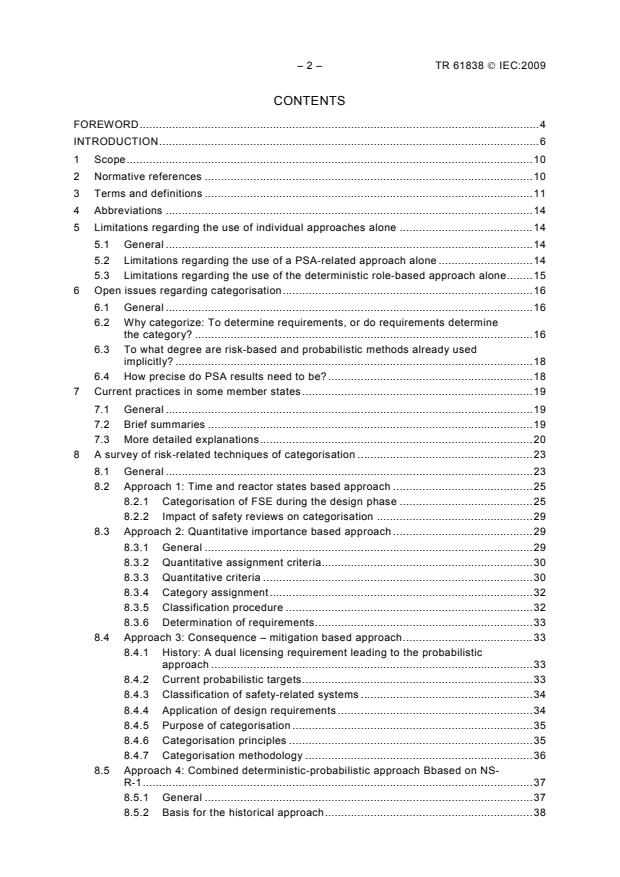
IEC TR 61838:2009 - Nuclear power plants - Instrumentation and control important to safety - Use of probabilistic safety assessment for the classification of functions Released:12/14/2009
Overview
IEC TR 61838:2009 is a critical technical report issued by the International Electrotechnical Commission (IEC) focusing on nuclear power plants. It addresses instrumentation and control systems important to safety and provides guidance on the use of probabilistic safety assessment (PSA) for the classification of safety functions. This report offers a survey of various methods to apply PSA results in defining risk-based classification criteria, aligning functional safety elements (FSEs) with categories established in IEC 61226.
The document updates previous iterations by refining terminology, integrating new references, and acknowledging advancements in PSA applications since the first edition. It is invaluable for nuclear industry professionals involved in safety classification, system design, and regulatory compliance.
Key Topics
- Probabilistic Safety Assessment (PSA): Explores the role of probabilistic methods to evaluate and enhance safety function classification in nuclear power plants.
- Risk-Based Classification: Discusses approaches to categorize functions based on their safety significance and likelihood of failure, bridging deterministic and probabilistic methods.
- Safety Function Categories: Introduces the four categories of safety functions as per IEC 61226 and how PSA informs their classification.
- Classification Approaches: Presents distinct strategies:
- Time and reactor state-based approaches
- Quantitative importance measures
- Consequence-mitigation techniques
- Combined deterministic-probabilistic frameworks
- Regional regulatory applications such as U.S. nuclear regulation methods
- Limitations and Open Issues: Addresses challenges in relying solely on PSA or deterministic methods and discusses the precision and applicability of PSA data.
- Comparative Analysis: Provides case studies comparing risk-based categorization results across different methodologies.
Applications
- Nuclear Plant Safety Systems: IEC TR 61838 guides the classification of instrumentation and control systems critical to nuclear safety, ensuring that design requirements match safety significance.
- Regulatory Compliance: Assists nuclear facility operators and regulators in applying internationally recognized risk-based criteria for safety function categorization.
- Design and Engineering: Supports engineers in determining appropriate safety requirements, reliability targets, and functional categories informed by PSA data.
- Safety Reviews and Risk Management: Facilitates ongoing risk assessments and updates of safety classifications in response to operational and design changes.
- Defense in Depth: Enhances safety through layered protection strategies relying on accurate classification of safety functions.
Related Standards
- IEC 61226: Specifies requirements for classification of safety functions and safety systems at nuclear power plants, providing the categorical framework applied in IEC TR 61838.
- IEC 61508: General standard on functional safety of electrical/electronic/programmable systems, supporting foundational concepts.
- INSAG-10: International Nuclear Safety Advisory Group document on safety classification principles that complement IEC TR 61838.
- Regional Regulatory Standards: U.S. nuclear regulation approaches mentioned in the report provide complementary perspectives on probabilistic classification methods.
This IEC technical report is essential for professionals involved in nuclear safety instrumentation and control, offering a comprehensive understanding of how probabilistic safety assessments enhance classification and risk management. By integrating PSA-based approaches, organizations can achieve more precise safety function categorizations, improve compliance with international standards, and foster safer nuclear power plant operations worldwide.
Relations
- Effective Date
- 05-Sep-2023
Buy Documents
IEC TR 61838:2009 - Nuclear power plants - Instrumentation and control important to safety - Use of probabilistic safety assessment for the classification of functions Released:12/14/2009
Get Certified
Connect with accredited certification bodies for this standard

BSI Group
BSI (British Standards Institution) is the business standards company that helps organizations make excellence a habit.

DNV
DNV is an independent assurance and risk management provider.

Lloyd's Register
Lloyd's Register is a global professional services organisation specialising in engineering and technology.
Sponsored listings
Frequently Asked Questions
IEC TR 61838:2009 is a technical report published by the International Electrotechnical Commission (IEC). Its full title is "Nuclear power plants - Instrumentation and control important to safety - Use of probabilistic safety assessment for the classification of functions". This standard covers: IEC/TR 61838:2009 provides a survey of some of the methods by which probabilistic risk assessment results can be used to establish "risk-based" classification criteria, so as to allow FSEs to be placed within the four categories established within IEC 61226. The safety principles and the usefulness of a risk-based approach to classification are discussed and a description of four different approaches is presented. The main technical changes in this second edition with regard to the previous edition are as follows: - to update the references and the terminology; - to take into account the progress done since edition 1.
IEC/TR 61838:2009 provides a survey of some of the methods by which probabilistic risk assessment results can be used to establish "risk-based" classification criteria, so as to allow FSEs to be placed within the four categories established within IEC 61226. The safety principles and the usefulness of a risk-based approach to classification are discussed and a description of four different approaches is presented. The main technical changes in this second edition with regard to the previous edition are as follows: - to update the references and the terminology; - to take into account the progress done since edition 1.
IEC TR 61838:2009 is classified under the following ICS (International Classification for Standards) categories: 27.120.20 - Nuclear power plants. Safety; 35.160 - Microprocessor systems. The ICS classification helps identify the subject area and facilitates finding related standards.
IEC TR 61838:2009 has the following relationships with other standards: It is inter standard links to IEC TR 61838:2001. Understanding these relationships helps ensure you are using the most current and applicable version of the standard.
IEC TR 61838:2009 is available in PDF format for immediate download after purchase. The document can be added to your cart and obtained through the secure checkout process. Digital delivery ensures instant access to the complete standard document.
Standards Content (Sample)
IEC/TR 61838 ®
Edition 2.0 2009-12
TECHNICAL
REPORT
RAPPORT
TECHNIQUE
colour
inside
Nuclear power plants – Instrumentation and control important to safety – Use of
probabilistic safety assessment for the classification of functions
Centrales nucléaires de puissance – Instrumentation et contrôle-commande
importants pour la sûreté – Utilisation des évaluations probabilistes de sûreté
pour le classement des fonctions
IEC/TR 61838:2009
All rights reserved. Unless otherwise specified, no part of this publication may be reproduced or utilized in any form or by
any means, electronic or mechanical, including photocopying and microfilm, without permission in writing from either IEC or
IEC's member National Committee in the country of the requester.
If you have any questions about IEC copyright or have an enquiry about obtaining additional rights to this publication,
please contact the address below or your local IEC member National Committee for further information.
Droits de reproduction réservés. Sauf indication contraire, aucune partie de cette publication ne peut être reproduite
ni utilisée sous quelque forme que ce soit et par aucun procédé, électronique ou mécanique, y compris la photocopie
et les microfilms, sans l'accord écrit de la CEI ou du Comité national de la CEI du pays du demandeur.
Si vous avez des questions sur le copyright de la CEI ou si vous désirez obtenir des droits supplémentaires sur cette
publication, utilisez les coordonnées ci-après ou contactez le Comité national de la CEI de votre pays de résidence.
IEC Central Office
3, rue de Varembé
CH-1211 Geneva 20
Switzerland
Email: inmail@iec.ch
Web: www.iec.ch
About the IEC
The International Electrotechnical Commission (IEC) is the leading global organization that prepares and publishes
International Standards for all electrical, electronic and related technologies.
About IEC publications
The technical content of IEC publications is kept under constant review by the IEC. Please make sure that you have the
latest edition, a corrigenda or an amendment might have been published.
ƒ Catalogue of IEC publications: www.iec.ch/searchpub
The IEC on-line Catalogue enables you to search by a variety of criteria (reference number, text, technical committee,…).
It also gives information on projects, withdrawn and replaced publications.
ƒ IEC Just Published: www.iec.ch/online_news/justpub
Stay up to date on all new IEC publications. Just Published details twice a month all new publications released. Available
on-line and also by email.
ƒ Electropedia: www.electropedia.org
The world's leading online dictionary of electronic and electrical terms containing more than 20 000 terms and definitions
in English and French, with equivalent terms in additional languages. Also known as the International Electrotechnical
Vocabulary online.
ƒ Customer Service Centre: www.iec.ch/webstore/custserv
If you wish to give us your feedback on this publication or need further assistance, please visit the Customer Service
Centre FAQ or contact us:
Email: csc@iec.ch
Tel.: +41 22 919 02 11
Fax: +41 22 919 03 00
A propos de la CEI
La Commission Electrotechnique Internationale (CEI) est la première organisation mondiale qui élabore et publie des
normes internationales pour tout ce qui a trait à l'électricité, à l'électronique et aux technologies apparentées.
A propos des publications CEI
Le contenu technique des publications de la CEI est constamment revu. Veuillez vous assurer que vous possédez
l’édition la plus récente, un corrigendum ou amendement peut avoir été publié.
ƒ Catalogue des publications de la CEI: www.iec.ch/searchpub/cur_fut-f.htm
Le Catalogue en-ligne de la CEI vous permet d’effectuer des recherches en utilisant différents critères (numéro de référence,
texte, comité d’études,…). Il donne aussi des informations sur les projets et les publications retirées ou remplacées.
ƒ Just Published CEI: www.iec.ch/online_news/justpub
Restez informé sur les nouvelles publications de la CEI. Just Published détaille deux fois par mois les nouvelles
publications parues. Disponible en-ligne et aussi par email.
ƒ Electropedia: www.electropedia.org
Le premier dictionnaire en ligne au monde de termes électroniques et électriques. Il contient plus de 20 000 termes et
définitions en anglais et en français, ainsi que les termes équivalents dans les langues additionnelles. Egalement appelé
Vocabulaire Electrotechnique International en ligne.
ƒ Service Clients: www.iec.ch/webstore/custserv/custserv_entry-f.htm
Si vous désirez nous donner des commentaires sur cette publication ou si vous avez des questions, visitez le FAQ du
Service clients ou contactez-nous:
Email: csc@iec.ch
Tél.: +41 22 919 02 11
Fax: +41 22 919 03 00
IEC/TR 61838 ®
Edition 2.0 2009-12
TECHNICAL
REPORT
RAPPORT
TECHNIQUE
colour
inside
Nuclear power plants – Instrumentation and control important to safety – Use of
probabilistic safety assessment for the classification of functions
Centrales nucléaires de puissance – Instrumentation et contrôle-commande
importants pour la sûreté – Utilisation des évaluations probabilistes de sûreté
pour le classement des fonctions
INTERNATIONAL
ELECTROTECHNICAL
COMMISSION
COMMISSION
ELECTROTECHNIQUE
PRICE CODE
INTERNATIONALE
XB
CODE PRIX
ICS 27.120.20 ISBN 978-2-88910-575-5
– 2 – TR 61838 © IEC:2009
CONTENTS
FOREWORD.4
INTRODUCTION.6
1 Scope.10
2 Normative references .10
3 Terms and definitions .11
4 Abbreviations .14
5 Limitations regarding the use of individual approaches alone .14
5.1 General .14
5.2 Limitations regarding the use of a PSA-related approach alone .14
5.3 Limitations regarding the use of the deterministic role-based approach alone.15
6 Open issues regarding categorisation.16
6.1 General .16
6.2 Why categorize: To determine requirements, or do requirements determine
the category? .16
6.3 To what degree are risk-based and probabilistic methods already used
implicitly? .18
6.4 How precise do PSA results need to be? .18
7 Current practices in some member states.19
7.1 General .19
7.2 Brief summaries .19
7.3 More detailed explanations.20
8 A survey of risk-related techniques of categorisation .23
8.1 General .23
8.2 Approach 1: Time and reactor states based approach .25
8.2.1 Categorisation of FSE during the design phase .25
8.2.2 Impact of safety reviews on categorisation .29
8.3 Approach 2: Quantitative importance based approach .29
8.3.1 General .29
8.3.2 Quantitative assignment criteria.30
8.3.3 Quantitative criteria .30
8.3.4 Category assignment.32
8.3.5 Classification procedure .32
8.3.6 Determination of requirements.33
8.4 Approach 3: Consequence – mitigation based approach.33
8.4.1 History: A dual licensing requirement leading to the probabilistic
approach .33
8.4.2 Current probabilistic targets.33
8.4.3 Classification of safety-related systems .34
8.4.4 Application of design requirements .34
8.4.5 Purpose of categorisation .35
8.4.6 Categorisation principles .35
8.4.7 Categorisation methodology .36
8.5 Approach 4: Combined deterministic-probabilistic approach Bbased on NS-
R-1.37
8.5.1 General .37
8.5.2 Basis for the historical approach.38
TR 61838 © IEC:2009 – 3 –
8.5.3 Plant state basis.38
8.5.4 Defence in depth considerations.40
8.5.5 Basis for classification – Based on IEC 61226 .40
8.5.6 Application of IEC 61226 .41
8.5.7 Safety classification methodology.42
8.5.8 Deterministic criteria for safety function categories.43
8.5.9 Other classification considerations .44
8.5.10 Worked example.45
8.5.11 Conclusion .46
8.6 Approach 5: Application of risk methodologies in U.S.A. nuclear regulation .46
9 Comparison of risk-related categorisation results .48
9.1 CANDU plant stepback function.48
9.1.1 Problem statement .48
9.1.2 Solution using approach 3 .49
9.1.3 Comparisons with other methods.50
9.2 Conclusions arising from the use of various approaches .50
Annex A (informative) The use of PSA: methods and results.52
Annex B (informative) Approach 6: Role-Reliability-Timeframe based approach.55
Bibliography.59
Figure 1 – Historical plant states and allowed releases .38
Figure 2 – Plant states and allowed releases .39
Figure 3 – Reliability requirements for state transition barriers.40
Figure 4 – Categories required to maintain plant states .41
Figure 5 – RISC Categories .47
Figure 6 – Event sequence and layer protection identification .49
Table 1 – Classification of I&C FSE .26
Table 2 – Correspondence between IEC 61226 and INSAG-10 .26
Table 3 – Minimum Requirements by Level of Function.28
Table 4 – Equipment requirements.29
Table 5 – Safety significance .36
Table 6 – Failure impact type.36
Table 7 – Category determination .37
Table 8 – Application of the changes to the safety classification methodology .43
Table B.1 – Prevention .56
Table B.2 – Termination.57
Table B.3 – Mitigation .57
– 4 – TR 61838 © IEC:2009
INTERNATIONAL ELECTROTECHNICAL COMMISSION
____________
NUCLEAR POWER PLANTS –
INSTRUMENTATION AND CONTROL IMPORTANT TO SAFETY –
USE OF PROBABILISTIC SAFETY ASSESSMENT
FOR THE CLASSIFICATION OF FUNCTIONS
FOREWORD
1) The International Electrotechnical Commission (IEC) is a worldwide organization for standardization comprising
all national electrotechnical committees (IEC National Committees). The object of IEC is to promote
international co-operation on all questions concerning standardization in the electrical and electronic fields. To
this end and in addition to other activities, IEC publishes International Standards, Technical Specifications,
Technical Reports, Publicly Available Specifications (PAS) and Guides (hereafter referred to as “IEC
Publication(s)”). Their preparation is entrusted to technical committees; any IEC National Committee interested
in the subject dealt with may participate in this preparatory work. International, governmental and non-
governmental organizations liaising with the IEC also participate in this preparation. IEC collaborates closely
with the International Organization for Standardization (ISO) in accordance with conditions determined by
agreement between the two organizations.
2) The formal decisions or agreements of IEC on technical matters express, as nearly as possible, an international
consensus of opinion on the relevant subjects since each technical committee has representation from all
interested IEC National Committees.
3) IEC Publications have the form of recommendations for international use and are accepted by IEC National
Committees in that sense. While all reasonable efforts are made to ensure that the technical content of IEC
Publications is accurate, IEC cannot be held responsible for the way in which they are used or for any
misinterpretation by any end user.
4) In order to promote international uniformity, IEC National Committees undertake to apply IEC Publications
transparently to the maximum extent possible in their national and regional publications. Any divergence
between any IEC Publication and the corresponding national or regional publication shall be clearly indicated in
the latter.
5) IEC itself does not provide any attestation of conformity. Independent certification bodies provide conformity
assessment services and, in some areas, access to IEC marks of conformity. IEC is not responsible for any
services carried out by independent certification bodies.
6) All users should ensure that they have the latest edition of this publication.
7) No liability shall attach to IEC or its directors, employees, servants or agents including individual experts and
members of its technical committees and IEC National Committees for any personal injury, property damage or
other damage of any nature whatsoever, whether direct or indirect, or for costs (including legal fees) and
expenses arising out of the publication, use of, or reliance upon, this IEC Publication or any other IEC
Publications.
8) Attention is drawn to the Normative references cited in this publication. Use of the referenced publications is
indispensable for the correct application of this publication.
9) Attention is drawn to the possibility that some of the elements of this IEC Publication may be the subject of
patent rights. IEC shall not be held responsible for identifying any or all such patent rights.
The main task of IEC technical committees is to prepare International Standards. However, a
technical committee may propose the publication of a technical report when it has collected
data of a different kind from that which is normally published as an International Standard, for
example "state of the art".
IEC 61838, which is a technical report, has been prepared by subcommittee 45A:
Instrumentation and control of nuclear facilities, of IEC technical committee 45: Nuclear
instrumentation.
This second edition cancels and replaces the first edition published in 2001.
The main technical changes with regard to the previous edition are as follows:
– to update references taking into account standards published since issue 1;
– to update the terminology;
TR 61838 © IEC:2009 – 5 –
– to take into account the progress done concerning the use of PSA for classification since
issue 1.
The text of this technical report is based on the following documents:
Enquiry draft Report on voting
45A/766/DTR 45A/779A/RVC
Full information on the voting for the approval of this technical report can be found in the
report on voting indicated in the above table.
This publication has been drafted in accordance with the ISO/IEC Directives, Part 2.
The committee has decided that the contents of this publication will remain unchanged until
the maintenance result date indicated on the IEC web site under "http://webstore.iec.ch" in
the data related to the specific publication. At this date, the publication will be
• reconfirmed,
• withdrawn,
• replaced by a revised edition, or
• amended.
IMPORTANT – The 'colour inside' logo on the cover page of this publication indicates
that it contains colours which are considered to be useful for the correct
understanding of its contents. Users should therefore print this document using a
colour printer.
– 6 – TR 61838 © IEC:2009
INTRODUCTION
a) Technical background, main issues and organisation of the Technical Report
IEC 61226 "Nuclear power plants – Instrumentation and control systems important for safety –
Classification" was published in 1993, and revised in 2005 and 2009. The need to classify
instrumentation and control functions on nuclear power plants now originates from an
International Atomic Energy Agency (IAEA) requirement stated in Standard NS-R-1, clause
5.2. IEC 61226 emphasizes that it is the functions, which must be classified early in the
design phase so that the degree of importance to safety of each function is determined. At the
design stage, I&C functions are allocated to specific instrumentation and control systems
each of which will normally comprise of several types of equipment. These systems and
equipment are usually assigned to classes according to the safety significance of the
functions assigned to each system (as per IEC 61513), but it is the functions which determine
the fundamental categorization. IAEA guide NS-G-1.14 (currently in draft form) extends the
concept of categorising functions to assigning the resultant category to all structures, systems
and components (SCCs) that implement the function.
In order to cater for this association of systems and equipment with functions, the concept of
an FSE was introduced in IEC 61226. An FSE is defined as:
Functions, and the associated systems and equipment. Functions are carried out for a
purpose or to achieve a goal. The associated systems and equipment are the collection of
components and the components themselves that are employed to achieve the functions.
IEC 61226 provides a categorization method for FSE based upon qualitative, role-based
criteria. Many of the criteria are well understood in the nuclear industry since they recognize
that the single and most important nuclear safety function is to prevent accidents and mitigate
against fission product releases. Consequently, the classification of FSE in IEC 61226,
Edition 3 is a deterministic process and takes little account of quantitative risk assessment
techniques.
During the last ten years, risk assessment methods, particularly applied to nuclear power
plants, have matured although their use in NPP design (and licensing) varies greatly
throughout the world. In some countries, a probabilistic risk assessment is seen as an
essential element of the design process and of the final safety case; this is not the case in
other countries.
The release in 2000 of IAEA NS-R-1 and in 2002 of NS-G-1.3 has highlighted the requirement
to factor engineering judgement and probabilistic criteria into the process of categorisation.
For several years, how a risk based classification scheme could be incorporated into
IEC 61226 to meet this requirement has been the topic of discussion. As indicated above,
there are significant differences in the use of risk assessments throughout the world, which
leads to several questions when drafting an International Standard, namely:
1) Should a risk-based classification scheme be acceptable in place of the deterministic
approach? If so, what are the requirements (especially regarding the standard of
modelling and the validity of data) that must be applied?
2) If a risk-based classification leads to different classifications of FSE compared to the
deterministic approach, which should take precedence?
3) Should the two approaches be used together in order to gain the maximum benefit? The
deterministic approach is based on sound, well-proven nuclear safety principles, which
people are comfortable with. Risk assessment results could lead to the classification of
specific I&C functions being upgraded or downgraded (because of plant-specific design
features). Should this upgrading or downgrading be limited in some way?
4) Should the use of risk assessments be mandated when considering the effectiveness of
plant and I&C modifications throughout the plant lifetime? Similarly, should requirements
be included for the use of risk assessments in making decisions about preventive
maintenance?
TR 61838 © IEC:2009 – 7 –
5) How should classification be applied to novel plant designs which do not fit the current
role-based classification scheme in IEC 61226, and how could classification based on
power plants be extended to other nuclear power plants, nuclear facilities such as low
power reactors used for research or isotope production, facilities handling high-level radio-
isotopes, nuclear fuel fabrication, and nuclear fuel reprocessing facilities?
This technical report now has been revised in the light of the publication of IAEA NS-R-1 and
NS-G-1.3, which require that classification be based upon deterministic methods
complemented where appropriate by engineering judgement and risk-related considerations.
Both the precise wording of NS-R-1 clause 5.2 and the list of criteria to consider (expanded in
clause 2.38 of NS-G-1.3) emphasize the importance of the latter criteria. It is eminently clear
that it is a requirement to consider engineering judgment and the cited risk-related criteria,
except where it can be shown to not be appropriate. This conclusion is also supported by
clause 3.4 of NS-R-1, which requires that design management “shall take account of the results of
the deterministic and complementary probabilistic safety analyses”, and now further emphasized by IAEA
NS-G-1.14 (draft currently in the review stage) which advocates a balanced approach
between probabilistic and deterministic methods.
This requirement to include risk-related consideration in the process of classification (unless
shown to be inappropriate) is of such paramount importance to the adoption of a method of
classification that the relevant clauses are reproduced below from NS-G-1.3 (note that clause
2.37 of NS-G-1.3 is a verbatim citation of clause 5.2 of NS-R-1 ):
2.37. In particular, the Requirements for Design require (Ref. [NS-R-1], para.
5.2) that the method for classifying the safety significance of a structure,
system or component be based primarily on deterministic methods,
complemented where appropriate by probabilistic methods and engineering
judgement, and that account be taken of factors such as:
• The safety function(s) to be performed;
• The consequences of the I&C system’s failure;
• The probability that the I&C system will be called upon to perform a
safety function; and
• Following a PIE, the time at which or the period for which the I&C
system will be called upon to operate.
2.38. In the method of classification, in addition to considering the
aforementioned factors, as required in [NS-R-1], the following factors should
also be taken into account in determining the class of the I&C system. The
criteria, as set out in the following factors for illustrative purposes, should be
chosen so as to provide a quantitative and/or qualitative indication of the
relative importance to safety of the I&C system being classified:
• The probability of PIEs and the potential severity of their consequences
if the I&C system provided fails (e.g. high, medium or low probability,
with high, medium or low consequences (e.g. radiological
consequences));
• The potential of the I&C system itself to cause a PIE (i.e. the I&C
system’s failure modes), the provisions made in the safety systems or
in other I&C systems covered by this Safety Guide for such a PIE (i.e.
provisions for detection of I&C system failure), and the combination of
probability and consequences of such a PIE (i.e. frequency of failure
and radiological consequences);
• The length of time for which the I&C system is required once the safety
function is initiated (e.g. up to 12 hours, beyond 12 hours);
• The timeliness and reliability with which alternative actions can be
—————————
Reproduced with the permission of IAEA.
– 8 – TR 61838 © IEC:2009
taken (e.g. immediate/low reliability, beyond 30 minutes/high
reliability); and
• The timeliness (e.g. up to 12 hours, beyond 12 hours) and reliability
with which any failure in the I&C system can be detected and remedied.
The goal of this report is then to help the community reach some consensus on a blended
approach to classification. Such an approach could possibly incorporate a framework where
the fundamental safety functions of last resort would be identified largely deterministically
(and presumably fall into Category A) while the primary continuously-operating functions that
maintain the plant at normal full-power would likely fall into Category C. Subsequently, all
plant functions, particularly those falling into Category B, would be classified using a blend of
methodologies that are appropriate to the plant design concept and the national licensing
approach in the member nation.
It was recognized by 2001 that an amendment to IEC 61226 would be very difficult. In order
to advance the debate, however, the first edition of this Technical Report presented a number
of different approaches to the application of risk-based and time-based criteria in the
classification of FSE. Since then, the increased use of PSA techniques and in particular the
release of IAEA NS-R-1 and now the current work on NS-G-1.14 indicate the need to revise
this Technical Report. Accordingly, this report examines both the issue of balancing the
qualitative and quantitative risk-based approaches, and the details of possible quantitative
methodologies.
b) Situation of the current Technical Report in the structure of the IEC SC 45A
standard series
IEC 61838 as a technical report is a fourth level IEC SC 45A document.
For more details on the structure of the IEC SC 45A standard series, see item d) of this
introduction.
c) Recommendations and limitations regarding the application of the Technical Report
It is important to note that a technical report is entirely informative in nature. It gathers data
collected from different origins and it establishes no requirements.
d) Description of the structure of the IEC SC 45A standard series and relationships
with other IEC documents and other bodies documents (IAEA, ISO)
The top-level document of the IEC SC 45A standard series is IEC 61513. It provides general
requirements for I&C systems and equipment that are used to perform functions important to
safety in NPPs. IEC 61513 structures the IEC SC 45A standard series.
IEC 61513 refers directly to other IEC SC 45A standards for general topics related to
categorization of functions and classification of systems, qualification, separation of systems,
defence against common cause failure, software aspects of computer-based systems,
hardware aspects of computer-based systems, and control room design. The standards
referenced directly at this second level should be considered together with IEC 61513 as a
consistent document set.
At a third level, IEC SC 45A standards not directly referenced by IEC 61513 are standards
related to specific equipment, technical methods, or specific activities. Usually these
documents, which make reference to second-level documents for general topics, can be used
on their own.
A fourth level extending the IEC SC 45A standard series, corresponds to the Technical
Reports which are not normative.
TR 61838 © IEC:2009 – 9 –
IEC 61513 has adopted a presentation format similar to the basic safety publication
IEC 61508 with an overall safety life-cycle framework and a system life-cycle framework and
provides an interpretation of the general requirements of IEC 61508-1, IEC 61508-2 and
IEC 61508-4, for the nuclear application sector. Compliance with IEC 61513 will facilitate
consistency with the requirements of IEC 61508 as they have been interpreted for the nuclear
industry. In this framework IEC 60880 and IEC 62138 correspond to IEC 61508-3 for the
nuclear application sector.
IEC 61513 refers to ISO as well as to IAEA 50-C-QA (now replaced by IAEA GS-R-3) for
topics related to quality assurance (QA).
The IEC SC 45A standards series consistently implements and details the principles and
basic safety aspects provided in the IAEA code on the safety of NPPs and in the IAEA safety
series, in particular the Requirements NS-R-1, establishing safety requirements related to the
design of Nuclear Power Plants, and the Safety Guide NS-G-1.3 dealing with instrumentation
and control systems important to safety in Nuclear Power Plants. The terminology and
definitions used by SC 45A standards are consistent with those used by the IAEA.
– 10 – TR 61838 © IEC:2009
NUCLEAR POWER PLANTS –
INSTRUMENTATION AND CONTROL IMPORTANT TO SAFETY –
USE OF PROBABILISTIC SAFETY ASSESSMENT
FOR THE CLASSIFICATION OF FUNCTIONS
1 Scope
This Technical Report provides a survey of some of the methods by which probabilistic risk
assessment results can be used to establish "risk-based" classification criteria, so as to allow
FSEs to be placed within the four categories established within IEC 61226.
The application of risk-based classification (categorisation) techniques, in conjunction with the
role-based deterministic approach to classification given in IEC 61226 Edition 3, will continue
to be decided by the utility and/or regulator within the National Regulatory frameworks.
However, these approaches would be expected to take due account of internationally agreed
approaches such as expressed in IAEA standards and guides. However, those are essentially
high level and for instrumentation and control systems IAEA have left it to IEC TC45 SC 45A
to determine the detailed approaches available and to express them in standards. There is an
increasing level of consensus on the topic of classification; however there is some way to go
yet. Edition 1 of this technical report published in 2001 assisted in the revision of IEC 61226
published in 2005. The scope of this revision to IEC 61838 is to stimulate debate on this
subject and encourage the convergence of views so that further revision to IEC 61226 can
be agreed to bring it into line with the latest IAEA guidance, i.e. to explicitly include
consideration of aspects such as risk and time lines of response.
The safety principles and the usefulness of a risk-based approach to classification are
discussed and a description of four different approaches is presented. Two of these
approaches are applied to a practical example and the results compared as a means to
evaluate the robustness and generality of the risk-based approach.
In other respects, references are given in this report to IEC and IAEA documents, which relate
directly to the topic.
This report also discusses the limitations associated with the use of either a risk-based
approach or a role-based approach on its own, either of which would be inconsistent with the
guidance soon to be released in IAEA NS-G-1.14.
2 Normative references
The following documents are referenced in this document. For dated references, only the
edition cited applies. For undated references, the latest edition of the referenced document
(including any amendments) applies.
IEC 60709:2004, Nuclear power plants – Instrumentation and control systems important to
safety – Separation
IEC 60964, Nuclear power plants – Control rooms – Design
IEC 61226:2009, Nuclear power plants – Instrumentation and control important to safety –
Classification of instrumentation and control functions
IEC 61513:2001, Nuclear power plants – Instrumentation and control for systems important
for safety – General requirements for systems
TR 61838 © IEC:2009 – 11 –
IEC 62138:2004, Nuclear power plants – Instrumentation and control important for safety –
Software aspects for computer-based systems performing category B or C functions
IAEA NS-R-1:2000, Requirements: Safety of Nuclear Power Plants Design, Safety
Requirements
IAEA NS-G-1.3:2002, Safety Guide: Instrumentation and Control Systems Important to Safety
in Nuclear Power Plants
IAEA NS-G-1.14, Safety Guide: Safety Classification of Structures, Systems and Components
Important to Safety Important to Safety in Nuclear Power Plants (draft)
INSAG-10: 1996, Defense in depth in nuclear safety
INSAG-12, Basic safety principles for nuclear power plants 75-INSAG-3, Rev. 1
IAEA Safety glossary, 2007 edition
3 Terms and definitions
For the purposes of this document, the following terms and definitions apply.
3.1
diversity
presence of two or more redundant systems or components to perform an identified function,
where the different systems or components have different attributes so as to reduce the
possibility of common cause failure, including common mode failure
[IAEA Safety Glossary, 2007 edition]
3.2
equipment
one or more parts of a system. An item of equipment is a single definable (and usually
removable) element or part of a system
[IEC 61513]
3.3
function
specific purpose or objective to be accomplished, that can be specified or described without
reference to the physical means of achieving it
[IEC 61226]
3.4
functionality
attribute of a function which defines the operations which transfer input information into output
information
[IEC 61513]
3.5
I&C FSE: functions, and the associated systems and equipment
functions are carried out for a purpose or to achieve a goal. The associated systems and
equipment are the collection of components and the components themselves that are
employed to achieve the functions
[IEC 61513]
– 12 – TR 61838 © IEC:2009
3.6
item important to safety
item that is part of a safety group and/or whose malfunction or failure could lead to radiation
exposure of the site personnel or members of the public.
Items important to safety include:
a) Those structures, systems and components whose malfunction or failure could lead to
undue radiation exposure of the site personnel or members of the public.
b) Those structures, systems and components that prevent anticipated operational
occurrences from leading to accident conditions.
c) Those features which are provided to mitigate the consequences of malfunction or failure
of structures, systems or components.
[IAEA Safety Glossary, 2007 edition]
NOTE 1 In this technical report the items considered will be mainly I&C FSE.
NOTE 2 The above definition of “important to safety” refers to both systems or functions that are designed
explicitly for their safety function (items b and c) and the systems whose failure could require other functions to act
(item a). This is in contrast with the definition in IEC 61508 where “safety related” applies only to systems and
functions designed explicitly to provide a safety function (items b and c).
3.7
nuclear safety
achievement of proper operating conditions, prevention of accidents or mitigation of accident
consequences, resulting in protection of workers, the public and the environment from undue
radiation hazards
[IAEA Safety Glossary, 2007 edition]
3.8
performance
effectiveness with which an intended function is carried out (e.g. time response, accuracy,
sensitivity to parameter changes)
[IEC 61226]
3.9
postulated initiating event (PIE)
event identified during design as capable of leading to anticipated operational occurrences or
accident conditions
[IAEA Safety Glossary, 2007 edition]
3.10
redundancy
provision of alternative (identical or diverse) structures, systems or components, so that any
one can perform the required function regardless of the state of operation or failure of any
other
[IAEA Safety Glossary, 2007 edition]
3.11
risk-based categorisation
the approach to categorisation based on the significance with regard to safety of the function
being categorized (i.e. degree of risk eliminated by the function).
NOTE This approach requires analyzing both the consequence eliminated or reduced by the function and the
reliability that the plant safety analysis requires for this function. The term “probabilistic categorisation” is often
imprecisely used for this approach. One limitation of this approach is that it imposes an analysis burden before one
may complete the categorisation.
TR 61838 © IEC:2009 – 13 –
3.12
role-based categorisation
the deterministic approach to categorisation based purely on the function (i.e. role) performed
by a function being categorized. This usually involves selecting the most appropriate role from
a list of roles associated with each category, such as in clause 5.4 of IEC 61226, Edition 3.
The list of roles associated with each category is deterministically selected, based on non-
quantitative criteria related to the safety significance of the function.
NOTE One limitation of this approach is that it does not provide a systematic approach for functions that do not
exactly fit the list provided.
3.13
safety function
specific purpose that must be accomplished for safety
[IAEA Safety Glossary, 2007 edition]
3.14
safety system
system important to safety, provided to ensure the safe shutdown of the reactor and the
residual heat removal from the core, or to limit the consequences of anticipated operational
occurrences and design basis accidents
[IAEA Safety Glossary, 2007 edition]
3.15
significant sequence
credible series or set of events that would result in unacceptable consequences such as:
• unacceptable radioactive release at the site or to the wider environment. This might be
either a massive, uncontrolled release at a frequency that is outside the NPP’s design
basis, or releases at a frequency that is within the design basis but exceed specified
magnitude and/or frequency limits;
• unacceptable fuel damage. This might be damage to the fuel clad that leads to an
unacceptable increase in the activity of the primary coolant, or structural damage to the
fuel that impairs the ability to cool it
3.16
single failure criterion (SFC)
criterion (or requirement) applied to a system such that it must be capable of performing its
safety task in the presence of any single failure
[IAEA Safety Glossary, 2007 edition]
3.17
system
set of components which interact according to a design, where an element of a system can be
another system, called a subsystem
[IEC 61513]
3.18
unavailability
fraction of time that a system or component is not capable of supporting its function
NOTE Unavailability may occur as a result of the item being repaired or a malfunction being detected, or the item
being tested, or it may occur as a result of undetected malfunctions.
– 14 – TR 61838 © IEC:2009
4 Abbreviations
ALARP As Low as Reasonably Practicable
CCF Common Cause Failure
DBC Design Basis Conditions
DEC Design Extension Conditions
EQ Environmental Qualification
FSE Function(s) and the associated systems and equipment that implement it (them)
FMEA Failure Modes And Effects Analysis
I&C Instrumentation And Control
IAEA International Atomic Energy Agency
NPP Nuclear Power Plant
PIE Postulated Initiating Event
PSA Probabilistic Safety Assessment
QA Quality Assurance
SFC Single Failure Criterion
SQ Seismic Qualification
V&V Verification and Validation
/ry per reactor year
/y per year
5 Limitations regarding the use of individual approaches alone
5.1 General
Clause 5.2 of IAEA NS-R-1 is clear in its requirement to use a balance of deterministic
methods and risk-based (or probabilistic) methods and the draft guide NS-G-1.14 further
emphasizes the importance of a balanced methodology. To explore this concept, this clause
considers the limitations of trying to approach the question of categorisation on the basis of
either a purely deterministic role-based or a purely risk-based approach
5.2 Limitations regarding the use of a PSA-related approa
...