


IEC 61400-25-6:2016
(Main)Wind energy generation systems - Part 25-6: Communications for monitoring and control of wind power plants - Logical node classes and data classes for condition monitoring
Wind energy generation systems - Part 25-6: Communications for monitoring and control of wind power plants - Logical node classes and data classes for condition monitoring
IEC 61400-25-6:2016 specifies the information models related to condition monitoring for wind power plants and the information exchange of data values related to these models. This standard is to be used with other standards of the IEC 61400-25 series. This new edition includes the following significant technical changes with respect to the previous edition:
- major restructuring of the data model to accommodate flexibility; removal of UFF58 format;
- access to data using the standard reporting and logging functions;
- recommendations for creating data names to accommodate flexibility
Systèmes de génération d'énergie éolienne - Partie 25-6: Communications pour la surveillance et la commande des centrales éoliennes – Classes de nœuds logiques et classes de données pour la surveillance d'état
l’IEC 61400-25-6:2016 spécifie les modèles d’information liés à la surveillance d’état pour les centrales éoliennes et l’échange d’information des valeurs de données liées à ces modèles. La présente norme doit être utilisée avec d'autres normes de la série CEI 61400-25. Cette édition inclut les modifications techniques majeures suivantes par rapport à l'édition précédente:
- restructuration majeure du modèle de données afin d’obtenir la flexibilité necessaire
- le format UFF58 n’est plus utilise.
- l’accès aux données utilise désormais les fonctions normalisées d’établissement de rapports et de journalisation
- les recommandations concernant la création de noms de données afin d’obtenir la flexibilité nécessaire
General Information
- Status
- Published
- Publication Date
- 15-Dec-2016
- Technical Committee
- TC 88 - Wind energy generation systems
- Drafting Committee
- JWG 25 - TC 88/JWG 25
- Current Stage
- PPUB - Publication issued
- Start Date
- 16-Dec-2016
- Completion Date
- 18-Jan-2017
Relations
- Effective Date
- 05-Sep-2023
Overview
IEC 61400-25-6:2016 is part of the IEC 61400-25 series for communications for monitoring and control of wind power plants. This part specifies the information models (logical node classes and data classes) related to condition monitoring and the rules for information exchange of data values tied to those models. It is intended to be used together with other IEC 61400-25 parts to enable interoperable condition monitoring across wind turbines, SCADA systems, and condition monitoring systems (CMS).
This second edition (2016) introduces major updates:
- Restructured data model to improve flexibility
- Removal of UFF58 format
- Access to data via standard reporting and logging functions
- Recommendations for creating datanames to support flexible naming and mapping
Key topics and technical content
- Information modelling for condition monitoring: Defines logical node(s) (e.g., WCON for wind turbine condition monitoring) and common data classes that describe sensors, measurements and metadata.
- Common data classes: Examples included in the standard are Condition Monitoring Measurement (CMM), Condition Monitoring Bin (CMB), Scalar Value Array (SVA) and Complex Measurement Value Array (CMVA).
- Measurement description attributes: Attributes for sensor identification, measurement type, shaft/bearing location and binning of operational states.
- Operational state bin concept: Mechanism to categorize measurements into bins (e.g., by power or speed ranges) to facilitate trending and alarms.
- Reporting & logging: Standardized use of IEC 61400-25 reporting and logging mechanisms for accessing condition monitoring data.
- Dataname recommendations: Guidance to create consistent, flexible names for data mapping and integration.
Practical applications
IEC 61400-25-6 enables:
- Interoperable condition monitoring between OEM turbine controllers, third‑party condition monitoring vendors, and SCADA/asset management systems
- Consistent definition and exchange of vibration, temperature, oil analysis and other CM measurements
- Structured alarm/threshold definition and bin-based trending for predictive maintenance
- Reduced integration time and costs through standardized data classes and naming guidance
Who should use this standard
- Wind turbine OEM engineers and controls developers
- Condition monitoring system vendors and integrators
- SCADA and fleet asset management teams
- Wind farm operators and maintenance planners
- System architects designing communications and data models for wind power plants
Related standards
- IEC 61400-25 series (all parts) - general communications framework
- IEC 61400-25-2 - logical node classes and data classes common to the series (referenced and extended by Part 25-6)
By specifying clear logical nodes and data classes for condition monitoring, IEC 61400-25-6 helps standardize data exchange across wind farms, enabling better predictive maintenance, interoperability and scalable monitoring deployments.


IEC 61400-25-6:2016 - Wind energy generation systems - Part 25-6: Communications for monitoring and control of wind power plants - Logical node classes and data classes for condition monitoring Released:12/16/2016 Isbn:9782832237236

IEC 61400-25-6:2016 - Wind energy generation systems - Part 25-6: Communications for monitoring and control of wind power plants - Logical node classes and data classes for condition monitoring
Get Certified
Connect with accredited certification bodies for this standard

DNV
DNV is an independent assurance and risk management provider.

Lloyd's Register
Lloyd's Register is a global professional services organisation specialising in engineering and technology.

BSI Group
BSI (British Standards Institution) is the business standards company that helps organizations make excellence a habit.
Sponsored listings
Frequently Asked Questions
IEC 61400-25-6:2016 is a standard published by the International Electrotechnical Commission (IEC). Its full title is "Wind energy generation systems - Part 25-6: Communications for monitoring and control of wind power plants - Logical node classes and data classes for condition monitoring". This standard covers: IEC 61400-25-6:2016 specifies the information models related to condition monitoring for wind power plants and the information exchange of data values related to these models. This standard is to be used with other standards of the IEC 61400-25 series. This new edition includes the following significant technical changes with respect to the previous edition: - major restructuring of the data model to accommodate flexibility; removal of UFF58 format; - access to data using the standard reporting and logging functions; - recommendations for creating data names to accommodate flexibility
IEC 61400-25-6:2016 specifies the information models related to condition monitoring for wind power plants and the information exchange of data values related to these models. This standard is to be used with other standards of the IEC 61400-25 series. This new edition includes the following significant technical changes with respect to the previous edition: - major restructuring of the data model to accommodate flexibility; removal of UFF58 format; - access to data using the standard reporting and logging functions; - recommendations for creating data names to accommodate flexibility
IEC 61400-25-6:2016 is classified under the following ICS (International Classification for Standards) categories: 03.120.01 - Quality in general; 03.120.30 - Application of statistical methods; 27.180 - Wind turbine energy systems. The ICS classification helps identify the subject area and facilitates finding related standards.
IEC 61400-25-6:2016 has the following relationships with other standards: It is inter standard links to IEC 61400-25-6:2010. Understanding these relationships helps ensure you are using the most current and applicable version of the standard.
IEC 61400-25-6:2016 is available in PDF format for immediate download after purchase. The document can be added to your cart and obtained through the secure checkout process. Digital delivery ensures instant access to the complete standard document.
Standards Content (Sample)
IEC 61400-25-6 ®
Edition 2.0 2016-12
INTERNATIONAL
STANDARD
colour
inside
Wind energy generation systems –
Part 25-6: Communications for monitoring and control of wind power plants –
Logical node classes and data classes for condition monitoring
All rights reserved. Unless otherwise specified, no part of this publication may be reproduced or utilized in any form
or by any means, electronic or mechanical, including photocopying and microfilm, without permission in writing from
either IEC or IEC's member National Committee in the country of the requester. If you have any questions about IEC
copyright or have an enquiry about obtaining additional rights to this publication, please contact the address below or
your local IEC member National Committee for further information.
IEC Central Office Tel.: +41 22 919 02 11
3, rue de Varembé Fax: +41 22 919 03 00
CH-1211 Geneva 20 info@iec.ch
Switzerland www.iec.ch
About the IEC
The International Electrotechnical Commission (IEC) is the leading global organization that prepares and publishes
International Standards for all electrical, electronic and related technologies.
About IEC publications
The technical content of IEC publications is kept under constant review by the IEC. Please make sure that you have the
latest edition, a corrigenda or an amendment might have been published.
IEC Catalogue - webstore.iec.ch/catalogue Electropedia - www.electropedia.org
The stand-alone application for consulting the entire The world's leading online dictionary of electronic and
bibliographical information on IEC International Standards, electrical terms containing 20 000 terms and definitions in
Technical Specifications, Technical Reports and other English and French, with equivalent terms in 15 additional
documents. Available for PC, Mac OS, Android Tablets and languages. Also known as the International Electrotechnical
iPad. Vocabulary (IEV) online.
IEC publications search - www.iec.ch/searchpub IEC Glossary - std.iec.ch/glossary
The advanced search enables to find IEC publications by a 65 000 electrotechnical terminology entries in English and
variety of criteria (reference number, text, technical French extracted from the Terms and Definitions clause of
committee,…). It also gives information on projects, replaced IEC publications issued since 2002. Some entries have been
and withdrawn publications. collected from earlier publications of IEC TC 37, 77, 86 and
CISPR.
IEC Just Published - webstore.iec.ch/justpublished
Stay up to date on all new IEC publications. Just Published IEC Customer Service Centre - webstore.iec.ch/csc
details all new publications released. Available online and If you wish to give us your feedback on this publication or
also once a month by email. need further assistance, please contact the Customer Service
Centre: csc@iec.ch.
IEC 61400-25-6 ®
Edition 2.0 2016-12
INTERNATIONAL
STANDARD
colour
inside
Wind energy generation systems –
Part 25-6: Communications for monitoring and control of wind power plants –
Logical node classes and data classes for condition monitoring
INTERNATIONAL
ELECTROTECHNICAL
COMMISSION
ICS 27.180 ISBN 978-2-8322-3723-6
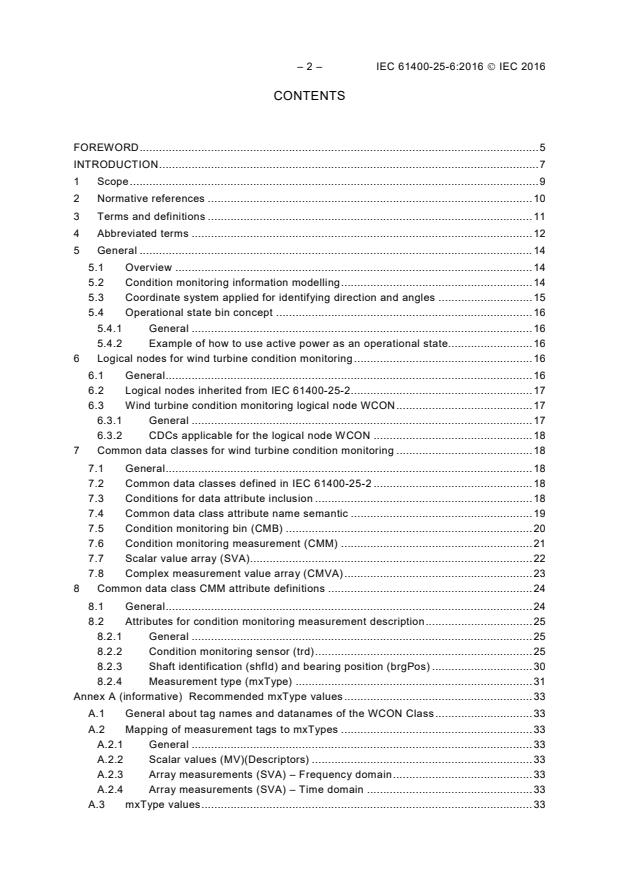
– 2 – IEC 61400-25-6:2016 IEC 2016
CONTENTS
FOREWORD . 5
INTRODUCTION . 7
1 Scope . 9
2 Normative references . 10
3 Terms and definitions . 10
4 Abbreviated terms . 12
5 General . 14
5.1 Overview . 14
5.2 Condition monitoring information modelling . 14
5.3 Coordinate system applied for identifying direction and angles . 15
5.4 Operational state bin concept . 16
5.4.1 General . 16
5.4.2 Example of how to use active power as an operational state. 16
6 Logical nodes for wind turbine condition monitoring . 16
6.1 General . 16
6.2 Logical nodes inherited from IEC 61400-25-2 . 17
6.3 Wind turbine condition monitoring logical node WCON . 17
6.3.1 General . 17
6.3.2 CDCs applicable for the logical node WCON . 18
7 Common data classes for wind turbine condition monitoring . 18
7.1 General . 18
7.2 Common data classes defined in IEC 61400-25-2 . 18
7.3 Conditions for data attribute inclusion . 18
7.4 Common data class attribute name semantic . 19
7.5 Condition monitoring bin (CMB) . 20
7.6 Condition monitoring measurement (CMM) . 21
7.7 Scalar value array (SVA). 22
7.8 Complex measurement value array (CMVA) . 23
8 Common data class CMM attribute definitions . 24
8.1 General . 24
8.2 Attributes for condition monitoring measurement description . 25
8.2.1 General . 25
8.2.2 Condition monitoring sensor (trd) . 25
8.2.3 Shaft identification (shfId) and bearing position (brgPos) . 30
8.2.4 Measurement type (mxType) . 31
Annex A (informative) Recommended mxType values . 33
A.1 General about tag names and datanames of the WCON Class . 33
A.2 Mapping of measurement tags to mxTypes . 33
A.2.1 General . 33
A.2.2 Scalar values (MV)(Descriptors) . 33
A.2.3 Array measurements (SVA) – Frequency domain . 33
A.2.4 Array measurements (SVA) – Time domain . 33
A.3 mxType values . 33
Annex B (informative) Application of data attributes for condition monitoring
measurement description for measurement tag naming. 37
B.1 General . 37
B.2 Naming principle using the data attributes in CMM CDC . 37
B.3 Examples . 38
Annex C (informative) Condition monitoring bins examples . 39
C.1 Example 1: One dimensional bins . 39
C.2 Example 2: Two dimensional bins . 40
C.3 Example 3: Two dimensional bins with overlap . 42
Annex D (informative) Application example . 45
D.1 Overview of CDCs essential to IEC 61400-25-6 . 45
D.2 How to apply data to CDCs . 45
D.3 How to apply an alarm . 47
Bibliography . 49
Figure 1 – Condition monitoring with separated TCD/CMD functions . 8
Figure 2 – Schematic flow of condition monitoring information . 9
Figure 3 – Reference coordinates system for the drive train . 15
Figure 4 – Active power bin concept . 16
Figure 5 – Sensor angular orientation as seen from the rotor end . 29
Figure 6 – Sensor motion identification . 29
Figure 7 – Sensor normal and reverse motion . 30
Figure 8 – Principle of shaft and bearing identification along a drive train . 31
Figure B.1 – Naming principles for trd data attribute . 37
Figure C.1 – Bin configuration example 1 . 40
Figure C.2 – Bin configuration example 2 . 42
Figure C.3 – Bin configuration example 3 . 44
Figure D.1 – Linkage of the CDCs . 45
Table 1 – Abbreviated terms applied . 13
Table 2 – Coordinate system and wind turbine related characteristics . 15
Table 3 – LN: Wind turbine condition monitoring information (WCON) . 18
Table 4 – Conditions for the presence of a data attribute . 19
Table 5 – Common data class attribute name semantic . 20
Table 6 – CDC: Condition monitoring bin (CMB) . 21
Table 7 – CDC: Condition monitoring measurement (CMM) . 22
Table 8 – CDC: Scalar value array (SVA) . 23
Table 9 – CDC: Complex measurement value array (CMVA) . 24
Table 10 – Data attributes used for measurement description . 25
Table 11 – Sensor identification convention for “trd” attribute . 25
Table 12 – Abbreviated terms for “trd” – “location” description . 26
Table 13 – Sensor type code . 28
Table 14 – Reference code for sensor sensitive axis orientation . 29
Table 15 – Gearbox shaft and bearing identification . 31
Table A.1 – Examples of applicable mappings from tag to MxType . 34
Table B.1 – Examples of Tag names and corresponding short datanames . 38
– 4 – IEC 61400-25-6:2016 IEC 2016
Table C.1 – CMB example 1 . 39
Table C.2 – CMB data object example 1 . 39
Table C.3 – CMB example 2 . 41
Table C.4 – CMB data object example 2 . 41
Table C.5 – CMB example 3 . 43
Table C.6 – CMB data object example 3 . 43
Table D.1 – Object overview . 46
Table D.2 – Name plate (LPL) . 46
Table D.3 – CDC example: Condition monitoring measurement (CMM) . 47
Table D.4 – CDC example: Condition monitoring bin (CMB) . 47
Table D.5 – CDC example: Alarm definition (ALM) . 48
Table D.6 – LN example: Alarm container definition . 48
INTERNATIONAL ELECTROTECHNICAL COMMISSION
____________
WIND ENERGY GENERATION SYSTEMS –
Part 25-6: Communications for monitoring and control of wind power
plants – Logical node classes and data classes for condition monitoring
FOREWORD
1) The International Electrotechnical Commission (IEC) is a worldwide organization for standardization comprising
all national electrotechnical committees (IEC National Committees). The object of IEC is to promote
international co-operation on all questions concerning standardization in the electrical and electronic fields. To
this end and in addition to other activities, IEC publishes International Standards, Technical Specifications,
Technical Reports, Publicly Available Specifications (PAS) and Guides (hereafter referred to as “IEC
Publication(s)”). Their preparation is entrusted to technical committees; any IEC National Committee interested
in the subject dealt with may participate in this preparatory work. International, governmental and non-
governmental organizations liaising with the IEC also participate in this preparation. IEC collaborates closely
with the International Organization for Standardization (ISO) in accordance with conditions determined by
agreement between the two organizations.
2) The formal decisions or agreements of IEC on technical matters express, as nearly as possible, an international
consensus of opinion on the relevant subjects since each technical committee has representation from all
interested IEC National Committees.
3) IEC Publications have the form of recommendations for international use and are accepted by IEC National
Committees in that sense. While all reasonable efforts are made to ensure that the technical content of IEC
Publications is accurate, IEC cannot be held responsible for the way in which they are used or for any
misinterpretation by any end user.
4) In order to promote international uniformity, IEC National Committees undertake to apply IEC Publications
transparently to the maximum extent possible in their national and regional publications. Any divergence
between any IEC Publication and the corresponding national or regional publication shall be clearly indicated in
the latter.
5) IEC itself does not provide any attestation of conformity. Independent certification bodies provide conformity
assessment services and, in some areas, access to IEC marks of conformity. IEC is not responsible for any
services carried out by independent certification bodies.
6) All users should ensure that they have the latest edition of this publication.
7) No liability shall attach to IEC or its directors, employees, servants or agents including individual experts and
members of its technical committees and IEC National Committees for any personal injury, property damage or
other damage of any nature whatsoever, whether direct or indirect, or for costs (including legal fees) and
expenses arising out of the publication, use of, or reliance upon, this IEC Publication or any other IEC
Publications.
8) Attention is drawn to the Normative references cited in this publication. Use of the referenced publications is
indispensable for the correct application of this publication.
9) Attention is drawn to the possibility that some of the elements of this IEC Publication may be the subject of
patent rights. IEC shall not be held responsible for identifying any or all such patent rights.
International Standard IEC 61400-25-6 has been prepared by IEC technical committee 88:
Wind energy generation systems.
This second edition cancels and replaces the first edition published in 2010. This edition
constitutes a technical revision.
This edition includes the following significant technical changes with respect to the previous
edition:
a) Major restructuring of the datamodel to accommodate needed flexibility.
b) UFF58 format is no longer used.
c) Access to data is now using the standard reporting and logging functions.
d) Recommendations for creating datanames to accommodate needed flexibility have been
defined.
– 6 – IEC 61400-25-6:2016 IEC 2016
The text of this standard is based on the following documents:
FDIS Report on voting
88/606/FDIS 88/611/RVD
Full information on the voting for the approval of this International Standard can be found in
the report on voting indicated in the above table.
This document has been drafted in accordance with the ISO/IEC Directives, Part 2.
As the title of technical committee 88 was changed in 2015 from Wind turbines to Wind
energy generation systems a list of all parts of the IEC 61400 series, under the general title
Wind turbines and Wind energy generation systems can be found on the IEC website.
The committee has decided that the contents of this document will remain unchanged until the
stability date indicated on the IEC website under "http://webstore.iec.ch" in the data related to
the specific document. At this date, the document will be
• reconfirmed,
• withdrawn,
• replaced by a revised edition, or
• amended.
A bilingual version of this publication may be issued at a later date.
IMPORTANT – The 'colour inside' logo on the cover page of this publication indicates
that it contains colours which are considered to be useful for the correct
understanding of its contents. Users should therefore print this document using a
colour printer.
INTRODUCTION
The IEC 61400-25 series defines information models and information exchange models for
monitoring and control of wind power plants. The modelling approach (for information models
and information exchange models) of IEC 61400-25-2 and IEC 61400-25-3 uses abstract
definitions of classes and services such that the specifications are independent of specific
communication protocol stacks, implementations, and operating systems. The mapping of
these abstract definitions to specific communication profiles is defined in IEC 61400-25-4 .
This document defines an information model for condition monitoring information and explains
how to use the existing definitions of IEC 61400-25-2 as well as the required extensions in
order to describe and exchange information related to condition monitoring of wind turbines.
The models of condition monitoring information defined in this document may represent
information provided by sensors or by calculation.
In the context of this document, condition monitoring means a process with the purpose of
observing components or structures of a wind turbine or wind power plant for a period of time
in order to evaluate the state of the components or structures and any changes to it, in order
to detect early indications of impending failures. With the objective to be able to monitor
components and structures recorded under approximately the same conditions, this document
introduces the operational state bin concept. The operational state bin concept is
multidimensional in order to fit the purpose of sorting complex operational conditions into
comparable circumstances.
Condition monitoring is most frequently used as a predictive or condition-based maintenance
technique (CBM). However, there are other predictive maintenance techniques that can also
be used, including the use of the human senses (look, listen, feel, smell) or machine
performance monitoring techniques. These could be considered to be part of the condition
monitoring.
Condition monitoring techniques
Condition monitoring techniques that generate information to be modelled include, but are not
limited to, measured or processed values such as:
a) vibration measurements and analysis;
b) oil debris measurement and analysis;
c) temperature measurement and analysis;
d) strain gauge measurement and analysis;
e) acoustic measurement and analysis.
Components and structures can be monitored by using automatic measurement retrieval or
via a manual process.
Condition monitoring devices
The condition monitoring functions may be located in different physical devices. Some
information may be exposed by a turbine controller device (TCD) while other information may
be exposed by an additional condition monitoring device (CMD). Various actors may request
to exchange data values located in the TCD and/or CMD. A SCADA device may request data
values from a TCD and/or CMD; a CMD may request data values from a TCD. The information
exchange between an actor and a device in a wind power plant requires the use of
information exchange services as defined in IEC 61400-25-3. A summary of the above is
shown in Figure 1.
—————————
To be published.
...
– 8 – IEC 61400-25-6:2016 IEC 2016
Actors like operators, control centre,
maintenance teams, owners, .
IEC 61400-25-3, IEC 61400-25-4
and IEC 61400-25-6
Information exchange
IEC 61400-25-3, IEC 61400-25-4
Condition monitoring device or function
and IEC 61400-25-6
with logical nodes and data objects
Information exchange
Gearbox
Generator
Brake
Tower
TC/CM
...
Scope of
document
Information
exchange
…
Logical nodes and data objects
IEC
Figure 1 – Condition monitoring with separated TCD/CMD functions
The state of the art in the wind power industry is a topology with separated devices for control
and condition monitoring applications. Based on this fact, the information and information
exchange modelling in the present document is based on a topology with a TCD and a CMD.
IEC 61400-25-6 represents an extension of the IEC 61400-25 series focussing on condition
monitoring.
Actors like operators,
control centre, maintenance
teams, owners, .
IEC 61400-25-3, IEC 61400-25-4
Information exchange
Wind turbine control device or function with
logical nodes and data objects
WIND ENERGY GENERATION SYSTEMS –
Part 25-6: Communications for monitoring and control of wind power
plants – Logical node classes and data classes for condition monitoring
1 Scope
This part of IEC 61400-25 specifies the information models related to condition monitoring for
wind power plants and the information exchange of data values related to these models.
NOTE Conformance to IEC 61400-25-6 presupposes in principle conformance to IEC 61400-25-2, IEC 61400-25-3
and IEC 61400-25-4.
Figure 2 illustrates the information flow of a system using condition monitoring to perform
condition based maintenance. The figure illustrates how data values are refined and
concentrated through the information flow, ending up with the ultimate goal of condition based
maintenance; actions to be performed via issuing work orders to maintenance teams in order
to prevent the wind power plant device to stop providing its intended service.
Data acquisition
Local condition
Local alarming
monitoring
(Long term trending)
(Long term trending)
Central condition Alarming
Long term data storage
monitoring
Condition
Alarm management
monitoring
Diagnosis
supervision
reporting
Service Work
management orders
Service staff
IEC
Figure 2 – Schematic flow of condition monitoring information
Data Data
Data
Data reduction
Refinement of information
Scope of IEC 61400-25-6
– 10 – IEC 61400-25-6:2016 IEC 2016
2 Normative references
The following documents are referred to in the text in such a way that some or all of their
content constitutes requirements of this document. For dated references, only the edition
cited applies. For undated references, the latest edition of the referenced document (including
any amendments) applies.
IEC 61400-25-1:2006, Wind turbines – Part 25-1: Communications for monitoring and control
of wind power plants – Overall description of principles and models
IEC 61400-25-2:2015, Wind turbines – Part 25-2: Communications for monitoring and control
of wind power plants – Information models
IEC 61400-25-3:2015, Wind turbines – Part 25-3: Communications for monitoring and control
of wind power plants – Information exchange models
IEC 61400-25-4:2016, Wind energy generation systems – Part 25-4: Communications for
monitoring and control of wind power plants – Mapping to communication profile
, Wind energy generation systems – Part 25-5: Communications for
IEC 61400-25-5:—
monitoring and control of wind power plants – Conformance testing
IEC 61850-7-1:2011, Communication networks and systems for power utility automation –
Part 7-1: Basic communication structure – Principles and models
IEC 61850-7-2:2010, Communication networks and systems for power utility automation –
Part 7-2: Basic information and communication structure – Abstract communication service
interface (ACSI)
IEC 61850-7-3:2010 Communication networks and systems for power utility automation –
Part 7-3: Basic communication structure – Common data classes
ISO 13373-1:2002, Condition monitoring and diagnostics of machines – Vibration condition
monitoring – Part 1: General procedures
3 Terms and definitions
For the purposes of this document, the terms and definitions given in IEC 61400-25-1,
IEC 61400-25-2, IEC 61400-25-3, IEC 61400-25-4 and IEC 61400-25-5 apply.
An exhaustive description of the term "bin" has been given in 5.4.
ISO and IEC maintain terminological databases for use in standardization at the following
addresses:
• IEC Electropedia: available at http://www.electropedia.org/
• ISO Online browsing platform: available at http://www.iso.org/obp
3.1
actor
any entity that receives (sends) data values from (to) another device
Note 1 to entry: Examples of actors could be SCADA systems, maintenance systems, owner, etc.
—————————
To be published.
3.2
mandatory
M
specific content provided to ensure compliance with this document
3.3
optional
O
specific content that can be provided to ensure compliance with this document
3.4
conditional
C
depending on stated conditions, specific content defined to ensure compliance with this
document
3.5
frequency analysis
raw time waveforms recorded by the sensor are post processed to measurement types in the
frequency domain
Note 1 to entry: The most common measurement type is the auto spectrum (AUS).
3.6
scalar value
data type representing a quantity which can be described by a single number, such as a
temperature
Note 1 to entry: A scalar value is a post processing of the raw vibration signal into one or more scalar values,
also called descriptors (see ISO 13379-1:2012). Each descriptor (scalar) value is used to indicate the presence of
a certain failure mode of a monitored machine part. E.g. one descriptor can indicate if a bearing fault is present by
measuring the vibration level at the outer ring of a certain bearing, another can indicate the vibration level of the
shaft running speed and can indicate misalignment, unbalance or other shaft related faults.
3.7
time waveform
sampled vibration signal recorded from the transducer
Note 1 to entry: Time waveform recordings have a certain length in time and represent the actual vibration level
at any instance during the recording of the waveform.
3.8
root mean square value
RMS
measure of the level of a signal calculated by squaring the instantaneous value of the signal,
averaging the squared values over time, and taking the square root of the average value
Note 1 to entry: The RMS value is the value which is used to calculate the energy or power in a signal.
– 12 – IEC 61400-25-6:2016 IEC 2016
4 Abbreviated terms
CDC Common data class
CM Condition monitoring (function)
CMD Condition monitoring device
DC Data class
ING Common data class for integer setting value (see IEC 61850-7-3)
LD Logical device
LN Logical node
LPHD Logical node physical device information
RCB Report control block
RMS Root mean square
SAV Common data class for sampled analogue values (see IEC 61850-7-3)
SHS Statistical and historical statistical data (as defined in IEC 61400-25-2:2015,
Annex A)
SMV Sampled measured values; sometimes short: SV = sampled values
TC Turbine controller (function)
TCD Turbine controller device
TMF Tooth meshing frequency
TOC Turbine operation conditions
WPP Wind power plant
WT Wind turbine
Abbreviated terms used to build names of data classes found in LNs shall be as listed in
Table 1 below and in the table of abbreviated terms in IEC 61400-25-2:2015, Clause 4.
Table 1 – Abbreviated terms applied
Term Description Term Description
Acc Accuracy; Acceleration Pc Power class
An Analogue Per Period, periodic
Ane Anemometer PF Power factor
Ang Angle Ph Phase
Av Average Plu Pollution
Ax Axial Pos Position
Azi Azimuth Prcd Processed
Bec Beacon Pres Pressure
Bn Bin (e.g. Power Bin) Prod Production
Cab Cable Pwr Power
Ccw Counter clockwise Ra Radial
Cw Clockwise React Reactive
Dcl Dc-link RMS Root-mean-square
Deb Debris Roof Roof
Dec Decrease Sb Sideband
Dir Direction Sdv Standard deviation
Dsp Displacement Smok Smoke
Dtc Detection Snd Sound pressure
Emg Emergency Spd Speed
En Energy Stld Structural load
Ent Entrance Stn Strain
Ety Empty Stop Stop
Ext Excitation Str Start
Flsh Flash Sw Switch
Gri Grid Swf Swarf
Gs Grease Tmp Temperature
Harm Harmonic Torq Torque
Hi High Trd Transducer
Hor Horizontal Trg Trigger
Hum Humidity Trs Transient
Hz Frequency V Voltage
Ice Ice Vbr Vibration
Idl Idling Ver Vertical
Inl Inline Wdp Wind power
Lev Level Wup Windup
Lft Lift Xdir X-direction
Lo Low (state or value) Ydir Y-direction
Lum Luminosity
Max Maximum
Met Meteorological
Min Minimum
Mult Multiplier
– 14 – IEC 61400-25-6:2016 IEC 2016
5 General
5.1 Overview
The primary objective of condition monitoring is to detect symptoms of a potential failure of a
wind turbine component before it leads to functional failure resulting in serious damage or
destruction of the wind turbine.
In condition monitoring systems, predefined triggers are applied to initiate a sequence of
events, for example issuing an alarm to the local SCADA system or sending a message to a
monitoring centre in order to prevent further damage on components or structures. In general,
such messages can be used by a condition monitoring supervision function to generate
actionable information which can be used by a service organization to create work orders and
initiate actions. Figure 2 illustrates the information flow of a system using condition monitoring
to perform condition based maintenance.
Condition monitoring is mainly associated with the following kinds of information.
a) Time waveform records (samples) of a specific time interval to be exchanged either
directly or as processed values for analysis (e.g. acceleration, position detection, speed,
stress detection).
b) Status information and measurements (synchronized with the waveform records)
representing the turbine operation conditions.
c) Results of time waveform record analysis of vibration data (scalar values, array values,
statistical values, historical (statistical) values, counters and status information).
d) Results of, for example, oil debris analysis.
The condition monitoring information can be described by specified data attributes, trigger
options and data objects of the following common data classes:
• condition monitoring measurement (CMM);
• measurement value (MV);
• scalar value array (SVA);
• complex measurement value (CMV);
• complex measurement value array (CMVA);
• condition monitoring bin (CMB);
• alarm (ALM).
The purpose of this document is to model condition monitoring information by using the
information modelling approach as described in 6.2.2 of IEC 61400-25-1:2006 and by
extending the information model as specified in Clause 5 of IEC 61400-25-2:2015 with an
additional logical node WCON for modelling information specific to condition monitoring of
wind power plants.
As the WCON class is modelled using the approach of IEC 61400-25-1 and IEC 61400-25-2,
the information exchange models as specified in IEC 61400-25-3 and the mapping to
communication profiles as specified in IEC 61400-25-4 can be used for exchanging condition
monitoring information.
5.2 Condition monitoring information modelling
When applicable, the binding of a specific condition monitoring information to a specific
sensor and a specific location in a wind turbine shall be specified using:
a) a definition of the coordinate system applied for specifying direction and angles; see 5.3;
b) data attributes for identifying the environment for a condition monitoring measurement –
operational state bin concept, see 5.4;
c) data attributes for identifying a condition monitoring measurement by sensor type, angular
orientation, direction of motion, and physical location in a wind turbine such as shaft
number, bearing position as well as identification of the primary measurement object for a
sensor. For further details, see Clause 8.
The sensor and location specifications in this document are in principle coordinated with the
specifications defined in ISO 13373-1, where coordination has been applicable.
5.3 Coordinate system applied for identifying direction and angles
In order to be able to unambiguously identify a sensor location, a coordination system is used
as a reference to specify all directions and angles. Figure 3 shows an X, Y, Z coordinate
system superimposed on the wind turbine drive train. The drive train is seen in the direction of
the wind. It is defined that the Z direction is always the same as the wind direction.
Main bearing Gearbox Generator
Y
Z
X
IEC
Figure 3 – Reference coordinates system for the drive train
Table 2 lists other commonly used designations as related to the reference coordinate system
defined in this document.
Table 2 – Coordinate system and wind turbine related characteristics
Used in this document Other designations
Z direction Downwind (as opposed to Upwind)
Axial (wind direction)
X direction Lateral
Transverse
Horizontal
Right (as opposed to Left)
Y direction Vertical
Up (as opposed to Down)
– 16 – IEC 61400-25-6:2016 IEC 2016
5.4 Operational state bin concept
5.4.1 General
In order to describe the environment for a set of condition monitoring measurements, the
operational state bin concept has been developed. A wind turbine operates in principle over a
wide range of wind speeds causing a large variety of loads on the mechanical structures. An
adaptive monitoring technique is often applied to secure a higher degree of reliability and
repeatability of measurements used to detect developing faults in the full operating range,
thus reducing the risk of triggering false alarms. In order to adapt to the varying operating
conditions, data can be stored according to several operational states in multiple dimensions.
The basic principle of condition monitoring is to observe the evolution of specific measured
variables by comparing new measurements with previous measurements. The effect of
changes in operational conditions can be limited by comparing information belonging only to
the same operational state bin.
5.4.2 Example of how to use active power as an operational state
Active power levels are used for the adaptive monitoring technique rather than the wind speed
as the vibration level measured and the stress on the turbine components are found to be
closely related to the active power production of the turbine. By using the active power level
as measurement trigger, it is also ensured that vibration measurements are recorded only
when a wind turbine is producing active power.
An example of vibration data from the generator Drive End (DE) which are individually
compared to trigger limits for five different “active power bins” with individual alarm trigger
levels is given in Figure 4.
Generator DE vibration
Bin 5
0,1
Bin 4
0,05
0 Bin 3
t
Generator power
1,5
Bin 2
Bin 5
1,2
Bin 4
0,9
Bin 3
0,6
Bin 2 Bin 1
0,3
Bin 1
t
IEC
Figure 4 – Active power bin concept
6 Logical nodes for wind turbine condition monitoring
6.1 General
Information collected with the purpose of monitoring the conditions of a wind turbine can all
be related to particular parts of a wind turbine, with the objective of having a complete picture
of the operational conditions in a wind turbine. The logical node WCON shall only comprise
MW m/s
required data for condition monitoring systems that has not already been specified in
IEC 61400-25-2.
6.2 Logical nodes inherited from IEC 61400-25-2
WCON access to the logical nodes which are specified in IEC 61400-25-2 are mandatory as
these logical nodes include relevant measured values to condition monitoring, such as
WGEN.W (Active Power Generation), WTRM.GbxOilTmp (Gearbox Oil Temperature) or the
WALM logical node for reading and setting alarm status information.
6.3 Wind turbine condition monitoring logical node WCON
6.3.1 General
The data object names of the WCON class have restrictions as specified below. In many
cases, it will not be possible to provide a meaningful naming of a condition monitoring
measurement just by using the data object name. It is recommended to supplement the data
object name with a more descriptive tag name by using the “d” attribute of the data classes of
the WCON logical node. The “d” attribute shall be constructed as a concatenation of the “trd”,
“shfId”, “brgPos” and “mxType” as specified in Clause 8. Annex A and Annex B provide a
guideline for descriptive tag naming to be used for the “d” attribute.
The naming conventions described in IEC 61850-7-1:2011, 14.3 and IEC 61850-7-2:2010,
Clause 22 shall be applied for the “vendor specific data object name” and “vendor specific bin
name”.
a) Maximum length is 12 characters.
b) Shall not start with a number.
c) Shall not contain spaces.
d) The characters allowed shall be:
“A” to “Z”, “a” to “z”, “0” to “9” and “_”
The WCON logical node shall be defined as specified in Table 3. Vendor specific datanames
can be constructed by using the abbreviations of Table 1 and the attribute definitions of
Clause 8. Refer to the examples in the explanation column of Table 3.
– 18 – IEC 61400-25-6:2016 IEC 2016
Table 3 – LN: Wind turbine condition monitoring information (WCON)
WCON class
Data object name Attr. type Explanation M/O
LN shall inherit all mandatory data from wind power
plant common logical node class (see 6.1.1 of M
IEC 61400-25-2:2015)
Data
Measured information
CMM e.g., ConMes001 for vibration of generator drive end GC_1O
.. … GC_1O
CMM e.g., ConMes002 for generator shaft vibration GC_1O
Configuration
CMB e.g., Bn1Pwr GC_1O
CMB e.g., Bn2Pwr GC_1O
… … GC_1O
CMB e.g., Bn1Tmp GC_1O
CMB e.g., Bn2Tmp GC_1O
6.3.2 CDCs applicable for the logical node WCON
All common data classes that are specified or referenced in this document or in
IEC 61400-25-2 can be used for specifying the data in the logical node WCON.
7 Common data classes for wind turbine condition monitoring
7.1 General
All common data classes that are specified in IEC 61400-25-2 can be applied for condition
monitoring. Additionally, the following common data classes are specifically related to
condition monitoring:
a) condition monitoring bin (CMB);
b) condition monitoring measurement (CMM);
c) common data class scalar array value (SVA);
d) complex measurement value array (CMVA).
7.2 Common data classes defined in IEC 61400-25-2
The common data classes specified or referenced in Clause 7 of IEC 61400-25-2:2015 are
applicable for modelling condition monitoring information as well as the common data classes
defined in the 7.5 up to 7.8.
7.3 Conditions for data attribute inclusion
Subclause 7.3 lists the conditions that specify the presence of a data attribute.
Table 4 gives the conditions used in this document indicating the the presence of data
attributes.
Table 4 – Conditions for the presence of a data attribute
Abbreviation Condition
AC_DLN_M The data attribute shall be present, if data name space of this data deviates from the data
name space referenced by ei
...
IEC 61400-25-6 ®
Edition 2.0 2016-12
INTERNATIONAL
STANDARD
NORME
INTERNATIONALE
colour
inside
Wind energy generation systems –
Part 25-6: Communications for monitoring and control of wind power plants –
Logical node classes and data classes for condition monitoring
Systèmes de génération d’énergie éolienne –
Partie 25-6: Communications pour la surveillance et la commande des centrales
éoliennes – Classes de nœuds logiques et classes de données pour la
surveillance d'état
All rights reserved. Unless otherwise specified, no part of this publication may be reproduced or utilized in any form
or by any means, electronic or mechanical, including photocopying and microfilm, without permission in writing from
either IEC or IEC's member National Committee in the country of the requester. If you have any questions about IEC
copyright or have an enquiry about obtaining additional rights to this publication, please contact the address below or
your local IEC member National Committee for further information.
Droits de reproduction réservés. Sauf indication contraire, aucune partie de cette publication ne peut être reproduite
ni utilisée sous quelque forme que ce soit et par aucun procédé, électronique ou mécanique, y compris la photocopie
et les microfilms, sans l'accord écrit de l'IEC ou du Comité national de l'IEC du pays du demandeur. Si vous avez des
questions sur le copyright de l'IEC ou si vous désirez obtenir des droits supplémentaires sur cette publication, utilisez
les coordonnées ci-après ou contactez le Comité national de l'IEC de votre pays de résidence.
IEC Central Office Tel.: +41 22 919 02 11
3, rue de Varembé Fax: +41 22 919 03 00
CH-1211 Geneva 20 info@iec.ch
Switzerland www.iec.ch
About the IEC
The International Electrotechnical Commission (IEC) is the leading global organization that prepares and publishes
International Standards for all electrical, electronic and related technologies.
About IEC publications
The technical content of IEC publications is kept under constant review by the IEC. Please make sure that you have the
latest edition, a corrigenda or an amendment might have been published.
IEC Catalogue - webstore.iec.ch/catalogue Electropedia - www.electropedia.org
The stand-alone application for consulting the entire The world's leading online dictionary of electronic and
bibliographical information on IEC International Standards, electrical terms containing 20 000 terms and definitions in
Technical Specifications, Technical Reports and other English and French, with equivalent terms in 16 additional
documents. Available for PC, Mac OS, Android Tablets and languages. Also known as the International Electrotechnical
iPad. Vocabulary (IEV) online.
IEC publications search - www.iec.ch/searchpub IEC Glossary - std.iec.ch/glossary
The advanced search enables to find IEC publications by a 65 000 electrotechnical terminology entries in English and
variety of criteria (reference number, text, technical French extracted from the Terms and Definitions clause of
committee,…). It also gives information on projects, replaced IEC publications issued since 2002. Some entries have been
and withdrawn publications. collected from earlier publications of IEC TC 37, 77, 86 and
CISPR.
IEC Just Published - webstore.iec.ch/justpublished
Stay up to date on all new IEC publications. Just Published IEC Customer Service Centre - webstore.iec.ch/csc
details all new publications released. Available online and If you wish to give us your feedback on this publication or
also once a month by email. need further assistance, please contact the Customer Service
Centre: csc@iec.ch.
A propos de l'IEC
La Commission Electrotechnique Internationale (IEC) est la première organisation mondiale qui élabore et publie des
Normes internationales pour tout ce qui a trait à l'électricité, à l'électronique et aux technologies apparentées.
A propos des publications IEC
Le contenu technique des publications IEC est constamment revu. Veuillez vous assurer que vous possédez l’édition la
plus récente, un corrigendum ou amendement peut avoir été publié.
Catalogue IEC - webstore.iec.ch/catalogue Electropedia - www.electropedia.org
Application autonome pour consulter tous les renseignements
Le premier dictionnaire en ligne de termes électroniques et
bibliographiques sur les Normes internationales,
électriques. Il contient 20 000 termes et définitions en anglais
Spécifications techniques, Rapports techniques et autres
et en français, ainsi que les termes équivalents dans 16
documents de l'IEC. Disponible pour PC, Mac OS, tablettes
langues additionnelles. Egalement appelé Vocabulaire
Android et iPad.
Electrotechnique International (IEV) en ligne.
Recherche de publications IEC - www.iec.ch/searchpub
Glossaire IEC - std.iec.ch/glossary
La recherche avancée permet de trouver des publications IEC 65 000 entrées terminologiques électrotechniques, en anglais
en utilisant différents critères (numéro de référence, texte, et en français, extraites des articles Termes et Définitions des
comité d’études,…). Elle donne aussi des informations sur les publications IEC parues depuis 2002. Plus certaines entrées
projets et les publications remplacées ou retirées. antérieures extraites des publications des CE 37, 77, 86 et
CISPR de l'IEC.
IEC Just Published - webstore.iec.ch/justpublished
Service Clients - webstore.iec.ch/csc
Restez informé sur les nouvelles publications IEC. Just
Published détaille les nouvelles publications parues. Si vous désirez nous donner des commentaires sur cette
Disponible en ligne et aussi une fois par mois par email. publication ou si vous avez des questions contactez-nous:
csc@iec.ch.
IEC 61400-25-6 ®
Edition 2.0 2016-12
INTERNATIONAL
STANDARD
NORME
INTERNATIONALE
colour
inside
Wind energy generation systems –
Part 25-6: Communications for monitoring and control of wind power plants –
Logical node classes and data classes for condition monitoring
Systèmes de génération d’énergie éolienne –
Partie 25-6: Communications pour la surveillance et la commande des centrales
éoliennes – Classes de nœuds logiques et classes de données pour la
surveillance d'état
INTERNATIONAL
ELECTROTECHNICAL
COMMISSION
COMMISSION
ELECTROTECHNIQUE
INTERNATIONALE
ICS 27.180 ISBN 978-2-8322-5158-4
– 2 – IEC 61400-25-6:2016 IEC 2016
CONTENTS
FOREWORD . 5
INTRODUCTION . 7
1 Scope . 9
2 Normative references . 10
3 Terms and definitions . 11
4 Abbreviated terms . 12
5 General . 14
5.1 Overview . 14
5.2 Condition monitoring information modelling . 14
5.3 Coordinate system applied for identifying direction and angles . 15
5.4 Operational state bin concept . 16
5.4.1 General . 16
5.4.2 Example of how to use active power as an operational state. 16
6 Logical nodes for wind turbine condition monitoring . 16
6.1 General . 16
6.2 Logical nodes inherited from IEC 61400-25-2 . 17
6.3 Wind turbine condition monitoring logical node WCON . 17
6.3.1 General . 17
6.3.2 CDCs applicable for the logical node WCON . 18
7 Common data classes for wind turbine condition monitoring . 18
7.1 General . 18
7.2 Common data classes defined in IEC 61400-25-2 . 18
7.3 Conditions for data attribute inclusion . 18
7.4 Common data class attribute name semantic . 19
7.5 Condition monitoring bin (CMB) . 20
7.6 Condition monitoring measurement (CMM) . 21
7.7 Scalar value array (SVA). 22
7.8 Complex measurement value array (CMVA) . 23
8 Common data class CMM attribute definitions . 24
8.1 General . 24
8.2 Attributes for condition monitoring measurement description . 25
8.2.1 General . 25
8.2.2 Condition monitoring sensor (trd) . 25
8.2.3 Shaft identification (shfId) and bearing position (brgPos) . 30
8.2.4 Measurement type (mxType) . 31
Annex A (informative) Recommended mxType values . 33
A.1 General about tag names and datanames of the WCON Class . 33
A.2 Mapping of measurement tags to mxTypes . 33
A.2.1 General . 33
A.2.2 Scalar values (MV)(Descriptors) . 33
A.2.3 Array measurements (SVA) – Frequency domain . 33
A.2.4 Array measurements (SVA) – Time domain . 33
A.3 mxType values . 33
Annex B (informative) Application of data attributes for condition monitoring
measurement description for measurement tag naming . 37
B.1 General . 37
B.2 Naming principle using the data attributes in CMM CDC . 37
B.3 Examples . 38
Annex C (informative) Condition monitoring bins examples . 39
C.1 Example 1: One dimensional bins . 39
C.2 Example 2: Two dimensional bins . 40
C.3 Example 3: Two dimensional bins with overlap . 42
Annex D (informative) Application example . 45
D.1 Overview of CDCs essential to IEC 61400-25-6 . 45
D.2 How to apply data to CDCs . 45
D.3 How to apply an alarm . 47
Bibliography . 49
Figure 1 – Condition monitoring with separated TCD/CMD functions . 8
Figure 2 – Schematic flow of condition monitoring information . 10
Figure 3 – Reference coordinates system for the drive train . 15
Figure 4 – Active power bin concept . 16
Figure 5 – Sensor angular orientation as seen from the rotor end . 29
Figure 6 – Sensor motion identification . 29
Figure 7 – Sensor normal and reverse motion . 30
Figure 8 – Principle of shaft and bearing identification along a drive train . 31
Figure B.1 – Naming principles for trd data attribute . 37
Figure C.1 – Bin configuration example 1 . 40
Figure C.2 – Bin configuration example 2 . 42
Figure C.3 – Bin configuration example 3 . 44
Figure D.1 – Linkage of the CDCs . 45
Table 1 – Abbreviated terms applied . 13
Table 2 – Coordinate system and wind turbine related characteristics . 15
Table 3 – LN: Wind turbine condition monitoring information (WCON) . 18
Table 4 – Conditions for the presence of a data attribute . 19
Table 5 – Common data class attribute name semantic . 20
Table 6 – CDC: Condition monitoring bin (CMB) . 21
Table 7 – CDC: Condition monitoring measurement (CMM) . 22
Table 8 – CDC: Scalar value array (SVA) . 23
Table 9 – CDC: Complex measurement value array (CMVA) . 24
Table 10 – Data attributes used for measurement description . 25
Table 11 – Sensor identification convention for “trd” attribute . 25
Table 12 – Abbreviated terms for “trd” – “location” description . 26
Table 13 – Sensor type code . 28
Table 14 – Reference code for sensor sensitive axis orientation . 29
Table 15 – Gearbox shaft and bearing identification . 31
– 4 – IEC 61400-25-6:2016 IEC 2016
Table A.1 – Examples of applicable mappings from tag to MxType . 34
Table B.1 – Examples of Tag names and corresponding short datanames . 38
Table C.1 – CMB example 1 . 39
Table C.2 – CMB data object example 1 . 39
Table C.3 – CMB example 2 . 41
Table C.4 – CMB data object example 2 . 41
Table C.5 – CMB example 3 . 43
Table C.6 – CMB data object example 3 . 43
Table D.1 – Object overview . 46
Table D.2 – Name plate (LPL) . 46
Table D.3 – CDC example: Condition monitoring measurement (CMM) . 47
Table D.4 – CDC example: Condition monitoring bin (CMB) . 47
Table D.5 – CDC example: Alarm definition (ALM) . 48
Table D.6 – LN example: Alarm container definition . 48
INTERNATIONAL ELECTROTECHNICAL COMMISSION
____________
WIND ENERGY GENERATION SYSTEMS –
Part 25-6: Communications for monitoring and control of
wind power plants – Logical node classes and
data classes for condition monitoring
FOREWORD
1) The International Electrotechnical Commission (IEC) is a worldwide organization for standardization comprising
all national electrotechnical committees (IEC National Committees). The object of IEC is to promote
international co-operation on all questions concerning standardization in the electrical and electronic fields. To
this end and in addition to other activities, IEC publishes International Standards, Technical Specifications,
Technical Reports, Publicly Available Specifications (PAS) and Guides (hereafter referred to as “IEC
Publication(s)”). Their preparation is entrusted to technical committees; any IEC National Committee interested
in the subject dealt with may participate in this preparatory work. International, governmental and non-
governmental organizations liaising with the IEC also participate in this preparation. IEC collaborates closely
with the International Organization for Standardization (ISO) in accordance with conditions determined by
agreement between the two organizations.
2) The formal decisions or agreements of IEC on technical matters express, as nearly as possible, an international
consensus of opinion on the relevant subjects since each technical committee has representation from all
interested IEC National Committees.
3) IEC Publications have the form of recommendations for international use and are accepted by IEC National
Committees in that sense. While all reasonable efforts are made to ensure that the technical content of IEC
Publications is accurate, IEC cannot be held responsible for the way in which they are used or for any
misinterpretation by any end user.
4) In order to promote international uniformity, IEC National Committees undertake to apply IEC Publications
transparently to the maximum extent possible in their national and regional publications. Any divergence
between any IEC Publication and the corresponding national or regional publication shall be clearly indicated in
the latter.
5) IEC itself does not provide any attestation of conformity. Independent certification bodies provide conformity
assessment services and, in some areas, access to IEC marks of conformity. IEC is not responsible for any
services carried out by independent certification bodies.
6) All users should ensure that they have the latest edition of this publication.
7) No liability shall attach to IEC or its directors, employees, servants or agents including individual experts and
members of its technical committees and IEC National Committees for any personal injury, property damage or
other damage of any nature whatsoever, whether direct or indirect, or for costs (including legal fees) and
expenses arising out of the publication, use of, or reliance upon, this IEC Publication or any other IEC
Publications.
8) Attention is drawn to the Normative references cited in this publication. Use of the referenced publications is
indispensable for the correct application of this publication.
9) Attention is drawn to the possibility that some of the elements of this IEC Publication may be the subject of
patent rights. IEC shall not be held responsible for identifying any or all such patent rights.
International Standard IEC 61400-25-6 has been prepared by IEC technical committee 88:
Wind energy generation systems.
This second edition cancels and replaces the first edition published in 2010. This edition
constitutes a technical revision.
This edition includes the following significant technical changes with respect to the previous
edition:
a) Major restructuring of the datamodel to accommodate needed flexibility.
b) UFF58 format is no longer used.
c) Access to data is now using the standard reporting and logging functions.
– 6 – IEC 61400-25-6:2016 IEC 2016
d) Recommendations for creating datanames to accommodate needed flexibility have been
defined.
This bilingual version (2019-01) corresponds to the monolingual English version, published in
2016-12.
The text of this standard is based on the following documents:
FDIS Report on voting
88/606/FDIS 88/611/RVD
Full information on the voting for the approval of this International Standard can be found in
the report on voting indicated in the above table.
The French version of this standard has not been voted upon.
This document has been drafted in accordance with the ISO/IEC Directives, Part 2.
As the title of technical committee 88 was changed in 2015 from Wind turbines to Wind
energy generation systems a list of all parts of the IEC 61400 series, under the general title
Wind turbines and Wind energy generation systems can be found on the IEC website.
The committee has decided that the contents of this document will remain unchanged until the
stability date indicated on the IEC website under "http://webstore.iec.ch" in the data related to
the specific document. At this date, the document will be
• reconfirmed,
• withdrawn,
• replaced by a revised edition, or
• amended.
IMPORTANT – The 'colour inside' logo on the cover page of this publication indicates
that it contains colours which are considered to be useful for the correct
understanding of its contents. Users should therefore print this document using a
colour printer.
INTRODUCTION
The IEC 61400-25 series defines information models and information exchange models for
monitoring and control of wind power plants. The modelling approach (for information models
and information exchange models) of IEC 61400-25-2 and IEC 61400-25-3 uses abstract
definitions of classes and services such that the specifications are independent of specific
communication protocol stacks, implementations, and operating systems. The mapping of
these abstract definitions to specific communication profiles is defined in IEC 61400-25-4 .
This document defines an information model for condition monitoring information and explains
how to use the existing definitions of IEC 61400-25-2 as well as the required extensions in
order to describe and exchange information related to condition monitoring of wind turbines.
The models of condition monitoring information defined in this document may represent
information provided by sensors or by calculation.
In the context of this document, condition monitoring means a process with the purpose of
observing components or structures of a wind turbine or wind power plant for a period of time
in order to evaluate the state of the components or structures and any changes to it, in order
to detect early indications of impending failures. With the objective to be able to monitor
components and structures recorded under approximately the same conditions, this document
introduces the operational state bin concept. The operational state bin concept is
multidimensional in order to fit the purpose of sorting complex operational conditions into
comparable circumstances.
Condition monitoring is most frequently used as a predictive or condition-based maintenance
technique (CBM). However, there are other predictive maintenance techniques that can also
be used, including the use of the human senses (look, listen, feel, smell) or machine
performance monitoring techniques. These could be considered to be part of the condition
monitoring.
Condition monitoring techniques
Condition monitoring techniques that generate information to be modelled include, but are not
limited to, measured or processed values such as:
a) vibration measurements and analysis;
b) oil debris measurement and analysis;
c) temperature measurement and analysis;
d) strain gauge measurement and analysis;
e) acoustic measurement and analysis.
Components and structures can be monitored by using automatic measurement retrieval or
via a manual process.
Condition monitoring devices
The condition monitoring functions may be located in different physical devices. Some
information may be exposed by a turbine controller device (TCD) while other information may
be exposed by an additional condition monitoring device (CMD). Various actors may request
to exchange data values located in the TCD and/or CMD. A SCADA device may request data
values from a TCD and/or CMD; a CMD may request data values from a TCD. The information
exchange between an actor and a device in a wind power plant requires the use of
information exchange services as defined in IEC 61400-25-3. A summary of the above is
shown in Figure 1.
—————————
To be published.
...
– 8 – IEC 61400-25-6:2016 IEC 2016
Actors like operators, control centre,
maintenance teams, owners, .
IEC 61400-25-3, IEC 61400-25-4
and IEC 61400-25-6
Information exchange
IEC 61400-25-3, IEC 61400-25-4
Condition monitoring device or function
and IEC 61400-25-6
with logical nodes and data objects
Information exchange
Gearbox
Generator
Brake
Tower
TC/CM
...
Scope of
document
Information
exchange
…
Logical nodes and data objects
IEC
Figure 1 – Condition monitoring with separated TCD/CMD functions
The state of the art in the wind power industry is a topology with separated devices for control
and condition monitoring applications. Based on this fact, the information and information
exchange modelling in the present document is based on a topology with a TCD and a CMD.
IEC 61400-25-6 represents an extension of the IEC 61400-25 series focussing on condition
monitoring.
Actors like operators,
control centre, maintenance
teams, owners, .
IEC 61400-25-3, IEC 61400-25-4
Information exchange
Wind turbine control device or function with
logical nodes and data objects
WIND ENERGY GENERATION SYSTEMS –
Part 25-6: Communications for monitoring and control of
wind power plants – Logical node classes and
data classes for condition monitoring
1 Scope
This part of IEC 61400-25 specifies the information models related to condition monitoring for
wind power plants and the information exchange of data values related to these models.
NOTE Conformance to IEC 61400-25-6 presupposes in principle conformance to IEC 61400-25-2, IEC 61400-25-3
and IEC 61400-25-4.
Figure 2 illustrates the information flow of a system using condition monitoring to perform
condition based maintenance. The figure illustrates how data values are refined and
concentrated through the information flow, ending up with the ultimate goal of condition based
maintenance; actions to be performed via issuing work orders to maintenance teams in order
to prevent the wind power plant device to stop providing its intended service.
– 10 – IEC 61400-25-6:2016 IEC 2016
Data acquisition
Local condition
Local alarming
monitoring
(Long term trending)
(Long term trending)
Central condition Alarming
Long term data storage
monitoring
Condition
Alarm management
monitoring
Diagnosis
supervision
reporting
Service Work
management orders
Service staff
IEC
Figure 2 – Schematic flow of condition monitoring information
2 Normative references
The following documents are referred to in the text in such a way that some or all of their
content constitutes requirements of this document. For dated references, only the edition
cited applies. For undated references, the latest edition of the referenced document (including
any amendments) applies.
IEC 61400-25-1:2006, Wind turbines – Part 25-1: Communications for monitoring and control
of wind power plants – Overall description of principles and models
IEC 61400-25-2:2015, Wind turbines – Part 25-2: Communications for monitoring and control
of wind power plants – Information models
IEC 61400-25-3:2015, Wind turbines – Part 25-3: Communications for monitoring and control
of wind power plants – Information exchange models
IEC 61400-25-4:2016, Wind energy generation systems – Part 25-4: Communications for
monitoring and control of wind power plants – Mapping to communication profile
Data Data Data
Data reduction
Refinement of information
Scope of IEC 61400-25-6
IEC 61400-25-5:— , Wind energy generation systems – Part 25-5: Communications for
monitoring and control of wind power plants – Conformance testing
IEC 61850-7-1:2011, Communication networks and systems for power utility automation –
Part 7-1: Basic communication structure – Principles and models
IEC 61850-7-2:2010, Communication networks and systems for power utility automation –
Part 7-2: Basic information and communication structure – Abstract communication service
interface (ACSI)
IEC 61850-7-3:2010 Communication networks and systems for power utility automation –
Part 7-3: Basic communication structure – Common data classes
ISO 13373-1:2002, Condition monitoring and diagnostics of machines – Vibration condition
monitoring – Part 1: General procedures
3 Terms and definitions
For the purposes of this document, the terms and definitions given in IEC 61400-25-1,
IEC 61400-25-2, IEC 61400-25-3, IEC 61400-25-4 and IEC 61400-25-5 apply.
An exhaustive description of the term "bin" has been given in 5.4.
ISO and IEC maintain terminological databases for use in standardization at the following
addresses:
• IEC Electropedia: available at http://www.electropedia.org/
• ISO Online browsing platform: available at http://www.iso.org/obp
3.1
actor
any entity that receives (sends) data values from (to) another device
Note 1 to entry: Examples of actors could be SCADA systems, maintenance systems, owner, etc.
3.2
mandatory
M
specific content provided to ensure compliance with this document
3.3
optional
O
specific content that can be provided to ensure compliance with this document
3.4
conditional
C
depending on stated conditions, specific content defined to ensure compliance with this
document
3.5
frequency analysis
raw time waveforms recorded by the sensor are post processed to measurement types in the
frequency domain
—————————
To be published.
– 12 – IEC 61400-25-6:2016 IEC 2016
Note 1 to entry: The most common measurement type is the auto spectrum (AUS).
3.6
scalar value
data type representing a quantity which can be described by a single number, such as a
temperature
Note 1 to entry: A scalar value is a post processing of the raw vibration signal into one or more scalar values,
also called descriptors (see ISO 13379-1:2012). Each descriptor (scalar) value is used to indicate the presence of
a certain failure mode of a monitored machine part. E.g. one descriptor can indicate if a bearing fault is present by
measuring the vibration level at the outer ring of a certain bearing, another can indicate the vibration level of the
shaft running speed and can indicate misalignment, unbalance or other shaft related faults.
3.7
time waveform
sampled vibration signal recorded from the transducer
Note 1 to entry: Time waveform recordings have a certain length in time and represent the actual vibration level
at any instance during the recording of the waveform.
3.8
root mean square value
RMS
measure of the level of a signal calculated by squaring the instantaneous value of the signal,
averaging the squared values over time, and taking the square root of the average value
Note 1 to entry: The RMS value is the value which is used to calculate the energy or power in a signal.
4 Abbreviated terms
CDC Common data class
CM Condition monitoring (function)
CMD Condition monitoring device
DC Data class
ING Common data class for integer setting value (see IEC 61850-7-3)
LD Logical device
LN Logical node
LPHD Logical node physical device information
RCB Report control block
RMS Root mean square
SAV Common data class for sampled analogue values (see IEC 61850-7-3)
SHS Statistical and historical statistical data (as defined in IEC 61400-25-2:2015,
Annex A)
SMV Sampled measured values; sometimes short: SV = sampled values
TC Turbine controller (function)
TCD Turbine controller device
TMF Tooth meshing frequency
TOC Turbine operation conditions
WPP Wind power plant
WT Wind turbine
Abbreviated terms used to build names of data classes found in LNs shall be as listed in
Table 1 below and in the table of abbreviated terms in IEC 61400-25-2:2015, Clause 4.
Table 1 – Abbreviated terms applied
Term Description Term Description
Acc Accuracy; Acceleration Pc Power class
An Analogue Per Period, periodic
Ane Anemometer PF Power factor
Ang Angle Ph Phase
Av Average Plu Pollution
Ax Axial Pos Position
Azi Azimuth Prcd Processed
Bec Beacon Pres Pressure
Bn Bin (e.g. Power Bin) Prod Production
Cab Cable Pwr Power
Ccw Counter clockwise Ra Radial
Cw Clockwise React Reactive
Dcl Dc-link RMS Root-mean-square
Deb Debris Roof Roof
Dec Decrease Sb Sideband
Dir Direction Sdv Standard deviation
Dsp Displacement Smok Smoke
Dtc Detection Snd Sound pressure
Emg Emergency Spd Speed
En Energy Stld Structural load
Ent Entrance Stn Strain
Ety Empty Stop Stop
Ext Excitation Str Start
Flsh Flash Sw Switch
Gri Grid Swf Swarf
Gs Grease Tmp Temperature
Harm Harmonic Torq Torque
Hi High Trd Transducer
Hor Horizontal Trg Trigger
Hum Humidity Trs Transient
Hz Frequency V Voltage
Ice Ice Vbr Vibration
Idl Idling Ver Vertical
Inl Inline Wdp Wind power
Lev Level Wup Windup
Lft Lift Xdir X-direction
Lo Low (state or value) Ydir Y-direction
Lum Luminosity
Max Maximum
Met Meteorological
Min Minimum
Mult Multiplier
– 14 – IEC 61400-25-6:2016 IEC 2016
5 General
5.1 Overview
The primary objective of condition monitoring is to detect symptoms of a potential failure of a
wind turbine component before it leads to functional failure resulting in serious damage or
destruction of the wind turbine.
In condition monitoring systems, predefined triggers are applied to initiate a sequence of
events, for example issuing an alarm to the local SCADA system or sending a message to a
monitoring centre in order to prevent further damage on components or structures. In general,
such messages can be used by a condition monitoring supervision function to generate
actionable information which can be used by a service organization to create work orders and
initiate actions. Figure 2 illustrates the information flow of a system using condition monitoring
to perform condition based maintenance.
Condition monitoring is mainly associated with the following kinds of information.
a) Time waveform records (samples) of a specific time interval to be exchanged either
directly or as processed values for analysis (e.g. acceleration, position detection, speed,
stress detection).
b) Status information and measurements (synchronized with the waveform records)
representing the turbine operation conditions.
c) Results of time waveform record analysis of vibration data (scalar values, array values,
statistical values, historical (statistical) values, counters and status information).
d) Results of, for example, oil debris analysis.
The condition monitoring information can be described by specified data attributes, trigger
options and data objects of the following common data classes:
• condition monitoring measurement (CMM);
• measurement value (MV);
• scalar value array (SVA);
• complex measurement value (CMV);
• complex measurement value array (CMVA);
• condition monitoring bin (CMB);
• alarm (ALM).
The purpose of this document is to model condition monitoring information by using the
information modelling approach as described in 6.2.2 of IEC 61400-25-1:2006 and by
extending the information model as specified in Clause 5 of IEC 61400-25-2:2015 with an
additional logical node WCON for modelling information specific to condition monitoring of
wind power plants.
As the WCON class is modelled using the approach of IEC 61400-25-1 and IEC 61400-25-2,
the information exchange models as specified in IEC 61400-25-3 and the mapping to
communication profiles as specified in IEC 61400-25-4 can be used for exchanging condition
monitoring information.
5.2 Condition monitoring information modelling
When applicable, the binding of a specific condition monitoring information to a specific
sensor and a specific location in a wind turbine shall be specified using:
a) a definition of the coordinate system applied for specifying direction and angles; see 5.3;
b) data attributes for identifying the environment for a condition monitoring measurement –
operational state bin concept, see 5.4;
c) data attributes for identifying a condition monitoring measurement by sensor type, angular
orientation, direction of motion, and physical location in a wind turbine such as shaft
number, bearing position as well as identification of the primary measurement object for a
sensor. For further details, see Clause 8.
The sensor and location specifications in this document are in principle coordinated with the
specifications defined in ISO 13373-1, where coordination has been applicable.
5.3 Coordinate system applied for identifying direction and angles
In order to be able to unambiguously identify a sensor location, a coordination system is used
as a reference to specify all directions and angles. Figure 3 shows an X, Y, Z coordinate
system superimposed on the wind turbine drive train. The drive train is seen in the direction of
the wind. It is defined that the Z direction is always the same as the wind direction.
Main bearing Gearbox Generator
Y
Z
X
IEC
Figure 3 – Reference coordinates system for the drive train
Table 2 lists other commonly used designations as related to the reference coordinate system
defined in this document.
Table 2 – Coordinate system and wind turbine related characteristics
Used in this document Other designations
Z direction Downwind (as opposed to Upwind)
Axial (wind direction)
X direction Lateral
Transverse
Horizontal
Right (as opposed to Left)
Y direction Vertical
Up (as opposed to Down)
– 16 – IEC 61400-25-6:2016 IEC 2016
5.4 Operational state bin concept
5.4.1 General
In order to describe the environment for a set of condition monitoring measurements, the
operational state bin concept has been developed. A wind turbine operates in principle over a
wide range of wind speeds causing a large variety of loads on the mechanical structures. An
adaptive monitoring technique is often applied to secure a higher degree of reliability and
repeatability of measurements used to detect developing faults in the full operating range,
thus reducing the risk of triggering false alarms. In order to adapt to the varying operating
conditions, data can be stored according to several operational states in multiple dimensions.
The basic principle of condition monitoring is to observe the evolution of specific measured
variables by comparing new measurements with previous measurements. The effect of
changes in operational conditions can be limited by comparing information belonging only to
the same operational state bin.
5.4.2 Example of how to use active power as an operational state
Active power levels are used for the adaptive monitoring technique rather than the wind speed
as the vibration level measured and the stress on the turbine components are found to be
closely related to the active power production of the turbine. By using the active power level
as measurement trigger, it is also ensured that vibration measurements are recorded only
when a wind turbine is producing active power.
An example of vibration data from the generator Drive End (DE) which are individually
compared to trigger limits for five different “active power bins” with individual alarm trigger
levels is given in Figure 4.
Generator DE vibration
Bin 5
0,1
Bin 4
0,05
0 Bin 3
t
Generator power
1,5
Bin 2
Bin 5
1,2
Bin 4
0,9
Bin 3
0,6
Bin 2 Bin 1
0,3
Bin 1
t
IEC
Figure 4 – Active power bin concept
6 Logical nodes for wind turbine condition monitoring
6.1 General
Information collected with the purpose of monitoring the conditions of a wind turbine can all
be related to particular parts of a wind turbine, with the objective of having a complete picture
of the operational conditions in a wind turbine. The logical node WCON shall only comprise
MW m/s
required data for condition monitoring systems that has not already been specified in
IEC 61400-25-2.
6.2 Logical nodes inherited from IEC 61400-25-2
WCON access to the logical nodes which are specified in IEC 61400-25-2 are mandatory as
these logical nodes include relevant measured values to condition monitoring, such as
WGEN.W (Active Power Generation), WTRM.GbxOilTmp (Gearbox Oil Temperature) or the
WALM logical node for reading and setting alarm status information.
6.3 Wind turbine condition monitoring logical node WCON
6.3.1 General
The data object names of the WCON class have restrictions as specified below. In many
cases, it wi
...
Questions, Comments and Discussion
Ask us and Technical Secretary will try to provide an answer. You can facilitate discussion about the standard in here.
Loading comments...