


EN 60950-1:2006/A1:2010
(Amendment)Information technology equipment - Safety - Part 1: General requirements
General Information
- Abstract
The contents of the corrigendum of August 2012 have been included in this copy.
- Status
- Withdrawn
- Publication Date
- 11-Mar-2010
- Withdrawal Date
- 28-Feb-2013
- Technical Committee
- CLC/TC 108X - Safety of electronic equipment within the fields of Audio/Video, Information Technology and Communication Technology
- Drafting Committee
- IEC/TC 108 - IEC_TC_108
- Parallel Committee
- IEC/TC 108 - IEC_TC_108
- Current Stage
- 9960 - Withdrawal effective - Withdrawal
- Start Date
- 20-Dec-2020
- Completion Date
- 20-Dec-2020
- Directive
- Not Harmonized1999/5/EC - Directive 1999/5/EC of the European Parliament and of the Council of 9 March 1999 on radio equipment and telecommunications terminal equipment and the mutual recognition of their conformityOJ Ref: C 356/01, C 297/01 OJ Date: 12-Oct-2013
Harmonized Standard2001/95/EC - General product safety
Not Harmonized2006/95/EC - Directive 2006/95/EC of the European Parliament and of the Council of 12 December 2006 on the harmonisation of the laws of Member States relating to electrical equipment designed for use within certain voltage limits (codified version)OJ Ref: C 87/, C 87/01, C 348/03 OJ Date: 28-Nov-2013
Harmonized Standard2014/35/EU - Directive 2014/35/EU of the European Parliament and of the Council of 26 February 2014 on the harmonisation of the laws of the Member States relating to the making available on the market of electrical equipment designed for use within certain voltage limitsOJ Ref: C 249/03 OJ Date: 08-Jul-2016

Relations
- Effective Date
- 28-Jan-2023
- Effective Date
- 09-Feb-2026
- Effective Date
- 03-Feb-2026
- Effective Date
- 03-Feb-2026
- Effective Date
- 03-Feb-2026
- Effective Date
- 03-Feb-2026
- Effective Date
- 03-Feb-2026
- Effective Date
- 03-Feb-2026
- Effective Date
- 03-Feb-2026
- Effective Date
- 03-Feb-2026
- Effective Date
- 03-Feb-2026
- Effective Date
- 03-Feb-2026
- Effective Date
- 03-Feb-2026
- Effective Date
- 03-Feb-2026
- Effective Date
- 03-Feb-2026
Get Certified
Connect with accredited certification bodies for this standard

BSI Group
BSI (British Standards Institution) is the business standards company that helps organizations make excellence a habit.

NYCE
Mexican standards and certification body.
Sponsored listings
Frequently Asked Questions
EN 60950-1:2006/A1:2010 is a amendment published by CLC. Its full title is "Information technology equipment - Safety - Part 1: General requirements". This standard covers: The contents of the corrigendum of August 2012 have been included in this copy.
The contents of the corrigendum of August 2012 have been included in this copy.
EN 60950-1:2006/A1:2010 is classified under the following ICS (International Classification for Standards) categories: 35.020 - Information technology (IT) in general; 35.260 - Office machines. The ICS classification helps identify the subject area and facilitates finding related standards.
EN 60950-1:2006/A1:2010 has the following relationships with other standards: It is inter standard links to EN 62368-1:2014, EN 12405-1:2021, EN 60950-22:2017, EN 61969-3:2012, EN 60601-2-66:2015, EN IEC 62282-4-101:2022, EN IEC 60601-2-66:2020, CLC IEC/TS 61851-3-1:2023, EN 60601-1:2006/A2:2021, EN IEC 62840-2:2019, EN IEC 62052-31:2024, EN 61587-1:2017, EN 62056-7-5:2016, EN 61969-1:2012, EN 60065:2014. Understanding these relationships helps ensure you are using the most current and applicable version of the standard.
EN 60950-1:2006/A1:2010 is associated with the following European legislation: EU Directives/Regulations: 1999/5/EC, 2001/95/EC, 2006/95/EC, 2014/35/EU, 2014/53/EU; Standardization Mandates: M/511, M/536. When a standard is cited in the Official Journal of the European Union, products manufactured in conformity with it benefit from a presumption of conformity with the essential requirements of the corresponding EU directive or regulation.
EN 60950-1:2006/A1:2010 is available in PDF format for immediate download after purchase. The document can be added to your cart and obtained through the secure checkout process. Digital delivery ensures instant access to the complete standard document.
Standards Content (Sample)
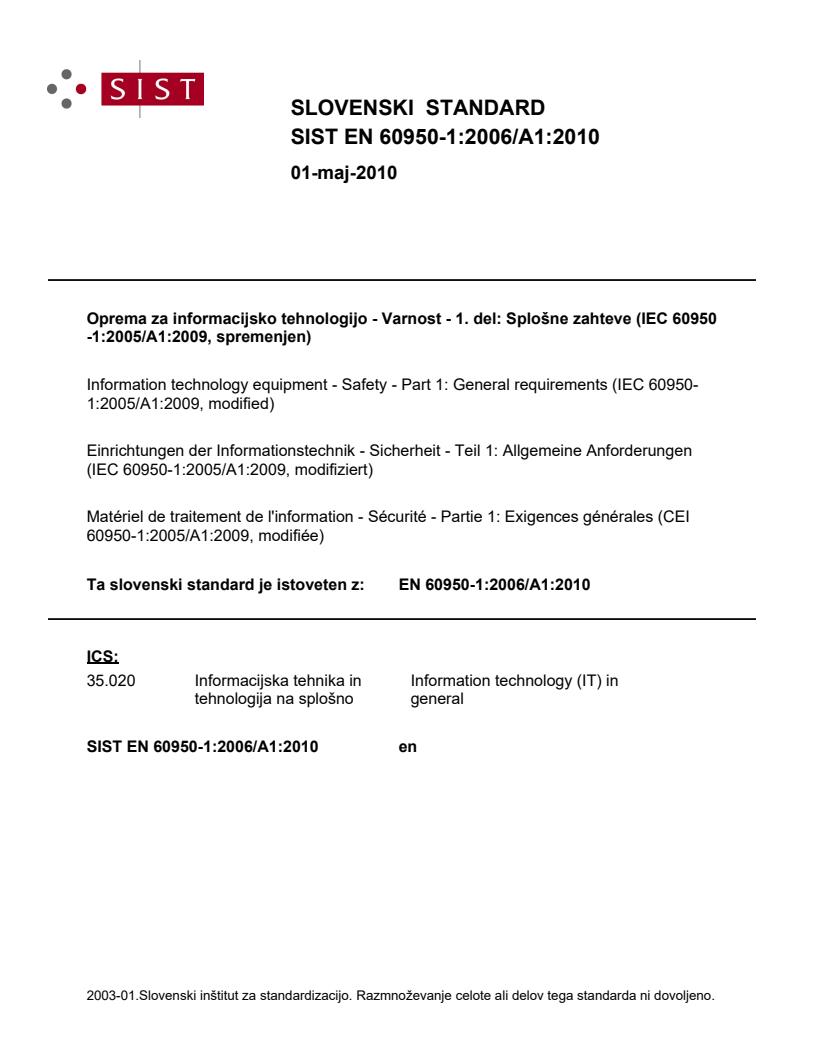
SLOVENSKI STANDARD
01-maj-2010
Oprema za informacijsko tehnologijo - Varnost - 1. del: Splošne zahteve (IEC 60950
-1:2005/A1:2009, spremenjen)
Information technology equipment - Safety - Part 1: General requirements (IEC 60950-
1:2005/A1:2009, modified)
Einrichtungen der Informationstechnik - Sicherheit - Teil 1: Allgemeine Anforderungen
(IEC 60950-1:2005/A1:2009, modifiziert)
Matériel de traitement de l'information - Sécurité - Partie 1: Exigences générales (CEI
60950-1:2005/A1:2009, modifiée)
Ta slovenski standard je istoveten z: EN 60950-1:2006/A1:2010
ICS:
35.020 Informacijska tehnika in Information technology (IT) in
tehnologija na splošno general
2003-01.Slovenski inštitut za standardizacijo. Razmnoževanje celote ali delov tega standarda ni dovoljeno.
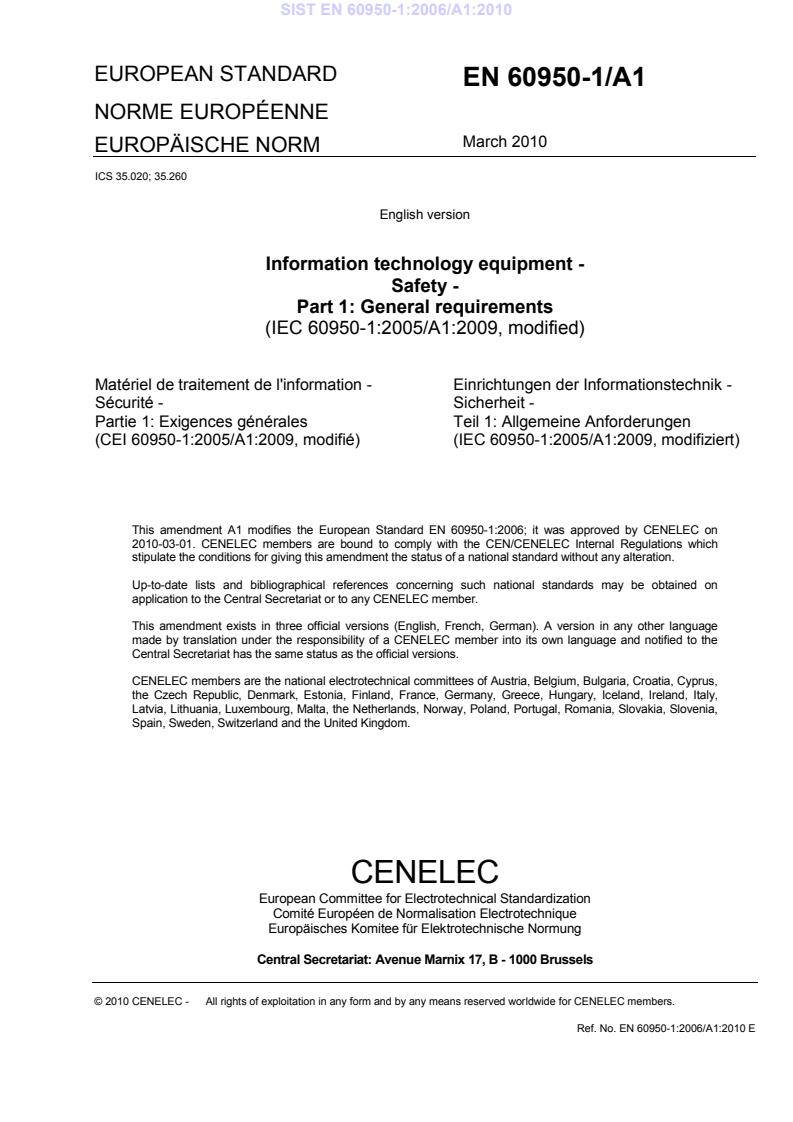
EUROPEAN STANDARD
EN 60950-1/A1
NORME EUROPÉENNE
March 2010
EUROPÄISCHE NORM
ICS 35.020; 35.260
English version
Information technology equipment -
Safety -
Part 1: General requirements
(IEC 60950-1:2005/A1:2009, modified)
Matériel de traitement de l'information - Einrichtungen der Informationstechnik -
Sécurité - Sicherheit -
Partie 1: Exigences générales Teil 1: Allgemeine Anforderungen
(CEI 60950-1:2005/A1:2009, modifié) (IEC 60950-1:2005/A1:2009, modifiziert)
This amendment A1 modifies the European Standard EN 60950-1:2006; it was approved by CENELEC on
2010-03-01. CENELEC members are bound to comply with the CEN/CENELEC Internal Regulations which
stipulate the conditions for giving this amendment the status of a national standard without any alteration.
Up-to-date lists and bibliographical references concerning such national standards may be obtained on
application to the Central Secretariat or to any CENELEC member.
This amendment exists in three official versions (English, French, German). A version in any other language
made by translation under the responsibility of a CENELEC member into its own language and notified to the
Central Secretariat has the same status as the official versions.
CENELEC members are the national electrotechnical committees of Austria, Belgium, Bulgaria, Croatia, Cyprus,
the Czech Republic, Denmark, Estonia, Finland, France, Germany, Greece, Hungary, Iceland, Ireland, Italy,
Latvia, Lithuania, Luxembourg, Malta, the Netherlands, Norway, Poland, Portugal, Romania, Slovakia, Slovenia,
Spain, Sweden, Switzerland and the United Kingdom.
CENELEC
European Committee for Electrotechnical Standardization
Comité Européen de Normalisation Electrotechnique
Europäisches Komitee für Elektrotechnische Normung
Central Secretariat: Avenue Marnix 17, B - 1000 Brussels
© 2010 CENELEC - All rights of exploitation in any form and by any means reserved worldwide for CENELEC members.
Ref. No. EN 60950-1:2006/A1:2010 E
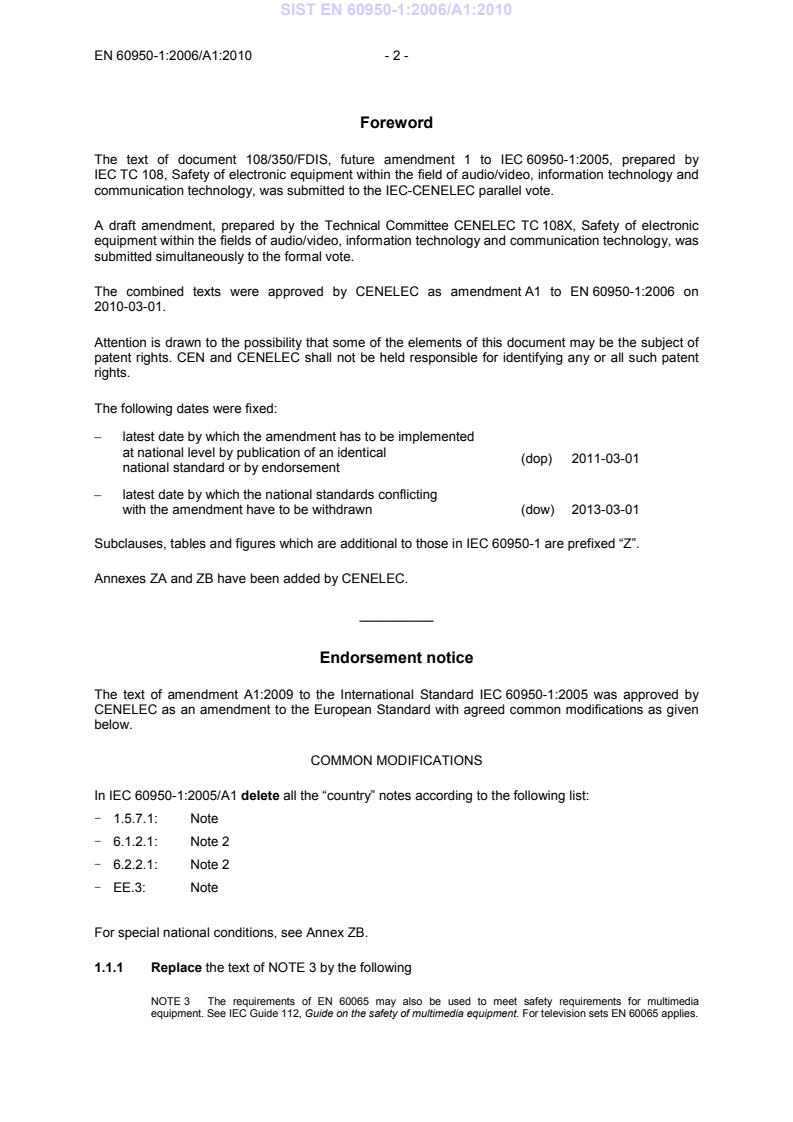
Foreword
The text of document 108/350/FDIS, future amendment 1 to IEC 60950-1:2005, prepared by
IEC TC 108, Safety of electronic equipment within the field of audio/video, information technology and
communication technology, was submitted to the IEC-CENELEC parallel vote.
A draft amendment, prepared by the Technical Committee CENELEC TC 108X, Safety of electronic
equipment within the fields of audio/video, information technology and communication technology, was
submitted simultaneously to the formal vote.
The combined texts were approved by CENELEC as amendment A1 to EN 60950-1:2006 on
2010-03-01.
Attention is drawn to the possibility that some of the elements of this document may be the subject of
patent rights. CEN and CENELEC shall not be held responsible for identifying any or all such patent
rights.
The following dates were fixed:
– latest date by which the amendment has to be implemented
at national level by publication of an identical
(dop) 2011-03-01
national standard or by endorsement
– latest date by which the national standards conflicting
with the amendment have to be withdrawn (dow) 2013-03-01
Subclauses, tables and figures which are additional to those in IEC 60950-1 are prefixed “Z”.
Annexes ZA and ZB have been added by CENELEC.
__________
Endorsement notice
The text of amendment A1:2009 to the International Standard IEC 60950-1:2005 was approved by
CENELEC as an amendment to the European Standard with agreed common modifications as given
below.
COMMON MODIFICATIONS
In IEC 60950-1:2005/A1 delete all the “country” notes according to the following list:
- 1.5.7.1: Note
- 6.1.2.1: Note 2
- 6.2.2.1: Note 2
- EE.3: Note
For special national conditions, see Annex ZB.
1.1.1 Replace the text of NOTE 3 by the following
NOTE 3 The requirements of EN 60065 may also be used to meet safety requirements for multimedia
equipment. See IEC Guide 112, Guide on the safety of multimedia equipment. For television sets EN 60065 applies.
- 3 - EN 60950-1:2006/A1:2010
1.2.3 Add the following definition:
1.2.3.Z1
PORTABLE SOUND SYSTEM
small battery powered audio equipment:
− whose prime purpose is to listen to recorded or broadcasted sound; and
− that uses headphones or earphones that can be worn in or on or around the ears; and
− that allows the user to walk around
NOTE Examples are mini-disk or CD players; MP3 audio players or similar equipment.
1.7.2.1 Delete NOTE Z1.
Add the following paragraph at the end of the subclause:
In addition, for a PORTABLE SOUND SYSTEM, the instructions shall include a warning that
excessive sound pressure from earphones and headphones can cause hearing loss.
4.3.13.6 Replace the existing NOTE by the following:
NOTE Z1 Attention is drawn to :
1999/519/EC: Council Recommendation on the limitation of exposure of the general public to electromagnetic fields
0 Hz to 300 GHz, and
2006/25/EC: Directive on the minimum health and safety requirements regarding the exposure of workers to risks
arising from physical agents (artificial optical radiation).
Standards taking into account mentioned Recommendation and Directive which demonstrate compliance with the
applicable EU Directive are indicated in the OJEC.
Bibliography Add the following note for the standard indicated:
IEC 60908 NOTE Harmonized as EN 60908.
Replace the entire Annex ZA by the following:
Annex ZA
(normative)
Normative references to international publications
with their corresponding European publications
The following referenced documents are indispensable for the application of this document. For dated
references, only the edition cited applies. For undated references, the latest edition of the referenced
document (including any amendments) applies.
NOTE When an international publication has been modified by common modifications, indicated by (mod), the relevant EN/HD
applies.
Publication Year Title EN/HD Year
Insulating, sheathing and covering EN 50363 Series
materials for low-voltage energy cables
Electrical test methods for low voltage EN 50395 2005
energy cables
Non electrical test methods for low voltage EN 50396 2005
energy cables
IEC 60065 (mod) 2001 Audio, video and similar electronic EN 60065 2002
A1 2005 apparatus – Safety requirements A1 2006
+ A11 2008
A2 - A2 + A12 -
IEC 60068-2-78 - Environmental testing EN 60068-2-78 -
Part 2-78: Tests – Test Cab: Damp heat,
steady state
IEC 60073 - Basic and safety principles for man- EN 60073 -
machine interface, marking and
identification – Coding principles for
indication devices and actuators
IEC 60083 - Plugs and socket-outlets for domestic and - -
similar general use standardized in
member countries of IEC
IEC 60085 2004 Electrical insulation – Thermal classification EN 60085 2004
IEC 60112 - Method for determining the proof and EN 60112 -
comparative tracking indices of insulating
materials
1)
IEC 60227 (mod) Series Polyvinyl chloride insulated cables of rated Series
HD 21
voltages up to and including 450/750V
2)
IEC 60245 (mod) Series Rubber insulated cables of rated voltages Series
HD 22
up to and including 450/750V
———————
1)
The HD 21 series is related to, but not directly equivalent with the IEC 60227 series. Also EN 50363, EN 50395 and
EN 50386 are to be taken into account.
2)
The HD 22 series is related to, but not directly equivalent with the IEC 60245 series. Also EN 50363, EN 50395 and
EN 50386 are to be taken into account.
- 5 - EN 60950-1:2006/A1:2010
Publication Year Title EN/HD Year
IEC 60309 Series Plugs, socket-outlets and couplers for EN 60309 Series
industrial purposes
IEC 60317 Series Specifications for particular types of EN 60317 Series
winding wires
IEC 60317-43 - Part 43: Aromatic polyimide tape wrapped EN 60317-43 -
round copper wire, class 240
IEC 60320 (mod) Series Appliance couplers for household and EN 60320 Series
similar general purposes
IEC 60364-1 (mod) 2001 Electrical installations of buildings HD 384.1 S2 2001
Part 1: Fundamental principles,
assessment of general characteristics,
definitions
IEC 60384-14 1993 Fixed capacitors for use in electronic EN 60384-14 2005
A1 1995 equipment
Part 14: Sectional specification: Fixed
capacitors for electromagnetic interference
suppression and connection to the supply
mains
IEC 60417 Data- Graphical symbols for use on equipment - -
base
IEC 60664-1 1992 Insulation coordination for equipment within
+ A1 2000 low-voltage systems
+ A2 2002 Part 1: Principles, requirements and tests EN 60664-1 2003
IEC 60695-2-11 - Fire hazard testing EN 60695-2-11 -
Part 2-11: Glowing/hot-wire based test
methods – Glow-wire flammability test
method for end-products
IEC 60695-2-20 - Part 2-20: Glowing/hot-wire based test - -
methods – Hot-wire coil ignitability –
Apparatus, test method and guidance
IEC 60695-10-2 - Part 10-2: Guidance and test methods for EN 60695-10-2 -
the minimization of the effects of abnormal
heat on electrotechnical products involved
in fires – Method for testing products made
from non-metallic materials for resistance
to heat using the ball pressure test
IEC 60695-10-3 - Fire hazard testing EN 60695-10-03 -
Part 10-3: Abnomal heat – Mould stress
relief distortion test
IEC 60695-11-3 - Part 11-3: Test flames – 500 W flames – - -
Apparatus and conformational test methods
IEC 60695-11-4 - Part 11-4: Test flames – 50 W flames – - -
Apparatus and conformational test methods
IEC 60695-11-10 - Part 11-10: Test flames – 50 W horizontal EN 60695-11-10 -
A1 and vertical flame test methods A1 -
Publication Year Title EN/HD Year
IEC 60695-11-20 - Part 11-20: Test flames – 500 W flame test EN 60695-11-20 -
A1 methods A1 -
1999 Automatic electrical controls for household EN 60730-1 2000
IEC 60730-1
2003 and similar use - A1 2004
(mod)
Part 1: General requirements + A12 2003
A1
+ A13 2004
+ A14 2005
+ A15 2007
+ A16 2007
2007 A2 2008
A2
IEC 60747-5-5 2007 Semiconductor devices – Discrete devices EN 60747-5-5 -
Part 5-5: Optoelectronic devices –
Photocouplers
IEC 60825-1 - Safety of laser products EN 60825-1 -
Part 1: Equipment classification,
requirements and user’s guide
IEC 60825-2 - Part 2: Safety of optical fibre EN 60825-2 -
communication systems A1 -
IEC/TR 60825-9 - Part 9: Compilation of maximum - -
permissible exposure to incoherent optical
radiation
IEC 60825-12 - Part 12: Safety of free space optical EN 60825-12 -
communication systems used for
transmission of information
IEC 60851-3 1996 Winding wires – Test methods EN 60851-3 1996
A1 1997 Part 3: Mechanical properties A1 1997
IEC 60851-5 1996 Part 5: Electrical properties EN 60851-5 1996
A1 1997 A1 1997
A2 2004 A2 2004
IEC 60851-6 1996 Part 6: Thermal properties EN 60851-6 1996
IEC 60885-1 1987 Electrical test methods for electric cables - -
Part 1: Electrical tests for cables, cords and
wires for voltages up to and including
450/750 V
IEC 60906-1 - IEC System of plugs and socket-outlet for - -
household and similar purposes
Part 1: Plugs and socket-outlets 16 A 250 V
a.c.
IEC 60906-2 - Part 2: Plugs and socket-outlets 15 A 125 V - -
a.c.
IEC 60947-1 2004 Low voltage switchgear and control gear EN 60947-1 2004
Part 1: General rules
IEC 60990 1999 Methods of measurement of touch current EN 60990 1999
and protective conductor current
- 7 - EN 60950-1:2006/A1:2010
Publication Year Title EN/HD Year
IEC 61051-2 1991 Varistors for use in electronic equipment - -
Part 2: Sectional specification for surge
suppression varistors
3)
IEC 61058-1 2000 Switches for appliances 2002
EN 61058-1
(mod) Part 1: General requirements
IEC 62471 - Photobiological safety of lamps and lamp EN 62471 -
(mod) systems
ISO 178 - Plastics - Determination of flexural EN ISO 178 2003
properties
ISO 179 Series Plastics - Determination of Charpy impact EN ISO 179 Series
strength
ISO 180 - Plastics - Determination of Izod impact EN ISO 180 -
strength
ISO 261 - ISO general-purpose metric screw threads - -
- General plan
ISO 262 - ISO general-purpose metric screw threads -
- Selected sizes for screws, bolts and nuts
ISO 527 Series Plastics - Determination of tensile EN ISO 527 Series
properties
ISO 3864 Series Safety colours and safety signs - -
ISO 4892-1 - Plastics - Methods of exposure to EN ISO 4892-1 -
laboratory light sources
Part 1: General guidance
ISO 4892-2 - Part 2: Xenon-arc sources EN ISO 4892-2 -
ISO 4892-4 - Part 4: Open-flame carbon-arc lamps - -
ISO 7000 Data- Graphical symbols for use on equipment - - -
base Index and synopsis
ISO 8256 - Plastics - Determination of tensile-impact EN ISO 8256 -
strength
ISO 9772 - Cellular plastics - Determination of - -
horizontal burning characteristics of small
specimens subjected to a small flame
ISO 9773 - Plastics - Determination of burning EN ISO 9773 -
behaviour of thin flexible vertical specimens
in contact with a small-flame ignition source
ITU-T - Resistibility tests for telecommunication - -
Recommendation equipment exposed to overvoltages and
K.44 overcurrents - Basic Recommendation
———————
3)
EN 61058-1:2002 includes A1:2001 to IEC 61058-1:2000.
Annex ZB
(normative)
Special National Conditions
Special national condition: National characteristic or practice that cannot be changed even over a
long period, e.g. climatic conditions, electrical earthing conditions. If it affects harmonization, it forms
part of the European Standard or Harmonization Document.
For the countries in which the relevant special national apply these provisions are normative, for other
countries they are informative.
Add the following special national condition:
Clause Special national condition
In Finland, Norway and Sweden
1.5.7.1
No changes needed - Correction of SNC already Part of A11.
6.1.2.1 In Finland, Norway and Sweden, add the following text between the first and second
paragraph of the compliance clause:
If this insulation is solid, including insulation forming part of a component, it shall at least
consist of either
- two layers of thin sheet material, each of which shall pass the electric strength test
below, or
- one layer having a distance through insulation of at least 0,4 mm, which shall pass
the electric strength test below.
Alternatively for components, there is no distance through insulation requirement for the
insulation consisting of an insulating compound completely filling the casing, so that
CLEARANCES and CREEPAGE DISTANCES do not exist, if the component passes the electric
strength test in accordance with the compliance clause below and in addition
- passes the tests and inspection criteria of 2.10.11 with an electric strength test of
1,5 kV multiplied by 1,6 (the electric strength test of 2.10.10 shall be performed using
1,5 kV), and
- is subject to ROUTINE TESTING for electric strength during manufacturing, using a test
voltage of 1,5 kV.
It is permitted to bridge this insulation with an optocoupler complying with 2.10.5.4 b).
It is permitted to bridge this insulation with a capacitor complying with
EN 60384-14:2005, subclass Y2.
A capacitor classified Y3 according to EN 60384-14:2005, may bridge this insulation
under the following conditions:
- the insulation requirements are satisfied by having a capacitor classified Y3 as
defined by EN 60384-14, which in addition to the Y3 testing, is tested with an
impulse test of 2,5 kV defined in EN 60950-1:2006, 6.2.2.1;
- the additional testing shall be performed on all the test specimens as described in
EN 60384-14;
- the impulse test of 2,5 kV is to be performed before the endurance test in
EN 60384-14, in the sequence of tests as described in EN 60384-14.
IEC 60950-1 ®
Edition 2.0 2009-12
INTERNATIONAL
STANDARD
colour
inside
AMENDMENT 1
Information technology equipment – Safety –
Part 1: General requirements
INTERNATIONAL
ELECTROTECHNICAL
COMMISSION
PRICE CODE
W
ICS 35.020; 35.260 ISBN 2-8318-1068-7
– 2 – 60950-1 Amend. 1 © IEC:2009(E)
FOREWORD
This amendment has been prepared by IEC technical committee 108: Safety of electronic
equipment within the field of audio/video, information technology and communication
technology.
The text of this amendment is based on the following documents:
FDIS Report on voting
108/350/FDIS 108/357/RVD
Full information on the voting for the approval of this amendment can be found in the report
on voting indicated in the above table.
The committee has decided that the contents of this amendment and the base publication will
remain unchanged until the maintenance result date indicated on the IEC web site under
"http://webstore.iec.ch" in the data related to the specific publication. At this date, the
publication will be
• reconfirmed,
• withdrawn,
• replaced by a revised edition, or
• amended.
IMPORTANT – The “colour inside” logo on the cover page of this publication indicates
that it contains colours which are considered to be useful for the correct understanding
of its contents. Users should therefore print this publication using a colour printer.
____________
CONTENTS
Add the titles of the new annexes as follows:
Annex CC (normative), Evaluation of integrated circuit (IC) current limiters
Annex DD (normative), Requirements for the mounting means of rack-mounted equipment
Annex EE (normative), Household and home/office document/media shredders
Add the titles of the new figures as follows:
Figure 4G – Example for determining opening ‘X’ without a deflector
Figure 4H – Example for determining opening ‘X’ with a deflector
Figure EE.1 – Wedge probe (overall view)
Figure EE.2 – Wedge probe (tip details)
60950-1 Amend. 1 © IEC:2009(E) – 3 –
1.2 Definitions
Add after “RATING, PROTECTIVE CURRENT….1.2.13.17” in the list of “Definitions in alphabetical
order of nouns” the following new entry:
SHREDDER (DOCUMENT/MEDIA, HOUSEHOLD AND HOME/OFFICE) ….1.2.13.18
Add, after the existing definition 1.2.13.17, the following new definition:
1.2.13.18
(HOUSEHOLD AND HOME/OFFICE DOCUMENT/MEDIA) SHREDDER
equipment with a plug configuration associated with PLUGGABLE EQUIPMENT TYPE A, or battery
operated equipment, designed to shred paper or other forms of media as instructed by the
manufacturer
NOTE 1 Examples of other forms of media include but are not limited to digital video disks, compact disks, flash
memory, magnetic strip cards, or magnetic disks, or the like.
NOTE 2 HOUSEHOLD AND HOME/OFFICE DOCUMENT/MEDIA SHREDDERS are typically identified as either strip-cut type
or cross-cut type. A strip-cut HOUSEHOLD AND HOME/OFFICE DOCUMENT/MEDIA SHREDDER shreds the paper into long
strips using a motor-based shredding mechanism. A cross-cut DOCUMENT/MEDIA SHREDDER shreds paper two or
more ways into tiny particles, typically using a more powerful motor and more complex shredding mechanism.
NOTE 3 A document/media shredder is considered to be non-household or non-home/office type if the
document/media shredder is provided with a plug configuration associated with PLUGGABLE EQUIPMENT TYPE B, or is
PERMANENTLY CONNECTED EQUIPMENT.
Table 1C – Capacitor ratings according to IEC 60384-14
Replace the existing rule 3 of this table by the following:
3 For a single capacitor bridging FUNCTIONAL INSULATION, BASIC INSULATION or SUPPLEMENTARY INSULATION, the peak
test voltage of the capacitor shall be at least equal to the peak value of the test voltage (not the r.m.s. voltage) of
Table 5B, or the peak value of the test voltage of Table 5C, as applicable, and the r.m.s. test voltage shall be not
less than the required r.m.s. test voltage of Table 5B, or the equivalent r.m.s. test voltage (not the peak voltage)
of Table 5C, as applicable.
Replace the existing rule 4 of this table by the following:
4 For a single capacitor bridging DOUBLE INSULATION or REINFORCED INSULATION, the peak test voltage of the
capacitor shall be not less than the peak value of the test voltage (not the r.m.s. voltage) of Table 5B, or the peak
value of the test voltage of Table 5C, as applicable; and the r.m.s. test voltage shall be not less than the required
r.m.s. test voltage of Table 5B, or the equivalent r.m.s. test voltage (not the peak voltage) of Table 5C, as
applicable.
Replace the existing rule 7 of this table by the following:
7 If two or more capacitors are used in series, all of the following apply:
– under single fault conditions, the voltage on each of the remaining individual capacitors shall not exceed
the voltage rating of the relevant individual capacitor;
– for BASIC INSULATION or SUPPLEMENTARY INSULATION, the sum of the peak impulse test voltages of all
capacitors shall be not less than the peak value of the test voltage (not the r.m.s. voltage) of Table 5B, or
the peak value of the test voltage of Table 5C, as applicable;
– for BASIC INSULATION or SUPPLEMENTARY INSULATION, the sum of the r.m.s. test voltages of all capacitors
shall be not less than the required r.m.s. test voltage of Table 5B, or the equivalent r.m.s. test voltage (not
the peak voltage) of Table 5C, as applicable;
– for REINFORCED INSULATION, the sum of the peak impulse test voltages of all capacitors shall be not less
than the peak value of the test voltage (not the r.m.s. voltage) of Table 5B, or the peak value of the test
voltage of Table 5C, as applicable;
– for REINFORCED INSULATION, the sum of the r.m.s. test voltages of all capacitors shall be not less than the
required r.m.s. test voltage of Table 5B, or the equivalent r.m.s. test voltage (not the peak voltage) of
Table 5C, as applicable;
– they shall comply with the other rules above.
– 4 – 60950-1 Amend. 1 © IEC:2009(E)
Table 1D – Informative examples of application of capacitors
Replace the existing Table 1D by the following new table:
AC MAINS
SUPPLY
MAINS
Number of capacitors
voltage
TRANSIENT
Overvoltage Bridged Capacitor
VOLTAGE
Category insulation type
up to and
Using Table Using Table
including
kV
5B 5C
V r.m.s.
II 1,5 B or S Y2 1 1
II 1,5 D or R Y2 2 2
II 1,5 D or R Y1 1 1
II 1,5 F X2 1 1
III 2,5 F X2 1 1
III 2,5 B or S Y2 - 2
III 2,5 D or R Y1 - 1
IV 4,0 F X1 - 1
IV 4,0 B or S Y1 - 1
IV 4,0 B or S Y2 - 2
IV 4,0 D or R Y1 - 2
II 2,5 F X2 1 1
250 III 4,0 F X1 1 1
II 2,5 B or S Y2 1 2
II 2,5 D or R Y1 1 1
II 2,5 D or R Y2 2 3
III 4,0 B or S Y1 - 1
III 4,0 B or S Y2 - 2
III 4,0 D or R Y1 - 2
III 4,0 D or R Y2 - 4
IV 6,0 F X1 - 2
IV 6,0 B or S Y1 - 2
IV 6,0 D or R Y1 - 3
II 4,0 F X1 1 1
II 4,0 B or S Y1 1 1
II 4,0 D or R Y1 1 2
III 6,0 F X1 - 2
500 III 6,0 B or S Y1 - 2
III 6,0 D or R Y1 - 3
IV 8,0 F X1 - 2
IV 8,0 B or S Y1 - 2
IV 8,0 D or R Y1 - 3
The values in the table apply to FUNCTIONAL INSULATION (F), BASIC INSULATION (B), SUPPLEMENTARY
INSULATION (S), DOUBLE INSULATION (D) and REINFORCED INSULATION (R).
NOTE Table 5B is used for Overvoltage Categories I and II only.
60950-1 Amend. 1 © IEC:2009(E) – 5 –
1.5.7.1 Resistors bridging functional insulation, basic insulation or supplementary
insulation
Replace the existing note of this subclause by the following new note:
NOTE In Finland, Norway and Sweden resistors bridging BASIC INSULATION in CLASS I PLUGGABLE EQUIPMENT TYPE
A must comply with 1.5.7.1. In addition when a single resistor is used, the resistor must withstand the resistor test
in 1.5.7.2.
1.5.7.2 Resistors bridging double insulation or reinforced insulation between the a.c.
mains supply and other circuits
Replace the fifth paragraph of this subclause by the following new paragraph:
If an accessible conductive part or circuit is separated from another part by DOUBLE
INSULATION or REINFORCED INSULATION that is bridged by a resistor or group of resistors, the
accessible part or circuit shall comply with the requirements for a LIMITED CURRENT CIRCUIT in
2.4 between the accessible conductive part or circuit and earth. If a group of resistors is used,
the current measurement in 2.4.2 is made with each resistor short-circuited in turn, unless the
group passes the resistor test below. When measuring the LIMITED CURRENT CIRCUIT, the
ammeter is placed between the load side of the bridging components and any USER
accessible part, including earth.
1.5.9.4 Bridging of basic insulation by a VDR
After the existing note of this subclause, add the following new paragraph:
It is permitted to use a gas discharge tube (GDT) in series with a VDR that bridges BASIC
INSULATION in accordance with the conditions in this subclause if the GDT complies with the
FUNCTIONAL INSULATION.
requirements for
– 6 – 60950-1 Amend. 1 © IEC:2009(E)
1.7 Markings and instructions
Replace the existing note of this subclause by the following new note:
NOTE Additional requirements for markings and instructions are contained in the following subclauses:
2.1.1.2 Battery compartments 4.3.3 Adjustable controls
2.1.1.8 Energy hazards 4.3.5 Plugs and sockets
2.3.2.3 Protection by earthing 4.3.13.4 UV radiation
2.6.1 Unearthed parts 4.3.13.5 Lasers
2.6.2 FUNCTIONAL EARTHING 4.4.2 Hazardous moving parts
2.6.3.4 c) Bonding conductors 4.4.5.2 Fan protection for USERS
2.6.5.1 Bonding conductors 4.4.5.3 Fan protection for service persons
2.7.1 External protective devices 4.5.4 Table 4C Marking of hot parts
2.7.6 Neutral fusing 4.5.4 Touch temperatures
2.10.3.2 Overvoltage Categories 4.6.2 Equipment on non-combustible floors
3.2.1.2 DC MAINS SUPPLY 4.6.3 Removable doors and covers
3.3.7 Grouping of wiring terminals 5.1.7.1 TOUCH CURRENT exceeding 3,5 mA
3.4.3 Disconnect devices 5.1.8.2 Summation of TOUCH CURRENTS
3.4.6 Two-pole disconnect devices 6.1.1 and 6.1.2.2 Earthing for a TELECOMMUNICATION NETWORK
3.4.7 Four-pole disconnect devices 7.2 and 7.4.1 Earthing for a CABLE DISTRIBUTION SYSTEM
3.4.9 Plugs as disconnect devices G.2.1 Equipment in Overvoltage Categories III and IV
3.4.10 Interconnected equipment DD.2 Maximum shelf load
3.4.11 Multiple power sources EE.2 Shredder warning
4.1 Equipment stability EE.4 Shredder power disconnection
4.2.5 Impact test
1.7.1 Power rating
Replace the existing title and text of this subclause by the following new title and text
(including the new subclauses 1.7.1.1 and 1.7.1.2):
1.7.1 Power rating and identification markings
1.7.1.1 Power rating markings
Equipment shall be provided with a power rating marking, the purpose of which is to specify a
supply of correct voltage and frequency, and of adequate current-carrying capacity.
If the equipment is not provided with a means for direct connection to a MAINS SUPPLY, it need
not be marked with any electrical rating, such as its RATED VOLTAGE, RATED CURRENT or RATED
FREQUENCY. If the equipment, or a system, has multiple MAINS SUPPLY connections, each
individual MAINS SUPPLY electrical rating must be marked, but the overall equipment or system
electrical rating need not be marked.
60950-1 Amend. 1 © IEC:2009(E) – 7 –
For equipment intended to be installed by an OPERATOR, the power rating marking, if required,
shall be readily visible in any OPERATOR ACCESS AREA. If a manual voltage selector is not
OPERATOR-accessible, the power rating marking shall indicate the RATED VOLTAGE for which
the equipment is set during manufacture; a temporary marker is permitted for this purpose.
The power rating marking is permitted on any outer surface of the equipment, except the
bottom of equipment having a mass exceeding 18 kg.
For STATIONARY EQUIPMENT, the power rating marking shall be visible after the equipment has
been installed as in normal use.
For equipment intended to be installed by a SERVICE PERSON, and if the power rating marking
is in a SERVICE ACCESS AREA, the location of the permanent marking shall be indicated in the
installation instructions or on a readily visible marker on the equipment. It is permitted to use
a temporary marker for this purpose.
The power rating marking shall include the following:
− RATED VOLTAGE(S) or RATED VOLTAGE RANGE(S), in volts;
• the voltage range shall have a hyphen (-) between the minimum and maximum RATED
VOLTAGES and when multiple RATED VOLTAGES or RATED VOLTAGE RANGES are given,
they shall be separated by a solidus (/);
NOTE 1 Some examples of RATED VOLTAGE markings are:
– RATED VOLTAGE RANGE: 220-240 V. This means that the equipment is designed to be connected to an
AC MAINS SUPPLY having any voltage between 220 V and 240 V.
– multiple RATED VOLTAGE: 120/230/240 V. This means that the equipment is designed to be connected to
an AC MAINS SUPPLY having a voltage of 120 V or 230 V or 240 V, usually after internal adjustment.
• if equipment is to be connected to both line conductors and to the neutral conductor
of a single-phase, three-wire power distribution system, the power rating marking
shall give the line-to-neutral voltage and the line-to-line voltage, separated by a
solidus (/), with the added notation "Three wires plus protective earth", "3W + PE" or
equivalent;
NOTE 2 Some examples of the above system rating markings are:
120/240 V; 3 wire + PE;
120/240 V; 3W + (60417-IEC-5019);
100/200 V; 2W + N + PE;
100-120/200-240 V; 2W + N + PE.
− symbol for nature of supply, for d.c. only;
− RATED FREQUENCY or RATED FREQUENCY RANGE, in hertz, unless the equipment is designed
for d.c. only;
RATED CURRENT, in milliamperes or amperes;
−
• for equipment with multiple RATED VOLTAGES, the corresponding RATED CURRENTS shall
be marked such that the different current ratings are separated by a solidus (/) and
the relation between RATED VOLTAGE and associated RATED CURRENT appears
distinctly;
• equipment with a RATED VOLTAGE RANGE shall be marked with either the maximum
RATED CURRENT or with the current range;
• the power rating marking for RATED CURRENT of a group of units having a single
supply connection shall be placed on the unit which is directly connected to a MAINS
– 8 – 60950-1 Amend. 1 © IEC:2009(E)
SUPPLY. The RATED CURRENT marked on that unit shall be the total maximum current
that can be on circuit at the same time and shall include the combined currents to all
units in the group that can be supplied simultaneously through the unit and that can
be operated simultaneously.
NOTE 3 Some examples of RATED CURRENT markings are:
– for equipment with multiple RATED VOLTAGES:
120/240 V; 2,4/1,2 A;
100-120/200-240 V; 2,4/1,2 A;
– for equipment with a RATED VOLTAGE RANGE:
100-240 V; 2,8 A or the peak value of the test voltage of Table 5C;
100-240 V; 2,8-1,4 A;
100-120 V; 2,8 A;
200-240 V; 1,4 A.
It is recognized that in some regions it is customary to use a point (·) as a decimal marker instead of a
comma.
Additional markings are permitted, provided that they do not give rise to misunderstanding.
Where symbols are used, they shall conform to ISO 7000 or IEC 60417 where appropriate
symbols exist.
1.7.1.2 Identification markings
Equipment shall be provided by the following identification markings:
− manufacturer's name or trade-mark or identification mark;
− manufacturer's model identification or type reference;
− symbol , IEC 60417-5172 (DB:2003-02), for the identification of CLASS II EQUIPMENT only,
except where this is forbidden by 2.6.2.
Additional identification markings are permitted, provided that they do not give rise to
misunderstanding.
These identification markings shall be readily visible in any OPERATOR ACCESS AREA, except
that they shall not be located on the bottom of equipment having a mass exceeding 18 kg. For
STATIONARY EQUIPMENT, the identification markings shall be visible after the equipment has
been installed as in normal use.
1.7.7.1 Protective earthing and bonding terminals
Replace the first paragraph of this subclause by the following new paragraph:
PROTECTIVE EARTHING CONDUCTOR shall be
A wiring terminal intended for connection of a
indicated by the symbol IEC 60417-5019 (DB:2002-10). This symbol shall not be used for
,
other earthing terminals, except that the symbol may also be used to identify the separate
protective earthing terminal specified in 5.1.7.1.
60950-1 Amend. 1 © IEC:2009(E) – 9 –
2.1.1.5 Energy hazards
Replace the existing text of c)2) by the following:
2) the stored energy in a capacitor is at a HAZARDOUS ENERGY LEVEL if the voltage, U, is 2 V or
more, and the stored energy, E, calculated from the following equation, is 20 J or more:
2 –6
E = 0,5 CU × 10
Where:
E is the energy, in joules (J);
C is the capacitance, in microfarads (µF);
U is the measured voltage on the capacitor, in volts (V).
2.1.1.7 Discharge of capacitors in equipment
Replace the last sentence of the last paragraph of this subclause by the following:
When conducting the voltage decay measurement, the measurement is either made with, or
referred to, an instrument having an input impedance consisting of a resistance of
100 MΩ ± 5 MΩ in parallel with an input capacitance of 25 pF or less.
2.1.1.8 Energy hazards - d.c. mains supplies
Replace the last sentence of item a) by the following:
A HAZARDOUS ENERGY LEVEL exists if the voltage, U, is 2 V or more, and the stored energy, E,
is 20 J or more.
2.4.1 General requirements
Add the following new Note 2 at the end of this subclause, and renumber the existing note as
Note 1:
NOTE 2 A LIMITED CURRENT CIRCUIT may be derived from either a PRIMARY CIRCUIT or a SECONDARY CIRCUIT.
2.5 Limited power sources
Replace the existing item b) by the following:
b) a linear or non-linear impedance limits the output in compliance with Table 2B. If a
positive temperature coefficient device is used, it shall:
– pass the tests specified in IEC 60730-1, Clauses 15, 17, J.15 and J.17; or
– meet the requirements in IEC 60730-1 for a device for Type 2.AL action;
– 10 – 60950-1 Amend. 1 © IEC:2009(E)
Replace the existing item c) by the following:
c) a regulating network, or an integrated circuit (IC) current limiter, limits the output in
compliance with Table 2B, both with and without a simulated single fault (see 1.4.14) in
the regulating network or the IC current limiter (open circuit or short circuit). A single fault
between the input and output is not conducted if the IC current limiter meets a suitable
test program as given in Annex CC;
2.6.2 Functional earthing
Delete the words “or inaccessible” in the first sentence of the existing first paragraph of this
subclause.
2.6.5.6 Corrosion resistance
Replace the words “protective earthing” by “protective earthing and protective bonding” in the
first sentence of the existing first paragraph of this subclause.
2.8.4 Fail-safe operation
Add, after the second item of the list, the following new paragraph and note:
For protection against extreme hazard, either a redundant system of two SAFETY INTERLOCK
systems shall be used or the fixed separation distances in a single SAFETY INTERLOCK system
circuit (for example, those associated with printed boards) shall meet the requirements for
REINFORCED INSULATION.
NOTE A SAFETY INTERLOCK system is considered to consist of the components/elements that are directly capable
of disconnecting the hazardous part (for example, relay contacts or a switch) including components (for example, a
relay coil) and other parts forming part of the initiation circuit (for example, those mounted on printed boards).
Replace the first compliance statement of this subclause by the following:
Compliance is checked by inspection of the SAFETY INTERLOCK system, circuit diagrams and
available data and, if necessary, by simulation of single faults (see 1.4.14) (for example,
failure of a semi-conductor device or an electromechanical component). Moving mechanical
parts in mechanical and electromechanical systems are not subjected to simulated single
faults if they comply with 2.8.5 and 2.8.7. Fixed separation distances in SAFETY INTERLOCK
system circuits (for example, those associated with printed boards) that protect against other
than extreme hazards are not subjected to simulated single faults if the separation distances
comply with 2.8.7.1.
2.8.7 Switches and relays
Replace the existing title of this subclause by the following new title:
2.8.7 Switches, relays and their related circuits
60950-1 Amend. 1 © IEC:2009(E) – 11 –
2.8.7.1 Contact gaps
Replace the existing title and text of this subclause by the following new title and text:
2.8.7.1 Separation distances for contact gaps and their related circuits
If the separation distances for contact gaps and their related circuits are located in the
PRIMARY CIRCUIT, the separation distances shall not be less than that for a disconnect device
(see 3.4.2). If the separation distance is located in a circuit other than a PRIMARY CIRCUIT, the
separation distance shall be not less than the relevant minimum CLEARANCE value for BASIC
INSULATION in a SECONDARY CIRCUIT specified in 2.10.3 (or Annex G).
Compliance is checked by inspection of the available data and, if necessary, by measurement.
2.8.7.2 Overload test
Replace the existing text of this subclause by the following new text:
The contact of a switch or relay in the SAFETY INTERLOCK system is subjected to an overload
test consisting of 50 cycles of operation at the rate of 6 to 10 cycles per minute, making and
breaking 150 % of the current imposed in the application, except that where a switch or relay
contact switches a motor load, the test is conducted with the rotor of the motor in a locked
condition. After the test, the SAFETY INTERLOCK system, including the switch or relay, shall still
be functional.
2.8.7.3 Endurance test
Replace the existing text of this subclause by the following new text:
The contact of a switch or a relay in the SAFETY INTERLOCK system is subjected to an
endurance test, making and breaking 100 % of the current imposed in the application at a rate
of 6 to 10 cycles of operation per minute. A higher rate of cycling is permitted if requested by
the manufacturer. For reed switches used in SAFETY INTERLOCK systems located in ELV
CIRCUITS, SELV CIRCUITS and TNV-1 CIRCUITS, the test is 100 000 operating cycles. For other
switches and relays in SAFETY INTERLOCK systems, the test is 10 000 operating cycles. After
the test, the SAFETY INTERLOCK system, including a switch or relay, shall still be functional.
2.8.7.4 Electric strength test
Replace the existing text of this subclause by the following new text:
Except for reed switches in ELV CIRCUITS, SELV CIRCUITS and TNV-1 CIRCUITS, an electric
strength test as specified in 5.2.2, is applied between the contacts of the relays and switches
after the tests of 2.8.7.2 and 2.8.7.3. If the contact is in a PRIMARY CIRCUIT, the test voltage is
as specified for REINFORCED INSULATION. If the contact is in a circuit other than a PRIMARY
CIRCUIT, the test voltage is as specified for BASIC INSULATION in a PRIMARY CIRCUIT.
– 12 – 60950-1 Amend. 1 © IEC:2009(E)
2.9.2 Humidity conditioning
Replace the first paragraph of this subclause by the following new paragraph:
Where required by 2.9.1, 2.10.8.3, 2.10.10 or 2.10.11, humidity conditioning is conducted for
48 h in a cabinet or room containing air with a relative humidity of (93 ± 3) %. The
temperature of the air, at all places where samples can be located, is maintained within 2 K of
any convenient value t between 20 °C and 30 °C such that condensation does not occur.
During this conditioning the component or subassembly is not energized.
Table 2K – Minimum clearances for insulation in primary circuits and between primary
and secondary circuits
Replace the existing Table 2K by the following new table:
CLEARANCES in mm
MAINS TRANSIENT VOLTAGE
PEAK WORKING
c c c
1 500 V 2 500 V 4 000 V
VOLTAGE
Pollution degree
up to and including
b b b
1 and 2 3 1 and 2 3 1, 2 and 3
V
F B/S R F B/S R F B/S R F B/S R F B/S R
a
71 0,4 1,0 2,0 0,8 1,3 2,6 1,0 2,0 4,0 1,3 2,0 4,0 2,0 3,2 6,4
(0,5) (1,0) (0,8) (1,6) (1,5) (3,0) (1,5) (3,0) (3,0) (6,0)
a
210 0,5 1,0 2,0 0,8 1,3 2,6 1,4 2,0 4,0 1,5 2,0 4,0 2,0 3,2 6,4
(0,5) (1,0) (0,8) (1,6) (1,5) (3,0) (1,5) (3,0) (3,0) (6,0)
a
420 F 1,5 B/S 2,0 (1,5) R 4,0 (3,0) 2,5 3,2 6,4
(3,0) (6,0)
840 F 3,0 B/S 3,2 (3,0) R 6,4 (6,0)
1 400 F/B/S 4,2 R 6,4
2 800 F/B/S/R 8,4
7 000 F/B/S/R 17,5
9 800 F/B/S/R 25
14 000 F/B/S/R 37
28 000 F/B/S/R 80
42 000 F/B/S/R 130
The values in the table are applicable to FUNCTIONAL INSULATION (F) if required by 5.3.4 a) (see 2.10.1.3), BASIC
INSULATION (B), SUPPLEMENTARY INSULATION (S) and REINFORCED INSULATION (R).
The values in parentheses apply to BASIC INSULATION, SUPPLEMENTARY INSULATION or REINFORCED INSULATION only if
manufacturing is subjected to a quality control programme that provides at least the same level of assurance as the
example given in Clause R.2. DOUBLE INSULATION and REINFORCED INSULATION shall be subjected to ROUTINE TESTS for
electric strength.
If the PEAK WORKING VOLTAGE exceeds the peak value of the AC MAINS SUPPLY voltage, linear interpolation is permitted
between the nearest two points, the calculated minimum CLEARANCE being rounded up to the next higher 0,1 mm
increment.
a
If the PEAK WORKING VOLTAGE exceeds the peak value of the AC MAINS SUPPLY voltage, use the peak value of the AC
MAINS SUPPLY voltage in this column and use Table 2L in accordance with 2.10.3.3 b) regarding additional
CLEARANCES
b
It is not required to pass the tests of 2.10.10 for Pollution Degree 1.
c
The relationship between MAINS TRANSIENT VOLTAGE and AC MAINS SUPPLY voltage is given in Table 2J.
60950-1 Amend. 1 © IEC:2009(E) – 13 –
Table 2L – Additional clearances in pri
...