


EN 61020-1:2009
(Main)Electromechanical switches for use in electrical and electronic equipment - Part 1: Generic specification
General Information
- Abstract
IEC 61020-1:2009 provides consistency in detail specifications for electromechanical switches by specifying the terminology, symbols, test methods and other necessary information. Switches covered by this specification: - are devices which open, close, or change the connection of a circuit by the mechanical motion of conducting parts (contacts); - have a maximum rated voltage of 480 V; - have a maximum rated current of 63 A. This second edition constitutes a technical revision and includes the following significant technical changes with respect to the previous edition: - The requirements of the IEC 60512 series of standards have been integrated. - Other necessary information concerning switches as specified in IEC 60512 have been implemented. The following items have been updated with respect to the first edition: - test methods were reviewed for detailed description; - the explanation for the test method of the operating force was rewritten in more detail; - the test voltage for measurement for contact bounce was reviewed; - the electrical endurance 'ON' duration in the duty cycle was harmonized with IEC 61058; - the requirements for fire hazards have been deleted; - testing methods of surface mounting switches based on the Japanese industrial standard were added.
- Status
- Withdrawn
- Publication Date
- 17-Sep-2009
- Withdrawal Date
- 31-Jul-2012
- Technical Committee
- CLC/SR 23J - Switches for appliances
- Drafting Committee
- IEC/SC 23J - IEC_SC_23J
- Parallel Committee
- IEC/SC 23J - IEC_SC_23J
- Current Stage
- 9960 - Withdrawal effective - Withdrawal
- Start Date
- 20-Feb-2022
- Completion Date
- 20-Feb-2022

Relations
- Effective Date
- 28-Jan-2023
- Effective Date
- 28-Jan-2023
- Effective Date
- 28-Jan-2023
- Effective Date
- 19-Mar-2019
- Effective Date
- 20-Feb-2026
- Effective Date
- 10-Feb-2026
- Effective Date
- 10-Feb-2026
- Effective Date
- 09-Feb-2026
- Refers
EN IEC 60068-2-14:2023 - Environmental testing - Part 2-14: Tests - Test N: Change of temperature - Effective Date
- 03-Feb-2026
- Effective Date
- 03-Feb-2026
- Effective Date
- 03-Feb-2026
- Effective Date
- 03-Feb-2026
- Effective Date
- 03-Feb-2026
- Effective Date
- 03-Feb-2026
- Effective Date
- 03-Feb-2026
Frequently Asked Questions
EN 61020-1:2009 is a standard published by CLC. Its full title is "Electromechanical switches for use in electrical and electronic equipment - Part 1: Generic specification". This standard covers: IEC 61020-1:2009 provides consistency in detail specifications for electromechanical switches by specifying the terminology, symbols, test methods and other necessary information. Switches covered by this specification: - are devices which open, close, or change the connection of a circuit by the mechanical motion of conducting parts (contacts); - have a maximum rated voltage of 480 V; - have a maximum rated current of 63 A. This second edition constitutes a technical revision and includes the following significant technical changes with respect to the previous edition: - The requirements of the IEC 60512 series of standards have been integrated. - Other necessary information concerning switches as specified in IEC 60512 have been implemented. The following items have been updated with respect to the first edition: - test methods were reviewed for detailed description; - the explanation for the test method of the operating force was rewritten in more detail; - the test voltage for measurement for contact bounce was reviewed; - the electrical endurance 'ON' duration in the duty cycle was harmonized with IEC 61058; - the requirements for fire hazards have been deleted; - testing methods of surface mounting switches based on the Japanese industrial standard were added.
IEC 61020-1:2009 provides consistency in detail specifications for electromechanical switches by specifying the terminology, symbols, test methods and other necessary information. Switches covered by this specification: - are devices which open, close, or change the connection of a circuit by the mechanical motion of conducting parts (contacts); - have a maximum rated voltage of 480 V; - have a maximum rated current of 63 A. This second edition constitutes a technical revision and includes the following significant technical changes with respect to the previous edition: - The requirements of the IEC 60512 series of standards have been integrated. - Other necessary information concerning switches as specified in IEC 60512 have been implemented. The following items have been updated with respect to the first edition: - test methods were reviewed for detailed description; - the explanation for the test method of the operating force was rewritten in more detail; - the test voltage for measurement for contact bounce was reviewed; - the electrical endurance 'ON' duration in the duty cycle was harmonized with IEC 61058; - the requirements for fire hazards have been deleted; - testing methods of surface mounting switches based on the Japanese industrial standard were added.
EN 61020-1:2009 is classified under the following ICS (International Classification for Standards) categories: 21.220.20 - Cable or rope drives and their components; 31.220.20 - Switches. The ICS classification helps identify the subject area and facilitates finding related standards.
EN 61020-1:2009 has the following relationships with other standards: It is inter standard links to EN 196500:1993/A1:2001, EN 196500:1993, EN 196103:1998, EN IEC 61020-1:2019, IEC 60050-581:2008, IEC 60027-1:1992, ISO 1000:1992, EN 13059:2002, EN IEC 60068-2-14:2023, EN 60068-2-45:1992, EN IEC 60068-2-2:2025, EN 60068-2-68:1996, EN IEC 60068-2-17:2023, EN IEC 60068-2-1:2025, EN IEC 60068-2-30:2025. Understanding these relationships helps ensure you are using the most current and applicable version of the standard.
EN 61020-1:2009 is available in PDF format for immediate download after purchase. The document can be added to your cart and obtained through the secure checkout process. Digital delivery ensures instant access to the complete standard document.
Standards Content (Sample)
SLOVENSKI STANDARD
01-november-2009
Elektromehanska stikala za elektronsko opremo - 1. del: Rodovna specifikacija
(IEC 61020-1:2009)
Electromechanical switches for use in electronic equipment - Part 1: Generic
specification (IEC 61020-1:2009)
Elektrisch-mechanische Schalter zur Verwendung in Geräten der Elektrotechnik und
Elektronik - Teil 1: Fachgrundspezifikation (IEC 61020-1:2009)
Interrupteurs électromécaniques pour équipements électriques et électroniques - Partie
1: Spécification générique (CEI 61020-1:2009)
Ta slovenski standard je istoveten z: EN 61020-1:2009
ICS:
31.220.20 Stikala Switches
2003-01.Slovenski inštitut za standardizacijo. Razmnoževanje celote ali delov tega standarda ni dovoljeno.
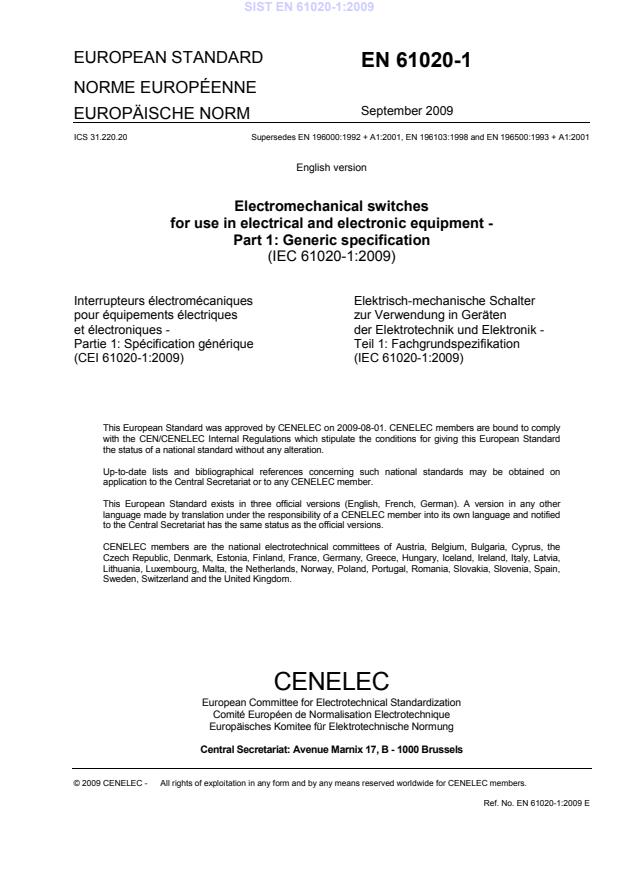
EUROPEAN STANDARD
EN 61020-1
NORME EUROPÉENNE
September 2009
EUROPÄISCHE NORM
ICS 31.220.20 Supersedes EN 196000:1992 + A1:2001, EN 196103:1998 and EN 196500:1993 + A1:2001
English version
Electromechanical switches
for use in electrical and electronic equipment -
Part 1: Generic specification
(IEC 61020-1:2009)
Interrupteurs électromécaniques Elektrisch-mechanische Schalter
pour équipements électriques zur Verwendung in Geräten
et électroniques - der Elektrotechnik und Elektronik -
Partie 1: Spécification générique Teil 1: Fachgrundspezifikation
(CEI 61020-1:2009) (IEC 61020-1:2009)
This European Standard was approved by CENELEC on 2009-08-01. CENELEC members are bound to comply
with the CEN/CENELEC Internal Regulations which stipulate the conditions for giving this European Standard
the status of a national standard without any alteration.
Up-to-date lists and bibliographical references concerning such national standards may be obtained on
application to the Central Secretariat or to any CENELEC member.
This European Standard exists in three official versions (English, French, German). A version in any other
language made by translation under the responsibility of a CENELEC member into its own language and notified
to the Central Secretariat has the same status as the official versions.
CENELEC members are the national electrotechnical committees of Austria, Belgium, Bulgaria, Cyprus, the
Czech Republic, Denmark, Estonia, Finland, France, Germany, Greece, Hungary, Iceland, Ireland, Italy, Latvia,
Lithuania, Luxembourg, Malta, the Netherlands, Norway, Poland, Portugal, Romania, Slovakia, Slovenia, Spain,
Sweden, Switzerland and the United Kingdom.
CENELEC
European Committee for Electrotechnical Standardization
Comité Européen de Normalisation Electrotechnique
Europäisches Komitee für Elektrotechnische Normung
Central Secretariat: Avenue Marnix 17, B - 1000 Brussels
© 2009 CENELEC - All rights of exploitation in any form and by any means reserved worldwide for CENELEC members.
Ref. No. EN 61020-1:2009 E
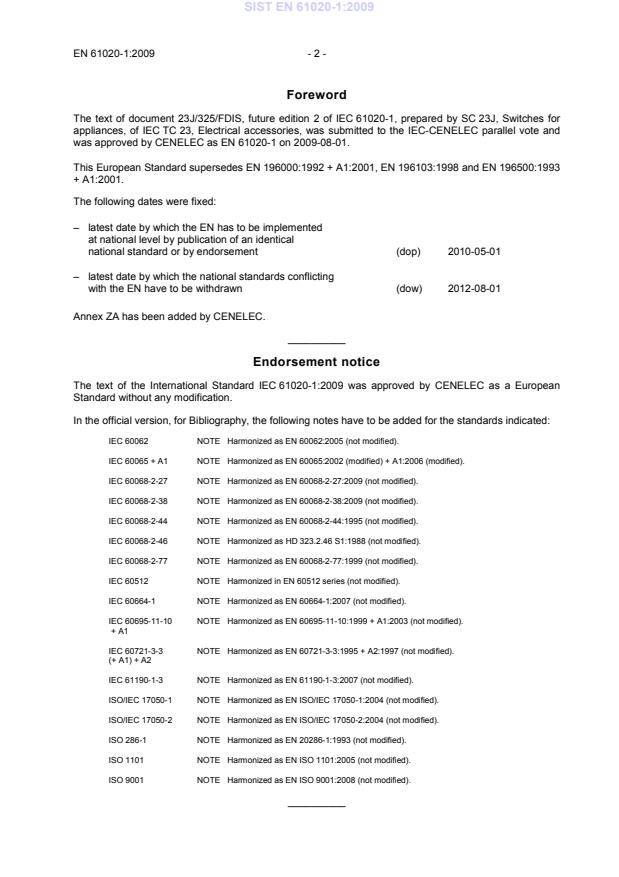
Foreword
The text of document 23J/325/FDIS, future edition 2 of IEC 61020-1, prepared by SC 23J, Switches for
appliances, of IEC TC 23, Electrical accessories, was submitted to the IEC-CENELEC parallel vote and
was approved by CENELEC as EN 61020-1 on 2009-08-01.
This European Standard supersedes EN 196000:1992 + A1:2001, EN 196103:1998 and EN 196500:1993
+ A1:2001.
The following dates were fixed:
– latest date by which the EN has to be implemented
at national level by publication of an identical
national standard or by endorsement (dop) 2010-05-01
– latest date by which the national standards conflicting
with the EN have to be withdrawn (dow) 2012-08-01
Annex ZA has been added by CENELEC.
__________
Endorsement notice
The text of the International Standard IEC 61020-1:2009 was approved by CENELEC as a European
Standard without any modification.
In the official version, for Bibliography, the following notes have to be added for the standards indicated:
IEC 60062 NOTE Harmonized as EN 60062:2005 (not modified).
IEC 60065 + A1 NOTE Harmonized as EN 60065:2002 (modified) + A1:2006 (modified).
IEC 60068-2-27 NOTE Harmonized as EN 60068-2-27:2009 (not modified).
IEC 60068-2-38 NOTE Harmonized as EN 60068-2-38:2009 (not modified).
IEC 60068-2-44 NOTE Harmonized as EN 60068-2-44:1995 (not modified).
IEC 60068-2-46 NOTE Harmonized as HD 323.2.46 S1:1988 (not modified).
IEC 60068-2-77 NOTE Harmonized as EN 60068-2-77:1999 (not modified).
IEC 60512 NOTE Harmonized in EN 60512 series (not modified).
IEC 60664-1 NOTE Harmonized as EN 60664-1:2007 (not modified).
IEC 60695-11-10 NOTE Harmonized as EN 60695-11-10:1999 + A1:2003 (not modified).
+ A1
IEC 60721-3-3 NOTE Harmonized as EN 60721-3-3:1995 + A2:1997 (not modified).
(+ A1) + A2
IEC 61190-1-3 NOTE Harmonized as EN 61190-1-3:2007 (not modified).
ISO/IEC 17050-1 NOTE Harmonized as EN ISO/IEC 17050-1:2004 (not modified).
ISO/IEC 17050-2 NOTE Harmonized as EN ISO/IEC 17050-2:2004 (not modified).
ISO 286-1 NOTE Harmonized as EN 20286-1:1993 (not modified).
ISO 1101 NOTE Harmonized as EN ISO 1101:2005 (not modified).
ISO 9001 NOTE Harmonized as EN ISO 9001:2008 (not modified).
__________
- 3 - EN 61020-1:2009
Annex ZA
(normative)
Normative references to international publications
with their corresponding European publications
The following referenced documents are indispensable for the application of this document. For dated
references, only the edition cited applies. For undated references, the latest edition of the referenced
document (including any amendments) applies.
NOTE When an international publication has been modified by common modifications, indicated by (mod), the relevant EN/HD
applies.
Publication Year Title EN/HD Year
IEC 60027 Series Letter symbols to be used in electrical EN 60027 Series
technology
IEC 60050-581 2008 International Electrotechnical Vocabulary - - -
Part 581: Electromechanical components for
electronic equipment
1)
IEC 60068-1 1988 Environmental testing - EN 60068-1 1994
A1 1992 Part 1: General and guidance
IEC 60068-2-1 2007 Environmental testing - EN 60068-2-1 2007
Part 2-1: Tests - Test A: Cold
IEC 60068-2-2 2007 Environmental testing - EN 60068-2-2 2007
Part 2-2: Tests - Test B: Dry heat
IEC 60068-2-6 2007 Environmental testing - EN 60068-2-6 2008
Part 2-6: Tests - Test Fc: Vibration
(sinusoidal)
IEC 60068-2-10 2005 Environmental testing - EN 60068-2-10 2005
Part 2-10: Tests - Test J and guidance: Mould
growth
IEC 60068-2-13 1983 Environmental testing - EN 60068-2-13 1999
Part 2: Tests - Test M: Low air pressure
IEC 60068-2-14 2009 Environmental testing - EN 60068-2-14 2009
Part 2-14: Tests - Test N: Change of
temperature
IEC 60068-2-17 1994 Environmental testing - EN 60068-2-17 1994
Part 2: Tests - Test Q: Sealing
IEC 60068-2-20 2008 Environmental testing - EN 60068-2-20 2008
Part 2-20: Tests - Test T: Test methods for
solderability and resistance to soldering heat
of devices with leads
IEC 60068-2-21 2006 Environmental testing - EN 60068-2-21 2006
Part 2-21: Tests - Test U: Robustness of
terminations and integral mounting devices
IEC 60068-2-30 2005 Environmental testing - EN 60068-2-30 2005
Part 2-30: Tests - Test Db: Damp heat, cyclic
(12 h + 12 h cycle)
IEC 60068-2-42 2003 Environmental testing - EN 60068-2-42 2003
Part 2-42: Tests - Test Kc: Sulphur dioxide
test for contacts and connections
1)
EN 60068-1 includes corr. October 1988 and A1:1992 to IEC 60068-1.
Publication Year Title EN/HD Year
IEC 60068-2-43 2003 Environmental testing - EN 60068-2-43 2003
Part 2-43: Tests - Test Kd: Hydrogen sulphide
test for contacts and connections
IEC 60068-2-45 1980 Environmental testing - EN 60068-2-45 1992
A1 1993 Part 2: Tests - Test Xa and guidance: A1 1993
Immersion in cleaning solvents
IEC 60068-2-49 1983 Environmental testing - - -
Part 2: Tests - Guidance to Test Kc: Sulphur
dioxide test for contacts and connections
2)
IEC 60068-2-58 1999 Environmental testing - EN 60068-2-58 1999
Part 2-58: Tests - Test Td: Test methods for
solderability, resistance to dissolution of
metallization and to soldering heat of surface
mounting devices (SMD)
IEC 60068-2-61 1991 Environmental testing - EN 60068-2-61 1993
Part 2: Test methods - Test Z/ABDM: Climatic
sequence
IEC 60068-2-68 1994 Environmental testing - EN 60068-2-68 1996
Part 2: Tests - Test L: Dust and sand
IEC 60068-2-78 2001 Environmental testing - EN 60068-2-78 2001
Part 2-78: Tests - Test Cab: Damp heat,
steady state
IEC 60529 1989 Degrees of protection provided by enclosures EN 60529 1991
(IP Code) + corr. May 1993
A1 1999 A1 2000
IEC 60617 data- Graphical symbols for diagrams - -
base
IEC 61058-1 (mod) 2000 Switches for appliances -
+ A1 2001 Part 1: General requirements EN 61058-1 2002
A2 2007 A2 2008
ISO 1000 1992 SI units and recommendations for the use of - -
their multiples and of certain other units
2)
EN 60068-2-58 is superseded by EN 60068-2-58:2004, which is based on IEC 60068-2-58:2004.
IEC 61020-1 ®
Edition 2.0 2009-07
INTERNATIONAL
STANDARD
NORME
INTERNATIONALE
Electromechanical switches for use in electrical and electronic equipment –
Part 1: Generic specification
Interrupteurs électromécaniques pour équipements électriques et
électroniques –
Partie 1: Spécification générique
INTERNATIONAL
ELECTROTECHNICAL
COMMISSION
COMMISSION
ELECTROTECHNIQUE
PRICE CODE
INTERNATIONALE
XB
CODE PRIX
ICS 31.220.20 ISBN 2-8318-1053-2
– 2 – 61020-1 © IEC:2009
CONTENTS
FOREWORD.5
INTRODUCTION.7
1 Scope and object.8
1.1 Scope.8
1.2 Object .8
2 General .8
2.1 Normative references .8
2.2 Units and symbols .10
2.3 Terms and definitions .10
2.4 Preferred values.12
2.4.1 Clearance and creepage distances .12
2.5 Marking .12
3 Quality assessment procedures.12
4 Test and measurement procedures.12
4.1 General .12
4.1.1 Tolerances .13
4.1.2 Preconditioning.13
4.1.3 Mounting .13
4.2 Standard atmospheric conditions.13
4.3 General examination .13
4.3.1 Visual examination .13
4.3.2 Dimensions .14
4.3.3 Dimensions, gauging .14
4.3.4 Mass .15
4.3.5 Functional operation .15
4.3.6 Operating characteristics .16
4.3.7 Contact bounce .18
4.4 Resistance measurements .19
4.4.1 Contact resistance – Millivolt level.19
4.4.2 Contact resistance – Specified current .21
4.4.3 Resistance from actuator to mounting bushing (surface).22
4.4.4 Insulation resistance.23
4.5 Dielectric strength .23
4.5.1 Dielectric strength at standard atmospheric conditions .23
4.5.2 Dielectric strength at low air pressure.24
4.6 Heating .25
4.6.1 Object .25
4.6.2 Method .25
4.6.3 Requirement.26
4.6.4 Details to be specified .26
4.7 Dynamic stress.26
4.7.1 Shock .26
4.7.2 Vibration.27
4.7.3 Contact disturbance.28
4.8 Mechanical strength .28
4.8.1 Robustness of actuator.28
61020-1 © IEC:2009 – 3 –
4.8.2 Robustness of mounting bushing .31
4.8.3 Robustness of screw mounting .31
4.8.4 Robustness of terminations .31
4.9 Mechanical endurance.32
4.9.1 Mechanical endurance – Standard atmospheric conditions .32
4.9.2 Mechanical endurance – Category temperature range .33
4.10 Electrical endurance.33
4.10.1 Electrical endurance – Standard atmospheric conditions .33
4.10.2 Electrical endurance – Upper category temperature.35
4.10.3 Electrical endurance – Category temperature range .36
4.10.4 Electrical endurance – Low air pressure .36
4.10.5 Logic loads (TTL) .37
4.10.6 Low level endurance test .38
4.11 Overload .39
4.11.2 Electrical overload .39
4.11.3 Capacitive load switching .40
4.12 Environmental testing.41
4.12.1 Climatic sequence .41
4.12.2 Damp heat, steady state.43
4.12.3 Rapid change of temperature.44
4.12.4 Mould growth (resistance) .44
4.12.5 Corrosion, industrial atmosphere .45
4.12.6 Dust and sand .46
4.12.7 Contact resistance stability.48
4.13 Soldering.49
4.13.1 Solderability, wetting, solder bath method.49
4.13.2 Solderability, wetting, soldering iron method.50
4.13.3 Solderability, de-wetting .51
4.13.4 Resistance to soldering heat, solder bath method.51
4.13.5 Resistance to soldering heat, soldering iron method .52
4.14 Panel seal .53
4.14.1 Drip – Proof .53
4.14.2 Splash – Proof.53
4.14.3 Immersion .53
4.14.4 Submersion .54
4.15 Enclosure seal.55
4.15.1 Watertight immersion.55
4.15.2 Resilient or hermetic seal .55
4.16 Fluid resistance.56
4.16.1 Immersion in cleaning solvents (marking) .56
4.17 Fire hazard.56
4.18 Capacitance .56
4.18.1 Object .56
4.18.2 Method .56
4.18.3 Requirement.57
4.18.4 Details to be specified .57
4.19 Illumination.57
4.19.1 Chromaticity .57
4.19.2 Transmittancy.57
– 4 – 61020-1 © IEC:2009
4.19.3 Temperature of illuminated surface.58
4.20 Soldering for surface mounting switches .58
4.20.1 Solderability, solder bath method (surface mounting switches) .58
4.20.2 Solderability, reflow method (surface mounting switches) .59
4.20.3 Solderability, soldering iron method (surface mounting switches) .60
4.20.4 Resistance to soldering heat , solder bath method (surface mounting
switches) .60
4.20.5 Resistance to soldering heat, reflow method (surface mounting
switches) .61
4.20.6 Resistance to soldering heat, soldering iron method (surface
mounting switches).62
4.21 Mechanical strength (surface mounting switches).62
4.21.1 Substrate bending (surface mounting switches) .62
4.21.2 Pull-off and push-off (surface mounting switches).63
4.21.3 Shear (surface mounting switches) .64
4.21.4 Body strength (surface mounting switches).64
Annex A (informative) Quality assurance procedures .66
Bibliography.67
Figure 1 – Contact bounce test circuit.18
Figure 2 – Typical trace of contact bounce.19
Figure 3 – Application of forces and torques for test 4.81.30
Figure 4 – Submersion seal enclosure .55
Table 1 – Minimum wire length .25
Table 2 – Torque values for mounting screws .31
Table 3 – Methods proposed for corrosion tests.46
Table 4 – Solderability, Bath method: Test severities (duration and temperature) .50
61020-1 © IEC:2009 – 5 –
INTERNATIONAL ELECTROTECHNICAL COMMISSION
____________
ELECTROMECHANICAL SWITCHES
FOR USE IN ELECTRICAL AND ELECTRONIC EQUIPMENT –
Part 1: Generic specification
FOREWORD
1) The International Electrotechnical Commission (IEC) is a worldwide organization for standardization comprising
all national electrotechnical committees (IEC National Committees). The object of IEC is to promote
international co-operation on all questions concerning standardization in the electrical and electronic fields. To
this end and in addition to other activities, IEC publishes International Standards, Technical Specifications,
Technical Reports, Publicly Available Specifications (PAS) and Guides (hereafter referred to as “IEC
Publication(s)”). Their preparation is entrusted to technical committees; any IEC National Committee interested
in the subject dealt with may participate in this preparatory work. International, governmental and non-
governmental organizations liaising with the IEC also participate in this preparation. IEC collaborates closely
with the International Organization for Standardization (ISO) in accordance with conditions determined by
agreement between the two organizations.
2) The formal decisions or agreements of IEC on technical matters express, as nearly as possible, an international
consensus of opinion on the relevant subjects since each technical committee has representation from all
interested IEC National Committees.
3) IEC Publications have the form of recommendations for international use and are accepted by IEC National
Committees in that sense. While all reasonable efforts are made to ensure that the technical content of IEC
Publications is accurate, IEC cannot be held responsible for the way in which they are used or for any
misinterpretation by any end user.
4) In order to promote international uniformity, IEC National Committees undertake to apply IEC Publications
transparently to the maximum extent possible in their national and regional publications. Any divergence
between any IEC Publication and the corresponding national or regional publication shall be clearly indicated in
the latter.
5) IEC provides no marking procedure to indicate its approval and cannot be rendered responsible for any
equipment declared to be in conformity with an IEC Publication.
6) All users should ensure that they have the latest edition of this publication.
7) No liability shall attach to IEC or its directors, employees, servants or agents including individual experts and
members of its technical committees and IEC National Committees for any personal injury, property damage or
other damage of any nature whatsoever, whether direct or indirect, or for costs (including legal fees) and
expenses arising out of the publication, use of, or reliance upon, this IEC Publication or any other IEC
Publications.
8) Attention is drawn to the Normative references cited in this publication. Use of the referenced publications is
indispensable for the correct application of this publication.
9) Attention is drawn to the possibility that some of the elements of this IEC Publication may be the subject of
patent rights. IEC shall not be held responsible for identifying any or all such patent rights.
International Standard IEC 61020-1 has been prepared by subcommittee 23J: Switches for
appliances, of IEC technical committee 23: Electrical accessories.
This second edition cancels and replaces the first edition published in 1991. This second
edition constitutes a technical revision.
This edition includes the following significant technical changes with respect to the previous
edition.
a) The requirements of the IEC 60512 series of standards have been integrated in this
second edition of IEC 61020-1. In particular the test methods, terminology, symbols and
other necessary information concerning switches as specified in IEC 60512 have been
implemented in this standard.
b) Additionally, the following items have been updated with respect to the first edition:
– test methods were reviewed for detailed description;
– 6 – 61020-1 © IEC:2009
– the explanation for the test method of the operating force was rewritten in more detail;
– the test voltage for measurement for contact bounce was reviewed;
– the electrical endurance “ON” duration in the duty cycle was harmonized with
IEC 61058;
– the requirements for fire hazards have been deleted;
– testing methods of surface mounting switches based on the Japanese industrial
standard were added.
The text of this standard is based on the following documents:
FDIS Report on voting
23J/325/FDIS 23J/328/RVD
Full information on the voting for the approval of this standard can be found in the report on
voting indicated in the above table.
This publication has been drafted in accordance with the ISO/IEC Directives, Part 2.
The committee has decided that the contents of this publication will remain unchanged until
the maintenance result date indicated on the IEC web site under "http://webstore.iec.ch" in
the data related to the specific publication. At this date, the publication will be
• reconfirmed,
• withdrawn,
• replaced by a revised edition, or
• amended.
61020-1 © IEC:2009 – 7 –
INTRODUCTION
This generic specification covers the general requirements and test methods for
electromechanical switches with optional quality assurance procedures. It provides the
general requirements and test methods for use in any detail specifications for pushbutton
switches, rotary switches, sensitive switches, toggle switches, and other electromechanical
switches. It also provides guidelines for appropriate quality assurance procedures in Annex A
(informative).
Where it is intended that an electromechanical switch comply with requirements related to
safety, the specific safety requirements are specified in IEC 61058-1.
– 8 – 61020-1 © IEC:2009
ELECTROMECHANICAL SWITCHES
FOR USE IN ELECTRICAL AND ELECTRONIC EQUIPMENT –
Part 1: Generic specification
1 Scope and object
1.1 Scope
This generic specification relates to electromechanical switches intended for use in electrical
and electronic appliances. Switches covered by this specification:
a) are devices which open, close, or change the connection of a circuit by the mechanical
motion of conducting parts (contacts);
b) have a maximum rated voltage of 480 V;
c) have a maximum rated current of 63 A.
This generic specification does not include keyboards and keypads which are intended for use
in information-handling systems. Electromechanical key switches may be included under the
scope of this generic specification.
Switch families shall be described in any detail specifications that will reference this generic
specification.
1.2 Object
The object of this generic specification is to provide consistency in detail specifications for
electromechanical switches by specifying the terminology, symbols, test methods and other
necessary information.
2 General
2.1 Normative references
The following referenced documents are indispensable for the application of this document.
For dated references, only the edition cited applies. For undated references, the latest edition
of the referenced document (including any amendments) applies.
IEC 60027 (all parts), Letter symbols to be used in electrical technology
IEC 60050-581:2008, International Electrotechnical Vocabulary – Part 581: Electromechanical
components for electronic equipment
IEC 60068-1:1988, Environmental testing – Part 1: General and guidance
Amendment 1 (1992)
IEC 60068-2-6:2007, Environmental testing – Part 2-6: Tests – Test Fc: Vibration (sinusoidal)
IEC 60068-2-1:2007, Environmental testing – Part 2-1: Tests – Test A: Cold
IEC 60068-2-2:2007, Environmental testing – Part 2-2: Tests – Test B: Dry heat
61020-1 © IEC:2009 – 9 –
IEC 60068-2-10:2005, Environmental testing – Part 2-10: Tests – Test J and guidance: Mould
growth
IEC 60068-2-13:1983, Environmental testing – Part 2-13: Tests – Test M: Low air pressure
IEC 60068-2-14:2009, Environmental testing – Part 2-14: Tests – Test N: Change of
temperature
IEC 60068-2-17:1994, Environmental testing – Part 2-17: Tests – Test Q: Sealing
IEC 60068-2-20:2008, Environmental testing – Part 2-20: Tests – Test T: Test methods for
solderability and resistance to soldering heat of devices with leads
IEC 60068-2-21:2006, Environmental testing – Part 2-21: Tests – Test U: Robustness of
terminations and integral mounting devices
IEC 60068-2-30:2005, Environmental testing – Part 2-30: Tests – Test Db: Damp heat, cyclic
(12+12-hour cycle)
IEC 60068-2-42:2003, Environmental testing – Part 2-42: Tests – Test Kc: Sulphur dioxide
test for contacts and connections
IEC 60068-2-43:2003, Environmental testing – Part 2-43: Tests – Test Kd: Hydrogen sulphide
test for contacts and connections
IEC 60068-2-45:1980, Environmental testing – Part 2-45: Tests – Test XA and guidance:
Immersion in cleaning solvents
Amendment 1 (1993)
IEC 60068-2-49:1983, Environmental testing – Part 2-49: Tests – Guidance to Test Kc:
Sulphur dioxide test for contacts and connections
IEC 60068-2-58:1999, Environmental testing Part 2-58: Tests – Tests Td: Test methods for
solderability, resistance to dissolution of metallization and to soldering heat of surface
mounting devices (SMD)
IEC 60068-2-61:1991, Environmental testing – Part 2-61: Test methods – Test Z/ABDM:
Climatic sequence
IEC 60068-2-68:1994, Environmental testing – Part 2-68: Tests – Test L: Dust and sand
IEC 60068-2-78:2001, Environmental testing – Part 2-78: Tests – Test Cab: Damp heat,
steady state
IEC 60529:1989, Degrees of protection provided by enclosures (IP Code)
Amendment 1 (2001)
IEC 60617, Graphical symbols for diagrams
IEC 61058-1:2000, Switches for appliances – Part 1: General requirements
Amendment 1 (2001)
Amendment 2 (2007)
ISO 1000:1992, SI units and recommendation for the use of their multiples and of certain
other units
– 10 – 61020-1 © IEC:2009
2.2 Units and symbols
Units, graphic symbols, and letter symbols shall be, whenever possible, in accordance with
ISO 1000, IEC 60027 and IEC 60617.
Graphic symbols and letter symbols peculiar to a particular switch subfamily shall be defined
in the applicable detail specification. Graphic symbols and letter symbols peculiar to a group
of structurally similar switches shall be defined in the detail specification. When additional
units or symbols are required, they shall be derived in accordance with the principles of the
documents listed above whenever possible.
2.3 Terms and definitions
For the purposes of this document the terminology of IEC 60050-581 as well as the following
terms and definitions apply.
Terminology peculiar to a particular switch subfamily shall be defined in the applicable detail
specification. Terminology peculiar to a group of structurally similar switches shall be defined
in the detail specification.
The following terminology is common to all electromechanical switches. Where the definition
is compatible with an established IEC 60050 definition, the IEV number for the related
definition is given in brackets.
2.3.1
category temperature range
range of ambient temperature for which the switch has been designed to operate continuously
2.3.2
clearance
shortest distance in air between two conductive parts
2.3.3
contact bounce
intermittent and random opening of closed contacts and closing of open contacts which may
occur after contact transfer and which is caused by the switch mechanism
2.3.4
contact bounce time
time period measured from the moment of first closure of two mating contacts or first opening
of two closed contacts to the moment when all contact bounce ceases
2.3.5
contact disturbance
intermittent and random closing of open contacts and/or opening of closed contacts caused by
external influences such as shock and vibration
2.3.6
contact separation (gap)
distance between mating contacts when the contacts are open
2.3.7
contact set
group of contacts which all function in relation to the same pole of a switch
2.3.8
creepage distance
shortest distance along the surface of the insulation material between two conductive parts
61020-1 © IEC:2009 – 11 –
[IEV 151-15-50 modified]
2.3.9
double break switch
switch that opens a conductor at two points in series with each other
2.3.10
double throw
term applied to a contact arrangement to denote that each contact form included is a make-
break
2.3.11
duty cycle
ratio of conducting (ON) time to the total time for one cycle; for example, 30 % ON
2.3.12
electromechanical switch
switch which opens, closes, or changes the connection of an electrical circuit by the
mechanical motion of conducting parts (contacts)
2.3.13
lower category temperature
minimum ambient temperature for which a switch has been designed to operate continuously
2.3.14
pole of a switch
the part of the switch associated exclusively with one, electrically separated, conducting path
of the switch
NOTE 1 Those parts that provide a means for mounting and operating all poles together are excluded from the
definition of a pole.
NOTE 2 A switch is called "single-pole" if it has only one pole. If it has more than one pole, it may be called
"multi-pole" (two-pole, three-pole, etc.) provided that the poles are coupled in such a manner as to operate
together.
2.3.15
operating cycle
succession of operations from one position to another and back to the first position through all
other positions, if any
[IEV 441-16-02]
2.3.16
opposite polarity
two parts of a switch such that when connected together may result in operation of the line
fuses to the power supply
2.3.17
single throw
term applied to a contact arrangement to denote that each contact form included is a single
contact pair
2.3.18
snap-action
type of switching action in which the speed of the moving contact is relatively independent of
the speed of the actuating mechanism
– 12 – 61020-1 © IEC:2009
2.3.19
surface mounting switch
small-sized switch which is suitable for surface mounting on the printed wiring board,
consisting of terminals and framing parts
2.3.20
upper category temperature
maximum ambient temperature for which a switch has been designed to operate continuously
2.4 Preferred values
The detail specification may prescribe any preferred values for rated and limiting values,
characteristics, tolerances, requirements and dimensions applicable to the whole subfamily.
2.4.1 Clearance and creepage distances
The detail specification shall specify either the minimum clearance and creepage distances or
the minimum dielectric test voltage under specified air pressure for functional insulation. For
basic, supplementary or reinforced insulation the minimum clearance and creepage distances
shall be specified in accordance with Clause 20 of IEC 61058-1.
2.5 Marking
Where space permits after national or contractual marking requirements (for example, safety
requirements) have been satisfied, each switch shall be marked with the following information:
a) manufacturer's name or trademark;
b) identification number;
c) terminal identification when specified by the detail specification;
d) date code: the date code shall be in accordance with IEC 60062.
Other markings may be applied to the switches provided they do not obscure or confuse the
required markings. When conditions do not permit full marking on the switch, the markings
shall be applied in the order of preference shown above. Any required marking that cannot be
applied to the switch, shall be marked on the smallest packing unit of the switch.
3 Quality assessment procedures
NOTE See Annex A (informative) for guidelines on quality assurance procedures.
4 Test and measurement procedures
4.1 General
Any detail specification shall contain tables showing the tests to be conducted, the
measurements to be made before and after each test or group of tests, and the sequence in
which they shall be carried out. The measuring conditions shall be the same for initial and
final measurements. When tests are performed in a sequence, the final measurements of one
test may be taken as the initial measurements for the succeeding test.
If national specifications within any quality assessment system include test methods other
than those specified in the above documents, the test methods shall be fully described.
Not all the test methods prescribed herein are applicable to all types of switches. The detail
specification shall prescribe the test methods which are applicable for that type of switch.
61020-1 © IEC:2009 – 13 –
When necessary, additional test methods and/or details of the test methods shall be
prescribed by the detail specification.
4.1.1 Tolerances
Unless otherwise specified, the actual value of the parameters, for example test voltage, test
current, test force or test torque shall be within 5 % of the specified values of the switch.
4.1.2 Preconditioning
Unless specified by the test method, the switches shall not be subjected to any special
preparations, such as cleaning, prior to or during the tests.
4.1.3 Mounting
When mounting is prescribed by the test method, the switch shall be rigidly mounted by its
normal mounting means and connected as specified in the detail specification. The method of
mounting and the materials used for mounting shall not adversely affect the electrical or
mechanical performance of the switch.
4.2 Standard atmospheric conditions
The standard atmospheric conditions shall be in accordance with Clause 5 of IEC 60068-1.
4.3 General examination
4.3.1 Visual examination
4.3.1.1 Method
The visual examination shall be carried out by one of the following methods:
a) with the naked eye (normal strength of vision, normal colour perception, at the most
favourable viewing distance and with suitable illumination);
b) with magnifiers, if specified.
For the purpose of this standard, special methods, for example using polarized light (for
observing internal tensions in materials) or other indicators (for observing internal material
cracks or pores), are not permitted unless explicitly required by the detail specification.
4.3.1.2 Features
The following features shall be examined without magnification:
a) markings according to 2.5;
b) general appearance;
c) workmanship.
4.3.1.3 Requirement
The markings shall be correct and legible. The switch shall be manufactured in a careful and
workmanlike manner.
4.3.1.4 Details to be specified
When this test is required by the detail specification, the following details shall be specified:
a) details to be examined;
b) features to be checked;
– 14 – 61020-1 © IEC:2009
c) acceptability;
d) power of magnifier, if specified;
e) any deviation from the standard test method.
4.3.2 Dimensions
4.3.2.1 Method
The examination of dimensions shall be carried out with appropriate measuring equipment, for
example:
a) with a vernier gauge, a micrometer and a dial gauge;
b) with a measuring projector with a suitable linear magnification;
c) with a measuring microscope.
The following details shall apply.
a) The specified outline dimensions, detailed dimensions, clearances and creepage
distances shall be measured.
b) The accuracy and resolution of the measuring equipment (micrometers, callipers, visual
comparators, etc.) shall be commensurate with the dimensions being measured.
4.3.2.2 Requirement
The dimensions shall be within the limits specified by the detail specification.
4.3.2.3 Details to be specified
When th
...