

CEN/TR 1404:2024
(Main)Test gases - Determination of emissions from appliances burning gaseous fuels during type-testing
- Abstract
This document covers the measurements of the emissions of carbon monoxide (CO) and nitrogen oxides (NOX) produced by the combustion of gaseous fuel in domestic appliances. It is also possible to adapt it to liquid fuel appliances.
It explains how to correct the measured values obtained at the testing conditions of temperature, humidity and gas used into the reference conditions, as well as their conversion to different aeration factor expressed as %O2 in the dry products of combustion.
The document also contains information on the types of sampling probes, mainly their form and their dimensions, which depend on the type of flue gas system.
It also gives detailed information on the sampling of the flue gas to be analysed, the transport / transfer lines and their components, and the materials recommended for their construction.
This document contains hints on the calculation of the uncertainties and the parameters to be considered in the whole analysis chain from the sampling probe to the analysers including the calibration gases.
The calculation of the uncertainties of the measurements of NOX and CO is not covered by this document.
- Status
- Published
- Publication Date
- 07-May-2024
- Technical Committee
- CEN/TC 238 - Test gases, test pressures and categories of appliances
- Drafting Committee
- CEN/TC 238/WG 2 - Non type tested
- Current Stage
- 6060 - Definitive text made available (DAV) - Publishing
- Start Date
- 08-May-2024
- Due Date
- 14-Apr-2023
- Completion Date
- 08-May-2024

Overview
CEN/TR 1404:2024 - Test gases: Determination of emissions from appliances burning gaseous fuels during type‑testing - is a CEN Technical Report published May 2024 by CEN/TC 238. It provides practical guidance for measuring carbon monoxide (CO) and nitrogen oxides (NOX) emissions from domestic appliances burning gaseous fuels (adaptable to liquid fuel appliances). The report explains sampling hardware, analyser performance characteristics, calibration gas considerations, and the methods to correct measured values to reference conditions and convert results to different aeration factors (expressed as %O2 in dry flue gas).
Key topics and technical requirements
- Scope and exclusions: Applies to domestic gas-fired appliances; excludes gas cookers, flue‑less appliances and industrial process appliances.
- Measured species: CO and NOX (NO + NO2), with definitions and units for concentrations in wet/dry flue gas and energy‑related emissions (mg/MJ, mg/kWh).
- Analyser types and performance:
- Chemiluminescent analysers for NO/NO2
- IR/UV absorption analysers for NO, NO2 (high concentrations), CO
- Paramagnetic analysers for O2
- Electrochemical sensors are considered inadequate for laboratory testing
- Performance checks: linearity, drift (time, temperature, pressure), interference, converter efficiency, measuring range, response time, warm‑up and zero setting
- Sampling system:
- Guidance on sampling probe form and dimensions depending on flue system (type B and type C appliances)
- Detailed recommendations for transport/transfer lines, coolers/condensers or permeation dryers, filters, manifolds, flow meters and pumps
- Recommended construction materials for components in contact with gases
- Conversions and corrections:
- Correction of measured concentrations from test temperature, humidity and gas composition to reference conditions (20 °C, specified humidity)
- Conversion of results to different aeration factors (%O2 dry)
- Uncertainty:
- Notes and parameters affecting uncertainty across the analysis chain (sampling probe to analysers and calibration gases)
- The document provides guidance but does not provide the full calculation method for NOX and CO measurement uncertainties
Applications and users
CEN/TR 1404:2024 is intended for:
- Type‑testing and laboratory emissions testing of gas‑fired household appliances
- Test laboratories, manufacturers, certification bodies and conformity assessment organizations
- Regulators and product designers seeking standardized methods for CO and NOX measurement, sampling, and data correction
- HVAC and combustion engineers implementing flue gas sampling systems and analyser setups
Related guidance
- Supersedes CR 1404:1994 and incorporates lessons from projects such as ECOTEST (ecodesign testing context)
- Parts of this Technical Report are referenced within national and product‑specific gas appliance standards and harmonized testing procedures
Keywords: CEN/TR 1404:2024, test gases, emissions measurement, CO, NOX, flue gas sampling, type‑testing, gas appliances, analyser performance, calibration gases.
Relations
- Replaces
CR 1404:1994 - Determination of emissions from appliances burning gaseous fuels during type-testing - Effective Date
- 19-Jan-2023
- Effective Date
- 10-Feb-2026
- Effective Date
- 28-Jan-2026
- Effective Date
- 28-Jan-2026
- Effective Date
- 28-Jan-2026
- Effective Date
- 28-Jan-2026
- Effective Date
- 28-Jan-2026
- Effective Date
- 28-Jan-2026
- Effective Date
- 28-Jan-2026
- Effective Date
- 28-Jan-2026
- Effective Date
- 28-Jan-2026
Get Certified
Connect with accredited certification bodies for this standard

CIS Institut d.o.o.
Personal Protective Equipment (PPE) certification body. Notified Body NB-2890 for EU Regulation 2016/425 PPE.

Kiwa BDA Testing
Building and construction product certification.
Kmetijski inštitut Slovenije
Agricultural Institute of Slovenia. Soil testing, plant health, agricultural product analysis.
Sponsored listings
Frequently Asked Questions
CEN/TR 1404:2024 is a technical report published by the European Committee for Standardization (CEN). Its full title is "Test gases - Determination of emissions from appliances burning gaseous fuels during type-testing". This standard covers: This document covers the measurements of the emissions of carbon monoxide (CO) and nitrogen oxides (NOX) produced by the combustion of gaseous fuel in domestic appliances. It is also possible to adapt it to liquid fuel appliances. It explains how to correct the measured values obtained at the testing conditions of temperature, humidity and gas used into the reference conditions, as well as their conversion to different aeration factor expressed as %O2 in the dry products of combustion. The document also contains information on the types of sampling probes, mainly their form and their dimensions, which depend on the type of flue gas system. It also gives detailed information on the sampling of the flue gas to be analysed, the transport / transfer lines and their components, and the materials recommended for their construction. This document contains hints on the calculation of the uncertainties and the parameters to be considered in the whole analysis chain from the sampling probe to the analysers including the calibration gases. The calculation of the uncertainties of the measurements of NOX and CO is not covered by this document.
This document covers the measurements of the emissions of carbon monoxide (CO) and nitrogen oxides (NOX) produced by the combustion of gaseous fuel in domestic appliances. It is also possible to adapt it to liquid fuel appliances. It explains how to correct the measured values obtained at the testing conditions of temperature, humidity and gas used into the reference conditions, as well as their conversion to different aeration factor expressed as %O2 in the dry products of combustion. The document also contains information on the types of sampling probes, mainly their form and their dimensions, which depend on the type of flue gas system. It also gives detailed information on the sampling of the flue gas to be analysed, the transport / transfer lines and their components, and the materials recommended for their construction. This document contains hints on the calculation of the uncertainties and the parameters to be considered in the whole analysis chain from the sampling probe to the analysers including the calibration gases. The calculation of the uncertainties of the measurements of NOX and CO is not covered by this document.
CEN/TR 1404:2024 is classified under the following ICS (International Classification for Standards) categories: 13.040.40 - Stationary source emissions; 97.040.20 - Cooking ranges, working tables, ovens and similar appliances. The ICS classification helps identify the subject area and facilitates finding related standards.
CEN/TR 1404:2024 has the following relationships with other standards: It is inter standard links to CR 1404:1994, EN 50465:2015, EN 14829:2007, EN 621:2009, EN 13278:2013, EN 1319:2009, EN 1020:2009, EN 778:2009, EN 12309-2:2015, EN 13278:2003, EN 89:2015. Understanding these relationships helps ensure you are using the most current and applicable version of the standard.
CEN/TR 1404:2024 is available in PDF format for immediate download after purchase. The document can be added to your cart and obtained through the secure checkout process. Digital delivery ensures instant access to the complete standard document.
Standards Content (Sample)
SLOVENSKI STANDARD
01-oktober-2024
Nadomešča:
SIST-TP CR 1404:2004
Določanje emisij iz plinskih aparatov pri tipskem preskušanju
Determination of emissions from appliances burning gaseous fuel during tape-testing
Bestimmung von Emissionen von Gasgeräten während der Typprüfung
Determination of emissions from appliances burning gaseous fuel during tape-testing
Ta slovenski standard je istoveten z: CEN/TR 1404:2024
ICS:
13.040.40 Emisije nepremičnih virov Stationary source emissions
27.060.20 Plinski gorilniki Gas fuel burners
2003-01.Slovenski inštitut za standardizacijo. Razmnoževanje celote ali delov tega standarda ni dovoljeno.
CEN/TR 1404
TECHNICAL REPORT
RAPPORT TECHNIQUE
May 2024
TECHNISCHER REPORT
ICS 97.040.20; 13.040.40 Supersedes CR 1404:1994
English Version
Test gases - Determination of emissions from appliances
burning gaseous fuels during type-testing
Determination of emissions from appliances burning Bestimmung von Emissionen von Gasgeräten während
gaseous fuel during tape-testing der Typprüfung
This Technical Report was approved by CEN on 22 January 2024. It has been drawn up by the Technical Committee CEN/TC 238.
CEN members are the national standards bodies of Austria, Belgium, Bulgaria, Croatia, Cyprus, Czech Republic, Denmark, Estonia,
Finland, France, Germany, Greece, Hungary, Iceland, Ireland, Italy, Latvia, Lithuania, Luxembourg, Malta, Netherlands, Norway,
Poland, Portugal, Republic of North Macedonia, Romania, Serbia, Slovakia, Slovenia, Spain, Sweden, Switzerland, Türkiye and
United Kingdom.
EUROPEAN COMMITTEE FOR STANDARDIZATION
COMITÉ EUROPÉEN DE NORMALISATION
EUROPÄISCHES KOMITEE FÜR NORMUNG
CEN-CENELEC Management Centre: Rue de la Science 23, B-1040 Brussels
© 2024 CEN All rights of exploitation in any form and by any means reserved Ref. No. CEN/TR 1404:2024 E
worldwide for CEN national Members.
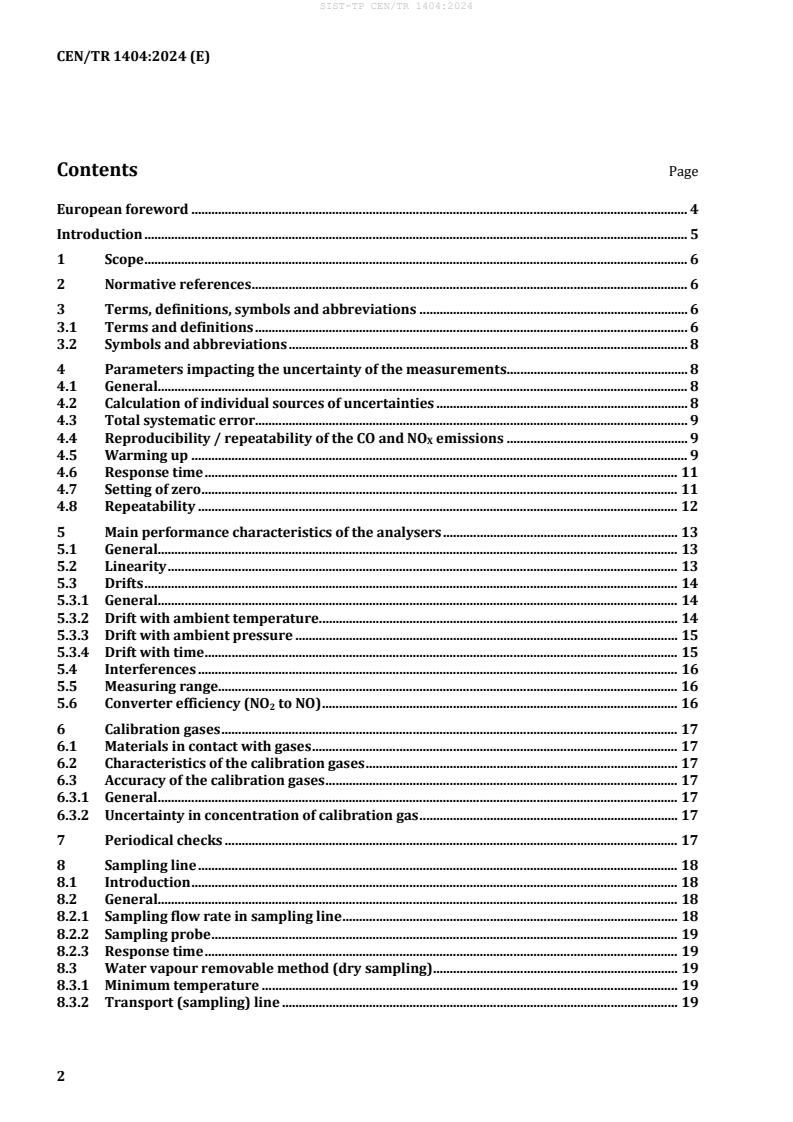
Contents Page
European foreword . 4
Introduction . 5
1 Scope . 6
2 Normative references . 6
3 Terms, definitions, symbols and abbreviations . 6
3.1 Terms and definitions . 6
3.2 Symbols and abbreviations . 8
4 Parameters impacting the uncertainty of the measurements . 8
4.1 General. 8
4.2 Calculation of individual sources of uncertainties . 8
4.3 Total systematic error. 9
4.4 Reproducibility / repeatability of the CO and NO emissions . 9
X
4.5 Warming up . 9
4.6 Response time . 11
4.7 Setting of zero . 11
4.8 Repeatability . 12
5 Main performance characteristics of the analysers . 13
5.1 General. 13
5.2 Linearity . 13
5.3 Drifts . 14
5.3.1 General. 14
5.3.2 Drift with ambient temperature . 14
5.3.3 Drift with ambient pressure . 15
5.3.4 Drift with time . 15
5.4 Interferences . 16
5.5 Measuring range . 16
5.6 Converter efficiency (NO to NO) . 16
6 Calibration gases . 17
6.1 Materials in contact with gases . 17
6.2 Characteristics of the calibration gases . 17
6.3 Accuracy of the calibration gases . 17
6.3.1 General. 17
6.3.2 Uncertainty in concentration of calibration gas . 17
7 Periodical checks . 17
8 Sampling line . 18
8.1 Introduction . 18
8.2 General. 18
8.2.1 Sampling flow rate in sampling line . 18
8.2.2 Sampling probe . 19
8.2.3 Response time . 19
8.3 Water vapour removable method (dry sampling) . 19
8.3.1 Minimum temperature . 19
8.3.2 Transport (sampling) line . 19
8.3.3 Cooler/condenser or permeation dryer . 19
8.3.4 Filter . 19
8.3.5 Manifold . 19
8.3.6 Flow meter / rotameter . 20
8.3.7 Sampling pump . 20
8.4 Wet sampling . 20
9 Testing procedures . 20
9.1 General . 20
9.2 Test room . 20
9.3 Calibration. 20
9.4 Sampling . 21
9.4.1 General . 21
9.4.2 Non-flued appliances are excluded from the scope. . 21
9.4.3 Flued appliances (type B appliances). 21
9.4.4 Balanced flue appliances (type C appliances) . 21
9.4.5 Forced draught burners in relation to the fire tube testing . 21
9.4.6 Test conditions . 21
9.5 Validity of the measurements . 21
9.6 Correction for ambient conditions . 21
9.7 Combustion parameters and conversion coefficients . 21
Annex A (informative) Sampling probes for type B appliances . 22
Annex B (informative) Sampling probes for type C appliances . 25
Annex C (informative) Sampling lines . 28
Annex D (informative) NO and CO: conversions to different units and dilutions . 29
X
Annex E (informative) NO and CO: correction ambient . 34
X
Annex F (informative) Combustion parameters and correction coefficients for CO and NO . 37
X
Annex G (informative) Determination of total CO and NO uncertainty . 40
X
Bibliography . 41
European foreword
This document (CEN/TR 1404:2024) has been prepared by Technical Committee CEN/TC 238 “Test
gases, test pressures, appliance categories and gas appliance types”, the secretariat of which is held by
AFNOR.
Attention is drawn to the possibility that some of the elements of this document may be the subject of
patent rights. CEN shall not be held responsible for identifying any or all such patent rights.
This document supersedes CR 1404:1994.
In comparison with CR 1404:1994, the following significant changes have been made:
emissions, an alternative to the correction formula derived from the BCR program (E.1) is
— for NOX
proposed by CETIAT (E.2), this alternative formula is based on measurements;
— characteristics to be checked before carrying out tests are explained (warming-up period, response
time, setting of zero or repeatability;
— the way to determine the main performances characteristics of analysers are more detailed
(linearity, drifts, interferences, measuring range and converter efficiency are more detailed;
— the calculation of the uncertainties of the measurements of NO and CO is no longer covered by this
X
document, and Annex III, Uncertainty calculation of NOX and CO measurements, has been deleted.
Any feedback and questions on this document should be directed to the users’ national standards body.
A complete listing of these bodies can be found on the CEN website.
Introduction
This document is based on CR 1404 and other information coming from the Guide for Laboratory Practice
(GLP) for the measurement, conversions and corrections of CO and NO . CR 1404 was published by CEN
X
in 1994. Several standards refer to it concerning the measurement, conversion and correction of the
emissions of CO and NO .
X
The ECOTEST project under mandates M/534 - ECODESIGN WATER HEATERS and 535 ECODESIGN
Central heating appliances under the "Specific agreement number:
SA/CEN/GROW/EFTA/534/535/2015-14 Rev" used the CR 1404:1994 as a reference document for the
of gas and liquid fuel boilers and water heaters tested
measurements of the emissions of CO and NOX
under this project.
After a brainstorming made by ECOTEST experts, it was recommended to CEN/TC 238 to revise this
document. CEN/TC 238 decided to revise it and publish it as a CEN Technical Report (CEN/TR).
This document describes test methods and automatic measurements for the determination of NO
X
(NO+NO ), CO, CO and O emissions in the flue gases including the sampling system and the calibration
2 2 2
gases. Parts of this document are already introduced in the relevant gas appliances standards.
Gas cookers, flue less appliances and appliances especially designed for use in industrial processes
carried out on industrial premises are excluded from the scope.
According to their principles of analysing the combustion products, the analysers are classified into the
following families:
— Analysers based on the chemiluminescent effect: NO and NO ,
— Analysers based on the absorption of infra-red and ultra-violet radiation: NO and NO (for
concentrations higher than 100 ppm), CO and CO ,
— Analysers based on the paramagnetic principle: O ,
— Electrochemical analysers: they are considered to be inadequate for laboratory testing procedures.
This document presents the procedures to convert the measured values of NO and CO to reference
X
aeration conditions.
It also explains how to correct the emissions of NO from the measured combustion air temperature and
X
humidity to the reference conditions of 20 °C and 10 g of water/kg of air.
1 Scope
This document covers the measurements of the emissions of carbon monoxide (CO) and nitrogen oxides
(NO ) produced by the combustion of gaseous fuel in domestic appliances. It is also possible to adapt it
X
to liquid fuel appliances.
It explains how to correct the measured values obtained at the testing conditions of temperature,
humidity and gas used into the reference conditions, as well as their conversion to different aeration
factor expressed as %O in the dry products of combustion.
The document also contains information on the types of sampling probes, mainly their form and their
dimensions, which depend on the type of flue gas system.
It also gives detailed information on the sampling of the flue gas to be analysed, the transport / transfer
lines and their components, and the materials recommended for their construction.
This document contains hints on the calculation of the uncertainties and the parameters to be considered
in the whole analysis chain from the sampling probe to the analysers including the calibration gases.
The calculation of the uncertainties of the measurements of NO and CO is not covered by this document.
X
2 Normative references
There are no normative references in this document.
3 Terms, definitions, symbols and abbreviations
3.1 Terms and definitions
For the purposes of this document, the following terms and definitions apply.
ISO and IEC maintain terminology databases for use in standardization at the following addresses:
— IEC Electropedia: available at http://www.electropedia.org/
— ISO Online browsing platform: available at http://www.iso.org/obp/
3.1.1
NO emissions
X
sum of the concentrations of nitrogen monoxide (NO) and nitrogen dioxide (NO ) in dry flue gases
measured in ppm (vol/vol) and expressed in mg/MJ and mg/kWh
3.1.2
NO emissions
concentration of nitrogen dioxide (NO ) in dry flue gases expressed in ppm (vol/vol)
3.1.3
NO emissions
concentration of nitrogen monoxide (NO) in dry flue gases expressed in ppm (vol/vol)
3.1.4
CO concentration
concentration of carbon dioxide in dry flue gases expressed in % (vol/vol)
3.1.5
water vapour concentration
H O
concentration of water vapour in wet flue gases expressed in % (vol/vol)
3.1.6
oxygen concentration
concentration of oxygen in dry flue gases expressed in % (vol/vol)
3.1.7
measured value
mv
concentration of pertinent gases measured in the dry or wet flue gases (CO, NO, …) expressed in ppm
(vol/vol) and (CO , O , H O) expressed in % (vol/vol)
2 2 2
3.1.8
calibration gases
gases to be analysed mixed with air, nitrogen and other gases used to calibrate the analysers
3.1.9
full scale calibration gas
gas diluted in nitrogen to be used to check the maximum content of the gas to be analysed
3.1.10
zero calibration gas
gas, usually nitrogen or air, used to set the zero
3.1.11
span gases
gases at different concentrations of the full scale which are used to check the linearity, the repeatability
and other parameters:
Gas span I: 30 % of full scale
Gas span II: 60 % of full scale
Gas span III: 90 % of full scale
3.1.12
parts per million
ppm
part (in volume) of a gas (e.g. CO or NO ) diluted in one million parts (volume) of the gas to be analysed
X
Note 1 to entry: 1 % CO or NOX (in volume)= 10 000 ppm CO or NOX (in volume).
3.2 Symbols and abbreviations
For the purposes of this document, the following symbols and abbreviations apply.
fs full scale at which the analyser is calibrated for a given gas
T temperature during calibration
cal
T temperature during use
use
P pressure during calibration
cal
P pressure during use
use
CO CO concentration in NO calibration gas
2cal 2 X
O O concentration in NO calibration gas
2cal 2 X
H O H O concentration in NO -calibration gas
2 cal 2 X
4 Parameters impacting the uncertainty of the measurements
4.1 General
The following elements impact the uncertainty of the measurement of the emissions of CO and NO :
X
— the sampling probe, and sampling line;
— the accuracy of the analysers, NO, NO , CO , CO, O ;
2 2 2
— the calibration gases and procedures;
— the test conditions.
4.2 Calculation of individual sources of uncertainties
The uncertainties are either:
— random uncertainties (U); or
— uncertainties caused by not correcting for systematic errors (E).
In some cases, when the uncertainty of an individual source is unknown, it is acceptable to assume worst
case uncertainty (Uwc) or worst-case error (Ewc).
The uncertainty of measurements of emissions depends on the following:
— the sampling probe;
— the characteristics of the transfer line and the treatment of the sample;
— the analysers;
— the calibration method and calibration gases;
— the measurement;
— the uncertainty in the reproducibility of the sources of emissions;
— the conversion and calculations to different air dilution factors or %O in dry flue gases.
The uncertainty concerning the calculation and conversion depends on the following:
— the NO absorption by water;
— the interferences between the different gases;
— the linearity of the analysers;
— the drift with temperature and the drift with pressure;
— the converter efficiency (NO/NO );
— the influence of the temperature and humidity of combustion air;
— the gas or fuel oil composition.
4.3 Total systematic error
It is possible that systematic errors be caused by temperature, pressure, absorption of NO , interference
and non-linearity.
If the total systematic error exceeds 2 % of the measured value, then the cause of it is investigated and
corrected. Correction is made to limit the systematic error to an acceptable value (e.g. 2 %).
4.4 Reproducibility / repeatability of the CO and NO emissions
X
It is possible that the number of factors, such as relative humidity and temperature of the combustion air
and the gas used, affect the level of NO emissions.
X
For NO emissions, a correction formula derived from the BCR programme is proposed in E.1 "Conversion
X
to reference conditions”.
NOTE CETIAT propose an alternative formula based on measurements performed on 6 low-NOX gas boilers.
This alternative method is also shown in E.2.
4.5 Warming up
To avoid the influence of start-up phenomena, the analyser is warm before use. At least the warm-up
period prescribed by the supplier of the analyser is observed. The warm-up period required is
determined as follows:
Connect a recorder to the output of the analyser to register the form of the output signal with time.
Connect the calibration gas cylinder (span gas III, 90 % of full scale) to the analyser.
Switch on the analyser and supply span gas III.
Readings are recorded until the output signal becomes stable (variation < ± 3 %) for at least 30 min
(Figure 1). A period of 3 times the warm up determined this way is observed after switching on the
analyser before every test. If the warm up period determined this way is shorter than the warm-up period
prescribed by the supplier, the latter is used during test in practice.
Key
1 concentration
2 time
3 drift
4 tdead
5 tresponse
6 t
warm-up
◆ measured value
Figure 1 — The path of the reading due to warming up phenomena
If an analyser of NO containing a converter to measure NO is checked, an extra test is performed. This
X 2
test is used to check if the converter has reached the operation temperature during warm-up.
To do so, supply the analyser with a calibration gas containing NO diluted in synthetic air and check if at
least 90 % of the NO reacts at the surface of the converter as shown in Table 1.
Table 1 — Use of calibration gas to check the operation of the converter
Calibration gas Reading
NO in synthetic air NO > 0,9 x [NO ]
2 2 2 cal gas
and/or
NO > 0,9 x [NO ]
X 2 cal gas
4.6 Response time
After a change in the input signal by injecting new calibration gas, the output signal of the analyser is not
reached immediately. It takes some time which is the response time.
The response time is the time between applying the calibration gas and reaching 90 % of the
concentration of the gas to be measured.
Reading the output of the analyser before it has reached the output level introduces an error. To avoid
this error, it is necessary to know the response time of the analyser, below a specified given value for
example 20 s.
The curve of Figure 2 shows as example a response time of 10 s recorded for a gas having a concentration
of 120 ppm. In the opposite side, a response time of 10 s is recorded to go back to 0 with the setting of
the "zero gas".
Key
1 concentration
2 time
3 t
III, 90
4 t
0, 90
◆ measured value
Figure 2 — Determination of the response time
4.7 Setting of zero
As shown in Figure 2 above, it is possible that an analyser does not indicate 0 if "zero gas" is supplied and
the 90 % of the full scale at the response time. It is possible to avoid the error then introduced.
The adjustment of the analyser is carried out if it does not adjust the zero automatically.
) to the instrument. Wait during a period of 3 times the response time "t90". Set
— Supply zero gas (N2
the instrument to zero.
— Supply span gas III with a concentration of 90 % full scale. Wait during a period of 3 times the
response time "t90". Set the instrument again to the new gas.
— Supply zero gas (N ) to the instrument. Wait during a period of 3 times the response time "t90".
Calibrate and adjust the instrument at zero if necessary.
— Supply span gas III with a concentration of 90 % full scale. Wait during 3 times the response time
"t90". Calibrate and adjust the instrument gain if necessary.
Repeat until no adjustment is needed.
4.8 Repeatability
Every measurement is influenced by several disturbances acting from the environment. Only a part of
these disturbances is assigned to certain error sources. Due to these unknown disturbances, any
measurement shows a varying result with a stochastic character (random).
This uncertainty is determined by carrying out the following instructions 5 times:
— Supply zero gas (N ) to the instrument.
— Wait during a period of 3 times the response time "t90". Report the reading of the analyser.
— Supply span gas III (90 % (full scale) to the instrument.
— Wait during a period of 3 times the response time "t90". Report the reading of the analyser.
Figure 3 shows how the repeatability is checked.
Key
1 concentration
2 number of measurement
◆ measured value
Figure 3 — Test results to determine repeatability
The repeatability is calculated from the average and standard deviation values obtained for the 5 values
obtained with " zero gas" and span gas III [90 % full scale) as well as the standard deviation due to the
resolution of the analyser.
5 Main performance characteristics of the analysers
5.1 General
The main emissions to be measured in the flue gases are NO, NO , CO , CO, O .
2 2 2
The characteristics of the analysers are checked for each range by the testing company, the certified
manufacturer, or a certified institute.
5.2 Linearity
Most instruments show a linear behaviour, where the output of the analyser is proportional to the input
signal. If the input signal is raised the output signal raises proportionally to the input signal.
For linear calibration curve, a check with 4 points "zero gas" and the 3 span gases 30/60/90 % is
sufficient.
It is possible that the output of a linear analyser differs from the linear function. As long as this deviation
is within certain limits, the analyser is assumed linear.
In the case of a non-linear calibration curve, at least 10 measuring points are required. The linearity is
checked at least once a year or after repairs of the analyser.
The following measurements are carried out for every range that needs to be checked to determine the
deviation from a linear function.
— Connect the calibration gas cylinder to the analyser.
— Supply "zero gas". Wait during a period of 3 times the warm-up time "t90". Report the reading.
— Supply span gas I [30 % full scale]. Wait during a period of 3 times the warm-up time "t90". Report
the reading.
— Supply span gas II [60 % full scale]. Wait during a period of 3 times the warm-up time "t90". Report
the reading.
— Supply span gas III [90 % full scale]. Wait during a period of 3 times the warm-up time "t90". Report
the reading.
— Supply again span gas III [90 % full scale]. Wait during a period of 3 times the warm-up time "t90".
Report the reading.
— Supply span gas II [60 % full scale]. Wait during a period of 3 times the warm-up time "t90". Report
the reading.
— Supply span gas I [30 % full scale]. Wait during a period of 3 times the warm-up time "t90". Report
the reading.
— Supply zero gas. Wait during a period of 3 times the warm-up time "t90". Report the reading.
— Repeat this series 2 times.
— The reported values are shown as in Figure 4.
Key
1 measured value
2 calibration gas (0 gas, span gas I, span gas II, span gas III)
st
◆ 1 serie up
st
1 serie down
↙
nd
▲
2 serie up
nd
x 2 serie down
Figure 4 — Test results to check linearity for a linear function
5.3 Drifts
5.3.1 General
The drift or the deviation of an analyser is characterized by an error in the measurement. It happens at
zero and full scale span as well as with temperature, pressure and time. There is a differentiation between
the different drifts.
5.3.2 Drift with ambient temperature
The output of an analyser is sensitive to the ambient temperature. This has physical causes for example
due to changing densities of gases, volumes or as a result of chemical reactions that take place quicker at
higher temperatures.
This sensitivity is determined by measuring the influence from temperature on the analyser on both ends
of the measurement range. It gives a good impression of the influence of the temperature, supposing the
linearity of the analyser is not affected by the temperature.
The permissible ambient temperature range, given by the manufacturer of the analyser covers at least
the range from 10 °C to 35 °C (Figure 5).
Key
1 measured value
2 calibration gas
3 0 gas
4 span gas III
◆ Tmin
Tcal
↙
▲ Tmax
Figure 5 — Test results due to drift by temperature
5.3.3 Drift with ambient pressure
The ambient pressure influences the measurement results. To investigate this phenomenon the analyser
is tested by raising the exhaust pressure of the analyser. This increases the pressure on the inside of the
analyser.
The adjustment of zero and full scale of the analyser are carried out directly before the tests to determine
the influence of the ambient pressure on the span.
5.3.4 Drift with time
The output of an analyser is sensitive to the time elapsing. This has physical causes for example due to
degradation of reactivity, contamination of parts of the analyser, etc. This sensitivity is determined by
measuring the influence of elapsing time on the analyser on both ends of the measurement range
(Figure 6). This gives a good impression of the influence of time, supposing the linearity of the analyser
is not affected by time.
The estimation of the drift with time covers a period of 8 h. A measurement is made each hour.
Key
1 measured value
2 calibration gas
3 0 gas
4 span gas III
◆ t
t
max
↙
Figure 6 — Test results due to drift by time
5.4 Interferences
The measurements of a gas in flue gases produced by the combustion are influenced by several other
components that are present in the flue gases. The main components in the flue gases are N , CO , O and
2 2 2
H O and other are also present but with smaller amounts like CO, H , SO , NO and NO .
2 2 2 2
Interference with other components than N present in the combustion products is possible, depending
on their concentration. This phenomenon is declared by the manufacturer.
For the chemiluminescence method of measuring NO and NO , interferences are expected from CO , O
2 2 2
and H O. For CO and CO analysers, interferences from all components of combustion products are
2 2
determined by applying calibration gases.
To determine the influence of an interfering component, an amount of the component (corresponding to
its presence in flue gases) is added to the calibration gas. With this gas mixture, the influence of an
interfering component on the reading of the analyser is determined.
5.5 Measuring range
The total uncertainty depends mainly on the lower limit of the measuring range. This is caused by a
number of uncertainties which are expressed as a percentage of the full scale.
5.6 Converter efficiency (NO2 to NO)
The concentration of NO is measured by a chemiluminescence analyser. A chemiluminescence analyser
is not able to detect the NO present in flue gases.
By converting the NO into NO the total amount of NO (NO + NO ) is determined as NO. The difference
2 X 2
between the concentration of NO and the concentration of NO is the amount of NO present in the flue
X 2
gases. The accuracy of the determination of the NO concentration depends on the efficiency of the
conversion from NO to NO.
The efficiency of a converter is determined by using a NO -containing calibration gas and another
calibration gas which has a concentration of NO equal to the NO -concentration (NO + NO ) of the NO
X 2 2
containing calibration gas.
6 Calibration gases
6.1 Materials in contact with gases
Parts of the cylinders in contact with the calibration gases are either constructed of stainless steel or
aluminium alloy or protected by nickel-plate.
Governors, tags, tubes, connections, etc. in contact with the sample, are constructed of stainless steel,
PTFE (Teflon), or glass.
6.2 Characteristics of the calibration gases
The concentration of the calibration gases either corresponds to 70 % to 80 % of the span value of the
selected scale or to the estimated value in the combustion products.
For the correct operation and calibration of the analysers, the following calibrating gases are used:
— N is used for all analysers for zero point control; for the low ranges special attention is paid to the
purity of the N gas;
— NO in N ;
— NO2 in air or NO2 generator for testing the normal operation of the converter;
— CO, CO and O in N .
2 2 2
The conservation characteristics of the calibrating gases are declared by the manufacturer for a minimum
period which is not less than 1 year.
Cylinders are not operated at a pressure less than 5 bars.
6.3 Accuracy of the calibration gases
6.3.1 General
The calibration gases used are certified and traceable to an international standard, or to a national
standard.
It is advisable to use calibration gases with an accuracy of 1 % to 2 % of the given value. This depends on
the application (linearity check and span check).
6.3.2 Uncertainty in concentration of calibration gas
The total uncertainty in the concentration of a calibration gas is reported by the manufacturer.
7 Periodical checks
— The sampling line is checked at least once a month for leakage which changes the composition of the
sampled gas to be analysed. This is done by introducing calibration gas (e.g. NO ) at atmospheric
pressure consecutively at points 1 and 7 (Figure C.1). If there is a difference between the injected
concentration of NO and the value measured it means that the line is leaking.
— The efficiency of the converter (NO to NO) is checked at least once a week.
— The analysers are checked for linearity at least once a year or after repairs. If there is a doubt, then it
is essential to compare the analyser with calibration gases.
8 Sampling line
8.1 Introduction
The sampled gas from the products of combustion is representative of the combustion products inside
the flue gases duct section. Therefore, specific sampling probes are used for appliances of type B with a
normal chimney and other specific probes are used for type C or balanced flue appliances.
The sampling probes are described in § 9.4 and Annexes A and B of this document.
The sampling line and its components depend on the method used for sampling (see Annex C). Three
methods apply:
— Dry: the water vapour is removed by condensation;
— Wet: The sampling is maintained wet (no condensation). The sampling line is insulated and/or
electrically heated;
— Dilution method by air.
The dilution method is not recommended for laboratory testing and is used on site measurements in
industrial processes. It is not described in this document.
A sampling line is composed of at least the following components:
1 calibration point to check the soundness of the whole sampling line;
2 sampling line;
3 cooler/condenser;
4 sampling vacuum pump (if required);
5 filter;
6 manifold;
7 calibration point to check the analysers separately from the total line;
8 flow meter / rotameter;
9 analysers;
10 data logging;
11 vent for excess gases.
8.2 General
8.2.1 Sampling flow rate in sampling line
The sampling flow rate through the analyser influences the reading of the analyser. To determine the
influence, the flow rate through the analyser is modified by changing the supply pressure of the
calibration gas.
A flow meter is installed before the analyser to control the sampling flow rate and to check its influence
on the analyser.
8.2.2 Sampling probe
The sampling probe is constructed of stainless steel or glass and depends on the type of appliance (B or
C).
8.2.3 Response time
The time between applying the calibration gas mixture (point 1, Figure C.1) and reaching 90 % of the
recorded maximum concentration, does not exceed 20 s including the probe and sampling line.
8.3 Water vapour removable method (dry sampling)
8.3.1 Minimum temperature
Upstream of the dryer, the sampling line is kept at least 15 K above the water and acid dew-point
temperature of the sampled gas. A temperature control is required to keep the line temperature constant.
8.3.2 Transport (sampling) line
To transfer the sampled gas to the analysers either stainless steel or PTFE (Teflon) tubes are used. The
diameter depends on the required quantity of sampled gas.
The diameter is not smaller than 4 mm (preferably 4 mm to 8 mm).
Rubber or silicon materials are not used.
8.3.3 Cooler/condenser or permeation dryer
The parts of the cooler/condenser in contact with the sample are made of glass, PTFE (Teflon) or stainless
steel.
Cooling needs to be sufficient for the sampled gas flow rate and the water concentration. The dew point
is sufficiently below the ambient temperature. A cooling temperature of 2 °C to 5 °C is sufficient. Usually
distributed water in the lab is used.
It is essential to remove condensates efficiently as quickly as possible in order to minimize the contact
with the sampled gas and to avoid the absorption of NO .
Desiccant as silica gel is not used.
NOTE When the dry (condensation) method is used, the removal of the condensed water flows continuously
outside the cooler.
8.3.4 Filter
A filter is positioned between the cooler and the manifold. The housing is constructed of stainless steel
or glass. The size is determined from the required sampling flow rate and the manufacturer's data on the
flow rate per unit area.
The sinter metal, PTFE (Teflon)-fibre or quartz filter retain particles not greater than 1 µm.
NOTE Care is taken to avoid contamination of the filter with particulate matter which reacts with sampled
gases to give an erroneous result.
8.3.5 Manifold
The manifold is constructed of stainless steel or PTFE (Teflon) with a separate connection for each
analyser. It has a sufficient size to accommodate the gas flow rate required by each analyser. However, it
is small enough to keep the sampled gas residence times to a minimum.
The excess of sampled gas and the exhaust of analysed gas are vented.
8.3.6 Flow meter / rotameter
In order to check the exact flow rate, a flow meter made of a suitable corrosion resistant material is
necessary.
8.3.7 Sampling pump
The parts of the sampling vacuum pump in contact with the sampled gases are constructed of PTFE
(Teflon), stainless steel or Viton. The capacity of the pump is such that it is able to supply all the analysers
with their required flows, plus a 10 % excess flow margin.
8.4 Wet sampling
The requirements and description are the same as for the dry (water vapour removal) method taking into
account the following considerations:
— No cooler/condenser is present in the sampling line.
— To avoid condensation, the part of the sampling line upstream of the analysers is kept at least 15 K
above the water and acid dew point temperature of the sampled gas. An electric heating resistance
is used to maintain the sampled gas wet.
— The analysers are especially designed for that method.
A correction for the water vapour in the sample is done (see D.4.2 · Conversion · Calculation).
9 Testing procedures
9.1 General
Before starting the measurements, it is essential that all analysers used during the tests have reached the
thermal equilibrium and that they have been correctly checked and calibrated according to the
manufacturer's instructions.
During the measurements, it is necessary that the flow rate, the temperature and the pressure correspond
to those values obtained when making the calibration; they fall within the limits specified by the
manufacturers.
The sampling line is purged effectively if high concentrations are measured before taking further
measurements.
9.2 Test room
The appliance is installed in a well-ventilated, draught free room, according to the appropriate CEN-
product standard used. The ambient temperature, the atmospheric pressure and the relative humidity
are measured and recorded in the test report.
9.3 Calibration
— Before and after each test or at least at the beginning and at the end of each day, check zero point and
span value of the instrument ranges which are used.
— The calibration function is checked by introducing calibration gases directly into the analysers (point
7 of Figure C.1).
— The setting of the analyser before the test is carried out as follows. Feed the zero gas into the analyser
...