

EN 1020:2009
(Main)Non-domestic forced convection gas-fired air heaters for space heating not exceeding a net heat input of 300 kW incorporating a fan to assist transportation of combustion air or combustion products
- Abstract
This European Standard specifies the requirements and test methods for the safety and efficiency of non-domestic gas-fired air heaters having a fan to assist the transportation of combustion air and/or flue gases, hereafter referred to as "appliances". This includes appliances having forced draught burners.
This European Standard applies to Type B12, B13, B14, B22, B23, B42, B43, B44, B52, B53, C12, C13, C32, C33, C62 and C63 appliances with a heat input not exceeding 300 kW (based on net calorific value) intended for use in other than single unit residential dwellings. It also applies to appliances intended for outdoor installation. Provision of the heated air may be by means of ducting or may be directly into the heated space.
For Type C62 and C63 appliances, this European Standard only applies when such appliances are intended for final installation in a similar manner to Type C3 appliances.
This standard does not apply to:
a) appliances intended for use in a single unit residential dwelling;
b) appliances of the condensing type;
c) appliances with atmospheric burners without a fan to assist the transportation of combustion air and/or flue gases;
d) dual purpose air conditioning appliances (heating and cooling);
e) appliances where the air is heated by an intermediate fluid;
f) appliances fitted with manual or automatic flue dampers;
g) portable or transportable forced convection appliances;
h) appliances having multiple heating units with a single draught diverter;
i) appliances fitted with more than one flue outlet;
j) appliances that are designed for continuous condensation within the flue system under normal operating conditions;
k) appliances having combustion products evacuation ducts, POCEDs, that are non-metallic.
This standard is applicable to appliances which are intended to be type tested. It also includes requirements concerning the evaluation of conformity, including factory production control, but these requirements only apply to ...
- Status
- Withdrawn
- Publication Date
- 03-Nov-2009
- Withdrawal Date
- 06-Oct-2026
- Technical Committee
- CEN/TC 180 - Non-domestic gas-fired overhead radiant heaters
- Current Stage
- 9960 - Withdrawal effective - Withdrawal
- Start Date
- 16-Oct-2019
- Completion Date
- 07-Oct-2026
- Directive
- 2009/142/EC - Appliances burning gaseous fuelsOJ Ref: C, C 349 OJ Date: 22-Dec-2010
305/2011 - Regulation (eu) No 305/2011 of the European Parliament and of the Council of 9 march 2011 laying down harmonised conditions for the marketing of construction products and repealing council directive 89/106/eecOJ Ref: C, C 259 OJ Date: 08-Aug-2014
89/106/EEC - Construction productsOJ Ref: C, C 71 OJ Date: 19-Mar-2010



Relations
- Effective Date
- 08-Jun-2022
- Effective Date
- 07-Nov-2009
- Effective Date
- 21-Sep-2016
- Effective Date
- 25-Aug-2026
- Effective Date
- 25-Aug-2026
- Effective Date
- 25-Aug-2026
- Effective Date
- 25-Aug-2026
- Effective Date
- 25-Aug-2026
- Effective Date
- 25-Aug-2026
- Effective Date
- 09-Feb-2026
- Effective Date
- 09-Feb-2026
- Effective Date
- 09-Feb-2026
- Effective Date
- 09-Feb-2026
- Effective Date
- 09-Feb-2026
- Effective Date
- 09-Feb-2026
Frequently Asked Questions
EN 1020:2009 is a standard published by the European Committee for Standardization (CEN). Its full title is "Non-domestic forced convection gas-fired air heaters for space heating not exceeding a net heat input of 300 kW incorporating a fan to assist transportation of combustion air or combustion products". This standard covers: This European Standard specifies the requirements and test methods for the safety and efficiency of non-domestic gas-fired air heaters having a fan to assist the transportation of combustion air and/or flue gases, hereafter referred to as "appliances". This includes appliances having forced draught burners. This European Standard applies to Type B12, B13, B14, B22, B23, B42, B43, B44, B52, B53, C12, C13, C32, C33, C62 and C63 appliances with a heat input not exceeding 300 kW (based on net calorific value) intended for use in other than single unit residential dwellings. It also applies to appliances intended for outdoor installation. Provision of the heated air may be by means of ducting or may be directly into the heated space. For Type C62 and C63 appliances, this European Standard only applies when such appliances are intended for final installation in a similar manner to Type C3 appliances. This standard does not apply to: a) appliances intended for use in a single unit residential dwelling; b) appliances of the condensing type; c) appliances with atmospheric burners without a fan to assist the transportation of combustion air and/or flue gases; d) dual purpose air conditioning appliances (heating and cooling); e) appliances where the air is heated by an intermediate fluid; f) appliances fitted with manual or automatic flue dampers; g) portable or transportable forced convection appliances; h) appliances having multiple heating units with a single draught diverter; i) appliances fitted with more than one flue outlet; j) appliances that are designed for continuous condensation within the flue system under normal operating conditions; k) appliances having combustion products evacuation ducts, POCEDs, that are non-metallic. This standard is applicable to appliances which are intended to be type tested. It also includes requirements concerning the evaluation of conformity, including factory production control, but these requirements only apply to ...
This European Standard specifies the requirements and test methods for the safety and efficiency of non-domestic gas-fired air heaters having a fan to assist the transportation of combustion air and/or flue gases, hereafter referred to as "appliances". This includes appliances having forced draught burners. This European Standard applies to Type B12, B13, B14, B22, B23, B42, B43, B44, B52, B53, C12, C13, C32, C33, C62 and C63 appliances with a heat input not exceeding 300 kW (based on net calorific value) intended for use in other than single unit residential dwellings. It also applies to appliances intended for outdoor installation. Provision of the heated air may be by means of ducting or may be directly into the heated space. For Type C62 and C63 appliances, this European Standard only applies when such appliances are intended for final installation in a similar manner to Type C3 appliances. This standard does not apply to: a) appliances intended for use in a single unit residential dwelling; b) appliances of the condensing type; c) appliances with atmospheric burners without a fan to assist the transportation of combustion air and/or flue gases; d) dual purpose air conditioning appliances (heating and cooling); e) appliances where the air is heated by an intermediate fluid; f) appliances fitted with manual or automatic flue dampers; g) portable or transportable forced convection appliances; h) appliances having multiple heating units with a single draught diverter; i) appliances fitted with more than one flue outlet; j) appliances that are designed for continuous condensation within the flue system under normal operating conditions; k) appliances having combustion products evacuation ducts, POCEDs, that are non-metallic. This standard is applicable to appliances which are intended to be type tested. It also includes requirements concerning the evaluation of conformity, including factory production control, but these requirements only apply to ...
EN 1020:2009 is classified under the following ICS (International Classification for Standards) categories: 97.100.20 - Gas heaters. The ICS classification helps identify the subject area and facilitates finding related standards.
EN 1020:2009 has the following relationships with other standards: It is inter standard links to EN 1020:1997, EN 1020:1997/A1:2001, EN 17082:2019, ISO 7-1:1994, ISO 7005-2:1988, ISO 228-1:1994, ISO 1182:1990, ISO 7005-3:1988, ISO 7005-1:1992, EN 60584-1:2013, EN 60529:1991, EN 60335-1:2002, EN 60730-2-9:2002, EN IEC 60335-2-102:2024, EN IEC 61058-1:2018. Understanding these relationships helps ensure you are using the most current and applicable version of the standard.
EN 1020:2009 is associated with the following European legislation: EU Directives/Regulations: 2009/142/EC, 305/2011, 89/106/EEC, 90/396/EEC; Standardization Mandates: M/105, M/BC/CEN/89/6. When a standard is cited in the Official Journal of the European Union, products manufactured in conformity with it benefit from a presumption of conformity with the essential requirements of the corresponding EU directive or regulation.
EN 1020:2009 is available in PDF format for immediate download after purchase. The document can be added to your cart and obtained through the secure checkout process. Digital delivery ensures instant access to the complete standard document.
Standards Content (Sample)
2003-01.Slovenski inštitut za standardizacijo. Razmnoževanje celote ali delov tega standarda ni dovoljeno.Gasbefeuerte Warmlufterzeuger mit verstärkter Konvektion für den nicht-häuslichen Gebrauch mit einer Nennwärmebelastung nicht über 300 kW, mit Gebläse zur Beförderung der Verbrennungsluft und/oder der AbgaseGénérateurs d'air chaud a convection forcée utilisant les combustibles gazeux pour le chauffage de locaux autres que l'habitat individuel de débit calorifique sur PCI inférieur ou égal a 300 kW, comportant un ventilateur pour aider l'alimentation en air comburant et/ou l'évacuation des produits de combustionNon-domestic forced convection gas-fired air heaters for space heating not exceeding a net heat input of 300 kW incorporating a fan to assist transportation of combustion air or combustion products97.100.20Plinski grelnikiGas heatersICS:Ta slovenski standard je istoveten z:EN 1020:2009SIST EN 1020:2010en,fr,de01-februar-2010SIST EN 1020:2010SLOVENSKI
STANDARDSIST EN 1020:1999/A1:2002SIST EN 1020:19991DGRPHãþD
EUROPEAN STANDARD NORME EUROPÉENNE EUROPÄISCHE NORM
EN 1020
November 2009 ICS 97.100.20 Supersedes EN 1020:1997English Version
Non-domestic forced convection gas-fired air heaters for space heating not exceeding a net heat input of 300 kW incorporating a fan to assist transportation of combustion air or combustion products
Générateurs d'air chaud à convection forcée utilisant les combustibles gazeux pour le chauffage de locaux autres que l'habitat individuel de débit calorifique sur PCI inférieur ou égal à 300 kW, comportant un ventilateur pour aider l'alimentation en air comburant et/ou l'évacuation des produits de combustion
Gasbefeuerte Warmlufterzeuger mit verstärkter Konvektion für den nicht-häuslichen Gebrauch mit einer Nennwärmebelastung nicht über 300 kW, mit Gebläse zur Beförderung der Verbrennungsluft und/oder der Abgase This European Standard was approved by CEN on 5 October 2009.
CEN members are bound to comply with the CEN/CENELEC Internal Regulations which stipulate the conditions for giving this European Standard the status of a national standard without any alteration. Up-to-date lists and bibliographical references concerning such national standards may be obtained on application to the CEN Management Centre or to any CEN member.
This European Standard exists in three official versions (English, French, German). A version in any other language made by translation under the responsibility of a CEN member into its own language and notified to the CEN Management Centre has the same status as the official versions.
CEN members are the national standards bodies of Austria, Belgium, Bulgaria, Cyprus, Czech Republic, Denmark, Estonia, Finland, France, Germany, Greece, Hungary, Iceland, Ireland, Italy, Latvia, Lithuania, Luxembourg, Malta, Netherlands, Norway, Poland, Portugal, Romania, Slovakia, Slovenia, Spain, Sweden, Switzerland and United Kingdom.
EUROPEAN COMMITTEE FOR STANDARDIZATION
COMITÉ EUROPÉEN DE NORMALISATION EUROPÄISCHES KOMITEE FÜR NORMUNG
Management Centre:
Avenue Marnix 17,
B-1000 Brussels © 2009 CEN All rights of exploitation in any form and by any means reserved worldwide for CEN national Members. Ref. No. EN 1020:2009: ESIST EN 1020:2010
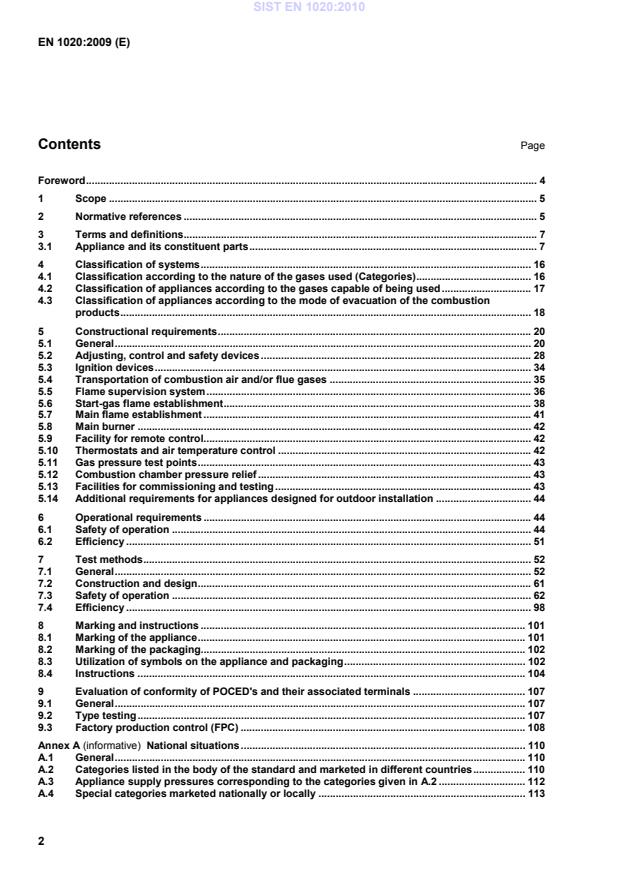
National situations . 110A.1General . 110A.2Categories listed in the body of the standard and marketed in different countries . 110A.3Appliance supply pressures corresponding to the categories given in A.2 . 112A.4Special categories marketed nationally or locally . 113SIST EN 1020:2010
Equivalence rules . 121B.1Conversion to categories within a restricted Wobbe index range . 121B.2Conversion to categories within an identical Wobbe index range . 121B.3Conversion to categories within a wider Wobbe index range . 122Annex C (normative)
Classification according to the evacuation of the combustion . 123C.1Type B1. 123C.2Type B2. 124C.3Type B4. 125C.4Type B5. 127C.5Type C1. 128C.6Type C3. 129Annex D (normative)
Requirements and test methods for separate air supply and combustion products evacuation ducts . 130D.1Requirements . 130D.2Test methods . 130Annex E (informative)
Facilities for commissioning and testing (see 5.13) . 134E.1Appliances with automatic ignition of a start-gas flame . 134E.2Appliances with direct automatic ignition of the main burner . 134Annex F (informative)
Identification of gas types in use in various countries . 135Annex G (informative)
Requirements in EN 1020 which relate to the design and construction of forced draught burners covered in EN 676:1996 . 136Annex H (informative)
A-deviations . 137H.1General . 137H.2Switzerland . 137Annex I (normative)
Special national conditions . 138I.1Special national conditions . 138I.2Belgium . 138I.3Italy . 138Annex J (informative)
National solutions for countries whose national bodies are Affiliate Members of CEN . 139J.1Categories listed in the body of the standard and marketed in different countries . 139J.2Appliance supply pressures corresponding to the categories given in J.1 . 139J.3Special categories marketed nationally or locally . 139J.4Gases and test pressures corresponding to the special categories given in J.3 . 139Annex K (informative)
Calculation of conversions of NOx . 140Annex L (informative)
Sampling plan example . 141L.1Sampling plans . 141L.2Inspection levels and procedures. 142Annex ZA (informative)
Relationship between this European Standard and the Essential Requirements of EU Directives . 143Annex ZB (informative)
Clauses of this European Standard addressing the provisions of the EU Construction Products Directive . 146ZB.2Procedure(s) for attestation of conformity of [construction products] . 148ZB.3 CE marking and labelling . 150Bibliography . 152 SIST EN 1020:2010
Furthermore, the opportunity presented by this revision has been taken to update the standard in respect to EN 437:2003.
NOTE For countries requesting special categories (specified in EN 437:2003), the absence of specific information concerning A.3.3 and A.3.4 implies that the general requirements described in the body of the standard (see 4.1.1, 4.2.2, 4.2.3 and 4.2.5) also apply to these special categories. According to the CEN/CENELEC Internal Regulations, the national standards organizations of the following countries are bound to implement this European Standard: Austria, Belgium, Bulgaria, Cyprus, Czech Republic, Denmark, Estonia, Finland, France, Germany, Greece, Hungary, Iceland, Ireland, Italy, Latvia, Lithuania, Luxembourg, Malta, Netherlands, Norway, Poland, Portugal, Romania, Slovakia, Slovenia, Spain, Sweden, Switzerland and the United Kingdom. SIST EN 1020:2010
1 Scope This European Standard specifies the requirements and test methods for the safety and efficiency of non-domestic gas-fired air heaters having a fan to assist the transportation of combustion air and/or flue gases, hereafter referred to as "appliances". This includes appliances having forced draught burners. This European Standard applies to Type B12, B13, B14, B22, B23, B42, B43, B44, B52, B53, C12, C13, C32, C33, C62 and C63 appliances with a heat input not exceeding 300 kW (based on net calorific value) intended for use in other than single unit residential dwellings. It also applies to appliances intended for outdoor installation. Provision of the heated air may be by means of ducting or may be directly into the heated space. For Type C62 and C63 appliances, this European Standard only applies when such appliances are intended for final installation in a similar manner to Type C3 appliances. This standard does not apply to: a) appliances intended for use in a single unit residential dwelling; b) appliances of the condensing type; c) appliances with atmospheric burners without a fan to assist the transportation of combustion air and/or flue gases; d) dual purpose air conditioning appliances (heating and cooling); e) appliances where the air is heated by an intermediate fluid; f) appliances fitted with manual or automatic flue dampers; g) portable or transportable forced convection appliances; h) appliances having multiple heating units with a single draught diverter; i) appliances fitted with more than one flue outlet; j) appliances that are designed for continuous condensation within the flue system under normal operating conditions; k) appliances having combustion products evacuation ducts, POCEDs, that are non-metallic. This standard is applicable to appliances which are intended to be type tested. It also includes requirements concerning the evaluation of conformity, including factory production control, but these requirements only apply to POCEDs and their associated terminals. NOTE Requirements for appliances which are not type tested would need to be subject to further consideration. 2 Normative references The following referenced documents are indispensable for the application of this document. For dated references, only the edition cited applies. For undated references, the latest edition of the referenced document (including any amendments) applies. EN 88-1, Pressure regulators and associated safety devices for gas appliances — Part 1: Pressure regulators for inlet pressures up to and including 500 mbar SIST EN 1020:2010
(IEC 60335-1:2001, modified) EN 60335-2-102, Household and similar electrical appliances — Safety — Part 2-102: Particular requirements for gas, oil and solid-fuel burning appliances having electrical connections
(IEC 60335-2-102:2004, modified) EN 60529:1991, Degrees of protection provided by enclosures (IP code) (IEC 60529:1989) EN 60584-1, Thermocouples — Part 1: Reference tables (IEC
60584-1:1995) EN 60584-2, Thermocouples — Part 2: Tolerances (IEC 60584- 2:1982 + A1:1989) EN 60730-1,Automatic electrical controls for household and similar use — Part 1: General requirements (IEC 60730-1:1999, modified) EN 60730-2-9:2002, Automatic electrical controls for household and similar use — Part 2-9: Particular requirements for temperature sensing controls (IEC 60730-2-9:2000, modified) EN 61058-1, Switches for appliances — Part 1: General requirements (IEC 61058-1:2000 + A1:2001, modified) EN ISO 228-1, Pipe threads where pressure-tight joints are not made on the threads — Part 1: Dimensions, tolerances and designation (ISO 228-1:2000) EN ISO 3166-1, Codes for the representation of names of countries and their subdivisions — Part 1: Country codes (ISO 3166-1:2006) EN ISO 6976, Natural gas — Calculation of the calorific values, density, relative density and Wobbe index from composition (ISO 6976:1995 including Corrigendum 1:1997, Corrigendum 2:1997 and Corrigendum 3:1999) ISO 7-1, Pipe threads where pressure-tight joints are made
on the threads - Part 1: Dimensions, tolerances
and designation SIST EN 1020:2010
made on the threads — Part 1: Dimensions,
tolerances and designation ISO 1182:1990, Reaction to fire tests for building products — Non-combustibility test ISO 7005-1, Metallic flanges — Part 1: Steel flanges ISO 7005-2, Metallic flanges — Part 2: Cast iron flanges ISO 7005-3, Metallic flanges — Part 3: Copper alloy and composite flanges CR 1404, Determination of emissions from appliances burning gaseous fuels during type testing 3 Terms and definitions For the purposes of this document, the following terms and definitions apply. 3.1
Appliance and its constituent parts 3.1.1
non-domestic air heater appliance designed for the heating and possibly ventilation of a building other than a single unit residential dwelling 3.1.2 forced convection air heater appliance designed to provide space heating from a central source by distributing heated air, by means of an air moving device, either through ducting or directly into the heated space 3.1.3 gas inlet connection part of the appliance intended to be connected to the gas supply 3.1.4 mechanical joint mechanical means of obtaining soundness means of ensuring the soundness of an assembly of several (generally metallic) parts without the use of liquids (e.g. pastes and tapes) EXAMPLES Metal to metal joints; conical joints; toroidal sealing rings (“O” rings); flat joints. 3.1.5
gas circuit part of the burner unit that conveys or contains the gas between the burner unit gas inlet connection and the burners 3.1.6 restrictor device with an orifice, which is placed in the gas circuit so as to create a pressure drop and thus reduce the gas pressure at the burner to a predetermined value for a given supply pressure and rate 3.1.7
gas rate adjuster component allowing an authorised person to set the gas rate of the burner to a predetermined value according to the supply conditions NOTE 1 Adjustment can be progressive (screw adjuster) or in discrete steps (by changing restrictors). SIST EN 1020:2010
NOTE 1 The adjuster is then said to be "sealed" in its adjustment position. NOTE 2 A factory sealed adjuster is considered to be non-existent. NOTE 3 A regulator is considered to be non-existent if it has been factory sealed in a position such that it is not operational in the range of supply pressures corresponding to the appliance category. 3.1.10 putting an adjuster or a control out of service putting an adjuster or a control (of temperature, pressure, etc.) out of action and sealing it in this position
NOTE The appliance then functions as if the adjuster or control had been removed. 3.1.11 injector component that admits the gas into a burner 3.1.12 main burner burner that is intended to assure the thermal function of the appliance 3.1.13 ignition device means (e.g. flame, electrical ignition device or other device) used to ignite the gas at the ignition burner or at the main burner NOTE This device can operate intermittently or permanently. 3.1.14 ignition burner burner whose flame is intended to ignite another burner 3.1.15 aeration adjuster device enabling the air to be set at the desired value according to the supply conditions NOTE The action of adjusting this device is called "adjusting the aeration". 3.1.16 combustion products circuit 3.1.16.1 combustion chamber enclosure inside which combustion of the air-gas mixture takes place SIST EN 1020:2010
Adjustment, control and safety devices 3.2.1 range rating device component on the appliance intended to be used by the installer to adjust the heat input of the appliance, within a range of heat inputs stated by the manufacturer, to suit the actual heat requirements of the installation NOTE This adjustment may be progressive (e.g. by use of a screw adjuster) or in discrete steps (e.g. by changing restrictors). 3.2.2 automatic burner control system system comprising at least a programming unit and all the elements of a flame detector device
NOTE The various functions of an automatic burner control system may be in one or more housings [EN 298:2003]. SIST EN 1020:2010
3.2.8 pressure regulator1) device which maintains the outlet pressure constant independent of the variations in inlet pressure and/or flow rate within defined limits 3.2.9 adjustable pressure regulator regulator provided with means for changing the outlet pressure setting 3.2.10 flame supervision device device that, in response to a signal from the flame detector, keeps the gas supply open and shuts it off in the absence of the supervised flame 3.2.11 automatic shut-off valve valve designed to open when energized and to close automatically when de-energized 3.2.12 control thermostat device controlling the operation of the appliance (by on/off, high/low or modulating control) and enabling the temperature to be kept automatically, within a given tolerance, at a predetermined value
1) The term "regulator" is used in this case and for a volume regulator. SIST EN 1020:2010
temperature sensor component that detects the temperature of the environment to be supervised or controlled 3.2.17 modulating control automatic control by which the heat input of the appliance can be varied in a continuous manner between the nominal heat input and a minimum value 3.2.18 high/low control automatic control which permits an appliance to operate either at the nominal heat input or at a fixed reduced heat input 3.2.19 closed position indicator switch switch fitted to an automatic shut-off valve which indicates when the closure member is in the closed position 3.2.20 proof of closure switch switch fitted to an automatic shut-off valve with mechanical overtravel which indicates when the closure member is in the closed position 3.2.21 valve proving system system to check the effective closure of the start gas or main gas safety shut-off valves, and which is capable of detecting small gas leakage rates (e.g. by means of a pressure or vacuum proving system) 3.3 Operation of the appliance 3.3.1 volume flow rate V volume of gas consumed by the appliance in unit time during continuous operation NOTE The volume flow rate is expressed in cubic metres per hour (m3/h), litres per minute (l/min), cubic decimetres per hour (dm3/h) or cubic decimetres per second (dm3/s) [EN 437:2003]. SIST EN 1020:2010
M mass of gas consumed by the appliance in unit time during continuous operation NOTE The mass flow rate is expressed in kilograms per hour (kg/h) or grams per hour (g/h) [EN 437:2003]. 3.3.3 heat input Q quantity of energy used in unit time corresponding to the volumetric or mass flow rates, the calorific value used being the net or gross calorific value NOTE The heat input is expressed in kilowatts (kW) [EN 437:2003]. 3.3.4 nominal heat input
Qn value of the heat input (kW) declared by the manufacturer 3.3.5 flame stability characteristic of flames which remain on the flame ports or in the flame reception zone intended by the construction 3.3.6 flame lift
total or partial lifting of the base of the flame away from the burner port or the flame reception zone provided by the design NOTE Flame lift may cause the flame to blow out (i.e. extinction of the air-gas mixture). 3.3.7 light-back entry of a flame into the body of the burner 3.3.8 light-back at the injector ignition of the gas at the injector, either as a result of light-back into the burner or by the propagation of a flame outside the burner 3.3.9 sooting phenomenon appearing during incomplete combustion and characterized by deposits of soot on the surfaces or parts in contact with the combustion products or with the flame 3.3.10 yellow tipping yellowing of the tip of the blue cone of an aerated flame 3.3.11 first safety time interval between the ignition burner gas valve, the start gas valve or main gas valve, as applicable, being energized and the ignition burner gas valve, start gas valve or main gas valve, as applicable, being de-energized if the flame detector signals the absence of a flame at the end of this interval NOTE Where there is no second safety time, this is called the safety time. SIST EN 1020:2010
Lock-out
3.3.21.1 non-volatile lock-out safety shut-down condition of the system, such that a restart can only be accomplished by a manual reset of the system and by no other means [EN 298:2003] 3.3.21.2 volatile lock-out safety shut-down condition of the system, such that a restart can only be accomplished by either the manual reset of the system or an interruption of the electrical supply and its subsequent restoration [EN 298:2003] SIST EN 1020:2010
3.4
Gases 3.4.1 test gases gases intended for the verification of the operational characteristics of appliances using combustible gases. NOTE Test gases comprise the reference and the limit gases [EN 437:2003]. 3.4.2 reference gases test gases with which appliances operate under nominal conditions when they are supplied at the corresponding normal pressure [EN 437:2003] 3.4.3 limit gases test gases representative of the extreme variations in the characteristics of the gases for which appliances have been designed [EN 437:2003] 3.4.4 gas pressure static pressure, relative to the atmospheric pressure, measured at right angles to the direction of flow of the gas NOTE Test pressures are expressed in millibars (mbar) or bars. SIST EN 1020:2010
gas pressures used to verify the operational characteristics of appliances using combustible gases
NOTE 1 Test pressures consist of normal and limit pressures. NOTE 2 Test pressures are expressed in millibars (mbar).
1 mbar = 102 Pa [EN 437:2003]. 3.4.6 normal pressure pn pressure under which the appliances operate in nominal conditions when they are supplied with the corresponding reference gas [EN 437:2003] 3.4.7 limit pressure
(maximum limit pressure pmax and minimum limit pressure pmin) pressures representative of the extreme variations in the appliance supply conditions [EN 437:2003] 3.4.8 pressure couple
combination of two distinct gas distribution pressures applied by reason of the significant difference existing between the Wobbe indices within a single family or group in which: a) the higher pressure corresponds only to gases of low Wobbe index;
b) the lower pressure corresponds to gases of high Wobbe index [EN 437:2003] 3.4.9 relative density d ratio of the masses of equal volumes of dry gas and dry air under the same conditions of temperature and pressure 3.4.10 calorific value quantity of heat produced by the complete combustion, at a constant pressure equal to 1 013,25 mbar, of a unit volume or mass of gas, the constituents of the combustible mixture being taken at reference conditions and the products of combustion being brought back to the same conditions NOTE 1 A distinction is made between: a) the gross calorific value Hs in which the water produced by combustion is assumed to be condensed; b) the net calorific value Hi in which the water produced by combustion is assumed to be in the vapour state. NOTE 2 The calorific value is expressed either in megajoules per cubic metre of dry gas at the reference conditions (MJ/m3) or in megajoules per kilogram of dry gas (MJ/kg) [EN 437:2003]. 3.4.11 Wobbe index gross Wobbe index: Ws; net Wobbe index: Wi. ratio of the calorific value of a gas per unit volume and the square root of its relative density under the same reference conditions NOTE 1 The Wobbe index is said to be gross or net according to whether the calorific value used is the gross or net calorific value. NOTE 2 The Wobbe index is expressed either in megajoules per cubic metre of dry gas at the reference conditions (MJ/m3) or in megajoules per kilogram of dry gas (MJ/kg) [EN437:2003]. SIST EN 1020:2010
Conditions of operation and measurement
3.5.1 reference conditions: for calorific values, temperature: 15 °C; for gas and air volumes dry, brought to 15 °C and to an absolute pressure of 1 013,25 mbar 3.5.2 cold condition condition of the appliance required for some tests and obtained by allowing the unlit appliance to attain thermal equilibrium at room temperature 3.5.3 hot condition condition of the installation required for some tests and obtained by heating to thermal equilibrium at nominal heat input 3.5.4 equivalent resistance resistance to flow (in mbar) measured at the outlet of the appliance, which is equivalent to that of the actual flue 3.5.5 thermal equilibrium operating state of the system corresponding to a particular setting of the input in which the flue gas temperature does not change by more than ± 2 % (in °C) over a period of 10 min 3.6
Country of destination
3.6.1 direct country of destination country for which the appliance has been certified and which is specified by the manufacturer as the intended country of destination NOTE 1 At the time of putting the appliance on the market and/or of installation, the appliance shall be capable of operating, without adjustment or modification, with one of the gases distributed in the country concerned, at the appropriate supply pressure. NOTE 2 More than one country can be specified if the appliance, in its current state of adjustment, can be used in each of these countries. 3.6.2 indirect country of destination country for which the appliance has been certified, but for which, in its present state of adjustment, it is not suitable NOTE Subsequent modification or adjustment is essential in order that it can be utilized safely and correctly in this country. 4 Classification of systems 4.1
Classification according to the nature of the gases used (Categories) Gases are classified into three families, possibly divided into groups according to the value of the Wobbe index. Table 1 specifies the families and groups of gas used in this standard. SIST EN 102
...