

EN 613:2021
(Main)Independent closed-fronted gas-fired type B11, type C11, type C31 and type C91 heaters
- Abstract
This document specifies the requirements and test methods for the construction, safety, marking and rational use of energy.
This document is applicable to types B11AS, B11BS, B11CS, C11, C31 and C91 appliances (see 4.2) and those that:
— are closed-fronted;
— incorporate a natural draught burner;
— are connected directly to an open flue or to a device to evacuate the products of combustion (open-flued appliances, balanced-flued appliances);
— are wall mounted, free-standing or built-in;
— have a nominal heat input not exceeding 20 kW (based on the net calorific value).
This document is not applicable to:
— open fronted appliances as specified in EN 13278:2013;
— decorative fuel effect appliances as specified in EN 509:1999/A1:2003;
— catalytic combustion appliances;
— appliances in which the supply of combustion air and/or evacuation of products of combustion is achieved by mechanical means as specified in EN 1266:2002;
— ducted-air appliances;
— appliances installed by means of a closure plate (see 3.3.3.3).
Matters related to quality assurance systems, tests during production and to certificates of conformity of auxiliary devices are not dealt with by this standard.
- Status
- Published
- Publication Date
- 21-Dec-2021
- Withdrawal Date
- 29-Jun-2022
- Technical Committee
- CEN/TC 62 - Independent gas-fired space heaters
- Drafting Committee
- CEN/TC 62/WG 3 - Chairman's Advisory Group
- Current Stage
- 6060 - Definitive text made available (DAV) - Publishing
- Start Date
- 22-Dec-2021
- Due Date
- 23-Feb-2021
- Completion Date
- 22-Dec-2021



Overview
EN 613:2021 (EN 613:2021) sets the requirements and test methods for independent closed-fronted gas-fired heaters of types B11 (including B11AS, B11BS, B11CS) and C11, C31, C91. The standard covers construction, safety, marking and the rational use of energy for appliances that:
- are closed-fronted and incorporate a natural draught burner;
- are connected to an open flue or a combustion-products evacuation device (open-flued or balanced-flued);
- are wall-mounted, free-standing or built-in; and
- have a nominal heat input ≤ 20 kW (net calorific value).
Exceptions include open-fronted appliances (EN 13278), decorative fuel-effect appliances (EN 509), catalytic combustion appliances, mechanically ventilated combustion/evacuation systems (EN 1266), ducted-air appliances, and appliances installed using a closure plate. Quality assurance, production-line testing and auxiliary-device conformity certificates are outside its scope.
Key topics and technical requirements
The standard provides prescriptive coverage and test methodologies for:
- Appliance construction: gas circuit, burners, ignition and flame supervision systems, controls and safety devices.
- Operational safety: soundness of gas and combustion-product circuits, spillage monitoring, flame stability and ignition behavior.
- Thermal performance: heat input measurement, working-surface temperatures and overall appliance efficiency testing.
- Pressure and regulation: requirements and test methods for pressure regulators and gas pressure test points.
- Marking and instructions: mandatory labelling, user and installation instructions for safe operation and energy-efficient use.
- Test methods and annexes: detailed procedures (e.g., hood test for type B appliances - Annex A), smoke-number determination (Annex C), NOx conversion calculations (Annex E) and leakage measurement arrangements (Annex G).
Normative cross-references include EN 437 (test gases & appliance categories), EN 60335 series (electrical safety), EN 88-1 (pressure governors) and other gas-appliance related standards.
Practical applications - who uses EN 613
- Manufacturers and product designers - to design and verify closed-fronted gas heaters meet European safety and performance requirements.
- Test laboratories and certification bodies - to perform type testing, combustion and leakage tests according to standardized methods.
- Regulatory authorities and market surveillance - to assess conformity with safety and marking obligations.
- Installers and technical service - to understand appliance classification, installation limits and user information requirements.
- Energy and compliance engineers - to evaluate appliance efficiency and rational energy use.
Related standards
- EN 437 (Test gases - categories)
- EN 60335-1 / EN 60335-2-102 (electrical safety for appliances)
- EN 1266 (mechanical combustion/evacuation) - referenced as exclusion
- EN 13278, EN 509 - referenced for excluded appliance types
Keywords: SIST EN 613, EN 613, closed-fronted gas heaters, B11 C11 C31 C91, natural draught burners, gas heater safety, test methods, appliance marking, energy efficiency.
Relations
- Effective Date
- 29-Dec-2021
- Effective Date
- 29-Dec-2021
- Effective Date
- 25-Aug-2026
- Effective Date
- 09-Feb-2026
- Effective Date
- 09-Feb-2026
- Effective Date
- 09-Feb-2026
- Effective Date
- 09-Feb-2026
- Effective Date
- 09-Feb-2026
- Effective Date
- 28-Jan-2026
- Effective Date
- 28-Jan-2026
- Refers
CR 1404:1994 - Determination of emissions from appliances burning gaseous fuels during type-testing - Effective Date
- 28-Jan-2026
- Effective Date
- 28-Jan-2026
- Effective Date
- 28-Jan-2026
- Effective Date
- 28-Jan-2026
- Effective Date
- 28-Jan-2026
Frequently Asked Questions
EN 613:2021 is a standard published by the European Committee for Standardization (CEN). Its full title is "Independent closed-fronted gas-fired type B11, type C11, type C31 and type C91 heaters". This standard covers: This document specifies the requirements and test methods for the construction, safety, marking and rational use of energy. This document is applicable to types B11AS, B11BS, B11CS, C11, C31 and C91 appliances (see 4.2) and those that: — are closed-fronted; — incorporate a natural draught burner; — are connected directly to an open flue or to a device to evacuate the products of combustion (open-flued appliances, balanced-flued appliances); — are wall mounted, free-standing or built-in; — have a nominal heat input not exceeding 20 kW (based on the net calorific value). This document is not applicable to: — open fronted appliances as specified in EN 13278:2013; — decorative fuel effect appliances as specified in EN 509:1999/A1:2003; — catalytic combustion appliances; — appliances in which the supply of combustion air and/or evacuation of products of combustion is achieved by mechanical means as specified in EN 1266:2002; — ducted-air appliances; — appliances installed by means of a closure plate (see 3.3.3.3). Matters related to quality assurance systems, tests during production and to certificates of conformity of auxiliary devices are not dealt with by this standard.
This document specifies the requirements and test methods for the construction, safety, marking and rational use of energy. This document is applicable to types B11AS, B11BS, B11CS, C11, C31 and C91 appliances (see 4.2) and those that: — are closed-fronted; — incorporate a natural draught burner; — are connected directly to an open flue or to a device to evacuate the products of combustion (open-flued appliances, balanced-flued appliances); — are wall mounted, free-standing or built-in; — have a nominal heat input not exceeding 20 kW (based on the net calorific value). This document is not applicable to: — open fronted appliances as specified in EN 13278:2013; — decorative fuel effect appliances as specified in EN 509:1999/A1:2003; — catalytic combustion appliances; — appliances in which the supply of combustion air and/or evacuation of products of combustion is achieved by mechanical means as specified in EN 1266:2002; — ducted-air appliances; — appliances installed by means of a closure plate (see 3.3.3.3). Matters related to quality assurance systems, tests during production and to certificates of conformity of auxiliary devices are not dealt with by this standard.
EN 613:2021 is classified under the following ICS (International Classification for Standards) categories: 97.100.20 - Gas heaters. The ICS classification helps identify the subject area and facilitates finding related standards.
EN 613:2021 has the following relationships with other standards: It is inter standard links to EN 613:2000, EN 613:2000/A1:2003, ISO 7-1:1994, EN 60730-1:2016, EN 60529:1991/A2:2013, EN 60335-1:2012/A2:2019, EN 60335-2-102:2016, EN IEC 60730-2-9:2019/A1:2019, EN 751-1:1996, EN 751-2:1996, CR 1404:1994, EN 88-1:2011+A1:2016, EN 1106:2010, EN 125:2010+A1:2015, EN 126:2012. Understanding these relationships helps ensure you are using the most current and applicable version of the standard.
EN 613:2021 is associated with the following European legislation: EU Directives/Regulations: 2016/426; Standardization Mandates: M/BC/CEN/89/6. When a standard is cited in the Official Journal of the European Union, products manufactured in conformity with it benefit from a presumption of conformity with the essential requirements of the corresponding EU directive or regulation.
EN 613:2021 is available in PDF format for immediate download after purchase. The document can be added to your cart and obtained through the secure checkout process. Digital delivery ensures instant access to the complete standard document.
Standards Content (Sample)
SLOVENSKI STANDARD
01-april-2022
Nadomešča:
SIST EN 613:2002
SIST EN 613:2002/A1:2004
Plinski grelniki z zaprtim kuriščem tipov B11, C11, C31 in C91
Independent closed-fronted gas-fired type B11, type C11, type C31 and type C91
heaters
Konvektions-Raumheizer für gasförmige Brennstoffe der Geräte Art B11, Art C11, Art
C31 und Art C91
Appareils de chauffage indépendants à foyer fermé utilisant les combustibles gazeux de
types B11, C11, C31 et C91
Ta slovenski standard je istoveten z: EN 613:2021
ICS:
97.100.20 Plinski grelniki Gas heaters
2003-01.Slovenski inštitut za standardizacijo. Razmnoževanje celote ali delov tega standarda ni dovoljeno.
EN 613
EUROPEAN STANDARD
NORME EUROPÉENNE
December 2021
EUROPÄISCHE NORM
ICS 97.100.20 Supersedes EN 613:2000
English Version
Independent closed-fronted gas-fired type B11, type C11,
type C31 and type C91 heaters
Appareils de chauffage indépendants à foyer fermé Konvektions-Raumheizer für gasförmige Brennstoffe
utilisant les combustibles gazeux de types B11, C11, der Geräte Art B11, Art C11, Art C31 und Art C91
C31 et C91
This European Standard was approved by CEN on 12 April 2021.
CEN members are bound to comply with the CEN/CENELEC Internal Regulations which stipulate the conditions for giving this
European Standard the status of a national standard without any alteration. Up-to-date lists and bibliographical references
concerning such national standards may be obtained on application to the CEN-CENELEC Management Centre or to any CEN
member.
This European Standard exists in three official versions (English, French, German). A version in any other language made by
translation under the responsibility of a CEN member into its own language and notified to the CEN-CENELEC Management
Centre has the same status as the official versions.
CEN members are the national standards bodies of Austria, Belgium, Bulgaria, Croatia, Cyprus, Czech Republic, Denmark, Estonia,
Finland, France, Germany, Greece, Hungary, Iceland, Ireland, Italy, Latvia, Lithuania, Luxembourg, Malta, Netherlands, Norway,
Poland, Portugal, Republic of North Macedonia, Romania, Serbia, Slovakia, Slovenia, Spain, Sweden, Switzerland, Turkey and
United Kingdom.
EUROPEAN COMMITTEE FOR STANDARDIZATION
COMITÉ EUROPÉEN DE NORMALISATION
EUROPÄISCHES KOMITEE FÜR NORMUNG
CEN-CENELEC Management Centre: Rue de la Science 23, B-1040 Brussels
© 2021 CEN All rights of exploitation in any form and by any means reserved Ref. No. EN 613:2021 E
worldwide for CEN national Members.
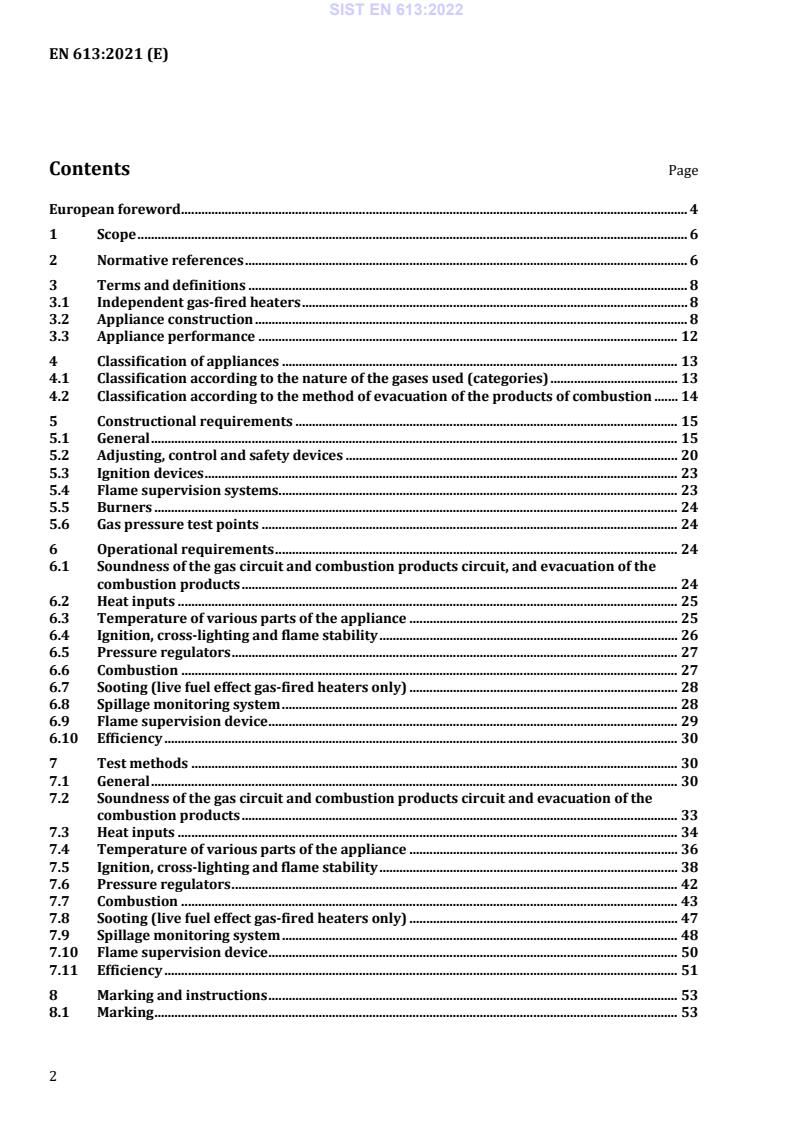
Contents Page
European foreword . 4
1 Scope . 6
2 Normative references . 6
3 Terms and definitions . 8
3.1 Independent gas-fired heaters . 8
3.2 Appliance construction . 8
3.3 Appliance performance . 12
4 Classification of appliances . 13
4.1 Classification according to the nature of the gases used (categories) . 13
4.2 Classification according to the method of evacuation of the products of combustion . 14
5 Constructional requirements . 15
5.1 General . 15
5.2 Adjusting, control and safety devices . 20
5.3 Ignition devices . 23
5.4 Flame supervision systems. 23
5.5 Burners . 24
5.6 Gas pressure test points . 24
6 Operational requirements . 24
6.1 Soundness of the gas circuit and combustion products circuit, and evacuation of the
combustion products . 24
6.2 Heat inputs . 25
6.3 Temperature of various parts of the appliance . 25
6.4 Ignition, cross-lighting and flame stability . 26
6.5 Pressure regulators . 27
6.6 Combustion . 27
6.7 Sooting (live fuel effect gas-fired heaters only) . 28
6.8 Spillage monitoring system . 28
6.9 Flame supervision device . 29
6.10 Efficiency . 30
7 Test methods . 30
7.1 General . 30
7.2 Soundness of the gas circuit and combustion products circuit and evacuation of the
combustion products . 33
7.3 Heat inputs . 34
7.4 Temperature of various parts of the appliance . 36
7.5 Ignition, cross-lighting and flame stability . 38
7.6 Pressure regulators . 42
7.7 Combustion . 43
7.8 Sooting (live fuel effect gas-fired heaters only) . 47
7.9 Spillage monitoring system . 48
7.10 Flame supervision device . 50
7.11 Efficiency . 51
8 Marking and instructions . 53
8.1 Marking . 53
8.2 Instructions . 56
Annex A (normative) Hood test method (type B appliances) . 71
Annex B (informative) Gas designations in force in the various EU countries . 75
Annex C (normative) Apparatus for the determination of the smoke number . 77
Annex D (informative) Symbols and abbreviations . 78
Annex E (normative) Calculation of conversions of NOx . 79
Annex F (normative) Arrangement for measuring the leakage rate . 80
Annex G (normative) Special national conditions . 81
Bibliography . 82
European foreword
This document (EN 613:2021) has been prepared by Technical Committee CEN/TC 62 “Independent
gas-fired space heaters”, the secretariat of which is held by BSI.
This European Standard shall be given the status of a national standard, either by publication of an
identical text or by endorsement, at the latest by June 2022, and conflicting national standards shall be
withdrawn at the latest by June 2022.
Attention is drawn to the possibility that some of the elements of this document may be the subject of
patent rights. CEN shall not be held responsible for identifying any or all such patent rights.
This document supersedes EN 613:2000.
The main changes compared to EN 613:2000 are the following:
• Clause 1 – the Scope has been extended to cover type C and type C appliances;
31 91
• Clause 3.2 – all terms and definitions related to gas in EN 613:2000, cl. 3.2, have been deleted and
replaced by reference to EN 437;
• EN 613:2000, Clauses 3.4 and 3.5 – have been deleted;
• EN 613:2000, Clause 3.6 – has been deleted;
• Clause 4.1 – original replaced by reference to EN 437;
• Clause 4.2 – classification extended to type C and type C appliances;
31 91
• EN 613:2000, Clauses 5.1.1.4, 5.2.7 and 5.6 – have been deleted;
• Clauses 7.1.1 and 7.1.2 – original replaced by reference to EN 437;
• Clause 6.2.2.2 and 7.2.2.2 – have been extended to cover type C and type C appliances;
31 91
• Clause 6.5.2.3 and 7.5.4 – have been extended to cover type C and type C appliances;
31 91
• Clause 7.1.5.3 – has been extended to cover type C and type C appliances;
31 91
• Clause 7.5.2 – has been extended to cover type C and type C appliances
31 91
• Clause 7.7.1.2 and 7.7.3.3 – have been extended to cover type C and type C appliances;
31 91
• Clause 7.11.1.3 – has been extended to cover type C and type C appliances;
31 91
• EN 613:2000, Annexes A, B, F and L – have been deleted;
• Annex G – new Annex to cover arrangement for measuring the leakage rate.
Any feedback and questions on this document should be directed to the users’ national standards body.
A complete listing of these bodies can be found on the CEN website.
According to the CEN-CENELEC Internal Regulations, the national standards organisations of the
following countries are bound to implement this European Standard: Austria, Belgium, Bulgaria,
Croatia, Cyprus, Czech Republic, Denmark, Estonia, Finland, France, Germany, Greece, Hungary, Iceland,
Ireland, Italy, Latvia, Lithuania, Luxembourg, Malta, Netherlands, Norway, Poland, Portugal, Republic of
North Macedonia, Romania, Serbia, Slovakia, Slovenia, Spain, Sweden, Switzerland, Turkey and the
United Kingdom.
1 Scope
This document specifies the requirements and test methods for the construction, safety, marking and
rational use of energy.
This document is applicable to types B B , B , C , C and C appliances (see 4.2) and those
11AS, 11BS 11CS 11 31 91
that:
— are closed-fronted;
— incorporate a natural draught burner;
— are connected directly to an open flue or to a device to evacuate the products of combustion (open-
flued appliances, balanced-flued appliances);
— are wall mounted, free-standing or built-in;
— have a nominal heat input not exceeding 20 kW (based on the net calorific value).
This document is not applicable to:
— open fronted appliances as specified in EN 13278:2013;
— decorative fuel effect appliances as specified in EN 509:1999/A1:2003;
— catalytic combustion appliances;
— appliances in which the supply of combustion air and/or evacuation of products of combustion is
achieved by mechanical means as specified in EN 1266:2002;
— ducted-air appliances;
— appliances installed by means of a closure plate (see 3.3.3.3).
Matters related to quality assurance systems, tests during production and to certificates of conformity
of auxiliary devices are not dealt with by this standard.
2 Normative references
The following documents are referred to in the text in such a way that some or all of their content
constitutes requirements of this document. For dated references, only the edition cited applies. For
undated references, the latest edition of the referenced document (including any amendments) applies.
EN 88-1:2011+A1:2016, Pressure governors for gas appliances for inlet pressure up to 200 mbar
EN 125:2010+A1:2015, Flame supervision devices for gas burning appliances — Thermoelectric flame
supervision devices
EN 126:2012, Multifunctional controls for gas burning appliances
EN 161:2011+A3:2013, Automatic shut-off valves for gas burners and gas appliances
EN 257:2010, Mechanical thermostats for gas-burning appliances
EN 298:2012, Automatic burner control systems for burners and appliances burning gaseous or liquid
fuels
EN 437:2021, Test gases — Test pressures — Appliance categories
EN 751-1:1996, Sealing materials for metallic threaded joints in contact with 1st, 2nd and 3rd family
gases and hot water — Part 1: Anaerobic jointing compounds
EN 751-2:1996, Sealing materials for metallic threaded joints in contact with 1st, 2nd and 3rd family
gases and hot water — Part 2: Non-hardening jointing compounds
EN 10226-1:2004, Pipe threads where pressure tight joints are made on the threads — Part 1: Taper
external threads and parallel internal threads — Dimensions, tolerances and designation
EN 10226-2:2005, Pipe threads where pressure tight joints are made on the threads — Part 2: Taper
external threads and taper internal threads — Dimensions, tolerances and designation
EN 1106:2010, Manually operated taps for gas burning appliances
EN 10305-1:2016, Steel tubes for precision applications — Technical delivery conditions — Part 1:
Seamless cold drawn tubes
EN 23166:1993, Codes for the representation of names of countries (ISO 3166:1993)
EN ISO 3166-1:2020, Codes for the representation of names of countries and their subdivisions — Part 1:
Country Codes (ISO 3166-1:2020)
EN 60335-1:2012/A2:2019, Household and similar electrical appliances — Part 1: Safety. General
requirements
EN 60335-2-102:2016, Household and similar electrical appliances — Safety — Part 2-102: Particular
requirements for gas, oil and solid-fuel burning appliances having electrical connections
EN 60529:1991/A2:2013, Degrees of protection provided by enclosures (IP code)
EN IEC 60730-2-9:2019/A1:2019, Automatic electrical controls — Part 2-9: Particular requirements for
temperature sensing control
EN 60730-1:2016, Automatic electrical controls — Part 1: General requirements
ISO 7-1:1994, Pipe threads where pressure-tight joints are made on the threads — Part 1: Dimensions,
tolerances and designation
EN ISO 228-1:2003, Pipe threads where pressure-tight joints are not made on the threads — Part 1:
Dimensions, tolerances and designation (ISO 228-1:2000)
CR 1404:1994, Determination of emissions from appliances burning gaseous fuels during type-testing
3 Terms and definitions
For the purposes of this document, the terms and definitions given in EN 437 and the following apply.
ISO and IEC maintain terminological databases for use in standardization at the following addresses:
— IEC Electropedia: available at https://www.electropedia.org/
— ISO Online browsing platform: available at https://www.iso.org/obp
3.1 Independent gas-fired heaters
3.1.1
closed-fronted appliance
appliance which does not have exposed flames or exposed incandescent areas
Note 1 to entry: Access to the flame is prevented by a panel made of glass, metal or a suitable material.
Note 2 to entry: Type C1 and type C3 appliances are room-sealed appliances.
3.1.2
forced gas-fired heater
appliance that incorporates a fan and thus allows an acceleration of the circulation of the air in contact
with the heating body
Note 1 to entry: Such an appliance is designed to discharge heated air directly into the room in which the
appliance is installed.
3.1.3
live fuel effect gas-firedheater
appliance which has a visual flame effect
3.1.4
working surfaces
area of the appliance that generates and emits heat
Note 1 to entry: Examples of working surfaces include fire bricks, refractories, imitation fuel, fire fronts, fire
baskets, burners, burner trays and bracketry.
3.1.5
convection fan
device to assist in the distribution of heated air
3.2 Appliance construction
3.2.1 The gas circuit
3.2.1.1
inlet connection
part of the appliance intended to be connected to the gas supply
3.2.1.2
mechanical joint
connection device assuring soundness in an assembly of several parts, generally of metal
Note 1 to entry: For example the following:
— cone seat joints;
— flat joints;
— metal to metal joints.
3.2.1.3
gas circuit
part of an appliance that conveys or contains the gas between the appliance gas inlet connection and the
burner(s)
3.2.1.4
gas restrictor
non-adjustable device which is placed in the gas circuit so as to create a pressure drop and thus reduce
the gas pressure at the burner to a predetermined value for a given supply pressure and rate
3.2.1.5
gas rate adjuster
component intended to set the gas rate to each burner at a predetermined value according to the supply
conditions
Note 1 to entry: The adjustment can be progressive (screw adjuster) or discontinuous (changing restrictors).
Note 2 to entry: The adjuster of an adjustable governor is regarded as a gas rate adjuster.
Note 3 to entry: The action of setting this device is called 'setting the gas rate'.
3.2.1.6
gas rate control
component allowing the user to open or close the gas supply to one or more burners
Note 1 to entry: It may also be used to adjust the gas rate of certain burners to a predetermined value, called the
'reduced rate'. This device can be a 'tap'.
3.2.1.7
injector
component that admits the gas into a burner, where the section of the outlet orifice is fixed
3.2.1.8
start gas
initial quantity of gas ignited to give a flame which is used to ignite the main burner
Note 1 to entry: It can be discharged through a separate ignition burner or part of the main burner.
3.2.2 Burner
3.2.2.1
main burner
burner that provides the primary thermal function of the appliance
3.2.2.2
pilot burner
burner intended to light the main burner and that supplements the main burner in providing a thermal
function of the appliance
3.2.2.2.1
permanent pilot
pilot burner that operates continuously throughout the whole period that the appliance is in use,
independent of the main burner, and has to be extinguished by manual intervention
3.2.2.2.2
non-permanent pilot
pilot burner that is extinguished automatically when there is no heat demand
3.2.2.2.3
fixed primary aeration restrictor
non-adjustable device which limits the supply of primary air to a burner
3.2.3 Combustion products circuit
3.2.3.1
flue outlet
part of a type B appliance that connects with a flue to evacuate the products of combustion
3.2.3.2
draught diverter
device placed in the combustion product's circuit to reduce the influence of flue-pull and to minimize
the effect of down-draught on the burner flame stability and combustion
3.2.3.3
closure plate
non-combustible plate used to cover and seal the front plane of a builder's opening, or fireplace
opening, such that when the appliance is installed, any air flowing from the room into the flue does so in
accordance with the design requirements of the appliance
Note 1 to entry: This plate contains an aperture through which the flue outlet spigot of the appliance projects
into the cavity of the builder's opening, or fireplace recess, but is not connected to the flue.
Note 2 to entry: The plate can be a separate component, or an integral part of the appliance, e.g. the back panel,
but in either case it is to be considered as part of the appliance.
3.2.3.4
builder's opening
enclosure constructed to accommodate fireplace components
3.2.3.5
fireplace opening
aperture formed in the face of the builder's opening, the fireplace recess or fire surround if fitted
3.2.3.6
fireplace recess
recess formed by the inclusion of fireplace components in the builder's opening
3.2.4 Auxiliary equipment
3.2.4.1
pressure governor
device that maintains, within a fixed range, a constant downstream pressure, independent of the
upstream pressure and/or the gas rate
3.2.4.2
ignition device
device that ignites one or more burners
3.2.4.3
flame supervision device
device that senses the absence or presence of a flame
3.2.4.4
combustion products discharge safety device
device that automatically shuts off the gas supply to the main burner, and perhaps to the ignition
burner, when there is unacceptably high spillage of combustion products from the draught diverter
3.2.4.5
atmosphere sensing device
device that reacts to the lack of oxygen in the surrounding atmosphere
3.2.4.6
control knob
component designed to be moved by hand in order to operate an appliance control (tap, thermostat,
etc.)
3.2.4.7
programming unit
unit which reacts to signals from control and safety devices, gives control commands, controls the start-
up sequence, supervises the burner operation and causes controlled shut-down, and if necessary safety
shut-down and lock-out
Note 1 to entry: The programming unit follows a predetermined sequence of actions and always operates in
conjunction with a flame detector device.
3.2.4.8
flame detector device
device by which the presence of a flame is detected and signalled
Note 1 to entry: It can consist of a flame sensor, an amplifier and a relay for signal transmission. These parts,
with the possible exception of the actual flame sensor, may be assembled in a single housing for use in conjunction
with a programming unit.
3.2.4.9
automatic burner system
burner system in which, when starting from the completely shut-down condition, the gas is ignited and
the flame is detected and proved and the main gas valve(s) is actuated without manual intervention
3.2.4.10
restart interlock
device which prevents the restoration of the gas supply to the main burner, or to the main burner and
ignition burner, until the end of the extinction delay time
3.3 Appliance performance
3.3.1 Gas rates
3.3.1.1
nominal heat input
Q
n
value of the heat input declared in the technical specification
Note 1 to entry: Unit: kilowatt (kW).
3.3.2 Gas combustion
3.3.2.1
flame stability
state of the flames resting in a stable manner on the burner ports or the flame contact area provided by
the design with no flame lift or light-back
3.3.2.2
flame lift
phenomenon characterized by the total or partial lifting of the base of the flame from the burner port or
the flame contact area provided by the design
3.3.2.3
light-back
phenomenon characterized by the entry of a flame into the body of a burner
3.3.2.4
light-back at the injector
phenomenon characterized by ignition of the gas at the injector, either as a result of the flame entering
the burner or by the propagation of a flame around the outside of the burner
3.3.2.5
sooting
phenomenon characterized by deposits of soot on the surfaces of parts of the appliance in contact with
the products of combustion or with the flame, or as particulate matter in the combustion products
3.3.2.6
yellow tipping
phenomenon characterized by the appearance of yellow colouring at the top of the blue cone of an
aerated flame
3.3.3
safety time
interval between the ignition burner gas valve, the start gas valve or main gas valve, as applicable, being
energized and the ignition burner gas valve, start gas valve or main gas valve, as applicable, being de-
energized if the flame detector signals the absence of a flame
3.3.4
extinction delay time
time that elapses between the disappearance of the flame and the interruption of the gas supply
3.3.5
ignition delay time
time that elapses between ignition of the supervised flame and the moment when the closure element is
held open by the flame signal
Note 1 to entry: This applies to a thermoelectric flame supervision device.
3.3.6
thermal equilibrium
operating state of the appliance, corresponding to a particular setting of the input, in which the flue gas
temperature does not change by more than ± 2 K over a period of 10 min
3.3.7
controlled shutdown
process by which a control device (on the appliance or external to it) causes the gas supply to the main
burner to be stopped immediately
3.3.8
safety shutdown
process which is initiated immediately in response to the signal from a limiting device or sensor and
which causes any burner to shut down
3.3.9
non-volatile lockout
shutdown condition so that a start can only be accomplished by a manual reset
3.3.10
volatile lockout
shutdown condition so that a start can be accomplished by restoration of the electrical supply after its
loss
3.3.11
smoke number
qualitative scale of the soot emission
4 Classification of appliances
4.1 Classification according to the nature of the gases used (categories)
4.1.1 Classification of gases
Gases are classified into three families, possibly divided into groups as a function of the Wobbe index in
accordance with the values given in EN 437:2021, Table 1.
4.1.2 Appliance categories
Appliance are classified into categories defined according to the gases and the pressures for which they
are designed as given in EN 437:2021, 6.1.
4.2 Classification according to the method of evacuation of the products of combustion
Appliances are classified into types according to the method of evacuation of the products of
combustion and of admission of the combustion air:
• Type B: An appliance intended to be connected to a flue which evacuates the products of
combustion to the outside of the room containing the appliance. The combustion air is drawn
directly from the room.
• Type B : A type B appliance incorporating a draught diverter.
• For the purposes of this standard a type B appliance is an appliance that is connected directly or
by means of an adaptor to a flue.
• Type B : A natural draught type B appliance designed for a natural draught flue, which includes
11 1
Type B Type B and Type B appliances.
11AS, 11BS 11CS
• Type B : A type B appliance fitted with an atmospheric sensing device to prevent the release of
11AS 11
combustion products in a dangerous quantity into the room under abnormal draught conditions.
• Type B : A type B appliance fitted with a combustion products discharge safety device to
11BS 11
prevent the release of combustion products in dangerous quantities into the room under abnormal
draught conditions.
• Type B : A type B appliance not fitted with an atmosphere sensing device or combustion
11CS 11
products discharge safety device, but is constructed to prevent the release of combustion products
in dangerous quantities into the room under abnormal draught conditions.
• Type C: An appliance in which the combustion circuit (air supply, combustion chamber, heat
exchanger, and evacuation of the combustion products) is sealed with respect to the room in which
the appliance is installed.
• Type C : A type C appliance that is designed for connection via its ducts to its horizontal terminal,
which at the same time admits fresh air to the burner and discharges the products of combustion to
the outside through orifices which are either concentric or close enough together to come under
the same wind conditions.
• Type C : A natural draught type C appliance.
11 1
• Type C : A type C appliance that is designed for connection via its ducts to a vertical terminal, which
at the same time admits fresh air to the burner and discharges the products of combustion to the
outside through orifices that are either concentric or close enough together to come under the same
wind conditions.
• Type C : A natural draught type C appliance.
31 3
• Type C : A type C appliance that is designed for connection via its flue duct to a vertical terminal
and via its inlet duct to an existing vertical duct. The terminal at the same time admits fresh air to
the burner and discharges the products of combustion to the outside through orifices that are
either concentric or close enough to come under similar wind conditions.
• Type C : A natural draught type C appliance.
91 9
5 Constructional requirements
5.1 General
5.1.1 Conversion to different gases
5.1.1.1 General
In accordance with the categories (see 4.1), the only acceptable modifications and/or adjustments when
converting from a gas of one group or family to another group or family and/or for adapting to a
different gas distribution pressures, are given in 5.1.1.2 to 5.1.1.3 for each appliance category.
For type B appliances, when the operation of atmosphere sensing devices depends upon the
11AS
characteristics of the gas (including pressure), a change of the complete atmosphere sensing device is
required when converting from a gas of one family to a gas of another family, or from one pressure or
pressure couple to another within the third family, if this is specified in the instructions for installation,
use and servicing.
5.1.1.2 Category I
• Categories I ,I ,I , I : Modification and/or adjustment of the appliance is not applicable.
2H 2L 2E 2E+
• Category I : No modification and/or adjustment of the appliance except for replacement of the
3+
injectors or restrictors in order to convert from one pressure couple to another (e.g. 28 mbar to
30 mbar/37 mbar < = > 50 mbar/67 mbar). Exchange of fixed primary aeration restrictor when
changing from one pressure couple to another or from one pressure to another within a pressure
couple is permitted.
• Category I , I : No modification and/or adjustment of the appliance with respect to a change of
3P 3B/P
gas. For a change of pressure range, replacement of injectors, and adjustment of gas rates and
exchange of fixed primary aeration restrictor is permitted.
5.1.1.3 Category II
5.1.1.3.1 Appliance categories designed for use on gases of the first and second families
The following modifications and/or adjustments are permitted but only when converting from a gas of
one family to a gas of another family:
a) adjustment of the gas rate with, if necessary, a change of injectors, restrictors or governor;
b) replacement of a burner assembly;
c) replacement of complete ignition burners or some of its parts;
d) exchange of fixed primary aeration restrictor.
If the appliance is intended to function without an operational governor for use with gases of the second
family, it is obligatory to put the governor out of service in these circumstances (see 5.2.6).
It is obligatory to put gas rate adjusters out of service for use with gases of the second family.
5.1.1.3.2 Appliance categories designed for use on gases of the second and third families
The following modifications and/or adjustments are permitted but only when converting from a gas of
one family to a gas of another family:
a) adjustment of the gas rate with, if necessary, a change of injectors, restrictors or governor;
b) replacement of a burner assembly;
c) replacement of complete ignition burner or some of its parts;
d) exchange of the fixed primary aeration restrictor.
The governor shall be put out of service where this is required in accordance with the requirements of
5.2.6.
Gas rate adjusters shall be put out of service in accordance with requirements of 5.2.2.
The following modifications and/or adjustments are permitted when changing from one pressure
couple to another or from one pressure range to another:
1) replacement of the injectors or restrictors in order to convert from one pressure couple to another
within the third family (e.g. 28 mbar to 30 mbar/37 mbar < = > 50 mbar/67 mbar).
2) exchange of fixed primary aeration restrictor when changing from one pressure couple to another
or from one pressure to another within a pressure couple is permitted.
For a change of pressure range in the case of appliance categories using third family gases without a
pressure couple (i.e. “3P” and “3B/P”), replacement of injectors, adjustment of the gas rates and
exchange of fixed primary aeration restrictor is permitted.
5.1.2 Materials and method of construction
The quality and thickness of the materials used in the construction of the appliance, and the method of
assembling the various parts, shall be such that the constructional, functional and operational
characteristics do not alter during a reasonable life under normal conditions of installation, use and
maintenance. This includes the gas carrying components which shall be of metallic or non-metallic
material but suitable for the type of gas for which the appliance is approved, this includes the gas
carrying and flue carrying components.
When the appliance is installed according to the instructions for installation, use and servicing and
national installation requirements, all components shall withstand the mechanical, chemical and
thermal conditions to which they might be subjected during use.
Sheet metal parts in contact with products of combustion and not made of corrosion-resistant material
shall be coated with an effective protection against corrosion, e.g. enamel.
Asbestos or materials containing asbestos shall not be used.
If condensation is produced at the start-up and/or during the normal operation of the appliance, it shall
not cause a deterioration in the construction of the appliance and/or materials used so as to affect the
safety of the appliance. The design of an appliance shall be such that condensate cannot drip outside of
the appliance.
5.1.3 Accessibility for use and maintenance
Any control placed in the gas circuit shall be arranged so that it can be adjusted, maintained or
exchanged.
Removable parts shall be so designed or marked that they are easy to reassemble correctly in
accordance with the instructions for installation, use and servicing and difficult to reassemble
incorrectly. Removable parts shall be so designed or marked that they are easy to reassemble correctly
in accordance with the instructions for installation, use and servicing and any incorrect assembly shall
be obvious.
It shall be possible to complete all the operations of removal and reassembly of parts which the user has
to carry out in the course of routine maintenance as explained in the instructions for installation, use
and servicing, without the aid of a tool.
Removable parts shall be dismountable for maintenance by a service engineer using tools in common
use, such as a screwdriver or a spanner.
For a type C , C and C appliances, the soundness of the combustion circuit shall be maintained
11 31 91
after reassembly and, if required, after replacing the sealing gasket following cleaning or maintenance
operations.
An appliance shall be capable of being fixed securely. The instructions for installation, use and servicing
shall give relevant and precise information.
When the combustion circuit of an appliance incorporates a door which is required to be opened or a
panel which is required to be removed, it shall be difficult to close the door or replace the panel
incorrectly.
If the above operation does not require the use of a tool, this operation shall not be obvious and the
procedure shall be specified in the instructions for use and servicing (see 8.2.2).
In the case where a special tool is supplied by the manufacturer, this tool shall be removable once the
above operation has been completed.
5.1.4 Connections
5.1.4.1 Appliance inlet connection
The appliance inlet connection shall conform to the soundness requirements specified in 6.1.1.
The appliance inlet connection shall be one of the following types:
a) a thread conforming to EN 10226-1:2004. In this case the end of the gas inlet connection shall have
a flat annular surface at least 3 mm wide for thread sizes 1/2" and 3/8" and at least 2,5 mm wide
for thread size 1/4", to allow the interposition of a sealing washer. When the end of the gas inlet
connection has a thread of nominal size 1/2", it shall be possible to insert a gauge of 12,3 mm
diameter to a depth of at least 4 mm;
b) a thread conforming to ISO 7-1:1994 and EN ISO 228-1:2003;
c) a compression fitting with dimensions compatible with the steel tube dimensions conforming to
EN 10305-1:2016;
d) a straight tube at least 30 mm long, the end of which is cylindrical, smooth and clean, to allow
connection by means of a compression fitting as specified in c);
e) a cone seat union.
Other connections are possible if the soundness requirements of 6.1.1 are met.
5.1.4.2 Access to the inlet connection
The position of the connection shall be such that connection to the gas supply can be made easily with
tools in common use.
5.1.5 Soundness of the gas circuit
The joints, sealing compounds and sealing materials used in the construction of the appliance, and the
method of assembling the various parts, shall be such that the constructional, functional and
operational characteristics do not alter significantly during a reasonable life under normal conditions of
installation, use and maintenance. This includes the gas carrying components. Sealing materials for
metallic threaded joints in gas circuit shall be in accordance with EN 751-1:1996 (for anaerobic jointing
compounds) or EN 751-2:1996 Class B (for non-hardening jointing compounds) for the threads in
compliance with EN 10226-1:2004 (Threaded joints using taper external threads and parallel internal
threads) (Threaded joints using taper external threads and taper internal threads) and
EN 10226-2:2005 (Threaded joints using taper external threads and taper internal threads).
Holes for screws, studs, etc., intended for the assembly of components shall not open into the gasways.
Brackets for supporting components shall not be interposed in any gas-carrying joints.
The soundness of components and assemblies connected to the gas circuit and likely to be dismantled
for routine maintenance at the consumer's premises, with the exception of taps and cocks, shall be
ensured by means of mechanical joints, e.g. metal to metal joints, O-ring joints or packing, but excluding
the use of any sealing compound such as tape, mastic or paste. Sealing compounds may be used for
permanent threaded assemblies and injectors and grease for taps and cocks. The sealing material shall
remain effective under normal conditions of appliance use.
The soundness of the gas circuit assemblies shall not be achieved by means of soft solder for which the
lowest temperature of the melting range, after application, is less than 450 °C.
The soundness of the gas circuit shall conform to 6.1.1.
5.1.6 Soundness of the combustion circuit
5.1.6.1 Type B appliances
The soundness of an appliance up to the draught-diverter shall be effected by mechanical means only,
with the exception of those parts which do not require to be disconnected for routine maintenance,
which may be joined with mastic or paste in such a way that permanent soundness is ensured under
normal conditions of use.
Parts which can be removed for routine maintenance shall be so designed and arranged that soundness
is ensured after reassembly.
5.1.6.2 Type C , C and C appliances
11 31 91
The soundness of the heating body and of the connection of an appliance to the combustion air inlet and
the products outlet ducts shall be effected by mechanical means only.
However, those parts of the assembly which do not require to be dismantled for routine maintenance
may be joined with mastic or paste in such a way that permanent soundness is ensured under normal
conditions of use.
The construction of the whole assembly shall ensure soundness in relation to the room in which an
appliance is installed.
Parts which can be removed for routine maintenance shall be so designed and arranged that soundness
is ensured after reassembly.
5.1.6.3 Built-in appliances
If an appliance is supplied in several sub-groups which have to be assembled on installation, it shall be
possible to carry out this operation without ambiguity when assembling in accordance with the
instructions for installation, use and servicing. If a special tool is required it shall be supplied by the
manufacturer.
Any components or materials necessary to assemble these sub-groups shall be supplied by the
manufacturer.
5.1.7 Supply of combustion air and
...