

EN 161:2011+A3:2013
(Main + Amendment)Automatic shut-off valves for gas burners and gas appliances
- Abstract
This European Standard specifies the safety, construction and performance requirements for automatic shut-off valves for use with gas burners, gas appliances and similar use, hereafter referred to as ‘valves’.
This European Standard is applicable to valves with declared maximum inlet pressures up to and including 500 kPa (5 bar) of nominal connection sizes up to and including DN 250 for use with one or more fuel gases in accordance with EN 437.
This European Standard is applicable to electrically operated valves and to valves actuated by fluids where the control valves for these fluids are actuated electrically, but not to any external electrical devices for switching the control signal or actuating energy.
An assessment method for valve designs is given by this European Standard.
This European Standard is also applicable to valves where the flow rate is controlled by external electrical signals, either in discrete steps or proportional to the applied signal.
This European Standard is also applicable to valves fitted with closed position indicator switches.
NOTE Provisions for final product inspection and testing by the manufacturer are not specified.
- Status
- Withdrawn
- Publication Date
- 15-Jan-2013
- Withdrawal Date
- 06-Oct-2026
- Technical Committee
- CEN/TC 58 - Safety and control devices for burners and appliances burning gaseous or liquid fuels
- Drafting Committee
- CEN/TC 58/WG 13 - Mechanics
- Current Stage
- 9960 - Withdrawal effective - Withdrawal
- Start Date
- 12-Oct-2022
- Completion Date
- 07-Oct-2026



Relations
- Effective Date
- 19-Jan-2023
- Effective Date
- 19-Jan-2023
- Effective Date
- 19-Oct-2022
- Effective Date
- 01-Apr-2026
- Effective Date
- 09-Feb-2026
- Effective Date
- 09-Feb-2026
- Effective Date
- 09-Feb-2026
- Effective Date
- 09-Feb-2026
- Effective Date
- 28-Jan-2026
- Effective Date
- 28-Jan-2026
- Effective Date
- 28-Jan-2026
- Effective Date
- 28-Jan-2026
- Effective Date
- 28-Jan-2026
- Effective Date
- 28-Jan-2026
- Effective Date
- 28-Jan-2026
Get Certified
Connect with accredited certification bodies for this standard

Institut za varilstvo d.o.o. (Welding Institute)
Slovenia's leading welding institute since 1952. ISO 3834, EN 1090, pressure equipment certification, NDT personnel, welder qualification. Only IIW Au
Sponsored listings
Frequently Asked Questions
EN 161:2011+A3:2013 is a standard published by the European Committee for Standardization (CEN). Its full title is "Automatic shut-off valves for gas burners and gas appliances". This standard covers: This European Standard specifies the safety, construction and performance requirements for automatic shut-off valves for use with gas burners, gas appliances and similar use, hereafter referred to as ‘valves’. This European Standard is applicable to valves with declared maximum inlet pressures up to and including 500 kPa (5 bar) of nominal connection sizes up to and including DN 250 for use with one or more fuel gases in accordance with EN 437. This European Standard is applicable to electrically operated valves and to valves actuated by fluids where the control valves for these fluids are actuated electrically, but not to any external electrical devices for switching the control signal or actuating energy. An assessment method for valve designs is given by this European Standard. This European Standard is also applicable to valves where the flow rate is controlled by external electrical signals, either in discrete steps or proportional to the applied signal. This European Standard is also applicable to valves fitted with closed position indicator switches. NOTE Provisions for final product inspection and testing by the manufacturer are not specified.
This European Standard specifies the safety, construction and performance requirements for automatic shut-off valves for use with gas burners, gas appliances and similar use, hereafter referred to as ‘valves’. This European Standard is applicable to valves with declared maximum inlet pressures up to and including 500 kPa (5 bar) of nominal connection sizes up to and including DN 250 for use with one or more fuel gases in accordance with EN 437. This European Standard is applicable to electrically operated valves and to valves actuated by fluids where the control valves for these fluids are actuated electrically, but not to any external electrical devices for switching the control signal or actuating energy. An assessment method for valve designs is given by this European Standard. This European Standard is also applicable to valves where the flow rate is controlled by external electrical signals, either in discrete steps or proportional to the applied signal. This European Standard is also applicable to valves fitted with closed position indicator switches. NOTE Provisions for final product inspection and testing by the manufacturer are not specified.
EN 161:2011+A3:2013 is classified under the following ICS (International Classification for Standards) categories: 23.060.10 - Globe valves. The ICS classification helps identify the subject area and facilitates finding related standards.
EN 161:2011+A3:2013 has the following relationships with other standards: It is inter standard links to EN 161:2011+A2:2012, EN 161:2011/FprA1, EN 161:2022, EN 30-1-4:2026, EN 60529:1991, EN IEC 61058-1:2018, EN 175301-803:2006, EN 60730-1:2000, EN 30-2-2:2024, EN 298:2022, EN 13611:2007+A2:2011, EN 30-1-2:2023+A1:2024, EN 13906-2:2013, EN 13906-1:2013, EN 30-2-1:2024. Understanding these relationships helps ensure you are using the most current and applicable version of the standard.
EN 161:2011+A3:2013 is associated with the following European legislation: EU Directives/Regulations: 2009/142/EC; Standardization Mandates: M/BC/CEN/89/6. When a standard is cited in the Official Journal of the European Union, products manufactured in conformity with it benefit from a presumption of conformity with the essential requirements of the corresponding EU directive or regulation.
EN 161:2011+A3:2013 is available in PDF format for immediate download after purchase. The document can be added to your cart and obtained through the secure checkout process. Digital delivery ensures instant access to the complete standard document.
Standards Content (Sample)
2003-01.Slovenski inštitut za standardizacijo. Razmnoževanje celote ali delov tega standarda ni dovoljeno.Automatische Absperrventile für Gasbrenner und GasgeräteRobinets automatiques de sectionnement pour brûleurs à gaz et appareils à gazAutomatic shut-off valves for gas burners and gas appliances27.060.20Plinski gorilnikiGas fuel burners23.060.10Zapirni ventili (kroglasti)Globe valvesICS:Ta slovenski standard je istoveten z:EN 161:2011+A3:2013SIST EN 161:2011+A3:2013en,fr,de01-julij-2013SIST EN 161:2011+A3:2013SLOVENSKI
STANDARDSIST EN 161:2011+A2:20131DGRPHãþD
EUROPEAN STANDARD NORME EUROPÉENNE EUROPÄISCHE NORM
EN 161:2011+A3
January 2013 ICS 23.060.10 Supersedes EN 161:2011+A2:2012English Version
Automatic shut-off valves for gas burners and gas appliances
Robinets automatiques de sectionnement pour brûleurs à gaz et appareils à gaz
Automatische Absperrventile für Gasbrenner und Gasgeräte This European Standard was approved by CEN on 20 February 2011 and includes Amendment 2 approved by CEN on 10 June 2012 and Amendment 3 approved by CEN on 10 November 2012.
CEN members are bound to comply with the CEN/CENELEC Internal Regulations which stipulate the conditions for giving this European Standard the status of a national standard without any alteration. Up-to-date lists and bibliographical references concerning such national standards may be obtained on application to the CEN-CENELEC Management Centre or to any CEN member.
This European Standard exists in three official versions (English, French, German). A version in any other language made by translation under the responsibility of a CEN member into its own language and notified to the CEN-CENELEC Management Centre has the same status as the official versions.
CEN members are the national standards bodies of Austria, Belgium, Bulgaria, Croatia, Cyprus, Czech Republic, Denmark, Estonia, Finland, Former Yugoslav Republic of Macedonia, France, Germany, Greece, Hungary, Iceland, Ireland, Italy, Latvia, Lithuania, Luxembourg, Malta, Netherlands, Norway, Poland, Portugal, Romania, Slovakia, Slovenia, Spain, Sweden, Switzerland, Turkey and United Kingdom.
EUROPEAN COMMITTEE FOR STANDARDIZATION
COMITÉ EUROPÉEN DE NORMALISATION EUROPÄISCHES KOMITEE FÜR NORMUNG
Management Centre:
Avenue Marnix 17,
B-1000 Brussels © 2013 CEN All rights of exploitation in any form and by any means reserved worldwide for CEN national Members. Ref. No. EN 161:2011+A3:2013: ESIST EN 161:2011+A3:2013
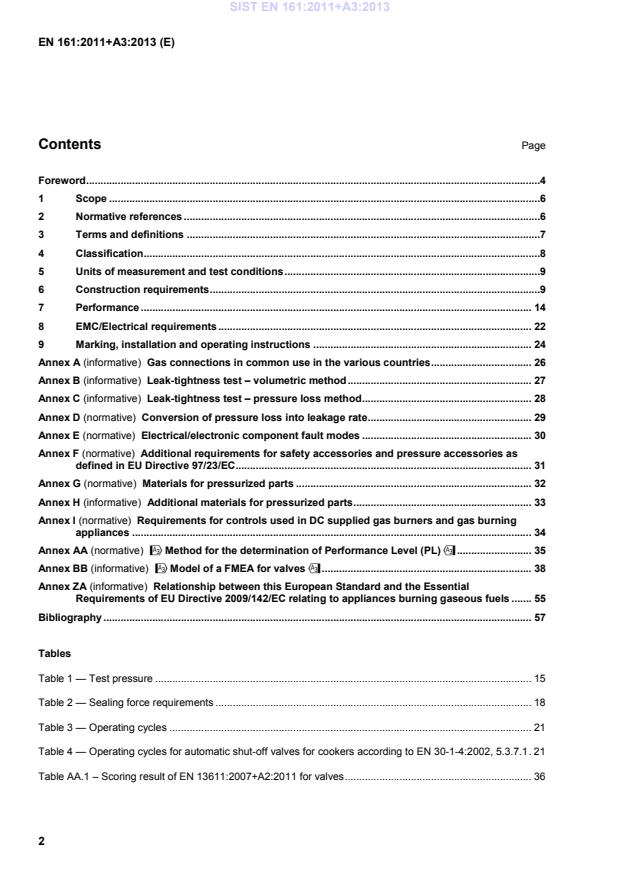
Gas connections in common use in the various countries . 26 Annex B (informative)
Leak-tightness test – volumetric method . 27 Annex C (informative)
Leak-tightness test – pressure loss method . 28 Annex D (normative)
Conversion of pressure loss into leakage rate . 29 Annex E (normative)
Electrical/electronic component fault modes . 30 Annex F (normative)
Additional requirements for safety accessories and pressure accessories as defined in EU Directive 97/23/EC . 31 Annex G (normative)
Materials for pressurized parts . 32 Annex H (informative)
Additional materials for pressurized parts . 33 Annex I (normative)
Requirements for controls used in DC supplied gas burners and gas burning appliances . 34 Annex AA (normative)
%Method for the determination of Performance Level (PL)& . 35 Annex BB (informative)
%Model of a FMEA for valves& . 38 Annex ZA (informative)
Relationship between this European Standard and the Essential Requirements of EU Directive 2009/142/EC relating to appliances burning gaseous fuels . 55 Bibliography . 57
Tables Table 1 — Test pressure . 15 Table 2 — Sealing force requirements . 18 Table 3 — Operating cycles . 21 Table 4 — Operating cycles for automatic shut-off valves for cookers according to EN 30-1-4:2002, 5.3.7.1 . 21 Table AA.1 – Scoring result of EN 13611:2007+A2:2011 for valves . 36 SIST EN 161:2011+A3:2013
Foreword This document (EN 161:2011+A3:2013) has been prepared by Technical Committee CEN/TC 58 “Safety and control devices for burners and appliances burning gaseous or liquid fuels”, the secretariat of which is held by BSI. This European Standard shall be given the status of a national standard, either by publication of an identical text or by endorsement, at the latest by July 2013, and conflicting national standards shall be withdrawn at the latest by July 2013. Attention is drawn to the possibility that some of the elements of this document may be the subject of patent rights. CEN [and/or CENELEC] shall not be held responsible for identifying any or all such patent rights. This document supersedes %EN 161:2011+A2:2012&. This document includes Amendment 2, approved by CEN on 2012-06-10 and Amendment 3 approved by CEN on 2012-11-10. The start and finish of text introduced or altered by amendment is indicated in the text by tags #$ and %&. This document is intended to be used in conjunction with #EN 13611:2007+A2:2011$. This document refers to clauses of #EN 13611:2007+A2:2011$ or adapts clauses by stating “with the following modification”, “with the following addition”, “is replaced by the following” or "is not applicable" in the corresponding clause. This European Standard adds clauses or sub-clauses to the structure of
#EN 13611:2007+A2:2011$ which are particular to this European Standard i.e. sub-clauses or annexes, which are additional to those in #EN 13611:2007+A2:2011$, are numbered starting from 101 or are designated as Annex AA, BB, CC etc. It should be noted that these clauses and sub-clauses are not indicated as an addition. %At the time of publication of Amendment 2, Amendment 1 was still at the draft stage. Therefore, there will be no Amendment 1 for this project. The present document incorporates the changes of the original Amendment 1 and Amendment 2.& It should be noted that the following significant editorial changes compared to the previous edition have been incorporated in this European Standard:
a) alignment to #EN 13611:2007+A2:2011$; b) normative references: ISO 4400 and ISO 6952 are changed to EN 175301-803; c) terms and definitions are aligned to #EN 13611:2007+A2:2011$; d) %sub-clause 6.2.105, Balanced valves, has been changed; e) sub-clause 6.2.107, Additional requirements for shut-off function, has been changed;& f) sub-clause 6.101 has been moved to sub-clause 8.11.102; g) %sub-clause 7.105.1, Sealing force requirements, has been changed;& h) installation and operating instructions are integrated in one sub-clause; SIST EN 161:2011+A3:2013
SIL classification according to EN 61508 cannot be claimed based upon compliance with this standard. Valves with SIL classification do not meet automatically the requirements of this standard. %Primarily in industrial applications it is common practice to rate the safety of a plant based on values describing the likelihood of a dangerous failure. These values are being used to determine Safety Integrity Levels or Performance Levels when the system is being assessed in its entirety. CEN/TC 58 standards for safety relevant controls do go beyond this approach, because for a certain life span for which the product is specified, designed and tested a dangerous failure is not allowed at all. Failure modes are described and assessed in greater detail. Measures to prevent dangerous situations occurring are defined. Field experience over many decades is reflected in the CEN/TC 58 standards. Requirements of these standards can be considered as proven in practice. The PL assessment in Annex AA is only applicable to automatic shut-off valves which are already certified to this European Standard. It cannot be presumed that any Safety Integrity Level or Performance Level assessment alone would imply that requirements of a CEN/TC 58 standard have been met.
To be able to provide parameters to allow for any formal Safety Integrity Level or Performance Level system assessment the Annexes AA and BB of this document define a methodology to derive the relevant parameters from the requirements of this standard.& According to the CEN/CENELEC Internal Regulations, the national standards organisations of the following countries are bound to implement this European Standard: Austria, Belgium, Bulgaria, Croatia, Cyprus, Czech Republic, Denmark, Estonia, Finland, Former Yugoslav Republic of Macedonia, France, Germany, Greece, Hungary, Iceland, Ireland, Italy, Latvia, Lithuania, Luxembourg, Malta, Netherlands, Norway, Poland, Portugal, Romania, Slovakia, Slovenia, Spain, Sweden, Switzerland, Turkey and the United Kingdom.
1 Scope This European Standard specifies the safety, construction and performance requirements for automatic shut-off valves for use with gas burners, gas appliances and similar use, hereafter referred to as ‘valves’.
This European Standard is applicable to valves with declared maximum inlet pressures up to and including 500 kPa (5 bar) of nominal connection sizes up to and including DN 250 for use with one or more fuel gases in accordance with EN 437. This European Standard is applicable to electrically operated valves and to valves actuated by fluids where the control valves for these fluids are actuated electrically, but not to any external electrical devices for switching the control signal or actuating energy. An assessment method for valve designs is given by this European Standard. This European Standard is also applicable to valves where the flow rate is controlled by external electrical signals, either in discrete steps or proportional to the applied signal. This European Standard is also applicable to valves fitted with closed position indicator switches. NOTE Provisions for final product inspection and testing by the manufacturer are not specified. %This European standard establishes methodologies for the determination of a Performance Level (PL) in accordance with EN 13611:2007+A2:2011, Annexes K and L.& 2 Normative references The following referenced documents are indispensable for the application of this document. For dated references, only the edition cited applies. For undated references, the latest edition of the referenced document (including any amendments) applies. EN 30 (all parts), Domestic cooking appliances burning gas EN 298, Automatic gas burner control systems for gas burners and gas burning appliances with or without fans #EN 13611:2007+A2:2011$, Safety and control devices for gas burners and gas burning appliances — General requirements EN 13906-1, Cylindrical helical springs made from round wire and bar — Calculation and design — Part 1: Compression springs EN 13906-2, Cylindrical helical springs made from round wire and bar — Calculation and design — Part 2: Extension springs EN 60529, Degrees of protection provided by enclosures (IP code) (IEC 60529:1989) EN 60730-1:2000, Automatic electrical controls for household and similar use — Part 1: General requirements (IEC 60730-1:1999, modified) EN 61058-1, Switches for appliances — Part 1: General requirements (IEC 61058-1:2000 modified + A1:2001 (Equivalent) SIST EN 161:2011+A3:2013
thickness, locking screw not detachable
3 Terms and definitions For the purposes of this document, the terms and definitions given in #EN 13611:2007+A2:2011$ and the following apply. 3.101 automatic shut-off valve valve which opens when energized and closes automatically when de-energized 3.102 actuating mechanism part of the valve which moves the closure member 3.103 valve with step control valve which controls the flow rate in steps 3.104 valve with modulating control valve which controls the flow rate continuously between two limits in response to external electrical signals 3.105 closed position indicator switch switch fitted to a valve which indicates when the closure member is in the closed position 3.106 actuating energy required energy for the actuating mechanism to move the closure member to the open position NOTE The actuating energy can have an external source (electrical, pneumatic or hydraulic) and can be transformed inside the valve. 3.107 opening force force required to move the closure member to the open position 3.108 closing force force available to close the valve, independent of any force provided by fuel gas pressure 3.109 sealing force force acting on the valve seat when the closure member is in the closed position, independent of any force provided by fuel gas pressure 3.110 frictional force largest force required to move the actuating mechanism and the closure member from the open position to the closed position with the closure spring removed, independent of any force provided by fuel gas pressure 3.111 actuating pressure hydraulic or pneumatic pressure supplied to the actuating mechanism of the valve SIST EN 161:2011+A3:2013
6 Construction requirements 6.1 General Shall be according to #EN 13611:2007+A2:2011$, 6.1. 6.2 Mechanical parts of the control 6.2.1 Appearance Shall be according to #EN 13611:2007+A2:2011$, 6.2.1. 6.2.2 Holes Shall be according to #EN 13611:2007+A2:2011$, 6.2.2. 6.2.3 Breather holes Shall be according to #EN 13611:2007+A2:2011$, 6.2.3. 6.2.4 Test for leakage of breather holes Shall be according to #EN 13611:2007+A2:2011$, 6.2.4. 6.2.5 Screwed fastenings Shall be according to #EN 13611:2007+A2:2011$, 6.2.5. 6.2.6 Jointing Shall be according to #EN 13611:2007+A2:2011$, 6.2.6. 6.2.7 Moving parts Shall be according to #EN 13611:2007+A2:2011$, 6.2.7. 6.2.8 Sealing caps Shall be according to #EN 13611:2007+A2:2011$, 6.2.8. 6.2.9 Dismantling and reassembly Shall be according to #EN 13611:2007+A2:2011$, 6.2.9. SIST EN 161:2011+A3:2013
6.2.106.2.1 General This clause defines a method for the assessment of other means for closing and sealing in automatic shut-off valves. By this clause the term “class of control function A, B or C” is not related to the sealing force classes but to the class of control function as described in 4.3. Sealing force of valves shall be classified according to 4.1. SIST EN 161:2011+A3:2013
#EN 13611:2007+A2:2011$, 6.6, the combination of two automatic shut-off valves is considered equal to a control function class C. This assumption is based on the construction and performance requirements of this European Standard. 6.2.106.2.2 New designs for closing and/or sealing New designs for closing and/or sealing shall fulfil at least the requirements of a control function class B. In all cases the gas shut-off function shall be a control function class C. NOTE For further information see EN 14459. During the testing, the valve shall fulfil the performance requirements of Clause 7. New designs may consist of a combination of closure members, electronic controller, sensing elements, actuators, lockout and reset. The manufacturer shall declare the other means for closing and/or sealing. For the assessment of the new design the requirements of this European Standard shall be used in combination with #EN 13611:2007+A2:2011$, 6.6. If this leads to aspects that are not described in this European Standard, the manufacturer shall supply a failure mode analysis on the new design. This analysis shall describe the specific failure modes for the type of technology used in relation to the following basic safety requirements: a) closing function at power interruption; b) leak tightness; c) sealing force (ability to withstand backpressure, to be checked by testing or calculation); d) closing force > friction force; e) closing time including the influence to the Burner Control (EN 298); f) no uncontrolled opening of the automatic shut-off valve. As a result of this failure mode analysis, additional constructional requirements shall be fulfilled and/or additional faults compared to #EN 13611:2007+A2:2011$, Annex E shall be included into the fault assessment. The outcome of the analysis shall provide a set of conditions under which the new design can be used in an automatic shut-off valve. These conditions involve construction requirements, safety requirements, performance requirements and test methods. The fault reaction time shall be declared by the manufacturer. Failure of mechanical parts adversely affecting the performance requirements of this European Standard is considered as an abnormal situation and can therefore be considered as a first fault according to the test method in #EN 13611:2007+A2:2011$, 6.6. SIST EN 161:2011+A3:2013
6.2.107.1 Diaphragms that assist the shut-off function
Shut-off functions using a diaphragm to apply (part of) the closing force to the closure member shall be designed in such a way that, when the diaphragm is damaged, the closure member closes and the maximum internal leakage rate of the valve is limited to 1 dm³/h. Conformity shall be verified by the method given in 6.2.107.2.
6.2.107.2 Leakage test
Remove or rupture the part(s) assisting the shut-off function. De-energize the valve. Measure the internal leakage rate of the valve according to 7.3.$ 6.3 Materials 6.3.1 General material requirements Shall be according to #EN 13611:2007+A2:2011$, 6.3.1. 6.3.2 Housing Shall be according to #EN 13611:2007+A2:2011$, 6.3.2. 6.3.3 Test for leakage of housing after removal of non-metallic parts Shall be according to #EN 13611:2007+A2:2011$, 6.3.3. 6.3.4 Zinc alloys Shall be according to #EN 13611:2007+A2:2011$, 6.3.4. 6.3.5 Springs providing closing and/or sealing force Shall be according to #EN 13611:2007+A2:2011$, 6.3.5. 6.3.6 Resistance to corrosion and surface protection Shall be according to #EN 13611:2007+A2:2011$, 6.3.6. 6.3.7 Impregnation Shall be according to #EN 13611:2007+A2:2011$, 6.3.7. 6.3.8 Seals for glands for moving parts Shall be according to #EN 13611:2007+A2:2011$, 6.3.8. SIST EN 161:2011+A3:2013
0 Pa ≤ p ≤ 50 kPa 2 × pmax For internal leak-tightness see values in
#EN 13611:2007+A2:2011$, Table 2 50 kPa < p ≤ 500 kPa p = pmax x [ 2 – ( pmax – 50)/900 ]
7.3 Test for leak-tightness 7.3.1 General Shall be according to #EN 13611:2007+A2:2011$, 7.3.1. 7.3.2 External leak-tightness Shall be according to #EN 13611:2007+A2:2011$, 7.3.2. 7.3.3 Internal leak-tightness Shall be according to #EN 13611:2007+A2:2011$, 7.3.3 with the following addition: For balanced valves pressurize the inlet to test pressures given in 7.2 and measure the leakage rate. 7.4 Torsion and bending Shall be according to #EN 13611:2007+A2:2011$, 7.4. 7.5 Torsion and bending tests Shall be according to #EN 13611:2007+A2:2011$, 7.5. 7.6 Rated flow rate Shall be according to #EN 13611:2007+A2:2011$, 7.6 with the following addition: 7.6.101 Valves with modulating control Where the manufacturer declares opening and closing characteristics for valves with modulating control, these shall be within ±10 % of the manufacturer’s declared value. 7.6.102 Valves with step control For valves with step control, where applicable, the manufacturer shall declare the maximum flow rate for each step as a percentage of the fully open flow rate. It shall not be possible to adjust the maximum flow rate for each step in excess of 1,1 times the declared value when tested to 7.7. SIST EN 161:2011+A3:2013
After the endurance test described in 7.107.2 the valve shall conform to the requirements of 7.2, 7.3, 7.101 and 7.103 to 7.106. For any setting according to 7.6.101 to 7.6.103 within the manufacturer’s declared adjustment range, the flow rate at the end of the endurance test described in 7.107.2 shall be within ± 10 % of the flow rate before the endurance test, when measured under the same conditions according to 7.7. 7.107.2 Endurance test Carry out tests for external leak-tightness to 7.3.2 and internal leak-tightness to 7.3.3 and performance requirements to 7.1, before the endurance test, after the test at 60 °C and after the test at 20 °C. Energize the valve at the maximum rated voltage or current increased by the tolerance according to 7.1, at maximum ambient temperature for a period of at least 24 h under no flow conditions. Without de-energizing the valve, slowly reduce the voltage or current to 15 % of the minimum rated value. Verify that the valve has closed. Connect the gas inlet to an air supply at the maximum inlet pressure. Do not exceed 10 % of the maximum rated flow rate. Operate the valve to the number of cycles given in Table 3 and Table 4 with a cycle period of no less than that declared by the manufacturer. Ensure that the valve travels to the fully open and fully closed position during each cycle. Carry out the part of the endurance test at maximum ambient temperature, at the maximum rated voltage or current. For the test at 20 °C, carry out 50 % of the cycles at the maximum rated voltage or current and 50 % at the minimum rated voltage or current. If the minimum ambient temperature is below 0 °C, carry out the following endurance test at the minimum rated voltage or current: for valves up to and including DN 150, carry out 25 000 cycles at −15 °C. Reduce the number of cycles for the test at 20 °C by 25 000 cycles; for valves above DN 150, carry out 5 000 cycles at –15 °C. Reduce the number of cycles for the test at 20 °C by 5 000 cycles. Where the valve has a pneumatic or hydraulic actuating mechanism, carry out the endurance test at the maximum actuating pressure. Check the operation of the valve throughout the endurance test, for example by monitoring the outlet pressure or the flow rate. Finally, re-test the valve to 7.101.2. SIST EN 161:2011+A3:2013
Table 4 — Operating cycles for automatic shut-off valves for cookers according to EN 30-1-4:2002, 5.3.7.1 Nominal inlet size DN Number of cycles at: Maximum ambient temperature – at least (60 ± 5) °C (20 ± 5) °C DN ≤ 25 Opening time ≤ 1 s maximum inlet pressure ≤ 15 kPa 800000 200000
7.107.3 Endurance test for closed position indicator switch Carry out the endurance test described in 7.107.2 on an unmodified valve with the maximum inductive or capacitive load declared by the manufacturer on the closed position indicator switch. During the test, monitor the switch to ensure that it indicates that the valve is closed when it is de-energized and open when energized. After the endurance test, carry out the test for indication of closure according to 7.106.2. 7.107.4 Flow characteristics 7.107.4.1 Valves with modulating control In addition to 7.107.2, test the valve for opening to the lowest set point as declared by the manufacturer and to the mid-point in the closing direction according to 7.7.2. SIST EN 161:2011+A3:2013
...