

CEN/TR 17011-2-2:2026
(Main)Electronic Public Procurement - Innovation guideline - Part 2-2: Identification of standardization activities to support innovative developments in procurement
- Abstract
This document establishes the technical pillar of the Strategic Trilogy, converting the 50 INNOV innovations from CEN/TR 17011-2-1 [1] into 87 comprehensive standards while operating within the legal facilitation framework provided by CEN/TR 17011-2-3 [2].
- Status
- Published
- Publication Date
- 15-Sep-2026
- Technical Committee
- CEN/TC 440 - Project Committee - Electronic Public Procurement
- Drafting Committee
- CEN/TC 440/WG 1 - Architecture
- Current Stage
- 6060 - Definitive text made available (DAV) - Publishing
- Start Date
- 16-Sep-2026
- Due Date
- 11-Nov-2026
- Completion Date
- 16-Sep-2026

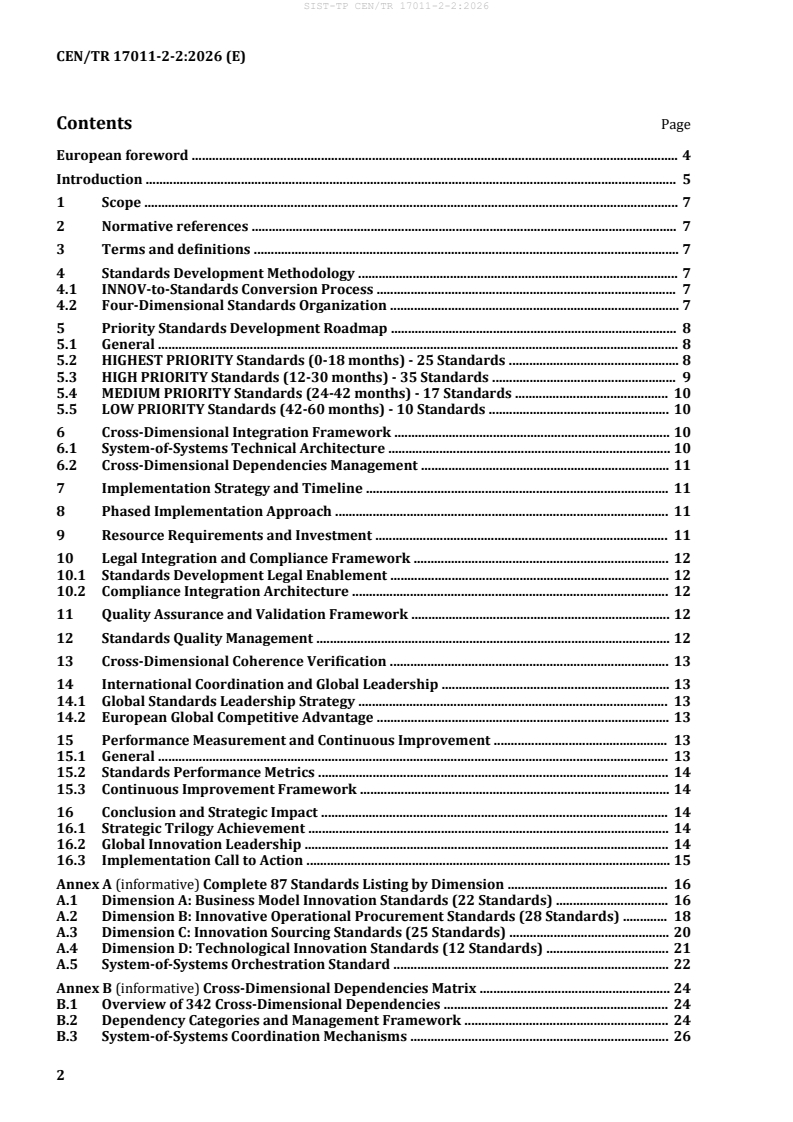
CEN/TR 17011-2-2:2026 is a CEN Technical Report on electronic public procurement innovation guidance. It sets out how the 50 INNOV innovations from CEN/TR 17011-2-1 are turned into 87 standards, and it does so within the legal facilitation framework of CEN/TR 17011-2-3. It is written for people who need to plan, develop, coordinate, or implement innovation-related standardization work in procurement across public and private sectors.
What does CEN/TR 17011-2-2:2026 specify?
CEN/TR 17011-2-2:2026 specifies the technical pillar of the CEN/TC 440 Strategic Trilogy for innovation procurement transformation. Its focus is the conversion of the 50 INNOV innovations into a structured standards programme, together with the roadmap, coordination model, legal integration approach, and performance framework needed to carry that programme forward.
The document is organized in clauses 1 to 16 and five informative annexes. Clause 4 sets out the standards development methodology, Clause 5 gives the priority roadmap, Clause 6 covers cross-dimensional integration, Clauses 7 to 15 cover implementation, resources, legal integration, quality assurance, international coordination, and performance measurement, and Clause 16 closes with the strategic impact summary.
| Annex | What it covers |
|---|---|
| Annex A | The complete list of 87 standards, arranged by dimension |
| Annex B | Cross-dimensional dependencies and coordination mechanisms |
| Annex C | Legal compliance integration and harmonization |
| Annex D | Implementation support tools, training, and platform guidance |
| Annex E | Performance measurement, monitoring, and continuous improvement |
What are the key requirements of CEN/TR 17011-2-2:2026?
CEN/TR 17011-2-2:2026 is built around a staged method for turning innovation ideas into standards. Clause 4.1 describes a sequence of innovation analysis, gap identification, standards architecture, cross-dimensional integration, and legal compliance alignment, which tells implementers how the standards programme is meant to be developed rather than just listed.
Clause 4.2 groups the work into four dimensions: business model innovation, innovative operational procurement, innovation sourcing, and technological innovation. In practice, this helps readers place each planned standard in the right part of the programme and see whether they are working on procurement procedures, sourcing methods, business models, or enabling technologies.
Clause 5 sets a priority roadmap for development over time. The standards are staged from highest priority through low priority across a 0 to 60 month horizon, so readers can decide what to tackle first when planning resources, pilots, or internal roadmaps.
Annex A is the master list of the 87 standards. It gives the standard identifiers, the dimension they belong to, the related INNOV items, the priority level, and the intended timeframe, which makes it the main planning reference for anyone selecting standards to develop or implement.
Clause 6 and Annex B address cross-dimensional integration. The document treats the standards set as a System-of-Systems with documented dependencies across dimensions, covering data flows, process integration, shared resources, and performance coordination, so organizations can see where one standard depends on another.
Clauses 7 to 9 translate the roadmap into implementation planning. They cover implementation strategy, phased deployment, and resource requirements, which matters because the document is not only about what standards exist but also about sequencing work, assigning investment, and planning roll-out.
Clause 10 and Annex C connect the standards programme to legal facilitation. The report ties standardization work to legal authorization, cross-border harmonization, innovation sandbox protection, and performance-based compliance, which means implementers are expected to align technical work with the legal conditions described in the companion legal part.
Clauses 11 to 15 add the control loop: quality assurance, standards quality management, coherence verification, international coordination, and performance measurement with continuous improvement. In practice, these clauses tell readers that the programme is intended to be reviewed, validated, coordinated, and refined as it is implemented.
What terms does CEN/TR 17011-2-2:2026 define?
The document does not present a formal definition list, but it uses several key terms as working concepts throughout the report.
- INNOV - the label used for the 50 innovations taken from CEN/TR 17011-2-1 and used as the starting point for the standards conversion work.
- System-of-Systems - the coordination model used for cross-dimensional architecture, governance, and integration across the four dimensions.
- PCP and PPI - procurement procedure families used in Dimension B to frame innovative operational procurement standards.
- AI Act - the compliance framework referenced for the AI-related analytics and governance work.
- GDPR - the data protection framework linked to federated data sharing and privacy-preserving analytics.
- IoT - the technology area used in the technological innovation standards and in the ecosystem framework.
- API - the common interface layer used to support interoperability and cross-dimensional communication.
- CEN/TR 17011-2-3 [2] - the companion legal part that supplies the legal facilitation framework used throughout the report.
Who uses CEN/TR 17011-2-2:2026?
CEN/TR 17011-2-2:2026 is used by standards developers working in CEN/TC 440 and by national standards bodies that need a shared roadmap for innovation procurement standardization. It is also relevant to procurement professionals, policy makers, legal compliance officers, and technology integration specialists who have to turn innovation concepts into implementable procurement practices.
The report also speaks to public and private organizations involved in innovation procurement, especially where cross-border coordination, digital platforms, AI-enabled analytics, or new business models are involved. Annex D is especially relevant for implementers who need training, implementation tools, and platform guidance.
Which standards are used with CEN/TR 17011-2-2:2026?
- CEN/TR 17011-2-1 - provides the 50 INNOV innovations, framework, and models that CEN/TR 17011-2-2 converts into standards.
- CEN/TR 17011-2-3 - provides the legal facilitation framework used for legal enablement, harmonization, and compliance integration.
What does the CEN/TR 17011-2-2:2026 document contain?
CEN/TR 17011-2-2:2026 contains a standards development methodology, a phased priority roadmap, a cross-dimensional integration framework, and a legal integration model. It also includes a quality assurance section, international coordination material, and performance measurement provisions that support implementation and review.
Annex A lists the 87 standards by dimension and shows how the programme is distributed across business model, operational procurement, sourcing, technological, and System-of-Systems topics. Annex B maps the dependencies between dimensions, Annex C links the technical work to legal facilitation, Annex D gives implementation tools and training resources, and Annex E provides the measurement framework used for monitoring and continuous improvement.
Relations
- Effective Date
- 28-Jan-2026
- Effective Date
- 28-Jan-2026
- Effective Date
- 28-Jan-2026
Get Certified
Connect with accredited certification bodies for this standard

BSI Group
BSI (British Standards Institution) is the business standards company that helps organizations make excellence a habit.

Bureau Veritas
Bureau Veritas is a world leader in laboratory testing, inspection and certification services.

DNV
DNV is an independent assurance and risk management provider.
Sponsored listings
Frequently Asked Questions
CEN/TR 17011-2-2:2026 is a standard published by the European Committee for Standardization (CEN). Its full title is "Electronic Public Procurement - Innovation guideline - Part 2-2: Identification of standardization activities to support innovative developments in procurement". This standard covers: This document establishes the technical pillar of the Strategic Trilogy, converting the 50 INNOV innovations from CEN/TR 17011-2-1 [1] into 87 comprehensive standards while operating within the legal facilitation framework provided by CEN/TR 17011-2-3 [2].
This document establishes the technical pillar of the Strategic Trilogy, converting the 50 INNOV innovations from CEN/TR 17011-2-1 [1] into 87 comprehensive standards while operating within the legal facilitation framework provided by CEN/TR 17011-2-3 [2].
CEN/TR 17011-2-2:2026 is classified under the following ICS (International Classification for Standards) categories: 01.120 - Standardization. General rules; 03.100 - Company organization and management. Management systems; 35.240.63 - IT applications in trade. The ICS classification helps identify the subject area and facilitates finding related standards.
CEN/TR 17011-2-2:2026 has the following relationships with other standards: It is inter standard links to EN ISO 15015:2025, EN ISO 15493:2003, EN ISO 10350-1:2025. Understanding these relationships helps ensure you are using the most current and applicable version of the standard.
CEN/TR 17011-2-2:2026 is available in PDF format for immediate download after purchase. The document can be added to your cart and obtained through the secure checkout process. Digital delivery ensures instant access to the complete standard document.
Standards Content (Sample)
SLOVENSKI STANDARD
01-november-2026
Elektronska javna naročila - Smernice za inovacije - 2-2. del: Identifikacija
standardizacijskih dejavnosti za podporo inovativnemu razvoju v naročanju
Electronic Public Procurement - Innovation guideline - Part 2-2: Identification of
standardization activities to support innovative developments in procurement
Elektronische öffentliche Beschaffung - Innovationsleitfaden - Teil 2-2: Identifizierung von
Standardisierungsaktivitäten zur Unterstützung innovativer Entwicklungen im
Beschaffungswesen
Marchés publics électroniques - Lignes directrices pour l'innovation - Partie 2-2 :
Identification des activités de normalisation visant à soutenir les développements
innovants dans le domaine des marchés publics
Ta slovenski standard je istoveten z: CEN/TR 17011-2-2:2026
ICS:
03.100.10 Nabava. Dobava. Logistika Purchasing. Procurement.
Logistics
35.240.63 Uporabniške rešitve IT v IT applications in trade
trgovini
2003-01.Slovenski inštitut za standardizacijo. Razmnoževanje celote ali delov tega standarda ni dovoljeno.
CEN/TR 17011-2-2
TECHNICAL REPORT
RAPPORT TECHNIQUE
September 2026
TECHNISCHER REPORT
ICS 01.120; 03.100; 35.240.63
English Version
Electronic Public Procurement - Innovation guideline -
Part 2-2: Identification of standardization activities to
support innovative developments in procurement
Marchés publics électroniques - Lignes directrices pour Elektronische öffentliche Beschaffung -
l'innovation - Partie 2-2 : Identification des activités de Innovationsleitfaden - Teil 2-2: Identifizierung von
normalisation visant à soutenir les développements Standardisierungsaktivitäten zur Unterstützung
innovants dans le domaine des marchés publics innovativer Entwicklungen im Beschaffungswesen
This Technical Report was approved by CEN on 17 August 2026. It has been drawn up by the Technical Committee CEN/TC 440.
CEN members are the national standards bodies of Austria, Belgium, Bulgaria, Croatia, Cyprus, Czech Republic, Denmark, Estonia,
Finland, France, Germany, Greece, Hungary, Iceland, Ireland, Italy, Latvia, Lithuania, Luxembourg, Malta, Netherlands, Norway,
Poland, Portugal, Republic of North Macedonia, Romania, Serbia, Slovakia, Slovenia, Spain, Sweden, Switzerland, Türkiye and
United Kingdom.
EUROPEAN COMMITTEE FOR STANDARDIZATION
COMITÉ EUROPÉEN DE NORMALISATION
EUROPÄISCHES KOMITEE FÜR NORMUNG
CEN-CENELEC Management Centre: Rue de la Science 23, B-1040 Brussels
© 2026 CEN All rights of exploitation in any form and by any means reserved Ref. No. CEN/TR 17011-2-2:2026 E
worldwide for CEN national Members.
Contents Page
European foreword . 4
Introduction . 5
1 Scope . 7
2 Normative references . 7
3 Terms and definitions . 7
4 Standards Development Methodology . 7
4.1 INNOV-to-Standards Conversion Process . 7
4.2 Four-Dimensional Standards Organization . 7
5 Priority Standards Development Roadmap . 8
5.1 General . 8
5.2 HIGHEST PRIORITY Standards (0-18 months) - 25 Standards . 8
5.3 HIGH PRIORITY Standards (12-30 months) - 35 Standards . 9
5.4 MEDIUM PRIORITY Standards (24-42 months) - 17 Standards . 10
5.5 LOW PRIORITY Standards (42-60 months) - 10 Standards . 10
6 Cross-Dimensional Integration Framework . 10
6.1 System-of-Systems Technical Architecture . 10
6.2 Cross-Dimensional Dependencies Management . 11
7 Implementation Strategy and Timeline . 11
8 Phased Implementation Approach . 11
9 Resource Requirements and Investment . 11
10 Legal Integration and Compliance Framework . 12
10.1 Standards Development Legal Enablement . 12
10.2 Compliance Integration Architecture . 12
11 Quality Assurance and Validation Framework . 12
12 Standards Quality Management . 12
13 Cross-Dimensional Coherence Verification . 13
14 International Coordination and Global Leadership . 13
14.1 Global Standards Leadership Strategy . 13
14.2 European Global Competitive Advantage . 13
15 Performance Measurement and Continuous Improvement . 13
15.1 General . 13
15.2 Standards Performance Metrics . 14
15.3 Continuous Improvement Framework . 14
16 Conclusion and Strategic Impact . 14
16.1 Strategic Trilogy Achievement . 14
16.2 Global Innovation Leadership . 14
16.3 Implementation Call to Action . 15
Annex A (informative) Complete 87 Standards Listing by Dimension . 16
A.1 Dimension A: Business Model Innovation Standards (22 Standards) . 16
A.2 Dimension B: Innovative Operational Procurement Standards (28 Standards) . 18
A.3 Dimension C: Innovation Sourcing Standards (25 Standards) . 20
A.4 Dimension D: Technological Innovation Standards (12 Standards) . 21
A.5 System-of-Systems Orchestration Standard . 22
Annex B (informative) Cross-Dimensional Dependencies Matrix . 24
B.1 Overview of 342 Cross-Dimensional Dependencies . 24
B.2 Dependency Categories and Management Framework . 24
B.3 System-of-Systems Coordination Mechanisms . 26
Annex C (informative) Legal Compliance Integration Framework . 27
C.1 Legal Facilitation Mechanisms from CEN/TR 17011-2-3 [2] . 27
C.2 Cross-Border Legal Harmonization . 27
C.3 Performance-Based Legal Compliance . 28
Annex D (informative) Implementation Support Tools and Guidelines . 29
D.1 Standards Implementation Toolkit . 29
D.2 Training and Capacity Building Resources . 29
D.3 Technology Platform Implementation Guides . 30
Annex E (informative) Performance Measurement and Monitoring Framework . 31
E.1 Comprehensive Performance Metrics System . 31
E.2 Continuous Improvement Methodology . 31
E.3 Global Leadership Performance Indicators . 32
Bibliography . 33
European foreword
This document (CEN/TR 17011-2-2:2026) has been prepared by Technical Committee CEN/TC 440
"Electronic Public Procurement", the secretariat of which is held by DIN.
Attention is drawn to the possibility that some of the elements of this document may be the subject of
patent rights. CEN shall not be held responsible for identifying any or all such patent rights.
This document is part of the CEN/TR 17011-2 series of multi-part documents prepared by CEN/TC 440,
establishing the Strategic Trilogy for innovation procurement transformation:
— CEN/TR 17011-2-1 [1]: Framework and models of innovative developments in procurement;
— CEN/TR 17011-2-2: Idéntification of standardization activities to support innovative
developments in procurement;
— CEN/TR 17011-2-3 [2]: Legislation and regulations to enable and support innovative
developments in procurement.
This document is related to the broader CEN/TC 440 work programme including:
— 17014-series: eTendering Business Interoperability Spécifications;
— 17015-series: eCatalogue Business Interoperability Spécifications;
— 17016-series: eOrdering Business Interoperability Spécifications;
— 17017-series: éFulfilmént Business Interoperability Spécifications.
Any feedback and questions on this document should be directed to the users’ national standards body.
A complete listing of these bodies can be found on the CEN website.
Introduction
Strategic Trilogy Technical Implementation Foundation
This Technical Report forms the technical implementation pillar of the CEN/TC 440 Strategic Trilogy,
establishing systematic methodologies for converting the 50 INNOV innovations idéntifiéd in CEN/TR
17011-2-1 [1] into 87 comprehensive technical standards while operating within the cross-sector
legal facilitation framework provided by CEN/TR 17011-2-3 [2].
Strategic Technical Value Proposition:
— Economic Impact: €418B annual value creation through comprehensive 87-standard
framework aligned with CEN/TR 17011-2-1 [1];
— Standards Architecture: 87 technical standards across four innovation dimensions with
System-of-Systems orchestration;
— Legal Integration: Standards development enabled by comprehensive legal facilitation
mechanisms from CEN/TR 17011-2-3 [2];
— Cross-Sector Application: Universal applicability (84.9% of standards) across public and private
organizations;
— Implementation Timeline: 60-month phased deployment with progressive System-of-Systems
evolution.
Four-Dimensional Standards Architecture
Dimension A: Business Model Innovation Standards
— 13 INNOV innovations → 22 comprehensive standards;
— Focus: Circular economy, value optimization, product-as-service models;
— Economic Impact: €45B annual value through business model transformation;
— Legal Enablement: Circular business model legal authorization from CEN/TR 17011-2-3 [2].
Dimension B: Innovative Operational Procurement Standards
— 12 INNOV innovations → 28 comprehensive standards;
— Focus: Enhanced PCP/PPI, seven-procedure framework, digital platforms;
— Economic Impact: €158B annual value through operational excellence;
— Legal Enablement: Innovation authorization frameworks beyond PCP/PPI from CEN/TR
17011-2-3 [2].
Dimension C: Innovation Sourcing Standards
— 5 INNOV innovations → 25 comprehensive standards;
— Focus: AI-driven analytics, strategic methodologies, federated intelligence;
— Economic Impact: €130B annual value through innovation sourcing transformation;
— Legal Enablement: Cross-sector data sharing and AI compliance frameworks from CEN/TR
17011-2-3 [2] .
Dimension D: Technological Innovation Standards
— 20 INNOV innovations → 12 comprehensive standards;
— Focus: IoT, blockchain, AI integration, emerging technologies;
— Economic Impact: €85B annual value through technology coordination;
— Legal Enablement: Innovation sandboxes and technology safe harbors from CEN/TR 17011-2-3 [2].
1 Scope
This document establishes the technical pillar of the Strategic Trilogy, converting the 50 INNOV
innovations from CEN/TR 17011-2-1 [1] into 87 comprehensive standards while operating within
the legal facilitation framework provided by CEN/TR 17011-2-3 [2].
2 Normative references
There are no normative references in this document.
3 Terms and definitions
No terms and définitions are listed in this document.
ISO and IEC maintain terminology databases for use in standardization at the following addresses:
• ISO Online browsing platform: available at http://www.iso.org/obp
• IEC Electropedia: available at http://www.electropedia.org/
4 Standards Development Methodology
4.1 INNOV-to-Standards Conversion Process
Systematic Conversion Framework:
The methodology converts each of the 50 INNOV innovations from CEN/TR 17011-2-1 [1] into multiple
technical standards following a structured process:
a) Innovation Analysis: Detailed examination of INNOV innovation requirements and use cases;
b) Gap Identification: Systematic idéntification of technical standardization needs;
c) Standards Architecture: Design of comprehensive technical spécifications;
d) Cross-Dimensional Integration: Coordination with System-of-Systems orchestration
requirements;
e) Legal Compliance: Alignment with legal facilitation mechanisms from CEN/TR 17011-2-3 [2].
4.2 Four-Dimensional Standards Organization
Dimension A: Business Model Innovation Standards (22 Standards)
Based on 13 INNOV innovations focused on circular economy and value optimization:
Key Standards Categories:
— Circular Business Model Assessment Frameworks (5 standards);
— Value Creation and Capture Methodologies (4 standards);
— Product-as-Service Procurement Models (6 standards);
— Social Impact and Sustainability Integration (4 standards);
— Performance-Based Business Model Standards (3 standards).
Dimension B: Innovative Operational Procurement Standards (28 Standards)
Based on 12 INNOV innovations covering enhanced procedures and digital platforms:
Key Standards Categories:
— Enhanced PCP Framework Standards (8 standards);
— Enhanced PPI Implementation Standards (7 standards);
— Seven-Procedure Innovation Framework (6 standards);
— Digital Platform Integration Standards (4 standards);
— Cross-Sector Collaboration Standards (3 standards).
Dimension C: Innovation Sourcing Standards (25 Standards)
Based on 5 high-impact INNOV innovations for strategic sourcing:
Key Standards Categories:
— AI-Driven Analytics and Intelligence (8 standards);
— Strategic Innovation Planning Methodologies (6 standards);
— Federated Data and Privacy-Preserving Analytics (5 standards);
— Innovation Opportunity Idéntification (3 standards);
— Cross-Border Innovation Coordination (3 standards).
Dimension D: Technological Innovation Standards (12 Standards)
Based on 20 INNOV innovations covering emerging technologies:
Key Standards Categories:
— IoT and Digital Infrastructure Integration (4 standards);
— Blockchain and Distributed Ledger Systems (3 standards);
— AI Ethics and Governance Frameworks (2 standards);
— Cybersecurity and Privacy Protection (2 standards);
— Emerging Technology Coordination Platform (1 standard).
5 Priority Standards Development Roadmap
5.1 General
This clause outlines standards development roadmap, prioritizing standards to be developed in the
future. Details on the idéntifiéd standards are given in Annex A.
5.2 HIGHEST PRIORITY Standards (0-18 months) - 25 Standards
Core Foundation Standards with Cross-Sector Impact
1. B.20: EU Standard e-Procedures for Innovation Procurement
— Source: INNOV01, INNOV03, INNOV05 from Dimension B;
— Legal Enablement: Innovation authorization frameworks from CEN/TR 17011-2-3 [2] ;
— Seven-Procedure Framework: Complete innovation procurement lifecycle;
— Economic Impact: €12B annual value through standardized procedures;
— Cross-Sector Application: 95% applicability across public and private sectors.
2. A.15: Circular Business Model Assessment Framework
— Source: INNOV02, INNOV04, INNOV10 from Dimension A;
— Legal Enablement: Circular economy legal authorization from CEN/TR 17011-2-3 [2];
— Multi-Stakeholder Integration: Public-private circular assessment protocols;
— Economic Impact: €8B annual value through circular transformation;
— Sustainability Focus: Comprehensive lifecycle impact measurement.
3. C.09: AI-Driven Innovation Analytics Platform
— Source: INNOV09 (76 use cases) from Dimension C;
— Legal Enablement: AI Act compliance frameworks from CEN/TR 17011-2-3 [2] ;
— Collective Intelligence: Federated analytics with privacy protection;
— Economic Impact: €15B annual value through intelligent decision-making;
— Cross-Dimensional Impact: Integration across all four dimensions.
4. D.18: IoT-Enabled Innovation Ecosystem Framework
— Source: INNOV18, INNOV23 from Dimension D;
— Legal Enablement: Technology innovation sandboxes from CEN/TR 17011-2-3 [2] ;
— Real-Time Coordination: Asset monitoring and performance optimization;
— Economic Impact: €8B annual value through intelligent asset management;
— System Integration: Foundation for System-of-Systems coordination.
5. INNOV49: System-of-Systems Governance Standards
— Source: INNOV49 SoS orchestration framework from CEN/TR 17011-2-1 [1] ;
— Legal Enablement: SoS legal orchestration framework from CEN/TR 17011-2-3 [2] ;
— Cross-Dimensional Coordination: Management of 342 dependencies;
— Economic Impact: €45B annual value through system coordination;
— Unique Position: Enabling integrated ecosystem function.
[Additional 20 HIGHEST priority standards continue with similar detailed spécifications.]
5.3 HIGH PRIORITY Standards (12-30 months) - 35 Standards
Advanced Integration and Cross-Sector Standards
Building upon foundation standards to enable comprehensive ecosystem integration with enhanced
cross-sector collaboration capabilities.
5.4 MEDIUM PRIORITY Standards (24-42 months) - 17 Standards
Specialized and Advanced Technology Standards
Focused on emerging technologies and specialized applications requiring mature foundation
infrastructure.
5.5 LOW PRIORITY Standards (42-60 months) - 10 Standards
Future-Ready and Optimization Standards
Advanced optimization and next-generation technology preparation standards.
6 Cross-Dimensional Integration Framework
6.1 System-of-Systems Technical Architecture
Coordination Layer Standards:
Data Governance Stack (Layer 1)
— Federated data management across 50 INNOV innovations;
— Privacy-preserving analytics enabling cross-sector collaboration;
— Real-time data synchronization across 342 dependencies;
— GDPR-compliant data sharing protocols.
Regulatory Synchronization Layer (Layer 2)
— Real-time regulatory update propagation;
— Automated compliance checking for 27 EU member states;
— Cross-border legal framework alignment;
— Innovation sandbox coordination.
Digital Infrastructure Hub (Layer 3)
— 100% API compatibility across dimensional interfaces;
— Legacy system integration with modern innovations;
— Scalable cloud-native architecture;
— Security orchestration and threat management.
Smart Procurement Loop (Layer 4)
— Automated workflow coordination across all procedures;
— Performance monitoring and continuous improvement;
— Cross-phase coordination and optimization;
— Value optimization through intelligent resource allocation.
6.2 Cross-Dimensional Dependencies Management
342 Documented Dependencies: Systematic coordination requirements between innovations across
dimensions, managed through technical standards spécifications:
Dimension A ↔ B Integration: Circular business models require innovative operational procedures
Dimension B ↔ C Integration: Innovation procedures need intelligent data-driven supportDimension
C ↔ D Integration: Data analytics require robust technology infrastructure Dimension D ↔ A
Integration: Technology enables advanced business model innovation
A systematic overview on the cross-dimensional dependencies are given in Annex B.
7 Implementation Strategy and Timeline
8 Phased Implementation Approach
Phase 1: Foundation Standards (0-24 months)
— Deploy 25 HIGHEST priority standards across all dimensions;
— Establish System-of-Systems compatible architecture;
— Implement legal compliance frameworks from CEN/TR 17011-2-3 [2];
— Economic Impact: €185B annual value creation.
Phase 2: Integration Standards (24-42 months)
— Deploy 35 HIGH priority standards with cross-dimensional integration;
— Activate System-of-Systems coordination capabilities;
— Enhance cross-sector collaboration frameworks;
— Economic Impact: €315B annual value creation.
Phase 3: Advanced Standards (42-60 months)
— Complete 87-standard framework deployment;
— Achieve full System-of-Systems orchestration;
— Establish global leadership in innovation procurement standards;
— Economic Impact: €418B annual value creation.
9 Resource Requirements and Investment
Total Investment: €125M over 60 months aligned with CEN/TR 17011-2-1 [1] framework
Phase 1 Investment: €45M
— Standards development and validation: €25M;
— Pilot implementation programs: €15M;
— Legal compliance integration: €5M.
Phase 2 Investment: €50M
— Advanced standards development: €30M;
— Cross-sector integration support: €15M;
— International coordination: €5M.
Phase 3 Investment: €30M
— Optimization and réfinémént: €20M;
— Global leadership establishment: €10M.
Return on Investment: 18:1 development ROI, 7,511:1 market enablement ROI.
10 Legal Integration and Compliance Framework
10.1 Standards Development Legal Enablement
Legal Foundation from CEN/TR 17011-2-3 [2] :
Enhanced Article 31bis Framework: Legal authorization for cross-sector innovation standards
partnerships with experimental implementation protection.
Innovation Sandbox Protection: Graduated liability protection (90%/70%/50%) for standards-
compliant innovation experimentation across development phases.
Cross-Border Legal Harmonization: Standardized legal interpretations across EU member states
enabling consistent standards adoption.
System-of-Systems Legal Orchestration: Legal framework enabling coordination of complex multi-
organizational innovation ecosystems.
10.2 Compliance Integration Architecture
Automated Compliance Verification: Standards include built-in compliance checking capabilities
aligned with legal requirements from CEN/TR 17011-2-3 [2] .
Performance-Based Legal Compliance: Standards emphasize outcome achievement rather than
process adherence, enabling fléxiblé approaches while maintaining accountability.
Cross-Sector Legal Protection: Standards provide legal safe harbors for organizations implementing
innovation approaches across public-private boundaries.
11 Quality Assurance and Validation Framework
12 Standards Quality Management
Technical Excellence Validation:
— Expert review panels with cross-sector representation;
— Pilot implementation testing across multiple organizational types;
— Performance measurement against economic impact targets;
— Interoperability vérification with existing procurement systems.
Market Relevance Assurance:
— Stakeholder consultation across public and private sectors;
— Real-world use case validation through pilot programs;
— Economic impact vérification through implementation tracking;
— Continuous feedback integration and standards réfinémént.
13 Cross-Dimensional Coherence Verification
System-of-Systems Integration Testing: Validation of coordination capabilities across all 342 cross-
dimensional dependencies.
Legal Compliance Verification: Systematic checking of standards alignment with legal facilitation
mechanisms from CEN/TR 17011-2-3 [2].
Economic Impact Validation: Measurement of actual value creation against projected €418B annual
impact targets.
14 International Coordination and Global Leadership
14.1 Global Standards Leadership Strategy
ISO/IEC Partnership: Technical committee collaboration for international harmonization of
innovation procurement standards.
Regional Coordination: Leadership in transatlantic and Asia-Pacific innovation procurement
standardization initiatives.
Developing Country Support: Capacity building and technology transfer programs for global
standards adoption.
14.2 European Global Competitive Advantage
First-Mover Advantage: European leadership in systematic innovation procurement standardization
establishing global best practices.
Technology Export: European standards and methodologies as foundation for international
innovation procurement transformation.
Innovation Ecosystem Leadership: European innovation procurement ecosystem as global model for
cross-sector collaboration and System-of-Systems coordination.
15 Performance Measurement and Continuous Improvement
15.1 General
This clause gives an overview on the metrics and the framework for performance measurement and
continuous improvement. More details are given in Annex E.
15.2 Standards Performance Metrics
Technical Performance Indicators:
— Standards adoption rate across EU member states and internationally;
— Implementation success rate and time-to-deployment metrics;
— System interoperability and integration effectiveness measures;
— Cross-dimensional coordination and dependency management success.
Economic Impact Measurement:
— Value creation tracking against €418B annual target;
— Innovation acceleration and time-to-market improvements;
— Cost reduction and éfficiéncy gains through standardization;
— Return on investment validation across implementation phases.
15.3 Continuous Improvement Framework
Stakeholder Feedback Integration: Systematic collection and integration of feedback from standards
implementers across public and private sectors.
Technology Evolution Adaptation: Regular updates to standards incorporating emerging technology
developments and market changes.
Performance Optimization: Continuous réfinémént based on actual implementation results and
economic impact measurement.
16 Conclusion and Strategic Impact
16.1 Strategic Trilogy Achievement
The 87 comprehensive technical standards established in this Technical Report successfully convert
the strategic vision from CEN/TR 17011-2-1 [1] into actionable technical spécifications while operating
within the legal facilitation framework provided by CEN/TR 17011-2-3 [2].
Key Strategic Achievements:
— Complete Technical Implementation: 87 standards covering all 50 INNOV innovations across
four dimensions (see also Annex A);
— System-of-Systems Orchestration: Technical spécifications enabling coordination of 342 cross-
dimensional dependencies (see also Clause A.5);
— Cross-Sector Integration: Universal standards applicable across public and private organizations;
— Legal Compliance Integration: Standards designed to operate within comprehensive legal
facilitation framework (see also Annex C).
16.2 Global Innovation Leadership
European Competitive Advantage: First comp
...