

EN 13355:2004
(Main)Coating plants - Combined booths - Safety requirements
- Abstract
This document is applicable to combined booths for the application of organic liquid coating materials by an operator with maximum drying temperature of 100 °C and deals with all hazards significant for combined booths, when they are used as intended and under the conditions foreseen by the manufacturer (see clause 4).
To the extent of this document, a combined booth is considered an assembly of the following equipment:
- forced ventilation by one or more fans,
- ventilation air heating system (e. g. heat exchanger or burner),
- power driven dampers, forced ventilation ducting,
- dry air filtering and/or wet air washing systems,
- automatic fire extinguishing equipment and additional specific electrical equipment,
- control and power circuits joined together for the spraying and drying process of liquid coating material in a space totally enclosed provided with forced ventilation.
- working pit, in special case.
This document does not cover:
a) booths for automatic spraying, powder spray booths, open booths, and portable heaters.
b) design of the building foundations upon which a booth is installed;
c) the civil engineering and building design where a booth is constructed as, or to use part of, a new or existing building;
d) spraying equipment (see EN 1953), automatic devices for spraying systems like robots (see EN 775) or reciprocators or similar systems, conveyors, lifts and continuous handling equipment and systems (see EN 619).
This document is not applicable to combined booths which are manufactured before the date of publication of this standard by CEN.
- Status
- Withdrawn
- Publication Date
- 21-Dec-2004
- Withdrawal Date
- 31-Mar-2009
- Technical Committee
- CEN/TC 271 - Surface treatment equipment - Safety
- Drafting Committee
- CEN/TC 271/WG 3 - Coating plants
- Current Stage
- 9960 - Withdrawal effective - Withdrawal
- Start Date
- 01-Apr-2009
- Completion Date
- 01-Apr-2009
98/37/EC - MachineryOJ Ref: C, C 336 OJ Date: 31-Dec-2005

Relations
- Effective Date
- 04-Feb-2009
- Effective Date
- 28-Jan-2026
- Effective Date
- 28-Jan-2026
- Effective Date
- 28-Jan-2026
- Effective Date
- 28-Jan-2026
- Effective Date
- 28-Jan-2026
- Effective Date
- 28-Jan-2026
- Effective Date
- 28-Jan-2026
- Effective Date
- 28-Jan-2026
- Effective Date
- 28-Jan-2026
- Effective Date
- 28-Jan-2026
- Effective Date
- 28-Jan-2026
- Effective Date
- 28-Jan-2026
Frequently Asked Questions
EN 13355:2004 is a standard published by the European Committee for Standardization (CEN). Its full title is "Coating plants - Combined booths - Safety requirements". This standard covers: This document is applicable to combined booths for the application of organic liquid coating materials by an operator with maximum drying temperature of 100 °C and deals with all hazards significant for combined booths, when they are used as intended and under the conditions foreseen by the manufacturer (see clause 4). To the extent of this document, a combined booth is considered an assembly of the following equipment: - forced ventilation by one or more fans, - ventilation air heating system (e. g. heat exchanger or burner), - power driven dampers, forced ventilation ducting, - dry air filtering and/or wet air washing systems, - automatic fire extinguishing equipment and additional specific electrical equipment, - control and power circuits joined together for the spraying and drying process of liquid coating material in a space totally enclosed provided with forced ventilation. - working pit, in special case. This document does not cover: a) booths for automatic spraying, powder spray booths, open booths, and portable heaters. b) design of the building foundations upon which a booth is installed; c) the civil engineering and building design where a booth is constructed as, or to use part of, a new or existing building; d) spraying equipment (see EN 1953), automatic devices for spraying systems like robots (see EN 775) or reciprocators or similar systems, conveyors, lifts and continuous handling equipment and systems (see EN 619). This document is not applicable to combined booths which are manufactured before the date of publication of this standard by CEN.
This document is applicable to combined booths for the application of organic liquid coating materials by an operator with maximum drying temperature of 100 °C and deals with all hazards significant for combined booths, when they are used as intended and under the conditions foreseen by the manufacturer (see clause 4). To the extent of this document, a combined booth is considered an assembly of the following equipment: - forced ventilation by one or more fans, - ventilation air heating system (e. g. heat exchanger or burner), - power driven dampers, forced ventilation ducting, - dry air filtering and/or wet air washing systems, - automatic fire extinguishing equipment and additional specific electrical equipment, - control and power circuits joined together for the spraying and drying process of liquid coating material in a space totally enclosed provided with forced ventilation. - working pit, in special case. This document does not cover: a) booths for automatic spraying, powder spray booths, open booths, and portable heaters. b) design of the building foundations upon which a booth is installed; c) the civil engineering and building design where a booth is constructed as, or to use part of, a new or existing building; d) spraying equipment (see EN 1953), automatic devices for spraying systems like robots (see EN 775) or reciprocators or similar systems, conveyors, lifts and continuous handling equipment and systems (see EN 619). This document is not applicable to combined booths which are manufactured before the date of publication of this standard by CEN.
EN 13355:2004 is classified under the following ICS (International Classification for Standards) categories: 87.100 - Paint coating equipment. The ICS classification helps identify the subject area and facilitates finding related standards.
EN 13355:2004 has the following relationships with other standards: It is inter standard links to EN 13355:2004+A1:2009, EN 206-1:2000, EN 12566-3:2005+A1:2009, EN 16192:2011, EN ISO 21877:2019, EN 206:2013+A1:2016, EN 206:2013, CEN/TS 16177:2012, EN 12566-3:2005+A2:2013, EN ISO 9509:2006, EN 206:2013+A2:2021, EN ISO 15175:2011, EN 16516:2017+A1:2020. Understanding these relationships helps ensure you are using the most current and applicable version of the standard.
EN 13355:2004 is associated with the following European legislation: EU Directives/Regulations: 94/9/EC, 98/37/EC; Standardization Mandates: M/079, M/BC/CEN/92/46. When a standard is cited in the Official Journal of the European Union, products manufactured in conformity with it benefit from a presumption of conformity with the essential requirements of the corresponding EU directive or regulation.
EN 13355:2004 is available in PDF format for immediate download after purchase. The document can be added to your cart and obtained through the secure checkout process. Digital delivery ensures instant access to the complete standard document.
Standards Content (Sample)
SLOVENSKI STANDARD
01-marec-2005
Premazne naprave - Kombinirane kabine za brizganje in sušenje – Varnostne
zahteve
Coating plants - Combined booths - Safety requirements
Beschichtungsanlagen - Kombinierte Spritz- und Trocknungskabinen -
Sicherheitsanforderungen
Installations d'application - Cabines mixtes d'application et de séchage - Prescriptions de
sécurité
Ta slovenski standard je istoveten z: EN 13355:2004
ICS:
87.100 Oprema za nanašanje Paint coating equipment
premazov
2003-01.Slovenski inštitut za standardizacijo. Razmnoževanje celote ali delov tega standarda ni dovoljeno.
EUROPEAN STANDARD
EN 13355
NORME EUROPÉENNE
EUROPÄISCHE NORM
December 2004
ICS 87.100
English version
Coating plants - Combined booths - Safety requirements
Installations d'application - Cabines mixtes d'application et Beschichtungsanlagen - Kombinierte Spritz- und
de séchage - Prescriptions de sécurité Trocknungskabinen - Sicherheitsanforderungen
This European Standard was approved by CEN on 22 November 2004.
CEN members are bound to comply with the CEN/CENELEC Internal Regulations which stipulate the conditions for giving this European
Standard the status of a national standard without any alteration. Up-to-date lists and bibliographical references concerning such national
standards may be obtained on application to the Central Secretariat or to any CEN member.
This European Standard exists in three official versions (English, French, German). A version in any other language made by translation
under the responsibility of a CEN member into its own language and notified to the Central Secretariat has the same status as the official
versions.
CEN members are the national standards bodies of Austria, Belgium, Cyprus, Czech Republic, Denmark, Estonia, Finland, France,
Germany, Greece, Hungary, Iceland, Ireland, Italy, Latvia, Lithuania, Luxembourg, Malta, Netherlands, Norway, Poland, Portugal, Slovakia,
Slovenia, Spain, Sweden, Switzerland and United Kingdom.
EUROPEAN COMMITTEE FOR STANDARDIZATION
COMITÉ EUROPÉEN DE NORMALISATION
EUROPÄISCHES KOMITEE FÜR NORMUNG
Management Centre: rue de Stassart, 36 B-1050 Brussels
© 2004 CEN All rights of exploitation in any form and by any means reserved Ref. No. EN 13355:2004: E
worldwide for CEN national Members.
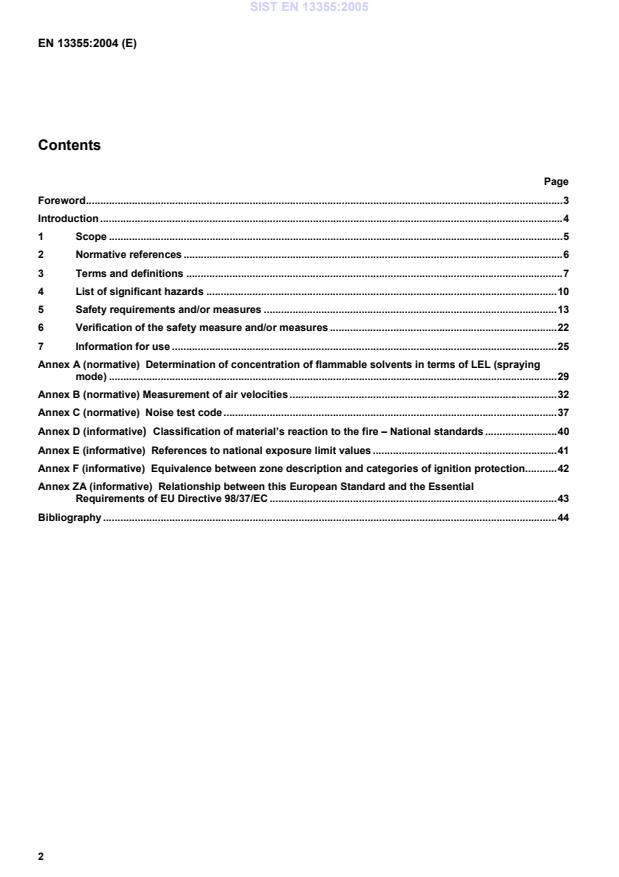
Contents
Page
Foreword.3
Introduction .4
1 Scope .5
2 Normative references .6
3 Terms and definitions .7
4 List of significant hazards .10
5 Safety requirements and/or measures .13
6 Verification of the safety measure and/or measures .22
7 Information for use .25
Annex A (normative) Determination of concentration of flammable solvents in terms of LEL (spraying
mode) .29
Annex B (normative) Measurement of air velocities .32
Annex C (normative) Noise test code.37
Annex D (informative) Classification of material’s reaction to the fire – National standards .40
Annex E (informative) References to national exposure limit values .41
Annex F (informative) Equivalence between zone description and categories of ignition protection.42
Annex ZA (informative) Relationship between this European Standard and the Essential
Requirements of EU Directive 98/37/EC .43
Bibliography .44
Foreword
This document (EN 13355:2004) has been prepared by Technical Committee CEN/TC 271 “Surface treatment
equipment — Safety”, the secretariat of which is held by DIN.
This European Standard shall be given the status of a national standard, either by publication of an identical text or
by endorsement, at the latest by June 2005, and conflicting national standards shall be withdrawn at the latest by
June 2005.
This document has been prepared under a mandate given to CEN by the European Commission and the European
Free Trade Association, and supports essential requirements of EU Directive(s) 98/37/EC and 94/9/EC.
For relationship with EU Directive(s), see informative Annex ZA, which is an integral part of this document.
This document is part of a series of standards in the area of safety for development and construction of machines
and plants for the coating of surfaces with organic substances (paints, varnishes and similar products).
This document is mainly based on EN 12215 and EN 1539.
NOTE: Although a spray booth, as an integral whole, formally does not fall under the scope of the ATEX Directive 94/9/EC,
the document is based upon a fundamental risk analysis according to this directive.
According to the CEN/CENELEC Internal Regulations, the national standards organizations of the following
countries are bound to implement this European Standard: Austria, Belgium, Cyprus, Czech Republic, Denmark,
Estonia, Finland, France, Germany, Greece, Hungary, Iceland, Ireland, Italy, Latvia, Lithuania, Luxembourg, Malta,
Netherlands, Norway, Poland, Portugal, Slovakia, Slovenia, Spain, Sweden, Switzerland and United Kingdom.
Introduction
This document is a C-type standard as stated in EN ISO 12100.
The machinery concerned and the extent to which hazards, hazardous situations and events are covered are
indicated in the scope of this document.
When provisions of this type C standard are different from those which are stated in type A or B standards, the
provisions of this type C standard take precedence over the provisions of the other standards, for machines that
have been designed and built according to the provisions of this type C standard.
1 Scope
This document is applicable to combined booths for the application of organic liquid coating materials by an
operator with maximum drying temperature of 100 °C and deals with all hazards significant for combined booths,
when they are used as intended and under the conditions foreseen by the manufacturer (see clause 4).
To the extent of this document, a combined booth is considered an assembly of the following equipment:
forced ventilation by one or more fans,
ventilation air heating system (e. g. heat exchanger or burner),
power driven dampers, forced ventilation ducting,
dry air filtering and/or wet air washing systems,
automatic fire extinguishing equipment and additional specific electrical equipment,
control and power circuits joined together for the spraying and drying process of liquid coating material in a
space totally enclosed provided with forced ventilation.
working pit, in special case.
This document does not cover:
a) booths for automatic spraying, powder spray booths, open booths, and portable heaters.
b) design of the building foundations upon which a booth is installed;
c) the civil engineering and building design where a booth is constructed as, or to use part of, a new or existing
building;
d) spraying equipment (see EN 1953), automatic devices for spraying systems like robots (see EN 775) or
reciprocators or similar systems, conveyors, lifts and continuous handling equipment and systems
(see EN 619).
This document is not applicable to combined booths which are manufactured before the date of publication of this
standard by CEN.
2 Normative references
The following referenced documents are indispensable for the application of this document. For dated references,
only the edition cited applies. For undated references, the latest edition of the referenced document (including any
amendments) applies.
EN 418, Safety of machinery — Emergency stop equipment, functional aspects — Principles for design.
EN 525, Non-domestic direct gas-fired forced convection air heaters for space heating not exceeding a net heat input
of 300 kW.
EN 563, Safety of machinery — Temperatures of touchable surfaces — Ergonomics data to establish temperature
limit values for hot surfaces.
EN 746-1, Industrial thermoprocessing equipment — Part 1: Common safety requirements for industrial
thermoprocessing equipment.
EN 746-2, Industrial thermoprocessing equipment — Part 2: Safety requirements for combustion and fuel handling
systems.
EN 954-1, Safety of machinery — Safety related parts of control systems — Part 1: General principles for design.
EN 971-1:1996, Paints and varnishes — Terms and definitions for coating materials — Part 1: General terms
EN 981, Safety of machinery — System of auditory and visual danger and information signals.
EN 982, Safety of machinery — Safety requirements for fluid power systems and their components — Hydraulics.
EN 983, Safety of machinery — Safety requirements for fluid power systems and their components — Pneumatics.
EN 1037, Safety of machinery — Prevention of unexpected start-up.
EN 1088, Safety of machinery — Interlocking devices associated with guards — Principles for design and selection.
EN 1127-1:1997, Explosive atmospheres — Explosion prevention and protection — Part 1: Basic concepts and
methodology.
EN 1539:2000; Dryers and ovens, in which flammable substances are released — Safety requirements.
EN 1953, Atomising and spraying equipment for coating materials - Safety requirements
prEN 12753; Thermal cleaning systems for exhaust gas from surface treatment equipment — Safety requirements.
EN 12433-1, Industrial, commercial and garage doors and gates — Terminology — Part 1: Types of doors.
EN 12433-2, Industrial, commercial and garage doors and gates — Terminology — Part 2: Parts of doors.
EN 12445, Industrial, commercial and garage doors and gates — Safety in use of power operated doors — Test
methods.
EN 12453, Industrial, commercial and garage doors and gates — Safety in use of power operated doors —
Requirements.
EN 12635, Industrial, commercial and garage doors and gates — Installation and use.
EN 12978, Industrial, commercial and garage doors and gates — Safety devices for power operated doors and gates
- — Requirements and test methods.
EN 13463-1:2001; Non-electrical equipment for potentially explosive atmospheres — Part 1: Basic method and
requirements
EN 13463-5, Non-electrical equipment intended for use in potentially explosive atmospheres — Part 5: Protection by
constructional safety "c".
EN 13478, Safety of machinery — Fire prevention and protection.
prEN 14986, Design of fans working in potentially explosive atmospheres.
EN 60079-0, Electrical apparatus for explosive gas atmospheres – Part 0: General requirements (IEC 60079-0:2004).
EN 60079-15, Electrical apparatus for explosive gas atmospheres – Part 15: Type of protection “n” (IEC 60079-
15:2001, modified).
EN 60204-1:1997, Safety of machinery — Electrical equipment of machines — Part 1: General requirements (IEC
60204-1:1997).
EN 60529, Degrees of protection provided by enclosures (IP code).
EN 61000-6-1, Electromagnetic compatibility (EMC) — Part 6-1: Generic standards; Immunity for residential,
commercial and light-industrial environments (IEC 61000-6-1:1997, modified).
EN 61000-6-3, Electromagnetic compatibility (EMC) — Part 6-3: Generic standards; Emission standard for residential,
commercial and light-industrial environments (IEC 61000-6-3:1996, modified).
EN 61000-6-4, Electromagnetic compatibility (EMC) — Part 6-4: Generic standards; Emission standard for industrial
environments (IEC 61000-6-4:1997, modified).
EN ISO 3746, Acoustics — Determination of sound power levels of noise sources using sound pressure — Survey
method using an enveloping measurement surface over a reflecting plane (ISO 3746:1995)
EN ISO 4871, Acoustics — Declaration and verification of noise emission values of machinery and equipment (ISO
4871:1996).
EN ISO 11202, Acoustics — Noise emitted by machinery and equipment — Measurement of emission sound
pressure levels at a work station and at other specified positions — Survey method in situ (ISO 11202:1995).
EN ISO 12100-1, Safety of machinery - Basic concepts, general principles for design - Part 1: Basic terminology,
methodology (ISO 12100-1:2003)
EN ISO 12100-2:2003, Safety of machinery - Basic concepts, general principles for design - Part 2: Technical
principles (ISO 12100-2:2003)
EN ISO 14122-2, Safety of machinery — Permanent means of access to machinery — Part 2: Working platforms and
walkways (ISO 14122-2:2001).
EN ISO 14122-3, Safety of machinery — Permanent means of access to machinery — Part 3: Stairs, stepladders and
guard-rails (ISO 14122-3:2001).
EN ISO 14122-4, Safety of machinery — Permanent means of access to machinery — Part 4: Fixed ladders (ISO
14122-4:2004).
3 Terms and definitions
For the purpose of this document, the terms and definitions given in EN 12100-1:2003 and the following apply.
3.1
combined booth
assembly of linked components such as fan(s), ventilation air heating system (e. g. heat exchanger or burner),
power driven dampers, forced ventilation ducting, dry air filtering and/or wet air washing systems, automatic fire
extinguishing equipment and additional specific electrical equipment, control and power circuits joined together for
the spraying and drying process of liquid coating material in a space totally enclosed provided with a forced
ventilation
3.2
working pit
ground excavation, illuminated and ventilated in which the operator works while painting the underside of an item
3.3
organic liquid coating material
organic product, in liquid form, that when applied to a substrate forms a film possessing protective, decorative
and/or specific technical properties, e.g.: paints, varnishes, including their solvents and thinners (see EN 971-1)
3.4
solvent
single liquid, or blends of liquid, volatile under specified drying conditions, and in which the binder is completely
soluble (see 1.4.5 of EN 971-1:1996)
NOTE Solvents are also contained in liquids used as cleaning or washing agents.
3.5
spraying
application of coating material on an item within the combined booth by pneumatic, airless, electrostatic or
combination of these spraying systems
3.6
drying
evaporation of liquids from the materials being processed (see 3.5 of EN 1539:2000).
3.7
curing
Transformation of a liquid, paste or powder coating material into a finished solid material (see 3.8 of EN 1539:2000)
NOTE Also known as gelling, through curing or through drying.
3.8
forced ventilation
air circulation achieved by one or several fans
3.9
recirculated air
air extracted from the volume and reintroduced into it
3.10
air cleaning (filtering system)
Filtering system used for introducing clean air into the booth and cleaning contaminated air extracted from the
combined booth
3.11
flammable (combustible) substances
substance in the form of gas, vapour, liquid, solid or mixtures of these, able to undergo an exothermic reaction with
air when ignited (see 3.1 of EN 1127-1:1997)
NOTE "Combustible materials" and "flammable substances" are equivalently used terms in this standard. Examples are
paint aerosols and solvents.
3.12
explosive atmosphere
mixture with air, under atmospheric conditions, of flammable substance(s) in the form of gas, vapour, mist or dust,
in which after ignition has occurred, combustion spreads to the entire unburned mixture (see EN 1127-1)
3.13
lower explosion limit (LEL)
lower limit of the range of concentration of a combustible in air over which an explosion can occur (3.8 and 3.13 of
EN 1127-1:1997)
NOTE ”Explosion limit” and ”Ignition limit” are equivalent. In accordance with international usage, only the term ”explosion
limit" is used in this standard.
3.14
total space
net volume within the booth during spraying and drying processes which may contain released substances. It
includes all sections of the combined booth recirculation system(s) and ends at the outlet connection to the external
exhaust
NOTE It does not include any items loaded into the combined booth, supports, transport systems or thermal cleaning
systems (see prEN 12753).
3.15
hazardous areas
areas where hazards due to explosive atmosphere may exist. The probability of occurrence of explosive
atmosphere is classified in zones
3.15.1
zone 0
place in which an explosive atmosphere consisting of a mixture with air of flammable substances in the form of gas,
vapour or mist is present continuously or for long periods or frequently (see 6.3.2 of EN 1127-1:1997)
3.15.2
zone 1
place in which an explosive atmosphere consisting of a mixture with air of flammable substances in the form of gas,
vapour or mist is likely to occur in normal operation occasionally (see 6.3.2 of EN 1127-1:1997)
3.15.3
zone 2
place in which an explosive atmosphere consisting of a mixture with air of flammable substances in the form of gas,
vapour or mist is not likely to occur in normal operation but, if it does occur, will persist for a short period only (see
6.3.2 of EN 1127-1:1997)
3.16
Equipment category
3.16.1
Equipment Group II Category 1
equipment in this category is intended for use in areas in which explosive atmospheres caused by mixtures of air
and gases, vapours or mists are present continuously for long periods or frequently (see 3.2.3 of EN 13463-1:2001)
NOTE Equipment of category 1 is suitable for use in zone 0.
3.16.2
Equipment Group II Category 2
equipment in this category is intended for use in areas in which explosive atmospheres caused by mixtures of air
and gases, vapours or mists are likely to occur (see 3.2.4 of EN 13463-1:2001)
NOTE Equipment of category 2 is suitable for use in zone 1.
3.16.3
Equipment Group II Category 3
equipment in this category is intended for use in areas in which explosive atmospheres caused by mixtures of air
and gases, vapours or mists are unlikely to occur, or, if they do occur, are likely to do so only in frequently and for a
short period only (see 3.2.5 of EN 13463-1:2001)
NOTE Equipment of category 3 is suitable for use in zone 2.
3.17
exposure limits
concentration limits of hazardous substances in air required by worker health legislation
NOTE Limits are different according to the countries (see Annex E).
3.18
maximum drying temperature
upper limit of circulated air temperature within the working area for which the combined booth is designed
3.19
ventilation air heating system
heat generating and air heat exchanger system direct or indirect, which may include burner, combustion chamber,
heat exchanger, fan(s), inlet, exhaust and recirculation ducts, enclosures and ancillaries, measuring and control
devices
4 List of significant hazards
4.1 General
This clause contains all the significant hazards, hazardous situations and events as far as they are dealt with in this
standard, identified by risk assessment as significant for this type of machinery and which require action to
eliminate or reduce the risk.
All hazards generated by spraying equipment for liquid paint and varnish and their ancillary devices are covered by
EN 1953.
NOTE Information on the method of risk analysis is given in EN 1050.
4.2 Mechanical hazards
4.2.1 Shearing, crushing and drawing in
These hazards are related to:
unexpected actuation of conveyor (whilst loading the combined booth)
fans (e.g. injuries caused by after-running of fan blades) and air change valves for the combined booth
damper adjusters (power driven dampers),
moving parts of combined booth (e.g. doors, gates and hoods).
4.2.2 Entrapment of operators
These hazards are related to:
obstacles or obstructions which can impede evacuation from the combined booth including any working pit in
case of mechanical accident or the occurrence of fire;
accidental significant lowering of pressure inside the combined booth (i.e.: obstruction of air inlet) capable of
clamping the doors by mechanical deformation of the structure of the combined booth;
increasing the door opening effort beyond human capability.
4.2.3 Hazards resulting from the operator slipping or falling:
These hazards are related to:
ladders, gangways, platform or stairs;
floor gratings;
slippery floors;
These hazards may be increased as a result of poor lighting.
4.3 Electrical hazards
4.3.1 Electrical shock (by direct or indirect contact)
These hazards are related to:
electrically live parts that are non insulated for operational reasons (for instance in electrostatic devices);
live parts when insulation is damaged by contact with solvents or by mechanical means.
4.3.2 External influence on electrical equipment
These hazards are related to:
interaction of the electrostatic high voltage equipment elements of the control and safety systems which can
cause dangerous malfunctions, e. g. short circuits on electronic safety circuits, entrance guards, alarm units.
4.4 Thermal hazards
These hazards are related to:
contact with hot surfaces within easy reach.
4.5 Hazards generated by noise
These hazards are related to combined booths and can be present inside as well as outside the booth.
They can be generated by noises emitted for instance by:
fans;
excessive air velocity in ducts and accessories ;
wet air washing systems;
air operated equipment ( nozzles of atomising and spraying equipment, pumps, valves.).
4.6 Hazards generated by radiation
These hazards are related to the use of infra-red radiation (IR) causing
damage to the eyes,
burning.
4.7 Hazards resulting from dangerous substances
4.7.1 Contact with/or absorption of, fluids (paints, solvents, hydraulic and thermal fluid) which are dangerous to
health causing damage to the skin or eyes or dermatitis or allergies.
4.7.2 Inhalation of aerosols and solvent vapours released by organic liquid coating materials.
4.7.3 Inhalation of toxic gases released from the heating device (e.g. heating and combustion gases).
4.7.4 Inhalation of dangerous gases, vapours emitted by automatic fire extinguishing equipment.
4.8 Fire and explosion hazards
4.8.1 Fire hazards
Fire hazards are related to combustible or flammable substances coming in contact with ore are ignited by:
hot surfaces (e.g. heating systems and electrical equipment);
sparks created by mechanically induced energy (e.g. fans and/or conveyors);
electrostatic and atmospheric discharges;
electrical sparks;
welding and other heating sources used during maintenance operations.
NOTE Examples of flammable substances are:
coating materials, solvents or thinners;
elements of construction;
condensates and deposits of paint in the insulation materials, pits , exhaust ducts and filters;
fuels used in heating and drying system burners;
flammable liquid products used for cleaning;
petrol vapours from a vehicle fuel tank (in case of vehicle refinishing).
4.8.2 Explosion hazards
Explosion hazards are related to an increase of the concentration of flammable substances in air exceeding the
lower explosion limit (LEL) and coming in contact with or are ignited by
hot surfaces (e.g. heating systems and electrical equipment);
sparks created by mechanically induced energy (e.g. fans and/or conveyors);
electrostatic and atmospheric discharges;
electrical sparks;
welding and other heating sources used during maintenance operations.
NOTE Examples of flammable substances which increase concentration above the lower explosion limit:
solvent vapours from the spraying and drying process;
gases from fuels and/or products of combustion of the heating system;
gases released from deposits;
combustible heating gases;
petrol vapours.
4.9 Hazards caused by failure of the energy supply and malfunction of the control system
4.9.1 Failure of energy supplies can lead to:
Loss of monitoring functions resulting in hazardous reduction of ventilation flow rate;
unexpected shutdown of control devices;
loss of monitoring functions resulting in a hazardous increase of solvent concentration;
loss of monitoring functions resulting in a hazardous reduction of recirculation flow rate;
loss of lighting.
4.9.2 Hazards due to failure or malfunction of the control system (unexpected start-up) which can lead to:
Incorrect position of dampers resulting in a hazardous increase of solvent concentration;
wrong sequence of essential control functions resulting in a start of heating before forced ventilation is
activated;
malfunction of temperature monitoring devices resulting in a hazardous increase of the temperatures of the
heating system.
4.10 Hazards caused by emergency stop devices
The use of emergency stop devices can lead to an interruption of the exhaust flow rate or of the recirculation flow
rate and can have as a consequence hazardous reduction in the forced ventilation flow rate, hazardous increase of
concentration of flammable substances (see 4.8.2).
5 Safety requirements and/or measures
5.1 General
Machinery shall comply with the safety requirements and/or protective measures of this clause. In addition, the
machine shall be designed according to the principles of EN ISO 12100 for hazards relevant but not significant
which are not dealt with by this document (e.g. sharp edges).
NOTE Hazards generated by spraying equipment for organic liquid coating materials and their ancillary devices are
covered by EN 1953.
5.2 Mechanical
5.2.1 Shearing, crushing and drawing in
The design shall avoid injury due to shearing, crushing or drawing-in by movement of machinery and/or parts of
equipment. Contact with dangerous moving parts shall be prevented by the following measures:
for fans and automated dampers adjusters: fitting of distance guards;
for power operated doors: mechanical or light sensitive protective devices;
for doors, gates and hoods: (re)movable guards, hydraulically, pneumatically or electrically interlocked with the
hazardous movement or event.
If automatic devices for spraying systems like robots or reciprocators or similar systems are installed, access to
dangerous areas requires doors or other protective devices (mechanical or light sensitive) interlocked with the
hazardous movement or event (see also 5.8.2.5).
NOTE Robots are dealt with in EN 775.
5.2.2 Entrapment of persons
Combined booths shall be designed so that in case of an emergency all persons entrapped can find their way out
of the combined booth in the quickest possible time, without being hindered by obstructions.
NOTE Auxiliary use of robots or similar automatic devices is excluded from the scope (see scope, exclusions under d)).
The doors provided for personnel:
shall be capable of being opened from inside and outside
shall be capable of being opened from inside by a mere push, independent of the air pressure (high or low)
within the combined booth,
shall be self-closing,
shall have a minimum 800 mm width and minimum 2000 mm height (free opening).
Combined booths shall be provided with a minimum of two permanently accessible and normally non-lockable
doors placed as far as practically possible apart from each other. Also when the booth is loaded the operator shall
not have more than 10m to travel in order to reach at least one of these doors.
If the booth-loading door can be opened by a mere push from the inside only one additional personnel door shall
be required.
If the longest wall is less than 5m a single door is considered to be sufficient.
Power-operated doors as well as vertical and horizontal sliding doors cannot be considered as personnel door.
Power-operated doors shall comply with EN 12433, EN 12445, EN 12453, EN 12635 and EN 12978.
In addition the length and width of combined booths shall be a minimum of 1m on each side than of the biggest
item to be painted.
5.2.3 Slip and fall
Gratings, platforms and other surfaces likely to be walked upon shall be designed so as to minimise the risk of
slipping or falling.
Ladders, gangways and railings shall comply with EN ISO 14122-2, EN ISO 14122-3 and EN ISO 14122-4.
The grid sections, platforms or similar equipment shall be securely located within their housings, to avoid
movement and instability.
The combined booth shall be provided with adequate lighting, with 600 lux minimum.
5.3 Electrical
5.3.1 General
Electrical equipment shall comply with EN 60204-1.
5.3.2 Electrical equipment
Protection against electrical shock shall comply with requirements of clause 6 of EN 60204-1:1997.
The insulation of electrical equipment shall be resistant against solvents and other fluids. Electrical equipment shall
be protected against outside mechanical influence.
All mechanical conductive parts shall be earthed (see EN 60204-1)
NOTE For spraying equipment, and ancillary equipment see EN 1953. For hand-held electrostatic guns see EN 50050 and
EN 1953.
5.3.3 External influence on electrical equipment
All systems and apparatus relevant for safety shall be constructed in such way that they cannot be influenced by
electromagnetic disturbances (see EN 61000-6-1, EN 61000-6-3, EN 61000-6-4).
5.4 Thermal
Protection against burns by hot surfaces shall be secured by means of appropriate insulation or protection against
contact of all elements within arm’s reach and within the working area. According to EN 563 at an ambient
temperature of 20 °C the surface temperature shall be less than 60°C. Exceptions are permissible in small
localised areas of the surface (for example flanges of burners, bolts, fan and roller shaft).
NOTE For safety of hot spraying systems, see EN 1953.
5.5 Noise
A combined booth shall be so designed and constructed that risks resulting from the emission of airborne noise are
reduced to the lowest level taking account of technical progress and the availability of means of reducing noise, in
particular at source.
The following measures can be adopted – where possible:
equipment set on anti-vibration supports;
flexible connections between the ducts and especially between fans and ducts;
choice of fan speed according to the most favourable noise curves;
air velocity reduction in ducts;
ducts soundproofing;
means to avoid transmission to the structure of the combined booth, of vibrations, resonances and any other
noise generated by ancillary equipment that is permanently installed and connected to the booth.
NOTE 1 This list is not exhaustive. EN ISO 11688-1 gives general technical information on widely recognised technical rules
and means to design low-noise machinery.
NOTE 2 EN ISO 11688-2 gives useful information on noise generation mechanisms in machinery.
NOTE 3 For noise emitted by air compressors and spraying equipment see EN 1012-1 and EN 1953.
5.6 Radiation
Infra-red heating systems shall be designed and constructed to minimise any harmful effect of radiation.
The protection can be achieved by the following measures:
interlocking of all doors to shut down the heating system to prevent entry by personnel when the heaters are in
use
special barriers or special enclosure of the light tube.
Additional warning signs shall be fitted on the outside of the doors (see 7.2.1).
5.7 Safety requirements against dangerous substances
5.7.1 Contact with/or absorption of dangerous fluids (paints, solvents)
Contact with or absorption of dangerous substances sprayed shall be reduced by forced ventilation as far as
possible (see 5.7.2). See also provisions for the information for use to be included in the instruction handbook
in 7.2.2.
5.7.2 Inhalation of aerosols and solvent vapours
5.7.2.1 Forced ventilation
In order to avoid inhalation of aerosols and solvent vapours the combined booth shall have an adequate forced
ventilation taking into account:
type of application,
size and shape of items,
amount of dangerous substances sprayed,
exposure limit values relevant to the used coating material (examples given in annex E).
5.7.2.2 Airflow
The following measures shall be applied:
Measures to prevent an atmosphere contaminated by aerosols and solvent vapours of organic liquid coating
materials above the exposure limit values.
The airflow shall be as uniform as possible. Furthermore, the escape of air containing solvent vapours in hazardous
amounts or concentrations from the booth shall be prevented (e.g. preferably by maintaining a negative pressure
within the booth).
The airflow shall be directed in such a way that the operator is protected against inhalation of air contaminated by
organic liquid coating materials at dangerous levels.
For residual risks emanating from the hazards dealt with in this clause see 7.2.2.
5.7.2.3 Air velocity
Combined booths shall be designed for air velocities specified below for empty booth conditions as described in a),
b) and c):
a) For combined booths for similar items (e.g.: small vehicles, vans) and combined booths for large similar items
(e.g.: buses, trucks):
The average of measured air velocities shall be at least 0,30 m/s,
Single measured values shall be at least 0,25 m/s.
Corresponding measurement points are specified in annex B.
b) For combined booths for industrial items of various sizes:
The air velocity at any point shall not be less than 0,30 m/s.
c) For combined booths with a working pit air velocities specified below shall be measured inside the working pit.
The average of measured air velocities inside the working pit shall be at least 0,30 m/s.
Single measured values inside the working pit shall be at least 0,25 m/s.
Corresponding measurement points are specified in annex B.
Special air velocities are acceptable for a combined booth where very long items are to be painted (e.g.: train
carriages, aeroplane), but the health and safety of the operator shall be ensured. The conditions for the health of
the operator inside the combined booth shall be evaluated by special risk assessment.
The use of personal breathing protective devices is required when spraying inside enclosures (e.g. train carriages,
trucks, busses or in a working pit within the booth, see clause 7.2.2).
5.7.2.4 Monitoring of air velocity
Combined booths shall be provided with a device that is capable of monitoring air velocity performance. The
ventilation air velocity shall not fall below that specified in 5.7.2.3 (see 5.8.2.5.1.).
Failure of the ventilation system, or insufficient ventilation, shall be indicated by a visual and audible alarm (see
EN 981).
5.7.3 Inhalation of toxic gases released by the heating device
a) General
Heating devices using combustible substances shall comply with specific standards EN 746-1, EN 746-2, and
EN 525.
To avoid reintroduction of contaminated air, the fresh air inlet duct shall be positioned apart from the exhaust air
duct and (for indirect systems) the burner flue.
The forced ventilation system shall be interlocked with the gas fuel admission to the burner.
b) Direct fired systems
Measures shall be taken to ensure that the use of a direct make-up heating system does not lead to a
dangerous gas concentration from combustion exceeding the exposure limit values specified by worker health
legislation (for example see annex E).
This can be achieved by a gas monitoring device which shuts down the heating system in the event of the
exposure limit values being exceeded (see annex E).
The forced ventilation system shall be interlocked with the gas fuel admission to the burner.
Burners shall comply with EN 746-1.
5.7.4 Inhalation of dangerous gases, and vapours emitted by fire extinguishing equipment
When an automatic fire extinguishing system is installed, a warning device shall be provided, which sounds before
discharge of dangerous fire extinguishing materials.
5.8 Fire and explosion prevention and protection
5.8.1 Fire prevention and protection
To preclude the fast propagation of fire, all elements of construction of the combined booth and its equipment shall
comply with the requirements for fire prevention and protection of machines as described in EN 13478.
5.8.1.1 Elements of construction
The following constituent elements shall be of non flammable material:
fixed elements of construction (such as walls, ceilings),
floors and gratings,
movable elements (such as loading and personnel doors),
ventilation ducts, which shall not affect the fire resistance of any wall traversed.
The heat insulation and small components parts material properties shall not support a fire or increase the risk of
fire.
Filters used for air inlet and cleaning of exhaust air, flexible connections and sealing mastics shall be made of
non-easily flammable material.
NOTE Additional information on reaction to fire of combustible materials is given in annex D.
5.8.1.2 Exhaust air ducts
Exhaust air ducts shall be provided with adequate hatches or removable sections for inspection and easy cleaning
purposes.
5.8.1.3 Heating devices
5.8.1.3.1 Ventilation air heating system (see 3.18)
Heating systems shall comply with specific standard EN 746-2.
The heating system shall not function unless forced ventilation or recirculation system is in operation.
The air generator inlet and burner flame shall be installed out of the spraying area and outside zone 2.
5.8.1.3.2 Over-temperature
Combined booths shall be equipped with a temperature limiting devices which in case of over-temperature (e.g. by
exceeding the maximum allowed temperature) will cut off the heating system (see 5.8.2.1).
Restart of the heating system shall not be automatic.
The temperature control device shall indicate the temperature inside the combined booth and the set point.
The temperature control and temperature limiting device shall be independent.
Temperature limitation shall not be required, if the heating medium, even in the case of operational failure, cannot
elevate the combined booth temperature above the maximum drying temperature.
After a breakdown of the heating device a purge of the air, within the combined booth to atmosphere shall be
activated.
It shall not be possible to start the heating device until this purge has been completed under the condition
described in 5.8.2.1.
5.8.1.3.3 Heating inside combined booth
Heating devices located inside the combined booth (e.g. IR-System, catalytic system) shall be designed so that
they are not capable of igniting paint aerosols and solvent vapours.
The following additional measures shall be taken:
Heating devices shall be permanently installed inside the booth;
in the spray mode an IR-System shall be protected against the coating material by a hood.
Safe distance between heating elements and coated surfaces shall be stipulated (see 7.2.2).
5.8.1.4 Fire extinguishing equipment
Manually operated or automatic fire extinguishing equipment shall be provided.
Installation of automatic fire extinguishing equipment depends on the size of the combined booth, the presence of
operator and the risk of fire (nature of coating material, spray processes). EN 13478 shall be taken into account.
5.8.2 Explosion prevention and protection
The requirements shall ensure that the:
Concentration of flammable substances shall be maintained below 25 % of LEL by forced ventilation,
ignition sources are either eliminated or reduced (see EN 1127-1).
5.8.2.1 Forced ventilation
The following requirements shall apply during both operation modes of the combined booth.
Dilution of the flammable substances is achieved by forced ventilation which shall be calculated:
a) for the spraying mode (see example of calculation in annex A);
b) for the drying mode (annex A and annex B of EN 1539:2000).
The solvent mixture and release rates shall be taken into consideration.
Forced ventilation shall ensure uniform removal and not permit pockets of flammable substances to build up to
levels above the admissible concentration.
The forced ventilation shall at all times scavenge all spaces, sections, ducts and exhaust systems of the combined
booth, preventing concentrations of flammable substances above the limiting level anywhere (with the exception of
the boundary layer of the coated material and the spraying cone).
Concentration of flammable substances shall be limited to 25 % of LEL.
Where dampers are used a minimum volume flow shall be ensured even with the dampers set at minimum position
in order to guarantee the minimum exhaust flow rate.
Heating source failure shall be followed by forced ventilation (see 5.8.1.3).
The forced ventilation shall operate to purge the total space with a quantity of fresh air equal to or more than five
times the total space, before the heating system can be restarted in drying mode (see also 5.8.1.3.2).
The spraying device shall be able to operate only if forced ventilation is working effectively (5.8.2.5.1).
In the event of forced ventilation failure, the spraying operation shall be stopped immediately and shall only be
restarted when ventilation is restored.
The heating system shall not function unless the forced ventilation system is operating.
5.8.2.2 Hazardous area
The classification of hazardous zones is an integral part of the safety concept for explosion prevention. The ignition
prevention category of equipment and component
...