


EN 16192:2011
(Main)Characterization of waste - Analysis of eluates
Characterization of waste - Analysis of eluates
This European Standard specifies methods for the determination of the parameters pH, ammonium, AOX, As, Ba, Cd, Cl-, easily liberatable CN-, Co, Cr, Cr(VI), Cu, DOC/TOC, electrical conductivity, F-, Hg, Mo, Ni, NO2-, Pb, phenol index, total S, Sb, Se, SO42-, TDS, V and Zn in aqueous eluates for the characterization of waste.
Charakterisierung von Abfällen - Analyse von Eluaten
Diese Europäische Norm legt Verfahren zur Bestimmung der Parameter pH-Wert, Ammonium, AOX, As, Ba, Cd, Cl, leicht freisetzbares CN, Co, Cr, Cr(VI), Cu, DOC/TOC, elektrische Leitfähigkeit, F, Hg, Mo, Ni, NO2 , Pb, Phenolindex, Gesamt S, Sb, Se, , TDS, V und Zn in wässrigen Eluaten für die Charakterisierung von Abfällen fest.
Caractérisation des déchets - Analyse des éluats
La présente Norme européenne spécifie des méthodes de détermination des paramètres pH, ammonium, AOX, As, Ba, Cd, Cl-, CN- aisément libérable, Co, Cr, Cr(VI), Cu, COD/COT, conductivité électrique, F-, Hg, Mo, Ni, NO2-, Pb, indice phénol, S total, Sb, Se, SO42-, TDS, V et Zn dans les éluats aqueux en vue de la caractérisation des déchets.
Karakterizacija odpadkov - Analiza izlužkov
Ta evropski standard opredeljuje metode za določanje parametrov pH, amonij, organsko vezani halogeni, sposobni adsorpcije (AOX), As, Ba, Cd, Cl-, prosti CN-, Co, Cr, Cr(VI), Cu, DOC/TOC, električna prevodnost, F-, Hg, Mo, Ni, NO2 -, Pb, fenolni indeks, skupni S, S, Sb, Se, SO4 2-, celotne raztopljene snovi (TDS), V in Zn v vodnih izlužkih za karakterizacijo odpadkov.
General Information
- Status
- Withdrawn
- Publication Date
- 22-Nov-2011
- Withdrawal Date
- 10-Feb-2026
- Technical Committee
- CEN/TC 444 - Environmental characterization
- Drafting Committee
- CEN/TC 444/WG 6 - Cross cutting issues
- Current Stage
- 9960 - Withdrawal effective - Withdrawal
- Start Date
- 25-Mar-2020
- Completion Date
- 11-Feb-2026
- Directive
- Not Harmonized75/442/EEC - Waste
Relations
- Effective Date
- 26-Nov-2011
- Effective Date
- 26-Nov-2011
- Effective Date
- 08-Jun-2022
- Effective Date
- 09-Feb-2026
- Effective Date
- 09-Feb-2026
- Effective Date
- 09-Feb-2026
- Effective Date
- 09-Feb-2026
- Effective Date
- 28-Jan-2026
- Effective Date
- 28-Jan-2026
- Effective Date
- 28-Jan-2026
- Effective Date
- 28-Jan-2026
- Effective Date
- 28-Jan-2026
- Effective Date
- 28-Jan-2026
- Effective Date
- 28-Jan-2026
- Effective Date
- 28-Jan-2026

Get Certified
Connect with accredited certification bodies for this standard

NSF International
Global independent organization facilitating standards development and certification.

CIS Institut d.o.o.
Personal Protective Equipment (PPE) certification body. Notified Body NB-2890 for EU Regulation 2016/425 PPE.

Kiwa BDA Testing
Building and construction product certification.
Sponsored listings
Frequently Asked Questions
EN 16192:2011 is a standard published by the European Committee for Standardization (CEN). Its full title is "Characterization of waste - Analysis of eluates". This standard covers: This European Standard specifies methods for the determination of the parameters pH, ammonium, AOX, As, Ba, Cd, Cl-, easily liberatable CN-, Co, Cr, Cr(VI), Cu, DOC/TOC, electrical conductivity, F-, Hg, Mo, Ni, NO2-, Pb, phenol index, total S, Sb, Se, SO42-, TDS, V and Zn in aqueous eluates for the characterization of waste.
This European Standard specifies methods for the determination of the parameters pH, ammonium, AOX, As, Ba, Cd, Cl-, easily liberatable CN-, Co, Cr, Cr(VI), Cu, DOC/TOC, electrical conductivity, F-, Hg, Mo, Ni, NO2-, Pb, phenol index, total S, Sb, Se, SO42-, TDS, V and Zn in aqueous eluates for the characterization of waste.
EN 16192:2011 is classified under the following ICS (International Classification for Standards) categories: 13.030.99 - Other standards related to wastes. The ICS classification helps identify the subject area and facilitates finding related standards.
EN 16192:2011 has the following relationships with other standards: It is inter standard links to EN 13370:2003, EN 12506:2003, CEN/TR 16192:2020, ISO 11083:1994, ISO 9297:1989, ISO 10359-1:1992, ISO 10523:2008, EN ISO 17294-2:2004, EN ISO 23913:2009, EN ISO 14911:1999, EN 26777:1993, EN ISO 17852:2008, EN ISO 14402:1999, EN ISO 10304-3:1997, EN ISO 15682:2001. Understanding these relationships helps ensure you are using the most current and applicable version of the standard.
EN 16192:2011 is associated with the following European legislation: EU Directives/Regulations: 75/442/EEC. When a standard is cited in the Official Journal of the European Union, products manufactured in conformity with it benefit from a presumption of conformity with the essential requirements of the corresponding EU directive or regulation.
EN 16192:2011 is available in PDF format for immediate download after purchase. The document can be added to your cart and obtained through the secure checkout process. Digital delivery ensures instant access to the complete standard document.
Standards Content (Sample)
2003-01.Slovenski inštitut za standardizacijo. Razmnoževanje celote ali delov tega standarda ni dovoljeno.Karakterizacija odpadkov - Analiza izlužkovCharakterisierung von Abfällen - Analyse von EluatenCaractérisation des déchets - Analyse des éluatsCharacterization of waste - Analysis of eluates13.030.20Liquid wastes. SludgeICS:Ta slovenski standard je istoveten z:EN 16192:2011SIST EN 16192:2012en,fr,de01-februar-2012SIST EN 16192:2012SLOVENSKI
STANDARDSIST EN 13370:2004SIST EN 12506:20041DGRPHãþD
EUROPEAN STANDARD NORME EUROPÉENNE EUROPÄISCHE NORM
EN 16192
November 2011 ICS 13.030.99 Supersedes EN 12506:2003, EN 13370:2003English Version
Characterization of waste - Analysis of eluates
Caractérisation des déchets - Analyse des éluats
Charakterisierung von Abfällen - Analyse von Eluaten This European Standard was approved by CEN on 15 October 2011.
CEN members are bound to comply with the CEN/CENELEC Internal Regulations which stipulate the conditions for giving this European Standard the status of a national standard without any alteration. Up-to-date lists and bibliographical references concerning such national standards may be obtained on application to the CEN-CENELEC Management Centre or to any CEN member.
This European Standard exists in three official versions (English, French, German). A version in any other language made by translation under the responsibility of a CEN member into its own language and notified to the CEN-CENELEC Management Centre has the same status as the official versions.
CEN members are the national standards bodies of Austria, Belgium, Bulgaria, Croatia, Cyprus, Czech Republic, Denmark, Estonia, Finland, France, Germany, Greece, Hungary, Iceland, Ireland, Italy, Latvia, Lithuania, Luxembourg, Malta, Netherlands, Norway, Poland, Portugal, Romania, Slovakia, Slovenia, Spain, Sweden, Switzerland and United Kingdom.
EUROPEAN COMMITTEE FOR STANDARDIZATION
COMITÉ EUROPÉEN DE NORMALISATION EUROPÄISCHES KOMITEE FÜR NORMUNG
Management Centre:
Avenue Marnix 17,
B-1000 Brussels © 2011 CEN All rights of exploitation in any form and by any means reserved worldwide for CEN national Members. Ref. No. EN 16192:2011: ESIST EN 16192:2012
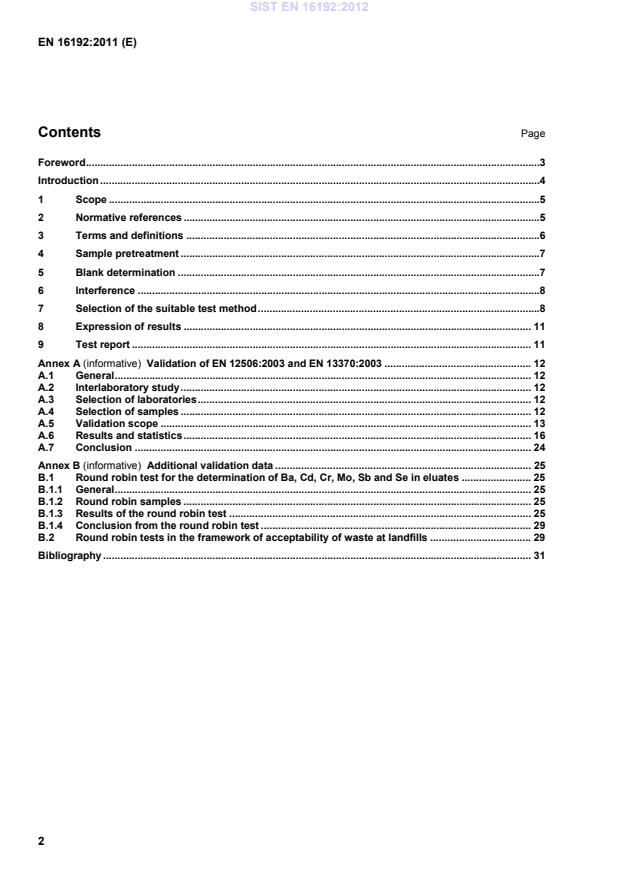
Validation of EN 12506:2003 and EN 13370:2003 . 12A.1 General . 12A.2 Interlaboratory study . 12A.3 Selection of laboratories . 12A.4 Selection of samples . 12A.5 Validation scope . 13A.6 Results and statistics . 16A.7 Conclusion . 24Annex B (informative)
Additional validation data . 25B.1 Round robin test for the determination of Ba, Cd, Cr, Mo, Sb and Se in eluates . 25B.1.1 General . 25B.1.2 Round robin samples . 25B.1.3 Results of the round robin test . 25B.1.4 Conclusion from the round robin test . 29B.2 Round robin tests in the framework of acceptability of waste at landfills . 29Bibliography . 31 SIST EN 16192:2012
This European Standard deals with the determination of chemical constituents, electrical conductivity, pH and total dissolved solids (TDS) in eluates which have been obtained by leaching of waste samples for example using EN 12457 “Characterization of waste - Leaching - Compliance test for leaching of granular waste materials and sludges” (Part 1 to Part 4). In principle, it may be used for the analysis of every kind of eluate as long as the performance characteristics of the applied analytical method fulfill the specific requirements. SIST EN 16192:2012
(ISO/DIS 5667-3:2010) EN ISO 9562:2004, Water quality — Determination of adsorbable organically bound halogens (AOX) (ISO 9562:2004) EN ISO 10304-1:2009, Water quality — Determination of dissolved anions by liquid chromatography of ions — Part 1: Determination of bromide, chloride, fluoride, nitrate, nitrite, phosphate and sulfate (ISO 10304-1:2007) EN ISO 10304-3:1997, Water quality — Determination of dissolved anions by liquid chromatography of ions — Part 3: Determination of chromate, iodide, sulfite, thiocyanate and thiosulfate (ISO 10304-3:1997) EN ISO 11732:2005, Water quality — Determination of ammonium nitrogen — Method by flow analysis (CFA and FIA) and spectrometric detection (ISO 11732:2005) EN ISO 11885:2009, Water quality — Determination of selected elements by inductively coupled plasma optical emission spectrometry (ICP-OES) (ISO 11885:2007) EN ISO 11969:1996, Water quality — Determination of arsenic — Atomic absorption spectrometric method (hydride technique) (ISO 11969:1996) EN ISO 13395:1996, Water quality — Determination of nitrite nitrogen and nitrate nitrogen and the sum of both by flow analysis (CFA and FIA) and spectrometric detection (ISO 13395:1996) EN ISO 14402:1999, Water quality — Determination of the phenol index by flow analysis (FIA and CFA)
(ISO 14402:1999) EN ISO 14403:2002, Water quality — Determination of total cyanide and free cyanide by continuous flow analysis
(ISO 14403:2002) EN ISO 14911:1999, Water quality — Determination of dissolved Li+, Na+, NH4+, K+, Mn2+, Ca2+, Mg2+, Sr2+ and Ba2+ using ion chromatography — Method for water and waste water (ISO 14911:1998) EN ISO 15586:2003, Water quality — Determination of trace elements using atomic absorption spectrometry with graphite furnace (ISO 15586:2003) SIST EN 16192:2012
(ISO 17852:2006) EN ISO 23913:2009, Water quality — Determination of chromium(VI) — Method using flow analysis (FIA and CFA) and spectrometric detection (ISO 23913:2006) ISO 6439:1990, Water quality — Determination of phenol index — 4-Aminoantipyrine spectrometic methods after distillation ISO 6703-2:1984, Water quality — Determination of cyanide — Part 2: Determination of easily liberatable cyanide ISO 7150-1:1984, Water quality — Determination of ammonium — Part 1: Manual spectrometric method ISO 8288:1986, Water quality — Determination of cobalt, nickel, copper, zinc, cadmium and lead — Flame atomic absorption spectrometric methods ISO 9297:1989, Water quality — Determination of chloride — Silver nitrate titration with chromate indicator (Mohr's method) ISO 9965:1993, Water quality — Determination of selenium — Atomic absorption spectrometric method (hydride technique) ISO 10359-1:1992, Water quality — Determination of fluoride — Part 1: Electrochemical probe method for potable and lightly polluted water ISO 10523:2008, Water quality — Determination of pH ISO 11083:1994, Water quality — Determination of chromium (VI) — Spectrometric method using 1,5-diphenylcarbazide ISO 22743:2006, Water quality — Determination of sulfates — Method by continuous flow analysis (CFA) 3 Terms and definitions For the purposes of this document, the following terms and definitions apply. 3.1 sample portion of material selected from a larger quantity of material 3.2 eluate solution obtained by a leaching test 3.3 laboratory sample sample or subsample(s) sent to or received by the laboratory 3.4 test sample; analytical sample sample, prepared from the laboratory sample, from which test portions are removed for testing or analysis SIST EN 16192:2012
It is therefore essential to take the necessary precautions to minimize these reactions and in the case of many parameters to analyze the eluate sample with a minimum of delay. The maximum delay is given in
prEN ISO 5667-3 or in the respective analytical standards. Precautions should be taken before and during transport as well as during the time in which the samples are preserved in the laboratory before being analyzed, to avoid alteration of the test portion. Split the eluate in an adequate number of test portions for different chemical analyses and preserve them according to the requirements in the analytical standards or prEN ISO 5667-3. One specific test portion may be an untreated aliquot of the laboratory sample for the analysis of chromates such as chloride, fluoride, sulfate, nitrite and chromium(VI) as well as for the determination of electrical conductivity. For trace metal analysis test portions usually need to be acidified to pH ≤ 2. NOTE 1 For safety reasons it is recommended to acidify the test portion under a hood as volatile toxic substances can be generated. NOTE 2 In cases where high contents of soluble solids are leached, acidification of the eluates can lead to precipitation of salts. This can be avoided by dilution prior to acidification. 5 Blank determination The blank contribution of the applied analytical procedures shall be determined as described in the analytical standards and considered in the calculation of the results when appropriate. SIST EN 16192:2012
If the methods referred to in Table 1 are found to be inappropriate by reason of, for example, detection limits, repeatability or interferences, other methods validated for water analysis e.g. discrete analyzer, can be used. Their suitability for waste eluates shall be checked in the laboratory performing the analysis. The reason for the deviation shall be stated in the test report. Table 1 — Parameters and test methods
Parameter Test method pH ISO 10523:2008 Ammonium EN ISO 11732:2005 EN ISO 14911:1999 ISO 7150-1:1984 AOX EN ISO 9562:2004 As EN ISO 11885:2009 EN ISO 11969:1996 EN ISO 15586:2003 EN ISO 17294-1:2006 EN ISO 17294-2:2004 Ba EN ISO 11885:2009 EN ISO 17294-1:2006 EN ISO 17294-2:2004 SIST EN 16192:2012
Table 1 (continued) Parameter Test method Cd ISO 8288:1986 EN ISO 11885:2009 EN ISO 15586:2003 EN ISO 17294-1:2006 EN ISO 17294-2:2004 Cl- ISO 9297:1989 EN ISO 10304-1:2009 EN ISO 15682:2001 CN-easily liberatable EN ISO 14403:2002a ISO 6703-2:1984 Co EN ISO 11885:2009 EN ISO 15586:2003 EN ISO 17294-1:2006 EN ISO 17294-2:2004 Cr EN ISO 11885:2009 EN ISO 15586:2003 EN ISO 17294-1:2006 EN ISO 17294-2:2004 Cr(VI) ISO 11083:1994 EN ISO 10304-3:1997 EN ISO 23913:2009 Cu ISO 8288:1986 EN ISO 11885:2009 EN ISO 15586:2003 EN ISO 17294-1:2006 EN ISO 17294-2:2004 DOC/TOC EN 1484:1997 Electrical conductivity EN 27888:1993 F- EN ISO 10304-1:2009b ISO 10359-1:1992 Hg EN 1483:2007 EN ISO 17852:2008 Mo EN ISO 11885:2009 EN ISO 15586:2003 EN ISO 17294-1:2006 EN ISO 17294-2:2004
j) a statement on measurement uncertainty (where needed); k) a signature and title or an equivalent marking of person(s) accepting technical responsibility for the test report and date of issue; l) a statement that the test results relate only to the laboratory sample; m) a statement that the report shall not be reproduced except in full without the written approval of the testing laboratory. SIST EN 16192:2012
Validation of EN 12506:2003 and EN 13370:2003 A.1 General During 1999 - 2001 a project for validation of these standards has been organized and carried out. The validation included an interlaboratory study for evaluation of performance characteristics of methods included in these standards (reproducibility and repeatability). A.2 Interlaboratory study The purpose of the validation trial was to check the suitability of the cited standards for analysis of waste eluates.
A.3 Selection of laboratories A questionnaire has been circulated by all CEN/TC 292/WG 2 and WG 3 members to collect a list of interested European laboratories. 41 laboratories gave their commitment to participate in the interlaboratory trial. All of them were asked to declare that they fulfil the minimum requirements to carry out the analyses according to the standards. According to ISO 5725 series no selection has been made in advance on the basis of the supposed "ability" of laboratories, their accreditation, etc. It is therefore legitimate to regard the participating laboratories as a good average of "normal" European laboratories. A.4 Selection of samples To test the analytical procedures on a proper number of eluates, four different materials were considered to produce bulk amounts of waste eluates: — contaminated soil (COS), — sewage sludge (SEW), — sand blasting waste (SBW), — fly ash filter cake from municipal solid waste incinerator (FFC), Additionally, three synthetic solutions were prepared (SYN1, SYN2 and SYN3). The analytical procedures mentioned in the cited standards require different conservation methods. Since it was impossible to produce waste eluates using all the different conservating agents and methods according to the corresponding standards, it was decided to use only two conservation methods:
— addition of HNO3 to a pH of about 2, — no conservation agents but storage of the eluates at 4°C in the dark. The waste eluates and synthetic solutions stabilized with HNO3 were filled into polyethylene bottles and other samples into glass bottles. Table A.1 shows the different conservation procedures as mentioned in the standards and used in this trial. SIST EN 16192:2012
The parameter/method combinations marked with an x in Table A.1 were successfully validated. A remark is given in Table A.1 for those parameter/method combinations where the validation was not successful, because: — the element concentrations in some samples did not match the working range for the analytical method; — the number of participants and/or the number of results was too low; — matrix dependent interferences occured. In the other cases no validation study was performed. Complementarily some of the standards cited in EN 12506:2003 and EN 13370:2003 have been validated by ISO on waste water. SIST EN 16192:2012
Parameter Standard Prescribed conservation in standard Used Conservation in trial COSFFC SBW SEW SYN1 SYN2 SYN3
Validated by ISO on waste water Ammonium NH4 ISO 7150-1 Immediate analysis or H2SO4 pH 2 None, 4 oC
x
x
Ammonium NH4 EN ISO 11732 Immediate analysis or H2SO4 pH 2 None, 4 oC
x
x
x AOX EN 1485 HNO3 pH 2 HNO3 pH 2 x
x
x As EN ISO 11885 HNO3 pH 2 HNO3 pH 2 x
x
a
x As EN ISO 11969 HCl pH 2 HNO3 pH 2 x
b
Ba EN ISO 11885 HNO3 pH 2 HNO3 pH 2
x x
x
Cd ISO 8288 HNO3 pH 2 HNO3 pH 2 x
x x
Cd EN ISO 11885 HNO3 pH 2 HNO3 pH 2 x
x
Cl- ISO 9297 None, 4 oC None, 4 oC
x x
x Cl- EN ISO 10304-1 None, 4 oC None, 4 oC
x x x
x Cyanide easily liberatable ISO 6703-2 NaOH pH 8 None, 4 oC
c
a x
Cyanide easily liberatable EN ISO 14403 NaOH pH 12 None, 4 oC
x a
x Co EN ISO 11885 HNO3 pH 2 HNO3 pH 2 x
x
Cr EN ISO 11885 HNO3 pH 2 HNO3 pH 2
x
x
Cr(Vl)
...
Questions, Comments and Discussion
Ask us and Technical Secretary will try to provide an answer. You can facilitate discussion about the standard in here.
Loading comments...