

EN 13355:2004+A1:2009
(Main + Amendment)Coating plants - Combined booths - Safety requirements
- Abstract
This document is applicable to combined booths for the application of organic liquid coating materials by an operator with maximum drying temperature of 100 °C and deals with all hazards significant for combined booths, when they are used as intended and under the conditions foreseen by the manufacturer (see clause 4).
To the extent of this document, a combined booth is considered an assembly of the following equipment:
- forced ventilation by one or more fans,
- ventilation air heating system (e. g. heat exchanger or burner),
- power driven dampers, forced ventilation ducting,
- dry air filtering and/or wet air washing systems,
- automatic fire extinguishing equipment and additional specific electrical equipment,
- control and power circuits joined together for the spraying and drying process of liquid coating material in a space totally enclosed provided with forced ventilation.
- working pit, in special case.
This document does not cover:
a) booths for automatic spraying, powder spray booths, open booths, and portable heaters.
b) design of the building foundations upon which a booth is installed;
c) the civil engineering and building design where a booth is constructed as, or to use part of, a new or existing building;
d) spraying equipment (see EN 1953), automatic devices for spraying systems like robots (see EN 775) or reciprocators or similar systems, conveyors, lifts and continuous handling equipment and systems (see EN 619).
This document is not applicable to combined booths which are manufactured before the date of publication of this standard by CEN.
- Status
- Withdrawn
- Publication Date
- 31-Mar-2009
- Withdrawal Date
- 06-Oct-2026
- Technical Committee
- CEN/TC 271 - Surface treatment equipment - Safety
- Drafting Committee
- CEN/TC 271/WG 3 - Coating plants
- Current Stage
- 9960 - Withdrawal effective - Withdrawal
- Start Date
- 05-Dec-2018
- Completion Date
- 07-Oct-2026
- Directive
- 2006/42/EC - Directive 2006/42/EC of the European Parliament and of the Council of 17 May 2006 on machinery, and amending Directive 95/16/EC (recast)OJ Ref: C, C 214 OJ Date: 08-Sep-2009

Relations
- Effective Date
- 04-Feb-2009
- Effective Date
- 11-Dec-2018
- Effective Date
- 02-Jun-2026
- Effective Date
- 09-Feb-2026
- Effective Date
- 09-Feb-2026
- Effective Date
- 09-Feb-2026
- Effective Date
- 09-Feb-2026
- Effective Date
- 09-Feb-2026
- Effective Date
- 09-Feb-2026
- Effective Date
- 09-Feb-2026
- Effective Date
- 28-Jan-2026
- Effective Date
- 28-Jan-2026
- Effective Date
- 28-Jan-2026
- Effective Date
- 28-Jan-2026
- Effective Date
- 28-Jan-2026
Frequently Asked Questions
EN 13355:2004+A1:2009 is a standard published by the European Committee for Standardization (CEN). Its full title is "Coating plants - Combined booths - Safety requirements". This standard covers: This document is applicable to combined booths for the application of organic liquid coating materials by an operator with maximum drying temperature of 100 °C and deals with all hazards significant for combined booths, when they are used as intended and under the conditions foreseen by the manufacturer (see clause 4). To the extent of this document, a combined booth is considered an assembly of the following equipment: - forced ventilation by one or more fans, - ventilation air heating system (e. g. heat exchanger or burner), - power driven dampers, forced ventilation ducting, - dry air filtering and/or wet air washing systems, - automatic fire extinguishing equipment and additional specific electrical equipment, - control and power circuits joined together for the spraying and drying process of liquid coating material in a space totally enclosed provided with forced ventilation. - working pit, in special case. This document does not cover: a) booths for automatic spraying, powder spray booths, open booths, and portable heaters. b) design of the building foundations upon which a booth is installed; c) the civil engineering and building design where a booth is constructed as, or to use part of, a new or existing building; d) spraying equipment (see EN 1953), automatic devices for spraying systems like robots (see EN 775) or reciprocators or similar systems, conveyors, lifts and continuous handling equipment and systems (see EN 619). This document is not applicable to combined booths which are manufactured before the date of publication of this standard by CEN.
This document is applicable to combined booths for the application of organic liquid coating materials by an operator with maximum drying temperature of 100 °C and deals with all hazards significant for combined booths, when they are used as intended and under the conditions foreseen by the manufacturer (see clause 4). To the extent of this document, a combined booth is considered an assembly of the following equipment: - forced ventilation by one or more fans, - ventilation air heating system (e. g. heat exchanger or burner), - power driven dampers, forced ventilation ducting, - dry air filtering and/or wet air washing systems, - automatic fire extinguishing equipment and additional specific electrical equipment, - control and power circuits joined together for the spraying and drying process of liquid coating material in a space totally enclosed provided with forced ventilation. - working pit, in special case. This document does not cover: a) booths for automatic spraying, powder spray booths, open booths, and portable heaters. b) design of the building foundations upon which a booth is installed; c) the civil engineering and building design where a booth is constructed as, or to use part of, a new or existing building; d) spraying equipment (see EN 1953), automatic devices for spraying systems like robots (see EN 775) or reciprocators or similar systems, conveyors, lifts and continuous handling equipment and systems (see EN 619). This document is not applicable to combined booths which are manufactured before the date of publication of this standard by CEN.
EN 13355:2004+A1:2009 is classified under the following ICS (International Classification for Standards) categories: 87.100 - Paint coating equipment. The ICS classification helps identify the subject area and facilitates finding related standards.
EN 13355:2004+A1:2009 has the following relationships with other standards: It is inter standard links to EN 13355:2004, EN 16985:2018, EN IEC 61000-6-3:2026, EN IEC 61000-6-4:2019, EN IEC 60079-0:2018, EN 60204-1:1997, EN 60529:1991, EN IEC 61000-6-1:2019, EN IEC 60079-15:2019, EN IEC 61000-6-3:2021, EN ISO 13849-1:2023, EN ISO 13850:2015, EN 12453:2017+A1:2021, EN ISO 14119:2025, EN 746-1:1997+A1:2009. Understanding these relationships helps ensure you are using the most current and applicable version of the standard.
EN 13355:2004+A1:2009 is associated with the following European legislation: EU Directives/Regulations: 2006/42/EC, 98/37/EC; Standardization Mandates: M/079, M/396. When a standard is cited in the Official Journal of the European Union, products manufactured in conformity with it benefit from a presumption of conformity with the essential requirements of the corresponding EU directive or regulation.
EN 13355:2004+A1:2009 is available in PDF format for immediate download after purchase. The document can be added to your cart and obtained through the secure checkout process. Digital delivery ensures instant access to the complete standard document.
Standards Content (Sample)
2003-01.Slovenski inštitut za standardizacijo. Razmnoževanje celote ali delov tega standarda ni dovoljeno.Premazne naprave - Kombinirane kabine za brizganje in sušenje - Varnostne zahteveBeschichtungsanlagen - Kombinierte Spritz- und Trocknungskabinen - SicherheitsanforderungenInstallations d'application - Cabines mixtes d'application et de séchage - Prescriptions de sécuritéCoating plants - Combined booths - Safety requirements87.100Oprema za nanašanje premazovPaint coating equipmentICS:Ta slovenski standard je istoveten z:EN 13355:2004+A1:2009SIST EN 13355:2005+A1:2009en,fr01-maj-2009SIST EN 13355:2005+A1:2009SLOVENSKI
STANDARDSIST EN 13355:20051DGRPHãþD
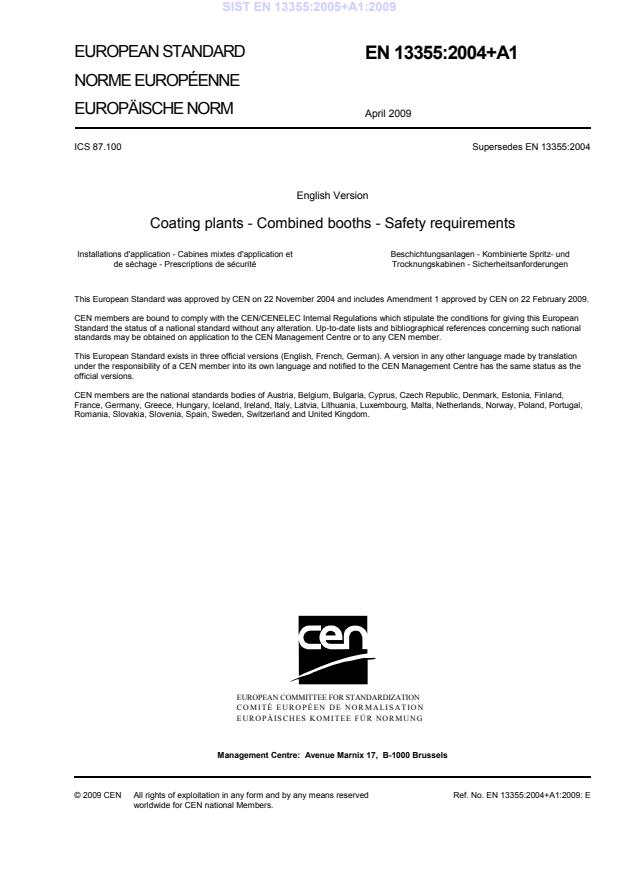
EUROPEAN STANDARD NORME EUROPÉENNE EUROPÄISCHE NORM
EN 13355:2004+A1
April 2009 ICS 87.100 Supersedes EN 13355:2004English Version
Coating plants - Combined booths - Safety requirements
Installations d'application - Cabines mixtes d'application et de séchage - Prescriptions de sécurité
Beschichtungsanlagen - Kombinierte Spritz- und Trocknungskabinen - Sicherheitsanforderungen This European Standard was approved by CEN on 22 November 2004 and includes Amendment 1 approved by CEN on 22 February 2009. CEN members are bound to comply with the CEN/CENELEC Internal Regulations which stipulate the conditions for giving this European Standard the status of a national standard without any alteration. Up-to-date lists and bibliographical references concerning such national standards may be obtained on application to the CEN Management Centre or to any CEN member.
This European Standard exists in three official versions (English, French, German). A version in any other language made by translation under the responsibility of a CEN member into its own language and notified to the CEN Management Centre has the same status as the official versions.
CEN members are the national standards bodies of Austria, Belgium, Bulgaria, Cyprus, Czech Republic, Denmark, Estonia, Finland, France, Germany, Greece, Hungary, Iceland, Ireland, Italy, Latvia, Lithuania, Luxembourg, Malta, Netherlands, Norway, Poland, Portugal, Romania, Slovakia, Slovenia, Spain, Sweden, Switzerland and United Kingdom.
EUROPEAN COMMITTEE FOR STANDARDIZATION
COMITÉ EUROPÉEN DE NORMALISATION EUROPÄISCHES KOMITEE FÜR NORMUNG
Management Centre:
Avenue Marnix 17,
B-1000 Brussels © 2009 CEN All rights of exploitation in any form and by any means reserved worldwide for CEN national Members. Ref. No. EN 13355:2004+A1:2009: ESIST EN 13355:2005+A1:2009
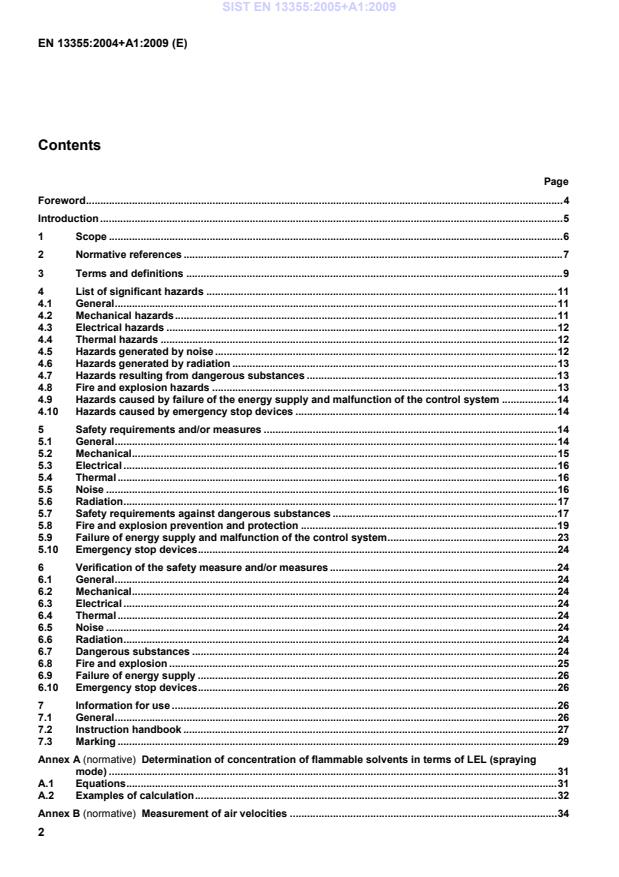
Determination of concentration of flammable solvents in terms of LEL (spraying mode) . 31A.1Equations . 31A.2Examples of calculation . 32Annex B (normative)
Measurement of air velocities . 34SIST EN 13355:2005+A1:2009
Classification of material’s reaction to the fire – National standards . 41Annex D (informative)
References to national exposure limit values . 42Annex E (informative)
Equivalence between zone description and categories of ignition protection . 43Annex ZA (informative)
Relationship between this European Standard and the Essential Requirements of EU Directive 98/37/EC !, amended by 98/79/EC" . 44Annex ZB (informative)
!Relationship between this European Standard and the Essential Requirements of EU Directive 2006/42/EC" . 45Bibliography . 46 SIST EN 13355:2005+A1:2009
ventilation air heating system (e. g. heat exchanger or burner),
power driven dampers, forced ventilation ducting,
dry air filtering and/or wet air washing systems,
automatic fire extinguishing equipment and additional specific electrical equipment,
control and power circuits joined together for the spraying and drying process of liquid coating material in a space totally enclosed provided with forced ventilation. working pit, in special case. This document does not cover: a) booths for automatic spraying, powder spray booths, open booths, and portable heaters. b) design of the building foundations upon which a booth is installed; c) the civil engineering and building design where a booth is constructed as, or to use part of, a new or existing building; d) spraying equipment (see EN 1953), automatic devices for spraying systems like robots (see EN 775) or reciprocators or similar systems, conveyors, lifts and continuous handling equipment and systems (see EN 619). This document is not applicable to combined booths which are manufactured before the date of publication of this standard by CEN. SIST EN 13355:2005+A1:2009
— Requirements and test methods SIST EN 13355:2005+A1:2009
(IEC 60079-15:2001, modified) EN 60204-1:1997, Safety of machinery — Electrical equipment of machines — Part 1: General requirements
(IEC 60204-1:1997) EN 60529, Degrees of protection provided by enclosures (IP code) EN 61000-6-1, Electromagnetic compatibility (EMC) — Part 6-1: Generic standards; Immunity for residential, commercial and light-industrial environments (IEC 61000-6-1:1997, modified) EN 61000-6-3, Electromagnetic compatibility (EMC) — Part 6-3: Generic standards; Emission standard for residential, commercial and light-industrial environments (IEC 61000-6-3:1996, modified) EN 61000-6-4, Electromagnetic compatibility (EMC) — Part 6-4: Generic standards; Emission standard for industrial environments (IEC 61000-6-4:1997, modified) EN ISO 3746, Acoustics — Determination of sound power levels of noise sources using sound pressure — Survey method using an enveloping measurement surface over a reflecting plane (ISO 3746:1995) EN ISO 4871, Acoustics — Declaration and verification of noise emission values of machinery and equipment
(ISO 4871:1996) EN ISO 11202, Acoustics — Noise emitted by machinery and equipment — Measurement of emission sound pressure levels at a work station and at other specified positions — Survey method in situ (ISO 11202:1995) EN ISO 12100-1, Safety of machinery — Basic concepts, general principles for design — Part 1: Basic terminology, methodology (ISO 12100-1:2003) EN ISO 12100-2:2003, Safety of machinery — Basic concepts, general principles for design — Part 2: Technical principles (ISO 12100-2:2003) EN ISO 14122-2, Safety of machinery — Permanent means of access to machinery — Part 2: Working platforms and walkways (ISO 14122-2:2001) EN ISO 14122-3, Safety of machinery — Permanent means of access to machinery — Part 3: Stairs, stepladders and guard-rails (ISO 14122-3:2001) EN ISO 14122-4, Safety of machinery — Permanent means of access to machinery — Part 4: Fixed ladders
(ISO 14122-4:2004) SIST EN 13355:2005+A1:2009
substrate forms a film possessing protective, decorative and/or specific technical properties, e.g.: paints, varnishes, including their solvents and thinners (see EN 971-1) 3.4 solvent single liquid, or blends of liquid, volatile under specified drying conditions, and in which the binder is completely soluble (see 1.4.5 of EN 971-1:1996) NOTE Solvents are also contained in liquids used as cleaning or washing agents. 3.5 spraying application of coating material on an item within the combined booth by pneumatic, airless, electrostatic or combination of these spraying systems 3.6 drying evaporation of liquids from the materials being processed (see 3.5 of EN 1539:2000). 3.7 curing Transformation of a liquid, paste or powder coating material into a finished solid material (see 3.8 of EN 1539:2000) NOTE Also known as gelling, through curing or through drying. 3.8 forced ventilation air circulation achieved by one or several fans 3.9 recirculated air air extracted from the volume and reintroduced into it 3.10 air cleaning (filtering system) Filtering system used for introducing clean air into the booth and cleaning contaminated air extracted from the combined booth SIST EN 13355:2005+A1:2009
to the entire unburned mixture (see EN 1127-1) 3.13 lower explosion limit (LEL) lower limit of the range of concentration of a combustible in air over which an explosion can occur (3.8 and 3.13 of EN 1127-1:1997) NOTE ”Explosion limit” and ”Ignition limit” are equivalent. In accordance with international usage, only the term ”explosion limit" is used in this standard. 3.14 total space net volume within the booth during spraying and drying processes which may contain released substances. It includes all sections of the combined booth recirculation system(s) and ends at the outlet connection to the external exhaust NOTE It does not include any items loaded into the combined booth, supports, transport systems or thermal cleaning systems (see !EN 12753"). 3.15 hazardous areas areas where hazards due to explosive atmosphere may exist. The probability of occurrence of explosive atmosphere is classified in zones 3.15.1 zone 0 place in which an explosive atmosphere consisting of a mixture with air of flammable substances in the form of gas, vapour or mist is present continuously or for long periods or frequently (see 6.3.2 of EN 1127-1:1997) 3.15.2 zone 1 place in which an explosive atmosphere consisting of a mixture with air of flammable substances in the form of gas, vapour or mist is likely to occur in normal operation occasionally (see 6.3.2 of EN 1127-1:1997) 3.15.3 zone 2 place in which an explosive atmosphere consisting of a mixture with air of flammable substances in the form of gas, vapour or mist is not likely to occur in normal operation but, if it does occur, will persist for a short period only (see 6.3.2 of EN 1127-1:1997) 3.16 Equipment category
3.16.1 Equipment Group II Category 1 equipment in this category is intended for use in areas in which explosive atmospheres caused by mixtures of air and gases, vapours or mists are present continuously for long periods or frequently (see 3.2.3 of EN 13463-1:2001) NOTE Equipment of category 1 is suitable for use in zone 0. SIST EN 13355:2005+A1:2009
moving parts of combined booth (e.g. doors, gates and hoods). SIST EN 13355:2005+A1:2009
the occurrence of fire; accidental significant lowering of pressure inside the combined booth (i.e.: obstruction of air inlet) capable of clamping the doors by mechanical deformation of the structure of the combined booth; increasing the door opening effort beyond human capability. 4.2.3 Hazards resulting from the operator slipping or falling: These hazards are related to: ladders, gangways, platform or stairs; floor gratings; slippery floors; These hazards may be increased as a result of poor lighting. 4.3 Electrical hazards 4.3.1 Electrical shock (by direct or indirect contact) These hazards are related to: electrically live parts that are non insulated for operational reasons (for instance in electrostatic devices); live parts when insulation is damaged by contact with solvents or by mechanical means. 4.3.2 External influence on electrical equipment These hazards are related to: interaction of the electrostatic high voltage equipment elements of the control and safety systems which can cause dangerous malfunctions, e. g. short circuits on electronic safety circuits, entrance guards, alarm units. 4.4 Thermal hazards These hazards are related to: contact with hot surfaces within easy reach. 4.5 Hazards generated by noise These hazards are related to combined booths and can be present inside as well as outside the booth. They can be generated by noises emitted for instance by: fans; excessive air velocity in ducts and accessories; SIST EN 13355:2005+A1:2009
from inside and outside shall be capable of being opened from inside by a mere push, independent of the air pressure (high or low) within the combined booth, shall be self-closing, shall have a minimum 800 mm width and minimum 2000 mm height (free opening). Combined booths shall be provided with a minimum of two permanently accessible and normally non-lockable doors placed as far as practically possible apart from each other. Also when the booth is loaded the operator shall not have more than 10m to travel in order to reach at least one of these doors. If the booth-loading door can be opened by a mere push from the inside only one additional personnel door shall be required. If the longest wall is less than 5m a single door is considered to be sufficient. Power-operated doors as well as vertical and horizontal sliding doors cannot be considered as personnel door. Power-operated doors shall comply with EN 12433, EN 12445, EN 12453, EN 12635 and EN 12978. In addition the length and width of combined booths shall be a minimum of 1m on each side than of the biggest item to be painted. SIST EN 13355:2005+A1:2009
Protection against burns by hot surfaces shall be secured by means of appropriate insulation or protection against contact of all elements within arm’s reach and within the working area. According to EN 563 at an ambient temperature of 20 °C the surface temperature shall be less than 60 °C. Exceptions are permissible in small localised areas of the surface (for example flanges of burners, bolts, fan and roller shaft). NOTE For safety of hot spraying systems, see EN 1953. 5.5 Noise A combined booth shall be so designed and constructed that risks resulting from the emission of airborne noise are reduced to the lowest level taking account of technical progress and the availability of means of reducing noise, in particular at source. The following measures can be adopted – where possible: equipment set on anti-vibration supports; flexible connections between the ducts and especially between fans and ducts; choice of fan speed according to the most favourable noise curves; SIST EN 13355:2005+A1:2009
NOTE 3 For noise emitted by air compressors and spraying equipment see EN 1012-1 and EN 1953. 5.6 Radiation Infra-red heating systems shall be designed and constructed to minimise any harmful effect of radiation. The protection can be achieved by the following measures: interlocking of all doors to shut down the heating system to prevent entry by personnel when the heaters are in use special barriers or special enclosure of the light tube. Additional warning signs shall be fitted on the outside of the doors (see 7.2.1). 5.7 Safety requirements against dangerous substances 5.7.1 Contact with/or absorption of dangerous fluids (paints, solvents) Contact with or absorption of dangerous substances sprayed shall be reduced by forced ventilation as far as possible (see 5.7.2). See also provisions for the information for use to be included in the instruction handbook in 7.2.2. 5.7.2 Inhalation of aerosols and solvent vapours 5.7.2.1 Forced ventilation In order to avoid inhalation of aerosols and solvent vapours the combined booth shall have an adequate forced ventilation taking into account: type of application, size and shape of items,
amount of dangerous substances sprayed, exposure limit values relevant to the used coating material (examples given in annex !D"). 5.7.2.2 Airflow The following measures shall be applied: Measures to prevent an atmosphere contaminated by aerosols and solvent vapours of organic liquid coating materials above the exposure limit values. SIST EN 13355:2005+A1:2009
For residual risks emanating from the hazards dealt with in this clause see 7.2.2. 5.7.2.3 Air velocity Combined booths shall be designed for air velocities specified below for empty booth conditions as described in a), b) and c): a) For combined booths for similar items (e.g.: small vehicles, vans) and combined booths for large similar items (e.g.: buses, trucks): The average of measured air velocities shall be at least 0,30 m/s, Single measured values shall be at least 0,25 m/s. Corresponding measurement points are specified in annex B. b) For combined booths for industrial items of various sizes: The air velocity at any point shall not be less than 0,30 m/s. c) For combined booths with a working pit air velocities specified below shall be measured inside the working pit. The average of measured air velocities inside the working pit shall be at least 0,30 m/s. Single measured values inside the working pit shall be at least 0,25 m/s. Corresponding measurement points are specified in annex B. Special air velocities are acceptable for a combined booth where very long items are to be painted (e.g.: train carriages, aeroplane), but the health and safety of the operator shall be ensured. The conditions for the health of the operator inside the combined booth shall be evaluated by special risk assessment. The use of personal breathing protective devices is required when spraying inside enclosures (e.g. train carriages, trucks, busses or in a working pit within the booth, see clause 7.2.2). 5.7.2.4 Monitoring of air velocity Combined booths shall be provided with a device that is capable of monitoring air velocity performance. The ventilation air velocity shall not fall below that specified in 5.7.2.3 (see 5.8.2.5.1.). Failure of the ventilation system, or insufficient ventilation, shall be indicated by a visual and audible alarm (see EN 981). 5.7.3 Inhalation of toxic gases released by the heating device a) General Heating devices using combustible substances shall comply with specific standards EN 746-1, EN 746-2, and EN 525. To avoid reintroduction of contaminated air, the fresh air inlet duct shall be positioned apart from the exhaust air duct and (for indirect systems) the burner flue. SIST EN 13355:2005+A1:2009
...