

EN 15609:2008
(Main)LPG equipment and accessories - LPG propulsion systems for boats, yachts and other craft - Installation requirements
- Abstract
This European Standard specifies the requirements for the LPG propulsion systems on craft with hull lengths less than or equal to 24 meters, see Directive 94/25.
- Status
- Withdrawn
- Publication Date
- 25-Nov-2008
- Withdrawal Date
- 24-Apr-2012
- Technical Committee
- CEN/TC 286 - Liquefied petroleum gas equipment and accessories
- Drafting Committee
- CEN/TC 286/WG 6 - Automative LPG system
- Current Stage
- 9960 - Withdrawal effective - Withdrawal
- Start Date
- 25-Apr-2012
- Completion Date
- 25-Apr-2012
- Directive
- 94/25/EC - Recreational craft


Relations
- Effective Date
- 02-May-2012
Get Certified
Connect with accredited certification bodies for this standard

DNV
DNV is an independent assurance and risk management provider.

Lloyd's Register
Lloyd's Register is a global professional services organisation specialising in engineering and technology.

FSC International
Forest Stewardship Council certification.
Sponsored listings
Frequently Asked Questions
EN 15609:2008 is a standard published by the European Committee for Standardization (CEN). Its full title is "LPG equipment and accessories - LPG propulsion systems for boats, yachts and other craft - Installation requirements". This standard covers: This European Standard specifies the requirements for the LPG propulsion systems on craft with hull lengths less than or equal to 24 meters, see Directive 94/25.
This European Standard specifies the requirements for the LPG propulsion systems on craft with hull lengths less than or equal to 24 meters, see Directive 94/25.
EN 15609:2008 is classified under the following ICS (International Classification for Standards) categories: 47.020.20 - Marine engines and propulsion systems; 47.080 - Small craft. The ICS classification helps identify the subject area and facilitates finding related standards.
EN 15609:2008 has the following relationships with other standards: It is inter standard links to EN 15609:2012. Understanding these relationships helps ensure you are using the most current and applicable version of the standard.
EN 15609:2008 is associated with the following European legislation: EU Directives/Regulations: 94/25/EC; Standardization Mandates: M/075. When a standard is cited in the Official Journal of the European Union, products manufactured in conformity with it benefit from a presumption of conformity with the essential requirements of the corresponding EU directive or regulation.
EN 15609:2008 is available in PDF format for immediate download after purchase. The document can be added to your cart and obtained through the secure checkout process. Digital delivery ensures instant access to the complete standard document.
Standards Content (Sample)
2003-01.Slovenski inštitut za standardizacijo. Razmnoževanje celote ali delov tega standarda ni dovoljeno.Flüssiggas-(LPG-)Geräte und Ausrüstungsteile - Flüssiggas-(LPG-)Antriebssysteme für Boote, Yachten und andere Wasserfahrzeuge - Anforderungen an die InstallationEquipements pour gaz de pétrole liquéfié et leurs accessoires - Systemes de propulsion GPL des bateaux, yachts et autres navires - Exigences d'installationLPG equipment and accessories - LPG propulsion systems for boats, yachts and other craft - Installation requirements47.020.01Splošni standardi v zvezi z ladjedelništvom in konstrukcijami na morjuGeneral standards related to shipbuilding and marine structures23.020.20Posode in vsebniki, montirani na vozilaVessels and containers mounted on vehiclesICS:Ta slovenski standard je istoveten z:EN 15609:2008SIST EN 15609:2009en,fr,de01-januar-2009SIST EN 15609:2009SLOVENSKI
STANDARD
EUROPEAN STANDARDNORME EUROPÉENNEEUROPÄISCHE NORMEN 15609November 2008ICS 47.020.20; 47.080 English VersionLPG equipment and accessories - LPG propulsion systems forboats, yachts and other craft - Installation requirementsEquipements pour gaz de pétrole liquéfié et leursaccessoires - Systèmes de propulsion GPL des bateaux,yachts et autres navires - Exigences d'installationFlüssiggas-(LPG-)Geräte und Ausrüstungsteile -Flüssiggas-(LPG-)Antriebssysteme für Boote, Jachten undandere Wasserfahrzeuge - Anforderungen an dieInstallationThis European Standard was approved by CEN on 25 October 2008.CEN members are bound to comply with the CEN/CENELEC Internal Regulations which stipulate the conditions for giving this EuropeanStandard the status of a national standard without any alteration. Up-to-date lists and bibliographical references concerning such nationalstandards may be obtained on application to the CEN Management Centre or to any CEN member.This European Standard exists in three official versions (English, French, German). A version in any other language made by translationunder the responsibility of a CEN member into its own language and notified to the CEN Management Centre has the same status as theofficial versions.CEN members are the national standards bodies of Austria, Belgium, Bulgaria, Cyprus, Czech Republic, Denmark, Estonia, Finland,France, Germany, Greece, Hungary, Iceland, Ireland, Italy, Latvia, Lithuania, Luxembourg, Malta, Netherlands, Norway, Poland, Portugal,Romania, Slovakia, Slovenia, Spain, Sweden, Switzerland and United Kingdom.EUROPEAN COMMITTEE FOR STANDARDIZATIONCOMITÉ EUROPÉEN DE NORMALISATIONEUROPÄISCHES KOMITEE FÜR NORMUNGManagement Centre: rue de Stassart, 36
B-1050 Brussels© 2008 CENAll rights of exploitation in any form and by any means reservedworldwide for CEN national Members.Ref. No. EN 15609:2008: ESIST EN 15609:2009
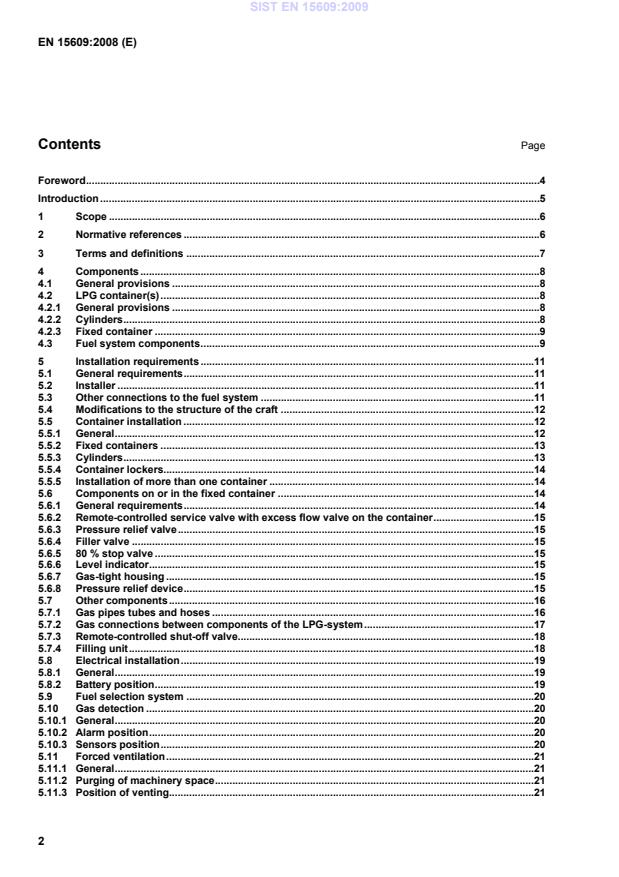
Fixing requirements for containers with a capacity up to and including 150 litres.23 A.1 General requirements.23 A.2 Container frame.24 Annex B (normative)
Fixing requirements for containers with a capacity over 150 litres.25 B.1 General requirements.25 B.2 Container frame.25 Annex C (normative)
Cylinder fixing requirements.26 C.1 General requirements.26 C.2 Cylinder frame.26 Annex D (normative)
Instructions to be included in the owner's manual.29 D.1 General requirements.29 D.2 Availability of LPG supply.29 D.3 Position and operation of emergency shut-off valve.29 D.4 Safety instructions to be included in the manual.29 D.5 Instruction for the normal use of the LPG system.30 D.5.1 Filling of the LPG system.30 D.5.2 Switching procedure (for bi-fuelled craft).30 D.5.3 Opening and closing of manual valves (in case of several containers).30 D.5.4 Level indicator (in case of fixed container).30 D.5.5 Maintenance and inspection.30 D.5.6 Defects and repairs.31 D.5.7 Storage, repair and maintenance.31 D.5.8 Disposal.31 D.5.9 Hot work.31 Annex E (informative)
Installation of more than one container.32 Annex F (informative)
Example of installation certificate.33 Annex ZA (informative)
Relationship between this European Standard and the Essential Requirements of EU Directive 94/25/EC amended by EU Directive 2003/44/EC.34 Bibliography.35
This standard is based on EN 12979 [2]. SIST EN 15609:2009
1 Scope This European Standard specifies the requirements for the LPG propulsion systems on craft with hull lengths less than or equal to 24 meters, see Directive 94/25. 2 Normative references The following referenced documents are indispensable for the application of this document. For dated references, only the edition cited applies. For undated references, the latest edition of the referenced document (including any amendments) applies. EN 1442, LPG equipment and accessories - Transportable refillable welded steel cylinders for LPG - Design and construction EN 12805, Automotive LPG components – Containers EN 12806:2003, Automotive liquefied petroleum gas components – Other than containers EN 12816, Transportable refillable steel and aluminium LPG cylinders – Disposal EN 12864, Low-pressure, non adjustable regulators having a maximum outlet pressure of less than or equal to 200 mbar, with a capacity of less than or equal to 4 kg/h, and their associated safety devices for butane, propane or their mixtures EN 13109, LPG tanks – Disposal EN 13110, Transportable refillable welded aluminium cylinders for liquefied petroleum gas (LPG) - Design and construction EN 14140, LPG equipment and accessories - Transportable refillable welded steel cylinders for LPG - Alternative design and construction EN 14427, Transportable refillable fully wrapped composite cylinders for Liquefied Petroleum Gases - Design and construction EN 28846, Small craft - Electrical devices - Protection against ignition of surrounding flammable gases (ISO 8846:1990) EN 60529, Degrees of protection provided by enclosures (IP-code) (IEC 60529:1989) EN ISO 898-1:1999, Mechanical properties of fasteners made of carbon steel and alloy steel - Part 1: Bolts, screws and studs (ISO 898-1:1999) EN ISO 10133, Small craft – Electrical systems – Extra-low-voltage d.c. installations (ISO 10133:2000) EN ISO 10239, Small craft – Liquefied petroleum gas (LPG) systems (ISO 10239:2008) EN ISO 10240, Small craft – Owner’s manual (ISO 10240:2004) EN ISO 11105, Small craft – Ventilation of petrol engine and/or petrol tank compartments (ISO 11105:1997) EN ISO 11591, Small craft, engine-driven - Field of vision from helm position (ISO 11591:2000) EN ISO 12217 (all parts), Small craft – Stability and buoyancy assessment and categorization SIST EN 15609:2009
3.9 fixed container LPG tank permanently installed to the structure of the craft 3.11 gas detection detection of the presence of LPG outside its containment system 3.13 installer person or organisation, who by qualification, training, experience and resources can assume technical responsibility for the installation of the LPG propulsion system 3.15 Liquefied Petroleum Gas (LPG) mixture of predominantly butane or propane with traces of other hydrocarbon gases classified in accordance with UN number 1965, hydrocarbon gases mixture, liquefied, NOS or UN number 1075, petroleum gases, liquefied NOTE 1 In some countries, UN numbers 1011 and 1978 may also be designated LPG. NOTE 2 For automotive LPG specification, see EN 589 [1].
an equivalent standard 4.2.3 Fixed container 4.2.3.1 General A fixed container shall comply with EN 12805, ISO 20826 or an equivalent standard. 4.2.3.2 Components fitted to the fixed container The container shall be equipped with the following components, which may be either separate or combined (e.g. multivalve): a) 80 % stop valve b) filler valve c) level indicator d) pressure relief valve or pressure relief device e) remotely controlled service valve with excess flow valve The container may be equipped with a: 1) gas-tight housing 2) power supply bushing for actuators/LPG fuel pump 3) LPG fuel pump inside the container 4) non-return valve All components fitted to the container shall comply with EN 12806. The filler valve shall incorporate a double non-return valve. The non-return valve in the filler valve shall comply with Annex G of EN 12806. 4.3 Fuel system components The following components of the fuel system, where used, shall comply with EN 12806 and shall be suitable for use in the marine environment: a) pressure regulator/vaporizer b) shut-off valve c) gas injection device or injector d) gas mixing unit e) gas dosage unit f) flexible fuel hoses and gas pipes SIST EN 15609:2009
The installer of the LPG-system shall: possess the competence and expertise necessary for the proper installation of the LPG-system; have a quality control system that ensures that the installation of the system meets the requirements of this standard; maintain records of the leak test (see X7.1X) and start up operations that are carried out after the installation The manufacturer of the system shall supply installation instructions to the installer of the system. NOTE An example of an installation certificate is given in XAnnex F. 5.3 1Other connections to the fuel system Other LPG systems (e.g. for cooking and heating appliances) which are connected to the LPG propulsion system, shall be adequately protected against unintended gas escape and the operation of the LPG propulsion system shall not be affected. Cooking appliances shall be connected to the vapour phase of the fixed container or cylinder and shall be adequately protected against unintended gas escape and the operation of the LPG propulsion system shall not be affected. SIST EN 15609:2009
Containers, regulators and safety devices shall be secured against any movement that is expected to result from marine service. The container shall be installed so that there is no metal-to-metal contact, other than at any permanent fixing points. A fixed container shall not be directly in contact with the floor and a minimum of 20 mm of space is required. SIST EN 15609:2009
NOTE Hatches for inspection or maintenance of fuel tanks may be covered by uncut carpet, provided that all tank fittings can be inspected and maintained through other openings. If the container is secured to the craft by a container frame and/or container straps, the container shall be installed according to the requirements of XAnnex AX or XAnnex BX as appropriate. Supports, chocks or hangers shall be separated from the surface of metal containers by a non-metallic, non-hygroscopic, non-abrasive material unless welded to the container. Foam shall not be the sole means used to secure containers in place. Where foam is in contact with the container, due care shall be taken to avoid corrosion. Metallic containers within the hull shall be installed with the container bottom no less than 25 mm above the top of the bilge pump inlet or the bilge pump automatic float switch, if fitted. 5.5.3 Cylinders 5.5.3.1 All cylinders Cylinder(s) shall be attached by a dedicated system to the structure of the craft as described in XAnnex CX. Cylinders, valves and pressure regulators shall be installed so that they are readily accessible. Copper-base alloy fittings may be used with aluminium cylinders if protected by a galvanic barrier. Where there is no means to indicate the liquid level of a cylinder, provision shall be made to store filled spare cylinders of equivalent capacity. Provisions for storage of unconnected LPG cylinders, whether filled or empty, shall be the same as for cylinders connected to the system. Cylinders designed to be used on their sides (e.g. FLT type) shall be secured at the correct rotational angle (to ensure correct, liquid off-take and relief valve position). 5.5.3.2 CCylinders in vapour/gas phase For cylinders working on vapour/gas, the low-pressure regulator shall be in accordance with EN 12864 and installed just after the cylinder’s valve outlet.
If several cylinders are simultaneously supplying the engine, an additional pressure-regulator may be installed as close as practicable to the cylinders.
remote (at least 250 mm) from the engine exhaust system; protected from blockage by virtue of its position or other means; located at least 500 mm from any hull opening to the interior of the craft All hoses or metal piping penetrating the locker walls shall be sealed at the wall so as to maintain gas tightness to the craft interior. 5.5.5 IInstallation of more than one container If more than one container is connected to the engine fuel line, the containers shall be installed so that no hydrostatic pressure build-up can take place in the fuel line and that LPG cannot flow from one container into another. This can be achieved by installing a non-return valve downstream of the remote-controlled service valve; or
manually operated valve on each container and a hydrostatic relief valve in the delivery tube, downstream of the non-return valves. An adequate filter system shall be placed upstream of the non-return valves to prevent fouling of the non-return valves. See Figure E.1. A non-return valve and a hydrostatic relief valve is not required if the back-flow pressure of the remote-controlled service valve or the manually operated valve, in the closed position, exceeds 500 kPa. See Figure E.2. In this case, the power supply to the remote-controlled service valves shall be wired so no more than one remote-controlled service valve on the container can be open at any one time. The overlap time to allow switching from one container to another shall be limited to two minutes. Each container shall be provided with its own 80 % stop valve, if required. 5.6 Components fitted to the fixed container 5.6.1 General requirements These requirements do not apply to cylinders. The components on and in the container shall be installed under the responsibility of the holder of the bonfire test certificate as described in EN 12805 or ISO 20826. SIST EN 15609:2009
5.6.7 Gas-tight housing A gas-tight housing shall be fitted over the container fittings unless the container is installed on the main deck and the container fittings are protected against dirt and water. The gas-tight housing shall be vented to the outside of the craft via a venting tube. The ventilation opening of the gas-tight housing shall be provided with adequate protection to prevent the ingress of water. It shall not be directed at a heat source such as the exhaust. The venting tube shall have a minimum clear cross sectional area of 450 mm2. If a gas tube, other tube or any electrical wiring is installed in the venting tube, the clear cross sectional area shall also be at least 450 mm2. The venting tube shall be securely attached to ensure a gas tight connection. 5.6.8 Pressure relief device The pressure relief device shall be fitted in or on the container so that it discharges overboard directly or via the gas-tight housing, if fitted. SIST EN 15609:2009
A flexible hose complying with the requirements of EN 12806 is a preferable alternative to copper gas piping. Rigid pipe shall not be used between parts which can move relative to each other, e.g. between a huII and a flexibly mounted engine.
Gas pipes shall be supported by fixing devices or other means, such as inside vented, non-metallic, supported conduit or piping, to prevent chafing or vibration damage.
Metallic gas pipes shall be secured so that they are not subject to excessive vibration or stress.
Flexible hoses and non-metallic gas pipes shall be secured so that they are not subject to excessive stress. Gas pipes or flexible hoses shall be: fitted with a protective sleeve at the fixing points in order to prevent abrasion; secured by clamps to the main structure of the craft or to parts rigidly connected to the main structure of the craft Piping and hoses shall not have direct contact with metallic parts of the craft structure. For copper or stainless steel piping, fixing devices shall be pipe rings spaced at intervals not exceeding 0,5 m. For piping of other materials, the fixing devices shall be spaced at not more than 1 m.
The fixing devices shall be corrosion resistant, non-abrasive, designed to prevent cutting or other damage to the piping and compatible with the pipe material. Metallic piping routed through engine compartments shall be protected by conduit or trunking or be supported by non-abrasive attachments, which are no more than 500 mm apart.
Piping shall be routed at least 30 mm away from electrical conductors, unless the piping passes through a conduit with no joints, or the conductors are sheathed or in a conduit or trunking in accordance with
EN ISO 10133 and EN ISO 13297.
Metallic piping shall be at least 100 mm from exposed terminals of electrical devices or accessories. Piping and hoses shall be installed as high as practicable above the bilge water level. Piping and hoses passing through bulkheads intended to maintain watertight integrity in the craft at the level of penetration shall be sealed by suitable materials or fittings at the point of penetration. Piping and hoses shall be protected from abrasion or chafing at the point where they pass through walls or bulkheads. A grommet shall be fitted to the hole where piping or flexible hoses pass through the structure of the craft. The outside diameter of the hole through the structure shall be at least 1,5 times the diameter of the pipe or hose that passes through it. SIST EN 15609:2009
Welded or brazed joints are permitted, provided that such joints are limited to the factory-assembling of components.
The melting point of materials at welded or brazed connections shall be not less than 450 °C. Solder should have a melting point of not less than 450 °C. The design pressure of the couplings shall be the same or higher than that specified for the gas pipe.
Distributing blocks shall be made of corrosion resistant material. Fittings for connections and joints in piping shall be metallic and of any of the following types: hard soldered connections; cutting-ring fittings; compression fittings made of copper alloy with solid or thick-walled copper rings on copper piping; stainless steel rings on stainless steel piping The wall thickness of the ring shall be greater than or equal to 0,5 mm and a jointing compound shall not be used on compression or flared fittings. Fittings shall be galvanically compatible with the metallic piping to which they are connected. Gas pipes shall be connected by appropriate fittings compatible with the material of the pipe. End-connecting fittings shall be of corrosion-resistant material such as brass or stainless steel. Brass end fittings and cutting rings shall not contain more than 15 % zinc. Where cutting-ring fittings are used in conjunction with copper piping, a brass insertion sleeve and brass cutting ring shall be fitted. All components shall be matched, i.e. shall be of the same series. The number of joints shall be kept to a minimum and shall only be made in locations where they can be inspected.
Supply piping shall be made up with as few fittings as practicable.
Joints and fittings shall be readily accessible. All joints and connections in piping and hose in the systems shall be made such that no undue stress is created at the fitting. Except for bulkhead fittings, there shall be no joints or fittings in piping that passes through engine compartments.
There shall be no connections in any enclosed compartment with the exception of: engine space; connections within and on the gas-tight housing; connection between the piping or flexible hose and the filling unit if this connection is covered with an LPG compatible sleeve that vents any leaking gas directly to the outside of the craft SIST EN 15609:2009
If the LPG-system requires a return pipe or hose to the container, the connection on the container shall be provided with a non-return valve. Hose clamps, if used to secure cylinder-locker vent hoses, shall be made of corrosion-resistant material, such as stainless steel of type 18Cr 8Ni, or equivalent, and be reusable. Hoses carrying LPG under pressure shall be provided with re-usable mechanical connections. Hose connections shall be stress free, i.e. not subjected to tension or kinking under any conditions of use. 5.7.3 Remote-controlled shut-off valve 5.7.3.1 Fixed container - liquid phase A remote-controlled shut-off valve shall be installed in the piping from the container to the pressure regulator/vaporiser, as close as possible to the pressure regulator/vaporiser. The shut-off valve shall be of the normally closed type. If a fuel return system between the pressure regulator and the container is provided, the remote-controlled shut-off valve shall be insta
...