

EN 16803-1:2016
(Main)Space - Use of GNSS-based positioning for road Intelligent Transport Systems (ITS) - Part 1: Definitions and system engineering procedures for the establishment and assessment of performances
- Abstract
EN 16803-1 addresses the final stage of the performance management approach, i.e. the assessment of the whole Road ITS system performance equipped with a given GBPT, using the Sensitivity analysis method.
EN 16803-1 addresses the assessment of GBPT performance, since it identifies and defines the positioning performance features and metrics to be used in the definition of the GBPT performance requirements.
This EN gives definitions of the various items to be considered when specifying an Operational scenario and provides a method to compare finely two environments with respect to their effects on GNSS positioning performance.
This EN gives definition of the most important terms used all along the document and describes the architecture of a Road ITS system based on GNSS as it is intended in this standard.
This EN does not address:
- the performance metrics to be used to define the Road ITS system performance requirements, highly depending on the use case and the will of the owner of the system;
- the performance requirements of the various kinds of Road ITS systems;
- the tests that are necessary to assess GBPT performances (field tests for this purpose will be addressed by EN 16803-2 and EN 16803-3).
- Status
- Withdrawn
- Publication Date
- 04-Oct-2016
- Withdrawal Date
- 06-Oct-2026
- Technical Committee
- CEN/CLC/TC 5 - Space
- Current Stage
- 9960 - Withdrawal effective - Withdrawal
- Start Date
- 23-Sep-2020
- Completion Date
- 07-Oct-2026



Relations
- Effective Date
- 30-Sep-2020
Get Certified
Connect with accredited certification bodies for this standard

BSI Group
BSI (British Standards Institution) is the business standards company that helps organizations make excellence a habit.

BUREAU VERITAS Certification Germany
Bureau Veritas certification in Germany.

Element Materials Technology
Materials testing and product certification.
Sponsored listings
Frequently Asked Questions
EN 16803-1:2016 is a standard published by the European Committee for Standardization (CEN). Its full title is "Space - Use of GNSS-based positioning for road Intelligent Transport Systems (ITS) - Part 1: Definitions and system engineering procedures for the establishment and assessment of performances". This standard covers: EN 16803-1 addresses the final stage of the performance management approach, i.e. the assessment of the whole Road ITS system performance equipped with a given GBPT, using the Sensitivity analysis method. EN 16803-1 addresses the assessment of GBPT performance, since it identifies and defines the positioning performance features and metrics to be used in the definition of the GBPT performance requirements. This EN gives definitions of the various items to be considered when specifying an Operational scenario and provides a method to compare finely two environments with respect to their effects on GNSS positioning performance. This EN gives definition of the most important terms used all along the document and describes the architecture of a Road ITS system based on GNSS as it is intended in this standard. This EN does not address: - the performance metrics to be used to define the Road ITS system performance requirements, highly depending on the use case and the will of the owner of the system; - the performance requirements of the various kinds of Road ITS systems; - the tests that are necessary to assess GBPT performances (field tests for this purpose will be addressed by EN 16803-2 and EN 16803-3).
EN 16803-1 addresses the final stage of the performance management approach, i.e. the assessment of the whole Road ITS system performance equipped with a given GBPT, using the Sensitivity analysis method. EN 16803-1 addresses the assessment of GBPT performance, since it identifies and defines the positioning performance features and metrics to be used in the definition of the GBPT performance requirements. This EN gives definitions of the various items to be considered when specifying an Operational scenario and provides a method to compare finely two environments with respect to their effects on GNSS positioning performance. This EN gives definition of the most important terms used all along the document and describes the architecture of a Road ITS system based on GNSS as it is intended in this standard. This EN does not address: - the performance metrics to be used to define the Road ITS system performance requirements, highly depending on the use case and the will of the owner of the system; - the performance requirements of the various kinds of Road ITS systems; - the tests that are necessary to assess GBPT performances (field tests for this purpose will be addressed by EN 16803-2 and EN 16803-3).
EN 16803-1:2016 is classified under the following ICS (International Classification for Standards) categories: 03.220.20 - Road transport; 33.060.30 - Radio relay and fixed satellite communications systems; 35.240.60 - IT applications in transport; 49.140 - Space systems and operations. The ICS classification helps identify the subject area and facilitates finding related standards.
EN 16803-1:2016 has the following relationships with other standards: It is inter standard links to EN 16803-1:2020. Understanding these relationships helps ensure you are using the most current and applicable version of the standard.
EN 16803-1:2016 is associated with the following European legislation: Standardization Mandates: M/496. When a standard is cited in the Official Journal of the European Union, products manufactured in conformity with it benefit from a presumption of conformity with the essential requirements of the corresponding EU directive or regulation.
EN 16803-1:2016 is available in PDF format for immediate download after purchase. The document can be added to your cart and obtained through the secure checkout process. Digital delivery ensures instant access to the complete standard document.
Standards Content (Sample)
2003-01.Slovenski inštitut za standardizacijo. Razmnoževanje celote ali delov tega standarda ni dovoljeno.Raumfahrt - Anwendung von GNSS-basierter Ortung für Intelligente Transportsysteme im Straßenverkehr - Teil 1: Definitionen und Systemtechnikverfahren für die Festlegung und Überprüfung von LeistungsdatenEspace - Utilisation de la localisation basée sur les GNSS pour les systèmes de transport intelligents - Partie 1: Définitions et procédure d’ingénierie système pour l’établissement et la vérification des performancesSpace - Use of GNSS-based positioning for road Intelligent Transport Systems (ITS) - Part 1: Definitions and system engineering procedures for the establishment and assessment of performances35.240.60Uporabniške rešitve IT v prometuIT applications in transport33.060.30Radiorelejni in fiksni satelitski komunikacijski sistemiRadio relay and fixed satellite communications systems03.220.20Cestni transportRoad transportICS:Ta slovenski standard je istoveten z:EN 16803-1:2016SIST EN 16803-1:2016en,fr,de01-december-2016SIST EN 16803-1:2016SLOVENSKI
STANDARD
EUROPEAN STANDARD NORME EUROPÉENNE EUROPÄISCHE NORM
EN 16803-1
October
t r s x ICS
v {ä s v r
English version
Space æ Use of GNSSæbased positioning for road Intelligent rt
sã Definitions and system engineering procedures for the establishment and assessment of performances
Espace æ Utilisation de la localisation basée sur les GNSS pour les systèmes de transport routiers intelligents æ Partie
sã Définitions et procédure d 5ingénierie système pour l 5établissement et la vérification des performances
Raumfahrt æ Anwendung von GNSSæbasierter Ortung Straßenverkehr æ Teil
sã Definitionen und Systemtechnikverfahren für die Festlegung und Überprüfung von Leistungsdaten This European Standard was approved by CEN on
s July
t r s xä
C Internal Regulations which stipulate the conditions for giving this European Standard the status of a national standard without any alterationä Upætoædate lists and bibliographical references concerning such national standards may be obtained on application to the CENæCENELEC Management Centre or to any CEN and CENELEC memberä
translation under the responsibility of a CEN and CENELEC member into its own language and notified to the CENæCENELEC Management Centre has the same status as the official versionsä
CEN and CENELEC members are the national standards bodies and national electrotechnical committees of Austriaá Belgiumá Bulgariaá Croatiaá Cyprusá Czech Republicá Denmarká Estoniaá Finlandá Former Yugoslav Republic of Macedoniaá Franceá Germanyá Greeceá Hungaryá Icelandá Irelandá Italyá Latviaá Lithuaniaá Luxembourgá Maltaá Netherlandsá Norwayá Polandá Portugalá Romaniaá Slovakiaá Sloveniaá Spainá Swedená Switzerlandá Turkey and United Kingdomä
CEN-CENELEC Management Centre: Avenue Marnix 17, B-1000 Brussels y any means reserved worldwide for CEN national Members and for CENELEC Membersä Refä Noä EN
s x z r uæ sã t r s x ESIST EN 16803-1:2016
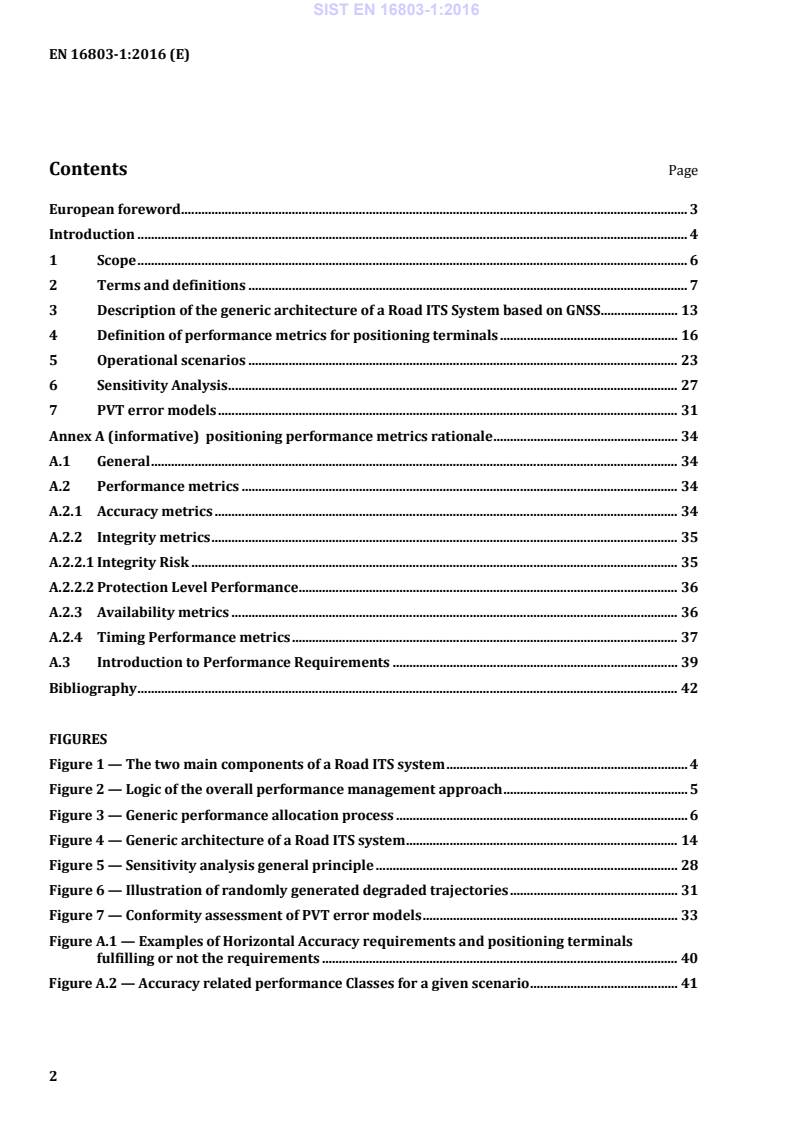
positioning performance metrics rationale . 34 A.1 General . 34 A.2 Performance metrics . 34 A.2.1 Accuracy metrics . 34 A.2.2 Integrity metrics . 35 A.2.2.1 Integrity Risk . 35 A.2.2.2 Protection Level Performance . 36 A.2.3 Availability metrics . 36 A.2.4 Timing Performance metrics . 37 A.3 Introduction to Performance Requirements . 39 Bibliography . 42
FIGURES Figure 1 — The two main components of a Road ITS system . 4 Figure 2 — Logic of the overall performance management approach . 5 Figure 3 — Generic performance allocation process . 6 Figure 4 — Generic architecture of a Road ITS system . 14 Figure 5 — Sensitivity analysis general principle . 28 Figure 6 — Illustration of randomly generated degraded trajectories . 31 Figure 7 — Conformity assessment of PVT error models . 33 Figure A.1 — Examples of Horizontal Accuracy requirements and positioning terminals fulfilling or not the requirements . 40 Figure A.2 — Accuracy related performance Classes for a given scenario . 41 SIST EN 16803-1:2016
— Part 1: Definitions and system engineering procedures for the establishment and assessment of performances — Part 21: Performance assessment tests of GNSS-based positioning terminals — Part 31: Security aspects of performance assessment tests According to the CEN-CENELEC Internal Regulations, the national standards organizations of the following countries are bound to implement this European Standard: Austria, Belgium, Bulgaria, Croatia, Cyprus, Czech Republic, Denmark, Estonia, Finland, Former Yugoslav Republic of Macedonia, France, Germany, Greece, Hungary, Iceland, Ireland, Italy, Latvia, Lithuania, Luxembourg, Malta, Netherlands, Norway, Poland, Portugal, Romania, Slovakia, Slovenia, Spain, Sweden, Switzerland, Turkey and the United Kingdom.
1 In preparation. SIST EN 16803-1:2016
Figure 1 — The two main components of a Road ITS system The main Road ITS systems concerned by this issue are: — GNSS-based Road User Charging systems (road, parking zone, urban…); — localized emergency calls (eCall); — electronic tachograph; — taximeter; — regulated freight transport systems (hazardous substances, livestock, etc.); — “Pay-as-you-drive” insurance; — road management systems, traffic information systems; — advanced Driver Assistance Systems (ADAS); — etc. Some Road ITS systems are considered as “safety critical”, because their failure may cause human death or injury and others are “liability critical”, because they include financial or regulatory aspects. In some cases, their development is subject to an official certification/homologation process.
Figure 2 — Logic of the overall performance management approach The starting point of any performance management of a Positioning-based road ITS system should be the definition and clear statement of the E2E performances which are targeted by the system to design and/or test, as expressed by the customer. In the context of this European Standard, the system breakdown into components is the one that has been introduced above: — The GNSS-based positioning terminal (GBPT) — The Road ITS application The interface between these two components is assumed to be the PVT information, together with some auxiliary information, for instance Integrity information if the GBPT is designed to support this kind of feature. Performance requirements are generally stated as requirements on the outputs of a given system component, assuming that the other components feeding it with input information do respect their own performance requirements. SIST EN 16803-1:2016
Figure 3 — Generic performance allocation process The performance requirements of the Road ITS application are actually the same ones as the system E2E performance requirements, but expressed under the condition that the GBPT respects certain performances requirements. NOTE Depending on the application, performance requirements may need to be put only on the position output or only on the velocity output by the GBPT. Due to the specificities of GNSS performances, which have to be defined statistically and which are highly dependent on the operational conditions, margins should be planned in the performance allocations, in order to allow the system to meet its performance requirements, even when, in certain conditions, one of its component does not strictly meet its own requirements. 1 Scope EN 16803-1 addresses the final stage of the performance management approach, i.e. the assessment of the whole Road ITS system performance equipped with a given GBPT, using the Sensitivity analysis method. EN 16803-1 addresses the assessment of GBPT performance, since it identifies and defines the positioning performance features and metrics to be used in the definition of the GBPT performance requirements. This EN gives definitions of the various items to be considered when specifying an Operational scenario and provides a method to compare finely two environments with respect to their effects on GNSS positioning performance. This EN gives definition of the most important terms used all along the document and describes the architecture of a Road ITS system based on GNSS as it is intended in this standard. This EN does not address: SIST EN 16803-1:2016
2 In preparation. SIST EN 16803-1:2016
Note 1 to entry: The performance is generally composed of several given performance features of given outputs of the system and measured by using given metrics. 2.1.9 performance class domain delimited by 2 boundaries for a given performance metric 2.1.10 performance feature given characteristic used to qualify and quantify the service provided by a system EXAMPLE: Accuracy for a Positioning system. 2.1.11 Performance metric precise definition of the means of measuring a given performance feature of a given output of a system
EXAMPLE: An Accuracy metric can be the median value of an error sample acquired during a given test following a given protocol. 2.1.12 positioning action of determining the position of a mobile object or a person 2.1.13 Pseudo-range measurement, by the GNSS receiver, of the distance between a satellite antenna and the receiver antenna, biased by the error due to the difference between the satellite clock and the receiver clock Note 1 to entry: Belongs to the category of Raw measurements. 2.1.14 SBAS Satellite Based Augmentation System regional augmentation system of complete satellite systems EXAMPLE GPS or GLONASS are examples for regional augmentation systems. Note 1 to entry: In Europe, EGNOS is the regional SBAS system
2.1.15 trajectory series of time-stamped positions (and possibly speeds) of a mobile object SIST EN 16803-1:2016
EXAMPLE: The time of presence of a vehicle inside a given zone is an Application quantity for a Geofencing application. 2.2.2 assisted GNSS technique consisting in assisting the positioning calculation performed by the GNSS terminal by providing it, via a telecommunication system, with partial or full navigation data as borne by the GNSS signal transmitted by the satellites NOTE 1 to entry: This technique reduces the Time To First Fix, and lowers the acquisition sensitivity threshold. 2.2.3 benchmark GNSS receiver any off-the-shelf, low-cost and high sensitivity GNSS receiver capable of providing pseudo-range measurements Note 1 to entry: This kind of receiver is proposed in this EN as a benchmark sensor of the environmental constraints that affect the GNSS signals propagation for fine comparison of environments between themselves. 2.2.4 E2E performance end-to-end performance performance of the service provided by a Road ITS system Note 1 to entry: E2E performance is measured by applying a performance metric to an Application quantity.
EXAMPLE: For a Taximeter, the accuracy of the travelled distance is an E2E performance 2.2.5 geofencing function consisting in determining the presence of certain persons or of certain moving objects within a certain geographical zone Note 1 to entry: This zone can be defined in several ways. 2.2.6 geo-object geographic entity, having the form of a virtual polygon, framing a point of interest or delimiting a zone of interest SIST EN 16803-1:2016
processing operation consisting in determining the position of the mobile on a map representing the road network.
Note 1 to entry: Requires a digital map. 2.2.10 operational scenario description of the conditions in which the GNSS-based road ITS system is operating and particularly affecting the GNSS-based positioning terminal 2.2.11 position location of the positioning terminal or, more specifically, of some reference point attached to it, such as the antenna phase centre 2.2.12 positioning system
set of hardware and software components, which can be in different locations, but interconnected, which contribute to estimating the position, velocity and associated timestamp of a mobile object 2.2.13 positioning terminal equipment (unit) carried by a vehicle or a person delivering a position solution to a Road ITS application Note 1 to entry: The Positioning terminal is the component of the Positioning system which is directly interfaced with the position data user (in this document the Road ITS application). Note 2 to entry: The Positioning terminal uses a GNSS receiver which may be hybridized or assisted. 2.2.14 positioning module software component of the Positioning terminal processing the PVT from the data of different sensors SIST EN 16803-1:2016
Note 1 to entry: The PVT error model is used to draw pseudo-random trajectories representative of real trajectories. 2.2.19 PVT Position, Velocity and Time data related with the position, the velocity and the time which is available at the output of a GNSS receiver or of a Positioning terminal in general 2.2.20 raw measurements describe all the quantities available in a GNSS receiver after the signal processing stage from which the PVT will be calculated Note 1 to entry: The Pseudo-ranges for each tracked satellite are essential components of the Raw measurements. 2.2.21 reference trajectory series of time-stamped positions of a reference point on a mobile object (test vehicle), produced by a Reference trajectory measurement system Note 1 to entry: This reference trajectory may be called “Ground truth” in some other documents. 2.2.22 RTMeS
reference trajectory measurement system
measurement means capable of accuracy performances better of at least one order of magnitude than those of the required performance of the Positioning terminal being tested SIST EN 16803-1:2016
processing part downstream of the Positioning terminal(s) which computes the Application quantities and provides the Road ITS service 2.2.24 sensitivity analysis method to assess the performance of a Road ITS application or of a whole Road ITS system, consisting in injecting a high number of simulated degraded PVT data obtained by adding to a reference trajectory PVT error models representing the real errors observed during dedicated field tests 2.2.25 speed norm of the velocity vector NOTE: The speed describes how fast the user moves relatively to the ground irrespectively of its direction. 2.2.26 velocity velocity of the positioning terminal relative to the ground expressed as a three-component vector 2.3 Acronyms 2.3.1 ADAS Advanced Driver Assistance System 2.3.2 CDF Cumulative Distribution Function 2.3.3 EFC Electronic Fee Collection 2.3.4 E2E End-To-End 2.3.5 EGNOS European Geostationary Navigation Overlay Service 2.3.6 GBPT GNSS-based positioning terminal 2.3.7 IMU Inertial Measurement Unit 2.3.8 NLOS Non Line Of Sight SIST EN 16803-1:2016
Figure 4 — Generic architecture of a Road ITS system
3.2 Components 3.2.1 Positioning components and outputs The Positioning terminal is the on-board part of the Positioning system, i.e. the part attached to the mobile object (vehicle), which position is expected by the application. In this respect, the terminal is the component of the Positioning system which is directly interfaced with the Position quantities user (in our case the Road ITS application). More precisely, since this EN is addressing the uses cases where a GNSS receiver is used, the terminal is called GNSS-based positioning terminal, or GBPT. The terminal itself consists of a series of on-board sensors and a positioning software component (Positioning module) supplying the Road ITS application with Position quantities. The Positioning module inside the terminal, or the GNSS sensor itself, can use external GNSS data provided through a data transmission channel, for instance assistance data, differential GNSS data or SBAS data. The position SIST EN 16803-1:2016
In the frame of this EN, the GBPT shall use at least a GNSS receiver which can be hybridized or assisted. In the frame of this EN, the Position quantities output by the GBPT shall comprise at least one of the two following quantities:
— the position of the phase centre of the GNSS receiver antenna or of any other reference point of the vehicle, expressed in a standard geodetic reference system; — the velocity of this point; each of them being associated with a timestamp indicating the time to which the output corresponds. Depending on the application, the position can be either the 3 components of the 3D position (i.e. a vector), or a subset of them, for example the 2D horizontal position (projection of the 3D position on the horizontal plane or on a plane tangent to the ellipsoid used by the geodetic reference frame) or the vertical position. The same way, the velocity can be limited to the horizontal 2D velocity or even to the module of it, i.e. the horizontal speed, or to any single component of the 3D velocity. In the case when the Positioning terminal is delivering Integrity information on any position or velocity component of the PVT, this information shall comprise at least: — a Protection level on the concerned PVT component, according to the definition given in this EN, that is to say a value that statistically bounds the error of the position or velocity component provided by the positioning terminal with a very high probability, — computed for a given Integrity risk, which is the complementary probability of the latter, that is to say the probability that the actual error on the component actually exceeds the associated Protection level. 3.2.2 Road ITS application and outputs The Road ITS application is a software module which is broken down for the purpose of this document into 2 sub-modules: 1) The Technical sub-module which transforms the Position quantities into Application quantities derived directly from the PVT and other data depending on the application and which are the key quantities necessary to deliver the final service to the user. EXAMPLE Position on a road segment (map-matched position), charging point detection, zone entry/exit detection, distance covered are examples of Application quantities. 2) The Business sub-module which is dedicated to the provision of the final service and highly dependent on the business model chosen by the operator of the system. EXAMPLE Computation of the bill to be sent to the user for a road user charging system is an example of processing done by this sub-module. Since this processing can be extremely variable, this sub-module is out of the scope of this EN, and will be considered in this EN only the cases when the End-to-end performances of the system providing the service are established on the Application quantities. SIST EN 16803-1:2016
NOTE These features resemble, to some extent, those identified by the Civil Aviation community regarding “Required Navigation Performances”, but with some key differences which reflect the peculiarities and specific needs of Road ITS applications.
The aforesaid features are: — Accuracy: it refers to statistical figures of merit of position error, velocity error or speed error (as defined in 4.3). — Integrity: it refers to the characteristic of the Protection level and its associated Integrity risk, in terms of reliability (verification of the risk) but also its efficiency and usability (size of the Protection level, which is directly related to their usability for the intended application).
(1) SIST EN 16803-1:2016
Along Track Position Accuracy is defined as the set of three statistical values given by the 50th, 75th and 95th percentiles of the cumulative distribution of the absolute values of Along Track position errors. Cross track Cross Position Accuracy is defined as the set of three statistical values given by the 50th, 75th and 95th percentiles of the cumulative distribution of the absolute values of Cross-Track position errors. Vertical Vertical Position Accuracy is defined as the set of three statistical values given by the 50th, 75th and 95th percentiles of the cumulative distribution of the absolute values of Vertical position errors. Velocity 3D 3D Velocity Accuracy is defined as the set of three statistical values given by the 50th, 75th and 95th percentiles of the cumulative distribution of 3D Velocity errors. Horizontal Horizontal Velocity Accuracy is defined as the set of three statistical values given by the 50th, 75th and 95th percentiles of the cumulative distribution of horizontal Velocity errors. East East Velocity Accuracy is defined as the set of three statistical values given by the 50th, 75th and 95th percentiles of the cumulative distribution of the absolute values of Velocity errors along the East–west direction. North North Velocity Accuracy is defined as the set of three statistical values given by the 50th, 75th and 95th percentiles of the cumulative distribution of the absolute values of Velocity errors along the North–south direction.
Along track
Along Velocity Accuracy is defined as the set of three statistical values given by the 50th, 75th and 95th percentiles of the cumulative distribution of the absolute values of Along Track Velocity errors. Cross track Cross Velocity Accuracy is defined as the set of three statistical values given by the 50th, 75th and 95th percentiles of the cumulative distribution of the absolute values of Cross-Track Velocity errors. Vertical Vertical Velocity Accuracy is defined as the set of three statistical values given by the 50th, 75th and 95th percentiles of the cumulative distribution of the absolute values of Vertical Velocity errors. Speed - Speed Accuracy is defined as the set of three statistical values given by the 50th, 75th and 95th percentiles of the cumulative distribution of Speed errors. SIST EN 16803-1:2016
Along Track Position Protection Level Performance for a given (e.g. 1E-6) target integrity risk is defined as the set of three statistical values given by the 50th, 75th and 95th percentiles of the cumulative distribution of Along Track position Protection Levels computed for that target integrity risk. The Along Track Position Integrity Risk is the probability that the Along Track position error exceeds the Along Track position Protection Level. Cross track Cross Track Position Protection Level Performance for a given (e.g. 1E-6) target integrity risk is defined as the set of three statistical values given by the 50th, 75th and 95th percentiles of the cumulative distribution of Cross Track position Protection Levels computed for that target integrity risk. The Cross Track Position Integrity Risk is the probability that the Cross Track position error exceeds the Cross Track position Protection Level. Vertical Vertical Position Protection Level Performance for a given (e.g. 1E-6) target integrity risk is defined as the set of three statistical values given by the 50th, 75th and 95th percentiles of the cumulative distribution of Vertical position Protection Levels computed for that target integrity risk. The Vertical Position Integrity Risk is the probability that the Vertical position error exceeds the Vertical position Protection Level. SIST EN 16803-1:2016
...