

EN 13230-3:2009
(Main)Railway applications - Track - Concrete sleepers and bearers - Part 3: Twin-block reinforced sleepers
- Abstract
This part of prEN 13230 defines technical criteria and control procedures for designing and manufacturing twin block reinforced concrete sleepers.
- Status
- Withdrawn
- Publication Date
- 09-Jun-2009
- Withdrawal Date
- 06-Oct-2026
- Technical Committee
- CEN/TC 256 - Railway applications
- Drafting Committee
- CEN/TC 256/SC 1/WG 16 - Sleepers and bearers
- Current Stage
- 9960 - Withdrawal effective - Withdrawal
- Start Date
- 11-May-2016
- Completion Date
- 07-Oct-2026

Relations
- Effective Date
- 13-Jun-2009
- Effective Date
- 18-May-2016
- Effective Date
- 11-Mar-2026
- Effective Date
- 28-Jan-2026
- Effective Date
- 28-Jan-2026
- Effective Date
- 28-Jan-2026
- Effective Date
- 28-Jan-2026
- Effective Date
- 28-Jan-2026
Get Certified
Connect with accredited certification bodies for this standard

DIBt (Deutsches Institut für Bautechnik)
German Institute for Building Technology.
DIN CERTCO
DIN Group product certification.
IRIS Certification (UNIFE)
International Railway Industry Standard certification.
Sponsored listings
Frequently Asked Questions
EN 13230-3:2009 is a standard published by the European Committee for Standardization (CEN). Its full title is "Railway applications - Track - Concrete sleepers and bearers - Part 3: Twin-block reinforced sleepers". This standard covers: This part of prEN 13230 defines technical criteria and control procedures for designing and manufacturing twin block reinforced concrete sleepers.
This part of prEN 13230 defines technical criteria and control procedures for designing and manufacturing twin block reinforced concrete sleepers.
EN 13230-3:2009 is classified under the following ICS (International Classification for Standards) categories: 45.080 - Rails and railway components; 91.100.30 - Concrete and concrete products; 93.100 - Construction of railways. The ICS classification helps identify the subject area and facilitates finding related standards.
EN 13230-3:2009 has the following relationships with other standards: It is inter standard links to EN 13230-3:2002, EN 13230-3:2016, EN 206-2:2026, EN ISO 6506-1:2014, EN ISO 6892-1:2019, EN 206:2013+A2:2021, EN 13230-5:2009, EN 13230-1:2009. Understanding these relationships helps ensure you are using the most current and applicable version of the standard.
EN 13230-3:2009 is associated with the following European legislation: EU Directives/Regulations: 2001/16/EC, 2008/57/EC, 93/38/EEC, 96/48/EC; Standardization Mandates: M/024, M/275, M/334. When a standard is cited in the Official Journal of the European Union, products manufactured in conformity with it benefit from a presumption of conformity with the essential requirements of the corresponding EU directive or regulation.
EN 13230-3:2009 is available in PDF format for immediate download after purchase. The document can be added to your cart and obtained through the secure checkout process. Digital delivery ensures instant access to the complete standard document.
Standards Content (Sample)
2003-01.Slovenski inštitut za standardizacijo. Razmnoževanje celote ali delov tega standarda ni dovoljeno.Železniške naprave - Zgornji ustroj - Betonski pragi in kretniški betonski pragi - 3. del: Dvodelni armiranobetonski pragiBahnanwendungen - Oberbau - Gleis- und Weichenschwellen aus Beton - Teil 3: Bewehrte ZweiblockschwellenApplications ferroviaires - Voie - Traverses et support en béton - Partie 3 : Traverses biblocs en béton arméRailway applications - Track - Concrete sleepers and bearers - Part 3: Twin-block reinforced sleepers91.100.30Beton in betonski izdelkiConcrete and concrete products45.080Rails and railway componentsICS:Ta slovenski standard je istoveten z:EN 13230-3:2009SIST EN 13230-3:2009en,de01-september-2009SIST EN 13230-3:2009SLOVENSKI
STANDARDSIST EN 13230-3:20041DGRPHãþD
EUROPEAN STANDARDNORME EUROPÉENNEEUROPÄISCHE NORMEN 13230-3June 2009ICS 91.100.30; 93.100Supersedes EN 13230-3:2002
English VersionRailway applications - Track - Concrete sleepers and bearers -Part 3: Twin-block reinforced sleepersApplications ferroviaires - Voie - Traverses et support enbéton - Partie 3 : Traverses biblocs en béton arméBahnanwendungen - Oberbau - Gleis- undWeichenschwellen aus Beton - Teil 3: BewehrteZweiblockschwellenThis European Standard was approved by CEN on 14 May 2009.CEN members are bound to comply with the CEN/CENELEC Internal Regulations which stipulate the conditions for giving this EuropeanStandard the status of a national standard without any alteration. Up-to-date lists and bibliographical references concerning such nationalstandards may be obtained on application to the CEN Management Centre or to any CEN member.This European Standard exists in three official versions (English, French, German). A version in any other language made by translationunder the responsibility of a CEN member into its own language and notified to the CEN Management Centre has the same status as theofficial versions.CEN members are the national standards bodies of Austria, Belgium, Bulgaria, Cyprus, Czech Republic, Denmark, Estonia, Finland,France, Germany, Greece, Hungary, Iceland, Ireland, Italy, Latvia, Lithuania, Luxembourg, Malta, Netherlands, Norway, Poland, Portugal,Romania, Slovakia, Slovenia, Spain, Sweden, Switzerland and United Kingdom.EUROPEAN COMMITTEE FOR STANDARDIZATIONCOMITÉ EUROPÉEN DE NORMALISATIONEUROPÄISCHES KOMITEE FÜR NORMUNGManagement Centre:
Avenue Marnix 17,
B-1000 Brussels© 2009 CENAll rights of exploitation in any form and by any means reservedworldwide for CEN national Members.Ref. No. EN 13230-3:2009: ESIST EN 13230-3:2009
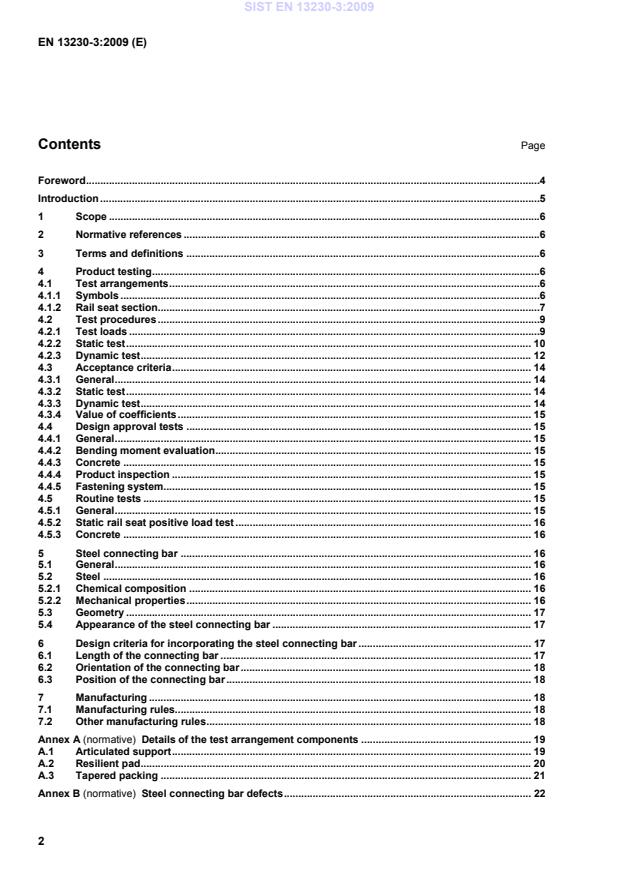
Details of the test arrangement components . 19A.1 Articulated support . 19A.2 Resilient pad . 20A.3 Tapered packing . 21Annex B (normative)
Steel connecting bar defects . 22SIST EN 13230-3:2009
Relationship between this European Standard and the Essential Requirements of EU Directive 2008/57/EC . 26Bibliography . 30 SIST EN 13230-3:2009
4.1.2 Rail seat section The arrangement for the rail seat positive load test is shown in Figure 1. The position of articulated supports (Lr) is defined in Table 2. The load Fr is applied perpendicularly to the base of the sleeper. SIST EN 13230-3:2009
Key 1 Rigid support 2 Articulated support (see Annex A for details) 3 Resilient pad (see Annex A for details) 4 Reinforced concrete block 5 Standard rail pad as defined by the purchaser 6 Tapered packing (see Annex A for details) 7 Lateral stop and base plate when used. To be agreed by the purchaser Figure 1 — Test arrangement at the rail seat section (positive bending moment) The test arrangement for the rail seat negative load test is shown in Figure 2, the value of Lr in relation to Lp.is detailed in Table 2. SIST EN 13230-3:2009
Key 1 Rigid support 2 Articulated support (see Annex A for details) 3 Resilient pad (see Annex A for details) 4 Reinforced concrete block 5 Special tapered packing 6 Special tapered packing Figure 2 — Test arrangement at the rail seat section (negative bending moment) Table 2 — Value of Lr in relation to Lp Lp in m Lr in m Lp < 0,349 0,350 ≤ Lp < 0,399 0,400 ≤ Lp < 0,449 Lp ≥ 0,450 0,3 0,4 0,5 0,6
4.2 Test proce
...