

EN 1367-2:2009
(Main)Tests for thermal and weathering properties of aggregates - Part 2: Magnesium sulfate test
- Abstract
This European Standard describes the reference method used for type testing and in cases of dispute for assessing how an aggregate behaves when subjected to the cyclic action of immersion in magnesium sulfate, followed by oven drying. For other purposes, in particular factory production control, other methods may be used provided that an appropriate working relationship with the reference method has been established.
NOTE The majority of aggregates can be tested for performance using this method. Precision has been established for the rock types listed in Annex A. The test may not be suitable for all rock types and reservations have been expressed elsewhere in respect of some carbonate aggregates and some aggregates having a high proportion of magnesium bearing materials or of cryptocrystalline quartz.
- Status
- Published
- Publication Date
- 27-Oct-2009
- Withdrawal Date
- 29-Apr-2010
- Technical Committee
- CEN/TC 154 - Aggregates
- Drafting Committee
- CEN/TC 154/SC 6 - Test methods
- Current Stage
- 9060 - Closure of 2 Year Review Enquiry - Review Enquiry
- Start Date
- 04-Jun-2026
- Completion Date
- 04-Jun-2026

Overview
EN 1367-2:2009, issued by CEN (European Committee for Standardization), is a vital European Standard focusing on the thermal and weathering properties of aggregates, specifically the magnesium sulfate test. This standard provides a reference method for evaluating how aggregates respond to cyclical immersion in a magnesium sulfate solution followed by oven drying. The test simulates the weathering processes that aggregates may face in real-world conditions and is essential for assessing their durability and performance, particularly in construction and civil engineering applications.
This reference method is required for type testing and in dispute cases. While alternatives may be used for routine factory production control, they must demonstrate a working correlation to the standard method described in EN 1367-2:2009.
Key Topics
- Magnesium Sulfate Test Methodology: Involves subjecting aggregate samples to repeated cycles of immersion in a saturated magnesium sulfate solution and subsequent oven drying. This simulates natural weathering and helps measure the aggregate’s resistance to disintegration.
- Sample Requirements: Specifies sample size, preparation, and sieving procedures, focusing on aggregates typically in the 10 mm to 14 mm size range, but allowing for other sizes as detailed in annexes.
- Testing Apparatus:
- Test sieves conforming to EN 933-2.
- Ventilated drying oven.
- Mesh baskets and density hydrometer.
- Accurate balances and containers.
- Calculated Results: The main result is the magnesium sulfate value (MS), determined by the percentage loss of mass in aggregates after test cycles, reflecting the material's soundness.
- Applicability & Limitations: The majority of aggregate types can be tested, but caution is prescribed for certain carbonate aggregates and those high in magnesium-bearing materials.
Applications
EN 1367-2:2009 is widely used across the construction and materials sectors to:
- Assess Aggregate Durability: Ensures aggregates employed in concrete, asphalt, or road bases will withstand thermal cycles and weathering, preserving performance and longevity of built infrastructure.
- Quality Assurance & Type Testing: Provides a standardized test method for type approval, factory production control, and in cases of product dispute, fostering confidence in material specifications for suppliers and customers.
- Regulatory Compliance: Meeting EN 1367-2 requirements is often mandatory under European construction product regulations and for tendering in public works.
- Research & Development: Supports innovation by providing reliable data for evaluating new sources or types of aggregates.
Related Standards
EN 1367-2:2009 is part of the wider EN 1367 series focused on aggregate weathering and thermal properties. Other related European and international standards include:
- EN 1367-1: Determination of resistance to freezing and thawing.
- EN 1367-3: Boiling test for selected aggregate types.
- EN 932 series: General properties, sampling, and equipment standards for aggregates.
- EN 933 series: Geometrical properties of aggregates, including particle size distribution.
- EN 1097: Mechanical and physical properties testing for aggregates.
- EN 1744: Chemical property tests for aggregates.
- EN 13179: Testing for filler aggregate used in bituminous mixtures.
- ISO 649-1: Laboratory glassware - Density hydrometers.
Practical Value
Implementing EN 1367-2:2009 ensures that aggregates used in construction are fit for purpose, minimizing risks associated with weather-induced degradation. Compliance with this aggregate testing standard helps maintain safety, durability, and sustainability in built environments, supporting robust quality management systems throughout the European construction supply chain. By following EN 1367-2:2009, organizations demonstrate commitment to product reliability, regulatory requirements, and market competitiveness in the aggregates industry.
Relations
- Effective Date
- 31-Oct-2009
- Effective Date
- 10-Jun-2026
- Effective Date
- 28-Jan-2026
- Effective Date
- 28-Jan-2026
- Effective Date
- 28-Jan-2026
- Effective Date
- 28-Jan-2026
- Effective Date
- 28-Jan-2026
- Effective Date
- 28-Jan-2026
- Referred By
EN ISO 2603:2016 - Simultaneous interpreting - Permanent booths - Requirements (ISO 2603:2016) - Effective Date
- 28-Jan-2026
- Referred By
EN 12620:2013 - Aggregates for concrete - Effective Date
- 28-Jan-2026
- Effective Date
- 28-Jan-2026
- Effective Date
- 28-Jan-2026
- Referred By
EN ISO 4043:2016 - Simultaneous interpreting - Mobile booths - Requirements (ISO 4043:2016) - Effective Date
- 28-Jan-2026
- Effective Date
- 28-Jan-2026
- Effective Date
- 28-Jan-2026
Get Certified
Connect with accredited certification bodies for this standard

DIBt (Deutsches Institut für Bautechnik)
German Institute for Building Technology.
DIN CERTCO
DIN Group product certification.

Aboma Certification B.V.
Specialized in construction, metal, and transport sectors.
Sponsored listings
Frequently Asked Questions
EN 1367-2:2009 is a standard published by the European Committee for Standardization (CEN). Its full title is "Tests for thermal and weathering properties of aggregates - Part 2: Magnesium sulfate test". This standard covers: This European Standard describes the reference method used for type testing and in cases of dispute for assessing how an aggregate behaves when subjected to the cyclic action of immersion in magnesium sulfate, followed by oven drying. For other purposes, in particular factory production control, other methods may be used provided that an appropriate working relationship with the reference method has been established. NOTE The majority of aggregates can be tested for performance using this method. Precision has been established for the rock types listed in Annex A. The test may not be suitable for all rock types and reservations have been expressed elsewhere in respect of some carbonate aggregates and some aggregates having a high proportion of magnesium bearing materials or of cryptocrystalline quartz.
This European Standard describes the reference method used for type testing and in cases of dispute for assessing how an aggregate behaves when subjected to the cyclic action of immersion in magnesium sulfate, followed by oven drying. For other purposes, in particular factory production control, other methods may be used provided that an appropriate working relationship with the reference method has been established. NOTE The majority of aggregates can be tested for performance using this method. Precision has been established for the rock types listed in Annex A. The test may not be suitable for all rock types and reservations have been expressed elsewhere in respect of some carbonate aggregates and some aggregates having a high proportion of magnesium bearing materials or of cryptocrystalline quartz.
EN 1367-2:2009 is classified under the following ICS (International Classification for Standards) categories: 91.100.15 - Mineral materials and products. The ICS classification helps identify the subject area and facilitates finding related standards.
EN 1367-2:2009 has the following relationships with other standards: It is inter standard links to EN 1367-2:1998, ISO 649-1:1981, EN 932-1:1996, EN 1330-7:2005, EN 932-5:2012, EN 933-2:2020, EN 932-3:2022, EN 13043:2013, EN ISO 2603:2016, EN 12620:2013, EN ISO 10218-2:2025, EN 13043:2002, EN ISO 4043:2016, EN 13000:2010+A1:2014, EN 13383-1:2013. Understanding these relationships helps ensure you are using the most current and applicable version of the standard.
EN 1367-2:2009 is available in PDF format for immediate download after purchase. The document can be added to your cart and obtained through the secure checkout process. Digital delivery ensures instant access to the complete standard document.
Standards Content (Sample)
2003-01.Slovenski inštitut za standardizacijo. Razmnoževanje celote ali delov tega standarda ni dovoljeno.Prüfverfahren für thermische Eigenschaften und Verwitterungsbeständigkeit von Gesteinskörnungen - Teil 2: Magnesiumsulfat-VerfahrenEssais pour déterminer les propriétés thermiques et l'altérabilité des granulats - Partie 2 : Essai au sulfate de magnésiumTests for thermal and weathering properties of aggregates - Part 2: Magnesium sulfate test91.100.15Mineralni materiali in izdelkiMineral materials and productsICS:Ta slovenski standard je istoveten z:EN 1367-2:2009SIST EN 1367-2:2010en,fr,de01-februar-2010SIST EN 1367-2:2010SLOVENSKI
STANDARDSIST EN 1367-2:19991DGRPHãþD
EUROPEAN STANDARD NORME EUROPÉENNE EUROPÄISCHE NORM
EN 1367-2
October 2009 ICS 91.100.15 Supersedes EN 1367-2:1998English Version
Tests for thermal and weathering properties of aggregates - Part 2: Magnesium sulfate test
Essais pour déterminer les propriétés thermiques et l'altérabilité des granulats - Partie 2 : Essai au sulfate de magnésium
Prüfverfahren für thermische Eigenschaften und Verwitterungsbeständigkeit von Gesteinskörnungen -Teil 2: Magnesiumsulfat-Verfahren This European Standard was approved by CEN on 19 September 2009.
CEN members are bound to comply with the CEN/CENELEC Internal Regulations which stipulate the conditions for giving this European Standard the status of a national standard without any alteration. Up-to-date lists and bibliographical references concerning such national standards may be obtained on application to the CEN Management Centre or to any CEN member.
This European Standard exists in three official versions (English, French, German). A version in any other language made by translation under the responsibility of a CEN member into its own language and notified to the CEN Management Centre has the same status as the official versions.
CEN members are the national standards bodies of Austria, Belgium, Bulgaria, Cyprus, Czech Republic, Denmark, Estonia, Finland, France, Germany, Greece, Hungary, Iceland, Ireland, Italy, Latvia, Lithuania, Luxembourg, Malta, Netherlands, Norway, Poland, Portugal, Romania, Slovakia, Slovenia, Spain, Sweden, Switzerland and United Kingdom.
EUROPEAN COMMITTEE FOR STANDARDIZATION
COMITÉ EUROPÉEN DE NORMALISATION EUROPÄISCHES KOMITEE FÜR NORMUNG
Management Centre:
Avenue Marnix 17,
B-1000 Brussels © 2009 CEN All rights of exploitation in any form and by any means reserved worldwide for CEN national Members. Ref. No. EN 1367-2:2009: ESIST EN 1367-2:2010
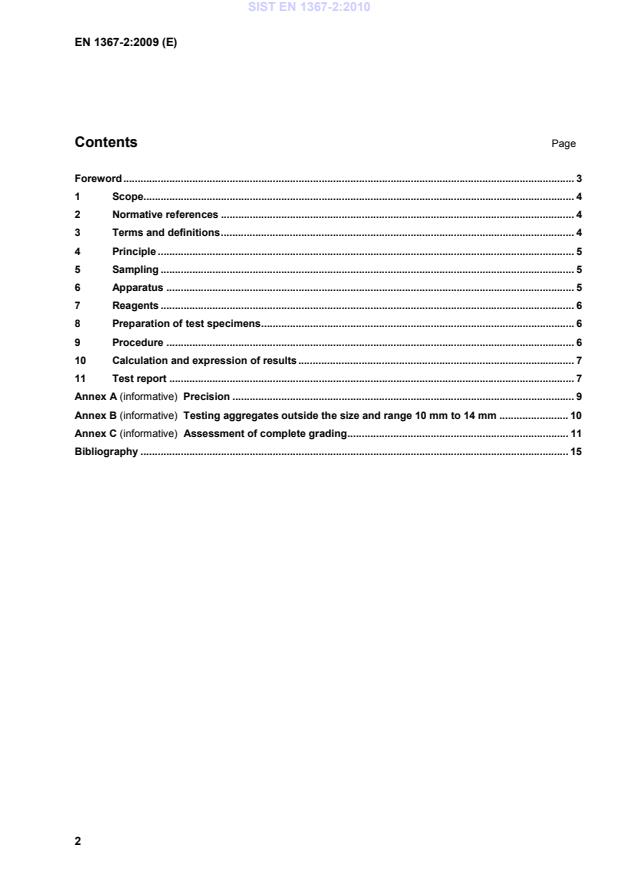
Precision . 9Annex B (informative)
Testing aggregates outside the size and range 10 mm to 14 mm . 10Annex C (informative)
Assessment of complete grading . 11Bibliography . 15 SIST EN 1367-2:2010
Part 1: Determination of resistance to freezing and thawing; Part 2: Magnesium sulfate test; Part 3: Boiling test for “Sonnenbrand basalt"; Part 4: Determination of drying shrinkage; Part 5: Determination of resistance to thermal shock; Part 6: Determination of resistance to freezing and thawing in the presence of salt (NaCl). Test methods for other properties of aggregates will be covered by Parts of the following European Standards: EN 932
Tests for general properties of aggregates; EN 933
Tests for geometrical properties of aggregates; EN 1097
Tests for mechanical and physical properties of aggregates; EN 1744
Tests for chemical properties of aggregates; EN 13179 Tests for filler aggregate used in bituminous mixtures. According to the CEN/CENELEC Internal Regulations, the national standards organizations of the following countries are bound to implement this European Standard: Austria, Belgium, Bulgaria, Cyprus, Czech Republic, Denmark, Estonia, Finland, France, Germany, Greece, Hungary, Iceland, Ireland, Italy, Latvia, Lithuania, Luxembourg, Malta, Netherlands, Norway, Poland, Portugal, Romania, Slovakia, Slovenia, Spain, Sweden, Switzerland and the United Kingdom.
Precision has been established for the rock types listed in Annex A. The test may not be suitable for all rock types and reservations have been expressed elsewhere in respect of some carbonate aggregates and some aggregates having a high proportion of magnesium bearing materials or of cryptocrystalline quartz. 2 Normative references
The following referenced documents are indispensable for the application of this document. For dated references, only the edition cited applies. For undated references, the latest edition of the referenced document (including any amendments) applies. EN 932-1, Tests for general properties of aggregates – Part 1: Methods for sampling EN 932-2, Tests for general properties of aggregates – Part 2: Methods for reducing laboratory samples EN 932-3, Tests for general properties of aggregates – Part 3: Procedure and terminology for simplified petrographic description EN 932-5, Tests for general properties of aggregates – Part 5: Common equipment and calibration EN 933-2, Tests for geometrical properties of aggregates – Part 2: Determination of particle size distribution – Test sieves, nominal size of apertures ISO 649-1, Laboratory glassware – Density hydrometers for general purposes – Part 1: Specification 3 Terms and definitions For the purposes of this document, the following terms and definitions apply. 3.1 laboratory sample sample intended for laboratory testing 3.2 test specimen sample used in a single determination when a test method requires more than one determination of a property SIST EN 1367-2:2010
The oven shall be capable of being controlled at (110 ± 5) ºC. 6.7 Density hydrometer, complying with ISO 649-1 and graduated at 20 ºC for medium surface tension 55 mN/m to measure densities in the range of 1,284 g/ml to 1,300 g/ml to an accuracy of 0,001 g/ml. 6.8 Desiccator, large enough to contain at least two of the baskets listed in 6.3. 6.9 Thermometer, of range 0 ºC to 120 ºC and accurate to 1 ºC. 6.10 Timing device, such that the full range of timed periods can be measured to an accuracy of ±1 min. SIST EN 1367-2:2010
A minimum of 3 l is required for each test. NOTE It is advisable to prepare a second batch of solution using the above procedure as a reserve, in case of solution failure during the test procedure, see
9.3. During preparation, maintain the temperature of the solution between 25 ºC and 30 ºC and stir thoroughly during the addition of the crystals. After preparation, lower the temperature to (20 ± 2) ºC, and maintain at this temperature for (48 ± 1) h. 7.3.2 Prior to use, check that the solution has achieved a density of (1,292 ± 0,008) g/ml by decanting a portion of the solution into a glass jar, measuring the density with the hydrometer, and returning the solution to the container. 8 Preparation of test specimens 8.1 Reduce the laboratory sample in accordance with EN 932-2 to produce two test specimens of sufficient mass such that each will produce a minimum of 500 g of the 10 mm to 14 mm size when processed as specified in 8.3. NOTE Guidance on testing other fractions is given in Annex B and on testing all fractions in Annex C. 8.2 Dry each test specimen in the oven at (110 ± 5) ºC for (24 ± 1) h, and allow to cool in the desiccator to laboratory temperature. 8.3 Sieve each test specimen using the 10 mm and 14 mm sieves to reject oversize and undersize to give a mass of approximately 500 g each. 8.4 Wash each test specimen with distilled water until free from dust, allow to drain and dry in the oven as specified in 8.2. 8.5 Repeat the sieving as specified in 8.3, to ensure that only material in the 10 mm to 14 mm range is used. 8.6 Weigh out between (420 ± 0,1) g and (430 ± 0,1) g from each test specimen and record the masses (M1).
Transfer the test specimens to two labelled mesh baskets. Avoid shaking
...