

EN 12620:2013
(Main)Aggregates for concrete
- Abstract
This European Standard specifies the properties of aggregates and filler aggregates obtained by processing natural, manufactured or recycled materials and mixtures of these aggregates for use in concrete in conformity with EN 206-1 and concrete used in roads and other pavements and for use in precast concrete products.
It covers aggregates having an oven dried particle density greater than 2,0 Mg/m3 (2000 Kg/m3). It also covers recycled aggregate with particle densities greater than 1,50 Mg/m3 (1 500 kg/m3) with appropriate caveats and recycled fine aggregate with appropriate caveats.
A list of the source materials that have been considered and indicating those which are within the scope of this standard is given in Annex A (normative).
Requirements are given in EN 16236.
It incorporates a general requirement that aggregates shall not release any dangerous substances in excess of the maximum permitted levels specified in a relevant European Standard for the material or permitted in the national regulations of the member state of destination.
The tables in this standard include categories which are common across the four main aggregate standards: EN 12620, EN 13043, EN 13139 and EN 13242. Not all of these categories are appropriate for aggregates for use in concrete.
Categories, notes, comments etc, which are grey shaded, should not be used in concrete.
Aggregates used in construction should comply with all the requirements of the relevant European Standards. These standards include comprehensive and specific requirements for natural aggregates, iron and steel making slag and recycled aggregates, dealing with, for example, the stability of certain basalts, the expansion of certain slags and the constitution of recycled aggregates.
For materials from some other secondary sources however, work is ongoing and the requirements are incomplete. In the meantime, such materials, when placed on the market as aggregates, should conform fully to this standard but may also be required to conform to specific relevant additional requirements at the place of use. Additional characteristics and requirements may be specified on a case by case basis depending upon experience of use of the product, and defined in specific contractual documents.
NOTE Requirements for lightweight aggregates are specified in EN 13055-1.
Requirements for the declaration of the potential of aggregates to release regulated dangerous substances are currently under development. Until such time as these are finalised, attention should be paid to requirements at the place of use.
- Status
- Withdrawn
- Publication Date
- 30-Apr-2013
- Withdrawal Date
- 11-Dec-2013
- Technical Committee
- CEN/TC 154 - Aggregates
- Current Stage
- 9960 - Withdrawal effective - Withdrawal
- Start Date
- 12-Dec-2013
- Completion Date
- 12-Dec-2013
- Ref Project
SIST EN 12620:2013 - Aggregates for concrete



Relations
- Effective Date
- 25-Aug-2026
- Effective Date
- 28-Jan-2026
- Effective Date
- 28-Jan-2026
- Effective Date
- 28-Jan-2026
- Effective Date
- 28-Jan-2026
- Effective Date
- 28-Jan-2026
- Effective Date
- 28-Jan-2026
- Effective Date
- 28-Jan-2026
- Effective Date
- 28-Jan-2026
- Effective Date
- 28-Jan-2026
- Effective Date
- 28-Jan-2026
- Effective Date
- 28-Jan-2026
- Effective Date
- 28-Jan-2026
- Refers
EN 1744-1:2009+A1:2012 - Tests for chemical properties of aggregates - Part 1: Chemical analysis - Effective Date
- 28-Jan-2026
- Effective Date
- 28-Jan-2026
Get Certified
Connect with accredited certification bodies for this standard

DIBt (Deutsches Institut für Bautechnik)
German Institute for Building Technology.
DIN CERTCO
DIN Group product certification.

Aboma Certification B.V.
Specialized in construction, metal, and transport sectors.
Sponsored listings
Frequently Asked Questions
EN 12620:2013 is a standard published by the European Committee for Standardization (CEN). Its full title is "Aggregates for concrete". This standard covers: This European Standard specifies the properties of aggregates and filler aggregates obtained by processing natural, manufactured or recycled materials and mixtures of these aggregates for use in concrete in conformity with EN 206-1 and concrete used in roads and other pavements and for use in precast concrete products. It covers aggregates having an oven dried particle density greater than 2,0 Mg/m3 (2000 Kg/m3). It also covers recycled aggregate with particle densities greater than 1,50 Mg/m3 (1 500 kg/m3) with appropriate caveats and recycled fine aggregate with appropriate caveats. A list of the source materials that have been considered and indicating those which are within the scope of this standard is given in Annex A (normative). Requirements are given in EN 16236. It incorporates a general requirement that aggregates shall not release any dangerous substances in excess of the maximum permitted levels specified in a relevant European Standard for the material or permitted in the national regulations of the member state of destination. The tables in this standard include categories which are common across the four main aggregate standards: EN 12620, EN 13043, EN 13139 and EN 13242. Not all of these categories are appropriate for aggregates for use in concrete. Categories, notes, comments etc, which are grey shaded, should not be used in concrete. Aggregates used in construction should comply with all the requirements of the relevant European Standards. These standards include comprehensive and specific requirements for natural aggregates, iron and steel making slag and recycled aggregates, dealing with, for example, the stability of certain basalts, the expansion of certain slags and the constitution of recycled aggregates. For materials from some other secondary sources however, work is ongoing and the requirements are incomplete. In the meantime, such materials, when placed on the market as aggregates, should conform fully to this standard but may also be required to conform to specific relevant additional requirements at the place of use. Additional characteristics and requirements may be specified on a case by case basis depending upon experience of use of the product, and defined in specific contractual documents. NOTE Requirements for lightweight aggregates are specified in EN 13055-1. Requirements for the declaration of the potential of aggregates to release regulated dangerous substances are currently under development. Until such time as these are finalised, attention should be paid to requirements at the place of use.
This European Standard specifies the properties of aggregates and filler aggregates obtained by processing natural, manufactured or recycled materials and mixtures of these aggregates for use in concrete in conformity with EN 206-1 and concrete used in roads and other pavements and for use in precast concrete products. It covers aggregates having an oven dried particle density greater than 2,0 Mg/m3 (2000 Kg/m3). It also covers recycled aggregate with particle densities greater than 1,50 Mg/m3 (1 500 kg/m3) with appropriate caveats and recycled fine aggregate with appropriate caveats. A list of the source materials that have been considered and indicating those which are within the scope of this standard is given in Annex A (normative). Requirements are given in EN 16236. It incorporates a general requirement that aggregates shall not release any dangerous substances in excess of the maximum permitted levels specified in a relevant European Standard for the material or permitted in the national regulations of the member state of destination. The tables in this standard include categories which are common across the four main aggregate standards: EN 12620, EN 13043, EN 13139 and EN 13242. Not all of these categories are appropriate for aggregates for use in concrete. Categories, notes, comments etc, which are grey shaded, should not be used in concrete. Aggregates used in construction should comply with all the requirements of the relevant European Standards. These standards include comprehensive and specific requirements for natural aggregates, iron and steel making slag and recycled aggregates, dealing with, for example, the stability of certain basalts, the expansion of certain slags and the constitution of recycled aggregates. For materials from some other secondary sources however, work is ongoing and the requirements are incomplete. In the meantime, such materials, when placed on the market as aggregates, should conform fully to this standard but may also be required to conform to specific relevant additional requirements at the place of use. Additional characteristics and requirements may be specified on a case by case basis depending upon experience of use of the product, and defined in specific contractual documents. NOTE Requirements for lightweight aggregates are specified in EN 13055-1. Requirements for the declaration of the potential of aggregates to release regulated dangerous substances are currently under development. Until such time as these are finalised, attention should be paid to requirements at the place of use.
EN 12620:2013 is classified under the following ICS (International Classification for Standards) categories: 91.100.15 - Mineral materials and products; 91.100.30 - Concrete and concrete products. The ICS classification helps identify the subject area and facilitates finding related standards.
EN 12620:2013 has the following relationships with other standards: It is inter standard links to ISO 565:1990, EN 196-2:2025, EN 932-3:2022, EN 1367-6:2008, EN 1097-6:2022, EN 1097-3:1998, EN 1744-6:2006, EN 933-7:1998, EN 1097-9:2014, EN 1097-1:2023, EN 1097-2:2020, EN 933-4:2008, EN 1367-1:2007, EN 1744-1:2009+A1:2012, EN 1744-5:2006. Understanding these relationships helps ensure you are using the most current and applicable version of the standard.
EN 12620:2013 is associated with the following European legislation: EU Directives/Regulations: 305/2011, 89/106/EEC; Standardization Mandates: M/115, M/125, M/125 REV1. When a standard is cited in the Official Journal of the European Union, products manufactured in conformity with it benefit from a presumption of conformity with the essential requirements of the corresponding EU directive or regulation.
EN 12620:2013 is available in PDF format for immediate download after purchase. The document can be added to your cart and obtained through the secure checkout process. Digital delivery ensures instant access to the complete standard document.
Standards Content (Sample)
2003-01.Slovenski inštitut za standardizacijo. Razmnoževanje celote ali delov tega standarda ni dovoljeno.Agregati za betonGesteinskörnungen für BetonGranulats pour bétonAggregates for concrete91.100.30Beton in betonski izdelkiConcrete and concrete products91.100.15Mineralni materiali in izdelkiMineral materials and productsICS:Ta slovenski standard je istoveten z:EN 12620:2013SIST EN 12620:2013en,fr,de01-julij-2013SIST EN 12620:2013SLOVENSKI
STANDARDSIST EN 12620:2002+A1:20081DGRPHãþD
EUROPEAN STANDARD NORME EUROPÉENNE EUROPÄISCHE NORM
EN 12620
May 2013 ICS 91.100.15 Supersedes EN 12620:2002+A1:2008English Version
Aggregates for concrete
Granulats pour béton
Gesteinskörnungen für Beton This European Standard was approved by CEN on 24 August 2011.
CEN members are bound to comply with the CEN/CENELEC Internal Regulations which stipulate the conditions for giving this European Standard the status of a national standard without any alteration. Up-to-date lists and bibliographical references concerning such national standards may be obtained on application to the CEN-CENELEC Management Centre or to any CEN member.
This European Standard exists in three official versions (English, French, German). A version in any other language made by translation under the responsibility of a CEN member into its own language and notified to the CEN-CENELEC Management Centre has the same status as the official versions.
CEN members are the national standards bodies of Austria, Belgium, Bulgaria, Croatia, Cyprus, Czech Republic, Denmark, Estonia, Finland, Former Yugoslav Republic of Macedonia, France, Germany, Greece, Hungary, Iceland, Ireland, Italy, Latvia, Lithuania, Luxembourg, Malta, Netherlands, Norway, Poland, Portugal, Romania, Slovakia, Slovenia, Spain, Sweden, Switzerland, Turkey and United Kingdom.
EUROPEAN COMMITTEE FOR STANDARDIZATION
COMITÉ EUROPÉEN DE NORMALISATION EUROPÄISCHES KOMITEE FÜR NORMUNG
Management Centre:
Avenue Marnix 17,
B-1000 Brussels © 2013 CEN All rights of exploitation in any form and by any means reserved worldwide for CEN national Members. Ref. No. EN 12620:2013: ESIST EN 12620:2013
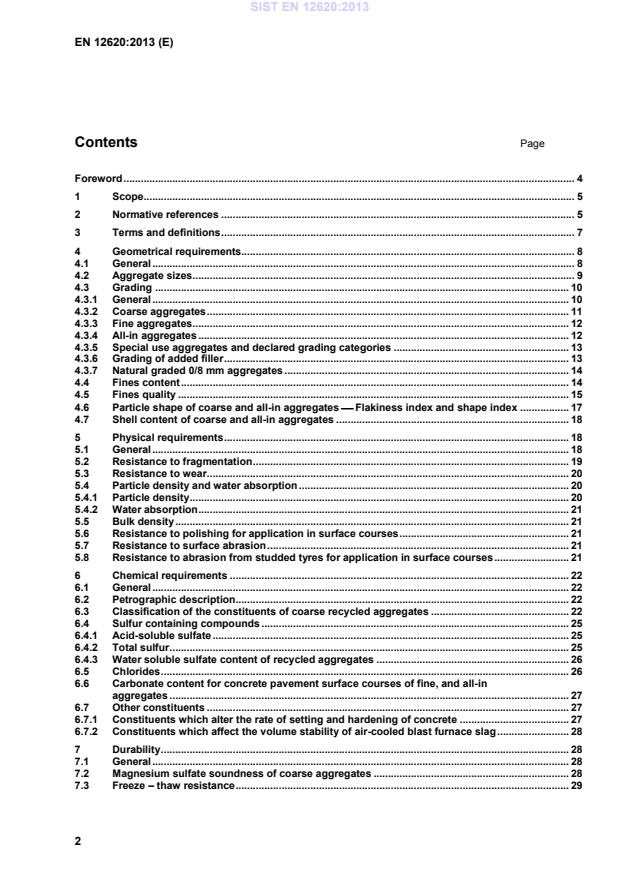
Source materials considered in the development of EN 12620 and their status in respect of the scope of the standard . 33 Annex B (informative)
Guidance on the description of coarseness/fineness of fine aggregates . 36 Annex C (normative)
Reduced grading tolerances on producer’s declared typical grading for natural graded 0/8 mm aggregates . 37 Annex D (informative)
Guidance on the effects of some chemical constituents of aggregates on the durability of concrete in which they are incorporated . 38 D.1 Chlorides . 38 D.1.1 Chlorides in natural aggregates . 38 D.1.2 Chlorides in recycled aggregates . 38 D.2 Sulfates . 38 D.3 Alkali-silica reaction . 39 D.3.1 Alkali-silica reaction with natural aggregates . 39 D.3.2 Alkali-silica reaction with recycled aggregates (including manufactured glass) . 39 D.4 Constituents affecting the surface finish of concrete . 39 D.5 Constituents affecting the setting and hardening of concrete . 40 D.6 Constituents of air-cooled blastfurnace slag . 40 Annex ZA (informative)
Clauses of this European Standard addressing the provisions of the EU Construction Products Directive . 41 ZA.1 Scope and relevant characteristics . 41 ZA.2 Procedures for attestation of conformity of aggregates and fillers . 44 ZA.2.1 System(s) of attestation of conformity . 44 ZA.2.2 EC Certificate Declaration of conformity . 46 ZA.3 CE marking and labelling . 48 Bibliography . 54
NOTE Requirements for lightweight aggregates are specified in prEN 13055. Requirements for the declaration of the potential of aggregates to release regulated dangerous substances are currently under development. Until such time as these are finalised, attention should be paid to requirements at the place of use. 2 Normative references The following documents, in whole or in part, are normatively referenced in this document and are indispensable for its application. For dated references, only the edition cited applies. For undated references, the latest edition of the referenced document (including any amendments) applies. EN 196-2, Methods of testing cement — Part 2: Chemical analysis of cement EN 932-3, Tests for general properties of aggregates — Part 3: Procedure and terminology for simplified petrographic description SIST EN 12620:2013
Y: upper limit passing d 3.8 fines particle size fraction of an aggregate that passes the 0,063 mm sieve 3.9 coarse aggregate designation given to the larger aggregate sizes with D greater than 4 mm and d greater than or equal to 1 mm Note 1 to entry: Aggregates that do not fit the definitions for fine or coarse (like 1/3, 1/4 and 2/4) are treated as coarse aggregate. 3.10 fine aggregate designation given to the smaller aggregate sizes with D less than or equal to 4 mm and d = 0 Note 1 to entry: Fine aggregate can be produced from natural disintegration of rock or gravel and/or by the crushing of rock or gravel or processing of manufactured aggregates. 3.11 all-in aggregate aggregate consisting of a mixture of coarse and fine aggregates with D greater than 4 mm and d = 0 Note 1 to entry: It can be produced without separating into coarse and fine fractions or it can be produced by combining coarse and fine aggregates. 3.12 filler aggregate aggregate, most of which passes a 0,063 mm sieve, which can be added to construction materials to provide certain properties
3.13 added filler filler aggregate of mineral origin, which has been produced separately 4 Geometrical requirements
4.1 General The necessity for testing and declaring all properties specified in this clause shall be limited according to the particular application at end use or origin of the aggregate. When required, the aggregates shall be tested as specified in Clause 4 to determine the relevant geometrical properties. When the value of a property is required but not defined by specified limits the value should be declared as an XXDeclared category, e.g. a value of, say, 55 for the flakiness index corresponds to FI55 (Declared Value). NOTE 1 When a property is not required, a “No requirement” category can be used. SIST EN 12620:2013
Categories, notes, comments etc, which are grey shaded, should not be used in concrete. 4.2 Aggregate sizes All aggregates shall be described in terms of aggregate sizes using the designations d/D, and shall conform to the grading requirements specified in 4.3, except for aggregates added as fillers which shall be specified as filler aggregate. Aggregate sizes shall be described by the pair of sieve sizes in millimetres selected from the basic set, or the basic set plus set 1, or the basic set plus set 2 in Table 1 with d as the lower limit designation and D as the upper limit designation sieve between which most of the particle size distribution lies, (e.g. 0/4mm, 0/2mm, 2/4mm etc.). A combination of sizes from set 1 and set 2 is not permissible. Aggregate sizes shall have D/d not less than 1,4. SIST EN 12620:2013
Table 1 — Sieve sizes for specifying aggregate sizes Basic set Basic set plus set 1 Basic set plus set 2 mm mm mm 0 0 0 1 1 1 2 2 2 4 4 4 – 5,6 (5) – – – 6,3 (6) 8 8 8 – – 10 – 11,2 (11) – – – 12,5 (12) – – 14 16 16 16 – – 20 – 22,4 (22) – 31,5 (32) 31,5 (32) 31,5 (32) – – 40 – 45 – – 56 – 63 63 63 – – 80 – 90 – NOTE Rounded sizes shown in parentheses can be used as simplified descriptions of aggregate sizes.
4.3 Grading 4.3.1 General The grading of the aggregate, when determined in accordance with EN 933-1, shall conform to the requirements of 4.3.2 to 4.3.5 as appropriate to its aggregate size d/D. Aggregates may comprise single sizes, all-in aggregates or combinations of two or more than two sizes. Aggregates supplied as a mixture of different sizes or types should be uniformly blended. When aggregates of significantly different density are blended, caution is necessary to avoid segregation. When assessing aggregates within a system of factory production control, at least 90% of gradings, taken on different batches, within a maximum period of six months, shall fall within the limits specified in Tables 2 to 5 for tolerances on manufacturer declared typical gradings. Size designations and grading categories are essentially categories of convenience and different sizes and grading categories may be used by agreement between supplier and purchaser. Where the specification requires the use of sieves which are a fraction or a multiple of the upper sieve size (eg D/2 or D/1,4 or 1,4D; 2D) the sieve chosen shall be the next nearest from basic set plus set 1 or basic set plus set 2. When a sieve size of the ISO 565 R20 series is closer to the calculated d/2, D/1,4 D/2 size, the manufacturer may choose to use this R20 size; SIST EN 12620:2013
Category G
2D a 1,4D
D b
d d/2 Coarse
D>4
d≥1
100 90 to 99 0 to 10 0 to 2 GC90/10 100 98 to 100 90 to 99 0 to 15 0 to 5 GC90/15 100 98 to 100 85 to 99 c 0 to 15 0 to 5 GC85/15 100 98 to 100 85 to 99 c 0 to 20 0 to 5 GC85/20 100 98 to 100 80 to 99 0 to 20 0 to 5 GC80/20 100 98 to 100 85 to 99 c 0 to 15 0 to 2 GCA85/15 d≥1 a≤4 100 95 to 100 85 to 99 0 to 15 -- GG85/15 100 98 to 100 85 to 99 0 to 20 0 to 5 GG85/20 Fine a≤4 d=0 100 95 to 100 85 to 99 - - GF85 All-in
D>4 d=0 100 98 to 100 90 to 99 - - GA90
100 98 to 100 85 to 99 - - GA85 100 98 to 100 80 to 99 - - GA80 100 - 75 to 99 - - GA75 a For aggregate sizes where D is greater than 63 mm (e.g. 80 mm and 90 mm) only the oversize requirements related to the 1,4 D sieve apply since there is no ISO 565/R20 series sieve above 125 mm. b If the percentage retained on D is < 1 % by mass the producer shall document and declare the typical
grading including the sieves D, d, d/2 and sieves in the basic set plus set 1 or basic set plus set 2
intermediate between d and D. c For single size coarse aggregates d/D, where D/d<2, of the categories GC85/15, GC85/20 and GCA85/15 the value of the percentage passing by mass at D may be lowered by 5 % according to the particular application or end use.
4.3.2 Coarse aggregates Coarse aggregates shall conform to the general grading requirements specified in Table 2 appropriate to their size designation d/D and grading category GCX/Y.
Table 3 — Overall limits and tolerances for coarse aggregate grading at mid-size sieves D/d Mid-size sieve mm Overall limits and tolerances at mid-size sieves (Percentage passing by mass) Category G Overall limits Tolerances on manufacturer’s declared typical grading < 4 D/1,4 25 to 80 ± 15 G25/15 20 to 70 ± 15 G20/15 ≥ 4 D/2 20 to 70 ± 17,5 G20/17,5 No requirement GNR
4.3.3 Fine aggregates Fine aggregates shall conform to the general grading requirements of Table 2 appropriate to their upper sieve size D and grading category GF85. When required the typical grading, in terms of the percentages passing the 4mm, 2mm, 1mm, 0,250mm and 0,063mm sieves shall be declared. When required, the grading of the fine aggregates shall comply with the tolerances in Table 4 applied around the declared typical grading.
4.3.4 All-in aggregates All-in aggregates shall conform to the general grading requirements of Table 2 appropriate to their upper sieve size D and grading category GAX/Y. When required, the typical grading passing the mid size sieve shall be declared and the tolerances selected from Table 4 appropriate to the grading category shall be applied. When required, all in aggregate for concrete shall, additionally, comply with the grading limits at intermediate sieves from Table 5 appropriate to their upper sieve size D. SIST EN 12620:2013
0,063a 0,250b Category GTC Tolerances ± 5 ± 10a ± 3 ± 20 GTC10 ± 5 ± 20 ± 5 ± 25 GTC20 Percentage passing by mass ± 7.5 ± 25 ± 5 ± 25 GTC25 No requirement GTCNR a
In all cases the upper limit determined by fines category takes preference b
Requirements on 0.250 mm sieve are only for fine aggregates Table 5 — Overall limits for all-in aggregate at intermediate sieves Size Overall limits at intermediate sieves mm (Percentage passing by mass) D/2 4 mm 2 mm 1 mm D ≤ 10 50 to 90 — — 20 to 60 10 < D < 32 50 to 90 — 20 to 60 — D ≥ 32 50 to 90 20 to 60 — — NOTE Tolerances are further limited by the requirements for the percentage passing the appropriate sieve.
4.3.5 Special use aggregates and declared grading categories When special aggregates gradings are required for a particular end use, or to define a specific source special grading envelopes shall be defined using the appropriate sieves from Table 1. The general principles of Clause 4 shall be applied using appropriate requirements at 2D, 1,4D, D, d, d/2. The grading category shall be quoted as DGX/Y to indicate clearly that it is a declared or special use category. The aggregate shall conform to the grading requirements specified. This recognises that size designations and grading categories are essentially categories of convenience and different sizes and grading categories may be used by agreement between manufacturer and purchaser. 4.3.6 Grading of added filler The grading shall be determined in accordance with EN 933-10 and shall conform to the values specified in Table 6. SIST EN 12620:2013
Sieve size
Percentage passing by mass mm Overall range for individual results Manufacturer's maximum declared grading range a 2 100 — 0,125 85 to 100 10 0,063 70 to 100 10 a Declared grading range on the basis of the last 20 values. 90 % of the results shall be within this range, but all the results shall be within the overall grading range .
4.3.7 Natural graded 0/8 mm aggregates Natural graded 0/8 mm aggregates shall conform to the general grading requirements specified in Table 2. The following additional requirements shall be applied to control the variability of natural graded 0/8mm aggregates. a) the manufacturer shall document and, on request, declare the typical grading for each aggregate produced; b) gradings shall comply with the tolerances given in Table 7. (Additional tolerances applicable for supplier declared gradings are given in Annex C, Table C.1.) Table 7 Grading requirements for 0/8mm natural graded aggregates Aggregate Size mm Percentage passing by mass
2D 1,4D D d d/2 Category Natural graded aggregates
D = 8 and
d = 0 100 98 to 100 90 to 99 - - GNG90
4.4 Fines content When required, the fines content shall be determined in accordance with EN 933-1, and the results declared in accordance with the relevant category specified in Table 8.
f0,5
≤1 f1
≤1,5
f1,5 ≤2 f2 ≤ 4 f4 > 4
fDeclared No requirement
fNR Natural graded 0/8 mm
≤ 3 f3 ≤ 5 f5 ≤ 7 f7
≤ 10 f10
≤ 16 f16
> 16
fDeclared No requirement fNR All-in
≤ 3 f3 ≤ 5 f5 ≤ 7 f7 ≤ 9 f9
≤ 11 f11
≤ 12 f12
≤ 15 f15
> 15
fDeclared No requirement fNR Fine ≤ 3 f3 ≤ 4 f4 ≤ 5 f5 ≤ 7 f7
≤ 10 f10
≤ 16 f16
≤ 22 f22
> 22
fDeclared No requirement fNR
4.5 Fines quality When required the fines quality of fine or all-in aggregates shall be evaluated and declared as follows: When the fines content in the fine aggregate, or in the all-in aggregate 0/D with D ≤ 8 mm, is not greater than 3 %, or any other value according to the provisions valid in the place of use of the aggregate, no further testing is required. If the fines content is greater than 3 %, the fines of fine or all-in aggregate shall be considered non-harmful (e.g. swelling of clay) when one of the two following conditions apply: a) The sand equivalent value (SE) of the required size fraction, when tested in accordance with EN 933-8, and declared in accordance with the relevant size fraction and category in Table 9 is higher than a specified limit. SIST EN 12620:2013
b) The methylene blue value (MB) on the required size fraction, when tested in accordance with EN 933-9, and declared in accordance with the relevant size fraction and category in Table 10 is lower than a specified limit. Table 10 Categories for maximum methylene blue (MB) values Aggregate Methylene blue values Category MB Fine
MB value g/kg
≤ 1 MB1 ≤ 1,5 MB1,5 ≤ 2 MB2 ≤ 2,5 MB2,5 ≤ 3 MB3 > 3 MBDeclared No requirement MBNR All-in
MB0/D = MB × passing the 2 mm sievea g/kg
≤ 0,8 MBA0,8 ≤ 1 MBA1 > 1 MBADeclared No requirement MBANR a MBA is MB measured on 0/2 mm fraction and reported on 0/D mm. SIST EN 12620:2013
FI ≤ 10 FI10 ≤ 15 FI15 ≤ 20 FI20 ≤ 25 FI25 ≤ 30 FI30 ≤ 35 FI35 ≤ 40 FI40 ≤ 50 FI50 > 50
FIDeclared No requirement FINR
When required, the shape index shall be determined in accordance with EN 933-4, and the results declared in accordance with the relevant category specified in Table 12 according to the particular application or end use. SIST EN 12620:2013
SI ≤ 15 SI15 ≤ 20 SI20 ≤ 25 SI25 ≤ 30 SI30 ≤ 35 SI35 ≤ 40 SI40 ≤ 50 SI50 ≤ 55 SI55 > 55
SIDeclared No requirement SINR 4.7 Shell content of coarse and all-in aggregates When required, the shell content of coarse and all-in aggregates shall be determined in accordance with EN 933-7, and the results declared in accordance with the relevant category specified in Table 13 according to the particular application or end use. For all-in aggregates the shell content has to be measured on the fraction 4/D. Table 13 — Category for maximum value of shell content of coarse and all-in aggregates
Shell content Category % SC ≤ 10 SC10 > 10
SCDeclared No requirement
SCNR
5 Physical requirements 5.1 General The necessity for testing and declaring all properties specified in this clause shall be limited according to the particular application or end use and origin of the aggregate. When required, the aggregates shall be tested as specified in Clause 5 to determine the relevant physical properties. When the value of a property is required but not defined by specified limits the value should be declared as an XXDeclared category, e.g. a Los Angeles coefficient of say 60 corresponds to LA60. NOTE 1 When a property is not required, a “No requirement” category can be used. SIST EN 12620:2013
Categories, notes, comments etc, which are grey shaded, should not be used in concrete. 5.2 Resistance to fragmentation
When required, the resistance to fragmentation shall be determined in terms of the Los Angeles coefficient as specified in EN 1097-2. The Los Angeles test method shall be the reference test for the determination of resistance to fragmentation. For all-in aggregates the test shall be carried out on the coarse aggregate fraction The Los Angeles coefficient shall be declared in accordance with the relevant category specified in Table 14 according to the particular application or end use. Table 14 — Categories for maximum values of Los Angeles coefficient Los Angeles coefficient Category
LA ≤ 15 LA15 ≤ 20 LA20 ≤ 25 LA25 ≤ 30 LA30 ≤ 35 LA35 ≤ 40 LA40 ≤ 45 LA45 ≤ 50 LA50 ≤ 60 LA60 > 60
LADeclared No requirement LANR
When required, the impact value shall be determined in accordance with EN 1097-2 and the results declared in accordance with the relevant category specified in Table 15 according to the particular application or end use. SIST EN 12620:2013
SZDeclared No requirement SZNR
5.3 Resistance to wear
When required, the resistance to wear (Micro-Deval coefficient - MDE) shall be determined in accordance with EN 1097-1, and the results declared in accordance with the relevant category specified in Table 16 according to the particular application or end use. Table 16 — Categories for maximum values of resistance to wear Micro-Deval coefficient Category
MDE ≤ 10 MDE10 ≤ 15 MDE15 ≤ 20 MDE20 ≤ 25 MDE25 ≤ 30 MDE30 ≤ 35 MDE35 ≤ 40 MDE40 ≤ 45 MDE45 ≤ 50 MDE50 > 50
MDEDeclared No requirement MDENR
5.4 Particle density and water absorption 5.4.1 Particle density When required, the particle density shall be determined in accordance with EN 1097-6 (apparent particle density) and the results declared.
PSV Declared No requirement PSVNR
5.7 Resistance to surface abrasion When required, the resistance to surface abrasion (aggregate abrasion value - AAV) shall be determined in accordance with EN 1097-8 and the results declared in accordance with the relevant category specified in Table 18. Table
18 — Categories for maximum values of resistance to surface abrasion Aggregate abrasion value Category AAV ≤ 10 ≤ 15 ≤ 20 > 20 AAV10 AAV15 AAV20
AAV Declared No requirement AAVNR
5.8 Resistance to abrasion from studded tyres for application in surface courses When required, the resistance to abrasion from studded tyres (Nordic abrasion value - AN) shall be determined in accordance with EN 1097-9 and the results declared in accordance with the relevant category specified in Table 19. SIST EN 12620:2013
19 —Categories for maximum values of resistance to abrasion from studded tyres Nordic abrasion value Category AN ≤
≤
7 ≤ 10 ≤ 14 ≤ 19 ≤ 30 Intermediate values and those > 30 AN 5 AN 7
AN 10
AN 14
AN 19
AN 30
AN Declared No requirement AN NR
6 Chemical requirements 6.1 General The necessity for testing and declaring all properties specified in this clause shall be limited according to the particular application at end use or origin of the aggregate. When required, the aggregates shall be tested as specified in Clause 6 to determine the relevant chemical properties. When the value of a property is r
...