


EN 1015-11:2019
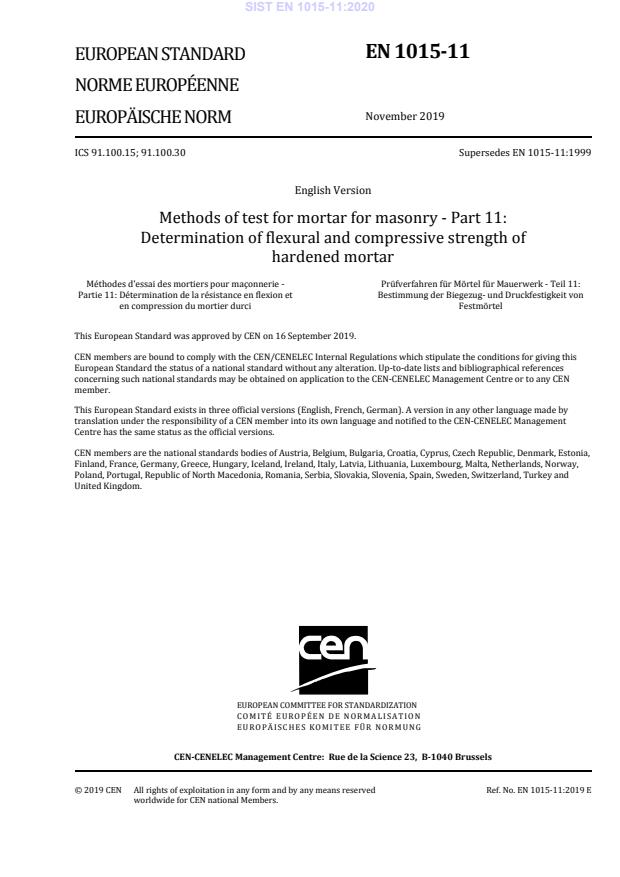
(Main)Methods of test for mortar for masonry - Part 11: Determination of flexural and compressive strength of hardened mortar
Methods of test for mortar for masonry - Part 11: Determination of flexural and compressive strength of hardened mortar
This document specifies a method for determining the flexural and compressive strength of moulded mortar specimens. This document is applicable to cement/air-lime mortars, air-lime mortars, mortars with hydraulic binders and retarded mortars.
Prüfverfahren für Mörtel für Mauerwerk - Teil 11: Bestimmung der Biegezug- und Druckfestigkeit von Festmörtel
Dieses Dokument legt ein Verfahren zur Bestimmung der Biegezug- und Druckfestigkeit von in Formen hergestellten Mörtelprüfkörpern fest. Dieses Dokument gilt für Luftkalk-Zementmörtel, Luftkalk-Mörtel, Mörtel mit hydraulischen Bindemitteln und verzögerte Mörtel.
Méthodes d’essai des mortiers pour maçonnerie - Partie 11: Détermination de la résistance en flexion et en compression du mortier durci
Le présent document prescrit une méthode de détermination de la résistance à la flexion et à la compression d’éprouvettes moulées de mortier. Le présent document est applicable aux mortiers bâtards, aux mortiers de chaux aérienne, aux mortiers avec liants hydrauliques et aux mortiers retardés.
Metode preskušanja zidarske malte - 11. del: Določevanje upogibne in tlačne trdnosti strjene malte
Ta evropski standard določa metodo za določevanje upogibne in tlačne trdnosti primerkov oblikovane malte.
General Information
- Status
- Published
- Publication Date
- 12-Nov-2019
- Withdrawal Date
- 30-May-2020
- Technical Committee
- CEN/TC 125 - Masonry
- Drafting Committee
- CEN/TC 125/WG 4 - Test methods
- Current Stage
- 9060 - Closure of 2 Year Review Enquiry - Review Enquiry
- Start Date
- 04-Jun-2025
- Completion Date
- 04-Jun-2025
Relations
- Effective Date
- 08-Jun-2022
- Effective Date
- 30-Nov-2016
- Effective Date
- 28-Jan-2026
- Effective Date
- 28-Jan-2026
- Effective Date
- 28-Jan-2026
- Effective Date
- 28-Jan-2026
- Effective Date
- 28-Jan-2026
- Effective Date
- 09-Feb-2026
- Effective Date
- 09-Feb-2026
- Referred By
EN 1052-2:2016 - Methods of test for masonry - Part 2: Determination of flexural strength - Effective Date
- 28-Jan-2026
- Effective Date
- 28-Jan-2026
- Effective Date
- 28-Jan-2026
- Effective Date
- 28-Jan-2026
- Effective Date
- 28-Jan-2026
- Effective Date
- 28-Jan-2026
Overview - EN 1015-11:2019 (CEN)
EN 1015-11:2019 - Methods of test for mortar for masonry - Part 11 - specifies a laboratory method to determine the flexural and compressive strength of hardened, moulded mortar specimens. Published by CEN, it applies to cement/air‑lime mortars, air‑lime mortars, mortars with hydraulic binders and retarded mortars. The standard defines specimen geometry, production, curing, test procedures and required apparatus for reproducible masonry mortar strength testing.
Key topics and technical requirements
- Principle: Flexural strength by three‑point bending; compressive strength on the two halves produced by the flexural test (or other undamaged halves).
- Specimen size and number: Rectangular prisms 160 × 40 × 40 mm. Three specimens per test set (yielding six halves for compression).
- Sampling and mixing: Minimum fresh mortar volume of 1.5 L (or 1.5× test requirement). Laboratory mixing and flow value measured per EN 1015‑3; testing normally within the mortar’s workable life (preferably within 30 min of mixing).
- Moulds and compaction: Metal moulds forming three compartments; compaction by tamper (25 strokes per layer) or alternative tilt/tap method (tilt ~30° + taps). Tamper dimensions and mass are specified for consistency.
- Curing and storage: Specific storage/curing regimes (different provisions for air‑lime vs hydraulic binders). Storage chamber nominally 20 °C (+3/‑2 °C) and RH (95 ±5 % or 65 ±5 %). Detailed procedures for gauze, filter paper and loading for air‑lime mortars are given.
- Apparatus and tolerances: Includes metal mould description, non‑absorptive plates, tamper, storage chamber, gauze and filter paper specifications, and loading plate tolerances for compression tests.
- Calculation and reporting: Methods to calculate flexural and compressive strengths and minimum content for the test report (test age, flow, compaction method, curing conditions, etc.).
Applications and target users
EN 1015‑11 is essential for:
- Mortar manufacturers validating product strength and conformity to specifications (EN 998 series).
- Laboratory testing services performing standardized masonry mortar tests.
- Construction engineers, specifiers and quality control teams requiring reliable performance data for design or compliance.
- Research and development when comparing binder types (air‑lime, hydraulic, retarded) or admixture effects.
Practical uses include product development, compliance testing for tenders/specifications, performance comparison between mortar types, and quality assurance on site or in factory settings.
Related standards
- EN 1015‑2 - Bulk sampling and preparation of test mortars
- EN 1015‑3 - Determination of consistence of fresh mortar (flow table)
- EN 196‑1 - Methods for testing cement - determination of strength
- EN 998 (all parts) - Specification for mortar for masonry
Keywords: EN 1015‑11:2019, mortar test, flexural strength, compressive strength, masonry mortar, CEN, moulded specimens, curing conditions.


Get Certified
Connect with accredited certification bodies for this standard

ICC Evaluation Service
Building products evaluation and certification.

QAI Laboratories
Building and construction product testing and certification.

Aboma Certification B.V.
Specialized in construction, metal, and transport sectors.
Sponsored listings
Frequently Asked Questions
EN 1015-11:2019 is a standard published by the European Committee for Standardization (CEN). Its full title is "Methods of test for mortar for masonry - Part 11: Determination of flexural and compressive strength of hardened mortar". This standard covers: This document specifies a method for determining the flexural and compressive strength of moulded mortar specimens. This document is applicable to cement/air-lime mortars, air-lime mortars, mortars with hydraulic binders and retarded mortars.
This document specifies a method for determining the flexural and compressive strength of moulded mortar specimens. This document is applicable to cement/air-lime mortars, air-lime mortars, mortars with hydraulic binders and retarded mortars.
EN 1015-11:2019 is classified under the following ICS (International Classification for Standards) categories: 91.100.15 - Mineral materials and products; 91.100.30 - Concrete and concrete products. The ICS classification helps identify the subject area and facilitates finding related standards.
EN 1015-11:2019 has the following relationships with other standards: It is inter standard links to EN 1015-11:1999, EN 1015-11:1999/A1:2006, EN 196-1:2016, EN 1015-3:1999, EN 1015-2:1998, EN ISO 5436-1:2000, EN ISO 6507-1:2023, EN IEC 61400-4:2025, EN 61400-4:2013, EN 1052-2:2016, EN 998-2:2010, EN 846-8:2000, EN 846-5:2012, EN 12158-1:2021, EN 1052-4:2000. Understanding these relationships helps ensure you are using the most current and applicable version of the standard.
EN 1015-11:2019 is associated with the following European legislation: EU Directives/Regulations: 305/2011; Standardization Mandates: M/116. When a standard is cited in the Official Journal of the European Union, products manufactured in conformity with it benefit from a presumption of conformity with the essential requirements of the corresponding EU directive or regulation.
EN 1015-11:2019 is available in PDF format for immediate download after purchase. The document can be added to your cart and obtained through the secure checkout process. Digital delivery ensures instant access to the complete standard document.
Standards Content (Sample)
SLOVENSKI STANDARD
01-januar-2020
Nadomešča:
SIST EN 1015-11:2001
SIST EN 1015-11:2001/A1:2007
Metode preskušanja zidarske malte - 11. del: Določevanje upogibne in tlačne
trdnosti strjene malte
Methods of test for mortar for masonry - Part 11: Determination of flexural and
compressive strength of hardened mortar
Prüfverfahren für Mörtel für Mauerwerk - Teil 11: Bestimmung der Biegezug- und
Druckfestigkeit von Festmörtel
Méthodes d’essai des mortiers pour maçonnerie - Partie 11: Détermination de la
résistance à la flexion et à la compression du mortier durci
Ta slovenski standard je istoveten z: EN 1015-11:2019
ICS:
91.100.10 Cement. Mavec. Apno. Malta Cement. Gypsum. Lime.
Mortar
2003-01.Slovenski inštitut za standardizacijo. Razmnoževanje celote ali delov tega standarda ni dovoljeno.
EN 1015-11
EUROPEAN STANDARD
NORME EUROPÉENNE
November 2019
EUROPÄISCHE NORM
ICS 91.100.15; 91.100.30 Supersedes EN 1015-11:1999
English Version
Methods of test for mortar for masonry - Part 11:
Determination of flexural and compressive strength of
hardened mortar
Méthodes d'essai des mortiers pour maçonnerie - Prüfverfahren für Mörtel für Mauerwerk - Teil 11:
Partie 11: Détermination de la résistance en flexion et Bestimmung der Biegezug- und Druckfestigkeit von
en compression du mortier durci Festmörtel
This European Standard was approved by CEN on 16 September 2019.
CEN members are bound to comply with the CEN/CENELEC Internal Regulations which stipulate the conditions for giving this
European Standard the status of a national standard without any alteration. Up-to-date lists and bibliographical references
concerning such national standards may be obtained on application to the CEN-CENELEC Management Centre or to any CEN
member.
This European Standard exists in three official versions (English, French, German). A version in any other language made by
translation under the responsibility of a CEN member into its own language and notified to the CEN-CENELEC Management
Centre has the same status as the official versions.
CEN members are the national standards bodies of Austria, Belgium, Bulgaria, Croatia, Cyprus, Czech Republic, Denmark, Estonia,
Finland, France, Germany, Greece, Hungary, Iceland, Ireland, Italy, Latvia, Lithuania, Luxembourg, Malta, Netherlands, Norway,
Poland, Portugal, Republic of North Macedonia, Romania, Serbia, Slovakia, Slovenia, Spain, Sweden, Switzerland, Turkey and
United Kingdom.
EUROPEAN COMMITTEE FOR STANDARDIZATION
COMITÉ EUROPÉEN DE NORMALISATION
EUROPÄISCHES KOMITEE FÜR NORMUNG
CEN-CENELEC Management Centre: Rue de la Science 23, B-1040 Brussels
© 2019 CEN All rights of exploitation in any form and by any means reserved Ref. No. EN 1015-11:2019 E
worldwide for CEN national Members.
Contents Page
European foreword . 3
1 Scope . 4
2 Normative references . 4
3 Terms, definitions and symbols . 4
3.1 Terms and definitions . 4
3.2 Symbols . 5
4 Principle . 5
5 Apparatus . 5
6 Sampling . 6
6.1 General . 6
6.2 Laboratory prepared mortars . 6
6.3 Mortars, other than laboratory prepared mortars . 7
7 Preparation and storage of test specimens . 7
7.1 General . 7
7.2 Preparation . 7
7.3 Storage and curing conditions . 8
8 Determination of flexural strength . 9
8.1 Apparatus . 9
8.2 Procedure. 10
8.3 Calculation and expression of results . 11
9 Determination of compressive strength . 11
9.1 Apparatus . 11
9.2 Procedure. 11
9.3 Calculation and expression of results . 12
10 Test report . 12
Annex A (normative) Description of metal moulds for specimen preparation . 13
Annex B (informative) Suggested loading rates for different classes of masonry and
rendering mortars . 14
Bibliography . 15
European foreword
This document (EN 1015-11:2019) has been prepared by Technical Committee CEN/TC 125 “Masonry”,
the secretariat of which is held by BSI.
This European Standard shall be given the status of a national standard, either by publication of an
identical text or by endorsement, at the latest by May 2020, and conflicting national standards shall be
withdrawn at the latest by May 2020.
Attention is drawn to the possibility that some of the elements of this document may be the subject of
patent rights. CEN shall not be held responsible for identifying any or all such patent rights.
This document supersedes EN 1015-11:1999.
The following main changes made to the previous edition include:
— Editorial revision (inversion Clauses 3 and 4, Clause 3, 5.1);
— Clause 6 has changed; time of starting and ending are indicated;
— 7.2.3: An additional type of compaction has been added;
— The storage condition different for air lime mortars and air lime-cement mortars with cement not
exceeding 50 % of the total binder mass (Table 1 and Table 2);
— 9.1.2: Tolerance for plate width added.
According to the CEN-CENELEC Internal Regulations, the national standards organisations of the
following countries are bound to implement this European Standard: Austria, Belgium, Bulgaria, Croatia,
Cyprus, Czech Republic, Denmark, Estonia, Finland, France, Germany, Greece, Hungary, Iceland, Ireland,
Italy, Latvia, Lithuania, Luxembourg, Malta, Netherlands, Norway, Poland, Portugal, Republic of North
Macedonia, Romania, Serbia, Slovakia, Slovenia, Spain, Sweden, Switzerland, Turkey and the United
Kingdom.
1 Scope
This document specifies a method for determining the flexural and compressive strength of moulded
mortar specimens. This document is applicable to cement/air-lime mortars, air-lime mortars, mortars
with hydraulic binders and retarded mortars.
2 Normative references
The following documents are referred to in the text in such a way that some or all of their content
constitutes requirements of this document. For dated references, only the edition cited applies. For
undated references, the latest edition of the referenced document (including any amendments) applies.
EN 196-1, Methods of testing cement — Part 1: Determination of strength
EN 998 (all parts), Specification for mortar for masonry
EN 1015-2, Methods of test for mortar for masonry — Part 2: Bulk sampling of mortars and preparation of
test mortars
EN 1015-3, Methods of test for mortar for masonry — Part 3: Determination of consistence of fresh mortar
(by flow table)
EN ISO 5436-1, Geometrical Product Specifications (GPS) — Surface texture: Profile method; Measurement
standards — Part 1: Material measures (ISO 5436-1)
EN ISO 6507-1, Metallic materials — Vickers hardness test — Part 1: Test method (ISO 6507-1)
3 Terms, definitions and symbols
3.1 Terms and definitions
For the purposes of this document, the following terms and definitions apply.
ISO and IEC maintain terminological databases for use in standardization at the following addresses:
• IEC Electropedia: available at http://www.electropedia.org/
• ISO Online browsing platform: available at https://www.iso.org/obp
3.1.1
air-lime
limes mainly consisting of calcium oxide or hydroxide which slowly harden in air by reacting with
atmospheric carbon dioxide and generally do not harden under water as they have no hydraulic
properties
Note 1 to entry: The definition of air-lime comprises an English translation of a term used in most European
countries.
3.2 Symbols
F is the maximum load applied to the specimen, in newtons (N).
l is the distance between the axes of the support rollers, in millimetres (mm).
b is the width of specimen, in millimetres (mm).
d is the depth of the specimen, in millimetres (mm).
4 Principle
The flexural strength of mortar is determined by three point loading of hardened moulded mortar
specimens to failure. The compressive strength of the mortar is determined on the two parts resulting
from the flexural strength test. Where the flexural strength is not required, the parts for compressive
strength testing can be produced from the specimens in any way which does not lead to these parts being
damaged.
5 Apparatus
5.1 Metal moulds consisting of an open frame of removable walls forming three compartments when
assembled (see Figure 1 for typical design and Annex A for a detailed description).
5.1.1 Metal moulds for use with mortars with hydraulic binders and air-lime mortars with mass
of air-lime not exceeding 50 % of total binder mass; a typical mould is given in EN 196-1.
5.1.2 Metal moulds for use with mortars based on air-lime/cement with cement mass not
exceeding 50 % of total binder mass.
5.2 Tamper consisting of a rigid, non-absorptive rod of square cross-section, each side of which is
(12 ± 1) mm. The tamping face is flat and at right angles to the length of the tamper. The mass of the
tamper is (50 ± 1) g.
5.3 Storage chamber capable of maintaining a temperature of 20 °C (+3 °C/-2 °C) and a relative
humidity of (95 ± 5) % or (65 ± 5) %.
5.4 White cotton gauze, four sheets each with a size of approximately 150 mm x 175 mm.
5.5 Absorbent filter paper with a specific mass of (200 ± 20) g/m and water absorption capacity of
(160 ± 20) g/m ; twelve sheets each with a size of approximately 150 mm x 175 mm.
The number of filter paper sheets may be increased or decreased to account for lower or higher water
absorption capacity.
5.6 Polyethylene bags capable of containing the metal moulds.
5.7 Non-absorptive plates of sufficient area to cover the metal mould and which can support a mass
of 5 kg.
5.8 Palette knife, or similar metal straight edge.
5.9 Metal grid, providing support for storing and curing the specimens.
5.10 Trowel.
Additional apparatus is described in 8.1 and 9.1.
Dimensions in millimetres
Figure 1 — Typical mould for forming test specimens
6 Sampling
6.1 General
The fresh mortar for this test shall have a minimum volume of 1,5 l or at least 1,5 times the quantity
needed to perform the test, whichever is the greater, and shall either be obtained by reduction of the bulk
test sample (see EN 1015-2) using a simple divider or by quartering or by preparation from water and
the other constituents in the laboratory. Two test samples shall be prepared.
6.2 Laboratory prepared mortars
The length of the mixing period shall be measured from the moment all the constituents are introduced
into the mixer. The mortar shall be brought to a defined flow value as specified in EN 1015-2 determined
in accordance with EN 1015-3 or EN 1015-4 and reported. The test procedure shall start after mixing but
shall be concluded within the specified workable life of the mortar (preferably within 30 min after
completion of mixing). Before testing, the batch shall be gently stirred by hand using a trowel or palette
knife in 5 s to 10 s to counteract any false setting, etc., but without any additional mixing of the batch.
6.3 Mortars, other than laboratory prepared mortars
Ready to use mortars (factory-made wet mortars which are retarded), and pre-batched air-lime/sand
wet mortars when not gauged with hydraulic binders, shall be used for specimen preparation
...
Questions, Comments and Discussion
Ask us and Technical Secretary will try to provide an answer. You can facilitate discussion about the standard in here.
Loading comments...