

EN 13000:2010+A1:2014
(Main + Amendment)Cranes - Mobile cranes
- Abstract
This European Standard is applicable to the design, construction, installation of safety devices, information for use, maintenance and testing of mobile cranes as defined in ISO 4306 2. Examples of mobile crane types are given in Annex A.
This European Standard does not apply to:
- loader cranes (see EN 12999)
- off-shore cranes (see EN 13852 1)
- floating cranes (see EN 13852 2)
- variable reach truck (see EN 1459)
NOTE 1 Variable Reach Trucks are commonly known as telehandlers.
- mobile self-erecting tower cranes
- earth-moving machinery used for object handling (see EN 474-series).
This standard does not cover hazards related to the lifting of persons.
NOTE 2 The use of mobile cranes for the lifting of persons is subject to specific national regulations.
Mobile cranes covered by this European Standard are designed for a limited number of stress cycles and particular properties of motions, e.g. smooth application of the driving forces and loading conditions according to ISO 4301 2:1985, group A1.
For a duty cycle such as grab, magnet or similar work, additional provisions are required which are outside the scope of this European Standard.
The hazards covered by this European Standard are identified by Annex C.
This document is not applicable to mobile cranes which are manufactured before the date of publication of this document by CEN.
- Status
- Published
- Publication Date
- 13-May-2014
- Withdrawal Date
- 29-Nov-2014
- Technical Committee
- CEN/TC 147 - Cranes - Safety
- Drafting Committee
- CEN/TC 147/WG 11 - Mobiles cranes
- Current Stage
- 6060 - Definitive text made available (DAV) - Publishing
- Start Date
- 14-May-2014
- Completion Date
- 14-May-2014
- Directive
- 2006/42/EC - Directive 2006/42/EC of the European Parliament and of the Council of 17 May 2006 on machinery, and amending Directive 95/16/EC (recast)OJ Ref: C, C 054, C 92 OJ Date: 13-Feb-2015

Overview
EN 13000:2010+A1:2014 - Cranes: Mobile cranes is the European standard that sets safety, design, construction, testing, maintenance and user‑information requirements for mobile cranes as defined in ISO 4306‑2. It covers structural requirements, equipment and device safety, verification (calculation and testing), operator information, marking and documentation. The standard applies to mobile cranes designed for a limited number of stress cycles (duty group A1) and excludes specific machine types and lifting‑of‑persons uses.
Key topics and technical requirements
- Scope and exclusions: applies to mobile cranes (telescopic, lattice‑boom, crawler, mobile harbour cranes, etc.). Not applicable to loader cranes (EN 12999), offshore cranes (EN 13852‑1), floating cranes (EN 13852‑2), variable reach trucks/telehandlers (EN 1459), mobile self‑erecting tower cranes or earth‑moving machinery for object handling (EN 474 series). Lifting persons is outside this standard (subject to national rules).
- Structures and limit states: requirements for load effects, structural strength and limit states verification.
- Equipment and devices: control stations, protection against falling objects, seats, controls and control systems, limiting/indicating devices, steering, brakes, hydraulic/pneumatic systems, hooks and hook blocks.
- Stability & dynamic effects: requirements for roll‑over/tip‑over protection, rigid body stability and combined motion load effects.
- Verification & testing: methods of verification (calculation and experimental tests), test procedures, test reports and certificates including noise emission verification.
- Information for use: operator instructions, assembly/erection/disassembly guidance, maintenance and inspection schedules, training requirements, spare parts and disposal instructions.
- Marking & record‑keeping: machine marking, warnings, graphic symbols, event recorder marking and certificates for wire rope/chain.
- Annexes: normative and informative annexes cover hazards (Annex C), parts and types, noise test code, structural material limits, hook and gear specifications, test certificates and relation to EU Machinery Directive 2006/42/EC.
Practical applications - who uses this standard
- Crane manufacturers - design, certification, user manuals, marking and conformity with EU requirements.
- Design and structural engineers - load calculations, limit state analysis and materials selection.
- Safety managers & site owners - selecting compliant equipment, maintenance regimes and operator instructions.
- Inspectors, test laboratories & certification bodies - verification tests, noise measurements and issuing test certificates.
- Purchasers and fleet managers - specification of hoist gears, hooks, lifting accessories and conformity checks.
Related standards
- ISO 4306‑2 (crane terminology)
- EN 12999 (loader cranes)
- EN 13852‑1 / EN 13852‑2 (offshore/floating cranes)
- EN 1459 (variable reach trucks / telehandlers)
- EN 474 series (earth‑moving machinery)
- EU Directive 2006/42/EC (Machinery Directive compliance)
SIST EN 13000 is essential for ensuring mobile crane safety, reliable operation and regulatory conformity across design, manufacturing, maintenance and inspection workflows.
Relations
- Merged From
EN 13000:2010/FprA1 - Cranes - Mobile cranes - Effective Date
- 19-Jan-2023
- Merged From
EN 13000:2010 - Cranes - Mobile cranes - Effective Date
- 18-Jan-2023
- Effective Date
- 29-Jan-2014
- Effective Date
- 25-Aug-2026
- Effective Date
- 25-Aug-2026
- Effective Date
- 25-Aug-2026
- Effective Date
- 25-Aug-2026
- Effective Date
- 25-Aug-2026
- Effective Date
- 25-Aug-2026
- Refers
ISO 4309:2004 - Cranes — Wire ropes — Care, maintenance, installation, examination and discard - Effective Date
- 25-Aug-2026
- Effective Date
- 25-Aug-2026
- Effective Date
- 25-Aug-2026
- Effective Date
- 25-Aug-2026
- Effective Date
- 25-Aug-2026
- Effective Date
- 25-Aug-2026
Frequently Asked Questions
EN 13000:2010+A1:2014 is a standard published by the European Committee for Standardization (CEN). Its full title is "Cranes - Mobile cranes". This standard covers: This European Standard is applicable to the design, construction, installation of safety devices, information for use, maintenance and testing of mobile cranes as defined in ISO 4306 2. Examples of mobile crane types are given in Annex A. This European Standard does not apply to: - loader cranes (see EN 12999) - off-shore cranes (see EN 13852 1) - floating cranes (see EN 13852 2) - variable reach truck (see EN 1459) NOTE 1 Variable Reach Trucks are commonly known as telehandlers. - mobile self-erecting tower cranes - earth-moving machinery used for object handling (see EN 474-series). This standard does not cover hazards related to the lifting of persons. NOTE 2 The use of mobile cranes for the lifting of persons is subject to specific national regulations. Mobile cranes covered by this European Standard are designed for a limited number of stress cycles and particular properties of motions, e.g. smooth application of the driving forces and loading conditions according to ISO 4301 2:1985, group A1. For a duty cycle such as grab, magnet or similar work, additional provisions are required which are outside the scope of this European Standard. The hazards covered by this European Standard are identified by Annex C. This document is not applicable to mobile cranes which are manufactured before the date of publication of this document by CEN.
This European Standard is applicable to the design, construction, installation of safety devices, information for use, maintenance and testing of mobile cranes as defined in ISO 4306 2. Examples of mobile crane types are given in Annex A. This European Standard does not apply to: - loader cranes (see EN 12999) - off-shore cranes (see EN 13852 1) - floating cranes (see EN 13852 2) - variable reach truck (see EN 1459) NOTE 1 Variable Reach Trucks are commonly known as telehandlers. - mobile self-erecting tower cranes - earth-moving machinery used for object handling (see EN 474-series). This standard does not cover hazards related to the lifting of persons. NOTE 2 The use of mobile cranes for the lifting of persons is subject to specific national regulations. Mobile cranes covered by this European Standard are designed for a limited number of stress cycles and particular properties of motions, e.g. smooth application of the driving forces and loading conditions according to ISO 4301 2:1985, group A1. For a duty cycle such as grab, magnet or similar work, additional provisions are required which are outside the scope of this European Standard. The hazards covered by this European Standard are identified by Annex C. This document is not applicable to mobile cranes which are manufactured before the date of publication of this document by CEN.
EN 13000:2010+A1:2014 is classified under the following ICS (International Classification for Standards) categories: 53.020.20 - Cranes. The ICS classification helps identify the subject area and facilitates finding related standards.
EN 13000:2010+A1:2014 has the following relationships with other standards: It is inter standard links to EN 13000:2010/FprA1, EN 13000:2010, EN 13000:2010/AC:2010, ISO 11662-1:1995, ISO 4301-1:1986, ISO 13200:1995, ISO 7000:2004, ISO 4310:1981, ISO 11660-2:1994, ISO 4309:2004, ISO 2631-1:1997, ISO 4306-1:2007, ISO 4308-1:2003, ISO 8995-1:2002, ISO 12480-1:1997. Understanding these relationships helps ensure you are using the most current and applicable version of the standard.
EN 13000:2010+A1:2014 is associated with the following European legislation: EU Directives/Regulations: 2006/42/EC; Standardization Mandates: M/396. When a standard is cited in the Official Journal of the European Union, products manufactured in conformity with it benefit from a presumption of conformity with the essential requirements of the corresponding EU directive or regulation.
EN 13000:2010+A1:2014 is available in PDF format for immediate download after purchase. The document can be added to your cart and obtained through the secure checkout process. Digital delivery ensures instant access to the complete standard document.
Standards Content (Sample)
2003-01.Slovenski inštitut za standardizacijo. Razmnoževanje celote ali delov tega standarda ni dovoljeno.Žerjavi - Mobilni žerjaviKrane - FahrzeugkraneAppareils de levage à charge suspendue - Grues mobilesCranes - Mobile cranes53.020.20DvigalaCranesICS:Ta slovenski standard je istoveten z:EN 13000:2010+A1:2014SIST EN 13000:2010+A1:2014en,fr,de01-julij-2014SIST EN 13000:2010+A1:2014SLOVENSKI
STANDARDSIST EN 13000:2010/AC:2011SIST EN 13000:20101DGRPHãþD
EUROPEAN STANDARD NORME EUROPÉENNE EUROPÄISCHE NORM
EN 13000:2010+A1
May 2014 ICS 53.020.20 Supersedes EN 13000:2010
English Version
Cranes - Mobile cranes
Appareils de levage à charge suspendue - Grues mobiles
Krane - Fahrzeugkrane This European Standard was approved by CEN on 19 December 2009 and includes Corrigendum 1 issued by CEN on 6 October 2010 and Amendment 1 approved by CEN on 9 February 2014.
CEN members are bound to comply with the CEN/CENELEC Internal Regulations which stipulate the conditions for giving this European Standard the status of a national standard without any alteration. Up-to-date lists and bibliographical references concerning such national standards may be obtained on application to the CEN-CENELEC Management Centre or to any CEN member.
This European Standard exists in three official versions (English, French, German). A version in any other language made by translation under the responsibility of a CEN member into its own language and notified to the CEN-CENELEC Management Centre has the same status as the official versions.
CEN members are the national standards bodies of Austria, Belgium, Bulgaria, Croatia, Cyprus, Czech Republic, Denmark, Estonia, Finland, Former Yugoslav Republic of Macedonia, France, Germany, Greece, Hungary, Iceland, Ireland, Italy, Latvia, Lithuania, Luxembourg, Malta, Netherlands, Norway, Poland, Portugal, Romania, Slovakia, Slovenia, Spain, Sweden, Switzerland, Turkey and United Kingdom.
EUROPEAN COMMITTEE FOR STANDARDIZATION
COMITÉ EUROPÉEN DE NORMALISATION
EUROPÄISCHES KOMITEE FÜR NORMUNG
CEN-CENELEC Management Centre:
Avenue Marnix 17,
B-1000 Brussels © 2014 CEN All rights of exploitation in any form and by any means reserved worldwide for CEN national Members. Ref. No. EN 13000:2010+A1:2014 E SIST EN 13000:2010+A1:2014
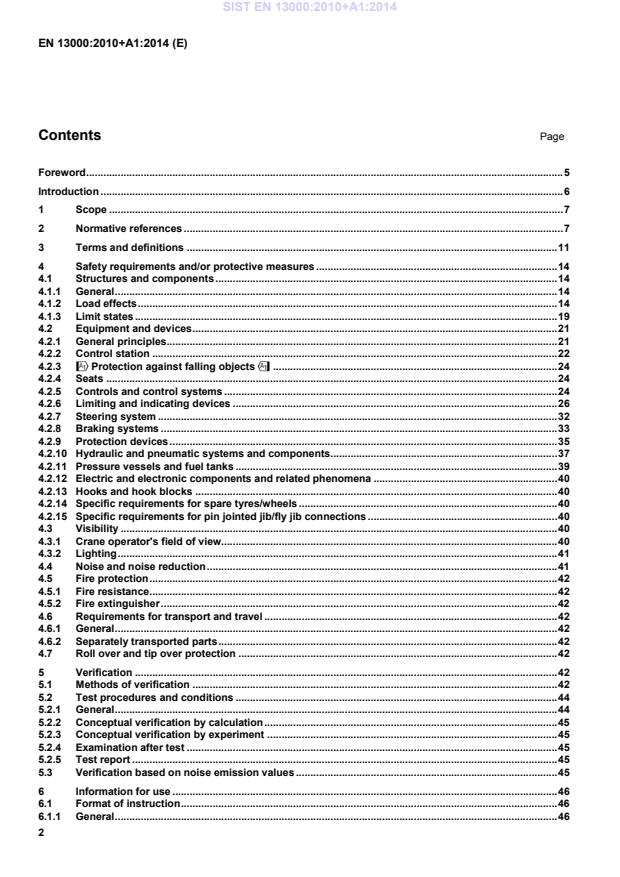
Examples of mobile crane types . 54 Annex B .1 (informative)
Major parts of telescopic cranes . 56 Annex B.2 (informative)
Major parts of lattice !boom" cranes . 57 Annex C (normative)
List of hazards . 58 Annex D (normative)
Load effects of combined motions . 62 Annex E (normative)
Crane operator's seat dimensions . 66 Annex F (normative)
Rigid body stability: Load effects due to acceleration . 68 Annex G .1 (normative)
Noise test code for mobile cranes . 69 Annex G.2 (normative)
Noise measurement, test report . 75 Annex H (normative)
Limit values for structural and fine grain steel types . 77 Annex J .1
(normative)
Minimum requirements for specification of hoist/derrick gears . 78 Annex K .1
(normative)
Minimum requirements for the specification of lifting hooks . 86 Annex L (normative)
Proof of competence . 95 Annex M (normative)
Test of steering systems for off-road mobile cranes . 98 Annex N .1
(informative)
Wind speed as a function of elevation . 99 Annex P (normative)
Efficiency of sheave sets . 107 Annex Q (informative)
Manufacturer's sign . 108 Annex R (normative)
Certificate for wire rope, requirements . 109 Annex S (normative)
Certificate for chain, requirements . 110 Annex T (informative)
Test procedures: Selection of load cases . 111 Annex U (normative)
Test certificate . 112 Annex V (informative)
Additional information of the concept of the limiting and indicating device . 113 Annex W (informative)
Selection of a suitable set of crane standards for a given application . 114 Annex ZA (informative)
Relation between this European Standard and the Essential Requirements of EU Directive 2006/42/EC. 116 Bibliography . 117 SIST EN 13000:2010+A1:2014
Foreword This document (EN 13000:2010+A1:2014) has been prepared by Technical Committee CEN/TC Safety”, the secretariat of which is held by BSI. This European Standard shall be given the status of a national standard, either by publication of an identical text or by endorsement, at the latest by November 2014, and conflicting national standards shall be withdrawn at the latest by November 2014. Attention is drawn to the possibility that some of the elements of this document may be the subject of patent rights. CEN [and/or CENELEC] shall not be held responsible for identifying any or all such patent rights. This document supersedes !EN 13000:2010". This document includes Amendment 1 approved by CEN on 2014-02-09. The start and finish of text introduced or altered by amendment is indicated in the text by tags !". This document has been prepared under a mandate given to CEN by the European Commission and the European Free Trade Association, and supports essential requirements of EU Directive(s). !For relationship with EU Directive(s), see informative Annex ZA, which is an integral part of this document." This standard applies to mobile cranes which are put on the market 12 months after the date of ratification by CEN of this standard or at the latest 2015-02-09. This document has been prepared by Product Working Group CEN/TC 147/WG 11 "Mobile Cranes", the secretariat of which is held by DIN. !CEN/TC 147 WG11 has reviewed EN 13000:2010 to adapt the standard to the technical progress, new requirements and changes in standards referenced; the main topics are: The scope of this standard has been amended to cover gaps and overlaps with other European Standards. Several wind related incidents forced the introduction of more clarification on wind loads and the development of explanations to be added in the instruction manual (4.1.2.2.2 and 6.2.2.4). The limit value for the noise measured at the operator position has been aligned with the actual legal requirements and the former noise clause has been reorganized to improve readability (5.3, 6.1.2 and Annex G). To cover the risk of a wrong setting of the outrigger configuration and to align the standard with other European Standards and recently introduced regulations outside of the EEA, requirements for outrigger monitoring are introduced (4.2.6.2.5)." Annexes A, C, D, E, F, G.1 and G.2, H, J.1 to J.4, K.1 to K.5, L, M, P, R, S and U are normative. Annexes B.1 and B.2, N.1 to N.3, Q, T, V and W are informative. According to the CEN/CENELEC Internal Regulations, the national standards organizations of the following countries are bound to implement this European Standard: Austria, Belgium, Bulgaria, Croatia, Cyprus, Czech Republic, Denmark, Estonia, Finland, Former Yugoslav Republic of Macedonia, France, Germany, Greece, Hungary, Iceland, Ireland, Italy, Latvia, Lithuania, Luxembourg, Malta, Netherlands, Norway, Poland, Portugal, Romania, Slovakia, Slovenia, Spain, Sweden, Switzerland, Turkey and the United Kingdom. SIST EN 13000:2010+A1:2014
Variable Reach Trucks are commonly known as telehandlers. • mobile self-erecting tower cranes • earth-moving machinery used for object handling (see EN 474-series)." This standard does not cover hazards related to the lifting of persons. !NOTE 2" The use of mobile cranes for the lifting of persons is subject to specific national regulations. Mobile cranes covered by this European Standard are designed for a limited number of stress cycles and particular properties of motions, e.g. smooth application of the driving forces and loading conditions according to ISO 4301-2:1985, group A1. For a duty cycle such as grab, magnet or similar work, additional provisions are required which are outside the scope of this European Standard. The hazards covered by this European Standard are identified by Annex C. This document is not applicable to mobile cranes which are manufactured before the date of publication of this document by CEN. 2 Normative references The following referenced documents are indispensable for the application of this document. For dated references, only the edition cited applies. For undated references, the latest edition of the referenced document (including any amendments) applies. EN 2:1992, Classification of fires EN 294:1992, Safety of machinery — Safety distance to prevent danger zones being reached by the upper limbs EN 349:1993, Safety of machinery — Minimum gaps to avoid crushing of parts of the human body EN 547-1:1996, Safety of machinery — Human body measurements — Part 1: Principles for determining the dimensions required for openings for whole body access into machinery EN 614-1:2006, Safety of machinery — Ergonomic design principles — Part 1: Terminology and general principles EN 626-1:1994, Safety of machinery — Reduction of risk to health from hazardous substances emitted by machinery — Part 1: Principles and specifications for machinery manufacturers SIST EN 13000:2010+A1:2014
1) The definitions are listed alphabetically. SIST EN 13000:2010+A1:2014
...