


EN 1367-2:1998
(Main)Tests for thermal and weathering properties of aggregates - Part 2: Magnesium sulfate test
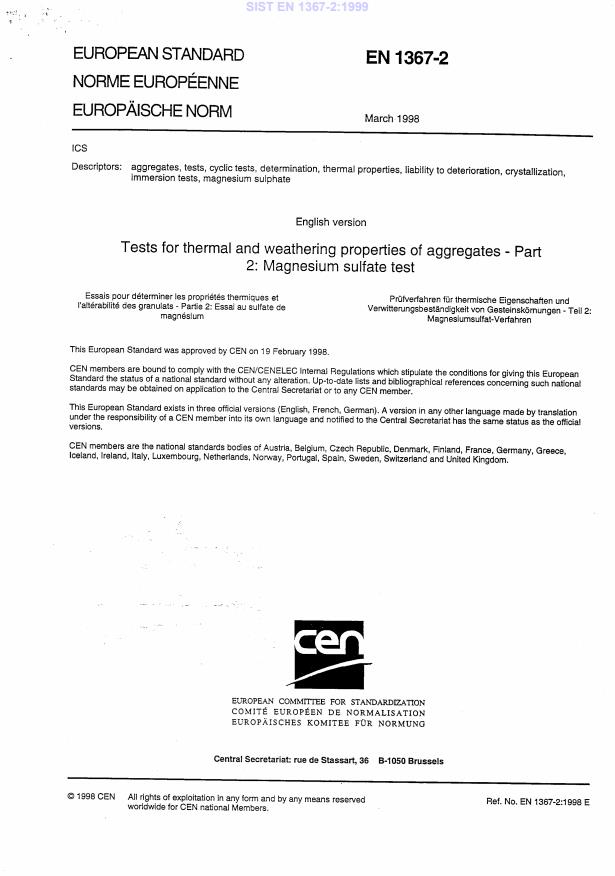
Tests for thermal and weathering properties of aggregates - Part 2: Magnesium sulfate test
This European Standard specifies a method for assessing how an aggregate behaves when subjected to the cyclic action of immersion in magnesium sulfate, followed by oven drying. NOTE: The majority of aggregates can be tested for performance using this method. Precision has been established for the rock types listed in annex A. The test may not be suitable for all rock types and reservations have been expressed elsewhere in respect of some carbonate aggregates and some aggregates having a high proportion of magnesium bearing minerals or of cryptocrystalline quartz.
Prüfverfahren für thermische Eigenschaften und Verwitterungsbeständigkeit von Gesteinskörnungen - Teil 2: Magnesiumsulfat-Verfahren
Dieser Teil der vorliegenden Europäischen Norm legt ein Verfahren für die Beurteilung des Verhaltens einer Gesteinskörnung fest, die einer Wechselbeanspruchung durch Eintauchen in Magnesiumsulfat und anschließender Trocknung in einer Wärmekammer ausgesetzt wird. ANMERKUNG: Hinsichtlich des Verhaltens kann die Mehrzahl der Gesteinskörnungen nach diesem Verfahren geprüft werden. Die Präzision ist für die in Tabelle 1 aufgeführten Gesteinsarten festgestellt worden. Der Versuch muß nicht für alle Gesteinsarten geeignet sein usw.
Essais pour déterminer les propriétés thermiques et l'altérabilité des granulats - Partie 2: Essai au sulfate de magnésium
La présente norme européenne décrit une méthode d'évaluation du comportement d'un granulat lorsqu'il est soumis à l'action cyclique d'immersion dans du sulfate de magnésium, suivi d'un étuvage. NOTE: Le niveau de performancede la plupart des granulats peut être vérifié avec cette méthode d'essai. La fidélité de cette méthode a été établie pour les types de roches énumérés dans l'annexe A. L'essai peut ne pas convenir à tous les types de roches et des réserves ont par ailleurs été exprimées en ce qui concerne les granulats calcaires et les granulats à proportion élevée en minéraux magnésiens...
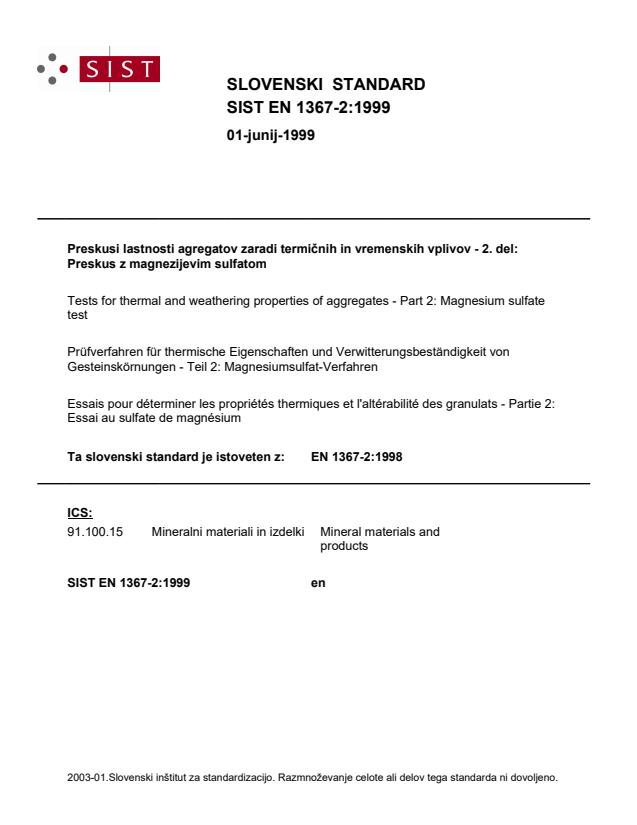
Preskusi lastnosti agregatov zaradi termičnih in vremenskih vplivov - 2. del: Preskus z magnezijevim sulfatom
General Information
- Status
- Withdrawn
- Publication Date
- 17-Mar-1998
- Withdrawal Date
- 27-Oct-2009
- Technical Committee
- CEN/TC 154 - Aggregates
- Drafting Committee
- CEN/TC 154/SC 6 - Test methods
- Current Stage
- 9960 - Withdrawal effective - Withdrawal
- Start Date
- 28-Oct-2009
- Completion Date
- 28-Oct-2009
- Directive
- 89/106/EEC - Construction products
Relations
- Effective Date
- 31-Oct-2009
- Effective Date
- 28-Jan-2026

Get Certified
Connect with accredited certification bodies for this standard

ICC Evaluation Service
Building products evaluation and certification.

QAI Laboratories
Building and construction product testing and certification.

Aboma Certification B.V.
Specialized in construction, metal, and transport sectors.
Sponsored listings
Frequently Asked Questions
EN 1367-2:1998 is a standard published by the European Committee for Standardization (CEN). Its full title is "Tests for thermal and weathering properties of aggregates - Part 2: Magnesium sulfate test". This standard covers: This European Standard specifies a method for assessing how an aggregate behaves when subjected to the cyclic action of immersion in magnesium sulfate, followed by oven drying. NOTE: The majority of aggregates can be tested for performance using this method. Precision has been established for the rock types listed in annex A. The test may not be suitable for all rock types and reservations have been expressed elsewhere in respect of some carbonate aggregates and some aggregates having a high proportion of magnesium bearing minerals or of cryptocrystalline quartz.
This European Standard specifies a method for assessing how an aggregate behaves when subjected to the cyclic action of immersion in magnesium sulfate, followed by oven drying. NOTE: The majority of aggregates can be tested for performance using this method. Precision has been established for the rock types listed in annex A. The test may not be suitable for all rock types and reservations have been expressed elsewhere in respect of some carbonate aggregates and some aggregates having a high proportion of magnesium bearing minerals or of cryptocrystalline quartz.
EN 1367-2:1998 is classified under the following ICS (International Classification for Standards) categories: 91.100.15 - Mineral materials and products. The ICS classification helps identify the subject area and facilitates finding related standards.
EN 1367-2:1998 has the following relationships with other standards: It is inter standard links to EN 1367-2:2009, EN 13450:2002. Understanding these relationships helps ensure you are using the most current and applicable version of the standard.
EN 1367-2:1998 is associated with the following European legislation: EU Directives/Regulations: 305/2011, 89/106/EEC; Standardization Mandates: M/125. When a standard is cited in the Official Journal of the European Union, products manufactured in conformity with it benefit from a presumption of conformity with the essential requirements of the corresponding EU directive or regulation.
EN 1367-2:1998 is available in PDF format for immediate download after purchase. The document can be added to your cart and obtained through the secure checkout process. Digital delivery ensures instant access to the complete standard document.
Standards Content (Sample)
2003-01.Slovenski inštitut za standardizacijo. Razmnoževanje celote ali delov tega standarda ni dovoljeno.Prüfverfahren für thermische Eigenschaften und Verwitterungsbeständigkeit von Gesteinskörnungen - Teil 2: Magnesiumsulfat-VerfahrenEssais pour déterminer les propriétés thermiques et l'altérabilité des granulats - Partie 2: Essai au sulfate de magnésiumTests for thermal and weathering properties of aggregates - Part 2: Magnesium sulfate test91.100.15Mineralni ma
...
Questions, Comments and Discussion
Ask us and Technical Secretary will try to provide an answer. You can facilitate discussion about the standard in here.
Loading comments...