

EN ISO 10218-2:2025
(Main)Robotics - Safety requirements - Part 2: Industrial robot applications and robot cells (ISO 10218-2:2025)
General Information
- Abstract
This document specifies requirements for the integration of industrial robot applications and industrial robot cells. The following are addressed:
— the design, integration, commissioning, operation, maintenance, decommissioning and disposal;
— integration of machines and components;
— information for use for the design, integration, commissioning, operation, maintenance, decommissioning and disposal.
This document is not applicable to the following uses and applications of industrial robots:
— underwater;
— law enforcement;
— military (defence);
— airborne and space, including outer space;
— medical;
— healthcare of a person;
— prosthetics and other aids for the physically impaired;
— service robots, which provide a service to a person and as such the public can have access;
— consumer products, as this is household use to which the public can have access;
— lifting or transporting people;
— multi-purpose lifting devices or machinery, e.g. cranes, forklift trucks.
NOTE Applications for the automation of laboratories are not considered as medical or healthcare of a person.
This document deals with the significant hazards, hazardous situations or hazardous events when used as intended and under specified conditions of misuse which are reasonably foreseeable by the integrator.
This document provides basic requirements for industrial robot applications, but does not cover the hazards related to the following:
— emission of airborne noise;
— severe conditions (e.g. extreme climates, freezer use, strong magnetic fields) outside of manufacturer’s specifications;
— underground use;
— use that has hygienic requirements;
— processing of any material (e.g. food, cosmetics, pharmaceutical, metal);
— use in nuclear environments;
— use in potentially explosive environments;
— mobility when robots or manipulators are integrated with driverless industrial trucks;
— mobility when robots or manipulators are integrated with mobile platforms;
— use in environments with hazardous ionizing and non-ionizing radiation levels;
— hazardous ionizing and non-ionizing radiation;
— handling loads the nature of which could lead to dangerous situations (e.g. molten metals, acids/bases, radiating materials);
— when the public or non-working adults have access.
Emission of acoustic noise could be identified to be a significant hazard, but emission of noise is not covered in this document.
- Status
- Published
- Publication Date
- 11-Mar-2025
- Withdrawal Date
- 10-Jan-2023
- Technical Committee
- CEN/TC 310 - Advanced Manufacturing Technologies
- Drafting Committee
- CEN/TC 310 - Advanced Manufacturing Technologies
- Current Stage
- 6060 - Definitive text made available (DAV) - Publishing
- Start Date
- 12-Mar-2025
- Completion Date
- 12-Mar-2025
- Directive
- 2006/42/EC - Directive 2006/42/EC of the European Parliament and of the Council of 17 May 2006 on machinery, and amending Directive 95/16/EC (recast)OJ Ref: OJ L, 2026/2015 OJ Date: 07-Sep-2026

Overview
EN ISO 10218-2:2025 - "Robotics - Safety requirements - Part 2: Industrial robot applications and robot cells (ISO 10218-2:2025)" specifies safety requirements for the integration of industrial robot applications and robot cells. It covers the lifecycle from design, integration and commissioning to operation, maintenance, decommissioning and disposal, and requires the provision of user information for these stages. The standard addresses significant hazards and foreseeable misuse relevant to integrators and system builders, while explicitly excluding certain applications and environments (e.g., underwater, medical, military, airborne/space, service/consumer robots, nuclear or explosive environments).
Key topics and technical requirements
- Risk assessment: Methods for identifying significant hazards, hazardous situations and hazardous events for intended use and reasonable misuse.
- Design and mechanical requirements: Materials, mechanical strength, stability, position holding and protective measures for moving parts.
- Control and safety systems: Requirements for control reliability, stopping functions (normal, operational, emergency), selection of operating modes and failure-management measures.
- Integration of machines and components: Safety considerations when combining robots with tools, end-effectors, conveyors or other machinery in robot cells.
- Information for use: Mandatory instructions, warnings, markings and documentation for integrators, operators and maintenance personnel.
- Commissioning, maintenance and decommissioning: Safe procedures, access, isolation of energy sources and operator interventions.
- Scope exclusions and limits: Lists environments, uses and hazard types not covered (e.g., emission of airborne noise, extreme climates, hazardous radiation, handling molten metals, public access scenarios).
Practical applications
This standard is intended to be applied when integrating or commissioning industrial robot systems and robot cells used in manufacturing and automation tasks such as material handling, machine tending, welding, painting and assembly - where hazards arise from robot movements, tooling and cell layout. It helps ensure safe cell design, selection of protective devices and compliant control strategies.
Who should use this standard
- System integrators and robot integrators - for safe cell design and commissioning
- Machine builders and OEMs - when combining robots with other machines or modules
- Safety engineers and risk assessors - to perform compliant risk assessments and select safeguards
- Maintenance and operations teams - to follow safe procedures and documentation requirements
- Compliance officers and notified bodies - for conformity assessment and alignment with EU Machinery Directive requirements (see Annex ZA)
Related standards
- ISO 10218-1 (robot safety requirements for robot manufacturers) - complements Part 2 by addressing manufacturer-level robot design.
- Relevant machinery and functional safety standards used in conjunction for full compliance.
Keywords: ISO 10218-2:2025, robotics safety, industrial robot applications, robot cells, robot cell integration, risk assessment, robot safety requirements.
Relations
- Effective Date
- 28-Jan-2023
- Effective Date
- 13-Feb-2026
- Effective Date
- 13-Feb-2026
- Effective Date
- 13-Feb-2026
- Effective Date
- 13-Feb-2026
- Effective Date
- 13-Feb-2026
- Effective Date
- 13-Feb-2026
- Effective Date
- 13-Feb-2026
- Effective Date
- 13-Feb-2026
- Effective Date
- 13-Feb-2026
- Effective Date
- 13-Feb-2026
- Effective Date
- 13-Feb-2026
- Refers
IEC 60825-1:2014 - Safety of laser products - Part 1: Equipment classification and requirements - Effective Date
- 13-Feb-2026
- Effective Date
- 13-Feb-2026
- Effective Date
- 13-Feb-2026
Get Certified
Connect with accredited certification bodies for this standard

DVS-ZERT GmbH
German welding certification society.
CARES (UK Certification Authority for Reinforcing Steels)
UK certification for reinforcing steels and construction.
EWF/IIW (European/International Welding Federation)
International welding personnel certification.
Sponsored listings
Frequently Asked Questions
EN ISO 10218-2:2025 is a standard published by the European Committee for Standardization (CEN). Its full title is "Robotics - Safety requirements - Part 2: Industrial robot applications and robot cells (ISO 10218-2:2025)". This standard covers: This document specifies requirements for the integration of industrial robot applications and industrial robot cells. The following are addressed: — the design, integration, commissioning, operation, maintenance, decommissioning and disposal; — integration of machines and components; — information for use for the design, integration, commissioning, operation, maintenance, decommissioning and disposal. This document is not applicable to the following uses and applications of industrial robots: — underwater; — law enforcement; — military (defence); — airborne and space, including outer space; — medical; — healthcare of a person; — prosthetics and other aids for the physically impaired; — service robots, which provide a service to a person and as such the public can have access; — consumer products, as this is household use to which the public can have access; — lifting or transporting people; — multi-purpose lifting devices or machinery, e.g. cranes, forklift trucks. NOTE Applications for the automation of laboratories are not considered as medical or healthcare of a person. This document deals with the significant hazards, hazardous situations or hazardous events when used as intended and under specified conditions of misuse which are reasonably foreseeable by the integrator. This document provides basic requirements for industrial robot applications, but does not cover the hazards related to the following: — emission of airborne noise; — severe conditions (e.g. extreme climates, freezer use, strong magnetic fields) outside of manufacturer’s specifications; — underground use; — use that has hygienic requirements; — processing of any material (e.g. food, cosmetics, pharmaceutical, metal); — use in nuclear environments; — use in potentially explosive environments; — mobility when robots or manipulators are integrated with driverless industrial trucks; — mobility when robots or manipulators are integrated with mobile platforms; — use in environments with hazardous ionizing and non-ionizing radiation levels; — hazardous ionizing and non-ionizing radiation; — handling loads the nature of which could lead to dangerous situations (e.g. molten metals, acids/bases, radiating materials); — when the public or non-working adults have access. Emission of acoustic noise could be identified to be a significant hazard, but emission of noise is not covered in this document.
This document specifies requirements for the integration of industrial robot applications and industrial robot cells. The following are addressed: — the design, integration, commissioning, operation, maintenance, decommissioning and disposal; — integration of machines and components; — information for use for the design, integration, commissioning, operation, maintenance, decommissioning and disposal. This document is not applicable to the following uses and applications of industrial robots: — underwater; — law enforcement; — military (defence); — airborne and space, including outer space; — medical; — healthcare of a person; — prosthetics and other aids for the physically impaired; — service robots, which provide a service to a person and as such the public can have access; — consumer products, as this is household use to which the public can have access; — lifting or transporting people; — multi-purpose lifting devices or machinery, e.g. cranes, forklift trucks. NOTE Applications for the automation of laboratories are not considered as medical or healthcare of a person. This document deals with the significant hazards, hazardous situations or hazardous events when used as intended and under specified conditions of misuse which are reasonably foreseeable by the integrator. This document provides basic requirements for industrial robot applications, but does not cover the hazards related to the following: — emission of airborne noise; — severe conditions (e.g. extreme climates, freezer use, strong magnetic fields) outside of manufacturer’s specifications; — underground use; — use that has hygienic requirements; — processing of any material (e.g. food, cosmetics, pharmaceutical, metal); — use in nuclear environments; — use in potentially explosive environments; — mobility when robots or manipulators are integrated with driverless industrial trucks; — mobility when robots or manipulators are integrated with mobile platforms; — use in environments with hazardous ionizing and non-ionizing radiation levels; — hazardous ionizing and non-ionizing radiation; — handling loads the nature of which could lead to dangerous situations (e.g. molten metals, acids/bases, radiating materials); — when the public or non-working adults have access. Emission of acoustic noise could be identified to be a significant hazard, but emission of noise is not covered in this document.
EN ISO 10218-2:2025 is classified under the following ICS (International Classification for Standards) categories: 25.040.30 - Industrial robots. Manipulators. The ICS classification helps identify the subject area and facilitates finding related standards.
EN ISO 10218-2:2025 has the following relationships with other standards: It is inter standard links to EN ISO 10218-2:2011, ISO 7010:2019, IEC 60204-1:2016, ISO 14120:2015, ISO 13849-1:2023, IEC 61310-3:2007, ISO 20643:2005, IEC 62046:2018, IEC 61310-1:2007, IEC 61508-2:2010, ISO 13850:2015, ISO 15534-1:2000, IEC 60825-1:2014, ISO 10218-1:2025, ISO/CIE 8995-3:2018. Understanding these relationships helps ensure you are using the most current and applicable version of the standard.
EN ISO 10218-2:2025 is associated with the following European legislation: EU Directives/Regulations: 2006/42/EC; Standardization Mandates: M/396. When a standard is cited in the Official Journal of the European Union, products manufactured in conformity with it benefit from a presumption of conformity with the essential requirements of the corresponding EU directive or regulation.
EN ISO 10218-2:2025 is available in PDF format for immediate download after purchase. The document can be added to your cart and obtained through the secure checkout process. Digital delivery ensures instant access to the complete standard document.
Standards Content (Sample)
SLOVENSKI STANDARD
01-maj-2025
Nadomešča:
SIST EN ISO 10218-2:2011
Robotika - Varnostne zahteve - 2. del: Uporaba industrijskih robotov in robotskih
celic (ISO 10218-2:2025)
Robotics - Safety requirements - Part 2: Industrial robot applications and robot cells (ISO
10218-2:2025)
Robotik - Sicherheitsanforderungen für Robotersysteme in industrieller Umgebung - Teil
2: Robotersysteme, Roboteranwendungen und Integration von Roboterzellen (ISO
10218-2:2025)
Robotique - Exigences de sécurité - Partie 2: Applications robotisées industrielles et
cellules robotisées (ISO 10218-2:2025)
Ta slovenski standard je istoveten z: EN ISO 10218-2:2025
ICS:
25.040.30 Industrijski roboti. Industrial robots.
Manipulatorji Manipulators
2003-01.Slovenski inštitut za standardizacijo. Razmnoževanje celote ali delov tega standarda ni dovoljeno.
EN ISO 10218-2
EUROPEAN STANDARD
NORME EUROPÉENNE
March 2025
EUROPÄISCHE NORM
ICS 25.040.30 Supersedes EN ISO 10218-2:2011
English Version
Robotics - Safety requirements - Part 2: Industrial robot
applications and robot cells (ISO 10218-2:2025)
Robotique - Exigences de sécurité - Partie 2: Robotik - Sicherheitsanforderungen für
Applications robotisées industrielles et cellules Robotersysteme in industrieller Umgebung - Teil 2:
robotisées (ISO 10218-2:2025) Robotersysteme, Roboteranwendungen und
Integration von Roboterzellen (ISO 10218-2:2025)
This European Standard was approved by CEN on 3 January 2025.
CEN members are bound to comply with the CEN/CENELEC Internal Regulations which stipulate the conditions for giving this
European Standard the status of a national standard without any alteration. Up-to-date lists and bibliographical references
concerning such national standards may be obtained on application to the CEN-CENELEC Management Centre or to any CEN
member.
This European Standard exists in three official versions (English, French, German). A version in any other language made by
translation under the responsibility of a CEN member into its own language and notified to the CEN-CENELEC Management
Centre has the same status as the official versions.
CEN members are the national standards bodies of Austria, Belgium, Bulgaria, Croatia, Cyprus, Czech Republic, Denmark, Estonia,
Finland, France, Germany, Greece, Hungary, Iceland, Ireland, Italy, Latvia, Lithuania, Luxembourg, Malta, Netherlands, Norway,
Poland, Portugal, Republic of North Macedonia, Romania, Serbia, Slovakia, Slovenia, Spain, Sweden, Switzerland, Türkiye and
United Kingdom.
EUROPEAN COMMITTEE FOR STANDARDIZATION
COMITÉ EUROPÉEN DE NORMALISATION
EUROPÄISCHES KOMITEE FÜR NORMUNG
CEN-CENELEC Management Centre: Rue de la Science 23, B-1040 Brussels
© 2025 CEN All rights of exploitation in any form and by any means reserved Ref. No. EN ISO 10218-2:2025 E
worldwide for CEN national Members.
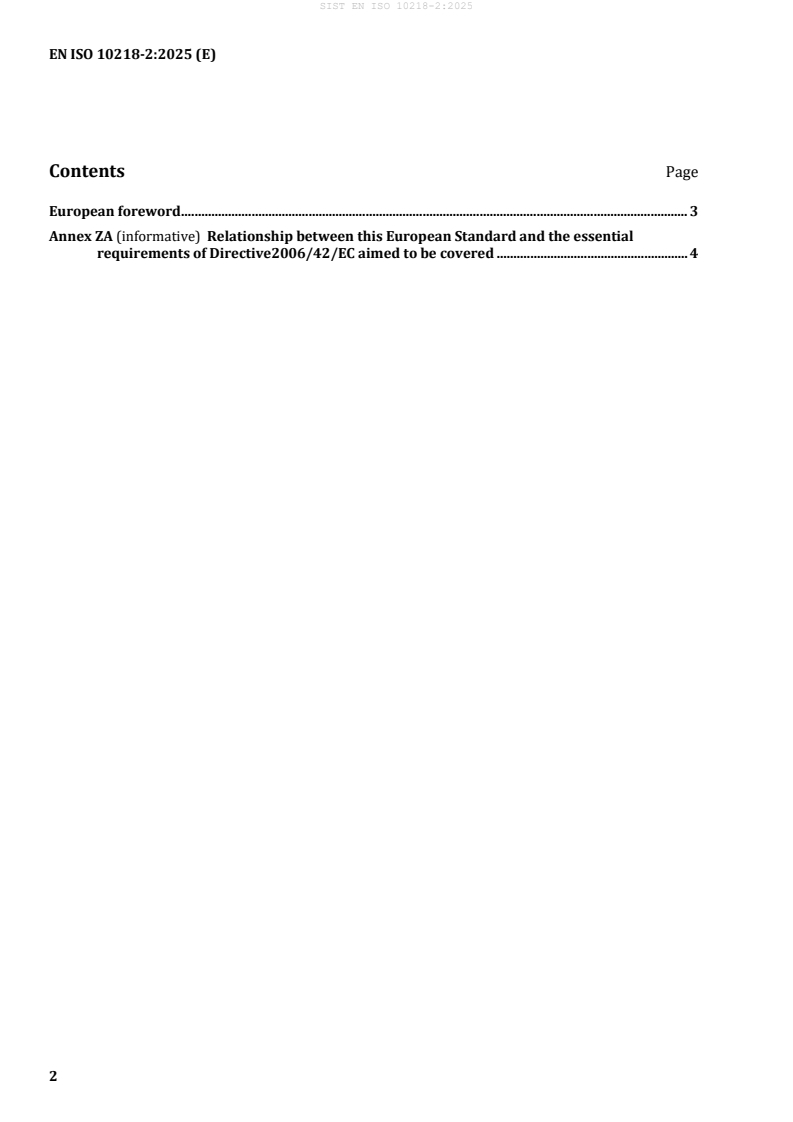
Contents Page
European foreword . 3
Annex ZA (informative) Relationship between this European Standard and the essential
requirements of Directive2006/42/EC aimed to be covered . 4
European foreword
This document (EN ISO 10218-2:2025) has been prepared by Technical Committee ISO/TC 299
"Robotics" in collaboration with Technical Committee CEN/TC 310 “Advanced automation technologies
and their applications” the secretariat of which is held by BSI.
This European Standard shall be given the status of a national standard, either by publication of an
identical text or by endorsement, at the latest by September 2025, and conflicting national standards
shall be withdrawn at the latest by March 2027.
Attention is drawn to the possibility that some of the elements of this document may be the subject of
patent rights. CEN shall not be held responsible for identifying any or all such patent rights.
This document supersedes EN ISO 10218-2:2011.
This document has been prepared under a standardization request addressed to CEN by the European
Commission. The Standing Committee of the EFTA States subsequently approves these requests for its
Member States.
For the relationship with EU Legislation, see informative Annex ZA, which is an integral part of this
document.
Any feedback and questions on this document should be directed to the users’ national standards
body/national committee. A complete listing of these bodies can be found on the CEN website.
According to the CEN-CENELEC Internal Regulations, the national standards organizations of the
following countries are bound to implement this European Standard: Austria, Belgium, Bulgaria,
Croatia, Cyprus, Czech Republic, Denmark, Estonia, Finland, France, Germany, Greece, Hungary, Iceland,
Ireland, Italy, Latvia, Lithuania, Luxembourg, Malta, Netherlands, Norway, Poland, Portugal, Republic of
North Macedonia, Romania, Serbia, Slovakia, Slovenia, Spain, Sweden, Switzerland, Türkiye and the
United Kingdom.
Endorsement notice
The text of ISO 10218-2:2025 has been approved by CEN as EN ISO 10218-2:2025 without any
modification.
Annex ZA
(informative)
Relationship between this European Standard and the essential
requirements of Directive2006/42/EC aimed to be covered
This European Standard has been prepared under a Commission’s standardization request “M/396
Mandate to CEN and CENELEC for Standardisation in the field of machinery" to provide one voluntary
means of conforming to essential requirements of Directive 2006/42/EC of the European Parliament
and of the Council of 17 May 2006 on machinery, and amending Directive 95/16/EC (recast).
Once this standard is cited in the Official Journal of the European Union under that Directive,
compliance with the normative clauses of this standard given in Table ZA.1 confers, within the limits of
the scope of this standard, a presumption of conformity with the corresponding essential requirements
of that Directive, and associated EFTA regulations.
Table ZA.1 — Correspondence between this European Standard and Annex I of Directive
2006/42/EC
The relevant Essential Requirements of Directive
Clause(s)/sub-clause(s) of this EN
2006/42/EC
1.1.2 (a) 5, 6, 7
1.1.2 (c) 5, 6, 7
1.1.2 (d) 5.2.2
1.1.2 (e) 5.2.7
1.1.3. Materials and products 5.2.2.2
1.1.4. Lighting 5.15.2, 5.15.4
1.1.5. Design of machinery to facilitate its handling 5.2.2, 5.2.3
5.4.1, 5.4.3, 5.4.4, 5.8.6.1, 5.12.2.1,
1.1.6. Ergonomics
5.14.4.2
1.2.1. Safety and reliability of control systems 5.2.8, 5.3, 5.4.7, 5.5, 5.6.1, 5.7, 5.9
1.2.2. Control devices 5.2.13, 5.7, 5.12.2.3, 5.14.4.1
1.2.3. Starting 5.5.7, 5.7.5
1.2.4.1. Normal stop 5.6.1, 5.6.4
1.2.4.2. Operational stop 5.5.8, 5.6.3
1.2.4.3. Emergency stop 5.6.2
1.2.4.4. Assembly of machinery 5.3
1.2.5. Selection of control or operating modes 5.7.2, 5.7.6.2
1.2.6. Failure of the power supply 5.2.10, 5.5.2, 5.6.1, 5.5.7.1, 5.9.1
1.3.1. Risk of loss of stability 5.2.5, 7.5.5
The relevant Essential Requirements of Directive
Clause(s)/sub-clause(s) of this EN
2006/42/EC
1.3.2. Risk of break-up during operation 5.2.2, 5.2.11, 5.2.13, 5.3.6, 7.5.9
1.3.3. Risks due to falling or ejected objects 5.9.1
1.3.4. Risks due to surfaces, edges or angles 5.2.2.4, 5.4.4, 5.9, 5.14.1
1.3.6. Risks related to variations in operating conditions 5.7.2
1.3.7. Risks related to moving parts 5.2.7, 5.8, 5.9, 5.10, 5.12, 5.14, 7.5.7
1.3.8. Choice of protection against risks arising from
5.2.2.4, 5.8, 5.9, 5.10.3, 5.12, 5.14
moving parts
1.3.8.1. Moving transmission parts 5.2.2.4
1.3.8.2. Moving parts involved in the process 5.2.2.4, 5.8, 5.9, 5.10, 5.12, 5.14
1.3.9. Risks of uncontrolled movements 5.2.8, 5.2.12.1
1.4.1. General requirements 5.2.2, 5.8.5, 5.8.6, 5.8.9
1.4.2.1. Fixed guards 5.8.5.1
1.4.2.2. Interlocking movable guards 5.8.5
1.4.2.3. Adjustable guards restricting access 5.8.5.1
1.4.3. Special requirements for protective devices 5.8.6, 5.8.9
1.5.1. Electricity supply 5.2.13
1.5.2 Static electricity 5.2.13
1.5.3. Energy supply other than electricity 5.2.13
1.5.4. Errors of fitting 5.2.2.4, 5.2.13, 7.5.9
1.5.5. Extreme temperature 5.2.6
1.5.6. Fire 5.2.6
1.5.8 Noise Not covered
1.5.9 Vibrations 5.14.4.1 7.5.19
1.5.12. Laser radiation 5.11
1.5.13. Emissions of hazardous materials and substances 5.2.4
1.5.14. Risk of being trapped in a machine 5.4.5, 5.8, 5.12.2.2, 5.14.1
1.5.15. Risk of slipping, tripping or falling 5.4.1, 5.7.8.3, 5.10.1,
1.6.1. Machinery maintenance 5.4.1, 5.7.8.1, 5.8.9.1, 5.16, 7.5.9
1.6.2. Access to operating positions and servicing points 5.4.1
1.6.3. Isolation of energy sources 5.2.13, 5.2.12
1.6.4. Operator intervention 5.4.1, 5.4.3
1.7.1. Information and warnings on the machinery 7.1, 7.2, 7.3, 7.4
1.7.1.1. Information and information devices 7.1, 7.2, 7.3, 7.4
1.7.1.2. Warning devices 5.7.2.5, 5.7.4, 7.2
The relevant Essential Requirements of Directive
Clause(s)/sub-clause(s) of this EN
2006/42/EC
1.7.2. Warning of residual risks 7.5.3, 7.5.17, 7.5.21
1.7.3. Marking of machinery 7.3
1.7.4. Instructions 7
1.7.4.1. General principles for the drafting of instructions 7.1, 7.5.3
1.7.4.2. Contents of the instructions 7.5
2.2.1. General 5.14.4
2.2.1.1. Instructions 7.5.19
2.3. Machinery for working wood and material with similar
5.8.1, 5.9.1, 5.9.4, 5.12.2.1
physical characteristics
4.1.2.2. Machinery running on guide rails and rail tracks 5.2.5
4.1.2.3. Mechanical strength 5.2.2
4.1.2.4. Pulleys, drums, wheels, ropes and chains 5.2.2.3
4.1.2.6. Control of movements 5.2.8, 5.4.7, 5.9.1
4.1.2.7. Movements of loads during handling 5.2.8, 5.7.8.2, 5.8, 5.14.4.2
4.1.2.8.1. Movements of the carrier 5.8, 5.10
4.1.3. Fitness for purpose 5.2.2.3
4.2.1 Control of movements 5.10.4
4.2.3 Installations guided by ropes 5.10.1
WARNING 1 — Presumption of conformity stays valid only as long as a reference to this European
Standard is maintained in the list published in the Official Journal of the European Union. Users of this
standard should consult frequently the latest list published in the Official Journal of the European
Union.
WARNING 2 — Other Union legislation may be applicable to the product(s) falling within the scope of
this standard.
International
Standard
ISO 10218-2
Second edition
Robotics — Safety requirements —
2025-02
Part 2:
Industrial robot applications and
robot cells
Robotique — Exigences de sécurité —
Partie 2: Applications robotisées industrielles et cellules
robotisées
Reference number
ISO 10218-2:2025(en) © ISO 2025
ISO 10218-2:2025(en)
© ISO 2025
All rights reserved. Unless otherwise specified, or required in the context of its implementation, no part of this publication may
be reproduced or utilized otherwise in any form or by any means, electronic or mechanical, including photocopying, or posting on
the internet or an intranet, without prior written permission. Permission can be requested from either ISO at the address below
or ISO’s member body in the country of the requester.
ISO copyright office
CP 401 • Ch. de Blandonnet 8
CH-1214 Vernier, Geneva
Phone: +41 22 749 01 11
Email: copyright@iso.org
Website: www.iso.org
Published in Switzerland
ii
ISO 10218-2:2025(en)
Contents Page
Foreword .vii
Introduction .viii
1 Scope . 1
2 Normative references . 2
3 Terms, definitions, symbols and abbreviated terms . 4
3.1 Terms and definitions .4
3.1.1 Robot, robot system, robot application, robot cell - related .4
3.1.2 Sub-assemblies and components .5
3.1.3 Controls-related .6
3.1.4 Program-related .8
3.1.5 Power-, energy-related . .8
3.1.6 Hazard-related .8
3.1.7 Role-related .9
3.1.8 Functional safety-related .9
3.1.9 Spaces, zones and distances .10
3.1.10 Risk reduction measures . 12
3.1.11 Verification and validation . 13
3.1.12 Contact-related.14
3.2 Abbreviated terms and symbols.14
4 Risk assessment . 19
4.1 General .19
4.2 Characteristics of robot applications and robot cells .19
4.3 Characteristics of collaborative applications . 20
4.3.1 General . 20
4.3.2 Risk assessment for contacts between moving parts of the robot application
and operator(s) .21
5 Safety requirements and risk reduction measures .22
5.1 General . 22
5.2 Design . 22
5.2.1 General . 22
5.2.2 Materials, mechanical strength and mechanical design . 23
5.2.3 Provisions for lifting or moving .24
5.2.4 Hazardous substances . .24
5.2.5 Stability .24
5.2.6 Temperature and fire risks . 25
5.2.7 Special equipment . 25
5.2.8 Position holding . 25
5.2.9 Additional axis (axes) . 25
5.2.10 Power loss or change . 26
5.2.11 Component malfunction . 26
5.2.12 Hazardous energy . 26
5.2.13 Electrical, pneumatic and hydraulic parts .27
5.2.14 Tool centre point (TCP) setting . 28
5.2.15 Payload setting . . 28
5.2.16 Cybersecurity . 28
5.3 Robot cell integration . 28
5.3.1 General . 28
5.3.2 Span-of-control . 29
5.3.3 Span-of-control of emergency stop function . 29
5.3.4 Operational modes with multi-robot applications or robot cells . 29
5.3.5 Local control, remote control and single-point-of-control . 29
5.3.6 Automatic workpiece feeding . 30
5.4 Layout . 30
iii
ISO 10218-2:2025(en)
5.4.1 General . 30
5.4.2 Use and limits .31
5.4.3 Design .31
5.4.4 Design for collaborative applications .32
5.4.5 Prevention of trapping within the safeguarded space .32
5.4.6 Establishing restricted spaces . 33
5.4.7 Limiting motion . 33
5.5 Safety functions . 34
5.5.1 General . 34
5.5.2 Functional safety standards . 35
5.5.3 Performance . 35
5.5.4 Failure or fault detection . 36
5.5.5 Parameterization of safety functions . 36
5.5.6 Speed limit(s) monitoring. 36
5.5.7 Start / restart interlock and reset .37
5.5.8 Monitored-standstill . 38
5.5.9 Communications . 38
5.5.10 Electromagnetic requirements . 39
5.6 Stopping . 39
5.6.1 General . 39
5.6.2 Emergency stop . 39
5.6.3 Protective stop . 40
5.6.4 Normal stop . 40
5.6.5 Associated equipment stopping .41
5.7 Control functions .41
5.7.1 General .41
5.7.2 Modes.41
5.7.3 Protection from unexpected start-up . 44
5.7.4 Status indication and warning devices . 44
5.7.5 Single-point-of-control . 44
5.7.6 Local and remote control .45
5.7.7 Enabling devices . 46
5.7.8 Control stations .47
5.7.9 Simultaneous motion . . . 49
5.8 Safeguards and their use . 49
5.8.1 General . 49
5.8.2 Establishing a safeguarded space . 50
5.8.3 Perimeter safeguarding . 50
5.8.4 Overriding of protective devices . 50
5.8.5 Guards . 50
5.8.6 Sensitive protective equipment .51
5.8.7 Muting . 53
5.8.8 Overriding of SPE . 53
5.8.9 Minimum distances . 53
5.8.10 Safeguarding to protect from unexpected restart . 54
5.9 End-effectors . 54
5.9.1 General . 54
5.9.2 Risk reduction measures . 55
5.9.3 Shape and surfaces . 56
5.9.4 Protective devices and/or safety functions . 56
5.9.5 End-effectors and robot application design .57
5.9.6 End-effectors exchange systems .57
5.10 Vertical transfer components . 58
5.10.1 Mechanical design . 58
5.10.2 Prevention of falling hazards . 58
5.10.3 Prevention of crushing hazards . 58
5.10.4 Control of movements .59
5.11 Lasers and laser equipment .59
5.12 Material handling, manual load/unload stations and material flow .59
iv
ISO 10218-2:2025(en)
5.12.1 Material handling .59
5.12.2 Manual load/unload stations and other manual stations.59
5.12.3 Material flow . 60
5.13 Adjacent robot cells .61
5.14 Collaborative applications .61
5.14.1 General .61
5.14.2 Safeguarded spaces.62
5.14.3 Transitions . 63
5.14.4 Hand-guided control (HGC) . 63
5.14.5 Speed and separation monitoring (SSM) . 64
5.14.6 Power and force limiting (PFL). 66
5.15 Assembly, installation and commissioning . 69
5.15.1 Commissioning of robot applications . 69
5.15.2 Environmental conditions .70
5.15.3 Power .70
5.15.4 Lighting .70
5.15.5 Labelling .70
5.16 Maintenance .71
5.16.1 General .71
5.16.2 Movement without drive power .71
6 Verification and validation .71
6.1 General .71
6.2 Verification and validation methods .71
6.3 Verification and validation of guards, protective devices, safety function parameter
settings and biomechanical threshold limits . 72
6.3.1 Guards and protective devices . 72
6.3.2 Safety function parameter settings . 72
6.3.3 Biomechanical limits . 72
6.4 Complementary protective measures . 72
7 Information for use .73
7.1 General . 73
7.2 Signals and warning devices . 73
7.3 Marking . 73
7.4 Signs (pictograms) and written warnings .74
7.5 Instruction handbook.74
7.5.1 General .74
7.5.2 Identification .74
7.5.3 Intended use .74
7.5.4 Transport, handling and lifting . 75
7.5.5 Installation . 75
7.5.6 Commissioning and programming . . 75
7.5.7 Abnormal and emergency situations .76
7.5.8 Settings and operation . 77
7.5.9 Maintenance . 77
7.5.10 Decommissioning . 78
7.5.11 Remote interventions. 78
7.5.12 Hazardous energy . 78
7.5.13 Limiting devices and restricted space . 78
7.5.14 Movement without drive power . 79
7.5.15 Control station(s) . 79
7.5.16 Functional safety . . . 79
7.5.17 Operating modes . 80
7.5.18 Enabling devices . 80
7.5.19 Vibration . 81
7.5.20 End-effector(s) . . 81
7.5.21 Manual load/ unload stations . 81
7.5.22 Collaborative applications . 81
7.5.23 Cybersecurity .
...