

IEC 62046:2018
(Main)Safety of machinery - Application of protective equipment to detect the presence of persons
General Information
- Abstract
IEC 62046:2018 specifies requirements for the selection, positioning, configuration and commissioning of protective equipment to detect the momentary or continued presence of persons in order to protect those persons from dangerous part(s) of machinery in industrial applications. This standard covers the application of electro-sensitive protective equipment (ESPE) specified in IEC 61496 (all parts) and pressure sensitive mats and floors specified in ISO 13856-1.
It takes into account the characteristics of the machinery, the protective equipment, the environment and human interaction by persons of 14 years and older.
This document includes informative annexes to provide guidance on the application of protective equipment to detect the presence of persons. These annexes contain examples to illustrate the principles of this standard. These examples are not intended to be the only solutions to a given application and are not intended to restrict innovation or advancement of technology. The examples are provided only as representative solutions to illustrate some of the concepts of integration of protective equipment, and have been simplified for clarity, so they may be incomplete.
This first edition cancels and replaces IEC TS 62046, published in 2008. This edition constitutes a technical revision.
This edition includes the following significant technical changes with respect to IEC TS 62046:2008:
a) additional annexes relating to muting and vision systems,
b) muting requirements have been updated,
c) blanking requirements have been updated,
d) addition of IEC 61496 series Types and capping the Safety Integrity level according to IEC 62061 and performance levels according to ISO 13849-1,
e) alignment to changes in IEC 61496 series
- Status
- Published
- Publication Date
- 27-Mar-2018
- Technical Committee
- TC 44 - Safety of machinery - Electrotechnical aspects
- Drafting Committee
- MT 62046 - TC 44/MT 62046
Buy Documents
IEC 62046:2018 - Safety of machinery - Application of protective equipment to detect the presence of persons Released:3/28/2018

IEC 62046:2018 - Safety of machinery - Application of protective equipment to detect the presence of persons Released:11/13/2018
Overview
IEC 62046:2018 - Safety of machinery: Application of protective equipment to detect the presence of persons specifies requirements for selecting, positioning, configuring and commissioning protective equipment that detects the momentary or continued presence of people to protect them from dangerous machine parts in industrial settings. It covers the application of electro-sensitive protective equipment (ESPE) (per IEC 61496) and pressure-sensitive mats and floors (per ISO 13856-1), and addresses machine, environmental and human factors for persons aged 14 and older. This first edition replaces IEC TS 62046:2008 and includes significant technical updates (muting and vision annexes, updated muting/blanking, alignment to IEC 61496 Types and integration with IEC 62061 / ISO 13849-1 safety levels).
Key Topics and Requirements
- Selection & positioning of protective devices to ensure reliable detection of persons and prevention of access to hazardous parts.
- Types of protective equipment covered: ESPE (light curtains, through-beam, retro-reflective), AOPDDRs, vision-based devices (VBPDs), and pressure-sensitive mats/floors.
- Functional roles: trip devices, presence-sensing devices, and combined trip/presence configurations.
- Integration with safety-related control systems, including requirements for stopping performance monitoring (SPM), external device monitoring (EDM), start/restart interlocks, and reinitiation controls.
- Muting and blanking: updated requirements and practical configuration guidance (annexes) for allowing material flow or personnel access without compromising safety.
- Performance classification and alignment with safety integrity/performance levels (IEC 62061 / ISO 13849-1).
- Inspection, testing and documentation: functional checks, periodic and initial tests, and information for safe use.
- Informative annexes with application examples (perimeter guarding, conveyor muting, AGV use cases, vision system examples) to illustrate integration principles.
Practical Applications
- Machinery guarding and perimeter protection on production lines.
- Conveyor and pallet-handling systems requiring muting for material transfer.
- Robots, automated cells and AGVs where presence detection prevents collisions or access to danger zones.
- Retrofit and OEM machine design to meet current machine safety regulations and certification requirements.
Who Uses This Standard
- Machine designers, safety engineers, and system integrators implementing presence-sensing protective measures.
- OEMs and manufacturers specifying ESPEs, pressure mats, and vision-based safety systems.
- Safety assessors, notified bodies and certification agencies verifying compliance with machine safety requirements.
- Maintenance teams and commissioning engineers performing inspections and functional tests.
Related Standards
- IEC 61496 (ESPE series)
- ISO 13856-1 (pressure-sensitive mats and floors)
- IEC 62061 and ISO 13849-1 (safety-related control system performance/SIL and PL alignment)
Keywords: IEC 62046:2018, safety of machinery, presence sensing, ESPE, pressure sensitive mats, muting, blanking, machine safety standards.
Relations
- Effective Date
- 25-Aug-2026
- Effective Date
- 25-Aug-2026
- Effective Date
- 13-Feb-2026
- Effective Date
- 05-Sep-2023
- Effective Date
- 05-Sep-2023
- Effective Date
- 05-Sep-2023
Buy Documents
IEC 62046:2018 - Safety of machinery - Application of protective equipment to detect the presence of persons Released:3/28/2018
IEC 62046:2018 - Safety of machinery - Application of protective equipment to detect the presence of persons Released:11/13/2018
Get Certified
Connect with accredited certification bodies for this standard

CIS Institut d.o.o.
Personal Protective Equipment (PPE) certification body. Notified Body NB-2890 for EU Regulation 2016/425 PPE.

Kiwa BDA Testing
Building and construction product certification.
Kmetijski inštitut Slovenije
Agricultural Institute of Slovenia. Soil testing, plant health, agricultural product analysis.
Sponsored listings
Frequently Asked Questions
IEC 62046:2018 is a standard published by the International Electrotechnical Commission (IEC). Its full title is "Safety of machinery - Application of protective equipment to detect the presence of persons". This standard covers: IEC 62046:2018 specifies requirements for the selection, positioning, configuration and commissioning of protective equipment to detect the momentary or continued presence of persons in order to protect those persons from dangerous part(s) of machinery in industrial applications. This standard covers the application of electro-sensitive protective equipment (ESPE) specified in IEC 61496 (all parts) and pressure sensitive mats and floors specified in ISO 13856-1. It takes into account the characteristics of the machinery, the protective equipment, the environment and human interaction by persons of 14 years and older. This document includes informative annexes to provide guidance on the application of protective equipment to detect the presence of persons. These annexes contain examples to illustrate the principles of this standard. These examples are not intended to be the only solutions to a given application and are not intended to restrict innovation or advancement of technology. The examples are provided only as representative solutions to illustrate some of the concepts of integration of protective equipment, and have been simplified for clarity, so they may be incomplete. This first edition cancels and replaces IEC TS 62046, published in 2008. This edition constitutes a technical revision. This edition includes the following significant technical changes with respect to IEC TS 62046:2008: a) additional annexes relating to muting and vision systems, b) muting requirements have been updated, c) blanking requirements have been updated, d) addition of IEC 61496 series Types and capping the Safety Integrity level according to IEC 62061 and performance levels according to ISO 13849-1, e) alignment to changes in IEC 61496 series
IEC 62046:2018 specifies requirements for the selection, positioning, configuration and commissioning of protective equipment to detect the momentary or continued presence of persons in order to protect those persons from dangerous part(s) of machinery in industrial applications. This standard covers the application of electro-sensitive protective equipment (ESPE) specified in IEC 61496 (all parts) and pressure sensitive mats and floors specified in ISO 13856-1. It takes into account the characteristics of the machinery, the protective equipment, the environment and human interaction by persons of 14 years and older. This document includes informative annexes to provide guidance on the application of protective equipment to detect the presence of persons. These annexes contain examples to illustrate the principles of this standard. These examples are not intended to be the only solutions to a given application and are not intended to restrict innovation or advancement of technology. The examples are provided only as representative solutions to illustrate some of the concepts of integration of protective equipment, and have been simplified for clarity, so they may be incomplete. This first edition cancels and replaces IEC TS 62046, published in 2008. This edition constitutes a technical revision. This edition includes the following significant technical changes with respect to IEC TS 62046:2008: a) additional annexes relating to muting and vision systems, b) muting requirements have been updated, c) blanking requirements have been updated, d) addition of IEC 61496 series Types and capping the Safety Integrity level according to IEC 62061 and performance levels according to ISO 13849-1, e) alignment to changes in IEC 61496 series
IEC 62046:2018 is classified under the following ICS (International Classification for Standards) categories: 13.110 - Safety of machinery. The ICS classification helps identify the subject area and facilitates finding related standards.
IEC 62046:2018 has the following relationships with other standards: It is inter standard links to EN ISO 3691-4:2023, EN ISO 13849-1:2023, EN ISO 10218-2:2025, IEC TS 62046:2008, IEC TS 62046:2004, IEC 62046:2026. Understanding these relationships helps ensure you are using the most current and applicable version of the standard.
IEC 62046:2018 is available in PDF format for immediate download after purchase. The document can be added to your cart and obtained through the secure checkout process. Digital delivery ensures instant access to the complete standard document.
Standards Content (Sample)
IEC 62046 ®
Edition 1.0 2018-03
INTERNATIONAL
STANDARD
colour
inside
Safety of machinery – Application of protective equipment to detect the
presence of persons
All rights reserved. Unless otherwise specified, no part of this publication may be reproduced or utilized in any form
or by any means, electronic or mechanical, including photocopying and microfilm, without permission in writing from
either IEC or IEC's member National Committee in the country of the requester. If you have any questions about IEC
copyright or have an enquiry about obtaining additional rights to this publication, please contact the address below or
your local IEC member National Committee for further information.
IEC Central Office Tel.: +41 22 919 02 11
3, rue de Varembé info@iec.ch
CH-1211 Geneva 20 www.iec.ch
Switzerland
About the IEC
The International Electrotechnical Commission (IEC) is the leading global organization that prepares and publishes
International Standards for all electrical, electronic and related technologies.
About IEC publications
The technical content of IEC publications is kept under constant review by the IEC. Please make sure that you have the
latest edition, a corrigenda or an amendment might have been published.
IEC Catalogue - webstore.iec.ch/catalogue Electropedia - www.electropedia.org
The stand-alone application for consulting the entire The world's leading online dictionary of electronic and
bibliographical information on IEC International Standards, electrical terms containing 21 000 terms and definitions in
Technical Specifications, Technical Reports and other English and French, with equivalent terms in 16 additional
documents. Available for PC, Mac OS, Android Tablets and languages. Also known as the International Electrotechnical
iPad. Vocabulary (IEV) online.
IEC publications search - webstore.iec.ch/advsearchform IEC Glossary - std.iec.ch/glossary
The advanced search enables to find IEC publications by a 67 000 electrotechnical terminology entries in English and
variety of criteria (reference number, text, technical French extracted from the Terms and Definitions clause of
committee,…). It also gives information on projects, replaced IEC publications issued since 2002. Some entries have been
and withdrawn publications. collected from earlier publications of IEC TC 37, 77, 86 and
CISPR.
IEC Just Published - webstore.iec.ch/justpublished
Stay up to date on all new IEC publications. Just Published IEC Customer Service Centre - webstore.iec.ch/csc
details all new publications released. Available online and If you wish to give us your feedback on this publication or
also once a month by email. need further assistance, please contact the Customer Service
Centre: sales@iec.ch.
IEC 62046 ®
Edition 1.0 2018-03
INTERNATIONAL
STANDARD
colour
inside
Safety of machinery – Application of protective equipment to detect the
presence of persons
INTERNATIONAL
ELECTROTECHNICAL
COMMISSION
ICS 13.110 ISBN 978-2-8322-5519-3
– 2 – IEC 62046:2018 © IEC 2018
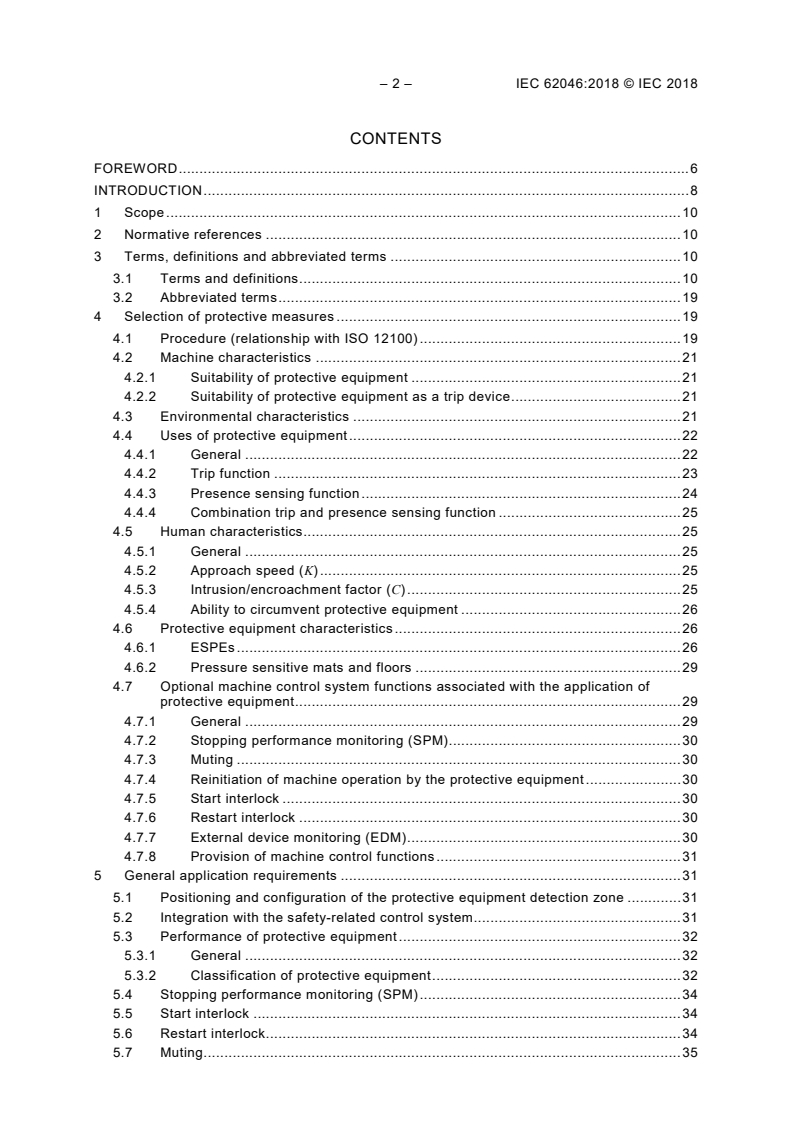
CONTENTS
FOREWORD . 6
INTRODUCTION . 8
1 Scope . 10
2 Normative references . 10
3 Terms, definitions and abbreviated terms . 10
3.1 Terms and definitions . 10
3.2 Abbreviated terms . 19
4 Selection of protective measures . 19
4.1 Procedure (relationship with ISO 12100) . 19
4.2 Machine characteristics . 21
4.2.1 Suitability of protective equipment . 21
4.2.2 Suitability of protective equipment as a trip device . 21
4.3 Environmental characteristics . 21
4.4 Uses of protective equipment . 22
4.4.1 General . 22
4.4.2 Trip function . 23
4.4.3 Presence sensing function . 24
4.4.4 Combination trip and presence sensing function . 25
4.5 Human characteristics. 25
4.5.1 General . 25
4.5.2 Approach speed (K) . 25
4.5.3 Intrusion/encroachment factor (C) . 25
4.5.4 Ability to circumvent protective equipment . 26
4.6 Protective equipment characteristics . 26
4.6.1 ESPEs . 26
4.6.2 Pressure sensitive mats and floors . 29
4.7 Optional machine control system functions associated with the application of
protective equipment . 29
4.7.1 General . 29
4.7.2 Stopping performance monitoring (SPM). 30
4.7.3 Muting . 30
4.7.4 Reinitiation of machine operation by the protective equipment . 30
4.7.5 Start interlock . 30
4.7.6 Restart interlock . 30
4.7.7 External device monitoring (EDM) . 30
4.7.8 Provision of machine control functions . 31
5 General application requirements . 31
5.1 Positioning and configuration of the protective equipment detection zone . 31
5.2 Integration with the safety-related control system. 31
5.3 Performance of protective equipment . 32
5.3.1 General . 32
5.3.2 Classification of protective equipment . 32
5.4 Stopping performance monitoring (SPM) . 34
5.5 Start interlock . 34
5.6 Restart interlock . 34
5.7 Muting. 35
5.7.1 General . 35
5.7.2 Muting to allow access by persons . 36
5.7.3 Muting to allow access by materials . 37
5.7.4 Mute dependent override . 37
5.8 Reinitiation of machine operation by the protective equipment . 38
6 Particular application requirements for specific protective equipment . 40
6.1 AOPDs . 40
6.1.1 General . 40
6.1.2 Light beam device(s) . 40
6.1.3 Light curtains . 42
6.2 AOPDDRs . 45
6.3 Vision based protective devices VBPD . 46
6.4 Pressure-sensitive mats and floors . 47
6.4.1 Pressure sensitive floors. 47
6.4.2 Pressure sensitive mats . 47
7 Inspection and test . 48
7.1 General . 48
7.2 Functional checks . 49
7.3 Periodic inspection and test . 50
7.4 Initial inspection and test . 50
7.5 Application specific tests . 51
8 Information for safe use . 52
Annex A (informative) Application examples . 53
A.1 General . 53
A.2 Protective equipment used as a trip device . 53
A.3 Use of protective equipment as a combined trip and presence sensing
device . 54
A.3.1 Example 1 . 54
A.3.2 Example 2 . 54
A.3.3 Example 3: horizontal AOPD . 55
A.3.4 Example 4; vertical AOPD . 56
A.3.5 Example 5 . 57
A.4 Perimeter guarding . 58
Annex B (informative) Additional recommendations for the application of AOPDDRs. 59
B.1 General . 59
B.2 Example of the use of an AOPDDR on stationary machinery . 61
B.3 Example of the use of an AOPDDR on an automatic guided vehicle (AGV) . 62
B.4 AOPDDR used for the detection of the body or parts of a body with
orthogonal approach . 63
B.4.1 Detection of a whole body . 63
B.4.2 Detection of parts of the body . 63
B.5 Examples of the use of an AOPDDR as a whole-body trip device . 63
B.6 Examples for the use of an AOPDDR as parts of a body trip device . 65
Annex C (informative) Application example of a vision based protective system
(VBPDST) . 67
Annex D (informative) Examples for the configuration of photoelectric muting sensors
when used to allow access by materials . 69
D.1 General . 69
D.2 Four beams. 71
– 4 – IEC 62046:2018 © IEC 2018
D.2.1 Four beams – Positioning of the sensors . 71
D.2.2 Four beams – timing control . 72
D.2.3 Four beams – sequence control . 73
D.2.4 Four beams with additional swinging doors . 74
D.2.5 Methods to avoid manipulation of the muting function . 75
D.2.6 Connection of the sensors to a two input muting control . 77
D.2.7 Two sensors – positioning of the sensors . 78
D.2.8 Two sensors – timing control . 81
D.2.9 Two muting sensor beams in combination with swinging doors . 82
D.2.10 Height of the crossing point of the muting sensor beams . 84
D.3 Two parallel muting sensor beams – exit only . 85
D.4 Protection of conveyor systems working in a coordinated manner . 88
Bibliography . 90
Figure 1 – Relationship of this International Standard to other standards . 9
Figure 2 – Risk reduction process . 20
Figure 3 – Detection principle of through-beam AOPD . 27
Figure 4 – Through-beam AOPD using mirrors . 27
Figure 5 – Retro-reflective AOPD . 27
Figure 6 – Detection principle of AOPDDR . 28
Figure 7 – Detection principle of VBPDST . 29
Figure 8 – Example of the effect of reflective surfaces . 40
Figure 9 – Detection capability of single light beam device . 42
Figure 10 – Detection capability of a multiple light beam device . 42
Figure 11 – Example of use of blanking . 44
Figure 12 – Example of reduced resolution . 45
Figure A.1 – Protective equipment used as a trip device . 53
Figure A.2 – Protective equipment used as combined trip and presence sensing device
– Example 1 . 54
Figure A.3 – Protective equipment used as a combined trip and presence sensing
device – Example 2 . 54
Figure A.4 – Horizontal AOPD . 55
Figure A.5 – Vertical AOPD . 56
Figure A.6 – Increased minimum distance . 57
Figure A.7 – Additional mechanical protection . 58
Figure A.8 – Use of a trip device . 58
Figure B.1 – Example of the use of an AOPDDR on machinery . 60
Figure B.2 – Example of the use of an AOPDDR on stationary machinery . 61
Figure B.3 – Example of the use of an AOPDDR on an AGV . 62
Figure B.4 – Use of an AOPDDR as a whole-body trip device – Example 1 . 63
Figure B.5 – Use of an AOPDDR as a whole-body trip device – Example 2 . 64
Figure B.6 – Use of an AOPDDR as parts of a body trip device – Example 1 . 65
Figure B.7 – Use of an AOPDDR as parts of a body trip device – Example 2 . 65
Figure C.1 – Application example of a VBPDST . 68
Figure D.1 – T configuration with timing control . 69
Figure D.2 – L configuration with timing control . 70
Figure D.3 – Parallel beams with timing or sequence control . 70
Figure D.4 – Four parallel beams with timing control . 71
Figure D.5 – Positioning of the muting sensors to avoid muting by a person's body
(plan view) . 72
Figure D.6 – Positioning of the muting sensors (side view) . 72
Figure D.7 – Timing diagram: four parallel beams with timing control . 73
Figure D.8 – Four beams: timing control and crossed beams (not recommended) . 73
Figure D.9 – Timing diagram: four beams and sequence control . 74
Figure D.10 – Four beams with additional swinging doors . 75
Figure D.11 – Timing diagram for mute enable signal (mute enable activated) . 75
Figure D.12 – Timing diagram for mute enable signal (mute enable not activated) . 76
Figure D.13 – Presence of the mute enable signal during more than one mute cycle . 76
Figure D.14 – Avoidance of manipulation of the muting function (plan view) . 77
Figure D.15 – Avoidance of manipulation of the muting function (front view) . 77
Figure D.16 – Connection of the muting sensors . 78
Figure D.17 – Two sensors – Crossed beams . 78
Figure D.18 – Two sensors – Crossed beams (risk of entering the hazardous zone
without detection when x >200 mm) . 79
Figure D.19 – Positioning of the muting sensors . 80
Figure D.20 – Detection of the test object . 80
Figure D.21 – Timing diagram for two crossed beams (normal operation) . 81
Figure D.22 – Timing diagram for two crossed beams (timeout) . 81
Figure D.23 – Single swinging doors in combination with a two-beam muting system
(correct position) . 82
Figure D.24 – Reaching hazardous zone behind the pallet (incorrect position of
swinging doors) . 83
Figure D.25 – Reaching hazardous zone in front of pallet (incorrect position of
swinging doors) . 84
Figure D.26 – Height of crossing point . 85
Figure D.27 – Interruption of the beam by foot . 85
Figure D.28 – Two muting sensor beams – exit only . 86
Figure D.29 – Timing diagram; two muting sensor beams – exit only, muting
terminated by the ESPE . 86
Figure D.30 – Timing diagram; two muting sensor beams – exit only, muting
terminated by the 4 s timer . 87
Figure D.31 – Timing diagram, muting terminated by the muting timeout . 87
Figure D.32 – Production line incorporating two conveyors (2 hazardous zones)
(incorrect application) . 88
Figure D.33 – Production line incorporating two conyeyors(2 hazardous zones) . 89
Table 1 – ESPE Types and achievable PL or SIL . 33
Table 2 – Beam heights for light beam devices . 41
Table D.1 – Truth table, four beams – sequence control . 74
– 6 – IEC 62046:2018 © IEC 2018
INTERNATIONAL ELECTROTECHNICAL COMMISSION
____________
SAFETY OF MACHINERY – APPLICATION OF PROTECTIVE
EQUIPMENT TO DETECT THE PRESENCE OF PERSONS
FOREWORD
1) The International Electrotechnical Commission (IEC) is a worldwide organization for standardization comprising
all national electrotechnical committees (IEC National Committees). The object of IEC is to promote
international co-operation on all questions concerning standardization in the electrical and electronic fields. To
this end and in addition to other activities, IEC publishes International Standards, Technical Specifications,
Technical Reports, Publicly Available Specifications (PAS) and Guides (hereafter referred to as “IEC
Publication(s)”). Their preparation is entrusted to technical committees; any IEC National Committee interested
in the subject dealt with may participate in this preparatory work. International, governmental and non-
governmental organizations liaising with the IEC also participate in this preparation. IEC collaborates closely
with the International Organization for Standardization (ISO) in accordance with conditions determined by
agreement between the two organizations.
2) The formal decisions or agreements of IEC on technical matters express, as nearly as possible, an international
consensus of opinion on the relevant subjects since each technical committee has representation from all
interested IEC National Committees.
3) IEC Publications have the form of recommendations for international use and are accepted by IEC National
Committees in that sense. While all reasonable efforts are made to ensure that the technical content of IEC
Publications is accurate, IEC cannot be held responsible for the way in which they are used or for any
misinterpretation by any end user.
4) In order to promote international uniformity, IEC National Committees undertake to apply IEC Publications
transparently to the maximum extent possible in their national and regional publications. Any divergence
between any IEC Publication and the corresponding national or regional publication shall be clearly indicated in
the latter.
5) IEC itself does not provide any attestation of conformity. Independent certification bodies provide conformity
assessment services and, in some areas, access to IEC marks of conformity. IEC is not responsible for any
services carried out by independent certification bodies.
6) All users should ensure that they have the latest edition of this publication.
7) No liability shall attach to IEC or its directors, employees, servants or agents including individual experts and
members of its technical committees and IEC National Committees for any personal injury, property damage or
other damage of any nature whatsoever, whether direct or indirect, or for costs (including legal fees) and
expenses arising out of the publication, use of, or reliance upon, this IEC Publication or any other IEC
Publications.
8) Attention is drawn to the Normative references cited in this publication. Use of the referenced publications is
indispensable for the correct application of this publication.
9) Attention is drawn to the possibility that some of the elements of this IEC Publication may be the subject of
patent rights. IEC shall not be held responsible for identifying any or all such patent rights.
International Standard IEC 62046 has been prepared by IEC technical committee 44: Safety
of machinery – Electrotechnical aspects.
This first edition cancels and replaces IEC TS 62046, published in 2008. This edition
constitutes a technical revision.
This edition includes the following significant technical changes with respect to IEC TS
62046:2008:
a) additional annexes relating to muting and vision systems,
b) muting requirements have been updated,
c) blanking requirements have been updated,
d) addition of IEC 61496 series Types and capping the Safety Integrity level according to
IEC 62061 and performance levels according to ISO 13849-1,
e) alignment to changes in IEC 61496 series.
The text of this International Standard is based on the following documents:
FDIS Report on voting
44/803/FDIS 44/812/RVD
Full information on the voting for the approval of this International Standard can be found in
the report on voting indicated in the above table.
This document has been drafted in accordance with the ISO/IEC Directives, Part 2.
The committee has decided that the contents of this document will remain unchanged until the
stability date indicated on the IEC website under "http://webstore.iec.ch" in the data related to
the specific document. At this date, the document will be
• reconfirmed,
• withdrawn,
• replaced by a revised edition, or
• amended.
A bilingual version of this publication may be issued at a later date.
IMPORTANT – The 'colour inside' logo on the cover page of this publication indicates
that it contains colours which are considered to be useful for the correct
understanding of its contents. Users should therefore print this document using a
colour printer.
– 8 – IEC 62046:2018 © IEC 2018
INTRODUCTION
This International Standard provides requirements and information on the application of
protective equipment, which employs (a) sensing device(s) to detect person(s), in order to
reduce or minimize a risk from hazardous parts of machinery, without providing a physical
barrier.
The objective of this document is to assist standards writing committees responsible for
developing machine standards ("C" Standards), machine designers, manufacturers and
refurbishers, machine safety certification organizations, workplace authorities and others on
the proper application of protective equipment to machinery.
Figure 1 and Figure 2 show the general context and the intended use of this standard.
Clauses 1 to 5, 7 and 8 of this document apply to all protective equipment included in the
scope, Clause 6 contains guidance for the application of specific kinds of protective
equipment.
The principles of this document can be useful in the application of devices using other
detection technologies but this document does not give specific requirements for devices
other than those listed above.
This document considers devices standardised in the IEC 61496 series and the ISO 13856
series. Unless a product-specific safety-related standard for devices using other sensing
technologies is published, their suitability as the sole means of protection from machine
hazards is unknown. Great care should be taken in the selection and use of devices for which
there is no product-specific safety-related standard because their behaviour, particularly
under fault conditions, is not known to be sufficiently predictable.
An SILCL (SIL claim limit, see IEC 62061) or PL (Performance Level, see ISO 13849-1) or SIL
(Safety Integrity Level, see IEC 61508) is not sufficient as an indication of a device's
suitability for use as a safeguard. Suitability depends on appropriate sensing means,
environmental conditions especially those that can affect the detection capability, behaviour
under fault conditions, etc
IEC
Figure 1 – Relationship of this International Standard
to other standards
(see also Figure 2)
– 10 – IEC 62046:2018 © IEC 2018
SAFETY OF MACHINERY – APPLICATION OF PROTECTIVE
EQUIPMENT TO DETECT THE PRESENCE OF PERSONS
1 Scope
This International Standard specifies requirements for the selection, positioning, configuration
and commissioning of protective equipment to detect the momentary or continued presence of
persons in order to protect those persons from dangerous part(s) of machinery in industrial
applications. This standard covers the application of electro-sensitive protective equipment
(ESPE) specified in IEC 61496 (all parts) and pressure sensitive mats and floors specified in
ISO 13856-1.
It takes into account the characteristics of the machinery, the protective equipment, the
environment and human interaction by persons of 14 years and older.
This document includes informative annexes to provide guidance on the application of
protective equipment to detect the presence of persons. These annexes contain examples to
illustrate the principles of this standard. These examples are not intended to be the only
solutions to a given application and are not intended to restrict innovation or advancement of
technology. The examples are provided only as representative solutions to illustrate some of
the concepts of integration of protective equipment, and have been simplified for clarity, so
they may be incomplete.
2 Normative references
The following documents are referred to in the text in such a way that some or all of their
content constitutes requirements of this document. For dated references, only the edition
cited applies. For undated references, the latest edition of the referenced document (including
any amendments) applies.
IEC 62061, Safety of machinery - Functional safety of safety-related electrical, electronic and
programmable electronic control systems
ISO 12100:2010 , Safety of machinery – General principles for design – Risk assessment and
risk reduction
ISO 13849 (all parts), Safety of machinery – Safety-related parts of control systems
ISO 13855:2010, Safety of machinery – Positioning of safeguards with respect to the
approach speeds of parts of the human body
3 Terms, definitions and abbreviated terms
3.1 Terms and definitions
For the purposes of this document, the following terms and definitions apply.
___________
ISO 12100:2010 constitutes a consolidation without technical changes of ISO 12100-1:2003,
ISO 12100-2:2003, ISO 14121-1:2007 and related amendments. This consolidation does not require updates or
revisions to type B- and type C- standards or other documents (e.g. for risk assessment) based on the previous
standards.
ISO and IEC maintain terminological databases for use in standardization at the following
addresses:
• IEC Electropedia: available at http://www.electropedia.org/
• ISO Online browsing platform: available at http://www.iso.org/obp
3.1.1
active opto-electronic protective device
AOPD
device whose sensing function is performed by opto-electronic emitting and receiving
elements detecting the interruption of optical radiations generated, within the device, by an
opaque object present in the specified detection zone (or for a light beam device, on the axis
of the light beam)
[SOURCE: IEC 61496-2:2013, 3.201]
3.1.2
actuation of an ESPE
detection of an object causing the OSSD(s) to go to the OFF-state
3.1.3
active opto-electronic protective device responsive to diffuse reflection
AOPDDR
device, whose sensing function is performed by opto-electronic emitting and receiving
elements, that detects the diffuse reflection of optical radiations generated within the device
by an object present in a detection zone specified in two dimensions
[SOURCE: IEC 61496-3:2008, 3.301]
3.1.4
blanking
optional function that permits an object of a size greater than the detection capability of the
ESPE to be located within the detection zone without causing an OFF-state of the OSSD(s)
Note 1 to entry: Blanked beams are monitored for continued interruption of light.
[SOURCE: IEC 61496-1:2012, 3.1, modified – Note 1 to entry has been modified, Note 2 to
entry has been removed]
3.1.5
detection capability
sensing function parameter limit specified by the supplier that will cause actuation of the
protective equipment
[SOURCE: IEC 61496-1:2012, 3.3, modified – "electro-sensitive" has been removed before
"protective equipment"]
3.1.6
detection zone
zone within which a specified test piece will be detected by the electro-sensitive protective
equipment (ESPE)
Note 1 to entry: ISO 13856-1 uses the term “effective sensing area” when describing pressure-sensitive mats and
floors. In this document the terms “detection zone” and “effective sensing area” are used synonymously.
[SOURCE: IEC 61496-1:2012, 3.4, modified – Note 1 to entry has been added]
– 12 – IEC 62046:2018 © IEC 2018
3.1.7
electro-sensitive protective equipment
ESPE
assembly of devices and/or components working together for protective tripping or presence-
sensing purposes and comprising as a minimum
– a sensing device;
– controlling/monitoring devices;
– output signal switching devices
[SOURCE: IEC 61496-1:2012, 3.5, modified – (Notes 1 and 2 to entry have been removed]
3.1.8
effective sensing area,
part of the top surface area of the sensor or a combination of sensors of the pressure-
sensitive mat or pressure-sensitive floor within which a response to an actuating force will
take place
Note 1 to entry: IEC 61496-1 uses the term “detection zone” when describing electro-sensitive protective
equipment. In this document the terms “detection zone” and “effective sensing area” are used synonymously.
[SOURCE: ISO 13856-1:2013, 3.4, modified – Note 1 to entry has been modified]
3.1.9
external device monitoring
EDM
means by which the electro-sensitive protective equipment (ESPE) monitors the state of
control devices which are external to the ESPE
[SOURCE: IEC 61496-1:2012, 3.6]
3.1.10
failure,
termination of the ability of an item to perform a required function
Note 1 to entry: After failure the item has a fault.
Note 2 to entry: "Failure" is an event, as distinguished from "fault", which is a state.
Note 3 to entry: This concept as defined does not apply to items consisting of software only.
[SOURCE: IEC 60050-191:1990, 191-04-01]
3.1.11
failure to danger
failure which prevents or delays all output signal switching devices going to, and/or remaining
in the OFF-state in response to a condition which, in normal operation, would result in their so
doing
[SOURCE: IEC 61496-1:2012, 3.8]
3.1.12
fault
state of an item characterized by its inability to perform a required function, excluding the
inability during preventive maintenance or other planned actions, or due to lack of external
resources
Note 1 to entry: A fault is often the result of a failure of the item itself, but may exist without prior failure.
Note 2 to entry: In the field of machinery, the English term `fault’ is commonly used in accordance with the
definition in IEV 191-05-01, whereas the French term “défaut” and the German term “fehler” are used rather than
the term “panne” and “fehlzustand” that appear with this definition.
Note 3 to entry: In practice, the terms “fault” and “failure” (see 3.1.9) are often used synonymously.
[SOURCE: IEC 60050-191:1990, 191-05-01, modified – Notes 1, 2 and 3 to entry have been
added ]
3.1.13
final switching device
FSD
component of the machine’s safety-related control system that interrupts the circuit to the
machine primary control element (MPCE) when the output signal switching device (OSSD)
goes to the OFF-state
[SOURCE: IEC 61496-1:2012, 3.10]
3.1.14
hazard
potential source of harm
Note 1 to entry: The word "hazard" is generally used in conjunction with other words defining its origin or the
nature of the expected injury or damage to health: electrical shock hazard, crushing hazard, shearing hazard, toxic
hazard, etc.
[SOURCE: ISO 12100:2010, 3.6, modified – Note 1 to entry has been modified, Notes 2 and 3
to entry have been removed]
3.1.15
hazardous situation
circumstance in which a person is exposed to at least one hazard
Note 1 to entry: The exposure can result in harm immediately or over a period of time.
[SOURCE: ISO 12100:2010, 3.10]
3.1.16
hazard zone
danger zone
any space within and/or around machinery in which a person can be exposed to a hazard
Note 1 to entry: The hazard:
– either is permanently present during the intended use of the machine (motion of hazardous moving elements,
electric arc during a welding phase); or
– can appear unexpectedly (unintended/unexpected start-up).
[SOURCE: ISO 12100, 3.11, modified – Note 1 to entry has been added]
3.1.17
integrator
individual or group of individuals responsible for selecting, configuring, installing and/or
interfacing the protective equipment to achieve the safeguarding identified by the risk
assessment
3.1.18
light beam device
AOPD comprising one or more emitting element(s) and corresponding receiving element(s),
where a detection zone is not specified by the supplier
– 14 – IEC 62046:2018 © IEC 2018
Note 1 to entry: An array of light beam devices is sometimes referred to as a light grid. Because this term is
ambiguous (see Note 1 of 3.1.19) the use of the term “light grid” is not recommended.
[SOURCE: IEC 61496-2:2013, 3.204, modified – Note 1 to entry has been added]
3.1.19
light curtain
active opto-electronic protective device (AOPD) comprising an integrated assembly of multiple
emitting elements and receiving elements forming a detection zone with a detection capability
specified by the AOPD supplier
Note 1 to entry: A light curtain with a large detection capability is sometimes referred to as a light grid.
[SOURCE: IEC 61496-2:2013, 3.205, modified – "one or more" has been replaced by
"multiple", "emitting" has been added]
3.1.20
lock-out condition
condition, initiated by a fault, preventing normal operation of the protective equipment which
is automatically attained when all output signal switching devices (OSSDs) and, where
applicable, all final switching devices (FSDs) are signaled to go to the OFF-state
Note 1 to entry: Resetting the ESPE from the lock-out condition is not possible until the fault have been remedied.
[SOURCE: IEC 61496-1:2012, 3.13, modified – "electro-sensitive protective equipment
(ESPE)" has been replaced by "protective equipment which is automatically attained ", Note 1
to entry has been added]
3.1.21
machine primary control element
MPCE
electrically powered element that directly controls the normal operation of a machine in such a
way that it is the last element (in time) to function when machine operation is to be initiated or
arrested
[SOURCE: IEC 61496-1:2012, 3.14, modified – Note 1 to entry has been removed]
3.1.22
minimum distance
S
calculated distance between the safeguard and the hazard zone necessary to prevent a
person or part of a person reaching the hazard zone before the termination of the hazardous
machine function
Note 1 to entry: Different minimum distances may be calculated for different conditions or approaches, but the
greatest of these minimum distances is used for selecting the position of the safeguard.
[SOURCE: ISO 13855:2010, 3.1.9]
3.1.23
mute dependent override function
function that allows manual operation of the machine when the detection zone of the ESPE is
interrupted to allow the evacuation of objects from the muting area
Note 1 to entry: This function can be necessary in case of a fault in the muting sequence(s) or when a blockage
occurs in the transport system or when an object is already present in front of the muting sensors at “power on”.
3.1.24
muting
temporary automatic suspension of a safety function(s) by safety-related parts of the control
system
Note 1 to entry: When muting is provided as part of the protective equipment and the protective equipment is
muted, the OSSD(s) remain in the `ON’ state upon activation of the protective equipment sensing function and
safety is maintained by other means.
[SOURCE: IEC 61496-1:2012, 3.16, modified – Note 1 t
...
IEC 62046 ®
Edition 1.0 2018-03
INTERNATIONAL
STANDARD
NORME
INTERNATIONALE
colour
inside
Safety of machinery – Application of protective equipment to detect the
presence of persons
Sécurité des machines – Application des équipements de protection à la
détection de la présence de personnes
All rights reserved. Unless otherwise specified, no part of this publication may be reproduced or utilized in any form
or by any means, electronic or mechanical, including photocopying and microfilm, without permission in writing from
either IEC or IEC's member National Committee in the country of the requester. If you have any questions about IEC
copyright or have an enquiry about obtaining additional rights to this publication, please contact the address below or
your local IEC member National Committee for further information.
Droits de reproduction réservés. Sauf indication contraire, aucune partie de cette publication ne peut être reproduite
ni utilisée sous quelque forme que ce soit et par aucun procédé, électronique ou mécanique, y compris la photocopie
et les microfilms, sans l'accord écrit de l'IEC ou du Comité national de l'IEC du pays du demandeur. Si vous avez des
questions sur le copyright de l'IEC ou si vous désirez obtenir des droits supplémentaires sur cette publication, utilisez
les coordonnées ci-après ou contactez le Comité national de l'IEC de votre pays de résidence.
IEC Central Office Tel.: +41 22 919 02 11
3, rue de Varembé info@iec.ch
CH-1211 Geneva 20 www.iec.ch
Switzerland
About the IEC
The International Electrotechnical Commission (IEC) is the leading global organization that prepares and publishes
International Standards for all electrical, electronic and related technologies.
About IEC publications
The technical content of IEC publications is kept under constant review by the IEC. Please make sure that you have the
latest edition, a corrigenda or an amendment might have been published.
IEC Catalogue - webstore.iec.ch/catalogue Electropedia - www.electropedia.org
The stand-alone application for consulting the entire The world's leading online dictionary of electronic and
bibliographical information on IEC International Standards, electrical terms containing 21 000 terms and definitions in
Technical Specifications, Technical Reports and other English and French, with equivalent terms in 16 additional
documents. Available for PC, Mac OS, Android Tablets and languages. Also known as the International Electrotechnical
iPad. Vocabulary (IEV) online.
IEC publications search - webstore.iec.ch/advsearchform IEC Glossary - std.iec.ch/glossary
The advanced search enables to find IEC publications by a 67 000 electrotechnical terminology entries in English and
variety of criteria (reference number, text, technical French extracted from the Terms and Definitions clause of
committee,…). It also gives information on projects, replaced IEC publications issued since 2002. Some entries have been
and withdrawn publications. collected from earlier publications of IEC TC 37, 77, 86 and
CISPR.
IEC Just Published - webstore.iec.ch/justpublished
Stay up to date on all new IEC publications. Just Published IEC Customer Service Centre - webstore.iec.ch/csc
details all new publications released. Available online and If you wish to give us your feedback on this publication or
also once a month by email. need further assistance, please contact the Customer Service
Centre: sales@iec.ch.
A propos de l'IEC
La Commission Electrotechnique Internationale (IEC) est la première organisation mondiale qui élabore et publie des
Normes internationales pour tout ce qui a trait à l'électricité, à l'électronique et aux technologies apparentées.
A propos des publications IEC
Le contenu technique des publications IEC est constamment revu. Veuillez vous assurer que vous possédez l’édition la
plus récente, un corrigendum ou amendement peut avoir été publié.
Catalogue IEC - webstore.iec.ch/catalogue Electropedia - www.electropedia.org
Application autonome pour consulter tous les renseignements
Le premier dictionnaire en ligne de termes électroniques et
bibliographiques sur les Normes internationales,
électriques. Il contient 21 000 termes et définitions en anglais
Spécifications techniques, Rapports techniques et autres
et en français, ainsi que les termes équivalents dans 16
documents de l'IEC. Disponible pour PC, Mac OS, tablettes
langues additionnelles. Egalement appelé Vocabulaire
Android et iPad.
Electrotechnique International (IEV) en ligne.
Recherche de publications IEC -
Glossaire IEC - std.iec.ch/glossary
webstore.iec.ch/advsearchform
67 000 entrées terminologiques électrotechniques, en anglais
La recherche avancée permet de trouver des publications IEC et en français, extraites des articles Termes et Définitions des
en utilisant différents critères (numéro de référence, texte, publications IEC parues depuis 2002. Plus certaines entrées
comité d’études,…). Elle donne aussi des informations sur les antérieures extraites des publications des CE 37, 77, 86 et
projets et les publications remplacées ou retirées. CISPR de l'IEC.
IEC Just Published - webstore.iec.ch/justpublished Service Clients - webstore.iec.ch/csc
Restez informé sur les nouvelles publications IEC. Just Si vous désirez nous donner des commentaires sur cette
Published détaille les nouvelles publications parues. publication ou si vous avez des questions contactez-nous:
Disponible en ligne et aussi une fois par mois par email. sales@iec.ch.
IEC 62046 ®
Edition 1.0 2018-03
INTERNATIONAL
STANDARD
NORME
INTERNATIONALE
colour
inside
Safety of machinery – Application of protective equipment to detect the
presence of persons
Sécurité des machines – Application des équipements de protection à la
détection de la présence de personnes
INTERNATIONAL
ELECTROTECHNICAL
COMMISSION
COMMISSION
ELECTROTECHNIQUE
INTERNATIONALE
ICS 13.110 ISBN 978-2-8322-6232-0
– 2 – IEC 62046:2018 © IEC 2018
CONTENTS
FOREWORD . 6
INTRODUCTION . 8
1 Scope . 10
2 Normative references . 10
3 Terms, definitions and abbreviated terms . 10
3.1 Terms and definitions . 10
3.2 Abbreviated terms . 19
4 Selection of protective measures . 19
4.1 Procedure (relationship with ISO 12100) . 19
4.2 Machine characteristics . 21
4.2.1 Suitability of protective equipment . 21
4.2.2 Suitability of protective equipment as a trip device . 21
4.3 Environmental characteristics . 21
4.4 Uses of protective equipment . 22
4.4.1 General . 22
4.4.2 Trip function . 23
4.4.3 Presence sensing function . 24
4.4.4 Combination trip and presence sensing function . 25
4.5 Human characteristics. 25
4.5.1 General . 25
4.5.2 Approach speed (K) . 25
4.5.3 Intrusion/encroachment factor (C) . 25
4.5.4 Ability to circumvent protective equipment . 26
4.6 Protective equipment characteristics . 26
4.6.1 ESPEs . 26
4.6.2 Pressure sensitive mats and floors . 29
4.7 Optional machine control system functions associated with the application of
protective equipment . 29
4.7.1 General . 29
4.7.2 Stopping performance monitoring (SPM). 30
4.7.3 Muting . 30
4.7.4 Reinitiation of machine operation by the protective equipment . 30
4.7.5 Start interlock . 30
4.7.6 Restart interlock . 30
4.7.7 External device monitoring (EDM) . 30
4.7.8 Provision of machine control functions . 31
5 General application requirements . 31
5.1 Positioning and configuration of the protective equipment detection zone . 31
5.2 Integration with the safety-related control system. 31
5.3 Performance of protective equipment . 32
5.3.1 General . 32
5.3.2 Classification of protective equipment . 32
5.4 Stopping performance monitoring (SPM) . 34
5.5 Start interlock . 34
5.6 Restart interlock . 34
5.7 Muting. 35
5.7.1 General . 35
5.7.2 Muting to allow access by persons . 36
5.7.3 Muting to allow access by materials . 37
5.7.4 Mute dependent override . 37
5.8 Reinitiation of machine operation by the protective equipment . 38
6 Particular application requirements for specific protective equipment . 40
6.1 AOPDs . 40
6.1.1 General . 40
6.1.2 Light beam device(s) . 40
6.1.3 Light curtains . 42
6.2 AOPDDRs . 45
6.3 Vision based protective devices VBPD . 46
6.4 Pressure-sensitive mats and floors . 47
6.4.1 Pressure sensitive floors. 47
6.4.2 Pressure sensitive mats . 47
7 Inspection and test . 48
7.1 General . 48
7.2 Functional checks . 49
7.3 Periodic inspection and test . 50
7.4 Initial inspection and test . 50
7.5 Application specific tests . 51
8 Information for safe use . 52
Annex A (informative) Application examples . 53
A.1 General . 53
A.2 Protective equipment used as a trip device . 53
A.3 Use of protective equipment as a combined trip and presence sensing
device . 54
A.3.1 Example 1 . 54
A.3.2 Example 2 . 54
A.3.3 Example 3: horizontal AOPD . 55
A.3.4 Example 4; vertical AOPD . 56
A.3.5 Example 5 . 57
A.4 Perimeter guarding . 58
Annex B (informative) Additional recommendations for the application of AOPDDRs. 59
B.1 General . 59
B.2 Example of the use of an AOPDDR on stationary machinery . 61
B.3 Example of the use of an AOPDDR on an automatic guided vehicle (AGV) . 62
B.4 AOPDDR used for the detection of the body or parts of a body with
orthogonal approach . 63
B.4.1 Detection of a whole body . 63
B.4.2 Detection of parts of the body . 63
B.5 Examples of the use of an AOPDDR as a whole-body trip device . 63
B.6 Examples for the use of an AOPDDR as parts of a body trip device . 65
Annex C (informative) Application example of a vision based protective system
(VBPDST) . 67
Annex D (informative) Examples for the configuration of photoelectric muting sensors
when used to allow access by materials . 69
D.1 General . 69
D.2 Four beams. 71
– 4 – IEC 62046:2018 © IEC 2018
D.2.1 Four beams – Positioning of the sensors . 71
D.2.2 Four beams – timing control . 73
D.2.3 Four beams – sequence control . 74
D.2.4 Four beams with additional swinging doors . 74
D.2.5 Methods to avoid manipulation of the muting function . 75
D.2.6 Connection of the sensors to a two input muting control . 77
D.2.7 Two sensors – positioning of the sensors . 78
D.2.8 Two sensors – timing control . 81
D.2.9 Two muting sensor beams in combination with swinging doors . 82
D.2.10 Height of the crossing point of the muting sensor beams . 84
D.3 Two parallel muting sensor beams – exit only . 85
D.4 Protection of conveyor systems working in a coordinated manner . 88
Bibliography . 90
Figure 1 – Relationship of this International Standard to other standards . 9
Figure 2 – Risk reduction process . 20
Figure 3 – Detection principle of through-beam AOPD . 27
Figure 4 – Through-beam AOPD using mirrors . 27
Figure 5 – Retro-reflective AOPD . 27
Figure 6 – Detection principle of AOPDDR . 28
Figure 7 – Detection principle of VBPDST . 29
Figure 8 – Example of the effect of reflective surfaces . 40
Figure 9 – Detection capability of single light beam device . 42
Figure 10 – Detection capability of a multiple light beam device . 42
Figure 11 – Example of use of blanking . 44
Figure 12 – Example of reduced resolution . 45
Figure A.1 – Protective equipment used as a trip device . 53
Figure A.2 – Protective equipment used as combined trip and presence sensing device
– Example 1 . 54
Figure A.3 – Protective equipment used as a combined trip and presence sensing
device – Example 2 . 54
Figure A.4 – Horizontal AOPD . 55
Figure A.5 – Vertical AOPD . 56
Figure A.6 – Increased minimum distance . 57
Figure A.7 – Additional mechanical protection . 58
Figure A.8 – Use of a trip device . 58
Figure B.1 – Example of the use of an AOPDDR on machinery . 60
Figure B.2 – Example of the use of an AOPDDR on stationary machinery . 61
Figure B.3 – Example of the use of an AOPDDR on an AGV . 62
Figure B.4 – Use of an AOPDDR as a whole-body trip device – Example 1 . 63
Figure B.5 – Use of an AOPDDR as a whole-body trip device – Example 2 . 64
Figure B.6 – Use of an AOPDDR as parts of a body trip device – Example 1 . 65
Figure B.7 – Use of an AOPDDR as parts of a body trip device – Example 2 . 65
Figure C.1 – Application example of a VBPDST . 68
Figure D.1 – T configuration with timing control . 69
Figure D.2 – L configuration with timing control . 70
Figure D.3 – Parallel beams with timing or sequence control . 70
Figure D.4 – Four parallel beams with timing control . 71
Figure D.5 – Positioning of the muting sensors to avoid muting by a person's body
(plan view) . 72
Figure D.6 – Positioning of the muting sensors (side view) . 72
Figure D.7 – Timing diagram: four parallel beams with timing control . 73
Figure D.8 – Four beams: timing control and crossed beams (not recommended) . 73
Figure D.9 – Timing diagram: four beams and sequence control . 74
Figure D.10 – Four beams with additional swinging doors . 75
Figure D.11 – Timing diagram for mute enable signal (mute enable activated) . 75
Figure D.12 – Timing diagram for mute enable signal (mute enable not activated) . 76
Figure D.13 – Presence of the mute enable signal during more than one mute cycle . 76
Figure D.14 – Avoidance of manipulation of the muting function (plan view) . 77
Figure D.15 – Avoidance of manipulation of the muting function (front view) . 77
Figure D.16 – Connection of the muting sensors . 78
Figure D.17 – Two sensors – Crossed beams . 78
Figure D.18 – Two sensors – Crossed beams (risk of entering the hazardous zone
without detection when x >200 mm) . 79
Figure D.19 – Positioning of the muting sensors . 80
Figure D.20 – Detection of the test object . 80
Figure D.21 – Timing diagram for two crossed beams (normal operation) . 81
Figure D.22 – Timing diagram for two crossed beams (timeout) . 81
Figure D.23 – Single swinging doors in combination with a two-beam muting system
(correct position) . 82
Figure D.24 – Reaching hazardous zone behind the pallet (incorrect position of
swinging doors) . 83
Figure D.25 – Reaching hazardous zone in front of pallet (incorrect position of
swinging doors) . 84
Figure D.26 – Height of crossing point . 85
Figure D.27 – Interruption of the beam by foot . 85
Figure D.28 – Two muting sensor beams – exit only . 86
Figure D.29 – Timing diagram; two muting sensor beams – exit only, muting
terminated by the ESPE . 86
Figure D.30 – Timing diagram; two muting sensor beams – exit only, muting
terminated by the 4 s timer . 87
Figure D.31 – Timing diagram, muting terminated by the muting timeout . 87
Figure D.32 – Production line incorporating two conveyors (2 hazardous zones)
(incorrect application) . 88
Figure D.33 – Production line incorporating two conyeyors(2 hazardous zones) . 89
Table 1 – ESPE Types and achievable PL or SIL . 33
Table 2 – Beam heights for light beam devices . 41
Table D.1 – Truth table, four beams – sequence control . 74
– 6 – IEC 62046:2018 © IEC 2018
INTERNATIONAL ELECTROTECHNICAL COMMISSION
____________
SAFETY OF MACHINERY – APPLICATION OF PROTECTIVE
EQUIPMENT TO DETECT THE PRESENCE OF PERSONS
FOREWORD
1) The International Electrotechnical Commission (IEC) is a worldwide organization for standardization comprising
all national electrotechnical committees (IEC National Committees). The object of IEC is to promote
international co-operation on all questions concerning standardization in the electrical and electronic fields. To
this end and in addition to other activities, IEC publishes International Standards, Technical Specifications,
Technical Reports, Publicly Available Specifications (PAS) and Guides (hereafter referred to as “IEC
Publication(s)”). Their preparation is entrusted to technical committees; any IEC National Committee interested
in the subject dealt with may participate in this preparatory work. International, governmental and non-
governmental organizations liaising with the IEC also participate in this preparation. IEC collaborates closely
with the International Organization for Standardization (ISO) in accordance with conditions determined by
agreement between the two organizations.
2) The formal decisions or agreements of IEC on technical matters express, as nearly as possible, an international
consensus of opinion on the relevant subjects since each technical committee has representation from all
interested IEC National Committees.
3) IEC Publications have the form of recommendations for international use and are accepted by IEC National
Committees in that sense. While all reasonable efforts are made to ensure that the technical content of IEC
Publications is accurate, IEC cannot be held responsible for the way in which they are used or for any
misinterpretation by any end user.
4) In order to promote international uniformity, IEC National Committees undertake to apply IEC Publications
transparently to the maximum extent possible in their national and regional publications. Any divergence
between any IEC Publication and the corresponding national or regional publication shall be clearly indicated in
the latter.
5) IEC itself does not provide any attestation of conformity. Independent certification bodies provide conformity
assessment services and, in some areas, access to IEC marks of conformity. IEC is not responsible for any
services carried out by independent certification bodies.
6) All users should ensure that they have the latest edition of this publication.
7) No liability shall attach to IEC or its directors, employees, servants or agents including individual experts and
members of its technical committees and IEC National Committees for any personal injury, property damage or
other damage of any nature whatsoever, whether direct or indirect, or for costs (including legal fees) and
expenses arising out of the publication, use of, or reliance upon, this IEC Publication or any other IEC
Publications.
8) Attention is drawn to the Normative references cited in this publication. Use of the referenced publications is
indispensable for the correct application of this publication.
9) Attention is drawn to the possibility that some of the elements of this IEC Publication may be the subject of
patent rights. IEC shall not be held responsible for identifying any or all such patent rights.
International Standard IEC 62046 has been prepared by IEC technical committee 44: Safety
of machinery – Electrotechnical aspects.
This bilingual version (2018-11) corresponds to the monolingual English version, published in
2018-03.
This first edition cancels and replaces IEC TS 62046, published in 2008. This edition
constitutes a technical revision.
This edition includes the following significant technical changes with respect to IEC TS
62046:2008:
a) additional annexes relating to muting and vision systems,
b) muting requirements have been updated,
c) blanking requirements have been updated,
d) addition of IEC 61496 series Types and capping the Safety Integrity level according to
IEC 62061 and performance levels according to ISO 13849-1,
e) alignment to changes in IEC 61496 series.
The text of this International Standard is based on the following documents:
FDIS Report on voting
44/803/FDIS 44/812/RVD
Full information on the voting for the approval of this International Standard can be found in
the report on voting indicated in the above table.
The French version of this document has not been voted upon.
This document has been drafted in accordance with the ISO/IEC Directives, Part 2.
The committee has decided that the contents of this document will remain unchanged until the
stability date indicated on the IEC website under "http://webstore.iec.ch" in the data related to
the specific document. At this date, the document will be
• reconfirmed,
• withdrawn,
• replaced by a revised edition, or
• amended.
IMPORTANT – The 'colour inside' logo on the cover page of this publication indicates
that it contains colours which are considered to be useful for the correct
understanding of its contents. Users should therefore print this document using a
colour printer.
– 8 – IEC 62046:2018 © IEC 2018
INTRODUCTION
This International Standard provides requirements and information on the application of
protective equipment, which employs (a) sensing device(s) to detect person(s), in order to
reduce or minimize a risk from hazardous parts of machinery, without providing a physical
barrier.
The objective of this document is to assist standards writing committees responsible for
developing machine standards ("C" Standards), machine designers, manufacturers and
refurbishers, machine safety certification organizations, workplace authorities and others on
the proper application of protective equipment to machinery.
Figure 1 and Figure 2 show the general context and the intended use of this standard.
Clauses 1 to 5, 7 and 8 of this document apply to all protective equipment included in the
scope, Clause 6 contains guidance for the application of specific kinds of protective
equipment.
The principles of this document can be useful in the application of devices using other
detection technologies but this document does not give specific requirements for devices
other than those listed above.
This document considers devices standardised in the IEC 61496 series and the ISO 13856
series. Unless a product-specific safety-related standard for devices using other sensing
technologies is published, their suitability as the sole means of protection from machine
hazards is unknown. Great care should be taken in the selection and use of devices for which
there is no product-specific safety-related standard because their behaviour, particularly
under fault conditions, is not known to be sufficiently predictable.
An SILCL (SIL claim limit, see IEC 62061) or PL (Performance Level, see ISO 13849-1) or SIL
(Safety Integrity Level, see IEC 61508) is not sufficient as an indication of a device's
suitability for use as a safeguard. Suitability depends on appropriate sensing means,
environmental conditions especially those that can affect the detection capability, behaviour
under fault conditions, etc
IEC
Figure 1 – Relationship of this International Standard
to other standards
(see also Figure 2)
– 10 – IEC 62046:2018 © IEC 2018
SAFETY OF MACHINERY – APPLICATION OF PROTECTIVE
EQUIPMENT TO DETECT THE PRESENCE OF PERSONS
1 Scope
This International Standard specifies requirements for the selection, positioning, configuration
and commissioning of protective equipment to detect the momentary or continued presence of
persons in order to protect those persons from dangerous part(s) of machinery in industrial
applications. This standard covers the application of electro-sensitive protective equipment
(ESPE) specified in IEC 61496 (all parts) and pressure sensitive mats and floors specified in
ISO 13856-1.
It takes into account the characteristics of the machinery, the protective equipment, the
environment and human interaction by persons of 14 years and older.
This document includes informative annexes to provide guidance on the application of
protective equipment to detect the presence of persons. These annexes contain examples to
illustrate the principles of this standard. These examples are not intended to be the only
solutions to a given application and are not intended to restrict innovation or advancement of
technology. The examples are provided only as representative solutions to illustrate some of
the concepts of integration of protective equipment, and have been simplified for clarity, so
they may be incomplete.
2 Normative references
The following documents are referred to in the text in such a way that some or all of their
content constitutes requirements of this document. For dated references, only the edition
cited applies. For undated references, the latest edition of the referenced document (including
any amendments) applies.
IEC 62061, Safety of machinery - Functional safety of safety-related electrical, electronic and
programmable electronic control systems
ISO 12100:2010 , Safety of machinery – General principles for design – Risk assessment and
risk reduction
ISO 13849 (all parts), Safety of machinery – Safety-related parts of control systems
ISO 13855:2010, Safety of machinery – Positioning of safeguards with respect to the
approach speeds of parts of the human body
3 Terms, definitions and abbreviated terms
3.1 Terms and definitions
For the purposes of this document, the following terms and definitions apply.
___________
ISO 12100:2010 constitutes a consolidation without technical changes of ISO 12100-1:2003,
ISO 12100-2:2003, ISO 14121-1:2007 and related amendments. This consolidation does not require updates or
revisions to type B- and type C- standards or other documents (e.g. for risk assessment) based on the previous
standards.
ISO and IEC maintain terminological databases for use in standardization at the following
addresses:
• IEC Electropedia: available at http://www.electropedia.org/
• ISO Online browsing platform: available at http://www.iso.org/obp
3.1.1
active opto-electronic protective device
AOPD
device whose sensing function is performed by opto-electronic emitting and receiving
elements detecting the interruption of optical radiations generated, within the device, by an
opaque object present in the specified detection zone (or for a light beam device, on the axis
of the light beam)
[SOURCE: IEC 61496-2:2013, 3.201]
3.1.2
actuation of an ESPE
detection of an object causing the OSSD(s) to go to the OFF-state
3.1.3
active opto-electronic protective device responsive to diffuse reflection
AOPDDR
device, whose sensing function is performed by opto-electronic emitting and receiving
elements, that detects the diffuse reflection of optical radiations generated within the device
by an object present in a detection zone specified in two dimensions
[SOURCE: IEC 61496-3:2008, 3.301]
3.1.4
blanking
optional function that permits an object of a size greater than the detection capability of the
ESPE to be located within the detection zone without causing an OFF-state of the OSSD(s)
Note 1 to entry: Blanked beams are monitored for continued interruption of light.
[SOURCE: IEC 61496-1:2012, 3.1, modified – Note 1 to entry has been modified, Note 2 to
entry has been removed]
3.1.5
detection capability
sensing function parameter limit specified by the supplier that will cause actuation of the
protective equipment
[SOURCE: IEC 61496-1:2012, 3.3, modified – "electro-sensitive" has been removed before
"protective equipment"]
3.1.6
detection zone
zone within which a specified test piece will be detected by the electro-sensitive protective
equipment (ESPE)
Note 1 to entry: ISO 13856-1 uses the term “effective sensing area” when describing pressure-sensitive mats and
floors. In this document the terms “detection zone” and “effective sensing area” are used synonymously.
[SOURCE: IEC 61496-1:2012, 3.4, modified – Note 1 to entry has been added]
– 12 – IEC 62046:2018 © IEC 2018
3.1.7
electro-sensitive protective equipment
ESPE
assembly of devices and/or components working together for protective tripping or presence-
sensing purposes and comprising as a minimum
– a sensing device;
– controlling/monitoring devices;
– output signal switching devices
[SOURCE: IEC 61496-1:2012, 3.5, modified – (Notes 1 and 2 to entry have been removed]
3.1.8
effective sensing area,
part of the top surface area of the sensor or a combination of sensors of the pressure-
sensitive mat or pressure-sensitive floor within which a response to an actuating force will
take place
Note 1 to entry: IEC 61496-1 uses the term “detection zone” when describing electro-sensitive protective
equipment. In this document the terms “detection zone” and “effective sensing area” are used synonymously.
[SOURCE: ISO 13856-1:2013, 3.4, modified – Note 1 to entry has been modified]
3.1.9
external device monitoring
EDM
means by which the electro-sensitive protective equipment (ESPE) monitors the state of
control devices which are external to the ESPE
[SOURCE: IEC 61496-1:2012, 3.6]
3.1.10
failure,
termination of the ability of an item to perform a required function
Note 1 to entry: After failure the item has a fault.
Note 2 to entry: "Failure" is an event, as distinguished from "fault", which is a state.
Note 3 to entry: This concept as defined does not apply to items consisting of software only.
[SOURCE: IEC 60050-191:1990, 191-04-01]
3.1.11
failure to danger
failure which prevents or delays all output signal switching devices going to, and/or remaining
in the OFF-state in response to a condition which, in normal operation, would result in their so
doing
[SOURCE: IEC 61496-1:2012, 3.8]
3.1.12
fault
state of an item characterized by its inability to perform a required function, excluding the
inability during preventive maintenance or other planned actions, or due to lack of external
resources
Note 1 to entry: A fault is often the result of a failure of the item itself, but may exist without prior failure.
Note 2 to entry: In the field of machinery, the English term `fault’ is commonly used in accordance with the
definition in IEV 191-05-01, whereas the French term “défaut” and the German term “fehler” are used rather than
the term “panne” and “fehlzustand” that appear with this definition.
Note 3 to entry: In practice, the terms “fault” and “failure” (see 3.1.9) are often used synonymously.
[SOURCE: IEC 60050-191:1990, 191-05-01, modified – Notes 1, 2 and 3 to entry have been
added ]
3.1.13
final switching device
FSD
component of the machine’s safety-related control system that interrupts the circuit to the
machine primary control element (MPCE) when the output signal switching device (OSSD)
goes to the OFF-state
[SOURCE: IEC 61496-1:2012, 3.10]
3.1.14
hazard
potential source of harm
Note 1 to entry: The word "hazard" is generally used in conjunction with other words defining its origin or the
nature of the expected injury or damage to health: electrical shock hazard, crushing hazard, shearing hazard, toxic
hazard, etc.
[SOURCE: ISO 12100:2010, 3.6, modified – Note 1 to entry has been modified, Notes 2 and 3
to entry have been removed]
3.1.15
hazardous situation
circumstance in which a person is exposed to at least one hazard
Note 1 to entry: The exposure can result in harm immediately or over a period of time.
[SOURCE: ISO 12100:2010, 3.10]
3.1.16
hazard zone
danger zone
any space within and/or around machinery in which a person can be exposed to a hazard
Note 1 to entry: The hazard:
– either is permanently present during the intended use of the machine (motion of hazardous moving elements,
electric arc during a welding phase); or
– can appear unexpectedly (unintended/unexpected start-up).
[SOURCE: ISO 12100, 3.11, modified – Note 1 to entry has been added]
3.1.17
integrator
individual or group of individuals responsible for selecting, configuring, installing and/or
interfacing the protective equipment to achieve the safeguarding identified by the risk
assessment
3.1.18
light beam device
AOPD comprising one or more emitting element(s) and corresponding receiving element(s),
where a detection zone is not specif
...