

IEC TS 62046:2004
(Main)Safety of machinery - Application of protective equipment to detect the presence of persons
General Information
- Abstract
specifies requirements for the selection, positioning, configuration and commissioning, of protective equipment to detect the presence of persons in order to protect those persons from dangerous part(s) of machinery in industrial applications. This specification covers the application of electro-sensitive protective equipment (ESPE) specified in IEC 61496 (all parts) and pressure sensitive mats and floors specified in ISO 13856-1.
- Status
- Published
- Publication Date
- 16-May-2004
- Technical Committee
- TC 44 - Safety of machinery - Electrotechnical aspects
- Current Stage
- DELPUB - Deleted Publication
- Start Date
- 22-Feb-2008
- Completion Date
- 28-Aug-2026
Overview
IEC TS 62046:2004 - Safety of machinery: Application of protective equipment to detect the presence of persons is a technical specification that guides the selection, positioning, configuration and commissioning of non‑physical protective equipment used to detect people near hazardous machine parts. It covers electro‑sensitive protective equipment (ESPE) specified in IEC 61496 (all parts) and pressure‑sensitive mats and floors specified in ISO 13856-1, and addresses machine, environment and human factors (persons aged 14 and over).
Key topics and technical requirements
- Scope of application: Industrial machinery where presence detection is used instead of a physical barrier.
- Selection procedure: Relationship to ISO 12100 risk assessment and preliminary choice of protective measures.
- Machine and human characteristics: Evaluating suitability of ESPEs and mats as trip or presence‑sensing devices.
- Environmental considerations: Guidance on how environmental factors affect sensor choice and performance.
- Positioning & configuration: Requirements for defining detection zones and sensor geometry to reliably detect persons.
- Integration with control systems: Requirements for interfacing protective equipment to safety‑related control systems (including stopping performance monitoring).
- Performance functions: Addressing muting, blanking, start/restart interlocks, re‑initiation of cyclic operation and other operational modes.
- Particular device guidance: Application notes for AOPDs, AOPDDRs, PIPDs and pressure‑sensitive mats/floors.
- Commissioning & verification: Procedures for installation checks, validation and information for safe use.
- Informative annexes: Examples of interfacing, environmental parameters and application scenarios to support practical design decisions.
Practical applications
IEC TS 62046 is used when designing, installing or validating presence‑detection solutions for industrial machinery, for example:
- Robotic workcells, presses, cutting and forming machines where access to hazardous zones must be monitored.
- Conveyor lines and automated assembly where pressure mats or light curtains detect operator entry.
- Retrofitting/refurbishing machines to replace guards with presence‑sensing protective equipment. The specification helps ensure sensors are correctly selected, positioned and integrated into the machine’s safety‑related control system to achieve the intended risk reduction.
Who uses this standard
- Machine designers and integrators
- Safety engineers and maintenance teams
- Certification and conformity assessment bodies
- Standards committees and machine manufacturers
- Workplace safety authorities and consultants
Related standards
- IEC 61496 (ESPE requirements)
- ISO 13856-1 (pressure‑sensitive mats/floors)
- ISO 12100 (risk assessment)
- ISO 13855, ISO 14118, ISO 13849 and IEC 62061 (safety‑related control and application guidance)
- IEC 60204-1 (electrical equipment of machines)
Keywords: IEC TS 62046:2004, safety of machinery, electro‑sensitive protective equipment, ESPE, AOPD, pressure sensitive mats, presence detection, machine safety, commissioning.
Relations
- Effective Date
- 31-Jul-2026
- Effective Date
- 05-Sep-2023
- Effective Date
- 05-Sep-2023
Get Certified
Connect with accredited certification bodies for this standard

CIS Institut d.o.o.
Personal Protective Equipment (PPE) certification body. Notified Body NB-2890 for EU Regulation 2016/425 PPE.

Kiwa BDA Testing
Building and construction product certification.
Kmetijski inštitut Slovenije
Agricultural Institute of Slovenia. Soil testing, plant health, agricultural product analysis.
Sponsored listings
Frequently Asked Questions
IEC TS 62046:2004 is a technical specification published by the International Electrotechnical Commission (IEC). Its full title is "Safety of machinery - Application of protective equipment to detect the presence of persons". This standard covers: specifies requirements for the selection, positioning, configuration and commissioning, of protective equipment to detect the presence of persons in order to protect those persons from dangerous part(s) of machinery in industrial applications. This specification covers the application of electro-sensitive protective equipment (ESPE) specified in IEC 61496 (all parts) and pressure sensitive mats and floors specified in ISO 13856-1.
specifies requirements for the selection, positioning, configuration and commissioning, of protective equipment to detect the presence of persons in order to protect those persons from dangerous part(s) of machinery in industrial applications. This specification covers the application of electro-sensitive protective equipment (ESPE) specified in IEC 61496 (all parts) and pressure sensitive mats and floors specified in ISO 13856-1.
IEC TS 62046:2004 is classified under the following ICS (International Classification for Standards) categories: 13.110 - Safety of machinery. The ICS classification helps identify the subject area and facilitates finding related standards.
IEC TS 62046:2004 has the following relationships with other standards: It is inter standard links to IEC 62046:2026, IEC TS 62046:2008, IEC 62046:2018. Understanding these relationships helps ensure you are using the most current and applicable version of the standard.
IEC TS 62046:2004 is available in PDF format for immediate download after purchase. The document can be added to your cart and obtained through the secure checkout process. Digital delivery ensures instant access to the complete standard document.
Standards Content (Sample)
TECHNICAL IEC
SPECIFICATION TS 62046
First edition
2004-05
Safety of machinery –
Application of protective equipment
to detect the presence of persons
Reference number
IEC/TS 62046:2004(E)
Publication numbering
As from 1 January 1997 all IEC publications are issued with a designation in the
60000 series. For example, IEC 34-1 is now referred to as IEC 60034-1.
Consolidated editions
The IEC is now publishing consolidated versions of its publications. For example,
edition numbers 1.0, 1.1 and 1.2 refer, respectively, to the base publication, the
base publication incorporating amendment 1 and the base publication incorporating
amendments 1 and 2.
Further information on IEC publications
The technical content of IEC publications is kept under constant review by the IEC,
thus ensuring that the content reflects current technology. Information relating to
this publication, including its validity, is available in the IEC Catalogue of
publications (see below) in addition to new editions, amendments and corrigenda.
Information on the subjects under consideration and work in progress undertaken
by the technical committee which has prepared this publication, as well as the list
of publications issued, is also available from the following:
• IEC Web Site (www.iec.ch)
• Catalogue of IEC publications
The on-line catalogue on the IEC web site (http://www.iec.ch/searchpub/cur_fut.htm)
enables you to search by a variety of criteria including text searches, technical
committees and date of publication. On-line information is also available on
recently issued publications, withdrawn and replaced publications, as well as
corrigenda.
• IEC Just Published
This summary of recently issued publications (http://www.iec.ch/online_news/
justpub/jp_entry.htm) is also available by email. Please contact the Customer
Service Centre (see below) for further information.
• Customer Service Centre
If you have any questions regarding this publication or need further assistance,
please contact the Customer Service Centre:
Email: custserv@iec.ch
Tel: +41 22 919 02 11
Fax: +41 22 919 03 00
TECHNICAL IEC
SPECIFICATION TS 62046
First edition
2004-05
Safety of machinery –
Application of protective equipment
to detect the presence of persons :
IEC 2004 Copyright - all rights reserved
No part of this publication may be reproduced or utilized in any form or by any means, electronic or
mechanical, including photocopying and microfilm, without permission in writing from the publisher.
International Electrotechnical Commission, 3, rue de Varembé, PO Box 131, CH-1211 Geneva 20, Switzerland
Telephone: +41 22 919 02 11 Telefax: +41 22 919 03 00 E-mail: inmail@iec.ch Web: www.iec.ch
PRICE CODE
Commission Electrotechnique Internationale XA
International Electrotechnical Commission
МеждународнаяЭлектротехническаяКомиссия
For price, see current catalogue
– 2 – TS 62046 IEC:2004(E)
CONTENTS
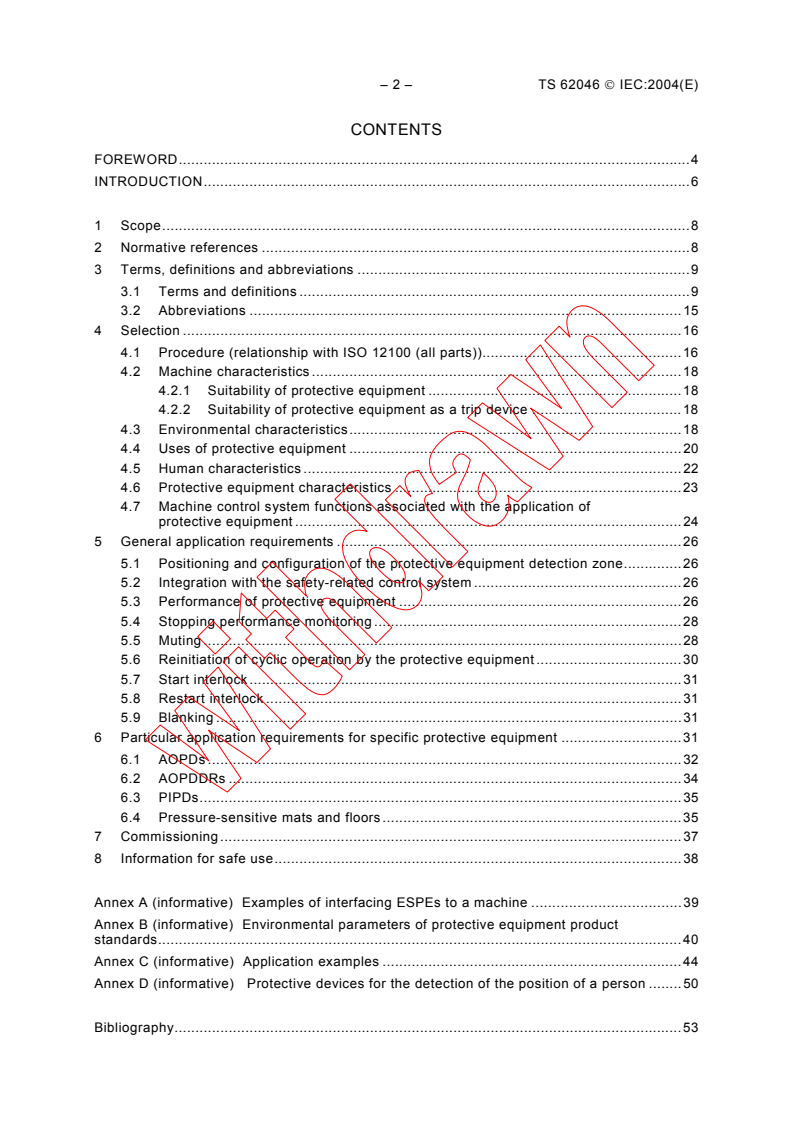
FOREWORD.4
INTRODUCTION.6
1 Scope.8
2 Normative references .8
3 Terms, definitions and abbreviations .9
3.1 Terms and definitions .9
3.2 Abbreviations .15
4 Selection .16
4.1 Procedure (relationship with ISO 12100 (all parts)).16
4.2 Machine characteristics .18
4.2.1 Suitability of protective equipment .18
4.2.2 Suitability of protective equipment as a trip device .18
4.3 Environmental characteristics.18
4.4 Uses of protective equipment .20
4.5 Human characteristics .22
4.6 Protective equipment characteristics .23
4.7 Machine control system functions associated with the application of
protective equipment .24
5 General application requirements .26
5.1 Positioning and configuration of the protective equipment detection zone.26
5.2 Integration with the safety-related control system .26
5.3 Performance of protective equipment .26
5.4 Stopping performance monitoring .28
5.5 Muting .28
5.6 Reinitiation of cyclic operation by the protective equipment .30
5.7 Start interlock.31
5.8 Restart interlock .31
5.9 Blanking .31
6 Particular application requirements for specific protective equipment .31
6.1 AOPDs .32
6.2 AOPDDRs .34
6.3 PIPDs.35
6.4 Pressure-sensitive mats and floors.35
7 Commissioning.37
8 Information for safe use.38
Annex A (informative) Examples of interfacing ESPEs to a machine .39
Annex B (informative) Environmental parameters of protective equipment product
standards.40
Annex C (informative) Application examples .44
Annex D (informative) Protective devices for the detection of the position of a person .50
Bibliography.53
TS 62046 © IEC:2004(E) – 3 –
Figure 1 – Relationship of this Technical Specification to other standards .7
Figure 2 – Risk reduction process (Figure 2 of ISO 12100-1) .17
Figure 3 – Example of the effect of reflective surfaces .32
Figure 4 – Example of use of blanking .34
Figure A.1 – Integration with the control system.39
Figure A.2 – Integration with a safety-related control system .39
Figure C.1 – Protective equipment used as a trip device (example 1) .44
Figure C.2 – Protective equipment used as a trip device (example 2) .44
Figure C.3 – Protective equipment used as combined trip and presence sensing device.45
Figure C.4 – Protective equipment used as a combined trip and presence sensing
device (example 3) .45
Figure C.5 – Horizontal AOPD .46
Figure C.6 – Vertical AOPD .47
Figure C.7 – Increased separation distance .48
Figure C.8 – Additional mechanical protection .49
Figure C.9 – Use of a trip device.49
Table 1 – Beam heights for light beam devices .33
Table B.1 – List of environmental considerations to assist the selection of a protective
equipment.41
– 4 – TS 62046 IEC:2004(E)
INTERNATIONAL ELECTROTECHNICAL COMMISSION
____________
SAFETY OF MACHINERY –
APPLICATION OF PROTECTIVE EQUIPMENT
TO DETECT THE PRESENCE OF PERSONS
FOREWORD
1) The International Electrotechnical Commission (IEC) is a worldwide organization for standardization comprising
all national electrotechnical committees (IEC National Committees). The object of IEC is to promote
international co-operation on all questions concerning standardization in the electrical and electronic fields. To
this end and in addition to other activities, IEC publishes International Standards, Technical Specifications,
Technical Reports, Publicly Available Specifications (PAS) and Guides (hereafter referred to as “IEC
Publication(s)”). Their preparation is entrusted to technical committees; any IEC National Committee interested
in the subject dealt with may participate in this preparatory work. International, governmental and non-
governmental organizations liaising with the IEC also participate in this preparation. IEC collaborates closely
with the International Organization for Standardization (ISO) in accordance with conditions determined by
agreement between the two organizations.
2) The formal decisions or agreements of IEC on technical matters express, as nearly as possible, an international
consensus of opinion on the relevant subjects since each technical committee has representation from all
interested IEC National Committees.
3) IEC Publications have the form of recommendations for international use and are accepted by IEC National
Committees in that sense. While all reasonable efforts are made to ensure that the technical content of IEC
Publications is accurate, IEC cannot be held responsible for the way in which they are used or for any
misinterpretation by any end user.
4) In order to promote international uniformity, IEC National Committees undertake to apply IEC Publications
transparently to the maximum extent possible in their national and regional publications. Any divergence
between any IEC Publication and the corresponding national or regional publication shall be clearly indicated in
the latter.
5) IEC provides no marking procedure to indicate its approval and cannot be rendered responsible for any
equipment declared to be in conformity with an IEC Publication.
6) All users should ensure that they have the latest edition of this publication.
7) No liability shall attach to IEC or its directors, employees, servants or agents including individual experts and
members of its technical committees and IEC National Committees for any personal injury, property damage or
other damage of any nature whatsoever, whether direct or indirect, or for costs (including legal fees) and
expenses arising out of the publication, use of, or reliance upon, this IEC Publication or any other IEC
Publications.
8) Attention is drawn to the Normative references cited in this publication. Use of the referenced publications is
indispensable for the correct application of this publication.
9) Attention is drawn to the possibility that some of the elements of this IEC Publication may be the subject of
patent rights. IEC shall not be held responsible for identifying any or all such patent rights.
The main task of IEC technical committees is to prepare International Standards. In
exceptional circumstances, a technical committee may propose the publication of a Technical
Specification when
• the required support cannot be obtained for the publication of an International Standard,
despite repeated efforts, or
• the subject is still under technical development or where, for any other reason, there is the
future but no immediate possibility of an agreement on an International Standard.
Technical Specifications are subject to review within three years of publication to decide
whether they can be transformed into International Standards.
IEC TS 62046, which is a Technical Specification, has been prepared by IEC technical
committee 44: Safety of machinery – Electrotechnical aspects.
TS 62046 © IEC:2004(E) – 5 –
The text of this Technical Specification is based on the following documents:
Enquiry Draft Report on voting
44/437/DTS 44/451/RVC
Full information on the voting for the approval of this Technical Specification can be found in
the report on voting indicated in the above table.
This publication has been drafted in accordance with the ISO/IEC Directives, Part 2.
The committee has decided that the contents of this publication will remain unchanged until
2006. At this date, the publication will be
• transformed into an International Standard;
• reconfirmed;
• withdrawn;
• replaced by a revised edition, or
• amended.
A bilingual edition of this Technical Specification may be issued at a later date.
– 6 – TS 62046 IEC:2004(E)
INTRODUCTION
This Technical Specification addresses the application of protective equipment, which
employs a sensing device(s) to detect person(s) in or approaching an area, in order to reduce
or minimize a risk from hazardous parts of machinery, without providing a physical barrier.
This specification provides information on the manner in which the protective equipment
should be applied to the machine to achieve the targeted level of risk reduction.
The objective of this specification is to assist: standards writing committees responsible for
developing machine standards ("C" Standards), machine designers, manufacturers and
refurbishers, machine safety certification organizations, workplace authorities and others on
the proper application of protective equipment to machinery.
Figures 1 and 2 show the general context and the intended use of this specification.
Clauses 1 to 5, 7 and 8 of this specification apply to all protective equipment included in the
scope, Clause 6 contains guidance for the application of specific kinds of protective
equipment.
TS 62046 © IEC:2004(E) – 7 –
From
ISO 12100-1
(see Figure 2)
Preliminary decision to use No
Use other protective
protective equipment?
measures
IEC 62046
Yes
General requirements for the safety
Environmental conditions
functions to be provided
Conditions for use
Functional requirements
For trip function or presence sensing
Human and machine properties
function see ISO 12100, ISO 13855;
For prevention of unexpected
start-up see ISO 14118
Standards giving general
Protective equipment Preliminary selection of a
requirements on the design of the
manufacturer’s specific kind of protective
safety related control system
information for use equipment - ISO 13849 (all parts)
IEC 62046 - IEC 62061
DETAILED DESIGN AND FINAL SELECTION
Integration into Dimensioning and
Specific machine
safety-related control positioning
(C-type) standards
system
giving specific
ISO 13849 IEC 62061 ISO 13855
requirements for the
(all parts)
application of
IEC 62046
sensitive protective
equipment
Verification,
validation and
commissioning
IEC 62046
To ISO 12100-1
(see Figure 2)
IEC 404/04
Figure 1 – Relationship of this Technical Specification to other standards
(see also Figure 2)
– 8 – TS 62046 IEC:2004(E)
SAFETY OF MACHINERY –
APPLICATION OF PROTECTIVE EQUIPMENT
TO DETECT THE PRESENCE OF PERSONS
1 Scope
This Technical Specification specifies requirements for the selection, positioning,
configuration and commissioning, of protective equipment to detect the presence of persons
in order to protect those persons from dangerous part(s) of machinery in industrial
applications. This specification covers the application of electro-sensitive protective
equipment (ESPE) specified in IEC 61496 (all parts) and pressure sensitive mats and floors
specified in ISO 13856-1.
It takes into account the characteristics of the machinery, the protective equipment, the
environment and human interaction by persons of 14 years and older.
NOTE This Technical Specification may also be used for guidance in the application of other protective devices.
2 Normative references
The following referenced documents are indispensable for the application of this document.
For dated references, only the edition cited applies. For undated references, the latest edition
of the referenced document (including any amendments) applies.
IEC 60204-1, Safety of machinery – Electrical equipment of machines – Part 1: General
requirements
IEC 61496-1:2004, Safety of Machinery – Electro-sensitive protective equipment – General
requirements and tests
IEC 61496-2:1997, Safety of machinery – Electro-sensitive protective equipment – Part 2:
Particular requirements for equipment using active opto-electronic protective devices
(AOPDs)
IEC 61496-3:2001, Safety of machinery – Electro-sensitive protective equipment – Particular
requirements for equipment for Active Opto-Electronic Protective Devices responsive to
Diffuse Reflection (AOPDDR)
IEC 62061, Safety of machinery – Functional safety of safety related electrical, electronic and
programmable control systems
ISO 12100-1: 2003, Safety of machinery – Basic concepts, general principles for design –
Part 1: Basic terminology, methodology
ISO 12100-2: 2003, Safety of machinery – Basic concepts, general principles for design –
Part 2: Technical principles
ISO 13849-1:1999, Safety of Machinery – Safety-related parts of control systems – Part 1:
General principles for design
ISO 13855:2002, Safety of machinery – Positioning of protective equipment with respect to
the approach speeds of parts of the human body
ISO 13856-1:2001, Safety of machinery – Pressure-sensitive protective devices – Part 1:
General principles for design and testing of pressure-sensitive mats and pressure-sensitive
floors
ISO 14118:2000, Safety of machinery – Prevention of unexpected start-up
TS 62046 © IEC:2004(E) – 9 –
ISO 14121:1999, Safety of machinery – Principles of risk assessment
CLC/TS 50418: 2004, Safety of Machinery - Electro-sensitive protective equipment - Passive
infra-red protective devices (PIPDs)
3 Terms, definitions and abbreviations
3.1 Terms and definitions
For the purposes of this technical specification, the following terms and definitions apply.
3.1.1
blanking
optional function that permits an object of a size greater than the detection capability of the
ESPE to be located within the detection zone without causing an OFF state of the OSSD(s)
3.1.2
detection capability
sensing function parameter limit specified by the supplier that will cause actuation of the
protective equipment
NOTE Adapted from IEC 61496-1.
3.1.3
detection zone
zone within which a specified test piece will be detected by the electro-sensitive protective
equipment
NOTE 1 ISO 13856 uses the term “effective sensing area” when describing pressure-sensitive mats and floors. In
this document the terms “detection zone” and “effective sensing area” are used synonymously.
NOTE 2 Adapted from IEC 61496-1.
3.1.4
effective sensing area
part of the top surface area of the sensor or a combination of the pressure-sensitive mat or
pressure-sensitive floor within which a response to an actuating force will take place
NOTE IEC 61496-1 uses the term “detection zone” when describing electro-sensitive protective equipment. In this
document the terms “detection zone” and “effective sensing area” are used synonymously.
NOTE Adapted from ISO 13856-1.
3.1.5
failure (of equipment)
termination of the ability of an item to perform a required function
NOTE 1 After failure the item has a fault.
NOTE 2 "Failure" is an event, as distinguished from "fault", which is a state.
NOTE 3 This concept as defined does not apply to items consisting of software only.
[IEV-191-04-01]
3.1.6
failure to danger
failure which prevents or delays all output signal switching devices going to, and/or remaining
in the OFF-state in response to a condition which, in normal operation, would result in their so
doing
[IEC 61496-1, 3.8]
– 10 – TS 62046 IEC:2004(E)
3.1.7
fault
state of an item characterized by its inability to perform a required function, excluding the
inability during preventive maintenance or other planned actions, or due to lack of external
resources
[IEV 191-05-01]
NOTE 1 A fault is often the result of a failure of the item itself, but may exist without prior failure.
NOTE 2 In the field of machinery, the English term `fault’ is commonly used in accordance with the definition in
IEV 191-05-01, whereas the French item “défaut” and the German term “fehler” are used rather than the term
“panne” and “fehlzustand” that appear with this definition.
NOTE 3 In practice, the terms “fault” and “failure” (see 3.1.5) are often used synonymously.
3.1.8
hazard
potential source of harm
[ISO 12100-1, 3.6]
NOTE The word "hazard" is generally used in conjunction with other words defining its origin or the nature of the
expected injury or damage to health: electrical shock hazard, crushing hazard, shearing hazard, toxic hazard, etc.
3.1.9
hazardous situation
circumstance in which a person is exposed to at least one hazard. The exposure can
immediately or over a period of time result in harm
[ISO 12100-1, 3.9]
3.1.10
hazard zone (danger zone)
any space within and/or around machinery in which a person can be exposed to a hazard
[ISO 12100-1, 3.10]
NOTE The hazard generating the risk envisaged in this definition:
– either is permanently present during the intended use of the machine (motion of hazardous moving elements,
electric arc during a welding phase);
– or can appear unexpectedly (unintended/unexpected start-up).
3.1.11
integrator
individual or group of individuals responsible for selecting, configuring, installing and/or
interfacing the protective equipment to achieve the safeguarding identified by the risk
assessment
3.1.12
lock-out condition
condition, initiated by a fault, preventing normal operation of the protective equipment which
is automatically attained when all output signal switching devices (OSSDs) and, where
applicable, all final switching devices (FSDs) and secondary switching devices (SSD) are
signalled to go to the OFF-state
[IEC 61496-1, 3.13 modified]
TS 62046 © IEC:2004(E) – 11 –
3.1.13
muting
temporary automatic suspension of a safety function(s) by safety-related parts of the control
system
[IEC 61496-1, 3.16]
NOTE When muting is provided as part of the protective equipment and the protective equipment is muted, the
OSSD(s) remain in the `ON’ state upon activation of the protective equipment sensing function and safety is
maintained by other means.
3.1.14
overall system stopping performance
time interval resulting from the sum of the protective equipment response time and the time to
the cessation of hazardous machine operation
[IEC 61496-1, 3.20]
3.1.15
Passive Infrared Protective Device
PIPD
device whose sensing function is performed by a receiving element(s) detecting thermal
radiation emitted by an object placed in, or moving within, the specified detection zone
3.1.16
periodic test
technique which stimulates or simulates the input of the protective equipment sensing
device(s) to determine if the protective equipment OSSD(s) go to the off state when required to
do so
NOTE The test input signal is usually produced by an external machine test input and is performed at intervals,
determined by the risk assessment, which provide a reasonable degree of confidence that the intended risk
reduction will be achieved.
3.1.17
protective equipment
assembly of devices using non-contact (electro-sensitive) or contact (pressure sensitive)
sensing means for detection of the presence of person(s) or parts of person(s) for the purpose
of controlling hazards associated with machinery and comprising as a minimum:
– a sensing device;
– control and monitoring devices;
– output signal switching devices
NOTE The safety related control system associated with the protective equipment, or the protective equipment
itself, can include additional safety features such as secondary switching devices, muting function, stopping
performance monitoring, etc.
3.1.18
presence sensing function
detection of the presence of a person, or a part of a person, while in a hazardous zone to
enable prevention of hazardous situations such as unexpected/unintended start-up of the
machine
– 12 – TS 62046 IEC:2004(E)
3.1.19
protective measure
safety measure
measure intended to achieve risk reduction, implemented:
– by the designer (inherent design, safeguarding and complementary protective measures,
information for use) and
– by the user (organization: safe working procedures, supervision, permit-to-work systems,
additional safeguards; personal protective equipment; training)
[ISO 12100-1, 3.18]
3.1.20
reasonably foreseeable misuse
use of a machine in a way not intended by the manufacturer, but which can result from readily
predictable human behaviour
[ISO/IEC Guide 51, 3.14 modified]
3.1.21
(protective equipment) response time
maximum time between the occurrence of the event leading to the actuation of the sensing
device and the output signal switching device (OSSD) achieving the OFF-state
NOTE For pressure-sensitive protective devices, the event leading to the actuation of the sensing device is the
application of a force within the effective sensing area
[IEC 61496-1, 3.21 modified]
3.1.22
restart interlock
means of preventing automatic restarting of a machine after actuation of the sensing device
during a hazardous part of the machine operating cycle, after a change in mode of operation
of the machine, and/or after a change in the means of start control of the machine
[IEC 61496-1, 3.22]
NOTE Modes of operation include inch, single stroke, automatic. Means of start control include foot switch, two-
hand control, and single or double actuation of an electro-sensitive protective equipment (ESPE) sensing device.
3.1.23
risk
combination of the probability of occurrence of harm and the severity of that harm
[ISO 12100-1, 3.11]
3.1.24
risk assessment
overall process comprising a risk analysis and a risk evaluation
[ISO 12100-1, 3.13]
3.1.24.1
risk analysis
combination of the specification of the limits of the machine, hazard identification and risk
estimation
[ISO 12100-1, 3.14]
TS 62046 © IEC:2004(E) – 13 –
3.1.24.2
risk evaluation
judgement, on the basis of risk analysis, of whether the risk reduction objectives have been
achieved
[ISO 12100-1, 3.16]
3.1.24.3
risk estimation
defining likely severity of harm and probability of its occurrence
[ISO 12100-1, 3.15]
3.1.25
Safety-Related part of a Control System
SRCS
part or subpart(s) of a control system which responds to input signals and generate(s) safety-
related output signals
NOTE 1 This also includes monitoring systems.
NOTE 2 The combined safety-related parts of a control system start at the points where the safety-related signals
are initiated and end at the output of the power control elements (see also Annex A of ISO 12100-1).
[IEC 61496-1, 3.23 modified]
3.1.26
start interlock
means which prevents an automatic machine start when the electrical supply to the protection
equipment(s)) is switched on, or is interrupted and restored
[IEC 61496-1, 3.26 modified]
3.1.27
start test
manual or automatic test which is performed after the protective equipment has been
switched on in order to test its complete safety-related control system before normal machine
operation is initiated
[IEC 61946-1, 3.26 modified]
3.1.28
stopping performance monitor
SPM
monitoring means to determine whether or not the overall system stopping performance is
within the preset limit(s)
[IEC 61496-1, 3.28]
3.1.29
trip function
detection of a person or a part of a person entering into a hazardous zone, to initiate a stop
function (or otherwise ensure a safe condition)
3.1.30
unexpected (unintended) start-up
any start-up caused by
– a start command, which is the result of a failure in, or an external influence on, the control
system;
– a start command generated by inopportune action on a start control or other parts of the
machine as, for example, a sensor or a power control element;
– 14 – TS 62046 IEC:2004(E)
– restoration of the power supply after an interruption;
– external/internal influences (gravity, wind, self-ignition in internal combustion engines ) on
parts of the machine
NOTE Automatic machine start-up during normal operation is not unintended, but can be considered to be
unexpected from the point of view of the operator. Prevention of accidents in this case involves the use of
safeguarding.
[ISO 12100-1, 3.29 modified]
3.1.31
Active Opto-electronic Protective Device
AOPD
device whose sensing function is performed by opto-electronic emitting and receiving
elements detecting the interruption of optical radiations generated, within the device, by an
opaque object present in the specified detection zone (or for a light beam device, on the axis
of the light beam)
[IEC 61496-2, 3.201 modified]
3.1.32
Active Opto-electronic Protective Device responsive to Diffuse Reflection
AOPDDR
device, whose sensing function is performed by opto-electronic emitting and receiving
elements, that detects the diffuse reflection of optical radiations generated within the device
by an object present in a detection zone specified in two dimensions
[IEC 61496-3, 3.301]
3.1.33
Electro-Sensitive Protective Equipment
ESPE
assembly of devices and/or components working together for protective tripping or presence-
sensing purposes and comprising as a minimum
– a sensing device;
– controlling/monitoring devices;
– output signal switching devices
[IEC 61496-1, 3.5]
3.1.34
pressure-sensitive mat (floor)
safety device that detects a person standing on it or who steps onto it comprising a sensor(s)
that responds to the application of pressure, a control unit and one or more output signal
switching device(s)
NOTE In a pressure-sensitive mat the effective sensing area is deformed locally when the sensor(s) is actuated.
In a pressure-sensitive floor, the effective sensing area is moved as a whole when the sensor(s) is actuated.
[ISO 13856-1, 3.1 and 3.2]
3.1.35
External Device Monitoring
EDM
means by which the electro-sensitive protective equipment monitors the state of control
devices which are external to the ESPE
[IEC 61496-1, 3.6]
TS 62046 © IEC:2004(E) – 15 –
3.1.36
Final Switching Device
FSD
component of the machine’s safety-related control system that interrupts the circuit to the
machine primary control element when the output signal switching device (OSSD) goes to the
OFF-state
[IEC 61496-1, 3.10]
3.1.37
Machine Primary Control Element
MPCE
electrically powered element that directly controls the normal operation of a machine in such a
way that it is the last element (in time) to function when machine operation is to be initiated or
arrested
[IEC 61496-1, 3.14]
3.1.38
Machine Secondary Control Element
MSCE
machine control element, independent of the machine primary control element(s), that is
capable of removing the source of power from the prime mover of the relevant hazardous
parts
[IEC 61496-1, 3.15]
3.1.39
Output Signal Switching Device
OSSD
component of electro-sensitive protective equipment (ESPE) connected to the machine
control system which, when the sensing device is actuated during normal operation, responds
by going to the OFF-state
[IEC 61496-1, 3.19 modified]
that part of the pressure-sensitive-mat or pressure-sensitive floor that, when the sensor or
monitoring function means is actuated, responds by producing an OFF state
[ISO 13856-1, 3.6]
3.1.40
Secondary Switching Device
SSD
device which, in a lock-out condition goes to the OFF-state. It may be used to initiate an
appropriate machine control action, for example de-energizing the machine secondary control
element (MSCE)
3.2 Abbreviations
Abbreviation Description
AGV Automated Guided Vehicle
AOPD Active Optoelectronic Protective Device
AOPDDR Active Optoelectronic Protective Device responsive to Diffuse Reflection
ESPE Electro-Sensitive Protective Equipment
EDM External Device Monitoring
FSD Final Switching Device
MPCE Machine Primary Control Element
– 16 – TS 62046 IEC:2004(E)
MSCE Machine Secondary Control Element
OSSD Output Signal Switching Device
PIPD Passive Infrared Protective Device
PSPD Pressure Sensitive Protective Device
SSD Secondary Switching Device
SPM Stopping Performance Monitor
4 Selection
4.1 Procedure (relationship with ISO 12100 (all parts))
This specification is an expansion of Step 2 “risk reduction by safeguarding” of the iterative 3-
step method of risk reduction for the design of safe machinery, contained in Clause 5 of
ISO 12100-1 (see Figure 2).
NOTE 1 This procedure presumes that a risk assessment has been carried out in accordance with ISO 14121,
that measures have been taken to remove or reduce risks by inherently safe design and safeguarding by means of
protective equipment is being considered.
The following characteristics shall be considered in the selection process when protective
equipment and other protective measures as necessary are being evaluated as a risk
reduction means:
– machine characteristics;
– environmental characteristics;
– human characteristics;
– protective equipment characteristics.
NOTE 2 These characteristics should be considered for both normal use and reasonably foreseeable misuse.
TS 62046 © IEC:2004(E) – 17 –
START
Risk assessment
Determination of the limits of the carried out in
machine accordance with
ISO 14121
This iterative risk reduction process
shall be carried out separately for
Hazard Identification
each hazard, hazardous situation,
under each condition of use
Risk estimation
Risk evaluation
YES
NO
Are other hazards
generated?
YES
Has the risk been
END
adequately reduced?
NO
YES
Can the hazard be
removed?
Risk reduction by
YES
intrinsic design Is the intended risk
Clause 4 of reduction achieved?
NO
ISO 12100-2
NO
Can the risk be
reduced by intrinsic
design?
YES
NO
Risk reduction by
safeguarding
Can the risk be
YES
YES Implementation of Is the intended risk
reduced by guards,
complementary reduction achieved?
protective devices?
protective measures
Clause 5 of ISO 12100-2
NO
NO
Risk reduction by
NO
YES Can the limits be Is the intended risk YES
information for use
specified again? reduction achieved?
Clause 6 of ISO 12100-2
NO
IEC 405/04
Figure 2 – Risk reduction process (Figure 2 of ISO 12100-1)
– 18 – TS 62046 IEC:2004(E)
4.2 Machine characteristics
4.2.1 Suitability of protective equipment
Protective equipment as described in this specification can be selected when machine
operation requires frequent access, personnel interaction with the machine, good visibility of
the machine or process, or when it is difficult to provide fixed guarding. However, some
characteristics of particular machines can preclude the use of protective equipment as the
sole protective measure. Examples of these machine characteristics are:
a) possibility that the machinery will eject materials, swarf or component parts;
b) risk of injury from thermal or other radiation;
c) unacceptable noise levels;
d) an environment likely to adversely affect the function of the protective equipment (see
4.3); and
e) a material being processed that can influence the effectiveness of the protective measure.
Where such situations exist, additional safety measures can be required. For example, while a
machine can require the use of an interlocked guard as a trip device, protective equipment
may be used for presence sensing purposes inside the guard for prevention of unexpected
start-up.
4.2.2 Suitability of protective equipment as a trip device
When protective equipment is used as a trip device (i.e. to detect the approach of a person or
a part of a person), the machine shall stop reliably before it is possible to reach to the
hazardous part(s) of the machine (for the minimum distances, see ISO 13855). However,
some characteristics of particular machines can preclude the use of protective equipment as a
trip device.
Protective equipment is unsuitable as a trip device or as a combined trip and presence
sensing device:
a) when the stopping performance of the machine is unknown, inconsistent or inadequate
due, for example, to
– the reaction characteristics of the machinery control circuitry;
– inadequate braking.
NOTE If a machine has variable speed, load or inertia, then the worst case should be taken into account.
b) the inability of the machine to stop part-way through a cycle due to:
– the nature of the process, where stopping would create additional hazards;
– the method of drive, for example positive key clutches or similar mechanisms for
engaging the drive so arranged that once started, the machinery can only be stopped
when the cycle is complete;
– stored energy, for example in the form of stored pressure in pneumatic reservoirs or
hydraulic accumulators.
4.3 Environmental characteristics
The functionality of protective equipment can be affected by environmental influences such as
temperature, pollution, electromagnetic disturbance, radiation, etc. The degree to which
environmental influences can affect the functionality of protective equipment can depend on
the sensing technology used by the protective equipment. Careful evaluation of the expected
environment and the sensing technology of the protective equipment should be performed
during the selection process of protective equipment.
TS 62046 © IEC:2004(E) – 19 –
Specifiers (i.e. integrators, end users, machine builders) of protective equipment should
ensure they have appropriate information to ensure that the protective equipment is suitable
for the intended use under all reasonably foreseeable environments to which the protective
equipment can be exposed over its entire operational lifecycle. This can take the form of
information for safe use provided by the protective equipment manufacturer and/or information
in the relevant product standard. Specifiers should request additional information if the
intended operating environment contains particular environmental conditions that are not
addressed by the information available.
Examples of environmental influences that should be considered include, but are not limited
to (see also Table B.1)
• electromagnetic interference;
– electrostatic discharge;
– radio frequency interference, for example mobile telephones;
• vibration/shock;
• light interference;
– ambient light;
– infra-red, for example remote controls;
– reflective surfaces;
– other ESPEs that can emit interfering light;
• pollution;
– water;
– dust;
– corrosive chemicals;
• temperature;
• humidity;
• weather conditions;
• radiation.
Additional and special requirements can apply to the protective equipment of machines that:
– are used in the open air (i.e. outside buildings or other protective structures);
– use, process, or produce potentially explosive material (for example paint or sawdust);
– are used in potentially explosive and/or flammable atmospheres;
– have special risks when producing or using certain materials;
– are used in mines.
The minimum values (for example operating range, immunity level, no failure to danger level,
etc.) specified in the product standards are shown in Table B.1.
NOTE 1 Table B.1 provides guidance for the environmental selection criteria of protective equipment. It does not
address the risk reduction contribution of the protective equipment.
NOTE 2 International product standards specify the information for safe use that is required to be provided by the
supplier. Suppliers’ promotional material is outside the scope of international product standards requirements and
can contain insufficient information.
NOTE 3 Information specific to particular protective equipment is provided in Clause 6.
NOTE 4 Where an application is under consideration which uses a combination of protective equipment sensing
techniques, the specifier should consider the relevant environmental characteristics for each protective equipment
sensing technique. In addition, consideration should be given to possible cross-interference between sensing
techniques.
– 20 – TS 62046 IEC:2004(E)
4.4 Uses of protective equipment
4.4.1 General
A protective equipment may be used as a:
– trip device; or
– presence sensing device; or
– combination trip device and presence sensing device.
4.4.2 Trip device
4.4.2.1 Distance to the hazard
Where the protective equipment is used as a trip device, it shall be positioned at a sufficient
distance from the specific machine hazard(s) to ensure the machine can stop or otherwise
reach a safe condition before any part of an approaching person can reach the hazardous
zone. The separation distance shall be maintained for all foreseeable directions of approach.
This distance shall take into account:
...