

IEC 61496-3:2025
(Main)Safety of machinery - Electro-sensitive protective equipment - Part 3: Particular requirements for active opto-electronic protective devices responsive to diffuse reflection (AOPDDR)
General Information
- Abstract
IEC 61496-3:2025 specifies additional requirements for the design, construction and testing of non‑contact electro-sensitive protective equipment (ESPE) designed specifically to detect persons or parts of persons as part of a safety-related system, employing active opto-electronic protective devices responsive to diffuse reflection (AOPDDRs) for the sensing function. Special attention is directed to requirements which ensure that an appropriate safety-related performance is achieved. An ESPE can include optional safety-related functions, the requirements for which are given both in Annex A of this document and in Annex A of IEC 61496‑1:2020.
NOTE "Non-contact" means that physical contact is not required for sensing.
This document does not specify the dimensions or configurations of the detection zone and its disposition in relation to hazardous parts for any particular application, nor what constitutes a hazardous state of any machine. It is restricted to the functioning of the ESPE and how it interfaces with the machine.
AOPDDRs are devices that have either
- one or more detection zone(s) specified in two dimensions (AOPDDR-2D), or
- one or more detection zone(s) specified in three dimensions (AOPDDR-3D)
wherein radiation in the near infrared range is emitted by an emitting element(s). When the emitted radiation impinges on an object (for example, a person or part of a person), a portion of the emitted radiation is reflected to a receiving element(s) by diffuse reflection. This reflection is used to determine the position of the object.
Opto-electronic devices that perform only a single one-dimensional spot-like distance measurement, for example, optical proximity switches, are not covered by this document.
This document is limited to ESPE that do not require human intervention for detection. It is limited to ESPE that detect objects entering into or being present in a detection zone(s).
This document does not address those aspects required for complex classification or differentiation of the object detected.
This document does not address requirements and tests for outdoor application.
Excluded from this document are AOPDDRs employing radiation with the peak of wavelength outside the range 820 nm to 1 100 nm, and those employing radiation other than that generated by the AOPDDR itself. For sensing devices that employ radiation of wavelengths outside this range, this document can be used as a guide. This document is relevant for AOPDDRs having a minimum detectable object size in the range from 30 mm to 200 mm.
This document can be relevant to applications other than those for the protection of persons, for example, for the protection of machinery or products from mechanical damage. In those applications, different requirements can be appropriate, for example when the materials that are recognized by the sensing function have different properties from those of persons and their clothing.
This document does not deal with electromagnetic compatibility (EMC) emission requirements.
This fourth edition cancels and replaces the third edition published in 2018. This edition constitutes a technical revision.
This edition includes the following significant technical changes with respect to the previous edition:
a) some requirement clauses and test procedures have been adapted or removed because they have been consolidated in IEC 61496-1:2020 (e.g. 5.4.6.2 Light sources and Clause A.9);
b) change of the minimum probability of detection and fault detection requirements for Type 2 AOPDDR;
c) using the AOPDDR as a trip device is described as an optional function in Clause A.13.
- Status
- Published
- Publication Date
- 13-Aug-2025
- Technical Committee
- TC 44 - Safety of machinery - Electrotechnical aspects
- Drafting Committee
- MT 61496-3 - TC 44/MT 61496-3
- Current Stage
- PPUB - Publication issued
- Start Date
- 14-Aug-2025
- Completion Date
- 15-Aug-2025
Buy Documents


IEC 61496-3:2025 - Safety of machinery - Electro-sensitive protective equipment - Part 3: Particular requirements for active opto-electronic protective devices responsive to diffuse reflection (AOPDDR)/14/2025


REDLINE IEC 61496-3:2025 CMV - Safety of machinery - Electro-sensitive protective equipment - Part 3: Particular requirements for active opto-electronic protective devices responsive to diffuse reflection (AOPDDR) Released:8/14/2025

IEC 61496-3:2025 - Sécurité des machines - Équipements de protection électrosensibles - Partie 3: Exigences particulières pour les équipements utilisant des dispositifs protecteurs optoélectroniques actifs sensibles aux réflexions diffuses (AOPDDR)/14/2025

IEC 61496-3:2025 - Safety of machinery - Electro-sensitive protective equipment - Part 3: Particular requirements for active opto-electronic protective devices responsive to diffuse reflection (AOPDDR)/14/2025
Overview
IEC 61496-3:2025 - "Safety of machinery - Electro-sensitive protective equipment - Part 3" specifies particular requirements for active opto-electronic protective devices responsive to diffuse reflection (AOPDDR). It is part of the IEC 61496 series covering electro-sensitive protective equipment (ESPE) used in safety-related systems to detect persons or parts of persons without physical contact. This fourth edition (2025) updates design, construction and test requirements to ensure appropriate safety‑related performance for AOPDDRs that emit near‑infrared radiation and detect objects by diffuse reflection.
Key scope boundaries:
- Covers AOPDDRs operating with emitted radiation peak wavelengths 820 nm to 1100 nm.
- Relevant for devices with minimum detectable object size roughly 30 mm to 200 mm.
- Excludes one‑dimensional spot distance sensors (e.g., basic optical proximity switches), outdoor applications, EMC emission requirements and complex object classification.
- Focuses on ESPE function and machine interface - it does not define detection‑zone placement relative to hazardous machine parts.
Key topics and requirements
- Functional and design requirements for AOPDDR sensing, emitting and receiving elements, and safety‑related logic (Clauses 4.x).
- Performance verification and testing: functional tests, performance under fault conditions, environmental tests (Clause 5). Tests include detection capability, light‑interference, endurance and fault catalogues.
- Probability of detection (POD) and fault detection requirements - notable change in minimum POD/fault detection for Type 2 AOPDDR in this edition.
- Optional safety functions described in normative Annex A (and cross‑references to IEC 61496‑1:2020 Annex A), including use as a trip device as an optional function.
- Marking and documentation requirements for safe use (Clause 6–7).
- Informative annexes with application examples (Annex AA) and relationship between position accuracy and POD (Annex BB).
Applications and users
Who benefits from IEC 61496-3:2025:
- Machine builders and integrators implementing non‑contact guarding systems.
- Manufacturers of AOPDDR sensors and ESPE systems for personnel protection.
- Safety engineers conducting risk assessments and selecting detection devices.
- Test laboratories and certification bodies verifying compliance with ESPE performance and testing protocols.
Typical applications:
- Presence or body/part detection for machine guarding, access control and safety interlocks.
- Integration on AGVs, robotic cells or machinery where non‑contact person detection is required.
- Protection of machinery or products from mechanical damage (with adapted requirements).
Related standards
- IEC 61496‑1:2020 - General requirements for ESPE (use in conjunction with Part 3).
- Other parts of the IEC 61496 series addressing different ESPE technologies and system aspects.
Keywords: IEC 61496-3:2025, AOPDDR, ESPE, electro‑sensitive protective equipment, diffuse reflection, near‑infrared, probability of detection, safety of machinery.
Relations
- Effective Date
- 05-Sep-2023
Buy Documents
IEC 61496-3:2025 - Safety of machinery - Electro-sensitive protective equipment - Part 3: Particular requirements for active opto-electronic protective devices responsive to diffuse reflection (AOPDDR)/14/2025
REDLINE IEC 61496-3:2025 CMV - Safety of machinery - Electro-sensitive protective equipment - Part 3: Particular requirements for active opto-electronic protective devices responsive to diffuse reflection (AOPDDR) Released:8/14/2025
IEC 61496-3:2025 - Sécurité des machines - Équipements de protection électrosensibles - Partie 3: Exigences particulières pour les équipements utilisant des dispositifs protecteurs optoélectroniques actifs sensibles aux réflexions diffuses (AOPDDR)/14/2025
IEC 61496-3:2025 - Safety of machinery - Electro-sensitive protective equipment - Part 3: Particular requirements for active opto-electronic protective devices responsive to diffuse reflection (AOPDDR)/14/2025
Get Certified
Connect with accredited certification bodies for this standard

CIS Institut d.o.o.
Personal Protective Equipment (PPE) certification body. Notified Body NB-2890 for EU Regulation 2016/425 PPE.

Kiwa BDA Testing
Building and construction product certification.
Kmetijski inštitut Slovenije
Agricultural Institute of Slovenia. Soil testing, plant health, agricultural product analysis.
Sponsored listings
Frequently Asked Questions
IEC 61496-3:2025 is a standard published by the International Electrotechnical Commission (IEC). Its full title is "Safety of machinery - Electro-sensitive protective equipment - Part 3: Particular requirements for active opto-electronic protective devices responsive to diffuse reflection (AOPDDR)". This standard covers: IEC 61496-3:2025 specifies additional requirements for the design, construction and testing of non‑contact electro-sensitive protective equipment (ESPE) designed specifically to detect persons or parts of persons as part of a safety-related system, employing active opto-electronic protective devices responsive to diffuse reflection (AOPDDRs) for the sensing function. Special attention is directed to requirements which ensure that an appropriate safety-related performance is achieved. An ESPE can include optional safety-related functions, the requirements for which are given both in Annex A of this document and in Annex A of IEC 61496‑1:2020. NOTE "Non-contact" means that physical contact is not required for sensing. This document does not specify the dimensions or configurations of the detection zone and its disposition in relation to hazardous parts for any particular application, nor what constitutes a hazardous state of any machine. It is restricted to the functioning of the ESPE and how it interfaces with the machine. AOPDDRs are devices that have either - one or more detection zone(s) specified in two dimensions (AOPDDR-2D), or - one or more detection zone(s) specified in three dimensions (AOPDDR-3D) wherein radiation in the near infrared range is emitted by an emitting element(s). When the emitted radiation impinges on an object (for example, a person or part of a person), a portion of the emitted radiation is reflected to a receiving element(s) by diffuse reflection. This reflection is used to determine the position of the object. Opto-electronic devices that perform only a single one-dimensional spot-like distance measurement, for example, optical proximity switches, are not covered by this document. This document is limited to ESPE that do not require human intervention for detection. It is limited to ESPE that detect objects entering into or being present in a detection zone(s). This document does not address those aspects required for complex classification or differentiation of the object detected. This document does not address requirements and tests for outdoor application. Excluded from this document are AOPDDRs employing radiation with the peak of wavelength outside the range 820 nm to 1 100 nm, and those employing radiation other than that generated by the AOPDDR itself. For sensing devices that employ radiation of wavelengths outside this range, this document can be used as a guide. This document is relevant for AOPDDRs having a minimum detectable object size in the range from 30 mm to 200 mm. This document can be relevant to applications other than those for the protection of persons, for example, for the protection of machinery or products from mechanical damage. In those applications, different requirements can be appropriate, for example when the materials that are recognized by the sensing function have different properties from those of persons and their clothing. This document does not deal with electromagnetic compatibility (EMC) emission requirements. This fourth edition cancels and replaces the third edition published in 2018. This edition constitutes a technical revision. This edition includes the following significant technical changes with respect to the previous edition: a) some requirement clauses and test procedures have been adapted or removed because they have been consolidated in IEC 61496-1:2020 (e.g. 5.4.6.2 Light sources and Clause A.9); b) change of the minimum probability of detection and fault detection requirements for Type 2 AOPDDR; c) using the AOPDDR as a trip device is described as an optional function in Clause A.13.
IEC 61496-3:2025 specifies additional requirements for the design, construction and testing of non‑contact electro-sensitive protective equipment (ESPE) designed specifically to detect persons or parts of persons as part of a safety-related system, employing active opto-electronic protective devices responsive to diffuse reflection (AOPDDRs) for the sensing function. Special attention is directed to requirements which ensure that an appropriate safety-related performance is achieved. An ESPE can include optional safety-related functions, the requirements for which are given both in Annex A of this document and in Annex A of IEC 61496‑1:2020. NOTE "Non-contact" means that physical contact is not required for sensing. This document does not specify the dimensions or configurations of the detection zone and its disposition in relation to hazardous parts for any particular application, nor what constitutes a hazardous state of any machine. It is restricted to the functioning of the ESPE and how it interfaces with the machine. AOPDDRs are devices that have either - one or more detection zone(s) specified in two dimensions (AOPDDR-2D), or - one or more detection zone(s) specified in three dimensions (AOPDDR-3D) wherein radiation in the near infrared range is emitted by an emitting element(s). When the emitted radiation impinges on an object (for example, a person or part of a person), a portion of the emitted radiation is reflected to a receiving element(s) by diffuse reflection. This reflection is used to determine the position of the object. Opto-electronic devices that perform only a single one-dimensional spot-like distance measurement, for example, optical proximity switches, are not covered by this document. This document is limited to ESPE that do not require human intervention for detection. It is limited to ESPE that detect objects entering into or being present in a detection zone(s). This document does not address those aspects required for complex classification or differentiation of the object detected. This document does not address requirements and tests for outdoor application. Excluded from this document are AOPDDRs employing radiation with the peak of wavelength outside the range 820 nm to 1 100 nm, and those employing radiation other than that generated by the AOPDDR itself. For sensing devices that employ radiation of wavelengths outside this range, this document can be used as a guide. This document is relevant for AOPDDRs having a minimum detectable object size in the range from 30 mm to 200 mm. This document can be relevant to applications other than those for the protection of persons, for example, for the protection of machinery or products from mechanical damage. In those applications, different requirements can be appropriate, for example when the materials that are recognized by the sensing function have different properties from those of persons and their clothing. This document does not deal with electromagnetic compatibility (EMC) emission requirements. This fourth edition cancels and replaces the third edition published in 2018. This edition constitutes a technical revision. This edition includes the following significant technical changes with respect to the previous edition: a) some requirement clauses and test procedures have been adapted or removed because they have been consolidated in IEC 61496-1:2020 (e.g. 5.4.6.2 Light sources and Clause A.9); b) change of the minimum probability of detection and fault detection requirements for Type 2 AOPDDR; c) using the AOPDDR as a trip device is described as an optional function in Clause A.13.
IEC 61496-3:2025 is classified under the following ICS (International Classification for Standards) categories: 13.110 - Safety of machinery; 31.260 - Optoelectronics. Laser equipment. The ICS classification helps identify the subject area and facilitates finding related standards.
IEC 61496-3:2025 has the following relationships with other standards: It is inter standard links to IEC 61496-3:2018. Understanding these relationships helps ensure you are using the most current and applicable version of the standard.
IEC 61496-3:2025 is available in PDF format for immediate download after purchase. The document can be added to your cart and obtained through the secure checkout process. Digital delivery ensures instant access to the complete standard document.
Standards Content (Sample)
IEC 61496-3 ®
Edition 4.0 2025-08
INTERNATIONAL
STANDARD
Safety of machinery - Electro-sensitive protective equipment -
Part 3: Particular requirements for active opto-electronic protective devices
responsive to diffuse reflection (AOPDDR)
ICS 13.110; 31.260 ISBN 978-2-8327-0593-3
All rights reserved. Unless otherwise specified, no part of this publication may be reproduced or utilized in any form or
by any means, electronic or mechanical, including photocopying and microfilm, without permission in writing from either
IEC or IEC's member National Committee in the country of the requester. If you have any questions about IEC copyright
or have an enquiry about obtaining additional rights to this publication, please contact the address below or your local
IEC member National Committee for further information.
IEC Secretariat Tel.: +41 22 919 02 11
3, rue de Varembé info@iec.ch
CH-1211 Geneva 20 www.iec.ch
Switzerland
About the IEC
The International Electrotechnical Commission (IEC) is the leading global organization that prepares and publishes
International Standards for all electrical, electronic and related technologies.
About IEC publications
The technical content of IEC publications is kept under constant review by the IEC. Please make sure that you have the
latest edition, a corrigendum or an amendment might have been published.
IEC publications search - IEC Products & Services Portal - products.iec.ch
webstore.iec.ch/advsearchform Discover our powerful search engine and read freely all the
The advanced search enables to find IEC publications by a publications previews, graphical symbols and the glossary.
variety of criteria (reference number, text, technical With a subscription you will always have access to up to date
committee, …). It also gives information on projects, content tailored to your needs.
replaced and withdrawn publications.
Electropedia - www.electropedia.org
The world's leading online dictionary on electrotechnology,
IEC Just Published - webstore.iec.ch/justpublished
Stay up to date on all new IEC publications. Just Published containing more than 22 500 terminological entries in English
details all new publications released. Available online and and French, with equivalent terms in 25 additional languages.
once a month by email. Also known as the International Electrotechnical Vocabulary
(IEV) online.
IEC Customer Service Centre - webstore.iec.ch/csc
If you wish to give us your feedback on this publication or
need further assistance, please contact the Customer
Service Centre: sales@iec.ch.
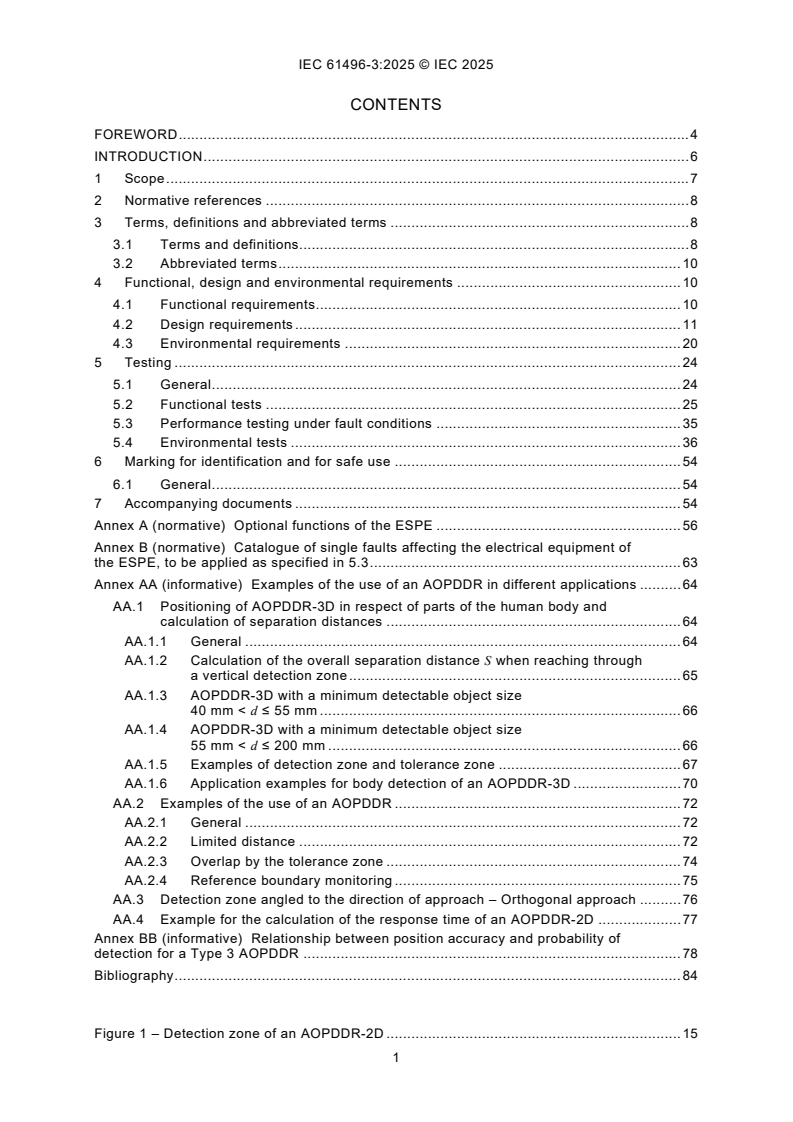
CONTENTS
FOREWORD . 4
INTRODUCTION . 6
1 Scope . 7
2 Normative references . 8
3 Terms, definitions and abbreviated terms . 8
3.1 Terms and definitions. 8
3.2 Abbreviated terms . 10
4 Functional, design and environmental requirements . 10
4.1 Functional requirements. 10
4.2 Design requirements . 11
4.3 Environmental requirements . 20
5 Testing . 24
5.1 General . 24
5.2 Functional tests . 25
5.3 Performance testing under fault conditions . 35
5.4 Environmental tests . 36
6 Marking for identification and for safe use . 54
6.1 General . 54
7 Accompanying documents . 54
Annex A (normative) Optional functions of the ESPE . 56
Annex B (normative) Catalogue of single faults affecting the electrical equipment of
the ESPE, to be applied as specified in 5.3 . 63
Annex AA (informative) Examples of the use of an AOPDDR in different applications . 64
AA.1 Positioning of AOPDDR-3D in respect of parts of the human body and
calculation of separation distances . 64
AA.1.1 General . 64
AA.1.2 Calculation of the overall separation distance S when reaching through
a vertical detection zone . 65
AA.1.3 AOPDDR-3D with a minimum detectable object size
40 mm < d ≤ 55 mm . 66
AA.1.4 AOPDDR-3D with a minimum detectable object size
55 mm < d ≤ 200 mm . 66
AA.1.5 Examples of detection zone and tolerance zone . 67
AA.1.6 Application examples for body detection of an AOPDDR-3D . 70
AA.2 Examples of the use of an AOPDDR . 72
AA.2.1 General . 72
AA.2.2 Limited distance . 72
AA.2.3 Overlap by the tolerance zone . 74
AA.2.4 Reference boundary monitoring . 75
AA.3 Detection zone angled to the direction of approach – Orthogonal approach . 76
AA.4 Example for the calculation of the response time of an AOPDDR-2D . 77
Annex BB (informative) Relationship between position accuracy and probability of
detection for a Type 3 AOPDDR . 78
Bibliography . 84
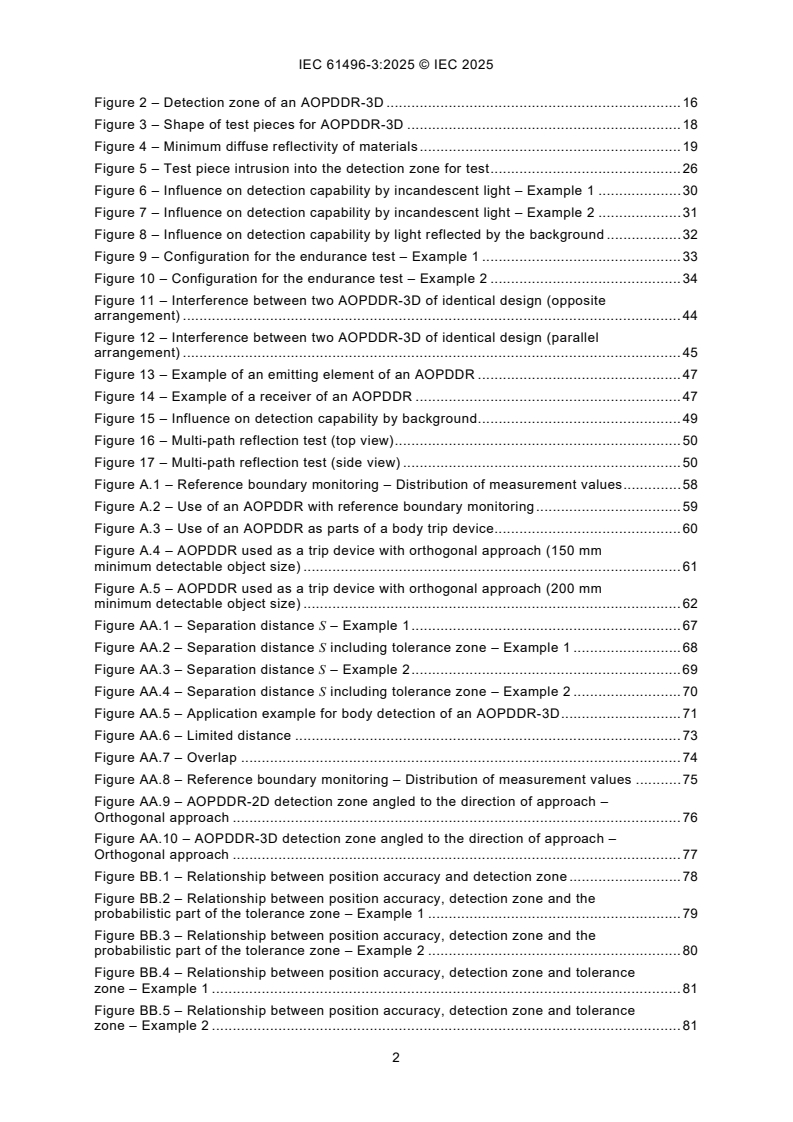
Figure 1 – Detection zone of an AOPDDR-2D . 15
Figure 2 – Detection zone of an AOPDDR-3D . 16
Figure 3 – Shape of test pieces for AOPDDR-3D . 18
Figure 4 – Minimum diffuse reflectivity of materials . 19
Figure 5 – Test piece intrusion into the detection zone for test . 26
Figure 6 – Influence on detection capability by incandescent light – Example 1 . 30
Figure 7 – Influence on detection capability by incandescent light – Example 2 . 31
Figure 8 – Influence on detection capability by light reflected by the background . 32
Figure 9 – Configuration for the endurance test – Example 1 . 33
Figure 10 – Configuration for the endurance test – Example 2 . 34
Figure 11 – Interference between two AOPDDR-3D of identical design (opposite
arrangement) . 44
Figure 12 – Interference between two AOPDDR-3D of identical design (parallel
arrangement) . 45
Figure 13 – Example of an emitting element of an AOPDDR . 47
Figure 14 – Example of a receiver of an AOPDDR . 47
Figure 15 – Influence on detection capability by background . 49
Figure 16 – Multi-path reflection test (top view) . 50
Figure 17 – Multi-path reflection test (side view) . 50
Figure A.1 – Reference boundary monitoring – Distribution of measurement values . 58
Figure A.2 – Use of an AOPDDR with reference boundary monitoring . 59
Figure A.3 – Use of an AOPDDR as parts of a body trip device. 60
Figure A.4 – AOPDDR used as a trip device with orthogonal approach (150 mm
minimum detectable object size) . 61
Figure A.5 – AOPDDR used as a trip device with orthogonal approach (200 mm
minimum detectable object size) . 62
Figure AA.1 – Separation distance S – Example 1 . 67
Figure AA.2 – Separation distance S including tolerance zone – Example 1 . 68
Figure AA.3 – Separation distance S – Example 2 . 69
Figure AA.4 – Separation distance S including tolerance zone – Example 2 . 70
Figure AA.5 – Application example for body detection of an AOPDDR-3D . 71
Figure AA.6 – Limited distance . 73
Figure AA.7 – Overlap . 74
Figure AA.8 – Reference boundary monitoring – Distribution of measurement values . 75
Figure AA.9 – AOPDDR-2D detection zone angled to the direction of approach –
Orthogonal approach . 76
Figure AA.10 – AOPDDR-3D detection zone angled to the direction of approach –
Orthogonal approach . 77
Figure BB.1 – Relationship between position accuracy and detection zone . 78
Figure BB.2 – Relationship between position accuracy, detection zone and the
probabilistic part of the tolerance zone – Example 1 . 79
Figure BB.3 – Relationship between position accuracy, detection zone and the
probabilistic part of the tolerance zone – Example 2 . 80
Figure BB.4 – Relationship between position accuracy, detection zone and tolerance
zone – Example 1 . 81
Figure BB.5 – Relationship between position accuracy, detection zone and tolerance
zone – Example 2 . 81
Figure BB.6 – POD of a single measurement (logarithmic) for a MooM-evaluation with
1 ≤ M ≤ 50 . 82
Figure BB.7 – POD of a single measurement for a MooM-evaluation with 1 ≤ M ≤ 50 in
relation to σ in the case of a normal distribution . 83
Table 1 – Minimum tests required for the verification of detection capability
requirements (see also 4.2.12.1) . 27
Table 2 – Overview of light interference tests . 39
Table B.1 – Sensor array for distance measurement . 63
INTERNATIONAL ELECTROTECHNICAL COMMISSION
____________
Safety of machinery - Electro-sensitive protective equipment -
Part 3: Particular requirements for active opto-electronic protective
devices responsive to diffuse reflection (AOPDDR)
FOREWORD
1) The International Electrotechnical Commission (IEC) is a worldwide organization for standardization comprising
all national electrotechnical committees (IEC National Committees). The object of IEC is to promote international
co-operation on all questions concerning standardization in the electrical and electronic fields. To this end and
in addition to other activities, IEC publishes International Standards, Technical Specifications, Technical Reports,
Publicly Available Specifications (PAS) and Guides (hereafter referred to as “IEC Publication(s)”). Their
preparation is entrusted to technical committees; any IEC National Committee interested in the subject dealt with
may participate in this preparatory work. International, governmental and non-governmental organizations liaising
with the IEC also participate in this preparation. IEC collaborates closely with the International Organization for
Standardization (ISO) in accordance with conditions determined by agreement between the two organizations.
2) The formal decisions or agreements of IEC on technical matters express, as nearly as possible, an international
consensus of opinion on the relevant subjects since each technical committee has representation from all
interested IEC National Committees.
3) IEC Publications have the form of recommendations for international use and are accepted by IEC National
Committees in that sense. While all reasonable efforts are made to ensure that the technical content of IEC
Publications is accurate, IEC cannot be held responsible for the way in which they are used or for any
misinterpretation by any end user.
4) In order to promote international uniformity, IEC National Committees undertake to apply IEC Publications
transparently to the maximum extent possible in their national and regional publications. Any divergence between
any IEC Publication and the corresponding national or regional publication shall be clearly indicated in the latter.
5) IEC itself does not provide any attestation of conformity. Independent certification bodies provide conformity
assessment services and, in some areas, access to IEC marks of conformity. IEC is not responsible for any
services carried out by independent certification bodies.
6) All users should ensure that they have the latest edition of this publication.
7) No liability shall attach to IEC or its directors, employees, servants or agents including individual experts and
members of its technical committees and IEC National Committees for any personal injury, property damage or
other damage of any nature whatsoever, whether direct or indirect, or for costs (including legal fees) and
expenses arising out of the publication, use of, or reliance upon, this IEC Publication or any other IEC
Publications.
8) Attention is drawn to the Normative references cited in this publication. Use of the referenced publications is
indispensable for the correct application of this publication.
9) IEC draws attention to the possibility that the implementation of this document may involve the use of (a)
patent(s). IEC takes no position concerning the evidence, validity or applicability of any claimed patent rights in
respect thereof. As of the date of publication of this document, IEC had not received notice of (a) patent(s), which
may be required to implement this document. However, implementers are cautioned that this may not represent
the latest information, which may be obtained from the patent database available at https://patents.iec.ch. IEC
shall not be held responsible for identifying any or all such patent rights.
IEC 61496-3 has been prepared by IEC technical committee 44: Safety of machinery –
Electrotechnical aspects. It is an International Standard.
This fourth edition cancels and replaces the third edition published in 2018. This edition
constitutes a technical revision.
This edition includes the following significant technical changes with respect to the previous
edition:
a) some requirement clauses and test procedures have been adapted or removed because
they have been consolidated in IEC 61496-1:2020 (e.g. 5.4.6.2 Light sources and
Clause A.9);
b) change of the minimum probability of detection and fault detection requirements for Type 2
AOPDDR;
c) using the AOPDDR as a trip device is described as an optional function in Clause A.13.
The text of this International Standard is based on the following documents:
Draft Report on voting
44/1061/FDIS 44/1065/RVD
Full information on the voting for its approval can be found in the report on voting indicated in
the above table.
This document is to be used in conjunction with IEC 61496-1:2020.
The language used for the development of this International Standard is English.
A list of all parts in the IEC 61496 series, published under the general title Safety of machinery
– Electro-sensitive protective equipment, can be found on the IEC website.
This document was drafted in accordance with ISO/IEC Directives, Part 2, and developed in
accordance with ISO/IEC Directives, Part 1 and ISO/IEC Directives, IEC Supplement, available
at www.iec.ch/members_experts/refdocs. The main document types developed by IEC are
described in greater detail at www.iec.ch/publications.
This document supplements or modifies the corresponding clauses in IEC 61496-1:2020 to
specify particular requirements for the design, construction and testing of electro-sensitive
protective equipment (ESPE) for the safeguarding of machinery, employing active opto-
electronic protective devices responsive to diffuse reflection (AOPDDR) for the sensing function.
Where a particular clause or subclause of IEC 61496-1:2020 is not mentioned in this document,
that clause or subclause applies as far as is reasonable. Where this document states "addition"
or "replacement", the relevant text of IEC 61496-1:2020 is adapted accordingly.
Clauses and subclauses which are additional to those of IEC 61496-1:2020 are numbered
sequentially, following on the last available number in IEC 61496-1:2020. Terminological entries
(in Clause 3) which are additional to those in IEC 61496-1:2020 are numbered starting from
3.301. Additional annexes are lettered from AA onwards.
The committee has decided that the contents of this document will remain unchanged until the
stability date indicated on the IEC website under webstore.iec.ch in the data related to the
specific document. At this date, the document will be
• reconfirmed,
• withdrawn, or
• revised.
INTRODUCTION
Electro-sensitive protective equipment (ESPE) is applied to machinery that presents a risk of
personal injury. It provides protection by causing the machine to revert to a safe condition
before a person can be placed in a hazardous situation.
This document supplements or modifies the corresponding clauses in IEC 61496-1:2020 to
specify particular requirements for the design, construction and testing of electro-sensitive
protective equipment (ESPE) for the safeguarding of machinery, employing active opto-
electronic protective devices responsive to diffuse reflection (AOPDDRs) for the sensing
function.
Each type of machine presents its own particular hazards, and it is not the purpose of this
document to recommend the manner of application of the ESPE to any particular machine. The
application of the ESPE is a matter for agreement between the equipment supplier, the machine
user and the enforcing authority. In this context, attention is drawn to the relevant guidance
established internationally, for example, in IEC 62046 and ISO 12100.
The group responsible for drafting this document was concerned that, due to the complexity of
the technology, there are many issues that are highly dependent on analysis and expertise in
specific test and measurement techniques. In order to provide a high level of confidence,
independent review by relevant experts is recommended. If this high level of confidence cannot
be established, these devices would not be suitable for use in safety related applications.
1 Scope
This document specifies additional requirements for the design, construction and testing of
non-contact electro-sensitive protective equipment (ESPE) designed specifically to detect
persons or parts of persons as part of a safety-related system, employing active opto-electronic
protective devices responsive to diffuse reflection (AOPDDRs) for the sensing function. Special
attention is directed to requirements which ensure that an appropriate safety-related
performance is achieved. An ESPE can include optional safety-related functions, the
requirements for which are given both in Annex A of this document and in Annex A of
IEC 61496-1:2020.
NOTE "Non-contact" means that physical contact is not required for sensing.
This document does not specify the dimensions or configurations of the detection zone and its
disposition in relation to hazardous parts for any particular application, nor what constitutes a
hazardous state of any machine. It is restricted to the functioning of the ESPE and how it
interfaces with the machine.
AOPDDRs are devices that have either
– one or more detection zone(s) specified in two dimensions (AOPDDR-2D), or
– one or more detection zone(s) specified in three dimensions (AOPDDR-3D)
wherein radiation in the near infrared range is emitted by an emitting element(s). When the
emitted radiation impinges on an object (for example, a person or part of a person), a portion
of the emitted radiation is reflected to a receiving element(s) by diffuse reflection. This reflection
is used to determine the position of the object.
Opto-electronic devices that perform only a single one-dimensional spot-like distance measure-
ment, for example, optical proximity switches, are not covered by this document.
This document is limited to ESPE that do not require human intervention for detection. It is
limited to ESPE that detect objects entering into or being present in a detection zone(s).
This document does not address those aspects required for complex classification or
differentiation of the object detected.
This document does not address requirements and tests for outdoor application.
Excluded from this document are AOPDDRs employing radiation with the peak of wavelength
outside the range 820 nm to 1 100 nm, and those employing radiation other than that generated
by the AOPDDR itself. For sensing devices that employ radiation of wavelengths outside this
range, this document can be used as a guide. This document is relevant for AOPDDRs having
a minimum detectable object size in the range from 30 mm to 200 mm.
This document can be relevant to applications other than those for the protection of persons,
for example, for the protection of machinery or products from mechanical damage. In those
applications, different requirements can be appropriate, for example when the materials that
are recognized by the sensing function have different properties from those of persons and their
clothing.
This document does not deal with electromagnetic compatibility (EMC) emission requirements.
2 Normative references
IEC 61496-1:2020, Clause 2 is applicable except as follows.
Addition:
IEC 60068-2-14:2023, Environmental testing - Part 2-14: Tests - Test N: Change of temperature
IEC 60068-2-75:2014, Environmental testing - Part 2-75: Tests - Test Eh: Hammer tests
IEC 60825-1:2014, Safety of laser products - Part 1: Equipment classification and requirements
IEC 61496-1:2020, Safety of machinery - Electro-sensitive protective equipment - Part 1:
General requirements and tests
IEC 62471:2006, Photobiological safety of lamps and lamp systems
IEC TS 62998-1:2019, Safety of machinery - Safety-related sensors used for the protection of
persons
IEC TS 62998-3:2023, Safety of machinery - Safety-related sensors used for the protection of
persons - Part 3: Sensor technologies and algorithms
ISO 13855:2024, Safety of machinery - Positioning of safeguards with respect to the approach
of the human body
ISO 20471:2013, High visibility clothing - Test methods and requirements
3 Terms and definitions
IEC 61496-1:2020, Clause 3 is applicable except as follows.
Replacement of the title with the following:
3 Terms, definitions and abbreviated terms
Addition:
3.1 Terms and definitions
Definition 3.1 is not applicable.
Replacement:
3.3
detection capability
ability to detect the specified test pieces in the specified detection zone
Note 1 to entry: A list of influences which can affect the AOPDDR detection capability is given in 4.2.12.1.
Note 2 to entry: Detection capability is often described by the minimum detectable object size and the object
reflectivity. The supplier can state more than one value as the minimum detectable object size, for example depending
on distances or mounting conditions. For an AOPPDR-2D the minimum detectable object size is the diameter of the
cylindrical test piece.
Note 3 to entry: A decrease of detection capability does not mean that a smaller object can be detected.
3.4
detection zone
zone within which the specified test piece(s) is detected by the AOPDDR with
a minimum required probability of detection
Note 1 to entry: A tolerance zone is necessary to achieve the required probability of detection of the specified test
piece(s) within the detection zone.
Addition:
3.301
active opto-electronic protective device responsive to diffuse reflection
AOPDDR
assembly using active optical radiation to detect the diffuse reflection of an object present in a
detection zone specified in two or three dimensions
3.302
AOPDDR-2D
AOPDDR that has one or more detection zone(s) specified in two dimensions
EXAMPLE A laser scanner that performs distance measurement by measuring the time a pulse needs for travelling
from the sensing device to an object and back to the sensing device. An AOPDDR-2D that has more than one
detection zone can carry out distance measurements in different planes.
Note 1 to entry: When the third dimension of each detection zone is not greater than the minimum detectable object
size, the AOPDDR is regarded as 2D.
3.303
AOPDDR-3D
AOPDDR that has one or more detection zone(s) specified in three dimensions
EXAMPLE A laser scanner with two perpendicular positioned moving mirrors or time-of-flight-cameras (TOF) that
perform distance measurement on several pixels. An AOPDDR-3D that has more than one detection zone can carry
out distance measurements in different volumes.
Note 1 to entry: When the third dimension of each detection zone is greater than the minimum detectable object
size, the AOPDDR is regarded as 3D. The detection zone(s) can be set-up for example as a volume in the shape of
a pyramid or a cone.
3.304
centre axis
line through the origin of distance measurement and the centre of the maximum detection zone
Note 1 to entry: See Figure 1 and Figure 2.
3.305
corner axis
line through the origin of distance measurement and defined by the bounding line of the
detection zone
Note 1 to entry: See Figure 1 and Figure 2.
3.306
maximum detection zone
largest dimension of the detection zone specified by the supplier
3.307
minimum detection zone
smallest dimension of the detection zone which is necessary to ensure the integrity of the
detection capability
3.308
position accuracy
accuracy in one or more dimension(s) of the position of an object as measured
3.309
tolerance zone
TZ
zone outside of and adjacent to the detection zone
Note 1 to entry: The tolerance zone is necessary to achieve the required probability of detection of the specified
test piece(s) within the detection zone
Note 2 to entry: For explanation of the concept of probability of detection and the tolerance zone, see Annex BB.
3.310
zone with limited detection capability
zone between the optical window and the beginning of the detection zone
Addition:
3.2 Abbreviated terms
AOPDDR active opto-electronic protective device responsive to diffuse reflection
BTD basic test distance
ESPE electro-sensitive protective equipment
lx Lux
OSSD output signal switching device
POD probability of detection
SNR signal-to-noise ratio
SRS/SRSS safety-related sensor / safety-related sensor system
TZ tolerance zone
4 Functional, design and environmental requirements
IEC 61496-1:2020, Clause 4 is applicable except as follows.
4.1 Functional requirements
4.1.2 Sensing function
Addition:
The detection zone shall begin at the border of the zone with limited detection capability and
end within the maximum operating distance.
Object(s) in the zone with limited detection capability shall not reduce the detection capability
within the detection zone. Any reduction of the detection capability shall be detected and the
AOPDDR shall go to lock-out condition.
The AOPDDR shall respond by giving appropriate output signal(s) when a test piece is present
anywhere within the detection zone whether static or moving with respect to the AOPDDR.
The supplier shall specify the limits of the detection capability. The supplier shall take into
account all influences listed in this document.
4.1.3 Types of ESPE
Replacement:
In this document, only type 2 and type 3 ESPE are considered. The types differ in their
performance in the presence of faults, under influences from environmental conditions and for
AOPDDR in the probability of detection. It is the responsibility of the machine supplier and/or
the user to specify which type is suitable for a particular application.
If IEC TS 62998-1 is applied in addition to this document (see e.g. 4.2.13.2), then the
requirements of SRS/SRSS performance class C for type 2 ESPE and SRS/SRSS performance
class D for type 3 ESPE shall be used.
The type 2 ESPE shall fulfil the fault detection requirements of 4.2.2.3 of this document. In
normal operation, the output circuit of each of at least two output signal switching devices
(OSSDs) shall go to the OFF-state when the sensing device is actuated, or when the power is
removed from the device.
The type 3 ESPE shall fulfil the fault detection requirements of 4.2.2.4 of this document. In
normal operation, the output circuit of each of at least two output signal switching devices
(OSSDs) of the type 3 ESPE shall go to the OFF-state when the sensing device is actuated, or
when the power is removed from the device.
When a single safety-related data interface is used to perform the functions of the OSSD(s),
then the data interface and associated safety-related communication interface shall meet the
requirements of 4.2.4.4. In this case, a single safety-related data interface can substitute for
two OSSDs in a type 3 ESPE.
Addition:
4.1.6 Zone(s) with limited detection capability
In order to ensure no hazard can arise in a particular application due to the presence of one or
more zone(s) with limited detection capability, the zone's dimensions and appropriate
information for use shall be provided by the supplier.
If the zone with limited detection capability extends more than 50 mm from the optical window
in the direction to the detection zone(s), then additional and effective technical measures shall
be applied to prevent undetected presence of objects or persons or parts of persons in the zone
with limited detection capability.
4.2 Design requirements
4.2.2 Fault detection requirements
4.2.2.2 Particular requirements for a type 1 ESPE
IEC 61496-1:2020, 4.2.2.2 is not applicable.
4.2.2.3 Particular requirements for a type 2 ESPE
Addition:
A single fault resulting in the deterioration of the stated AOPDDR detection capability shall
result in a lock-out condition at least as a result of the next periodic test. If the periodic test
cycle is less than 1 min then deterioration of the stated AOPDDR detection capability shall be
detected within 1 min.
EXAMPLE Deterioration of the AOPDDR detection capability includes:
– the increase of the minimum detectable object size,
– the increase in the minimum detectable reflectivity, and;
– the decrease of position accuracy.
If the periodic test is automatically initiated, the correct functioning of the periodic test shall be
monitored. In the event of a fault, the OSSD(s) shall be signalled to go to the OFF-state. If one
or more OSSDs do(es) not go to the OFF-state, a lock-out condition shall be initiated.
When it is not possible to reveal a failure to danger by periodic tests, other equivalent measures
shall be applied.
4.2.2.4 Particular requirements for a type 3 ESPE
Addition:
NOTE For AOPDDR using rotating mirrors for scanning the detection zone, this requirement can be fulfilled by
scanning on a defined reference object located outside the detection zone and the tolerance zone.
EXAMPLE Deterioration of the AOPDDR detection capability includes:
– the increase of the minimum detectable object size,
– the increase in the minimum detectable reflectivity, and
– the decrease of position accuracy.
An external test signal can be required if, for example, in a particular application, the frequency
of actuation of the sensing function is foreseeably low and the OSSDs are monitored at the
change of state only.
4.2.2.5 Particular requirements for a type 4 ESPE
IEC 61496-1:2020, 4.2.2.5 is not applicable.
4.2.12 Integrity of the ESPE detection capability
Replacement:
4.2.12.1 General
The design of the AOPDDR shall ensure that the detection capability is not decreased below
the limits specified by the supplier and in this document by any of, but not limited to, the
following:
a) reflectivity of objects in the range defined for the test pieces to be detected;
b) the position, size and number of objects within the detection zone;
c) the size of detection zones;
d) auto-adjustment, for example the following:
1) gain control;
2) sample rate;
3) shutter time;
4) optical characteristics;
e) properties and/or limitations of the emitting and/or receiving element, optics and signal
processing, for example the following:
1) signal noise;
2) dynamic range;
3) sensitivity and uniformity (e.g. cold and hot pixels);
4) micro-lenses;
5) change of characteristics;
f) calibration of the sensing device;
g) accuracy of object position in image(s);
h) at the limits of alignment and/or adjustment;
i) environmental conditions specified in 4.3;
j) component tolerances;
k) changing of characteristics of internal and external references to ensure the detection
capability.
NOTE 1 Under certain circumstances, limitations of the sensor in relation to its use are of interest. For example,
– objects that generate mirror-like (specular) reflections cannot be detected if the portion of diffuse reflectivity is
less than that specified for the "black" test piece;
– the determination of the minimum reflectivity for the detection of obstacles is based on the clothing of a person;
it is possible that objects having a reflectivity lower than that considered in this document are not detected.
NOTE 2 The technique of scanning on a reference object can satisfy the requirement in respect of ageing of
components. Other techniques giving the same level of assurance are possible.
NOTE 3 A receiving element can be composed of optics or optic-arrays and a single sensor element(s) or a sensor
array(s).
4.2.12.2 Detection zone(s) and tolerance zone(s)
The supplier shall specify the tolerance zone(s).
The supplier shall take into account worst-case conditions including, for example, signal-to-
noise ratio (SNR) and standard deviation σ considering all influences listed in this document
and any additional influences specified by the supplier (environmental influence, component
faults, multi-path reflections, etc.).
The supplier shall specify the relevant parameters of the detection zone(s), including operating
distance and scanning angle or field of view. The geometry and/or frequency shall be sufficient
to ensure that a test piece with a diameter of the specified minimum detectable object size is
detected at the maximum operating distance. The supplier shall specify values in the range of
30 mm to 200 mm as the minimum detectable object size of the AOPDDR. The minimum
detectable object size may be distance dependent.
The restriction of the minimum detectable object size to the range of 30 mm to 200 mm is based
on current applications. Additional requirements can be necessary for AOPDDRs having
detection capabilities outside this range.
EXAMPLE For an AOPDDR-2D the detection capability can be determined by the optical geometry so that one
complete beam will impinge on the specified test pieces in the maximum distance of detection zone and tolerance
zone for a special design. In this case, the distance between the centre of two adjacent emitter beams (except the
first and the last one) will not exceed half the diameter of the test pieces. For other designs, it can be more difficult
to carry out the verification according to 5.2.1.2 and 5.2.11, especially when movement of objects is taken into
account.
All points on a path projected from any point on the border of the detection zone to the receiving
element(s) of the AOPDDR shall be within the detection zone or the zone with limited detection
capability (see 4.1.6).
The tolerance zone depends on systematic influences, measurement faults, resolution of the
measurement values, etc., and is necessary to ensure the required probability of detection
within the detection zone. Figure 1 and Figure 2 show examples of tolerance zones.
The test pieces (see 4.2.13) shall be detected throughout the detection zone(s) with a minimum
probability of detection of
–6
for a Type 2 AOPDDR.
a) 1 – 2,9 × 10
–7
b) 1 – 2,9 × 10 for a Type 3 AOPDDR.
To achieve this minimum probability of detection, the tolerance zone is added to the detection
zone (see Figure BB.2). Even if a measured distance value of a test piece falls into the tolerance
zone, this test piece will be determined as detected and the OSSDs shall go to the OFF-state
or remain in the OFF-state.
NOTE 1 An AOPDDR-3D can detect an object based on a large number of single measurements. In this case, the
detection does not necessarily provide an object distance value. If such an object distance value is not provided by
the sensor, other means defined by the supplier to relate the single measurement uncertainty to the probability of
detection and the tolerance zone are possible.
NOTE 2 The tolerance zone is not included in the detection zone.
NOTE 3 Probability of detection as used in this document is not related to the probability of faults.
Special attention can be required when the detection zone of AOPDDR is made up by more
than one emitting and/or receiving unit to ensure that the AOPDDR detection capability is not
affected between the fields of view of these units.
When a test piece is placed on the boundary between the detection zone and the tolerance
zone (i.e. on the border of the detection zone) the measured distance values of this test piece
shall be the median point of the distribution of measurement values determined using a test
piece with a reflectivity of any value from that of the "black" test piece to that of the "white" test
piece. The supplier shall document the reflectivity of the test piece and the calculations used.
The value for the position accuracy and the tolerance zone is not necessarily a constant. It can,
for example, be a function of the measurement distance. It can be necessary to take into
account that the size of parts of the tolerance zone can be related for example to the diameter
of the test piece and the beam position. The dimensions of the tolerance zone in the three axes
can be different.
NOTE 4 Annex BB gives additional information about the relationship between position accuracy and probability of
detection.
Key
1 AOPDDR-2D
2 AOPDDR-2D coordinate system
3 zone with limited detection capability
4 detection zone
5 tolerance zone (TZ)
6 maximum detection zone (e.g. maximum operating distance and scanning angle)
7 maximum operating distance
8 reference plane, for example floor
9 origin of distance measurement (origin of coordinate system)
10 centre axis
11 corner axis
Figure 1 – Detection zone of an AOPDDR-2D
Key
1 AOPDDR-3D
2 AOPDDR-3D coordinate system
3 zone with limited detection capability
4 detection zone
5 tolerance zone (TZ)
6 maximum detection zone (e.g. maximum operating distance and field of view)
7 maximum operating distance
8 reference plane, for example floor
9 origin of distance measurement (origin of the coordinate system)
10 centre axis
11 corner axis
Figure 2 – Detection zone of an AOPDDR-3D
4.2.12.3 Influences on detection
Objects of the minimum detectable size that are either stationary or moving within the detection
zone at any speed up to 1,6 m/s shall be detected by the ESPE within the specified response
time. The supplier shall specify the maximum response time. The supplier shall take into
account worst-case conditions, including, for example, frame rate, evaluation time, minimum
diameter of the test piece, maximum speed of the test piece, number of objects
...
IEC 61496-3 ®
Edition 4.0 2025-08
INTERNATIONAL
STANDARD
COMMENTED VERSION
Safety of machinery - Electro-sensitive protective equipment -
Part 3: Particular requirements for active opto-electronic protective devices
responsive to diffuse reflection (AOPDDR)
ICS 13.110; 31.260 ISBN 978-2-8327-0662-6
All rights reserved. Unless otherwise specified, no part of this publication may be reproduced or utilized in any form or
by any means, electronic or mechanical, including photocopying and microfilm, without permission in writing from either
IEC or IEC's member National Committee in the country of the requester. If you have any questions about IEC copyright
or have an enquiry about obtaining additional rights to this publication, please contact the address below or your local
IEC member National Committee for further information.
IEC Secretariat Tel.: +41 22 919 02 11
3, rue de Varembé info@iec.ch
CH-1211 Geneva 20 www.iec.ch
Switzerland
About the IEC
The International Electrotechnical Commission (IEC) is the leading global organization that prepares and publishes
International Standards for all electrical, electronic and related technologies.
About IEC publications
The technical content of IEC publications is kept under constant review by the IEC. Please make sure that you have the
latest edition, a corrigendum or an amendment might have been published.
IEC publications search - IEC Products & Services Portal - products.iec.ch
webstore.iec.ch/advsearchform Discover our powerful search engine and read freely all the
The advanced search enables to find IEC publications by a publications previews, graphical symbols and the glossary.
variety of criteria (reference number, text, technical With a subscription you will always have access to up to date
committee, …). It also gives information on projects, content tailored to your needs.
replaced and withdrawn publications.
Electropedia - www.electropedia.org
The world's leading online dictionary on electrotechnology,
IEC Just Published - webstore.iec.ch/justpublished
Stay up to date on all new IEC publications. Just Published containing more than 22 500 terminological entries in English
details all new publications released. Available online and and French, with equivalent terms in 25 additional languages.
once a month by email. Also known as the International Electrotechnical Vocabulary
(IEV) online.
IEC Customer Service Centre - webstore.iec.ch/csc
If you wish to give us your feedback on this publication or
need further assistance, please contact the Customer
Service Centre: sales@iec.ch.
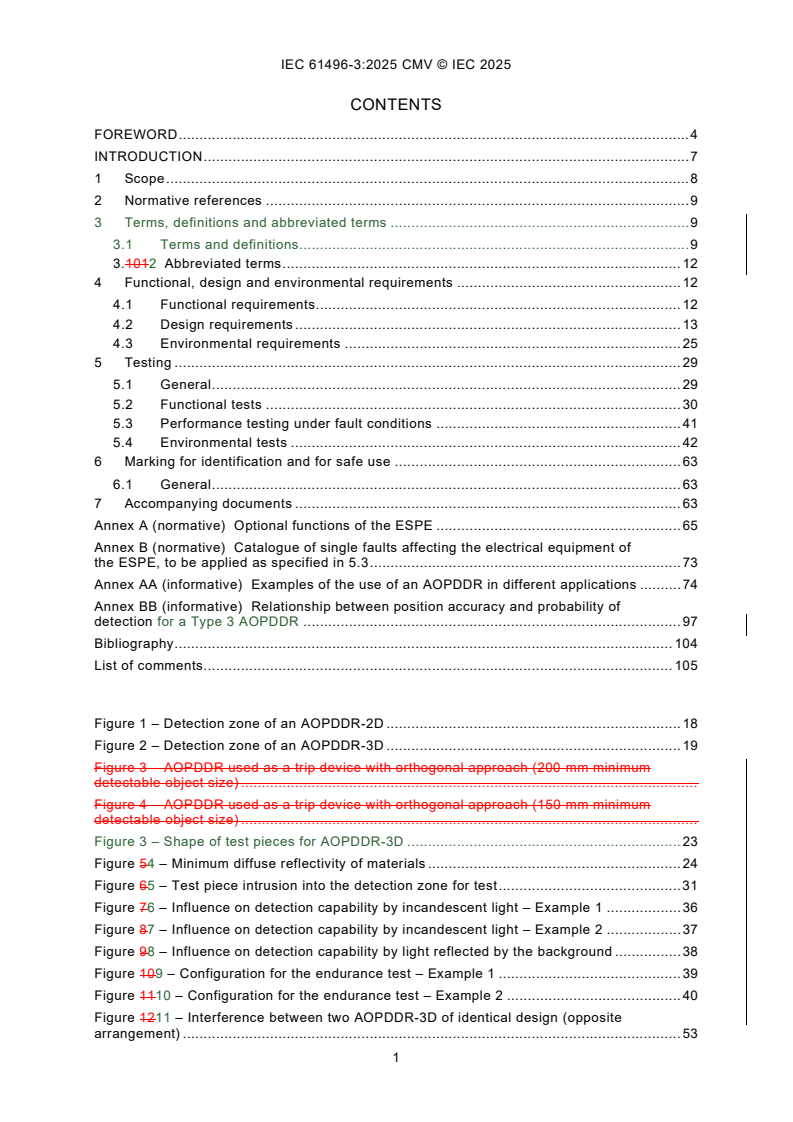
CONTENTS
FOREWORD . 4
INTRODUCTION . 7
1 Scope . 8
2 Normative references . 9
3 Terms, definitions and abbreviated terms . 9
3.1 Terms and definitions. 9
3.1012 Abbreviated terms . 12
4 Functional, design and environmental requirements . 12
4.1 Functional requirements. 12
4.2 Design requirements . 13
4.3 Environmental requirements . 25
5 Testing . 29
5.1 General . 29
5.2 Functional tests . 30
5.3 Performance testing under fault conditions . 41
5.4 Environmental tests . 42
6 Marking for identification and for safe use . 63
6.1 General . 63
7 Accompanying documents . 63
Annex A (normative) Optional functions of the ESPE . 65
Annex B (normative) Catalogue of single faults affecting the electrical equipment of
the ESPE, to be applied as specified in 5.3 . 73
Annex AA (informative) Examples of the use of an AOPDDR in different applications . 74
Annex BB (informative) Relationship between position accuracy and probability of
detection for a Type 3 AOPDDR . 97
Bibliography . 104
List of comments. 105
Figure 1 – Detection zone of an AOPDDR-2D . 18
Figure 2 – Detection zone of an AOPDDR-3D . 19
Figure 3 – AOPDDR used as a trip device with orthogonal approach (200 mm minimum
detectable object size) .
Figure 4 – AOPDDR used as a trip device with orthogonal approach (150 mm minimum
detectable object size) .
Figure 3 – Shape of test pieces for AOPDDR-3D . 23
Figure 54 – Minimum diffuse reflectivity of materials . 24
Figure 65 – Test piece intrusion into the detection zone for test . 31
Figure 76 – Influence on detection capability by incandescent light – Example 1 . 36
Figure 87 – Influence on detection capability by incandescent light – Example 2 . 37
Figure 98 – Influence on detection capability by light reflected by the background . 38
Figure 109 – Configuration for the endurance test – Example 1 . 39
Figure 1110 – Configuration for the endurance test – Example 2 . 40
Figure 1211 – Interference between two AOPDDR-3D of identical design (opposite
arrangement) . 53
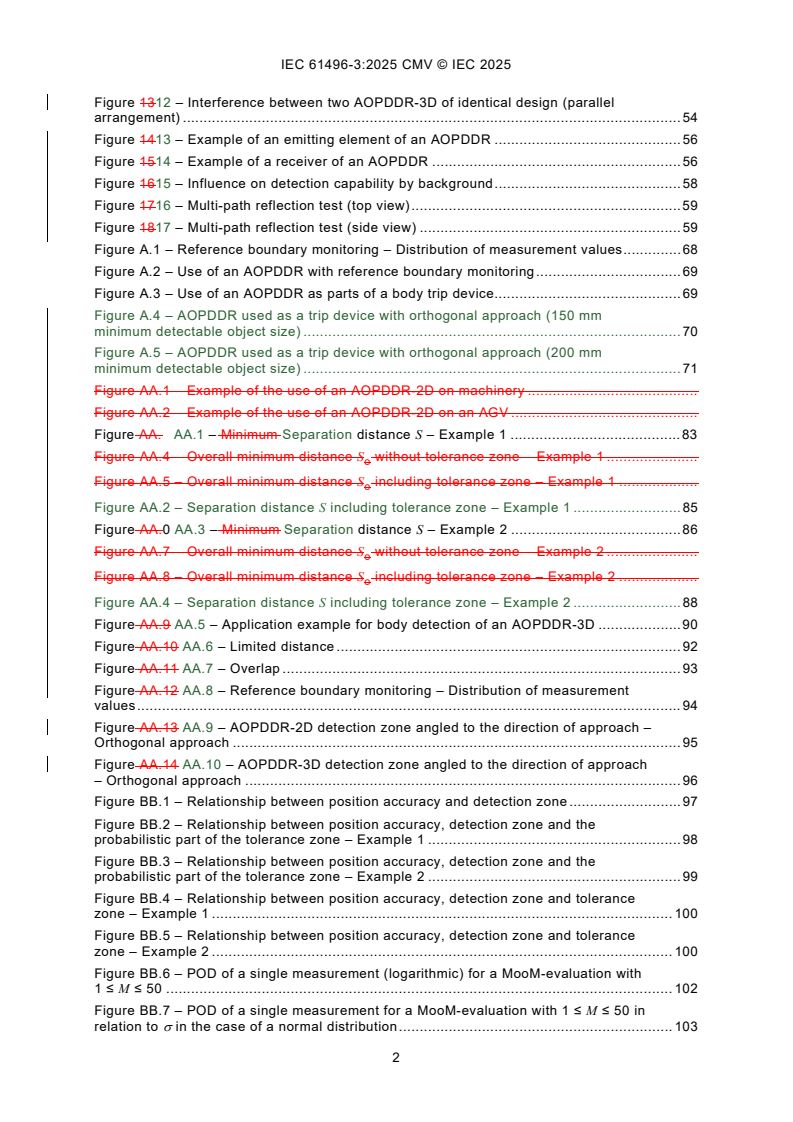
Figure 1312 – Interference between two AOPDDR-3D of identical design (parallel
arrangement) . 54
Figure 1413 – Example of an emitting element of an AOPDDR . 56
Figure 1514 – Example of a receiver of an AOPDDR . 56
Figure 1615 – Influence on detection capability by background . 58
Figure 1716 – Multi-path reflection test (top view) . 59
Figure 1817 – Multi-path reflection test (side view) . 59
Figure A.1 – Reference boundary monitoring – Distribution of measurement values . 68
Figure A.2 – Use of an AOPDDR with reference boundary monitoring . 69
Figure A.3 – Use of an AOPDDR as parts of a body trip device. 69
Figure A.4 – AOPDDR used as a trip device with orthogonal approach (150 mm
minimum detectable object size) . 70
Figure A.5 – AOPDDR used as a trip device with orthogonal approach (200 mm
minimum detectable object size) . 71
Figure AA.1 – Example of the use of an AOPDDR-2D on machinery .
Figure AA.2 – Example of the use of an AOPDDR-2D on an AGV .
Figure AA. AA.1 – Minimum Separation distance S – Example 1 . 83
Figure AA.4 – Overall minimum distance S without tolerance zone – Example 1 .
o
Figure AA.5 – Overall minimum distance S including tolerance zone – Example 1 .
o
Figure AA.2 – Separation distance S including tolerance zone – Example 1 . 85
Figure AA.0 AA.3 – Minimum Separation distance S – Example 2 . 86
Figure AA.7 – Overall minimum distance S without tolerance zone – Example 2 .
o
Figure AA.8 – Overall minimum distance S including tolerance zone – Example 2 .
o
Figure AA.4 – Separation distance S including tolerance zone – Example 2 . 88
Figure AA.9 AA.5 – Application example for body detection of an AOPDDR-3D . 90
Figure AA.10 AA.6 – Limited distance . 92
Figure AA.11 AA.7 – Overlap . 93
Figure AA.12 AA.8 – Reference boundary monitoring – Distribution of measurement
values . 94
Figure AA.13 AA.9 – AOPDDR-2D detection zone angled to the direction of approach –
Orthogonal approach . 95
Figure AA.14 AA.10 – AOPDDR-3D detection zone angled to the direction of approach
– Orthogonal approach . 96
Figure BB.1 – Relationship between position accuracy and detection zone . 97
Figure BB.2 – Relationship between position accuracy, detection zone and the
probabilistic part of the tolerance zone – Example 1 . 98
Figure BB.3 – Relationship between position accuracy, detection zone and the
probabilistic part of the tolerance zone – Example 2 . 99
Figure BB.4 – Relationship between position accuracy, detection zone and tolerance
zone – Example 1 . 100
Figure BB.5 – Relationship between position accuracy, detection zone and tolerance
zone – Example 2 . 100
Figure BB.6 – POD of a single measurement (logarithmic) for a MooM-evaluation with
1 ≤ M ≤ 50 . 102
Figure BB.7 – POD of a single measurement for a MooM-evaluation with 1 ≤ M ≤ 50 in
relation to σ in the case of a normal distribution . 103
Table 1 – Minimum tests required for the verification of detection capability
requirements (see also 4.2.12.1) . 32
Table 2 – Overview of light interference tests . 47
Table B.1 – Sensor array for distance measurement . 73
INTERNATIONAL ELECTROTECHNICAL COMMISSION
____________
Safety of machinery - Electro-sensitive protective equipment -
Part 3: Particular requirements for active opto-electronic protective
devices responsive to diffuse reflection (AOPDDR)
FOREWORD
1) The International Electrotechnical Commission (IEC) is a worldwide organization for standardization comprising
all national electrotechnical committees (IEC National Committees). The object of IEC is to promote international
co-operation on all questions concerning standardization in the electrical and electronic fields. To this end and
in addition to other activities, IEC publishes International Standards, Technical Specifications, Technical Reports,
Publicly Available Specifications (PAS) and Guides (hereafter referred to as “IEC Publication(s)”). Their
preparation is entrusted to technical committees; any IEC National Committee interested in the subject dealt with
may participate in this preparatory work. International, governmental and non-governmental organizations liaising
with the IEC also participate in this preparation. IEC collaborates closely with the International Organization for
Standardization (ISO) in accordance with conditions determined by agreement between the two organizations.
2) The formal decisions or agreements of IEC on technical matters express, as nearly as possible, an international
consensus of opinion on the relevant subjects since each technical committee has representation from all
interested IEC National Committees.
3) IEC Publications have the form of recommendations for international use and are accepted by IEC National
Committees in that sense. While all reasonable efforts are made to ensure that the technical content of IEC
Publications is accurate, IEC cannot be held responsible for the way in which they are used or for any
misinterpretation by any end user.
4) In order to promote international uniformity, IEC National Committees undertake to apply IEC Publications
transparently to the maximum extent possible in their national and regional publications. Any divergence between
any IEC Publication and the corresponding national or regional publication shall be clearly indicated in the latter.
5) IEC itself does not provide any attestation of conformity. Independent certification bodies provide conformity
assessment services and, in some areas, access to IEC marks of conformity. IEC is not responsible for any
services carried out by independent certification bodies.
6) All users should ensure that they have the latest edition of this publication.
7) No liability shall attach to IEC or its directors, employees, servants or agents including individual experts and
members of its technical committees and IEC National Committees for any personal injury, property damage or
other damage of any nature whatsoever, whether direct or indirect, or for costs (including legal fees) and
expenses arising out of the publication, use of, or reliance upon, this IEC Publication or any other IEC
Publications.
8) Attention is drawn to the Normative references cited in this publication. Use of the referenced publications is
indispensable for the correct application of this publication.
9) IEC draws attention to the possibility that the implementation of this document may involve the use of (a)
patent(s). IEC takes no position concerning the evidence, validity or applicability of any claimed patent rights in
respect thereof. As of the date of publication of this document, IEC had not received notice of (a) patent(s), which
may be required to implement this document. However, implementers are cautioned that this may not represent
the latest information, which may be obtained from the patent database available at https://patents.iec.ch. IEC
shall not be held responsible for identifying any or all such patent rights.
This commented version (CMV) of the official standard IEC 61496-3:2025 edition 4.0
allows the user to identify the changes made to the previous IEC 61496-3:2018
edition 3.0. Furthermore, comments from IEC TC 44 experts are provided to explain the reasons
of the most relevant changes, or to clarify any part of the content.
A vertical bar appears in the margin wherever a change has been made. Additions are in green
text, deletions are in strikethrough red text. Experts' comments are identified by a blue-
background number. Mouse over a number to display a pop-up note with the comment.
This publication contains the CMV and the official standard. The full list of comments is available
at the end of the CMV.
IEC 61496-3 has been prepared by IEC technical committee 44: Safety of machinery –
Electrotechnical aspects. It is an International Standard.
This fourth edition cancels and replaces the third edition published in 2018. This edition
constitutes a technical revision.
This edition includes the following significant technical changes with respect to the previous
edition:
a) some requirement clauses and test procedures have been adapted or removed because
they have been consolidated in IEC 61496-1:2020 (e.g. 5.4.6.2 Light sources and
Clause A.9);
b) change of the minimum probability of detection and fault detection requirements for Type 2
AOPDDR;
c) using the AOPDDR as a trip device is described as an optional function in Clause A.13.
The text of this International Standard is based on the following documents:
Draft Report on voting
44/1061/FDIS 44/1065/RVD
Full information on the voting for its approval can be found in the report on voting indicated in
the above table.
This document is to be used in conjunction with IEC 61496-1:2020.
The language used for the development of this International Standard is English.
A list of all parts in the IEC 61496 series, published under the general title Safety of machinery
– Electro-sensitive protective equipment, can be found on the IEC website.
This document was drafted in accordance with ISO/IEC Directives, Part 2, and developed in
accordance with ISO/IEC Directives, Part 1 and ISO/IEC Directives, IEC Supplement, available
at www.iec.ch/members_experts/refdocs. The main document types developed by IEC are
described in greater detail at www.iec.ch/publications.
This document supplements or modifies the corresponding clauses in IEC 61496-1:2020 to
specify particular requirements for the design, construction and testing of electro-sensitive
protective equipment (ESPE) for the safeguarding of machinery, employing active opto-
electronic protective devices responsive to diffuse reflection (AOPDDR) for the sensing function.
Where a particular clause or subclause of IEC 61496-1:2020 is not mentioned in this document,
that clause or subclause applies as far as is reasonable. Where this document states "addition"
or "replacement", the relevant text of IEC 61496-1:2020 is adapted accordingly.
Clauses and subclauses which are additional to those of IEC 61496-1:2020 are numbered
sequentially, following on the last available number in IEC 61496-1:2020. Terminological entries
(in Clause 3) which are additional to those in IEC 61496-1:2020 are numbered starting from
3.301. Additional annexes are lettered from AA onwards.
The committee has decided that the contents of this document will remain unchanged until the
stability date indicated on the IEC website under webstore.iec.ch in the data related to the
specific document. At this date, the document will be
• reconfirmed,
• withdrawn, or
• revised.
INTRODUCTION
Electro-sensitive protective equipment (ESPE) is applied to machinery that presents a risk of
personal injury. It provides protection by causing the machine to revert to a safe condition
before a person can be placed in a hazardous situation.
This document supplements or modifies the corresponding clauses in IEC 61496-1:2020 to
specify particular requirements for the design, construction and testing of electro-sensitive
protective equipment (ESPE) for the safeguarding of machinery, employing active opto-
electronic protective devices responsive to diffuse reflection (AOPDDRs) for the sensing
function.
Each type of machine presents its own particular hazards, and it is not the purpose of this
document to recommend the manner of application of the ESPE to any particular machine. The
application of the ESPE is a matter for agreement between the equipment supplier, the machine
user and the enforcing authority. In this context, attention is drawn to the relevant guidance
established internationally, for example, in IEC 62046 and ISO 12100.
The group responsible for drafting this document was concerned that, due to the complexity of
the technology, there are many issues that are highly dependent on analysis and expertise in
specific test and measurement techniques. In order to provide a high level of confidence,
independent review by relevant experts is recommended. If this high level of confidence cannot
be established, these devices would not be suitable for use in safety related applications.
1 Scope
This document specifies additional requirements for the design, construction and testing of
non-contact 1 electro-sensitive protective equipment (ESPE) designed specifically to detect
persons or parts of persons as part of a safety-related system, employing active opto-electronic
protective devices responsive to diffuse reflection (AOPDDRs) for the sensing function. Special
attention is directed to requirements which ensure that an appropriate safety-related
performance is achieved. An ESPE can include optional safety-related functions, the
requirements for which are given both in Annex A of this document and in Annex A of
IEC 61496-1:20122020.
NOTE "Non-contact" means that physical contact is not required for sensing.
This document does not specify the dimensions or configurations of the detection zone and its
disposition in relation to hazardous parts for any particular application, nor what constitutes a
hazardous state of any machine. It is restricted to the functioning of the ESPE and how it
interfaces with the machine.
AOPDDRs are devices that have either
– one or more detection zone(s) specified in two dimensions (AOPDDR-2D), or
– one or more detection zone(s) specified in three dimensions (AOPDDR-3D)
wherein radiation in the near infrared range is emitted by an emitting element(s). When the
emitted radiation impinges on an object (for example, a person or part of a person), a portion
of the emitted radiation is reflected to a receiving element(s) by diffuse reflection. This reflection
is used to determine the position of the object.
Opto-electronic devices that perform only a single one-dimensional spot-like distance measure-
ment, for example, optical proximity switches, are not covered by this document.
This document is limited to ESPE that do not require human intervention for detection. It is
limited to ESPE that detect objects entering into or being present in a detection zone(s). 2
This document does not address those aspects required for complex classification or
differentiation of the object detected.
This document does not address requirements and tests for outdoor application.
Excluded from this document are AOPDDRs employing radiation with the peak of wavelength
outside the range 820 nm to 950 1 100 nm 3, and those employing radiation other than that
generated by the AOPDDR itself. For sensing devices that employ radiation of wavelengths
outside this range, this document can be used as a guide. This document is relevant for
AOPDDRs having a minimum detectable object size in the range from 30 mm to 200 mm.
This document can be relevant to applications other than those for the protection of persons,
for example, for the protection of machinery or products from mechanical damage. In those
applications, different requirements can be appropriate, for example when the materials that
have to be are recognized by the sensing function have different properties from those of
persons and their clothing.
This document does not deal with electromagnetic compatibility (EMC) emission requirements.
2 Normative references
IEC 61496-1:20122020, Clause 2 is applicable except as follows.
Addition:
IEC 60068-2-14:2023, Environmental testing - Part 2-14: Tests - Test N: Change of temperature
IEC 60068-2-75:2014, Environmental testing - Part 2-75: Tests - Test Eh: Hammer tests
IEC TR 60721-4-5, Classification of environmental conditions – Part 4-5: Guidance for the
correlation and transformation of environmental condition classes of IEC 60721-3 to the
environmental tests of IEC 60068 – Ground vehicle installations
IEC 60825-1:2014, Safety of laser products - Part 1: Equipment classification and requirements
IEC 61496-1:20122020, Safety of machinery - Electro-sensitive protective equipment - Part 1:
General requirements and tests
IEC 62471:2006, Photobiological safety of lamps and lamp systems
IEC TS 62998-1:2019, Safety of machinery - Safety-related sensors used for the protection of
persons
IEC TS 62998-3:2023, Safety of machinery - Safety-related sensors used for the protection of
persons - Part 3: Sensor technologies and algorithms
ISO 13855:20102024, Safety of machinery - Positioning of safeguards with respect to the
approach speeds of parts of the human body
ISO 20471:2013, High visibility clothing - Test methods and requirements
3 Terms and definitions 4
IEC 61496-1:20122020, Clause 3 is applicable except as follows.
Replacement of the title with the following:
3 Terms, definitions and abbreviated terms
Addition:
3.1 Terms and definitions
Definition 3.1 is not applicable.
Replacement:
3.3
detection capability
ability to detect the specified test pieces (see 4.2.13) in the specified
detection zone
Note 1 to entry: A list of influences which can affect the AOPDDR detection capability is given in 4.2.12.1.
Note 2 to entry: Detection capability is often described by the minimum detectable object size and the object
reflectivity. The supplier can state more than one value as the minimum detectable object size, for example depending
on distances or mounting conditions. For an AOPPDR-2D the minimum detectable object size is the diameter of the
cylindrical test piece.
Note 3 to entry: A decrease of detection capability does not mean that a smaller object can be detected.
3.4
detection zone
zone within which the specified test piece(s) (see 4.2.13) is detected by the
AOPDDR with a minimum required probability of detection (see 4.2.12.2)
Note 1 to entry: A tolerance zone is necessary to achieve the required probability of detection of the specified test
piece(s) within the detection zone.
Addition:
3.301
active opto-electronic protective device responsive to diffuse reflection
AOPDDR
device, whose sensing function is performed by opto-electronic emitting and receiving
elements, that detects the diffuse reflection of optical radiations generated within the device by
an object present in a detection zone specified in two or three dimensions
Note 1 to entry: A receiving element can be composed by optics/optic-arrays and a single sensor element(s) or a
sensor array(s).
Note 2 to entry: This note applies to the French language only.
assembly using active optical radiation to detect the diffuse reflection of an object present in a
detection zone specified in two or three dimensions
3.302
AOPDDR-2D
AOPDDR that has one or more detection zone(s) specified in two dimensions
Note 1 to entry: For example, a third dimension is not greater than the minimum detectable object size, then the
AOPDDR is regarded as 2D (see Figures 1 and 2).
Note 2 to entry: A typical example of an AOPDDR-2D is A laser scanner that performs distance measurement by
measuring the time a pulse needs for travelling from the sensing device to an object and back to the sensing device.
An AOPDDR-2D that has more than one detection zone may carry out distance measurements in different planes.
Note 3 to entry: This note applies to the French language only.
EXAMPLE A laser scanner that performs distance measurement by measuring the time a pulse needs for travelling
from the sensing device to an object and back to the sensing device. An AOPDDR-2D that has more than one
detection zone can carry out distance measurements in different planes.
Note 1 to entry: When the third dimension of each detection zone is not greater than the minimum detectable object
size, the AOPDDR is regarded as 2D.
3.303
AOPDDR-3D
AOPDDR that has one or more detection zone(s) specified in three dimensions
Note 1 to entry: For example, a third dimension as specified by the supplier is greater than the minimum detectable
object size, the AOPDDR is regarded as 3D (see Figures 1 and 2). The detection zone(s) can be set-up for example
as a volume in the shape of a pyramid or a cone.
Note 2 to entry: Typical examples of AOPDDR-3D are laser scanners with two perpendicular positioned moving
mirrors or time-of-flight-cameras (TOF) that perform distance measurement on several pixels. An AOPDDR-3D that
has more than one detection zone may carry out distance measurements in different volumes.
Note 3 to entry: This note applies to the French language only.
EXAMPLE A laser scanner with two perpendicular positioned moving mirrors or time-of-flight-cameras (TOF) that
perform distance measurement on several pixels. An AOPDDR-3D that has more than one detection zone can carry
out distance measurements in different volumes.
Note 1 to entry: When the third dimension of each detection zone is greater than the minimum detectable object
size, the AOPDDR is regarded as 3D. The detection zone(s) can be set-up for example as a volume in the shape of
a pyramid or a cone.
3.304
basic test distance
BTD
Radius, respectively width and length (or equivalent values), of the detection zone used for test
set-up
Note 1 to entry: For dimension of BTD, see 5.1.1.2.
Note 2 to entry: This note applies to the French language only.
3.305304
centre axis
line through the origin of distance measurement and the centre of the maximum detection zone
stated by the supplier
Note 1 to entry: See Figure 1 and Figure 2.
3.306305
corner axis
line through the origin of distance measurement and defined by the bounding line of the
detection zone
Note 1 to entry: See Figure 1 and Figure 2.
3.306
maximum detection zone
largest dimension of the detection zone specified by the supplier
3.307
minimum detection zone
lowestsmallest dimension of the detection zone which is necessary to ensure the integrity of
the detection capability
3.308
position accuracy
accuracy in two one or three dimensions more dimension(s) of the position of an object as
measured by the AOPDDR
3.309
tolerance zone
TZ
zone outside of and adjacent to the detection zone within which the specified test piece(s) (see
4.2.13) is detected with a probability of detection lower than the required probability within the
detection zone
Note 1 to entry: The tolerance zone is necessary to achieve the required probability of detection of the specified
test piece(s) within the detection zone
Note 2 to entry: For explanation of the concept of probability of detection and the tolerance zone, see Annex BB.
Note 3 to entry: This note applies to the French language only.
3.310
zone with limited detection capability
zone between the optical window and the beginning of the detection zone, where the detection
capability is not achieved
Note 1 to entry: The dimensions and appropriate information for use of the zone with limited detection capability
are provided by the supplier.
Addition:
3.1012 Abbreviated terms
AGV automated guided vehicle
AOPDDR active opto-electronic protective device responsive to diffuse reflection
BTD basic test distance
ESPE electro-sensitive protective equipment
lx Lux
OSSD output signal switching device
POD probability of detection
SNR signal-to-noise ratio
SRS/SRSS safety-related sensor / safety-related sensor system
TZ tolerance zone
4 Functional, design and environmental requirements
IEC 61496-1:2020, Clause 4 is applicable except as follows.
4.1 Functional requirements
4.1.2 Sensing function 5
Addition:
The detection zone shall begin at the border of the zone with limited detection capability and
end within the maximum operating distance.
Object(s) in the zone with limited detection capability shall not reduce the detection capability
within the detection zone. Any reduction of the detection capability shall be detected and the
AOPDDR shall go to lock-out condition.
The AOPDDR shall respond by giving appropriate output signal(s) when a test piece is present
anywhere within the detection zone whether static or moving with respect to the AOPDDR.
The supplier shall specify the limits of the detection capability. The supplier shall take into
account all influences listed in this document.
4.1.3 Types of ESPE
Replacement:
In this document, only type 2 and type 3 ESPE are considered. The types differ in their
performance in the presence of faults and, under influences from environmental conditions. and
for AOPDDR in the probability of detection. It is the responsibility of the machine supplier and/or
the user to prescribe specify which type is suitable for a particular application.
If IEC TS 62998-1 is applied in addition to this document (see e.g. 4.2.13.2), then the
requirements of SRS/SRSS performance class C for type 2 ESPE and SRS/SRSS performance
class D for type 3 ESPE shall be used. 6
The type 2 ESPE shall fulfil the fault detection requirements of 4.2.2.3 of this document. In
normal operation, the output circuit of each of at least two output signal switching devices
(OSSDs) or of one output signal switching device (OSSD) and one secondary switching device
(SSD) of the type 2 ESPE 7 shall go to the OFF-state when the sensing device is actuated, or
when the power is removed from the device.
The type 3 ESPE shall fulfil the fault detection requirements of 4.2.2.4 of this document. In
normal operation, the output circuit of each of at least two output signal switching devices
(OSSDs) of the type 3 ESPE shall go to the OFF-state when the sensing device is actuated, or
when the power is removed from the device.
When a single safety-related data interface is used to perform the functions of the OSSD(s),
then the data interface and associated safety-related communication interface shall meet the
requirements of 4.2.4.4. In this case, a single safety-related data interface can substitute for
two OSSDs in a type 3 ESPE.
Addition:
4.1.6 Zone(s) with limited detection capability
In order to ensure no hazard can arise in a particular application due to the presence of one or
more zone(s) with limited detection capability between the optical window and the detection
zone, its, the zone's dimensions and appropriate information for use shall be provided by the
supplier.
If the zone with limited detection capability extends more than 50 mm from the optical window
in the direction to the detection zone(s), then additional and effective technical measures shall
be applied to prevent undetected presence of objects or persons or parts of persons in the zone
with limited detection capability.
4.2 Design requirements
4.2.2 Fault detection requirements
4.2.2.2 Particular requirements for a type 1 ESPE
IEC 61496-1:20122020, 4.2.2.2 is not applicable.
4.2.2.3 Particular requirements for a type 2 ESPE
Replacement:
A type 2 ESPE shall have a means of periodic test to reveal a failure to danger (for example
loss of detection capability, response time exceeding that specified).
The test shall be performed also at power-on of the ESPE before going to the ON-state and at
each reset.
Depending on the application, the periodic test may need to be performed more often to achieve
a desired safety performance. Generic functional safety standards give requirements how often
periodic test have to be applied to fulfil the requirements for a certain safety performance.
NOTE 1 The periodic test can be initiated by external or internal means.
When it is not possible to reveal a failure to danger by periodic tests other equivalent measures
shall be applied.
A single fault resulting in the loss of the stated AOPDDR detection capability or the increase in
response time beyond the specified time or preventing one or more of the OSSDs going to the
OFF-state shall result in a lock-out condition as a result of the next periodic test. 8
Addition:
A single fault resulting in the deterioration of the stated AOPDDR detection capability shall
result in a lock-out condition at least as a result of the next periodic test. If the periodic test
cycle is less than 5 s 1 min 9 then deterioration of the stated AOPDDR detection capability
shall be detected within 5 s 1 min.
NOTE 2 Examples of EXAMPLE Deterioration of the AOPDDR detection capability includeincludes:
– the increase of the minimum detectable object size,
– the increase in the minimum detectable reflectivity, and;
– the decrease of position accuracy.
The occurrence of single faults shall be considered by analysis and/or test with each of the
following conditions and throughout the entire detection zone:
– environmental conditions specified in 4.3;
– at the limits of alignment and/or adjustment.
Where the periodic test is intended to be initiated by an external (for example machine) safety-
related control system, the ESPE shall be provided with suitable input facilities (for example
terminals).
The duration of the periodic test shall be such that the intended safety function is not impaired,
especially if the ESPE is intended for use as a trip device. 10
If the periodic test is automatically initiated, the correct functioning of the periodic test shall be
monitored. In the event of a fault, the OSSD(s) shall be signalled to go to the OFF-state. If one
or more OSSDs do(es) not go to the OFF-state, a lock-out condition shall be initiated.
An ESPE with only one OSSD shall have a minimum of one SSD (see Clause A.4 of IEC 61496-
1:2012). 11
When it is not possible to reveal a failure to danger by periodic tests, other equivalent measures
shall be applied.
4.2.2.4 Particular requirements for a type 3 ESPE
Replacement:
A single fault in the sensing device resulting in a complete loss of the stated AOPDDR detection
capability shall cause the ESPE to go to a lock-out condition within the specified response time. 12
Addition:
NOTE 1 For AOPDDR using rotating mirrors for scanning the detection zone, this requirement can be fulfilled by
scanning on a defined reference object located outside the detection zone and the tolerance zone.
A single fault resulting in a deterioration of the stated AOPDDR detection capability shall cause
the ESPE to go to a lock-out condition within a time period of 5 s following the occurrence of
that fault. 13
NOTE 2 Examples of deterioration of the AOPDDR detection capability include
EXAMPLE Deterioration of the AOPDDR detection capability includes:
– the increase of the minimum detectable object size,
– the increase in the minimum detectable reflectivity, and
– the decrease of position accuracy.
A single fault resulting in an increase in response time beyond the specified value or preventing
at least one OSSD going to the OFF-state shall cause the ESPE to go to a lock-out condition
within the response time, or immediately upon any of the following demand events where fault
detection requires a change in state:
– on actuation of the sensing function;
– on switch off/on;
– on reset of the start interlock or the restart interlock, if available (see Clauses A.5 and A.6
of IEC 61496-1:2012);
– on the application of an external test signal, if available. 14
An external test signal can be required if, for example, in a particular application, the frequency
of actuation of the sensing function is foreseeably low and the OSSDs are monitored at the
change of state only.
In cases where a single fault which in itself does not cause a failure to danger is not detected,
the occurrence of one additional fault shall not cause a failure to danger. For verification of this
requirement, see 5.3.4.
The occurrence of single faults shall be considered by analysis and/or test with each of the
following conditions and throughout the entire detection zone:
– environmental conditions specified in 4.3;
– at the limits of alignment and/or adjustment. 15
4.2.2.5 Particular requirements for a type 4 ESPE
IEC 61496-1:20122020, 4.2.2.5 is not applicable.
Addition:
4.2.12 Integrity of the AOPDDR ESPE detection capability
Replacement:
4.2.12.1 General
The design of the AOPDDR shall ensure that the detection capability is not decreased below
the limits specified by the supplier and in this document by any of, but not limited to, the
following:
a) reflectivity of objects in the range defined for the test pieces to be detected;
b) the position, size and number of objects within the detection zone;
c) the size of detection zones;
d) auto-adjustment, for example the following:
1) gain control;
2) sample rate;
3) shutter time;
4) optical characteristics;
e) properties/ and/or limitations of the emitting/ and/or receiving element, optics and signal
processing, for example the following:
1) signal noise;
2) dynamic range;
3) sensitivity and uniformity (e.g. cold and hot pixels);
4) micro-lenses;
5) change of characteristics;
f) calibration of the sensing device;
g) accuracy of object position in image(s);
h) at the limits of alignment and/or adjustment;
i) environmental conditions specified in 4.3;
j) component tolerances;
k) changing of characteristics of internal and external references to ensure the detection
capability.
NOTE 1 Under certain circumstances, limitations of the sensor in relation to its use need to be considered are of
interest. For exampl
...
IEC 61496-3 ®
Edition 4.0 2025-08
NORME
INTERNATIONALE
Sécurité des machines - Équipements de protection électrosensibles -
Partie 3: Exigences particulières pour les équipements utilisant des dispositifs
protecteurs optoélectroniques actifs sensibles aux réflexions diffuses
(AOPDDR)
ICS 13.110; 31.260 ISBN 978-2-8327-0593-3
Droits de reproduction réservés. Sauf indication contraire, aucune partie de cette publication ne peut être reproduite ni
utilisée sous quelque forme que ce soit et par aucun procédé, électronique ou mécanique, y compris la photocopie et
les microfilms, sans l'accord écrit de l'IEC ou du Comité national de l'IEC du pays du demandeur. Si vous avez des
questions sur le copyright de l'IEC ou si vous désirez obtenir des droits supplémentaires sur cette publication, utilisez
les coordonnées ci-après ou contactez le Comité national de l'IEC de votre pays de résidence.
IEC Secretariat Tel.: +41 22 919 02 11
3, rue de Varembé info@iec.ch
CH-1211 Geneva 20 www.iec.ch
Switzerland
A propos de l'IEC
La Commission Electrotechnique Internationale (IEC) est la première organisation mondiale qui élabore et publie des
Normes internationales pour tout ce qui a trait à l'électricité, à l'électronique et aux technologies apparentées.
A propos des publications IEC
Le contenu technique des publications IEC est constamment revu. Veuillez vous assurer que vous possédez l’édition la
plus récente, un corrigendum ou amendement peut avoir été publié.
Recherche de publications IEC - IEC Products & Services Portal - products.iec.ch
webstore.iec.ch/advsearchform Découvrez notre puissant moteur de recherche et consultez
La recherche avancée permet de trouver des publications gratuitement tous les aperçus des publications, symboles
IEC en utilisant différents critères (numéro de référence, graphiques et le glossaire. Avec un abonnement, vous aurez
texte, comité d’études, …). Elle donne aussi des toujours accès à un contenu à jour adapté à vos besoins.
informations sur les projets et les publications remplacées
ou retirées. Electropedia - www.electropedia.org
Le premier dictionnaire d'électrotechnologie en ligne au
IEC Just Published - webstore.iec.ch/justpublished monde, avec plus de 22 500 articles terminologiques en
Restez informé sur les nouvelles publications IEC. Just anglais et en français, ainsi que les termes équivalents
dans 25 langues additionnelles. Egalement appelé
Published détaille les nouvelles publications parues.
Disponible en ligne et une fois par mois par email. Vocabulaire Electrotechnique International (IEV) en ligne.
Service Clients - webstore.iec.ch/csc
Si vous désirez nous donner des commentaires sur cette
publication ou si vous avez des questions contactez-
nous: sales@iec.ch.
SOMMAIRE
AVANT-PROPOS . 4
INTRODUCTION . 6
1 Domaine d'application . 7
2 Références normatives . 8
3 Termes, définitions et abréviations . 9
3.1 Termes et définitions . 9
3.2 Abréviations . 11
4 Exigences de fonctionnement, de conception et d'environnement . 11
4.1 Exigences de fonctionnement . 11
4.2 Exigences de conception . 12
4.3 Exigences relatives aux conditions ambiantes. 22
5 Essais . 26
5.1 Généralités . 26
5.2 Essais de fonctionnement . 27
5.3 Essais de performance sous condition de défaut . 38
5.4 Essais d'environnement . 39
6 Marquage d'identification et de sécurité . 58
6.1 Généralités . 58
7 Documents d'accompagnement . 58
Annexe A (normative) Fonctions facultatives de l'ESPE . 60
Annexe B (normative) Catalogue des premiers défauts affectant l'équipement
électrique d'un ESPE à appliquer selon 5.3 . 68
Annexe AA (informative) Exemples d'utilisation d'un AOPDDR dans différentes
applications . 69
AA.1 Placement de l'AOPDDR tridimensionnel par rapport aux parties du corps et
calcul des distances de séparation . 69
AA.1.1 Généralités . 69
AA.1.2 Calcul de la distance de séparation totale S en cas de traversée d'une
zone de détection verticale . 70
AA.1.3 AOPDDR tridimensionnel avec une taille d'objet minimale détectable
40 mm < d ≤ 55 mm . 71
AA.1.4 AOPDDR tridimensionnel avec une taille d'objet minimale détectable
55 mm < d ≤ 200 mm . 72
AA.1.5 Exemples de zone détection et de zone de tolérance. 72
AA.1.6 Exemples d'application d'un AOPDDR tridimensionnel pour la détection
du corps . 75
AA.2 Exemples d'utilisation d'un AOPDDR . 77
AA.2.1 Généralités . 77
AA.2.2 Distance limitée . 77
AA.2.3 Chevauchement par la zone de tolérance . 79
AA.2.4 Surveillance de la frontière de référence. 80
AA.3 Zone de détection angulaire par rapport à la direction d'approche –
Approche orthogonale . 81
AA.4 Exemple de calcul du temps de réponse d'un AOPDDR bidimensionnel . 82
Annexe BB (informative) Relation entre l'exactitude de position et la probabilité de
détection pour un AOPDDR de type 3 . 83
Bibliographie . 89
Figure 1 – Zone de détection d'un AOPDDR bidimensionnel . 16
Figure 2 – Zone de détection d'un AOPDDR tridimensionnel . 17
Figure 3 – Forme des éprouvettes pour un AOPDDR tridimensionnel . 20
Figure 4 – Réflectivité diffuse minimale des matières . 21
Figure 5 – Insertion de l'éprouvette dans la zone de détection pour l'essai . 28
Figure 6 – Influence de la lumière incandescente sur la capacité de détection –
Exemple 1 . 33
Figure 7 – Influence de la lumière incandescente sur la capacité de détection –
Exemple 2 . 34
Figure 8 – Influence de la lumière réfléchie par l'arrière-plan sur la capacité de
détection . 35
Figure 9 – Configuration pour l'essai d'endurance – Exemple 1 . 36
Figure 10 – Configuration pour l'essai d'endurance – Exemple 2. 37
Figure 11 – Interférence entre deux AOPDDR tridimensionnels de conception identique
(montage opposé) . 47
Figure 12 – Interférence entre deux AOPDDR tridimensionnels de conception identique
(montage parallèle) . 48
Figure 13 – Exemple d'émetteur d'un AOPDDR . 50
Figure 14 – Exemple de récepteur d'un AOPDDR . 51
Figure 15 – Influence de l'arrière-plan sur la capacité de détection . 53
Figure 16 – Essai de réflexion par trajets multiples (vue de dessus) . 54
Figure 17 – Essai de réflexion par trajets multiples (vue de côté) . 54
Figure A.1 – Surveillance de la frontière de référence – Distribution des valeurs de
mesure . 62
Figure A.2 – Utilisation d'un AOPDDR avec surveillance de la frontière de référence . 63
Figure A.3 – Utilisation d'un AOPDDR comme dispositif de déclenchement pour les
parties d'un corps . 64
Figure A.4 – AOPDDR utilisé comme dispositif de déclenchement avec une approche
orthogonale (taille d'objet minimale détectable de 150 mm) . 65
Figure A.5 – AOPDDR utilisé comme dispositif de déclenchement avec une approche
orthogonale (taille d'objet minimale détectable de 200 mm) . 66
Figure AA.1 – Distance de séparation S – Exemple 1 . 72
Figure AA.2 – Distance de séparation S avec zone de tolérance – Exemple 1 . 73
Figure AA.3 – Distance de séparation S – Exemple 2 . 74
Figure AA.4 – Distance de séparation S avec zone de tolérance – Exemple 2 . 75
Figure AA.5 – Exemple d'application d'un AOPDDR tridimensionnel pour la détection
du corps . 76
Figure AA.6 – Distance limitée . 78
Figure AA.7 – Chevauchement. 79
Figure AA.8 – Surveillance de la frontière de référence – Distribution des valeurs de
mesure . 80
Figure AA.9 – Zone de détection angulaire par rapport à la direction d'approche pour
un AOPDDR bidimensionnel – Approche orthogonale . 81
Figure AA.10 – Zone de détection angulaire par rapport à la direction d'approche pour
un AOPDDR tridimensionnel – Approche orthogonale . 82
Figure BB.1 – Relation entre l'exactitude de position et la zone de détection . 83
Figure BB.2 – Relation entre l'exactitude de position, la zone de détection et la partie
de la zone de tolérance liée au calcul de probabilité – Exemple 1 . 85
Figure BB.3 – Relation entre l'exactitude de position, la zone de détection et la partie
de la zone de tolérance liée au calcul de probabilité – Exemple 2 . 85
Figure BB.4 – Relation entre l'exactitude de position, la zone de détection et la zone
de tolérance – Exemple 1 . 86
Figure BB.5 – Relation entre l'exactitude de position, la zone de détection et la zone
de tolérance – Exemple 2 . 87
Figure BB.6 – POD d'un mesurage unique (échelle logarithmique) pour une évaluation
MooM avec 1 ≤ M ≤ 50 . 88
Figure BB.7 – POD d'un mesurage unique pour une évaluation MooM avec 1 ≤ M ≤ 50
en fonction de σ dans le cas d'une distribution normale . 88
Tableau 1 – Essais minimaux exigés pour vérifier les exigences de capacité de
détection (voir aussi le 4.2.12.1) . 29
Tableau 2 – Vue d'ensemble des essais d'interférence lumineuse . 42
Tableau B.1 – Matrice de capteurs pour mesurage des distances . 68
COMMISSION ÉLECTROTECHNIQUE INTERNATIONALE
____________
Sécurité des machines - Équipements de protection électrosensibles -
Partie 3: Exigences particulières pour les équipements utilisant
des dispositifs protecteurs optoélectroniques actifs
sensibles aux réflexions diffuses (AOPDDR)
AVANT-PROPOS
1) La Commission Électrotechnique Internationale (IEC) est une organisation mondiale de normalisation composée
de l'ensemble des comités électrotechniques nationaux (Comités nationaux de l'IEC). L'IEC a pour objet de
favoriser la coopération internationale pour toutes les questions de normalisation dans les domaines de
l'électricité et de l'électronique. À cet effet, l'IEC – entre autres activités – publie des Normes internationales,
des Spécifications techniques, des Rapports techniques, des Spécifications accessibles au public (PAS) et des
Guides (ci-après dénommés "Publication(s) de l'IEC"). Leur élaboration est confiée à des comités d'études, aux
travaux desquels tout Comité national intéressé par le sujet traité peut participer. Les organisations
internationales, gouvernementales et non gouvernementales, en liaison avec l'IEC, participent également aux
travaux. L'IEC collabore étroitement avec l'Organisation Internationale de Normalisation (ISO), selon des
conditions fixées par accord entre les deux organisations.
2) Les décisions ou accords officiels de l'IEC concernant les questions techniques représentent, dans la mesure du
possible, un accord international sur les sujets étudiés, étant donné que les Comités nationaux de l'IEC intéressés
sont représentés dans chaque comité d'études.
3) Les Publications de l'IEC se présentent sous la forme de recommandations internationales et sont agréées
comme telles par les Comités nationaux de l'IEC. Tous les efforts raisonnables sont entrepris afin que l'IEC
s'assure de l'exactitude du contenu technique de ses publications; l'IEC ne peut pas être tenue responsable de
l'éventuelle mauvaise utilisation ou interprétation qui en est faite par un quelconque utilisateur final.
4) Dans le but d'encourager l'uniformité internationale, les Comités nationaux de l'IEC s'engagent, dans toute la
mesure possible, à appliquer de façon transparente les Publications de l'IEC dans leurs publications nationales
et régionales. Toutes divergences entre toutes Publications de l'IEC et toutes publications nationales ou
régionales correspondantes doivent être indiquées en termes clairs dans ces dernières.
5) L'IEC elle-même ne fournit aucune attestation de conformité. Des organismes de certification indépendants
fournissent des services d'évaluation de conformité et, dans certains secteurs, accèdent aux marques de
conformité de l'IEC. L'IEC n'est responsable d'aucun des services effectués par les organismes de certification
indépendants.
6) Tous les utilisateurs doivent s'assurer qu'ils sont en possession de la dernière édition de cette publication.
7) Aucune responsabilité ne doit être imputée à l'IEC, à ses administrateurs, employés, auxiliaires ou mandataires,
y compris ses experts particuliers et les membres de ses comités d'études et des Comités nationaux de l'IEC,
pour tout préjudice causé en cas de dommages corporels et matériels, ou de tout autre dommage de quelque
nature que ce soit, directe ou indirecte, ou pour supporter les coûts (y compris les frais de justice) et les dépenses
découlant de la publication ou de l'utilisation de cette Publication de l'IEC ou de toute autre Publication de l'IEC,
ou au crédit qui lui est accordé.
8) L'attention est attirée sur les références normatives citées dans cette publication. L'utilisation de publications
référencées est obligatoire pour une application correcte de la présente publication.
9) L'IEC attire l'attention sur le fait que la mise en application du présent document peut entraîner l'utilisation d'un
ou de plusieurs brevets. L'IEC ne prend pas position quant à la preuve, à la validité et à l'applicabilité de tout
droit de brevet revendiqué à cet égard. À la date de publication du présent document, l'IEC n'avait pas reçu
notification qu'un ou plusieurs brevets pouvaient être nécessaires à sa mise en application. Toutefois, il y a lieu
d'avertir les responsables de la mise en application du présent document que des informations plus récentes
sont susceptibles de figurer dans la base de données de brevets, disponible à l'adresse https://patents.iec.ch.
L'IEC ne saurait être tenue pour responsable de ne pas avoir identifié de tels droits de brevets.
L'IEC 61496-3 a été établie par le comité d'études 44 de l'IEC: Sécurité des machines – Aspects
électrotechniques. Il s'agit d'une Norme internationale.
Cette quatrième annule et remplace la troisième édition parue en 2018. Cette édition constitue
une révision technique.
Cette édition inclut les modifications techniques majeures suivantes par rapport à l'édition
précédente:
a) certains articles d'exigences et certaines procédures d'essai ont été adaptés ou supprimés,
car ils ont été consolidés dans l'IEC 61496-1:2020 (par exemple, le 5.4.6.2 "Sources de
lumière" et l'Article A.9);
b) la probabilité de détection minimale et les exigences de détection des défauts pour un
AOPDDR de type 2 ont été modifiées;
c) l'utilisation de l'AOPDDR comme dispositif de déclenchement est décrite comme une
fonction facultative à l'Article A.13.
Le texte de cette Norme internationale est issu des documents suivants:
Projet Rapport de vote
44/1061/FDIS 44/1065/RVD
Le rapport de vote indiqué dans le tableau ci-dessus donne toute information sur le vote ayant
abouti à son approbation.
Le présent document doit être utilisé conjointement avec l'IEC 61496-1:2020.
La langue employée pour l'élaboration de cette Norme internationale est l'anglais.
Une liste de toutes les parties de la série IEC 61496, publiées sous le titre général Sécurité des
machines – Équipements de protection électrosensibles, se trouve sur le site web de l'IEC.
Ce document a été rédigé selon les Directives ISO/IEC, Partie 2, il a été développé selon les
Directives ISO/IEC, Partie 1 et les Directives ISO/IEC, Supplément IEC, disponibles sous
www.iec.ch/members_experts/refdocs. Les principaux types de documents développés par
l'IEC sont décrits plus en détail sous www.iec.ch/publications.
Le présent document complète ou modifie les articles correspondants de l'IEC 61496-1:2020
afin de spécifier des exigences particulières pour la conception, la construction et les essais
des équipements de protection électrosensibles (ESPE, Electro-Sensitive Protective Equipment)
destinés à la sécurité des machines et qui utilisent des dispositifs protecteurs optoélectroniques
actifs sensibles aux réflexions diffuses (AOPDDR, Active Opto-Electronic Protective Devices
Responsive To Diffuse Reflection) pour la fonction de détection.
Lorsqu'un article ou un paragraphe particulier de l'IEC 61496-1:2020 n'est pas mentionné dans
le présent document, cet article ou ce paragraphe s'applique pour autant que cela soit
raisonnable. Lorsque le présent document mentionne "addition" ou "remplacement", le texte
correspondant de l'IEC 61496-1:2020 est adapté en conséquence.
Les articles et paragraphes qui s'ajoutent à ceux de l'IEC 61496-1:2020 sont numérotés dans
l'ordre, à partir du dernier numéro disponible dans l'IEC 61496-1:2020. Les articles
terminologiques (définis à l'Article 3) qui s'ajoutent à ceux de l'IEC 61496-1:2020 sont
numérotés à partir de 3.301. Les annexes qui sont ajoutées sont désignées AA, etc.
Le comité a décidé que le contenu de ce document ne sera pas modifié avant la date de stabilité
indiquée sur le site web de l'IEC sous webstore.iec.ch dans les données relatives au document
recherché. À cette date, le document sera
• reconduit,
• supprimé, ou
• révisé.
INTRODUCTION
Des équipements de protection électrosensibles (ESPE) sont installés sur les machines qui
présentent un risque de dommage corporel. Ils procurent une protection en mettant la machine
dans des conditions de sécurité avant qu'une personne puisse se retrouver dans une situation
dangereuse.
Le présent document complète ou modifie les articles correspondants de l'IEC 61496-1:2020
afin de spécifier des exigences particulières pour la conception, la construction et les essais
des équipements de protection électrosensibles (ESPE) destinés à la sécurité des machines et
qui utilisent des dispositifs protecteurs optoélectroniques actifs sensibles aux réflexions
diffuses (AOPDDR) pour la fonction de détection.
Chaque type de machine présente ses propres dangers (phénomènes dangereux), et le présent
document n'a pas pour objet de recommander la méthode d'application de l'ESPE à une
quelconque machine particulière. L'application de l'ESPE relève d'un accord entre le
fournisseur de l'équipement, l'utilisateur de la machine et l'organisme de sécurité. Dans ce
contexte, l'attention est attirée sur les recommandations internationales pertinentes, par
exemple dans l'IEC 62046 et l'ISO 12100.
Le groupe en charge de l'élaboration du présent document a souligné que, en raison de la
complexité de la technologie déployée, de nombreuses questions dépendaient en grande partie
de l'analyse et de l'expertise en matière de techniques d'essai et de mesure spécifiques. Une
revue indépendante par des experts compétents est donc recommandée pour assurer un haut
niveau de confiance. Si ce haut niveau de confiance ne peut pas être établi, ces dispositifs ne
sont alors pas adaptés pour les applications relatives à la sécurité.
1 Domaine d'application
Le présent document spécifie des exigences supplémentaires pour la conception, la
construction et les essais des équipements de protection électrosensibles (ESPE) sans contact,
conçus spécifiquement pour détecter des personnes ou des parties de leurs corps, dans le
cadre d'un système relatif à la sécurité, et qui utilisent des dispositifs protecteurs
optoélectroniques actifs sensibles aux réflexions diffuses (AOPDDR) pour la fonction de
détection. Une attention particulière est portée aux exigences qui permettent de s'assurer
qu'une performance relative à la sécurité appropriée est atteinte. Un ESPE peut comporter des
fonctions relatives à la sécurité facultatives; les exigences de ces fonctions sont spécifiées à
l'Annexe A du présent document et à l'Annexe A de l'IEC 61496-1:2020.
NOTE L'expression "sans contact" signifie qu'un contact physique n'est pas exigé pour la détection.
Le présent document ne spécifie pas les dimensions ou les configurations de la zone de
détection, ni son emplacement par rapport aux parties dangereuses dans une application
particulière, ne définit pas non plus ce qui constitue un état dangereux pour une machine
donnée. Il se limite au fonctionnement de l'ESPE et à son interface avec la machine.
Les AOPDDR sont des dispositifs qui comportent soit
– une ou plusieurs zones de détection bidimensionnelles (AOPDDR bidimensionnel), soit
– une ou plusieurs zones de détection tridimensionnelles (AOPDDR tridimensionnel)
dans laquelle ou lesquelles le rayonnement dans le champ proche infrarouge est émis par un
ou plusieurs émetteurs. Lorsque le rayonnement émis heurte un objet (par exemple, une
personne ou une partie de son corps), une partie du rayonnement émis est réfléchi par réflexion
diffuse sur un ou plusieurs récepteurs. Cette réflexion permet de déterminer la position de
l'objet.
Les équipements optoélectroniques qui réalisent un seul mesurage de distances
unidimensionnelles ponctuelles, par exemple les interrupteurs de proximité optiques, ne sont
pas couverts par le présent document.
Le présent document se limite aux ESPE qui n'exigent pas d'intervention humaine pour la
détection. Il se limite aux ESPE qui détectent les objets qui entrent ou sont présents dans une
ou plusieurs zones de détection.
Le présent document ne traite pas des aspects exigés pour une classification complexe ou une
différenciation de l'objet détecté.
Le présent document ne traite pas des exigences ni des essais pour une application extérieure.
Les AOPDDR qui utilisent des longueurs d'onde de crête de rayonnement en dehors de la plage
de 820 nm à 1 100 nm ainsi que ceux dont les longueurs d'onde de rayonnement sont
différentes de celles générées par l'AOPDDR lui-même sont exclus du présent document. Ce
dernier peut servir de guide pour les dispositifs de détection qui utilisent des longueurs d'onde
de rayonnement en dehors de cette plage. Le présent document est pertinent pour les AOPDDR
dont la taille d'objet minimale détectable est comprise dans la plage entre 30 mm et 200 mm.
Le présent document peut être pertinent pour les applications autres que la protection des
personnes, par exemple la protection des machines ou des produits contre des dommages
mécaniques. Dans ces applications, des exigences différentes peuvent être appropriées, par
exemple lorsque les matières qui sont reconnues par la fonction de détection possèdent des
propriétés différentes de celles des personnes et de leurs vêtements.
Le présent document ne traite pas des exigences d'émission concernant la compatibilité
électromagnétique (CEM).
2 Références normatives
L'IEC 61496-1:2020, Article 2 s'applique, avec l'exception suivante.
Addition:
IEC 60068-2-14:2023, Essais d'environnement - Partie 2-14: Essais - Essai N: Variation de
température
IEC 60068-2-75:2014, Essais d'environnement - Partie 2-75: Essais - Essai Eh: Essais au
marteau
IEC 60825-1:2014, Sécurité des appareils à laser - Partie 1: Classification des matériels et
exigences
IEC 61496-1:2020, Sécurité des machines - Équipements de protection électrosensibles -
Partie 1: Exigences générales et essais
IEC 62471:2006, Sécurité photobiologique des lampes et des appareils utilisant des lampes
IEC TS 62998-1:2019, Safety of machinery - Safety-related sensors used for the protection of
persons (disponible en anglais seulement)
IEC TS 62998-3:2023, Safety of machinery - Safety-related sensors used for the protection of
persons - Part 3: Sensor technologies and algorithms (disponible en anglais seulement)
ISO 13855:2024, Sécurité des machines - Positionnement des moyens de protection par
rapport à l'approche du corps humain
ISO 20471:2013, Vêtements à haute visibilité - Méthodes d'essai et exigences
3 Termes et définitions
L'IEC 61496-1:2020, Article 3 s'applique, avec les exceptions suivantes.
Remplacement du titre par le suivant:
3 Termes, définitions et abréviations
Addition:
3.1 Termes et définitions
La définition 3.1 ne s'applique pas.
Remplacement:
3.3
capacité de détection
capacité à détecter les éprouvettes spécifiées à l'intérieur de la zone de
détection spécifiée
Note 1 à l'article: Le 4.2.12.1 répertorie les influences qui peuvent altérer la capacité de détection de l'AOPDDR.
Note 2 à l'article: La capacité de détection est souvent décrite par la taille d'objet minimale détectable et la
réflectivité de l'objet. Le fournisseur peut définir plusieurs valeurs pour la taille d'objet minimale détectable, selon
les distances ou les conditions de montage par exemple. Pour un AOPPDR bidimensionnel, la taille d'objet minimale
détectable correspond au diamètre de l'éprouvette cylindrique.
Note 3 à l'article: Une diminution de la capacité de détection ne signifie pas qu'un objet plus petit peut être détecté.
3.4
zone de détection
zone dans laquelle l'éprouvette ou les éprouvettes spécifiées sont détectées
par l'AOPDDR avec la probabilité de détection minimale exigée
Note 1 à l'article: Une zone de tolérance est nécessaire pour obtenir la probabilité exigée de détection de
l'éprouvette ou des éprouvettes spécifiées à l'intérieur de la zone de détection.
Addition:
3.301
dispositif protecteur optoélectronique actif sensible aux réflexions diffuses
AOPDDR
assemblage qui utilise un rayonnement optique actif pour détecter la réflexion diffuse d'un objet
présent dans une zone de détection spécifiée en deux ou trois dimensions
Note 1 à l'article: L'abréviation "AOPDDR" est dérivée du terme anglais développé correspondant "active opto
electronic protective device responsive to diffuse reflection".
3.302
AOPDDR bidimensionnel
AOPDDR-2D
AOPDDR qui comporte une ou plusieurs zones de détection spécifiées en deux dimensions
EXEMPLE Un lecteur laser qui mesure la distance en déterminant le temps de parcours nécessaire à une impulsion
pour aller du dispositif de détection à un objet et inversement. Un AOPDDR bidimensionnel qui comporte au moins
deux zones de détection peut mesurer la distance dans différents plans.
Note 1 à l'article: Lorsque la troisième dimension de chaque zone de détection n'est pas supérieure à la taille
d'objet minimale détectable, l'AOPDDR est considéré comme étant de type bidimensionnel.
3.303
AOPDDR tridimensionnel
AOPDDR-3D
AOPDDR qui comporte une ou plusieurs zones de détection spécifiées en trois dimensions
EXEMPLE Un lecteur laser à deux miroirs rotatifs perpendiculaires ou caméras temps de vol (TOF, Time-Of-Flight)
qui mesurent la distance sur plusieurs pixels. Un AOPDDR tridimensionnel qui comporte au moins deux zones de
détection peut mesurer la distance dans différents volumes.
Note 1 à l'article: Lorsque la troisième dimension de chaque zone de détection est supérieure à la taille d'objet
minimale détectable, l'AOPDDR est considéré comme étant de type tridimensionnel. La ou les zones de détection
peuvent être montées, par exemple, comme un volume de forme pyramidale ou conique.
3.304
axe central
droite qui passe par le point d'origine de mesure de la distance et le centre de la zone de
détection maximale
Note 1 à l'article: Voir la Figure 1 et la Figure 2.
3.305
axe angulaire
droite qui passe par le point d'origine de mesure de la distance et qui est définie par la limite
de la zone de détection
Note 1 à l'article: Voir la Figure 1 et la Figure 2.
3.306
zone de détection maximale
dimension la plus grande de la zone de détection spécifiée par le fournisseur
3.307
zone de détection minimale
dimension la plus petite de la zone de détection qui est nécessaire pour assurer l'intégrité de
la capacité de détection
3.308
exactitude de position
exactitude, en une ou plusieurs dimensions, de la position d'un objet mesurée
3.309
zone de tolérance
TZ
zone à l'extérieur de, et adjacente à, la zone de détection
Note 1 à l'article: La zone de tolérance est nécessaire pour obtenir la probabilité exigée de détection de l'éprouvette
ou des éprouvettes spécifiées à l'intérieur de la zone de détection.
Note 2 à l'article: Pour une explication des concepts de probabilité de détection et de zone de tolérance, voir
l'Annexe BB.
Note 3 à l'article: L'abréviation "TZ" est dérivée du terme anglais développé correspondant "tolerance zone".
3.310
zone à capacité de détection limitée
zone entre la fenêtre optique et le début de la zone de détection
Addition:
3.2 Abréviations
AOPDDR (Active Opto-electronic Protective Dispositif protecteur optoélectronique actif
Device Responsive To Diffuse Reflection) sensible aux réflexions diffuses
BTD (Basic Test Distance) Distance d'essai de base
ESPE (Electro-Sensitive Protective Équipement de protection électrosensible
Equipment)
lx Lux
OSSD (Output Signal Switching Device) Dispositif de commutation du signal de sortie
POD (Probability Of Detection) Probabilité de détection
SNR (Signal-to-Noise Ratio) Rapport signal sur bruit
SRS/SRSS (Safety-Related Sensor/ Capteur de sécurité/ Système de capteurs de
Safety-Related Sensor System) sécurité
TZ (Tolerance Zone) Zone de tolérance
4 Exigences de fonctionnement, de conception et d'environnement
L'IEC 61496-1:2020, Article 4 s'applique, avec les exceptions suivantes.
4.1 Exigences de fonctionnement
4.1.2 Fonction de détection
Addition:
La zone de détection doit commencer en bordure de la zone à capacité de détection limitée et
se terminer aux limites de la distance de fonctionnement maximale.
L'objet ou les objets situés dans une zone à capacité de détection limitée ne doivent pas réduire
la capacité de détection à l'intérieur de la zone de détection. Toute réduction de la capacité de
détection doit être identifiée, et l'AOPDDR doit passer en condition de blocage à l'arrêt.
L'AOPDDR doit réagir en émettant le ou les signaux de sortie appropriés lorsqu'une éprouvette
est présente en tout point de la zone de détection, qu'elle soit immobile ou en mouvement par
rapport à l'AOPDDR.
Le fournisseur doit spécifier les limites de la capacité de détection. Le fournisseur doit tenir
compte de l'ensemble des influences répertoriées dans le présent document.
4.1.3 Types d'ESPE
Remplacement:
Dans le présent document, seuls les ESPE de types 2 et 3 sont pris en considération. Les
performances des types d'ESPE diffèrent en présence de défauts, sous l'influence des
conditions d'environnement, et dans le cas des AOPDDR, de la probabilité de détection. Il
incombe au fournisseur de la machine et/ou à l'utilisateur de spécifier quel type est adapté à
une application particulière.
Si l'IEC TS 62998-1 est appliquée en plus du présent document (voir par exemple le 4.2.13.2),
alors les exigences des SRS/SRSS de classe de performance C pour les ESPE de type 2 et
des SRS/SRSS de classe de performance D pour les ESPE de type 3 doivent être utilisées.
L'ESPE de type 2 doit satisfaire aux exigences de détection des défauts spécifiées au 4.2.2.3
du présent document. En fonctionnement normal, chacun des circuits de sortie d'au moins deux
dispositifs de commutation du signal de sortie (OSSD) doit passer à l'état INACTIF lorsque le
dispositif de détection est activé ou lorsque le dispositif n'est plus alimenté.
L'ESPE de type 3 doit satisfaire aux exigences de détection des défauts spécifiées au 4.2.2.4
du présent document. En fonctionnement normal, chacun des circuits de sortie d'au moins deux
dispositifs de commutation du signal de sortie (OSSD) de l'ESPE de type 3 doit passer à l'état
INACTIF lorsque le dispositif de détection est activé ou lorsque le dispositif n'est plus alimenté.
Lorsqu'une seule interface de données relatives à la sécurité est utilisée pour exécuter les
fonctions de l'OSSD ou des OSSD, l'interface de données et l'interface de communication
relative à la sécurité associée doivent satisfaire aux exigences du 4.2.4.4. Dans ce cas, une
seule interface de données relatives à la sécurité peut se substituer à deux OSSD dans un
ESPE de type 3.
Addition:
4.1.6 Zone(s) à capacité de détection limitée
Pour s'assurer qu'aucun danger ne peut survenir dans une application particulière en raison de
la présence d'une ou de plusieurs zones à capacité de détection limitée, les dimensions de la
zone et les informations d'utilisation appropriées doivent être indiquées par le fournisseur.
Si la zone à capacité de détection limitée s'étend de plus de 50 mm par rapport à la fenêtre
optique en direction de la ou des zones de détection, des mesures techniques efficaces
supplémentaires doivent alors être appliquées pour empêcher toute présence non détectée
d'objets, de personnes ou de parties de leur corps dans la zone à capacité de détection limitée.
4.2 Exigences de conception
4.2.2 Exigences de détection des défauts
4.2.2.2 Exigences particulières pour un ESPE de type 1
L'IEC 61496-1:2020, 4.2.2.2 ne s'applique pas.
4.2.2.3 Exigences particulières pour un ESPE de type 2
Addition:
Un premier défaut provoquant une détérioration de la capacité de détection indiquée de
l'AOPDDR doit entraîner une condition de blocage à l'arrêt au moins à la suite de l'essai
périodique suivant. Si le cycle d'essai périodique est inférieur à 1 min, la détérioration de la
capacité de détection indiquée de l'AOPDDR doit alors être détectée dans un délai de 1 min.
EXEMPLE La détérioration de la capacité de détection de l'AOPDDR inclut:
– l'augmentation de la taille d'objet minimale détectable,
– l'augmentation de la réflectivité minimale détectable, et
– la réduction de l'exactitude de position.
En cas de déclenchement automatique de l'essai périodique, le déroulement correct de l'essai
périodique doit être surveillé. En cas de défaut, un signal doit indiquer à l'OSSD ou aux OSSD
de passer à l'état INACTIF. Le non-passage à l'état INACTIF d'un ou de plusieurs OSSD doit
entraîner une condition de blocage à l'arrêt.
Lorsque les essais périodiques ne permettent pas d'identifier une défaillance dangereuse,
d'autres mesures équivalentes doivent être appliquées.
4.2.2.4 Exigences particulières pour un ESPE de type 3
Addition:
NOTE Dans le cas des AOPDDR qui utilisent des miroirs rotatifs pour balayer la zone de détection, cette exigence
peut être respectée en balayant un objet de référence défini situé à l'extérieur de la zone de détection et de la zone
de tolérance.
EXEMPLE La détérioration de la capacité de détection de l'AOPDDR inclut:
– l'augmentation de la taille d'objet minimale détectable,
– l'augmentation de la réflectivité minimale détectable, et
– la réduction de l'exactitude de position.
Un signal d'essai externe peut être exigé si, dans une application particulière par exemple, il
est prévisible que la fréquence d'activation de la fonction de détection soit faible et si les OSSD
ne sont surveillés que lors du changement d'état.
4.2.2.5 Exigences particulières pour un ESPE de type 4
L'IEC 61496-1:2020, 4.2.2.5 ne s'applique pas.
4.2.12 Intégrité de la capacité de détection de l'ESPE
Remplacement:
4.2.12.1 Généralités
La conception de l'AOPDDR doit permettre de s'assurer que la capacité de détection n'est pas
réduite au-dessous des limites spécifiées par le fournisseur et dans le présent document, par
un ou plusieurs des facteurs suivants (liste non exhaustive):
a) réflectivité des objets dans la plage définie pour les éprouvettes à détecter;
b) position, taille et nombre des objets à l'intérieur de la zone de détection;
c) taille des zones de détection;
d) réglage automatique, par exemple:
1) commande de gain;
2) fréquence d'échantillonnage;
3) temps d'obturation;
4) caractéristiques optiques;
e) propriétés et/ou limitations de l'émetteur et/ou du récepteur, de l'optique et du traitement
des signaux, par exemple:
1) bruit de signal;
2) dynamique;
3) sensibilité et uniformité (par exemple, pixels froids et chauds);
4) microlentilles;
5) modification des caractéristiques;
f) étalonnage du dispositif de détection;
g) exactitude de la position des objets dans l'image ou les images;
h) limites d'alignement et/ou de réglage;
i) conditions d'environnement spécifiées au 4.3;
j) tolérances sur les composants;
k) modification des caractéristiques des références internes et externes pour assurer la
capacité de détection.
NOTE 1 Dans certains cas, les limites du capteur par rapport à son utilisation présentent un intérêt. Par exemple,
– les objets qui génèrent des réflexions de type miroir (spéculaires) ne peuvent pas être détectés si la part de la
réflectivité diffuse est inférieure à celle spécifiée pour l'éprouvette "noire";
– la détermination de la réflectivité minimale pour la détection d'obstacles est fondée sur les vêtements d'une
personne; il est possible que des objets possédant une réflectivité inférieure à celle prise en compte dans le
présent document ne soient pas détectés.
NOTE 2 La technique de balayage d'un objet de référence peut respecter l'exigence relative au vieillissement des
composants. D'autres techniques procurant le même niveau d'assurance sont possibles.
NOTE 3 Un récepteur peut être constitué d'un élément optique ou d'une matrice d'éléments optiques et d'un ou de
plusieurs capteurs ou d'une ou de plusieurs matrices de capteurs.
4.2.12.2 Zone(s) de détection et zone(s) de tolérance
Le fournisseur doit spécifier la ou les zones de tolérance.
Le fournisseur doit prendre en compte les conditions les plus défavorables, y compris par
exemple le rapport signal sur bruit (SNR) et l'écart-type σ en tenant compte de l'ensemble des
influences répertoriées dans le présent document, ainsi que de toutes les autres influences
spécifiées par le fournisseur (influence de l'environnement, défauts des composants, réflexions
par trajets multiples, etc.).
Le fournisseur doit spécifier les paramètres appropriés de la ou des zones de détection,
notamment la distance de fonctionnement et l'angle de balayage ou le champ de vision. La
géométrie et/ou la fréquence doivent être suffisantes pour s'assurer qu'une éprouvette d'un
diamètre co
...
IEC 61496-3 ®
Edition 4.0 2025-08
INTERNATIONAL
STANDARD
NORME
INTERNATIONALE
Safety of machinery - Electro-sensitive protective equipment -
Part 3: Particular requirements for active opto-electronic protective devices
responsive to diffuse reflection (AOPDDR)
Sécurité des machines - Équipements de protection électrosensibles -
Partie 3: Exigences particulières pour les équipements utilisant des dispositifs
protecteurs optoélectroniques actifs sensibles aux réflexions diffuses
(AOPDDR)
ICS 13.110, 31.260 ISBN 978-2-8327-0593-3
All rights reserved. Unless otherwise specified, no part of this publication may be reproduced or utilized in any form or
by any means, electronic or mechanical, including photocopying and microfilm, without permission in writing from either
IEC or IEC's member National Committee in the country of the requester. If you have any questions about IEC copyright
or have an enquiry about obtaining additional rights to this publication, please contact the address below or your local
IEC member National Committee for further information.
Droits de reproduction réservés. Sauf indication contraire, aucune partie de cette publication ne peut être reproduite ni
utilisée sous quelque forme que ce soit et par aucun procédé, électronique ou mécanique, y compris la photocopie et
les microfilms, sans l'accord écrit de l'IEC ou du Comité national de l'IEC du pays du demandeur. Si vous avez des
questions sur le copyright de l'IEC ou si vous désirez obtenir des droits supplémentaires sur cette publication, utilisez
les coordonnées ci-après ou contactez le Comité national de l'IEC de votre pays de résidence.
IEC Secretariat Tel.: +41 22 919 02 11
3, rue de Varembé info@iec.ch
CH-1211 Geneva 20 www.iec.ch
Switzerland
About the IEC
The International Electrotechnical Commission (IEC) is the leading global organization that prepares and publishes
International Standards for all electrical, electronic and related technologies.
About IEC publications
The technical content of IEC publications is kept under constant review by the IEC. Please make sure that you have the
latest edition, a corrigendum or an amendment might have been published.
IEC publications search - IEC Products & Services Portal - products.iec.ch
webstore.iec.ch/advsearchform Discover our powerful search engine and read freely all the
The advanced search enables to find IEC publications by a publications previews, graphical symbols and the glossary.
variety of criteria (reference number, text, technical With a subscription you will always have access to up to date
committee, …). It also gives information on projects, content tailored to your needs.
replaced and withdrawn publications.
Electropedia - www.electropedia.org
IEC Just Published - webstore.iec.ch/justpublished The world's leading online dictionary on electrotechnology,
Stay up to date on all new IEC publications. Just Published containing more than 22 500 terminological entries in English
details all new publications released. Available online and and French, with equivalent terms in 25 additional languages.
once a month by email. Also known as the International Electrotechnical Vocabulary
(IEV) online.
IEC Customer Service Centre - webstore.iec.ch/csc
If you wish to give us your feedback on this publication or
need further assistance, please contact the Customer
Service Centre: sales@iec.ch.
A propos de l'IEC
La Commission Electrotechnique Internationale (IEC) est la première organisation mondiale qui élabore et publie des
Normes internationales pour tout ce qui a trait à l'électricité, à l'électronique et aux technologies apparentées.
A propos des publications IEC
Le contenu technique des publications IEC est constamment revu. Veuillez vous assurer que vous possédez l’édition la
plus récente, un corrigendum ou amendement peut avoir été publié.
Recherche de publications IEC - IEC Products & Services Portal - products.iec.ch
webstore.iec.ch/advsearchform Découvrez notre puissant moteur de recherche et consultez
La recherche avancée permet de trouver des publications gratuitement tous les aperçus des publications, symboles
IEC en utilisant différents critères (numéro de référence, graphiques et le glossaire. Avec un abonnement, vous aurez
texte, comité d’études, …). Elle donne aussi des toujours accès à un contenu à jour adapté à vos besoins.
informations sur les projets et les publications remplacées
ou retirées. Electropedia - www.electropedia.org
Le premier dictionnaire d'électrotechnologie en ligne au
IEC Just Published - webstore.iec.ch/justpublished monde, avec plus de 22 500 articles terminologiques en
Restez informé sur les nouvelles publications IEC. Just anglais et en français, ainsi que les termes équivalents
Published détaille les nouvelles publications parues. dans 25 langues additionnelles. Egalement appelé
Disponible en ligne et une fois par mois par email. Vocabulaire Electrotechnique International (IEV) en ligne.
Service Clients - webstore.iec.ch/csc
Si vous désirez nous donner des commentaires sur cette
publication ou si vous avez des questions contactez-
nous: sales@iec.ch.
CONTENTS
FOREWORD . 4
INTRODUCTION . 6
1 Scope . 7
2 Normative references . 8
3 Terms, definitions and abbreviated terms . 8
3.1 Terms and definitions. 8
3.2 Abbreviated terms . 10
4 Functional, design and environmental requirements . 10
4.1 Functional requirements. 10
4.2 Design requirements . 11
4.3 Environmental requirements . 20
5 Testing . 24
5.1 General . 24
5.2 Functional tests . 25
5.3 Performance testing under fault conditions . 35
5.4 Environmental tests . 36
6 Marking for identification and for safe use . 54
6.1 General . 54
7 Accompanying documents . 54
Annex A (normative) Optional functions of the ESPE . 56
Annex B (normative) Catalogue of single faults affecting the electrical equipment of
the ESPE, to be applied as specified in 5.3 . 63
Annex AA (informative) Examples of the use of an AOPDDR in different applications . 64
AA.1 Positioning of AOPDDR-3D in respect of parts of the human body and
calculation of separation distances . 64
AA.1.1 General . 64
AA.1.2 Calculation of the overall separation distance S when reaching through
a vertical detection zone . 65
AA.1.3 AOPDDR-3D with a minimum detectable object size
40 mm < d ≤ 55 mm . 66
AA.1.4 AOPDDR-3D with a minimum detectable object size
55 mm < d ≤ 200 mm . 66
AA.1.5 Examples of detection zone and tolerance zone . 67
AA.1.6 Application examples for body detection of an AOPDDR-3D . 70
AA.2 Examples of the use of an AOPDDR . 72
AA.2.1 General . 72
AA.2.2 Limited distance . 72
AA.2.3 Overlap by the tolerance zone . 74
AA.2.4 Reference boundary monitoring . 75
AA.3 Detection zone angled to the direction of approach – Orthogonal approach . 76
AA.4 Example for the calculation of the response time of an AOPDDR-2D . 77
Annex BB (informative) Relationship between position accuracy and probability of
detection for a Type 3 AOPDDR . 78
Bibliography . 84
Figure 1 – Detection zone of an AOPDDR-2D . 15
Figure 2 – Detection zone of an AOPDDR-3D . 16
Figure 3 – Shape of test pieces for AOPDDR-3D . 18
Figure 4 – Minimum diffuse reflectivity of materials . 19
Figure 5 – Test piece intrusion into the detection zone for test . 26
Figure 6 – Influence on detection capability by incandescent light – Example 1 . 30
Figure 7 – Influence on detection capability by incandescent light – Example 2 . 31
Figure 8 – Influence on detection capability by light reflected by the background . 32
Figure 9 – Configuration for the endurance test – Example 1 . 33
Figure 10 – Configuration for the endurance test – Example 2 . 34
Figure 11 – Interference between two AOPDDR-3D of identical design (opposite
arrangement) . 44
Figure 12 – Interference between two AOPDDR-3D of identical design (parallel
arrangement) . 45
Figure 13 – Example of an emitting element of an AOPDDR . 47
Figure 14 – Example of a receiver of an AOPDDR . 47
Figure 15 – Influence on detection capability by background . 49
Figure 16 – Multi-path reflection test (top view) . 50
Figure 17 – Multi-path reflection test (side view) . 50
Figure A.1 – Reference boundary monitoring – Distribution of measurement values . 58
Figure A.2 – Use of an AOPDDR with reference boundary monitoring . 59
Figure A.3 – Use of an AOPDDR as parts of a body trip device. 60
Figure A.4 – AOPDDR used as a trip device with orthogonal approach (150 mm
minimum detectable object size) . 61
Figure A.5 – AOPDDR used as a trip device with orthogonal approach (200 mm
minimum detectable object size) . 62
Figure AA.1 – Separation distance S – Example 1 . 67
Figure AA.2 – Separation distance S including tolerance zone – Example 1 . 68
Figure AA.3 – Separation distance S – Example 2 . 69
Figure AA.4 – Separation distance S including tolerance zone – Example 2 . 70
Figure AA.5 – Application example for body detection of an AOPDDR-3D . 71
Figure AA.6 – Limited distance . 73
Figure AA.7 – Overlap . 74
Figure AA.8 – Reference boundary monitoring – Distribution of measurement values . 75
Figure AA.9 – AOPDDR-2D detection zone angled to the direction of approach –
Orthogonal approach . 76
Figure AA.10 – AOPDDR-3D detection zone angled to the direction of approach –
Orthogonal approach . 77
Figure BB.1 – Relationship between position accuracy and detection zone . 78
Figure BB.2 – Relationship between position accuracy, detection zone and the
probabilistic part of the tolerance zone – Example 1 . 79
Figure BB.3 – Relationship between position accuracy, detection zone and the
probabilistic part of the tolerance zone – Example 2 . 80
Figure BB.4 – Relationship between position accuracy, detection zone and tolerance
zone – Example 1 . 81
Figure BB.5 – Relationship between position accuracy, detection zone and tolerance
zone – Example 2 . 81
Figure BB.6 – POD of a single measurement (logarithmic) for a MooM-evaluation with
1 ≤ M ≤ 50 . 82
Figure BB.7 – POD of a single measurement for a MooM-evaluation with 1 ≤ M ≤ 50 in
relation to σ in the case of a normal distribution . 83
Table 1 – Minimum tests required for the verification of detection capability
requirements (see also 4.2.12.1) . 27
Table 2 – Overview of light interference tests . 39
Table B.1 – Sensor array for distance measurement . 63
INTERNATIONAL ELECTROTECHNICAL COMMISSION
____________
Safety of machinery - Electro-sensitive protective equipment -
Part 3: Particular requirements for active opto-electronic protective
devices responsive to diffuse reflection (AOPDDR)
FOREWORD
1) The International Electrotechnical Commission (IEC) is a worldwide organization for standardization comprising
all national electrotechnical committees (IEC National Committees). The object of IEC is to promote international
co-operation on all questions concerning standardization in the electrical and electronic fields. To this end and
in addition to other activities, IEC publishes International Standards, Technical Specifications, Technical Reports,
Publicly Available Specifications (PAS) and Guides (hereafter referred to as “IEC Publication(s)”). Their
preparation is entrusted to technical committees; any IEC National Committee interested in the subject dealt with
may participate in this preparatory work. International, governmental and non-governmental organizations liaising
with the IEC also participate in this preparation. IEC collaborates closely with the International Organization for
Standardization (ISO) in accordance with conditions determined by agreement between the two organizations.
2) The formal decisions or agreements of IEC on technical matters express, as nearly as possible, an international
consensus of opinion on the relevant subjects since each technical committee has representation from all
interested IEC National Committees.
3) IEC Publications have the form of recommendations for international use and are accepted by IEC National
Committees in that sense. While all reasonable efforts are made to ensure that the technical content of IEC
Publications is accurate, IEC cannot be held responsible for the way in which they are used or for any
misinterpretation by any end user.
4) In order to promote international uniformity, IEC National Committees undertake to apply IEC Publications
transparently to the maximum extent possible in their national and regional publications. Any divergence between
any IEC Publication and the corresponding national or regional publication shall be clearly indicated in the latter.
5) IEC itself does not provide any attestation of conformity. Independent certification bodies provide conformity
assessment services and, in some areas, access to IEC marks of conformity. IEC is not responsible for any
services carried out by independent certification bodies.
6) All users should ensure that they have the latest edition of this publication.
7) No liability shall attach to IEC or its directors, employees, servants or agents including individual experts and
members of its technical committees and IEC National Committees for any personal injury, property damage or
other damage of any nature whatsoever, whether direct or indirect, or for costs (including legal fees) and
expenses arising out of the publication, use of, or reliance upon, this IEC Publication or any other IEC
Publications.
8) Attention is drawn to the Normative references cited in this publication. Use of the referenced publications is
indispensable for the correct application of this publication.
9) IEC draws attention to the possibility that the implementation of this document may involve the use of (a)
patent(s). IEC takes no position concerning the evidence, validity or applicability of any claimed patent rights in
respect thereof. As of the date of publication of this document, IEC had not received notice of (a) patent(s), which
may be required to implement this document. However, implementers are cautioned that this may not represent
the latest information, which may be obtained from the patent database available at https://patents.iec.ch. IEC
shall not be held responsible for identifying any or all such patent rights.
IEC 61496-3 has been prepared by IEC technical committee 44: Safety of machinery –
Electrotechnical aspects. It is an International Standard.
This fourth edition cancels and replaces the third edition published in 2018. This edition
constitutes a technical revision.
This edition includes the following significant technical changes with respect to the previous
edition:
a) some requirement clauses and test procedures have been adapted or removed because
they have been consolidated in IEC 61496-1:2020 (e.g. 5.4.6.2 Light sources and
Clause A.9);
b) change of the minimum probability of detection and fault detection requirements for Type 2
AOPDDR;
c) using the AOPDDR as a trip device is described as an optional function in Clause A.13.
The text of this International Standard is based on the following documents:
Draft Report on voting
44/1061/FDIS 44/1065/RVD
Full information on the voting for its approval can be found in the report on voting indicated in
the above table.
This document is to be used in conjunction with IEC 61496-1:2020.
The language used for the development of this International Standard is English.
A list of all parts in the IEC 61496 series, published under the general title Safety of machinery
– Electro-sensitive protective equipment, can be found on the IEC website.
This document was drafted in accordance with ISO/IEC Directives, Part 2, and developed in
accordance with ISO/IEC Directives, Part 1 and ISO/IEC Directives, IEC Supplement, available
at www.iec.ch/members_experts/refdocs. The main document types developed by IEC are
described in greater detail at www.iec.ch/publications.
This document supplements or modifies the corresponding clauses in IEC 61496-1:2020 to
specify particular requirements for the design, construction and testing of electro-sensitive
protective equipment (ESPE) for the safeguarding of machinery, employing active opto-
electronic protective devices responsive to diffuse reflection (AOPDDR) for the sensing function.
Where a particular clause or subclause of IEC 61496-1:2020 is not mentioned in this document,
that clause or subclause applies as far as is reasonable. Where this document states "addition"
or "replacement", the relevant text of IEC 61496-1:2020 is adapted accordingly.
Clauses and subclauses which are additional to those of IEC 61496-1:2020 are numbered
sequentially, following on the last available number in IEC 61496-1:2020. Terminological entries
(in Clause 3) which are additional to those in IEC 61496-1:2020 are numbered starting from
3.301. Additional annexes are lettered from AA onwards.
The committee has decided that the contents of this document will remain unchanged until the
stability date indicated on the IEC website under webstore.iec.ch in the data related to the
specific document. At this date, the document will be
• reconfirmed,
• withdrawn, or
• revised.
INTRODUCTION
Electro-sensitive protective equipment (ESPE) is applied to machinery that presents a risk of
personal injury. It provides protection by causing the machine to revert to a safe condition
before a person can be placed in a hazardous situation.
This document supplements or modifies the corresponding clauses in IEC 61496-1:2020 to
specify particular requirements for the design, construction and testing of electro-sensitive
protective equipment (ESPE) for the safeguarding of machinery, employing active opto-
electronic protective devices responsive to diffuse reflection (AOPDDRs) for the sensing
function.
Each type of machine presents its own particular hazards, and it is not the purpose of this
document to recommend the manner of application of the ESPE to any particular machine. The
application of the ESPE is a matter for agreement between the equipment supplier, the machine
user and the enforcing authority. In this context, attention is drawn to the relevant guidance
established internationally, for example, in IEC 62046 and ISO 12100.
The group responsible for drafting this document was concerned that, due to the complexity of
the technology, there are many issues that are highly dependent on analysis and expertise in
specific test and measurement techniques. In order to provide a high level of confidence,
independent review by relevant experts is recommended. If this high level of confidence cannot
be established, these devices would not be suitable for use in safety related applications.
1 Scope
This document specifies additional requirements for the design, construction and testing of
non-contact electro-sensitive protective equipment (ESPE) designed specifically to detect
persons or parts of persons as part of a safety-related system, employing active opto-electronic
protective devices responsive to diffuse reflection (AOPDDRs) for the sensing function. Special
attention is directed to requirements which ensure that an appropriate safety-related
performance is achieved. An ESPE can include optional safety-related functions, the
requirements for which are given both in Annex A of this document and in Annex A of
IEC 61496-1:2020.
NOTE "Non-contact" means that physical contact is not required for sensing.
This document does not specify the dimensions or configurations of the detection zone and its
disposition in relation to hazardous parts for any particular application, nor what constitutes a
hazardous state of any machine. It is restricted to the functioning of the ESPE and how it
interfaces with the machine.
AOPDDRs are devices that have either
– one or more detection zone(s) specified in two dimensions (AOPDDR-2D), or
– one or more detection zone(s) specified in three dimensions (AOPDDR-3D)
wherein radiation in the near infrared range is emitted by an emitting element(s). When the
emitted radiation impinges on an object (for example, a person or part of a person), a portion
of the emitted radiation is reflected to a receiving element(s) by diffuse reflection. This reflection
is used to determine the position of the object.
Opto-electronic devices that perform only a single one-dimensional spot-like distance measure-
ment, for example, optical proximity switches, are not covered by this document.
This document is limited to ESPE that do not require human intervention for detection. It is
limited to ESPE that detect objects entering into or being present in a detection zone(s).
This document does not address those aspects required for complex classification or
differentiation of the object detected.
This document does not address requirements and tests for outdoor application.
Excluded from this document are AOPDDRs employing radiation with the peak of wavelength
outside the range 820 nm to 1 100 nm, and those employing radiation other than that generated
by the AOPDDR itself. For sensing devices that employ radiation of wavelengths outside this
range, this document can be used as a guide. This document is relevant for AOPDDRs having
a minimum detectable object size in the range from 30 mm to 200 mm.
This document can be relevant to applications other than those for the protection of persons,
for example, for the protection of machinery or products from mechanical damage. In those
applications, different requirements can be appropriate, for example when the materials that
are recognized by the sensing function have different properties from those of persons and their
clothing.
This document does not deal with electromagnetic compatibility (EMC) emission requirements.
2 Normative references
IEC 61496-1:2020, Clause 2 is applicable except as follows.
Addition:
IEC 60068-2-14:2023, Environmental testing - Part 2-14: Tests - Test N: Change of temperature
IEC 60068-2-75:2014, Environmental testing - Part 2-75: Tests - Test Eh: Hammer tests
IEC 60825-1:2014, Safety of laser products - Part 1: Equipment classification and requirements
IEC 61496-1:2020, Safety of machinery - Electro-sensitive protective equipment - Part 1:
General requirements and tests
IEC 62471:2006, Photobiological safety of lamps and lamp systems
IEC TS 62998-1:2019, Safety of machinery - Safety-related sensors used for the protection of
persons
IEC TS 62998-3:2023, Safety of machinery - Safety-related sensors used for the protection of
persons - Part 3: Sensor technologies and algorithms
ISO 13855:2024, Safety of machinery - Positioning of safeguards with respect to the approach
of the human body
ISO 20471:2013, High visibility clothing - Test methods and requirements
3 Terms and definitions
IEC 61496-1:2020, Clause 3 is applicable except as follows.
Replacement of the title with the following:
3 Terms, definitions and abbreviated terms
Addition:
3.1 Terms and definitions
Definition 3.1 is not applicable.
Replacement:
3.3
detection capability
ability to detect the specified test pieces in the specified detection zone
Note 1 to entry: A list of influences which can affect the AOPDDR detection capability is given in 4.2.12.1.
Note 2 to entry: Detection capability is often described by the minimum detectable object size and the object
reflectivity. The supplier can state more than one value as the minimum detectable object size, for example depending
on distances or mounting conditions. For an AOPPDR-2D the minimum detectable object size is the diameter of the
cylindrical test piece.
Note 3 to entry: A decrease of detection capability does not mean that a smaller object can be detected.
3.4
detection zone
zone within which the specified test piece(s) is detected by the AOPDDR with
a minimum required probability of detection
Note 1 to entry: A tolerance zone is necessary to achieve the required probability of detection of the specified test
piece(s) within the detection zone.
Addition:
3.301
active opto-electronic protective device responsive to diffuse reflection
AOPDDR
assembly using active optical radiation to detect the diffuse reflection of an object present in a
detection zone specified in two or three dimensions
3.302
AOPDDR-2D
AOPDDR that has one or more detection zone(s) specified in two dimensions
EXAMPLE A laser scanner that performs distance measurement by measuring the time a pulse needs for travelling
from the sensing device to an object and back to the sensing device. An AOPDDR-2D that has more than one
detection zone can carry out distance measurements in different planes.
Note 1 to entry: When the third dimension of each detection zone is not greater than the minimum detectable object
size, the AOPDDR is regarded as 2D.
3.303
AOPDDR-3D
AOPDDR that has one or more detection zone(s) specified in three dimensions
EXAMPLE A laser scanner with two perpendicular positioned moving mirrors or time-of-flight-cameras (TOF) that
perform distance measurement on several pixels. An AOPDDR-3D that has more than one detection zone can carry
out distance measurements in different volumes.
Note 1 to entry: When the third dimension of each detection zone is greater than the minimum detectable object
size, the AOPDDR is regarded as 3D. The detection zone(s) can be set-up for example as a volume in the shape of
a pyramid or a cone.
3.304
centre axis
line through the origin of distance measurement and the centre of the maximum detection zone
Note 1 to entry: See Figure 1 and Figure 2.
3.305
corner axis
line through the origin of distance measurement and defined by the bounding line of the
detection zone
Note 1 to entry: See Figure 1 and Figure 2.
3.306
maximum detection zone
largest dimension of the detection zone specified by the supplier
3.307
minimum detection zone
smallest dimension of the detection zone which is necessary to ensure the integrity of the
detection capability
3.308
position accuracy
accuracy in one or more dimension(s) of the position of an object as measured
3.309
tolerance zone
TZ
zone outside of and adjacent to the detection zone
Note 1 to entry: The tolerance zone is necessary to achieve the required probability of detection of the specified
test piece(s) within the detection zone
Note 2 to entry: For explanation of the concept of probability of detection and the tolerance zone, see Annex BB.
3.310
zone with limited detection capability
zone between the optical window and the beginning of the detection zone
Addition:
3.2 Abbreviated terms
AOPDDR active opto-electronic protective device responsive to diffuse reflection
BTD basic test distance
ESPE electro-sensitive protective equipment
lx Lux
OSSD output signal switching device
POD probability of detection
SNR signal-to-noise ratio
SRS/SRSS safety-related sensor / safety-related sensor system
TZ tolerance zone
4 Functional, design and environmental requirements
IEC 61496-1:2020, Clause 4 is applicable except as follows.
4.1 Functional requirements
4.1.2 Sensing function
Addition:
The detection zone shall begin at the border of the zone with limited detection capability and
end within the maximum operating distance.
Object(s) in the zone with limited detection capability shall not reduce the detection capability
within the detection zone. Any reduction of the detection capability shall be detected and the
AOPDDR shall go to lock-out condition.
The AOPDDR shall respond by giving appropriate output signal(s) when a test piece is present
anywhere within the detection zone whether static or moving with respect to the AOPDDR.
The supplier shall specify the limits of the detection capability. The supplier shall take into
account all influences listed in this document.
4.1.3 Types of ESPE
Replacement:
In this document, only type 2 and type 3 ESPE are considered. The types differ in their
performance in the presence of faults, under influences from environmental conditions and for
AOPDDR in the probability of detection. It is the responsibility of the machine supplier and/or
the user to specify which type is suitable for a particular application.
If IEC TS 62998-1 is applied in addition to this document (see e.g. 4.2.13.2), then the
requirements of SRS/SRSS performance class C for type 2 ESPE and SRS/SRSS performance
class D for type 3 ESPE shall be used.
The type 2 ESPE shall fulfil the fault detection requirements of 4.2.2.3 of this document. In
normal operation, the output circuit of each of at least two output signal switching devices
(OSSDs) shall go to the OFF-state when the sensing device is actuated, or when the power is
removed from the device.
The type 3 ESPE shall fulfil the fault detection requirements of 4.2.2.4 of this document. In
normal operation, the output circuit of each of at least two output signal switching devices
(OSSDs) of the type 3 ESPE shall go to the OFF-state when the sensing device is actuated, or
when the power is removed from the device.
When a single safety-related data interface is used to perform the functions of the OSSD(s),
then the data interface and associated safety-related communication interface shall meet the
requirements of 4.2.4.4. In this case, a single safety-related data interface can substitute for
two OSSDs in a type 3 ESPE.
Addition:
4.1.6 Zone(s) with limited detection capability
In order to ensure no hazard can arise in a particular application due to the presence of one or
more zone(s) with limited detection capability, the zone's dimensions and appropriate
information for use shall be provided by the supplier.
If the zone with limited detection capability extends more than 50 mm from the optical window
in the direction to the detection zone(s), then additional and effective technical measures shall
be applied to prevent undetected presence of objects or persons or parts of persons in the zone
with limited detection capability.
4.2 Design requirements
4.2.2 Fault detection requirements
4.2.2.2 Particular requirements for a type 1 ESPE
IEC 61496-1:2020, 4.2.2.2 is not applicable.
4.2.2.3 Particular requirements for a type 2 ESPE
Addition:
A single fault resulting in the deterioration of the stated AOPDDR detection capability shall
result in a lock-out condition at least as a result of the next periodic test. If the periodic test
cycle is less than 1 min then deterioration of the stated AOPDDR detection capability shall be
detected within 1 min.
EXAMPLE Deterioration of the AOPDDR detection capability includes:
– the increase of the minimum detectable object size,
– the increase in the minimum detectable reflectivity, and;
– the decrease of position accuracy.
If the periodic test is automatically initiated, the correct functioning of the periodic test shall be
monitored. In the event of a fault, the OSSD(s) shall be signalled to go to the OFF-state. If one
or more OSSDs do(es) not go to the OFF-state, a lock-out condition shall be initiated.
When it is not possible to reveal a failure to danger by periodic tests, other equivalent measures
shall be applied.
4.2.2.4 Particular requirements for a type 3 ESPE
Addition:
NOTE For AOPDDR using rotating mirrors for scanning the detection zone, this requirement can be fulfilled by
scanning on a defined reference object located outside the detection zone and the tolerance zone.
EXAMPLE Deterioration of the AOPDDR detection capability includes:
– the increase of the minimum detectable object size,
– the increase in the minimum detectable reflectivity, and
– the decrease of position accuracy.
An external test signal can be required if, for example, in a particular application, the frequency
of actuation of the sensing function is foreseeably low and the OSSDs are monitored at the
change of state only.
4.2.2.5 Particular requirements for a type 4 ESPE
IEC 61496-1:2020, 4.2.2.5 is not applicable.
4.2.12 Integrity of the ESPE detection capability
Replacement:
4.2.12.1 General
The design of the AOPDDR shall ensure that the detection capability is not decreased below
the limits specified by the supplier and in this document by any of, but not limited to, the
following:
a) reflectivity of objects in the range defined for the test pieces to be detected;
b) the position, size and number of objects within the detection zone;
c) the size of detection zones;
d) auto-adjustment, for example the following:
1) gain control;
2) sample rate;
3) shutter time;
4) optical characteristics;
e) properties and/or limitations of the emitting and/or receiving element, optics and signal
processing, for example the following:
1) signal noise;
2) dynamic range;
3) sensitivity and uniformity (e.g. cold and hot pixels);
4) micro-lenses;
5) change of characteristics;
f) calibration of the sensing device;
g) accuracy of object position in image(s);
h) at the limits of alignment and/or adjustment;
i) environmental conditions specified in 4.3;
j) component tolerances;
k) changing of characteristics of internal and external references to ensure the detection
capability.
NOTE 1 Under certain circumstances, limitations of the sensor in relation to its use are of interest. For example,
– objects that generate mirror-like (specular) reflections cannot be detected if the portion of diffuse reflectivity is
less than that specified for the "black" test piece;
– the determination of the minimum reflectivity for the detection of obstacles is based on the clothing of a person;
it is possible that objects having a reflectivity lower than that considered in this document are not detected.
NOTE 2 The technique of scanning on a reference object can satisfy the requirement in respect of ageing of
components. Other techniques giving the same level of assurance are possible.
NOTE 3 A receiving element can be composed of optics or optic-arrays and a single sensor element(s) or a sensor
array(s).
4.2.12.2 Detection zone(s) and tolerance zone(s)
The supplier shall specify the tolerance zone(s).
The supplier shall take into account worst-case conditions including, for example, signal-to-
noise ratio (SNR) and standard deviation σ considering all influences listed in this document
and any additional influences specified by the supplier (environmental influence, component
faults, multi-path reflections, etc.).
The supplier shall specify the relevant parameters of the detection zone(s), including operating
distance and scanning angle or field of view. The geometry and/or frequency shall be sufficient
to ensure that a test piece with a diameter of the specified minimum detectable object size is
detected at the maximum operating distance. The supplier shall specify values in the range of
30 mm to 200 mm as the minimum detectable object size of the AOPDDR. The minimum
detectable object size may be distance dependent.
The restriction of the minimum detectable object size to the range of 30 mm to 200 mm is based
on current applications. Additional requirements can be necessary for AOPDDRs having
detection capabilities outside this range.
EXAMPLE For an AOPDDR-2D the detection capability can be determined by the optical geometry so that one
complete beam will impinge on the specified test pieces in the maximum distance of detection zone and tolerance
zone for a special design. In this case, the distance between the centre of two adjacent emitter beams (except the
first and the last one) will not exceed half the diameter of the test pieces. For other designs, it can be more difficult
to carry out the verification according to 5.2.1.2 and 5.2.11, especially when movement of objects is taken into
account.
All points on a path projected from any point on the border of the detection zone to the receiving
element(s) of the AOPDDR shall be within the detection zone or the zone with limited detection
capability (see 4.1.6).
The tolerance zone depends on systematic influences, measurement faults, resolution of the
measurement values, etc., and is necessary to ensure the required probability of detection
within the detection zone. Figure 1 and Figure 2 show examples of tolerance zones.
The test pieces (see 4.2.13) shall be detected throughout the detection zone(s) with a minimum
probability of detection of
–6
for a Type 2 AOPDDR.
a) 1 – 2,9 × 10
–7
b) 1 – 2,9 × 10 for a Type 3 AOPDDR.
To achieve this minimum probability of detection, the tolerance zone is added to the detection
zone (see Figure BB.2). Even if a measured distance value of a test piece falls into the tolerance
zone, this test piece will be determined as detected and the OSSDs shall go to the OFF-state
or remain in the OFF-state.
NOTE 1 An AOPDDR-3D can detect an object based on a large number of single measurements. In this case, the
detection does not necessarily provide an object distance value. If such an object distance value is not provided by
the sensor, other means defined by the supplier to relate the single measurement uncertainty to the probability of
detection and the tolerance zone are possible.
NOTE 2 The tolerance zone is not included in the detection zone.
NOTE 3 Probability of detection as used in this document is not related to the probability of faults.
Special attention can be required when the detection zone of AOPDDR is made up by more
than one emitting and/or receiving unit to ensure that the A
...