

IEC 61496-3:2008
(Main)Safety of machinery - Electro-sensitive protective equipment - Part 3: Particular requirements for Active Opto-electronic Protective Devices responsive to Diffuse Reflection (AOPDDR)
General Information
- Abstract
It specifies additional requirements for the design, construction and testing of non-contact electro-sensitive protective equipment (ESPE) designed specifically to detect persons as part of a safety related system, employing active opto-electronic protective devices responsive to diffuse reflection (AOPDDRs) for the sensing function. Special attention is directed to requirements which ensure that an appropriate safety-related performance is achieved. An ESPE may include optional safety-related functions, the requirements for which are given both in Annex A of this part and in Annex A of IEC 61496-1. The important changes and improvements compared to the first edition of this part of the standard are:
- extension of the range of detection capability covered by this part of the standard from 50 mm to 100 mm to the range of 30 mm to 200 mm;
- clarification of requirements for the selection of multiple detection zones (Clause A.10);
- more detailed information about the use of an AOPDDR as a whole body trip device by extension of Clause A.12 and a new Clause A.13;
- improved description of the relationship between ranging accuracy and probability of detection (Annex BB).
- Status
- Published
- Publication Date
- 12-Feb-2008
- Technical Committee
- TC 44 - Safety of machinery - Electrotechnical aspects
- Drafting Committee
- MT 61496-3 - TC 44/MT 61496-3
- Current Stage
- DELPUB - Deleted Publication
- Start Date
- 07-Dec-2018
- Completion Date
- 28-Aug-2026
Buy Documents



IEC 61496-3:2008 - Safety of machinery - Electro-sensitive protective equipment - Part 3: Particular requirements for Active Opto-electronic Protective Devices responsive to Diffuse Reflection (AOPDDR) Released:2/13/2008
Overview
IEC 61496-3:2008 is an international standard published by the International Electrotechnical Commission (IEC) that outlines particular requirements for Active Opto-electronic Protective Devices responsive to Diffuse Reflection (AOPDDR). These devices form a critical category of electro-sensitive protective equipment (ESPE) used to enhance the safety of machinery by detecting the presence of persons through non-contact sensing methods. The standard focuses on design, construction, testing, and performance ensuring high safety-related reliability in industrial environments.
This second edition updates the prior version by extending the detection capability range from 30 mm to 200 mm, clarifying multiple detection zone selection, and improving guidance on the use of AOPDDRs as whole-body trip devices. The document also enhances the understanding of the relationship between ranging accuracy and probability of detection, supporting better safety implementation.
Key Topics
- Scope and Application: IEC 61496-3:2008 specifies additional requirements beyond IEC 61496-1, targeting active opto-electronic safety devices that rely on diffuse reflection to detect human presence near machinery.
- Functional and Design Requirements: Outlines essential functional criteria, including detection principles, reliability, and safety-related performance to minimize risk of injury.
- Environmental Considerations: Addresses how environmental factors like light interference, pollution, and temperature affect device performance, with testing protocols to ensure consistent operation.
- Detection Zones: Details selection and configuration of multiple detection zones, enabling tailored protection strategies adapted to specific machinery or operational needs.
- Testing Procedures: Comprehensive guidance on functional, fault condition, and environmental testing ensures devices meet safety standards under various conditions.
- Optional Safety Functions: Annex A describes additional safety-related functions that may be integrated, while Annex BB elaborates the link between detection accuracy and performance probabilities.
- Marking and Documentation: Requirements for clear marking and supporting documents ensure correct identification and safe use of AOPDDRs.
Applications
IEC 61496-3:2008 certified AOPDDRs are widely applied in numerous industrial scenarios requiring reliable person detection for machinery safety, such as:
- Automated Manufacturing Lines: Protecting operators from robotic arms, press machines, and conveyors by detecting entry into hazardous zones.
- Automated Guided Vehicles (AGVs): Detecting presence and movement around mobile equipment to prevent accidents.
- Whole-Body Trip Devices: Used to shut down machinery immediately when a person is detected anywhere within the protective field.
- Body-Part Detection: Configured in multiple zones for more precise protection, useful in complex machinery where only specific parts of the operator should trigger a stop.
- Harsh Environments: Designed to function despite dust, pollution, variable lighting, or electromagnetic interference commonly found in industrial settings.
Implementing AOPDDR devices compliant with IEC 61496-3 ensures machinery safety systems meet international standards for electro-sensitive protective equipment, enhancing both personnel safety and operational reliability.
Related Standards
To fully comply with safety regulations and optimize protection systems using AOPDDRs, users should consider the following related standards:
- IEC 61496-1: General requirements for electro-sensitive protective equipment, which sets the foundational safety principles and requirements.
- IEC 61496 series: Other parts cover different types of ESPE, such as light curtains and other opto-electronic protective devices.
- ISO 13849 & IEC 62061: Standards for functional safety of machinery control systems, often used alongside IEC 61496 for risk assessment and safety integration.
- ISO 12100: General principles for risk assessment and risk reduction, guiding appropriate application of protective devices in machinery design.
By aligning with IEC 61496-3 and these complementary standards, manufacturers and safety professionals can implement robust, standardized safety solutions that comply with global safety regulations.
Keywords: IEC 61496-3, electro-sensitive protective equipment, AOPDDR, diffuse reflection, active opto-electronic protective devices, machinery safety, detection zones, functional safety, industrial safety standards, machinery safety devices, safety-related performance, safety sensors, light reflection detection.
Relations
- Effective Date
- 25-Aug-2026
- Effective Date
- 25-Aug-2026
- Effective Date
- 25-Aug-2026
- Effective Date
- 25-Aug-2026
- Effective Date
- 25-Aug-2026
- Referred By
EN ISO 19085-1:2017 - Woodworking machines - Safety - Part 1: Common requirements (ISO 19085-1:2017) - Effective Date
- 25-Aug-2026
- Effective Date
- 24-Jun-2026
- Effective Date
- 20-May-2026
- Effective Date
- 05-Sep-2023
- Effective Date
- 05-Sep-2023
Buy Documents
IEC 61496-3:2008 - Safety of machinery - Electro-sensitive protective equipment - Part 3: Particular requirements for Active Opto-electronic Protective Devices responsive to Diffuse Reflection (AOPDDR) Released:2/13/2008
Get Certified
Connect with accredited certification bodies for this standard

CIS Institut d.o.o.
Personal Protective Equipment (PPE) certification body. Notified Body NB-2890 for EU Regulation 2016/425 PPE.

Kiwa BDA Testing
Building and construction product certification.
Kmetijski inštitut Slovenije
Agricultural Institute of Slovenia. Soil testing, plant health, agricultural product analysis.
Sponsored listings
Frequently Asked Questions
IEC 61496-3:2008 is a standard published by the International Electrotechnical Commission (IEC). Its full title is "Safety of machinery - Electro-sensitive protective equipment - Part 3: Particular requirements for Active Opto-electronic Protective Devices responsive to Diffuse Reflection (AOPDDR)". This standard covers: It specifies additional requirements for the design, construction and testing of non-contact electro-sensitive protective equipment (ESPE) designed specifically to detect persons as part of a safety related system, employing active opto-electronic protective devices responsive to diffuse reflection (AOPDDRs) for the sensing function. Special attention is directed to requirements which ensure that an appropriate safety-related performance is achieved. An ESPE may include optional safety-related functions, the requirements for which are given both in Annex A of this part and in Annex A of IEC 61496-1. The important changes and improvements compared to the first edition of this part of the standard are: - extension of the range of detection capability covered by this part of the standard from 50 mm to 100 mm to the range of 30 mm to 200 mm; - clarification of requirements for the selection of multiple detection zones (Clause A.10); - more detailed information about the use of an AOPDDR as a whole body trip device by extension of Clause A.12 and a new Clause A.13; - improved description of the relationship between ranging accuracy and probability of detection (Annex BB).
It specifies additional requirements for the design, construction and testing of non-contact electro-sensitive protective equipment (ESPE) designed specifically to detect persons as part of a safety related system, employing active opto-electronic protective devices responsive to diffuse reflection (AOPDDRs) for the sensing function. Special attention is directed to requirements which ensure that an appropriate safety-related performance is achieved. An ESPE may include optional safety-related functions, the requirements for which are given both in Annex A of this part and in Annex A of IEC 61496-1. The important changes and improvements compared to the first edition of this part of the standard are: - extension of the range of detection capability covered by this part of the standard from 50 mm to 100 mm to the range of 30 mm to 200 mm; - clarification of requirements for the selection of multiple detection zones (Clause A.10); - more detailed information about the use of an AOPDDR as a whole body trip device by extension of Clause A.12 and a new Clause A.13; - improved description of the relationship between ranging accuracy and probability of detection (Annex BB).
IEC 61496-3:2008 is classified under the following ICS (International Classification for Standards) categories: 13.110 - Safety of machinery; 31.260 - Optoelectronics. Laser equipment. The ICS classification helps identify the subject area and facilitates finding related standards.
IEC 61496-3:2008 has the following relationships with other standards: It is inter standard links to EN ISO 20430:2020, EN 415-6:2006+A1:2009, EN ISO 13482:2014, EN ISO 11111-1:2009, EN ISO 3691-4:2020, EN ISO 19085-1:2017, EN ISO 11111-1:2016, EN ISO 16092-1:2018, IEC 61496-3:2001, IEC 61496-3:2018. Understanding these relationships helps ensure you are using the most current and applicable version of the standard.
IEC 61496-3:2008 is available in PDF format for immediate download after purchase. The document can be added to your cart and obtained through the secure checkout process. Digital delivery ensures instant access to the complete standard document.
Standards Content (Sample)
IEC 61496-3
Edition 2.0 2008-02
INTERNATIONAL
STANDARD
NORME
INTERNATIONALE
Safety of machinery – Electro-sensitive protective equipment –
Part 3: Particular requirements for Active Opto-electronic Protective Devices
responsive to Diffuse Reflection (AOPDDR)
Sécurité des machines – Equipements de protection électro-sensibles –
Partie 3: Exigences particulières pour les équipements utilisant des dispositifs
protecteurs optoélectroniques actifs sensibles aux réflexions diffuses
(AOPDDR)
All rights reserved. Unless otherwise specified, no part of this publication may be reproduced or utilized in any form or by
any means, electronic or mechanical, including photocopying and microfilm, without permission in writing from either IEC or
IEC's member National Committee in the country of the requester.
If you have any questions about IEC copyright or have an enquiry about obtaining additional rights to this publication,
please contact the address below or your local IEC member National Committee for further information.
Droits de reproduction réservés. Sauf indication contraire, aucune partie de cette publication ne peut être reproduite
ni utilisée sous quelque forme que ce soit et par aucun procédé, électronique ou mécanique, y compris la photocopie
et les microfilms, sans l'accord écrit de la CEI ou du Comité national de la CEI du pays du demandeur.
Si vous avez des questions sur le copyright de la CEI ou si vous désirez obtenir des droits supplémentaires sur cette
publication, utilisez les coordonnées ci-après ou contactez le Comité national de la CEI de votre pays de résidence.
IEC Central Office
3, rue de Varembé
CH-1211 Geneva 20
Switzerland
Email: inmail@iec.ch
Web: www.iec.ch
About the IEC
The International Electrotechnical Commission (IEC) is the leading global organization that prepares and publishes
International Standards for all electrical, electronic and related technologies.
About IEC publications
The technical content of IEC publications is kept under constant review by the IEC. Please make sure that you have the
latest edition, a corrigenda or an amendment might have been published.
ƒ Catalogue of IEC publications: www.iec.ch/searchpub
The IEC on-line Catalogue enables you to search by a variety of criteria (reference number, text, technical committee,…).
It also gives information on projects, withdrawn and replaced publications.
ƒ IEC Just Published: www.iec.ch/online_news/justpub
Stay up to date on all new IEC publications. Just Published details twice a month all new publications released. Available
on-line and also by email.
ƒ Electropedia: www.electropedia.org
The world's leading online dictionary of electronic and electrical terms containing more than 20 000 terms and definitions
in English and French, with equivalent terms in additional languages. Also known as the International Electrotechnical
Vocabulary online.
ƒ Customer Service Centre: www.iec.ch/webstore/custserv
If you wish to give us your feedback on this publication or need further assistance, please visit the Customer Service
Centre FAQ or contact us:
Email: csc@iec.ch
Tel.: +41 22 919 02 11
Fax: +41 22 919 03 00
A propos de la CEI
La Commission Electrotechnique Internationale (CEI) est la première organisation mondiale qui élabore et publie des
normes internationales pour tout ce qui a trait à l'électricité, à l'électronique et aux technologies apparentées.
A propos des publications CEI
Le contenu technique des publications de la CEI est constamment revu. Veuillez vous assurer que vous possédez
l’édition la plus récente, un corrigendum ou amendement peut avoir été publié.
ƒ Catalogue des publications de la CEI: www.iec.ch/searchpub/cur_fut-f.htm
Le Catalogue en-ligne de la CEI vous permet d’effectuer des recherches en utilisant différents critères (numéro de référence,
texte, comité d’études,…). Il donne aussi des informations sur les projets et les publications retirées ou remplacées.
ƒ Just Published CEI: www.iec.ch/online_news/justpub
Restez informé sur les nouvelles publications de la CEI. Just Published détaille deux fois par mois les nouvelles
publications parues. Disponible en-ligne et aussi par email.
ƒ Electropedia: www.electropedia.org
Le premier dictionnaire en ligne au monde de termes électroniques et électriques. Il contient plus de 20 000 termes et
définitions en anglais et en français, ainsi que les termes équivalents dans les langues additionnelles. Egalement appelé
Vocabulaire Electrotechnique International en ligne.
ƒ Service Clients: www.iec.ch/webstore/custserv/custserv_entry-f.htm
Si vous désirez nous donner des commentaires sur cette publication ou si vous avez des questions, visitez le FAQ du
Service clients ou contactez-nous:
Email: csc@iec.ch
Tél.: +41 22 919 02 11
Fax: +41 22 919 03 00
IEC 61496-3
Edition 2.0 2008-02
INTERNATIONAL
STANDARD
NORME
INTERNATIONALE
Safety of machinery – Electro-sensitive protective equipment –
Part 3: Particular requirements for Active Opto-electronic Protective Devices
responsive to Diffuse Reflection (AOPDDR)
Sécurité des machines – Equipements de protection électro-sensibles –
Partie 3: Exigences particulières pour les équipements utilisant des dispositifs
protecteurs optoélectroniques actifs sensibles aux réflexions diffuses
(AOPDDR)
INTERNATIONAL
ELECTROTECHNICAL
COMMISSION
COMMISSION
ELECTROTECHNIQUE
PRICE CODE
INTERNATIONALE
XB
CODE PRIX
ICS 13.110; 31.260 ISBN 2-8318-9588-X
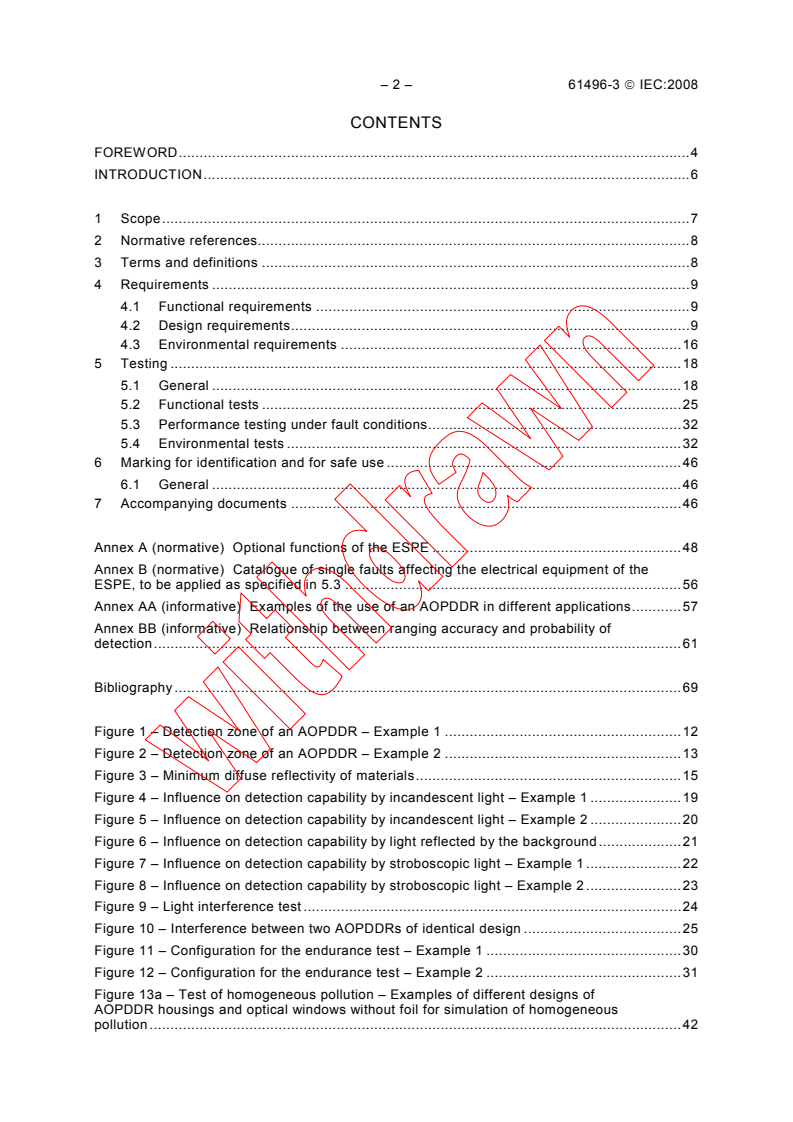
– 2 – 61496-3 © IEC:2008
CONTENTS
FOREWORD.4
INTRODUCTION.6
1 Scope.7
2 Normative references.8
3 Terms and definitions .8
4 Requirements .9
4.1 Functional requirements .9
4.2 Design requirements.9
4.3 Environmental requirements .16
5 Testing .18
5.1 General .18
5.2 Functional tests .25
5.3 Performance testing under fault conditions.32
5.4 Environmental tests .32
6 Marking for identification and for safe use .46
6.1 General .46
7 Accompanying documents .46
Annex A (normative) Optional functions of the ESPE .48
Annex B (normative) Catalogue of single faults affecting the electrical equipment of the
ESPE, to be applied as specified in 5.3 .56
Annex AA (informative) Examples of the use of an AOPDDR in different applications.57
Annex BB (informative) Relationship between ranging accuracy and probability of
detection.61
Bibliography .69
Figure 1 – Detection zone of an AOPDDR – Example 1 .12
Figure 2 – Detection zone of an AOPDDR – Example 2 .13
Figure 3 – Minimum diffuse reflectivity of materials.15
Figure 4 – Influence on detection capability by incandescent light – Example 1 .19
Figure 5 – Influence on detection capability by incandescent light – Example 2 .20
Figure 6 – Influence on detection capability by light reflected by the background.21
Figure 7 – Influence on detection capability by stroboscopic light – Example 1 .22
Figure 8 – Influence on detection capability by stroboscopic light – Example 2 .23
Figure 9 – Light interference test .24
Figure 10 – Interference between two AOPDDRs of identical design .25
Figure 11 – Configuration for the endurance test – Example 1 .30
Figure 12 – Configuration for the endurance test – Example 2 .31
Figure 13a – Test of homogeneous pollution – Examples of different designs of
AOPDDR housings and optical windows without foil for simulation of homogeneous
pollution .42
61496-3 © IEC:2008 – 3 –
Figure 13b – Test of homogeneous pollution – Examples of different designs of
AOPDDR housings and optical windows – Examples of correct positions of the foil.43
Figure 13c – Test of homogeneous pollution – Examples of different designs of
AOPDDR housings and optical windows – Examples of incorrect positions of the foil .43
Figure 14 – Influence on detection capability by background .44
Figure A.1 – Use of an AOPDDR as a whole-body trip device – Example 1 .51
Figure A.2 – Use of an AOPDDR as a whole-body trip device – Example 2 .52
Figure A.3 – Use of an AOPDDR as parts of a body trip device – Example 1.54
Figure A.4 – Use of an AOPDDR as parts of a body trip device – Example 2.54
Figure AA.1 – Example of the use of an AOPDDR on machinery.58
Figure AA.2 – Example of the use of an AOPDDR on an AGV.59
Figure BB.1 – Relationship between ranging accuracy and detection zone .61
Figure BB.2 – Relationship between ranging accuracy, detection zone and the
probabilistic part of the tolerance zone – Example 1 .62
Figure BB.3 – Relationship between ranging accuracy, detection zone and the
probabilistic part of the tolerance zone – Example 2 .63
Figure BB.4 – Relationship between ranging accuracy, detection zone and tolerance
zone – Example 1 .64
Figure BB.5 – Relationship between ranging accuracy, detection zone and tolerance
zone – Example 2 .65
Figure BB.6 – Reference boundary monitoring – Distribution of measurement values –
Example 1.66
Figure BB.7 – Reference boundary monitoring – Distribution of measurement values –
Example 2.66
Figure BB.8 – POD of a single measurement (logarithmic) for a MooM-evaluation with 1
≤ M ≤ 50 .67
Figure BB.9 – POD of a single measurement for a MooM-evaluation with 1 ≤ M ≤ 50 in
relation to σ in the case of a normal distribution.68
Table 1 – Minimum tests required for the verification of detection capability
requirements (see also 4.2.12.1) .27
Table 2 – Overview of light interference tests .36
– 4 – 61496-3 © IEC:2008
INTERNATIONAL ELECTROTECHNICAL COMMISSION
____________
SAFETY OF MACHINERY –
ELECTRO-SENSITIVE PROTECTIVE EQUIPMENT –
Part 3: Particular requirements for Active Opto-electronic
Protective Devices responsive to
Diffuse Reflection (AOPDDR)
FOREWORD
1) The International Electrotechnical Commission (IEC) is a worldwide organization for standardization comprising
all national electrotechnical committees (IEC National Committees). The object of IEC is to promote
international co-operation on all questions concerning standardization in the electrical and electronic fields. To
this end and in addition to other activities, IEC publishes International Standards, Technical Specifications,
Technical Reports, Publicly Available Specifications (PAS) and Guides (hereafter referred to as “IEC
Publication(s)”). Their preparation is entrusted to technical committees; any IEC National Committee interested
in the subject dealt with may participate in this preparatory work. International, governmental and non-
governmental organizations liaising with the IEC also participate in this preparation. IEC collaborates closely
with the International Organization for Standardization (ISO) in accordance with conditions determined by
agreement between the two organizations.
2) The formal decisions or agreements of IEC on technical matters express, as nearly as possible, an international
consensus of opinion on the relevant subjects since each technical committee has representation from all
interested IEC National Committees.
3) IEC Publications have the form of recommendations for international use and are accepted by IEC National
Committees in that sense. While all reasonable efforts are made to ensure that the technical content of IEC
Publications is accurate, IEC cannot be held responsible for the way in which they are used or for any
misinterpretation by any end user.
4) In order to promote international uniformity, IEC National Committees undertake to apply IEC Publications
transparently to the maximum extent possible in their national and regional publications. Any divergence
between any IEC Publication and the corresponding national or regional publication shall be clearly indicated in
the latter.
5) IEC provides no marking procedure to indicate its approval and cannot be rendered responsible for any
equipment declared to be in conformity with an IEC Publication.
6) All users should ensure that they have the latest edition of this publication.
7) No liability shall attach to IEC or its directors, employees, servants or agents including individual experts and
members of its technical committees and IEC National Committees for any personal injury, property damage or
other damage of any nature whatsoever, whether direct or indirect, or for costs (including legal fees) and
expenses arising out of the publication, use of, or reliance upon, this IEC Publication or any other IEC
Publications.
8) Attention is drawn to the Normative references cited in this publication. Use of the referenced publications is
indispensable for the correct application of this publication.
9) Attention is drawn to the possibility that some of the elements of this IEC Publication may be the subject of
patent rights. IEC shall not be held responsible for identifying any or all such patent rights.
International Standard IEC 61496-3 has been prepared by IEC technical committee 44: Safety
of machinery – Electrotechnical aspects, in collaboration with CENELEC technical committee
44X: Safety of machinery – Electrotechnical aspects.
This second edition cancels and replaces the first edition issued in 2001 and constitutes a
technical revision.
The most important changes and improvements compared to the first edition of this part of the
standard are:
– extension of the range of detection capability covered by this part of the standard from
50 mm to 100 mm to the range of 30 mm to 200 mm;
– clarification of requirements for the selection of multiple detection zones (Clause A.10);
61496-3 © IEC:2008 – 5 –
– more detailed information about the use of an AOPDDR as a whole body trip device by
extension of Clause A.12 and a new Clause A.13;
– improved description of the relationship between ranging accuracy and probability of
detection (Annex BB).
This International Standard is to be used in conjunction with IEC 61496-1.
The text of this standard is based on the following documents:
FDIS Report on voting
44/572/FDIS 44/578/RVD
Full information on the voting for the approval of this standard can be found in the report on
voting indicated in the above table.
This publication has been drafted in accordance with the ISO/IEC Directives, Part 2.
A list of all parts of IEC 61496 series, under the general title Safety of machinery – Electro-
sensitive protective equipment, can be found on the IEC website.
The committee has decided that the contents of this publication will remain unchanged until the
maintenance result date indicated on the IEC web site under "http://webstore.iec.ch" in the data
related to the specific publication. At this date, the publication will be
• reconfirmed,
• withdrawn,
• replaced by a revised edition, or
• amended.
This standard has the status of a dedicated product standard and may be used as a normative
reference in a dedicated product standard for the safety of machinery.
– 6 – 61496-3 © IEC:2008
INTRODUCTION
An electro-sensitive protective equipment (ESPE) is applied to machinery presenting a risk of
personal injury. It provides protection by causing the machine to revert to a safe condition
before a person can be placed in a hazardous situation.
This part supplements or modifies the corresponding clauses in IEC 61496-1 to specify
particular requirements for the design, construction and testing of electro-sensitive protective
equipment (ESPE) for the safeguarding of machinery, employing active opto-electronic
protective devices responsive to diffuse reflection (AOPDDRs) for the sensing function.
Where a particular clause or subclause of part 1 is not mentioned in this part 3, that clause or
subclause applies as far as is reasonable. Where this part states "addition", "modification" or
"replacement", the relevant text of part 1 should be adapted accordingly.
Supplementary Annexes are entitled AA, BB, etc.
Each type of machine presents its own particular hazards, and it is not the purpose of this
standard to recommend the manner of application of the ESPE to any particular machine. The
application of the ESPE should be a matter for agreement between the equipment supplier, the
machine user and the enforcing authority. In this context, attention is drawn to the relevant
guidance established internationally, for example, ISO/TR 12100.
Due to the complexity of the technology there are many issues that are highly dependent on
analysis and expertise in specific test and measurement techniques. In order to provide a high
level of confidence, independent review by relevant expertise is recommended.
61496-3 © IEC:2008 – 7 –
SAFETY OF MACHINERY –
ELECTRO-SENSITIVE PROTECTIVE EQUIPMENT –
Part 3: Particular requirements for Active Opto-electronic
Protective Devices responsive to
Diffuse Reflection (AOPDDR)
1 Scope
Replacement:
This part of IEC 61496 specifies additional requirements for the design, construction and
testing of non-contact electro-sensitive protective equipment (ESPE) designed specifically to
detect persons as part of a safety related system, employing active opto-electronic protective
devices responsive to diffuse reflection (AOPDDRs) for the sensing function. Special attention
is directed to requirements which ensure that an appropriate safety-related performance is
achieved. An ESPE may include optional safety-related functions, the requirements for which
are given both in Annex A of this part and in Annex A of IEC 61496-1.
This part does not specify the dimensions or configurations of the detection zone and its
disposition in relation to hazardous parts for any particular application, nor what constitutes a
hazardous state of any machine. It is restricted to the functioning of the ESPE and how it
interfaces with the machine.
AOPDDRs are devices that have a detection zone specified in two dimensions wherein
radiation in the near infrared range is emitted by a transmitter element(s). When the emitted
radiation impinges on an object (for example, a person or part of a person), a portion of the
emitted radiation is reflected to a receiving element(s) by diffuse reflection whereby the
presence of the object can be detected.
NOTE 1 Under certain circumstances, limitations of the sensor in relation to its use need to be considered. For
example:
– Objects that generate mirror-like (specular) reflections may not be detected if the diffuse reflectance value is
less than that specified for the "black" test piece.
– The determination of the minimal reflection factors for the detection of obstacles is based on the clothing of a
person. Objects having a reflectivity lower than that considered in this part may not be detected.
Excluded from this part are AOPDDRs employing radiation of wavelength outside the range
820 nm to 946 nm, and those employing radiation other than that generated by the AOPDDR
itself. For sensing devices that employ radiation of wavelengths outside this range, this part
may be used as a guide. This part is relevant for AOPDDRs having a stated detection capability
in the range from 30 mm to 200 mm. AOPDDRs intended for use as trip device using whole-
body detection with normal approach to the detection zone and having a stated detection
capability not exceeding 200 mm shall meet the requirements of Clause A.12. AOPDDRs
intended for a direction of approach normal to the detection zone and having a stated detection
capability in the range from 30 mm to 70 mm shall meet the requirements of Clause A.13.
NOTE 2 According to ISO 13855 (EN 999), 6.3 foreseeable angles of approach greater than 30” should be
considered normal approach and foreseeable angles of approach less than 30” should be considered parallel
approach.
NOTE 3 According to ISO 13855 (EN 999), 6.2 when electro-sensitive protective equipment employing active opto-
electronic protective devices is used for direction of approach parallel to the detection zone the device should have
a detection capability in the range from 50 mm to 117 mm.
– 8 – 61496-3 © IEC:2008
This part may be relevant to applications other than those for the protection of persons, for
example, for the protection of machinery or products from mechanical damage. In those
applications, different requirements may be necessary, for example when the materials that
have to be recognized by the sensing function have different properties from those of persons
and their clothing.
This part does not deal with electromagnetic compatibility (EMC) emission requirements.
Opto-electronic devices that perform only one-dimensional spot-like distance measurements,
for example, proximity switches, are not covered by this part.
2 Normative references
Addition:
IEC 60068-2-14:1984, Basic environmental testing procedures – Part 2: Tests – Test N:
Change of temperature
Amendment 1 (1986)
IEC 60068-2-75:1997-08, Environmental testing – Part 2-75: Tests – Test Eh: Hammer tests
IEC 60825-1, Safety of laser products – Part 1: Equipment classification, requirements and
user’s guide
IEC 61496-1:2004, Safety of machinery – Electro-sensitive protective equipment – Part 1:
General requirements and tests
IEC 62046 , Safety of machinery – Application of protective equipment to detect the presence
of persons
ISO 13855:2002, Safety of machinery – Positioning of protective equipment with respect to the
approach speeds of parts of the human body
EN 471:2003-09, High-visibility warning clothing for professional use – Test methods and
requirements
3 Terms and definitions
Replacement:
3.4
detection zone
zone within which the specified test piece(s) (see 4.2.13) is detected by the AOPDDR with a
minimum required probability of detection (see 4.2.12.2)
NOTE A tolerance zone is necessary to achieve the required probability of detection of the specified test piece(s)
within the detection zone.
Addition:
———————
To be published.
61496-3 © IEC:2008 – 9 –
3.301
active opto-electronic protective device responsive to diffuse reflection
AOPDDR
device, whose sensing function is performed by opto-electronic emitting and receiving
elements, that detects the diffuse reflection of optical radiations generated within the device by
an object present in a detection zone specified in two dimensions
3.302
AOPDDR detection capability
ability to detect the specified test pieces (see 4.2.13) in the detection zone
NOTE A list of influences which can affect the AOPDDR detection capability is given in 4.2.12.1.
3.303
tolerance zone
zone outside of and adjacent to the detection zone within which the specified test piece(s) (see
4.2.13) is detected with a probability of detection lower than the required probability within the
detection zone. The tolerance zone is necessary to achieve the required probability of detection
of the specified test piece(s) within the detection zone
NOTE For explanation of the concept of probability of detection and the tolerance zone see Annex BB.
4 Requirements
This clause of part 1 is applicable except as follows:
4.1 Functional requirements
4.1.3 Types of ESPE
Replacement:
In this part of IEC 61496 only a type 3 ESPE is considered. It is the responsibility of the
machine supplier and/or the user to prescribe if this type is suitable for a particular application.
The type 3 ESPE shall fulfil the fault detection requirements of 4.2.2.4 of this part. In normal
operation, the output circuit of each of at least two output signal switching devices (OSSDs) of
the type 3 ESPE shall go to the OFF-state when the sensing device is actuated, or when the
power is removed from the device.
Additional functional requirements:
4.1.4 Zone(s) with limited detection capability
A zone between the optical window and the beginning of the detection zone is referred to as a
zone with limited detection capability. In order to ensure no hazard can arise in a particular
application due to the presence of this zone(s) between the optical window and the detection
zone, its dimensions and appropriate information for use shall be provided by the supplier.
A zone with limited detection capability shall not extend more than 50 mm from the optical
window in the plane of detection.
4.2 Design requirements
4.2.2 Fault detection requirements
4.2.2.2 Particular requirements for a type 1 ESPE
This subclause of part 1 is not applicable.
– 10 – 61496-3 © IEC:2008
4.2.2.3 Particular requirements for a type 2 ESPE
This subclause of part 1 is not applicable.
4.2.2.4 Particular requirements for a type 3 ESPE
Replacement:
A single fault in the sensing device resulting in a complete loss of the stated AOPDDR
detection capability shall cause the ESPE to go to a lock-out condition within the specified
response time.
NOTE 1 For AOPDDR using rotating mirrors for scanning the detection zone, this requirement can be fulfilled by
scanning on a defined reference object located outside the detection zone and the tolerance zone.
A single fault resulting in a deterioration of the stated AOPDDR detection capability shall cause
the ESPE to go to a lock-out condition within a time period of 5 s following the occurrence of
that fault.
NOTE 2 Examples of deterioration of the AOPDDR detection capability include:
– increase of the minimum detectable object size;
– increase in the minimum detectable reflectance;
– decrease of measurement accuracy.
A single fault resulting in an increase in response time beyond the specified value or preventing
at least one OSSD going to the OFF-state shall cause the ESPE to go to a lock-out condition
immediately, i.e. within the response time, or immediately upon any of the following demand
events where fault detection requires a change in state:
– on actuation of the sensing function;
– on switch off/on;
– on reset of the start interlock or the restart interlock, if available (see Clauses A.5 and A.6
of IEC 61496-1);
– on the application of an external test signal, if available.
NOTE 3 An external test signal may be required if, for example, in a particular application, the frequency of
actuation of the sensing function is foreseeably low and the OSSDs are monitored only at the change of state.
It shall not be possible for the ESPE to achieve a reset from a lock-out condition, for example,
by interruption and restoration of the mains power supply or by any other means, when the fault
which initiated the lock-out condition is still present.
In cases where a single fault which does not cause a failure to danger of the ESPE is not
detected, the occurrence of further faults shall not cause a failure to danger. For verification of
this requirement, see 5.3.4.
4.2.2.5 Particular requirements for a type 4 ESPE
This subclause of part 1 is not applicable.
Additional design requirements:
4.2.12 Integrity of the AOPDDR detection capability
4.2.12.1 General
The design of the AOPDDR shall ensure that the detection capability is not decreased below
the limits specified by the supplier and in this standard by any of, but not limited to, the
following:
61496-3 © IEC:2008 – 11 –
− ageing of components;
− component tolerances (for example, spectral sensitivity of the receiver element);
− distance-dependent changes of sensitivity related for example to optics;
− limits of adjustment;
− insecure fixing of optical and mechanical components within the AOPDDR;
− environmental interference, especially:
a) system noise;
b) electrical interference according to 4.3.2 of IEC 61496-1;
c) pollution on the surface of the optical window of the housing;
d) condensation on the surface of the optical window of the housing;
e) ambient temperature;
f) ambient light;
g) background (for example, contrast between object and background);
h) vibration and bump;
i) humidity;
j) supply voltage variations and interruptions;
k) reflections of emitted light(s) from parts of the surrounding especially for devices with
more than one transmitting and/or receiving element.
If a single fault (as specified in Annex B of IEC 61496-1), which under normal operating
conditions (see 5.1.2.1 of IEC 61496-1) would not result in a loss of the stated AOPDDR
detection capability but, when occurring with a combination of the above conditions, would
result in such a loss, that fault, together with that combination of conditions, shall be
considered as a single fault and the AOPDDR shall respond to such a single fault as required
in 4.2.2.4.
NOTE The technique of scanning on a reference object can satisfy the requirement in respect of ageing of
components. Other techniques giving the same level of assurance may be used.
4.2.12.2 Detection zone(s) and tolerance zone(s)
The supplier shall specify the tolerance zone(s).
The supplier shall take into account worst-case conditions including, for example, signal-to-
noise ratio S/N and standard deviation σ considering all influences listed in this standard and
any additional influences specified by the supplier (environmental influence, component faults,
etc.).
The tolerance zone depends on systematic interferences, measurement faults, resolution of the
measurement values, etc. and is necessary to ensure the required detection probability within
the detection zone. Figures 1 and 2 show examples of tolerance zones.
– 12 – 61496-3 © IEC:2008
Top view
b
a
IEC 035/08
Key
1 Detection zone within which the specified test piece(s) is detected by the AOPDDR with a minimum required
probability of detection.
2 Tolerance zone (detection not assured).
3 Zone with limited detection capability (detection not assured).
4 AOPDDR
NOTE 1 For an application of the AOPDDR, it may be necessary to take into account that the size of parts of the
tolerance zone can be related for example to the diameter of the test piece and the beam position (see value of "a").
The value of "b" corresponds for example to the distance measurement accuracy.
NOTE 2 The detection zone origin is marked by a cross.
Figure 1 – Detection zone of an AOPDDR – Example 1
61496-3 © IEC:2008 – 13 –
Top view
a b
IEC 036/08
Key
1 Detection zone
2 Tolerance zone
3 AOPDDR
NOTE The value of "a" corresponds for example to the diameter of the test piece and the beam position. The
value of "b" corresponds for example to the distance measurement accuracy.
Figure 2 – Detection zone of an AOPDDR – Example 2
The test pieces (see 4.2.13) shall be detected with a minimum probability of detection of
–7
1 – 2,9 × 10 throughout the detection zone(s). To achieve this minimum probability of detection,
the tolerance zone is added to the detection zone (see Figure BB.2). Even if a measured
distance value of a test piece falls into the tolerance zone this test piece will be determined as
detected and the OSSDs shall go to the OFF-state or remain in the OFF-state.
NOTE 1 The tolerance zone is not included in the detection zone.
NOTE 2 Probability of detection as used in this part is not related to the probability of faults.
NOTE 3 Special attention may be required when the detection zone of AOPDDR is made up by more than one
transmitting and/or receiving unit to ensure that the AOPDDR detection capability is not affected between the fields
of view of these units.
When a test piece is placed on the boundary between the detection zone and the tolerance
zone (i.e. on the border of the detection zone) the measured distance values of this test piece
shall be the median point of the distribution of measurement values determined using a test
piece with a reflectivity of any value from that of the "black" test piece to that of the "white" test
piece. The supplier shall document the reflectivity of the test piece and the calculations used.
This requirement may be verified by inspection of the supplier's documentation.
NOTE 4 The value for the ranging accuracy and the tolerance zone is not necessarily a constant. It can, for
example, be a function of the measurement distance.
a b
– 14 – 61496-3 © IEC:2008
NOTE 5 If the AOPDDR has a facility to automatically set its detection zone(s), the ranging error of the set values
is taken into account when determining the tolerance zone (see Clause A.11).
NOTE 6 Annex BB gives additional information about the relationship between ranging accuracy and probability of
detection.
4.2.12.3 Scanning geometry, scanning frequency and response time
The supplier shall specify the relevant parameters of the detection zone(s), including range and
scanning angle. The scanning geometry and/or scanning frequency shall be sufficient to ensure
that a test piece with a diameter of the specified minimum detectable object size is detected at
the maximum range of the detection zone(s). The supplier shall define values in the range of
30 mm to 200 mm as the minimum detectable object size of the AOPDDR. The minimum
detectable object size may be distance dependent.
NOTE 1 The restriction of the minimum detectable object size to the range of 30 mm to 200 mm is based on
current applications. Additional requirements may be necessary for AOPDDRs having detection capabilities outside
this range.
Objects of the minimum detectable size that are either stationary or moving within the detection
zone at any speed up to 1,6 m/s shall be detected by the ESPE within the specified response
time. The response time shall be determined by the supplier taking into account worst-case
conditions, especially for the scanning frequency and the movement of objects. Where the
supplier states that an AOPDDR can be used to detect objects moving at speeds greater than
1,6 m/s, the requirements shall be met at any speed up to and including the stated maximum
speed(s).
NOTE 2 The detection capability may be determined by the optical geometry of the AOPDDR so that one complete
beam will impinge on the specified test pieces in the maximum range of detection zone and tolerance zone for a
special design. In this case, the distance between the centre of two adjacent transmitter beams (except the first and
the last one) will not exceed half the diameter of the test pieces. For other designs, it can be more difficult to carry
out the verification according to 5.2.1.2 and 5.2.11, especially when movement of objects is taken into account, as
required above.
NOTE 3 An example for the calculation of the response time is given in Clause AA.5.
All points on a path projected from any point on the border of the detection zone to the
receiving element(s) of the AOPDDR shall be within the detection zone (see 4.2.12.2) or the
zone with limited detection capability (see 4.1.4).
4.2.13 Test pieces for type testing
4.2.13.1 General
The test pieces are part of the AOPDDR and shall therefore be provided by the supplier for use
in the type tests of Clause 5. They shall be marked with a type reference and identification of
the AOPDDR with which they are intended to be used.
The test pieces shall have a diameter equal to the maximum specified detection capability
(minimum diameter). Other diameters within the range of 30 mm to 200 mm may be required
for testing depending on the detection capability of the AOPDDR.
NOTE The minimum effective length of the test pieces has been selected for ease of use.
4.2.13.2 Black test piece
The black test piece shall be a cylinder with a minimum effective length of 0,3 m. The surface
of the test piece shall have a diffuse reflectance value in the range of 1,6 % to 2,0 % including
measurement accuracy, at the wavelength of the transmitter and under normal conditions. This
value shall be verified by measurement. Where this reflectance value is used for calculation,
the nominal value of 1,8 % shall be used.
61496-3 © IEC:2008 – 15 –
NOTE Figure 3 shows the results of an investigation to determine the reflectance of the black test piece
(performed by Berufsgenossenschaftliches Institut für Arbeitsschutz, 53754 Sankt Augustin, Germany).
β*
2,5
2,0
1,5
1,0
0,5
780 790 800 809 819 832 846 857 867 881 895 906 917 931 946 W
1 2 3 4 5 6
IEC 037/08
Key
1 Black velvet MG 20/5
2 Black broad corduroy MG 0/5
3 Black plastic foam MG 0/5
4 Black gumboot MG 20/5
5 Black synthetic material MG 20/5
6 Black shoe leather MG 20/5
W Wavelength [nm]
β* Coefficient of diffuse reflection [%]
NOTE A measurement geometry (MG) of, for example, 0/5 is represented by an entrance angle of 0° and an
observation angle of 5°. The entrance angle characterizes the angular position of the tested material with respect to
the direction of the incident light. The observation angle is the angle by which the direction of the observation of the
tested material differs from the direction of the incident light.
Figure 3 – Minimum diffuse reflectivity of materials
4.2.13.3 White test piece
The white test piece shall be a cylinder with a minimum effective length of 0,3 m. The surface
of the test piece shall have a diffuse reflectance value in the range of 80 % to 90 % at the
wavelength of the transmitter.
4.2.13.4 Retro-reflective test piece
The retro-reflective test piece shall be a cylinder with a minimum effective length of 0,3 m. The
surface of the test piece shall be of retro-reflecting material. The material shall comply with the
requirements for retro-reflection of EN 471 class 2 or equivalent.
– 16 – 61496-3 © IEC:2008
–1
NOTE Table 5 of EN 471 defines the minimum coefficient of retro-reflection for class 2 material as 330 cd ⋅ lx ⋅
–2
m with an entrance angle of 5° and an observation angle of 0,2° (12').
4.2.14 Wavelength
AOPDDRs shall operate at a wavelength within the range of 820 nm to 946 nm.
NOTE This range of wavelengths is based on the present availability of components together with research which
shows it to be suitable for materials used as clothing.
4.2.15 Radiation intensity
The radiation intensity generated and emitted by the AOPDDR shall at no time, even in the
presence of a component failure, exceed the maximum power or energy levels for a class 1M
laser in accordance with IEC 60825-1. The marking as a class 1 laser shall be carried out as
required in 5.2 of IEC 60825-1.
4.2.16 Mechanical construction
When the detection capability can be decreased below the limit stated by the supplier, as a
result of a change of position of components, the fixing of those components shall not rely
solely on friction.
NOTE The use of oblong mounting holes without additional means could lead for example to a change of the
position of the detection zone under mechanical interference such as bump.
4.3 Environmental requirements
Addition:
NOTE These requirements may not fulfil the needs of certain applications (for example: use on vehicles, including
automatic guided vehicles (AGVs), forklifts, mobile machinery, etc.).
4.3.1 Ambient air temperature range and humidity
Addition:
The ESPE shall not fail to danger when subjected to a rapid change of temperature and
humidity leading to condensation on the optical window.
This requirement is verified by the condensing test of 5.4.2.
4.3.3 Mechanical environment
Additional mechanical requirements:
4.3.3.3 Change of temperature
The ESPE shall be free of damage, including displacement and/or cracks of the optical window,
after the tests of 5.4.4.3 and it shall be capable of continuing in normal operation.
4.3.3.4 Impact resistance
4.3.3.4.1 Normal operation
The ESPE
...