

IEC TS 60825-20:2025
(Main)Safety of laser products - Part 20: Safety requirements for products intentionally exposing face or eyes to laser radiation
General Information
- Abstract
IEC TS 60825-20:2025 provides radiation safety requirements (normative) and guidelines (informative) for the consideration of faults for Class 1 laser devices with laser radiation directed towards the eyes or face. Requirements for the safety of the nominal emission are not in the scope of this document.
Examples:
− devices with laser light facial or ocular recognition;
− virtual reality headsets or glasses;
− devices with gesture tracking via eye or facial movements;
− driver surveillance cameras;
− full body scanners (including eyes, face, and body).
Products exempted from this document include:
− medical and ophthalmic devices;
− automotive (lidars), lamps;
− laser applications where the laser is used in a professional (non-consumer) setting and is intended for direct or long-time exposure of the eyes or face.
This document provides normative requirements and informative guidelines for:
− radiation safety analysis;
− production-line testing;
− hazard analysis for laser radiation emissions (using a modified safety-focused FMEA approach)
NOTE all subsequent references to FMEA in this document refers to this safety-focused FMEA approach.
− examples of typical failure modes and mitigation techniques
- Status
- Published
- Publication Date
- 22-Sep-2025
- Technical Committee
- TC 76 - Optical radiation safety and laser equipment
- Drafting Committee
- WG 1 - TC 76/WG 1
- Current Stage
- PPUB - Publication issued
- Start Date
- 23-Sep-2025
- Completion Date
- 25-Jul-2025
Overview - IEC TS 60825-20:2025 (Safety of laser products)
IEC TS 60825-20:2025 establishes radiation safety requirements (normative) and guidance (informative) focused on fault conditions for Class 1 laser devices that intentionally direct laser radiation toward the face or eyes. The document does not address safety of the nominal emission; instead it targets how products should manage foreseeable failures, production testing, and mitigation to prevent excessive eye/face exposure.
Typical product examples covered:
- Laser-based facial or ocular recognition systems
- Virtual reality (VR) headsets and glasses
- Gesture- and eye-tracking devices
- Driver surveillance cameras and full body scanners
Exemptions include medical/ophthalmic devices, automotive lidars and lamps, and professional laser applications intended for direct or long-term face/eye exposure.
Key Topics and Requirements
- Risk analysis and risk management: A structured 10-step process for identifying intended use, hazards, severity, occurrence, and final risk categorization.
- Safety-focused FMEA: A modified Failure Mode and Effects Analysis (FMEA) tailored to laser radiation hazards - normative methodology for analyzing faults, causes, effects, and controls.
- Production-line testing: Normative requirements and guidance for verifying safety measures during manufacturing and post-production.
- Hazard analysis and mitigation: Examples of typical failure modes, recommended mitigation techniques, and documentation requirements.
- Labelling and documentation: Requirements for marking and documenting safety-related information for devices that direct lasers at the face/eyes.
- Informative annexes: Worked FMEA examples, manufacturing process FMEA, emission-limit background (Annex E), and guidance on future product changes.
Applications and Who Uses It
This technical specification is essential for:
- Product designers and safety engineers developing consumer electronics that incorporate eye/face-directed lasers (e.g., VR/AR, eye-tracking, facial recognition).
- Compliance and regulatory teams assessing product risk and preparing conformity documentation.
- Manufacturers and production engineers implementing production-line testing and manufacturing FMEA.
- Test laboratories and certification bodies evaluating fault conditions and mitigation effectiveness.
Use cases include designing fail-safe optics, specifying control software behavior for fault scenarios, performing safety-focused FMEA, and establishing production verification plans.
Related Standards
- IEC TS 60825-20 complements and compares against IEC 60825-1 (laser product classification and nominal emission limits) and provides focused, fault-analysis guidance for Class 1 devices directing radiation toward the face and eyes.
Keywords: IEC TS 60825-20:2025, safety of laser products, Class 1 laser devices, laser radiation, FMEA, risk analysis, VR headsets, facial recognition, production-line testing.
Get Certified
Connect with accredited certification bodies for this standard

CIS Institut d.o.o.
Personal Protective Equipment (PPE) certification body. Notified Body NB-2890 for EU Regulation 2016/425 PPE.

Kiwa BDA Testing
Building and construction product certification.
Kmetijski inštitut Slovenije
Agricultural Institute of Slovenia. Soil testing, plant health, agricultural product analysis.
Sponsored listings
Frequently Asked Questions
IEC TS 60825-20:2025 is a technical specification published by the International Electrotechnical Commission (IEC). Its full title is "Safety of laser products - Part 20: Safety requirements for products intentionally exposing face or eyes to laser radiation". This standard covers: IEC TS 60825-20:2025 provides radiation safety requirements (normative) and guidelines (informative) for the consideration of faults for Class 1 laser devices with laser radiation directed towards the eyes or face. Requirements for the safety of the nominal emission are not in the scope of this document. Examples: − devices with laser light facial or ocular recognition; − virtual reality headsets or glasses; − devices with gesture tracking via eye or facial movements; − driver surveillance cameras; − full body scanners (including eyes, face, and body). Products exempted from this document include: − medical and ophthalmic devices; − automotive (lidars), lamps; − laser applications where the laser is used in a professional (non-consumer) setting and is intended for direct or long-time exposure of the eyes or face. This document provides normative requirements and informative guidelines for: − radiation safety analysis; − production-line testing; − hazard analysis for laser radiation emissions (using a modified safety-focused FMEA approach) NOTE all subsequent references to FMEA in this document refers to this safety-focused FMEA approach. − examples of typical failure modes and mitigation techniques
IEC TS 60825-20:2025 provides radiation safety requirements (normative) and guidelines (informative) for the consideration of faults for Class 1 laser devices with laser radiation directed towards the eyes or face. Requirements for the safety of the nominal emission are not in the scope of this document. Examples: − devices with laser light facial or ocular recognition; − virtual reality headsets or glasses; − devices with gesture tracking via eye or facial movements; − driver surveillance cameras; − full body scanners (including eyes, face, and body). Products exempted from this document include: − medical and ophthalmic devices; − automotive (lidars), lamps; − laser applications where the laser is used in a professional (non-consumer) setting and is intended for direct or long-time exposure of the eyes or face. This document provides normative requirements and informative guidelines for: − radiation safety analysis; − production-line testing; − hazard analysis for laser radiation emissions (using a modified safety-focused FMEA approach) NOTE all subsequent references to FMEA in this document refers to this safety-focused FMEA approach. − examples of typical failure modes and mitigation techniques
IEC TS 60825-20:2025 is classified under the following ICS (International Classification for Standards) categories: 13.110 - Safety of machinery; 31.260 - Optoelectronics. Laser equipment. The ICS classification helps identify the subject area and facilitates finding related standards.
IEC TS 60825-20:2025 is available in PDF format for immediate download after purchase. The document can be added to your cart and obtained through the secure checkout process. Digital delivery ensures instant access to the complete standard document.
Standards Content (Sample)
IEC TS 60825-20 ®
Edition 1.0 2025-09
TECHNICAL
SPECIFICATION
Safety of laser products -
Part 20: Safety requirements for products intentionally exposing face or eyes to
laser radiation
ICS 13.110; 31.260 ISBN 978-2-8327-0718-0
All rights reserved. Unless otherwise specified, no part of this publication may be reproduced or utilized in any form or
by any means, electronic or mechanical, including photocopying and microfilm, without permission in writing from either
IEC or IEC's member National Committee in the country of the requester. If you have any questions about IEC copyright
or have an enquiry about obtaining additional rights to this publication, please contact the address below or your local
IEC member National Committee for further information.
IEC Secretariat Tel.: +41 22 919 02 11
3, rue de Varembé info@iec.ch
CH-1211 Geneva 20 www.iec.ch
Switzerland
About the IEC
The International Electrotechnical Commission (IEC) is the leading global organization that prepares and publishes
International Standards for all electrical, electronic and related technologies.
About IEC publications
The technical content of IEC publications is kept under constant review by the IEC. Please make sure that you have the
latest edition, a corrigendum or an amendment might have been published.
IEC publications search - IEC Products & Services Portal - products.iec.ch
webstore.iec.ch/advsearchform Discover our powerful search engine and read freely all the
The advanced search enables to find IEC publications by a publications previews, graphical symbols and the glossary.
variety of criteria (reference number, text, technical With a subscription you will always have access to up to date
committee, …). It also gives information on projects, content tailored to your needs.
replaced and withdrawn publications.
Electropedia - www.electropedia.org
The world's leading online dictionary on electrotechnology,
IEC Just Published - webstore.iec.ch/justpublished
Stay up to date on all new IEC publications. Just Published containing more than 22 500 terminological entries in English
details all new publications released. Available online and and French, with equivalent terms in 25 additional languages.
once a month by email. Also known as the International Electrotechnical Vocabulary
(IEV) online.
IEC Customer Service Centre - webstore.iec.ch/csc
If you wish to give us your feedback on this publication or
need further assistance, please contact the Customer
Service Centre: sales@iec.ch.
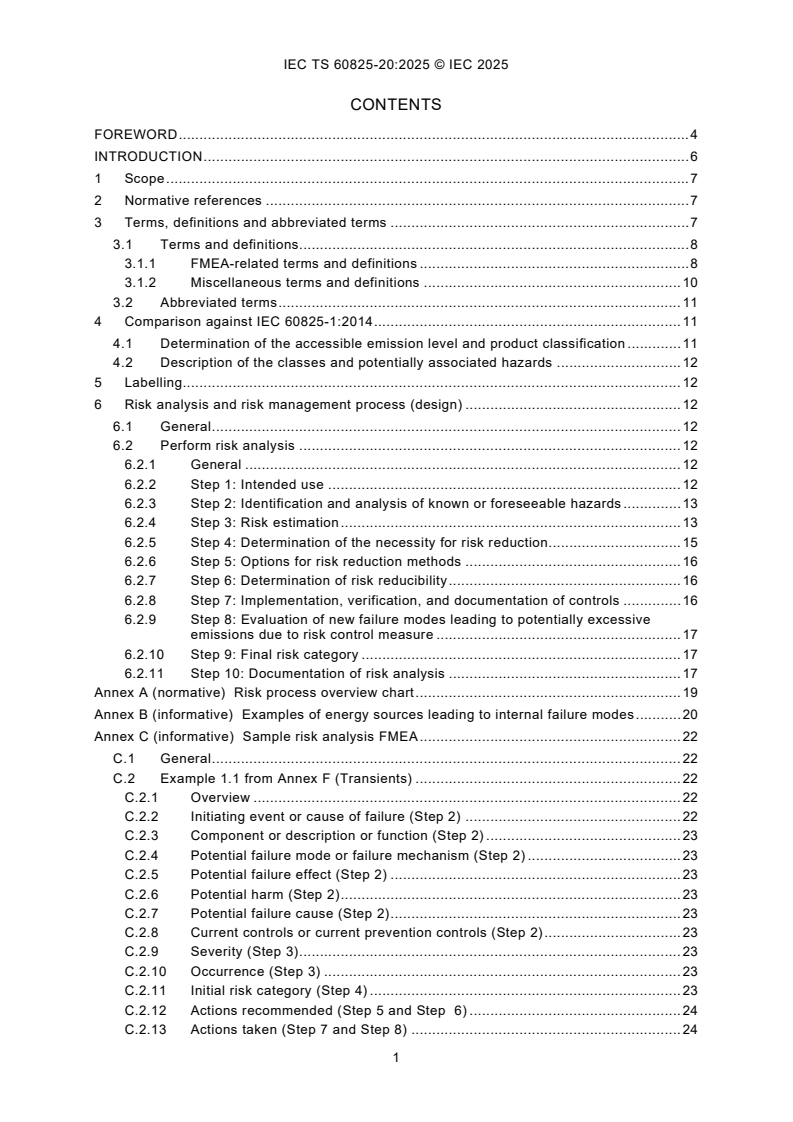
CONTENTS
FOREWORD . 4
INTRODUCTION . 6
1 Scope . 7
2 Normative references . 7
3 Terms, definitions and abbreviated terms . 7
3.1 Terms and definitions. 8
3.1.1 FMEA-related terms and definitions . 8
3.1.2 Miscellaneous terms and definitions . 10
3.2 Abbreviated terms . 11
4 Comparison against IEC 60825-1:2014 . 11
4.1 Determination of the accessible emission level and product classification . 11
4.2 Description of the classes and potentially associated hazards . 12
5 Labelling. 12
6 Risk analysis and risk management process (design) . 12
6.1 General . 12
6.2 Perform risk analysis . 12
6.2.1 General . 12
6.2.2 Step 1: Intended use . 12
6.2.3 Step 2: Identification and analysis of known or foreseeable hazards . 13
6.2.4 Step 3: Risk estimation . 13
6.2.5 Step 4: Determination of the necessity for risk reduction . 15
6.2.6 Step 5: Options for risk reduction methods . 16
6.2.7 Step 6: Determination of risk reducibility . 16
6.2.8 Step 7: Implementation, verification, and documentation of controls . 16
6.2.9 Step 8: Evaluation of new failure modes leading to potentially excessive
emissions due to risk control measure . 17
6.2.10 Step 9: Final risk category . 17
6.2.11 Step 10: Documentation of risk analysis . 17
Annex A (normative) Risk process overview chart . 19
Annex B (informative) Examples of energy sources leading to internal failure modes . 20
Annex C (informative) Sample risk analysis FMEA . 22
C.1 General . 22
C.2 Example 1.1 from Annex F (Transients) . 22
C.2.1 Overview . 22
C.2.2 Initiating event or cause of failure (Step 2) . 22
C.2.3 Component or description or function (Step 2) . 23
C.2.4 Potential failure mode or failure mechanism (Step 2) . 23
C.2.5 Potential failure effect (Step 2) . 23
C.2.6 Potential harm (Step 2) . 23
C.2.7 Potential failure cause (Step 2) . 23
C.2.8 Current controls or current prevention controls (Step 2) . 23
C.2.9 Severity (Step 3) . 23
C.2.10 Occurrence (Step 3) . 23
C.2.11 Initial risk category (Step 4) . 23
C.2.12 Actions recommended (Step 5 and Step 6) . 24
C.2.13 Actions taken (Step 7 and Step 8) . 24
C.2.14 Final risk category (Step 9) . 24
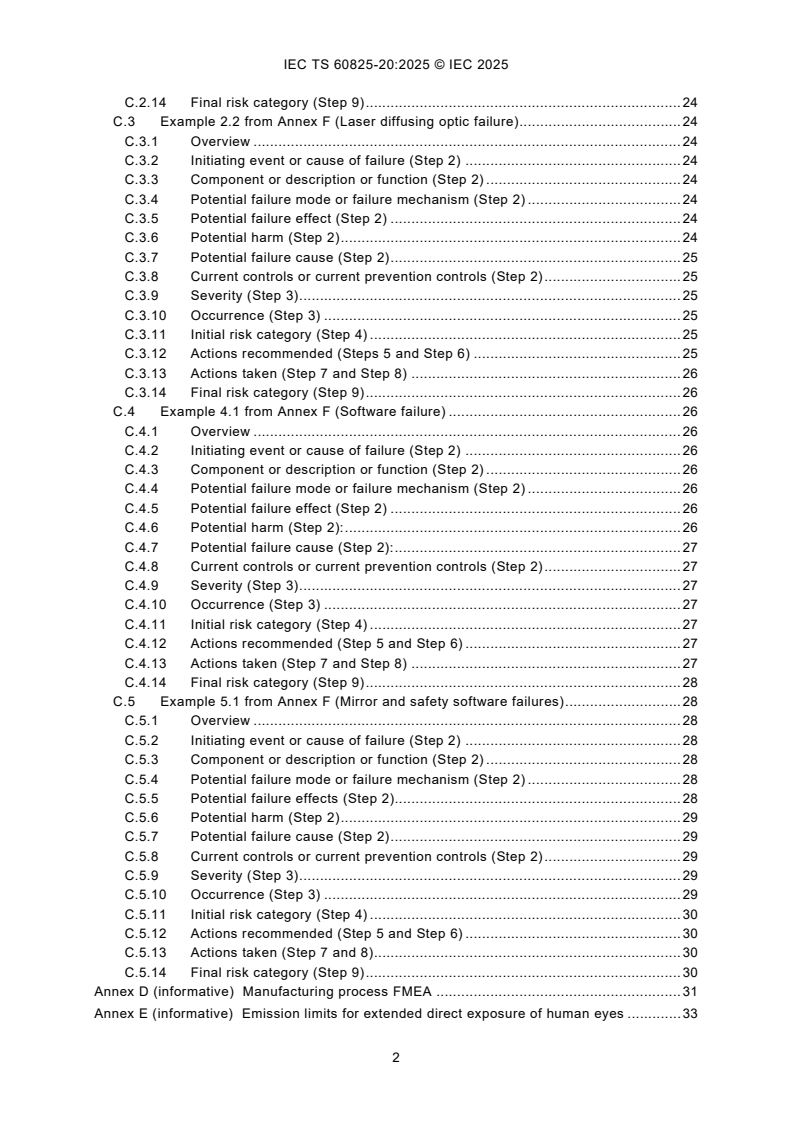
C.3 Example 2.2 from Annex F (Laser diffusing optic failure) . 24
C.3.1 Overview . 24
C.3.2 Initiating event or cause of failure (Step 2) . 24
C.3.3 Component or description or function (Step 2) . 24
C.3.4 Potential failure mode or failure mechanism (Step 2) . 24
C.3.5 Potential failure effect (Step 2) . 24
C.3.6 Potential harm (Step 2) . 24
C.3.7 Potential failure cause (Step 2) . 25
C.3.8 Current controls or current prevention controls (Step 2) . 25
C.3.9 Severity (Step 3) . 25
C.3.10 Occurrence (Step 3) . 25
C.3.11 Initial risk category (Step 4) . 25
C.3.12 Actions recommended (Steps 5 and Step 6) . 25
C.3.13 Actions taken (Step 7 and Step 8) . 26
C.3.14 Final risk category (Step 9) . 26
C.4 Example 4.1 from Annex F (Software failure) . 26
C.4.1 Overview . 26
C.4.2 Initiating event or cause of failure (Step 2) . 26
C.4.3 Component or description or function (Step 2) . 26
C.4.4 Potential failure mode or failure mechanism (Step 2) . 26
C.4.5 Potential failure effect (Step 2) . 26
C.4.6 Potential harm (Step 2): . 26
C.4.7 Potential failure cause (Step 2): . 27
C.4.8 Current controls or current prevention controls (Step 2) . 27
C.4.9 Severity (Step 3) . 27
C.4.10 Occurrence (Step 3) . 27
C.4.11 Initial risk category (Step 4) . 27
C.4.12 Actions recommended (Step 5 and Step 6) . 27
C.4.13 Actions taken (Step 7 and Step 8) . 27
C.4.14 Final risk category (Step 9) . 28
C.5 Example 5.1 from Annex F (Mirror and safety software failures) . 28
C.5.1 Overview . 28
C.5.2 Initiating event or cause of failure (Step 2) . 28
C.5.3 Component or description or function (Step 2) . 28
C.5.4 Potential failure mode or failure mechanism (Step 2) . 28
C.5.5 Potential failure effects (Step 2). 28
C.5.6 Potential harm (Step 2) . 29
C.5.7 Potential failure cause (Step 2) . 29
C.5.8 Current controls or current prevention controls (Step 2) . 29
C.5.9 Severity (Step 3) . 29
C.5.10 Occurrence (Step 3) . 29
C.5.11 Initial risk category (Step 4) . 30
C.5.12 Actions recommended (Step 5 and Step 6) . 30
C.5.13 Actions taken (Step 7 and 8) . 30
C.5.14 Final risk category (Step 9) . 30
Annex D (informative) Manufacturing process FMEA . 31
Annex E (informative) Emission limits for extended direct exposure of human eyes . 33
E.1 IEC 60825-1 emission limits for t > 1 000 s – General information and
background . 33
E.1.1 General . 33
E.1.2 Visible wavelength AELs . 33
E.1.3 Ultraviolet and infrared AELs . 33
E.2 Laser beams directed intentionally at the human face . 34
E.2.1 Current applications. 34
E.2.2 Historical record . 34
E.2.3 Comparison with lamp AELs . 35
E.3 Limits to protect the retina – the biological bases . 35
E.4 Anterior segment – lens and cornea . 36
E.5 Exposure acceptability during fault conditions . 36
E.6 Conclusion . 37
Annex F (informative) Risk analysis FMEA worksheet example . 38
Annex G (informative) Future product changes . 41
Bibliography . 42
Figure A.1 –Steps for the risk process flow . 19
Table 1 – Severity levels of harm classification (refer to Annex E) . 14
Table 2 – Occurrence levels . 15
Table 3 – Risk prioritization (SxO) matrix . 15
Table B.1 – Examples of external energy factors . 20
Table B.2 – Examples of resulting failure modes . 21
Table F.1 – Risk analysis FMEA worksheet example. 39
INTERNATIONAL ELECTROTECHNICAL COMMISSION
____________
Safety of laser products -
Part 20: Safety requirements for products
intentionally exposing face or eyes to laser radiation
FOREWORD
1) The International Electrotechnical Commission (IEC) is a worldwide organization for standardization comprising
all national electrotechnical committees (IEC National Committees). The object of IEC is to promote international
co-operation on all questions concerning standardization in the electrical and electronic fields. To this end and
in addition to other activities, IEC publishes International Standards, Technical Specifications, Technical Reports,
Publicly Available Specifications (PAS) and Guides (hereafter referred to as "IEC Publication(s)"). Their
preparation is entrusted to technical committees; any IEC National Committee interested in the subject dealt with
may participate in this preparatory work. International, governmental and non-governmental organizations liaising
with the IEC also participate in this preparation. IEC collaborates closely with the International Organization for
Standardization (ISO) in accordance with conditions determined by agreement between the two organizations.
2) The formal decisions or agreements of IEC on technical matters express, as nearly as possible, an international
consensus of opinion on the relevant subjects since each technical committee has representation from all
interested IEC National Committees.
3) IEC Publications have the form of recommendations for international use and are accepted by IEC National
Committees in that sense. While all reasonable efforts are made to ensure that the technical content of IEC
Publications is accurate, IEC cannot be held responsible for the way in which they are used or for any
misinterpretation by any end user.
4) In order to promote international uniformity, IEC National Committees undertake to apply IEC Publications
transparently to the maximum extent possible in their national and regional publications. Any divergence between
any IEC Publication and the corresponding national or regional publication shall be clearly indicated in the latter.
5) IEC itself does not provide any attestation of conformity. Independent certification bodies provide conformity
assessment services and, in some areas, access to IEC marks of conformity. IEC is not responsible for any
services carried out by independent certification bodies.
6) All users should ensure that they have the latest edition of this publication.
7) No liability shall attach to IEC or its directors, employees, servants or agents including individual experts and
members of its technical committees and IEC National Committees for any personal injury, property damage or
other damage of any nature whatsoever, whether direct or indirect, or for costs (including legal fees) and
expenses arising out of the publication, use of, or reliance upon, this IEC Publication or any other IEC
Publications.
8) Attention is drawn to the Normative references cited in this publication. Use of the referenced publications is
indispensable for the correct application of this publication.
9) IEC draws attention to the possibility that the implementation of this document may involve the use of (a)
patent(s). IEC takes no position concerning the evidence, validity or applicability of any claimed patent rights in
respect thereof. As of the date of publication of this document, IEC had not received notice of (a) patent(s), which
may be required to implement this document. However, implementers are cautioned that this may not represent
the latest information, which may be obtained from the patent database available at https://patents.iec.ch. IEC
shall not be held responsible for identifying any or all such patent rights.
IEC TS 60825-20 has been prepared by IEC technical committee 76: Optical radiation safety
and laser equipment. It is a Technical Specification.
This Technical Specification is to be used in conjunction with IEC 60825-1:2014.
The text of this Technical Specification is based on the following documents:
Draft Report on voting
76/766/DTS 76/776/RVDTS
Full information on the voting for its approval can be found in the report on voting indicated in
the above table.
The language used for the development of this Technical Specification is English.
A list of all parts in the IEC 60825 series, published under the general title Safety for laser
products, can be found on the IEC website.
This document was drafted in accordance with ISO/IEC Directives, Part 2, and developed in
accordance with ISO/IEC Directives, Part 1 and ISO/IEC Directives, IEC Supplement, available
at www.iec.ch/members_experts/refdocs. The main document types developed by IEC are
described in greater detail at www.iec.ch/publications.
The committee has decided that the contents of this document will remain unchanged until the
stability date indicated on the IEC website under webstore.iec.ch in the data related to the
specific document. At this date, the document will be
• reconfirmed,
• withdrawn, or
• revised.
INTRODUCTION
There is an emerging set of consumer Class 1 laser devices that intentionally directs laser
radiation towards a person's eyes, or face, or both to perform a useful function (example: facial
or retina or iris recognition, glasses and headsets for augmented reality (AR), virtual reality (VR)
and mixed reality (MR), etc.). The nature of these devices is such that in the event of a fault or
misuse resulting in excessive emissions, the likelihood of ocular injury can be greater during
operation when compared to a device not intended for direct exposure.
This document provides risk-based requirements in the form of a safety-focused failure mode
and effects analysis (FMEA) defined in Clause 6 for products that intentionally direct laser
radiation towards the user's eyes or face, or both. The purpose of a risk analysis for such laser
products is to reduce the risk of potential injury to the eyes or to the face during fault conditions
which could occur at any time over the expected useful lifetime of the product.
1 Scope
This document provides radiation safety requirements (normative) and guidelines (informative)
for the consideration of faults for Class 1 laser devices with laser radiation directed towards the
eyes or face. Requirements for the safety of the nominal emission are not in the scope of this
document.
Examples:
– devices with laser light facial or ocular recognition;
– virtual reality headsets or glasses;
– devices with gesture tracking via eye or facial movements;
– driver surveillance cameras;
– full body scanners (including eyes, face, and body).
Products exempted from this document include:
– medical and ophthalmic devices;
– automotive (lidars), lamps;
– laser applications where the laser is used in a professional (non-consumer) setting and is
intended for direct or long-time exposure of the eyes or face.
This document provides normative requirements and informative guidelines for:
– radiation safety analysis;
– production-line testing;
– hazard analysis for laser radiation emissions (using a modified safety-focused FMEA
approach)
NOTE all subsequent references to FMEA in this document refers to this safety-focused FMEA approach.
– examples of typical failure modes and mitigation techniques
2 Normative references
The following documents are referred to in the text in such a way that some or all of their content
constitutes requirements of this document. For dated references, only the edition cited applies.
For undated references, the latest edition of the referenced document (including any
amendments) applies.
IEC 60825-1:2014, Safety of laser products - Part 1: Equipment classification and requirements
ISO/IEC Guide 51:2014, Safety aspects - Guidelines for their inclusion in standards
3 Terms, definitions and abbreviated terms
For the purposes of this document, the following terms and definitions apply.
ISO and IEC maintain terminology databases for use in standardization at the following
addresses:
• IEC Electropedia: available at https://www.electropedia.org/
• ISO Online browsing platform: available at https://www.iso.org/obp
3.1 Terms and definitions
3.1.1 FMEA-related terms and definitions
3.1.1.1
action taken
specific action that is implemented to reduce risk to an acceptable level
3.1.1.2
cause of failure
specific reason for the failure, often expressed as a potential design or manufacturing deficiency
that results in the failure mode
3.1.1.3
current control
method or action currently planned, or already in place, to reduce or eliminate the risk
associated with each potential failure mode and associated cause
Note 1 to entry: The control can be the method to prevent or detect the cause or failure mode during product
development.
3.1.1.4
current detection control
method or action by which a failure mode or cause in the product design or manufacturing
process is detected, based on current or planned actions
Note 1 to entry: Current detection control is intended to increase the likelihood that the problem will be detected
before it reaches the end user.
3.1.1.5
current prevention control
method or actions by which a cause, failure mode, or effect in the product design or
manufacturing process is prevented based on current or planned actions
Note 1 to entry: Current prevention controls are intended to reduce the likelihood that the problem will occur and
are used as input to the occurrence ranking.
3.1.1.6
failure effect
consequence of the failure on the system or end user, often described from local effect up to
end effect
Note 1 to entry: For process FMEAs, analysis should consider the failure effect at manufacturing or assembly level,
as well as at system or end user level.
3.1.1.7
failure mechanism
physical, chemical, thermodynamic, electrical or other process that results in failure
Note 1 to entry: For a component it is the actual physical phenomenon behind the failure; for a system it is the
process of degradation or chain of events leading to and resulting in a particular failure mode.
3.1.1.8
failure mode
manner in which the item potentially fails to meet or deliver the intended function and associated
requirements
3.1.1.9
failure mode and effects analysis
FMEA
engineering analysis done by a cross-functional team of subject matter experts that thoroughly
analyses product designs or manufacturing processes, early in the product development
process, with the objective of finding and correcting any potential design or manufacturing
deficiency before the product gets into the hands of the customer
3.1.1.10
function
item's intent usually to a given requirement
Note 1 to entry: For design FMEAs, it is the primary purpose or design intent of the item. For process FMEAs, it is
the primary purpose of the manufacturing or assembly operation. A requirement is a measurable characteristic of a
function, which can be quantitative or qualitative. A product function may have multiple requirements.
3.1.1.11
harm
injury or damage to the health of people, or damage to property or the environment
3.1.1.12
hazard
potential source of harm
3.1.1.13
initiating event
event and circumstance that can result in a hazardous situation, and potential harm
3.1.1.14
item
focus of the FMEA project
Note 1 to entry: For a design FMEA, it is the system, subsystem or component under analysis. For a process FMEA,
it is one of the specific steps of the manufacturing or assembly process under analysis.
3.1.1.15
new occurrence
reassessment of occurrence rating after actions have been implemented
3.1.1.16
new risk category
indication of the level of risk, after actions have been taken
3.1.1.17
new severity
reassessment of severity rating after actions have been implemented
3.1.1.18
new SxO
reassessment of SxO after actions have been taken
3.1.1.19
occurrence
ranking number associated with the likelihood that the failure mode and its associated cause
will be present in the item being analysed
Note 1 to entry: For design FMEAs, it is usually the likelihood of occurrence during the design life of the product;
For process FMEAs, it is usually the likelihood of occurrence during the manufacturing process.
3.1.1.20
recommended action
tasks recommended by the FMEA team to improve designs and tests in order to reduce risk to
an acceptable level
3.1.1.21
risk category
indication of the level of risk, based on initial severity and occurrence ratings
3.1.1.22
risk prioritization SxO
purpose of risk prioritization is to help understand relative risk within an analysis
Note 1 to entry: One method for risk prioritization is SxO, which is the arithmetic product of severity and occurrence
ratings.
3.1.1.23
safety-focused FMEA
modified approach to FMEA focusing entirely on the potential hazard of laser radiation emission
Note 1 to entry: This term is specific to this document. All potential failure modes leading to harmful emissions are
listed and analysed, and unacceptable risk is identified and mitigated using FMEA procedure.
3.1.1.24
severity
ranking number associated with the most serious effect for a given failure mode
3.1.1.25
potential for introducing new failure mode
description of any potential new failure mode that is introduced by the actions taken
3.1.1.26
verification
confirmation, through the provision of objective evidence, that specified requirements have
been fulfilled
3.1.2 Miscellaneous terms and definitions
3.1.2.1
intended use
use in accordance with information provided with a product or system, or, in the absence of
such information, by generally understood patterns of usage
[SOURCE: ISO/IEC Guide 51:2014, 3.6]
3.1.2.2
reasonably foreseeable misuse
use of a product or system in a way not intended by the manufacturer, but which can result from
readily predictable human behaviour
[SOURCE: ISO 14971:2019 [1], 3.15]
3.1.2.3
residual risk
risk remaining after risk reduction measures have been implemented
[SOURCE: ISO/IEC Guide 51:2014, 3.8]
3.1.2.4
risk analysis
systematic use of available information to identify hazards and to estimate risk
[SOURCE: ISO/IEC Guide 51:2014, 3.10]
3.1.2.5
risk reduction
action or means to eliminate hazards or reduce risks
[SOURCE: ISO/IEC Guide 51:2014, 3.13, modified – In term entry, the word "measure" has
been deleted, the admitted term has been deleted. ]
3.1.2.6
useful life
time interval, from first use until user requirements are no longer met, due to economics of
operation and maintenance, or obsolescence
[SOURCE: IEC 60050-192:2015 [2], 192-02-27, modified – Note 1 to entry has been deleted.]
3.1.2.7
excessive emissions
accessible emissions that exceed the unidentifiable row in Table 1 or the alternative methods
3.2 Abbreviated terms
AEL accessible emission limit
CW continuous wave
CIE JTC Joint Technical Committee (of the CIE - the International Commission on
Illumination)
ESD electrostatic discharge
FMEA failure modes and effects analysis
FTA fault tree analysis
IR infrared
LED light-emitting diode
MPE maximum permissible exposure
MTTF mean time to failure
QMS quality management system
RG risk group
SxO severity times occurrence
Td Troland
4 Comparison against IEC 60825-1:2014
4.1 Determination of the accessible emission level and product classification
In addition to IEC 60825-1:2014, 5.1 whereby risk analysis can be used to assist in determining
reasonably foreseeable single fault conditions, this document specifies:
Risk analysis per Clause 6 shall be used in determining reasonably foreseeable single and
multiple fault conditions.
4.2 Description of the classes and potentially associated hazards
In addition to IEC 60825-1:2014, Clause C.3, sixth dash, this document specifies "multiple
faults" as opposed to "double faults".
5 Labelling
For all laser products within scope, labelling requirements as per IEC 60825-1:2014 shall be
followed.
6 Risk analysis and risk management process (design)
6.1 General
For all laser products within the scope of this document, a risk analysis of the product design
is required. The analysis shall address all reasonably foreseeable single and multiple faults
resulting in an accessible emission as noted within 6.2.6 Step 5. The risk analysis shall consider
the complete product design of all features including the potential introduction of a defect during
manufacturing and servicing that could lead to excessive laser radiation resulting in injury.
The process is conducted by means of identifying and analysing conditions potentially resulting in
harmful excessive emissions as well as conducting detailed risk analysis using a safety-focused
FMEA approach defined in 6.2.
The process flow shall be as presented in Figure A.1. The steps to perform a risk analysis are
described in Clause 6.2. The results from all risk activities shall be recorded into the risk report
for the product. See Annex F.
NOTE 1 An equivalent risk-based analysis whereby the intentions of the FMEA are satisfied can be used in lieu of
an FMEA. Elements essential to a risk-based analysis consist of a complete identification of use cases potentially
resulting in harmful emissions, failure modes, likelihood of failure, potential risk of harm, mitigation of excessive risk,
a thorough validation and detailed documentation.
NOTE 2 While section 6 includes normative requirements for design, Annex D provides informative guidelines on
manufacturing of the laser device and for production line testing.
6.2 Perform risk analysis
6.2.1 General
The steps from Step 1 to Step 10 (see Annex A) cover requirements to accomplish a safety-
focused FMEA.
6.2.2 Step 1: Intended use
If the product is intended to direct laser radiation towards either the eyes or the face, or both,
this document shall be used in conjunction with IEC 60825-1:2014. The product shall be a
Class 1 product of IEC 60825-1:2014 (time base of 30 000 s). If the product is not intended to
direct laser radiation towards the eyes or face or both, this document does not apply.
Step 1 of Safety-focused FMEA (examples in Annex C and Annex F) is where it is determined
if there is reason to do a safety-focused FMEA on the potential hazard of laser radiation
emissions.
6.2.3 Step 2: Identification and analysis of known or foreseeable hazards
Hazard analysis involves the identification of safety impacting characteristics and potential failure
modes. Identification of potential failure modes leading to injury of the eyes or face shall be
performed via a safety-focused FMEA as described in this document. As part of the process,
manufacturers can choose to consider a user study, historical evaluation of like products, review
of industry standards, or other means. Fault identification shall include known or reasonably
foreseeable faults associated with the intended use or intended purpose. Normal use and
reasonably foreseeable conditions including misuse, single fault conditions and multiple fault
conditions shall be considered. In this portion of the analysis, it should be assumed that the
product is manufactured correctly. All potential people at risk (user, service, and bystander) for
all identifiable external energy sources or failure modes resulting in ocular or facial injury shall
be considered. Annex B provides examples of energy sources leading to internal failure modes.
See Table B.1 and Table B.2.
Any potential introduction of a failure mode(s) during manufacturing or servicing that could
potentially lead to excessive laser radiation resulting in injury shall be mitigated during the
design of the product. (e.g. service persons shall not be exposed to excessive laser radiation
or be able to inadvertently damage a safety critical component).
The type of FMEA performed in support of step 2 of the risk analysis is a safety-focused FMEA,
emphasizing the potential hazards of laser radiation emissions. All potential failure modes
leading to harmful emissions shall be listed and analysed, including all combinations of potential
failure cause(s), potential failure mode(s), and potential failure effect(s) based on controls
currently in place. Unacceptable risk shall be identified and mitigated using the FMEA procedure.
Results shall be recorded in the risk report. See Annex F – Risk analysis FMEA worksheet
example.
The step 2 of Safety-focused FMEA (examples in Annex C and Annex F) is where the FMEA
team enters the following information: potential hazard, initiating event, item, function(s),
potential failure modes(s), potential effect(s) of failure, potential harm, potential cause(s) of
failure, likelihood of failure, and current controls.
6.2.4 Step 3: Risk estimation
The initial risk level for each combination of failure mode, effect and cause shall be established
by estimating the severity of the potential failure mode's effect and the likelihood of occurrence
of the potential failure mode and associated cause. Using the severity levels established in
Table 1, estimate the severity of the potential failure mode's effect. Using the occurrence levels
in Table 2, estimate the likelihood of occurrence of the potential failure mode and associated
cause.
Quantitative analysis can be used to help define the qualitative terms used in the likelihood of
occurrence descriptions. When the likelihood of occurrence of the potential failure mode and
associated cause cannot be estimated using either a quantitative or qualitative method, the
occurrence shall be set at the highest level (3) as defined in Table 2.
Table 1 – Severity levels of harm classification (refer to Annex E)
Level Severity Definition
Potential failure mode(s) affects the safe operation of the laser whereby accessible
emissions are:
– greater than the accessible emission limit (AEL) of Class 3R; or
3 Critical
– greater than the AEL of Class 3B as measured with a 3,5 mm aperture at the
most restrictive point of human access; or
– greater than the limits of IEC 60825-1:2014, Table A.5 for wavelengths between
1 250 nm and 1 400 nm at the most restrictive point of human access.
Potential failure mode(s) affects the safe operation of the laser whereby emissions
are:
– greater than the AEL of Class 1; and
– equal to or less than the AEL of Class 3R; and
2 Moderate
– less than or equal to the AEL of Class 3B as measured with a 3,5 mm aperture
at the most restrictive point of human access; and
– less than the limits of IEC 60825-1:2014, Table A.5 for wavelengths between
1 250 nm and 1 400 nm at the most restrictive point of human access.
No safety issues are identified for the laser whereby emissions are:
– equal to or less than the AEL of Class 1; and
– less than or equal to the AEL of Class 3B as measured with a 3,5 mm aperture
1 Unidentifiable
at the most restrictive point of human access; and
– less than the limits of IEC 60825-1:2014, Table A.5 for wavelengths between
1 250 nm and1 400 nm at the most restrictive point of human access.
Severity level 1 can alternatively be demonstrated using either alternative method 1 or 2. These
alternative methods permit that when the limits given in Table 1 for "Unidentifiable" are
exceeded, the severity level "Unidentifiable" is still assigned.
Alternative method 1:
– using an injury threshold model whereby emission of radiation, exposure time and
accessibility to the radiation are considered not to pose a risk of injury; and
– verification by a documented and credible source (e.g. the International Commission on
Non-Ionizing Radiation Protection (ICNIRP) guidelines [3] provide references to credible
studies)
NOTE Information about the minimum reduction factor that was applied for the derivation of the exposure limits to
protect the retina is given in the ICNIRP 2013 guidelines [3]; since Class 1 AELs are equivalent in value to the
ICNIRP exposure limits for the eye, this information on reduction factor also applies to Class 1 AELs. A discussion
about the meaning of the reduction factor can be found in [4]
Alternative method 2:
– for wavelengths between 180 nm and 400 nm, accessible emission at levels less than the
AEL of Class 3R determined for t = 30 000 s is considered not to pose a risk of injury when
the emission is terminated within 10 s after the occurrence of the fault; or
– for wavelengths between 400 nm and 500 nm, accessible emission at levels less than the
CW small source limit of Class 3R (i.e. 5 mW) is considered not to pose a risk of injury when
the emission is terminated within 0,1 s after the occurrence of the fault; or
___________
Numbers in square brackets refer to the Bibliography.
– for wavelengths between 500 nm and 1 250 nm, accessible emission at levels less than the
CW small source limit of Class 3R (i.e. 5 mW for wavelengths less than 700 nm and
5 mW × C for wavelengths equal to or greater than 700 nm) is considered not to pose a
risk of injury when the emission is terminated within 1 s after the occurrence of the fault; or
– for wavelengths between 1 250 nm and 1 400 nm, there are no applicable safe limits above
the limits specified in Table 1; or
– for wavelengths above 1 400 nm, accessible emission at levels less than the AEL of Class
3R is considered not to pose a risk of injury when the emission is terminated within 2 s after
the occurrence of the fault.
For pulsed emissions, in the wavelength range of 400 nm to 1 250 nm, the above-listed
limitations for alternative method 2 for pulse repetition rates less than 1 MHz apply to the peak
power per pulse and for pulse repetition rates larger than or equal to 1 MHz apply to the average
power.
Table 2 – Occurrence levels
Level Occurrence Definition
Moderate and above likelihood that the failure mode and associated cause will occur
3 Expected
at least once in the lifetime of a unit.
Low likelihood that the failure mode and associated cause will occur once in the
2 Remote
lifetime of a unit.
Extremely low likelihood that the failure mode and associated cause will occur in the
1 Incredible
lifetime of a unit.
The step 3 of Safety-focused FMEA (examples in Annex C and Annex F) is where the FMEA
team assesses ratings for severity and occurrence, using Table 1 and Table 2.
6.2.5 Step 4: Determination of the necessity for risk reduction
Table 3 is a risk policy where:
– risk category "acceptable" means "no further risk reduction is required"
– risk category "mitigation required" means "risk reduction is necessary", see Step 5: Options
for risk reduction methods
For each failure mode resulting in possible emissions based on the initial risk levels, determine
whether risk reduction is necessary.
Table 3 – Risk prioritization (SxO) matrix
Severity
Occurrence
Unidentifiable (1) Moderate (2) Critical (3)
Expected (3) Acceptable (3) Mitigation required (6) Mitigation required (9)
Acceptable (4)
Remote (2) Acceptable (2) Mitigation required (6)
Incredible (1) Acceptable (1) Acceptable (2) Acceptable (3)
NOTE The number in parenthesis is calculated based on the SxO.
...