

EN 10028-7:2007
(Main)Flat products made of steels for pressure purposes - Part 7: Stainless steels
- Abstract
This European Standard specifies requirements for flat products for pressure purposes made of stainless steels, including austenitic creep resisting steels, in thicknesses as indicated in Tables 7 to 10.
The requirements of EN 10028-1 also apply.
NOTE 1 The steel grades covered by this European Standard have been selected from EN 10088-1.
NOTE 2 Once this European Standard is published in the Official Journal of the European Union (OJEU) under Directive 97/23/EC, presumption of conformity to the Essential Safety Requirements (ESRs) of Directive 97/23/EC is limited to technical data of materials in this European Standard (Part 1 and Part 7) and does not presume adequacy of the material to a specific item of equipment. Consequently, the assessment of the technical data stated in this material standard against the design requirements of this specific item of equipment to verify that the ESRs of the Pressure Equipment
Directive are satisfied, needs to be done.
- Status
- Withdrawn
- Publication Date
- 04-Dec-2007
- Withdrawal Date
- 06-Oct-2026
- Technical Committee
- ECISS/TC 107 - Steels for pressure purposes
- Drafting Committee
- ECISS/TC 107 - Steels for pressure purposes
- Current Stage
- 9960 - Withdrawal effective - Withdrawal
- Start Date
- 13-Jul-2016
- Completion Date
- 07-Oct-2026
- Directive
- 2014/68/EU - Directive 2014/68/EU of the European Parliament and of the Council of 15 May 2014 on the harmonisation of the laws of the Member States relating to the making available on the market of pressure equipmentOJ Ref: C 293/01 OJ Date: 12-Aug-2016
97/23/EC - Pressure equipmentOJ Ref: C, C 46 OJ Date: 25-Feb-2009
Buy Documents




Relations
- Replaces
EN 10028-7:2000 - Flat products made of steels for pressure purposes - Part 7: Stainless steels - Effective Date
- 22-Dec-2008
- Effective Date
- 22-Dec-2008
- Replaced By
EN 10028-7:2016 - Flat products made of steels for pressure purposes - Part 7: Stainless steels - Effective Date
- 20-Jul-2016
- Refers
EN ISO 643:2024 - Steels - Micrographic determination of the apparent grain size (ISO 643:2024) - Effective Date
- 28-Jan-2026
- Effective Date
- 28-Jan-2026
- Refers
EN 10029:2010 - Hot-rolled steel plates 3 mm thick or above - Tolerances on dimensions and shape - Effective Date
- 28-Jan-2026
- Effective Date
- 28-Jan-2026
- Refers
EN 10028-1:2007 - Flat products made of steels for pressure purposes - Part 1: General requirements - Effective Date
- 28-Jan-2026
- Effective Date
- 28-Jan-2026
- Effective Date
- 28-Jan-2026
- Effective Date
- 28-Jan-2026
- Effective Date
- 28-Jan-2026
- Effective Date
- 28-Jan-2026
- Effective Date
- 28-Jan-2026
- Effective Date
- 28-Jan-2026
Buy Documents
Get Certified
Connect with accredited certification bodies for this standard

Element Materials Technology
Materials testing and product certification.

Inštitut za kovinske materiale in tehnologije
Institute of Metals and Technology. Materials testing, metallurgical analysis, NDT.
Sponsored listings
Frequently Asked Questions
EN 10028-7:2007 is a standard published by the European Committee for Standardization (CEN). Its full title is "Flat products made of steels for pressure purposes - Part 7: Stainless steels". This standard covers: This European Standard specifies requirements for flat products for pressure purposes made of stainless steels, including austenitic creep resisting steels, in thicknesses as indicated in Tables 7 to 10. The requirements of EN 10028-1 also apply. NOTE 1 The steel grades covered by this European Standard have been selected from EN 10088-1. NOTE 2 Once this European Standard is published in the Official Journal of the European Union (OJEU) under Directive 97/23/EC, presumption of conformity to the Essential Safety Requirements (ESRs) of Directive 97/23/EC is limited to technical data of materials in this European Standard (Part 1 and Part 7) and does not presume adequacy of the material to a specific item of equipment. Consequently, the assessment of the technical data stated in this material standard against the design requirements of this specific item of equipment to verify that the ESRs of the Pressure Equipment Directive are satisfied, needs to be done.
This European Standard specifies requirements for flat products for pressure purposes made of stainless steels, including austenitic creep resisting steels, in thicknesses as indicated in Tables 7 to 10. The requirements of EN 10028-1 also apply. NOTE 1 The steel grades covered by this European Standard have been selected from EN 10088-1. NOTE 2 Once this European Standard is published in the Official Journal of the European Union (OJEU) under Directive 97/23/EC, presumption of conformity to the Essential Safety Requirements (ESRs) of Directive 97/23/EC is limited to technical data of materials in this European Standard (Part 1 and Part 7) and does not presume adequacy of the material to a specific item of equipment. Consequently, the assessment of the technical data stated in this material standard against the design requirements of this specific item of equipment to verify that the ESRs of the Pressure Equipment Directive are satisfied, needs to be done.
EN 10028-7:2007 is classified under the following ICS (International Classification for Standards) categories: 77.140.20 - Stainless steels; 77.140.30 - Steels for pressure purposes; 77.140.50 - Flat steel products and semi-products. The ICS classification helps identify the subject area and facilitates finding related standards.
EN 10028-7:2007 has the following relationships with other standards: It is inter standard links to EN 10028-7:2000, EN 10028-7:2000/AC:2004, EN 10028-7:2016, EN ISO 643:2024, EN ISO 3651-2:1998, EN 10029:2010, EN 10088-1:2005, EN 10028-1:2007, EN 10217-7:2014, EN 13611:2007+A2:2011, EN 14917:2009+A1:2012, EN 1092-1:2007+A1:2013, EN 12952-2:2011, EN 13445-2:2009, EN 12516-1:2014+A1:2018. Understanding these relationships helps ensure you are using the most current and applicable version of the standard.
EN 10028-7:2007 is associated with the following European legislation: EU Directives/Regulations: 2014/68/EU, 97/23/EC; Standardization Mandates: M/071. When a standard is cited in the Official Journal of the European Union, products manufactured in conformity with it benefit from a presumption of conformity with the essential requirements of the corresponding EU directive or regulation.
EN 10028-7:2007 is available in PDF format for immediate download after purchase. The document can be added to your cart and obtained through the secure checkout process. Digital delivery ensures instant access to the complete standard document.
Standards Content (Sample)
2003-01.Slovenski inštitut za standardizacijo. Razmnoževanje celote ali delov tega standarda ni dovoljeno.Flat products made of steels for pressure purposes - Part 7: Stainless steelsDProduits plats en aciers pour appareils à pression - Partie 7: Aciers inoxydablesFlacherzeugnisse aus Druckbehälterstählen - Teil 7: Nichtrostende StähleTa slovenski standard je istoveten z:EN 10028-7:2007SIST EN 10028-7:2008en,de77.140.50SROL]GHONLFlat steel products and semi-products77.140.30Jekla za uporabo pod tlakomSteels for pressure purposesICS:SIST EN 10028-7:2000/AC:2005SIST EN 10028-7:20001DGRPHãþDSLOVENSKI
STANDARDSIST EN 10028-7:200801-februar-2008
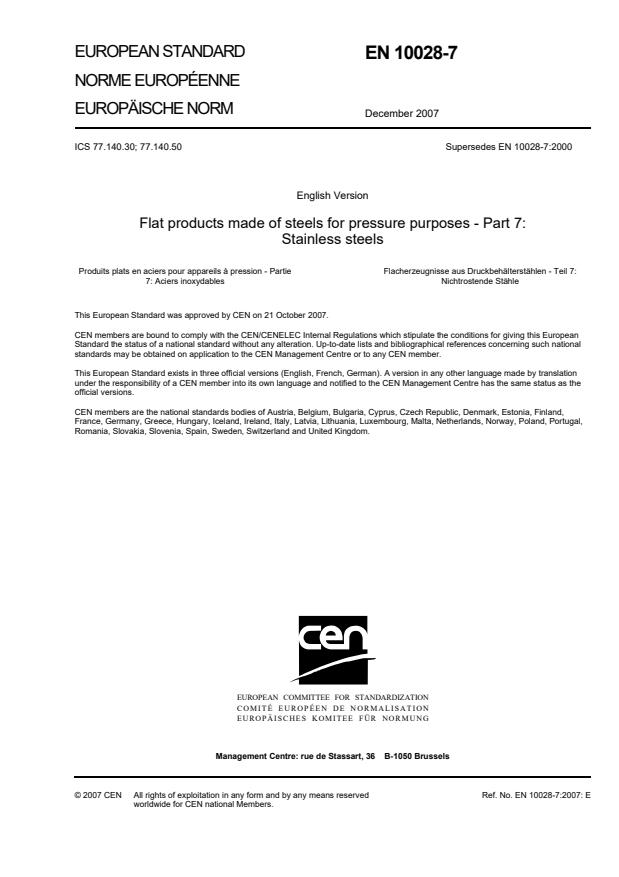
EUROPEAN STANDARDNORME EUROPÉENNEEUROPÄISCHE NORMEN 10028-7December 2007ICS 77.140.30; 77.140.50Supersedes EN 10028-7:2000
English VersionFlat products made of steels for pressure purposes - Part 7:Stainless steelsProduits plats en aciers pour appareils à pression - Partie7: Aciers inoxydablesFlacherzeugnisse aus Druckbehälterstählen - Teil 7:Nichtrostende StähleThis European Standard was approved by CEN on 21 October 2007.CEN members are bound to comply with the CEN/CENELEC Internal Regulations which stipulate the conditions for giving this EuropeanStandard the status of a national standard without any alteration. Up-to-date lists and bibliographical references concerning such nationalstandards may be obtained on application to the CEN Management Centre or to any CEN member.This European Standard exists in three official versions (English, French, German). A version in any other language made by translationunder the responsibility of a CEN member into its own language and notified to the CEN Management Centre has the same status as theofficial versions.CEN members are the national standards bodies of Austria, Belgium, Bulgaria, Cyprus, Czech Republic, Denmark, Estonia, Finland,France, Germany, Greece, Hungary, Iceland, Ireland, Italy, Latvia, Lithuania, Luxembourg, Malta, Netherlands, Norway, Poland, Portugal,Romania, Slovakia, Slovenia, Spain, Sweden, Switzerland and United Kingdom.EUROPEAN COMMITTEE FOR STANDARDIZATIONCOMITÉ EUROPÉEN DE NORMALISATIONEUROPÄISCHES KOMITEE FÜR NORMUNGManagement Centre: rue de Stassart, 36
B-1050 Brussels© 2007 CENAll rights of exploitation in any form and by any means reservedworldwide for CEN national Members.Ref. No. EN 10028-7:2007: E
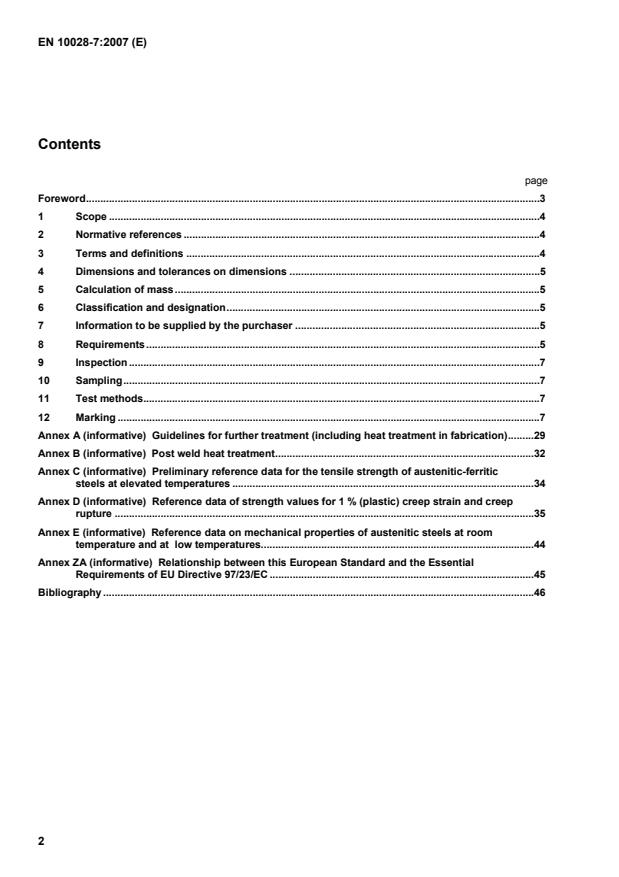
Guidelines for further treatment (including heat treatment in fabrication).29 Annex B (informative)
Post weld heat treatment.32 Annex C (informative)
Preliminary reference data for the tensile strength of austenitic-ferritic steels at elevated temperatures.34 Annex D (informative)
Reference data of strength values for 1 % (plastic) creep strain and creep rupture.35 Annex E (informative)
Reference data on mechanical properties of austenitic steels at room temperature and at
low temperatures.44 Annex ZA (informative)
Relationship between this European Standard and the Essential Requirements of EU Directive 97/23/EC.45 Bibliography.46
document. The steel grades covered by this European Standard have been selected from EN 10088-1. EN 10028 consists of the following parts under the general title Flat products made of steels for pressure
purposes: Part 1: General requirements Part 2: Non-alloy and alloy steels with specified elevated temperature properties Part 3: Weldable fine grain steels, normalized Part 4: Nickel alloy steels with specified low temperature properties Part 5: Weldable fine grain steels, thermomechanically rolled Part 6: Weldable fine grain steels, quenched and tempered Part 7: Stainless steels NOTE The clauses marked by two points (••) contain information relating to agreements that may be made at the time of enquiry and order. According to the CEN/CENELEC Internal Regulations, the national standards organizations of the following countries are bound to implement this European Standard: Austria, Belgium, Bulgaria, Cyprus, Czech Repub-lic, Denmark, Estonia, Finland, France, Germany, Greece, Hungary, Iceland, Ireland, Italy, Latvia, Lithuania, Luxembourg, Malta, Netherlands, Norway, Poland, Portugal, Romania, Slovakia, Slovenia, Spain, Sweden, Switzerland and United Kingdom.
Directive are satisfied, needs to be done. 2 Normative references The following referenced documents are indispensable for the application of this document. For dated
references, only the edition cited applies. For undated references, the latest edition of the referenced docu-ment (including any amendments) applies. EN 10028-1:2007, Flat products made of steels for pressure purposes — Part 1: General requirements EN 10029, Hot rolled plates 3 mm thick or above — Tolerances on dimensions, shape and mass EN 10088-1:2005, Stainless steels — Part 1: List of stainless steels EN ISO 643, Steels — Micrographic determination of the apparent grain size (ISO 643:2003) EN ISO 3651-2, Determination of the resistance to intergranular corrosion of stainless steels — Part 2:
Ferritic, austenitic and ferritic-austenitic (duplex) stainless steels — Corrosion test in media containing sulfuric acid (ISO 3651-2:1998) 3 Terms and definitions For the purposes of this document, the terms and definitions given in EN 10028-1:2007 and the following ap-ply. 3.1 cryogenic temperature temperature lower than –75 °C used in the liquefaction of gases
EN 10028-1 apply. If the purchaser does not indicate a wish to implement any of these options at the time of enquiry and order, the products shall be supplied in accordance with the basic specification (see
EN 10028-1). a) mechanical properties for increased product thicknesses (see Table 7, footnote e); b) higher Rp0,2 and Rp1,0 values for continuously hot rolled products (see Table 9, footnote d and Table 10, footnote b). 7.3 Example for ordering 10 plates made of a steel grade with the name X5CrNi18-10 and the number 1.4301 as specified in
EN 10028-7 with nominal dimensions, thickness = 8 mm, width = 2 000 mm, length = 5 000 mm; tolerances on dimensions, shape and mass as specified in EN 10029 with thickness tolerance class A and "normal"
flatness tolerance according to process route 1D (see Table 6), inspection document 3.1 as specified in
EN 10204: 10 plates–EN 10029–8Ax2000x5000–steel EN 10028-7–X5CrNi18-10+1D–inspection document 3.1 or 10 plates– EN 10029–8Ax2000x5000–steel EN 10028-7–1.4301+1D–inspection document 3.1 8 Requirements 8.1 Steelmaking process Shall be according to EN 10028-1.
composition according to the cast analysis. 8.3.2 The product analysis may deviate from the limiting values for the cast analysis given in Tables 1 to 4 by the values listed in Table 5. 8.3.3 The specifications in Tables 7, 9 and 10 shall apply in respect to resistance to intergranular corrosion as defined in EN ISO 3651-2, for ferritic, austenitic and austenitic-ferritic steels. NOTE 1 EN ISO 3651-2 is not applicable for testing martensitic steels. NOTE 2 The corrosion resistance of stainless steels is very dependent on the type of environment and can therefore not always be clearly ascertained through laboratory tests. It is therefore advisable to draw on the available experience of the use of the steels. 8.4 Mechanical properties 8.4.1 The tensile properties at room temperature and the impact energy at room and at low temperatures as specified in Tables 7 to 10 apply for the relevant specified heat treatment condition. NOTE Austenitic stainless steels are insensitive to brittle fracture in the solution annealed condition. As they have a good resistance to shock loads, due to their high impact energy, also at very low (cryogenic) temperatures, they are useful for applications at such temperatures (see also the NOTE to Tables 9 and 10). 8.4.2 The values in Tables 11 to 14 apply for the 0,2 % and 1,0 % proof strength at elevated temperatures. Additionally, the values in Table 15 apply for the tensile strength at elevated temperatures. Tensile strength values at elevated temperatures for austenitic-ferritic steels are given for guidance in
Annex C. 8.4.3 Annex D gives mean values as preliminary data for the purchaser about strength for 1 % (plastic) creep strain and creep rupture. These data apply for the solution annealed condition only (see Table A.3). 8.4.4 In Annex E preliminary data on mechanical properties at low temperatures of austenitic steels are listed. 8.5 Surface condition Shall be according to EN 10028-1 and Table 6. 8.6 Internal soundness Shall be according to EN 10028-1. 8.7 Physical properties For reference data on physical properties, see Annex A of EN 10088-1:2005.
number C max. Si max. Mn max. P max. S max. N max. Cr Mo Nb Ni Ti X2CrNi12 1.4003 0,030 1,00 1,50 0,040 0,015 0,030 10,5 to 12,5 – – 0,30 to 1,00 – X6CrNiTi12 1.4516 0,08 0,70 1,50 0,040 0,015 – 10,5 to 12,5 – – 0,50 to 1,50 0,05 to 0,35 X2CrTi17 1.4520 0,025 0,50 0,50 0,040 0,015 0,015 16,0 to 18,0 – – – 0,30 to 0,60 X3CrTi17 1.4510 0,05 1,00 1,00 0,040 0,015 – 16,0 to 18,0 – – – [4 x(C+N) + 0,15] to 0,80 b X2CrMoTi17-1 1.4513 0,025 1,00 1,00 0,040 0,015 0,020 16,0 to 18,0 0,80 to 1,40 – – 0,30 to 0,60 X2CrMoTi18-2 1.4521 0,025 1,00 1,00 0,040 0,015 0,030 17,0 to 20,0 1,80 to 2,50 – – [4 x(C+N) + 0,15] to 0,80 b X6CrMoNb17-1 1.4526 0,08 1,00 1,00 0,040 0,015 0,040 16,0 to 18,0 0,80 to 1,40 [7x(C+N) + 0,10] to 1,00 – – X2CrTiNb18 1.4509 0,030 1,00 1,00 0,040 0,015 – 17,5 to 18,5 – [(3xC )+ 0,30] to 1,00 – 0,10 to 0,60 a Elements not listed in this table shall not be intentionally added to the steel without the agreement of the purchaser except for finishing of the cast. All appropriate precautions are to be taken to avoid the
addition of such elements from scrap and other materials used in production which would impair mechanical properties and the suitability of the steel. b The stabilisation may be made by use of titanium or niobium or zirconium. According to the atomic mass of these elements and the content of carbon and nitrogen, the equivalence shall be the following,
in % by mass:
Nb = Zr =47 Ti
Table 2 — Chemical composition (cast analysis) a of martensitic steels Steel grade % by mass
Steel name Steel number C max. Si max. Mn max. P max. S max. Cr Mo Ni N min. X3CrNiMo13-4 1.4313 0,05 0,70 1,50 0,040 0,015 12,0 to 14,0 0,30 to 0,70 3,5 to 4,5 0,020 X4CrNiMo16-5-1 1.4418 0,06 0,70 1,50 0,040 0,015 15,0 to 17,0 0,80 to 1,50 4,0 to 6,0 0,020 a Elements not quoted in this table shall not be intentionally added to the steel without the agreement of the purchaser except for finishing the cast. All appropriate
precautions are to be taken to avoid the addition of such elements from scrap and other materials used in production which would impair mechanical properties and the
suitability of the steel.
1,00 9,0 to 12,0 – – X1CrNi25-21 1.4335 ≤ 0,020 ≤ 0,25 2,00 0,025 0,010 ≤ 0,10 24,0 to 26,0 – ≤ 0,20 – 20,0 to 22,0 – – X2CrNiMo17-12-2 1.4404 ≤ 0,030 ≤ 1,00 2,00 0,045 0,015 ≤ 0,10 16,5 to 18,5 – 2,00 to 2,50 – 10,0 to 13,0 – – X2CrNiMoN17-11-2 1.4406 ≤ 0,030 ≤ 1,00 2,00 0,045 0,015 0,12 to 0,22 16,5 to 18,5 – 2,00 to 2,50 – 10,0 to 12,5 – – X5CrNiMo17-12-2 1.4401 ≤ 0,07 ≤ 1,00 2,00 0,045 0,015 ≤ 0,10 16,5 to 18,5 – 2,00 to 2,50 – 10,0 to 13,0 – – X1CrNiMoN25-22-2 1.4466 ≤ 0,020 ≤ 0,70 2,00 0,025 0,010 0,10 to 0,16 24,0 to 26,0 – 2,00 to 2,50 – 21,0 to 23,0 – – X6CrNiMoTi17-12-2 1.4571 ≤ 0,08 ≤ 1,00 2,00 0,045 0,015 – 16,5 to 18,5 – 2,00 to 2,50 – 10,5 to 13,5 5 x C to 0,70 – X6CrNiMoNb17- 12-2 1.4580 ≤ 0,08 ≤ 1,00 2,00 0,045 0,015 – 16,5 to 18,5 – 2,00 to 2,50 10 x C to 1,00 10,5 to 13,5 – – X2CrNiMo17-12-3 1.4432 ≤ 0,030 ≤ 1,00 2,00 0,045 0,015 ≤ 0,10 16,5 to 18,5 – 2,50 to 3,00 – 10,5 to 13,0 – – X2CrNiMoN17-13-3 1.4429 ≤ 0,030 ≤ 1,00 2,00 0,045 0,015 0,12 to 0,22 16,5 to 18,5 – 2,50 to 3,00 – 11,0 to 14,0 – – X3CrNiMo17-13-3 1.4436 ≤ 0,05 ≤ 1,00 2,00 0,045 0,015 ≤ 0,10 16,5 to 18,5 – 2,50 to 3,00 – 10,5 to 13,0 – – X2CrNiMo18-14-3 1.4435 ≤ 0,030 ≤ 1,00 2,00 0,045 0,015 ≤ 0,10 17,0 to 19,0 – 2,50 to 3,00 – 12,5 to 15,0 – – X2CrNiMoN18-12-4 1.4434 ≤ 0,030 ≤ 1,00 2,00 0,045 0,015 0,10 to 0,20 16,5 to 19,5 – 3,0 to 4,0 – 10,5 to 14,0 – – (to be continued)
2,00 to 3,00 – 12,0 to 14,0 – 0,001 5 to 0,005 0 B X6CrNiTiB18-10 1.4941 0,04 to 0,08 ≤ 1,00 2,00 0,035 0,015 – 17,0 to 19,0 – – – 9,0 to 12,0 5 x C to 0,80 0,001 5 to
0,005 0 B X6CrNi18-10 1.4948 0,04 to 0,08 ≤ 1,00 2,00 0,035 0,015 ≤ 0,10 17,0 to 19,0 – – – 8,0 to 11,0 – – X6CrNi23-13 1.4950 0,04 to 0,08 ≤ 0,70 2,00 0,035 0,015 ≤ 0,10 22,0 to 24,0 – – – 12,0 to 15,0 – – X6CrNi25-20 1.4951 0,04 to 0,08 ≤ 0,70 2,00 0,035 0,015 ≤ 0,10 24,0 to 26,0 – – – 19,0 to 22,0 – – X5NiCrAlTi31-20 (+RA) 1.4958(+RA) 0,03 to 0,08 ≤ 0,70 1,50 0,015 0,010 ≤ 0,030 19,0 to 22,0 ≤ 0,50 – ≤ 0,10 30,0 to 32,5 0,20 to 0,50 0,20 to 0,50 Al Al+Ti:
≤ 0,70 ≤ 0,50 Co Ni+Co: 30,0 to 32,5 X8NiCrAlTi32-21 1.4959 0,05 to 0,10 ≤ 0,70 1,50 0,015 0,010 ≤ 0,030 19,0 to 22,0 ≤ 0,50 – – 30,0 to 34,0 0,25 to 0,65 0,25 to 0,65 Al ≤ 0,50 Co Ni+Co: 30,0 to 34,0 X8CrNiNb16-13 1.4961 0,04 to 0,10 0,30 to 0,60 1,50 0,035 0,015 – 15,0 to 17,0 – – 10 x C to 1,20 12,0 to 14,0 – – a Elements not listed in this table shall not be intentionally added to the steel without the agreement of the purchaser except for finishing of the cast. All appropriate precautions are to be taken to avoid
the addition of such elements from scrap and other materials used in production which would impair mechanical properties and the suitability of the steel.
addition of such elements from scrap and other materials used in production which would impair mechanical properties and the suitability of the steel.
% by mass Permissible tolerance a % by mass
≤ 0,030 + 0,005 Carbon > 0,030 ≤ 0,10 ± 0,01 Silicon
≤ 1,00 + 0,05
≤ 1,00 + 0,03 Manganese > 1,00 ≤ 2,00 + 0,04 Phosphorus
≤ 0,045 + 0,005 Sulphur
≤ 0,015 + 0,003 Nitrogen
≤ 0,35 ± 0,01 Aluminium
≤ 0,65 ± 0,10 Boron ≥ 0,001 5 ≤ 0,005 0 ± 0,000 3 ≥ 10,5 < 15,0 ± 0,15 ≥ 15,0 ≤ 20,0 ± 0,20 Chromium > 20,0 ≤ 28,0 ± 0,25
≤ 1,00 ± 0,07 Copper > 1,00 ≤ 2,50 ± 0,10
≤ 0,60 ± 0,03 > 0,60 < 1,75 ± 0,05 Molybdenum ≥ 1,75 ≤ 7,0 ± 0,10 Niobium
≤ 1,20 ± 0,05
≤ 1,00 ± 0,03 > 1,00 ≤ 5,0 ± 0,07 > 5,0 ≤ 10,0 ± 0,10 > 10,0 ≤ 20,0 ± 0,15 Nickel > 20,0 ≤ 34,0 ± 0,20 Cobalt
≤ 0,50 + 0,05 Titanium
≤ 0,80 ± 0,05 Tungsten
≤ 1,00 ± 0,05 a If several product analyses are carried out on one cast and the contents of an
individual element determined lie outside the permissible range of the chemical
composition specified for the cast analysis, then it is only allowed to exceed the
permissible maximum value or to fall short of the permissible minimum value, but
not both for one cast.
Abbreviation b Type of treatment c Surface finish Notes Hot rolled 1C Hot rolled, heat treated, not descaled Covered with the rolling scale Suitable for parts which will be descaled or ma-chined in subsequent production or for certain heat-resisting applications. 1E Hot rolled, heat treated, mechanically descaled Free of scale The type of mechanical descaling, e.g. coarse grind-ing or shot blasting, depends on the steel grade and the product, and is left to the manufacturer's discre-tion, unless otherwise agreed.
1D Hot rolled, heat treated, pickled Free of scale Usually standard for most steel types to ensure good corrosion resistance; also common finish for further processing. It is permissible for grinding marks to be present. Not as smooth as 2D or 2B. Cold rolled 2C Cold rolled, heat treated, not descaled Smooth with scale from heat treatment Suitable for parts which will be descaled or ma-chined in subsequent production or for certain heat-resisting applications. 2E Cold rolled, heat treated, mechanically descaled Rough and dull Usually applied to steels with a scale which is very resistant to pickling solutions. May be followed by pickling. 2D Cold rolled, heat treated, pickled Smooth Finish for good ductility, but not as smooth as 2B or 2R. 2B Cold rolled, heat treated, pickled, skin passed Smoother than 2D Most common finish for most steel types to ensure good corrosion resistance, smoothness and flatness. Also common finish for further processing. Skin
passing may be by tension levelling.
2R Cold rolled, bright
annealed d Smooth, bright, reflective
Smoother and brighter than 2B. Also common finish for further processing. Special finishes 1G or 2G Ground e See footnote f. Grade of grit or surface roughness can be specified. Unidirectional texture, not very reflective. 1J or 2J Brushed e or dull
polished e Smoother than ground. See footnote f Grade of brush or surface roughness can be speci-fied. Unidirectional texture, not very
reflective. 1K or 2K Satin polished e See footnote f Additional specific requirements to a “J” type finish, in order to achieve adequate corrosion resistance for marine and external architectural applications. Transverse Ra < 0,5 µm with clean cut surface fin-ish. 1P or 2P Bright polished e See footnote f Mechanical polishing. Process or surface roughness can be specified. Non-directional finish, reflective with high degree of image clarity.
2F Cold rolled, heat treated, skin passed on rough-ened rolls Uniform non-reflective matt surface Heat treatment by bright annealing or by annealing and pickling. a Not all process routes and surface finishes are available for all steels. b First digit, 1 = hot rolled, 2 = cold rolled. c The basic heat treatment condition specified in the relevant Table 7, 8, 9 or 10 applies. d
May be skin passed. e One surface only, unless specifically agreed at the time of enquiry and order. f Within each finish description the surface characteristics can vary, and more specific requirements may need to be agreed between
manufacturer and purchaser (e.g. grade of grit or surface roughness).
Table A.1) and resistance to intergranular corrosion Steel
grade Elongation after fracture Resistance to inter- granular corrosiond
Thick- ness
mm max. 0,2 % proof strength Rp0,2
MPa min. Tensile strength Rm
MPa
Steel name Steel num-ber Product form a
(long.) (tr.)
A80 mm b
< 3 mm thick % min.
(long. + tr.) A c ≥ 3 mm thick % min.
(long. + tr.)
in the delivery condi-tion
In the welded condition Impact en-ergy (ISO-V) KV min.
J
(tr.) C 8 H 13,5 280 320 20 X2CrNi12 1.4003 P 25e 250 280 450 to 650 18
no
no
50 C 8 H 13,5 280 320 23 X6CrNiTi12 1.4516 P 25e 250 280 450 to 650 20
no
no
50 X2CrTi17 1.4520 C 4 180 200 380 to 530 24 yes yes – f X3CrTi17 1.4510 C 4 230 240 420 to 600 23 yes yes – f X2CrMoTi17-1 1.4513 C 4 200 220 400 to 550 23 yes yes – f X2CrMoTi18-2 1.4521 C 4 300 320 420 to 640 20 yes yes – f X6CrMoNb17-1 1.4526 C 4 280 300 480 to 560 25 yes yes – f X2CrTiNb18 1.4509 C 4 230 250 430 to 630 18 yes yes – f a C = cold rolled strip; H = hot rolled strip; P = hot rolled plate. b The values are related to test pieces with a gauge length of 80 mm and a width of 20 mm. Test pieces with a gauge length of 50 mm and a width of 12,5 mm may
also be used. c The values are related to test pieces with a gauge length of 5,650S. d When tested according to EN ISO 3651-2. e ≤≤ For thicknesses above 25 mm up to 75 mm, the mechanical properties may be agreed at the time of enquiry and order. f Because of the small maximum product thickness t, no verifiable values can be specified (the requirement to prepare impact test pieces applies for t ≥ 6 mm, see EN 10028-1:2007, 10.2.2.3 c)).
Steel grade Impact energy (ISO-V) KV
J min. at 20 °C at –20 °C
Steel name
Steel number Product form a Thickness mm max. 0,2 % proof strength Rp0.2
MPa min. Tensile strength Rm
MPa Elongation after fracture A b ≥ 3 mm thick % min. (long. + tr.) (long. + tr.) X3CrNiMo13-4 1.4313 P 75 650 780 to 980 14 70 40 X4CrNiMo16-5-1 1.4418 P 75 680 840 to 980 14 55 40 a P = hot rolled plate. b The values apply for test pieces with a gauge length of 5,650S.
Rp0,2 1,0 % proof strength Rp1,0 Impact energy (ISO-V) KV
J min. Resistance to
intergranular
corrosion g
at 20 °C Steel name
Steel num-ber Pro-duct- form b
Thick-ness
mm max.
MPa min. (tr.) c d Tensile strength
Rm
MPa
A80mm e < 3 mm thick % min.
(tr.) c
Af ≥ 3 mm thick % min.
(tr.) c
(long.)
(tr.)
at –196°C (tr.) in the delivery condition in the sensitized condition Austenitic corrosion resisting grades C 8 350 380 H 13,5 330 370 X2CrNiN18-7 1.4318 P 75 330 370 650 to 850 35 40 90 60 – yes yes C 8 220 250 H 13,5 200 240 520 to 700 X2CrNi18-9 1.4307 P 75 200 240 500 to 700 45 45 100 60 60 yes yes C 8 220 250 H 13,5 200 240 520 to 700 X2CrNi19-11 1.4306 P 75 200 240 500 to 700 45 45 100 60 60 yes yes C 8 290 320 H 13,5 270 310 X5CrNiN19-9 1.4315 P 75 270 310 550 to 750 40 40 100 60 60 (yes) i No j C 8 290 320 H 13,5 270 310 X2CrNiN18-10 1.4311 P 75 270 310 550 to 750 40 40 100 60 60 yes yes C 8 230 260 540 to 750 H 13,5 210 250 45 h 45 h X5CrNi18-10 1.4301 P 75 210 250 520 to 720 45 45 100 60 60 (yes) i No j C 8 220 250 H 13,5 200 240 520 to 720 X6CrNiTi18-10 1.4541 P 75 200 240 500 to 700 40 40 100 60 60 yes yes H 13,5 200 240 520 to 720 X6CrNiNb18-10 1.4550 P 75 200 240 500 to 700 40 40 100 60 40 yes yes X1CrNi25-21 1.4335 P 75 200 240 470 to 670 40 40 100 60 60 yes yes (to be continued)
Rp0,2 1,0 % proof strength Rp1,0 Impact energy (ISO-V) KV
J min. Resistance to
intergranular
corrosion g
at 20 °C Steel name
Steel num-ber Pro-duct- form b
Thick-ness
mm max.
MPa min. (tr.) c d Tensile strength
Rm
MPa
A80mme < 3 mm thick % min.
(tr.) c
Af ≥ 3 mm thick % min.
(tr.) c
(long.) (tr.)
at –196°C (tr.) in the delivery condition in the sensitized condition C 8 240 270 H 13,5 220 260 530 to 680 40 40 X2CrNiMo17-12-2 1.4404 P 75 220 260 520 to 670 45 45 100 60 60 yes yes C 8 300 330 H 13,5 280 320 X2CrNiMoN17-11-2 1.4406 P 75 280 320 580 to 780 40 40 100 60 60 yes yes C 8 240 270 H 13,5 220 260 530 to 680 40 40 X5CrNiMo17-12-2 1.4401 P 75 220 260 520 to 670 45 45 100 60 60 yes i no j X1CrNiMoN25-22-2 1.4466 P 75 250 290 540 to 740 40 40 100 60 60 yes yes C 8 240 270 H 13,5 220 260 540 to 690 X6CrNiMoTi17-12-2 1.4571 P 75 220 260 520 to 670 40 40 100 60 60 yes yes X6CrNiMoNb17-12-2 1.4580 P 75 220 260 520 to 720 40 40 100 60 – yes yes C 8 240 270 H 13,5 220 260 550 to 700 40 40 X2CrNiMo17-12-3 1.4432 P 75 220 260 520 to 670 45 45 100 60 60 yes yes C 8 300 330 H 13,5 280 320 35 35 X2CrNiMoN17-13-3 1.4429 P 75 280 320 580 to 780 40 40 100 60 60 yes yes (to be continued)
Rp0,2 1,0 % proof strength Rp1,0 Impact energy (ISO-V) KV
J min. Resistance to
intergranular
corrosion g
at 20 °C Steel name
Steel num-ber Pro-duct- form b
Thick-ness
mm max.
MPa min. (tr.) c d Tensile strength
Rm
MPa
A80mme < 3 mm thick % min.
(tr.) c
Af ≥ 3 mm thick % min.
(tr.) c
(long.)
(tr.)
at –196°C(tr.) in the delivery condition in the sensitized condition C 8 240 270 H 13,5 220 260 550 to 700 40 40 X3CrNiMo17-13-3 1.4436 P 75 220 260 530 to 730 40 40 100 60 60 (yes) i no j C 8 240 270 H 13,5 220 260 550 to 700 40 40 X2CrNiMo18-14-3 1.4435 P 75 220 260 520 to 670 45 45 100 60 60 yes yes C 8 290 320 H 13,5 270 310 570 to 770 35 35 X2CrNiMoN18-12-4 1.4434 P 75 270 310 540 to 740 40 40 100 60 60 yes yes C 8 240 270 H 13,5 220 260 550 to 700 35 35 X2CrNiMo18-15-4 1.4438 P 75 220 260 520 to 720 40 40 100 60 60 yes yes C 8 290 320 H 13,5 270 310 35 35 X2CrNiMoN17-13-5 1.4439 P 75 270 310 580 to 780 40 40 100 60 60 yes yes X1NiCrMoCu31-27-4 1.4563 P 75 220 260 500 to 700 40 40 100 60 60 yes yes C 8 240 270 H 13,5 220 260 530 to 730 X1NiCrMoCu25-20-5 1.4539 P 75 220 260 520 to 720 35 35 100 60 60 yes yes X1CrNiMoCuN25-25-5 1.4537 P 75 290 330 600 to 800 40 40 100 60 60 yes yes C 8 320 350 H 13,5 300 340 35 35 X1CrNiMoCuN20-18-7 1.4547 P 75 300 340 650 to 850 40 40 100 60 60 yes yes X1NiCrMoCuN25-20-7 1.4529 P 75 300 340 650 to 850 40 40 100 60 60 yes yes (to be continued)
Rp0,2 1,0 % proof strength
Rp1,0 Impact energy (ISO-V) KV
J min. Resistance to
intergranular
corrosion g
at 20 °C Steel name
Steel num-ber Pro-duct- form b
Thick-ness
mm max.
MPa min. (tr.) c d Tensile strength
Rm
MPa
A80mme < 3 mm thick % min.
(tr.) c
Af ≥ 3 mm thick % min.
(tr.) c
(long.) (tr.)
at –196°C (tr.) in the delivery condition in the sensitized condition Austenitic creep resisting grades C 8 300 330 580 to 780 H 13,5 260 300 X3CrNiMoBN17-13-3 1.4910 P 75 260 300 550 to 750 35 40 100 60 – yes yes C 8 220 250 H 13,5 200 240 510 to 710 X6CrNiTiB18-10 1.4941 P 75 200 240 490 to 690 40 40 100 60 – yes yes C 8 230 260 530 to 740 45 h
45 h
H 13,5 210 250 X6CrNi18-10 1.4948 P 75 190 230 510 to 710 45 45 100 60 – no no C 8 220 250 530 to 730 H 13,5 200 240 X6CrNi23-13 1.4950 P 75 200 240 510 to 710 35 35 100 60 – no no C 8 220 250 530 to 730 H 13,5 200 240 X6CrNi25-20 1.4951 P 75 200 240 510 to 710 35 35 100 60 – no no X5NiCrAlTi31-20 1.4958 P 75 170 200 500 to 750 30 30 120 80 – yes no (to be continued)
Rp0,2 1,0 % proof strength Rp1,0 Impact energy (ISO-V) KV
J min. Resistance to
intergranular
corrosion g
at 20 °C Steel name
Steel num-ber Pro-duct- form b
Thick-ness
mm max.
MPa min. (tr.) c d Tensile strength
Rm
MPa
A80mme < 3 mm thick % min.
(tr.) c
Af ≥ 3 mm thick % min.
(tr.) c
(long.)
(tr.)
at –196°C (tr.) in the delivery condition in the sensitized condition X5NiCrAlTi31-20+RAk 1.4958+RA k P 75 210 240 500 to 750 30 30 120 80 – yes no X8NiCrAlTi32-21 1.4959 P 75 170 200 500 to 750 30 30 120 80 – yes no X8CrNiNb16-13 1.4961 P 75 200 240 510 to 690 35 35 100 60 – yes yes NOTE
Austenitic steels always have adequate toughness and do not need to be impact tested. In contrast, austenitic-ferritic steels need to be tested to the impact energy requirements In Table 10 to ensure that toughness is adequate.
a See Table A.3. b C = cold rolled strip; H = hot rolled strip; P = hot rolled plate. c If, in the case of strip in rolling widths < 300 mm, longitudinal test pieces are taken, the minimum values are reduced as follows:
– proof strength Rp0,2: minus 15 MPa
– elongation for constant gauge length A80 mm: minus 5 %
– elongation for proportional gauge length A: minus 2 %. d ≤≤ For continuously hot rolled products, 20 MPa higher minimum values of Rp0,2 and 10 MPa higher minimum values of Rp1,0 may
be agreed at the time of
enquiry and order. e The values are related to test pieces with a gauge length of 80 mm and a width of 20 mm; test pieces with a gauge length of 50 mm and a width of 12,5 mm
can also be used. f The values are related to test pieces with a gauge length of 5,65 0S. g When tested according to EN ISO 3651-2. h For stretcher levelled material, the minimum value is 5 % lower. i Normally for thicknesses up to 6 mm. j Resistance to intergranular corrosion is given for thicknesses up to 6 mm
in the welded condition. k +RA = recrystallizing annealed condition.
corrosion e Thick-ness 0,2 % proof strengthRp0,2 MPa b min.
strip width KV J min.
Steel grade A80mm < 3 mm thick c % min. A ≥ 3 mm thick d % min. at 20 °C at -40 °C Steel name Steel num-ber Pro-duct form a
mm max. (long.)
< 300 mm (tr.) ≥ 300 mm Tensile strengthRm
MPa (long. + tr.) (long. + tr.) (long.) (tr.) (tr.) in the delivery conditionin the sensi-tized condi-tion C 8 405 420 H 13,5 385 400 600 to 850 20 20 X2CrNiN23-4 1.4362 P 50 385 400 630 to 800 25 25
90 40 yes yes C 8 485 500 20 20 H 13,5 445 460 700 to 950 25 25 X2CrNiMoN22-5-3 1.4462 P 75 445 460 640 to 840 25 25 150 100 40 yes yes C 8 495 510 H 13,5 475 490 690 to 940 20 20 X2CrNiMoCuN25-6-3 1.4507 P 50 475 490 690 to 890 25 25 150 90 40 yes yes C 8 535 550 H 13,5 515 530 750 to 1 000 20 20 X2CrNiMoN25-7-4 1.4410 P 50 515 530 730 to 930 20 20 150 90 40 yes yes X2CrNiMoCuWN25-7-4 1.4501 P 50 515 530 730 to 930 25 25 150 90 40 yes yes NOTE
Austenitic-ferritic steels need to be tested to the above impact energy requirements to ensure that toughness is adequate. In contrast, austenitic steels always have adequate toughness and do not need to be tested. a C = cold rolled strip; H = hot rolled strip; P = hot rolled plate. b ≤≤ For continuously hot rolled products, 20 MPa higher minimum values of Rp0,2 may be agreed at the time of enquiry and order. c The values are related to test pieces with a gauge length of 80 mm and a width of 20 mm; test pieces with a gauge length of 50 mm and a width of
12,5 mm may also
be used. d The values are related to test pieces with a gauge length of 5,65 0S. e
When tested according to EN ISO 3651-2.
Table 12 — Minimum values for the 0,2 % proof strength of martensitic steels at elevated temperatures in the quenched and tempered condition (see Table A.2) Steel grade Minimum 0,2 % proof strength Rp0,2, MPa at a temperature (in °C) of Steel name Steel number 50 a 100 150 200 250 300 350 X3CrNiMo13-4 1.4313 627 590 575 560 545 530 515 X4CrNiMo16-5-1 1.4418 672 660 640 620 600 580 –- a Determined by linear interpolation.
Table 13 — Minimum values for the 0,2 % and 1,0 % proof strength of austenitic steels at elevated temperatures in the solution annealed condition (see Table A.3) Steel grade Minimum 0,2 % proof strength Rp0,2, MPa
Minimum 1,0 % proof strength Rp1,0, MPa
at a temperature (in °C) of Steel name Steel number 50a
100 150 200 250 300 350 400 450 500 550 600 50a 100 150 200 250 300 350 400 450 500 550 600 Austenitic corrosion resisting grades X2CrNiN18-7 1.4318 309 265 200 185 180 170 165 – – – – – – – 235 215 210 200 195 – – – – – X2CrNi18-9 1.4307 180 147 132 118 108 100 94 89 85 81 80 – 218 181 162 147 137 127 121 116 112 109 108 – X2CrNi19-11 1.4306 180 147 132 118 108 100 94 89 85 81 80 – 218 181 162 147 137 127 121 116 112 109 108 – X5CrNiN19-9 1.4315 246 205 175 157 145 136 130 125 121 119 118 – 284 240 210 187 175 167 161 156 152 149 147 – X2CrNiN18-10 1.4311 246 205 175 157 145 136 130 125 121 119 118 – 284 240 210 187 175 167 161 156 152 149 147 – X5CrNi18-10 1.4301 190 157 142 127 118 110 104 98 95 92 90 – 228 191 172 157 145 135 129 125 122 120 120 – X6CrNiTi18-10 1.4541 191 176 167 157 147 136 130 125 121 119 118 – 228 208 196 186 177 167 161 156 152 149 147 – X6CrNiNb18-10- 1.4550 191 177 167 157 147 136 130 125 121 119 118 – 229 211 196 186 177 167 161 156 152 149 147 – X1CrNi25-21 1.4335 181 150 140 130 120 115 110 105 – – – – 217 180 170 160 150 140 135 130 – – – – X2CrNiMo17-12-2 1.4404 200 166 152 137 127 118 113 108 103 100 98 – 237 199 181 167 157 145 139 135 130 128 127 – X2CrNiMoN17-11-2 1.4406 254 211 185 167 155 145 140 135 131 128 127 – 292 246 218 198 183 175 169 164 160 158 157 – X5CrNiMo17-12-2 1.4401 204 177 162 147 137 127 120 115 112 110 108 – 242 211 191 177 167 156 150 144 141 139 137 – X1CrNiMoN25-22-2 1.4466 229 195 170 160 150 140 135 – – – – – 266 225 205 190 180 170 165 – – – – – X6CrNiMoTi17-12-2 1.4571 207 185 177 167 157 145 140 135 131 129 127 – 244 218 206 196 186 175 169 164 160 158 157 – X6CrNiMoNb17-12-2 1.4580 207 185 177 167 157 145 140 135 131 129 127 – 244 218 206 196 186 175 169 164 160 158 157 – X2CrNiMo17-12-3 1.4432 200 166 152 137 127 118 113 108 103 100 98 – 237 199 181 167 157 145 139 135 130 128 127 – X2CrNiMoN17-13-3 1.4429 254 211 185 167 155 145 140 135 131 129 127
292 246 218 198 183 175 169 164 160 158 157 – X3CrNiMo17-13-3 1.4436 204 177 162 147 137 127 120 115 112 110 108 – 252 211 191 177 167 156 150 144 141 139 137 – X2CrNiMo18-14-3 1.4435 199 165 150 137 127 119 113 108 103 100 98 – 237 200 180 165 153 145 139 135 130 128 127 – (to be continued)
Minimum 1,0 % proof strength Rp1,0,
MPa
at a temperature (in °C) of Steel name Steel
number 50a
100 150 200 250 300 350 400 450 500 550 600 50a 100 150 200 250 300 350 400 450 500 550 600 X2CrNiMoN18-12-4 1.4434 248 211 185 167 155 145 140 135 131 129 127 – 286 246 218 198 183 175 169 164 160 158 157 – X2CrNiMo18-15-4 1.4438 202 172 157 147 137 127 120 115 112 110 108 – 240 206 188 177 167 156 148 144 140 138 136 – X2CrNiMoN17-13-5 1.4439 253 225 200 185 175 165 155 150 – – – – 289 255 230 210 200 190 180 175 – – – – X1NiCrMoCu31-27-4 1.4563 209 190 175 160 155 150 145 135 125 120 115 – 245 220 205 190 185 180 175 165 155 150 145 – X1NiCrMoCu25-20-5 1.4539 214 205 190 175 160 145 135 125 115 110 105 – 251 235 220 205 190 175 165 155 145 140 135 – X1CrNiMoCuN25-25-51.4537 271 240 220 200 190 180 175 170 – – – – 307 270 250 230 220 210 205 200 – – – – X1CrNiMoCuN20-18-71.4547 274 230 205 190 180 170 165 160 153 148 – – 314 270 245 225 212 200 195 190 184 180 – – X1NiCrMoCuN25-20-71.4529 274 230 210 190 180 170 165 160 130 120 105 – 314 270 245 225 215 205 195 190 160 150 135 – Austenitic creep resisting grades X3CrNiMoBN17-13-3 1.4910 239 205 187 170 159 148 141 134 130 127 124 121 277 240 220 200 189 178 171 164 160 157 154 151 X6CrNiTiB18-10 1.4941 186 162 152 142 137 132 127 123 118 113 108 103 225 201 191 181 176 172 167 162 157 152 147 142 X6CrNi18-10 1.4948 178 157 142 127 117 108 103 98 93 88 83 78 215 191 172 157 147 137 132 127 122 118 113 108 X6CrNi23-13 1.4950 177 140 128 116 108 100 94 91 86 85 84 82 219 185 167 154 146 139 132 126 123 121 118 114 X6CrNi25-20 1.4951 177 140 128 116 108 100 94 91 86 85 84 82 219 185 167 154 146 139 132 126 123 121 118 114 X5NiCrAlTi31-20 1.4958 159 140 127 115 105 95 90 85 82 80 75 75 185 160 147 135 125 115 110 105 102 100 95 95 X5NiCrAlTi31-20+RA 1.4958+RA 199 180 170 160 152 145 137 130 125 120 115 110 227 205 193 180 172 165 160 155 150 145 140 135 X8NiCrAlTi32-21 1.4959 159 140 127 115 105 95 90 85 82 80 75 75 185 160 147 135 125 115 110 105 102 100 95 95 X8CrNiNb16-13 1.4961 191 175 166 157 147 137 132 128 123 118 118 113 227 205 195 186 176 167 162 157 152 147 147 142 a Determined by linear
...
2003-01.Slovenski inštitut za standardizacijo. Razmnoževanje celote ali delov tega standarda ni dovoljeno.DFlacherzeugnisse aus Druckbehälterstählen - Teil 7: Nichtrostende StähleProduits plats en aciers pour appareils à pression - Partie 7: Aciers inoxydablesFlat products made of steels for pressure purposes - Part 7: Stainless steels77.140.50SROL]GHONLFlat steel products and semi-products77.140.30Jekla za uporabo pod tlakomSteels for pressure purposesICS:Ta slovenski standard je istoveten z:EN 10028-7:2007SIST EN 10028-7:2008en,de01-februar-2008SIST EN 10028-7:2008SLOVENSKI
STANDARDSIST EN 10028-7:2000/AC:2005SIST EN 10028-7:20001DGRPHãþD
EUROPÄISCHE NORMEUROPEAN STANDARDNORME EUROPÉENNEEN 10028-7Dezember 2007ICS 77.140.30; 77.140.50Ersatz für EN 10028-7:2000
Deutsche FassungFlacherzeugnisse aus Druckbehälterstählen - Teil 7:Nichtrostende StähleFlat products made of steels for pressure purposes - Part7: Stainless steelsProduits plats en aciers pour appareils à pression - Partie7: Aciers inoxydablesDiese Europäische Norm wurde vom CEN am 21.Oktober 2007 angenommen.Die CEN-Mitglieder sind gehalten, die CEN/CENELEC-Geschäftsordnung zu erfüllen, in der die Bedingungen festgelegt sind, unter denendieser Europäischen Norm ohne jede Änderung der Status einer nationalen Norm zu geben ist. Auf dem letzen Stand befindliche Listendieser nationalen Normen mit ihren bibliographischen Angaben sind beim Management-Zentrum des CEN oder bei jedem CEN-Mitglied aufAnfrage erhältlich.Diese Europäische Norm besteht in drei offiziellen Fassungen (Deutsch, Englisch, Französisch). Eine Fassung in einer anderen Sprache,die von einem CEN-Mitglied in eigener Verantwortung durch Übersetzung in seine Landessprache gemacht und dem Zentralsekretariatmitgeteilt worden ist, hat den gleichen Status wie die offiziellen Fassungen.CEN-Mitglieder sind die nationalen Normungsinstitute von Belgien, Bulgarien, Dänemark, Deutschland, Estland, Finnland, Frankreich,Griechenland, Irland, Island, Italien, Lettland, Litauen, Luxemburg, Malta, den Niederlanden, Norwegen, Österreich, Polen, Portugal,Rumänien, Schweden, der Schweiz, der Slowakei, Slowenien, Spanien, der Tschechischen Republik, Ungarn, dem Vereinigten Königreichund Zypern.EUROPÄISCHES KOMITEE FÜR NORMUNGEUROPEAN COMMITTEE FOR STANDARDIZATIONCOMITÉ EUROPÉEN DE NORMALISATIONManagement-Zentrum: rue de Stassart, 36
B-1050 Brüssel© 2007 CENAlle Rechte der Verwertung, gleich in welcher Form und in welchemVerfahren, sind weltweit den nationalen Mitgliedern von CEN vorbehalten.Ref. Nr. EN 10028-7:2007 DSIST EN 10028-7:2008
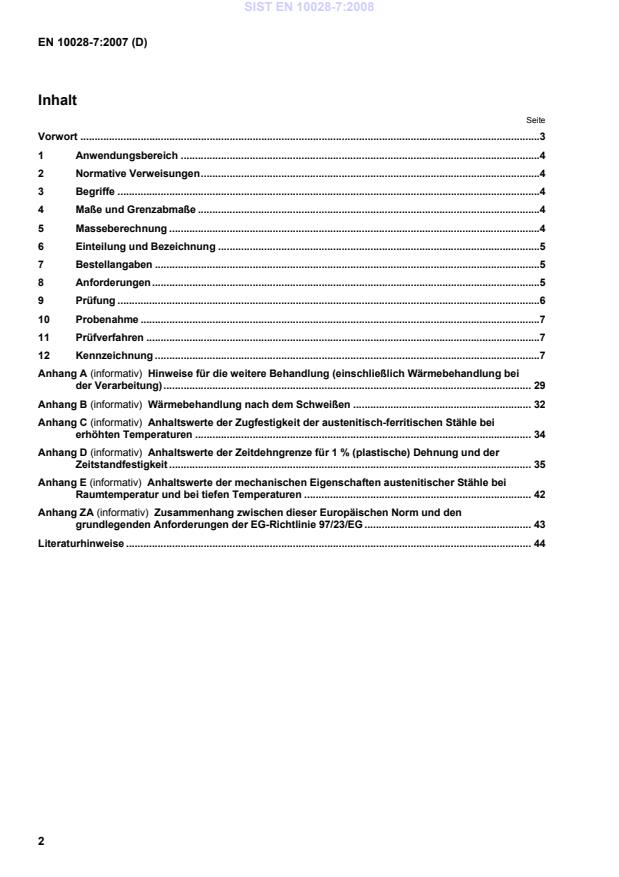
Hinweise für die weitere Behandlung (einschließlich Wärmebehandlung bei der Verarbeitung).29 Anhang B (informativ)
Wärmebehandlung nach dem Schweißen.32 Anhang C (informativ)
Anhaltswerte der Zugfestigkeit der austenitisch-ferritischen Stähle bei erhöhten Temperaturen.34 Anhang D (informativ)
Anhaltswerte der Zeitdehngrenze für 1 % (plastische) Dehnung und der Zeitstandfestigkeit.35 Anhang E (informativ)
Anhaltswerte der mechanischen Eigenschaften austenitischer Stähle bei Raumtemperatur und bei tiefen Temperaturen.42 Anhang ZA (informativ)
Zusammenhang zwischen dieser Europäischen Norm und den grundlegenden Anforderungen der EG-Richtlinie 97/23/EG.43 Literaturhinweise.44
Europäische Freihandelszone dem CEN erteilt haben, und unterstützt grundlegende Anforderungen der
EG-Richtlinie 97/23/EG. Zum Zusammenhang mit der EG-Richtlinie 97/23/EG, siehe Anhang ZA, der Bestandteil dieser Norm ist. Die Stahlsorten nach dieser Europäischen Norm wurden aus EN 10088-1 ausgewählt.
EN 10028 besteht unter dem Haupttitel
Flacherzeugnisse aus Druckbehälterstählen aus den folgenden Teilen:
Teil 1: Allgemeine Anforderungen
Teil 2: Unlegierte und legierte warmfeste Stähle
Teil 3: Schweißgeeignete Feinkornbaustähle, normalgeglüht
Teil 4: Nickellegierte kaltzähe Stähle
Teil 5: Schweißgeeignete Feinkornbaustähle, thermomechanisch gewalzt
Teil 6: Schweißgeeignete Feinkornbaustähle, vergütet
Teil 7:
Nichtrostende Stähle ANMERKUNG Die mit zwei (••) gekennzeichneten Abschnitte enthalten Angaben über Vereinbarungen, die bei der Bestellung getroffen werden können. Entsprechend der CEN/CENELEC-Geschäftsordnung sind die nationalen Normungsinstitute der folgenden Länder gehalten, diese Europäische Norm zu übernehmen: Belgien, Bulgarien, Dänemark, Deutschland, Est-land, Finnland, Frankreich, Griechenland, Irland, Island, Italien, Lettland, Litauen, Luxemburg, Malta, Nieder-lande, Norwegen, Österreich, Polen, Portugal, Rumänien, Schweden, Schweiz, Slowakei, Slowenien, Spanien, Tschechische Republik, Ungarn, Vereinigtes Königreich und Zypern. SIST EN 10028-7:2008
Die Stahlsorten nach dieser Europäischen Norm wurden aus EN 10088-1 ausgewählt. ANMERKUNG 2 Nach Veröffentlichung dieser Europäischen Norm im EU-Amtsblatt (OJEU) ist die Annahme ihrer Kon-formität mit den grundlegenden Anforderungen (ESR) der Richtlinie 97/23/EG auf die technischen Daten
von Werkstoffen in dieser Europäischen Norm (Teil 1 und Teil 7) beschränkt, und es darf nicht angenommen werden, dass damit die Eig-nung des Werkstoffs für ein bestimmtes Ausrüstungsteil festgestellt ist. Folglich müssen die in dieser Werkstoffnorm an-gegebenen technischen Parameter im Hinblick auf die konstruktiven Anforderungen dieses bestimmten Ausrüstungsteils ermittelt werden, um damit zu verifizieren, dass den ESR der Richtlinie 97/23/EG entsprochen wird. 2 Normative Verweisungen Die folgenden zitierten Dokumente sind für die Anwendung dieser Norm erforderlich. Bei datierten Verweisun-gen gilt nur die in Bezug genommene Ausgabe. Bei undatierten Verweisungen gilt die letzte Ausgabe des in Bezug genommenen Dokuments (einschließlich aller Änderungen). EN 10028-1:2007, Flacherzeugnisse aus Druckbehälterstählen
Teil 1: Allgemeine Anforderungen EN 10029, Warmgewalztes Stahlblech von 3 mm Dicke an
Grenzabmaße, Formtoleranzen, zulässige
Gewichtsabweichungen EN 10088-1:2005, Nichtrostende Stähle
Teil 1: Verzeichnis der nichtrostenden Stähle EN ISO 643, Stahl
Mikrophotographische Bestimmung der scheinbaren Korngröße (ISO 643:2003) EN ISO 3651-2, Ermittlung der Beständigkeit nichtrostender Stähle gegen interkristalline Korrosion
Teil 2: Nichtrostende ferritische, austenitische und austenitisch-ferritische (Duplex-) nichtrostende Stähle
Korrosionsversuch in schwefelsäurehaltigen Medien (ISO 3561-2:1998) 3 Begriffe Für die Anwendung dieses Dokuments gelten die Begriffe in EN 10028-1:2007 und der folgende Begriff. 3.1 kryogene Temperatur Temperatur unter –75 °C, die bei der Gasverflüssigung angewendet wird 4 Maße und Grenzabmaße Es gilt EN 10028-1. 5 Masseberechnung Für die Dichtewerte gilt EN 10088-1:2005, Anhang A. SIST EN 10028-7:2008
EN 10028-1). a) mechanische Eigenschaften für größere Erzeugnisdicken (siehe Tabelle 7, Fußnote e); b) höhere Rp0,2- und Rp1,0-Werte für kontinuierlich warmgewalzte Erzeugnisse (siehe Tabelle 9, Fußnote d und Tabelle 10, Fußnote b). 7.3 Bestellbeispiel 10 Bleche einer Stahlsorte mit dem Kurznamen X5CrNi18-10 und der Werkstoffnummer 1.4301 nach
EN 10028-7 mit den Nennmaßen Dicke = 8 mm, Breite = 2 000 mm, Länge = 5 000 mm; Grenzabweichungen für Maße, Form und Masse nach EN 10029, mit Klasse A für die Grenzabmaße der Dicke und „normaler“
Ebenheitstoleranz, in Ausführung 1D (siehe Tabelle 6), Prüfbescheinigung 3.1 nach EN 10204: 10 Bleche–EN 10029–8Ax2000x5000–Stahl EN 10028-7–X5CrNi18-10+1D–Prüfbescheinigung 3.1 oder 10 Bleche–EN 10029–8Ax2000x5000–Stahl EN 10028-7–1.4301+1D–Prüfbescheinigung 3.1 8 Anforderungen 8.1 Stahlherstellungsverfahren Es gilt EN 10028-1. 8.2 Lieferzustand Die Erzeugnisse sind in dem Lieferzustand zu liefern, der im Auftrag unter Hinweis auf die entsprechende
Ausführungsart nach Tabelle 6 und, soweit unterschiedliche Alternativen bestehen, auf die Behandlungsbedin-gungen in den Tabellen 7 bis 10 festgelegt ist. Hinweise für die weitere Behandlung einschließlich der Wärmebe-handlung enthält Anhang A.
8.3 Chemische Zusammensetzung und chemische Korrosionseigenschaften 8.3.1 Die Anforderungen an die chemische Zusammensetzung in den Tabellen 1 bis 4 gelten für die chemi-sche Zusammensetzung nach der Schmelzenanalyse.
8.3.3 Hinsichtlich der Beständigkeit gegen interkristalline Korrosion nach der Definition in EN ISO 3651-2 für ferritische, austenitische und austenitisch-ferritische Stähle gelten die Festlegungen in den Tabellen 7, 9 und 10. ANMERKUNG 1 EN ISO 3651-2 ist nicht anwendbar für die Prüfung martensitischer Stähle. ANMERKUNG 2 Die Korrosionsbeständigkeit nichtrostender Stähle ist stark von der Art der Umgebungseinflüsse
abhängig und kann daher in Laborversuchen nicht immer eindeutig bestimmt werden. Es ist daher ratsam, auf vorhande-ne Erfahrungen mit dem Einsatz dieser Stähle zurückzugreifen.
8.4 Mechanische Eigenschaften 8.4.1 Die im Zugversuch bei Raumtemperatur zu ermittelnden Eigenschaften und die Kerbschlagarbeit bei Raumtemperatur und tiefen Temperaturen, wie sie in den Tabellen 7 bis 10 festgelegt sind, gelten für den entsprechenden festgelegten Wärmebehandlungszustand.
ANMERKUNG Austenitische Stähle sind im lösungsgeglühten Zustand sprödbruchunempfindlich. Da sie keine aus-geprägte Übergangstemperatur aufweisen, wie sie für andere Stähle charakteristisch ist, sind sie auch für den Einsatz bei sehr tiefen (kryogenen) Temperaturen anwendbar (siehe auch ANMERKUNG zu den Tabellen 9 und 10). 8.4.2 Die Werte in den Tabellen 11 bis 14 gelten für die 0,2-%- und 1,0-%-Dehngrenze bei erhöhten Tem-peraturen. Zusätzlich gelten die Werte in Tabelle 15 für die Zugfestigkeit bei erhöhten Temperaturen.
Anhaltswerte der Zugfestigkeit bei erhöhten Temperaturen für austenitisch-ferritische Stähle werden in
Anhang C angegeben. 8.4.3 In Anhang D werden dem Besteller vorläufige Mittelwerte der Zeitdehngrenze und Zeitstandfestigkeit angegeben. Diese Werte gelten nur für den lösungsgeglühten Zustand (siehe Tabelle A.3). 8.4.4 In Anhang E sind vorläufige Werte mechanischer Eigenschaften bei tiefen Temperaturen für austeni- tische Stähle aufgeführt.
8.5 Oberflächenbeschaffenheit Es gelten EN 10028-1 und Tabelle 6. 8.6 Innere Beschaffenheit Es gilt EN 10028-1. 8.7 Physikalische Eigenschaften Wegen der Referenzwerte für physikalische Eigenschaften, siehe EN 10088-1:2005, Anhang A. 8.8 Wärmebehandlung nach dem Schweißen Instruktionen für den Besteller zur Wärmebehandlung nach dem Schweißen werden in Anhang B gegeben.
9 Prüfung 9.1 Art der Prüfungen und Prüfbescheinigungen Es gilt EN 10028-1. SIST EN 10028-7:2008
Kurzname Werkstoff- nummer C max. Si max. Mn max. P max. S max. N max. Cr Mo Nb Ni Ti X2CrNi12 1.4003 0,030 1,00 1,50 0,040 0,015 0,030 10,5 bis 12,5 – – 0,30 bis 1,00 – X6CrNiTi12 1.4516 0,08 0,70 1,50 0,040 0,015 – 10,5 bis 12,5 – – 0,50 bis 1,50 0,05 bis 0,35 X2CrTi17 1.4520 0,025 0,50 0,50 0,040 0,015 0,015 16,0 bis 18,0 – – – 0,30 bis 0,60 X3CrTi17 1.4510 0,05 1,00 1,00 0,040 0,015 – 16,0 bis 18,0 – – – [4 x(C+N) + 0,15] bis 0,80b
X2CrMoTi17-1 1.4513 0,025 1,00 1,00 0,040 0,015 0,020 16,0 bis 18,0 0,80 bis 1,40– – 0,30 bis 0,60 X2CrMoTi18-2 1.4521 0,025 1,00 1,00 0,040 0,015 0,030 17,0 bis 20,0 1,80 bis 2,50– – [4 x(C+N) + 0,15] bis 0,80b X6CrMoNb17-1 1.4526 0,08 1,00 1,00 0,040 0,015 0,040 16,0 bis 18,0 0,80 bis 1,40[7x(C+N) + 0,10] bis 1,00 – – X2CrTiNb18 1.4509 0,030 1,00 1,00 0,040 0,015 – 17,5 bis 18,5 – [3xC + 0,30] bis 1,00 – 0,10 bis 0,60 a In dieser Tabelle nicht aufgeführte Elemente dürfen dem Stahl, außer zum Fertigbehandeln der Schmelze, ohne Zustimmung des Bestellers nicht absichtlich zugegeben werden. Es sind alle ange- messenen Vorkehrungen zu treffen, um die Zufuhr solcher Elemente aus dem Schrott und anderen bei der Herstellung verwendeten Stoffen, die die mechanischen Eigenschaften und die Verwendbar- keit des Stahls beeinträchtigen, zu vermeiden. b Die Stabilisierung kann durch den Einsatz von Titan oder Niob oder Zirkon erfolgen. Entsprechend der Ordnungszahl dieser Elemente und unter Berücksichtigung der Anteile an Kohlenstoff und
Stickstoff müssen bei der zusätzlichen Stabilisierung mit Niob oder Zirkon folgende Gleichgewichte eingehalten werden:
Ti47ZrNb
==
Kurzname Werkstoff- nummer C max. Si max. Mn max. P max. S max. Cr Mo Ni N min. X3CrNiMo13-4 1.4313 0,05 0,70 1,50 0,040 0,015 12,0 bis 14,0 0,30 bis 0,70 3,5 bis 4,5 0,020 X4CrNiMo16-5-1 1.4418 0,06 0,70 1,50 0,040 0,015 15,0 bis 17,0 0,80 bis 1,50 4,0 bis 6,0 0,020 a In dieser Tabelle nicht aufgeführte Elemente dürfen dem Stahl, außer zum Fertigbehandeln der Schmelze, ohne Zustimmung des Bestellers nicht absichtlich zugegeben werden. Es sind alle angemessenen Vorkehrungen zu treffen, um die Zufuhr solcher Elemente aus dem Schrott und anderen bei der Herstellung verwendeten Stoffen, die die mechanischen Eigenschaften und die Verwendbarkeit des Stahls beeinträchtigen, zu vermeiden.
Stahlsorte Massenanteile in % Kurzname Werkstoff- nummer C Si Mn max. P max. S max. N Cr Cu Mo Nb Ni Ti Sonstige Austenitische korrosionsbeständige Stähle X2CrNiN18-7 1.4318 ≤ 0,030 ≤ 1,00 2,00 0,045 0,015 0,10 bis 0,20 16,5 bis 18,5 – – – 6,0 bis 8,0 – – X2CrNi18-9 1.4307 ≤ 0,030 ≤ 1,00 2,00 0,045 0,015 ≤ 0,10 17,5 bis 19,5 – – – 8,0 bis 10,5 – – X2CrNi19-11 1.4306 ≤ 0,030 ≤ 1,00 2,00 0,045 0,015 ≤ 0,10 18,0 bis 20,0 – – – 10,0 bis 12,0 – – X5CrNiN19-9 1.4315 ≤ 0,06 ≤ 1,00 2,00 0,045 0,015 0,12 bis 0,22 18,0 bis 20,0 – – – 8,0 bis 11,0 – – X2CrNiN18-10 1.4311 ≤ 0,030 ≤ 1,00 2,00 0,045 0,015 0,12 bis 0,22 17,5 bis 19,5 – – – 8,5 bis 11,5 – – X5CrNi18-10 1.4301 ≤ 0,07 ≤ 1,00 2,00 0,045 0,015 ≤ 0,10 17,5 bis 19,5 – – – 8,0 bis 10,5 – – X6CrNiTi18-10 1.4541 ≤ 0,08 ≤ 1,00 2,00 0,045 0,015 – 17,0 bis 19,0 – – – 9,0 bis 12,0 5 x C bis 0,70 – X6CrNiNb18-10 1.4550 ≤ 0,08 ≤ 1,00 2,00 0,045 0,015 – 17,0 bis 19,0 – – 10 x C bis
1,00 9,0 bis 12,0 – – X1CrNi25-21 1.4335 ≤ 0,020 ≤ 0,25 2,00 0,025 0,010 ≤ 0,10 24,0 bis 26,0 – ≤ 0,20 – 20,0 bis 22,0 – – X2CrNiMo17-12-2 1.4404 ≤ 0,030 ≤ 1,00 2,00 0,045 0,015 ≤ 0,10 16,5 bis 18,5 – 2,00 bis 2,50 – 10,0 bis 13,0 – – X2CrNiMoN17-11-2 1.4406 ≤ 0,030 ≤ 1,00 2,00 0,045 0,015 0,12 bis 0,22 16,5 bis 18,5 – 2,00 bis 2,50 – 10,0 bis 12,5 – – X5CrNiMo17-12-2 1.4401 ≤ 0,07 ≤ 1,00 2,00 0,045 0,015 ≤ 0,10 16,5 bis 18,5 – 2,00 bis 2,50 – 10,0 bis 13,0 – – X1CrNiMoN25-22-2 1.4466 ≤ 0,020 ≤ 0,70 2,00 0,025 0,010 0,10 bis 0,16 24,0 bis 26,0 – 2,00 bis 2,50 – 21,0 bis 23,0 – – X6CrNiMoTi17-12-2 1.4571 ≤ 0,08 ≤ 1,00 2,00 0,045 0,015 – 16,5 bis 18,5 – 2,00 bis 2,50 – 10,5 bis 13,5 5 x C bis 0,70 – X6CrNiMoNb17-12-2 1.4580 ≤ 0,08 ≤ 1,00 2,00 0,045 0,015 – 16,5 bis 18,5 – 2,00 bis 2,50 10 x C bis 1,00 10,5 bis 13,5 – – X2CrNiMo17-12-3 1.4432 ≤ 0,030 ≤ 1,00 2,00 0,045 0,015 ≤ 0,10 16,5 bis 18,5 – 2,50 bis 3,00 – 10,5 bis 13,0 – – X2CrNiMoN17-13-3 1.4429 ≤ 0,030 ≤ 1,00 2,00 0,045 0,015 0,12 bis 0,22 16,5 bis 18,5 – 2,50 bis 3,00 – 11,0 bis 14,0 – – X3CrNiMo17-13-3 1.4436 ≤ 0,05 ≤ 1,00 2,00 0,045 0,015 ≤ 0,10 16,5 bis 18,5 – 2,50 bis 3,00 – 10,5 bis 13,0 – – X2CrNiMo18-14-3 1.4435 ≤ 0,030 ≤ 1,00 2,00 0,045 0,015 ≤ 0,10 17,0 bis 19,0 – 2,50 bis 3,00 – 12,5 bis 15,0 – – X2CrNiMoN18-12-4 1.4434 ≤ 0,030 ≤ 1,00 2,00 0,045 0,015 0,10 bis 0,20 16,5 bis 19,5 – 3,0 bis 4,0 – 10,5 bis 14,0 – – SIST EN 10028-7:2008
bis 2,00 4,7 bis 5,7 – 24,0 bis 27,0 – – X1CrNiMoCuN20-18-7 1.4547 ≤ 0,020 ≤ 0,70 1,00 0,030 0,010 0,18 bis 0,25 19,5 bis 20,5 0,50 bis 1,00 6,0 bis 7,0 – 17,5 bis 18,5 – – X1NiCrMoCuN25-20-7 1.4529 ≤ 0,020 ≤ 0,50 1,00 0,030 0,010 0,15 bis 0,25 19,0 bis 21,0 0,50 bis 1,50 6,0 bis 7,0 – 24,0 bis 26,0 – – Austenitische warmfeste Stähle X3CrNiMoBN17-13-3 1.4910 ≤ 0,04 ≤ 0,75 2,00 0,035 0,015 0,10 bis 0,18 16,0 bis 18,0 – 2,00 bis 3,00 – 12,0 bis 14,0 – 0,001 5 bis 0,005 0 B X6CrNiTiB18-10 1.4941 0,04 bis 0,08 ≤ 1,00 2,00 0,035 0,015 – 17,0 bis 19,0 – – – 9,0 bis 12,0 5 x C bis 0,80 0,001 5 bis
0,005 0 B X6CrNi18-10 1.4948 0,04 bis 0,08 ≤ 1,00 2,00 0,035 0,015 ≤ 0,10 17,0 bis 19,0 – – – 8,0 bis 11,0 – – X6CrNi23-13 1.4950 0,04 bis 0,08 ≤ 0,70 2,00 0,035 0,015 ≤ 0,10 22,0 bis 24,0 – – – 12,0 bis 15,0 – – X6CrNi25-20 1.4951 0,04 bis 0,08 ≤ 0,70 2,00 0,035 0,015 ≤ 0,10 24,0 bis 26,0 – – – 19,0 bis 22,0 – – X5NiCrAlTi31-20 (+RA) 1.4958 (+RA) 0,03 bis 0,08 ≤ 0,70 1,50 0,015 0,010 ≤ 0,030 19,0 bis 22,0 ≤ 0,50 – ≤ 0,10 30,0 bis 32,5 0,20 bis 0,50 0,20 bis 0,50 Al Al+Ti:
≤ 0,70 ≤ 0,50 Co Ni+Co: 30,0 bis 32,5 X8NiCrAlTi32-21 1.4959 0,05 bis 0,10 ≤ 0,70 1,50 0,015 0,010 ≤ 0,030 19,0 bis 22,0 ≤ 0,50 – – 30,0 bis 34,0 0,25 bis 0,65 0,25 bis 0,65 Al ≤ 0,50 Co Ni+Co: 30,0 bis 34,0 X8CrNiNb16-13 1.4961 0,04 bis 0,10 0,30 bis 0,60 1,50 0,035 0,015 – 15,0 bis 17,0 – – ≥ 10 x C bis 1,20 12,0 bis 14,0 – – a In dieser Tabelle nicht aufgeführte Elemente dürfen dem Stahl, außer zum Fertigbehandeln der Schmelze, ohne Zustimmung des Bestellers nicht absichtlich zugegeben werden. Es sind alle ange-messenen Vorkehrungen zu treffen, um die Zufuhr solcher Elemente aus dem Schrott und anderen bei der Herstellung verwendeten Stoffen,
die die mechanischen Eigenschaften und die Ver-wendbarkeit des Stahls beeinträchtigen, zu vermeiden. SIST EN 10028-7:2008
die die mechanischen Eigenschaften und die Verwendbar-keit des Stahls beeinträchtigen, zu vermeiden. SIST EN 10028-7:2008
nach der Stückanalyse von den nach der Schmelzenanalyse
in den Tabellen 1 bis 4 gültigen Grenzwerten Element Festgelegte Grenzwerte Schmelzenanalyse Massenanteile in % Grenzab- weichungena
Massenanteile in %
≤ 0,030 +
0,005 Kohlenstoff > 0,030 ≤ 0,10 ± 0,01 Silicium
≤ 1,00 + 0,05
≤ 1,00 + 0,03 Mangan > 1,00 ≤ 2,00 + 0,04 Phosphor
≤ 0,045 + 0,005 Schwefel
≤ 0,015 + 0,003 Stickstoff
≤ 0,35 ± 0,01 Aluminium
≤ 0,65 ± 0,10 Bor ≥ 0,001 5 ≤ 0,005 0 ± 0,000 3 ≥ 10,5 < 15,0 ± 0,15 ≥ 15,0 ≤ 20,0 ± 0,20 Chrom > 20,0 ≤ 28,0 ± 0,25
≤ 1,00 ± 0,07 Kupfer > 1,00 ≤ 2,50 ± 0,10
≤ 0,60 ± 0,03 > 0,60 < 1,75 ± 0,05 Molybdän ≥ 1,75 ≤ 7,0 ± 0,10 Niob
≤ 1,20 ± 0,05
≤ 1,00 ± 0,03 > 1,00 ≤ 5,0 ± 0,07 > 5,0 ≤ 10,0 ± 0,10 > 10,0 ≤ 20,0 ± 0,15 Nickel > 20,0 ≤ 34,0 ± 0,20 Kobalt
≤ 0,50 + 0,05 Titan
≤ 0,80 ± 0,05 Wolfram
≤ 1,00 ± 0,05 a Werden bei einer Schmelze mehrere Stückanalysen durchgeführt und werden dabei für ein einzelnes Element Anteile außerhalb des nach der Schmelzen-
analyse zulässigen Bereiches der chemischen Zusammensetzung festgestellt, so sind entweder nur Überschreitungen des zulässigen Höchstwertes oder nur
Unterschreitungen des zulässigen Mindestwertes gestattet, nicht jedoch bei einer Schmelze beides gleichzeitig. SIST EN 10028-7:2008
Kurz-zeichenb
Ausführungsartc Oberflächen-beschaffenheit Bemerkungen 1C Warmgewalzt, wärme-behandelt, nicht ent-zundert Mit Walzzunder
bedeckt Geeignet für Teile, die anschließend entzundert oder bearbeitet werden oder für gewisse hitze-beständige Anwendungen. 1E Warmgewalzt, wärme-behandelt, mechanisch entzundert Zunderfrei Die Art der mechanischen Entzunderung, z. B. Rohschleifen oder Strahlen, hängt von der Stahlsorte und der Erzeugnisform ab und bleibt, wenn nicht anders vereinbart, dem Hersteller überlassen. Warmge-walzt 1D Warmgewalzt, wärme-behandelt, gebeizt Zunderfrei Üblicher Standard für die meisten Stahlsorten, um gute Korrosionsbeständigkeit sicherzustel-len; auch übliche Ausführung für die Weiterver-arbeitung. Schleifspuren dürfen vorhanden sein. Nicht so glatt wie 2D oder 2B. 2C Kaltgewalzt, wärmebe-handelt, nicht entzun-dert Glatt, mit Zunder von der Wärmebehandlung Geeignet für Teile, die anschließend entzundert oder bearbeitet werden oder für gewisse hitze-beständige Anwendungen. 2E Kaltgewalzt, wärmebe-handelt, mechanisch entzundert Rau und stumpf Üblicherweise angewendet für Stähle mit sehr beizbeständigem Zunder. Kann nachfolgend gebeizt werden.
2D Kaltgewalzt, wärmebe-handelt, gebeizt Glatt Ausführung für gute Umformbarkeit, aber nicht so glatt wie 2B oder 2R. 2B Kaltgewalzt, wärmebe-handelt, gebeizt, kalt nachgewalzt Glatter als 2D Häufigste Ausführung für die meisten Stahl-sorten, um gute Korrosionsbeständigkeit, Glattheit und Ebenheit sicherzustellen. Auch übliche Ausführung für die Weiterverarbeitung. Nachwalzen kann durch Streckrichten erfolgen.
Kaltgewalzt 2R Kaltgewalzt, blankge-glühtd
Glatt, blank, reflektie-rend Glatter und blanker als 2B. Auch übliche Aus-führung für die Weiterverarbeitung. 1G oder 2G Geschliffene
Siehe Fußnote f. Schleifpulver oder Oberflächenrauheit kann festgelegt werden. Gleichgerichtete Textur, nicht sehr reflektierend.
1J oder 2J Gebürstete oder matt-polierte Glatter als geschliffen. Siehe Fußnote f. Bürstenart oder Polierband oder Oberflächen-rauheit kann festgelegt werden. Gleichgerichtete Textur, nicht sehr reflektierend. 1K oder 2K Seidenmattpolierte Siehe Fußnote f. Zusätzliche besondere Anforderungen für eine „J“-Ausführung, um angemessene Korro-sionsbeständigkeit für architektonische See- und Außenanwendungen zu erzielen. Quer
Ra < 0,5 µm in sauber geschliffener Ausführung. 1P oder 2P
Blankpolierte Siehe Fußnote f. Mechanisches Polieren. Verfahren oder Ober-flächenrauheit kann festgelegt werden. Unge-richtete Ausführung, reflektierend mit hohem Grad von Bildklarheit.
Sonderaus-führungen 2F Kaltgewalzt, wärmebe-handelt, kalt nachge-walzt mit aufgerauten Walzen Gleichförmige, nicht re-flektierende matte
Oberfläche Wärmebehandlung in Form von Blankglühen oder Glühen und Beizen. a Nicht alle Ausführungsarten und Oberflächenbeschaffenheiten sind für alle Stähle verfügbar. b Erste Stelle: 1 warmgewalzt, 2 kaltgewalzt. c Es gilt die Grundwärmebehandlung nach der zutreffenden Tabelle 7, 8, 9 oder 10. d Es darf nachgewalzt werden. e Nur eine Oberfläche, falls nicht bei der Bestellung ausdrücklich anders vereinbart. f Innerhalb jeder Ausführungsbeschreibung können die Oberflächeneigenschaften variieren, und es kann erforderlich sein,
genauere Anforderungen zwischen Hersteller und Verbraucher zu vereinbaren (z. B. Schleifkörnung oder Oberflächenrauheit). SIST EN 10028-7:2008
Beständigkeit gegen interkristalline Korro-siond
Dicke
mm max. 0,2-%-Dehn- grenze Rp0,2
MPa min. Zug- festigkeit Rm
MPa
Kurzname Werk-stoff-nummer Er-zeugnis-forma
(längs) (quer)
A80 mmb
< 3 mm Dicke
% min.
(längs + quer) Ac
≥ 3 mm Dicke
% min.
(längs + quer)
im Liefer- zustand
im ge- schweiß-ten Zu-stand Kerb-schlag-arbeit (ISO-V) KV min. J min.
(quer) C 8 H 13,5 280 320 20 X2CrNi12 1.4003 P 25e 250 280 450 bis 650 18
nein
nein
50 C 8 H 13,5 280 320 23 X6CrNiTi12 1.4516 P 25e 250 280 450 bis 650 20
nein
nein
50 X2CrTi17 1.4520 C 4 180 200 380 bis 530 24 ja ja –f
X3CrTi17 1.4510 C 4 230 240 420 bis 600 23 ja ja –f X2CrMoTi17-1 1.4513 C 4 200 220 400 bis 550 23 ja ja –f X2CrMoTi18-2 1.4521 C 4 300 320 420 bis 640 20 ja ja –f X6CrMoNb17-1 1.4526 C 4 280 300 480 bis 560 25 ja ja –f X2CrTiNb18 1.4509 C 4 230 250 430 bis 630 18 ja ja –f a C: kaltgewalztes Blech; H: warmgewalztes Band; P: warmgewalztes Blech. b Die Werte gelten für Proben mit einer Messlänge von 80 mm und einer Breite von 20 mm; Proben mit einer Messlänge von 50 mm und einer Breite von 12,5 mm dürfen ebenfalls verwendet werden. c Die Werte gelten für Proben mit einer Messlänge von 5,65 0S. d Bei Prüfung nach EN ISO 3651-2. e ≤≤ Für Dicken über 25 mm bis 75 mm können die mechanischen Eigenschaften bei der Anfrage und Bestellung vereinbart werden. f Wegen der kleinen maximalen Erzeugnisdicke t können keine verifizierbaren Werte festgelegt werden (die Anforderung, Kerbschlagproben zu fertigen, gilt für t ≥ 6 mm, siehe EN 10028-1:2007, 10.2.2.3 c)) .
KV
J min.
bei 20 °C bei –20 °C Kurzname Werk-stoff-nummer Erzeug-nisforma
Dicke
mm max. 0,2-%-Dehn-grenze Rp0.2
MPa min. Zugfestigkeit
Rm
MPa Bruchdehnung
Ab
≥ 3 mm Dicke % min.
(längs + quer) (längs + quer) X3CrNiMo13-4 1.4313 P 75 650 780 bis 980 14 70 40 X4CrNiMo16-5-1 1.4418 P 75 680 840 bis 980 14 55 40 a P: warmgewalztes Blech. b Die Werte gelten für Proben mit einer Messlänge von 5,65 0S.
und Beständigkeit gegen interkristalline Korrosion Bruchdehnung Stahlsorte 0,2-%-Dehn- grenze Rp0,2 1,0-%-Dehn- grenze
Rp1,0 Kerbschlagarbeit (ISO-V)
KV
J min. Beständigkeit gegen
interkristalline
Korrosiong
MPa min. Zug- festigkeit Rm
MPa
A80mme < 3 mm Dicke
% min.
Af ≥ 3 mm Dicke
% min. bei 20 °C bei –196 °C Kurzname Werk-stoff-nummer Er-zeug-nis-formb
Dicke
mm max. (quer)c,d
(quer)c (quer)c (längs)(quer) (quer) im
Lieferzu-stand im
sensibili-sierten Zustand Austenitisch korrosionsbeständige Stähle C 8 350 380 H 13,5 330 370 X2CrNiN18-7 1.4318 P 75 330 370 650 bis 850 35 40 90 60 – ja ja C 8 220 250 H 13,5 200 240 520 bis 700 X2CrNi18-9 1.4307 P 75 200 240 500 bis 700 45 45 100 60 60 ja ja C 8 220 250 H 13,5 200 240 520 bis 700 X2CrNi19-11 1.4306 P 75 200 240 500 bis 700 45 45 100 60 60 ja ja C 8 290 320 H 13,5 270 310 X5CrNiN19-9 1.4315 P 75 270 310 550 bis 750 40 40 100 60 60 (ja)i neinj C 8 290 320 H 13,5 270 310 X2CrNiN18-10 1.4311 P 75 270 310 550 bis 750 40 40 100 60 60 ja ja C 8 230 260 540 bis 750 H 13,5 210 250 45h 45h X5CrNi18-10 1.4301 P 75 210 250 520 bis 720 45 45 100 60 60 (ja)i neinj C 8 220 250 H 13,5 200 240 520 bis 720 X6CrNiTi18-10 1.4541 P 75 200 240 500 bis 700 40 40 100 60 60 ja ja H 13,5 200 240 520 bis 720 X6CrNiNb18-10 1.4550 P 75 200 240 500 bis 700 40 40 100 60 40 ja ja X1CrNi25-21 1.4335 P 75 200 240 470 bis 670 40 40 100 60 60 ja ja
Rp0,2 1,0-%- Dehn- grenze
Rp1,0 Kerbschlagarbeit (ISO-V)
KV
J min. Beständigkeit
gegen interkristalline
Korrosiong
MPa min. Zug- festigkeit Rm
MPa
A80mme< 3 mm Dicke
% min.
Af ≥ 3 mm Dicke
% min.
bei 20 °C bei –196 °C Kurzname Werk-stoff-nummer Er-zeug-nis- formb Dicke
mm max. (quer)c,d
(quer)c(quer)c(längs)(quer)(quer) im
Liefer-zustand im
sensibili-sierten Zustand C 8 240 270 H 13,5 220 260 530 bis 680 40 40 X2CrNiMo17-12-2 1.4404 P 75 220 260 520 bis 670 45 45 100 60 60 ja ja C 8 300 330 H 13,5 280 320 X2CrNiMoN17-11-2 1.4406 P 75 280 320 580 bis 780 40 40 100 60 60 ja ja C 8 240 270 H 13,5 220 260 530 bis 680 40 40 X5CrNiMo17-12-2 1.4401 P 75 220 260 520 bis 670 45 45 100 60 60 ja i neinj X1CrNiMoN25-22-2 1.4466 P 75 250 290 540 bis 740 40 40 100 60 60 ja ja C 8 240 270 H 13,5 220 260 540 bis 690 X6CrNiMoTi17-12-2 1.4571 P 75 220 260 520 bis 670 40 40 100 60 60 ja ja X6CrNiMoNb17-12-2 1.4580 P 75 220 260 520 bis 720 40 40 100 60 – ja ja C 8 240 270 H 13,5 220 260 550 bis 700 40 40 X2CrNiMo17-12-3 1.4432 P 75 220 260 520 bis 670 45 45 100 60 60 ja ja C 8 300 330 H 13,5 280 320 35 35 X2CrNiMoN17-13-3 1.4429 P 75 280 320 580 bis 780 40 40 100 60 60 ja ja
Rp1,0 Kerbschlagarbeit (ISO-V)
KV
J min. Beständigkeit gegen interkristalline Korrosiong
MPa min. Zug- festigkeit Rm
MPa
A80mme< 3 mm Dicke
% min.
Af ≥ 3 mm Dicke
% min. bei 20 °C bei –196 °C Kurzname Werk-stoff-num-mer Er-zeug-nis-formb Dicke
mm max. (quer)c,d
(quer)c(quer)c(längs) (quer) (quer) im
Liefer-zustandim
sensibili-sierten ZustandC 8 240 270 H 13,5 220 260 550 bis 700 40 40 X3CrNiMo17-13-3 1.4436 P 75 220 260 530 bis 730 40 40 100 60 60 (ja)i neinj C 8 240 270 H 13,5 220 260 550 bis 700 40 40 X2CrNiMo18-14-3 1.4435 P 75 220 260 520 bis 670 45 45 100 60 60 ja ja C 8 290 320 H 13,5 270 310 570 bis 770 35 35 X2CrNiMoN18-12-4 1.4434 P 75 270 310 540 bis 740 40 40 100 60 60 ja ja C 8 240 270 H 13,5 220 260 550 bis 700 35 35 X2CrNiMo18-15-4 1.4438 P 75 220 260 520 bis 720 40 40 100 60 60 ja ja C 8 290 320 H 13,5 270 310 35 35 X2CrNiMoN17-13-5 1.4439 P 75 270 310 580 bis 780 40 40 100 60 60 ja ja X1NiCrMoCu31-27-4 1.4563 P 75 220 260 500 bis 700 40 40 100 60 60 ja ja C 8 240 270 H 13,5 220 260 530 bis 730 X1NiCrMoCu25-20-5 1.4539 P 75 220 260 520 bis 720 35 35 100 60 60 ja ja X1CrNiMoCuN25-25-5 1.4537 P 75 290 330 600 bis 800 40 40 100 60 60 ja ja C 8 320 350 H 13,5 300 340 35 35 X1CrNiMoCuN20-18-7 1.4547 P 75 300 340 650 bis 850 40 40 100 60 60 ja ja X1NiCrMoCuN25-20-7 1.4529 P 75 300 340 650 bis 850 40 40 100 60 60 ja ja
Rp0,2 1,0-%- Dehn- grenze
Rp1,0 Kerbschlagarbeit (ISO-V)
KV
J min. Beständigkeit gegen interkristalline Korrosiong
MPa min. Zug- festigkeit Rm
MPa
A80mme< 3 mm Dicke
% min.
Af ≥ 3 mm Dicke
% min. bei 20 °C bei –196 °C Kurzname Werk-stoff-num-mer Er-zeug-nis-formbDicke
mm max. (quer)c,d
(quer)c(quer)c(längs)(quer)(quer) im
Liefer-zutand im
sensibili-sierten ZustandAustenitische warmfeste Stähle C 8 300 330 580 bis 780 H 13,5 260 300 X3CrNiMoBN17-13-3 1.4910 P 75 260 300 550 bis 750 35 40 100 60 – ja ja C 8 220 250 H 13,5 200 240 510 bis 710 X6CrNiTiB18-10 1.4941 P 75 200 240 490 bis 690 40 40 100 60 – ja ja C 8 230 260 530 bis 740 45h
45h
H 13,5 210 250 X6CrNi18-10 1.4948 P 75 190 230 510 bis 710 45 45 100 60 – nein nein C 8 220 250 530 bis 730 H 13,5 200 240 X6CrNi23-13 1.4950 P 75 200 240 510 bis 710 35 35 100 60 – nein nein C 8 220 250 530 bis 730 H 13,5 200 240 X6CrNi25-20 1.4951 P 75 200 240 510 bis 710 35 35 100 60 – nein nein X5NiCrAlTi31-20 1.4958 P 75 170 200 500 bis 750 30 30 120 80 – ja nein
Rp1,0 Kerbschlagarbeit (ISO-V)
KV
J min. Beständigkeit gegen
interkristalline Korrosiong
MPa min. Zug- festigkeit Rm
MPa
A80mme< 3 mm Dicke
% min.
Af ≥ 3 mm Dicke
% min.
bei 20 °C bei –196 °C Kurzname Werk-stoff-num- mer Er-zeug-nis-formb Dicke
mm max. (quer)c,d
(quer)c(quer)c(längs) (quer) (quer) im Liefer-zutandim
sensibili-sierten Zustand X5NiCrAlTi31-20+RAk 1.4958 +RAk P 75 210 240 500 bis 750 30 30 120 80 – ja nein X8NiCrAlTi32-21 1.4959 P 75 170 200 500 bis 750 30 30 120 80 – ja nein X8CrNiNb16-13 1.4961 P 75 200 240 510 bis 690 35 35 100 60 – ja ja ANMERKUNG Austenitische Stähle weisen stets eine angemessene Zähigkeit auf und brauchen daher nicht geprüft zu werden. Im Gegensatz dazu müssen austenitisch-ferritische Stähle zum Nachweis der in Tabelle 10 festgelegten Anforderungen an die Kerb-schlagarbeit geprüft werden, um damit eine angemessene Zähigkeit nachzuweisen.
a Siehe Tabelle A.3.
b C: kaltgewalztes Band; H: warmgewalztes Band; P: warmgewalztes Blech. c
Werden bei Band in Walzbreiten < 300 mm Längsproben entnommen, so erniedrigen sich die Mindestwerte wie folgt:
– Dehngrenze Rp0,2: minus 15 MPa
– Dehnung für konstante Messlänge A80mm: minus 5 %
– Dehnung für proportionale Messlänge A: minus 2 %. d ≤≤ Für kontinuierlich warmgewalzte Erzeugnisse können bei der Anfrage und Bestellung um 20 MPa höhere Mindestwerte für Rp0,2 und um 10 MPa
höhere Mindestwerte für Rp1,0 vereinbart werden.
e Die Werte gelten für Proben mit einer Messlänge von 80 mm und einer Breite von 20 mm; Proben mit einer Messlänge von 50 mm und einer Breite
von 12,5 mm dürfen ebenfalls verwendet werden. f Die Werte gelten für Proben mit einer Messlänge von 5,65 0S. g Bei Prüfung nach EN ISO 3651-2. h Bei streckgerichteten Erzeugnissen ist der Mindestwert 5 % niedriger. i Üblicherweise für Dicken bis 6 mm. j Beständigkeit gegen interkristalline Korrosion ist im geschweißten Zustand bis 6 mm Dicke gegeben.
k +RA:
rekristallisierend geglühter Zustand.
Bandbreite A80mm < 3 mm Dickec % min. A ≥ 3 mm Dicked % min. Kerbschlagarbeit
(ISO-V) KV
J min. Beständigkeit gegen
interkristalline Korrosione
Stahlsorte bei 20 °C bei
–40 °C Kurzname Werk- stoff- num- mer Erzeug-nisforma Dicke mm max. < 300 mm ≥ 300 mm Zug-
festigkeitRm MPa
(längs + quer)
(längs + quer)(längs)(quer) (quer) im Liefer-zustandim sensibi-lisierten ZustandC 8 405 420 H 13,5 385 400 600 bis 85020 20 X2CrNiN23-4 1.4362 P 50 385 400 630 bis 80025 25 120 90 40 ja ja C 8 485 500 20 20 H 13,5 445 460 700 bis 95025 25 X2CrNiMoN22-5-3 1.4462 P 75 445 460 640 bis 84025 25 150 100 40 ja ja C 8 495 510 H 13,5 475 490 690 bis 94020 20 X2CrNiMoCuN25-6-3 1.4507 P 50 475 490 690 bis 89025 25 150 90 40 ja ja C 8 535 550 H 13,5 515 530 750 bis
1 000 20 20 X2CrNiMoN25-7-4 1.4410 P 50 515 530 730 bis 93020 20 150 90 40 ja ja X2CrNiMoCuWN25-7-4 1.4501 P 50 515 530 730 bis 93025 25 150 90 40 ja ja ANMERKUNG Austenitisch-ferritische Stähle müssen zum Nachweis der oben festgelegten Anforderungen an die Kerbschlagarbeit geprüft werden, um damit eine angemessene Zähigkeit nachzuweisen. Im Gegensatz dazu weisen austenitische Stähle stets eine an-gemessene Zähigkeit auf und brauchen daher nicht geprüft zu werden. a C: kaltgewalztes Band; H: warmgewalztes Band; P: warmgewalztes Blech. b ≤≤ Für kontinuierlich warmgewalzte Erzeugnisse dürfen bei der Anfrage und Bestellung um 20 MPa höhere Mindestwerte für Rp0,2 vereinbart werden. c Die Werte gelten für Proben mit einer Messlänge von 80 mm und einer Breite von 20 mm; Proben mit einer Messlänge von 50 mm und einer Breite von
12,5 mm dürfen ebenfalls verwendet werden.
d Die Werte gelten für Proben mit einer Messlänge von 5,65 0S. e Bei Prüfung nach
EN ISO 3651-2.
Stähle bei erhöhten Temperaturen im lösungsgeglühten Zustand
(siehe Tabelle A.1) Stahlsorte Mindestwert der 0,2-%-Dehngrenze Rp0,2, MPa bei einer Temperatur (in °C) von Kurzname Werk-stoff-nummer 50a
100 150 200 250 300 350 400 X2CrNi12 1.4003 265 240 235 230 220 215 – – X6CrNiTi12 1.4516 – 300 270 250 245 225 215 – X2CrTi17 1.4520 198 195 180 170 160 155 – – X3CrTi17 1.4510 223 195 190 185 175 165 155 – X2CrMoTi17-1 1.4513 – 250 240 230 220 210 205 200 X2CrMoTi18-2 1.4521 294 250 240 230 220 210 205 – X6CrMoNb17-1 1.4526 289 270 265 250 235 215 205 – X2CrTiNb18 1.4509 242 230 220 210 205 200 180 – a Bestimmt durch lineare Interpolation.
Tabelle 12 — Mindestwerte der 0,2-%-Dehngrenze der martensitischen
Stähle bei erhöhten Temperaturen im vergüteten Zustand
(siehe Tabelle A.2) Stahlsorte Mindestwert der 0,2-%-Dehngrenze Rp0,2, MPa bei einer Temperatur (in °C) von Kurzname Kurzname 50a
100 150 200 250 300 350 X3CrNiMo13-4 1.4313 627 590 575 560 545 530 515 X4CrNiMo16-5-1 1.4418 672 660 640 620 600 580 – a Bestimmt durch lineare Interpolation. SIST EN 10028-7:2008
Stahlsorte Mindestwert der 0,2-%-Dehngrenze Rp0,2, MPa Mindestwert der 1,0-%-Dehngrenze Rp1,0, MPa Kurzname bei einer Temperatur (in °C) von
Werk-stoff-
nummer 50a
100 150 200 250 300 350 400 450 500 550 600 50a 100 150 200 250 300 350 400 450 500 550 600 Austenitische korrosionsbeständige Stähle X2CrNiN18-7 1.4318 309 265 200 185 180 170 165 – – – – – – – 235 215 210 200 195 – – – – – X2CrNi18-9 1.4307 180 147 132 118 108 100 94 89 85 81 80 – 218 181 162 147 137 127 121 116 112 109 108 – X2CrNi19-11 1.4306 180 147 132 118 108 100 94 89 85 81 80 – 218 181 162 147 137 127 121 116 112 109 108 – X5CrNiN19-9 1.4315 246 205 175 157 145 136 130 125 121 119 118 – 284 240 210 187 175 167 161 156 152 149 147 – X2CrNiN18-10 1.4311 246 205 175 157 145 136 130 125 121 119 118 – 284 240 210 187 175 167 161 156 152 149 147 – X5CrNi18-10 1.4301 190 157 142 127 118 110 104 98 95 92 90 – 228 191 172 157 145 135 129 125 122 120 120 – X6CrNiTi18-10 1.4541 191 176 167 157 147 136 130 125 121 119 118 – 228 208 196 186 177 167 161 156 152 149 147 – X6CrNiNb18-10- 1.4550 191 177 167 157 147 136 130 125 121 119 118 – 229 211 196 186 177 167 161 156 152 149 147 – X1CrNi25-21 1.4335 181 150 140 130 120 115 110 105 – – – – 217 180 170 160 150 140 135 130 – – – – X2CrNiMo17-12-2 1.4404 200 166 152 137 127 118 113 108 103 100 98 – 237 199 181 167 157 145 139 135 130 128 127 – X2CrNiMoN17-11-2 1.4406 254 211 185 167 155 145 140 135 131 128 127 – 292 246 218 198 183 175 169 164 160 158 157 – X5CrNiMo17-12-2 1.4401 204 177 162 147 137 127 120 115 112 110 108 – 242 211 191 177 167 156 150 144 141 139 137 – X1CrNiMoN25-22-2 1.4466 229 195 170 160 150 140 135 – – – – – 266 225 205 190 180 170 165 – – – – – X6CrNiMoTi17-12-2 1.4571 207 185 177 167 157 145 140 135 131 129 127 – 244 218 206 196 186 175 169 164 160 158 157 – X6CrNiMoNb17-12-2 1.4580 207 185 177 167 157 145 140 135 131 129 127 – 244 218 206 196 186 175 169 164 160 158 157 – X2CrNiMo17-12-3 1.4432 200 166 152 137 127 118 113 108 103 100 98 – 237 199 181 167 157 145 139 135 130 128 127 – X2CrNiMoN17-13-3 1.4429 254 211 185 167 155 145 140 135 131 129 127
292 246 218 198 183 175 169 164 160 158 157 – X3CrNiMo17-13-3 1.4436 204 177 162 147 137 127 120 115 112 110 108 – 252 211 191 177 167 156 150 144 141 139 137 – X2CrNiMo18-14-3 1.4435 199 165 150 137 127 119 113 108 103 100 98 – 237 200 180 165 153 145 139 135 130 128 127 –
MPa Mindestwert der 1,0-%-Dehngrenze Rp1,0,
MPa Kurzname bei einer Temperatur (in °C) von
Werk-st
...