

EN 13445-2:2009
(Main)Unfired pressure vessels - Part 2: Materials
- Abstract
This Part of this European Standard specifies the requirements for materials (including clad materials) for unfired
pressure vessels and supports which are covered by EN 13445-1:2009 and manufactured from metallic materials;
it is currently limited to steels with sufficient ductility but it is, for components operating in the creep range, also
limited to sufficiently creep ductile materials .
It specifies the requirements for the selection, inspection, testing and marking of metallic materials for the
fabrication of unfired pressure vessels.
- Status
- Withdrawn
- Publication Date
- 21-Jul-2009
- Withdrawal Date
- 06-Oct-2026
- Technical Committee
- CEN/TC 54 - Unfired pressure vessels
- Drafting Committee
- CEN/TC 54/WG 52 - B - Material selection
- Current Stage
- 9960 - Withdrawal effective - Withdrawal
- Start Date
- 10-Sep-2014
- Completion Date
- 07-Oct-2026
- Directive
- 97/23/EC - Pressure equipmentOJ Ref: C, C 309 OJ Date: 18-Dec-2009

Relations
- Effective Date
- 08-Jun-2022
- Effective Date
- 25-Jul-2009
- Effective Date
- 25-Jul-2009
- Effective Date
- 25-Jul-2009
- Effective Date
- 25-Jul-2009
- Effective Date
- 22-Dec-2008
- Effective Date
- 17-Sep-2014
- Effective Date
- 28-Jan-2026
- Effective Date
- 28-Jan-2026
- Effective Date
- 28-Jan-2026
- Refers
CR ISO 15608:2000 - Welding - Guidelines for a metallic material grouping system (ISO/TR 15608:2000) - Effective Date
- 28-Jan-2026
- Effective Date
- 28-Jan-2026
- Effective Date
- 28-Jan-2026
- Effective Date
- 28-Jan-2026
- Effective Date
- 28-Jan-2026
Get Certified
Connect with accredited certification bodies for this standard

Institut za varilstvo d.o.o. (Welding Institute)
Slovenia's leading welding institute since 1952. ISO 3834, EN 1090, pressure equipment certification, NDT personnel, welder qualification. Only IIW Au
Sponsored listings
Frequently Asked Questions
EN 13445-2:2009 is a standard published by the European Committee for Standardization (CEN). Its full title is "Unfired pressure vessels - Part 2: Materials". This standard covers: This Part of this European Standard specifies the requirements for materials (including clad materials) for unfired pressure vessels and supports which are covered by EN 13445-1:2009 and manufactured from metallic materials; it is currently limited to steels with sufficient ductility but it is, for components operating in the creep range, also limited to sufficiently creep ductile materials . It specifies the requirements for the selection, inspection, testing and marking of metallic materials for the fabrication of unfired pressure vessels.
This Part of this European Standard specifies the requirements for materials (including clad materials) for unfired pressure vessels and supports which are covered by EN 13445-1:2009 and manufactured from metallic materials; it is currently limited to steels with sufficient ductility but it is, for components operating in the creep range, also limited to sufficiently creep ductile materials . It specifies the requirements for the selection, inspection, testing and marking of metallic materials for the fabrication of unfired pressure vessels.
EN 13445-2:2009 is classified under the following ICS (International Classification for Standards) categories: 23.020.30 - Pressure vessels, gas cylinders. The ICS classification helps identify the subject area and facilitates finding related standards.
EN 13445-2:2009 has the following relationships with other standards: It is inter standard links to EN 13445-2:2002/A1:2007, EN 13445-2:2002/prA4, EN 13445-2:2002, EN 13445-2:2002/A3:2009, EN 13445-2:2002/A5:2009, EN 13445-2:2002/A2:2006, EN 13445-2:2014, EN ISO 2566-2:1999, EN ISO 2566-1:1999, EN ISO 898-1:1999, CR ISO 15608:2000, EN 20898-2:1993, EN 10028-3:2003, EN 10028-5:2003, EN 10222-3:1998. Understanding these relationships helps ensure you are using the most current and applicable version of the standard.
EN 13445-2:2009 is associated with the following European legislation: EU Directives/Regulations: 97/23/EC; Standardization Mandates: M/071. When a standard is cited in the Official Journal of the European Union, products manufactured in conformity with it benefit from a presumption of conformity with the essential requirements of the corresponding EU directive or regulation.
EN 13445-2:2009 is available in PDF format for immediate download after purchase. The document can be added to your cart and obtained through the secure checkout process. Digital delivery ensures instant access to the complete standard document.
Standards Content (Sample)
2003-01.Slovenski inštitut za standardizacijo. Razmnoževanje celote ali delov tega standarda ni dovoljeno.Unbefeuerte Druckbehälter - Teil 2: WerkstoffeRécipients sous pression non soumis à la flamme - Partie 2 : matériauxUnfired pressure vessels - Part 2: Materials23.020.30MHNOHQNHPressure vessels, gas cylindersICS:Ta slovenski standard je istoveten z:EN 13445-2:2009SIST EN 13445-2:2009en,fr,de01-november-2009SIST EN 13445-2:2009SLOVENSKI
STANDARDSIST EN 13445-2:2002/A5:2009SIST EN 13445-2:2002/oprA4:2006SIST EN 13445-2:2002/A3:2009SIST EN 13445-2:2002/A1:2009SIST EN 13445-2:2002/A2:20071DGRPHãþD
EUROPEAN STANDARDNORME EUROPÉENNEEUROPÄISCHE NORMEN 13445-2July 2009ICS 23.020.30Supersedes EN 13445-2:2002
English VersionUnfired pressure vessels - Part 2: MaterialsRécipients sous pression non soumis à la flamme - Partie 2: matériauxUnbefeuerte Druckbehälter - Teil 2: WerkstoffeThis European Standard was approved by CEN on 30 June 2009.CEN members are bound to comply with the CEN/CENELEC Internal Regulations which stipulate the conditions for giving this EuropeanStandard the status of a national standard without any alteration. Up-to-date lists and bibliographical references concerning such nationalstandards may be obtained on application to the CEN Management Centre or to any CEN member.This European Standard exists in three official versions (English, French, German). A version in any other language made by translationunder the responsibility of a CEN member into its own language and notified to the CEN Management Centre has the same status as theofficial versions.CEN members are the national standards bodies of Austria, Belgium, Bulgaria, Cyprus, Czech Republic, Denmark, Estonia, Finland,France, Germany, Greece, Hungary, Iceland, Ireland, Italy, Latvia, Lithuania, Luxembourg, Malta, Netherlands, Norway, Poland, Portugal,Romania, Slovakia, Slovenia, Spain, Sweden, Switzerland and United Kingdom.EUROPEAN COMMITTEE FOR STANDARDIZATIONCOMITÉ EUROPÉEN DE NORMALISATIONEUROPÄISCHES KOMITEE FÜR NORMUNGManagement Centre:
Avenue Marnix 17,
B-1000 Brussels© 2009 CENAll rights of exploitation in any form and by any means reservedworldwide for CEN national Members.Ref. No. EN 13445-2:2009: ESIST EN 13445-2:2009
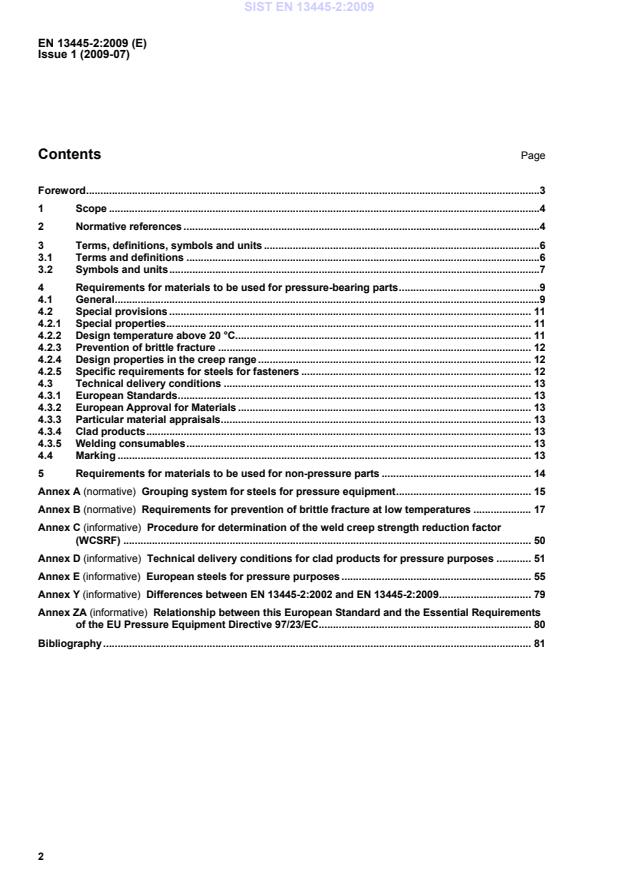
Grouping system for steels for pressure equipment.15 Annex B (normative)
Requirements for prevention of brittle fracture at low temperatures.17 Annex C (informative)
Procedure for determination of the weld creep strength reduction factor (WCSRF).50 Annex D (informative)
Technical delivery conditions for clad products for pressure purposes.51 Annex E (informative)
European steels for pressure purposes.55 Annex Y (informative)
Differences between EN 13445-2:2002 and EN 13445-2:2009.79 Annex ZA (informative)
Relationship between this European Standard and the Essential Requirements of the EU Pressure Equipment Directive 97/23/EC.80 Bibliography.81
2 Normative references This European Standard incorporates by dated or undated reference, provisions from other publications. These normative references are cited at the appropriate places in the text and the publications are listed hereafter. For dated references, subsequent amendments to or revisions of any of these publications apply to this European Standard only when incorporated in it by amendment or revision. For undated references the latest edition of the publication referred to applies (including amendments). EN 764-1:2004, Pressure equipment — Terminology — Part 1: Pressure, temperature, volume, nominal size. EN 764-2:2002, Pressure equipment — Part 2: Quantities, symbols and units. EN 764-3:2002, Pressure equipment — Part 3: Definition of parties involved. EN 1092-1:2007, Flanges and their joints — Circular flanges for pipes, valves, fittings and accessories, PN designated — Part 1: Steel flanges EN 10002-1:2001, Metallic materials - Tensile testing - Part 1: Method of test at ambient temperature EN 10028-2:2003, Flat products made of steels for pressure purposes — Part 2: Non-alloy and alloy steels with specified elevated temperature properties. EN 10028-3:2003, Flat products made of steels for pressure purposes — Part 3: Weldable fine grain steels, normalized. EN 10028-4:2003, Flat products made of steels for pressure purposes — Part 4: Nickel alloy steels with specified low temperature properties. EN 10028-5:2003, Flat products made of steels for pressure purposes — Part 5: Weldable fine grain steels, thermomechanically rolled. EN 10028-6:2003, Flat products made of steels for pressure purposes — Part 6: Weldable fine grain steels, quenched and tempered. EN 10028-7:2007, Flat products made of steels for pressure purposes — Part 7: Stainless steels. EN 10045-1:1990, Metallic materials — Charpy impact test — Part 1: Test method. EN 10164:2004, Steel products with improved deformation properties perpendicular to the surface of the product — Technical delivery conditions. EN 10204:2004, Metallic products — Types of inspection documents. SIST EN 13445-2:2009
3 Terms, definitions, symbols and units 3.1 Terms and definitions For the purposes of this European Standard the terms and definitions given in EN 13445-1:2009, EN 764-1:2004, EN 764-3:2002 and the following terms and definitions shall apply. 3.1.1 minimum metal temperature TM the lowest temperature determined for any of the following conditions (also see 3.1.2, 3.1.3): ⎯ normal operations; ⎯ start up and shut down procedures; ⎯ possible process upsets, such as flashings of fluid, which have an atmospheric boiling point below 0 °C; ⎯ during pressure or leak testing.
3.1.2 temperature adjustment term TS relevant to the calculation of the design reference temperature TR and is dependent on the calculated tensile membrane stress at the appropriate minimum metal temperature NOTE 1 Values for TS are given in Table B.2-12. NOTE 2 For tensile membrane stress reference is made to EN 13445-3:2009, Annex C. 3.1.3 design reference temperature TR the temperature used for determining the impact energy requirements and is determined by adding the temperature adjustment TS to the minimum metal temperature TM: TR = TM + TS 3.1.4 impact test temperature TKV the temperature at which the required impact energy has to be achieved (see clause B.2). 3.1.5 impact energy KV the energy absorbed by a sample of material when subjected to a Charpy-V-notch test in accordance with EN 10045-1:1990 3.1.6 reference thickness eB thickness of a component to be used to relate the design reference temperature TR of the component with its required impact test temperature TKV , (see Tables B.2-2 to B.2-7 and Figures B.2-1 to B.2-11). For unwelded parts the reference thickness eB is equal to the nominal wall thickness (including corrosion allowance). For welded parts the reference thickness is defined in Table B.4-1. SIST EN 13445-2:2009
mm3
b, c weight W N, kN density ρ
kg/mm3
d second moment of area Ι mm4 section modulus Z mm3 acceleration γ m/s2 plane angle any Greek letter a rad, ° a Symbols may use any lower-case letter, except for those defined elsewhere in this table. b Volume may also be given in m3 or L. c Litre "L" is a non-SI unit which may be used with SI units and their multiples. d Density may also be given in kg/m3.
a Symbol
b Unit
force F N moment M N.mm pressure p, P
bar c, MPa Temperature T °C linear expansion coefficient α μm/m°C normal stress σ MPa shear stress τ MPa nominal design stress f MPa tensile strength
Rm MPa ultimate tensile strength at temperature T Rm/T MPa yield strength Re MPa yield strength at temperature T Re/T MPa upper yield strength
ReH MPa 1 % proof strength Rp1,0 MPa 0,2 % proof strength
Rp0,2 MPa 0,2 % proof strength at temperature T Rp0,2/T MPa modulus of elasticity E MPa shear modulus G MPa Poisson's ratio υ – strain ε % elongation after fracture A % impact energy KV J hardness
HB, HV – Joint coefficient z – safety factor S – Mean 1 % creep strain limit at calculation temperature T and lifetime t p1,0/T/tR MPa Mean creep rupture strength at calculation temperature T and lifetime t m/T/tR MPa Weld creep strength reduction factor
cz - a Quantities without a temperature index normally refer to room temperature. b Some of these symbols, such as R,
f, are not part of ISO 31. c "bar" is a non-SI unit which may be used with SI units and their multiples. The unit bar shall be used on nameplates, certificates, drawings, pressure gauges and instrumentation and is always used as a gauge pressure. This is in line with the requirements of the Pressure Equipment Directive 97/23/EC.
NOTE 2 When technical delivery conditions for pressure-bearing parts are developed, the structure and requirements of EN 764-4:2002 should be met. Exceptions should be technically justified. The materials shall be grouped in accordance with CR ISO 15608:2000 to relate manufacturing and inspection requirements to generic material types. NOTE 3 Materials have been allocated into these groups in accordance with their chemical composition and properties in view of manufacture and heat treatment after welding. 4.1.2 Materials for pressure-bearing parts compliant with the requirements of this European Standard shall be accompanied by inspection documents in accordance with EN 10204:2004. Certificate of specific control (3.1 or 3.2 certificate) shall be required for all steels if Design by Analysis – Direct Route according to Annex B of EN 13445-3:2009 is used. NOTE The type of inspection document should be in accordance with EN 764-5:2002 and include a declaration of compliance to the material specification. 4.1.3 The materials shall be free from surface and internal defects which can impair their intended usability. 4.1.4 Steels shall have a specified minimum elongation after fracture measured on a gauge length oSL65,5o= (4.1-1) where
So is the original cross sectional area within the gauge length. The minimum elongation after fracture in any direction shall be ≥ 14 %; However, lower elongation values may also be applied (e.g. for fasteners or castings), provided that appropriate measures are taken to compensate for these lower values and the specific requirements are verifiable. NOTE Examples for compensation: ⎯ application of higher safety factors in design; ⎯ performance of burst tests to demonstrate ductile material behaviour. SIST EN 13445-2:2009
at a test temperature in accordance with Annex B, but not higher than 20 °C. The other requirements of Annex B shall also apply. 4.1.7 The chemical composition of steels intended for welding or forming shall not exceed the values in Table 4.1-1. Line 2 of the table refers to vessels or parts designed using Design by Analysis – Direct Route according to Annex B of EN 13445-3:2009. Exceptions shall be technically justified. Table 4.1-1 — Maximum carbon-, phosphorus- and sulphur contents for steels intended for welding or forming Maximum content of cast analysis Steel group (according to Table A-1) % C % P % S Steels (1 to 6 and 9) 0,23a 0,035 0,025 Steels (1 to 6 and 9)
when DBA – Direct Route is used c 0,20 0,025 0,015 Ferritic stainless steels (7.1) 0,08 0,040 0,015 Martensitic stainless steels (7.2) 0,06 0,040 0,015 Austenitic stainless steels (8.1) 0,08 0,045 0,015b Austenitic stainless steels (8.2) 0,10 0,035 0,015 Austenitic-ferritic stainless steels (10) 0,030 0,035 0,015 a Maximum content of product analysis 0,25 %. b For products to be machined a controlled sulphur content of 0,015 % to 0,030 % is permitted by agreement provided the resistance to corrosion is satisfied for the intended purpose. c In addition the ratio on thickness reduction (ratio of initial thickness of slab/ingot to the thickness of the final plate) shall be equal or greater than: ⎯ 4 for NL2 steels and steels of material group 9; ⎯ 3 for other materials.
For other than austenitic and austenitic-ferritic stainless steels, the specified value of ReH (Rp0,2) at room tempe-rature (RT) may be used for temperatures less than or equal to 50 °C. Interpolation between 50 °C and 100 °C shall be performed with the values of RT and 100 °C and using 20 °C as the starting point for interpolation. Above 100 °C linear interpolation shall be performed between the tabulated values given in the table. 4.2.2.2 As the impact properties may be affected by long or frequent holding of the material at elevated temperatures, it is presupposed that the temperatures and periods of exposure to elevated temperatures be recorded for review during in-service inspection. The influence of such exposure upon the lifetime expectancy shall be estimated and recorded. For operations such as drying and cleaning of pressure vessels, steels with specified low temperature properties but without elevated temperature 0,2 % proof strength values may however be used at elevated temperatures for drying and cleaning processes provided that the values of 0,2 % proof strength used in design calculations for elevated temperatures shall be obtained by multiplying the specified minimum yield strength values at 20 °C by the factor given in Table 4.2-1. SIST EN 13445-2:2009
Interpolation shall be carried out as in 4.2.2.1.
4.2.3 Prevention of brittle fracture The requirements in Annex B shall apply. 4.2.4 Design properties in the creep range 4.2.4.1 Creep properties of base material For interpolation and extrapolation of creep properties given in the materials standard, see EN 13445-3:2009, Clause 19. When creep properties are not available from a materials standard, they shall be determined using EN 10291:2000. 4.2.4.2 Creep properties of weldments Creep properties of weld joints subjected to stresses normal to the weld can differ significantly from those of the base material.
For the design of vessels in the creep range, this is taken into account in EN 13445-3:2009 by making use of a weld creep strength reduction factor cz obtained from tests on weldments. If no data are available, a default value of cz is used.
An acceptable method to determine cz by cross-weld tests is given in Annex C (see also [17]). 4.2.5 Specific requirements for steels for fasteners Fasteners include bolts, studs and nuts. Free cutting steel shall not be used. Bolting made of carbon steel or Ni alloy ferritic steel with > 3,5 % nickel shall not be used above 300 °C. The specified minimum tensile strength of bar material of ferritic and martensitic steel for bolts shall not exceed 1 000 MPa. The minimum elongation of bar material after fracture shall be at least A5 = 14 %. Impact requirements for ferritic and martensitic steels are specified in B.2.2.4.
Bolt material with a design temperature below − 160 °C shall be impact tested at − 196 °C. Hydrogen embrittlement, fatigue or relaxation properties shall be taken into account where appropriate. SIST EN 13445-2:2009
Equivalent national/international specifications are accepted which fulfil the same criteria with respect to the requirements for the Quality Assurance System and the requirements for manufacture, supply, distribution, test methods and evaluation of consumables.
4.4 Marking The marking of the products or delivery units shall ensure traceability between the product or delivery unit and the inspection documents. SIST EN 13445-2:2009
Grouping system for steels for pressure equipment Steels shall be grouped as shown in Table A-1. The figures given in group 1 are referring to the ladle analysis of the materials. The figures given in group 4 to 10 are based on the element content used in the designation of the alloys. Table A-1 — Grouping system for steels (extract from CR ISO 15608:2000)
Group Sub- group Type of steel 1
Steels with a specified minimum yield strength ReH ≤ 460 MPa a and with analysis in %: C ≤ 0,25 Si ≤ 0,60 Mn ≤ 1,70 Mo ≤ 0,70b S ≤ 0,045 P ≤ 0,045 Cu ≤ 0,40b Ni ≤ 0,5b Cr ≤ 0,3 (0,4 for castings)b Nb ≤ 0,05 V ≤ 0,12b Ti ≤ 0,05
1.1 Steels with a specified minimum yield strength ReH ≤ 275 MPa
1.2 Steels with a specified minimum yield strength 275 MPa < ReH ≤ 360 MPa
1.3 Normalised fine grain steels with a specified minimum yield strength ReH > 360 MPa
1.4 Steels with improved atmospheric corrosion resistance whose analysis may exceed the requirements for the single elements as indicated under 1 2
Thermomechanically treated fine grain steels and cast steels with a specified minimum yield strength ReH > 360 MPa
2.1 Thermomechanically treated fine grain steels and cast steels with a specified minimum yield strength 360 MPa < ReH ≤ 460 MPa
2.2 Thermomechanically treated fine grain steels and cast steels with a specified minimum yield strength ReH > 460 MPa 3
Quenched and tempered steels and precipitation hardened steels except stainless steels with a specified minimum yield strength ReH > 360 MPa
3.1 Quenched and tempered steels with a specified minimum yield strength 360 MPa < ReH ≤ 690 MPa
3.2 Quenched and tempered steels with a specified minimum yield strength ReH > 690 MPa
3.3 Precipitation hardened steels except stainless steels
(concluded) Group Sub- group Type of steel 4
Low vanadium alloyed Cr-Mo-(Ni) steels with Mo ≤ 0,7 % and V ≤ 0,1 %
4.1 Steels with Cr ≤ 0,3 % and Ni ≤ 0,7 %
4.2 Steels with Cr ≤ 0,7 % and Ni ≤ 1,5 % 5
Cr-Mo steels free of vanadium with C ≤ 0,35 %c
5.1 Steels with 0,75 % ≤ Cr ≤ 1,5 % and Mo ≤ 0,7 %
5.2 Steels with 1,5 % < Cr ≤ 3,5 % and 0,7 < Mo ≤ 1,2 %
5.3 Steels with 3,5 % < Cr ≤ 7,0 % and 0,4 < Mo ≤ 0,7 %
5.4 Steels with 7,0 % < Cr ≤ 10 % and 0,7 < Mo ≤ 1,2 % 6
High vanadium alloyed Cr-Mo-(Ni) steels
6.1 Steels with 0,3 % ≤ Cr ≤ 0,75 %, Mo ≤ 0,7 % and V ≤ 0,35 %
6.2 Steels with 0,75 % < Cr ≤ 3,5 %, 0,7 % < Mo ≤ 1,2 % and V ≤ 0,35 %
6.3 Steels with 3,5 % < Cr ≤ 7,0 %, Mo ≤ 0,7 % and 0,45 % ≤ V ≤ 0,55 %
6.4 Steels with 7,0 % < Cr ≤ 12,5 %, 0,7 % < Mo ≤ 1,2 % and V ≤ 0,35 % 7
Ferritic, martensitic or precipitation hardened stainless steels with C ≤ 0,35 % and 10,5 % ≤ Cr ≤ 30 %
7.1 Ferritic stainless steels
7.2 Martensitic stainless steels
7.3 Precipitation hardened stainless steels 8
Austenitic steels
8.1 Austenitic stainless steels with Cr ≤ 19 %
8.2 Austenitic stainless steels with Cr > 19 %
8.3 Manganese austenitic stainless steels with 4 % < Mn ≤ 12 % 9
Nickel alloyed steels with Ni ≤ 10 %
9.1 Nickel alloyed steels with Ni ≤ 3 %
9.2 Nickel alloyed steels with 3 % < Ni ≤ 8 %
9.3 Nickel alloyed steels with 8 % < Ni ≤ 10 % 10
Austenitic ferritic stainless steels (duplex)
10.1 Austenitic ferritic stainless steels with Cr ≤ 24 %
10.2 Austenitic ferritic stainless steels with Cr > 24 % a In accordance with the specification of the steel product standards, ReH may be replaced by Rp0,2 or Rt0.5. b A higher value is accepted provided that Cr + Mo + Ni + Cu + V ≤ 0,75 %. c "Free of vanadium" means not deliberately added to the material. SIST EN 13445-2:2009
Requirements for prevention of brittle fracture at low temperatures B.1 General This annex distinguishes between pressure equipment that has design temperature for normal operation higher or lower than 50 °C.
For pressure equipment with normal operation temperatures higher than 50 °C B.5 applies. If B.5 is not applicable, the following rules for lower normal operation temperatures shall be used.
For pressure equipment with design temperature equal to or less than 50 °C this annex specifies three alternative methods for establishing criteria for the prevention of low temperature brittle fracture1) of steels in the form of plate, strip, tubes, fittings, forgings, castings, flanges, fasteners and weldments used in pressure parts. The criteria are based on impact energy requirements at specified temperatures for the base material, heat affected zone (including the fusion line) and weld metals. The three methods are: Method 1 Code of Practice:
a) Technical requirements based on the choice of TR = T27J as specified in harmonised European Material Standards and on the assumption that it is possible to achieve these minimum properties after fabrication. Calculated from the principles of fracture mechanics used for method 2 for C and CMn steels with yield strength < 460 MPa and
b) based on operating experience for Ni-alloyed steels with Ni ≥ 3 % up to 9 %, for austenitic steels and for bolts and nuts. Method 2 Method developed from the principles of fracture mechanics and from operating experiences:
A more flexible approach than method 1 for derivation of technical requirements applicable to C, CMn and low alloy ferritic steels with a specified minimum yield strength ≤ 500 MPa and for austenitic-ferritic steels with a specified minimum yield strength ≤ 550 MPa. This method can be applied for these steels to a wider range of thicknesses and temperatures than method 1 because TR must not be equal to T27J (see Figures B.2–1 to B.2–11). In addition, for ferritic steels with max 355 MPa in PWHT condition operation experience was considered for higher thicknesses. Method 3 The application of a fracture mechanics analysis. This general method is applicable to cases not covered by methods 1 or 2. This method may also be used to justify deviations from the requirements of method 1 or 2. Only general guidance is given on the use of this method which shall only be used in agreement with the parties concerned.
1) Including temperatures at pressure tests SIST EN 13445-2:2009
B.2 Material selection and impact energy requirements B.2.1 Introduction
The methods specified in B.2.2 (method 1) or B.2.3 (method 2) shall be used to determine the impact energy required to avoid brittle fracture. Alternatively, B.2.4 (method 3) may be used to determine the required toughness. The method used shall be fully documented, in order to ensure that compliance can be verified. Reference thickness for constructional details is defined in Table B.4-1. B.2.2 Method 1 B.2.2.1 General Method 1 allows the selection of materials taken from harmonised European material standards with regard to prevention of brittle fracture. Table B.2–1 gives an overview to the following tables by steel type and product form.
The weld metal, the heat affected zone and other parts affected by manufacturing
processes shall satisfy the same impact energy requirements as the guaranteed minimum properties for the base material at TR given in the tables.
The Table lists design reference temperatures for maximum thickness at given strength levels represented by steels from harmonised European material standards with guaranteed minimum strength and impact properties. Where it is not possible to achieve these minimum properties after fabrication, a tougher starting material shall be selected.
Table B.2–1
Guide to material selection Table Material or product form Steel group Clause B.2–2 Plates and strips B.2–3 Seamless and welded pipes B.2–4 Bars B.2–5 Forgings Ferritic steels B.2.2.2 B.2–6 Ni alloyed steels (1,5 < Ni
≤ 5 %) B.2–7 Ni-alloyed steel (9 % Ni) Ferritic steels B.2.2.3 B.2–8 B.2–9 B.2–10
Bolts and nuts Ferritic steels Austenitic steels B.2.2.4 B.2–11 Austenitic steel grades Austenitic steels B.2.2.5
Values of the design reference temperature TR shall be calculated from the metal temperature TM using the values of the temperature adjustment TS given in Table B.2–12. B.2.2.2 Ferritic steels
Tables B.2–2 to B.2–5 list ferritic steels taken from harmonised European material standards with specified impact properties below –10 °C.
The tabulated value of TR is based on the impact test temperature TKV for KV = 27 J.
Table B.2–2 — General requirements for prevention of brittle
fracture with reference thickness for plates and strips Plates and Strips Max. reference thickness eB No. as per Table E.2-1 European Standard
Grade Material No. AW PWHT Design reference temperature TR (°C) Material group to CR ISO
15608:2000 Remarks 1 P235GH 1.0345 35 90
2 P265GH 1.0425 35 75 1.1
3 P295GH 1.0481 35 65
4 EN 10028-2:2003 P355GH 1.0473 35 55 – 20 1.2
29 P275NH 1.0487 35 75 – 20
30 P275NL1 1.0488 35 75 – 40
31 P275NL2 1.1104 35 90 – 50 1.1
32 P355N 1.0562 35 55 – 20
33 P355NH 1.0565 35 55 – 20
34 P355NL1 1.0566 35 55 – 40
35 EN 10028-3:2003 P355NL2 1.1106 35 55 – 50 1.2
39 11MnNi5-3 1.6212 35 50 – 60
40 13MnNi6-3 1.6217 35 50 – 60
41 EN 10028-4:2003 15NiMn6 1.6228 35 50 – 80 9.1
50 P355M 1.8821 35 - – 20 a) 51 P355ML1 1.8832 35 - – 40 a) 52 P355ML2 1.8833 35 - – 50 1.2 a) 53 P420M 1.8824 35 - – 20 a) 54 P420ML1 1.8835 35 - – 40 a) 55 EN 10028-5:2003 P420ML2 1.8828 35 - – 50 2.1 a) 59 P355Q 1.8866 35 60 – 20
60 P355QH 1.8867 35 60 – 20
61 P355QL1 1.8868 35 60 – 40
62 EN 10028-6:2003 P355QL2 1.8869 35 60 – 60 1.2
a) TMCP steels shall not be Post Weld Heat Treated
with reference thickness for seamless and welded tubes Seamless and welded tubes Max. reference thickness eB No. as per Table E.2-1 European Standard
Grade Material No. AW PWHT Design reference temperature TR (°C) Material group to CR ISO
15608:2000 Remarks 231 P275NL1 1.0488 35 75 – 40
232 P275NL2 1.1104 35 75 – 50 1.1
233 P355N 1.0562 35 55 – 20
234 P355NH 1.0565 35 55 – 20
235 P355NL1 1.0566 35 55 – 40
236 EN 10216-3:2002
P355NL2 1.1106 35 55 – 50 1.2
248 P215NL 1.0451 10 10 – 40 a) 249 P255QL 1.0452 35 40 – 50
250 P265NL 1.0453 25 25 – 40 1.1
251 26CrMo4-21.7219 15 40 – 60 5.1
252 11MnNi5-31.6212 35 40 – 60 9.1
253 EN 10216-4:2002
13MnNi6-31.6217 35 40 – 60 9.1
306 P275NL1 1.0488 35 40 – 40
307 P275NL2 1.1104 35 40 – 50 1.1
308 P355N 1.0562 35 40 – 20
309 P355NH 1.0565 35 40 – 20
310 P355NL1 1.0566 35 40 – 40
311 EN 10217-3:2002
P355NL2 1.1106 35 40 – 50 1.2
316 P215NL 1.0451 10 10 – 40 1.1 a) 317 EN 10217-4:2002 P265NL 1.0453 16 16 – 40 1.1 a) 321 P215NL 1.0451 10 10 – 40 1.1 a) 322 EN 10217-6:2002 P265NL 1.0453 25 25 – 40 1.1 a) a) Thickness limitation results from wall thickness limitation in the European material standard and in the European component standards respectively.
brittle fracture with reference thickness for bars Bars Max. reference thickness eB No. as per Table E.2-1 European Standard
Grade Material No. AW PWHTDesign reference temperature TR (°C) Material group to CR ISO
15608:2000 Remarks 147 P275NH 1.0487 35 75 1.1
148 P355NH 1.0565 35 55 1.2
150 EN 10273:2007 P355QH 1.8867 35 55 – 20 1.2
Table B.2–5 — General requirements for prevention of
brittle fracture with reference thickness for forgings Forgings Max. ref. thickness eB No. as per Table E.2-1 European Standard
Grade Material No. AW PWHT Design reference temperature TR (°C) Material group to CR ISO
15608:2000 Remarks 367 13MnNi6-3 1.6217 35 70 – 60 9.1
369 EN 10222-3:1998 15NiMn6 1.6228 35 50 – 80 9.1
378 P285QH 1.0478 35 85 – 20 1.2
380 P355QH1 1.0571 35 60 – 20 1.2
382 EN 10222-4:1998 P420QH 1.8936 35 50 – 20 3.1
B.2.2.3 Ni –alloyed steels (Ni > 1,5 %) Table B.2-6 lists Ni alloyed steels up
...