

EN 10216-5:2013
(Main)Seamless steel tubes for pressure purposes - Technical delivery conditions - Part 5: Stainless steel tubes
- Abstract
This European Standard specifies the technical delivery conditions in two test categories for seamless tubes of circular cross section made of austenitic (including creep resisting steel) and austenitic-ferritic stainless steel which are intended for pressure and corrosion resisting purposes at room temperature, at low temperatures or at elevated temperatures.
NOTE Once this standard is published in the Official Journal of the European Union (OJEU) under Directive 97/23/EC, presumption of conformity to the Essential Safety Requirements (ESR) of Directive 97/23/EC is limited to technical data of materials in this standard and does not presume adequacy of the material to a specific item of equipment. Consequently, the assessment of the technical data stated in this material standard against the design requirements of this specific item of equipment to verify that the ESRs of the Pressure Equipment Directive are satisfied, needs to be done by the designer or manufacturer of the pressure equipment, taking also into account the subsequent manufacturing processes which may affect properties of the base materials.
- Status
- Withdrawn
- Publication Date
- 10-Dec-2013
- Withdrawal Date
- 06-Oct-2026
- Technical Committee
- ECISS/TC 110 - Steel tubes, and iron and steel fittings
- Drafting Committee
- ECISS/TC 29/SC 1 - Tubes for pressure purposes
- Current Stage
- 9960 - Withdrawal effective - Withdrawal
- Start Date
- 21-Apr-2021
- Completion Date
- 07-Oct-2026
- Directive
- 2014/68/EU - Directive 2014/68/EU of the European Parliament and of the Council of 15 May 2014 on the harmonisation of the laws of the Member States relating to the making available on the market of pressure equipmentOJ Ref: C 293/01 OJ Date: 12-Aug-2016
97/23/EC - Pressure equipmentOJ Ref: C, C 313 OJ Date: 12-Sep-2014
Relations
- Effective Date
- 18-Dec-2013
- Effective Date
- 15-Apr-2009
- Effective Date
- 28-Apr-2021
- Effective Date
- 12-Aug-2026
- Effective Date
- 09-Feb-2026
- Refers
EN ISO 643:2024 - Steels - Micrographic determination of the apparent grain size (ISO 643:2024) - Effective Date
- 28-Jan-2026
- Effective Date
- 28-Jan-2026
- Effective Date
- 28-Jan-2026
- Effective Date
- 28-Jan-2026
- Effective Date
- 28-Jan-2026
- Effective Date
- 28-Jan-2026
- Effective Date
- 28-Jan-2026
- Effective Date
- 28-Jan-2026
- Effective Date
- 28-Jan-2026
- Effective Date
- 28-Jan-2026
Get Certified
Connect with accredited certification bodies for this standard

Element Materials Technology
Materials testing and product certification.

Inštitut za kovinske materiale in tehnologije
Institute of Metals and Technology. Materials testing, metallurgical analysis, NDT.
Institut za varilstvo d.o.o. (Welding Institute)
Slovenia's leading welding institute since 1952. ISO 3834, EN 1090, pressure equipment certification, NDT personnel, welder qualification. Only IIW Au
Sponsored listings
Frequently Asked Questions
EN 10216-5:2013 is a standard published by the European Committee for Standardization (CEN). Its full title is "Seamless steel tubes for pressure purposes - Technical delivery conditions - Part 5: Stainless steel tubes". This standard covers: This European Standard specifies the technical delivery conditions in two test categories for seamless tubes of circular cross section made of austenitic (including creep resisting steel) and austenitic-ferritic stainless steel which are intended for pressure and corrosion resisting purposes at room temperature, at low temperatures or at elevated temperatures. NOTE Once this standard is published in the Official Journal of the European Union (OJEU) under Directive 97/23/EC, presumption of conformity to the Essential Safety Requirements (ESR) of Directive 97/23/EC is limited to technical data of materials in this standard and does not presume adequacy of the material to a specific item of equipment. Consequently, the assessment of the technical data stated in this material standard against the design requirements of this specific item of equipment to verify that the ESRs of the Pressure Equipment Directive are satisfied, needs to be done by the designer or manufacturer of the pressure equipment, taking also into account the subsequent manufacturing processes which may affect properties of the base materials.
This European Standard specifies the technical delivery conditions in two test categories for seamless tubes of circular cross section made of austenitic (including creep resisting steel) and austenitic-ferritic stainless steel which are intended for pressure and corrosion resisting purposes at room temperature, at low temperatures or at elevated temperatures. NOTE Once this standard is published in the Official Journal of the European Union (OJEU) under Directive 97/23/EC, presumption of conformity to the Essential Safety Requirements (ESR) of Directive 97/23/EC is limited to technical data of materials in this standard and does not presume adequacy of the material to a specific item of equipment. Consequently, the assessment of the technical data stated in this material standard against the design requirements of this specific item of equipment to verify that the ESRs of the Pressure Equipment Directive are satisfied, needs to be done by the designer or manufacturer of the pressure equipment, taking also into account the subsequent manufacturing processes which may affect properties of the base materials.
EN 10216-5:2013 is classified under the following ICS (International Classification for Standards) categories: 23.040.10 - Iron and steel pipes; 77.140.75 - Steel pipes and tubes for specific use. The ICS classification helps identify the subject area and facilitates finding related standards.
EN 10216-5:2013 has the following relationships with other standards: It is inter standard links to EN 10216-5:2004/AC:2008, EN 10216-5:2004, EN 10216-5:2021, EN ISO 4885:2026, ISO 11484:2009, EN ISO 643:2024, EN ISO 8495:2013, EN 10204:2004, EN 10020:2000, EN ISO 6892-2:2011, EN ISO 8493:2004, EN ISO 14284:2002, EN 10168:2004, EN 10021:2006, EN ISO 10893-10:2011. Understanding these relationships helps ensure you are using the most current and applicable version of the standard.
EN 10216-5:2013 is associated with the following European legislation: EU Directives/Regulations: 2014/68/EU, 97/23/EC; Standardization Mandates: M/071. When a standard is cited in the Official Journal of the European Union, products manufactured in conformity with it benefit from a presumption of conformity with the essential requirements of the corresponding EU directive or regulation.
EN 10216-5:2013 is available in PDF format for immediate download after purchase. The document can be added to your cart and obtained through the secure checkout process. Digital delivery ensures instant access to the complete standard document.
Standards Content (Sample)
2003-01.Slovenski inštitut za standardizacijo. Razmnoževanje celote ali delov tega standarda ni dovoljeno.Nahtlose Stahlrohre für Druckbeanspruchungen - Technische Lieferbedingungen - Teil 5: Rohre aus nichtrostenden StählenTubes sans soudure en acier pour service sous pression - Conditions techniques de livraison - Partie 5 : Tubes en aciers inoxydablesSeamless steel tubes for pressure purposes - Technical delivery conditions - Part 5: Stainless steel tubes77.140.75Jeklene cevi in cevni profili za posebne nameneSteel pipes and tubes for specific use23.020.30MHNOHQNHPressure vessels, gas cylindersICS:Ta slovenski standard je istoveten z:EN 10216-5:2013SIST EN 10216-5:2014en,fr,de01-julij-2014SIST EN 10216-5:2014SLOVENSKI
STANDARDSIST EN 10216-5:2004/AC:2008SIST EN 10216-5:20041DGRPHãþD
EUROPEAN STANDARD NORME EUROPÉENNE EUROPÄISCHE NORM
EN 10216-5
December 2013 ICS 23.040.10; 77.140.75 Supersedes EN 10216-5:2004English Version
Seamless steel tubes for pressure purposes - Technical delivery conditions - Part 5: Stainless steel tubes
Tubes sans soudure pour service sous pression - Conditions techniques de livraison - Partie 5: Tubes en aciers inoxydables
Nahtlose Stahlrohre für Druckbeanspruchungen - Technische Lieferbedingungen - Teil 5: Rohre aus nichtrostenden Stählen This European Standard was approved by CEN on 17 August 2013.
CEN members are bound to comply with the CEN/CENELEC Internal Regulations which stipulate the conditions for giving this European Standard the status of a national standard without any alteration. Up-to-date lists and bibliographical references concerning such national standards may be obtained on application to the CEN-CENELEC Management Centre or to any CEN member.
This European Standard exists in three official versions (English, French, German). A version in any other language made by translation under the responsibility of a CEN member into its own language and notified to the CEN-CENELEC Management Centre has the same status as the official versions.
CEN members are the national standards bodies of Austria, Belgium, Bulgaria, Croatia, Cyprus, Czech Republic, Denmark, Estonia, Finland, Former Yugoslav Republic of Macedonia, France, Germany, Greece, Hungary, Iceland, Ireland, Italy, Latvia, Lithuania, Luxembourg, Malta, Netherlands, Norway, Poland, Portugal, Romania, Slovakia, Slovenia, Spain, Sweden, Switzerland, Turkey and United Kingdom.
EUROPEAN COMMITTEE FOR STANDARDIZATION
COMITÉ EUROPÉEN DE NORMALISATION EUROPÄISCHES KOMITEE FÜR NORMUNG
CEN-CENELEC Management Centre:
Avenue Marnix 17,
B-1000 Brussels © 2013 CEN All rights of exploitation in any form and by any means reserved worldwide for CEN national Members. Ref. No. EN 10216-5:2013 ESIST EN 10216-5:2014
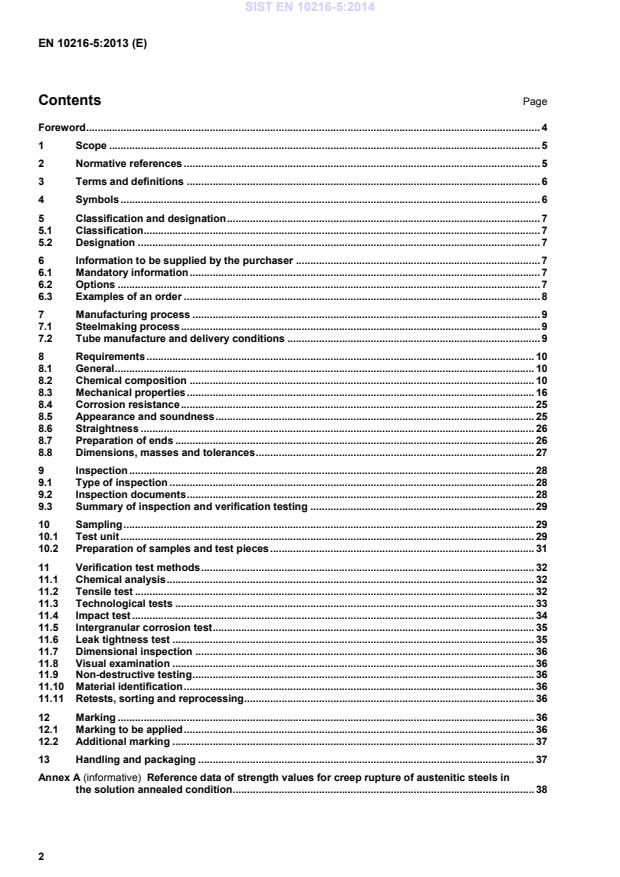
Reference data of strength values for creep rupture of austenitic steels in the solution annealed condition . 38 SIST EN 10216-5:2014
Technical changes from the previous edition . 44 Annex ZA (informative)
Clauses of this part of EN 10216 addressing essential safety requirements of the EU Directive 97/23/EC . 45 Bibliography . 46 SIST EN 10216-5:2014
test category (see 9.3). 6.2 Options A number of options are specified in this part of EN 10216 and these are listed below. In the event that the purchaser does not indicate a wish to implement any of these options at the time of enquiry and order, the tube shall be supplied in accordance with the basic specification (see 6.1). 1) information about steelmaking process (see 7.1); 2) delivery condition (see 7.2.4); 3) specified range for sulphur content (see Table 2, footnote b); 4) product analysis (see 8.2.2); SIST EN 10216-5:2014
additional heat treatment (see 8.3.1); 6) verification of impact energy at room temperature (see 8.3.1); 7) agreed mechanical properties at room temperature for austenitic corrosion resisting steel tubes with wall thicknesses greater than 60 mm (see Table 6, footnote a); 8) agreed mechanical properties at room temperature for austenitic creep resisting steel tubes with wall thicknesses greater than 50 mm (see Table 7, footnote a); 9) verification of proof strength Rp0,2 or Rp1,0 at elevated temperatures (see 8.3.2.1); 10) agreed proof strength values at elevated temperatures for austenitic corrosion resisting steel tubes with wall thicknesses greater than 60 mm (see Table 9, footnote a); 11) verification of impact energy at low temperature (see 8.3.3); 12) intergranular corrosion test (see 8.4); 13) selection of method for verification of leak-tightness test method (see 8.5.2.1); 14) Non-Destructive Testing for test category 2 tubes with specified outside diameter less than or equal to 101,6 mm and specified wall thickness less than or equal to 5,6 mm for detection of longitudinal imperfections (see 8.5.2.2); 15) Non-Destructive Testing for test category 2 tubes for detection of transverse imperfections (see 8.5.2.2); 16) Non-Destructive Testing for test category 2 tubes with specified wall thickness greater than 40 mm for detection of laminar imperfections at tube ends (see 8.5.2.2); 17) special ends preparation (see 8.7); 18) exact lengths (see 8.8.3); 19) sized tube ends for tube of D > 219,1 mm (see Table 12); 20) tolerance classes D 4 and T 4 for tubes ordered cold finished (see Table 13); 21) inspection certificate 3.2 other than the standard document (see 9.2.1); 22) test pressure for hydrostatic leak-tightness test (see 11.6.1); 23) wall thickness measurement away from the ends (see 11.7); 24) additional marking (see 12.2); 25) special protection (see 13). 6.3 Examples of an order 6.3.1 Example 1 2 000 m of hot finished descaled seamless tube with an outside diameter of 168,3 mm, a wall thickness of 4,5 mm, in accordance with this part of EN 10216, tolerance classes D 2 and T 2, made of steel grade X2CrNi19-11, to test category 1, with a 3.1 inspection certificate in accordance with EN 10204: EXAMPLE 2 000 m - HFD Tube – 168,3 X 4,5 - EN 10216-5
- X2CrNi19-11 - TC 1
Steel grade C max Si Mn P max S max N Cr Cu Mo Nb Ni Ti Others Steel name Steel
number X2CrNi18-9 1.4307 0,030 ≤ 1,00 ≤ 2,00 0,040 0,015b ≤ 0,10 17,5 to 19,5 _ _ _ 8,0 to 10,0c _ _ X2CrNi19-11 1.4306 0,030 ≤ 1,00 ≤ 2,00 0,040 0,015b ≤ 0,10 18,0 to 20,0 _ _ _ 10,0 to 12,0d _ _ X2CrNiN18-10 1.4311 0,030 ≤ 1,00 ≤ 2,00 0,040 0,015 0,12 to 0,22 17,0 to 19,5 _ _ _ 8,5 to 11,5 _ _ X5CrNi18-10 1.4301 0,07 ≤ 1,00 ≤ 2,00 0,040 0,015b ≤ 0,10 17,0 to 19,5 _ _ _ 8,0 to 10,5 _ _ X6CrNiTi18-10 1.4541 0,08 ≤ 1,00 ≤ 2,00 0,040 0,015 _ 17,0 to 19,0 _ _ _ 9,0 to 12,0d 5xC to 0,70 _ X6CrNiNb18-10 1.4550 0,08 ≤ 1,00 ≤ 2,00 0,040 0,015 _ 17,0 to 19,0 _ _ 10xC to 1,00 9,0 to 12,0d _ _ X1CrNi25-21 1.4335 0,020 ≤ 0,25 ≤ 2,00 0,025 0,010 ≤ 0,10 24,0 to 26,0 _ ≤ 0,20 _ 20,0 to 22,0 _ _ X2CrNiMo17-12-2 1.4404 0,030 ≤ 1,00 ≤ 2,00 0,040 0,015b ≤ 0,10 16,5 to 18,5 _ 2,0 to 2,5 _ 10,0 to 13,0e _ _ X5CrNiMo17-12-2 1.4401 0,07 ≤ 1,00 ≤ 2,00 0,040 0,015b ≤ 0,10 16,5 to 18,5 _ 2,0 to 2,5 _ 10,0 to 13,0 _ _ X1CrNiMoN25-22-2 1.4466 0,020 ≤ 0,70 ≤ 2,00 0,025 0,010 0,10 to
0,16 24,0 to 26,0 _ 2,00 to 2,50 _ 21,0 to 23,0 _ _ X6CrNiMoTi17-12-2 1.4571 0,08 ≤ 1,00 ≤ 2,00 0,040 0,015b _ 16,5 to 18,5 _ 2,00 to 2,50 _ 10,5 to 13,5c 5xC to 0,70 _ X6CrNiMoNb17-12-2 1.4580 0,08 ≤ 1,00 ≤ 2,00 0,040 0,015 _ 16,5 to 18,5 _ 2,00 to 2,50 10xC to 1,00 10,5 to 13,5 _ _ X2CrNiMoN17-13-3 1.4429 0,030 ≤ 1,00 ≤ 2,00 0,040 0,015 0,12 to
0,22 16,5 to 18,5 _ 2,50 to 3,0 _ 11,0 to 14,0d _ _ X3CrNiMo17-13-3 1.4436 0,05 ≤ 1,00 ≤ 2,00 0,040 0,015b ≤ 0,10 16,5 to 18,5 _ 2,50 to 3,0 _ 10,5 to 13,0d _ _ X2CrNiMo18-14-3 1.4435 0,030 ≤ 1,00 ≤ 2,00 0,040 0,015b ≤ 0,10 17,0 to 19,0 _ 2,50 to 3,0 _ 12,5 to 15,0 _ _ X2CrNiMoN17-13-5 1.4439 0,030 ≤ 1,00 ≤ 2,00 0,040 0,015 0,12 to 0,22 16,5 to 18,5 _ 4,0 to 5,0 _ 12,50to 14,5 _ _ SIST EN 10216-5:2014
number X1NiCrMoCu31-27-4 1.4563 0,020 ≤ 0,70 ≤ 2,00 0,030 0,010 ≤ 0,10 26,0 to 28,0 0,70 to
1,50 3,0 to 4,0 _ 30,0 to 32,0 _ _ X1NiCrMoCu25-20-5 1.4539 0,020 ≤ 0,70 ≤ 2,00 0,030 0,010 ≤ 0,15 19,0 to 21,0 1,20 to
2,00 4,0 to 5,0 _ 24,0 to 26,0 _ _ X1CrNiMoCuN20-18-7 1.4547 0,020 ≤ 0,70 ≤ 1,00 0,030 0,010 0,18 to 0,25 19,5 to 20,5 0,50 to
1,00 6,0 to 7.0 _ 17.5 to 18,5 _ _ X1NiCrMoCuN25-20-7 1.4529 0,020 ≤ 0,50 ≤ 1,00 0,030 0,010 0,15 to 0,25 19,0 to 21,0 0,50 to
1,50 6,0 to 7,0 _ 24,0 to 26,0 _ _ X2NiCrAlTi32-20 1.4558 0,030 ≤ 0,70 ≤ 1,00 0,020 0,015 _ 20,0 to 23,0 _ _ _ 32,0 to 35,0 8X(C+N) to 0,60 Al: 0,15 to 0,45 a Elements not listed in this table shall not be intentionally added to the steel without the agreement of the purchaser except for finishing the cast. All appropriate precautions are to be taken to avoid the addition of such elements from scrap and other materials used in production which would impair mechanical properties and the suitability of the steel. b For products to be machined a controlled sulphur content of 0,015 % to 0,030 % is permitted by agreement provided the resistance to corrosion is still satisfied for the intended purpose.
Option 3: A sulphur content of 0,015 % to 0,030 % is specified. c Where for special reasons, e.g. hot workability it is necessary to minimize the deltaferrite content, or with the aim of low permeability, the maximum nickel content may be increased by 0,50 %. d Where for special reasons, e.g. hot workability it is necessary to minimize the deltaferrite content, or with the aim of low permeability, the maximum nickel content may be increased by 1,00 %. e Where for special reasons, e.g. hot workability it is necessary to minimize the deltaferrite content, or with the aim of low permeability, the maximum nickel content may be increased by 1,50 %.
max max
X6CrNi18-10 1.4948 0,04 to
0,08 ≤ 1,00 ≤ 2,00 0,035 0,015 ≤ 0,10 17,0 to 19,0 - - - 8,0 to
11,0 - - X7CrNiTi18-10 1.4940 0,04 to
0,08 ≤ 1,00 ≤2,00 0,040 0,015 ≤ 0,10 17,0 to
19,0 - - - 9,0 to
13,0 5x(C+N) to 0,80
X7CrNiNb18-10 1.4912 0,04 to
0,10 ≤ 1,00 ≤ 2,00 0,040 0,015 ≤ 0,10 17,0 to
19,0 - - 10xC to 1,20 9,0 to 12,0
X6CrNiTiB18-10 1.4941 0,04 to
0,08 ≤ 1,00 ≤ 2,00 0,035 0,015 - 17,0 to 19,0 - - - 9,0 to 12,0 5xC to 0,80 B: 0,001 5 to 0,005 0 X6CrNiMo17-13-2
1.4918 0,04 to
0,08 ≤ 0,75 ≤ 2,00 0,035 0,015 ≤ 0,10 16,0 to 18,0 - 2,00 to
2,50
12,0 to
14,0 - - X5NiCrAlTi31-20 (+RA) b 1.4958(+RA) 0,03 to
0,08 ≤ 0,70 ≤ 1,50 0,015 0,010 - 19,0 to 22,0 ≤ 0,50 - ≤ 0,10 30,0 to
32,5 0,20 to
0,50 Al: 0,20 to 0,50 Al+Ti: ≤ 0,70 Co: ≤ 0,5 Ni+Co = 30,0 to 32,5 X8NiCrAlTi32-21 1.4959 0,05 to
0,10 ≤ 0,70 ≤ 1,50 0,015 0,010 - 19,0 to 22,0 ≤ 0,50 - - 30,0 to 34,0 0,25 to
0,65 Al: 0,20 to 0,65 X3CrNiMoBN17-13-3 1.4910 ≤ 0,04 ≤ 0, 75 ≤ 2,00 0,035 0,015 0,10 to
0,18 16,0 to 18,0 - 2,00 to
3,0 - 12,0 to 14,0 - B: 0,001 5 to 0,005 0 X8CrNiNb16-13 1.4961 0,04 to 0,10 0,30 to
0,60 ≤ 1,50 0,035 0,015 - 15,0 to 17,0 - - 10xC to 1,20 12,0 to
14,0 - - X8CrNiMoVNb16-13 1.4988 0,04 to
0,10 0,30 to
0,60 ≤ 1,50 0,035 0,015 0,06 to 0,14 15,5 to 17,5 - 1,10 to
1,50 10xC to 1,20 12,5 to
14,5 - V: 0,60 to 0,85 X8CrNiMoNb16-16 1.4981 0,04 to
0,10 0,30 to
0,60 ≤ 1,50 0,035 0,015 - 15,5 to 17,5 - 1,60 to
2,00 10xC to 1,20 c 15,5 to
17,5 - - X10CrNiMoMnNbVB15-10-1 1.4982 0,06 to
0,15 0,20 to
1,00 5,50 to
7,00 0,035 0,015 - 14,0 to 16,0 - 0,80 to
1,20 0,75 to 1,25 9,0 to 11,0 - V: 0,15 to 0,40 B 0,003 to 0,009 a Elements not listed in this table shall not be intentionally added to the steel without the agreement of the purchaser except for finishing the cast. All appropriate precautions are to be taken to avoid the addition of such elements from scrap and other materials used in production which would impair mechanical properties and the suitability of the steel. b Recrystallizing annealed condition. c Including Ta. SIST EN 10216-5:2014
Table 4 - Chemical composition (cast analysis) a of austenitic-ferritic steels, in % by mass Steel grade C max Si Mn P max S max N Cr Cu Mo Ni Others Steel name Steel number X2CrNiMoN22-5-3 1.4462 0,030 ≤ 1,00 ≤ 2,00 0,035 0,015 0,10 to 0,22 21,0 to 23,0 _ 2,50 to 3,5 4,5 to 6,5 _ X2CrNiMoSi18-5-3 1.4424 0,030 1,40 to 2,00 1,20 to 2,00 0,035 0,015 0,05 to 0,10 18,0 to 19,0 _ 2,50 to 3,0 4,5 to 5,2 _ X2CrNiN23-4
1.4362 0,030 ≤ 1,00 ≤ 2,00 0,035 0,015 0,05 to 0,20 22,0 to 24,0 0,10 to 0,60 0,10 to 0,60 3,5 to 5,5 _ X2CrNiMoN25-7-4
1.4410 0,030 ≤ 1,00 ≤ 2,00 0,035 0,015 0,20 to 0,35 24,0 to 26,0 _ 3,00 to 4,5 6,0 to 8,0 _ X2CrNiMoCuN25-6-3 1.4507 0,030 ≤ 0,70 ≤ 2,00 0,035 0,015 0,15 to 0,30 24,0 to 26,0 1,00 to 2,50 2,70 to 4,0 5,5 to 7,5 _ X2CrNiMoCuWN25-7-4 1.4501 0,030 ≤ 1,00 ≤ 1,00 0,035 0,015 0,20 to 0,30 24,0 to 26,0 0,50 to 1,00 3,00 to 4,0 6,0 to 8,0 W: 0,50 to 1,00 a Elements not listed in this table shall not be intentionally added to the steel without the agreement of the purchaser except for finishing the cast. All appropriate precautions are to be taken to avoid the addition of such elements from scrap and other materials used in production which would impair mechanical properties and the suitability of the steel. SIST EN 10216-5:2014
analysis given in Tables 2, 3 and 4 Element Limiting value for the cast analysis according to Tables 2, 3 and 4
% by mass Permissible deviation of the product analysis a % by mass Carbon ≤ 0,030 + 0,005
> 0,030 to ≤ 0,15 ± 0,01 Silicon ≤ 2,00 ± 0,05
≤ 1,00 + 0,03 Manganese > 1,00 to ≤ 2,00 ± 0,04
> 2,00 to ≤ 7,00 ± 0,10 Phosphorus
≤ 0,030 + 0,003
> 0,030 to ≤ 0,040 + 0,005 Sulphur ≤ 0,015 + 0,003
> 0,015 to ≤ 0,030 +0,005 Nitrogen ≤ 0,35 ±
0,01 Aluminium ≤ 0,65 ± 0,10 Boron ≥ 0,001 5 to ≤ 0,009 0 ± 0,000 3 Chromium > 14,0 to ≤ 20,0 ± 0,20
>20,0 to ≤ 28,0 ± 0,25 Cobalt ≤ 0,50 + 0,10 Copper ≤ 1,00 ± 0,07
> 1,00 to ≤ 2,50 ± 0,10 Molybdenum ≤ 0,60 ± 0,03
> 0,60 to ≤ 1,75 ± 0,05
> 1,75 to ≤ 7,0 ± 0,10 Niobium ≤ 1,25 ± 0,05 Nickel > 3,5 to ≤ 5,0 ± 0,07
> 5,0 to ≤ 10,0 ± 0,10
> 10,0 to ≤ 20,0 ± 0,15
>20,0 to ≤35,0 ± 0,20 Titanium ≤ 0,80 ± 0,05 Vanadium ≤ 0,85 ± 0,03 Tungsten ≤ 1,00 ± 0,05 a If several product analyses are carried out on one cast, and the contents of an individual element determined lie outside the permissible range of the chemical composition specified for the cast analysis, then it is only allowed to exceed the permissible maximum value or to fall short of the permissible minimum value, but not both for one cast. SIST EN 10216-5:2014
condition (+AT) and information about intergranular corrosion b Steel grade Tensile properties at room temperature c Impact properties c Reference heat treatment Resistance to Proof strength Tensile strength Elongation
Minimum average absorbed energy KV2 J
conditions intergranular corrosion
Rp0,2 min Rp1,0 min Rm A min (%) at RT at –196°C Solution temperature d °C Cooling in e f Method in
EN ISO 3651-2 Steel name Steel number MPa MPa MPa l t l t t
X2CrNi18-9 1.4307 180 215 460 to 680 40 35 100 60 60 1 000 to 1 100 w, a yes A X2CrNi19-11 1.4306 180 215 460 to 680 40 35 100 60 60 1 000 to 1 100 w, a yes A X2CrNiN18-10 1.4311 270 305 550 to 760 35 30 100 60 60 1 000 to 1 100 w, a yes A X5CrNi18-10 1.4301 195 230 500 to 700 40 35 100 60 60 1 000 to 1 100 w, a yes g A X6CrNiTi18-10 (cold finish) 1.4541 200 235 500 to 730 35 30 100 60 60 1 020 to 1 120 w, a yes A X6CrNiTi18-10 (hot finish) 1.4541 180 215 460 to 680 35 30 100 60 60 1 020 to 1 120 w, a yes A X6CrNiNb18-10 1.4550 205 240 510 to 740 35 30 100 60 60 1 020 to 1 120 w, a yes A X1CrNi25-21 1.4335 180 210 470 to 670 35 30 100 60 60 1 030 to 1 110 w, a yes A X2CrNiMo17-12-2 1.4404 190 225 490 to 690 40 30 100 60 60 1 020 to 1 120 w, a yes A X5CrNiMo17-12-2 1.4401 205 240 510 to 710 40 30 100 60 60 1 020 to 1 120 w, a yes g A X1CrNiMoN25-22-2 1.4466 260 295 540 to 740 40 30 100 60 60 1 070 to 1 150 w, a yes A or B X6CrNiMoTi17-12-2 (cold finish) 1.4571 210 245 500 to 730 35 30 100 60 - 1 020 to 1 120 w, a yes A X6CrNiMoTi17-12-2 (hot finish) 1.4571 190 225 490 to 690 35 30 100 60 60 1 020 to 1 120 w, a yes A X6CrNiMoNb17-12-2 1.4580 215 250 510 to 740 35 30 100 60 - 1 020 to 1 120 w, a yes A X2CrNiMoN17-13-3 1.4429 295 330 580 to 800 35 30 100 60 60 1 020 to 1 120 w, a yes A SIST EN 10216-5:2014
Minimum average absorbed energy KV2 J
conditions intergranular corrosion
Rp0,2 min Rp1,0 min Rm A min (%) at RT at –196°C Solution temperature d °C Cooling in e f Method in
EN ISO 3651-2 Steel name Steel number MPa MPa MPa l t l t t
X3CrNiMo17-13-3 1.4436 205 240 510 to 710 40 30 100 60 60 1 020 to 1 120 w, a yes g A X2CrNiMo18-14-3 1.4435 190 225 490 to 690 40 30 100 60 60 1 020 to 1 120 w, a yes A X2CrNiMoN17-13-5 1.4439 285 315 580 to 800 35 30 100 60 60 1 060 to 1 140 w, a yes A X1NiCrMoCu31-27-4 1.4563 215 245 500 to 750 40 35 120 90 60 1 070 to 1 150 w, a yes B or C X1NiCrMoCu25-20-5 1.4539 230 250 520 to 720 35 30 120 90 60 1 060 to 1 140 w, a yes C X1CrNiMoCuN20-18-7 1.4547 300 340 650 to 850 35 30 100 60 60 1 140 to 1 200 w, a yes C X1NiCrMoCuN25-20-7 1.4529 270 310 600 to 800 35 30 100 60 60 1 120 to 1 180 w, a yes C X2NiCrAlTi32-20 1.4558 180 210 450 to 700 35 30 120 90 60 950 to 1 050 w, a yes A a For wall thicknesses greater than 60 mm, the mechanical properties are subject to agreement at the time of enquiry and order. Option 7: Agreed mechanical properties for wall thicknesses greater than 60 mm apply. b Inspection and testing to be carried out are summarized in Table 15. c l = longitudinal; t = transverse. d The maximum temperatures are for guidance only. e w = water; a = air; cooling sufficiently rapid. f When tested according to EN ISO 3651-2 (appropriate method, A or B or C, as indicated) up to the limit temperatures indicated in the last column of Table 9. g In delivery condition. (Normally not fulfilled in the sensitized condition).
condition (+AT) and information about intergranular corrosion b Steel grade Tensile properties at room temperature c Impact properties at room temperature c Reference heat treatment conditions Resistance to intergranular corrosion Proof strength Tensile strength Elongation
Minimum average absorbed
energy KV2 Solution temperature d Cooling in e f Method in
EN ISO 3651-2 Rp0,2 min Rp1,0 min Rm A min (%) J
°C
Steel name Steel number MPa MPa MPa l t l t
X6CrNi18-10 1.4948 185 225 500 to 700 40 30 100 60 1 000 to 1 080 w, a no A X7CrNiTi18-10 1.4940 190 220 510 to 710 35 30 100 60 1 100 to 1 150 w, a no A X7CrNiNb18-10 1.4912 205 240 510 to 710 40 30 100 60 1 070 to 1 125 w, a no A X6CrNiTiB18-10 1.4941 195 235 490 to 680 35 30 100 60 1 070 to 1 150 w, a no A X6CrNiMo17-13-2 1.4918 205 245 490 to 690 35 30 100 60 1 020 to 1 100 w, a no A X5NiCrAlTi31-20 1.4958 170 200 500 to 750 35 30 120 80 1 150 to 1 200 w, a no A X5NiCrAlTi31-20 + RA 1.4958+RA 210 240 500 to 750 35 30 120 80 920 to 1 000 g w,a no A X8NiCrAlTi32-21 1.4959 170 200 500 to 750 35 30 120 80 1 150 to 1 200 h w, a no A X3CrNiMoBN17-13-3 1.4910 260 300 550 to 750 35 30 120 80 1 020 to 1 100 w, a no A X8CrNiNb16-13 1.4961 205 245 510 to 690 35 22 100 60 1 050 to 1 100 w, a no A X8CrNiMoVNb16-13 1.4988 255 295 540 to 740 30 20 60 40 1 100 to 1 150 i w, a no A X8CrNiMoNb16-16 1.4981 215 255 530 to 690 35 22 100 60 1 050 to 1 100 w,a no A X10CrNiMoMnNbVB15-10-1 1.4982 220 270 540 to 740 35 30 100 60 1 050 to 1 150 w, a no A SIST EN 10216-5:2014
When tested according to EN ISO 3651-2 (appropriate method, A or B or C, as indicated) up to the limit temperatures indicated in the last column of Table 10. g After solution annealing the grain size shall be 1 to 5 according to EN ISO 643. h After solution annealing the grain size according to EN ISO 643 shall be 1 to 5 for cold worked tube and 5 or coarser for hot extruded tube. i Additionally to be tempered at 750 °C to 800 °C, 1 h to 5 h and air cooling. SIST EN 10216-5:2014
condition (+AT) and information about intergranular corrosion a
Tensile properties at room temperature b Impact properties b Reference heat treatment conditions Resistance to intergranular corrosion Steel grade Proof strength Tensile strength Elongation
Minimum average absorbed energy KV2 J
Rp0,2 min. Rm A min
(%) at RT at -40 °C Solution temperature c Cooling in d e Method in
EN ISO 3651-2 Steel name Steel number MPa MPa l t l t t
X2CrNiMoN22-5-3 1.4462 450 640 to 880 f 22 22 150 100 40 1 020 to 1 100 w, a yes B X2CrNiMoSi18-5-3 1.4424 480 700 to 900 30 30 120 80 - 975 to 1 050 w, a yes A X2CrNiN23-4 1.4362 400 600 to 820 25 25
...