

EN 10216-2:2024
(Main)Seamless steel tubes for pressure purposes - Technical delivery conditions - Part 2: Non-alloy and alloy steel tubes with specified elevated temperature properties
General Information
- Abstract
This document specifies the technical delivery conditions in two test categories for seamless tubes of circular cross section, with specified elevated temperature properties, made of non-alloy and alloy steel.
This Part of EN 10216 is also be applied for tubes of non-circular cross section; necessary modification will be agreed at the time of enquiry and order.
- Status
- Published
- Publication Date
- 12-Nov-2024
- Technical Committee
- ECISS/TC 110 - Steel tubes, and iron and steel fittings
- Drafting Committee
- ECISS/TC 110/WG 1 - Tubes for pressure purposes
- Current Stage
- 6060 - Definitive text made available (DAV) - Publishing
- Start Date
- 13-Nov-2024
- Due Date
- 25-Mar-2025
- Completion Date
- 13-Nov-2024
Overview
EN 10216-2:2024 - "Seamless steel tubes for pressure purposes - Technical delivery conditions - Part 2: Non-alloy and alloy steel tubes with specified elevated temperature properties" is a European standard (CEN) that sets the technical delivery requirements for seamless steel tubes intended for pressure use at elevated temperatures. Published November 2024 and approved 13 October 2024, this Part of EN 10216 covers tubes of circular cross section (and may be applied to non‑circular sections by agreement) and defines two test categories for inspection and verification.
Key Topics
- Scope and classification
- Applies to non‑alloy and alloy seamless tubes with specified elevated temperature properties.
- Two test categories define the extent and level of inspection and testing.
- Technical delivery conditions
- Information required at enquiry and order (mandatory data and options).
- Manufacturing and delivery requirements including steelmaking and tube production methods.
- Material requirements
- Chemical composition and mechanical property requirements adapted for elevated temperature service.
- Reference to creep/long‑term elevated temperature behaviour (see informative Annex A).
- Inspection and testing
- Verification test methods: tensile tests (room and elevated temperature), flattening, ring tensile, drift and ring expanding tests, impact tests where applicable, leak tightness.
- Non‑destructive testing (NDT) methods referenced: automated electromagnetic testing, ultrasonic testing and flux leakage (EN ISO 10893 series).
- Sampling frequency, preparation of test pieces and retest/sorting rules.
- Dimensional and quality controls
- Requirements for dimensions, masses, tolerances, straightness, internal soundness and end preparation.
- Marking, documentation and protection for delivery.
- Normative references and regulatory alignment
- Cross‑references to EN/ISO test methods and related standards; includes informative Annex ZA relating the standard to Directive 2014/68/EU (pressure equipment).
Applications
EN 10216-2:2024 is intended for manufacturers, purchasers and users of seamless steel tubes used in high‑temperature pressure applications, including:
- Pressure vessels, boilers and heat exchangers
- Power generation (fossil and thermal plants)
- Petrochemical and chemical process plants
- High-temperature piping systems and industrial heaters Professionals who use this standard: tube manufacturers, material specifiers, piping engineers, pressure‑equipment designers, fabricators, NDT technicians, inspection bodies and procurement teams.
Related Standards
- EN 10216 series (Parts 1, 3, 4, 5)
- EN 10217 (welded tubes for pressure purposes)
- EN ISO test standards referenced (e.g., EN ISO 6892 tensile tests; EN ISO 148 Charpy impact; EN ISO 10893 NDT of tubes)
- National implementations of CEN members’ standards
Using EN 10216-2:2024 ensures consistent material quality, traceability and fitness for elevated‑temperature pressure service, aligning manufacturing and inspection practices across the EU and CEN member countries.
Relations
- Effective Date
- 18-Jan-2023
- Effective Date
- 18-Mar-2026
- Effective Date
- 28-Jan-2026
- Effective Date
- 28-Jan-2026
- Effective Date
- 28-Jan-2026
- Effective Date
- 28-Jan-2026
- Effective Date
- 28-Jan-2026
- Effective Date
- 28-Jan-2026
- Effective Date
- 28-Jan-2026
- Effective Date
- 28-Jan-2026
- Effective Date
- 28-Jan-2026
- Effective Date
- 28-Jan-2026
- Effective Date
- 28-Jan-2026
- Effective Date
- 28-Jan-2026
- Effective Date
- 28-Jan-2026
Get Certified
Connect with accredited certification bodies for this standard

Element Materials Technology
Materials testing and product certification.

Inštitut za kovinske materiale in tehnologije
Institute of Metals and Technology. Materials testing, metallurgical analysis, NDT.
Institut za varilstvo d.o.o. (Welding Institute)
Slovenia's leading welding institute since 1952. ISO 3834, EN 1090, pressure equipment certification, NDT personnel, welder qualification. Only IIW Au
Sponsored listings
Frequently Asked Questions
EN 10216-2:2024 is a standard published by the European Committee for Standardization (CEN). Its full title is "Seamless steel tubes for pressure purposes - Technical delivery conditions - Part 2: Non-alloy and alloy steel tubes with specified elevated temperature properties". This standard covers: This document specifies the technical delivery conditions in two test categories for seamless tubes of circular cross section, with specified elevated temperature properties, made of non-alloy and alloy steel. This Part of EN 10216 is also be applied for tubes of non-circular cross section; necessary modification will be agreed at the time of enquiry and order.
This document specifies the technical delivery conditions in two test categories for seamless tubes of circular cross section, with specified elevated temperature properties, made of non-alloy and alloy steel. This Part of EN 10216 is also be applied for tubes of non-circular cross section; necessary modification will be agreed at the time of enquiry and order.
EN 10216-2:2024 is classified under the following ICS (International Classification for Standards) categories: 23.040.10 - Iron and steel pipes; 77.140.75 - Steel pipes and tubes for specific use. The ICS classification helps identify the subject area and facilitates finding related standards.
EN 10216-2:2024 has the following relationships with other standards: It is inter standard links to EN 10216-2:2013+A1:2019, ISO 11484:2019, EN 10204:2004, EN 1434-2:2022, EN ISO 6892-1:2019, EN ISO 10893-3:2011, EN ISO 8495:2013, EN ISO 10893-3:2011/A2:2020, EN ISO 10893-10:2011, EN ISO 10893-8:2011/A1:2020, EN ISO 10893-10:2011/A1:2020, EN 10020:2000, EN ISO 8493:2004, EN 10168:2004, EN ISO 8496:2013. Understanding these relationships helps ensure you are using the most current and applicable version of the standard.
EN 10216-2:2024 is associated with the following European legislation: EU Directives/Regulations: 2014/68/EU; Standardization Mandates: M/071, M/601. When a standard is cited in the Official Journal of the European Union, products manufactured in conformity with it benefit from a presumption of conformity with the essential requirements of the corresponding EU directive or regulation.
EN 10216-2:2024 is available in PDF format for immediate download after purchase. The document can be added to your cart and obtained through the secure checkout process. Digital delivery ensures instant access to the complete standard document.
Standards Content (Sample)
SLOVENSKI STANDARD
01-januar-2025
Nevarjene jeklene cevi za tlačne posode - Tehnični dobavni pogoji - 2. del:
Nelegirane in legirane jeklene cevi s specificiranimi lastnostmi za delo pri
povišanih temperaturah
Seamless steel tubes for pressure purposes - Technical delivery conditions - Part 2:
Non-alloy and alloy steel tubes with specified elevated temperature properties
Nahtlose Stahlrohre für Druckbeanspruchungen - Technische Lieferbedingungen - Teil 2:
Rohre aus unlegierten und legierten Stählen mit festgelegten Eigenschaften bei erhöhten
Temperaturen
Tubes sans soudure en acier pour service sous pression - Conditions techniques de
livraison - Partie 2: Tubes en acier non allié et allié avec caractéristiques spécifiées à
température élevée
Ta slovenski standard je istoveten z: EN 10216-2:2024
ICS:
23.020.32 Tlačne posode Pressure vessels
77.140.75 Jeklene cevi in cevni profili Steel pipes and tubes for
za posebne namene specific use
2003-01.Slovenski inštitut za standardizacijo. Razmnoževanje celote ali delov tega standarda ni dovoljeno.
EN 10216-2
EUROPEAN STANDARD
NORME EUROPÉENNE
November 2024
EUROPÄISCHE NORM
ICS 23.040.10; 77.140.75 Supersedes EN 10216-2:2013+A1:2019
English Version
Seamless steel tubes for pressure purposes - Technical
delivery conditions - Part 2: Non-alloy and alloy steel tubes
with specified elevated temperature properties
Tubes sans soudure en acier pour service sous Nahtlose Stahlrohre für Druckbeanspruchungen -
pression - Conditions techniques de livraison - Partie 2: Technische Lieferbedingungen - Teil 2: Rohre aus
Tubes en acier non allié et allié avec caractéristiques unlegierten und legierten Stählen mit festgelegten
spécifiées à température élevée Eigenschaften bei erhöhten Temperaturen
This European Standard was approved by CEN on 13 October 2024.
CEN members are bound to comply with the CEN/CENELEC Internal Regulations which stipulate the conditions for giving this
European Standard the status of a national standard without any alteration. Up-to-date lists and bibliographical references
concerning such national standards may be obtained on application to the CEN-CENELEC Management Centre or to any CEN
member.
This European Standard exists in three official versions (English, French, German). A version in any other language made by
translation under the responsibility of a CEN member into its own language and notified to the CEN-CENELEC Management
Centre has the same status as the official versions.
CEN members are the national standards bodies of Austria, Belgium, Bulgaria, Croatia, Cyprus, Czech Republic, Denmark, Estonia,
Finland, France, Germany, Greece, Hungary, Iceland, Ireland, Italy, Latvia, Lithuania, Luxembourg, Malta, Netherlands, Norway,
Poland, Portugal, Republic of North Macedonia, Romania, Serbia, Slovakia, Slovenia, Spain, Sweden, Switzerland, Türkiye and
United Kingdom.
EUROPEAN COMMITTEE FOR STANDARDIZATION
COMITÉ EUROPÉEN DE NORMALISATION
EUROPÄISCHES KOMITEE FÜR NORMUNG
CEN-CENELEC Management Centre: Rue de la Science 23, B-1040 Brussels
© 2024 CEN All rights of exploitation in any form and by any means reserved Ref. No. EN 10216-2:2024 E
worldwide for CEN national Members.
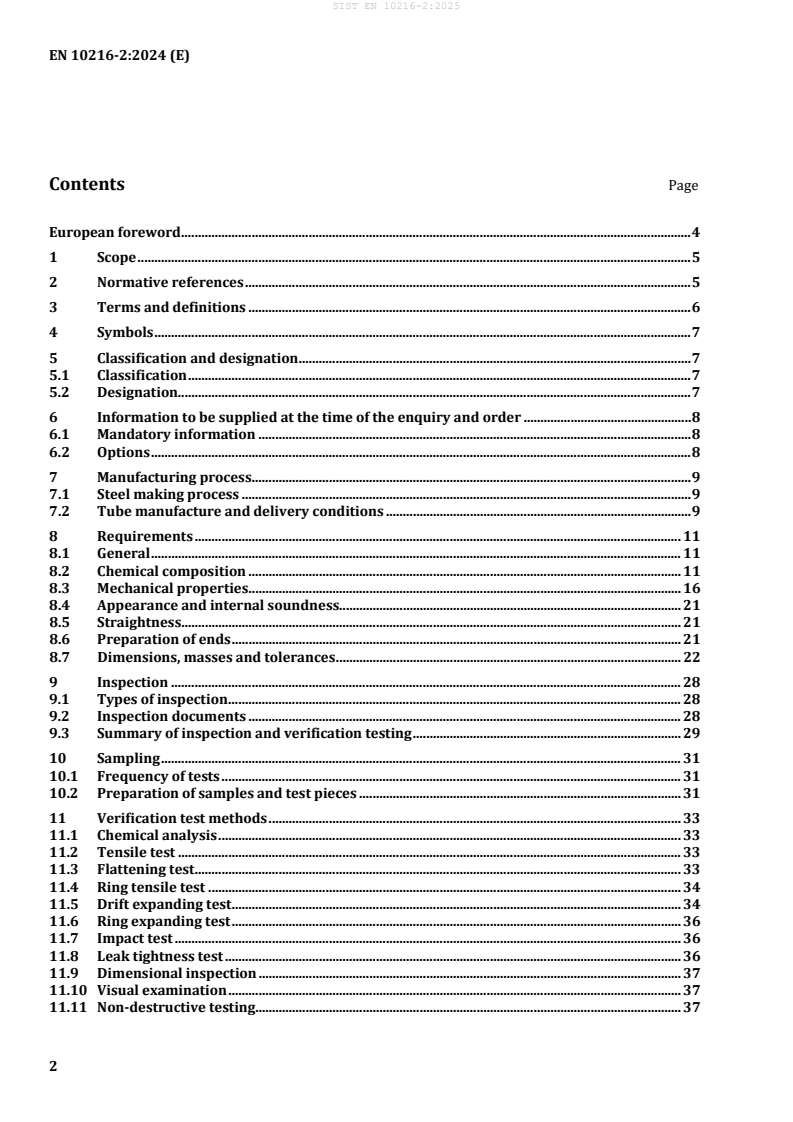
Contents Page
European foreword . 4
1 Scope . 5
2 Normative references . 5
3 Terms and definitions . 6
4 Symbols . 7
5 Classification and designation . 7
5.1 Classification . 7
5.2 Designation. 7
6 Information to be supplied at the time of the enquiry and order . 8
6.1 Mandatory information . 8
6.2 Options . 8
7 Manufacturing process . 9
7.1 Steel making process . 9
7.2 Tube manufacture and delivery conditions . 9
8 Requirements . 11
8.1 General . 11
8.2 Chemical composition . 11
8.3 Mechanical properties . 16
8.4 Appearance and internal soundness. 21
8.5 Straightness . 21
8.6 Preparation of ends . 21
8.7 Dimensions, masses and tolerances . 22
9 Inspection . 28
9.1 Types of inspection . 28
9.2 Inspection documents . 28
9.3 Summary of inspection and verification testing . 29
10 Sampling . 31
10.1 Frequency of tests . 31
10.2 Preparation of samples and test pieces . 31
11 Verification test methods . 33
11.1 Chemical analysis . 33
11.2 Tensile test . 33
11.3 Flattening test . 33
11.4 Ring tensile test . 34
11.5 Drift expanding test . 34
11.6 Ring expanding test . 36
11.7 Impact test . 36
11.8 Leak tightness test . 36
11.9 Dimensional inspection . 37
11.10 Visual examination . 37
11.11 Non-destructive testing. 37
11.12 Material identification .38
11.13 Retests, sorting and reprocessing .38
12 Marking .38
12.1 Marking to be applied .38
12.2 Additional marking .38
13 Protection .38
Annex A (informative) Creep rupture strength values .39
Annex B (informative) Technical changes from the previous edition .49
B.1 Introduction .49
B.2 Technical changes .49
Annex ZA (informative) Relationship between this European Standard and the Essential
Requirements of Directive 2014/68/EU aimed to be covered .50
Bibliography .51
European foreword
This document (EN 10216-2:2024) has been prepared by Technical Committee CEN/TC 459 “ECISS –
European Committee for Iron and Steel Standardization” , the secretariat of which is held by AFNOR.
This European Standard shall be given the status of a national standard, either by publication of an
identical text or by endorsement, at the latest by May 2025 and conflicting national standards shall be
withdrawn at the latest by May 2025.
Attention is drawn to the possibility that some of the elements of this document may be the subject of
patent rights. CEN shall not be held responsible for identifying any or all such patent rights.
This document supersedes EN 10216-2:2013+A1:2019.
For the list of the most significant technical changes that were made in EN 10216-2:2024, see Annex B.
This document has been prepared under a standardization request addressed to CEN by the European
Commission. The Standing Committee of the EFTA States subsequently approves these requests for its
Member States.
For the relationship with EU Legislation, see informative Annex ZA, which is an integral part of this
document.
EN 10216 consists of the following parts, under the general title "Seamless steel tubes for pressure
purposes – Technical delivery conditions":
— Part 1: Non-alloy steel tubes with specified room temperature properties
— Part 2: Non-alloy and alloy steel tubes with specified elevated temperature properties (the present
document)
— Part 3: Alloy fine grain steel tubes
— Part 4: Non-alloy and alloy steel tubes with specified low temperature properties
— Part 5: Stainless steel tubes
Another European Standard series covering tubes for pressure purposes is:
EN 10217 series, Welded steel tubes for pressure purposes – Technical delivery conditions
Any feedback and questions on this document should be directed to the users’ national standards body.
A complete listing of these bodies can be found on the CEN website.
According to the CEN-CENELEC Internal Regulations, the national standards organizations of the
following countries are bound to implement this European Standard: Austria, Belgium, Bulgaria, Croatia,
Cyprus, Czech Republic, Denmark, Estonia, Finland, France, Germany, Greece, Hungary, Iceland, Ireland,
Italy, Latvia, Lithuania, Luxembourg, Malta, Netherlands, Norway, Poland, Portugal, Republic of North
Macedonia, Romania, Serbia, Slovakia, Slovenia, Spain, Sweden, Switzerland, Türkiye and the United
Kingdom.
Through its sub-committee SC 10 “Steel tubes, and iron and steel fittings” (secretariat: UNI).
1 Scope
This document specifies the technical delivery conditions in two test categories for seamless tubes of
circular cross section, with specified elevated temperature properties, made of non-alloy and alloy steel.
This Part of EN 10216 is also applicable to tubes of non-circular cross section; necessary modification
will be agreed at the time of enquiry and order.
2 Normative references
The following documents are referred to in the text in such a way that some or all of their content
constitutes requirements of this document. For dated references, only the edition cited applies. For
undated references, the latest edition of the referenced document (including any amendments) applies.
EN 10020:2000, Definition and classification of grades of steel
EN 10021:2006, General technical delivery conditions for steel products
EN 10027-1:2016, Designation systems for steels - Part 1: Steel names
EN 10027-2:2015, Designation systems for steels - Part 2: Numerical system
EN 10168:2004, Steel products - Inspection documents - List of information and description
EN 10204:2004, Metallic products - Types of inspection documents
EN 10220:2002, Seamless and welded steel tubes - Dimensions and masses per unit length
EN 10266:2003, Steel tubes, fittings and structural hollow sections - Symbols and definitions of terms for
use in product standards
EN ISO 148-1:2016, Metallic materials - Charpy pendulum impact test - Part 1: Test method (ISO 148-1:
2016)
EN ISO 377:2017, Steel and steel products - Location and preparation of samples and test pieces for
mechanical testing (ISO 377:2017)
EN ISO 2566-1:2021, Steel - Conversion of elongation values - Part 1: Carbon and low-alloy steels (ISO 2566-
1:2021, Corrected version 2022-06)
EN ISO 4885:2018, Ferrous materials –Heat treatments – Vocabulary (ISO 4885:2018)
EN ISO 6892-1:2019, Metallic materials - Tensile testing - Part 1: Method of test at room temperature
(ISO 6892-1:2019)
EN ISO 6892-2:2018, Metallic materials - Tensile testing - Part 2: Method of test at elevated temperature
(ISO 6892-2:2018)
EN ISO 8492:2013, Metallic materials - Tube - Flattening test (ISO 8492:2013)
EN ISO 8493:2004, Metallic materials - Tube - Drift expanding test (ISO 8493:1998)
EN ISO 8495:2013, Metallic materials - Tube - Ring expanding test (ISO 8495:2013)
EN ISO 8496:2013, Metallic materials - Tube - Ring tensile test (ISO 8496:2013)
EN ISO 9712:2022, Non-destructive testing - Qualification and certification of NDT personnel (ISO
9712:2021)
EN ISO 10893-1:2011, Non-destructive testing of steel tubes - Part 1: Automated electromagnetic testing
of seamless and welded (except submerged arc-welded) steel tubes for the verification of hydraulic leak-
tightness (ISO 10893-1)
EN ISO 10893-3:2011, Non-destructive testing of steel tubes - Part 3: Automated full peripheral flux
leakage testing of seamless and welded (except submerged arc-welded) ferromagnetic steel tubes for the
detection of longitudinal and/or transverse imperfections (ISO 10893-3)
EN ISO 10893-8:2011, Non-destructive testing of steel tubes - Part 8: Automated ultrasonic testing of
seamless and welded steel tubes for the detection of laminar imperfections (ISO 10893-8)
EN ISO 10893-10:2011, Non-destructive testing of steel tubes - Part 10: Automated full peripheral
ultrasonic testing of seamless and welded (except submerged arc-welded) steel tubes for the detection of
longitudinal and/or transverse imperfections (ISO 10893-10)
EN ISO 14284:2022, Steel and iron - Sampling and preparation of samples for the determination of chemical
composition (ISO 14284:2022)
ISO 11484:2019, Steel products - Employer’s qualification system for non-destructive testing (NDT)
personnel
3 Terms and definitions
For the purposes of this document, the terms and definitions given in EN 10020:2000, EN 10021:2006,
EN ISO 4885:2018 and EN 10266:2003 and the following apply.
3.1
test category
classification that indicates the extent and level of inspection and testing
3.2
employer
organization for which a person works on a regular basis
Note 1 to entry: The employer may be either the tube manufacturer or supplier or a third party organization
providing Non-Destructive Testing (NDT) services.
As impacted by EN ISO 10893-1:2011/A1:2020.
As impacted by EN ISO 10893-3:2011/A1:2019 and EN ISO 10893-3:2011/A2:2020.
As impacted by EN ISO 10893-8:2011/A1:2020.
As impacted by EN ISO 10893-10:2011/A1:2020.
4 Symbols
For the purposes of this document, the symbols given in EN 10266:2003 and the following apply:
d specified inside diameter
d specified minimum inside diameter
min
T specified minimum wall thickness
min
D calculated outside diameter
c
d calculated inside diameter
c
T specified wall thickness
T calculated wall thickness
c
TC test category
5 Classification and designation
5.1 Classification
In accordance with the classification system in EN 10020:2000, the steel grades P195GH, P235GH and
P265GH are classified as non-alloy quality steels and the other steel grades are classified as alloy special
steels.
5.2 Designation
5.2.1 For the tubes covered by this Part of EN 10216, the steel designation consists of:
— the number of this Part of EN 10216;
plus either:
— the steel name in accordance with EN 10027-1:2016;
or:
— the steel number allocated in accordance with EN 10027-2:2015.
5.2.2 The steel name of non-alloy steel grades is designated by:
— the capital letter P for pressure purposes;
— the indication of the specified minimum yield strength at room temperature for wall thickness less
than or equal to 16 mm, expressed in MPa (see Table 4);
— the symbols GH for elevated temperature.
5.2.3 The steel name of alloy steel grades is designated by the chemical composition (see Table 2) and
the symbols for the heat treatment, where specified in column 3 and footnote c of Table 1.
6 Information to be supplied at the time of the enquiry and order
6.1 Mandatory information
The following information shall be supplied at the time of enquiry and order:
a) the quantity (mass or total length or number);
b) the term "tube";
c) the dimensions (outside diameter D and wall thickness T or a set of dimensions covered by Option
11) (see Table 6);
d) the designation of the steel grade in accordance with this Part of EN 10216 (see 5.2);
e) the test category (TC) for non-alloy steel (see 9.3).
6.2 Options
A number of options are specified in this Part of EN 10216 and these are listed below. In the event that
none of these options is specified at the time of enquiry and order, the tubes at least shall be supplied in
accordance with the basic specification (see 6.1).
1) Cold finishing (see 7.2.2);
2) restriction on copper and tin content (see Table 2);
3) product analysis (see 8.2.2);
4) verification of impact energy (see Table 4);
5) verification of longitudinal impact energy at -10° C for non-alloy steel grades (see Table 4);
6) verification of elevated temperature properties (see 8.3.2);
7) selection test method for verification of leak-tightness (see 8.4.2.1);
8) Non-Destructive Testing for test category 2 tubes for detection of transverse imperfections (see
8.4.2.2);
9) Non-Destructive Testing for test category 2 tubes for detection of laminar imperfections (see 8.4.2.2);
10) special ends preparation (see 8.6);
11) set of dimensions other than D and T (see 8.7.1);
12) exact lengths (see 8.7.3);
13) the type of inspection certificate 3.2 (see 9.2.1);
14) test pressure for hydrostatic leak-tightness test (see 11.8.1);
15) wall thickness measurement away from the ends (see 11.9);
16) Non-Destructive Testing method (see 11.11.1);
17) additional marking (see 12.2);
18) protection (see Clause 13);
19) material positive identification (see 11.12).
Examples of an order:
Example 1
100 t of seamless tube with an outside diameter of 168,3 mm, a wall thickness of 4,5 mm, in accordance
with EN 10216-2, made of steel grade P265GH, to test category 1 with a 3.2 inspection certificate in
accordance with EN 10204:2004:
EXAMPLE 1 100 t - Tube - 168,3 x 4,5 - EN 10216-2 - P265GH - TC1 - Option 13: 3.2
Example 2
100 m of seamless tube with a minimum inside diameter of 240 mm, a minimum wall thickness of 40 mm
in accordance with EN 10216-2, made of steel grade 10CrMo9-10, with a 3.2 inspection certificate in
accordance with EN 10204:2004:
EXAMPLE 2 100 m - Tube - dmin 240 x Tmin 40 - EN 10216-2 - 10CrMo9-10 - Option 13: 3.2
7 Manufacturing process
7.1 Steel making process
The steelmaking process is defined by the manufacturer with the exception that the open hearth
(Siemens-Martin) process shall not be employed unless in combination with a secondary steelmaking or
ladle refining process.
Steels shall be fully killed.
NOTE This excludes the use of rimming, balanced or semi-killed steel.
7.2 Tube manufacture and delivery conditions
7.2.1 All NDT activities shall be carried out by qualified and competent level 1,2 and/or 3 personnel
authorized in writing to operate by the employer.
NOTE See definition of employer 3.2.
The qualification for level 1 and 2 shall be in accordance with ISO 11484:2019 or EN ISO 9712:2022.
The qualification for the level 3 shall be in accordance with EN ISO 9712:2022.
NDT operations shall be authorized by level 3 NDT individual approved by the employer.
NOTE The definition of level 1, 2 and 3 can be found in EN ISO 9712:2022 or ISO 11484:2019
7.2.2 The tubes shall be manufactured by a seamless process.
Unless option 1 is specified, the tubes may be either hot or cold finished. The terms “hot finished” and
“cold finished” apply to the condition of the tube before it is heat treated in accordance with 7.2.3.
Option 1: The tubes shall be cold finished before heat treatment.
7.2.3 The tubes shall be supplied in the relevant heat treatment conditions as specified in Table 1.
Table 1 — Heat treatment conditions
Steel grade Austenitizing Tempering
Heat
Temperature Temperature
Cooling Cooling
a
treatment
Steel name Steel number
Medium medium
°C °C
b
P195GH 1.0348 +N 880 to 940 air - -
b
P235GH 1.0345 +N 880 to 940 air - -
b
P265GH 1.0425 +N 880 to 940 air - -
b
20MnNb6 1.0471 +N 900 to 960 air - -
b
16Mo3 1.5415 +N 890 to 950 air - -
b
8MoB5-4 1.5450 +N 920 to 960 air - -
b c
14MoV6-3 1.7715 +NT 930 to 990 air 680 to730 air
b c
10CrMo5-5 1.7338 +NT 900 to 960 air 650 to 750 air
b c
13CrMo4-5 1.7335 +NT 900 to 960 air 660 to 730 air
b c
10CrMo9-10 1.7380 +NT 900 to 960 air 680 to 750 air
11CrMo9-10 1.7383 +QT 900 to 960 air or liquid 680 to 750 air
25CrMo4 1.7218 +QT 860 to 900 air or liquid 620 to 680 air
20CrMoV13-5-5 1.7779 +QT 980 to 1030 air or liquid 680 to 730 air
c
15NiCuMoNb5-6-4 1.6368 +NT 880 to 980 air 580 to 680 air
d
7CrWVMoNb9-6 1.8201 +NT 1 040 to 1 080 air 730 to 780 air
d
7CrMoVTiB10-10 1.7378 +NT 980 to 1 020 air 730 to 770 air
furnace
X11CrMo5+I 1.7362+I +I 890 to 950 - -
atmosphere
X11CrMo5+NT1 1.7362+NT1 +NT1 930 to 980 air 730 to 770 air
c
X11CrMo5+NT2 1.7362+NT2 +NT2 930 to 980 air 710 to 750 air
furnace
X11CrMo9-1+I 1.7386+I +I 950 to 980 - -
atmosphere
c
X11CrMo9-1+NT 1.7386+NT +NT 890 to 950 air 720 to 800 air
c
X10CrMoVNb9-1 1.4903 +NT 1 040 to 1 090 air 730 to 780 air
c
X10CrWMoVNb9-2 1.4901 +NT 1 040 to 1 090 air 730 to 780 air
c
X11CrMoWVNb9-1-1 1.4905 +NT 1 040 to 1 080 air 740 to 780 air
c
X20CrMoV11-1 1.4922 +NT 1 020 to 1 080 air 730 to 780 air
c
X10CrSiCuMoNi9-2-1 1.7392 +NT 910 to 950 air 730 to 770 air
c
X12CrCoWVNb12-2-2 1.4915 +NT 1 040 to 1 080 air 760 to 800 air
c
X13CrCoWMoVNbBN11-2-2 1.4965 +NT 1 070 to 1 170 air 760 to 800 air
c
X10CrMoVNb11 1.4927 +NT 1 060 to 1 100 air 750 to 790 air
a
+N = Normalizing, +NT = Normalizing + Tempering, +QT = Quenching + Tempering (air or liquid), +I = Isothermal Annealing.
b
Normalizing includes Normalizing Forming. Normalized Forming shall be carried out in a temperature range from 880 °C to
1 000 °C.
c
For these steel grades it may be necessary in the case of wall thickness T above 10 mm or T/D > 0,15 to apply quenching and
tempering in order to achieve the intended structure and material properties. The decision shall be stated at the time of enquiry
and order. Steel tubes treated in such a way shall be designated by the steel name supplemented by the symbol “+QT “.
d
For these steel grades it may be necessary in case of wall thickness T above 16 mm or T/D > 0,15 to apply quenching and
tempering in order to achieve the intended structure and material properties. The decision shall be stated at the time of enquiry
and order. Steel tubes treated in such a way shall be designated by the steel name supplemented by the symbol “+QT”.
8 Requirements
8.1 General
When supplied in a delivery condition indicated in 7.2 and inspected in accordance with Clauses 9, 10
and 11, the tubes shall conform to the requirements of this Part of EN 10216.
In addition, the general technical delivery requirements specified in EN 10021:2006 shall apply.
Tubes shall be suitable for hot and cold bending provided the bending is carried out in an appropriate
manner.
When tubes are specified in the order by d, d or T the following formulae, with all terms in mm, shall
min min
apply for the calculation of outside diameter D , inside diameter d and wall thickness T , instead of D, d
c c c
and T for the relevant requirements in 8.4.1.4, 10.2.2.2, 11.3, 11.8.1, 11.9, 11.11.4, 12.1 and Table 1,
footnote c, Tables 4, 5, 8, 10, 13 and 14:
D = dT+ 2 (1)
c
tolerance⋅⋅of d
min
D = dT++ 2 (2)
c
min
tolerance⋅⋅of d
min
d = d + (3)
c
min
tolerance⋅⋅of T
min
T = (4)
c T +
min
For tolerances, see Tables 8, 9 and 10.
8.2 Chemical composition
8.2.1 Cast analysis
The cast analysis reported by the steel producer shall apply and conform to the requirements of Table 2.
When welding tubes produced in accordance with this Part of this EN 10216, account should be taken of
the fact that the behaviour of the steel during and after welding is dependent not only on the steel, but
also on the applied heat treatment and the conditions of preparing for and carrying out the welding.
8.2.2 Product analysis
Option 3: Product analysis for the tubes shall be supplied.
Table 3 specifies the permissible deviations of the product analysis from the specified limits on cast
analysis given in Table 2.
a
Table 2 — Chemical composition (cast analysis) , in % by mass
Steel grade
Ti Cr+Cu
P S
C Si Mn Cr Mo Ni Al Cu Nb V Others
tot
Steel
max max
max +Mo+Ni
Steel name
number
h b c d d d
P195GH 1.0348 ≤ 0,13 ≤ 0,35 ≤ 0,70 0,025 0,010 ≤ 0,30 ≤ 0,08 ≤ 0,30 ≥ 0,020 ≤ 0,30 ≤ 0,010 0,040 ≤ 0,02 ≤ 0,70 -
h b c d d d
P235GH 1.0345 ≤ 0,16 ≤ 0,35 ≤ 1,20 0,025 0,010 ≤ 0,30 ≤ 0,08 ≤ 0,30 ≥ 0,020 ≤ 0,30 ≤ 0,020 0,040 ≤ 0,02 ≤ 0,70 -
h b c d d d
P265GH 1.0425 ≤ 0,20 ≤ 0,40 ≤ 1,40 0,025 0,010 ≤ 0,30 ≤ 0,08 ≤ 0,30 ≥ 0,020 ≤ 0,30 ≤ 0,020 0,040 ≤ 0,02 ≤ 0,70 -
≤ 0,22 0,15 1,00 0,015
c
20MnNb6 1.0471 to to 0,025 0,010 - - - ≤ 0,060 ≤ 0,30 to - - - -
0,35 1,50 0,10
0,12 0,40 0,25
c
16Mo3 1.5415 to ≤ 0,35 to 0,025 0,010 ≤ 0,30 to ≤ 0,30 ≤ 0,040 ≤ 0,30 - - - - -
e
0,20 0,90 0,35
0,06 0,10 0,60 0,40 0,002
c
8MoB5-4 1.5450 to to to 0,025 0,010 ≤ 0,20 to - ≤ 0,060 ≤ 0,30 - 0,060 - - B = to
0,10 0,35 0,80 0,50 0,006
0,10 0,15 0,40 0,30 0,50 0,22
c
14MoV6-3 1.7715 to to to 0,025 0,010 to to ≤ 0,30 ≤ 0,040 ≤ 0,30 - - to - -
0,15 0,35 0,70 0,60 0,70 0,28
≤ 0,15 0,50 0,30 1,00 0,45
c
10CrMo5-5 1.7338 to to 0,025 0,010 to to ≤ 0,30 ≤ 0,040 ≤ 0,30 - - - - -
1,00 0,60 1,50 0,65
0,10 0,40 0,70 0,40
c
13CrMo4-5 1.7335 to ≤ 0,35 to 0,025 0,010 to to ≤ 0,30 ≤ 0,040 ≤ 0,30 - - - - -
e
0,17 0,70 1,15 0,60
0,08 0,30 2,00 0,90
c
10CrMo9-10 1.7380 to ≤ 0,50 to 0,020 0,010 to to ≤ 0,30 ≤ 0,040 ≤ 0,30 - - . - -
0,14 0,70 2,50 1,10
0,08 0,40 2,00 0,90
c
11CrMo9-10 1.7383 to ≤ 0,50 to 0,025 0,010 to to ≤ 0,30 ≤ 0,040 ≤ 0,30 - - . - -
0,15 0,80 2,50 1,10
Steel grade
Ti Cr+Cu
P S
C Si Mn Cr Mo Ni Al Cu Nb V Others
tot
Steel
max max
max +Mo+Ni
Steel name
number
0,22 0,60 0,90 0,15
c
25CrMo4 1.7218 to ≤ 0,40 to 0,025 0,010 to to ≤ 0,3 ≤ 0,040 ≤ 0,30 - - - - -
0,29 0,90 1,20 0,30
0,17 0,15 0,30 3,00 0,50 0,45
c
20CrMoV13-5-5 1.7779 to to to 0,025 0,010 to to ≤ 0,3 ≤ 0,040 ≤ 0,30 - - to - -
0,23 0,35 0,50 3,30 0,60 0,55
0,25 0,80 0,25 1,00 0,50 0,015
15NiCuMoNb5-
1.6368 ≤ 0,17 to to 0,025 0,010 ≤ 0,30 to to ≤ 0,050 to to - - - -
6-4
0,50 1,20 0,50 1,30 0,80 0,045
N ≤ 0,015
B = 0,001 0 to
0,005 to
7CrWVMoNb9- 0,04 to 0,10 to 1,90 to 0,05 to 0,02 to 0,20 to
0,006
1.8201 ≤ 0,50 0,030 0,010 - ≤ 0,030 - -
6 0,10 0,60 2,60 0,30 0,08 0,30
0,060
W = 1,45 to 1,75
g
Ti/N ≥3,5
N ≤ 0,010
7CrMoVTiB10- 0,05 to 0,15 to 0,30 to 2,20 to 0,90 to 0,05 to 0,20 to
1.7378 0,020 0,010 - ≤ 0,020 - - -
B = 0,001 5 to
10 0,10 0,45 0,70 2,60 1,10 0,10 0,30
0,007 0
X11CrMo5+I 1.7362+I 0,08 0,15 0,30 4,0 0,45
c
X11CrMo5+NT1 1.7362+NT1 to to to 0,025 0,010 to to - ≤ 0,040 ≤ 0,30 - - - - -
X11CrMo5+NT2 1.7362+NT2 0,15 0,50 0,60 6,0 0,65
X11CrMo9-1+I 1.7386+I 0,08 0,25 0,30 8,0 0,90
c
X11CrMo9- 1.7386+NT to to to 0,025 0,010 to to - ≤ 0,040 ≤ 0,30 - - - - -
1+NT 0,15 1,00 0,60 10,0 1.10
0,030
0,08 0,20 0,30 8,0 0,85 0,06 0,18
N = to
X10CrMoVNb9-
c
1.4903 to to to 0,020 0,005 to to ≤ 0,40 ≤ 0,02 ≤ 0,30 to 0,01 max to -
0,070
0,12 0,50 0,60 9,5 1,05 0,10 0,25
Zr = 0,01 max
Steel grade
Ti Cr+Cu
P S
C Si Mn Cr Mo Ni Al Cu Nb V Others
tot
Steel
max max
max +Mo+Ni
Steel name
number
- N = 0,030 to
0,070
0,04 to
8,5 0,15
B = 0,001 to
X10CrWMoVNb 0,07 to 0,30 to 0,30 to
0,09
1.4901 ≤ 0,50 0,020 0,010 to ≤ 0,40 ≤ 0,02 - 0,01 max to
0,006
9-2 0,13 0,60 0,60
9,5 0,25
W = 1,50 to 2,00
Zr = 0,01 max
- N = 0,050 to
0,090
8,5 0,06 0,18
B = 0,0005 to
X11CrMoWVNb 0,09 to 0,10 to 0,30 to 0,90 to 0,10 to
1.4905 0,020 0,010 to ≤ 0,02 - to 0,01 max to
0,005
9-1-1 0,13 0,50 0,60 1,10 0,40
9,5 0,10 0,25
W = 0,90 to 1,10
Zr = 0,01 max
0,17 0,15 10,0 0,80 0,30 0,25 - -
c
X20CrMoV11-1 1.4922 to to ≤ 1,00 0,025 0,010 to to to ≤ 0,040 ≤ 0,30 - - to
f
0,23 0,50 12,5 1,20 0,80 0.35
X10CrSiCuMoNi 0,06 to 1,54 to 0,45 to 7,9 to 0,76 to 0,73 to 0,045 0,75 to
1.7392 0,035 0,025 - - - - N = 0,01 to 0,06
9-2-1 0,14 2,26 0,75 9,6 1,14 1,47 max 1,45
N = 0,020 to
0,080
B = 0,002 to
10,85
X12CrCoWVNb 0,08 to 0,34 to 0,10 to 0,16 to 0,05 to 0,025 0,025 to 0,17 to
0,007
1.4915 0,025 0,013 to 0,30 max - -
12-2-2 0,16 0,66 0,50 0,44 0,47 max 0,085 0,33
12,15
W = 1,20 to 1,80
Co = 1,30 to
1,80
Steel grade
Ti Cr+Cu
P S
C Si Mn Cr Mo Ni Al Cu Nb V Others
tot
Steel
max max
max +Mo+Ni
Steel name
number
N = 0,002 to
0,030
B = 0,007 to
10,35
X13CrCoWMoV 0,08 to 0,14 to 0,25 to 0,06 to 0,47 0,025 0,015 to 0,030 0,12 to
0,016
1.4965 0,025 0,013 to 0,20 max -
NbBN11-2-2 0,18 0,66 0,85 0,64 max max 0,105 max 0,33
12,15
W = 1,40 to 2,60
Co = 1,40 to
2,60
0,08 0,15 0,2 10,0 0,02 0,18 _ N = 0,030 to
0,40 to
X10CrMoVNb11 1.4927 to to to 0,02 0,005 to ≤ 0,20 ≤ 0,02 ≤ 0,15 to _ to 0,070
0,60
0,13 0,45 0,5 11,5 0,06 0,25
a
Elements not included in this table shall not be intentionally added to the steel without the agreement of the purchaser, except for elements which may be added for finishing the cast. All appropriate
measures shall be taken to prevent the addition of undesirable elements from scrap or other materials used in the steel making process.
b
This requirement is not applicable provided the steel contains a sufficient amount of other nitrogen binding elements which shall be reported. When using titanium, the producer shall verify that
(Al+Ti/2) ≥ 0,020 %.
c
Option 2: In order to facilitate subsequent forming operations, an agreed maximum copper content lower than indicated and an agreed specified maximum tin content shall apply.
d
The content of these elements need not to be reported unless intentionally added to the cast.
e
For wall thickness T ≥ 30 mm the carbon content may be increased by 0,02 % for cast and product analysis.
f
The upper carbon value of 0,23 % shall not be exceeded for product analysis.
g
Alternatively, in lieu of the minimum ratio the material shall a have a minimum hardness of 275 HV in the hardened condition, defined as after austenitizing and cooling to room temperature, but
before tempering. Hardness testing shall be performed at mid thickness of the product. The testing frequency shall be two samples of product per heat treatment lot and the hardness testing results
shall be reported.
h
Al/N ≥ 2, if nitrogen is fixed by niobium, titanium or vanadium the requirements for Al tot and Al/N do not apply.
Table 3 — Permissible deviations of the product analysis from specified limits on cast analysis
given in Table 2
Limiting value for the cast analysis in Permissible deviation of the product
accordance with Table 2 analysis
Element
% by mass % by mass
C ≤ 0,29 ± 0,02
≤ 0,40 ± 0,05
Si
> 0,40 to ≤ 1,00 ± 0,06
≤ 1,00 ± 0,05
Mn
> 1,00 to ≤ 1,50 ± 0,10
P ≤ 0,030 + 0,005
≤ 0,010 + 0,003
S
> 0,010 to ≤ 0,020 + 0,005
Al ≤ 0,060 ± 0,005
B ≤ 0,007 + 0,000 5
≤ 1,00 ± 0,05
Cr > 1,00 to ≤ 10,0 ± 0,10
> 10,0 to ≤ 12,5 ± 0,15
Cu ≤ 0,80 ± 0,05
≤ 0,35 ± 0,03
Mo
> 0,35 to ≤ 1,20 ± 0,04
N ≤ 0,070 ± 0,01
Nb ≤ 0,10 ± 0,005
≤ 0,35 ± 0,05
Ni
> 0,35 to ≤ 1,30 ± 0,07
Ti ≤ 0,060 + 0,010
≤ 0,10 + 0,01
V
> 0,10 to ≤ 0,55 ± 0,03
W ≤ 2,00 ± 0,10
8.3 Mechanical properties
8.3.1 Mechanical properties at and below room temperature
The mechanical properties at and below room temperature of the tubes shall conform to the
requirements in Table 4 and in 11.3, 11.4, 11.5 and 11.6 irrespective of whether they are verified or not
(see Table 13).
8.3.2 Proof strength at elevated temperature
If Option 6 is specified by the purchaser, the minimum proof strength R values at elevated
p0,2
temperature are given in Table 5.
Option 6: Proof strength R shall be verified. The test temperature shall be specified at the time of
p0,2
enquiry and order.
8.3.3 Creep rupture strength
The creep rupture strength values are given in Annex A for information.
Table 4 — Mechanical properties
a b
Steel grade Tensile properties at room temperature Impact properties
Upper yield strength or proof strength Tensile Elongation Minimum average absorbed energy KV
strength
ReH or Rp0,2 for wall thickness T A min. J
Rm
a
min. % at a temperature of
Steel
Steel name
number
°C
T ≤ 16 16 < T ≤ 40 40 < T ≤ 60 60 < T ≤ 100 l t
l t
MPa MPa MPa MPa MPa 20 0 -10 20 0
c d c
P195GH 1.0348 195 - - - 320 to 440 27 25 - 40 28 - 27
c d c
P235GH 1.0345 235 225 215 - 360 to 500 25 23 - 40 28 - 27
c d c
P265GH 1.0425 265 255 245 - 410 to 570 23 21 - 40 28 - 27
c c
20MnNb6 1.0471 355 345 335 - 500 to 650 22 20 . 40 - - 27
c c
16Mo3 1.5415 280 270 260 - 450 to 600 22 20 40 - - 27 -
c c
8MoB5-4 1.5450 400 - - - 540 to 690 19 17 40 - - 27 -
c f c f
14MoV6-3 1.7715 320 320 310 - 460 to 610 20 18 40 - - 27 -
c c
10CrMo5-5 1.7338 275 275 265 - 410 to 560 22 20 40 - - 27 -
c c
13CrMo4-5 1.7335 290 290 280 - 440 to 590 22 20 40 - - 27 -
c c
10CrMo9-10 1.7380 280 280 270 - 480 to 630 22 20 40 - - 27 -
c c
11CrMo9-10 1.7383 355 355 355 - 540 to 680 20 18 40 - - 27 -
c f c f
25CrMo4 1.7218 345 345 345 - 540 to 690 18 15 40 - - 27 -
c f c f
20CrMoV13-5-5 1.7779 590 590 590 - 740 to 880 16 14 40 - - 27 -
e c f c f
15NiCuMoNb5-6-4 1.6368 440 440 440 440 610 to 780 19 17 40 - - 27 -
c f c f
7CrWVMoNb9-6 1.8201 400 400 400 - 510 to 740 20 18 40 - - 27 -
c f c f
7CrMoVTiB10-10 1.7378 450 430 430 - 565 to 840 17 15 40 - - 27 -
c c
X11CrMo5+I 1.7362+I 175 175 175 175 430 to 580 22 20 40 - - 27 -
c c
X11CrMo5+NT1 1.7362+NT1 280 280 280 280 480 to 640 20 18 40 - - 27 -
c c
X11CrMo5+NT2 1.7362+NT2 390 390 390 390 570 to 740 18 16 40 - - 27 -
c c
X11CrMo9-1+I 1.7386+I 210 210 210 - 460 to 640 20 18 40 - - 27 -
c c
X11CrMo9-1+NT 1.7386+NT 390 390 390 - 590 to 740 18 16 40 - - 27 -
c f c f
X10CrMoVNb9-1 1.4903 450 450 450 450 630 to 830 19 17 40 - - 27 -
a b
Steel grade Tensile properties at room temperature Impact properties
Upper yield strength or proof strength Tensile Elongation Minimum average absorbed energy KV
strength
R or R for wall thickness T A min. J
eH p0,2
Rm
a
min. % at a temperature of
Steel
Steel name
number
°C
T ≤ 16 16 < T ≤ 40 40 < T ≤ 60 60 < T ≤ 100 l t
l t
MPa MPa MPa MPa MPa 20 0 -10 20 0
c f c f
X10CrWMoVNb9-2 1.4901 440 440 440 440 620 to 850 19 17 40 - - 27 -
c f c f
X11CrMoWVNb9-1-1 1.4905 450 450 450 450 620 to 850 19 17 40 - - 27 -
c f c f
X20CrMoV11-1 1.4922 490 490 490 490 690 to 840 17 14 40 - - 27 -
c c
X10CrSiCuMoNi9-2-1 1.7392 580 580 - - 750 to 950 18 18 40 - - 27 -
c c
X12CrCoWVNb12-2-2 1.4915 450 - - - 620 to 850 19 17 40 - - 27 -
X13CrCoWMoVNbBN11- - - -
c f c f
1.4965 490 490 490 490 650 to 880 19 17 40 27
2-2
c f c f
X10CrMoVNb11 1.4927 450 450 450 - 620 to 850 19 17 40 - - 27 -
a
l = longitudinal; t = transverse.
b f
To be verified when Option 4 or Option 5 or both is/are specified, unless footnote applies.
c
Option 4: Impact energy shall be verified for Group B (see Table 13; for specimen direction see 10.2.2.4).
d
Option 5: Longitudinal impact energy shall be verified at −10 °C.
e
For wall thickness 60 mm < T ≤ 80 mm.
f
Impact test verification (longitudinal or transversal) is mandatory for wall thickness T ≥ 16 mm.
Table 5 — Minimum proof strength R at elevated temperature
p0,2
Steel grade Wall Minimum proof strength Rp0,2 MPa
thickness
at a temperature of °C
mm
Steel name Steel number 100 150 200 250 300 350 400 450 500 550 600
P195GH 1.0348 ≤16 175 165 150 130 113 102 94 - - - -
P235GH 1.0345 ≤ 60 198 187 170 150 132 120 112 108 - - -
P265GH 1.0425 ≤ 60 226 213 192 171 154 141 134 128 - - -
20MnNb6 1.0471 ≤ 60 312 292 264 241 219 200 186 174 - - -
16Mo3 1.5415 ≤ 60 243 237 224 205 173 159 156 150 146 - -
8MoB5-4 1.5450 ≤ 16 368 368 368 368 368 368 368 - - - -
14MoV6-3 1.7715 ≤ 60 282 276 267 241 225 216 209 203 200 197 -
10CrMo5-5 1.7338 ≤ 60 240 228 219 208 165 156 148 144 143 - -
13CrMo4-5 1.7335 ≤ 60 264 253 245 236 192 182 174 168 166 - -
10CrMo9-10 1.7380 ≤ 60 249 241 234 224 219 212 207 193 180 - -
11CrMo9-10 1.7383 ≤ 60 323 312 304 296 289 280 275 257 239 - -
25CrMo4 1.7218 ≤ 60 - 315 305 295 285 265 225 185 - - -
20CrMoV13-5-5 1.7779 ≤ 60 - 575 570 560 550 510 470 420 370 - -
15NiCuMoNb5-6-4 1.6368 ≤ 80 422 412 402 392 382 373 343 304 - - -
7CrWVMoNb9-6 1.8201 ≤ 60 379 370 363 361 359 351 345 338 330 299 266
7CrMoVTiB10-10 1.7378 ≤ 60 397 383 373 366 359 352 345 336 324 301 248
X11CrMo5+I 1.7362+I ≤ 100 156 150 148 147 145 142 137 129 116 - -
X11CrMo5+NT1 1.7362+NT1 ≤ 100 245 237 230 223 216 206 196 181 167 - -
X11CrMo5+NT2 1.7362+NT2 ≤ 100 366 350 334 332 309 299 289 280 265 - -
X11CrMo9-1+I 1.7386+I ≤ 60 187 186 178 177 175 171 164 153 142 120 -
X11CrMo9-1+NT 1.7386+NT ≤ 60 363 348 334 330 326 322 316 311 290 235 -
X10CrMoVNb9-1 1.4903 ≤ 100 410 395 380 370 360 350 340 320 300 270 215
Steel grade Wall Minimum proof strength Rp0,2 MPa
thickness
at a temperature of °C
mm
Steel name Steel number 100 150 200 250 300 350 400 450 500 550 600
X10CrWMoVNb9-2 1.4901 ≤ 100 420 412 405 400 392 382 372 360 340 300 248
X11CrMoWVNb9-1-1 1.4905 ≤ 100 412 401 390 383 376 367 356 342 319 287 231
X20CrMoV11-1 1.4922 ≤ 100 - - 430 415 390 380 360 330 290 250
X10CrSiCuMoNi9-2-1 1.7392 ≤ 25 527 493 467 453 447 444 435 411 367 298 209
X12CrCoWVNb12-2-2 1.4915 ≤ 12 420 412 405 400 392 382 372 360 340 300 248
X13CrCoWMoVNbBN11-2-2 1.4965 ≤ 100 420 412 405 400 392 382 372 360 340 300 248
X10CrMoVNb11 1.4927 ≤ 100 410 395 380 370 360 350 340 320 300 270 215
8.4 Appearance and internal soundness
8.4.1 Appearance
8.4.1.1 The tubes shall be free from external and internal surface defects that are detectable by visual
examination.
8.4.1.2 The internal and external surface finish of the tubes shall be typical of the manufactur
...