

EN 14033-2:2008+A1:2011
(Main + Amendment)Railway applications - Track - Railbound construction and maintenance machines - Part 2: Technical requirements for working
- Abstract
1.1 General
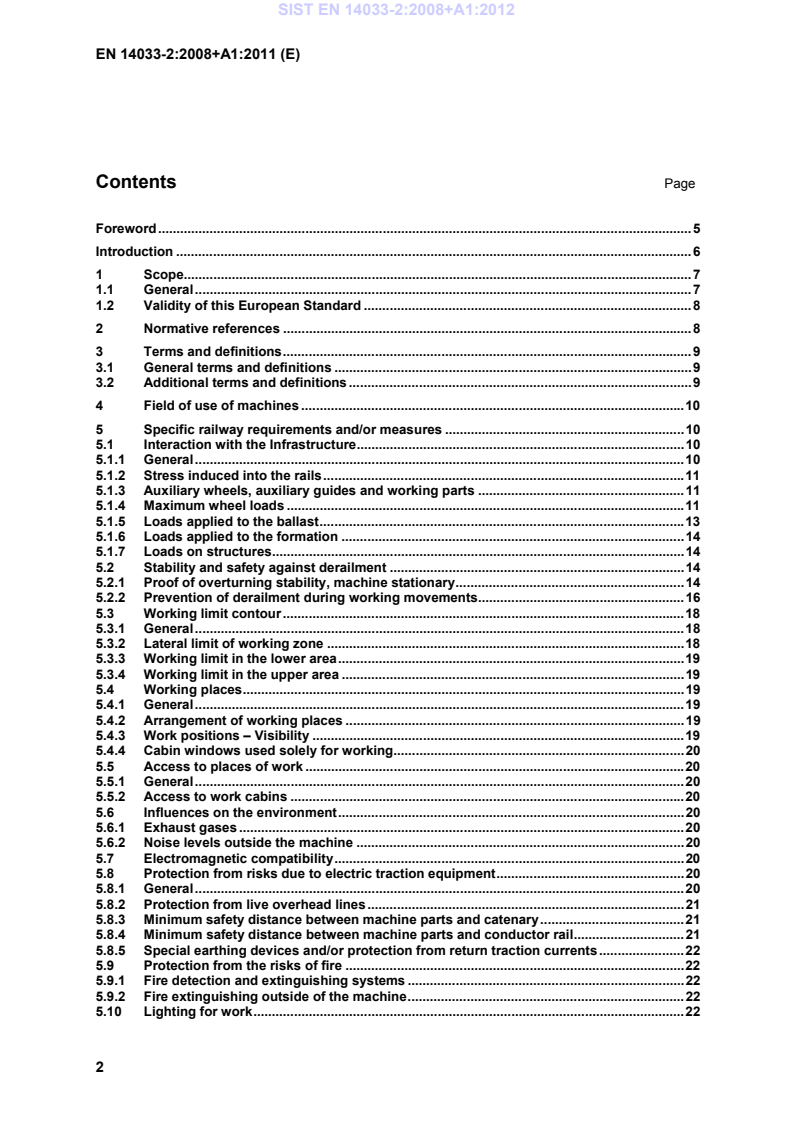
This European Standard defines the specific technical railway requirements for working with machines and other vehicles used for construction, maintenance and inspection of track, structures, track formation and fixed electric traction equipment as specified in EN 14033-1.
This European Standard applies to all railbound machines and other vehicles - referred to as machines - working exclusively on the railway (utilising adhesion between the rail and rail wheels) and used for construction, maintenance and inspection of track, structures, infrastructure and fixed electric traction equipment.
This European Standard applies to machines that are intended to operate signalling and control systems. Other similar machines are dealt with in other European Standards, see Annex M.
Additional requirements can apply for working on infrastructures with narrow gauge or broad gauge lines, lines of tramways, railways utilising other than adhesion between the rail and rail wheels and underground infrastructures.
This European Standard is applicable to 1 435 mm nominal track gauge. Some requirements may be applicable for working on infrastructures with nominal narrow track gauge or nominal broad track gauge lines, lines of tramways, railways utilising other than adhesion between the rail and rail wheels and underground infrastructures.
This European Standard covers the safety requirements for the railway specific problems for working on different infrastructures. The application of these requirements is the object of a verification procedure, which does not form part of this European Standard, but an Annex J is included for information. In all cases an authorisation to work is required to access the infrastructure.
This European Standard is also applicable for machines that in working position are partly supported on the ballast or the formation.
This European Standard does not apply to
- the requirements with regard to the quality of work, including the related measuring methods, and the performance of the machine; )
- the specific requirements established by each railway infrastructure manager for the use of machines which will be the subject of negotiation between the manufacturer and the infrastructure manager.
This European Standard does not deal with the following additional requirements:
- working methods;
- operation in severe working conditions requiring special measures (e.g. work in tunnels or in cuttings, extreme environmental conditions such as freezer applications, high temperatures, corrosive environment, tropical environment, contaminating environments, strong magnetic fields);
- operation subject to special rules (e.g. potentially explosive atmospheres);
- hazards due to errors in software;
- hazards occurring when used to handle suspended loads which may swing freely;
- hazards due to wind pressure greater than normal e.g. pressures caused by the passing of trains at speed in excess of 190 km/h.
1.2 Validity of this European Standard
This European Standard applies to all machines, which are ordered after one year from the publication date of this European Standard.
- Status
- Withdrawn
- Publication Date
- 13-Dec-2011
- Withdrawal Date
- 06-Oct-2026
- Technical Committee
- CEN/TC 256 - Railway applications
- Drafting Committee
- CEN/TC 256/SC 1/WG 5 - Track construction and maintenance machines
- Current Stage
- 9960 - Withdrawal effective - Withdrawal
- Start Date
- 31-May-2017
- Completion Date
- 07-Oct-2026

Relations
- Effective Date
- 19-Jan-2023
- Effective Date
- 21-Dec-2011
- Effective Date
- 25-Aug-2026
- Effective Date
- 25-Aug-2026
- Effective Date
- 09-Feb-2026
- Effective Date
- 09-Feb-2026
- Effective Date
- 28-Jan-2026
- Effective Date
- 28-Jan-2026
- Effective Date
- 28-Jan-2026
- Effective Date
- 28-Jan-2026
- Effective Date
- 28-Jan-2026
- Effective Date
- 28-Jan-2026
- Effective Date
- 28-Jan-2026
- Effective Date
- 28-Jan-2026
- Effective Date
- 28-Jan-2026
Get Certified
Connect with accredited certification bodies for this standard

IRIS Certification (UNIFE)
International Railway Industry Standard certification.

TÜV SÜD Rail GmbH
TÜV SÜD railway certification services.

Bureau Veritas Railway Certification
Railway and transportation certification.
Sponsored listings
Frequently Asked Questions
EN 14033-2:2008+A1:2011 is a standard published by the European Committee for Standardization (CEN). Its full title is "Railway applications - Track - Railbound construction and maintenance machines - Part 2: Technical requirements for working". This standard covers: 1.1 General This European Standard defines the specific technical railway requirements for working with machines and other vehicles used for construction, maintenance and inspection of track, structures, track formation and fixed electric traction equipment as specified in EN 14033-1. This European Standard applies to all railbound machines and other vehicles - referred to as machines - working exclusively on the railway (utilising adhesion between the rail and rail wheels) and used for construction, maintenance and inspection of track, structures, infrastructure and fixed electric traction equipment. This European Standard applies to machines that are intended to operate signalling and control systems. Other similar machines are dealt with in other European Standards, see Annex M. Additional requirements can apply for working on infrastructures with narrow gauge or broad gauge lines, lines of tramways, railways utilising other than adhesion between the rail and rail wheels and underground infrastructures. This European Standard is applicable to 1 435 mm nominal track gauge. Some requirements may be applicable for working on infrastructures with nominal narrow track gauge or nominal broad track gauge lines, lines of tramways, railways utilising other than adhesion between the rail and rail wheels and underground infrastructures. This European Standard covers the safety requirements for the railway specific problems for working on different infrastructures. The application of these requirements is the object of a verification procedure, which does not form part of this European Standard, but an Annex J is included for information. In all cases an authorisation to work is required to access the infrastructure. This European Standard is also applicable for machines that in working position are partly supported on the ballast or the formation. This European Standard does not apply to - the requirements with regard to the quality of work, including the related measuring methods, and the performance of the machine; ) - the specific requirements established by each railway infrastructure manager for the use of machines which will be the subject of negotiation between the manufacturer and the infrastructure manager. This European Standard does not deal with the following additional requirements: - working methods; - operation in severe working conditions requiring special measures (e.g. work in tunnels or in cuttings, extreme environmental conditions such as freezer applications, high temperatures, corrosive environment, tropical environment, contaminating environments, strong magnetic fields); - operation subject to special rules (e.g. potentially explosive atmospheres); - hazards due to errors in software; - hazards occurring when used to handle suspended loads which may swing freely; - hazards due to wind pressure greater than normal e.g. pressures caused by the passing of trains at speed in excess of 190 km/h. 1.2 Validity of this European Standard This European Standard applies to all machines, which are ordered after one year from the publication date of this European Standard.
1.1 General This European Standard defines the specific technical railway requirements for working with machines and other vehicles used for construction, maintenance and inspection of track, structures, track formation and fixed electric traction equipment as specified in EN 14033-1. This European Standard applies to all railbound machines and other vehicles - referred to as machines - working exclusively on the railway (utilising adhesion between the rail and rail wheels) and used for construction, maintenance and inspection of track, structures, infrastructure and fixed electric traction equipment. This European Standard applies to machines that are intended to operate signalling and control systems. Other similar machines are dealt with in other European Standards, see Annex M. Additional requirements can apply for working on infrastructures with narrow gauge or broad gauge lines, lines of tramways, railways utilising other than adhesion between the rail and rail wheels and underground infrastructures. This European Standard is applicable to 1 435 mm nominal track gauge. Some requirements may be applicable for working on infrastructures with nominal narrow track gauge or nominal broad track gauge lines, lines of tramways, railways utilising other than adhesion between the rail and rail wheels and underground infrastructures. This European Standard covers the safety requirements for the railway specific problems for working on different infrastructures. The application of these requirements is the object of a verification procedure, which does not form part of this European Standard, but an Annex J is included for information. In all cases an authorisation to work is required to access the infrastructure. This European Standard is also applicable for machines that in working position are partly supported on the ballast or the formation. This European Standard does not apply to - the requirements with regard to the quality of work, including the related measuring methods, and the performance of the machine; ) - the specific requirements established by each railway infrastructure manager for the use of machines which will be the subject of negotiation between the manufacturer and the infrastructure manager. This European Standard does not deal with the following additional requirements: - working methods; - operation in severe working conditions requiring special measures (e.g. work in tunnels or in cuttings, extreme environmental conditions such as freezer applications, high temperatures, corrosive environment, tropical environment, contaminating environments, strong magnetic fields); - operation subject to special rules (e.g. potentially explosive atmospheres); - hazards due to errors in software; - hazards occurring when used to handle suspended loads which may swing freely; - hazards due to wind pressure greater than normal e.g. pressures caused by the passing of trains at speed in excess of 190 km/h. 1.2 Validity of this European Standard This European Standard applies to all machines, which are ordered after one year from the publication date of this European Standard.
EN 14033-2:2008+A1:2011 is classified under the following ICS (International Classification for Standards) categories: 45.120 - Equipment for railway/cableway construction and maintenance; 93.100 - Construction of railways. The ICS classification helps identify the subject area and facilitates finding related standards.
EN 14033-2:2008+A1:2011 has the following relationships with other standards: It is inter standard links to EN 14033-2:2008, EN 14033-2:2017, ISO 7574-4:1985, ISO 4305:1991, EN 50122-1:2022, ISO 4310:2009, EN ISO 7731:2008, EN 14033-3:2009+A1:2011, EN 16228-7:2014+A1:2021, EN 12077-2:1998, EN ISO 6808:2000, EN 3-7:2004+A1:2007, EN 14363:2005, EN 14033-1:2011, EN ISO 12100:2010. Understanding these relationships helps ensure you are using the most current and applicable version of the standard.
EN 14033-2:2008+A1:2011 is available in PDF format for immediate download after purchase. The document can be added to your cart and obtained through the secure checkout process. Digital delivery ensures instant access to the complete standard document.
Standards Content (Sample)
2003-01.Slovenski inštitut za standardizacijo. Razmnoževanje celote ali delov tega standarda ni dovoljeno.Bahnanwendungen - Oberbau - Schienengebundene Bau- und Instandhaltungsmaschinen - Teil 2: Technische Anforderungen an den ArbeitseinsatzApplications ferroviaires - Voie - Machines de construction et de maintenance empruntant exclusivement les voies ferrées - Partie 2: Prescriptions techniques pour le travailRailway applications - Track - Railbound construction and maintenance machines - Part 2: Technical requirements for working45.120åLþQLFEquipment for railway/cableway construction and maintenanceICS:Ta slovenski standard je istoveten z:EN 14033-2:2008+A1:2011SIST EN 14033-2:2008+A1:2012en,fr,de01-februar-2012SIST EN 14033-2:2008+A1:2012SLOVENSKI
STANDARD
EUROPEAN STANDARD NORME EUROPÉENNE EUROPÄISCHE NORM
EN 14033-2:2008+A1
December 2011 ICS 45.120; 93.100 Supersedes EN 14033-2:2008English Version
Railway applications - Track - Railbound construction and maintenance machines - Part 2: Technical requirements for working
Applications ferroviaires - Voie - Machines de construction et de maintenance empruntant exclusivement les voies ferrées - Partie 2: Prescriptions techniques pour le travail
Bahnanwendungen - Oberbau - Schienengebundene Bau- und Instandhaltungsmaschinen - Teil 2: Technische Anforderungen an den Arbeitseinsatz This European Standard was approved by CEN on 11 August 2007 and includes Amendment 1 approved by CEN on 8 November 2011.
CEN members are bound to comply with the CEN/CENELEC Internal Regulations which stipulate the conditions for giving this European Standard the status of a national standard without any alteration. Up-to-date lists and bibliographical references concerning such national standards may be obtained on application to the CEN-CENELEC Management Centre or to any CEN member.
This European Standard exists in three official versions (English, French, German). A version in any other language made by translation under the responsibility of a CEN member into its own language and notified to the CEN-CENELEC Management Centre has the same status as the official versions.
CEN members are the national standards bodies of Austria, Belgium, Bulgaria, Croatia, Cyprus, Czech Republic, Denmark, Estonia, Finland, France, Germany, Greece, Hungary, Iceland, Ireland, Italy, Latvia, Lithuania, Luxembourg, Malta, Netherlands, Norway, Poland, Portugal, Romania, Slovakia, Slovenia, Spain, Sweden, Switzerland and United Kingdom.
EUROPEAN COMMITTEE FOR STANDARDIZATION
COMITÉ EUROPÉEN DE NORMALISATION EUROPÄISCHES KOMITEE FÜR NORMUNG
Management Centre:
Avenue Marnix 17,
B-1000 Brussels © 2011 CEN All rights of exploitation in any form and by any means reserved worldwide for CEN national Members. Ref. No. EN 14033-2:2008+A1:2011: ESIST EN 14033-2:2008+A1:2012
Special national conditions . 28Annex B (normative)
Check list for conformity . 31Annex C (normative)
Warning plate . 34Annex D (normative)
Working gauge . 35D.1General . 35D.1.1Introduction . 35D.1.2Scope. 35D.1.3List of symbols used . 35D.2Determination of the horizontal working limit . 38D.2.1General . 38D.2.2Characteristics of the working track and the machine . 39D.2.3Characteristics of a standard vehicle travelling on the adjacent line in service . 39D.3Calculation of the reductions for the limit line of Figure D.2, applicable to the critical parts of the machine . 39D.4Determination of clearance of the working parts . 40D.4.1General . 40D.4.2Method of calculation . 41D.4.3Addition for curvature, for working parts (Zb) . 41D.4.4Addition for cant (Zu) . 41D.4.5Addition for safety (zs) . 42D.4.6Kinematic clearance necessary for a standard vehicle on the track in service (RBk) . 42D.4.7Possible exterior clearance for a working part (AWz) . 42Annex E (normative)
Technical documentation . 48E.1General . 48E.2General notices on the machine . 48SIST EN 14033-2:2008+A1:2012
Limiting geometric parameters of the working track . 50Annex G (normative)
Pictograms . 51G.1Pictogram “Forbidden to climb if there is a catenary” . 51G.2Pictogram "Working direction" . 52Annex H (informative)
Certificates . 53H.1Certificate of conformity for EN 14033-2 . 53H.2Working authorisation for the machine . 54H.2.1Machine identification . 54H.2.2General working characteristics (Assembly drawing to be enclosed, see E.3) . 55H.2.3Declaration of the authorised body . 55Annex I (informative)
Method of calculating safety from derailment . 56I.1Calculation of the safety against derailment. 56I.1.1General . 56I.1.2Calculation of the vehicle testing twist . 57I.1.3Limit value of the safety against derailment . 58I.1.4Guiding force and vertical wheel-load of the leading wheel . 58I.1.5Guiding force and vertical wheel-load of the leading wheel in the working load case . 59I.1.6Calculation of the torsional stiffness of the vehicle . 59Annex J (informative)
Procedure for working authorisation . 63J.1General . 63J.2Validity and application of the authorisation to work . 63J.2.1Validity. 63J.2.2Field of application . 63J.2.3Enlargement of field of application . 63J.2.4Withdrawal of the authorisation to work . 63J.2.5Renewal of the authorisation to work . 64J.3Applications for authorisation to work . 64J.4Submission of the technical documentation . 64J.5Type testing . 64J.6Quality testing . 64J.7Type approval . 65J.8Examining the finished machine . 65J.9Authorisation to work for machines identical to a machine that has received type approval . 65J.10Refusal of working authorisation . 65J.11Validity of working authorisation . 65J.12Procedure for working agreement . 67J.13Infrastructure managers and authorised bodies (non-exhaustive list) . 68Annex K (informative)
Basis of calculations . 71K.1General . 71K.2Machines without load control devices . 71K.3Machines with load control devices . 72Annex L (informative)
Instruction handbook . 73Annex M (informative)
!Structure of European Standards for track construction and maintenance machines" . 74Bibliography . 76 SIST EN 14033-2:2008+A1:2012
1) Parameters for the measurement of track quality are dealt with in !EN 13848-3". SIST EN 14033-2:2008+A1:2012
bending stress middle of the head and middle of the foot of the rail 45 at the corner of the head of the rail 50 at the foot of the rail 60 b) Maximum permissible
compressive bending stress head and foot of the rail 65
The values above allow for safety in particular conditions, e.g. heavy rail use, joints with big gaps, non standard sleeper spacing, residual stresses in the rails. 5.1.3 Auxiliary wheels, auxiliary guides and working parts The wheels and guides referred to in this clause are for the support and guidance of assemblies associated with the operation of the machine and not for running. The construction and positioning of any auxiliary wheels and/or guides shall provide satisfactory guidance on rails and shall not cause damage to the rail or any associated part of the railway infrastructure. The devices for the vertical and lateral positioning of the rails not placed on sleepers, e.g. guiding rollers, rail hooks, shall be designed in order to prevent dangerous movements of rail in case of fracture of the rails or fishplates. Any additional supporting elements necessary to ensure stability or assist the work process shall also comply with the above requirements. 5.1.4 Maximum wheel loads 5.1.4.1 General The wheels referred to in this clause are the wheels used for the running of the machine as specified in EN 14033-1. SIST EN 14033-2:2008+A1:2012
d mm Qmax kN Rail a with σB = 880 N/mm2 Rail b with σB = 680 N/mm2
∅
≥
920 222 136 920 >
∅
≥
840 222 136 840 >
∅
≥ 760 201 120 760 >
∅
≥ 680 179 107 680 >
∅
≥ 630 167 99 630 >
∅
≥ 550 146 89 550 >
∅
≥ 470 124 74 470 >
∅
≥ 390 103 62 390 >
∅
≥ 330 87 52 σB = maximum tensile stress of rail material d = worn diameter limit ∅ = wheel diameter a Corresponds e.g. to rails UIC 60, S 54, S49 (880 N/mm2). b Corresponds e.g. to rails, rails S 49 (680 N/mm2).
If, in working mode, the maximum static wheel load exceeds the values for rails with σb = 680N/mm2, it shall be stated in the documentation, see Annex E, and in the instruction handbook. SIST EN 14033-2:2008+A1:2012
d mm Qmax kN Rail a with σB = 880 N/mm2 Rail b with σB = 680 N/mm2
∅
≥
920 243 170 920 >
∅
≥ 840 243 170 840 >
∅
≥ 760 243 154 760 >
∅
≥ 680 230 138 680 >
∅
≥ 630 213 127 630 >
∅
≥ 550 186 111 550 >
∅
≥ 470 159 95 470 >
∅
≥ 390 132 79 390 >
∅
≥ 330 112 67 d = worn diameter limit ∅ = wheel diameter σB = maximum tensile stress of rail material a Corresponds e.g. to rails UIC 60, S 54, S49 (880 N/mm2). b Corresponds e.g. to rails, rails S 49 (680 N/mm2).
If, in working mode, the maximum static wheel load exceeds the values for rails with σb = 680 N/mm2 given in Table 3 it shall be stated in the documentation, see Annex E, and in the instruction handbook. 5.1.5 Loads applied to the ballast The surface pressure applied to the ballast shall not exceed 0,3 MN/m2. In the case of a tracked machine the surface pressure shall be calculated as specified in EN 791. SIST EN 14033-2:2008+A1:2012
mm
with stabilisers on operating track 180 1,25 P + 0,1 F 15 % of the machine weight as minimal wheel forces in relation to the tilting edge
on working track 200
free on wheels – verification across the track on operating track 180 1,33 P + 0,1 F
on working tracks 200 1,33 P + 0,1 F P > 12 t P + 4 t + 0,1 F 8 t < P < 12 t 1,50 P + 0,1 F P < 8 t on wheels without propping–direction along the track on operating tracks 180 1,25 P + 0,1 F surveillance of the allowable lifting load in longitudinal direction by comparison of the boom setting angle of the crane with the position of the boom angle in the horizontal (momentum equilibrium at the boom pivot point)on working tracks 200 backward stability no load on hook, pulley block on the ground
- 0,15 P
"abstraction of load" P = Load with lifting tackle in accordance with EN ISO 12100-2 F = Mass of the jib, lifting ropes and the pulley block in accordance with ISO 4310 NOTE
All wheels on the endangered track side describe the tilting edge.
For machines with mobile elevating work platforms, the overturning safety calculations shall be done in accordance with EN 280. SIST EN 14033-2:2008+A1:2012
...