

CEN/TR 17498:2020
(Main)Railway applications - Infrastructure - Rail mounted railway maintenance and inspection machines and associated equipment - Explanation of machine type and compliance, including acceptance processes
- Abstract
This document covers machines fitted with rail wheels that are used for the construction, maintenance, inspection, repair and renewal of railway infrastructure. It is also applicable to machines used for emergency rescue purposes on railway infrastructure.
NOTE Inspection of the infrastructure includes measurement
This document explains the different modes of operation, classification of machines and which standard covers the technical requirements. There is also guidance on the compliance process provided to explain the design review process of different legislation, how these can be combined into one process (to avoid duplication) and achieve a common understanding of what the design review is achieving.
- Status
- Published
- Publication Date
- 14-Jul-2020
- Technical Committee
- CEN/TC 256 - Railway applications
- Drafting Committee
- CEN/TC 256/SC 1/WG 5 - Track construction and maintenance machines
- Current Stage
- 6060 - Definitive text made available (DAV) - Publishing
- Start Date
- 15-Jul-2020
- Due Date
- 26-Jul-2020
- Completion Date
- 15-Jul-2020


Overview - CEN/TR 17498:2020 (Rail mounted maintenance & inspection machines)
CEN/TR 17498:2020 is a CEN Technical Report that explains the types, modes of operation, compliance and acceptance processes for rail‑mounted railway maintenance and infrastructure inspection machines. It covers machines fitted with rail wheels used for construction, maintenance, inspection (including measurement), repair, renewal and emergency rescue on railway infrastructure. The report is an explanatory guide - it does not introduce new requirements but clarifies which existing standards and legislative frameworks apply to different machine types.
Key topics and technical requirements
- Modes of operation - clear definitions of working mode, travelling mode and running mode, and how each mode affects safety and compliance requirements.
- Classification of machines - taxonomy covering:
- Railbound machines (on‑track machines, infrastructure inspection machines)
- Road‑rail machines (RRVs)
- Demountable machines, trailers, trolleys and portable machines
- Demountable modules and attachments
- Machines without rail wheels but used in rail contexts
- Assessment & compliance processes - guidance on how to assess machines against:
- The Machinery Directive
- The European Railway Package (including the Interoperability Directive and the Safety Directive 2004/49/EC as amended by 2016/798/EU)
- National requirements and special national conditions
- Design review and acceptance - advice on combining multiple legal and technical design reviews into a single, non‑duplicative process to reach a common understanding of compliance and acceptance to work on the railway.
- Composition of standards - mapping of which standards apply to which machine classes (examples referenced: EN 13977, EN 14033 series, EN 15746 series, EN 15955, EN 16704‑1).
Practical applications and target users
This Technical Report is practical for:
- Manufacturers and designers of rail‑mounted maintenance and inspection machines who need to identify applicable standards and harmonize design reviews.
- Infrastructure Managers and contractors planning acceptance and permission processes for machines to operate on the network.
- Certification bodies, safety assessors and procurement teams needing clarification on compliance scopes, acceptance to work procedures, and how to apply interoperability and safety directives.
- Operators of road‑rail and demountable equipment seeking guidance on modes of operation and legal responsibilities.
Related standards (select)
- EN 13977 - portable machines and trolleys
- EN 14033 (Parts 1–4) - railbound construction & maintenance machines
- EN 15746 (Parts 1–4) - road‑rail machines and equipment
- EN 15955 - demountable machines and trailers
- EN 16704‑1 - safety protection on the track during work
CEN/TR 17498:2020 is a concise, practical reference to help align technical design, safety assessment and legal compliance for rail‑mounted maintenance and inspection machines. Keywords: CEN/TR 17498:2020, rail mounted railway maintenance machines, infrastructure inspection machines, road‑rail, demountable, acceptance processes, compliance, EN 14033, EN 15746.
Relations
- Effective Date
- 28-Jan-2026
- Effective Date
- 28-Jan-2026
- Effective Date
- 28-Jan-2026
- Effective Date
- 28-Jan-2026
- Effective Date
- 28-Jan-2026
- Effective Date
- 28-Jan-2026
- Effective Date
- 28-Jan-2026
- Effective Date
- 28-Jan-2026
- Effective Date
- 28-Jan-2026
- Effective Date
- 28-Jan-2026
- Effective Date
- 28-Jan-2026
- Effective Date
- 28-Jan-2026
Get Certified
Connect with accredited certification bodies for this standard

IRIS Certification (UNIFE)
International Railway Industry Standard certification.

TÜV SÜD Rail GmbH
TÜV SÜD railway certification services.

Bureau Veritas Railway Certification
Railway and transportation certification.
Sponsored listings
Frequently Asked Questions
CEN/TR 17498:2020 is a technical report published by the European Committee for Standardization (CEN). Its full title is "Railway applications - Infrastructure - Rail mounted railway maintenance and inspection machines and associated equipment - Explanation of machine type and compliance, including acceptance processes". This standard covers: This document covers machines fitted with rail wheels that are used for the construction, maintenance, inspection, repair and renewal of railway infrastructure. It is also applicable to machines used for emergency rescue purposes on railway infrastructure. NOTE Inspection of the infrastructure includes measurement This document explains the different modes of operation, classification of machines and which standard covers the technical requirements. There is also guidance on the compliance process provided to explain the design review process of different legislation, how these can be combined into one process (to avoid duplication) and achieve a common understanding of what the design review is achieving.
This document covers machines fitted with rail wheels that are used for the construction, maintenance, inspection, repair and renewal of railway infrastructure. It is also applicable to machines used for emergency rescue purposes on railway infrastructure. NOTE Inspection of the infrastructure includes measurement This document explains the different modes of operation, classification of machines and which standard covers the technical requirements. There is also guidance on the compliance process provided to explain the design review process of different legislation, how these can be combined into one process (to avoid duplication) and achieve a common understanding of what the design review is achieving.
CEN/TR 17498:2020 is classified under the following ICS (International Classification for Standards) categories: 45.120 - Equipment for railway/cableway construction and maintenance; 93.100 - Construction of railways. The ICS classification helps identify the subject area and facilitates finding related standards.
CEN/TR 17498:2020 has the following relationships with other standards: It is inter standard links to EN 14033-1:2017, EN 14033-4:2019, EN 13977:2011, EN 14033-3:2017, EN 15746-1:2020, EN 16704-1:2016+A1:2021, FprEN 15955, EN 15746-2:2020, EN 15746-4:2020, EN 15746-3:2020, EN 14033-2:2017, EN ISO 12100:2010. Understanding these relationships helps ensure you are using the most current and applicable version of the standard.
CEN/TR 17498:2020 is available in PDF format for immediate download after purchase. The document can be added to your cart and obtained through the secure checkout process. Digital delivery ensures instant access to the complete standard document.
Standards Content (Sample)
SLOVENSKI STANDARD
01-oktober-2020
Železniške naprave - Infrastruktura - Tirna vozila za vzdrževanje železniških tirov
in nadzorna vozila ter pripadajoča oprema - Pojasnila o tipu in skladnosti vozila,
vključno s prevzemnimi procesi
Railway applications - Infrastructure - Rail mounted railway maintenance and inspection
machines and associated equipment - Explanation of machine type and compliance,
including acceptance processes
Bahnanwendungen - Infrastruktur - Schienengebundene Instandhaltungs- und
Inspektionsmaschinen - Erläuterung des Maschinentyps und der Konformität,
einschließlich der Zulassungsverfahren
Applications ferroviaires - Infrastructure - Machines ferroviaires de maintenance et
d’inspection - Explication du type de machine et de leur conformité, y compris les
processus d’autorisation
Ta slovenski standard je istoveten z: CEN/TR 17498:2020
ICS:
45.120 Oprema za gradnjo in Equipment for
vzdrževanje železnic oz. railway/cableway
žičnic construction and
maintenance
2003-01.Slovenski inštitut za standardizacijo. Razmnoževanje celote ali delov tega standarda ni dovoljeno.
CEN/TR 17498
TECHNICAL REPORT
RAPPORT TECHNIQUE
July 2020
TECHNISCHER BERICHT
ICS 45.120; 93.100
English Version
Railway applications - Infrastructure - Rail mounted
railway maintenance and inspection machines and
associated equipment - Explanation of machine type and
compliance, including acceptance processes
Applications ferroviaires - Infrastructure - Machines Bahnanwendungen - Infrastruktur -
ferroviaires de maintenance et d'inspection - Schienengebundene Instandhaltungs- und
Explication du type de machine et de leur conformité, y Inspektionsmaschinen - Erläuterung des
compris les processus d'autorisation Maschinentyps und der Konformität, einschließlich der
Zulassungsverfahren
This Technical Report was approved by CEN on 15 June 2020. It has been drawn up by the Technical Committee CEN/TC 256.
CEN members are the national standards bodies of Austria, Belgium, Bulgaria, Croatia, Cyprus, Czech Republic, Denmark, Estonia,
Finland, France, Germany, Greece, Hungary, Iceland, Ireland, Italy, Latvia, Lithuania, Luxembourg, Malta, Netherlands, Norway,
Poland, Portugal, Republic of North Macedonia, Romania, Serbia, Slovakia, Slovenia, Spain, Sweden, Switzerland, Turkey and
United Kingdom.
EUROPEAN COMMITTEE FOR STANDARDIZATION
COMITÉ EUROPÉEN DE NORMALISATION
EUROPÄISCHES KOMITEE FÜR NORMUNG
CEN-CENELEC Management Centre: Rue de la Science 23, B-1040 Brussels
© 2020 CEN All rights of exploitation in any form and by any means reserved Ref. No. CEN/TR 17498:2020 E
worldwide for CEN national Members.
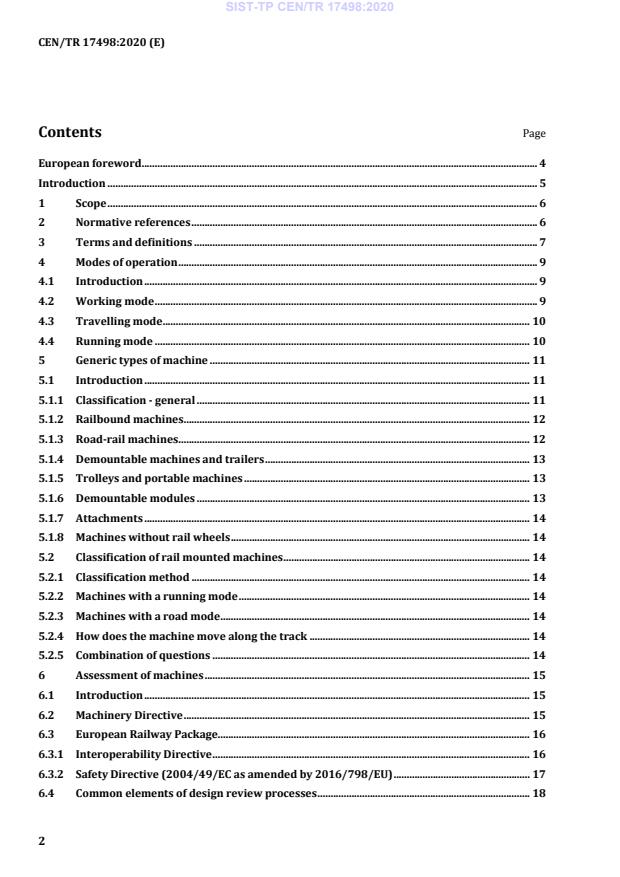
Contents Page
European foreword . 4
Introduction . 5
1 Scope . 6
2 Normative references . 6
3 Terms and definitions . 7
4 Modes of operation . 9
4.1 Introduction . 9
4.2 Working mode . 9
4.3 Travelling mode . 10
4.4 Running mode . 10
5 Generic types of machine . 11
5.1 Introduction . 11
5.1.1 Classification - general . 11
5.1.2 Railbound machines . 12
5.1.3 Road-rail machines . 12
5.1.4 Demountable machines and trailers . 13
5.1.5 Trolleys and portable machines . 13
5.1.6 Demountable modules . 13
5.1.7 Attachments . 14
5.1.8 Machines without rail wheels . 14
5.2 Classification of rail mounted machines . 14
5.2.1 Classification method . 14
5.2.2 Machines with a running mode . 14
5.2.3 Machines with a road mode . 14
5.2.4 How does the machine move along the track . 14
5.2.5 Combination of questions . 14
6 Assessment of machines . 15
6.1 Introduction . 15
6.2 Machinery Directive . 15
6.3 European Railway Package. 16
6.3.1 Interoperability Directive . 16
6.3.2 Safety Directive (2004/49/EC as amended by 2016/798/EU) . 17
6.4 Common elements of design review processes . 18
6.5 Acceptance to work on the railway . 20
7 Composition of standards for machines . 20
7.1 Introduction. 20
7.2 Series of standards . 20
8 Special national conditions . 21
8.1 Introduction. 21
Annex A (informative) Examples of machine types . 22
Bibliography . 40
European foreword
This document (CEN/TR 17498:2020) has been prepared by Technical Committee CEN/TC 256
“Railway applications”, the secretariat of which is held by DIN.
Attention is drawn to the possibility that some of the elements of this document may be the subject of
patent rights. CEN shall not be held responsible for identifying any or all such patent rights.
Introduction
This document is intended as an explanatory guide to machines that are fitted with rail wheels. It is
written to clarify the complex variety of machines that are used for the construction, maintenance,
inspection, repair and renewal of railway infrastructure. It is intended to be used as an introduction to,
and application guide for, the suite of standards for rail mounted maintenance and infrastructure
inspection machines. It is an aid to clarify which standard to use for a particular machine. This
document does not introduce any new requirements.
Machines are designed and intended for a specific working purpose and their ability to operate as a
railway vehicle is considered as an additional function.
There are various standards which apply to the machines in scope of this document:
— EN 13977;
— EN 14033 series;
— EN 15746 series;
— EN 15955.
1 Scope
This document covers machines fitted with rail wheels that are used for the construction, maintenance,
inspection, repair and renewal of railway infrastructure. It is also applicable to machines used for
emergency rescue purposes on railway infrastructure.
NOTE Inspection of the infrastructure includes measurement.
This document explains the different modes of operation, classification of machines and which standard
covers the technical requirements. There is also guidance on the compliance process provided to
explain the design review process of different legislation, how these can be combined into one process
(to avoid duplication) and achieve a common understanding of what the design review is achieving.
2 Normative references
The following documents are referred to in the text in such a way that some or all of their content
constitutes requirements of this document. For dated references, only the edition cited applies. For
undated references, the latest edition of the referenced document (including any amendments) applies.
EN ISO 12100, Safety of machinery — General principles for design — Risk assessment and risk reduction
(ISO 12100)
EN 13977, Railway applications — Track — Safety requirements for portable machines and trolleys for
construction and maintenance
EN 14033-1:2017, Railway applications — Track — Railbound construction and maintenance
machines — Part 1: Technical requirements for running
EN 14033-2, Railway applications — Track — Railbound construction and maintenance machines —
Part 2: Technical requirements for travelling and working
EN 14033-3, Railway applications — Track — Railbound construction and maintenance machines —
Part 3: General safety requirements
EN 14033-4, Railway applications — Track — Railbound construction and maintenance machines —
Part 4: Technical requirements for running, travelling and working on urban rail
EN 15746-1:— , Railway applications — Track — Road-rail machines and associated equipment —
Part 1: Technical requirements for travelling and working
EN 15746-2:— , Railway applications — Track — Road-rail machines and associated equipment —
Part 2: General safety requirements
, Railway applications — Track — Road-rail machines and associated equipment —
EN 15746-3:—
Part 3: Technical requirements for running
Under preparation. Stage at the time of publication: FprEN 15746-1.
Under preparation. Stage at the time of publication: FprEN 15746-2.
Under preparation. Stage at the time of publication: FprEN 15746-3.
EN 15746-4:— , Railway applications — Track — Road-rail machines and associated equipment —
Part 4: Technical requirements for running, travelling and working on urban rail
EN 15955:— , Railway applications — Infrastructure — Demountable machines, trailers and associated
equipment — General safety and technical requirements for travelling and working
EN 16704-1, Railway applications — Track — Safety protection on the track during work — Part 1:
Railway risks and common principles for protection of fixed and mobile work sites
3 Terms and definitions
For the purposes of this document, the following terms and definitions apply.
ISO and IEC maintain terminological databases for use in standardization at the following addresses:
— ISO Online browsing platform: available at https://www.iso.org/obp/ui
— IEC Electropedia: available at http://www.electropedia.org/
3.1
rail mounted railway maintenance and infrastructure inspection machine
generic term for the collection of all machines which have wheels suitable for running on rails and are
intended for the construction, maintenance, inspection, repair and renewal of railway infrastructure. It
is also applicable to machines used for emergency rescue purposes on railway infrastructure
3.2
railbound construction and maintenance machine
collective term for on-track machines and infrastructure inspection machines
3.3
on-track machine
OTM
machine specially designed for construction and maintenance of the track and infrastructure, running
on its own rail wheels and designed and intended to operate signalling systems
Note 1 to entry: Signalling systems are defined in CCS TSI Index 77 and/or defined by the urban rail manager.
3.4
infrastructure inspection machine
self-propelled or a hauled machine used to monitor the condition of the infrastructure, running on its
own rail wheels, and designed and intended to operate signalling systems
Note 1 to entry: These machines are also referred to in the Loc&Pas TSI as infrastructure inspection vehicles.
Note 2 to entry: These machines are also referred to in EN 13848-2 as Track Recording Vehicles.
Under preparation. Stage at the time of publication: FprEN 15746-4.
Under preparation. Stage at the time of publication: prEN 15955.
3.5
road-rail machine
self-propelled machine that can move on rails and ground
Note 1 to entry: It is normally a road vehicle adapted for moving on rail also, but can be a specially designed rail
vehicle for moving on the ground also.
Note 2 to entry: It does not imply that the machine is suitable for use on the public road.
Note 3 to entry: Road-rail machines were historically referred to as road-rail vehicles (RRVs). The term no
longer applies, but the abbreviation RRV is commonly still used for a road-rail machine.
3.6
demountable machine
self-propelled machine that can travel and work on rail only and is not intended to operate track
signalling and control systems
Note 1 to entry: Such a machine is designed to get on and off track by its own means or with other lifting
equipment. In the case of demounting by its own means these are not intended for general movement on the
ground.
Note 2 to entry: Such a machine is permitted to work on the railway only under special operating conditions
granted by the Infrastructure Manager and travel under special conditions granted by the authorized body and/or
the Infrastructure Manager.
3.7
trailer
non-self-propelled machine that can be towed on rail wheels and is not intended to operate track
signalling and control systems
Note 1 to entry: Trailers are not designed to have a running mode.
3.8
road-rail trailer
trailer that can be towed on rails and ground
3.9
trolley
equipment moved along track on wheels or runners by human force only, which is designed so that it
can be manually placed on or off the track by one or more people; uses include transport of materials,
tools and/or various equipment
3.10
portable machine
machine designed or adapted for use on the track which is propelled by manual effort (i.e. no powered
drive system), but has a lifting capability and/or incorporates a power system (e.g. internal combustion,
electro-mechanical, hydraulic, pneumatic energy sources or from an external supply) for specific work
applications
Note 1 to entry: This type of equipment is covered under the definition of ‘Machinery’ in the Machinery
Directive as per Article 2(a)
3.11
associated equipment
device which, after the putting into service of the machine, is connected to that machine
Note 1 to entry: Specific examples of associated equipment are described in 5.1.6 and 5.1.7, but anything
plugged into the host machine is considered to be associated.
4 Modes of operation
4.1 Introduction
Before explaining the various generic types of machines it is useful for the reader to understand the
three basic operating modes of a machine on the railway as described in this report, as they have a
significant effect on the type of machine and its compliance process.
4.2 Working mode
When in working mode the machine is protected from interference with all traffic (for example,
passenger and freight trains, locomotives) by operational controls applied to the rules of the
Infrastructure Manager. It is possible, but not always the case, that signalling systems will not be
operational. Safety protection during work is described in more detail in EN 16704-1.
Key
1 machine 5 signal (with a cross means may be isolated)
2 moveable component outside machine gauge 6 track mounted signalling equipment
3 limiting infrastructure gauge (tunnel, etc.) 7 vehicle mounted signalling equipment (off)
4 signalling block sections 8 train stop for passenger and freight trains
Figure 1 — Schematic representation of working mode
In working mode a machine is permitted to exceed the vehicle gauge of the track it is on. Planning will
be undertaken to avoid damage to the infrastructure by the machine which may need devices to limit its
movement and/or other operational controls. Another area of planning is whether passenger and
freight trains will be allowed to pass the work site on the adjacent track.
When self-propelled a machine will be operated by a driver/operator who has to fulfil the
Infrastructure Manager’s requirements for the line it is on.
4.3 Travelling mode
Where the machine needs to move from one worksite to another worksite, but only on the sections of
track out of service by operational controls applied to the rules of the Infrastructure Manager, then the
machine needs to be within gauge for the line but does not necessarily need to react with signals. This is
called travelling mode. Where the machine is self-propelled it will be operated by a driver/operator
who has to fulfil the Infrastructure Manager’s requirements and the driver/operator needs to be able to
see far enough ahead of the machine to enable the machine to stop within the sighting distance.
Key
1 machine 5 signal (with a cross means may be isolated)
2 moveable component within machine gauge 6 track mounted signalling equipment
3 limiting infrastructure gauge (tunnel, etc.) 7 vehicle mounted signalling equipment (off)
4 signalling block sections 8 train stop for passenger and freight trains
Figure 2 — Schematic representation of travelling mode
4.4 Running mode
This is where the machine is operated under the same rules as a comparable standard railway vehicle.
Not every machine has a running mode. A machine in running mode will be expected to behave and
react to the railway signalling and control systems on the track it is running on in the same way that a
passenger or freight train would be scheduled for operational service.
In running mode a machine can either be self-propelled or towed. When self-propelled it will be driven
by a train driver who has to comply with the signalling systems on the line it is running on, e.g. the
driver has to be able to see and react to the signals, machine is fitted with in cab signalling, etc. When a
machine is not self-propelled in running mode it will be towed and needs to behave with the signalling
system in the same way that is expected for a railway wagon.
Key
1 machine 5 signal
2 moveable component locked in machine gauge 6 track mounted signalling equipment
3 limiting infrastructure gauge (tunnel, etc.) 7 vehicle mounted signalling equipment (active)
4 signalling block sections
Figure 3 — Schematic representation of running mode
In addition to signalling, machines also need to comply with other infrastructure based control and
detection systems. When in running mode, the machine has to be within, and remain within, the gauge
of the line it is running on to avoid collision with infrastructure or trains/machines on adjacent tracks.
Machines that have a running mode will have similar features to conventional rolling stock (e.g.
locomotives, wagons or multiple units). When a machine is in running mode it will have to be
compatible with the interfaces of the railway it is running on. It should always be considered there will
be differences between machines and railway vehicles, which are discussed in this technical report. The
primary purpose of a machine is the working processes which are different from those for vehicles for
the transportation of passengers and freight.
5 Generic types of machine
5.1 Introduction
5.1.1 Classification - general
The range of machines that are used for railway infrastructure work is extremely varied. Some
examples are shown in Annex A, but these are a small selection and new models are continually being
created. However, there are a few basic principles that can be used to decide what generic type of
machine any particular machine falls into. Principally there are four generic types of machine, and each
machine will ultimately be one of these:
a) Railbound machines;
b) Road-rail machines;
c) Demountable machines and trailers (including road rail trailers);
d) Trolleys and portable machines.
By a relatively simple series of decisions it is possible to clarify which generic type the machine belongs,
see 5.2.5.
5.1.2 Railbound machines
5.1.2.1 Introduction
Railbound machines tend to be the larger machines and, as the name suggests, remain on the railway
line, i.e. they are delivered to their place of work by use of the railway line. As will be discussed later (in
part 6) this generic type of machine is within scope of the Loc&Pas TSI. In that TSI railbound machines
are referred to as ‘special vehicles’ and it is explained that such machines include infrastructure
inspection machines and on-track machines (OTM).
5.1.2.2 OTM
Railbound machines are built to be able to interact with the signalling and control system for the
railway line they are being used on. If the railbound machine is self-propelled in running mode then it
will need to be fitted with all the in cab signalling systems that a passenger or freight train is fitted with
on that line; for example Indusi, TVM430, AWS, ERTMS, etc. If the machine is hauled in running mode
then it still needs to react with the signalling and control systems in the way that a freight wagon is
expected to; for example, the axle weights and wheel spacing will need to be compatible with the
signalling system, the axle bearings will need to be in a position to be monitored by the hot box
detection systems, etc.
Railbound machines can be self-propelled in running and travelling/working modes, or hauled in
running mode and self-propelled in travelling/working modes, or hauled in both running and
travelling/working modes.
5.1.2.3 Infrastructure inspection machines
The requirements for infrastructure inspection machines within the Loc&Pas TSI are ambiguous, but
the ERA Application Guide to this TSI makes it clear that the manufacturer can decide whether such a
machine should meet the requirements of coaches/wagons or for OTM. It is recommended that
infrastructure inspection machines that are designed to be incorporated into passenger trains should be
considered railway vehicles rather than machines and should comply with the standards applicable to
passenger vehicle(s) concerned. Self-propelled infrastructure inspection machines are similar to OTMs
and it is recommended they should be constructed in compliance with EN 14033 series. This
interpretation aligns with the definition set out in EN 14033-1:2017 3.3.
Additionally there is equipment that is attached to railway vehicles which is used to monitor the
condition of the infrastructure, such as unattended measurement systems. This monitoring equipment
is not considered in the series of standards referred to in 7.2.
5.1.2.4 Converted railway vehicles
Converted railway vehicles where this involves components moving out of vehicle gauge or generating
asymmetric/abnormal wheel loads are now considered as machines and will need to be reassessed as
machines. This is applicable to all new and existing wagons and coaches that are modified by the
fitment of equipment or machines to carry out work on the railway infrastructure.
5.1.3 Road-rail machines
Road-rail machines have the ability to move on their own power on railway track and on the ground. In
general they approach the railway track by land based means and then are used on the track to fulfil
their function. These machines move on the ground by means of either road wheels or caterpillar
tracks. It should be noted that machines which use only sliding rams to get onto the track are not
considered road-rail (and would be classified as a demountable machine). There are examples of
machines with road wheels that get near to the track and then use sliding rams to position themselves
onto the rails; these are road-rail machines because of the fitment of road wheels (or caterpillar tracks).
A machine that is able to move on the ground should not be taken as meaning that the machine has the
ability (or necessity) for use on a public road. So in some respects the name road-rail is slightly
confusing because it does not confer rights or ability to use a “road”.
Some rail-road machines are designed, intended and permitted to be used on the railway line without
special protection for them, i.e. they have a running mode, these will need to react with the signalling
and control systems as explained in 5.1.2.
5.1.4 Demountable machines and trailers
This generic type of machine is always used in an area separated from passenger or freight trains by
operational means as specified for the railway line it is on. They do not therefore need to interact with
all the signalling and control systems. This means that the machines have to be brought to near the
intended railway worksite and then lifted onto the railway track. Once on the railway track
demountable machines are self-propelled and trailers are hauled along the track.
Road rail trailers have the ability to be moved on railway track and on the ground. In general they
approach the railway track by land based means and then are used on the track to fulfil their function.
The method of movement on the ground is normally by either road wheels or caterpillar tracks. There
are examples of trailers with road wheels that get near to the track and then use sliding rams to
position themselves onto the rails; these are road-rail trailers because of the fitment of road wheels (or
caterpillar tracks). A road rail trailer can be self-propelled on the ground but NOT on the railway track.
5.1.5 Trolleys and portable machines
Manual propulsion is the only permitted form of movement along the railway track for trolleys and
portable machines with rail wheels, which characterizes this specific generic type of machines. Any
machine which is intended to be towed at any stage, belongs to one of the previous generic types. If
there is any form of powered movement along the track, even if very slow, then it is NOT a trolley (and
will probably be classified as a demountable machine).
5.1.6 Demountable modules
Demountable modules are removable units which are capable of being attached with dedicated
fastening system to a machine or railway vehicle, to perform a specific function. A demountable module
will need to be checked for conformity as part of the machine to all relevant clauses in all parts of the
relevant machine standard when any of the following apply:
a) It has been manufactured or modified to suit the particular machine or type of machine.
b) It is used to carry personnel during travelling mode.
c) It is positioned on the machine by other than gravity or twist locks.
d) It has electrical, pneumatic or hydraulic connections to the machine.
e) It is connected to the machine by twist locks and is used for lifting any load whilst on the machine.
f) It is connected to the machine by twist locks and has moveable components which are able to
exceed the gauge profile of the machine.
5.1.7 Attachments
Attachments could be fitted to machines that are described in this Technical Report. Any equipment
that is mechanically fixed to and / or powered or controlled from the host machine is considered as an
attachment (this could be a lifting accessory). Mechanically fixed is normally taken to indicate that the
attaching point is semi-permanent (very often a Quick Hitch type device, twist lock or plug and play
mechanism). Equipment which requires a workshop and skilled fitting staff to assemble / remove is
considered to be a part of the host machine, and its addition is a modification to the machine.
The use of attachments needs to be carefully described by the manufacturer of the attachment because
they can have detrimental effects on the host machine. The effect on stability is more serious for railway
use. For safe operation the instruction handbook for the attachment should specify the minimum
characteristics of the host machine.
5.1.8 Machines without rail wheels
There are machines that are specifically designed and intended for use on the railway infrastructure
that are not guided by the rails. These machines are not covered by the series of standards referred to in
this technical report.
5.2 Classification of rail mounted machines
5.2.1 Classification method
There is, as has previously been stated, an almost infinite variety of machines. However, with relatively
few questions it is possible to ascertain which is the applicable standard for that machine – see Figure 4.
5.2.2 Machines with a running mode
Running mode means the ability to run on the railway track in a manner similar to passenger and
freight trains, i.e. to interact with the signalling and control systems. All railbound machines have a
running mode and some road-rail machines could have a running mode.
5.2.3 Machines with a road mode
Road-rail machines are able to move on the ground as well as on rail – note that all the machines have
the ability to move along the railway line. Machines that have wheels or caterpillar tracks for use of
movement on the ground are said to have a road mode. The use of the term road mode does not confer
any ability of the machine to be used on a public road.
There are machines that in their working mode have the ability to move on ground, if these are
railbound machines that only travel on the ground in working mode then they are not road-rail
machines and should be considered as OTMs that turn into civil engineering machines when on site,
normally when the track is missing during the working process.
There are many machines which do not have rail wheels, i.e. they ONLY have the ability to move on
ground, generally referred to as “civil engineering machines”, e.g. excavators, loaders, mobile elevating
work platforms (MEWP), mobile cranes. These machines shall be CE-marked (fulfil the requirements in
the Machinery Directive) but are outside the scope of rail mounted machine standards; it should be
noted these could be subject to the Infrastructure Manager’s specific conditions.
5.2.4 How does the machine move along the track
For movement along the track a machine is either self-propelled, towed or manually pushed.
5.2.5 Combination of questions
By answering the three questions in 5.2.2 to 5.2.4, it is possible to ascertain what standard (or series of
standards) a machine should comply with, as shown in the flowchart in Figure 4.
Figure 4 — Machine decision flow chart
6 Assessment of machines
6.1 Introduction
The legal position of rail mounted railway maintenance and infrastructure inspection machines is
complex because some machines fall under two well established processes. All machines within the
scope of this technical report have to comply with the Machinery Directive, 2006/42/EC (there is one
exception, see 6.2). Any machine that is used on the mainline railway, interacting with signalling and
control systems (i.e. has a running mode) also has to comply with the Interoperability Directive,
2008/57/EC as amended by 2016/797/EU.
6.2 Machinery Directive
Every machine will need to comply with the Machinery Directive, except a manually propelled trolley
that has no power source attached for other purposes and is not used for lifting.
Machines are self-certificated as compliant to the Machinery Directive by the manufacturer. The
‘manufacturer’ is the entity that:
— constructs the entire rail mounted maintenance and infrastructure inspection machine, or
— who converts an existing host vehicle or civil machine into a rail mounted maintenance and
infrastructure inspection machine, or
— imports a rail mounted maintenance and infrastructure inspection machine from elsewhere in the
world and places it onto the market of the European Union.
A presumption of conformity to the Machinery Directive can be made by assessing compliance with:
— EN 14033-3 for a railbound machine;
— EN 15746-2 for a road-rail machine;
— EN 15955 for a demountable machine or trailer;
— EN 13977 for a trolley that has a power unit attached, or is used for lifting irrespective of how
powered.
There is considerable advice on compliance with the Machinery Directive available elsewhere. This
report limits itself to stating the necessity for compliance.
6.3 European Railway Package
6.3.1 Interoperability Directive
6.3.1.1 General
For machines with a running mode compliance with the Interoperability Directive is also required, but
only for the machine in running mode – travelling and working modes are not assessed against the
Interoperability Directive.
The Interoperability Directive has several technical specifications for interoperability (TSI) which give
the requirements for railway sub-systems to meet. Principally machines are in scope of the Loc&Pas TSI
(Commission Regulation (EU) No 1302/2014 of 18 November 2014); however, subclause 7.1.1.3 of that
TSI states:
7.1.1.3 Application to mobile equipment for railway infrastructure construction and maintenance
(1) The application of this TSI to mobile railway infrastructure construction and maintenance equipment
(as defined in Sections 2.2 and 2.3) is not mandatory.
(2) The conformity assessment process as described in the Clause 6.2.1 may be used by applicants on a
voluntary basis in order to establish an EC declaration of verification against this TSI; this EC
declaration of verification shall be recognized as such by Member States.
(3) In case the applicant chooses not to apply this TSI, the mobile railway infrastructure construction and
maintenance equipment may be authorized in accordance with Article 24 or 25 of Directive
2008/57/EC.
6.3.1.2 Application of Interoperability Directive to OTM and infrastructure inspection machines
In line with 6.3.1.1, machines are able to be accepted for use in individual countries without
demonstrating compliance to the Loc&Pas TSI. However, the benefit of compliance with the TSI is the
mutual recognition across Europe of machines in their running mode. Standard EN 14033-1 has been
written to align with the requirements of the Loc&Pas TSI with the needs of railbound machinery in
running mode, and Annex ZA.1 of EN 14033-1 demonstrates that compliance with the standard can be
used as presumption of conformity with the Loc&Pas TSI.
There are other TSIs which railbound machines need to comply with:
a) The Control, Command and Signalling TSI (CCS TSI) - correspondence between EN 14033-1 and the
CR TSI Control Command and Signalling (published in OJEU dated 7th January 2015) is
demonstrated in Annex ZA.2 of EN 14033-1.
b) The Noise TSI (NOI TSI) - correspondence between EN 14033-1 and the CR TSI Noise (published in
OJEU dated 12th December 2014) is demonstrated in Annex ZA.3 of EN 14033-1.
c) The Operation and traffic management TSI (OPE TSI) - correspondence between EN 14033-1 and
the TSI ‘Operation and traffic management’ (published in OJEU dated 30th June 2015) is
demonstrated in Annex ZA.4 of EN 14033-1.
Thus compliance with EN 14033-1 can be used as a presumption of conformity with all the relevant
TSIs and hence a presumption of conformity with the Interoperability Directive.
NOTE The TSIs quoted in EN 14033-1:2017 are not the latest and EN 14033-1:2017 needs to be updated.
6.3.1.3 Application of Interoperability Directive to road-rail machines
All railbound construction and maintenance machines have a running mode and hence need to be
authorized under the Interoperability Directive for their running mode. In addition some road-rail
machines have a running mode, as such these machines will also need to be authorized under the
Interoperability Directive for their running mode. In the similar way that EN 14033-1 has been written
for railbound machines, EN 15746-3 has been written for rail-road machines in running mode. As in the
EN 14033-1 standard, there is an Appendix ZA which gives a presumption of conformity with:
a) The Loc&Pas TSI - correspondence between EN 15746-3 and the Commission Regulation (EU) No
1302/2014 of 18 November 2014 concerning a technical specification for interoperability relating
to the ‘rolling stock — locomotives and passenger rolling stock’ subsystem of the rail system in the
European Union published in the Official Journal L356/228 on 12/12/2014 is demonstrated in
Annex ZA.1 of EN 15746-3.
b) The CCS TSI - correspondence between EN 15746-3 and the Commission Regulation (EU)
2016/919 of 27 May 2016 on the technical specification for interoperability relating to the ‘control-
command and signalling’ subsystems of the rail system in the European Union is demonstrated in
Annex ZA.2 of EN 15746-3.
c) The NOI TSI - correspondence between EN 15746-3 and the Commission Regulation (EU) No
1304/2014 of 26 November 2014 on the technical specification for interoperability relating to the
subsystem ‘rolling stock — noise’ amending Decision 2008/232/EC and repealing Decision
2011/229/EU - published in the Official Journal L356/421 on 12/12/2014 is demonstrated in
Annex ZA.3 of EN 15746-3.
d) The Operation and traffic management TSI (OPE TSI) - correspondence between EN 15746-3 and
the Commission Implementing Regulation (EU) 2019/773 of 16 May 2019 on the technical
specification for interoperability relating to the operation and traffic management subsystem of the
rail system within the European Union and repealing Decision 2012/757/EU is demonstrated in
Annex ZA.4 of EN 15746-3
Thus compliance with EN 15746-3 can be used as a presumption of conformity with all the relevant
TSIs and hence a presumption of conformity with the Interoperability Directive for those road-rail
machines that have a running mode.
6.3.2 Safety Directive (2004/49/EC as amended by 2016/798/EU)
A design review of machines will need to be carried out in compliance with the Common Safety Method
Risk Evaluation and Assessment. Commission Implementing Regulation (EU) 402/2013 (the Regulation
on a common safety method (CSM) for risk evaluation and assessment (or 'the CSM-RA')) came into
force on 30 April 2013. It is a framework that describes a common mandatory European risk
management process for the rail industry and does not prescribe specific tools or techniques to be used.
There is considerable guidance on compliance with this CSM.
There is a similar design review requirement in the Machinery Directive. Clause 1 of the General
Principles states:
The manufacturer of machinery or his authorized representative must ensure that a risk assessment is
carried out in order to determine the health and safety requirements which apply to the machinery. The
machinery must then be designed and constructed taking into account the results of the risk assessment.
By the iterative process of risk assessment and risk reduction referred to above, the manufacturer or his
authorized representative shall:
— determine the limits of the machinery, which include the intended use and any reasonably foreseeable
misuse thereof,
— identify the hazards that can be generated by the machinery and the associated hazardous situations,
— estimate the risks, taking into account the severity of the possible injury or damage to health and the
probability of its occurrence,
— evaluate the risks, with a view to determining whether risk reduction is required, in accordance with
the objective of this Directive,
— eliminate the hazards or reduce the risks associated with these hazards by application of protective
measures, in the order of priority established in section 1.1.2(b).
6.4 Common elements of design review processes
It can be seen, as shown in 6.3.2, the le
...