

EN 3-7:2004+A1:2007
(Main + Amendment)Portable fire extinguishers - Part 7: Characteristics, performance requirements and test methods
- Abstract
This standard specifies the characteristics, performance requirements and test methods for portable fire extinguishers.
Reference to the suitability of an extinguisher for use on gaseous fires (class C fires) are at the manufacturer’s discretion, but are applied only to powder type extinguishers which have gained a class B or class A and class B rating.
Suitability of extinguishers for use on class D fires (fires involving flammable metals) is outside the scope of this standard in respect of test fires. However, extinguishers claiming class D suitability are covered in all other respects by the requirements in this standard for powder extinguishers.
It is considered hazardous for powder and carbon dioxide fire extinguishers to be used on Class F fires. For this reason powder and carbon dioxide fire extinguishers are excluded for conformance with regard to Class F in this European Standard.
NOTE The extinction of a metal fire presents a situation so specific (in terms of the metal itself, its form, the configuration of the fire etc.) that it is not possible to define a representative standard fire for the purposes of testing. The efficiency of extinguishers on class D fires needs to be established on a case by case basis.
- Status
- Published
- Publication Date
- 07-Aug-2007
- Withdrawal Date
- 28-Feb-2008
- Technical Committee
- CEN/TC 70 - Manual means of fire fighting equipment
- Drafting Committee
- CEN/TC 70/WG 5 - Revision of EN 3
- Current Stage
- 9093 - Decision to confirm - Review Enquiry
- Start Date
- 27-Mar-2009
- Completion Date
- 27-Mar-2009



Overview
EN 3-7:2004+A1:2007 is a European (CEN) standard that specifies the characteristics, performance requirements and test methods for portable fire extinguishers. It covers design and performance aspects for common extinguisher types (water-based, powder, carbon dioxide, halon and clean agents) and defines how portable extinguishers (designed to be carried and operated by hand - mass ≤ 20 kg) should perform and be tested.
This standard is part of the EN 3 series for portable fire extinguishers and is used to verify safe, reliable operation, fire rating performance and component integrity.
Key Topics
- Scope and classifications: Fire class references follow EN 2; manufacturer discretion applies for class C (gaseous fires) suitability - limited to powder extinguishers that already have class B or A+B ratings. Class D (metal fires) test fires are excluded from scope; claims for class D must be justified case-by-case. Powder and CO2 extinguishers are excluded from conformance for class F due to hazards.
- Performance and test methods: Includes requirements and test methods for nominal charge, filling tolerances, minimum fire ratings, duration of discharge, residual charge and operating temperature range (Tmin/Tmax).
- Pressure and propellant control: Stored-pressure and cartridge-operated devices are covered, with requirements for retention of propellant and pressure indication (gauges/indicators).
- Component requirements: Tests and requirements for hoses, control valves, safety devices, horns (CO2), filters (water-based), and mounting brackets.
- Environmental and durability tests: Corrosion resistance, dielectric tests for water-based agents, and resistance to extinguishing media.
- Identification and marking: Colour and marking rules to ensure traceability and correct use.
- Annexed test procedures: Normative annexes provide detailed test methods (duration tests, corrosion, fire tests, control valve tests, etc.).
Applications and Who Uses It
- Manufacturers and designers of portable fire extinguishers - to design products that meet European performance expectations.
- Testing laboratories and conformity assessors - to perform standardized tests and issue evidence of performance.
- Specifiers, procurement teams and facility managers - to select the correct extinguisher types and fire ratings for workplaces, buildings and industrial sites.
- Fire safety consultants and authorities - to reference accepted test methods and performance criteria in risk assessments and regulations.
- Maintenance and service providers - to verify ongoing performance, refill tolerances and pressure retention.
Related Standards
- EN 3 series (other parts covering conformity, pressure/mechanical tests and CO2 pressure resistance - e.g., EN 3-8, EN 3-9, EN 3-10)
- EN 2 (Classification of fires)
- ISO 9227 (salt spray corrosion testing) and other referenced standards listed normatively.
Keywords: EN 3-7:2004+A1:2007, portable fire extinguishers, performance requirements, test methods, fire ratings, powder extinguisher, carbon dioxide, water-based extinguishers, CEN, fire safety standards.
Relations
- Effective Date
- 18-Jan-2023
- Effective Date
- 25-Aug-2026
- Effective Date
- 25-Aug-2026
- Effective Date
- 09-Feb-2026
- Effective Date
- 28-Jan-2026
- Effective Date
- 28-Jan-2026
- Effective Date
- 28-Jan-2026
- Effective Date
- 29-Jul-2026
- Effective Date
- 10-Feb-2026
- Effective Date
- 09-Feb-2026
- Effective Date
- 09-Feb-2026
- Effective Date
- 28-Jan-2026
- Effective Date
- 28-Jan-2026
- Effective Date
- 28-Jan-2026
- Effective Date
- 28-Jan-2026
Get Certified
Connect with accredited certification bodies for this standard

CIS Institut d.o.o.
Personal Protective Equipment (PPE) certification body. Notified Body NB-2890 for EU Regulation 2016/425 PPE.

Kiwa BDA Testing
Building and construction product certification.
Kmetijski inštitut Slovenije
Agricultural Institute of Slovenia. Soil testing, plant health, agricultural product analysis.
Sponsored listings
Frequently Asked Questions
EN 3-7:2004+A1:2007 is a standard published by the European Committee for Standardization (CEN). Its full title is "Portable fire extinguishers - Part 7: Characteristics, performance requirements and test methods". This standard covers: This standard specifies the characteristics, performance requirements and test methods for portable fire extinguishers. Reference to the suitability of an extinguisher for use on gaseous fires (class C fires) are at the manufacturer’s discretion, but are applied only to powder type extinguishers which have gained a class B or class A and class B rating. Suitability of extinguishers for use on class D fires (fires involving flammable metals) is outside the scope of this standard in respect of test fires. However, extinguishers claiming class D suitability are covered in all other respects by the requirements in this standard for powder extinguishers. It is considered hazardous for powder and carbon dioxide fire extinguishers to be used on Class F fires. For this reason powder and carbon dioxide fire extinguishers are excluded for conformance with regard to Class F in this European Standard. NOTE The extinction of a metal fire presents a situation so specific (in terms of the metal itself, its form, the configuration of the fire etc.) that it is not possible to define a representative standard fire for the purposes of testing. The efficiency of extinguishers on class D fires needs to be established on a case by case basis.
This standard specifies the characteristics, performance requirements and test methods for portable fire extinguishers. Reference to the suitability of an extinguisher for use on gaseous fires (class C fires) are at the manufacturer’s discretion, but are applied only to powder type extinguishers which have gained a class B or class A and class B rating. Suitability of extinguishers for use on class D fires (fires involving flammable metals) is outside the scope of this standard in respect of test fires. However, extinguishers claiming class D suitability are covered in all other respects by the requirements in this standard for powder extinguishers. It is considered hazardous for powder and carbon dioxide fire extinguishers to be used on Class F fires. For this reason powder and carbon dioxide fire extinguishers are excluded for conformance with regard to Class F in this European Standard. NOTE The extinction of a metal fire presents a situation so specific (in terms of the metal itself, its form, the configuration of the fire etc.) that it is not possible to define a representative standard fire for the purposes of testing. The efficiency of extinguishers on class D fires needs to be established on a case by case basis.
EN 3-7:2004+A1:2007 is classified under the following ICS (International Classification for Standards) categories: 13.220.10 - Fire-fighting. The ICS classification helps identify the subject area and facilitates finding related standards.
EN 3-7:2004+A1:2007 has the following relationships with other standards: It is inter standard links to EN 3-7:2004, ISO 9227:2006, ISO 657-1:1989, ISO 4470:1981, EN 2:1992, EN 462-5:1996, EN 14140:2014, EN 45545-6:2024+A1:2026, CEN/TS 45545-6:2009, EN 50600-2-5:2021, EN 50600-2-5:2016, EN 3-10:2009, EN 3-8:2021, EN 14033-2:2008+A1:2011, EN 13814:2004. Understanding these relationships helps ensure you are using the most current and applicable version of the standard.
EN 3-7:2004+A1:2007 is associated with the following European legislation: EU Directives/Regulations: 2008/68/EC, 2014/90/EU, 96/98/EC, TRRTP121. When a standard is cited in the Official Journal of the European Union, products manufactured in conformity with it benefit from a presumption of conformity with the essential requirements of the corresponding EU directive or regulation.
EN 3-7:2004+A1:2007 is available in PDF format for immediate download after purchase. The document can be added to your cart and obtained through the secure checkout process. Digital delivery ensures instant access to the complete standard document.
Standards Content (Sample)
2003-01.Slovenski inštitut za standardizacijo. Razmnoževanje celote ali delov tega standarda ni dovoljeno.Portable fire extinguishers - Part 7: Characteristics, performance requirements and test methodsPrenosni gasilniki - 7. del: Lastnosti, zahteve za obnašanje v uporabi in preskusne metodeExtincteurs d'incendie portatifs - Partie 7: Caractéristiques, performances et méthodes d'essaiTragbare Feuerlöscher - Teil 7: Eigenschaften, Leistungsanforderungen und PrüfungenTa slovenski standard je istoveten z:EN 3-7:2004+A1:2007SIST EN 3-7:2004+A1:2008en,fr,de13.220.10ICS:SLOVENSKI
STANDARDSIST EN 3-7:2004+A1:200801-februar-2008
EUROPEAN STANDARD NORME EUROPÉENNE EUROPÄISCHE NORM
EN 3-7:2004+A1
August 2007 ICS 13.220.10 Supersedes EN 3-7:2004English Version
Portable fire extinguishers -Part 7: Characteristics, performance requirements and test methods
Extincteurs d'incendie portatifs - Partie 7: Caractéristiques, performances et méthodes d'essai
Tragbare Feuerlöscher - Teil 7: Eigenschaften, Leistungsanforderungen und Prüfungen This European Standard was approved by CEN on 5 March 2003 and includes Amendment 1 approved by CEN on 30 June 2007.
CEN members are bound to comply with the CEN/CENELEC Internal Regulations which stipulate the conditions for giving this European Standard the status of a national standard without any alteration. Up-to-date lists and bibliographical references concerning such national standards may be obtained on application to the CEN Management Centre or to any CEN member.
This European Standard exists in three official versions (English, French, German). A version in any other language made by translation under the responsibility of a CEN member into its own language and notified to the CEN Management Centre has the same status as the official versions.
CEN members are the national standards bodies of Austria, Belgium, Bulgaria, Cyprus, Czech Republic, Denmark, Estonia, Finland, France, Germany, Greece, Hungary, Iceland, Ireland, Italy, Latvia, Lithuania, Luxembourg, Malta, Netherlands, Norway, Poland, Portugal, Romania, Slovakia, Slovenia, Spain, Sweden, Switzerland and United Kingdom.
EUROPEAN COMMITTEE FOR STANDARDIZATION
COMITÉ EUROPÉEN DE NORMALISATION EUROPÄISCHES KOMITEE FÜR NORMUNG
Management Centre: rue de Stassart, 36
B-1050 Brussels © 2007 CEN All rights of exploitation in any form and by any means reserved worldwide for CEN national Members. Ref. No. EN 3-7:2004+A1:2007: E
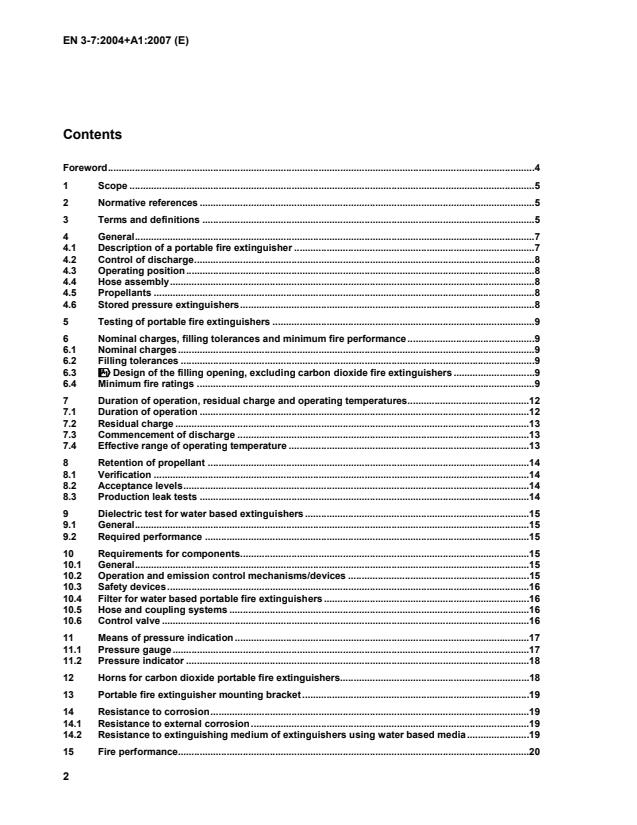
Duration of operation, residual charge tests.25 Annex B (normative)
Range of operating temperature.26 Annex C (normative)
Dielectric test.27 Annex D (normative)
Operation and emission control mechanisms/devices.29 Annex E (normative)
Test for performance of the hose.30 Annex F (normative)
Control valve test.31 Annex G (normative)
Tests on the horn.32 Annex H (normative)
Resistance to corrosion.33 Annex I (normative)
Fire tests.34 Annex J (normative)
Measurement of moisture content of wood.42 Annex K (normative)
Compaction procedure.43 Annex L (normative)
!Specific requirements for Class F fire extinguisher.45 Annex M (normative)
!Polar solvents.50 Bibliography.52
1)
EN 3-6 will be superseded by EN 3-10. 2) EN 3-10 will update and amend EN 3-6. EN 3-10 will supersede EN 3-6.
For this reason powder and carbon dioxide fire extinguishers are excluded for conformance with regard to Class F in this European Standard." NOTE The extinction of a metal fire presents a situation so specific (in terms of the metal itself, its form, the configuration of the fire etc.) that it is not possible to define a representative standard fire for the purposes of testing. The efficiency of extinguishers on class D fires needs to be established on a case by case basis. 2 Normative references This European Standard incorporates by dated or undated reference, provisions from other publications. These normative references are cited at the appropriate places in the text and the publications are listed hereafter. For dated references, subsequent amendments to or revisions of any of these publications apply to this European Standard only when incorporated in it by amendment or revision. For undated references the latest edition of the publication referred to applies (including amendments). EN 2, Classification of fires ISO 9227, Corrosion tests in artificial atmospheres — Salt spray tests ISO 657-1, Hot-rolled steel sections — Part 1: Equal-leg angles — Dimensions ISO 4470, Sawn timber — Determination of the average moisture content of a lot Farbregister RAL-841-GL. 3 Terms and definitions For the purposes of this European Standard, the following terms and definitions apply. 3.1 fire extinguisher appliance containing an extinguishing medium which can be expelled by the action of internal pressure and be directed on to a fire NOTE This pressure can be stored pressure or pressure produced by the release of an auxiliary gas from a cartridge.
% Powder
1 kg ± 5 2 kg ± 3 ≥ 3 kg ± 2 All other media 0
- 5 6.3 !Design of the filling opening, excluding carbon dioxide fire extinguishers The filling opening shall have a minimum diameter of: 20 mm for extinguishers with a charge of less than or equal to 3 kg or 3 l; 25 mm for extinguishers with a charge of more than 3 kg or 3 l. The main closure of the filling opening, intended to be removed during service or maintenance, shall be provided with an automatic means of venting any residual pressure from the extinguisher. The initial venting of any residual pressure shall occur when the means of securing the closure, or pressure retaining part, is disengaged by not more than one third of full engagement." 6.4 Minimum fire ratings 6.4.1 General Fire classes are defined in EN 2.
for powder extinguishers Minimum duration of operation Nominal permitted charges Fire rating s kg 5A 6 1 8A 6 1, 2 13A 9 1, 2, 3, 4 21A 9 1, 2, 3, 4, 6 27A 9 1, 2, 3, 4, 6, 9 34A 12 1, 2, 3, 4, 6, 9 43A 15 1, 2, 3, 4, 6, 9, 12 55A 15 1, 2, 3, 4, 6, 9, 12 Table 4 — Fire ratings, minimum duration of operation and nominal charges for water
based extinguishers, including foam extinguishers Minimum duration of operation Nominal permitted charges Fire rating s l 5A 6 2, 3 8A 9 2, 3, 6 13A 9 2, 3, 6, 9 21A 9 2, 3, 6, 9 27A 12 2, 3, 6, 9 34A 15 2, 3, 6, 9 43A 15 2, 3, 6, 9 55A 15 2, 3, 6, 9
for powder extinguishers Minimum duration of operation Nominal permitted charges Fire rating s kg 21B 6 1 34B 6 1, 2 55B 9 1, 2, 3 70B 9 1, 2, 3, 4 89B 9 1, 2, 3, 4 113B 12 1, 2, 3, 4, 6 144B 15 1, 2, 3, 4, 6, 9 183B 15 1, 2, 3, 4, 6, 9, 12 233B 15 1, 2, 3, 4, 6, 9, 12 Table 6 — Fire ratings, minimum duration of operation and nominal charges for water based
extinguishers, including foam extinguishers Minimum duration of operation Nominal permitted charges Fire rating s l 34B 6 2 55B 9 2, 3 70B 9 2, 3 89B 9 2, 3 113B 12 2, 3, 6 144B 15 2, 3, 6 183B 15 2, 3, 6, 9 233B 15 2, 3, 6, 9
Key 1 Rounded to the nearest 0,5 bar 2 Green 3 Red Figure 1 — Scale on pressure gauge 11.1.3 When tested at a temperature of (20 ± 5) °C, the pressure gauge shall operate within the range of error permitted by 11.1.2 after having been subjected to 1 000 pressure cycles from zero to P (Tmax) and back to zero at an average rate of pressure change of (20 ± 5) bar/min. 11.1.4 The materials of construction of the pressure gauge which may be in contact with the extinguishing medium and propellant gas shall be compatible with these or protected from them. 11.1.5 All tests shall be carried out at (20 ± 5) °C. 11.2 Pressure indicator 11.2.1 The pressure indicator shall indicate whether the extinguisher is in an operable condition. 11.2.2 The change in indication between an operable and an inoperable condition shall occur at a pressure corresponding to the pressure at the minimum operating temperature. The error in this indication shall not exceed 1 bar. 12 Horns for carbon dioxide portable fire extinguishers 12.1 If the horn is not incorporated in the extinguisher (e.g. when it is connected by a hose) it shall be fitted with a handle to protect the hand of the operator against cooling during use. 12.2 After being subjected to the test described in G.1, the horn shall show no damage, and no deformation which alters the diameter of the end of the horn by more than 10 %. 12.3 All connections between the valve and the horn and nozzle shall be such as to prevent loosening or detachment. Where this is provided by mechanical means such as lock-nuts, lock-washers, or spring washers, the torque required to loosen the assembly shall be equal to or greater than 20 N·m. When adhesives, or other methods of assembly, are used the torque required to loosen the assembly shall be equal to or greater than 10 N·m.
...