

EN 1866-1:2007
(Main)Mobile fire extinguishers - Part 1: Characteristics, performance and test methods
- Abstract
This European Standard specifies the rules of design, type testing and inspection during manufacturing, ratings and classification of mobile fire extinguishers and test methods to be used. It applies to mobile fire extinguishers with a total mass above 20 kg for powder, water based and CO2 extinguishers. This standard applies to mobile fire extinguishers that are manoeuvred by an operator on foot only.
It does not cover fire tests for class C and class F fires, but the used extinguishing media can be effective on these types of fire. Class D fires are considered to be a very specialist application and are not included in this standard, but may be made the object of national specification.
- Status
- Published
- Publication Date
- 31-Jul-2007
- Withdrawal Date
- 28-Feb-2008
- Technical Committee
- CEN/TC 70 - Manual means of fire fighting equipment
- Drafting Committee
- CEN/TC 70/WG 2 - Mobile extinguishers
- Current Stage
- 9060 - Closure of 2 Year Review Enquiry - Review Enquiry
- Start Date
- 02-Sep-2023
- Completion Date
- 02-Sep-2023

Overview
EN 1866-1:2007 is a European Standard published by CEN that defines design rules, type testing, manufacturing inspection, ratings and test methods for mobile fire extinguishers (wheeled units) containing powder, water‑based (including foam) or CO2 extinguishing media. It applies to mobile extinguishers with a total mass above 20 kg that are manoeuvred by an operator on foot. The standard sets performance, safety and identification requirements and specifies laboratory test methods (temperature, corrosion, dielectric, fire performance) used to verify conformity.
Key Topics and Requirements
- Scope and applicability
- Covers powder, water‑based and CO2 mobile extinguishers; excludes specialist Class D fire tests and does not include Class C/F fire tests (though media may still be effective).
- Applies to wheeled extinguishers >20 kg operated on foot.
- Design and components
- Defines essential components: extinguisher body, wheels, gripping device, propellant cylinder (where applicable), control device, hose assembly, main closure and operating device.
- Performance and safety requirements
- Operating temperature range: specifies TSmax (≥ 60 °C) and TSmin options (e.g., −20 °C, −30 °C for powders/CO2; range of minima for water‑based models).
- Filling specifications: nominal charges, filling tolerances and propellant requirements.
- Discharge characteristics: duration of operation, residual mass, discharge range.
- Retention of propellant and integrity of propellant containers and stored‑pressure designs.
- Control valve, hose, coupling and operating devices: operational safety, jet control and pressure gauge requirements.
- Identification and marking: colour, labelling and classification for ratings.
- Tests and verification
- Temperature tests, external/internal corrosion tests (e.g., salt spray), dielectric testing, leakage and bursting tests and fire performance tests for Class A and B scenarios.
- Annex A provides specific test methods (duration, leakage measurement, force/energy measurement).
Applications - Who Uses This Standard
- Manufacturers - product design, type testing and in‑line production inspection.
- Testing laboratories - accredited testing to verify conformity with EN 1866‑1:2007.
- Fire safety engineers & specifiers - selecting appropriate mobile extinguishers for industrial sites, warehouses and large facilities.
- Procurement and compliance officers - ensuring supplied equipment meets European performance and marking requirements.
- Standards bodies and regulators - national adoption and enforcement of harmonized requirements.
Related Standards
- EN 1866‑2 and EN 1866‑3 (additional construction/pressure requirements)
- EN 3‑7 (portable fire extinguisher test methods)
- EN ISO 9227 (salt spray corrosion tests)
EN 1866-1:2007 is essential for ensuring safe, reliable wheeled fire extinguishers through harmonized type testing, manufacturing inspection, and performance classification.
Relations
- Effective Date
- 08-Jun-2022
- Refers
EN ISO 9227:2022 - Corrosion tests in artificial atmospheres - Salt spray tests (ISO 9227:2022) - Effective Date
- 28-Jan-2026
- Effective Date
- 28-Jan-2026
- Effective Date
- 28-Jan-2026
- Effective Date
- 28-Jan-2026
Get Certified
Connect with accredited certification bodies for this standard

CIS Institut d.o.o.
Personal Protective Equipment (PPE) certification body. Notified Body NB-2890 for EU Regulation 2016/425 PPE.

Kiwa BDA Testing
Building and construction product certification.
Kmetijski inštitut Slovenije
Agricultural Institute of Slovenia. Soil testing, plant health, agricultural product analysis.
Sponsored listings
Frequently Asked Questions
EN 1866-1:2007 is a standard published by the European Committee for Standardization (CEN). Its full title is "Mobile fire extinguishers - Part 1: Characteristics, performance and test methods". This standard covers: This European Standard specifies the rules of design, type testing and inspection during manufacturing, ratings and classification of mobile fire extinguishers and test methods to be used. It applies to mobile fire extinguishers with a total mass above 20 kg for powder, water based and CO2 extinguishers. This standard applies to mobile fire extinguishers that are manoeuvred by an operator on foot only. It does not cover fire tests for class C and class F fires, but the used extinguishing media can be effective on these types of fire. Class D fires are considered to be a very specialist application and are not included in this standard, but may be made the object of national specification.
This European Standard specifies the rules of design, type testing and inspection during manufacturing, ratings and classification of mobile fire extinguishers and test methods to be used. It applies to mobile fire extinguishers with a total mass above 20 kg for powder, water based and CO2 extinguishers. This standard applies to mobile fire extinguishers that are manoeuvred by an operator on foot only. It does not cover fire tests for class C and class F fires, but the used extinguishing media can be effective on these types of fire. Class D fires are considered to be a very specialist application and are not included in this standard, but may be made the object of national specification.
EN 1866-1:2007 is classified under the following ICS (International Classification for Standards) categories: 13.220.10 - Fire-fighting. The ICS classification helps identify the subject area and facilitates finding related standards.
EN 1866-1:2007 has the following relationships with other standards: It is inter standard links to EN 1866:2005, EN ISO 9227:2022, EN 3-7:2004+A1:2007, EN 1866-3:2013, EN 1866-2:2014. Understanding these relationships helps ensure you are using the most current and applicable version of the standard.
EN 1866-1:2007 is available in PDF format for immediate download after purchase. The document can be added to your cart and obtained through the secure checkout process. Digital delivery ensures instant access to the complete standard document.
Standards Content (Sample)
2003-01.Slovenski inštitut za standardizacijo. Razmnoževanje celote ali delov tega standarda ni dovoljeno.Mobile fire extinguishers - Part 1: Characteristics, performance and test methodsPrevozni gasilniki - 1. del: Lastnosti, zahteve in preskusne metodeExtincteurs d'incendie mobiles - Partie 1 : Caractéristiques, performances et méthodes d'essaiFahrbare Feuerlöscher - Teil 1: Eigenschaften, Löschleistung und PrüfungenTa slovenski standard je istoveten z:EN 1866-1:2007SIST EN 1866-1:2008en,fr,de13.220.10ICS:SIST EN 1866:20061DGRPHãþDSLOVENSKI
STANDARDSIST EN 1866-1:200801-februar-2008
EUROPEAN STANDARD NORME EUROPÉENNE EUROPÄISCHE NORM
EN 1866-1
August 2007 ICS 13.220.10 Supersedes, together with EN 1866-2 and EN 1866-3, EN 1866:2005 English Version
Mobile fire extinguishers - Part 1: Characteristics, performance and test methods
Extincteurs d'incendie mobiles - Partie 1 : Caractéristiques, performances et méthodes d'essai
Fahrbare Feuerlöscher - Teil 1: Eigenschaften, Löschleistung und Prüfungen This European Standard was approved by CEN on 30 June 2007.
CEN members are bound to comply with the CEN/CENELEC Internal Regulations which stipulate the conditions for giving this European Standard the status of a national standard without any alteration. Up-to-date lists and bibliographical references concerning such national standards may be obtained on application to the CEN Management Centre or to any CEN member.
This European Standard exists in three official versions (English, French, German). A version in any other language made by translation under the responsibility of a CEN member into its own language and notified to the CEN Management Centre has the same status as the official versions.
CEN members are the national standards bodies of Austria, Belgium, Bulgaria, Cyprus, Czech Republic, Denmark, Estonia, Finland, France, Germany, Greece, Hungary, Iceland, Ireland, Italy, Latvia, Lithuania, Luxembourg, Malta, Netherlands, Norway, Poland, Portugal, Romania, Slovakia, Slovenia, Spain, Sweden, Switzerland and United Kingdom.
EUROPEAN COMMITTEE FOR STANDARDIZATION
COMITÉ EUROPÉEN DE NORMALISATION EUROPÄISCHES KOMITEE FÜR NORMUNG
Management Centre: rue de Stassart, 36
B-1050 Brussels © 2007 CEN All rights of exploitation in any form and by any means reserved worldwide for CEN national Members. Ref. No. EN 1866-1:2007: E
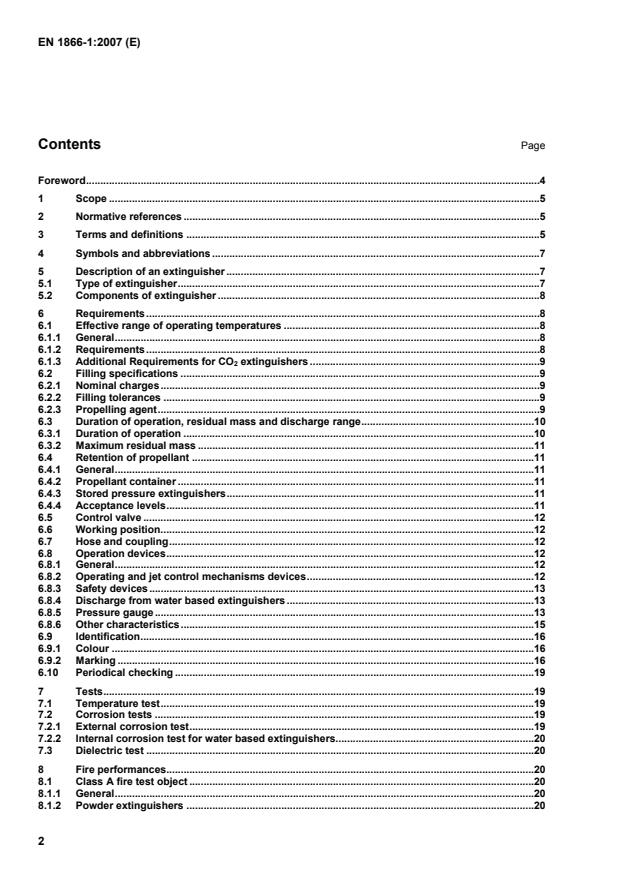
Test methods.23 A.1 Test methods.23 A.2 Duration of operation and residual mass.23 A.3 Measurement of the force.23 A.4 Measurement of the energy.23 A.5 Measurement of leakage of the control valve.23 A.6 Temperatures test.24 A.7 Internal corrosion test.24 Bibliography.25
1) In preparation.
(pressure experimentally measured) pressure measured in the extinguisher after stabilisation during at least 24 h at a maximum operating temperature TSmax (≥ 60 °C) and for cartridge operated extinguishers, the maximum pressure shall be the maximum pressure recorded for 0,5 s during a period of 3 min, excluding the first 5 s after releasing the propellant gas 3.2 body shell of the mobile fire extinguisher not fitted with accessories, but fitted with all welded parts 3.3 maximum allowable pressure, PS
(maximum declared pressure) maximum pressure for which the equipment is designed as specified by the manufacturer and which is in any case, greater than or equal to PTSmax 3.4 charge of an extinguisher mass or volume of the extinguishing media contained in the mobile fire extinguisher NOTE For extinguishers expressed as a volume (in litres) for water based extinguishers and as a mass (kilograms) for powder and CO2 extinguishers. 3.5 closure component, other than a safety device or pressure indicator, subject to the internal pressure and used to close off and seal the body
- 25 °C, -30 °C or lower. For water based extinguishers without any protection against freezing. TSmin shall be + 5 °C; TSmax and TSmin claimed by the manufacturer shall be used for the tests. 6.1.2 Requirements After the test described in A.6, the requirements for all extinguishers are as follows: shall operate satisfactorily; discharge shall commence within 10 s of the opening of the control valve; cartridge operated extinguishers shall be activated 30 s prior to opening the control valve; duration of operation shall be according to A.2 and not be less than the value applicable given in Table 4, Table 5, and Table 6; residual charge remaining in the extinguisher after one single and complete discharge including full decompression shall be as given in Table 7.
It is allowed to reduce the charge of the cylinder by 10 % to avoid overpressure in areas with high ambient temperatures. 6.2.2 Filling tolerances The actual charge of the extinguisher shall be equal to the nominal charge within the tolerances given in Table 2. Table 2 — Filling tolerances on nominal charges Powder Water based CO2 ± 2 % 0 % 0 %
− 5 % − 5 % 6.2.3 Propelling agent Only propellants listed in Table 3 or mixtures thereof, shall be used in extinguishers, whether they are the stored pressure type or cartridge extinguisher type. The maximum proportion of water in mass shall be as specified in Table 3, except when used in stored pressure water based extinguishers. Tracers may be added to the propellant to facilitate leakage detection, but the content shall not exceed 3 % of the propellant content.
% Air 0,006 Argon 0,006 CO2 0,015 Helium 0,006 Nitrogen 0,006 For the charge of the propellant cartridge, the tolerance shall be + 0 %, − 5 % in mass for CO2 and for compressed gases + 0 %, − 5 % in pressure at 20 °C. 6.3 Duration of operation, residual mass and discharge range 6.3.1 Duration of operation 6.3.1.1 Powder extinguishers When determined in accordance with A.2, the duration of operation of powder extinguishers shall be as given in Table 4. Table 4 — Duration time for powder extinguishers Nominal charge in kg Min. Dura
...