

EN 1866:2005
(Main)Mobile fire extinguishers
- Abstract
This document specifies the rules of design, type testing and inspection during manufacturing, ratings and classification of mobile fire extinguishers and test method to be used. It applies to mobile fire extinguishers with a total mass above 20 kg. This document is limited to water based and powder mobile extinguishers with a maximum allowed pressure PS of 30 bar. This document applies to mobile fire extinguishers with a nominal content of 50 kg (powder) and 45 l or 50 l (water, water based and foam) that are manoeuvred by an operator on foot only.
It does not cover fire tests for class C fires, but powder extinguishers are effective on this type of fire. Class D fires are considered to be a very specialist application and are not included in this document, but may be made the object of national specification.
NOTE This document does not specify any metallic materials which comply with the essential requirements of the Directive 97/23EEC (PED). Materials that successfully pass the essential requirements of the PED may be used.
- Status
- Withdrawn
- Publication Date
- 20-Dec-2005
- Withdrawal Date
- 06-May-2014
- Technical Committee
- CEN/TC 70 - Manual means of fire fighting equipment
- Drafting Committee
- CEN/TC 70 - Manual means of fire fighting equipment
- Current Stage
- 9960 - Withdrawal effective - Withdrawal
- Start Date
- 07-May-2014
- Completion Date
- 07-May-2014
97/23/EC - Pressure equipmentOJ Ref: C, C 118 OJ Date: 15-Apr-2011

Relations
- Effective Date
- 22-Dec-2008
- Effective Date
- 08-Jun-2022
- Effective Date
- 08-Jun-2022
- Replaced By
EN 1866-1:2007 - Mobile fire extinguishers - Part 1: Characteristics, performance and test methods - Effective Date
- 08-Jun-2022
- Effective Date
- 25-Aug-2026
- Effective Date
- 08-Jul-2026
- Effective Date
- 08-Jul-2026
- Effective Date
- 08-Jul-2026
- Effective Date
- 08-Jul-2026
- Effective Date
- 08-Jul-2026
- Effective Date
- 18-Feb-2026
- Effective Date
- 28-Jan-2026
- Effective Date
- 28-Jan-2026
- Effective Date
- 28-Jan-2026
- Effective Date
- 28-Jan-2026
Get Certified
Connect with accredited certification bodies for this standard

CIS Institut d.o.o.
Personal Protective Equipment (PPE) certification body. Notified Body NB-2890 for EU Regulation 2016/425 PPE.

Kiwa BDA Testing
Building and construction product certification.
Kmetijski inštitut Slovenije
Agricultural Institute of Slovenia. Soil testing, plant health, agricultural product analysis.
Sponsored listings
Frequently Asked Questions
EN 1866:2005 is a standard published by the European Committee for Standardization (CEN). Its full title is "Mobile fire extinguishers". This standard covers: This document specifies the rules of design, type testing and inspection during manufacturing, ratings and classification of mobile fire extinguishers and test method to be used. It applies to mobile fire extinguishers with a total mass above 20 kg. This document is limited to water based and powder mobile extinguishers with a maximum allowed pressure PS of 30 bar. This document applies to mobile fire extinguishers with a nominal content of 50 kg (powder) and 45 l or 50 l (water, water based and foam) that are manoeuvred by an operator on foot only. It does not cover fire tests for class C fires, but powder extinguishers are effective on this type of fire. Class D fires are considered to be a very specialist application and are not included in this document, but may be made the object of national specification. NOTE This document does not specify any metallic materials which comply with the essential requirements of the Directive 97/23EEC (PED). Materials that successfully pass the essential requirements of the PED may be used.
This document specifies the rules of design, type testing and inspection during manufacturing, ratings and classification of mobile fire extinguishers and test method to be used. It applies to mobile fire extinguishers with a total mass above 20 kg. This document is limited to water based and powder mobile extinguishers with a maximum allowed pressure PS of 30 bar. This document applies to mobile fire extinguishers with a nominal content of 50 kg (powder) and 45 l or 50 l (water, water based and foam) that are manoeuvred by an operator on foot only. It does not cover fire tests for class C fires, but powder extinguishers are effective on this type of fire. Class D fires are considered to be a very specialist application and are not included in this document, but may be made the object of national specification. NOTE This document does not specify any metallic materials which comply with the essential requirements of the Directive 97/23EEC (PED). Materials that successfully pass the essential requirements of the PED may be used.
EN 1866:2005 is classified under the following ICS (International Classification for Standards) categories: 13.220.10 - Fire-fighting. The ICS classification helps identify the subject area and facilitates finding related standards.
EN 1866:2005 has the following relationships with other standards: It is inter standard links to EN 1866:1998, EN 1866-2:2014, EN 1866-3:2013, EN 1866-1:2007, ISO 9227:1990, EN 13445-4:2026, EN 13445-3:2026, EN 13445-1:2026, EN 13445-5:2026, EN 13445-2:2026, EN 13445-3:2021+A1:2026, EN 13445-2:2021+A1:2023, EN ISO 15614-2:2025, EN ISO 17779:2025, EN ISO 15614-1:2017. Understanding these relationships helps ensure you are using the most current and applicable version of the standard.
EN 1866:2005 is associated with the following European legislation: EU Directives/Regulations: 2014/90/EU, 96/98/EC, 97/23/EC; Standardization Mandates: M/071. When a standard is cited in the Official Journal of the European Union, products manufactured in conformity with it benefit from a presumption of conformity with the essential requirements of the corresponding EU directive or regulation.
EN 1866:2005 is available in PDF format for immediate download after purchase. The document can be added to your cart and obtained through the secure checkout process. Digital delivery ensures instant access to the complete standard document.
Standards Content (Sample)
2003-01.Slovenski inštitut za standardizacijo. Razmnoževanje celote ali delov tega standarda ni dovoljeno.Mobile fire extinguishersPrevozni gasilnikiExtincteurs d'incendie mobilesFahrbare FeuerlöscherTa slovenski standard je istoveten z:EN 1866:2005SIST EN 1866:2006en13.220.10ICS:SIST EN 1866:19981DGRPHãþDSLOVENSKI
STANDARDSIST EN 1866:200601-maj-2006
EUROPEAN STANDARDNORME EUROPÉENNEEUROPÄISCHE NORMEN 1866December 2005ICS 13.220.10Supersedes EN 1866:1998
English VersionMobile fire extinguishersExtincteurs d'incendie mobilesFahrbare FeuerlöscherThis European Standard was approved by CEN on 17 November 2005.CEN members are bound to comply with the CEN/CENELEC Internal Regulations which stipulate the conditions for giving this EuropeanStandard the status of a national standard without any alteration. Up-to-date lists and bibliographical references concerning such nationalstandards may be obtained on application to the Central Secretariat or to any CEN member.This European Standard exists in three official versions (English, French, German). A version in any other language made by translationunder the responsibility of a CEN member into its own language and notified to the Central Secretariat has the same status as the officialversions.CEN members are the national standards bodies of Austria, Belgium, Cyprus, Czech Republic, Denmark, Estonia, Finland, France,Germany, Greece, Hungary, Iceland, Ireland, Italy, Latvia, Lithuania, Luxembourg, Malta, Netherlands, Norway, Poland, Portugal, Slovakia,Slovenia, Spain, Sweden, Switzerland and United Kingdom.EUROPEAN COMMITTEE FOR STANDARDIZATIONCOMITÉ EUROPÉEN DE NORMALISATIONEUROPÄISCHES KOMITEE FÜR NORMUNGManagement Centre: rue de Stassart, 36
B-1050 Brussels© 2005 CENAll rights of exploitation in any form and by any means reservedworldwide for CEN national Members.Ref. No. EN 1866:2005: E
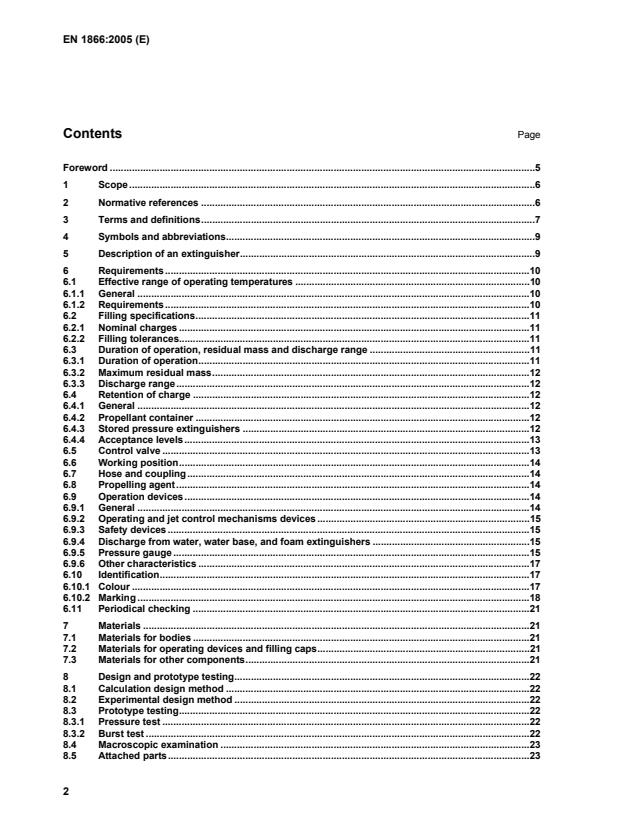
Classification of the different parts of an extinguisher subject to internal pressure.28 Annex B (normative)
Specifications for plastics components (except hoses, pistols and nozzles).29 B.1 General.29 B.2 Requirements for plastics components subject to pressure.29 B.2.1 General.29 B.2.2 Burst under pressure.29 B.2.3 Temperature conditioning 60 °C.29 B.2.4 Ageing test - Xenon arc.30 B.2.5 Impact test after ageing at 20 °C.30 B.2.6 Plastic/metal thread design (jet control devices at the end of hoses are excluded).31 Annex C (normative)
Symbols of pressures.32 Annex D (normative)
Test methods.33 D.1 Test methods.33 D.2 Duration of operation and residual mass.33 D.3 Measurement of the force.33 D.4 Measurement of the energy.33 D.5 Measurement of leakage of the control valve.33 D.6 Temperatures test.34 D.7 Internal corrosion test.34
Overfill pressure test.35 Annex F (normative)
Test for burst pressure of hose and hose assembly and attached components.36 Annex ZA (informative)
Relationship between this European Standard and the essential requirements of EU Directive 97/23/EC.37 Bibliography.38
1) Under preparation.
EN 287-2, Approval testing of welders – Fusion welding – Part 2: Aluminium and aluminium alloys EN 288-4, Specification and approval of welding procedures for metallic materials – Part 4: Welding procedure tests for the arc welding of aluminium and its alloys EN 1320, Destructive tests on welds in metallic materials – Fracture test EN 1418, Welding personnel – Approval testing of welding operators for fusion welding and resistance weld setters for fully mechanized and automatic welding of metallic materials EN 10204, Metallic products – Types of inspection documents EN 13133, Brazing – Brazer approval EN 13134, Brazing – Procedure approval EN 13445-1, Unfired pressure vessels – Part 1: General EN 13445-2, Unfired pressure vessels – Part 2: Materials EN 13445-3, Unfired pressure vessels – Part 3: Design EN 13445-4, Unfired pressure vessels – Part 4: Fabrication EN 13445-5, Unfired pressure vessels – Part 5: Inspection and testing EN ISO 4892-2, Plastics – Methods of exposure to laboratory light sources – Part 2: Xenon-arc sources (ISO 4892-2:1994) EN ISO 15609-1, Specification and qualification of welding procedures for metallic materials – Welding procedure specification – Part 1: Arc welding (ISO 15609-1:2004)
(pressure experimentally measured) pressure measured in the extinguisher after stabilisation during at least 24 h at maximum operating temperature Tmax (≥ 60 °C) and for cartridge operated extinguishers, the maximum pressure is the maximum pressure recorded for 0,5 s during a period of 3 min, excluding the first 5 s after release of the propellant gas 3.2 body shell of the mobile fire extinguisher not fitted with its accessories but fitted with all its welded parts NOTE Previous 3.3. deleted, cartridge extinguisher etc. and renumbered. 3.3 maximum allowable pressure, PS
(Maximum declared pressure) maximum pressure for which the equipment is designed, as specified by the manufacturer and which is in any case greater than or equal to PTmax 3.4 charge of an extinguisher mass or volume of the extinguishing media contained in the wheeled fire extinguisher NOTE Expressed as a volume (in litres) for water, water based and foam extinguishers and as a mass (kilograms) for powder extinguishers. 3.5 closure component, other than a safety device or pressure indicator, subject to the internal pressure and used to close off and seal the body 3.6 fire extinguisher pressure vessel assembly of parts to comprise the pressure retaining part of a fire extinguisher which can include a body, operating device, filling cap, closure, valve, hose 3.7 duration of operation time during which the extinguishing media is discharged, without any interruption in the discharge and with the valve fully opened not including the residual propellant gas 3.8 fire extinguisher appliance containing an extinguishing medium which can be expelled by the action of internal pressure and be directed on to a fire NOTE This pressure may be stored pressure (stored pressure extinguisher) or obtained by the release of an propellant gas from a separate cylinder (cartridge extinguisher).
maximum pressure measured during a bursting test 3.17 Tmax maximum operating temperature declared by the manufacturer 3.18 Tmin minimum operating temperature declared by the manufacturer
- 30 °C or lower. For water based extinguishers without any protection against freezing. Tmin shall be + 5 °C. Tmax and Tmin claimed by the manufacturer shall be used for the tests. 6.1.2 Requirements After the test described in D.6, the requirements for all extinguishers are as follows: they shall operate satisfactorily; discharge shall commence within 10 s of the opening of the control valve; discharge duration shall be according D.2 and not be less than the value applicable given in Table 3 and Table 4; residual charge remaining in the extinguisher after one single and complete discharge including full decompression shall be as given in Table 5.
−5% For the charge of the propellant cartridge, the tolerance shall be + 0, − 5 % in mass for CO2 and for compressed gases + 0, − 5 % in pressure at 20 °C. 6.3 Duration of operation, residual mass and discharge range 6.3.1 Duration of operation 6.3.1.1 Powder extinguishers When determined in accordance with D.2, the duration of operation of type I (short duration time) and type II (long duration time) powder extinguishers shall be as given in Table 3. Table 3 – Duration time for 50 kg powder extinguishers Duration time in s Type Min Max I 30 50 II 50 70
2,5 times the pressure at 60 °C (P60 °C) when subjected to a pressure increasing at an average rate of
(20 ± 5) bar/min. Failure shall occur at a pressure greater than 2,5 x P(60 °C) and when the gauge fails there shall be no ejection of any components. 6.9.5.4 Operating test of pressure gauges When tested at a temperature of (20 ± 5) °C, the pressure gauge shall operate within the range of error permitted by 6.9.5.2 after having been subjected to 1 000 pressure cycles from zero to P(60 °C)
and back to zero at an average rate of pressure change of (20 ± 5) bar/min. 6.9.5.5 Materials for pressure gauges The materials of construction of the pressure gauge which could be in contact with the extinguishing medium and propellant gas shall be compatible with these or protected from them. NOTE The same pressure gauge need not be used for the tests in 6.9.5.3 and 6.9.5.4.
Key 1 Rounded to the nearest 0,5 bar 2 Green 3 Red P(Tmin) Pressure at the minimum temperature claimed by the manufacturer (see 6.1.1) P(Tmax) Pressure at a temperature of + 60 °C or higher Figure 1 – Scale on pressure gauge 6.9.6 Other characteristics 6.9.6.1 Design of the filling opening Filling opening shall have a minimum diameter of 50 mm; main closure of the filling opening, intended to be removed during service or maintenance, shall be provided with an automatic means of venting any residual pressure from the extinguisher. The initial venting of any residual pressure shall not occur when securing the closure, or pressure retaining part, is disengaged by not more than one third of full engagement. 6.9.6.2 The diameter of the wheels shall be equal to or greater than 280 mm. 6.9.6.3 The width of the tyres shall be ≥ 50 mm, measured at the widest point of each tyre. 6.9.6.4 The distance between the handle and the floor, in storage position, shall be between 0,7 m and 1,6 m. 6.9.6.5 The mobile extinguisher shall be equipped with a storage socket for the nozzle. 6.9.6.6 The hose shall not be damaged when rolled up or stored. 6.10 Identification 6.10.1 Colour The colour of extinguisher bodies shall be red, but in addition to the marking, a zone of colour of area up to 5 % of the external area of the body may be used to identify the extinguishing media in accordance with national specifications.
1 FIRE EXTINGUISHER 50 Kg POWDER 1,5 0,75 2 1. OPEN THE PROPELLANT GAS CYLINDER 2. UNROLL THE HOSE 3. AIM NOZZLE AND OPERATE VALVE
1 3 CAUTION 1 4 REFILL AFTER USE – CHECK PERIODICALLY CHECK PROPELLANT CYLINDER WEIGHT ANNUALY USE ONLY PRODUCTS AND SPARE PARTS IN CONFORMITY WITH THE AGREED MODEL EXSTINGUISHING MEDIUM: 50 kg POWDER APPROVAL N°: PROPELLANT: TYPE: TEMPERATURE RANGE: - 20 °C TO + 60 °C 0,5 5 MANUFACTURER
NOTE The circled numbers indicate the parts of the marking and the numbers to the right of each part indicate the height of the lettering as a proportion of H (see 6.10.2). Figure 2 – Informative marking of a mobile fire extinguisher
Figure 3 – Pictograms 6.10.2.3 Part 3 shall contain information relating to any restrictions or dangers of use, in particular in relation to toxicity and electrical risk. NOTE Attention is drawn to national regulations. Wheeled fire extinguishers using water or foam and not tested against, or not meeting the requirements of 11.3 shall be marked with the following warning: “WARNING – Do not use on live electrical equipment”. Wheeled fire extingui
...