

EN 14140:2014
(Main)LPG equipment and accessories - Transportable refillable welded steel cylinders for LPG - Alternative design and construction
- Abstract
This European Standard specifies the minimum requirements for the design, construction and testing during manufacture of transportable refillable welded steel Liquefied Petroleum Gas (LPG) cylinders, of water capacity from 0,5 l up to and including 150 l, exposed to temperatures of -20 °C to +65 °C. It allows alternative design and construction methods to those required in EN 1442, including coated cylinders, over-moulded cylinders and cylinders for hot air balloons.
This European Standard applies only to pressure receptacles with a circular cross-section.
This European Standard does not include the equipping of the cylinders with valves and other service equipment.
- Status
- Published
- Publication Date
- 02-Dec-2014
- Withdrawal Date
- 29-Jun-2015
- Technical Committee
- CEN/TC 286 - Liquefied petroleum gas equipment and accessories
- Drafting Committee
- CEN/TC 286/WG 1 - Design and manufacture of LPG pressure vessels
- Current Stage
- 9093 - Decision to confirm - Review Enquiry
- Start Date
- 26-May-2023
- Completion Date
- 07-Oct-2026

Overview - EN 14140:2014 (LPG cylinders, alternative design)
EN 14140:2014 is a CEN European Standard that sets minimum requirements for the design, construction and factory testing of transportable, refillable, welded steel cylinders for Liquefied Petroleum Gas (LPG). It covers cylinders with a water capacity from 0.5 L up to and including 150 L, intended for service at ambient temperatures from ‑20 °C to +65 °C. The standard permits alternative design and construction methods to those in EN 1442 (for example coated, over‑moulded cylinders and cylinders for hot air balloons) and applies only to pressure receptacles with a circular cross‑section. It does not include requirements for valves and other service equipment.
Key topics and technical requirements
- Scope and limits: Size range (0.5–150 L), temperature range (‑20 °C to +65 °C), circular cross‑section requirement, exclusion of valves.
- Materials: Requirements for steels and acceptance of newer, higher‑strength materials where validated by testing.
- Design rules: Calculation of shell thickness, end design (torispherical, semi‑ellipsoidal and other shapes), openings, valve protection and non‑pressure attachments.
- Alternative constructions: Provisions for coated cylinders, over‑moulded cylinders, and hot air balloon cylinders, with specific performance checks.
- Welding and fabrication: Welding qualification, plate/pressed part requirements, tolerances, heat treatment and workmanship standards.
- Testing and inspection:
- Prototype and production testing such as burst tests, fatigue tests, drop/impact tests (special provisions for hot air balloon cylinders),
- Non‑destructive testing (radiography, macro and visual examinations),
- Production pressure tests, batch sampling and acceptance criteria.
- Production controls: Batch testing, sampling rates, failure handling, and retest procedures.
- Marking, documentation and certification: Manufacturer marking, technical documentation and type approval procedures.
Applications - who uses EN 14140:2014
EN 14140:2014 is intended for:
- Cylinder manufacturers designing and producing refillable welded steel LPG cylinders using alternative construction methods.
- Design engineers and material specialists specifying cylinder geometry, wall thickness, welding procedures and coatings.
- Testing and certification bodies performing type approval, prototype tests and production inspection.
- Regulatory authorities, transport and safety officials referencing technical compliance for LPG cylinders in transport and storage.
- Operators and fleet managers of equipment using LPG cylinders (including hot‑air balloon operators) who need to ensure cylinders meet recognized safety and performance standards.
Related standards and regulations
- EN 1442 (traditional design and construction for LPG cylinders) - EN 14140 allows alternative methods to EN 1442.
- ADR / RID / ADN transport regulations - referenced for legal precedence in transport.
- National adoptions of EN 14140:2014 by CEN member bodies.
Keywords: EN 14140:2014, LPG cylinders, transportable refillable welded steel cylinders, over‑moulded cylinders, hot air balloon cylinders, LPG cylinder design and testing, CEN standard.
Relations
- Effective Date
- 10-Dec-2014
- Effective Date
- 28-Jan-2026
- Effective Date
- 28-Jan-2026
- Effective Date
- 28-Jan-2026
- Effective Date
- 28-Jan-2026
- Effective Date
- 28-Jan-2026
- Refers
EN ISO 643:2024 - Steels - Micrographic determination of the apparent grain size (ISO 643:2024) - Effective Date
- 28-Jan-2026
- Effective Date
- 28-Jan-2026
- Effective Date
- 28-Jan-2026
- Refers
EN ISO 9227:2022 - Corrosion tests in artificial atmospheres - Salt spray tests (ISO 9227:2022) - Effective Date
- 28-Jan-2026
- Effective Date
- 28-Jan-2026
- Effective Date
- 28-Jan-2026
- Effective Date
- 28-Jan-2026
- Effective Date
- 28-Jan-2026
- Effective Date
- 28-Jan-2026
Get Certified
Connect with accredited certification bodies for this standard

Institut za varilstvo d.o.o. (Welding Institute)
Slovenia's leading welding institute since 1952. ISO 3834, EN 1090, pressure equipment certification, NDT personnel, welder qualification. Only IIW Au
Sponsored listings
Frequently Asked Questions
EN 14140:2014 is a standard published by the European Committee for Standardization (CEN). Its full title is "LPG equipment and accessories - Transportable refillable welded steel cylinders for LPG - Alternative design and construction". This standard covers: This European Standard specifies the minimum requirements for the design, construction and testing during manufacture of transportable refillable welded steel Liquefied Petroleum Gas (LPG) cylinders, of water capacity from 0,5 l up to and including 150 l, exposed to temperatures of -20 °C to +65 °C. It allows alternative design and construction methods to those required in EN 1442, including coated cylinders, over-moulded cylinders and cylinders for hot air balloons. This European Standard applies only to pressure receptacles with a circular cross-section. This European Standard does not include the equipping of the cylinders with valves and other service equipment.
This European Standard specifies the minimum requirements for the design, construction and testing during manufacture of transportable refillable welded steel Liquefied Petroleum Gas (LPG) cylinders, of water capacity from 0,5 l up to and including 150 l, exposed to temperatures of -20 °C to +65 °C. It allows alternative design and construction methods to those required in EN 1442, including coated cylinders, over-moulded cylinders and cylinders for hot air balloons. This European Standard applies only to pressure receptacles with a circular cross-section. This European Standard does not include the equipping of the cylinders with valves and other service equipment.
EN 14140:2014 is classified under the following ICS (International Classification for Standards) categories: 23.020.30 - Pressure vessels, gas cylinders; 23.020.35 - Gas cylinders. The ICS classification helps identify the subject area and facilitates finding related standards.
EN 14140:2014 has the following relationships with other standards: It is inter standard links to EN 14140:2003+A1:2006, EN 10204:2004, EN ISO 2409:2013, EN ISO 6520-1:2007, EN ISO 6892-1:2019, EN 1439:2021, EN ISO 643:2024, EN ISO 17637:2016, EN ISO 9712:2012, EN ISO 9227:2022, EN ISO 11117:2008, EN 14894:2021, EN ISO 9606-1:2017, EN ISO 17636-1:2013, EN ISO 14732:2025. Understanding these relationships helps ensure you are using the most current and applicable version of the standard.
EN 14140:2014 is associated with the following European legislation: EU Directives/Regulations: 2008/68/EC, 94/55/EC, 96/49/EC; Standardization Mandates: M/086. When a standard is cited in the Official Journal of the European Union, products manufactured in conformity with it benefit from a presumption of conformity with the essential requirements of the corresponding EU directive or regulation.
EN 14140:2014 is available in PDF format for immediate download after purchase. The document can be added to your cart and obtained through the secure checkout process. Digital delivery ensures instant access to the complete standard document.
Standards Content (Sample)
2003-01.Slovenski inštitut za standardizacijo. Razmnoževanje celote ali delov tega standarda ni dovoljeno.Flüssiggas-Geräte und Ausrüstungsteile - Ortsbewegliche, wiederbefüllbare, geschweißte Flaschen aus Stahl für Flüssiggas (LPG) - Alternative Gestaltung und KonstruktionEquipements pour GPL et leurs accessoires - Bouteilles en acier soudé transportables et rechargeables pour gaz de pétrole liquéfié (GPL) - Autres solutions en matière de conception et constructionLPG equipment and accessories - Transportable refillable welded steel cylinders for LPG - Alternative design and construction23.020.30MHNOHQNHPressure vessels, gas cylindersICS:Ta slovenski standard je istoveten z:EN 14140:2014SIST EN 14140:2015en,fr,de01-februar-2015SIST EN 14140:2015SLOVENSKI
STANDARDSIST EN 14140:2004+A1:20071DGRPHãþD
EUROPEAN STANDARD NORME EUROPÉENNE EUROPÄISCHE NORM
EN 14140
December 2014 ICS 23.020.30 Supersedes EN 14140:2003+A1:2006English Version
LPG equipment and accessories - Transportable refillable welded steel cylinders for LPG - Alternative design and construction
Équipements pour GPL et leurs accessoires - Bouteilles en acier soudé transportables et rechargeables pour gaz de pétrole liquéfié (GPL) - Autres solutions en matière de conception et construction
Flüssiggas-Geräte und Ausrüstungsteile - Ortsbewegliche, wiederbefüllbare, geschweißte Flaschen aus Stahl für Flüssiggas (LPG) - Alternative Gestaltung und KonstruktionThis European Standard was approved by CEN on 9 August 2014.
CEN members are bound to comply with the CEN/CENELEC Internal Regulations which stipulate the conditions for giving this European Standard the status of a national standard without any alteration. Up-to-date lists and bibliographical references concerning such national standards may be obtained on application to the CEN-CENELEC Management Centre or to any CEN member.
This European Standard exists in three official versions (English, French, German). A version in any other language made by translation under the responsibility of a CEN member into its own language and notified to the CEN-CENELEC Management Centre has the same status as the official versions.
CEN members are the national standards bodies of Austria, Belgium, Bulgaria, Croatia, Cyprus, Czech Republic, Denmark, Estonia, Finland, Former Yugoslav Republic of Macedonia, France, Germany, Greece, Hungary, Iceland, Ireland, Italy, Latvia, Lithuania, Luxembourg, Malta, Netherlands, Norway, Poland, Portugal, Romania, Slovakia, Slovenia, Spain, Sweden, Switzerland, Turkey and United Kingdom.
EUROPEAN COMMITTEE FOR STANDARDIZATION
COMITÉ EUROPÉEN DE NORMALISATION EUROPÄISCHES KOMITEE FÜR NORMUNG
CEN-CENELEC Management Centre:
Avenue Marnix 17,
B-1000 Brussels © 2014 CEN All rights of exploitation in any form and by any means reserved worldwide for CEN national Members. Ref. No. EN 14140:2014 ESIST EN 14140:2015
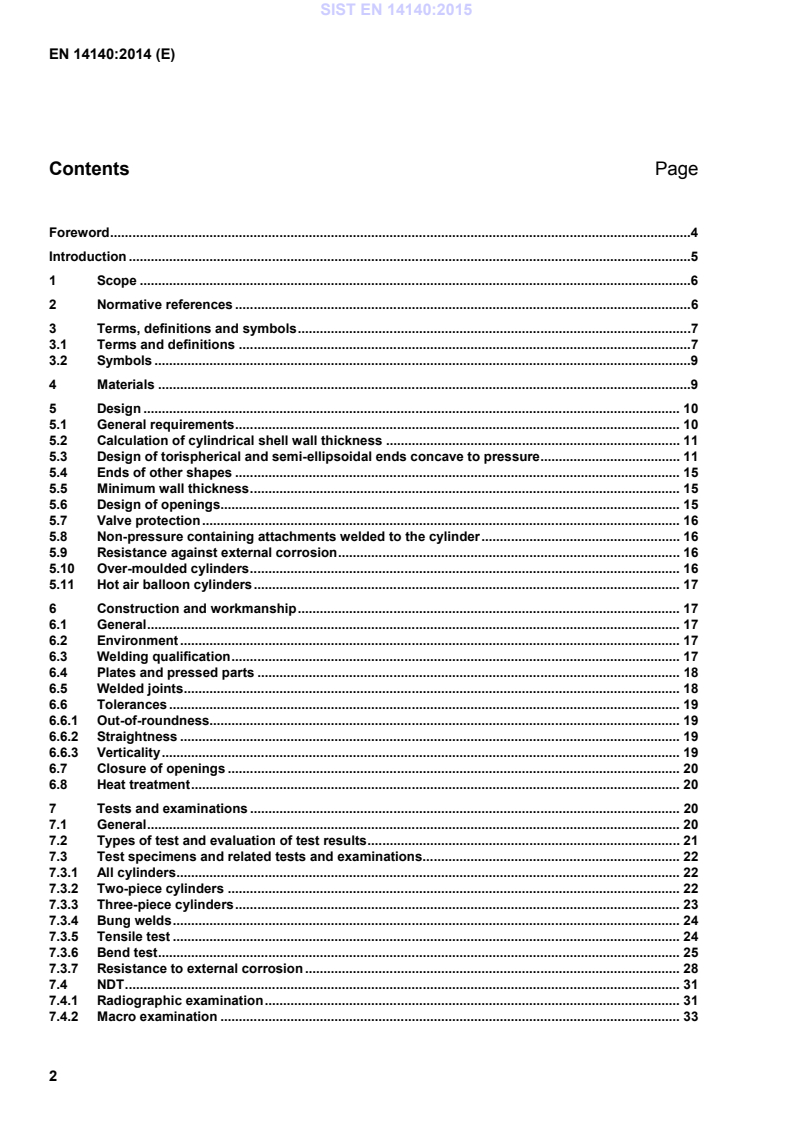
2 Contents Page
Foreword .4 Introduction .5 1 Scope .6 2 Normative references .6 3 Terms, definitions and symbols .7 3.1 Terms and definitions .7 3.2 Symbols .9 4 Materials .9 5 Design . 10 5.1 General requirements . 10 5.2 Calculation of cylindrical shell wall thickness . 11 5.3 Design of torispherical and semi-ellipsoidal ends concave to pressure . 11 5.4 Ends of other shapes . 15 5.5 Minimum wall thickness . 15 5.6 Design of openings. 15 5.7 Valve protection . 16 5.8 Non-pressure containing attachments welded to the cylinder . 16 5.9 Resistance against external corrosion . 16 5.10 Over-moulded cylinders . 16 5.11 Hot air balloon cylinders . 17 6 Construction and workmanship . 17 6.1 General . 17 6.2 Environment . 17 6.3 Welding qualification . 17 6.4 Plates and pressed parts . 18 6.5 Welded joints . 18 6.6 Tolerances . 19 6.6.1 Out-of-roundness. 19 6.6.2 Straightness . 19 6.6.3 Verticality . 19 6.7 Closure of openings . 20 6.8 Heat treatment . 20 7 Tests and examinations . 20 7.1 General . 20 7.2 Types of test and evaluation of test results . 21 7.3 Test specimens and related tests and examinations. 22 7.3.1 All cylinders . 22 7.3.2 Two-piece cylinders . 22 7.3.3 Three-piece cylinders . 23 7.3.4 Bung welds . 24 7.3.5 Tensile test . 24 7.3.6 Bend test . 25 7.3.7 Resistance to external corrosion . 28 7.4 NDT . 31 7.4.1 Radiographic examination . 31 7.4.2 Macro examination . 33 SIST EN 14140:2015
3 7.4.3 Visual examination of the surface of the weld . 33 7.5 Prototype and production batch testing . 33 7.5.1 Burst test under pressure. 33 7.5.2 Fatigue test . 34 7.5.3 Cylinder body integrity impact tests (not required for hot air balloon cylinders) . 35 7.5.4 Drop tests (all cylinders except hot air balloon cylinders) . 39 7.5.5 Drop tests (hot air balloon cylinders only) . 40 8 Technical requirements for type approval . 41 8.1 General . 41 8.2 Extent of testing . 41 8.3 Design type variations . 42 8.3.1 General . 42 8.3.2 Two piece cylinders . 42 8.3.3 Three piece cylinders . 42 9 Initial inspection and tests . 43 9.1 Tests and examinations applicable to all cylinders . 43 9.2 Radiographic examination. 43 9.3 Macro examination . 44 9.4 Examination of bung welding . 44 9.5 Examination of welding of non-pressure containing attachments . 44 9.5.1 Macro examinations . 44 9.5.2 Weld penetration requirement . 44 9.6 Unacceptable imperfections in radiographic or macro examination . 44 9.7 Production pressure test . 44 9.7.1 Procedure . 44 9.7.2 Requirements . 45 9.8 Production batch testing (Mechanical / Burst tests) . 45 9.8.1 Production batch . 45 9.8.2 Inspection lots . 45 9.8.3 Rate of sampling . 45 9.8.4 Verification of conformance with type approval . 47 9.9 Failure to meet mechanical and burst test requirements . 48 9.9.1 General . 48 9.9.2 Mechanical . 48 9.9.3 Burst . 48 9.9.4 Production batch retest . 48 9.9.5 Resubmission of production batch . 48 9.9.6 Additional checks . 49 9.10 Production adhesion test for over-moulded cylinders . 49 9.11 Production water absorption test for over-moulded cylinders . 49 10 Marking . 50 11 Documentation . 51 12 Certification . 51 Annex A (normative)
Additional manufacturers markings . 52 Annex B (informative)
Over-moulded cylinder . 53 Annex C (informative)
Hot Air Balloon Cylinders . 55 C.1 Description . 55 Annex D (informative)
Environmental checklist. 57 Bibliography . 59
4 Foreword This document (EN 14140:2014) has been prepared by Technical Committee CEN/TC 286 "Liquefied petroleum gas equipment and accessories", the secretariat of which is held by NSAI. This European Standard shall be given the status of a national standard, either by publication of an identical text or by endorsement, at the latest by June 2015 and conflicting national standards shall be withdrawn at the latest by June 2015. Attention is drawn to the possibility that some of the elements of this document may be the subject of patent rights. CEN [and/or CENELEC] shall not be held responsible for identifying any or all such patent rights. This document supersedes EN 14140:2003+A1:2006. This document has been prepared under a mandate given to CEN by the European Commission and the European Free Trade Association. This European Standard has been submitted for reference into: − the RID [11]; and − the technical annexes of the ADR [12]. NOTE These regulations take precedence over any clause of this European Standard. It is emphasised that RID/ADR/ADN are being revised regularly at intervals of two years which may lead to temporary non-compliances with the clauses of this European Standard. The major changes to this revision include: − restructure of standard; − the addition of requirements for hot air balloon cylinders; − an update on the terminology; − the addition of requirements for over-moulded cylinders; − the addition of the environmental checklist, Annex D. According to the CEN-CENELEC Internal Regulations, the national standards organizations of the following countries are bound to implement this European Standard: Austria, Belgium, Bulgaria, Croatia, Cyprus, Czech Republic, Denmark, Estonia, Finland, Former Yugoslav Republic of Macedonia, France, Germany, Greece, Hungary, Iceland, Ireland, Italy, Latvia, Lithuania, Luxembourg, Malta, Netherlands, Norway, Poland, Portugal, Romania, Slovakia, Slovenia, Spain, Sweden, Switzerland, Turkey and the United Kingdom. SIST EN 14140:2015
5 Introduction This European Standard calls for the use of substances and procedures that may be injurious to health and/or the environment if adequate precautions are not taken. It refers only to technical suitability: it does not absolve the user from their legal obligations at any stage. It has been assumed in the drafting of this European Standard that the execution of its provisions is entrusted to appropriately qualified and experienced people. This European Standard permits the use of new and higher strength steels and has the potential for cylinders to have a wall thickness thinner than the minimum wall thickness related to diameter, when compared with cylinders in accordance with EN 1442. These changes in technology are justified by requiring a series of performance tests, including impact testing, to demonstrate the adequacy of the calculated pressure thickness for service and transport considerations Reference should also be made to EN 1439 and EN 1440, which requires the cylinder manufacturer to perform additional tests to determine the rejection limits for in-service damage and to include these limits in the documentation for the cylinder. Protection of the environment is a key political issue in Europe and elsewhere around the world. Protection of the environment in this document is understood in a very broad sense. The phrase is used, for example, in relation to the total life-cycle aspects of a product on the environment, including expenditure of energy, and during all phases of its existence, from mining of raw materials, to fabrication, packaging, distribution, use, scrapping, recycling of materials, etc. Annex D comprises an environmental checklist which highlights the clauses of this European Standard that address environmental aspects. It is recommended that manufacturers develop an environmental management policy. For guidance see
EN ISO 14000 series, [6], [7] and [8]]. Provisions need to be restricted to a general guidance. Limit values are specified in national laws. All pressures are gauged unless otherwise stated. NOTE This European Standard requires measurement of material properties, dimensions and pressures. All such measurements are subject to a degree of uncertainty due to tolerances in measuring equipment etc. It may be beneficial to refer to the leaflet “measurement uncertainty leaflet" SP INFO 2000 27 [14]. SIST EN 14140:2015
6 1 Scope This European Standard specifies the minimum requirements for the design, construction and testing during manufacture of transportable refillable welded steel Liquefied Petroleum Gas (LPG) cylinders, of water capacity from 0,5 l up to and including 150 l, exposed to temperatures of -20 °C to +65 °C. It allows alternative design and construction methods to those required in EN 1442, including coated cylinders, over-moulded cylinders and cylinders for hot air balloons. This European Standard applies only to pressure receptacles with a circular cross-section. This European Standard does not include the equipping of the cylinders with valves and other service equipment. 2 Normative references The following documents, in whole or in part, are normatively referenced in this document and are indispensable for its application. For dated references, only the edition cited applies. For undated references, the latest edition of the referenced document (including any amendments) applies. EN 1439, LPG equipment and accessories - Procedure for checking LPG cylinders before, during and after filling EN 10028-7, Flat products made of steels for pressure purposes - Part 7: Stainless steels EN 10120, Steel sheet and strip for welded gas cylinders EN 10204:2004, Metallic products - Types of inspection documents EN 10272, Stainless steel bars for pressure purposes EN 14717, Welding and allied processes - Environmental check list EN 14894, LPG equipment and accessories - Cylinder and drum marking EN ISO 643, Steels - Micrographic determination of the apparent grain size (ISO 643) EN ISO 2409:2013, Paints and varnishes - Cross-cut test (ISO 2409:2013) EN ISO 2812-2, Paints and varnishes - Determination of resistance to liquids - Part 2: Water immersion method (ISO 2812-2) EN ISO 3231:1997, Paints and varnishes - Determination of resistance to humid atmospheres containing sulfur dioxide (ISO 3231:1993) EN ISO 4136, Destructive tests on welds in metallic materials - Transverse tensile test (ISO 4136) EN ISO 4624, Paints and varnishes - Pull-off test for adhesion (ISO 4624) EN ISO 5173, Destructive tests on welds in metallic materials - Bend tests (ISO 5173) EN ISO 6520-1, Welding and allied processes - Classification of geometric imperfections in metallic materials - Part 1: Fusion welding (ISO 6520-1) EN ISO 6892-1, Metallic materials - Tensile testing - Part 1: Method of test at room temperature (ISO 6892-1) EN ISO 9227, Corrosion tests in artificial atmospheres - Salt spray tests (ISO 9227) SIST EN 14140:2015
7 EN ISO 9606-1, Qualification testing of welders - Fusion welding - Part 1: Steels (ISO 9606-1) EN ISO 9712:2012, Non-destructive testing - Qualification and certification of NDT personnel (ISO 9712:2012) EN ISO 11117:2008, Gas cylinders - Valve protection caps and valve guards - Design, construction and tests (ISO 11117:2008) EN ISO 11997-2, Paints and varnishes - Determination of resistance to cyclic corrosion conditions - Part 2: Wet (salt fog)/dry/humidity/UV light (ISO 11997-2) EN ISO 14732, Welding personnel - Qualification testing of welding operators and weld setters for mechanized and automatic welding of metallic materials (ISO 14732) EN ISO 15609-1, Specification and qualification of welding procedures for metallic materials - Welding procedure specification - Part 1: Arc welding (ISO 15609-1) EN ISO 15613, Specification and qualification of welding procedures for metallic materials - Qualification based on pre-production welding test (ISO 15613) EN ISO 15614-1, Specification and qualification of welding procedures for metallic materials - Welding procedure test - Part 1: Arc and gas welding of steels and arc welding of nickel and nickel alloys (ISO 15614-1) EN ISO 17636-1:2013, Non-destructive testing of welds - Radiographic testing - Part 1: X- and gamma-ray techniques with film (ISO 17636-1:2013) EN ISO 17636-2:2013, Non-destructive testing of welds - Radiographic testing - Part 2: X- and gamma-ray techniques with digital detectors (ISO 17636-2:2013) EN ISO 17637, Non-destructive testing of welds - Visual testing of fusion-welded joints (ISO 17637) EN ISO 17639, Destructive tests on welds in metallic materials - Macroscopic and microscopic examination of welds (ISO 17639) EN ISO 19232-1, Non-destructive testing - Image quality of radiographs - Part 1: Determination of the image quality value using wire-type image quality indicators (ISO 19232-1) EN ISO 19232-2, Non-destructive testing - Image quality of radiographs - Part 2: Determination of the image quality value using step/hole-type image quality indicators (ISO 19232-2) 3 Terms, definitions and symbols 3.1 Terms and definitions For the purposes of this document, the following terms and definitions apply. 3.1.1 liquefied petroleum gas LPG low pressure liquefied gas composed of one or more light hydrocarbons which are assigned to UN 1011, UN 1075, UN 1965, UN 1969 or UN 1978 only and which consists mainly of propane, propene, butane, butane isomers, butene with traces of other hydrocarbon gases 3.1.2 cylinder transportable, pressure receptacle with a water capacity not exceeding150 l SIST EN 14140:2015
8 3.1.3 over-moulded cylinder a cylinder intended for the carriage of LPG of a water capacity not exceeding 13 l made of a coated steel inner pressure receptacle with an over-moulded protective case made from cellular plastic which is non removable and bonded to the outer surface of the inner receptacle wall 3.1.4 manufacturer manufacturer of the cylinder, unless otherwise specified 3.1.5 yield strength upper yield strength Reh or, for steels that do not exhibit a definite yield, the 0,2 % proof strength Rp0,2 3.1.6 heat treatment solution heat treatment, quenching and artificial or natural ageing that ensures the strength values required 3.1.7 normalised condition resulting from heat treatment to a uniform temperature above the upper critical point (Ac3) of the steel and then cooled under controlled conditions 3.1.8 stress relieved condition resulting from heat treatment in which a finished cylinder is heated to a uniform temperature below the lower critical point (Ac1) of the steel and cooled in a still atmosphere, the object of which is to reduce the residual stresses without altering the metallurgical structure of the steel 3.1.9 production batch group of pressure parts or finished pressure vessels, made consecutively by the same manufacturer using the same manufacturing techniques to the same design, nominal size and material specifications on the same production machinery and subject to the same heat treatment conditions Note 1 to entry: In this context, 'consecutively' need not imply continuous production. 3.1.10 over-moulded casing layer of over-moulded material which gives mechanical protection which, either cannot be removed without destroying it or is only removable with special tools or is bonded to the cylinder wall Note 1 to entry: This definition can be applied to cylinders with over-moulded layers or with separate casings. 3.1.11 protective coating layer of paint or other material applied to the pressure receptacle to provide resistance to external corrosion 3.1.12 hot air balloon cylinder stainless steel cylinder, fitted with a removable structural foam protective cover, which has been approved for aviation purposes (Commission Regulation (EU) No 748/2012, Annex Part 21) 3.1.13 cold-forming forming at temperatures not less than 25 °C below the maximum permissible temperature for stress relieving, in accordance with the applicable material specifications SIST EN 14140:2015
9 3.1.14 production batch (over-moulded cylinders) 12 months production of cylinders from a single over-moulding company, using inner cylinders manufactured by one manufacturer 3.2 Symbols a Calculated minimum thickness of the cylindrical shell, in millimetres. A Percentage elongation after fracture. b Calculated minimum thickness of the end of the cylinder, in millimetres. C Shape factor for ends (see Table 1 and Figure 2). D Outside diameter of the cylinder as given in the design drawing (see Figure 1), in millimetres. Dp Outside diameter of a bend tests former (see Figure 8), in millimetres. e Actual thickness of the material used, in millimetres. F Energy, in Joules, used in the cylinder body impact tests. h Height, in millimetres, of the cylindrical part of the end (see Figure 1). H Outside height, in millimetres, of the domed part of the end (see Figure 1). J Stress reduction factor. l Length of the cylinder, in millimetres. Lo Original gauge length of the test piece, in accordance with EN ISO 6892-1, in millimetres. M Maximum operating mass of the cylinder, in kg. n Ratio of diameter of bend test former to the thickness of the test piece, (see Table 5). Pc Calculation pressure (1 bar = 105 Pa = 105 N/m2), used to calculate the minimum required thickness of the cylindrical shell and ends, in bar. Pb Maximum pressure attained during the burst test, in bar. Ph Actual test pressure applied to the cylinder by the manufacturer, in bar. Phmin
Minimum permissible test pressure, in bar. r Inside knuckle radius of the end, in millimetres. R Inside dishing radius of the end, in millimetres. Rg Guaranteed tensile strength guaranteed by the cylinder manufacturer for the finished cylinder, in N/mm2. Ro Minimum value of yield strength guaranteed by the cylinder manufacturer for the finished cylinder, in N/mm2. Rm Actual value of tensile strength determined by the tensile test specified in 7.4, in N/mm2. 4 Materials 4.1 Steels for the pressure receptacle shall not be affected or weakened by the intended contents (LPG) and shall not cause a dangerous effect e.g. catalysing a reaction or reacting with the dangerous goods. The steel shall be resistant to brittle fracture and to stress corrosion cracking. NOTE See EN ISO 11114-1. 4.2 Materials for shells and end pressings shall be: SIST EN 14140:2015
10 a) carbon steel in accordance with EN 10120 or other appropriate standard providing they comply with the tests results described in this European Standard, or b) stainless steel in accordance with EN 10028-7. 4.3 All parts welded to the cylinder shall be made of material compatible with the cylinder material. For hot air balloon cylinders the valve and fitting bosses shall be stainless steel in accordance with EN 10272. 4.4 Materials used for the coating, protection and over-moulding of cylinders shall conform to the material specifications, which shall be available to the manufacturer and for the type approval. 4.5 The welding consumables shall be such that they are capable of giving consistent welds. The strength characteristics of the welds in the finished cylinder shall fulfil all requirements for the design and calculation of the cylinder. 4.6 The cylinder manufacturer shall obtain certificates showing the chemical analysis and details of the mechanical properties of the steel supplied for the construction of the pressure retaining parts. The certificates shall be in accordance with EN 10204:2004, certificate Type 3.1 for shells and ends and Type 2.2 for the valves and fittings boss or bosses. 4.7 The manufacturer shall maintain a system of identification for the materials used in the fabrication in order that all materials for pressure parts in the completed cylinder can be traced to their origin. 4.8 The manufacturer shall endeavour to acquire materials and components from suppliers who have a declared environmental policy, see EN ISO 14021 [6], EN ISO 14024 [7] and EN ISO 14025 [8]. 4.9 The design of cylinders and over-moulded or protective casings shall minimize the waste of materials. 4.10 The manufacturer should endeavour to minimise wastage of material by selecting appropriately sized materials related to the finished parts required for manufacture. 4.11 Over-moulded or protective casings manufactured from recyclable plastic materials shall display the appropriate recycling symbol. 4.12 All processes should be designed to minimise VOC emissions. 5 Design 5.1 General requirements 5.1.1 The calculation of the wall thickness of the pressure parts shall be based on the yield strength of the material. 5.1.2 For calculation purposes, the value of the yield strength Ro is limited to a maximum of 0,85 Rg. 5.1.3 The calculation pressure (Pc) shall be: a) for cylinders restricted to LPG with a test pressure not exceeding 16 bar absolute (UN1011, UN 1965 Mixtures A, A01, A02 and A0 and UN 1969): Pc = Phmin = 15 bar. b) for all other LPG cylinders: Pc = Phmin = 30 bar. NOTE See RID/ADR 4.1.4.1 P200 Table 2 for LPG test pressures. SIST EN 14140:2015
11 5.1.4 A fully dimensioned drawing including the specification of the material shall be produced. 5.1.5 The design of the cylinder should take into account the following: − ease of manual handling; − ease of connection for filling and use; − safe stacking (when designed to be stacked); − minimising the use of materials; and − minimising the environmental impact of in service, maintenance and end of life disposal. 5.2 Calculation of cylindrical shell wall thickness The wall thickness, a, of the cylindrical shell shall be not less than: 4320
ocRJcPDaP×××=+ For cylinders with a longitudinal weld: J = 0,9 For cylinders without a longitudinal weld: J = 1,0 5.3 Design of torispherical and semi-ellipsoidal ends concave to pressure 5.3.1 The shape of ends shall be such that the following conditions are fulfilled: − for torispherical ends R < D ; r >0,1 D ; h > 4b (see Figure 1), − for semi-ellipsoidal ends H > 0,192 D; h > 4b (see Figure 1). 5.3.2 The wall thickness, b, shall be not less than: c15ocP DCb(R)P××=×+ In this formula, C is a shape factor, the value of which depends on the ratio H/D. For H/D values between 0,2 and 0,25 the value of C shall be obtained from Figure 2. For H/D values between 0,25 and 0,5 the value of C shall be obtained from Table 1 or Figure 3. SIST EN 14140:2015
Key 1 torispherical end 2 semi-ellipsoidal end NOTE For torispherical ends the height H can be calculated using: )]() [(])[()(b r
b R
b R
b R HDD+−++×−+−+=222 Figure 1 — Illustration of cylinder ends concave to pressure SIST EN 14140:2015
Figure 2 — Values of shape factor C for H/D between 0,2 and 0,25 SIST EN 14140:2015
Figure 3 — Values of shape factor C for H/D between 0,25 and 0,5 SIST EN 14140:2015
15 Table 1 — Relationship between H/D and shape factor C H/D C
H/D C 0,25 1,000
0,38 0,612 0,26 0,931
0,39 0,604 0,27 0,885
0,40 0,596 0,28 0,845
0,41 0,588 0,29 0,809
0,42 0,581 0,30 0,775
0,43 0,576 0,31 0,743
0,44 0,572 0,32 0,713
0,45 0,570 0,33 0,687
0,46 0,568 0,34 0,667
0,47 0,566 0,35 0,649
0,48 0,565 0,36 0,633
0,49 0,564 0,37 0,621
0,50 0,564 NOTE Intermediate values can be obtained by linear interpolation. 5.4 Ends of other shapes Ends of shapes other than those covered by 5.3 may be used provided that the adequacy of their design is demonstrated by a fatigue test in accordance with 7.5.2 or by appropriate stress analysis. 5.5 Minimum wall thickness The minimum wall thickness of each pressure part shall be the greater of that required by: − for cylindrical shells, 5.2 or that required to meet the tests described in 8.2, − for ends, 5.3 or 5.4, as appropriate, or that required to meet the tests described in 8.2. 5.6 Design of openings 5.6.1 All openings shall be located in one end of the cylinder. 5.6.2 Each opening in the cylinder shall be reinforced, either by a valve boss or pad securely attached by welding. The suitability of the design of the reinforcement or design changes within an approved type of cylinder shall be confirmed by design calculations or a fatigue test in accordance with 7.5.2. 5.6.3 The welds of the opening reinforcement shall be not less than bD2,5 mm from any circumferential joints. 5.6.4 Unless otherwise specified, valve boss threads shall conform to a recognised specification. NOTE Suitable thread specifications include EN ISO 11363-1 for 17E and 25E thread. SIST EN 14140:2015
16 5.7 Valve protection The design of a cylinder and its over-moulded casing, where applicable, shall provide protection for the valve/s against damage in order to avoid the release of the cylinder contents, unless the valve/s are protected by other means. Where the casing provides protection, it shall be regarded as part of the complete cylinder. When the valve protection is integral with the cylinder, this shall be demonstrated by drop testing in accordance with the requirements of 6.7 of EN ISO 11117:2008 or for hot air balloon cylinders the drop testing shall be in accordance with the drop tests specified in 7.5.5. NOTE The requirement for this test can be considered to have been met if the drop tests specified in 7.5.4 or for hot air balloon cylinder 7.5.5 are carried out with the cylinder valve/s (and fittings) in place and the acceptance criteria as defined in EN ISO 11117 are met. When the cylinder is not provided with integral valve protection, the manufacturer should specify that cylinders containing LPG should be conveyed in crates or cradles or should be provided during transportation with some other effective valve protection. Otherwise the manufacturer should specify that the cylinder should be fitted with valves that have demonstrated, by impact tests in accordance with EN ISO 14245 or EN ISO 15995, that the valve can withstand damage without leakage of the contents. 5.8 Non-pressure containing attachments welded to the cylinder 5.8.1 Attachments shall be designed so as to avoid trapping water and to permit external inspection of the attachment welds. They shall be clear of longitudinal and circumferential joints. 5.8.2 Where a footring is fitted, it shall be of adequate strength to provide stability and be attached so that it does not prevent inspection of any pressure containing welds. Any footring shall be suitably drained and the space enclosed by the footring suitably ventilated e.g. by means of openings. 5.9 Resistance against external corrosion Non stainless steel cylinders built according to this standard shall be coated or protected against external corrosion. Stainless steel may be coated or protected against external corrosion. The coating and protection shall comply with the performance test requirement of 7.3.7. Only stainless steel or coated cylinders may additionally be protected by over-moulding – see 5.10. 5.10 Over-moulded cylinders 5.10.1 The over-moulded case shall be polyurethane or a material which provides the same protection. The over-moulding shall be applied to a coated cylinder which meets the requirements of 7.3.7.1. Over- moulded case shall protect the coating and provide protection to the metal cylinder against corrosion as required in 7.3.7 and shall be designed to withstand the drop test requirements of 7.5.4. 5.10.2 The design of over- moulded cases shall facilitate manual handling, stowage and stacking without impeding access to the valve for the purposes of filling, emptying, maintenance and replacement. 5.10.3 The material used for the over-moulding shall be of the dense semi-rigid cellular plastic type, with an integral skin of mostly closed cells. 5.10.4 The design life of the cellular plastic over-moulding shall be not less than the life time of the design type of the over-moulded cylinder. 5.10.5 The over moulding shall be applied in a thermosetting casting process. 5.10.6 The over-moulding shall not cover the cylinder serial number and if the other permanent marks are covered by the over-moulding they shall be moulded into the over-moulding or on a plate entrained within the over-moulding. Where a separate plate is used it shall also be marked with the cylinder serial number. SIST EN 14140:2015
17 5.10.7 Additional details on the design of over-moulded cylinders are given in Annex B. NOTE Figure B.1 displays an example of an over-moulded cylinder. 5.10.8 The material used for the over-moulding shall be of the dense semi-rigid cellular plastic type, with an integral skin of mostly closed cells. 5.10.9 The design life of the cellular plastic over-moulding shall be not less than the life time of the design type of the over-moulded cylinder. 5.10.10 The over moulding shall be applied in a thermosetting casting process. 5.11 Hot air balloon cylinders The manufacturer should specify that cylinders, for use in hot air balloons, shall be transported, when more than nominally empty, with their protective sleeve fitted and within the balloon basket or with additional protection. 6 Construction and workmanship 6.1 General Cylinder manufactures shall have a documented quality system to ensure that the requirements of this standard are fulfilled and are correctly applied. 6.2 Environment The environmental impact of welding and allied processes shall be assessed in accordance with EN 14717. The manufacturer should endeavour to minimise wastage of materials by selecting appropriately sized materials related to the finished parts required for the manufacture. Unavoidable waste/scrap material should be recycled. Noise levels from the production process should be evaluated and measures put into place to minimise the impact upon the external environment. 6.3 Welding qualification 6.3.1 Welding associated with the pressure envelope including non-pressure-containing parts shall: − have welding procedure specifications for all joints in accordance with EN ISO 15609-1, qualified in accordance with EN ISO 15614-1 or EN ISO 15613; − be done by welders approved in accordance with EN ISO 9606-1 and welding personnel in accordance with EN ISO 14732. 6.3.2 Welding procedure approval tests shall be on welds that are representative of those made in production. 6.3.3 Welders shall have passed the approval tests for the specific type of work and procedure to be performed. 6.3.4 The manufacturer shall maintain the records of the above tests. SIST EN 14140:2015
18 6.4 Plates and pressed parts 6.4.1 The manufacturer shall ensure that pressure parts of the cylinders are of uniform quality and free from visible defects, which may ultimately affect the cylinder integrity. 6.4.2 In the case of cylinders manufactured from stainless steel, care shall be taken to avoid contamination from other manufacturing materials. Any hot forming process should be designed to minimise energy consumption and ensure the environmentally friendly disposal of insulating material and other waste. Material off-cuts should be processed for recycling. 6.5 Welded joints 6.5.1 The welding of the longitudinal and circumferential joints shall be a fully mechanised or automatic process so as to provide consistent and reproducible welds. 6.5.2 There shall be no more than one longitudinal joint, which shall be butt-welded, and this weld shall not be of the joggled type. Permanent backing strips shall not be used with longitudinal welds. 6.5.3 There shall be no more than two circumferential joints which shall be butt welded or butt welded with one member offset to form an integral backing strip i.e. joggled, see Figure 4. 6.5.4 Before the cylinders are closed, longitudinal welds shall be visually examined from bot
...