

EN 13272:2012
(Main)Railway applications - Electrical lighting for rolling stock in public transport systems
- Abstract
This European Standard contains performance requirements and recommendations for electrical lighting systems in the interiors of public transport railway rolling stock under all operating and emergency conditions. This European Standard does not address lighting installed in instruments or controls.
- Status
- Withdrawn
- Publication Date
- 21-Feb-2012
- Withdrawal Date
- 15-Oct-2019
- Technical Committee
- CEN/TC 256 - Railway applications
- Drafting Committee
- CEN/TC 256/WG 9 - Lighting
- Current Stage
- 9960 - Withdrawal effective - Withdrawal
- Start Date
- 16-Oct-2019
- Completion Date
- 16-Oct-2019
- Directive
- 2008/57/EC - DIRECTIVE 2008/57/EC OF THE EUROPEAN PARLIAMENT AND OF THE COUNCIL of 17 June 2008 on the interoperability of the rail system within the Community (Recast)OJ Ref: C, C 345 OJ Date: 26-Nov-2013



Relations
- Effective Date
- 29-Feb-2012
- Effective Date
- 20-Nov-2019
- Effective Date
- 20-Nov-2019
- Effective Date
- 25-Aug-2026
- Effective Date
- 09-Feb-2026
- Effective Date
- 09-Feb-2026
- Effective Date
- 09-Feb-2026
- Effective Date
- 09-Feb-2026
- Effective Date
- 09-Feb-2026
- Effective Date
- 09-Feb-2026
- Effective Date
- 09-Feb-2026
- Effective Date
- 09-Feb-2026
- Effective Date
- 09-Feb-2026
- Effective Date
- 09-Feb-2026
- Effective Date
- 28-Jan-2026
Get Certified
Connect with accredited certification bodies for this standard

DIBt (Deutsches Institut für Bautechnik)
German Institute for Building Technology.
DIN CERTCO
DIN Group product certification.
IRIS Certification (UNIFE)
International Railway Industry Standard certification.
Sponsored listings
Frequently Asked Questions
EN 13272:2012 is a standard published by the European Committee for Standardization (CEN). Its full title is "Railway applications - Electrical lighting for rolling stock in public transport systems". This standard covers: This European Standard contains performance requirements and recommendations for electrical lighting systems in the interiors of public transport railway rolling stock under all operating and emergency conditions. This European Standard does not address lighting installed in instruments or controls.
This European Standard contains performance requirements and recommendations for electrical lighting systems in the interiors of public transport railway rolling stock under all operating and emergency conditions. This European Standard does not address lighting installed in instruments or controls.
EN 13272:2012 is classified under the following ICS (International Classification for Standards) categories: 45.060.01 - Railway rolling stock in general; 45.140 - Metro, tram and light rail equipment; 91.160.10 - Interior lighting. The ICS classification helps identify the subject area and facilitates finding related standards.
EN 13272:2012 has the following relationships with other standards: It is inter standard links to EN 13272:2001, EN 13272-2:2019, EN 13272-1:2019, ISO 7574-4:1985, EN 50121-3-2:2016/A1:2019, EN 50121-4:2016, EN 50121-4:2016/A1:2019, EN 50121-2:2017, EN 50121-3-2:2016, EN 50121-3-1:2017, EN 50121-1:2017, EN 50121-5:2017/A1:2019, EN 50121-5:2017, EN 50121-3-1:2017/A1:2019, EN 14752:2019. Understanding these relationships helps ensure you are using the most current and applicable version of the standard.
EN 13272:2012 is associated with the following European legislation: EU Directives/Regulations: 2008/57/EC, 96/48/EC; Standardization Mandates: M/334, M/483. When a standard is cited in the Official Journal of the European Union, products manufactured in conformity with it benefit from a presumption of conformity with the essential requirements of the corresponding EU directive or regulation.
EN 13272:2012 is available in PDF format for immediate download after purchase. The document can be added to your cart and obtained through the secure checkout process. Digital delivery ensures instant access to the complete standard document.
Standards Content (Sample)
2003-01.Slovenski inštitut za standardizacijo. Razmnoževanje celote ali delov tega standarda ni dovoljeno.VLVWHPHBahnanwendungen - Elektrische Beleuchtung in Schienenfahrzeugen des öffentlichen VerkehrsApplications ferroviaires - Eclairage électrique pour matériel roulant des systémes de transport publicRailway applications - Electrical lighting for rolling stock in public transport systems91.160.01Razsvetljava na splošnoLighting in general45.060.01Železniška vozila na splošnoRailway rolling stock in generalICS:Ta slovenski standard je istoveten z:EN 13272:2012SIST EN 13272:2012en,fr,de01-maj-2012SIST EN 13272:2012SLOVENSKI
STANDARDSIST EN 13272:20041DGRPHãþD
EUROPEAN STANDARD NORME EUROPÉENNE EUROPÄISCHE NORM
EN 13272
February 2012 ICS 45.060.01; 91.160.10 Supersedes EN 13272:2001English Version
Railway applications - Electrical lighting for rolling stock in public transport systems
Applications ferroviaires - Eclairage électrique pour matériel roulant des systémes de transport public
Bahnanwendungen - Elektrische Beleuchtung in Schienenfahrzeugen des öffentlichen Verkehrs This European Standard was approved by CEN on 16 December 2011.
CEN members are bound to comply with the CEN/CENELEC Internal Regulations which stipulate the conditions for giving this European Standard the status of a national standard without any alteration. Up-to-date lists and bibliographical references concerning such national standards may be obtained on application to the CEN-CENELEC Management Centre or to any CEN member.
This European Standard exists in three official versions (English, French, German). A version in any other language made by translation under the responsibility of a CEN member into its own language and notified to the CEN-CENELEC Management Centre has the same status as the official versions.
CEN members are the national standards bodies of Austria, Belgium, Bulgaria, Croatia, Cyprus, Czech Republic, Denmark, Estonia, Finland, France, Germany, Greece, Hungary, Iceland, Ireland, Italy, Latvia, Lithuania, Luxembourg, Malta, Netherlands, Norway, Poland, Portugal, Romania, Slovakia, Slovenia, Spain, Sweden, Switzerland, Turkey and United Kingdom.
EUROPEAN COMMITTEE FOR STANDARDIZATION
COMITÉ EUROPÉEN DE NORMALISATION EUROPÄISCHES KOMITEE FÜR NORMUNG
Management Centre:
Avenue Marnix 17,
B-1000 Brussels © 2012 CEN All rights of exploitation in any form and by any means reserved worldwide for CEN national Members. Ref. No. EN 13272:2012: ESIST EN 13272:2012
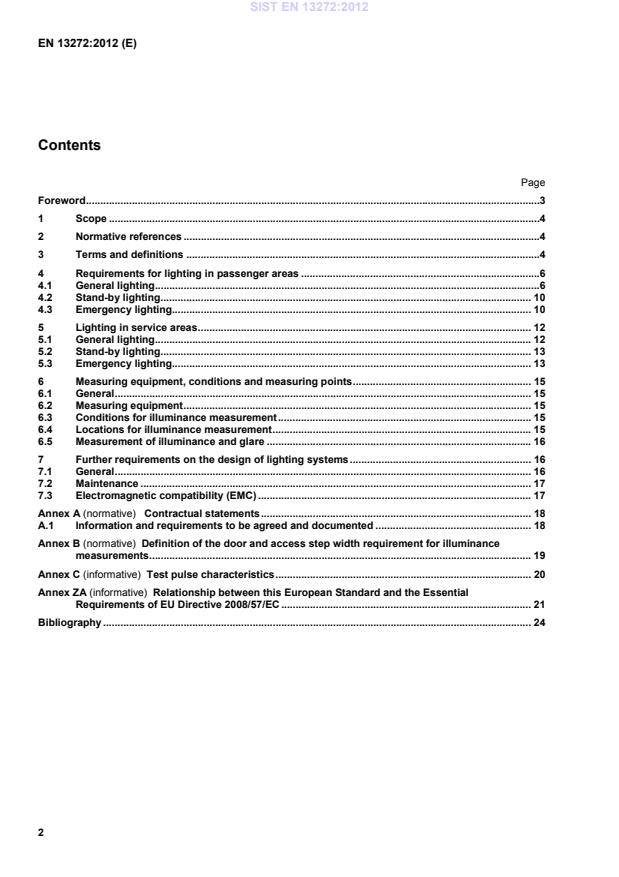
Contractual statements . 18A.1Information and requirements to be agreed and documented . 18Annex B (normative)
Definition of the door and access step width requirement for illuminance measurements . 19Annex C (informative)
Test pulse characteristics . 20Annex ZA (informative)
Relationship between this European Standard and the Essential Requirements of EU Directive 2008/57/EC . 21Bibliography . 24
According to the CEN/CENELEC Internal Regulations, the national standards organizations of the following countries are bound to implement this European Standard: Austria, Belgium, Bulgaria, Croatia, Cyprus, Czech Republic, Denmark, Estonia, Finland, France, Germany, Greece, Hungary, Iceland, Ireland, Italy, Latvia, Lithuania, Luxembourg, Malta, Netherlands, Norway, Poland, Portugal, Romania, Slovakia, Slovenia, Spain, Sweden, Switzerland, Turkey and the United Kingdom.
Note 1 to entry: It is the light power emitted by a source. Note 2 to entry: Adapted from EN 12665. 3.1.8 illuminance (E) ratio of the luminous flux incident on a surface to the area of the illuminated surface Unit: lux (lx) = lm/m2
Note 1 to entry: Illuminance was previously known as the illumination level or value. Note 2 to entry: The orientation of the surface may be defined, e.g. horizontal, vertical. 3.1.9 average illuminance (Eav) illuminance averaged over the specified surface Unit: lux (lx) Note 1 to entry: Adapted from EN 12665. Note 2 to entry: In practice this may be derived either from the total luminous flux falling on the surface divided by the total area of the surface, or alternatively from an arithmetic average of the illuminances at a representative number of points on the surface. 3.1.10 illuminance uniformity ratio of the least favourable illuminance to the average illuminance within the specified measurement surface Note 1 to entry: The least favourable illuminance may be either the minimum or maximum illuminance over all the measurement points. 3.1.11 correlated colour temperature (of a light source) (Tcp) temperature of a Planckian radiator whose perceived colour most closely resembles that of the given stimulus at the same brightness and under specified viewing conditions Unit: Kelvin (K) Note 1 to entry: Adapted from EN 12665. SIST EN 13272:2012
Note 1 to entry: Adapted from IEC 60050-845-09-59. 3.1.14 unified glare rating CIE discomfort glare measure 3.1.15 contractor(s) organization(s) responsible for
the design, manufacture or supply of the lighting system, and the purchase, installation or use of the lighting system 3.2 Types of lighting 3.2.1 general lighting lighting of an interior provided for normal operation 3.2.2 stand-by lighting lighting condition below the level of general lighting provided for a specified time limit, taking supply interruptions into account 3.2.3 emergency lighting lighting provided for a specified minimum time limit when the general or the stand-by lighting fails 3.2.4 reduced lighting level of illumination as a design feature for passenger comfort and energy conservation 4 Requirements for lighting in passenger areas 4.1 General lighting 4.1.1 General The quality of lighting influences visual performance, performance attitude, safety at work and general well-being. The lighting for rolling stock in public transport systems shall enable a range of visual tasks to be performed. SIST EN 13272:2012
a) For high speed and conventional trains, which travel on either or both of the high speed and conventional trans-European rail systems, the minimum value of the average illuminance and uniformity requirements shall be in accordance with Table 1. b) For other trains, the minimum value of the average illuminance and uniformity requirements shall be in accordance with Table 2. SIST EN 13272:2012
Minimum values of average illuminance
and target uniformity for high speed and conventional trains Location Illuminance a Uniformity
Eav in lx
Seating areas where no additional reading lights are provided b ≥ 150 0,7 to 1,3 Seating area with reading lights which are switched off b, c ≥ 100 0,7 to 1,3 Reading zone, where reading lights are provided ≥ 150 0,7 to 1,3 Side corridors and aisles, at floor level ≥ 50 0,5 to 2,5 Side corridors and aisles, at 0,8 m above floor level ≥ 75 0,5 to 2,5 Vestibules
≥ 75 0,8 to 1,2 Vehicle access steps d ≥ 75 not applicable Toilets, washrooms ≥ 150 not applicable Steps and stairs ≥ 75 0,8 to 1,2 Standing areas, multifunctional areas, open gangways ≥ 75 0,5 to 2,5 Gangways ≥ 5 not applicable Tables ≥ 150 0,7 to 1,3 a The values for illuminance are minimum values and may be increased by agreement between contractors. b Where the average illuminance is greater than 220 lux, the uniformity range 0,7 to 1,5 shall apply. C In the case of seating areas in dining cars, the uniformity requirements shall not apply and alternative illuminance levels may be agreed between contractors. d Measured across the central 80 % of the width of the vehicle access step by a light placed within or immediately adjacent to it, according to Annex B (normative).
Minimum values of average illuminance
and target uniformity for other trains Location Illuminance a Uniformity
Eav in lx
Seating areas ≥ 150 0,8 to 1,2 Standing areas, open gangways
≥ 50 0,5 to 2,5 Aisles at floor level ≥ 50 0,5 to 2,5 Aisles at 0, 8 m above floor level ≥ 75 0,5 to 2,5 Vestibules b ≥ 75 0,8 to 1,2 Vehicle access steps c ≥ 75 not applicable a The values for illuminance are minimum values and may be increased by agreement between contractors. b With additional but switched-off threshold / step lighting. c Measured across 80 % of the width of the vehicle access step by a light placed within or immediately adjacent to it, according to Annex B (normative).
The values of illuminance given in this clause shall be achieved in the different locations in accordance with the measuring points in 6.4. 4.1.3
Glare limitation The lighting system shall be designed to minimize glare and to avoid glare from night time reflections in windows. The glare rating for the lighting system, when calculated using the Unified Glare Rating (UGR) tabular method set out in CIE S 008 / ISO 8995, shall be not greater than 22. 4.1.4 Correlated colour temperature The correlated colour temperature of the lamps used for general lighting shall be between 2 800 K and 7 000 K. NOTE For reasons of visual comfort, colour temperatures above 5 000 K are not advisable. 4.1.5 Colour rendering The ability of a light source to render colours of surfaces accurately is important for safety and comfort. The Colour Rendering Index Ra of the light sources as defined in CIE 17.4, shall be ≥ 80 or colour rendering group 1B. 4.1.6 Illuminance in vehicles for night service In vehicles that are intended predominantly for night service, the lighting shall be arranged to meet particular requirements concerning minimum illuminance.
• In passenger seating areas, the emergency lighting illuminance requirements of 4.3.3 shall apply.
• In sleeping compartments, individual subdued sleeping lighting should be provided. Where provided, general light switches shall be internally lit. SIST EN 13272:2012
The power supply shall be designed so that in the event of a fire, a minimum of 50 % of the emergency lighting in the vehicles not affected by fire shall be maintained for a period of time to be agreed by contractors. 4.3.3 Illuminance The minimum value of the average emergency illuminance shall be 5 lx at floor level along the centre line of the escape route.
NOTE This ensures the correct functioning of photoluminescent materials. All values shall be measured in accordance with 6.2 and 6.3. 4.3.4 Uniformity of illuminance The uniformity ratio of t
...