

EN 16584-3:2017
(Main)Railway applications - Design for PRM use - General requirements - Part 3: Optical and friction characteristics
- Abstract
This European standard describes the specific ‘Design for PRM Use’ requirements applying to both infrastructure and rolling stock and the assessment of those requirements. The following applies to this standard:
- The definitions and requirements describe specific aspects of ‘Design for PRM Use’ required by persons with disabilities and persons with reduced mobility as defined in the PRM TSI.
- This standard defines elements which are universally valid for obstacle free travelling including lighting, contrast, tactile feedback, transmission of visual and acoustic information. The definitions and requirements of this standard are to be used for infrastructure and rolling stock applications.
- This standard only refers to aspects of accessibility for PRM passengers it does not define non PRM related requirements and definitions.
- This standard assumes that the infrastructure or rolling stock is in its defined operating condition.
- Where minimum or maximum dimensions are quoted these are absolute NOT nominal requirements.
The ‘General Requirements’ standard is written in three parts:
- Part 1 contains:
- contrast.
- Part 2 contains:
- spoken information;
- written information;
- tactile information;
- pictograms.
- This document is Part 3 and contains:
- lighting;
- low reflecting properties;
- transparent obstacles;
- slip resistance.
- Status
- Withdrawn
- Publication Date
- 03-Jan-2017
- Withdrawal Date
- 13-Oct-2026
- Technical Committee
- CEN/TC 256 - Railway applications
- Drafting Committee
- CEN/TC 256/WG 44 - People with Reduced Mobility (PRM)
- Current Stage
- 9960 - Withdrawal effective - Withdrawal
- Start Date
- 01-Oct-2025
- Completion Date
- 14-Oct-2026
- Directive
- 2008/57/EC - DIRECTIVE 2008/57/EC OF THE EUROPEAN PARLIAMENT AND OF THE COUNCIL of 17 June 2008 on the interoperability of the rail system within the Community (Recast)OJ Ref: C 282, C 282/3 OJ Date: 10-Aug-2018

Relations
- Effective Date
- 19-Jan-2023
- Effective Date
- 09-Feb-2026
- Effective Date
- 09-Feb-2026
- Effective Date
- 28-Jan-2026
- Effective Date
- 28-Jan-2026
- Effective Date
- 28-Jan-2026
- Effective Date
- 28-Jan-2026
- Effective Date
- 28-Jan-2026
- Effective Date
- 28-Jan-2026
- Effective Date
- 28-Jan-2026
- Effective Date
- 28-Jan-2026
- Effective Date
- 28-Jan-2026
- Referred By
EN 17863:2023 - Railway applications - Ground based services - Coach hygiene requirements - Effective Date
- 28-Jan-2026
- Effective Date
- 28-Jan-2026
Get Certified
Connect with accredited certification bodies for this standard

BSI Group
BSI (British Standards Institution) is the business standards company that helps organizations make excellence a habit.

TÜV Rheinland
TÜV Rheinland is a leading international provider of technical services.

TÜV SÜD
TÜV SÜD is a trusted partner of choice for safety, security and sustainability solutions.
Sponsored listings
Frequently Asked Questions
EN 16584-3:2017 is a standard published by the European Committee for Standardization (CEN). Its full title is "Railway applications - Design for PRM use - General requirements - Part 3: Optical and friction characteristics". This standard covers: This European standard describes the specific ‘Design for PRM Use’ requirements applying to both infrastructure and rolling stock and the assessment of those requirements. The following applies to this standard: - The definitions and requirements describe specific aspects of ‘Design for PRM Use’ required by persons with disabilities and persons with reduced mobility as defined in the PRM TSI. - This standard defines elements which are universally valid for obstacle free travelling including lighting, contrast, tactile feedback, transmission of visual and acoustic information. The definitions and requirements of this standard are to be used for infrastructure and rolling stock applications. - This standard only refers to aspects of accessibility for PRM passengers it does not define non PRM related requirements and definitions. - This standard assumes that the infrastructure or rolling stock is in its defined operating condition. - Where minimum or maximum dimensions are quoted these are absolute NOT nominal requirements. The ‘General Requirements’ standard is written in three parts: - Part 1 contains: - contrast. - Part 2 contains: - spoken information; - written information; - tactile information; - pictograms. - This document is Part 3 and contains: - lighting; - low reflecting properties; - transparent obstacles; - slip resistance.
This European standard describes the specific ‘Design for PRM Use’ requirements applying to both infrastructure and rolling stock and the assessment of those requirements. The following applies to this standard: - The definitions and requirements describe specific aspects of ‘Design for PRM Use’ required by persons with disabilities and persons with reduced mobility as defined in the PRM TSI. - This standard defines elements which are universally valid for obstacle free travelling including lighting, contrast, tactile feedback, transmission of visual and acoustic information. The definitions and requirements of this standard are to be used for infrastructure and rolling stock applications. - This standard only refers to aspects of accessibility for PRM passengers it does not define non PRM related requirements and definitions. - This standard assumes that the infrastructure or rolling stock is in its defined operating condition. - Where minimum or maximum dimensions are quoted these are absolute NOT nominal requirements. The ‘General Requirements’ standard is written in three parts: - Part 1 contains: - contrast. - Part 2 contains: - spoken information; - written information; - tactile information; - pictograms. - This document is Part 3 and contains: - lighting; - low reflecting properties; - transparent obstacles; - slip resistance.
EN 16584-3:2017 is classified under the following ICS (International Classification for Standards) categories: 11.180.01 - Aids for disabled and handicapped persons in general; 45.020 - Railway engineering in general. The ICS classification helps identify the subject area and facilitates finding related standards.
EN 16584-3:2017 has the following relationships with other standards: It is inter standard links to EN 16584-3:2025, ISO 4649:2010, ISO 21542:2011, EN 16587:2017, EN ISO 2813:2014, EN 12464-2:2024, EN 16584-1:2025, EN 1838:2024, EN 16584-2:2025, EN 12464-1:2021, EN 13272:2012, EN ISO 10438-2:2007, EN 17863:2023, EN ISO 10438-3:2007. Understanding these relationships helps ensure you are using the most current and applicable version of the standard.
EN 16584-3:2017 is associated with the following European legislation: EU Directives/Regulations: 2008/57/EC; Standardization Mandates: M/334, M/483. When a standard is cited in the Official Journal of the European Union, products manufactured in conformity with it benefit from a presumption of conformity with the essential requirements of the corresponding EU directive or regulation.
EN 16584-3:2017 is available in PDF format for immediate download after purchase. The document can be added to your cart and obtained through the secure checkout process. Digital delivery ensures instant access to the complete standard document.
Standards Content (Sample)
2003-01.Slovenski inštitut za standardizacijo. Razmnoževanje celote ali delov tega standarda ni dovoljeno.EigenschaftenBahnanwendungen - Gestaltung für mobilitätseingeschränkte Menschen - Allgemeine Anforderungen - Teil 3: Rutschfestigkeit und Optische EigenschaftenApplications ferroviaires - Conception destinée à l'usage par les PMR: Exigences générales - Partie 3: Caractéristiques optiques et de frictionRailway Applications - Design for PRM Use - General Requirements - Part 3: Optical and Friction Characteristics45.020Železniška tehnika na splošnoRailway engineering in general11.180.01VSORãQRAids for disabled and handicapped persons in generalICS:Ta slovenski standard je istoveten z:EN 16584-3:2017SIST EN 16584-3:2017en,fr,de01-marec-2017SIST EN 16584-3:2017SLOVENSKI
STANDARD
EUROPEAN STANDARD NORME EUROPÉENNE EUROPÄISCHE NORM
EN 16584-3
January
t r s y ICS
s sä s z rä r sâ
v wä r t r English Version
Railway applications æ Design for PRM use æ General requirements æ Part
uã Optical and friction characteristicsApplications ferroviaires æ Conception destinée à l 5usage par les PMR æ Exigences générales æ Partie
u ã Caractéristiques optiques et de friction
Bahnanwendungen æ Gestaltung für die Nutzung durch PRM æ Allgemeine Anforderungen æ Teil
uã Optische Eigenschaften und Rutschfestigkeit This European Standard was approved by CEN on
s r September
t r s xä
egulations which stipulate the conditions for giving this European Standard the status of a national standard without any alterationä Upætoædate lists and bibliographical references concerning such national standards may be obtained on application to the CENæCENELEC Management Centre or to any CEN memberä
translation under the responsibility of a CEN member into its own language and notified to the CENæCENELEC Management Centre has the same status as the official versionsä
CEN members are the national standards bodies of Austriaá Belgiumá Bulgariaá Croatiaá Cyprusá Czech Republicá Denmarká Estoniaá Finlandá Former Yugoslav Republic of Macedoniaá Franceá Germanyá Greeceá Hungaryá Icelandá Irelandá Italyá Latviaá Lithuaniaá Luxembourgá Maltaá Netherlandsá Norwayá Polandá Portugalá Romaniaá Serbiaá Slovakiaá Sloveniaá Spainá Swedená Switzerlandá Turkey and United Kingdomä
EUROPEAN COMMITTEE FOR STANDARDIZATION COMITÉ EUROPÉEN DE NORMALISATION EUROPÄISCHES KOMITEE FÜR NORMUNG
CEN-CENELEC Management Centre:
Avenue Marnix 17,
B-1000 Brussels
t r s y CEN All rights of exploitation in any form and by any means reserved worldwide for CEN national Membersä Refä Noä EN
s x w z væ uã t r s y ESIST EN 16584-3:2017
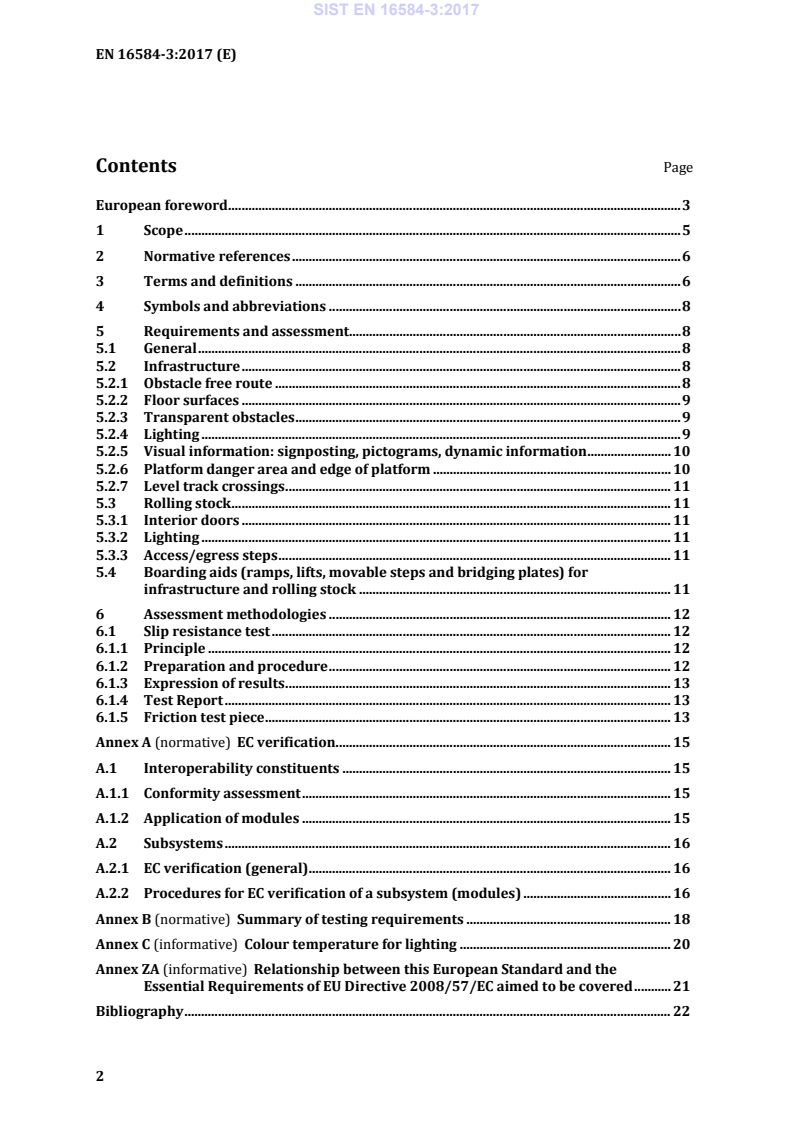
EC verification . 15 A.1 Interoperability constituents . 15 A.1.1 Conformity assessment . 15 A.1.2 Application of modules . 15 A.2 Subsystems . 16 A.2.1 EC verification (general) . 16 A.2.2 Procedures for EC verification of a subsystem (modules) . 16 Annex B (normative)
Summary of testing requirements . 18 Annex C (informative)
Colour temperature for lighting . 20 Annex ZA (informative)
Relationship between this European Standard and the Essential Requirements of EU Directive 2008/57/EC aimed to be covered . 21 Bibliography . 22 SIST EN 16584-3:2017
— Part 1: Steps for access and egress (EN 16586-1); — Part 2: Boarding aids (EN 16586-2). — EN 16587 is a standard that covers infrastructure — Railway applications — Design for PRM use — Requirements for obstacle free routes for infrastructure. SIST EN 16584-3:2017
— This standard only refers to aspects of accessibility for PRM passengers it does not define non PRM related requirements and definitions. — This standard assumes that the infrastructure or rolling stock is in its defined operating condition. — Where minimum or maximum dimensions are quoted these are absolute NOT nominal requirements. The ‘General requirements’ standard is written in three parts: — Part 1 contains: — contrast. — Part 2 contains: — spoken information; — written information; — tactile information; — pictograms. — This document is Part 3 and contains: — lighting; — low reflective properties; — transparent obstacles; — slip resistance. SIST EN 16584-3:2017
EN 1838, Lighting applications — Emergency lighting EN 12464 (series), Light and lighting — Lighting of work places EN 13272:2012, Railway applications — Electrical lighting for rolling stock in public transport systems EN 16584-1, Railway applications — Design for PRM use — General Requirements — Part 1: Contrast
EN 16584-2, Railway applications — Design for PRM use — General Requirements — Part
2: Information prEN 16587:2013, Railway applications — Design for PRM use — Requirements for Obstacle Free Routes for Infrastructure EN ISO 2813, Paints and varnishes - Determination of gloss value at 20°, 60° and 85° (ISO 2813) ISO 4649, Rubber, vulcanized or thermoplastic — Determination of abrasion resistance using a rotating cylindrical drum device ISO 21542, Building construction — Accessibility and usability of the built environment 3 Terms and definitions For the purposes of this document, the following terms and definitions apply. 3.1 contrast perception of a difference visually between one surface or element of a building/rail vehicle and another by reference to their light reflectance values (LRV) or luminance values
Note 1 to entry: See BS 8300:2009+A1:2010 for further information. 3.2 Light Reflectance Value LRV total quantity of visible light that is reflected by a surface at all wavelengths and directions when illuminated by a light source Note 1 to entry: The measured range of LRV is between 0 points and 100 points. 3.3 low reflective properties characteristics that reduce reflection of light from a surface SIST EN 16584-3:2017
Glass or other transparent/translucent materials that are coated or treated to reduce the light transmission shall have low reflective properties so as not to create a mirror effect (lighting is assumed to be the normal operating condition). 5.2.4 Lighting 1) The illuminance level of the external areas of the station shall be sufficient to facilitate way finding and to highlight the changes of level, doors and entrances. — Light levels shall be according to either ISO 21542 or the EN 12464 series and method of assessment according to the EN 12464 series. 2) The illuminance level along obstacle free routes shall be adapted to the visual task of the passenger. Particular attention shall be paid to the changes of levels, ticket vending offices and machines, information desks and information displays. i. From the accessible building entrance to the platform access point, the obstacle free route shall be illuminated, measured at floor level, within the confines of the station building. — Light levels shall be according to either ISO 21542 or the EN 12464 series and method of assessment according to the EN 12464 series. ii. The minimum lighting level shall be across the full width of the obstacle free route.
— The obstacle free route shall be according to prEN 16587:2013. — The measurement shall be taken at floor level. iii. The minimum required light level on stairs and at the start and end of ramps, shall be measured at floor level. — Light levels shall be ac
...