

EN 13381-7:2019
(Main)Test methods for determining the contribution to the fire resistance of structural members - Part 7: Applied protection to timber members
- Abstract
This document specifies test methods for determining the contribution of fire protection kits to the fire resistance of structural timber members.
Such fire protection kits include claddings, sprayed fire protection and reactive coatings.
The method is applicable to all fire protection kits used for the protection of timber members. These can be fixed directly, totally or in part, to the timber member and can include an air gap between the fire protectionkit and the timber member, as an integral part of its design.
Evaluation of timber constructions protected by horizontal or vertical protective membranes are the subject of EN 13381-1 or EN 13381-2 respectively.
The test method is applicable to the determination of the contribution of fire protection kits to the fire resistance of loadbearing timber structural members including floors, roofs, walls, beams and columns.
This document contains the fire test which specifies the test to be carried out to determine the ability of the fire protection kit at a specified thickness to delay the temperature rise throughout the timber member, to determine the ability of the fire protection kit at a specified thickness to remain coherent and fixed to the timber member and to provide data for determining the charring rate of the protected test member, when exposed to the standard temperature/time curve according to the procedures defined herein. This document is not appropriated to classify the tested assembly according to EN 13501-2.
The test to subject reactive protection material to a smouldering temperature time fire curve and the special circumstances for this are detailed in Annex G.
The fire test methodology makes provision for the collection and presentation of data which can be used as direct input to the calculation of fire resistance of timber members in accordance with the procedures given in EN 1995-1-2.
A description of the relationship of this test method and the assessment of the results obtained therefrom to EN 1995-1-2 and guidelines for the use of this test method in accordance with that standard are given in Annex B.
This document also contains the assessment which indicates how the analysis of the test data should be made and gives guidance to the procedures by which interpolation should be undertaken.
The limits of applicability of the results of the assessment arising from the fire test are defined, together with the direct application of the results to different timber constructions with the specified thickness and fixation of the applied fire protection kit tested.
- Status
- Published
- Publication Date
- 18-Jun-2019
- Withdrawal Date
- 30-Mar-2021
- Technical Committee
- CEN/TC 127 - Fire safety in buildings
- Drafting Committee
- CEN/TC 127/WG 1 - Structural and separating elements
- Current Stage
- 6060 - Definitive text made available (DAV) - Publishing
- Start Date
- 19-Jun-2019
- Due Date
- 09-May-2017
- Completion Date
- 19-Jun-2019


Overview
EN 13381-7:2019 - Test methods for determining the contribution to the fire resistance of structural members (Part 7: Applied protection to timber members) defines standardized fire test methods to assess how applied fire protection kits (for example claddings, sprayed fire protection and reactive coatings) contribute to the fire resistance of loadbearing timber elements. The standard covers large‑scale and model‑scale tests, instrumentation, test procedure, assessment of results (including charring rate and fixation/cohesion of the protection), and limits of applicability. Results from the tests are intended to provide input data for fire resistance calculations in accordance with EN 1995-1-2.
Key topics and technical requirements
- Scope of application: protection systems fixed directly or with an air gap to timber members including floors, roofs, walls, beams and columns.
- Types of protection covered: cladding boards/panels, sprayed protection, reactive coatings (with special smouldering test procedures in Annex G).
- Test objectives: determine the ability of a protection kit at a specified thickness to delay timber temperature rise, remain coherent/fixed, and provide data for charring rate determination when exposed to the standard temperature/time curve.
- Test setup and instrumentation: requirements for furnaces, loading and restraint conditions, thermocouples, deformation and load measurement, and conditioning of specimens.
- Specimen types: charring specimens, large‑scale wall/floor/beam tests and model‑scale tests (Annex A).
- Assessment and reporting: guidance on determining start of charring, charring rate, failure time, interpolation procedures and limits of applicability of results (e.g., thickness, orientation, multiple layers, board size, timber types).
- Limitations: not intended to classify assemblies under EN 13501‑2; rather to supply data for structural fire design (EN 1995‑1‑2).
Practical applications
- Product development and validation of fire protection kits for timber (boards, sprays, coatings).
- Input to engineering calculations for timber member fire resistance using EN 1995‑1‑2.
- Preparation of technical dossiers for certification, performance claims, and regulatory submissions.
- Selection and specification of protection type and required thickness for beams, columns, floors and walls in timber construction.
- Fire testing laboratories use the standard to produce reproducible, comparable test data.
Who should use this standard
- Fire test laboratories and manufacturers of timber fire protection systems
- Structural engineers and fire safety engineers performing fire resistance design for timber structures
- Certification bodies, product assessors and building code officials
- Architects and specifiers selecting protective systems for timber construction
Related standards
- EN 13381-1 / EN 13381-2 (protective membranes for horizontal/vertical constructions)
- EN 1995-1-2 (timber structures - structural fire design) - Annex B in EN 13381-7 explains the relationship
- EN 13501-2 (fire classification of construction products) - note: EN 13381-7 is not for classification under EN 13501-2
Keywords: EN 13381-7:2019, fire resistance, timber members, fire protection kits, cladding, sprayed protection, reactive coatings, charring rate, EN 1995-1-2.
Relations
- Effective Date
- 26-Jun-2019
- Effective Date
- 01-Jul-2026
- Effective Date
- 18-Mar-2026
- Effective Date
- 18-Mar-2026
- Effective Date
- 09-Feb-2026
- Effective Date
- 28-Jan-2026
- Effective Date
- 28-Jan-2026
- Refers
EN 14080:2013 - Timber structures - Glued laminated timber and glued solid timber - Requirements - Effective Date
- 28-Jan-2026
- Effective Date
- 28-Jan-2026
- Effective Date
- 28-Jan-2026
- Effective Date
- 28-Jan-2026
- Effective Date
- 28-Jan-2026
- Effective Date
- 28-Jan-2026
- Effective Date
- 28-Jan-2026
- Effective Date
- 28-Jan-2026
Get Certified
Connect with accredited certification bodies for this standard

DIBt (Deutsches Institut für Bautechnik)
German Institute for Building Technology.
DIN CERTCO
DIN Group product certification.

Kiwa BDA Testing
Building and construction product certification.
Sponsored listings
Frequently Asked Questions
EN 13381-7:2019 is a standard published by the European Committee for Standardization (CEN). Its full title is "Test methods for determining the contribution to the fire resistance of structural members - Part 7: Applied protection to timber members". This standard covers: This document specifies test methods for determining the contribution of fire protection kits to the fire resistance of structural timber members. Such fire protection kits include claddings, sprayed fire protection and reactive coatings. The method is applicable to all fire protection kits used for the protection of timber members. These can be fixed directly, totally or in part, to the timber member and can include an air gap between the fire protectionkit and the timber member, as an integral part of its design. Evaluation of timber constructions protected by horizontal or vertical protective membranes are the subject of EN 13381-1 or EN 13381-2 respectively. The test method is applicable to the determination of the contribution of fire protection kits to the fire resistance of loadbearing timber structural members including floors, roofs, walls, beams and columns. This document contains the fire test which specifies the test to be carried out to determine the ability of the fire protection kit at a specified thickness to delay the temperature rise throughout the timber member, to determine the ability of the fire protection kit at a specified thickness to remain coherent and fixed to the timber member and to provide data for determining the charring rate of the protected test member, when exposed to the standard temperature/time curve according to the procedures defined herein. This document is not appropriated to classify the tested assembly according to EN 13501-2. The test to subject reactive protection material to a smouldering temperature time fire curve and the special circumstances for this are detailed in Annex G. The fire test methodology makes provision for the collection and presentation of data which can be used as direct input to the calculation of fire resistance of timber members in accordance with the procedures given in EN 1995-1-2. A description of the relationship of this test method and the assessment of the results obtained therefrom to EN 1995-1-2 and guidelines for the use of this test method in accordance with that standard are given in Annex B. This document also contains the assessment which indicates how the analysis of the test data should be made and gives guidance to the procedures by which interpolation should be undertaken. The limits of applicability of the results of the assessment arising from the fire test are defined, together with the direct application of the results to different timber constructions with the specified thickness and fixation of the applied fire protection kit tested.
This document specifies test methods for determining the contribution of fire protection kits to the fire resistance of structural timber members. Such fire protection kits include claddings, sprayed fire protection and reactive coatings. The method is applicable to all fire protection kits used for the protection of timber members. These can be fixed directly, totally or in part, to the timber member and can include an air gap between the fire protectionkit and the timber member, as an integral part of its design. Evaluation of timber constructions protected by horizontal or vertical protective membranes are the subject of EN 13381-1 or EN 13381-2 respectively. The test method is applicable to the determination of the contribution of fire protection kits to the fire resistance of loadbearing timber structural members including floors, roofs, walls, beams and columns. This document contains the fire test which specifies the test to be carried out to determine the ability of the fire protection kit at a specified thickness to delay the temperature rise throughout the timber member, to determine the ability of the fire protection kit at a specified thickness to remain coherent and fixed to the timber member and to provide data for determining the charring rate of the protected test member, when exposed to the standard temperature/time curve according to the procedures defined herein. This document is not appropriated to classify the tested assembly according to EN 13501-2. The test to subject reactive protection material to a smouldering temperature time fire curve and the special circumstances for this are detailed in Annex G. The fire test methodology makes provision for the collection and presentation of data which can be used as direct input to the calculation of fire resistance of timber members in accordance with the procedures given in EN 1995-1-2. A description of the relationship of this test method and the assessment of the results obtained therefrom to EN 1995-1-2 and guidelines for the use of this test method in accordance with that standard are given in Annex B. This document also contains the assessment which indicates how the analysis of the test data should be made and gives guidance to the procedures by which interpolation should be undertaken. The limits of applicability of the results of the assessment arising from the fire test are defined, together with the direct application of the results to different timber constructions with the specified thickness and fixation of the applied fire protection kit tested.
EN 13381-7:2019 is classified under the following ICS (International Classification for Standards) categories: 13.220.50 - Fire-resistance of building materials and elements; 91.080.20 - Timber structures. The ICS classification helps identify the subject area and facilitates finding related standards.
EN 13381-7:2019 has the following relationships with other standards: It is inter standard links to ENV 13381-7:2002, ISO 8421-2:1987, EN 15425:2023+A1:2026, EN 301:2023+A1:2026, ISO 834-12:2012, EN 1365-3:1999, EN 1365-2:2014, EN 14080:2013, EN 1363-1:2020, EN ISO 29466:2022, EN 13381-1:2020, EN 13381-8:2013, EN ISO 13943:2023, EN 12467:2012+A2:2018, EN 14081-1:2016+A1:2019. Understanding these relationships helps ensure you are using the most current and applicable version of the standard.
EN 13381-7:2019 is associated with the following European legislation: EU Directives/Regulations: 305/2011, 89/106/EEC; Standardization Mandates: M/117. When a standard is cited in the Official Journal of the European Union, products manufactured in conformity with it benefit from a presumption of conformity with the essential requirements of the corresponding EU directive or regulation.
EN 13381-7:2019 is available in PDF format for immediate download after purchase. The document can be added to your cart and obtained through the secure checkout process. Digital delivery ensures instant access to the complete standard document.
Standards Content (Sample)
SLOVENSKI STANDARD
01-september-2019
Nadomešča:
SIST ENV 13381-7:2003
Preskusne metode za ugotavljanje prispevka k požarni odpornosti konstrukcijskih
elementov - 7. del: Zaščita lesenih elementov
Test methods for determining the contribution to the fire resistance of structural members
- Part 7: Applied protection to timber members
Prüfverfahren zur Bestimmung des Beitrages zum Feuerwiderstand von tragenden
Bauteilen - Brandschutzmaßnahmen für Holzbauteile
Méthodes d'essai pour déterminer la contribution à la résistance au feu des éléments de
construction - Partie 7: Protection appliquée aux éléments en bois
Ta slovenski standard je istoveten z: EN 13381-7:2019
ICS:
13.220.50 Požarna odpornost Fire-resistance of building
gradbenih materialov in materials and elements
elementov
91.080.20 Lesene konstrukcije Timber structures
2003-01.Slovenski inštitut za standardizacijo. Razmnoževanje celote ali delov tega standarda ni dovoljeno.
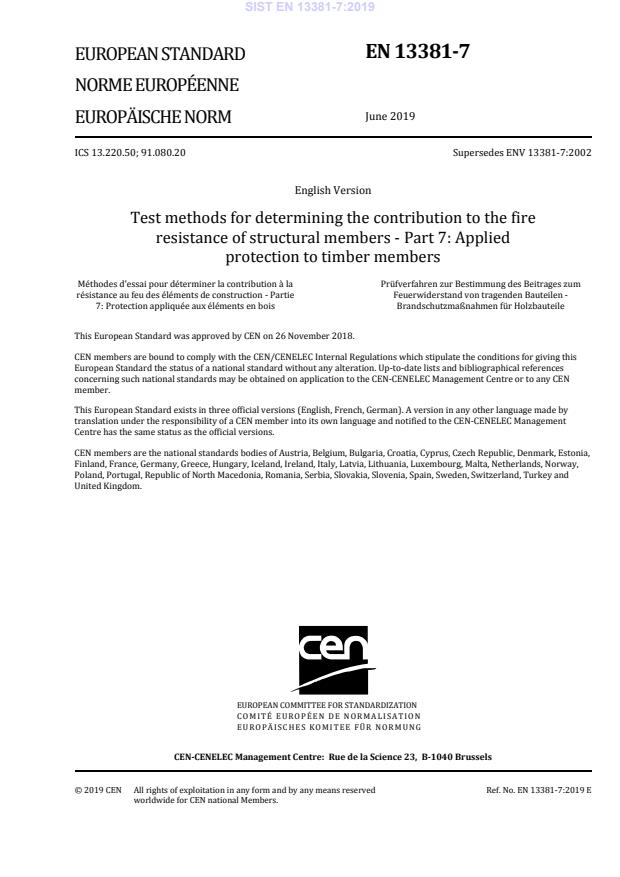
EN 13381-7
EUROPEAN STANDARD
NORME EUROPÉENNE
June 2019
EUROPÄISCHE NORM
ICS 13.220.50; 91.080.20 Supersedes ENV 13381-7:2002
English Version
Test methods for determining the contribution to the fire
resistance of structural members - Part 7: Applied
protection to timber members
Méthodes d'essai pour déterminer la contribution à la Prüfverfahren zur Bestimmung des Beitrages zum
résistance au feu des éléments de construction - Partie Feuerwiderstand von tragenden Bauteilen -
7: Protection appliquée aux éléments en bois Brandschutzmaßnahmen für Holzbauteile
This European Standard was approved by CEN on 26 November 2018.
CEN members are bound to comply with the CEN/CENELEC Internal Regulations which stipulate the conditions for giving this
European Standard the status of a national standard without any alteration. Up-to-date lists and bibliographical references
concerning such national standards may be obtained on application to the CEN-CENELEC Management Centre or to any CEN
member.
This European Standard exists in three official versions (English, French, German). A version in any other language made by
translation under the responsibility of a CEN member into its own language and notified to the CEN-CENELEC Management
Centre has the same status as the official versions.
CEN members are the national standards bodies of Austria, Belgium, Bulgaria, Croatia, Cyprus, Czech Republic, Denmark, Estonia,
Finland, France, Germany, Greece, Hungary, Iceland, Ireland, Italy, Latvia, Lithuania, Luxembourg, Malta, Netherlands, Norway,
Poland, Portugal, Republic of North Macedonia, Romania, Serbia, Slovakia, Slovenia, Spain, Sweden, Switzerland, Turkey and
United Kingdom.
EUROPEAN COMMITTEE FOR STANDARDIZATION
COMITÉ EUROPÉEN DE NORMALISATION
EUROPÄISCHES KOMITEE FÜR NORMUNG
CEN-CENELEC Management Centre: Rue de la Science 23, B-1040 Brussels
© 2019 CEN All rights of exploitation in any form and by any means reserved Ref. No. EN 13381-7:2019 E
worldwide for CEN national Members.
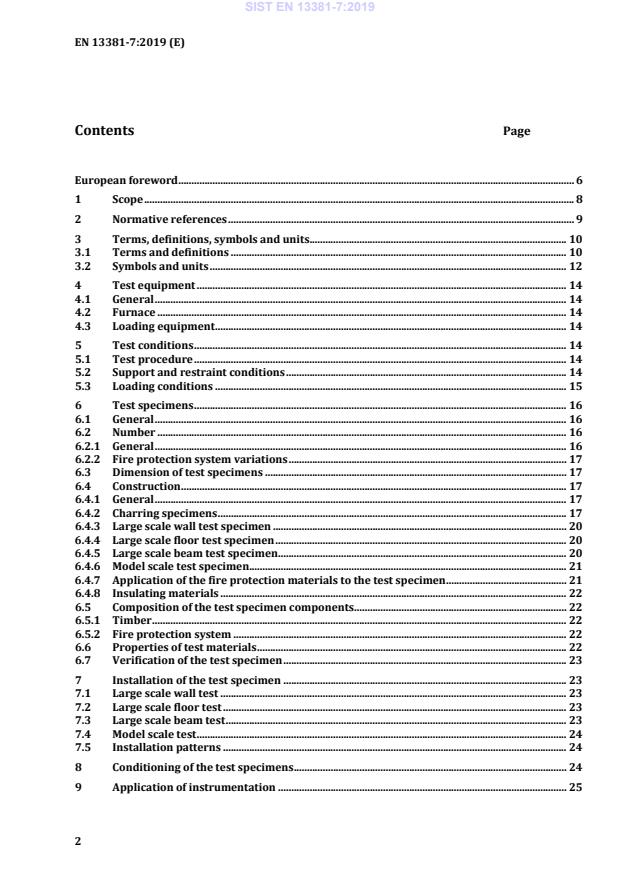
Contents Page
European foreword . 6
1 Scope . 8
2 Normative references . 9
3 Terms, definitions, symbols and units. 10
3.1 Terms and definitions . 10
3.2 Symbols and units . 12
4 Test equipment . 14
4.1 General . 14
4.2 Furnace . 14
4.3 Loading equipment . 14
5 Test conditions . 14
5.1 Test procedure . 14
5.2 Support and restraint conditions . 14
5.3 Loading conditions . 15
6 Test specimens . 16
6.1 General . 16
6.2 Number . 16
6.2.1 General . 16
6.2.2 Fire protection system variations . 17
6.3 Dimension of test specimens . 17
6.4 Construction . 17
6.4.1 General . 17
6.4.2 Charring specimens . 17
6.4.3 Large scale wall test specimen . 20
6.4.4 Large scale floor test specimen . 20
6.4.5 Large scale beam test specimen . 20
6.4.6 Model scale test specimen . 21
6.4.7 Application of the fire protection materials to the test specimen . 21
6.4.8 Insulating materials . 22
6.5 Composition of the test specimen components . 22
6.5.1 Timber . 22
6.5.2 Fire protection system . 22
6.6 Properties of test materials . 22
6.7 Verification of the test specimen . 23
7 Installation of the test specimen . 23
7.1 Large scale wall test . 23
7.2 Large scale floor test . 23
7.3 Large scale beam test . 23
7.4 Model scale test . 24
7.5 Installation patterns . 24
8 Conditioning of the test specimens . 24
9 Application of instrumentation . 25
9.1 General . 25
9.2 Instrumentation for measurement of furnace temperature . 25
9.2.1 General . 25
9.2.2 Large scale wall test . 25
9.2.3 Large scale floor test . 25
9.2.4 Large scale beam test . 25
9.2.5 Model scale test . 25
9.3 Instrumentation for measurement of test specimen temperature . 25
9.3.1 General . 25
9.3.2 Charring specimen . 26
9.3.3 Large scale wall test specimen . 26
9.3.4 Large scale floor test specimen . 27
9.3.5 Large scale beam test specimen . 27
9.3.6 Model scale test specimen . 28
9.4 Instrumentation for measurement of pressure . 28
9.5 Instrumentation for measurement of deformation . 28
9.6 Instrumentation for measurement of applied load . 28
10 Test procedure . 29
10.1 General . 29
10.2 Furnace temperature and pressure . 29
10.3 Application and control of load . 29
10.4 Temperature of test specimen . 29
10.5 Deformation . 29
10.6 Observations . 29
10.7 Termination test . 29
11 Test results . 29
11.1 Acceptability of test results . 29
11.1.1 General . 29
11.1.2 Charring specimen . 30
11.1.3 Loaded members in Large scale tests . 30
11.2 Presentation of test results . 30
12 Test report . 31
13 Assessment . 32
13.1 General . 32
13.2 Assessment of the start of charring . 32
13.2.1 General . 32
13.2.2 Large scale test specimen . 32
13.2.3 Charring specimens . 33
13.3 Assessment of the charring rate . 33
13.4 Assessment of failure time . 34
13.4.1 General . 34
13.4.2 Large scale wall test and large scale floor test . 34
13.4.3 Large scale beam test . 34
14 Report of the assessment . 34
15 Limits of applicability of the results of the assessment . 35
15.1 General . 35
15.2 Limits of applicability of the assessment results . 35
15.2.1 General . 35
15.2.2 Thickness of fire protection material . 35
15.2.3 Multiple layers . 36
15.2.4 Board or panel size . 36
15.2.5 Orientation of test . 36
15.2.6 Timber . 36
15.2.7 Insulation materials . 36
15.2.8 Fixtures and fittings . 37
15.3 Additional limits of applicability of the assessment results for specific
construction types . 37
15.3.1 Walls and floors - type of construction . 37
15.3.2 Beams and columns - type of construction . 37
Annex A (normative) Model scale test . 58
A.1 General . 58
A.2 Test equipment, installation of the specimen and test load . 58
A.3 End of the model scale test . 58
Annex B (informative) Overview of available methods of EN 13381-7 . 61
B.1 General . 61
B.2 Fire protection systems for intended use applied timber frame walls, timber
beams and timber columns: . 61
B.3 Fire protection systems for intended use applied on timber frame floors,
timber frame walls, timber beams and timber columns: . 61
B.4 Fire protection systems for intended use applied on timber beams and
timber columns: . 62
Annex C (normative) Measurement of properties of fire protection materials . 65
C.1 Introduction . 65
C.2 Thickness of fire protection materials . 65
C.2.1 General . 65
C.2.2 Board or slab/mat fire protection materials . 65
C.2.3 Coatings with reactive and non-reactive fire protection materials and
systems. 65
C.2.3.1 General . 65
C.2.3.2 Measuring positions for Fire Protection Materials . 66
C.3 Density of applied fire protection materials . 67
C.4 Moisture content of applied fire protection materials . 67
Annex D (normative) Fixing of thermocouples to timber members and timber frame
assemblies and routing of cables. 69
D.1 General . 69
D.2 Types of thermocouples . 69
D.3 Fixing of thermocouples . 69
D.3.1 General . 69
D.3.2 Internal thermocouples . 69
D.3.3 Thermocouples at the surface of the timber member . 70
D.3.4 Thermocouples in the interlayer of the fire protection system and the cavity
insulation . 70
D.4 Routing of thermocouple wires. 70
D.4.1 General . 70
D.4.2 Internal thermocouples . 70
D.5 Connection of thermocouples . 71
D.6 Thermocouple failures . 71
Annex E (informative) Calculation of load to be applied on the large scale test
specimen . 74
E.1 General . 74
E.2 Example 1: Load calculation for a large scale wall test specimen . 74
E.3 Example 2: Load calculation for the large scale beam test. 76
Annex F (informative) Examples of Assessment of Fire Protection System
Performance. 77
F.1 General . 77
F.2 Assessment of the start of charring behind the fire protection system . 77
F.3 Assessment of the charring rate behind the fire protection system . 80
F.4 The time of loss of stickability of the fire protect system . 81
Annex G (normative) Test method to the smouldering fire or slow heating curve . 84
G.1 Introduction . 84
G.2 Test equipment . 84
G.3 Test conditions . 84
G.4 Test specimens . 84
G.5 Installation of the test specimens . 84
G.6 Conditioning of the test specimens . 84
G.7 Application of instrumentation . 84
G.8 Test procedure . 85
G.9 Test results . 85
G.10 Evaluation of the results . 85
Annex H (informative) Calculation of the dimensions of the charring specimen
dimensions and the model scale specimen . 87
H.1 Introduction . 87
H.2 Calculation of the thickness of the charring specimen . 87
H.3 Calculation of the number or thermocouples . 88
H.4 Calculation of the charring specimen length . 88
H.5 Calculation of the charring specimen width . 88
H.6 Calculation of the dimensions of the model scale test specimen . 89
Bibliography . 90
European foreword
This document (EN 13381-7:2019) has been prepared by Technical Committee CEN/TC 127
“Fire safety in buildings”, the secretariat of which is held by BSI.
This European Standard shall be given the status of a national standard, either by publication of
an identical text or by endorsement, at the latest by December 2019, and conflicting national
standards shall be withdrawn at the latest by March 2021.
Attention is drawn to the possibility that some of the elements of this document may be the
subject of patent rights. CEN shall not be held responsible for identifying any or all such patent
rights.
This document supersedes ENV 13381-7:2002.
This European Standard is one of a series of standards for evaluating the contribution to the fire
resistance of structural members by applied fire protection materials. Other parts of this
standard are:
Part 1: Horizontal protective membranes.
Part 2: Vertical protective membranes.
Part 3: Applied protection to concrete members.
Part 4: Applied protection to steel members.
Part 5: Applied protection to concrete/profiled sheet steel composite members.
Part 6: Applied protection to concrete filled hollow steel columns.
Part 8: Applied reactive protection to steel members.
Part 9: Applied fire protection systems to steel beams with web openings.
Part 10: Applied protection to solid steel rods.
The main changes compared to ENV 13381-7:2002 are:
a) New test procedures have been introduced to address the different fields of applications of
fire protection systems on solid timber products and timber frame assemblies in horizontal
and vertical position and the design models available in EN 1995-1-2.
b) Loaded tests are performed using large-scale test specimens depending on their intended
use on walls or ceilings.
c) The start of charring and the stickability is measured with thermocouples on the timber
member(s) surface of a beam specimen or a timber frame specimen.
d) Charring behind a fire protection system is measured using charring specimens embedded
in the cavity insulation of a timber frame specimen.
e) Interpolation of results for different thicknesses of fire protection system is not allowed.
f) The use of test results for different orientations obtained in tests in one orientation is
specified.
WARNING - The attention of all persons concerned with managing and carrying out this fire
resistance test, is drawn to fact that fire testing can be hazardous and that there is a possibility
that toxic and/or harmful smoke and gases can be evolved during the test. Mechanical and
operational hazards can also arise during the construction of test elements or structures, their
testing and the disposal of test residues.
An assessment of all potential hazards and risks to health should be made and safety
precautions should be identified and provided. Written safety instructions should be issued.
Appropriate training should be given to relevant personnel. Laboratory personnel should
ensure that they follow written safety instructions at all times.
The specific health and safety instructions contained within this standard should be followed.
This document has been prepared under a standardization request given to CEN/CENELEC by
the European Commission and the European Free Trade Association.
According to the CEN-CENELEC Internal Regulations, the national standards organisations of
the following countries are bound to implement this European Standard: Austria, Belgium,
Bulgaria, Croatia, Cyprus, Czech Republic, Denmark, Estonia, Finland, France, Germany, Greece,
Hungary, Iceland, Ireland, Italy, Latvia, Lithuania, Luxembourg, Malta, Netherlands, Norway,
Poland, Portugal, Republic of North Macedonia, Romania, Serbia, Slovakia, Slovenia, Spain,
Sweden, Switzerland, Turkey and the United Kingdom.
1 Scope
This document specifies test methods for determining the contribution of fire protection kits to
the fire resistance of structural timber members.
Such fire protection kits include claddings, sprayed fire protection and reactive coatings.
The method is applicable to all fire protection kits used for the protection of timber members.
These can be fixed directly, totally or in part, to the timber member and can include an air gap
between the fire protectionkit and the timber member, as an integral part of its design.
Evaluation of timber constructions protected by horizontal or vertical protective membranes
are the subject of EN 13381-1 or EN 13381-2 respectively.
The test method is applicable to the determination of the contribution of fire protection kits to
the fire resistance of loadbearing timber structural members including floors, roofs, walls,
beams and columns.
This document contains the fire test which specifies the test to be carried out to determine the
ability of the fire protection kit at a specified thickness to delay the temperature rise throughout
the timber member, to determine the ability of the fire protection kit at a specified thickness to
remain coherent and fixed to the timber member and to provide data for determining the
charring rate of the protected test member, when exposed to the standard temperature/time
curve according to the procedures defined herein. This document is not appropriated to classify
the tested assembly according to EN 13501-2.
The test to subject reactive protection material to a smouldering temperature time fire curve
and the special circumstances for this are detailed in Annex G.
The fire test methodology makes provision for the collection and presentation of data which can
be used as direct input to the calculation of fire resistance of timber members in accordance
with the procedures given in EN 1995-1-2.
A description of the relationship of this test method and the assessment of the results obtained
therefrom to EN 1995-1-2 and guidelines for the use of this test method in accordance with that
standard are given in Annex B.
This document also contains the assessment which indicates how the analysis of the test data
should be made and gives guidance to the procedures by which interpolation should be
undertaken.
The limits of applicability of the results of the assessment arising from the fire test are defined,
together with the direct application of the results to different timber constructions with the
specified thickness and fixation of the applied fire protection kit tested.
2 Normative references
The following documents are referred to in the text in such a way that some or all of their
content constitutes requirements of this document. For dated references, only the edition cited
applies. For undated references, the latest edition of the referenced document (including any
amendments) applies.
EN 301, Adhesives, phenolic and aminoplastic, for load-bearing timber structures — Classification
and performance requirements
EN 338, Structural timber — Strength classes
EN 823, Thermal insulating products for building applications — Determination of thickness
EN 1995-1-1, Eurocode 5: Design of timber structures — Part 1-1: General — Common rules and
rules for buildings
EN 1995-1-2:2004, Eurocode 5: Design of timber structures — Part 1-2: General — Structural fire
design
EN 1363-1, Fire resistance tests — Part 1: General Requirements
EN 1363-2, Fire resistance tests — Part 2: Alternative and additional procedures
EN 1365-1, Fire resistance tests for loadbearing elements — Part 1: Walls
EN 1365-2, Fire resistance tests for loadbearing elements — Part 2: Floors and roofs
EN 1365-3, Fire resistance tests for loadbearing elements — Part 3: Beams
EN 12467, Fibre-cement flat sheets — Product specification and test methods
EN 13162, Thermal insulation products for buildings — Factory made mineral wool (MW)
products — Specification
EN 13381-1, Test methods for determining the contribution to the fire resistance of structural
members — Part 1: Horizontal protective membranes
EN 13381-8, Test methods for determining the contribution to the fire resistance of structural
members — Part 8: Applied reactive protection to steel members
EN 14080, Timber structures - Glued laminated timber and glued solid timber — Requirements
EN 14081-1, Timber structures — Strength graded structural timber with rectangular cross
section — Part 1: General requirements
EN 15425, Adhesives — One component polyurethane (PUR) for load-bearing timber structures —
Classification and performance requirements
EN ISO 2808, Paints and varnishes — Determination of film thickness (ISO 2808)
EN ISO 13943, Fire safety — Vocabulary (ISO 13943)
ISO 8421-2, Fire protection — Vocabulary — Part 2: Structural fire protection
ISO 834-12, Fire resistance tests — Elements of building construction — Part 12: Specific
requirements for separating elements evaluated on less than full scale furnaces
3 Terms, definitions, symbols and units
3.1 Terms and definitions
For the purposes of this document, the terms and definitions given in EN 1363-1, EN ISO 13943
and ISO 8421-2, together with the following, apply.
ISO and IEC maintain terminological databases for use in standardization at the following
addresses:
— IEC Electropedia: available at http://www.electropedia.org/
— ISO Online browsing platform: available at http://www.iso.org/obp
3.1.1
board
part of a building assembly of typically not reactive material, used as a part or as fire protection
material
3.1.2
cavity insulation
3 3
stone wool insulation in batts of reaction to fire class A1 and a density of 30 KG/m (±5 KG/m )
to be placed between timber joists or studs over their full depth in timber frame assemblies
tested according this standard to achieve a loading of and heat accumulation in the fire exposed
fire protection kit
3.1.3
char line
border-line between char layer and the residual cross section assumed to be equal with the
position of the 300 degree Celsius isotherm
3.1.4
charring depth
distance from the original surface of the timber member to the char line
3.1.5
charring specimen
non-load bearing, instrumented, laminated timber specimen containing one temperature
measurement station incorporated into a large scale test specimen, into a large scale test or a
model scale test specimen to follow the charring behind a fire protection kit
3.1.6
failure time
time at which failure of the fire protection kit occurs, due to detachment of a significant area or
sudden significant temperature rise upon the initially protected timber surface
3.1.7
fire protection material
material or combination of materials applied to the surface of a timber structural member for
the purpose of increasing its fire resistance
3.1.8
fire protection kit
fire protection material together with a prescribed method of attachment to a timber structural
member for which the fire protection kit may include multiple layers of materials and multiple
combinations of materials
3.1.9
model scale test
test to determine the charring rate during the protected charring phase on a furnace of full scale
or less than full scale depending on the dimension of the model scale test specimen
3.1.10
passive fire protection materials
materials which do not change their physical form upon heating, provide fire protection by
virtue of their physical or thermal properties, and they may include materials containing water
which, on heating, is removed to produce cooling effects
3.1.11
reactive fire protection materials
materials which are specifically formulated to provide a chemical reaction upon heating such
that their physical form changes and in so doing provide fire protection by thermal insulative
and cooling effects
3.1.12
timber structural member
element of building construction which may be loadbearing or non-loadbearing and which is
mainly constructed from solid timber and/or other wood based products
3.1.13
fire protection
protection afforded to the timber member by the fire protection kit such that the rise of
temperature of the timber and fixings is limited or delayed throughout the period of exposure to
fire
3.1.14
stickability
ability of a fire protection material to remain sufficiently coherent and in position without
failure due to detachment of a significant area or sudden significant temperature rise upon the
initially protected timber surface
3.1.15
temperature measurement station
number of thermocouples in different depths which are installed within the charring specimen
and are representative for a limited area
3.1.16
test specimen
assembly of the timber or wood based test member with its fire protection kit
3.1.17
spreader beam
stiff beam with a height width ratio of equal or less than 1,0 used in large scale tests to
distribute the load uniformly placed on the top of the large scale floor test specimen or the large
scale wall test specimen over the whole width of the specimen
3.1.18
start of charring
point in time when the temperature measurement at an initially fire protected timber surface
reaches or exceeds 300 °C
3.1.19
wood defect
knot, bark pocket, resin pocket, pith or crack
3.1.20
large scale test
loaded test to determine the start of charring behind the fire protection kit and the stickability
of a fire protection kit (applied to a horizontal or vertical timber framed assembly or to a timber
beam) on a full scale furnace
3.2 Symbols and units
For the purposes of this document, the following symbols and units apply.
Symbol Unit Description
A mm Area
E N/mm Fifth percentile value of modulus of elasticity
0.05
I mm Second Moment of area about the z-axis
z
L mm Length of the specimen exposed to the heating
exp
L mm Length of the specimen between centres of supports
sup
T °C Temperature
TC Thermocouple
b mm Width of the large scale test specimen
c mm Centre distance of loaded joists
d mm Vertical distance between horizontal joints
d mm Charring depth
char
d mm Distance of the thermocouple from the exposed side of the timber member
TC
f N/mm Design compressive strength along the grain
c,0,d
f N/mm Characteristic compressive strength along the grain
c,0,k
h mm Depth of the timber member;
The height of a large scale test specimen;
The depth of the model scale test specimen;
The height of the joists in a large scale wall test
h mm Depth of the aerated concrete member
c
h mm Thickness of the decking of the large floor element
D
h mm Thickness of the fire protection kit. In the case of two or more layers of fire
p
protection material h is the sum of the thicknesses.
p
h mm Thickness of the decking at the non-exposed side for large scale wall test
D
specimens and large scale floor test specimens
SIST EN 13
...